TaskUs: Shareholders Blocked the $16.50 Buyout — Four Months Later the Majority Took $332.8 Million Off the Balance Sheet
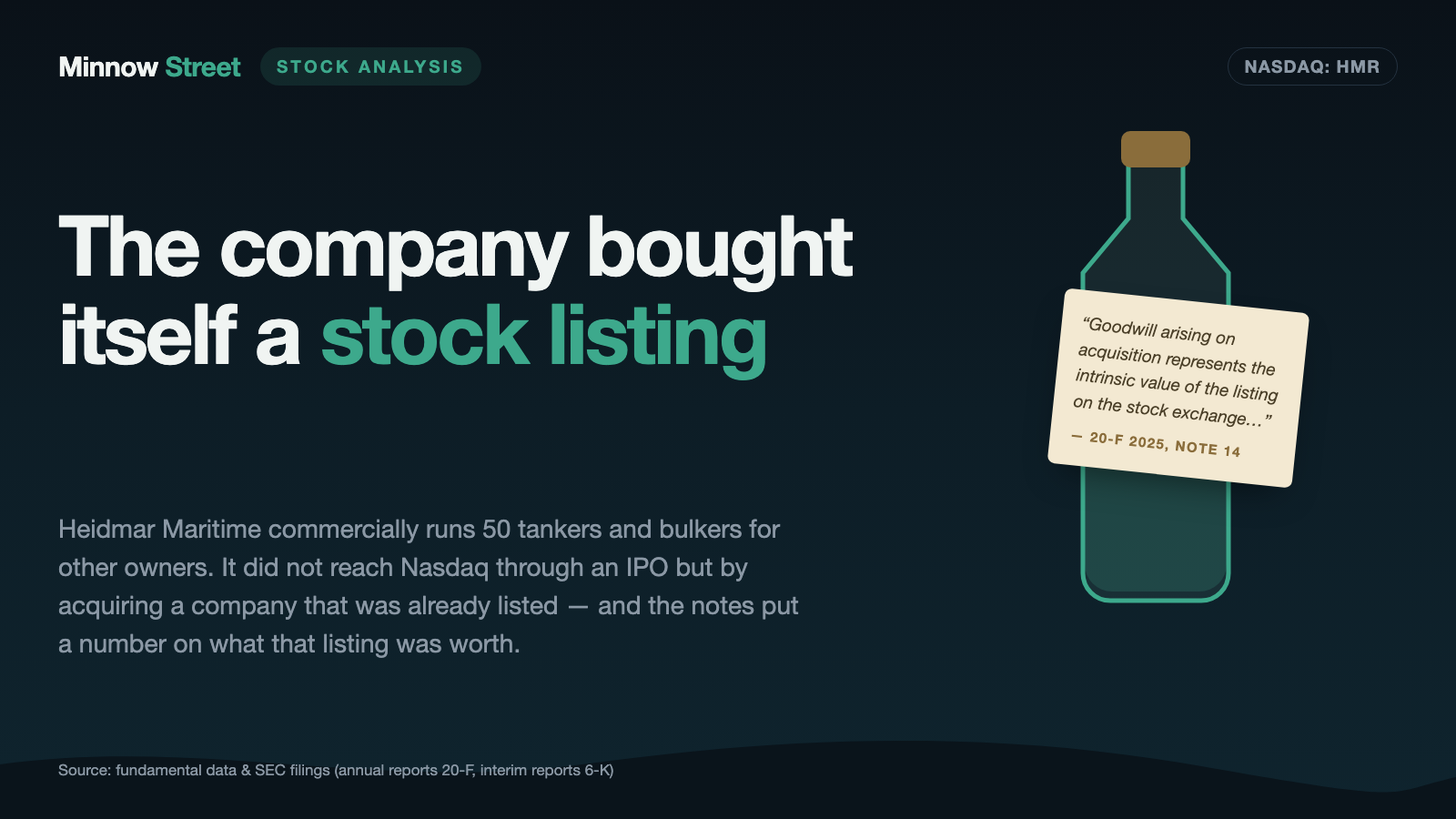
In October 2025 TaskUs was supposed to leave the stock market. Blackstone and the two co-founders offered $16.50 per share in cash — and public stockholders voted 10,064,296 against, 840,473 in favor. The agreement was terminated one day later, with no break fee owed by either side. Four months after that, the same board declared a special dividend of $3.65 per share: $332.8 million in total, $200.9 million of it to the Class B holders — Blackstone and the founders. It was paid for with a new $500.0 million term loan. Shareholders' equity fell from $600.0 million to $275.0 million in a single quarter, while the business itself grew 19 percent to $1,183.5 million in 2025. Not investment advice — just the question of what a vote is worth when the majority can reach the till without it.
 Thomas Mücke
Founder & Publisher
Thomas Mücke
Founder & Publisher
Chart
Interactive price chart (TradingView).
Note: pure fact-based analysis, not investment advice and not a solicitation to buy or sell. All figures without guarantee.
There is a feeling that feels exactly like justice: the no. Somebody makes you an offer you consider too low, you get to vote, you vote against it — and you win. That feeling has a name, and it is a trap: the illusion of control. It makes you believe power sits with whoever casts the ballot. In reality it sits with whoever controls the balance sheet. At TaskUs, Inc. (Nasdaq: TASK) you can study both in a single case, and all of it is on the public record. In October 2025 the public shareholders voted down a buyout at $16.50 per share — and won. Five months later the same company wired $332.8 million to its owners, two thirds of it to precisely the side that had wanted to buy. So let us make a deal: before you decide whether this is a bargain or a trap, we will read together what TaskUs itself reported to the U.S. securities regulator, the SEC — the annual report (10-K) for 2025, the quarterly report (10-Q) as of March 31, 2026, and the current reports (8-K) around the vote. Those documents are honest under penalty of law. What you make of them is your decision.
What TaskUs actually does — the invisible workforce behind the apps
TaskUs is an outsourcing provider. Here is the everyday picture: when you tap "help" inside a delivery app and somebody answers within minutes, that somebody most likely does not work for the app company. They work for a provider like TaskUs — in the Philippines, in India, in Colombia — inside the client\'s own systems, under the client\'s rules, with the client\'s logo in the chat window. As of December 31, 2025 the company counted roughly 65,500 employees across 31 sites in 13 countries, about 38,100 of them (58 percent) in the Philippines, serving roughly 200 clients in more than 30 languages.
The business stands on three legs, and the first-quarter 2026 report separates them cleanly:
- Digital Customer Experience (customer care, mostly written rather than by phone): $661.9 million of revenue in 2025, up 8 percent; $168.5 million in the first quarter of 2026, up 5 percent. The largest leg, and the slowest.
- Trust & Safety (content review, fraud prevention, policy enforcement on platforms): $307.4 million in 2025, up 24 percent; $75.8 million in the first quarter of 2026, up 5 percent. This is the work where people spend the day looking at what you are never supposed to see — the company runs a dedicated wellness and resiliency department for it and names the psychological burden as a risk factor.
- AI Services (data labeling, annotation, testing and evaluation of large language models): $214.2 million in 2025, up 59 percent; $61.9 million in the first quarter of 2026, up 36 percent. The fastest leg — and the one with the double role we will come back to.
One piece of corporate history matters for everything that follows: TaskUs was formed in 2018 by funds affiliated with Blackstone Inc. as an acquisition vehicle and was named TU TopCo, Inc. before the IPO. The Class A shares listed on the Nasdaq on June 11, 2021 — the rest of the company stayed where it was. That is exactly where the central tension of this analysis comes from, and it runs through every chapter: public shareholders own roughly 40 percent of the economics and roughly 3 percent of the votes. When both sides want the same thing, nobody notices the difference. When they do not, only one side notices.
How this stock landed on our desk
Not through a ratio screen. TaskUs reached our list through the Reddit hype scan of July 30, 2026 — our observation of which U.S. tickers are mentioned unusually often in retail investor forums. At the time of writing, the stock was new to our universe and appeared in none of the lists produced by our in-house stock scanner (as of July 30, 2026); those lists are recalculated daily, so the finding can change. If you want to replicate how we work, the scanner lists live at our stock scanner and the company itself at the TaskUs stock profile.
What stopped us while reading was not a price but a filing dated October 9, 2025. It is four paragraphs long and contains the sentence everything else turns on:
"At the Special Meeting, the requisite Company stockholders did not approve the Merger Agreement Proposal. As a result, on October 9, 2025, the Merger Corporation and the Company entered into a mutual agreement to terminate the Merger Agreement, effective immediately (the “Termination Agreement”)."
— TaskUs, Inc., SEC current report 8-K dated October 9, 2025, Item 1.02

Now the numbers behind it, because they are the real finding. The offer of May 8, 2025 came from a purpose-built entity, Breeze Merger Corporation, behind which stood Blackstone\'s BCP FC Aggregator L.P. together with co-founders Bryce Maddock and Jaspar Weir and their family trusts. The price was $16.50 per share in cash. For the merger to close, four separate approval thresholds had to be met at once — including one that exists precisely for cases like this: a majority of the votes cast by the public stockholders. The results:
- Public stockholders: 840,473 votes in favor against 10,064,296 votes opposed and 495,668 abstentions. Roughly twelve to one.
- Class A as a separate class: 16,936,145 votes in favor — against 34,843,287 eligible Class A shares, the required majority of 17,421,644 was narrowly missed.
- Class B as a separate class: 550,326,940 votes in favor, zero against. Unanimous.
Two of four thresholds failed. The next day the agreement was history, and no side owed the other a cent. Remember this image: the minority did not win because it was strong. It won because a contract gave it a veto for exactly one evening.
The numbers over the years — honestly appraised
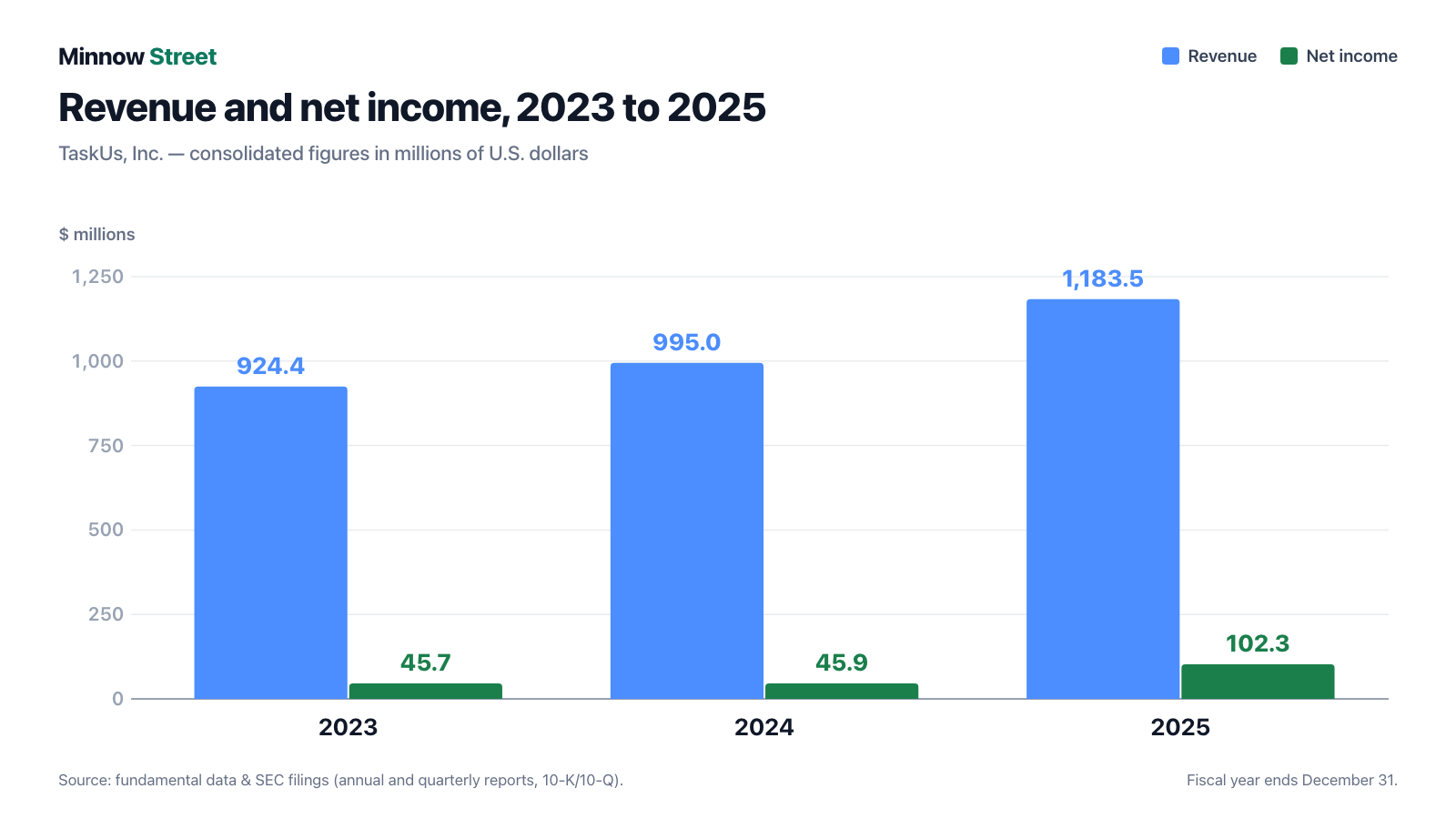
First what genuinely impresses, and there is more of it than the share price suggests. TaskUs is profitable, and increasingly so. Revenue climbed from $924.4 million in 2023 to $995.0 million in 2024 and $1,183.5 million in 2025 — up 19 percent in the last year after 8 percent the year before. Net income rose from $45.7 million (2023) and $45.9 million (2024) to $102.3 million (2025), more than a doubling. Net margin went from 4.6 to 8.6 percent. Operating income grew 52 percent to $140.6 million.
Cash follows the profit. In 2025 the business generated $137.2 million of operating cash flow; after $63.5 million of capital spending, $73.7 million of free cash flow remained (2024: $99.8 million on lower capex). Adjusted EBITDA — the company\'s own rough proxy for operating cash earnings — came to $249.1 million in 2025, a margin of 21.0 percent.
The first quarter of 2026 did not break the trend, but it did soften it: $306.3 million of revenue (up 10 percent), $24.3 million of net income (up 15 percent), $46.3 million of operating cash flow. Adjusted EBITDA slipped slightly to $58.6 million from $59.3 million a year earlier, and the margin fell from 21.3 to 19.1 percent. The growth engine is running, but it is getting more expensive: cost of services rose 15.5 percent in the quarter, faster than revenue.
One more figure, because it misleads without context: the 19 percent growth of 2025 did not come from the core. Digital Customer Experience, the largest leg, added only 8 percent. The acceleration came from Trust & Safety (up 24 percent) and above all AI Services (up 59 percent), both driven by social media clients. Anyone who treats this company as a plain call-center operator is measuring the wrong business.
What the filings say — four uncomfortable truths
Uncomfortable truth no. 1: two parties hold 96.9 percent of the votes
TaskUs has two share classes. The Class A trades on the Nasdaq and carries one vote per share. The Class B is unlisted and carries ten votes per share. An everyday picture: imagine a homeowners\' meeting where the ground-floor owners get one vote each and the two penthouse owners get ten each — same apartment size, same share of the costs. The annual report states the outcome without varnish:
"Our Sponsor and our Co-Founders beneficially owned approximately 96.9% of the combined voting power of our Class A common stock and Class B common stock as of December 31, 2025."
— TaskUs, Inc., SEC annual report 10-K for 2025, Item 1A "Risk Factors"
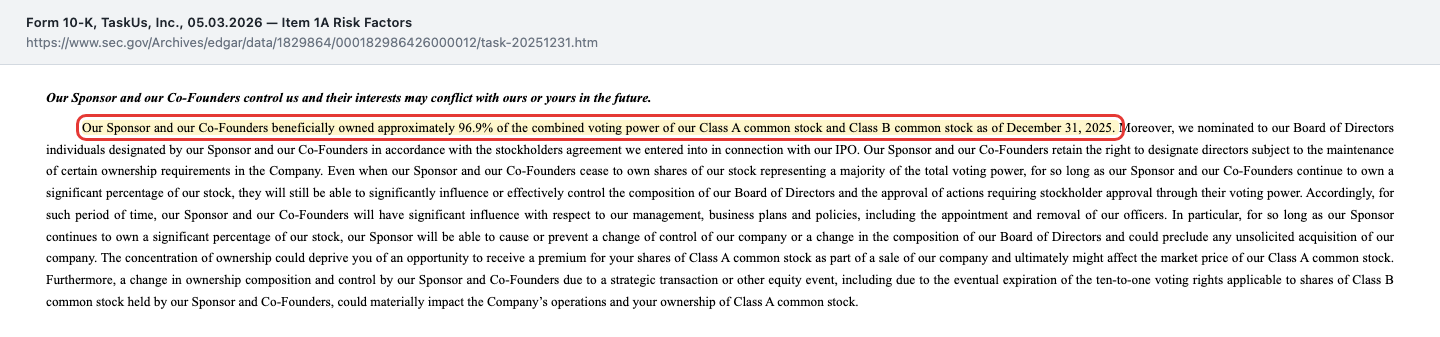
The report goes further and spells out what that concentration means for the stock: it "could deprive you of an opportunity to receive a premium for your shares of Class A common stock as part of a sale of our company". That sentence was tested in 2025 — only in the opposite direction from the one intended. One thing matters for the future: the ten-vote shares are not permanent. Under the charter, every Class B share converts into a Class A share no later than June 10, 2028, seven years after the IPO. Until then, a control transaction is considerably easier for the majority to arrange than it will be afterwards.
Uncomfortable truth no. 2: $332.8 million went out — and came back as debt
On February 25, 2026, four months after the lost vote, the board declared a special dividend. The notes to the quarterly report record it plainly:
"On February 25, 2026, the Board of Directors declared a special cash dividend of $3.65 per share of outstanding Class A and Class B common stock (the “Special Dividend”). On March 25, 2026, the Company paid, in aggregate, $131.9 million and $200.9 million to shareholders of outstanding Class A and Class B commons stock, respectively."
— TaskUs, Inc., SEC quarterly report 10-Q as of March 31, 2026, Note 2(e) "Dividends"

The payout did not come from cash alone. On March 11, 2026 — two weeks before the payment date — TaskUs signed a new credit agreement: a $500.0 million term loan maturing March 11, 2031, plus an undrawn $100.0 million revolving facility. The filing says what the money was for: repay the old facilities, pay the related fees — and fund the special dividend. The interest rate stood at 6.412 percent per annum as of March 31, 2026; quarterly amortization of 1.25 percent of the original principal starts in the third quarter of 2026.
What that did to the balance sheet is best seen as a staircase:
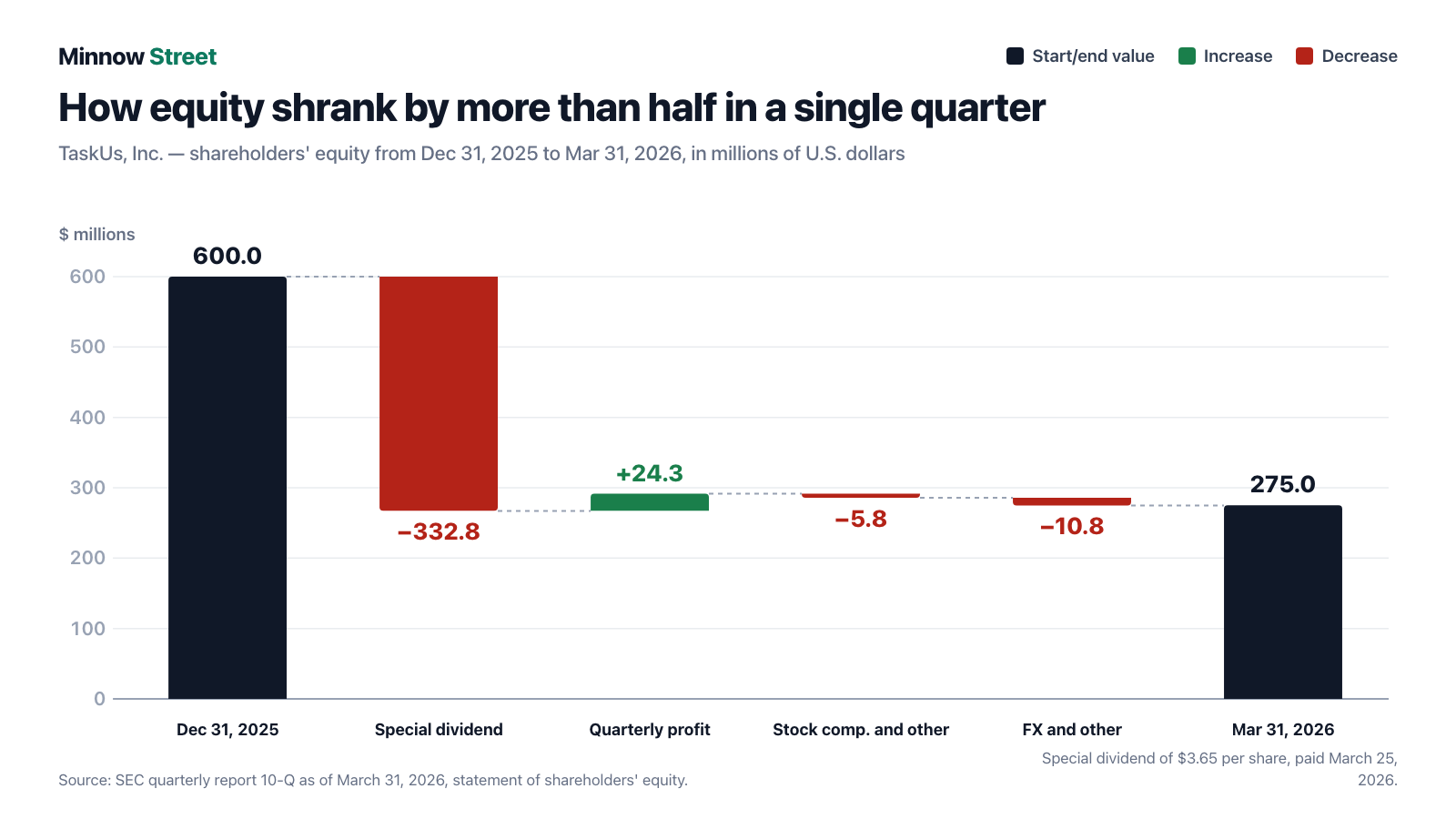
In numbers: equity fell from $600.0 million to $275.0 million, total debt rose from $241.4 million to $491.6 million, and cash dropped from $211.7 million to $152.3 million. Roughly $30 million of net debt became roughly $339 million. Total assets shrank from $1,050.8 million to $981.6 million.
Is that dangerous? Honestly: no, not today. Measured against trailing twelve-month adjusted EBITDA of roughly $248 million, net debt sits at about 1.4 times — an ordinary level for a services business with steady cash generation. Annual interest of roughly $32 million is covered more than four times by 2025 operating income of $140.6 million, and the company reports compliance with all covenants as of March 31, 2026. But the cushion is gone: anyone who wants to fund a downturn, an acquisition or a buyback from here does so from a much thinner balance sheet. And a rule that outlives this one company: a special dividend is not a gift, it is a transfer. What lands in shareholders\' accounts today is missing inside the company tomorrow — and it carries interest.
Uncomfortable truth no. 3: one client brings a quarter of the revenue — and is automating right now
Customer concentration is the technical term; the everyday picture is a contractor for whom a single customer writes every fourth invoice. If that customer leaves, it is not a dent, it is a leg. At TaskUs the numbers look like this: the largest client — named outright as Meta in the annual report — accounted for 26 percent of revenue in 2025 (2024: 22 percent). The ten largest clients together made up 58 percent, the twenty largest 71 percent. In the quarterly report as of March 31, 2026 the same client is called only "Client A" and stands at 24 percent.
That alone would be a familiar risk. What makes it notable is what management writes in the same report about what this client intends to do:
"Certain of our clients, including our largest client, have announced automation initiatives which include significant investments in generative AI. In some cases, TaskUs is supporting these initiatives, which may lead to revenue growth in the near term but may ultimately result in the automation of some services that TaskUs currently provides for these clients."
— TaskUs, Inc., SEC annual report 10-K for 2025, Item 7 "2025 Developments: AI Investments"

That is the most honest passage in the entire report, and the most uncomfortable. Through AI Services ($214.2 million of revenue in 2025), TaskUs sells exactly the groundwork from which the systems emerge that may later take over its own customer care contracts. In the short run the AI wave pays the invoices; in the long run it can cancel them. We have described this pattern once before, at a direct competitor: TTEC Holdings sells the technology that shrinks its own business — the difference is that TaskUs is still growing while TTEC is shrinking.
Uncomfortable truth no. 4: the share count you see is not the company\'s share count
Look TaskUs up in most data services and you will find 36,545,511 shares outstanding. That is correct — and it is only the Class A. The cover page of the quarterly report as of March 31, 2026 carries both numbers: 36,545,511 Class A shares and 55,032,694 Class B shares as of May 1, 2026, together 91,578,205 shares. Use the Class A alone and you understate market capitalization, enterprise value and every ratio derived from them by roughly 60 percent. The company itself uses both: first-quarter 2026 earnings per share are based on 90,792,750 basic and 93,094,002 diluted shares.
Two more numbers from the same part of the balance sheet belong here. First, TaskUs holds 15,436,224 treasury shares acquired for $189.3 million — $12.26 apiece. Second, 2,500,000,000 Class A shares are authorized under the charter, of which 51,950,389 have been issued. That is not an acute dilution risk, but it explains why ratio comparisons for this company so often go wrong.
And one leadership finding worth knowing: the chief financial officer changed twice in 2026. Balaji Sekar gave notice on February 20, 2026, effective March 31, 2026; Trent Thrash served on an interim basis; since June 19, 2026 the CFO has been Rishabh Khemka. At the annual meeting on May 21, 2026 the board was reduced from nine to eight members, KPMG was ratified as auditor for 2026 — and Blackstone used its contractual designation right to swap Amit Dixit for Amit Dalmia. A company in motion, but with no dispute on the record: all three filings state expressly that no disagreement was involved.
Valuation — what the market charges for this package
A word on method first, because it decides the outcome here: we use all 91,578,205 shares across both classes. On that basis TaskUs cost roughly $570 million in late July 2026 (data as of July 29, 2026). Against that stand $1,212.0 million of revenue and $105.5 million of net income over the trailing twelve months (second quarter of 2025 through first quarter of 2026). As orders of magnitude, that gives:
- Price/sales of roughly 0.5 — the market pays about 50 cents for a dollar of annual revenue.
- Price/earnings of roughly 5 — at an unchanged profit, the purchase price would be earned back in a little over five years.
- Enterprise value (market capitalization plus debt minus cash) of roughly $910 million, or about 0.75 times annual revenue and about 3.7 times adjusted EBITDA.
That is cheap — and it is the market\'s answer to precisely the four truths above. One comparison makes the tension tangible: the $16.50 per share offered in May 2025 valued the whole company at roughly $1.5 billion. Anyone who voted no back then held, in late July 2026, a share worth roughly $10 including the $3.65 special dividend received (data as of July 29, 2026). That does not prove the no was wrong — it is the price a no can carry.
The professionals\' view fits the picture, without enthusiasm: six firms cover the stock, one with a buy rating and five with holds, average price target $9.50 (data as of July 29, 2026). A consensus that roughly says the business is worth more than the price, but nobody wants to stake their reputation on it. For a look at how a controlling owner can also handle this: at Utz Brands the public shareholders received a 91 percent premium while the founding family stayed on board — the same basic setup, the opposite outcome.
Opportunities and risks at a glance
What speaks for TaskUs:
- The business grows and earns: $1,183.5 million of revenue in 2025 (up 19 percent), $102.3 million of net income, an 8.6 percent net margin — plus $306.3 million of revenue in the first quarter of 2026 (up 10 percent).
- The fastest service line is the most future-facing one: AI Services grew 59 percent to $214.2 million in 2025 and 36 percent to $61.9 million in the first quarter of 2026.
- The cash is real: $137.2 million of operating cash flow in 2025, $46.3 million in the first quarter of 2026 alone.
- The valuation is low: roughly 0.5 times annual revenue and roughly 5 times trailing twelve-month earnings (data as of July 29, 2026).
- The debt load is manageable: net debt of about 1.4 times adjusted EBITDA, with all covenants met as of March 31, 2026.
What speaks against it:
- Blackstone and the co-founders held roughly 96.9 percent of the votes as of December 31, 2025. Minority shareholders decide only where a contract expressly gives them a say.
- The special dividend halved shareholders\' equity in one quarter, from $600.0 million to $275.0 million, and more than doubled debt to $491.6 million at 6.412 percent interest.
- One client accounted for 26 percent of 2025 revenue and 24 percent in the first quarter of 2026; the ten largest clients stand for 58 percent.
- That same largest client is investing in generative AI that may replace TaskUs services — the company itself states there is no assurance revenue will continue at the same level.
- Margins are under pressure: adjusted EBITDA margin fell from 21.3 to 19.1 percent in the first quarter of 2026 while cost of services rose 15.5 percent.
- The chief financial officer changed twice in 2026; the permanent appointment dates only from June 19, 2026.
A human conclusion
Back to the illusion of control. In October 2025 the public shareholders of TaskUs pulled off something that almost never works: they stopped a buyout by their own controlling owner, roughly twelve to one, and it cost them nothing. That was a genuine victory — and a victory with very precisely limited reach. Because what happened next needed no vote from them at all: a special dividend no shareholder has to approve, funded by a loan no shareholder has to sign off on, paid out 60 percent to the side that had wanted to buy. Whoever holds a vote decides on proposals. Whoever holds the balance sheet decides on money.
So this is not a story about good and evil, it is a question about the price tag. Underneath all the governance weather sits a company that grew 19 percent in 2025, earned $102.3 million and is available for roughly five times that profit. At the same time a quarter of its revenue hangs on a client who openly says it intends to automate parts of that work — and the company itself sells the groundwork for it. Both facts sit in the same filings, both are documented, and neither cancels the other.
You have now read both sides with the original documents on the table: the vote, the credit agreement, the statement of shareholders\' equity, the concentration table. What you make of it is your decision. And that is exactly as it should be.
Sources
- TaskUs, Inc. — SEC quarterly report 10-Q as of March 31, 2026 (filed May 7, 2026): balance sheet, income statement, statement of shareholders\' equity, cash flow statement, Note 2(d) concentration risk, Note 2(e) dividends, Note 7 long-term debt, Note 10 stock-based compensation, Note 12 earnings per share.
- TaskUs, Inc. — SEC annual report 10-K for 2025 (March 5, 2026): Item 1 business and service lines, Item 1A risk factors (voting rights, customer concentration, AI), Item 7 management\'s discussion and "2025 Developments", charter note on voting and conversion rights.
- TaskUs, Inc. — SEC annual report 10-K for 2024 (March 6, 2025): comparative figures for 2023 and 2024.
- SEC current report 8-K dated May 9, 2025, Item 1.01: merger agreement with Breeze Merger Corporation, consideration of $16.50 per share in cash.
- SEC current report 8-K dated October 8, 2025, Item 5.07: special meeting vote results, all four approval thresholds in detail.
- SEC current report 8-K dated October 9, 2025, Item 1.02: termination of the merger agreement, no break fee payable by either party.
- SEC current report 8-K dated February 25, 2026, Item 5.02: resignation of CFO Balaji Sekar effective March 31, 2026, interim arrangement.
- SEC current report 8-K dated May 26, 2026, Item 5.07: results of the May 21, 2026 annual meeting, ratification of KPMG as auditor.
- SEC current report 8-K dated June 22, 2026, Item 5.02: appointment of Rishabh Khemka as chief financial officer effective June 19, 2026.
- SEC XBRL company concept series for CIK 0001829864 (net income 2019 through 2025) and fundamental data for market capitalization, ratios and analyst coverage (data as of July 29, 2026).
This analysis is a journalistic contextualization of publicly available information and is not investment advice. It is neither a solicitation to buy nor to sell securities. Stocks can lose substantial value; a total loss of invested capital is possible. All figures come from the original documents linked above and carry the as-of date of their respective report. The author holds no position in TaskUs, Inc. at the time of publication.
Our Bottom Line at a Glance
- Business performance positive
- Revenue rose 19 percent to $1,183.5 million in 2025 and net income more than doubled to $102.3 million, lifting the net margin from 4.6 to 8.6 percent. Operating cash flow came to $137.2 million. The first quarter of 2026 added $306.3 million of revenue (up 10 percent) and $24.3 million of profit. The growth is carried by Trust & Safety (up 24 percent) and AI Services (up 59 percent), not by the largest but slowest leg, Digital Customer Experience (up 8 percent).
- Balance sheet after the special dividend negative
- The $332.8 million payout on March 25, 2026 halved shareholders' equity in a single quarter, from $600.0 million to $275.0 million; debt rose from $241.4 million to $491.6 million and cash fell from $211.7 million to $152.3 million. It is serviceable — net debt of roughly 1.4 times adjusted EBITDA, all covenants met as of March 31, 2026 — but the cushion for a bad year is gone, and the 6.412 percent interest rate runs until 2031.
- Client concentration and AI negative
- The largest client accounted for 26 percent of 2025 revenue (2024: 22 percent) and the ten largest for 58 percent; in the first quarter of 2026 the largest client stood at 24 percent. The same annual report states that clients, expressly including the largest, are investing in generative AI that may replace TaskUs services, and that there is no assurance revenue will continue at the same level. In the short run that same AI wave pays the bills through AI Services ($214.2 million in 2025).
- Control and minority rights negative
- Blackstone and the two co-founders held roughly 96.9 percent of the voting power as of December 31, 2025 while owning roughly 60 percent of the shares, because each Class B share carries ten votes. The no vote of October 8, 2025 was only possible because the merger agreement required a separate majority of the public stockholders. The special dividend four months later needed no such hurdle. The ten-to-one voting rights expire no later than June 10, 2028.
- Price tag positive
- Across all 91,578,205 shares the company cost roughly $570 million in late July 2026 (data as of July 29, 2026) — about 0.5 times revenue and about 5 times trailing twelve-month earnings ($1,212.0 million and $105.5 million respectively). The May 2025 offer of $16.50 per share valued the whole company at roughly $1.5 billion. Six analyst firms rate the stock once buy and five times hold, with an average price target of $9.50.
TaskUs is the illusion of control in its purest form: on October 8, 2025 the public shareholders stopped a buyout by Blackstone and the two co-founders at $16.50 per share, voting 10,064,296 against 840,473, with no break fee owed by either side. Four months later the same board declared a special dividend of $3.65 per share, $332.8 million in total, $200.9 million of it to the Class B side; it was paid for with a new $500.0 million term loan at 6.412 percent. Shareholders' equity fell from $600.0 million to $275.0 million. Underneath all of that works a company that grew 19 percent to $1,183.5 million in 2025 and earned $102.3 million — with one client contributing a quarter of revenue and openly planning to automate parts of that work. Not investment advice.
What Our Rating Means
Open questions
The business works in principle, but one material question is open. As long as it stays open, our findings do not carry a quality verdict.
Yellow here stands for a business that demonstrably works and for two open questions it cannot answer on its own. What is documented: $1,183.5 million of 2025 revenue at 19 percent growth, $102.3 million of net income, $137.2 million of operating cash flow, no going-concern warning, no covenant breach, a clean audit opinion and a debt load covered more than four times by operating income. What is open: first, 26 percent of 2025 revenue hangs on a client that, per the same annual report, is investing in generative AI capable of replacing TaskUs services — and that client was already down to 24 percent in the first quarter of 2026. Second, the special dividend of March 25, 2026 halved equity from $600.0 million to $275.0 million in one quarter and more than doubled debt to $491.6 million; that is serviceable, but it removes the room to maneuver in the next weak year. On price, which explicitly does not set the traffic light: roughly five times annual earnings is little for a growing, profitable business — and the market does not demand that discount without reason, because the use of the money is decided by a side that holds 96.9 percent of the votes and has already shown how it does that. The decision is yours.
A journalistic assessment by our editorial team at the time of the deep dive, based on public sources — not investment advice and not a solicitation to buy or sell. Your personal circumstances (investment goals, risk capacity, taxes) cannot be taken into account. What our levels mean, how verdicts are formed, and what conflicts of interest exist →
Worth Noting
- TaskUs reached our list through the Reddit hype scan of July 30, 2026, not through a ratio or momentum screen. At the time of writing the stock was new to our universe and appeared in none of the lists produced by our in-house stock scanner (as of July 30, 2026); those lists are recalculated daily.
- Share count and market capitalization are the main source of error at this company: many data services list only the 36,545,511 publicly traded Class A shares. Both classes matter — together 91,578,205 shares per the cover page of the quarterly report as of March 31, 2026 (as of May 1, 2026). Every valuation figure in this analysis uses the total; the cross-check via price/sales, price/book and price/earnings ratios produces the same share price.
- Every point-in-time figure — cash, debt, equity, interest rate, management, share count — comes from the most recent document that states it: the quarterly report 10-Q as of March 31, 2026 and the current reports 8-K through June 22, 2026. Valuation figures are dated and deliberately kept as orders of magnitude; analyses are evergreen, daily prices are not a buy argument.
Frequently Asked Questions
Because the public shareholders voted it down. On October 8, 2025, the proposal missed two of four required approvals: among public stockholders, 840,473 votes were cast in favor against 10,064,296 opposed, and Class A holders voting as a separate class delivered 16,936,145 votes in favor against 34,843,287 eligible shares. On October 9, 2025, both sides terminated the agreement by mutual consent, with no break fee.
The board declared it on February 25, 2026 and it was paid on March 25, 2026: $332.8 million in total, of which $131.9 million went to Class A holders and $200.9 million to Class B holders. It was funded through a $500.0 million term loan signed on March 11, 2026 at an interest rate of 6.412 percent as of March 31, 2026.
The capital sits in two classes: 36,545,511 Class A shares (listed, one vote each) and 55,032,694 Class B shares (unlisted, ten votes each) as of May 1, 2026. Blackstone and co-founders Bryce Maddock and Jaspar Weir held roughly 96.9 percent of the combined voting power as of December 31, 2025. Under the charter, the ten-to-one voting rights expire no later than June 10, 2028.
TaskUs provides outsourced digital services to roughly 200 clients — customer care mostly over chat and email (Digital Customer Experience, $661.9 million of 2025 revenue), platform content review and fraud prevention (Trust & Safety, $307.4 million) and data labeling and large language model testing (AI Services, $214.2 million). As of December 31, 2025 roughly 65,500 people worked across 31 sites in 13 countries.
Very. The largest client, named as Meta in the 2025 annual report, generated 26 percent of annual revenue (2024: 22 percent). The ten largest clients accounted for 58 percent and the twenty largest for 71 percent. In the first quarter of 2026 the largest client stood at 24 percent of quarterly revenue, and its share of outstanding receivables fell from 19 to 11 percent.
The company says so itself. The 2025 annual report states that clients, expressly including the largest client, have announced automation initiatives with significant investments in generative AI that may ultimately replace services TaskUs performs today. At the same time TaskUs earns from that same wave: the AI Services line grew 59 percent to $214.2 million in 2025.
Because many data services list only the publicly traded Class A. The cover page of the quarterly report as of March 31, 2026 gives both classes: 36,545,511 Class A and 55,032,694 Class B shares as of May 1, 2026, together 91,578,205. Using Class A alone understates market capitalization and enterprise value by roughly 60 percent. The company's own earnings per share calculation uses 90,792,750 basic shares.
As of March 31, 2026, $491.6 million of debt stood against $152.3 million of cash, and shareholders' equity was $275.0 million (December 31, 2025: $600.0 million). The $500.0 million term loan matures on March 11, 2031, alongside an undrawn $100.0 million revolving facility. The company reports compliance with all covenants as of March 31, 2026.
Found an error?
Did you spot a factual error, an outdated number, or a typo in this deep dive? Let us know briefly — your report goes straight to the editorial team.