A2Z Cust2Mate: $166 Million Announced, $9.7 Million Earned — and One Paying Customer
The shopping cart built by A2Z Cust2Mate (Nasdaq: AZ) weighs, scans, takes payment and shows ads — and the press releases read like a directory of Israeli retail: Yochananof, Carrefour, HaStock, Toys "R" Us, plus Trixo in Mexico and Migros in Turkey. Roughly $166 million in announced order value all together. The mandatory filings to the U.S. securities regulator, the SEC, carry the other half: $7.901 million in 2025 revenue, a $38.484 million annual loss, $20.357 million for stock-based pay alone — and through March 31, 2026 the smart-cart revenue came from exactly one customer. Not investment advice — just the question of how many carts actually have to roll before fourteen names turn into a business.
 Thomas Mücke
Founder & Publisher
Thomas Mücke
Founder & Publisher
Chart
Interactive price chart (TradingView).
Note: pure fact-based analysis, not investment advice and not a solicitation to buy or sell. All figures without guarantee.
There is an investor trap that arrives looking friendly, because it looks like homework: the announcement trap. It works like this — you read a headline ("framework agreement worth $50 million"), your mind files the number under "revenue," and from then on it keeps counting with it. By the fifth headline you are carrying around a company with hundreds of millions in sales, even though nothing has landed in the bank account yet. A2Z Cust2Mate Solutions Corp. (Nasdaq: AZ) sits squarely in that trap. Between June 2025 and April 2026 the company announced orders and framework agreements worth roughly $166 million in total — Yochananof, Carrefour Israel, HaStock, Toys "R" Us Israel, Trixo in Mexico, plus Migros in Turkey. So let us make a deal: we leave the press releases alone and read only what A2Z reported, under penalty of law, to the U.S. securities regulator, the SEC — the annual report of a foreign private issuer (Form 20-F) for 2025 filed April 1, 2026, the interim report (Form 6-K) as of March 31, 2026 filed May 15, 2026, and everything that came after. What you make of it is up to you.
What A2Z Cust2Mate actually does — a shopping cart with a checkout and an ad screen
The product is pleasantly easy to picture. A smart cart is a shopping cart with a scale, a barcode scanner, a large touchscreen and a payment terminal built in. You drop in the milk, the cart recognizes it, adds it to the bill, keeps a running total, and at the end you pay at the cart instead of at the register. For the retailer that means fewer checkout staff, shorter lines, less shrinkage — and, this is the real plan, a screen right next to the purchase decision. That advertising business is what A2Z has called its Retail Media Division since September 2025, the second growth engine.
Behind the product sits an unusual map. The parent was incorporated on January 15, 2018 in British Columbia, Canada, as ECC Ventures 1 Corp., was renamed A2Z Smart Technologies Corp. on July 20, 2020, and has carried its present name, A2Z Cust2Mate Solutions Corp., only since August 12, 2024 — so a data sheet still showing the old name is not a different company, just a stale line. Operations sit in Israel, in the Shahar Tower in Givatayim: the subsidiary Cust2Mate Ltd. (A2Z holds 96.58 percent) builds the carts, the subsidiary Isramat Ltd. manufactures precision metal parts. As of the date of the annual report, 122 people worked there, 119 of them in Israel — 81 at Cust2Mate, 38 at Isramat. The stock has traded on Nasdaq since January 22, 2022; the secondary listing on the TSX Venture Exchange in Toronto was voluntarily dropped on February 28, 2024. Because A2Z qualifies as a foreign private issuer, there is no quarterly report (10-Q) here, but an annual report (20-F) and interim reports (6-K). That is not a defect, just a different filing cabinet.
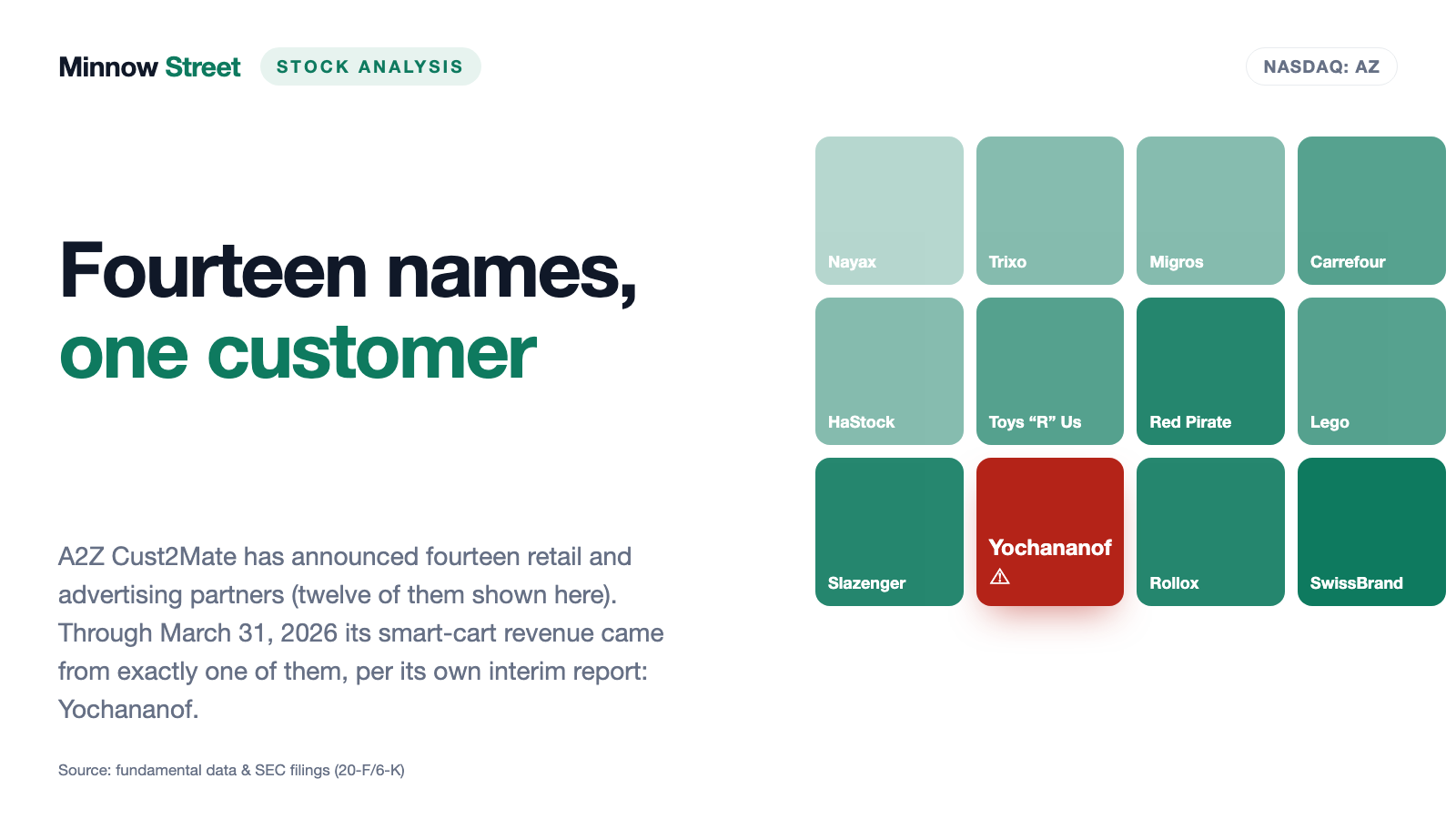
How full the shop window has become shows up in a simple list. The filings through July 14, 2026 name fourteen retail and advertising partners: the retail chains Yochananof, Carrefour Israel, HaStock and Migros Ticaret (Turkey), the toy retailers Toys “R” Us Israel and The Red Pirate, the technology integrator Trixo for Mexico and Central America, the payments provider Nayax for a first deployment in France (announced September 10, 2024, followed on September 25, 2024 by a financing framework with Nayax Capital), plus the advertisers Lego (October 1, 2025) and — with the announcement of May 9, 2026 — Under Armour, Santa Barbara Polo Club, Slazenger, Rollox and SwissBrand. Fourteen names, then — and alongside them, and this is the finding of this analysis, exactly one customer through March 31, 2026 from whom the smart-cart revenue comes.
Which names the central tension of this analysis, and it runs through every chapter: demand for the product is asserted in framework agreements worth $166 million — but through March 31, 2026 exactly one customer in exactly one country had paid for it.
How the stock reached our desk — and what our scanners say about it
A2Z Cust2Mate landed on the research list through the Reddit hype scan of July 30, 2026, that is, through chatter volume in investor forums, not through a metric. We queried our own data set on the same day: the stock sits in none of our regular scanner lists — not in a momentum, quality or value filter (live query in our in-house stock scanner, as of July 30, 2026; the lists are recalculated daily, so the finding can change). That is not a footnote but the honest starting point: there is no numerical hook here that a filter would have found. What makes A2Z interesting is the gap between the story and the bookkeeping — and you only find that by reading.
The metrics from fundamental data (as of July 30, 2026) say the following, translated and rated: the Piotroski F-Score, a nine-point test for the health of the books, stands at 4 of 9 — that is weak; genuinely healthy companies sit at 8 or 9. The equity ratio of roughly 89 percent, by contrast, is excellent ($68.646 million of equity against $76.821 million of total assets, March 31, 2026), as is the debt-to-equity ratio of about 0.01: A2Z has almost no bank debt. Analysts? Exactly one has an opinion on file. Remember the image: hardly anyone here is checking the work, so you have to read it yourself.
The numbers over the years — honestly appraised
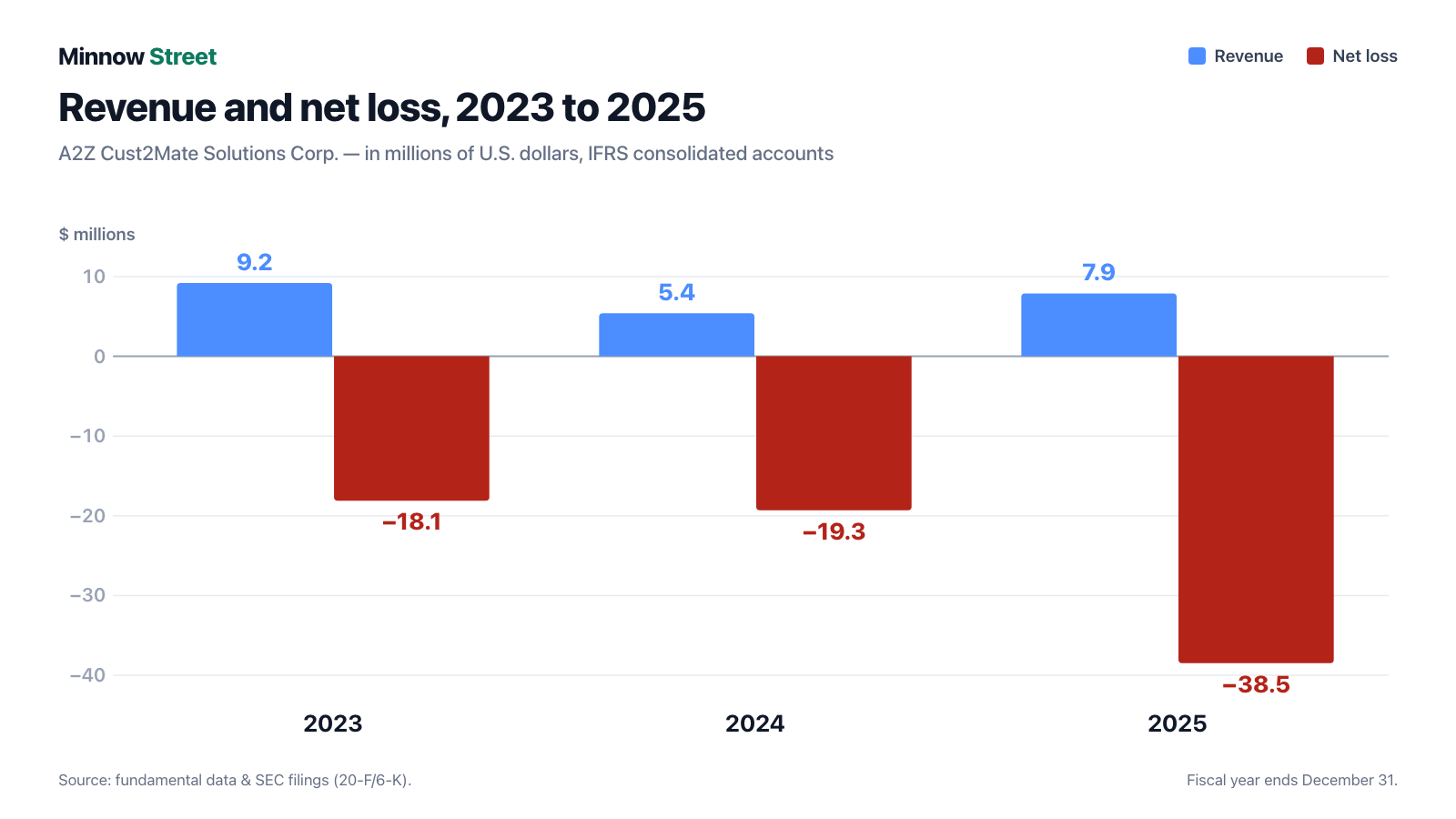
First what genuinely speaks for A2Z, because it is more than the loss line suggests. Revenue is growing again: $7.901 million in 2025 after $5.376 million in 2024 — up 47 percent. In the first quarter of 2026 it was $3.317 million against $1.547 million in the year-earlier quarter, more than a doubling. And the shift inside is real: the smart-cart segment delivered $2.450 million in the first quarter of 2026, after $194 thousand a year earlier. For context, the starting point: in 2023 the segment had booked $6.128 million, then fell to $532 thousand in 2024 because the first Yochananof order had been delivered and the new cart generation was only ramping. So the business is not new — it is coming back.
And the balance sheet is remarkably robust for a company this size. As of March 31, 2026 the books showed $16.208 million of cash, plus $40.664 million in short-term securities (mutual funds and bonds yielding 3.70 to 4.35 percent, held explicitly for capital preservation) and $473 thousand of short-term deposits — roughly $57.3 million of liquidity all together. Against that: $8.175 million of total liabilities, of which $6.611 million is current. Working capital, meaning what is left of current assets after all current liabilities, stands at $63.288 million. The auditor, BDO Ziv Haft of Tel Aviv (PCAOB number 1185, in office since 2017), signed off on the 2025 accounts without qualification and without a going-concern paragraph. If you are looking for the safety line at a small company with $7.9 million of revenue: it is here, and it is real.
So much for the good half. Now the other one.
What the filings say — the uncomfortable truths
Uncomfortable truth no. 1: All of the smart-cart revenue comes from a single customer — in a single country
The segment table in the annual report carries a footnote worth reading twice:
"Revenues from the smart cart segment are generated from one customer, and account for 41%, 10%, and 67% of the Company's revenues for the years ended December 31, 2025, 2024, and 2023. Revenues from the precision metal parts segment are generated from dozens of customers, and account for 59%, 90%, and 33% of the Company's revenues for the years ended December 31, 2025, 2024, and 2023."
— A2Z Cust2Mate Solutions Corp., SEC annual report 20-F for 2025, segment disclosure (Item 4)

The line directly above the highlighted paragraph reads: "All revenues are generated in the state of Israel." — the entire 2025 consolidated revenue was earned in Israel. And in the MD&A for the first quarter of 2026 the sentence stands unchanged in the present tense: "While revenues from the smart cart division are currently derived from only one customer, revenues from the Company's precision metal parts segments are derived from hundreds of customers." Put in everyday terms: picture a baker whose display window is covered in purchase orders from big chains — but every loaf sold so far has gone to the same neighbor, on the same street. The neighbor is a good customer. He is also exactly one. That customer is Yochananof, a large Israeli supermarket chain, which on September 3, 2025 was announced as placing an order worth $55 million for 5,000 carts, billed through an upfront payment and monthly charges over at least 60 months. Remember the pattern: a reference customer is an opportunity. A single customer is a risk — even when it is the same one.
Uncomfortable truth no. 2: In 2025 stock-based pay cost 2.6 times revenue
The 2025 annual loss of $38.484 million looks like a company in deep trouble. The cash flow statement explains where more than half of it comes from: $20.357 million of share-based compensation — payment in shares and options instead of cash (2024: $1.913 million plus $1.286 million to service providers; 2023: $5.324 million). General and administrative expense alone jumped from $7.948 million to $23.749 million, $13.550 million of which was share-based compensation; research and development carried another $4.154 million. The report names the reason itself: the grants were made "in recognition of management achievements during 2025, including two successful financing and the launch of the model 3.0 smart-cart."
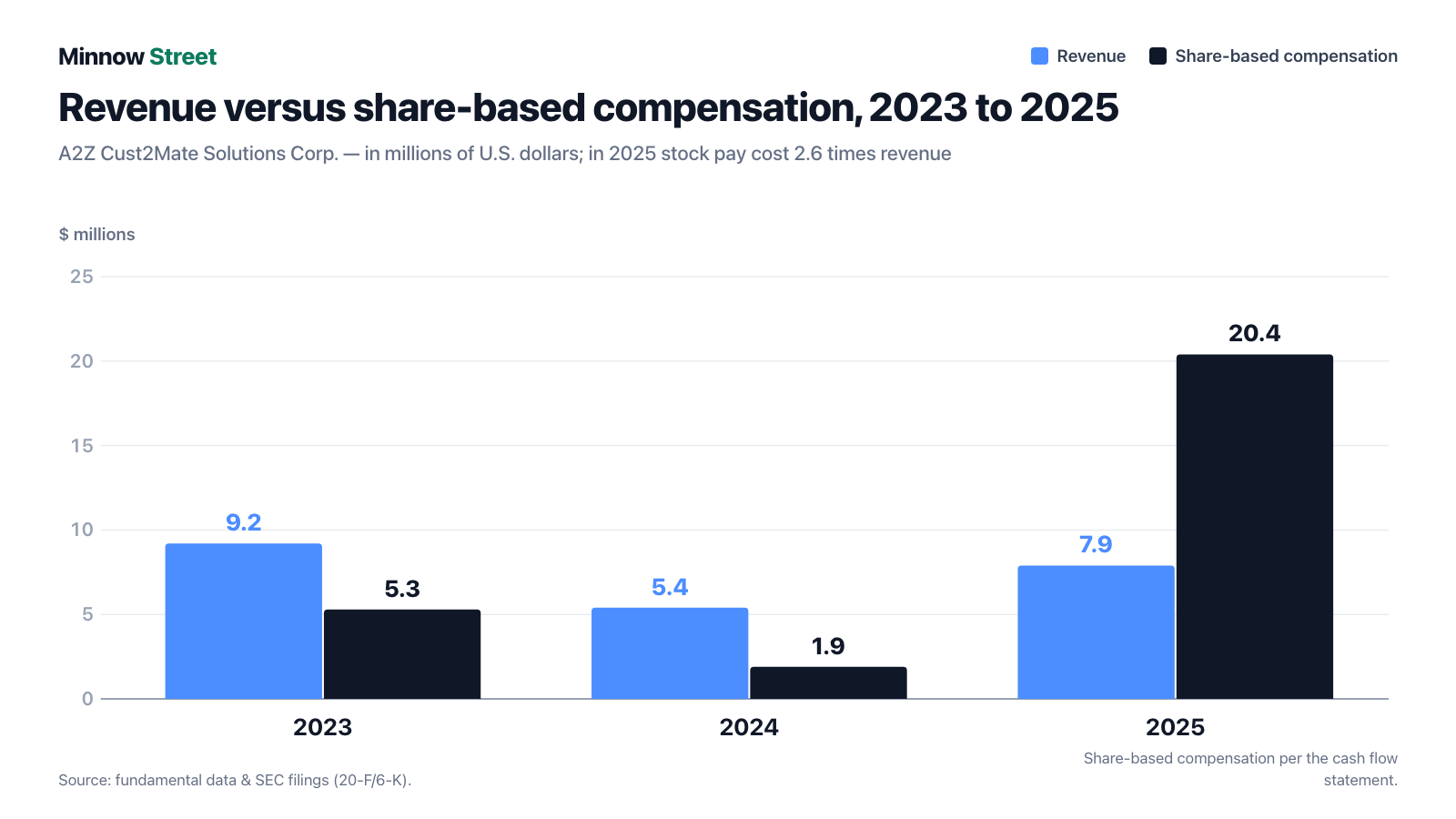
Why this matters to you even though no cash leaves the building: stock compensation is dilution — your slice of the pie gets smaller because new slices are constantly being cut and handed out. The second point is more serious: even after stripping out those bookings, real cash still leaves. Cash used in operating activities was $22.907 million in 2025 (2024: $11.711 million, 2023: $11.387 million) and $9.658 million in the first quarter of 2026. Against roughly $57.3 million of liquidity as of March 31, 2026, that cushion lasts about five to six quarters at this pace — not tight, but not comfortable either. The MD&A puts it soberly itself:
"As of the date of the issuance of the accompanied condensed consolidated interim financial statements, the Company has not yet commenced generating sufficient revenues to fund its operations and therefore depends on fundraising from new and existing investors to finance its activities."
— A2Z Cust2Mate Solutions Corp., SEC interim report 6-K as of March 31, 2026, exhibit 99.2, section "Liquidity, Capital Resources and Going Concern Uncertainty"
In fairness, the sentence two lines above it: following the equity raised in 2025 the company has "sufficient working capital for at least the next 12 months." The auditor went along with that; there is no going-concern paragraph. But the dependence on capital providers stands in the file as the company's own statement, not as an outside guess.
Uncomfortable truth no. 3: Gross margin fell to 4 percent — in the quarter with the highest revenue
This is the finding that surprised me most while reading. Normally you expect more units, more margin. At A2Z it is the other way around. In the first quarter of 2026, revenue of $3.317 million met cost of revenues of $3.178 million. What remains is $139 thousand of gross profit — a gross margin of 4.2 percent. A year earlier, on less than half the revenue, it was $580 thousand, or 37.5 percent. Over the years: 35.1 percent in 2024, 13.8 percent in 2025. Translated: of every $100 in revenue, a little over $4 currently remains after direct costs — and research, sales and administration have to be paid out of that, which together cost $8.166 million in the first quarter of 2026.
The company attributes the rise in cost of revenues to "increased productions costs" at Cust2Mate and higher payroll. That may be a ramp curve — new cart generation, first production runs, expensive small-batch builds. It may also mean the product is structurally too expensive to make at these prices. Both readings are currently defensible, and that is exactly the open question in this stock. The business model has an answer ready: away from one-time sales and toward subscriptions. The report describes it this way — the company intends to retain title to the carts, provide them against an upfront payment and monthly fees, and fund manufacturing "through loans against receivables from such orders." That fits the announcement of May 14, 2026: one of Israel's largest commercial banks has presented a "firm proposal" for a $30 million credit line. Note the wording: a firm proposal, not a signed contract. Through the most recent filing of July 14, 2026, nothing in the record confirms that the line has been drawn.
Uncomfortable truth no. 4: The company's own control over its bookkeeping was not effective at year-end
The annual report carries a sentence no company writes voluntarily:
"Management identified material weaknesses in controls over inventory, payroll and accounts payable. […] As a result of these material weaknesses, management concluded that the Company's ICFR was not effective as of December 31, 2025."
— A2Z Cust2Mate Solutions Corp., SEC annual report 20-F for 2025, Item 15 "Controls and Procedures"

What does "not effective" mean? Not that the numbers are wrong — the auditor signed off on the accounts. It means that in these areas the safety net that would catch an error early is missing. The annual report quantifies the remaining gap: of six control areas tested during 2025, cash, equity, payroll and financial reporting were effective; still open were "controls over procurement to pay and inventory management and counts." A new enterprise resource planning system has been running since January 1, 2026 and additional staff has been hired. On the timing, note this: the MD&A for the first quarter of 2026 repeats that same 2025 finding and states expressly that there were no changes to internal control during the quarter — so the filings show no progress against year-end. The combination is what stands out: in exactly that area, inventories grew from $796 thousand (end of 2024) to $3.891 million (end of 2025) to $5.536 million (March 31, 2026) — almost sevenfold in fifteen months. A third construction site fits the picture: A2Z is switching its accounting from international standards (IFRS) to U.S. rules (U.S. GAAP), announced April 16, 2026, effective from the first quarter of 2026, and expects to derecognize previously capitalized development costs in the process. That too is disclosed, unfinished and not yet audited.
Uncomfortable truth no. 5: The company is buying back its own stock — and has cleared itself to issue $200 million of new securities
On January 7, 2026 the board approved a buyback of up to $20 million, first through April 7, then through July 6, and finally — with the announcement of July 6, 2026 — through December 31, 2026. Where it stands:
"To date, the Company has repurchased an aggregate of 1,066,541 shares for an aggregate of US$6,668,473, not including broker commissions. As of the date hereof, approximately US$13.3 million remains available under the Repurchase Program for future repurchases."
— A2Z Cust2Mate Solutions Corp., SEC interim report 6-K of July 6, 2026, exhibit 99.1

Now the other hand. On April 17, 2026 A2Z filed a shelf registration (Form F-3) — a kind of standing authorization from the regulator to sell securities later at any time without running a new process each time. It has been effective since May 14, 2026:
"Under this shelf registration process, we may sell any combination of the securities described in this prospectus in one or more offerings up to a total dollar amount of $200,000,000."
— A2Z Cust2Mate Solutions Corp., SEC shelf registration Form F-3 of April 17, 2026, section "About This Prospectus"

You do not have to treat this as a scandal: a shelf registration is an option, not an issuance, and a buyback in a thinly traded stock can make sense. But the orders of magnitude belong side by side: $20 million of buyback against $200 million of selling authorization — on equity of $68.646 million and a share count of 45,075,009 (as of May 14, 2026). On top of that sit 5,163,571 options and warrants, another 11.5 percent of potential new shares; the largest blocks are 1,250,500 options at $8.00 and 500,000 at $6.00, both running to the end of 2035. The recent past shows how quickly this can move: in January 2025 A2Z placed 4,687,500 shares at $6.40 ($30 million gross), in September 2025 another 5,625,000 shares at $8.00 ($45 million gross). Contributed capital thereby rose from $83.120 million to $206.953 million within a single year. Remember the arithmetic: through March 31, 2026 shareholders had paid in $210.362 million in total — $146.259 million of that now sits on the balance sheet as accumulated losses.
Valuation: what is the market paying for the announcements?
There is no price-to-earnings ratio, because there are no earnings. That leaves revenue. On a market value of about $263 million (data as of July 30, 2026) and revenue of $9.671 million for the twelve months through March 31, 2026, the price-to-sales ratio is about 27; measured against fiscal 2025 ($7.901 million) it is roughly 33. For comparison: a solid, growing industrial company is typically valued at one to three times revenue, a fast-growing software vendor at five to ten times. A multiple of 27 to 33 is therefore not a valuation of today's business but a prepayment on the announced one.
Two cross-checks for perspective. First, book value: against the $263 million market value stands equity of $68.646 million (March 31, 2026) — a price-to-book ratio of about 3.8. Second, adjusting for cash: strip out the $57.3 million of liquidity and the market is paying roughly $205 million for the operating business — on $9.7 million of revenue and $139 thousand of gross profit in the latest quarter. The filings name exactly one price tied to a single day, and it sits far above today's level: the cover page of the shelf registration reads "On April 16, 2026, the closing price of our common shares on the Nasdaq Capital Market was $8.39 per share." The company's own buybacks through July 6, 2026 cost an average of roughly $6.25 per share ($6,668,473 for 1,066,541 shares) — but that is an average across half a year, not a price on a date. A2Z sold new shares at $8.00 in September 2025 and at $6.40 in January 2025. If you want a sense of how a hardware story with real deliveries and thin margins gets valued, our Ouster stock analysis shows the same mechanism in a different industry: the price pays for volume production long before it arrives.
Opportunities and risks at a glance
What speaks for A2Z Cust2Mate:
- A tangible, finished product with a reference installation: the carts are running at Yochananof, and the segment already delivered $2.450 million of revenue in the first quarter of 2026 (year-earlier quarter: $194 thousand).
- A quantified order book with dates: roughly $166 million from five announced orders, rollout starts announced for the third quarter of 2026 at Carrefour Israel and HaStock, and Migros Ticaret in Turkey for the first quarter of 2027.
- An unusually clean balance sheet for this size: $68.646 million of equity, roughly $57.3 million of liquidity, only $8.175 million of liabilities, working capital of $63.288 million (March 31, 2026); audit opinion without a going-concern paragraph.
- A second revenue path under construction: the retail media division (since September 2025) has a guaranteed minimum of $1.2 million from Toys "R" Us Israel and The Red Pirate starting January 2026 and running to December 2028, plus advertising deals with brands such as Lego, Slazenger, Rollox and SwissBrand.
- A stabilizing second business: the metal-parts subsidiary Isramat supplies dozens of customers and contributed $4.693 million, or 59 percent of 2025 revenue — it does not hang on the smart cart.
What speaks against it:
- Smart-cart revenue comes from exactly one customer per the annual report and the interim report, and all 2025 consolidated revenue was earned in Israel — concentration risk in customer and country at the same time.
- Gross margin fell to 4.2 percent in the first quarter of 2026 (2024: 35.1 percent, 2025: 13.8 percent), and that in the strongest revenue quarter — whether this is a ramp curve or a structural problem is open.
- In 2025 share-based compensation cost $20.357 million on $7.901 million of revenue; cash used in operating activities was $22.907 million for the year and $9.658 million in the first quarter of 2026 — against $57.3 million of liquidity, that lasts about five to six quarters.
- Dilution pressure from two directions: a shelf registration for $200 million effective since May 14, 2026 (76 percent of market value) and 5,163,571 options and warrants against 45,075,009 shares.
- Internal control over financial reporting was not effective as of December 31, 2025 (inventory, payroll, accounts payable); procurement and inventory control remain open while inventories grew almost sevenfold in fifteen months. On top of that, the switch from IFRS to U.S. GAAP is unaudited and unfinished.
- Barely any outside scrutiny and a shifting management bench: only one analyst covers the stock. Chairman Bentsur Joseph stepped down effective December 31, 2025; per the annual report, chief executive Gadi Graus took the chair on an interim basis in addition to his own role, and as of April 1, 2026 no permanent chairperson had been found. In the announcement of July 14, 2026 Graus carries the title "Executive Chair"; the same day Gadi Levin was presented as chief financial officer and Alan Rootenberg thanked as his predecessor.
A human conclusion
Back to the announcement trap from the opening. Its core is not that A2Z Cust2Mate is fibbing — the orders are announced, the dates are named, the carts exist, and everything uncomfortable is set out openly in the filings, including the control weaknesses and the dilution authorization. Its core is that our mind remembers an announcement more easily than a gross margin. So whoever buys today is buying neither the product nor the balance sheet, but a single conversion: will $166 million of announced order value turn into enough revenue at enough margin before the $57.3 million of liquidity is used up and the $200 million authorization is drawn? That question can be answered honestly, and not by me but by the next two interim reports: do the carts roll at Carrefour and HaStock in the third quarter of 2026? Does a second paying customer join Yochananof in the books? And does gross margin rise with volume instead of falling? Until those three lines exist, A2Z is a bet on a story with a healthy cash position — no more, but no less either. What you make of it is your decision. And that is exactly as it should be.
Sources
Every original document used in this analysis — for you to read yourself:
- A2Z Cust2Mate Solutions Corp. — SEC annual report of a foreign private issuer (Form 20-F) for 2025, filed April 1, 2026
- A2Z Cust2Mate Solutions Corp. — SEC interim report (Form 6-K) as of March 31, 2026, exhibit 99.1: condensed interim financial statements, filed May 15, 2026
- A2Z Cust2Mate Solutions Corp. — SEC interim report (Form 6-K) as of March 31, 2026, exhibit 99.2: management’s discussion and analysis
- A2Z Cust2Mate Solutions Corp. — SEC interim report (Form 6-K) of April 1, 2026: results of the annual and special meeting of March 31, 2026
- A2Z Cust2Mate Solutions Corp. — SEC interim report (Form 6-K) of April 8, 2026: Nasdaq confirms regained compliance with the annual meeting requirement (Rule 5620)
- A2Z Cust2Mate Solutions Corp. — SEC interim report (Form 6-K) of July 6, 2026: extension of the share repurchase program through December 31, 2026
- A2Z Cust2Mate Solutions Corp. — SEC interim report (Form 6-K) of July 14, 2026: Gadi Levin appointed chief financial officer
- A2Z Cust2Mate Solutions Corp. — SEC shelf registration (Form F-3) for $200 million, filed April 17, 2026, effective May 14, 2026
- Complete SEC filing history of A2Z Cust2Mate Solutions Corp. (CIK 0001866030): EDGAR overview (sec.gov)
- Fundamental data (market value, price-to-book ratio, Piotroski F-Score, equity ratio, analyst coverage; data as of July 30, 2026), reconciled with the SEC filings.
- Scanner status: live query in our in-house stock scanner on July 30, 2026 — no membership in any regular scanner list; the lists are recalculated daily.
Transparency & disclaimer: This analysis is a journalistic contextualization of publicly available information. It is not investment advice, not a regulated financial analysis and not a solicitation to buy or sell securities. Equity investments carry substantial risks up to and including total loss. All figures without warranty; the data cut-off is noted in the text. At the time of publication the author holds no position in shares of A2Z Cust2Mate Solutions Corp.
Our Bottom Line at a Glance
- Balance sheet & liquidity positive
- For a company with $7.901 million of annual revenue the balance sheet is unusually clean: as of March 31, 2026, $68.646 million of equity, roughly $57.3 million of liquidity ($16.208 million cash plus $40.664 million short-term securities plus $0.473 million short-term deposits), only $8.175 million of total liabilities and $63.288 million of working capital. Auditor BDO Ziv Haft signed off on the 2025 accounts without qualification and without a going-concern paragraph.
- Order book & demand neutral
- Roughly $166 million of announced order value from five quantified agreements (Yochananof $55 million, Carrefour Israel about $50 million, Trixo more than $25 million, Toys "R" Us Israel and The Red Pirate at least $15 million, HaStock more than $21 million) stands against $9.671 million of revenue for the twelve months through March 31, 2026. The dates are named — rollout at Carrefour Israel and HaStock from the third quarter of 2026, Migros Ticaret from the first quarter of 2027 — but none of it has been delivered yet.
- Customer concentration negative
- Smart-cart revenue comes from exactly one customer per the annual report 20-F for 2025 and the MD&A as of March 31, 2026 (41 percent of consolidated revenue in 2025, 10 percent in 2024, 67 percent in 2023), and all 2025 consolidated revenue was earned in Israel. Concentration risk in customer and country at once; cushioned only by the metal-parts business with dozens of customers (59 percent of 2025 revenue).
- Earnings quality & margin negative
- Gross margin fell from 35.1 percent (2024) to 13.8 percent (2025) and to 4.2 percent in the first quarter of 2026 — in the strongest revenue quarter. In 2025 share-based compensation cost $20.357 million, 2.6 times revenue, contributing more than half of the $38.484 million annual loss. Cash used in operating activities was $22.907 million in 2025 and $9.658 million in the first quarter of 2026.
- Capital policy & dilution negative
- A2Z repurchased its own shares for $6,668,473 through July 6, 2026 (1,066,541 shares, program running to December 31, 2026, $13.3 million unused) and has held an effective shelf registration for $200 million since May 14, 2026 — roughly 76 percent of market value. Add 5,163,571 options and warrants against 45,075,009 shares (11.5 percent) and the record of two 2025 placements totaling $75 million gross.
- Controls & reporting negative
- Internal control over financial reporting was not effective as of December 31, 2025 (weaknesses in inventory, payroll and accounts payable); as of March 31, 2026 procurement to pay and inventory management remained open while inventories grew from $796 thousand to $5.536 million in fifteen months. In parallel runs the unaudited switch from IFRS to U.S. GAAP announced on April 16, 2026.
A2Z Cust2Mate is the announcement trap in its purest form: a tangible product, five quantified orders worth roughly $166 million in total, a balance sheet that is remarkably clean for this size with $68.646 million of equity and $57.3 million of liquidity (March 31, 2026) — and next to it $7.901 million of 2025 revenue, a gross margin down to 4.2 percent in the first quarter of 2026, $20.357 million of share-based compensation in a single year, and smart-cart revenue that per the company's own filings comes from exactly one customer in exactly one country. Whoever buys here is not betting on the product but on a conversion: that announced contracts turn into revenue with margin before the liquidity is used up or the $200 million shelf registration is drawn. Not investment advice.
What Our Rating Means
Open questions
The business works in principle, but one material question is open. As long as it stays open, our findings do not carry a quality verdict.
Yellow here stands for an open operational question, not for a risk to the substance. The substance is documented and unusually solid: $68.646 million of equity against $8.175 million of liabilities, roughly $57.3 million of liquidity, no going-concern paragraph in the audit opinion, no meaningful bank debt, and the Nasdaq annual meeting requirement satisfied again since April 7, 2026. What is open is the business itself: smart-cart revenue comes from a single customer, gross margin fell to 4.2 percent in the strongest revenue quarter, and none of the roughly $166 million of announced order value has been billed. Add two housekeeping issues: internal controls over inventory and procurement that are not effective, and the unaudited switch from IFRS to U.S. GAAP. The stock is also expensive — a price-to-sales ratio of about 27 on trailing twelve months — but that is a price argument and does not drive this rating. It would turn red only if the cash position tightened or the audit opinion changed; it would turn green once a second paying customer and a workable margin appear in the books. The decision is yours.
A journalistic assessment by our editorial team at the time of the deep dive, based on public sources — not investment advice and not a solicitation to buy or sell. Your personal circumstances (investment goals, risk capacity, taxes) cannot be taken into account. What our levels mean, how verdicts are formed, and what conflicts of interest exist →
Worth Noting
- A2Z Cust2Mate reached the research list through the Reddit hype scan of July 30, 2026. A live query of our own data set on the same day showed that the stock sits in none of our regular scanner lists (no momentum, quality or value filter). The lists are recalculated daily, so the finding can change.
- Data provenance and reporting regime: A2Z is registered with the SEC as a foreign private issuer (CIK 0001866030) and therefore files no quarterly report (10-Q), but an annual report on Form 20-F and interim reports on Form 6-K. The quarterly figures as of March 31, 2026 sit in exhibits 99.1 and 99.2 of the interim report of May 15, 2026. The accounts follow IFRS in U.S. dollars; the switch to U.S. GAAP is announced but preliminary and unaudited.
- Risk of confusion: until August 12, 2024 the company was called A2Z Smart Technologies Corp., and before July 20, 2020 ECC Ventures 1 Corp. Some data sheets still carry the old name — it is the same company under the ticker AZ. Cross-check on the market value of about $263 million (data as of July 30, 2026): it rests on 44,532,164 shares and therefore sits within 0.1 percent of the 44,545,009 shares reported in the interim accounts as of March 31, 2026 (the MD&A of May 14, 2026 states 45,075,009, including treasury shares not yet cancelled). The share price of roughly $5.90 implied by that figure is a single day's number and not a valuation argument; the only price tied to a day in the filings themselves is the $8.39 closing price of April 16, 2026 on the cover page of the shelf registration F-3. What is cleanly checkable is the revenue base: the price-to-sales ratio in the fundamental data uses revenue of $9.671 million — exactly the sum of $7.901 million (2025) less $1.547 million (Q1 2025) plus $3.317 million (Q1 2026). Analyses are evergreen; daily prices are not a buy argument.
Frequently Asked Questions
A2Z Cust2Mate Solutions Corp. (Nasdaq: AZ) develops and sells "smart carts": shopping carts with a scale, a barcode scanner, a touchscreen, on-cart payment and an advertising screen. They are built by the Israeli subsidiary Cust2Mate Ltd. (96.58 percent owned). A second business, the subsidiary Isramat, manufactures precision metal parts and delivered the larger share of 2025 revenue with $4.693 million of $7.901 million. Since September 2025 the company has also been building a retail media division that sells the screen space inside the cart.
The company was incorporated in British Columbia on January 15, 2018 as ECC Ventures 1 Corp., renamed itself A2Z Smart Technologies Corp. on July 20, 2020, and has been A2Z Cust2Mate Solutions Corp. since August 12, 2024 — by its own account "to better reflect the Company's business plan." Some data providers still carry the old name; the SEC registration under CIK 0001866030 belongs throughout to the same company and the ticker AZ.
In fiscal 2025 (ended December 31, 2025) it was $7.901 million, after $5.376 million in 2024 and $9.212 million in 2023. In the first quarter of 2026 revenue rose to $3.317 million (year-earlier quarter: $1.547 million), $2.450 million of which came from the smart-cart segment. For the twelve months through March 31, 2026 revenue adds up to $9.671 million. Against that stand announced order values of roughly $166 million.
The annual report (Form 20-F) for 2025 says it verbatim: "Revenues from the smart cart segment are generated from one customer" — smart-cart revenue comes from one customer and accounted for 41 percent of consolidated revenue in 2025 (2024: 10 percent, 2023: 67 percent). The MD&A as of March 31, 2026 repeats this in the present tense. The customer is the Israeli supermarket chain Yochananof. The rest of revenue comes from the metal-parts business with dozens of customers; all 2025 revenue was generated in Israel.
Because the U.S. securities regulator, the SEC, treats the company as a foreign private issuer. Such companies file neither a quarterly report (10-Q) nor a domestic annual report (10-K), but an annual report on Form 20-F and ongoing interim reports on Form 6-K. The quarterly figures as of March 31, 2026 therefore sit as exhibits 99.1 and 99.2 in the interim report of May 15, 2026. For fiscal 2021 A2Z still filed a Canadian annual report (Form 40-F); from fiscal 2022 onward it has used Form 20-F.
As of March 31, 2026 the company held $16.208 million of cash, $40.664 million in short-term securities and $473 thousand of short-term deposits — roughly $57.3 million of liquidity against just $8.175 million of total liabilities. Cash used in operating activities was $9.658 million in the first quarter of 2026 and $22.907 million for full-year 2025. At the pace of the first quarter of 2026 that corresponds to about five to six quarters. The company itself states it has "sufficient working capital for at least the next 12 months"; the auditor signed off without a going-concern paragraph.
There is no price-to-earnings ratio because the company is loss-making. Measured against revenue the stock is expensive: on roughly $263 million of market value (data as of July 30, 2026) and $9.671 million of trailing twelve-month revenue, the price-to-sales ratio is about 27, and about 33 measured against fiscal 2025. The price-to-book ratio is roughly 3.8 (equity of $68.646 million as of March 31, 2026). The only price tied to a single day anywhere in the filings sits on the cover page of the shelf registration F-3: an $8.39 closing price on April 16, 2026. The company's own buybacks through July 6, 2026 averaged roughly $6.25 per share — a half-year average, not a price.
Found an error?
Did you spot a factual error, an outdated number, or a typo in this deep dive? Let us know briefly — your report goes straight to the editorial team.