Corvex: A wellness ring became an AI cloud — and $518 million of the purchase price is goodwill
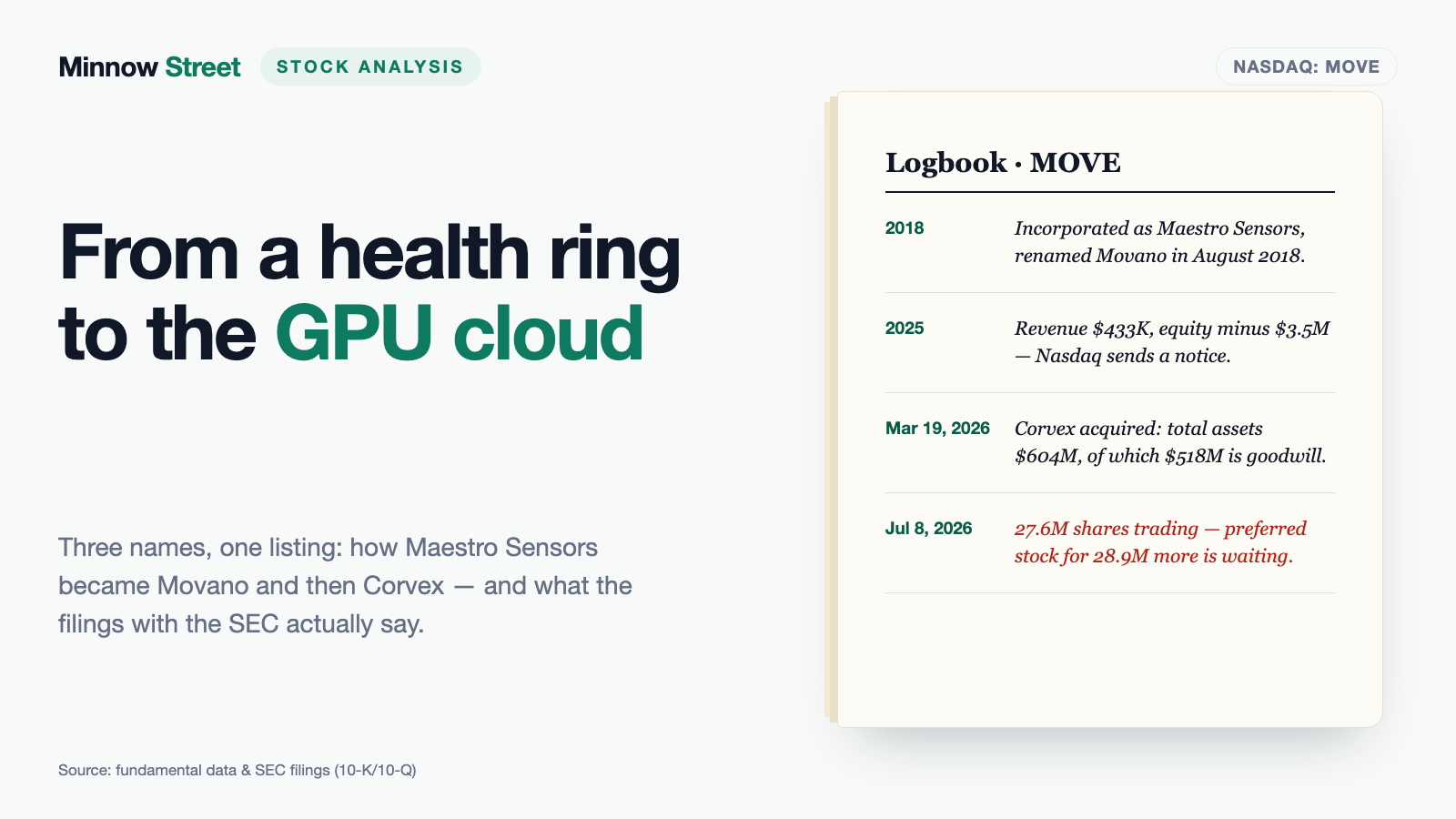
On March 19, 2026 a tiny company called Movano Inc. — a maker of wellness rings for women that booked $433,000 of revenue in all of 2025 — bought a private AI data center business for $581.9 million, paid entirely in its own convertible preferred stock. Four days later it renamed itself Corvex. Equity of negative $3.5 million became positive $576.0 million; 1.9 million shares became 27.6 million by July 8, 2026, with another 28.9 million still waiting inside the preferred. The quarterly report filed with the U.S. securities regulator, the SEC, shows what actually sits on that balance sheet: $518.3 million of the $604.5 million in total assets is goodwill, pro forma 2025 revenue of the combined company was $7.5 million, and a single customer delivered roughly 52 percent of first quarter revenue. This time the most interesting number is not in the income statement — it sits on the line marked goodwill.
 Thomas Mücke
Founder & Publisher
Thomas Mücke
Founder & Publisher
Chart
Interactive price chart (TradingView).
Note: pure fact-based analysis, not investment advice and not a solicitation to buy or sell. All figures without guarantee.
The trap: we trust the sign above the door
Picture a shop you have walked past for years. The sign above the door used to read “Jewelry and Watches.” Today it reads “Data Center.” Same address, same window, same door handle — only the sign is new. Would you immediately believe there are servers inside? Or would you look in first?
In the stock market we almost never look in. We trust the sign. And that is the trap this analysis is about: a company name is not a fact about a business, it is a claim about a business. At Corvex, Inc. (NASDAQ: MOVE) the sign is unusually fresh. Until March 23, 2026 the company was named Movano Inc. and sold a wellness ring for women. Until August 3, 2018 it was named Maestro Sensors Inc. Three names, one listing, the same CUSIP lineage.
So here is the deal. We leave the sign alone and read what the company itself filed with the U.S. securities regulator, the SEC: the annual report (10-K) for 2025 of March 31, 2026, the quarterly report (10-Q) as of March 31, 2026 filed on May 19, 2026, and everything that followed — five current reports (8-K), two ownership filings (SC 13D), two registration statements (S-8 and S-1) and a prospectus (424B7) dated July 22, 2026. A filing with the SEC is honest under threat of penalty. And this one tells a story more interesting than any sign. What you make of it is up to you.

What Corvex actually does today
Corvex rents out computing power for artificial intelligence. In plain terms, the company is a power plant with a grid for thinking work. Training or running an AI model requires specialized chips — GPUs, originally graphics cards, today the workhorses of AI. Those chips are expensive, loud, hot and hard to obtain in volume. Corvex assembles them in data centers, cools them, wires them and sells the compute time by the hour or in fixed packages. The prospectus of July 22, 2026 puts it this way:
“Corvex, Inc. (formerly known as Movano Inc., dba Movano Health), a Delaware corporation, is an AI cloud computing business specializing in GPU-accelerated infrastructure for AI workloads.”
— Corvex, Inc., SEC prospectus 424B7 of July 22, 2026, Prospectus Summary
The company names three building blocks. First, AI Factories and GPU Clusters: pre-wired compute blocks including power, cooling and systems software, deployed either on a customer’s own premises or shared with other tenants, in each case built to the U.S. health data standard HIPAA and the SOC 2 Type II audit standard. Second, confidential computing — a vault for AI models. The patent-pending Corvex Secure Model Weights product is designed to let a third party’s AI model run on a third party’s hardware without the hardware operator being able to see the model itself. Third, the Token Factory, described in the annual report as still in development: access to premium open-source AI models through an application programming interface, with a promise of lower cost per unit of text processed.
Alongside that, smaller than before, the old business continues. The quarterly report describes both halves in a single sentence:
“Following the closing of the Merger, the Company has an Artificial Intelligence (“AI”) cloud computing business that specializes in Graphic Processing Unit-accelerated (“GPU”) infrastructure for AI workloads and a healthcare business that consists of our wellness ring (formerly referred to as the Evie Ring) (the “Wellness Ring”), a wearable designed specifically for women that was launched in November 2023.”
— Corvex, Inc., SEC quarterly report 10-Q as of March 31, 2026, Note 1
How the transformation worked mechanically matters for everything that follows. On March 19, 2026 Movano bought the private Corvex, Inc. — since renamed Corvex Legacy Holdings, Inc. and now a subsidiary. The buyer did not issue common stock in the narrow sense but three classes of convertible preferred stock, each single share convertible into 1,000 common shares. For accounting purposes Movano is the acquirer and the purchased business the acquiree. Four days later, on March 23, 2026, the sign changed. And that names the central tension of this analysis, which runs through every chapter: the purchase price was paid entirely in the company’s own stock, and 89 percent of it now sits on the balance sheet as goodwill — while the acquired business is only twelve days old in the reported figures and a single customer supplies roughly half of its revenue.
How the stock reached our desk
MOVE reached our research list through the mention counts in U.S. retail investor forums, as of July 30, 2026. Such lists say nothing about the merit of a business; they only say where a lot of people are looking. What made the ticker genuinely interesting was something else: the filing history at the SEC. Three company names appeared there for the same security — Maestro Sensors, Movano, Corvex — and between June 16 and July 22, 2026 an unusually dense chain of 22 filings: three current reports (8-K), ten insider filings (Form 4), three initial insider filings (Form 3), two ownership filings (SC 13D), two registration statements (S-8 and S-1) and a prospectus (424B7) with its notice of effectiveness (EFFECT). When a company with $433,000 of most recent annual revenue files that many mandatory documents in five weeks, something fundamental is happening.
One note on the data that matters if you check the arithmetic. The common metrics databases still carry the old company name “Movano Inc” for this ticker, along with a market capitalization of $307.6 million (data as of July 29, 2026). We do not use that market capitalization in this analysis. The reason is a cross-check: $307.6 million equals 27,635,745 shares times a price of $11.13. But the last price stated in a mandatory filing is a different one — the 424B7 prospectus gives a closing price of $16.50 for July 8, 2026. Run the same multiplication with that and you get $456.0 million, a third more. At that kind of gap a feed number is no longer an anchor, and everything you would derive from it — price-to-sales, enterprise value — would be wrong. The same caution applies to the feed revenue figure of $7.406 million: that number appears in no filing. So from here on we work exclusively with figures from the reports and name the basis of each one. The share count from the feed, on the other hand, holds up: 27,635,745 appears verbatim in the Form 8-K of July 7, 2026 and in the prospectus of July 22, 2026.
Remember that step; it costs two minutes and saves whole investment theses: before you use a metric, run it once against a mandatory filing. How quickly a narrative otherwise drifts away from its own numbers is something we have seen before in our analysis of Recursion Pharmaceuticals.
The numbers across the years — given their due
First the part that genuinely impresses, and it is more than a name change. Understanding the starting point makes the achievement clear. Movano was facing delisting. On October 1, 2025 Nasdaq notified the company that it failed Listing Rule 5550(b)(1), which requires a minimum of $2.5 million of stockholders’ equity for continued listing. The half-year report showed $1.637 million. After a hearing on August 19, 2025, the Nasdaq panel set a deadline of March 30, 2026. The merger closed on March 19, 2026 — eleven days before it ran out.
“In its Quarterly Report on Form 10-Q for the fiscal year ended June 30, 2025, filed with the U.S. Securities and Exchange Commission on September 24, 2025, the Company reported a stockholders’ equity of approximately $1.637 million and, as a result, does not satisfy the Stockholders’ Equity Requirement.”
— Movano Inc. (now Corvex, Inc.), SEC Form 8-K of March 19, 2026, Item 3.01

This is exactly where the fine print is worth reading, because the story is not quite as clean as it sounds. That the bar has been cleared in amount is beyond doubt: $576.003 million of equity as of March 31, 2026 against a $2.5 million requirement. But Nasdaq’s formal determination that the company has regained compliance is documented in no filing through July 22, 2026. The Form 8-K of March 19, 2026 says so itself: “The Company is awaiting formal determination from Nasdaq that it has regained compliance with the Stockholders’ Equity Requirement.” The annual report of March 31, 2026 only says the company submitted a written update to the Nasdaq panel on March 19 describing how the merger restored compliance. For the two other 2025 breaches — late filings and minimum bid price — the same report expressly names Nasdaq’s confirmations of October 7 and November 11, 2025; for the equity requirement no such line exists. Two things are therefore documented and no more: the stock trades — the prospectus of July 22, 2026 gives the listing on the Nasdaq Capital Market under the symbol MOVE — and the formal closure appears in no mandatory filing through that date. A threshold met and a proceeding closed are two different things.
Equity of negative $3.474 million (December 31, 2025) became positive $576.003 million (March 31, 2026). Cash of $2.827 million became $29.330 million — mostly because the acquired business brought $36.679 million of cash with it. And a company with almost no fixed assets became one with $29.074 million of property and equipment; $6.238 million went into servers in the first quarter of 2026 alone. This is not cosmetics. This is a different company.
Revenue tells a clear story too — you just have to say which revenue you mean. Reported revenue for 2025 was $433,000 (2024: $1.013 million), because 2025 was still a pure Movano year. The acquired business on its own booked $7.102 million in 2025. On a pro forma basis, as if the merger had existed since January 1, 2025, it would have been $7.535 million. For the first quarter of 2026 the same three figures read: reported $510,000, of which $475,000 came from the AI business from March 19 onward; pro forma $3.633 million against $1.351 million in the prior-year quarter. That is a 169 percent increase on a pro forma basis — but on a basis that never existed as an audited consolidated figure.
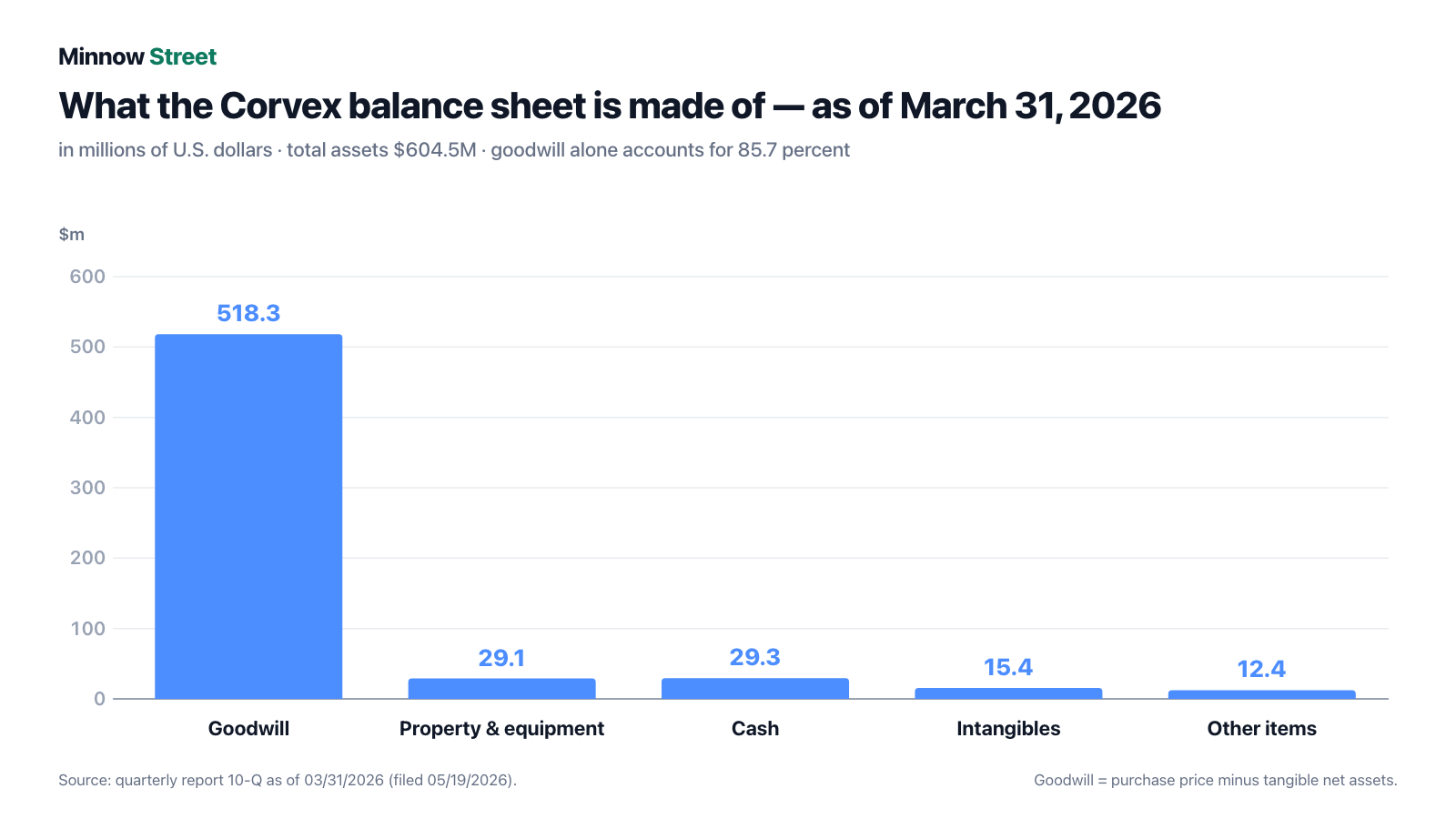
Now the chart that overshadows everything else. It shows what the March 31, 2026 balance sheet actually consists of:
Which brings us to the uncomfortable truths.
What the filings say — the uncomfortable truths
Uncomfortable truth no. 1: 85.7 percent of the balance sheet is goodwill
First the term in plain language. Goodwill is what is left over when you buy a company and subtract everything you can touch, count or value individually from the purchase price. Buy a bakery with $50,000 of ovens for $200,000 and you have paid $150,000 for something that is not standing in the workshop: the customers, the reputation, the team, the location. That remainder is goodwill. It is not inherently improper — but it is an expectation, not substance. And it can be written off in a single accounting entry if the expectation is not met.
At Corvex the arithmetic goes like this. The purchase price was $581.911 million — $577.045 million for the preferred stock issued (valued at $10.71 per common share equivalent) and $4.866 million for the pre-combination portion of the assumed employee equity awards. In return the company acquired assets of $83.905 million — cash $36.678 million, property and equipment $26.412 million, intangibles $15.400 million, receivables $1.342 million, lease right-of-use assets $3.477 million, prepaid expenses $0.596 million — and assumed liabilities of $20.257 million. That leaves $63.648 million of tangible net assets. The difference to the purchase price: $518.263 million of goodwill, or 89.1 percent of what was paid. On the March 31, 2026 balance sheet that is 85.7 percent of total assets.
What exactly was that amount paid for? The quarterly report says so itself:
“The excess of the purchase price over the fair value of the net assets acquired was allocated to goodwill, none of which is expected to be deductible for tax purposes. Goodwill is primarily attributable to the assembled workforce as well as the anticipated operational synergies from the integration of Corvex’s technology and resources to deploy AI infrastructure demand at scale with a differentiated product offering, growing sales pipeline and leadership experienced in large-scale distributed computing and software development.”
— Corvex, Inc., SEC quarterly report 10-Q as of March 31, 2026, Note 3 Acquisition

Two points belong here in fairness. First, the purchase price allocation is expressly preliminary. The report states that the fair values of intangible assets, of certain tangible assets and liabilities, and the useful lives have not been finalized; the company has up to twelve months from the acquisition date. It can still shift — in either direction. Second, as of March 31, 2026 there was no impairment of goodwill. So there is no finding here that too much was paid. There is only the sober observation that the judgment has been deferred — and that 85.7 percent of the balance sheet rests on an expectation nobody has tested yet. Keep the image: goodwill is an invoice a company writes to itself. The auditor comes later.
Uncomfortable truth no. 2: 1.9 million shares became 56.6 million
Dilution means your slice of the cake gets smaller because new slices keep being cut. At Corvex the cake was cut into fourteen times as many slices between March 31 and July 8, 2026 — and once the remaining preferred converts it will be twenty-nine times as many.
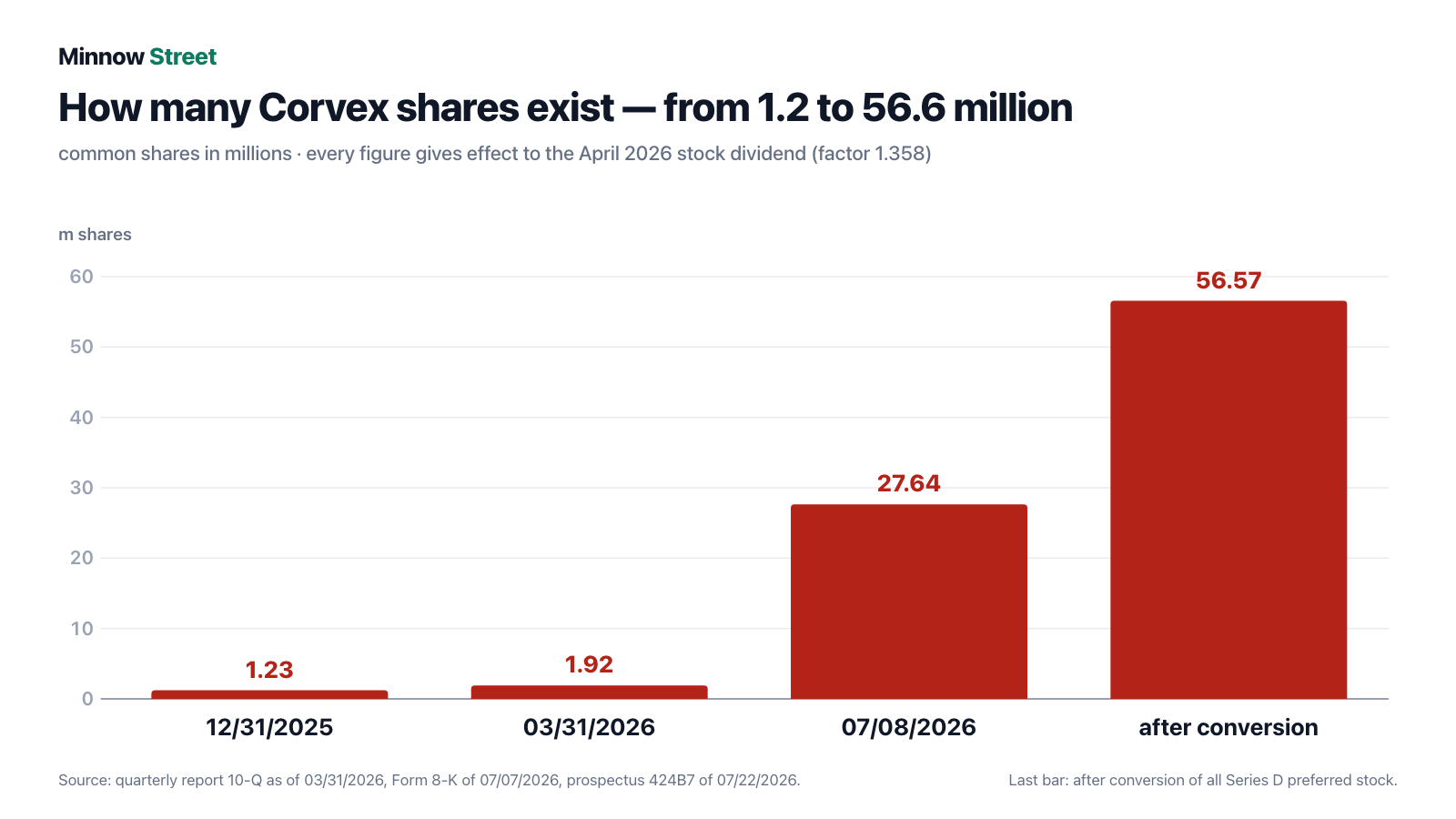
The path there is a chain of capital measures, each documented in a mandatory filing. On October 10, 2025 Movano executed a 1-for-10 reverse split — ten old shares became one new one. On March 19, 2026, in connection with the merger, the company issued 240.562 shares of Series B, 23,551.5195 of Series C and 30,227.0524 of Series D preferred stock; each one converts into 1,000 common shares. March 30, 2026 was the record date for a stock dividend of 0.358 shares per share — accounted for as a 1.358-for-1 split and distributed on April 6, 2026. Series B converted automatically on March 31, 2026. Following the shareholder vote of July 1, 2026, all of Series C plus part of Series D converted on July 7, 2026. After that the count stood as follows:
“Following such conversions, the Company has 27,635,745 shares of common stock outstanding and shares of Series D Preferred Stock convertible into 28,929,592 shares of common stock.”
— Corvex, Inc., SEC Form 8-K of July 7, 2026, Item 8.01
If all the Series D converts, the total is 56,565,333 common shares — the prospectus states that figure itself. One note for anyone doing the arithmetic: the prospectus of July 22, 2026 puts the conversion of the remaining 28,929.5944 Series D shares at 28,929,588 common shares, while the Form 8-K two weeks earlier puts it at 28,929,592 — a four-share difference the filings do not explain. This analysis uses the prospectus figure throughout, because it is the later document and the company draws the 56,565,333 total there itself. And then there is the list of what that number does not include: 9,324,425 shares underlying outstanding options, 7,145,141 underlying restricted stock units, 438,547 underlying warrants at a weighted average exercise price of $52.48, 20,174 underlying pre-funded warrants at $0.12, and 3,645,305 shares reserved for future grants across four equity plans. Together, another 20.57 million shares. Authorized capital stands at 500 million common shares — so there is plenty of room.
The third part of this finding is the one that lands closest to shareholders. The 424B7 prospectus of July 22, 2026 registers 53,390,008 shares for resale and does the math itself:
“The Selling Stockholders can resell, under this prospectus, up to 53,390,008 shares of Common Stock. If all of the 53,390,008 shares of our Common Stock offered by the Selling Stockholders under this prospectus were issued and outstanding as of the date hereof, such shares would represent approximately 94% of the total number of shares of our Common Stock outstanding.”
— Corvex, Inc., SEC prospectus 424B7 of July 22, 2026, Risk Factors

One more figure from the same source fits alongside: on July 8, 2026 those 27,635,745 common shares were held by exactly 77 holders of record, and the Series D preferred was spread across twelve. A security is rarely that narrowly held. There are two brakes, though, and fairness requires naming them. First, directors, officers and substantially all former owners may not transfer their shares for 180 days from the closing of March 19, 2026 per the merger filing, so that period runs to mid-September 2026. Second, an individual holder may only convert Series D preferred up to the point where it would not exceed 4.99 percent of the common stock (raisable on request, with 61 days’ notice, to a maximum of 19.99 percent). The dilution therefore arrives in portions rather than all at once. Growth paid for with fresh shares is never entirely free.
Uncomfortable truth no. 3: $143.6 million of stock pay is still to come
When one company buys another, it also has to replace the target’s employee equity awards. At Corvex that meant 3,934,154 options and 2,744,776 restricted stock units of the acquired business, which became 8,755,418 options and 6,108,470 units of the new company after the merger exchange ratio. Their fair value: roughly $148.5 million. Only $4.9 million of that counts as purchase price. The rest is pay for work still to come — and has to be expensed over the years:
“The fair value of these stock options and RSUs was approximately $148.5 million. Of this amount, $4.9 million was recognized in the total purchase price (Note 3). The remainder of the fair value of approximately $143.6 million will be recognized as compensation expense subsequent to the Merger until the year 2030.”
— Corvex, Inc., SEC quarterly report 10-Q as of March 31, 2026, Note 12 Stock-Based Compensation

Put that in proportion. $143.6 million is nineteen times the pro forma 2025 revenue of $7.535 million. Spread across the years to 2030 it is roughly $30 million a year — for a business whose strongest documented quarter produced $3.633 million of pro forma revenue. Two qualifications belong here: first, stock compensation is not a cash expense; it costs ownership, not cash. Second, it does not spread evenly, because the awards vest at different speeds. In the first quarter of 2026 — with only twelve days of the new business — the income statement already carried $2.178 million of stock compensation, after $299,000 in the prior-year quarter. The effect is visible already, and it will grow. Pay handed out in shares never shows up in the cash account; it shows up in your slice.
Uncomfortable truth no. 4: one customer, 52 percent of revenue
Customer concentration is easy to explain at the kitchen table: if your neighbor tells you his business is doing splendidly, but a single customer supplies half the revenue, would you swallow briefly? The quarterly report puts it plainly: “One customer accounted for approximately 52% of the Company’s revenue for the three months ended March 31, 2026, related to the Company’s AI cloud computing business.” In the prior-year quarter no customer reached the ten percent mark (SEC quarterly report 10-Q as of March 31, 2026, Significant Customers).
Two qualifications are honest. The figure covers twelve days of business; a single large order easily distorts a period that short. And there is a counterweight on the balance sheet: $4.379 million of deferred revenue as of March 31, 2026 ($2.226 million current, $2.153 million non-current) — money customers have already paid for services not yet delivered. Against pro forma quarterly revenue of $3.633 million that is a good quarter of prepaid business. That is more commitment than the concentration figure alone would suggest.
One further finding belongs here because it shows the same youth of the business. The AI segment posted a net loss of $1.625 million in the first quarter of 2026 but came in at only negative $98,000 on adjusted earnings before interest, taxes, depreciation and amortization — close to break-even. The old ring business came to negative $3.380 million net and negative $1.506 million adjusted, after negative $4.901 million in the prior-year quarter, because it was deliberately scaled back. Read only the consolidated figures and you conflate the two. One quarter does not make a summer — and twelve days do not make a quarter.
Valuation: what the filings actually allow you to say
This is where it gets uncomfortably honest, because all the convenient routes are blocked. There is no price-to-earnings ratio: the company posts losses, $5.005 million reported and $16.040 million pro forma in the first quarter of 2026. A market capitalization from the metrics database is, as shown above, not reliable. And there is effectively no analyst consensus either: as of July 29, 2026 the fundamental data carry exactly one estimate, with a price target of $300 — more than eighteen times the last price documented in a mandatory filing, $16.50 on July 8, 2026. A price target that far from the documented price level is no anchor. We leave it alone.
What remains is the calculation you can run yourself, with two numbers that both appear in filings. The 424B7 prospectus states a closing price of $16.50 for July 8, 2026 and, for the same day, 27,635,745 common shares outstanding. That gives a market capitalization of roughly $456 million. Include the Series D preferred still outstanding, for 56,565,333 shares, and you arrive at roughly $933 million. Both figures carry the as-of date of July 8, 2026 and are a yardstick, not a price call.
Against revenue that means: on pro forma 2025 revenue of $7.535 million the market pays roughly 60 times annual sales — and roughly 124 times after full conversion. Against substance: of the $604.5 million in total assets, $518.3 million is goodwill; everything else combined — property and equipment, cash, intangibles, other items — comes to $86.2 million. So what you buy here is not assets at a discount but an expectation at a multiple. Whether that multiple is justified turns on a single question: how fast a growing sales pipeline becomes real, recurring revenue. And no share price answers that question — the next quarterly report does. What it looks like when such a bet fails to pay off over years is something you can read in our analysis of Ouster, where a combination was likewise paid for in stock.
Opportunities and risks at a glance
What speaks for Corvex:
- The transformation delivered a real business, not just a sign: total assets of $604.5 million instead of $5.6 million, equity of positive $576.0 million instead of negative $3.5 million, cash of $29.3 million instead of $2.8 million — March 31, 2026 against December 31, 2025 in each case.
- In the first quarter of 2026 the AI segment was near break-even on adjusted earnings before interest, taxes, depreciation and amortization at negative $98,000, and pro forma revenue rose from $1.351 million (Q1 2025) to $3.633 million (Q1 2026).
- The cause of the delisting proceeding is gone: after the merger, equity of $576.0 million sits far above the $2.5 million Nasdaq bar that Movano breached in late 2025; that proceeding was the actual trigger for the combination, and the stock still trades on the Nasdaq Capital Market per the prospectus of July 22, 2026 (Nasdaq’s formal determination is documented in no mandatory filing through that date).
- There is prepaid business: $4.379 million of deferred revenue as of March 31, 2026 — more than one pro forma quarter of revenue that customers have already paid for.
- Management is in the boat: co-chief executives Seth Demsey and Jay Crystal together report 34.8 percent of the common stock (Schedule 13D ownership filings of July 8, 2026), and their shares are subject to the 180-day lock-up from March 19, 2026.
What speaks against it:
- 85.7 percent of total assets is goodwill ($518.3 million of $604.5 million), the purchase price allocation is expressly preliminary, and the goodwill is not deductible for tax purposes — it can disappear in a single accounting entry if the expectation is not met.
- The share count rose from 1.92 million (March 31, 2026) to 27.64 million (July 8, 2026) and goes to 56.57 million once all Series D preferred converts; on top of that sit 20.57 million shares underlying options, restricted stock units, warrants and plan reserves.
- 53,390,008 shares have been registered for resale since July 22, 2026 — roughly 94 percent of all common stock by the prospectus’s own math — and the former owners’ lock-up ends in mid-September 2026.
- $143.6 million of stock compensation still has to run through the income statement by 2030, nineteen times pro forma 2025 revenue; and one customer accounted for roughly 52 percent of first quarter 2026 revenue.
- The data situation is a trap in itself: metrics databases still carry the old name, a market capitalization a third below the filing-based calculation, and revenue of $7.406 million that appears in no report. Anyone who calculates without checking calculates wrongly.
A human conclusion
Back to the shop with the new sign. We went in, and there is genuinely something inside: servers, contracts, prepayments, a team, a segment result close to break-even. That is more than survives many a name change on the stock market. But the largest item in the shop is invisible. Of the $604.5 million on this balance sheet, $86.2 million is everything that is not goodwill. The rest is the invoice the company wrote to itself about its own future — paid with shares that did not exist four months ago.
That is not a scandal, and nothing is hidden: every figure in this analysis comes from a document the company filed itself. It is simply a very specific bet, and you should know what you are betting on. Not on a wellness ring. Not on a company name. But on the proposition that a sales pipeline carrying roughly $3.6 million of pro forma quarterly revenue today will, within a few years, carry enough for $518 million of goodwill and $143.6 million of stock pay to disappear behind it.
So the honest question is not “Is Corvex an AI winner?” It is: would you buy a company whose most valuable balance sheet item is an expectation nobody has tested yet, knowing that in mid-September 2026 the lock-up expires on shares representing 94 percent of the capital? If yes, you have a thesis and you know what to watch: the revenue line of the next quarterly report, and the goodwill line right above it. If no, two minutes in a quarterly report just saved you a great deal of money. What you make of it is up to you. And that is exactly as it should be.
Sources
Every original document used in this analysis — to read for yourself:
- Corvex, Inc. — SEC quarterly report 10-Q as of March 31, 2026 (filed May 19, 2026)
- Corvex, Inc. — SEC annual report 10-K for 2025 (filed March 31, 2026)
- Movano Inc. (now Corvex, Inc.) — SEC Form 8-K of March 19, 2026 (merger closing, Items 1.01, 3.01, 3.02, 3.03, 5.02, 5.03)
- Corvex, Inc. — SEC Form 8-K of May 19, 2026 (Item 2.02, pro forma presentation for Q1 2026 and 2025 plus non-GAAP information)
- Corvex, Inc. — SEC Form 8-K of May 19, 2026 (Item 2.02, first quarter 2026 earnings release with pro forma exhibit)
- Corvex, Inc. — SEC Form 8-K of June 16, 2026 (new chief financial officer)
- Corvex, Inc. — SEC Form 8-K of June 26, 2026 (annual meeting adjourned)
- Corvex, Inc. — SEC Form 8-K of July 7, 2026 (conversions, second chief executive, voting results)
- Seth Demsey — SEC Schedule 13D ownership filing of July 8, 2026 (20.0 percent)
- John Crystal III — SEC Schedule 13D ownership filing of July 8, 2026 (14.8 percent)
- Corvex, Inc. — SEC registration statement S-1 of July 10, 2026 (resale)
- Corvex, Inc. — SEC prospectus 424B7 of July 22, 2026
- Complete SEC filing history of Corvex, Inc.: EDGAR overview (sec.gov)
- Fundamental data (sector, price series, metrics used for the cross-check; data as of July 29, 2026), reconciled against the SEC filings.
- Origin: mention counts of U.S. small caps in retail investor forums, as of July 30, 2026.
Transparency & disclaimer: this analysis is journalistic commentary on publicly available information. It is not investment advice, not a financial analysis in any regulatory sense, and not a solicitation to buy or sell securities. Equity investments carry substantial risk up to total loss. All information is provided without warranty; the as-of date of each figure is stated in the text. The author holds no position in Corvex shares at the time of publication.
Our Bottom Line at a Glance
- Balance sheet quality negative
- Of the $604.483 million in total assets as of March 31, 2026, $518.263 million is goodwill — 85.7 percent. Everything else combined comes to $86.2 million (property and equipment $29.074m, cash $29.330m, intangibles $15.359m, other items $12.457m). The purchase price allocation is expressly preliminary, the goodwill is not deductible for tax purposes, and no impairment had been recorded as of the balance sheet date. Buy substance here and 86 percent of what you get is an expectation.
- Dilution negative
- 1,921,809 common shares (March 31, 2026) became 27,635,745 (July 8, 2026); after conversion of the Series D preferred still outstanding, 56,565,333. On top of that sit roughly 20.57 million shares from options, restricted stock units, warrants and plan reserves. The prospectus of July 22, 2026 registers 53,390,008 shares for resale and names the order of magnitude itself: roughly 94 percent of all common stock. The former owners’ lock-up ends 180 days after March 19, 2026.
- Financial position neutral
- Equity swung from negative $3.474 million (December 31, 2025) to positive $576.003 million and cash from $2.827 million to $29.330 million; there is no going-concern qualification, and the company considers its funds sufficient for at least twelve months. Against that stand $4.288 million of operating cash outflow and $6.238 million of server purchases in the first quarter of 2026 alone, plus a $4.5 million bridge loan whose outcome after its June 30, 2026 maturity is not reported in any filing through July 22, 2026.
- Business and customer base neutral
- In the first quarter of 2026 the AI segment was close to break-even on adjusted earnings before interest, taxes, depreciation and amortization at negative $98,000, pro forma revenue rose from $1.351 million (Q1 2025) to $3.633 million (Q1 2026), and $4.379 million of deferred revenue represents business already paid for. At the same time a single customer accounted for roughly 52 percent of quarterly revenue, and the figures cover only twelve days of the new business.
- Future charges to earnings negative
- Of the $148.5 million fair value of the assumed options and restricted stock units, $143.6 million has to be recognized as compensation expense through 2030 — nineteen times the pro forma 2025 revenue of $7.535 million. The first quarter of 2026 already carried $2.178 million, after $299,000 in the prior-year quarter. The charge is not a cash expense, but it will weigh on reported earnings for years.
- Data quality and verifiability negative
- As of July 29, 2026 the metrics databases still carry the old name “Movano Inc”, a market capitalization of $307.6 million (a third below 27,635,745 shares × the $16.50 closing price of July 8, 2026 taken from the prospectus) and revenue of $7.406 million that appears in no filing. The share-count series are unusable as well, because they carry weighted averages. The only reliable figure is the current share count of 27,635,745, which appears verbatim in the Form 8-K of July 7, 2026.
Corvex is the name-on-the-door trap in its purest form — except that this time there really is something behind the new sign. The all-but-failed Movano Inc., which in 2025 carried $433,000 of revenue and negative $3.5 million of equity while facing a Nasdaq delisting, turned on March 19, 2026 into an AI data center provider with $604.5 million of total assets, $29.3 million of cash and a segment already close to break-even on adjusted earnings — by buying one for $581.9 million. All of it was paid in its own shares: $518.3 million of the purchase price sits on the balance sheet as goodwill, 85.7 percent of total assets, and the share count went from 1.9 million to 27.6 million in four months and heads to 56.6 million once the preferred converts. Behind that wait $143.6 million of stock compensation through 2030 and a resale registration covering 94 percent of the capital, whose lock-up expires in mid-September 2026. The question is not whether the business is real — it is real, but twelve days old on this balance sheet and 52 percent dependent on one customer. The question is whether it will ever produce enough revenue for the goodwill to be allowed to stay. Not investment advice.
What Our Rating Means
Open questions
The business works in principle, but one material question is open. As long as it stays open, our findings do not carry a quality verdict.
Yellow rather than red: the March 31, 2026 balance sheet shows $576.003 million of equity, $29.330 million of cash and $28.480 million of liabilities — no going-concern qualification, no negative equity, and the company itself considers its funds sufficient for at least twelve months. The financial cause of the listing deficiency that brought Movano to the edge of delisting in late 2025 was removed by the merger — $576.003 million against a $2.5 million bar — and the stock still trades on Nasdaq per the prospectus of July 22, 2026; Nasdaq's formal determination, however, appears in no filing through that date. Yellow rather than green: the business is twelve days old on this balance sheet, one customer accounted for roughly 52 percent of quarterly revenue, 85.7 percent of total assets is goodwill on a preliminary purchase price allocation, and $143.6 million of stock compensation still has to run through the income statement by 2030. That the stock costs roughly 60 times pro forma annual revenue measured at the documented price is a price argument and does not set the color — it belongs on the table anyway, because it shows how much future performance is already priced in. We stay alert on cash runway: $4.3 million of operating outflow plus $6.2 million of server purchases in the first quarter of 2026 is not a pace you sustain long on $29.3 million of cash without fresh capital. The decision is yours.
A journalistic assessment by our editorial team at the time of the deep dive, based on public sources — not investment advice and not a solicitation to buy or sell. Your personal circumstances (investment goals, risk capacity, taxes) cannot be taken into account. What our levels mean, how verdicts are formed, and what conflicts of interest exist →
Worth Noting
- MOVE reached our research list through the mention counts of U.S. small caps in retail investor forums (as of July 30, 2026) and through the unusually dense chain of SEC filings between June 16 and July 22, 2026 — 22 filings: three Forms 8-K, ten insider filings (Form 4), three initial insider filings (Form 3), two ownership filings (SC 13D), two registration statements (S-8 and S-1) and a prospectus (424B7) with its notice of effectiveness (EFFECT). Forum lists say nothing about the merit of a business, only about where a lot of people are looking.
- Timeliness gate: the most recent periodic report is the quarterly report 10-Q as of March 31, 2026 (filed May 19, 2026). Two additional Forms 8-K carrying Item 2.02 were filed the same day and both were reviewed: the first quarter 2026 earnings release with its pro forma exhibit, and the pro forma presentation for the first quarter of 2026 and for 2025 plus non-GAAP information. No Form 8-K was filed on the day of the annual report (March 31, 2026). All 28 filings from May 19, 2026 onward were reviewed individually: the three Forms 8-K of June 16 (chief financial officer Chance Moreland effective June 29), June 26 (annual meeting adjourned to July 1) and July 7, 2026 (conversions, second chief executive, voting results, auditor), ten insider filings (Form 4) and three initial filings (Form 3), the annual meeting materials (PRER14A of May 27, DEF 14A and annual report to shareholders of June 5), the S-8 registration statement of July 1 covering a total of 13,678,629 shares under the equity plans (8,755,418 under the assumed 2024 plan, 3,500,000 under the new 2026 plan, 900,000 for the employee stock purchase plan and 523,211 as the chief financial officer's inducement award) — those claims sit inside the roughly 20.57 million shares this analysis names as further dilution, the two ownership filings (SC 13D) of July 8, the S-1 registration statement of July 10 and the prospectus 424B7 with its notice of effectiveness of July 22, 2026. The share count used in the article comes from the most recent document that states one.
- Market-cap cross-check: FAILED — which is why the market capitalization from the fundamental data is not used, and neither is any metric derived from it. The arithmetic: $307,585,824 equals 27,635,745 shares times $11.13. The last price documented in a mandatory filing is $16.50 on July 8, 2026 (prospectus 424B7), which gives $456.0 million — a gap of 32.5 percent and therefore more than one fifth. The share count, by contrast, passed: 27,635,745 appears verbatim in the Form 8-K of July 7, 2026 and in the prospectus of July 22, 2026. Also unusable are the feed revenue figure of $7.406 million, which appears in no filing, and the feed share-count series, which carry weighted averages (Q1 2026: 162.9 million against 1,921,809 shares actually outstanding).
- Do not mix revenue bases: this analysis names the basis of every revenue figure. Reported (consolidated under U.S. GAAP, with Movano as the accounting acquirer): $433K for 2025 and $510K for the first quarter of 2026. Acquired business alone for 2025: $7.102 million. Pro forma combined: $7.535 million for 2025 (pro forma exhibits to both Forms 8-K of May 19, 2026, merger assumed as of January 1, 2025 — the figure does not appear in the 424B7 prospectus) and $3.633 million for the first quarter of 2026 against $1.351 million in the prior-year quarter (10-Q, Note 3, merger likewise assumed as of January 1, 2025). For the first quarter of 2026 both Forms 8-K of May 19, 2026 show $3.653 million instead ($510K of Movano plus $3.143 million of the acquired business, merger assumed there as of January 1, 2026). Why the two quarterly figures differ by $20K the filings do not say; this analysis uses the quarterly report figure throughout. The annual report 10-K for 2025 is presented without the stock dividend (904,486 common shares as of December 31, 2025) and the quarterly report with it (1,228,272 as of the same date) — every share count in this analysis is stated on the basis that gives effect to the stock dividend.
- Not to be confused: the ticker MOVE belongs to Corvex, Inc. (CIK 0001734750) — not to Movano Health as a standalone company, and not to the private Corvex, Inc. that existed before the merger, which is today named Corvex Legacy Holdings, Inc. and is a subsidiary. There is no reliable analyst consensus: as of July 29, 2026 the fundamental data carry exactly one estimate, with a price target of $300, more than eighteen times the price last documented in a filing. It is not used as a valuation anchor in this analysis.
Frequently Asked Questions
Corvex rents out GPU-accelerated computing power for AI workloads: pre-wired compute blocks including power and cooling (“AI Factories and GPU Clusters”), a method for protecting a third party’s AI model on a third party’s hardware (“Corvex Secure Model Weights”, patent pending) and the still-in-development “Token Factory”. Alongside that, Movano’s old wellness-ring business continues at reduced scale. The company is headquartered in Arlington, Virginia.
The company was incorporated on January 30, 2018 as Maestro Sensors Inc. and was named Movano Inc. from August 3, 2018. On March 19, 2026 Movano acquired the private Corvex, Inc. — today Corvex Legacy Holdings, Inc. — for convertible preferred stock worth $581.9 million. Four days later, on March 23, 2026, the buyer renamed itself Corvex, Inc. For accounting purposes the old Movano is the acquirer and the purchased business the acquiree.
Because the $581.911 million purchase price far exceeded the tangible substance acquired. The company acquired $83.905 million of assets and assumed $20.257 million of liabilities, or $63.648 million net. The $518.263 million difference was booked as goodwill — per the quarterly report, for the assembled workforce, anticipated synergies and a growing sales pipeline. As of March 31, 2026 that is 85.7 percent of the $604.5 million in total assets, and the purchase price allocation is expressly preliminary.
As of July 8, 2026 there were 27,635,745 common shares outstanding, held by 77 holders of record (March 31, 2026: 1,921,809). The remaining 28,929.5944 shares of Series D preferred convert into 28,929,588 further common shares, which would bring the total to 56,565,333. On top of that sit claims on roughly 20.57 million shares from options, restricted stock units, warrants and plan reserves. Authorized capital covers 500 million common shares.
That depends on the basis, and the basis has to be named. Reported revenue was $433,000 for 2025 (a pure Movano year) and $510,000 for the first quarter of 2026, of which $475,000 came from the AI business from March 19 onward. The acquired business alone booked $7.102 million in 2025. On a pro forma basis — as if the merger had already existed on January 1, 2025 — the pro forma exhibits to the Forms 8-K of May 19, 2026 put 2025 at $7.535 million, and the quarterly report puts the first quarter of 2026 at $3.633 million (prior-year quarter: $1.351 million).
There is no price-to-earnings ratio, because the company posts losses. Calculated with filing figures — 27,635,745 shares and the $16.50 closing price the prospectus states for July 8, 2026 — the market capitalization is roughly $456 million, and roughly $933 million after full conversion of the preferred. Measured against pro forma 2025 revenue of $7.535 million, that is roughly 60 and 124 times annual sales respectively.
On October 1, 2025 Nasdaq notified Movano that it breached Listing Rule 5550(b)(1), which requires a minimum of $2.5 million of stockholders’ equity for continued listing. The report as of June 30, 2025 showed $1.637 million. After a hearing on August 19, 2025, the Nasdaq panel granted an extension to March 30, 2026 on December 18, 2025. The merger closed on March 19, 2026 and lifted equity to $576.0 million, so the threshold is cleared by a wide margin. Nasdaq's formal determination that the requirement has been regained appears in no filing through July 22, 2026; the Form 8-K of March 19, 2026 says the company is still awaiting it. The stock trades on the Nasdaq Capital Market per the prospectus of July 22, 2026.
Corvex is run by two chief executives: Jay Crystal and, since July 1, 2026, Seth Demsey, co-founder of the acquired business. Chance Moreland has been chief financial officer since June 29, 2026. The Schedule 13D ownership filings of July 8, 2026 report 5,540,329 shares (20.0 percent) for Demsey and 4,071,809 shares (14.8 percent) for Crystal, or 34.8 percent combined. The auditor for 2026 is BDO USA, P.C., ratified at the annual meeting of July 1, 2026.
Found an error?
Did you spot a factual error, an outdated number, or a typo in this deep dive? Let us know briefly — your report goes straight to the editorial team.