Equillium: The Drug Is Gone, the Cash Box Is Full — and the Share Count Keeps Growing
At first glance Equillium looks reassuring: $61.3 million in cash as of March 31, 2026, $60.4 million of it in money market funds, no financial debt, no auditor doubting that the company can keep going. The second glance, into the filings with the U.S. securities regulator, the SEC, shows where that cash came from — and what is left of the company underneath it. The $41.1 million of revenue booked in 2024 came from a single contract whose purchase option expired on October 30, 2024; on September 30, 2025 every right to the former lead drug itolizumab reverted to the licensor Biocon. What remains is 14 employees, two preclinical compounds — and a share count the quoted price shows only half of: on top of the 63.2 million shares outstanding sit 48.5 million pre-funded warrants that the company itself folds into its own loss per share. Not investment advice — just the arithmetic of who really owns this cash.
 Thomas Mücke
Founder & Publisher
Thomas Mücke
Founder & Publisher
Chart
Interactive price chart (TradingView).
Note: pure fact-based analysis, not investment advice and not a solicitation to buy or sell. All figures without guarantee.
The trap: a full cash box feels like safety
There is an investor trap that does not feel like greed. It feels like prudence — and that is exactly why it works so well. Call it the cash illusion. It goes like this: you read two numbers about a small company, "plenty of money in the bank" and "no debt", and in a fraction of a second your head turns them into a verdict: nothing can go wrong here. The feeling is understandable. It is still wrong, for two reasons. First: cash is not a business. A bank balance earns nothing; it only empties more slowly or more quickly. Second, and this is the uncomfortable part: that balance belongs to you only in proportion to the slice of the company your shares represent. If the share count grows faster than the cash, your share of that money shrinks every year — even when the absolute number in the report goes up.
Equillium, Inc. (Nasdaq: EQ) of La Jolla, California is the textbook case for both points. As of March 31, 2026 the company held $61.3 million in cash, $60.4 million of it in money market funds — available any day. Financial debt: none. Credit line: none. Convertible note: none. An auditor doubting that the business can keep going: none for fiscal 2025. That sounds like the safest small biotech stock in the world. Except: the drug that was supposed to make this company big does not belong to it any more. The revenue it reported for 2024 was the wind-down of a single contract. And the number of shares that cash is spread across grew faster last year than the cash itself.
So let's make a deal. We read together what Equillium itself filed with the U.S. securities regulator, the SEC — the annual report (10-K) for 2025 of March 25, 2026, the quarterly report (10-Q) as of March 31, 2026 filed on May 13, 2026, and everything that came after, right through to the current report (8-K) on the annual meeting of May 28, 2026. A filing with the SEC is made under penalty of perjury. And this one tells a story the share price does not. At the end you decide for yourself.

What Equillium actually does today
Equillium was founded in March 2017, listed on the Nasdaq in October 2018 and employed exactly 14 people as of December 31, 2025, 13 of them full-time. That is not a factory; it is a single floor: roughly 5,545 square feet of office space in La Jolla and 5,086 square feet of laboratory space in San Diego, plus three subsidiaries. Nothing is made in house — drug substance production and clinical trials run entirely through contract firms.
The business model of a company like this is simple at heart and usually told in a complicated way: you develop a compound far enough that a large drugmaker buys or licenses it. Put in everyday terms: Equillium is not a baker selling bread, it is a recipe developer hoping a large bakery will buy his recipe. Until that happens, no money comes in — only goes out.
Two recipes currently sit on the shelf, and both are preclinical — meaning they have never been given to a human being. EQ504 is an AhR modulator, a compound meant to flip one switch in the immune system without suppressing the whole of it; the target disease is ulcerative colitis, a chronic bowel inflammation. It arrived with the acquisition of a company called Ariagen in October 2024. EQ302 is an orally available dual inhibitor of two signaling molecules (IL-15 and IL-21), intended for celiac disease and inflammatory bowel disease — its development is explicitly paused. The annual report states the priorities without ambiguity:
"Our primary goal is to advance EQ504, a novel aryl hydrocarbon receptor, or AhR, modulator, into and through clinical development."
— Equillium, Inc., SEC annual report 10-K for 2025 (filed March 25, 2026), Item 1 (Business), Overview
That names the central tension of this analysis, and it runs through every chapter: the drug is gone, the cash box is full — and the share count keeps growing. A company that still counted as "clinical-stage" in 2024 is back at square one today, funded with money it raised by issuing new shares.
How this stock reached our desk
This analysis does not begin with a metric. Equillium turned up in the Reddit hype watch run of our in-house stock scanner, cut-off date July 30, 2026 — the run that simply measures which U.S. small caps investor forums are talking about unusually often right now. That is all it is, and that is all we claim.
That needs framing, before anyone reads more into it than is there: attention online is not a quality signal. A forum ranking says nothing about a balance sheet, a product or a management team — it only says where a lot of people are currently looking. For us a signal like that is therefore only a reason to read the original documents, never an argument. The classic metric screens do not help with Equillium anyway: there is no price-to-earnings ratio (the company loses money), there is no price-to-sales ratio (there is no revenue), and the automatically computed balance sheet scores come out mechanically well for a company with plenty of cash and almost no liabilities, without that meaning anything at all. Remember the principle: where no metric applies, you have to read the filing. That is exactly what we do now.
The numbers over the years — given their due
First, what genuinely impresses. Equillium reported $41.1 million of revenue for 2024 and came close to breakeven doing it: the net loss was only $8.1 million, after $13.3 million (2023), $62.4 million (2022) and $39.1 million (2021). For a biotech with no product on the market that is a remarkable performance. The cost discipline of 2025 is real too: research spending fell from $37.4 million to $12.8 million, administrative expenses from $11.9 million to $10.8 million, the entire cost base from $49.4 million to $23.6 million — halved in a single year.
And now the line underneath, which changes everything: in that same year the net loss rose from $8.1 million to $22.4 million — even though costs were cut in half. How does that work? Because the $41.1 million on the income side disappeared.
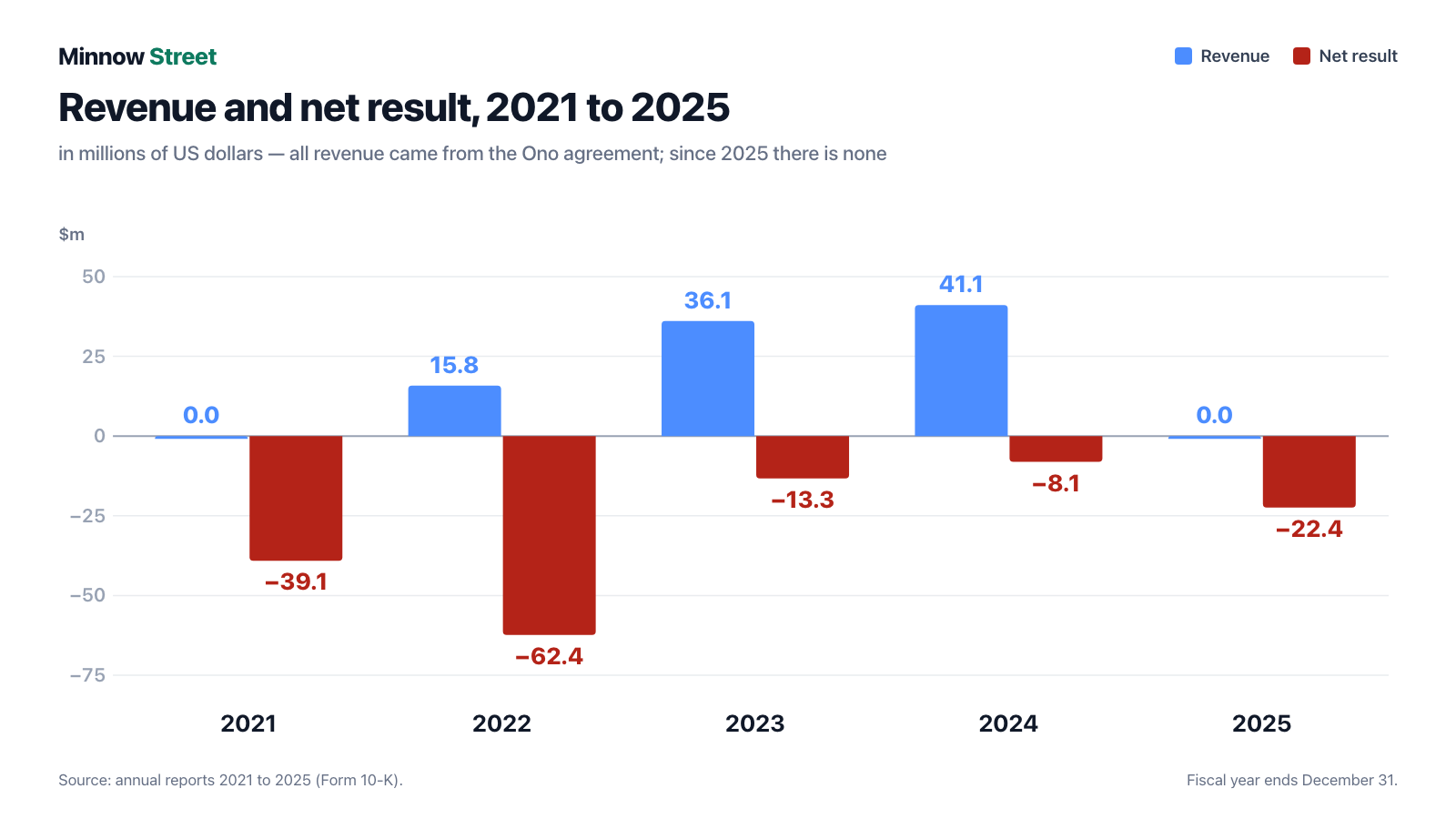
That revenue was never what investors normally understand by revenue. It came entirely from a contract with the Japanese pharmaceutical company Ono Pharmaceutical dated December 5, 2022: Ono paid a one-time 3.5 billion yen — roughly $26.4 million — for an option to buy the rights to the compound itolizumab for North America, Australia and New Zealand at a later date, and funded the research quarterly in the meantime. In plain terms: somebody paid a deposit to have a house held for them and covered the contractors while they thought about it. In accounting terms that deposit was recognized as revenue over the term of the deal. And then the interested party decided against buying:
"Ono made a strategic business decision to allow its Option to expire on October 30, 2024 and, as a result, the Asset Purchase Agreement automatically terminated on that date pursuant to its terms."
— Equillium, Inc., SEC annual report 10-K for 2025 (filed March 25, 2026), Item 7 (MD&A), Overview
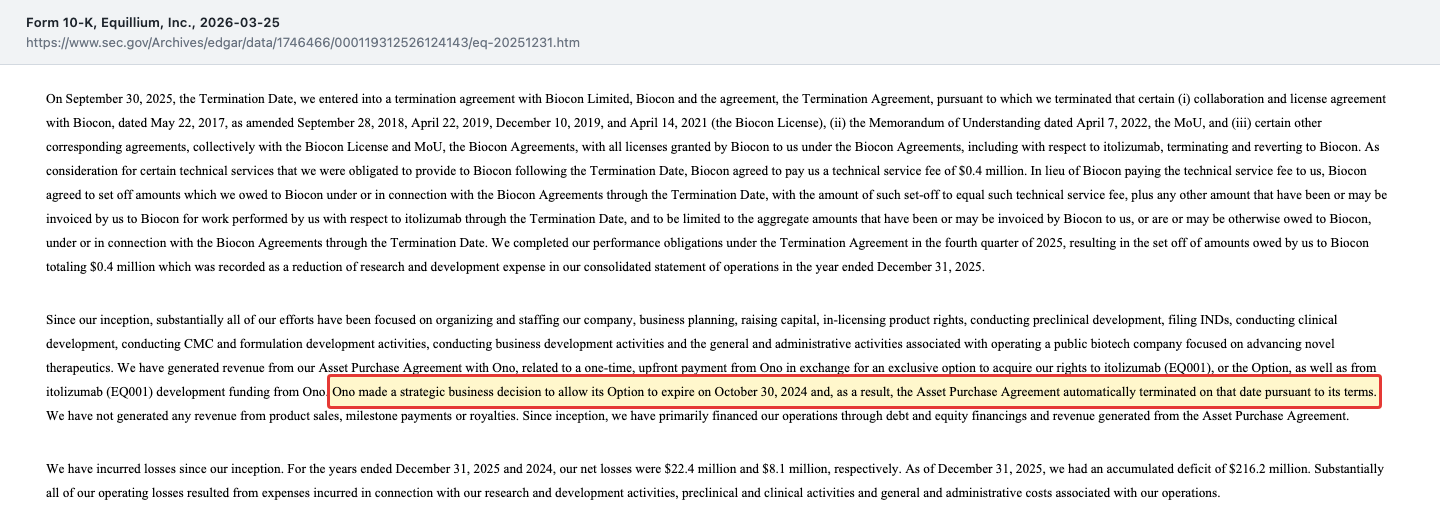
That explains the series of numbers — and puts it in honest perspective. The company itself says it has never generated "any revenue from product sales, milestone payments or royalties." Read the other way around, that means: the small loss of 2024 was not a sign of earning power, it was the result of somebody else paying for the research. When that somebody left, the true cost block came into view. In the first quarter of 2026 the net loss was $5.3 million, after $8.7 million in the year-earlier quarter; the income statement has carried no revenue line at all for five quarters. Since inception Equillium has lost $221.5 million (as of March 31, 2026).
Uncomfortable truth no. 1: 48.5 million shares the quoted price never counts
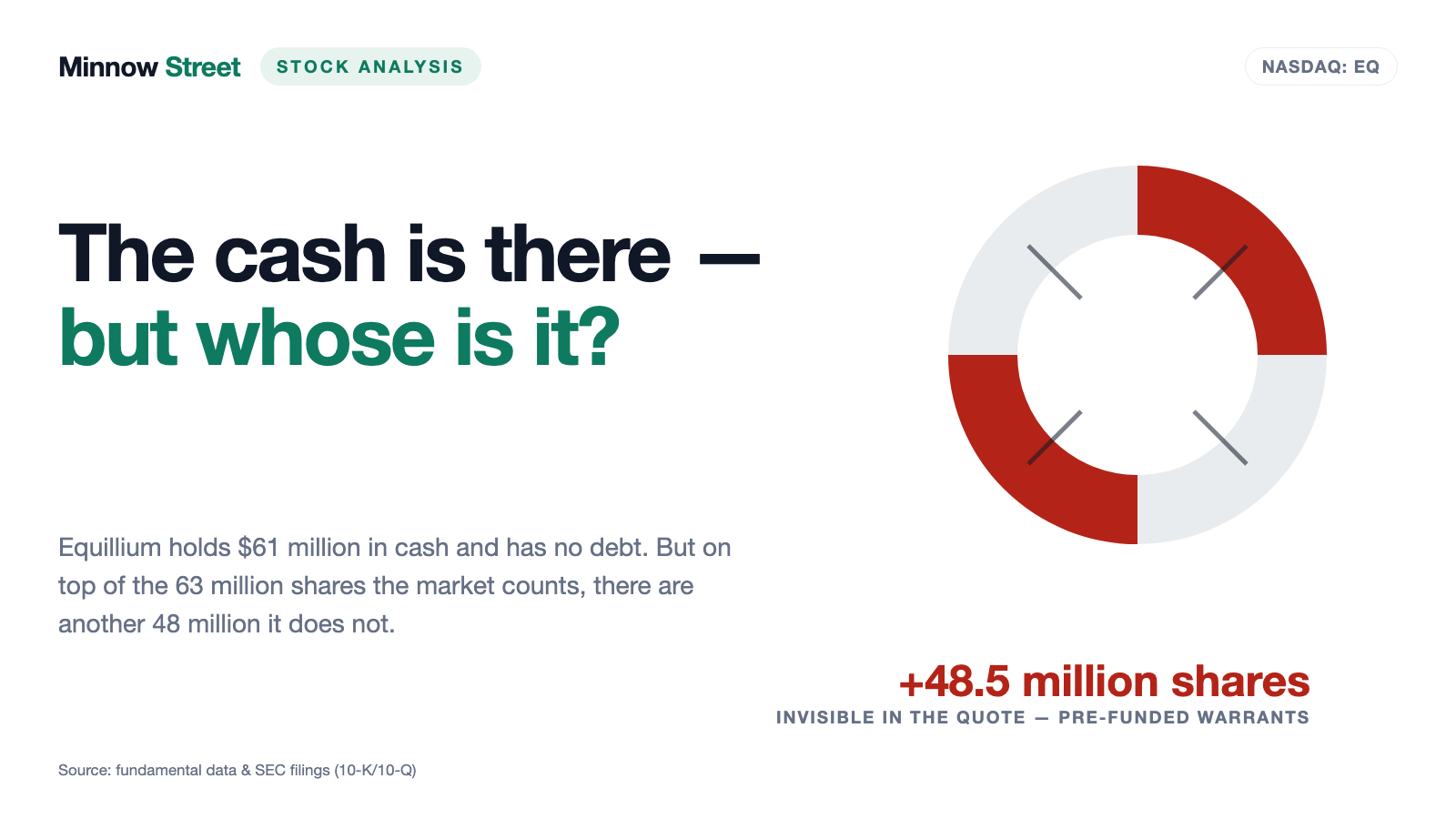
Let's start with the finding that overturns every valuation calculation for this stock. The cover page of the quarterly report carries a clear number: 63,226,556 shares outstanding as of May 8, 2026. That is precisely the number quote pages and data feeds use to compute the market value. Only it is incomplete — and that is not buried in the fine print, it is in the very first note:
"Pre-funded warrants to purchase 48,515,298 shares of common stock are included in the computation of basic and diluted net loss per share for the three months ended March 31, 2026, as the pre-funded warrants are exercisable for nominal consideration."
— Equillium, Inc., SEC quarterly report 10-Q as of March 31, 2026 (filed May 13, 2026), Note 1
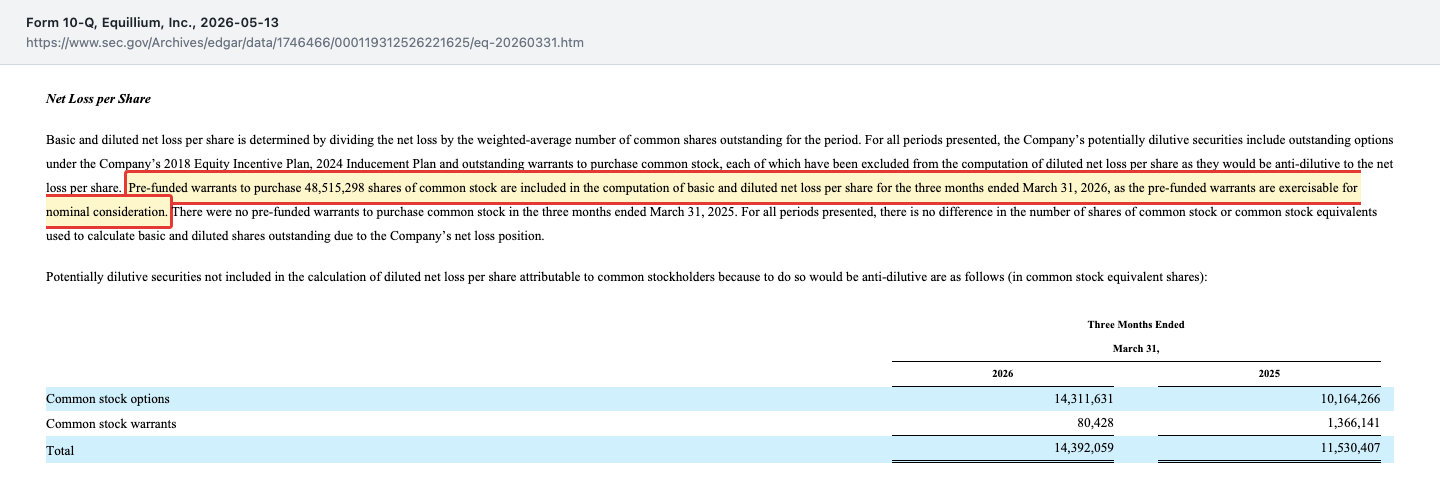
So what is a pre-funded warrant? In everyday terms, it is a voucher for a share that has already been paid for in full. The holder has wired the purchase price; to redeem it, only a symbolic remainder of $0.0001 per share is missing. These vouchers never expire and can be redeemed at any time. Economically their holder has long been a shareholder — he simply leaves the stock formally outside the share count so that he stays below every disclosure threshold.
The arithmetic is therefore unambiguous: 63,226,556 + 48,515,298 = 111,741,854 economic shares. The company itself calculates that way — in the first quarter of 2026 with 96,279,216 weighted shares, that is, considerably more than are actually outstanding. The loss per share of 6 cents the company reports rests on that larger number. And if you keep counting, the number climbs higher still: the reservation table in the notes lists 101,477,921 reserved shares as of March 31, 2026 — 48,515,298 for the pre-funded warrants, 35,087,717 for the still-open second financing tranche and 17,874,906 for options, employee plans and legacy warrants. Together with the shares outstanding that makes 164,704,477 potential shares.
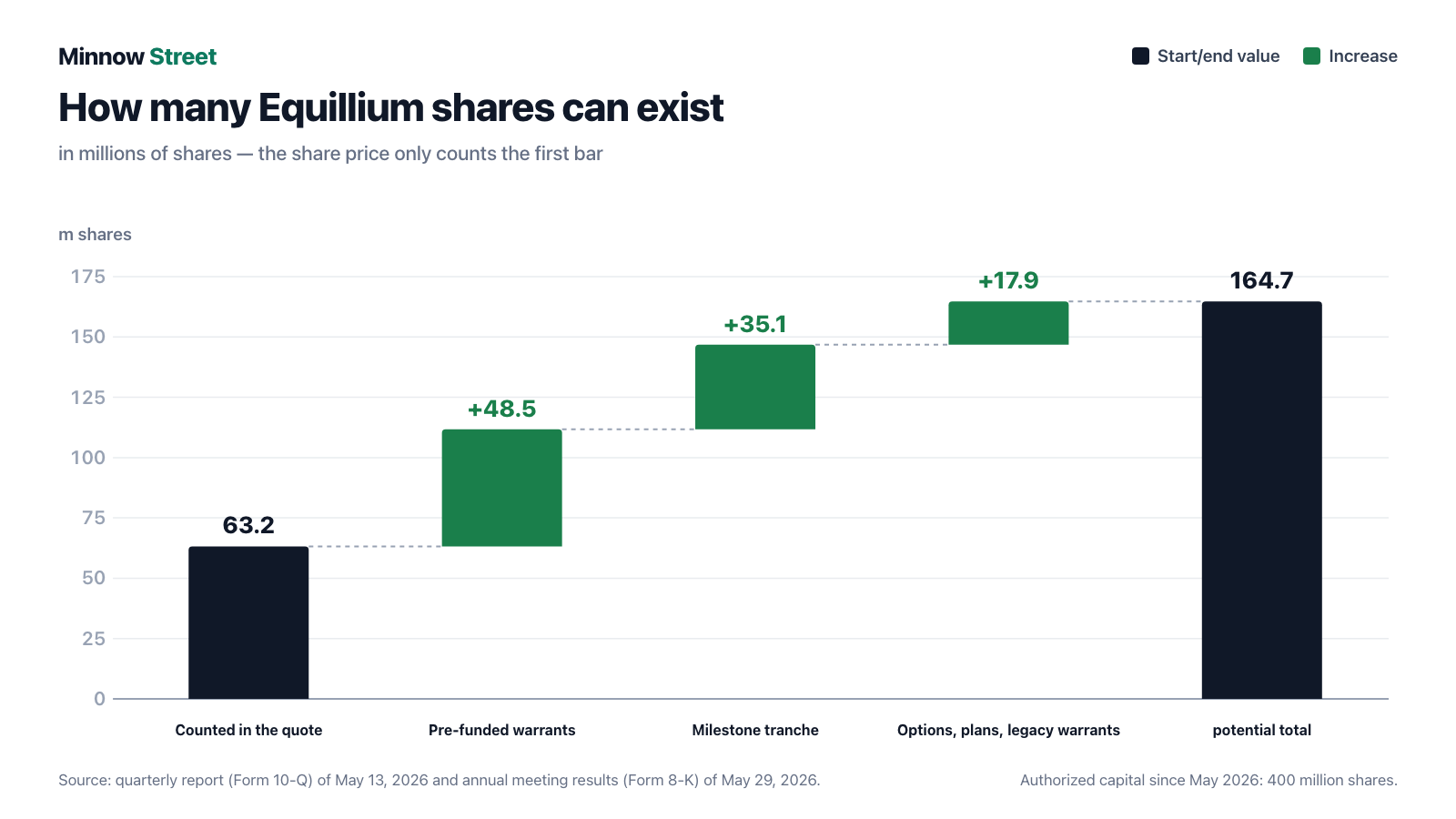
For a sense of how quickly that happened: at the end of 2024, 35,557,563 shares were outstanding; at the end of 2025 it was already 61,464,368 — and reservations jumped in the same year from 13.3 million to 80.7 million shares. Remember this sentence: at Equillium the share count is the fastest-moving number at this company, faster than any cash balance. And that is exactly the practical side of the cash illusion: cash rose from $30.3 million (December 31, 2025) to $61.3 million (March 31, 2026), so it comfortably doubled. Over the same period the economic share count rose from 92.3 million to 111.7 million. That leaves roughly 55 cents of cash per economic share — against a documented price of $2.01 on April 6, 2026.
Uncomfortable truth no. 2: the lead drug is not paused — it belongs to somebody else now
In write-ups about small biotechs you often read that a program has been "paused" or "deprioritized". At Equillium it is something else. The former lead product itolizumab (EQ001), an antibody, was never the company's property — it was licensed from the Indian manufacturer Biocon. And that license ended:
"with all licenses granted by Biocon to us under the Biocon Agreements, including with respect to itolizumab, terminating and reverting to Biocon."
— Equillium, Inc., SEC annual report 10-K for 2025 (filed March 25, 2026), Item 7 (MD&A) and Note 8 (Partnerships)
The effective date was September 30, 2025. What vanished with it is more than a compound — and part of it was a burden. Because the $30 million and the $565 million written into that contract were never owed by Biocon to Equillium; they were owed by Equillium to Biocon: up to $30 million of regulatory milestone payments, up to $565 million of sales milestone payments and, on top of that, running royalties on every unit sold (annual report 10-K for 2024, Item 1, Biocon license). Handing the compound back extinguished that payment obligation — the one consolation in this setback. Because in the same moment everything that could ever have earned those payments went away too. Think of it this way: the recipe developer has handed the recipe back. He owes the big bakery nothing any more — he simply has nothing left to sell either.
And the setback goes deeper than the press wording suggests. In the risk chapter of the annual report the company lists every trial it has ever run in one anonymous half-sentence: "We previously conducted four Phase 1 studies, one Phase 2 study and one Phase 3 study of discontinued product candidates and indications." — four Phase 1 studies, one Phase 2 study and one Phase 3 study of discontinued candidates. The disease it was about — acute graft-versus-host disease, or aGVHD — does not appear a single time in the entire report for 2025. The name of the failed Phase 3 study, EQUATOR, is left in three times: once as a cost line in the research table and twice in the explanation of that line, which is about winding the study down. A reader of that report alone will never learn that a Phase 3 missed its primary endpoint here in March 2025.
That leaves Equillium standing today where it stood in 2018 — with two preclinical compounds. The schedule for the next step is on the record: "We intend to commence a Phase 1 proof-of-mechanism study for EQ504 … in mid-2026, with data expected to follow approximately six months thereafter" (quarterly report 10-Q as of March 31, 2026). As of July 30, 2026 no filing confirms that the study has started. The most recent document Equillium has filed with the SEC at all is dated June 5, 2026. The start is neither announced nor denied — it is simply the next hard checkpoint. How high the stakes run in this phase we saw at Gossamer Bio, where the same question — does the cash last longer than the pipeline needs? — hangs on a study that failed.
Uncomfortable truth no. 3: the report says more about cryptocurrency than about both compounds
This truth can not only be quoted, it can be measured. In August 2025 — in the middle of the stretch when the stock traded below one dollar and the Nasdaq was threatening to delist it — Equillium announced it would widen its own treasury strategy to include digital currencies:
"In August 2025 we announced the expansion of our treasury strategy to include digital currencies for the diversification, liquidity and long-term capital appreciation potential they represent, and we updated our treasury investment policy to permit such investments. We have not initiated our cryptocurrency treasury strategy but we may in the future invest in or otherwise acquire digital currencies."
— Equillium, Inc., SEC annual report 10-K for 2025 (filed March 25, 2026), Item 1A "Risks Related to Our Crypto Treasury Strategy"

Three points make this an uncomfortable truth. First, the sheer volume: the company's own risk chapter on cryptocurrency runs to roughly 25,500 characters in the annual report; the complete description of both compounds EQ504 and EQ302 in Item 1 comes to roughly 10,900 characters. There is more than twice as much text about an investment strategy that does not yet exist as about the actual product.
Second, the funding source. The only proceeds expressly excluded from crypto use are those of the two private placements. The proceeds of the facility for ongoing share sales over the exchange — since September 19, 2025 up to $75.0 million — are not. Put differently: money raised by issuing new shares may, according to the report, flow into cryptocurrency. For an existing shareholder that is an uncomfortable combination — he is diluted, and the proceeds may end up in an asset class that has nothing to do with the disease this is all supposed to be about.
Third, the state of play. Nothing has been implemented as of July 30, 2026: the balance sheet as of March 31, 2026 carries no line for digital assets, and current assets consist of $61.322 million of cash and $953 thousand of prepaid expenses. That is precisely what makes it a point to watch rather than an accusation — but it belongs on the table if you want to judge what this company's cash is actually for.
Uncomfortable truth no. 4: what the annual meeting of May 28, 2026 approved
Anyone reading only the quarterly report of May 13, 2026 has missed the most important resolution of the year — it came fifteen days later. At the annual meeting on May 28, 2026 two things were decided that mean more for tomorrow's share count than any study.
First: authorized capital was doubled.
"The Company's stockholders approved an amendment to the Company's Amended and Restated Certificate of Incorporation to increase the authorized number of shares of common stock from 200,000,000 to 400,000,000 shares."
— Equillium, Inc., SEC current report 8-K of May 29, 2026, Item 5.07 (proposal 4)

This is not an announcement, it is done: the 8-K attaches as Exhibit 3.1 the certificate of amendment dated May 28, 2026. What is remarkable is the voting pattern. 11,570,307 shares voted against and 42,687,545 in favor — that is roughly 21 percent of the 54,287,329 shares represented at the meeting. On the other substantive resolutions opposition stayed below 3 percent; only the re-election of director Charles McDermott drew comparable resistance, with 10,018,889 votes withheld, or roughly 18.5 percent. Part of the large shareholders who funded this company themselves in August 2025 and March 2026 visibly did not want the extra share reserve.
Second: authority for a reverse stock split. Shareholders allowed the board to consolidate the stock at a ratio of 1-for-2 up to 1-for-20 — the ratio, the timing and the question of whether at all rest, per the resolution text, in the board's discretion alone. According to the proxy statement, that authority runs through December 31, 2027.
A reverse split is neutral to begin with: twenty shares become one, the price multiplies by twenty on paper, your slice stays the same — like cutting a pizza into fewer, larger pieces. What matters is the occasion. And here the picture is clear: the Nasdaq is not forcing Equillium to do it. The minimum bid price proceeding that began on December 13, 2024 has been closed since August 29, 2025 — the exchange confirmed compliance in writing back then, and there is no open proceeding. The rationale in the proxy statement is correspondingly soft: the company wants to improve tradability and liquidity and reach investors who are not allowed to buy low-priced stock. A consolidation held on standby, with no external pressure, a range up to 1-for-20 and a runway through the end of 2027 — that is no scandal, but it is a tool that can be pulled at any time without anyone asking you again.
Uncomfortable truth no. 5: $1.3 million for the lead project, $4.8 million for the wind-down
Finally, a look at the place where a research company really discloses its priorities: the breakdown of research spending. Of the $12.8 million Equillium reported for research and development in 2025, exactly $1.301 million went into the declared lead project EQ504. Winding down the failed Phase 3 study of the old compound consumed $4.827 million in the same year. And the largest block was no program at all: $6.530 million fell on indirect costs, meaning personnel and overhead — more than all direct program costs combined ($6.313 million).
Beside that sit $10.8 million of administrative expenses for 14 employees. Put another way: for every dollar that went into the compound meant to save this company in 2025, roughly eight dollars went into administration. That is not an accusation of waste — a listed company with two acquisitions, a listing proceeding, two capital raises and a licensing unwind behind it has real fixed costs. But it puts the celebrated cost halving in perspective: the savings came above all where the research was.
One detail also shows how tight things got in the meantime. Part of the reported cost reduction comes not from efficiency but from concessions: the company negotiated discounts with clinical service providers on invoices already outstanding and booked them as a reduction of research expense; a service fee of $0.4 million was offset by Biocon against existing debt. One line of the cost table therefore shows a negative expense of minus $115 thousand. Anyone negotiating with suppliers over open invoices rarely does so from a position of strength.
The other side of the ledger — what is genuinely solid here
This analysis would be dishonest if it ended here. Because the balance sheet side of Equillium really is strong, in a way that is rare among micro caps.
- No financial debt. No loan, no credit line, no convertible note. Total liabilities of $3.596 million (March 31, 2026) consist of open supplier invoices, accruals and lease obligations. The old $10 million loan was repaid in full back on May 25, 2023.
- $61.3 million of cash, $60.4 million of it in money market funds — so not in securities whose price can swing, but effectively as overnight money.
- No going-concern doubt in the audit opinion for fiscal 2025 or in the quarterly report: the terms "going concern" and "substantial doubt" do not appear a single time in the 10-Q.
- Cost base halved (from $49.4 million to $23.6 million) and an operating cash burn that fell to $4.3 million in the first quarter of 2026 — after $8.2 million in the year-earlier quarter.
- Specialist owners. Six healthcare-focused funds together hold 33,755,941 shares, or 53.4 percent; every one of them sits exactly at its 9.9 or 9.99 percent reporting cap. These investors have funded the company twice voluntarily — in August 2025 at $0.57 and in March 2026 at $1.854 per share.
- No litigation as of December 31, 2025 and no open Nasdaq proceeding.
An honest look at the cash runway has to run in both directions. The company itself says:
"We believe that our cash and cash equivalents will be sufficient to fund our operating expenses into 2029."
— Equillium, Inc., SEC annual report 10-K for 2025 (filed March 25, 2026), Item 1 (Business)
Let's check the arithmetic. At the actual first-quarter 2026 cash burn of $4.301 million, $61.3 million lasts about 14 quarters — which does indeed carry into the end of 2029. Take instead the spending level of the year-earlier quarter, when clinical work was still running ($8.169 million per quarter), and it is only seven and a half quarters — so into early 2028. Which number sits closer to the truth is something the company answers itself: "We expect research and development expenses in future periods to increase primarily due to the advancement of EQ504 … into and through clinical development." Research costs are meant to rise, in other words. The first quarter of 2026 was a quarter between two programs — the old studies wound down, the new one not yet begun.
And one more piece of context belongs to fairness: dropping the going-concern paragraph is real progress — but the auditor changed in the same year. The report for fiscal 2024 came from KPMG (auditor since 2018) and carries the substantial-doubt paragraph; the report for 2025 was prepared by Crowe LLP, without one. Both are compliant and disclosed, and the all-clear is well supported by $61.3 million of cash. It still belongs on the record that the auditor who wrote the warning is the one who left. Incidentally, the audited note is more cautious than the 2029 statement in the narrative section: it says the funds are sufficient "for at least the next 12 months" — at least twelve months from the filing date.
Valuation: why every data feed measures this company wrong
The warning comes first, because for once it is the most important statement of the chapter: metrics from data feeds will mislead you on Equillium. There is no price-to-earnings ratio, because the company loses money. There is no price-to-sales ratio, because there is no revenue — and yet databases publish one, because they carry $130,000 of revenue for 2025 that the filing does not know (the filing says zero), and because their trailing twelve-month revenue still drags along the fourth quarter of 2024. The forward P/E, enterprise value to operating profit and every growth rate are contaminated from the same source. Anyone using those numbers is doing arithmetic on a company that does not exist.
What holds up are only dated prices out of the filings themselves. Three are available: $1.55 as of December 31, 2025 (year-end price, notes to the annual report), $2.01 on April 6, 2026 (cover page of the registration statement S-3) and $3.1638 as the average price of a documented insider sale on June 4, 2026.
Take the middle, well-documented anchor of April 6, 2026 and run the order of magnitude twice:
- Narrow count (shares outstanding only): 63,226,556 × $2.01 = roughly $127 million. That is how every data feed sees it.
- Economic count (including pre-funded warrants): 111,741,854 × $2.01 = roughly $225 million. That is how the company itself counts when it reports earnings per share.
The economic figure is roughly 77 percent higher — and that flips the entire narrative. Counted narrowly, Equillium looks like a company whose market value is half cash ($61.3 million of $127 million, or 48 percent). Counted economically, it is 27 percent. Book value per share falls in the same calculation from $0.94 to $0.53.
So what are you paying for if you buy here? Broadly: roughly $225 million for $61 million of cash, two preclinical compounds, 14 employees and a study start that so far exists only as an announcement. The difference of roughly $164 million is the price of hope. Whether that is reasonable depends entirely on what EQ504 can do — and until the first study data nobody knows that, the company included. For a comparison with a clinically far more advanced case: how quickly a valuation like this is decided on a single date is what our analysis of Capricor shows.
The "professionals' view" is thin on this stock: the data we evaluated contain just two analyst opinions, both "hold", at an average price target of $8.56 (data as of July 29, 2026). Two opinions are not a consensus, they are two opinions — and a price target roughly four times the documented filing prices says above all how wide the range of expectations is for a company without revenue.
Opportunities and risks at a glance
What speaks for Equillium:
- A debt-free balance sheet: $61.3 million of cash ($60.4 million of it in money market funds) against $3.6 million of liabilities as of March 31, 2026, no financial debt whatsoever and no going-concern doubt in the audit opinion for fiscal 2025.
- Cost base halved: from $49.4 million to $23.6 million (2024 to 2025), with operating cash burn in the first quarter of 2026 down to $4.3 million after $8.2 million in the year-earlier quarter.
- Runway: at the current burn the cash lasts about 14 quarters; the company itself says "into 2029" and therefore needs no fresh money for the next development step.
- A specialist owner base: six healthcare funds hold 53.4 percent and have voluntarily supplied fresh capital twice (August 2025 at $0.57, March 2026 at $1.854 per share); insiders hold a further 17.84 percent.
- A possible additional inflow with no new negotiation: up to $20 million from the second financing tranche, if EQ504 makes it into the clinic and the stock reaches the agreed threshold.
- No open Nasdaq proceeding (minimum bid price satisfied since August 29, 2025) and no litigation as of December 31, 2025.
What speaks against it:
- No revenue, no product: the income statement has had no revenue line for five quarters; the former lead product reverted to Biocon on September 30, 2025. That Equillium's own payment obligation to Biocon lapsed with it — up to $30 million plus $565 million of milestones — is relief on paper only: it would have fallen due only on an approval that can now never come. The pipeline is preclinical — back to square one.
- Dilution as a permanent condition: 63.2 million visible, 111.7 million economic and 164.7 million potential shares; reservations sextupled in 2025 to 80.7 million, and the first quarter of 2026 added 4.48 million new options — for 14 employees.
- Authorized capital doubled to 400 million shares on May 28, 2026 (21 percent voting against), plus authority for a 1-for-2 to 1-for-20 reverse split through the end of 2027 at the board's sole discretion.
- An uncertain date: the Phase 1 start announced for mid-2026 is confirmed in no filing as of July 30, 2026; the most recent document at the SEC is dated June 5, 2026.
- An approved but unexecuted cryptocurrency treasury whose risk chapter in the annual report runs to roughly 25,500 characters against roughly 10,900 characters of product description; proceeds from the $75 million share-sale facility may flow there.
- Management structure and insider behavior: no dedicated finance chief (the chief executive is also principal financial officer), only 39 holders of record, and the president and chief scientific officer sold a total of 230,975 founder shares from 2017 on June 4 and 5, 2026 without a pre-arranged trading plan.
A human conclusion
Back to the cash illusion from the opening. Its core is not that cash is a bad thing — $61.3 million without a cent of debt is a genuine asset, and plenty of small biotechs would give a lot for it. Its core is that "plenty of money, no debt" is a statement about the past: it describes what was raised, not what is being earned. And it leaves the decisive question unanswered, namely: how much of that money is actually yours?
At Equillium the honest answer is: less than the quoted price suggests, and probably less tomorrow than today. Count in the 48.5 million already-paid share vouchers and roughly 55 cents of cash falls on each economic share. If the second financing tranche fires, 35.1 million shares at $0.57 come on top. If every reservation is drawn, the count is 164.7 million. And since May 28, 2026 the authorized capital stretches to 400 million.
Buying here therefore means buying exactly two things: a well-filled, debt-free cash box — and a hope that has a name, EQ504, and needs a date that no document has yet confirmed. That can be an entirely reasonable decision: preclinical compounds have often become medicines, and a company that can go three years without raising money has more calm than most of its competitors. It is simply not a safety decision, it is a wager. So the honest question to you is not "is the balance sheet healthy?" — it is. The question is: would you pay $225 million for a cash box holding $61 million, because you believe in a molecule that has never seen a human being? If yes, you have a thesis. If no, you had a good feeling. What you make of it is your decision. And that is exactly as it should be.
Sources
Every original document used in this analysis, for you to read yourself:
- Equillium, Inc. — SEC annual report 10-K for 2025 (filed March 25, 2026)
- Equillium, Inc. — SEC annual report 10-K for 2024 (filed March 27, 2025)
- Equillium, Inc. — SEC quarterly report 10-Q as of March 31, 2026 (filed May 13, 2026)
- Equillium, Inc. — SEC current report 8-K of May 29, 2026, Item 5.07 (annual meeting of May 28, 2026)
- Equillium, Inc. — SEC current report 8-K of March 13, 2026, Items 1.01/3.02 ($35 million private placement)
- Equillium, Inc. — SEC registration statement S-3 of April 7, 2026 (resale, 333-294919; price anchor $2.01 of April 6, 2026)
- Equillium, Inc. — SEC registration statement S-3 of November 13, 2025 ($250 million shelf, 333-291510)
- Complete SEC filing history of Equillium, Inc. (CIK 0001746466), including the proxy statement DEF 14A of April 15, 2026 as well as the insider filings (Form 4) and notices of proposed insider sales (Form 144) from May and June 2026: EDGAR overview (sec.gov)
- Fundamental data (industry, ownership, price series, analyst opinions; data as of July 29, 2026), reconciled against the SEC filings and the SEC's XBRL financial series. The revenue and valuation metrics derived from it were not used, because the stored 2025 annual revenue ($130,000) contradicts the filing (zero).
- Hook: Reddit hype watch run of our in-house stock scanner, cut-off date July 30, 2026.
Transparency & disclaimer: This analysis is journalistic commentary on publicly available information. It is not investment advice, not a regulated financial analysis and not a solicitation to buy or sell securities. Equity investments carry substantial risks up to the total loss of capital — particularly so at a biotechnology company with no revenue and no approved product. All information is provided without warranty; the as-of date for each figure is stated in the text. The author holds no position in Equillium shares at the time of publication.
Our Bottom Line at a Glance
- Balance sheet and funding positive
- As of March 31, 2026 there is $61.322 million of cash ($60.390 million of it in money market funds) against $3.596 million of liabilities, consisting solely of supplier invoices, accruals and lease obligations. There is no loan, no credit line and no convertible note; the old $10 million loan was repaid in full on May 25, 2023. The audit opinion for fiscal 2025 contains no going-concern doubt.
- Business and pipeline negative
- Revenue fell from $41.1 million (2024) to zero (2025) and stays there — the income statement has had no revenue line for five quarters. The cause is the expiry of the Ono purchase option on October 30, 2024. On September 30, 2025 all itolizumab rights reverted to Biocon; in return Equillium's own obligation to pay Biocon up to $30 million plus $565 million of milestones lapsed — together with any prospect of ever triggering it. What remains are two preclinical candidates; the Phase 1 start announced for mid-2026 is confirmed in no filing as of July 30, 2026.
- Dilution negative
- The quoted price counts 63,226,556 shares (May 8, 2026), the company itself 96,279,216 weighted shares in the first quarter of 2026, because 48,515,298 pre-funded warrants at $0.0001 enter the basic loss per share. Economically there are 111,741,854 shares, potentially 164,704,477. Reservations rose in 2025 from 13.3 million to 80.7 million; the first quarter of 2026 alone added 4.48 million new options — for 14 employees.
- Governance and capital authority negative
- The annual meeting of May 28, 2026 doubled authorized capital from 200 million to 400 million shares (executed by certificate of amendment, 11,570,307 votes against = roughly 21 percent of the 54,287,329 shares represented) and granted authority for a reverse split of 1-for-2 to 1-for-20 through December 31, 2027 at the board's sole discretion — with no Nasdaq pressure, since the minimum bid price requirement has been satisfied since August 29, 2025. On top: no dedicated finance chief, and a sale of 230,975 founder shares by the president and chief scientific officer on June 4 and 5, 2026 without a pre-arranged trading plan.
- Use of funds neutral
- Of $12.8 million of research expense in 2025, $1.301 million went to the declared lead project EQ504, $4.827 million to winding down the failed legacy study and $6.530 million to indirect costs; beside that sit $10.8 million of administrative expense for 14 employees. The cryptocurrency treasury approved in August 2025 remains unimplemented as of July 30, 2026, and its risk chapter runs to roughly 25,500 characters — more than twice the product description (roughly 10,900).
- Data quality and verifiability negative
- Metric databases carry $130,000 of 2025 revenue while the filing reports zero; every price-to-sales, enterprise-value and growth figure derived from it is unusable. The feed market value also counts only the 63.2 million shares outstanding and therefore prices the company roughly 43 percent below its economic size (roughly $127 million instead of roughly $225 million at the documented price of $2.01 on April 6, 2026). Only dated filing prices hold up.
Equillium is the cash illusion in its purest form: $61.3 million of cash as of March 31, 2026, no financial debt, no going-concern qualification — and behind it a company with 14 employees, no revenue, no product and two preclinical compounds. The $41.1 million of 2024 revenue was the wind-down of a single contract whose purchase option expired on October 30, 2024; on September 30, 2025 every right to the former lead product reverted to Biocon. The full cash box was paid for with stock: on top of the 63.2 million visible shares sit 48.5 million pre-funded warrants that the company itself counts, plus reservations taking the total to 164.7 million — and since May 28, 2026 an authorized capital of 400 million. Buying here means buying a well-filled cash box plus the hope for a molecule whose first study in humans no document has yet confirmed. Not investment advice.
What Our Rating Means
Open questions
The business works in principle, but one material question is open. As long as it stays open, our findings do not carry a quality verdict.
Yellow rather than red: there is no documented threat to the substance of the company. The balance sheet as of March 31, 2026 shows $61.322 million of cash against $3.596 million of liabilities, no financial debt whatsoever, equity of $59.487 million and no going-concern doubt; the Nasdaq minimum bid price proceeding has been closed since August 29, 2025, no delisting risk for financial reasons is documented, and even on the pessimistic calculation the cash runway is seven and a half quarters. Yellow rather than green: there is no product, no revenue and no pipeline beyond the preclinical stage. The former lead product has been back with the licensor since September 30, 2025, the first study in humans was announced for mid-2026 and is confirmed in no filing as of July 30, 2026, and the share count grows faster than the cash: 63.2 million visible, 111.7 million economic, 164.7 million potential shares against an authorized capital that has stood at 400 million since May 28, 2026. Whoever buys here buys a well-filled cash box plus a hope — and should know that his slice of that cash gets smaller with every financing round. That the stock costs roughly $225 million economically at the documented price anchor is a price argument and does not set the color, but it belongs on the table. The decision is yours.
A journalistic assessment by our editorial team at the time of the deep dive, based on public sources — not investment advice and not a solicitation to buy or sell. Your personal circumstances (investment goals, risk capacity, taxes) cannot be taken into account. What our levels mean, how verdicts are formed, and what conflicts of interest exist →
Worth Noting
- EQ reached the research list through the Reddit hype watch run of our in-house stock scanner, cut-off date July 30, 2026 — that is, through the sheer frequency of mentions in investor forums. That is a reason to read the original documents, not a quality signal. Classic metric screens do not apply here anyway: no profit, so no P/E; no revenue, so no P/S.
- Recency gate: the most recent periodic report is the quarterly report (10-Q) as of March 31, 2026, filed May 13, 2026; the same-day results release (8-K, Item 2.02) has been evaluated. Every filing after that was reviewed individually — two ownership filings of May 15, 2026, the current report 8-K of May 29, 2026 on the annual meeting plus seven insider filings (Form 4), and a further insider filing (Form 4) and notices of proposed insider sales (Form 144) of June 4 and 5, 2026. Nothing after that through July 30, 2026. Important: the quarterly report still states 200,000,000 authorized shares — that figure has been outdated since May 28, 2026 (400,000,000).
- Valuation figures dated and evergreen: documented filing prices of $1.55 (December 31, 2025), $2.01 (April 6, 2026) and $3.1638 (average of an insider sale on June 4, 2026). Market value is deliberately stated twice (roughly $127 million narrow, roughly $225 million economic as of April 6, 2026), because any calculation without the 48,515,298 pre-funded warrants comes out roughly 43 percent below the economic figure. Risk of confusion: the going-concern paragraph reprinted in the report for 2025 comes from the predecessor auditor and relates to 2024 and 2023 — for 2025 itself there is none.
Frequently Asked Questions
Equillium, Inc. (Nasdaq: EQ) of La Jolla, California develops compounds against severe autoimmune and inflammatory diseases. As of December 31, 2025 it employed 14 people. Two preclinical candidates are in development: EQ504, an AhR modulator for ulcerative colitis, and EQ302 for celiac disease, whose development is paused. Manufacturing runs entirely through contract firms; the company owns no approved medicine.
Because its only revenue contract ended. From December 2022 the Japanese partner Ono paid roughly $26.4 million for a purchase option on itolizumab and funded the research. Ono let that option expire on October 30, 2024, which automatically terminated the contract. Revenue of $41.1 million in 2024 became zero in 2025. The company says it never earned product, milestone or royalty revenue.
The cover page of the quarterly report shows 63,226,556 shares as of May 8, 2026. Economically there are 111,741,854, because 48,515,298 pre-funded warrants come on top — fully paid share vouchers with a remaining price of $0.0001 that never expire. The company folds them into its own loss per share. With every reservation drawn, 164,704,477 shares are possible; authorized capital has been 400 million since May 28, 2026.
As of March 31, 2026 the company held $61.3 million in cash, $60.4 million of it in money market funds, and no financial debt. Management expects that to last into 2029. At the first-quarter 2026 burn of $4.3 million that is about 14 quarters; at the year-earlier level of $8.2 million only seven and a half, so into early 2028 — and research costs are meant to rise.
Because both foundations are missing. There is no price-to-earnings ratio, because the company loses money, and no price-to-sales ratio, because there is no revenue. Databases nevertheless carry $130,000 of 2025 revenue while the filing reports zero. Feeds also value the company on 63.2 million shares only: roughly $127 million instead of roughly $225 million at the documented price of April 6, 2026 — about 43 percent short.
Two things with consequences for the share count. Authorized capital was doubled from 200 million to 400 million shares, executed at once by certificate of amendment; 11,570,307 of the 54,287,329 shares represented voted against, roughly 21 percent. And the board may carry out a reverse split of 1-for-2 to 1-for-20 through December 31, 2027 at its own discretion — with no Nasdaq pressure since August 29, 2025.
In August 2025 Equillium announced it may hold corporate cash in digital currencies and updated its investment policy accordingly. Nothing has been implemented as of July 30, 2026 — the balance sheet shows no digital assets. Proceeds from the $75 million share-sale facility may flow there, per the report. The crypto risk chapter runs to roughly 25,500 characters, the description of both compounds to roughly 10,900.
The start is announced for mid-2026, with first data roughly six months later — a sentence in both the annual report of March 25, 2026 and the quarterly report of May 13, 2026. As of July 30, 2026 no filing confirms the actual start; the most recent SEC document is dated June 5, 2026. That start also triggers the second financing tranche of up to $20 million.
Found an error?
Did you spot a factual error, an outdated number, or a typo in this deep dive? Let us know briefly — your report goes straight to the editorial team.