Dynex Capital Stock: A 15.7 Percent Dividend — Paid Out of Substance
The scanner reports triple-digit revenue growth, but Dynex Capital is not a company with revenue — it is a leveraged bond fund in a stock costume. The "growth" is merely the interest booking of a balance sheet tripled on repo credit from $8 billion to $24 billion — and the record quarter still ended in a loss. The tempting 15.7 percent dividend is not earned. We read the annual report (10-K) and the quarterly report (10-Q). Not investment advice — just the package insert that belongs on this dividend.
 Thomas Mücke
Founder & Publisher
Thomas Mücke
Founder & Publisher
Chart
Interactive price chart (TradingView).
Note: pure fact-based analysis, not investment advice and not a solicitation to buy or sell. All figures without guarantee.
There is one number that switches off every investor's caution: a double-digit dividend yield. 15.7 percent, paid monthly — that sounds like a money-printing machine wiring cash to your account month after month. And when the stock scanner then also reports "triple-digit revenue growth", the case seems clear to many: buy, collect, enjoy. Exactly this reflex — call it yield greed — is dangerous, because it skips two questions: Why would the market give away 15.7 percent when money is scarce everywhere? And is this dividend actually earned — or are you just getting your own money back? So let's make a deal: before you touch a single share of Dynex Capital (NYSE: DX), we read together what the company files with the U.S. securities regulator, the SEC. An SEC filing is honest under penalty of law. And at Dynex it tells a story you will find on no dividend portal. In the end, you decide for yourself.
What Dynex actually does
Let's start with a disappointment: Dynex is not a company in the usual sense. It has no product, no customers, no revenue — it has 28 employees and a balance sheet. Dynex is a mortgage REIT, and its business is at its core a single trick: it does what a home builder does, in reverse. Instead of borrowing long-term and earning short-term, Dynex borrows very short-term — through so-called repo transactions, with maturities from overnight to a few months — and uses the money to buy long-dated mortgage securities. What it earns is the difference between the interest the securities yield and the interest the short-term loans cost. Think of it as a leveraged bond fund in a stock costume. The annual report puts it soberly:
"Dynex Capital, Inc. is a real estate investment trust (»REIT«) structured to deliver dividends to shareholders supported by long term returns from investments in mortgage assets backed by U.S. housing and commercial real estate."
— Dynex Capital, Inc., SEC annual report (10-K) for fiscal year 2025, Item 1 "Business"
The good news: the securities Dynex buys are predominantly agency MBS — mortgage packages guaranteed by the government-sponsored U.S. institutions Fannie Mae and Freddie Mac. A credit default is thus practically ruled out. The bad news hides in the little word "leverage". And precisely that turns a boring interest fund into a stock whose book value swings from quarter to quarter.
Where the stock shows up in our scanner
Every day we run about 3,500 stocks through our scanners. Dynex fires in no fewer than 20 filters at once (data as of July 8, 2026), among them "triple-digit revenue growth", "high revenue growth" and "EPS & revenue power". The reason: these growth scanners read the interest-income line as "revenue" — and that line rose 170.8 percent in the first quarter of 2026 versus the prior year (the internal import field even shows +234.8 percent).
Sounds like a rocket? It is not. A mortgage REIT can increase its "revenue" at will — it merely has to issue more shares, take on more credit and buy more bonds. That is exactly what happened. Remember this tension: "revenue" grows triple digits — and the very same quarter shows a loss. It is the connecting thread for everything that follows. To replicate it yourself: on minnowstreet.com, open the "triple-digit revenue growth" filter in the scanner menu and look for the DX row.
The same artifact carries Dynex into a second list: as of July 18, 2026 the stock sits at rank 3 in our EBIT-margin ranking (US selection). An honest caveat belongs next to that ranking: for mortgage REITs the EBIT margin flatters massively, because their largest real cost — the interest expense on billions of repo debt — does not reduce EBIT by definition. A margin far above what any operating business could ever reach says more about the metric than about the company. The branch-appropriate yardsticks for a mortgage REIT are book value per share, the earned result (EAD) and dividend coverage — and those are exactly the numbers we go through now.
The numbers — why "revenue" means nothing here
Look at the quarterly series the scanner fires on. The "revenue" (that is, gross interest income) does indeed climb quarter after quarter — but the net margin jumps wildly between plus 105 and minus 31 percent. No real company shows swings like that; this is mark-to-market accounting:
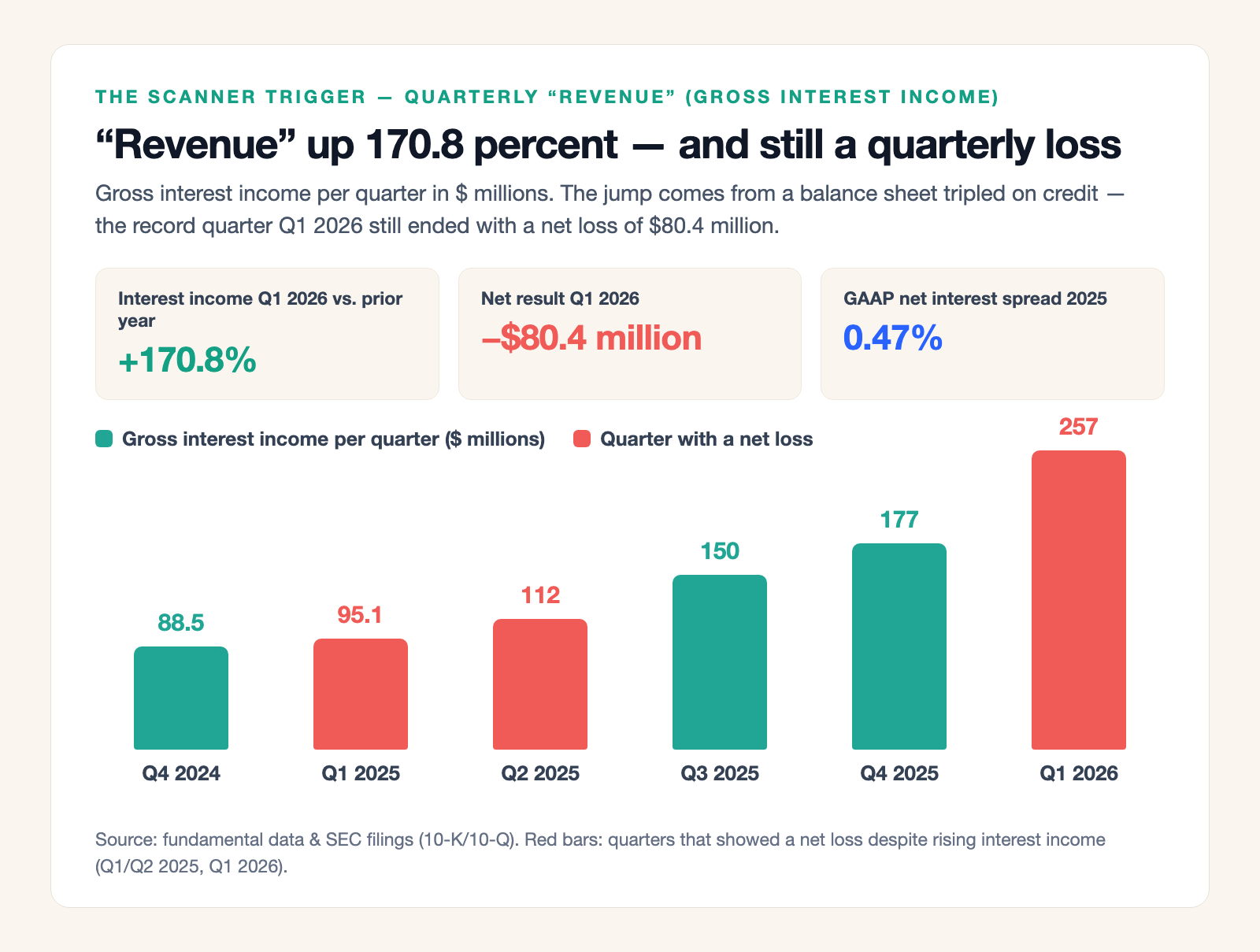
The reason for the jump sits in the balance sheet: Dynex tripled its total assets in just five quarters, from $8.2 billion to $24.3 billion (December 31, 2024 through March 31, 2026), and its repo debt from $6.6 billion to $21.0 billion. More bonds bring more interest income — mechanically, without the business getting any "better". Of the $533.5 million of interest income in 2025, only $114.4 million remained after interest costs; that works out to a meager GAAP net interest spread of 0.47 percent. A revenue-growth screen measures the gas pedal here, not the speed.
The uncomfortable truths
Uncomfortable truth no. 1: the 15.7 percent dividend is not earned
Now to the number most readers came for — the dividend. The honest yardstick for it at a mortgage REIT is called EAD ("earnings available for distribution"). And it shows an uncomfortable gap:
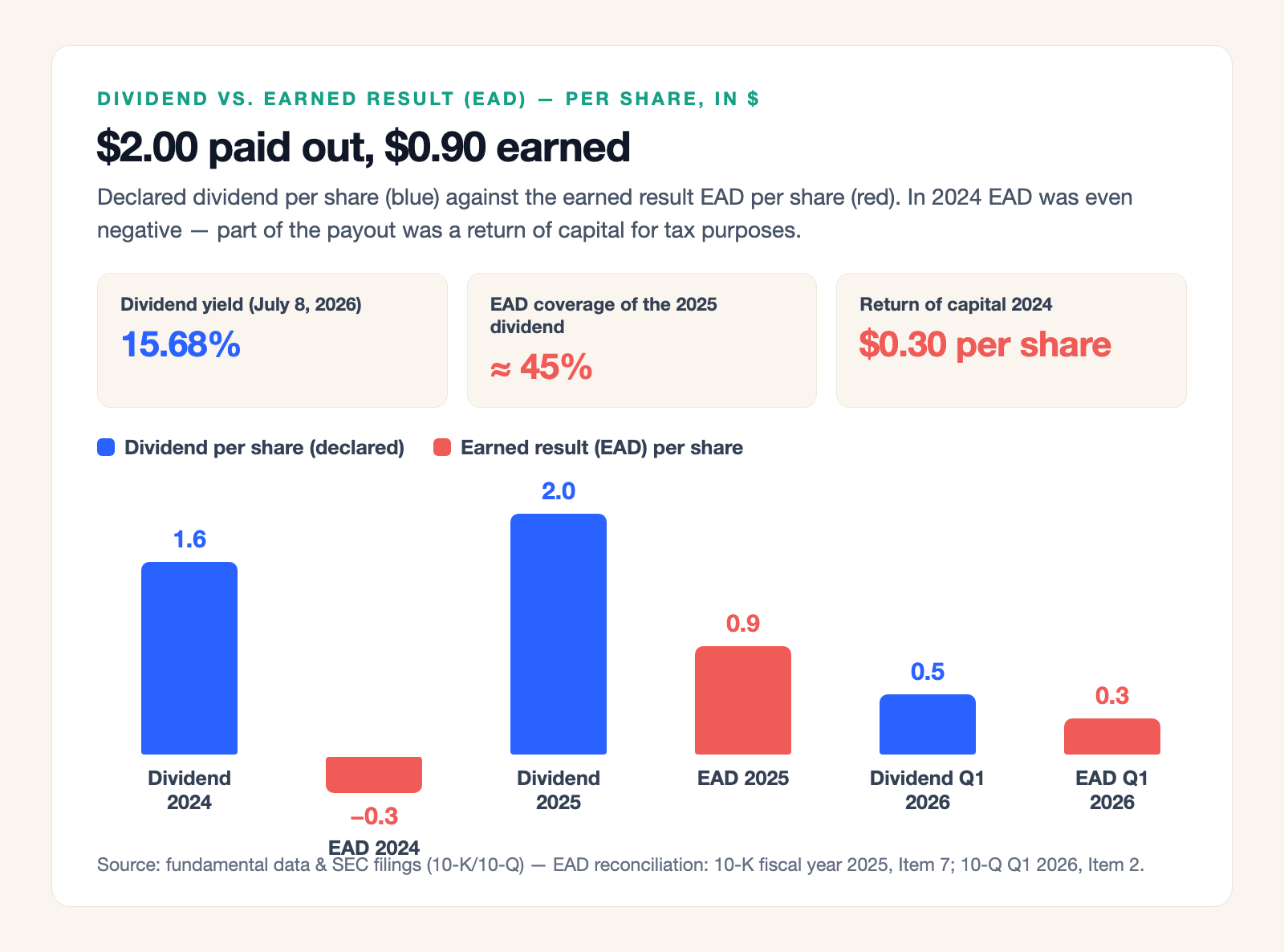
In numbers: in 2024 Dynex paid $1.60 per share but earned minus $0.35; in 2025 it paid $2.00 and earned $0.90; in the first quarter of 2026 it paid $0.51 and earned $0.31. Part of the "yield" is therefore simply a repayment of your own capital — reported for tax purposes as "return of capital". And Dynex makes no secret of the fact that the dividend can fluctuate:
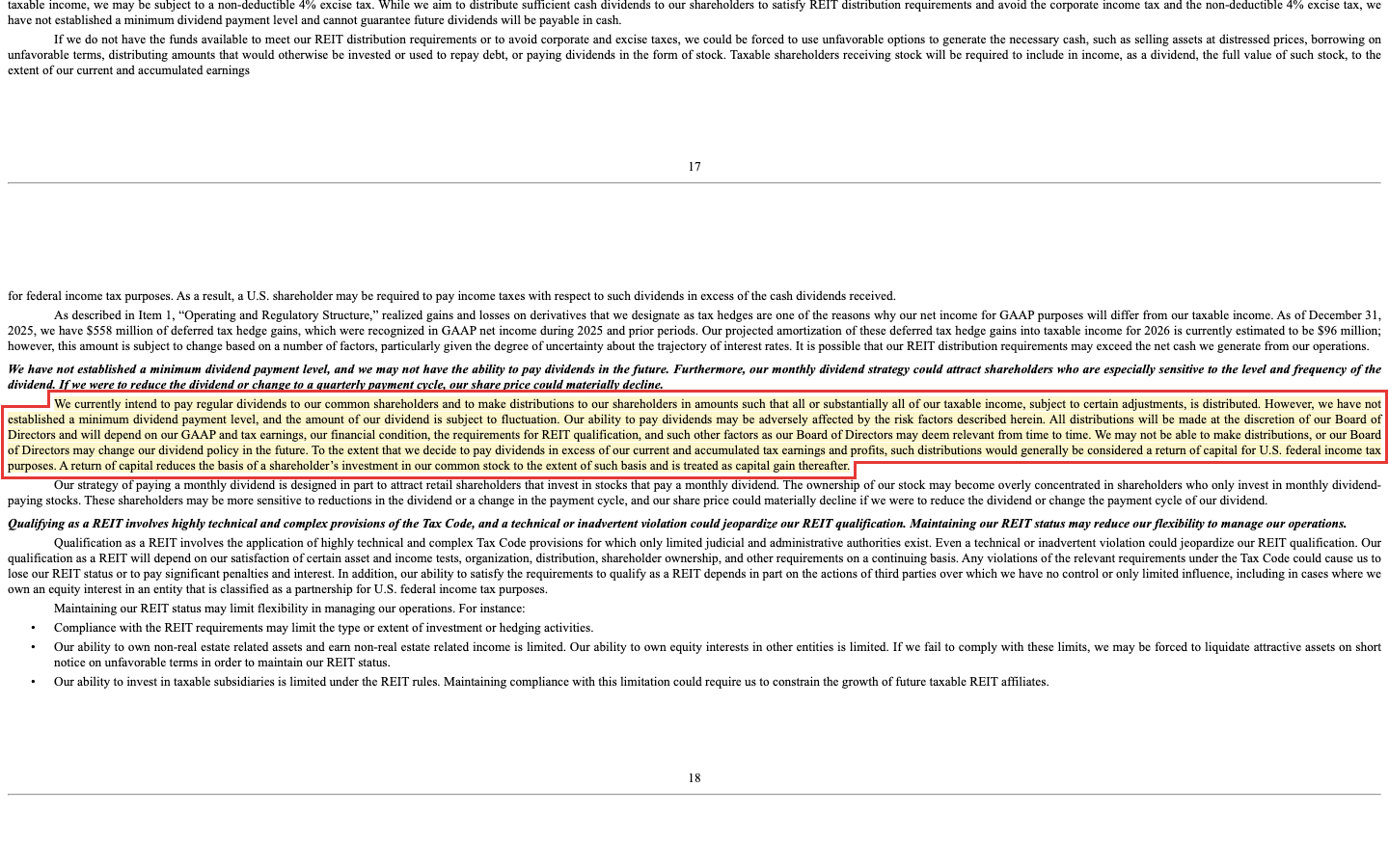
"However, we have not established a minimum dividend payment level, and the amount of our dividend is subject to fluctuation. […] To the extent that we decide to pay dividends in excess of our current and accumulated tax earnings and profits, such distributions would generally be considered a return of capital for U.S. federal income tax purposes."
— Dynex Capital, Inc., SEC annual report 10-K for fiscal year 2025, Item 1A "Risk Factors"
Uncomfortable truth no. 2: the "yield" runs on a dilution machine
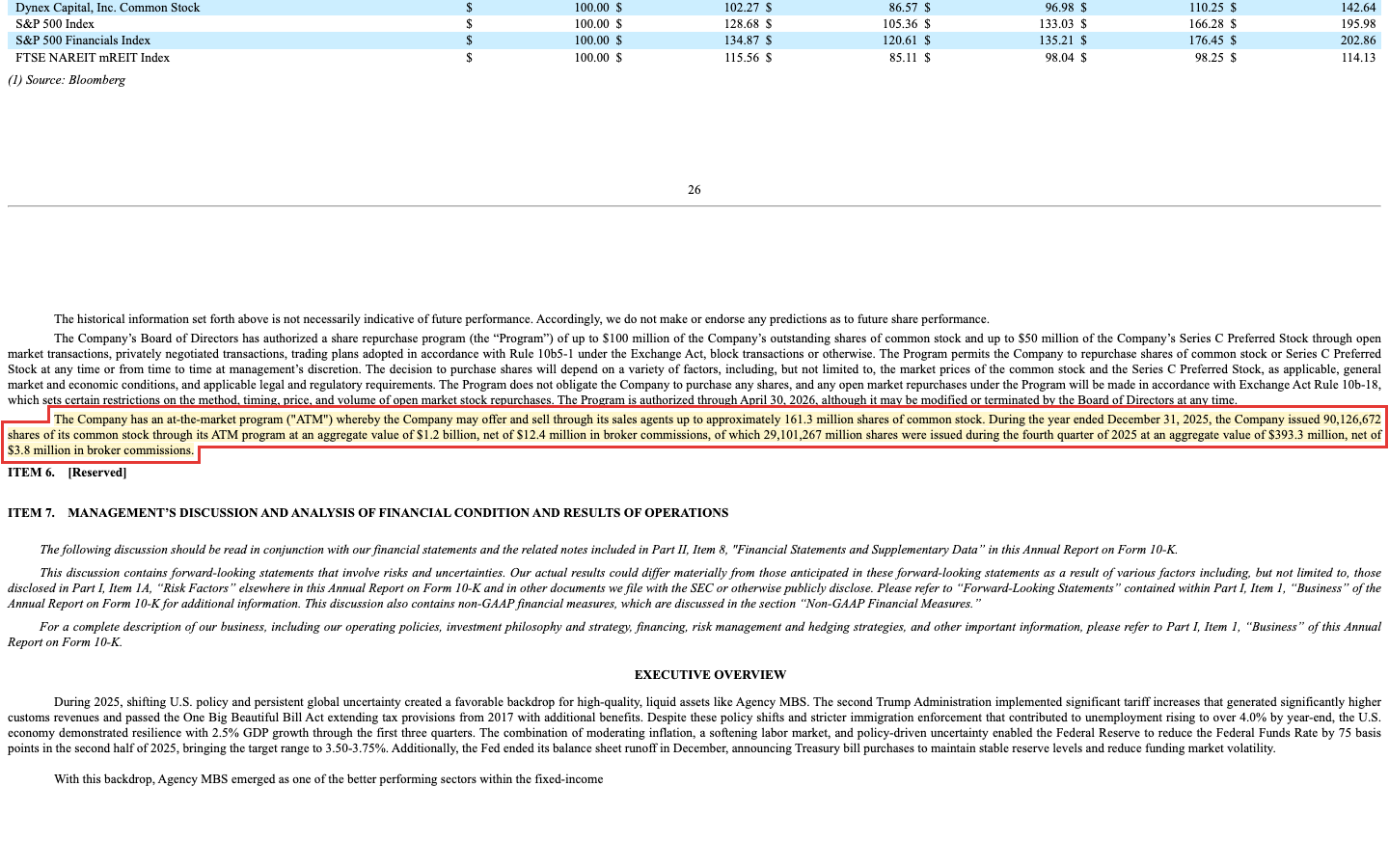
How can Dynex pay a dividend it does not earn? By collecting the money on the stock exchange — through a so-called ATM program (at-the-market), a vending machine for freshly printed shares. The 10-K names the volume:
"During the year ended December 31, 2025, the Company issued 90,126,672 shares of its common stock through its ATM program at an aggregate value of $1.2 billion, net of $12.4 million in broker commissions […]"
— Dynex Capital, Inc., SEC annual report 10-K for fiscal year 2025, Item 5
The share count consequently rose from 53.6 million (end of 2022) to 207.2 million (March 31, 2026) — almost fourfold in a bit over three years. For you as a shareholder that means dilution: your slice of the pie keeps shrinking. Dynex even warns about it itself — future share issuances would "likely dilute" existing shareholders. The dividend is thus increasingly paid out of freshly collected capital to an ever larger share base. Remember: a yield financed by selling new shares is only as stable as the stream of new buyers.
Uncomfortable truth no. 3: book value is eroding — and the leverage sits on call money
At a mortgage REIT the most important number is not the price and not the dividend, but book value per share — the equity attributable to each share. And it is shrinking over the long run: from $19.08 (end of 2020) to $12.60 (March 31, 2026), a minus of 34 percent. In the first quarter of 2026 alone, Dynex gave up $0.85 of book value per share — more than it paid in dividends. Management does the math itself in the quarterly report (10-Q):
"For the first quarter of 2026, our total economic return of $(0.34) per common share was comprised of a decrease in book value of $(0.85) per common share offset by dividends declared of $0.51 per common share. […] Our adjusted leverage increased to 8.6 times equity primarily due to our use of repurchase agreement borrowings to partially finance these purchases."
— Dynex Capital, Inc., SEC quarterly report 10-Q for Q1 2026, Item 2
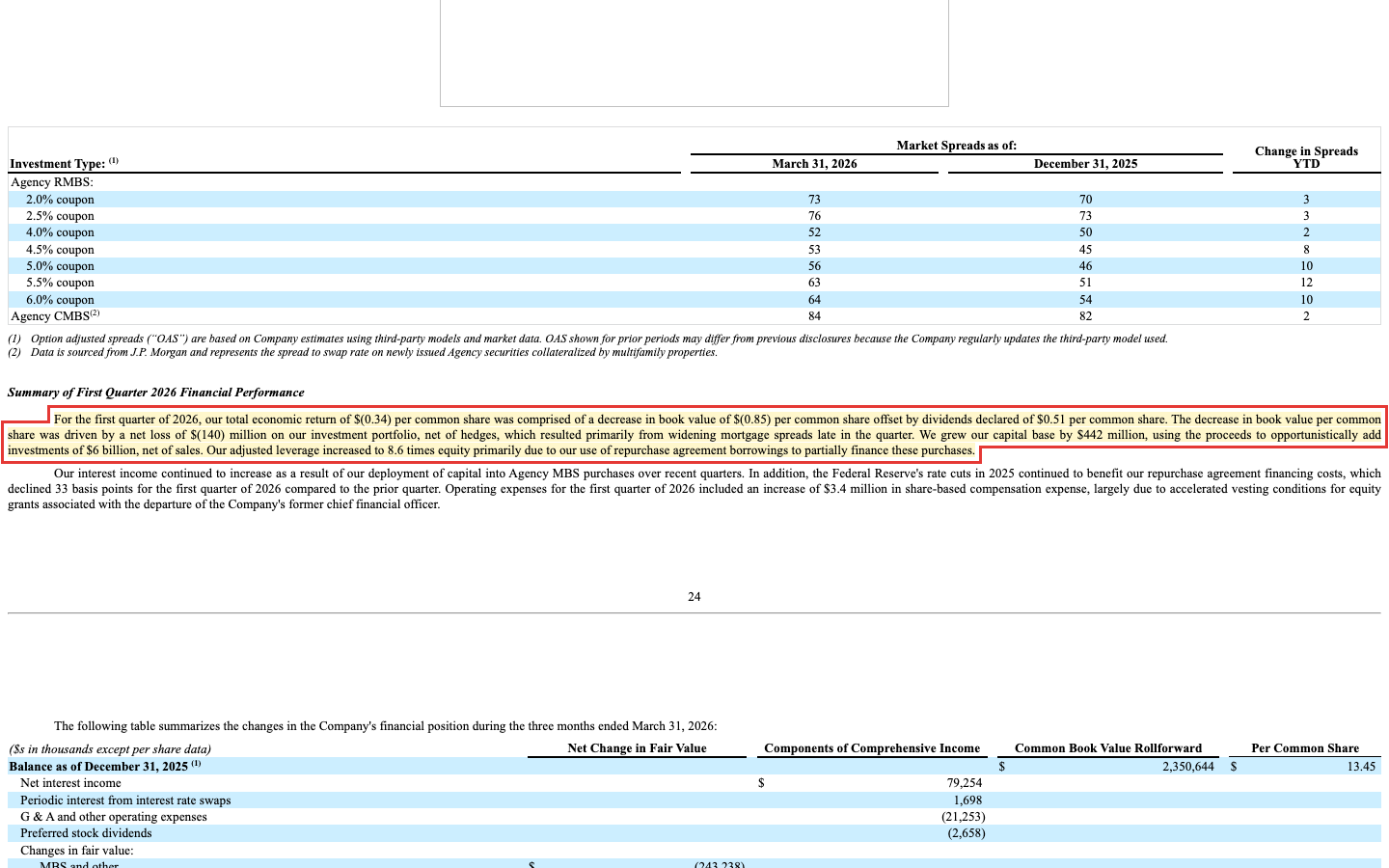
Leverage of 8.6 times means: for every dollar of equity there are $8.60 of borrowed money — and that money sits on repo loans with maturities from overnight to a few months, which the lenders extend at their own discretion. If bond prices fall (say, because mortgage spreads widen, as they did in the first quarter of 2026), margin calls follow. Leverage magnifies the gains when everything goes well — and the losses when it does not. Exactly that happened in the first quarter of 2026.
Valuation — price-to-book instead of price-to-sales
For a mortgage REIT, the price-to-sales ratio and even the price-to-earnings ratio (optically a low 6.2 here, but full of valuation gains) are worthless. The only meaningful figure is the price-to-book ratio: book value of $12.60 (March 31, 2026) against a price around $13.24 (early July 2026) works out to roughly 1.05. Mortgage REITs historically trade around or below book value; a premium is justified only as long as management can issue new shares above book value and thereby create value. The honest earnings yardstick is not the 15.7 percent headline but the earned result of $0.90 per share (2025) — against a running annual dividend of $2.04.
Opportunities and risks at a glance
What speaks for Dynex:
- The portfolio consists predominantly of agency MBS with a government guarantee (Fannie/Freddie) — practically no credit default risk, high liquidity.
- A high payout, paid monthly ($0.17 per month) — attractive for income-oriented investors who understand the risk.
- The environment turned in favor of mortgage REITs in 2025: the earned interest spread came back out of negative territory, the Federal Reserve cut rates; per management, a directive to the government-sponsored institutions ($200 billion of bond purchases) provides an additional tailwind.
- Internally managed (no external management fees, unlike many peers), an experienced co-CEO team, active hedging with interest rate swaps and futures.
What speaks against it:
- The "triple-digit revenue growth" is a balance-sheet artifact; the record quarter showed a net loss of $80.4 million, and the 2025 net interest spread was just 0.47 percent.
- The 15.7 percent dividend is not earned ($2.00 paid, $0.90 earned); part of it is a return of capital for tax purposes.
- A dilution machine: the share count rose from 53.6 million to 207.2 million since the end of 2022; book value per share fell 34 percent since the end of 2020.
- Leverage of 8.6 times equity on repo loans callable overnight; falling bond prices trigger margin calls — the business hangs on the yield curve and on the moods of its lenders.
A human conclusion
Remember the yield greed from the opening — the voice that switches off all caution at 15.7 percent? After reading the filings it sounds different. Yes, Dynex pays a high dividend. But it does not earn it: a substantial part is a repayment of your own capital, financed through ever more new shares that shrink your stake — while book value erodes over the long run. The "triple-digit revenue growth" that triggers the scanner is not growth but a balance sheet inflated on credit, which produced a loss in the very same quarter. That is one half of the truth.
The other half: Dynex is neither a fraud nor a bankruptcy candidate. The securities carry a government guarantee, management is experienced and internal (no expensive external fees), and in 2025 the interest environment genuinely turned in its favor. For an investor who knows precisely that he is not buying a growing business here but a leveraged interest-rate bet with a high yet fluctuating payout, this can be a deliberate investment. Just not the money-printing machine the yield number dresses up as.
What you make of it is your decision. And that is exactly as it should be. What matters is that you know what you are betting on — the yield curve and the book value, not the 15.7 percent from the portal. How a soaring revenue figure can promise more than the business behind it delivers is something we also dissected at Sandisk, where a 251 percent revenue jump sat almost entirely in the price per gigabyte, and at Micron — very different companies in which one number says less than it seems.
Sources
- Dynex Capital, Inc. — SEC annual report 10-K for fiscal year 2025 (filed February 25, 2026)
- Dynex Capital, Inc. — SEC quarterly report 10-Q for Q1 2026 (as of March 31, 2026, filed April 27, 2026)
- Fundamental data (metrics, valuation, quarterly series, XBRL time series); in-house stock scanner, data as of July 8, 2026 (EBIT-margin ranking, US selection: rank 3 as of July 18, 2026).
Transparency & disclaimer: This analysis is a journalistic contextualization of publicly available information and is not investment advice, not a financial analysis in the regulatory sense, and not a solicitation to buy or sell securities. Stock investments carry substantial risks up to total loss. All information without guarantee; the data cut-off is noted in the text in each case. The author holds no position in Dynex Capital stock at the time of publication.
Our Bottom Line at a Glance
- Portfolio quality positive
- Predominantly agency MBS guaranteed by the government-sponsored U.S. institutions Fannie Mae and Freddie Mac — practically no credit default risk, high liquidity. Internally managed, so no expensive external management fees.
- Revenue "growth" negative
- The +170.8 percent of "revenue" is a balance-sheet artifact: total assets were tripled in five quarters from $8.2 billion to $24.3 billion. The record quarter Q1 2026 still showed a net loss of $80.4 million; the 2025 net interest spread was just 0.47 percent. The rank-3 spot in the EBIT-margin ranking (US selection, as of July 18, 2026) is the same distortion — interest expense does not reduce EBIT.
- Dividend coverage negative
- The 15.7 percent dividend is not earned: in 2025, $2.00 was paid but only $0.90 earned (EAD); in 2024 the earned result was negative at minus $0.35. Part of it is a return of the shareholders' own capital for tax purposes; no minimum dividend level has been established.
- Book value & dilution negative
- Book value per share fell from $19.08 (end of 2020) to $12.60 (03/31/2026) — minus 34 percent. The share count rose from 53.6 million to 207.2 million since the end of 2022; the dividend is increasingly paid out of freshly collected capital to a larger share base.
- Leverage & interest-rate risk negative
- Leverage of 8.6 times equity on repo loans callable overnight ($21.0 billion), which the lenders extend at their own discretion. Falling bond prices trigger margin calls; the first quarter of 2026 produced a negative total economic return of $0.34 per share.
- Environment neutral
- The interest environment turned in favor of mortgage REITs in 2025 (the earned spread came back out of negative territory, rate cuts); per management, a directive covering $200 billion of bond purchases provides an additional tailwind. That can turn again with the yield curve.
Dynex Capital is not a growth stock but a leveraged interest-rate bet with a high yet unearned payout. The "triple-digit revenue growth" is an accounting artifact of a balance sheet tripled on repo credit; the 15.7 percent dividend is earned to less than half and partly paid out of the investors' own capital, while book value erodes over the long run. On the other side stand government-guaranteed securities, internal management and an interest environment that was favorable in 2025. Not investment advice.
What Our Rating Means
- If you don't own the stock
- In our view, the documented risks clearly outweigh — we see no basis for an entry.
- If you hold it in your portfolio
- In our view, the findings carry enough weight to warrant a critical look at your own position.
A journalistic assessment by our editorial team at the time of the deep dive, based on public sources — not investment advice and not a solicitation to buy or sell. Your personal circumstances (investment goals, risk capacity, taxes) cannot be taken into account. What our categories mean, how verdicts are formed, and what conflicts of interest exist →
Worth Noting
- For a mortgage REIT, price-to-sales and price-to-earnings ratios are misleading; the relevant valuation figure is the price-to-book ratio (around 1.05 as of March 31, 2026). The EBIT margin (rank 3 in the US EBIT-margin ranking as of July 18, 2026) is likewise distorted, because interest expense — the largest real cost — does not reduce EBIT.
- The record 2025 profit ($319 million) consists mostly of non-cash fair-value gains on the bonds, not of recurring earnings power.
- Distress metrics such as the Altman Z-Score (−1.94) are of limited methodological validity for financial companies, but they do reflect the heavily leveraged balance-sheet structure.
Frequently Asked Questions
Dynex Capital is a mortgage REIT: it borrows very short-term money through repo transactions and uses it to buy long-dated, government-guaranteed mortgage securities (agency MBS). It earns the interest spread between the yield of the securities and the cost of the loans. It is not a company with a product or revenue, but a leveraged bond fund in a stock costume with about 28 employees.
Because growth scanners read the interest-income line as "revenue". Dynex tripled its total assets in five quarters from $8.2 billion to $24.3 billion — financed with new shares and repo debt. More bonds mechanically produce more interest income; operating performance it is not. The same quarter (Q1 2026) still showed a net loss of $80.4 million.
It is currently not earned. In 2025 Dynex paid $2.00 per share, but the earned result (EAD) was only $0.90; in 2024 it was even negative at minus $0.35. For tax purposes, part of the payout was a return of the shareholders' own capital. Dynex has not established a minimum dividend level; the amount can fluctuate.
Because at a mortgage REIT the reported profit depends heavily on non-cash fair-value movements and swings wildly — which makes the P/E ratio misleading. The meaningful figure is book value per share ($12.60 as of March 31, 2026) relative to the price, roughly 1.05. Mortgage REITs historically trade around or below book value.
Dynex works with borrowed money of 8.6 times its equity, mostly on repo loans with maturities from overnight to a few months, which the lenders extend at their own discretion. If bond prices fall, margin calls follow. Leverage magnifies gains and losses alike; in the first quarter of 2026 it led to a negative total economic return of $0.34 per share.
That depends on what you are buying. The securities carry a government guarantee, management is experienced and internal (no expensive external fees), and the interest environment turned in favor of mortgage REITs in 2025. Whoever deliberately wants a leveraged interest-rate bet with a high but fluctuating payout can see an investment in it — a growing business or a secured dividend is not what you are buying.
Found an error?
Did you spot a factual error, an outdated number, or a typo in this deep dive? Let us know briefly — your report goes straight to the editorial team.