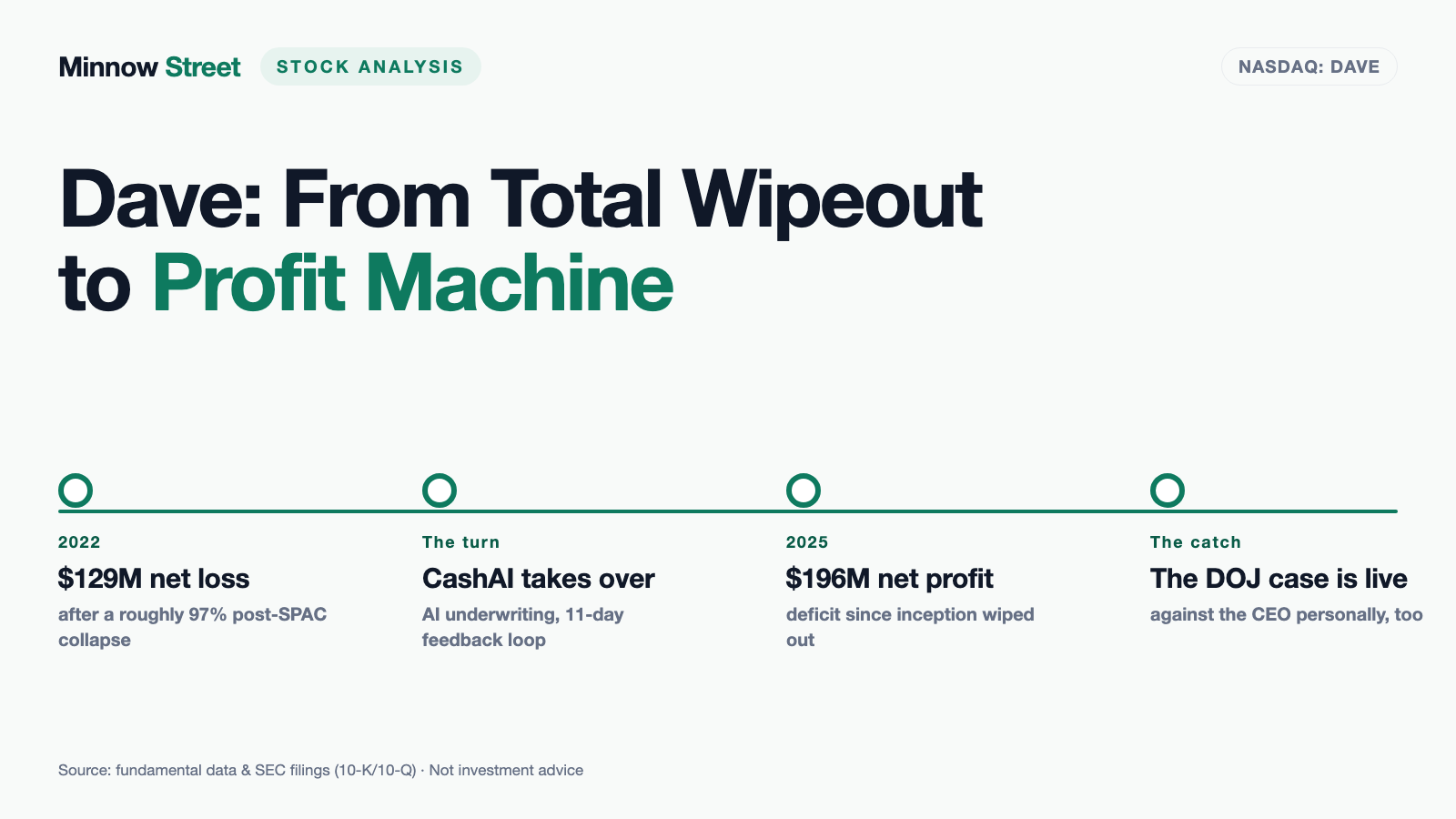
Dave Stock: From Total Wipeout to Profit Machine — With a Lawsuit in the Backpack
After its market debut the Dave stock once lost about 97 percent. Today the fintech earns $195.9 million a year, grows around 60 percent and sits fourth in our Fundamental Rank scanner. We read the SEC filings: an engine that learns a loan in eleven days, a Department of Justice action against the company and its chief executive personally, and a credit-loss provision growing far faster than revenue. Not investment advice — only the case file.
 Thomas Mücke
Founder & Publisher
Thomas Mücke
Founder & Publisher
Chart
Interactive price chart (TradingView).
Note: pure fact-based analysis, not investment advice and not a solicitation to buy or sell. All figures without guarantee.
Be honest with yourself: when a stock loses 97 percent after its market debut, you put it in a drawer. The drawer is labelled "junk", and you never open it again. That filing reflex is human — it protects you from repeating a mistake. But it has a blind spot: it never checks whether the contents have changed. Dave Inc. (Nasdaq: DAVE) is one of those drawers. A SPAC listing in early 2022, a drop of roughly 97 percent from the peak, a 1-for-32 reverse split — the full wall-of-shame kit. And today? Fourth place in our Fundamental Rank scanner, $195.9 million of annual profit, revenue growth close to 60 percent. So let's make a deal: we open the drawer together, read the last two annual reports and four quarterly reports, and we also look at the part the comeback story would rather leave out — a live case brought by the U.S. Department of Justice. You decide at the end.
What Dave actually does
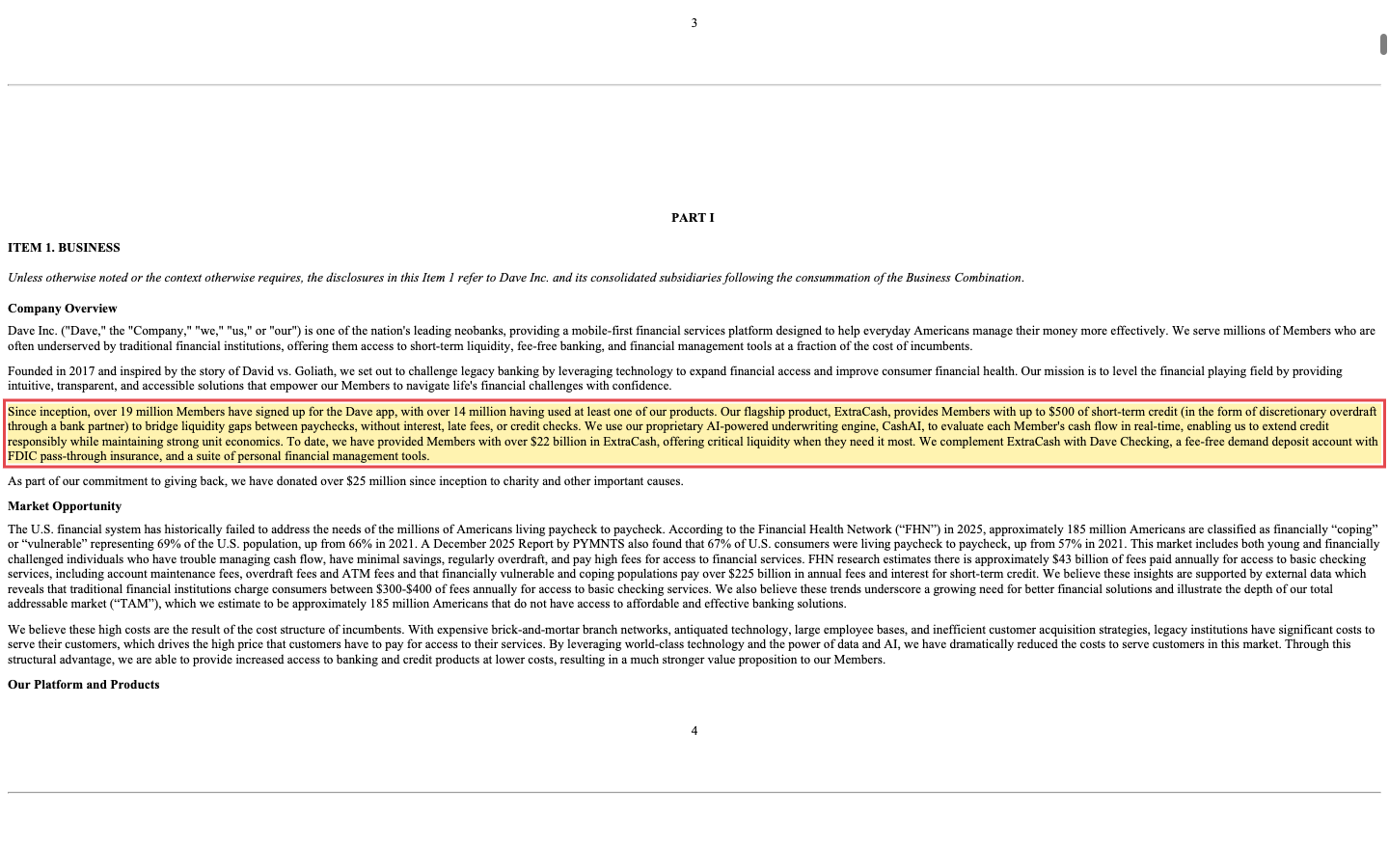
Dave is a banking app for people who regularly have more month left than money. The flagship product is called ExtraCash: a short-term advance of up to $500 that bridges the gap to the next paycheck — without interest, without late fees and without a conventional credit check. Instead of a credit bureau score, an in-house engine called CashAI reads the incoming and outgoing payments on the member's bank account and decides in real time who gets how much. The average term of an advance: roughly eleven days. Around it sits a fee-free checking account with a debit card. Since inception more than 19 million people have signed up for the app, over 14 million of them have used at least one product, and Dave has advanced more than $22 billion in total (10-K 2025, Item 1).
The remarkable part of the construction: Dave is not a bank. Accounts and cards run through partner banks — more on that later, because that is exactly where one of the risks sits.
Where the stock shows up in our scanner
Every day we run thousands of U.S. and German stocks through our screeners. In our in-house stock screener Dave is not a hidden tip from the back row — it sits near the top of the quality ranking. This is the scanner row, measured on the day of the screenshot:
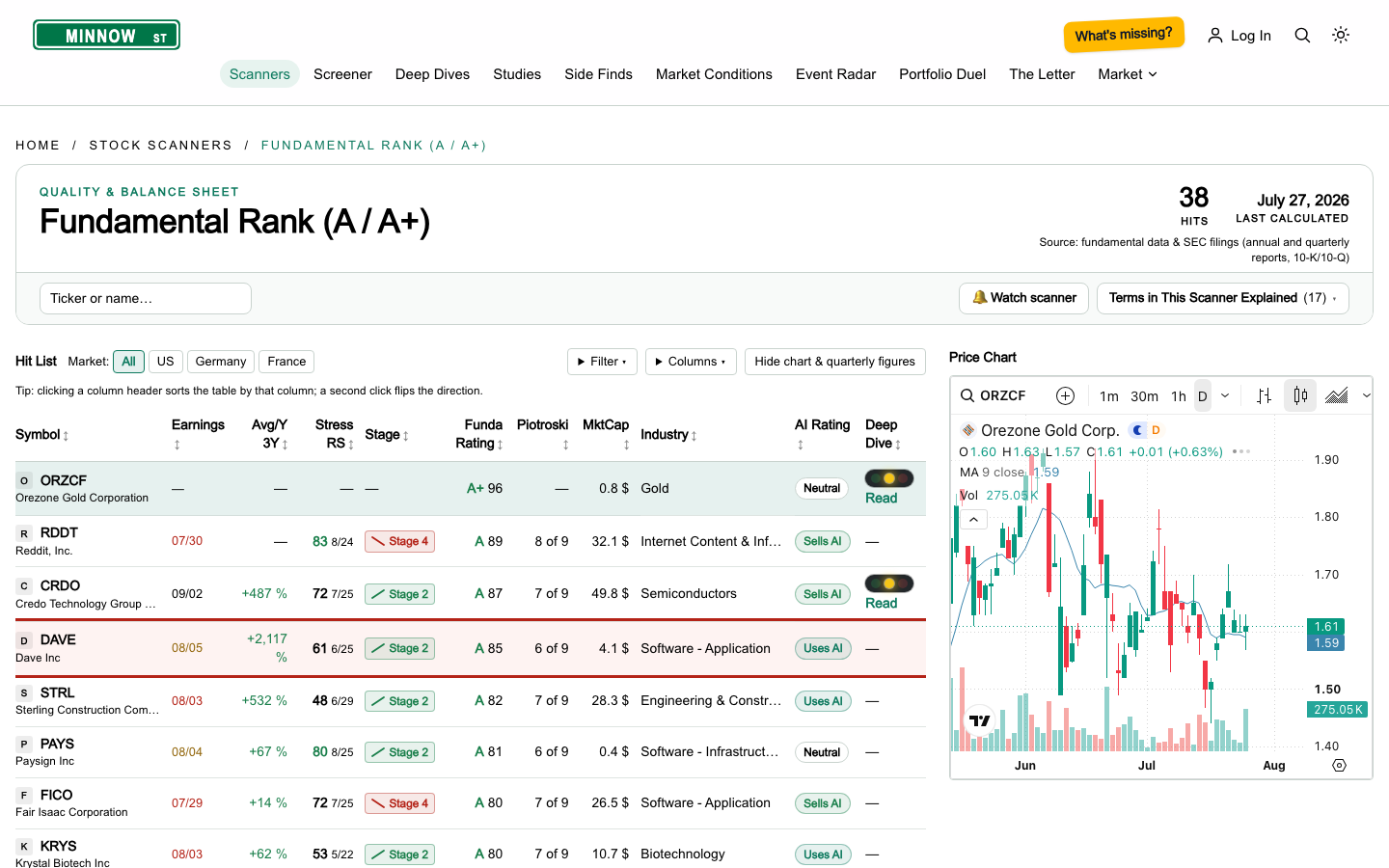
Ahead of Dave in that list on the day of the screenshot: the gold explorer Orezone Gold, Reddit and Credo Technology, whose growth story we have taken apart separately. Across the whole system Dave currently matches 24 of our scanner strategies (data as of July 27, 2026) — six growth filters, four quality and balance-sheet filters, three breakout and setup filters and eleven momentum and trend filters, from "Stan Weinstein: Stage 2" through "CANSLIM Type RS" to "Power Trend". Translated into plain language, the most important values say this:
- Stage 2 with an RS rating of 83 — the stock sits in Stan Weinstein's advancing phase and has outrun 83 percent of the market: up 43.6 percent year to date, up 50.5 percent over twelve months, and only 5.8 percent below its 52-week high (data as of July 27, 2026). The average annual move over three years works out at plus 2,117 percent — the scar of the SPAC crash is still visible in that number, because it is measured from a very low base.
- An EPS rating of 86 — on the 1-to-99 percentile scale of earnings-per-share growth, Dave outgrows 86 percent of the market. Growth is happening on both lines, not just the top one: return on equity comes to 111.6 percent, the net margin to 37.2 percent (trailing twelve months, data as of July 27, 2026).
- A Piotroski score of 6 out of 9 — and that is the honest dampener. Six is okay, not good. A thoroughly healthy company sits at 8 or 9. The reason lies mostly in the balance-sheet structure of a lender — we will get to that.
Remember the tension of this analysis: a highly profitable turnaround carrying a court case in its backpack.
The numbers over the years — the phoenix settles up
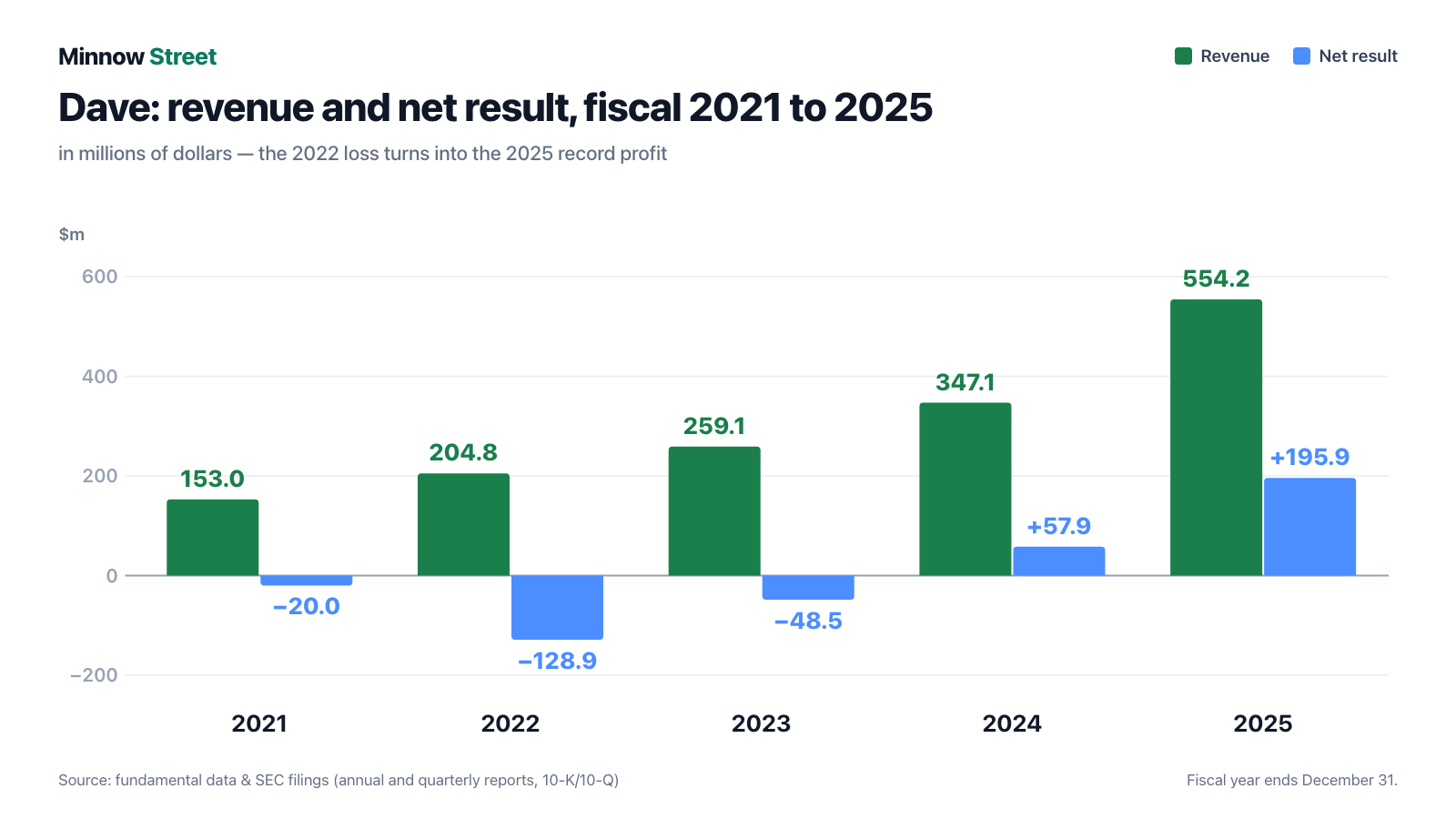
The short version of the comeback: revenue from $153.0 million to $554.2 million in four years, the net result from minus $128.9 million (2022) to plus $195.9 million (2025). Free cash flow came to $289.7 million in 2025 — operating cash flow of $290.0 million against capital expenditure of just $0.3 million, because Dave owns no branches and no factories, only software. The prettiest detail sits in the balance sheet: the deficit accumulated since inception (minus $161.8 million at its worst, end of 2022) was wiped out in 2025. What used to be an "accumulated deficit" is now $43.4 million of retained earnings. The phoenix has settled its debt with the past. And it did so with about 280 full-time employees at the end of 2025 — roughly $2 million of revenue per head.
How does an app manage that? The annual report explains the engine room — and here, for once, the AI is not a marketing word but a measurable tool:
"In September 2025, we deployed CashAI v5.5, which nearly doubles the feature set of prior versions. Early results demonstrate improved risk ranking, higher average approval amounts, and lower delinquency rates. CashAI has leveraged insights from over 180 million ExtraCash originations […] The short average term of ExtraCash (approximately 11 days) creates rapid feedback loops, enabling iterative model refinement."
— Dave Inc., SEC annual report 10-K 2025, Item 7 MD&A "Credit Performance"
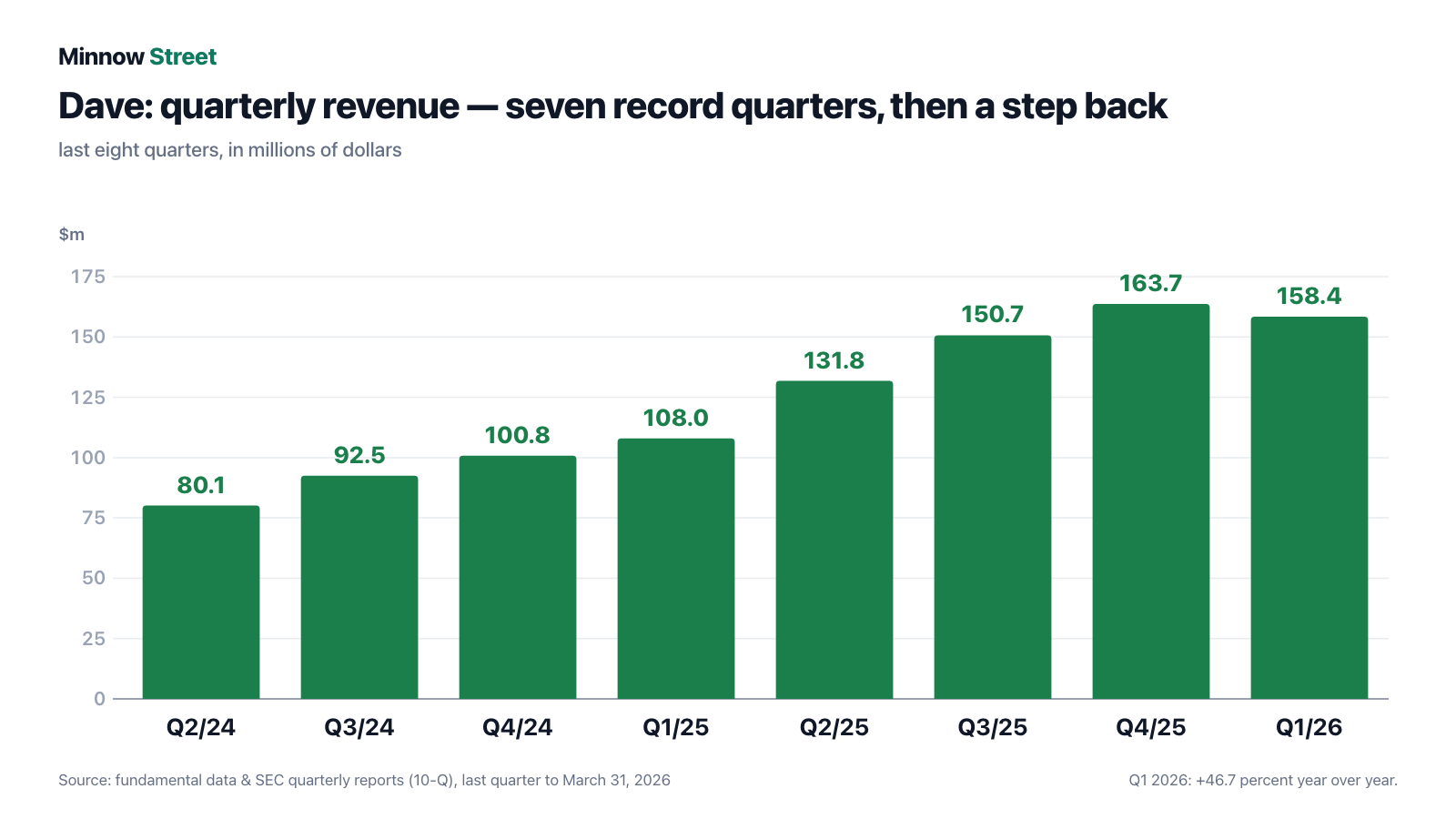
One footnote for the careful reader, because it matters for the valuation later: the profit spike in the third quarter of 2025 ($92.1 million net on $150.7 million of revenue) contains a large one-off tax benefit of $33.6 million; across the full year 2025 the income tax line was a net benefit of $27.8 million rather than an expense. The first quarter of 2026 shows the cleaner picture of the earnings power: $57.9 million of net income after $12.2 million of income tax.
What the filings say — three uncomfortable truths
Uncomfortable truth no. 1: the Department of Justice is suing — the chief executive personally, too
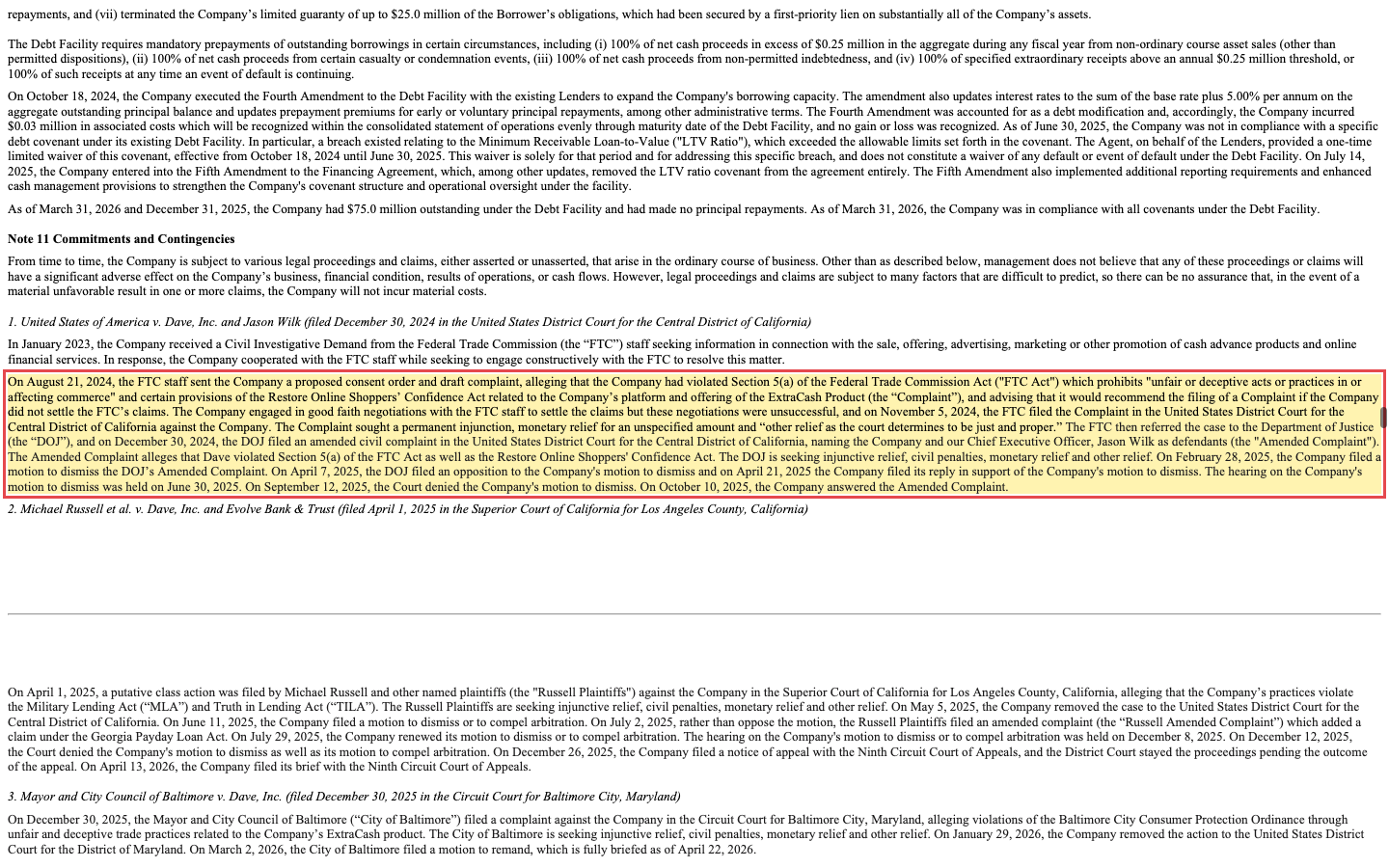
Now for the backpack. The consumer protection regulator FTC began investigating Dave's old fee practice in 2023 — above all the "tips" and express fees, which in the agency's view were presented in a misleading way. The case moved on to the Department of Justice, and the quarterly report documents the escalation steps with remarkable precision:
"The FTC then referred the case to the Department of Justice (the 'DOJ'), and on December 30, 2024, the DOJ filed an amended civil complaint […], naming the Company and our Chief Executive Officer, Jason Wilk as defendants […] On September 12, 2025, the Court denied the Company's motion to dismiss. On October 10, 2025, the Company answered the Amended Complaint."
— Dave Inc., SEC quarterly report 10-Q Q1 2026, Note 11 "Commitments and Contingencies"
How much money is at stake? The filings do not put a number on the outcome — but they do put one on the books. As of December 31, 2025 Dave carried an aggregate accrual for legal contingencies of $7.8 million, the amount management considers both probable and reasonably estimable. The same paragraph says plainly that the company "is unable to reasonably predict the possible outcome of the matters described above". Read that as it is written: $7.8 million is what has been booked, not what the case is worth.
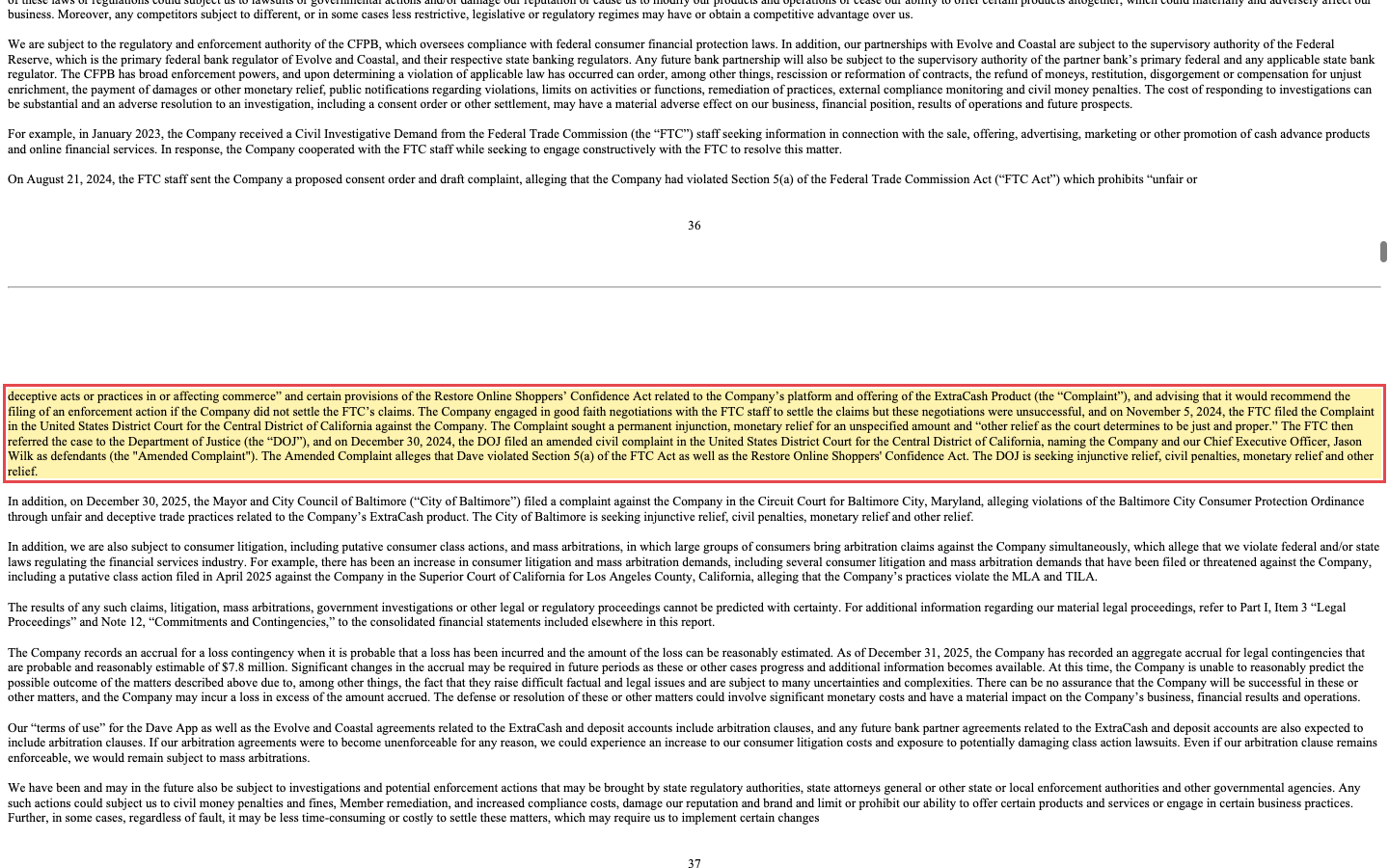
The irony of the story: Dave buried the criticised tipping model long ago. Since February 2025 a transparent mandatory fee applies — 5 percent of the advance, with a $5 minimum. Tips revenue fell from $7.5 million (first quarter of 2025) to zero (first quarter of 2026), and revenue still grew 46.7 percent. The forced clean-up turned into a margin booster. Legally, though, the picture stands: the case concerns the past, it is running, the chief executive is on the paperwork personally, and alongside it sit a consumer class action (with the uncomfortable allegation that ExtraCash is effectively a payday loan) and the City of Baltimore complaint. Outcome: open.
Uncomfortable truth no. 2: the provision for credit losses grows three times as fast as revenue
Dave earns money by advancing cash to people who are short of it. That works only as long as the losses stay small. Which makes this line from the quarterly report perhaps the most important one in the whole analysis:
"The provision for credit losses was $26.6 million for the three months ended March 31, 2026, compared to $10.6 million for the three months ended March 31, 2025, resulting in an increase of $16.0 million, or 151%."
— Dave Inc., SEC quarterly report 10-Q Q1 2026, Item 2 MD&A
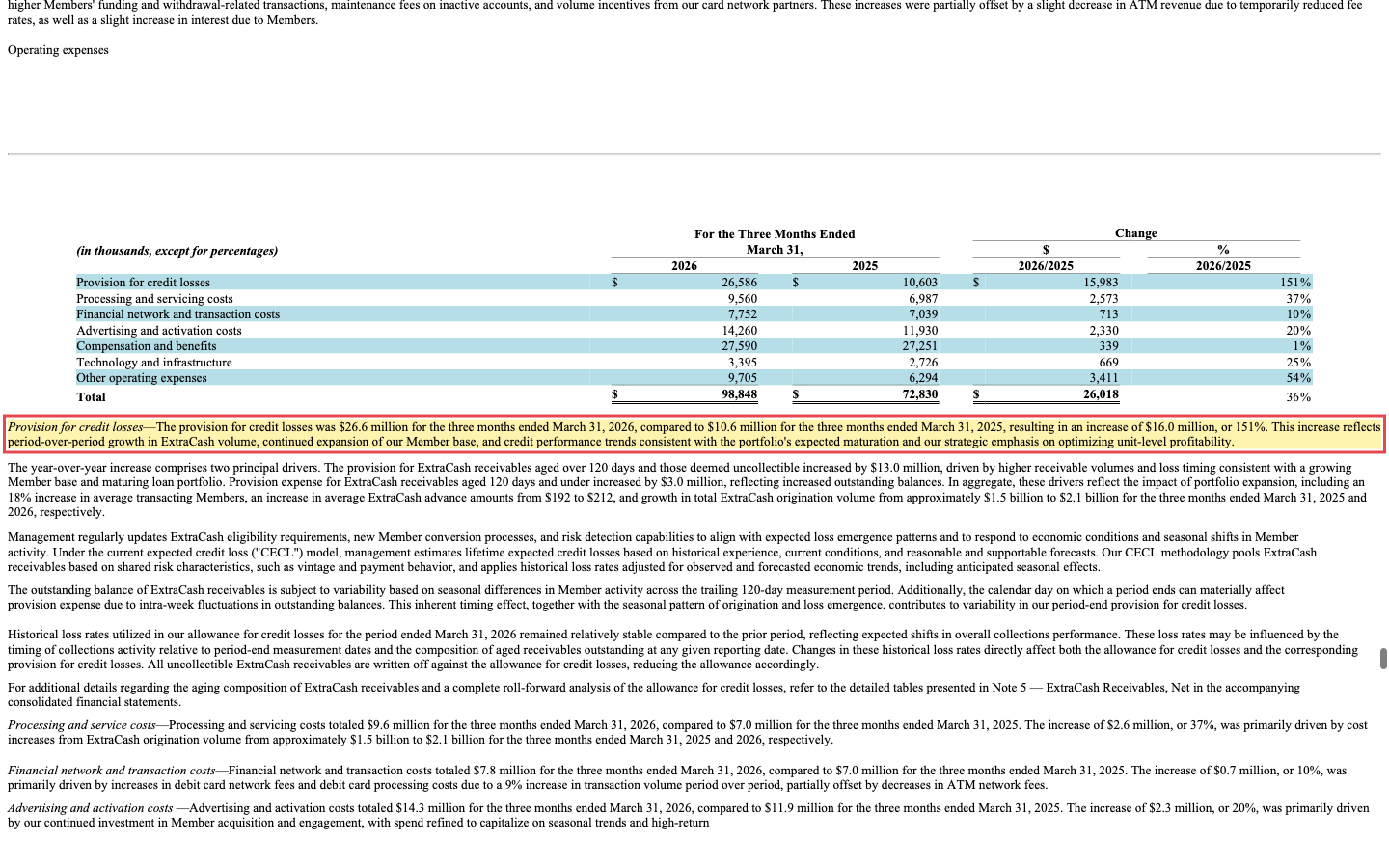
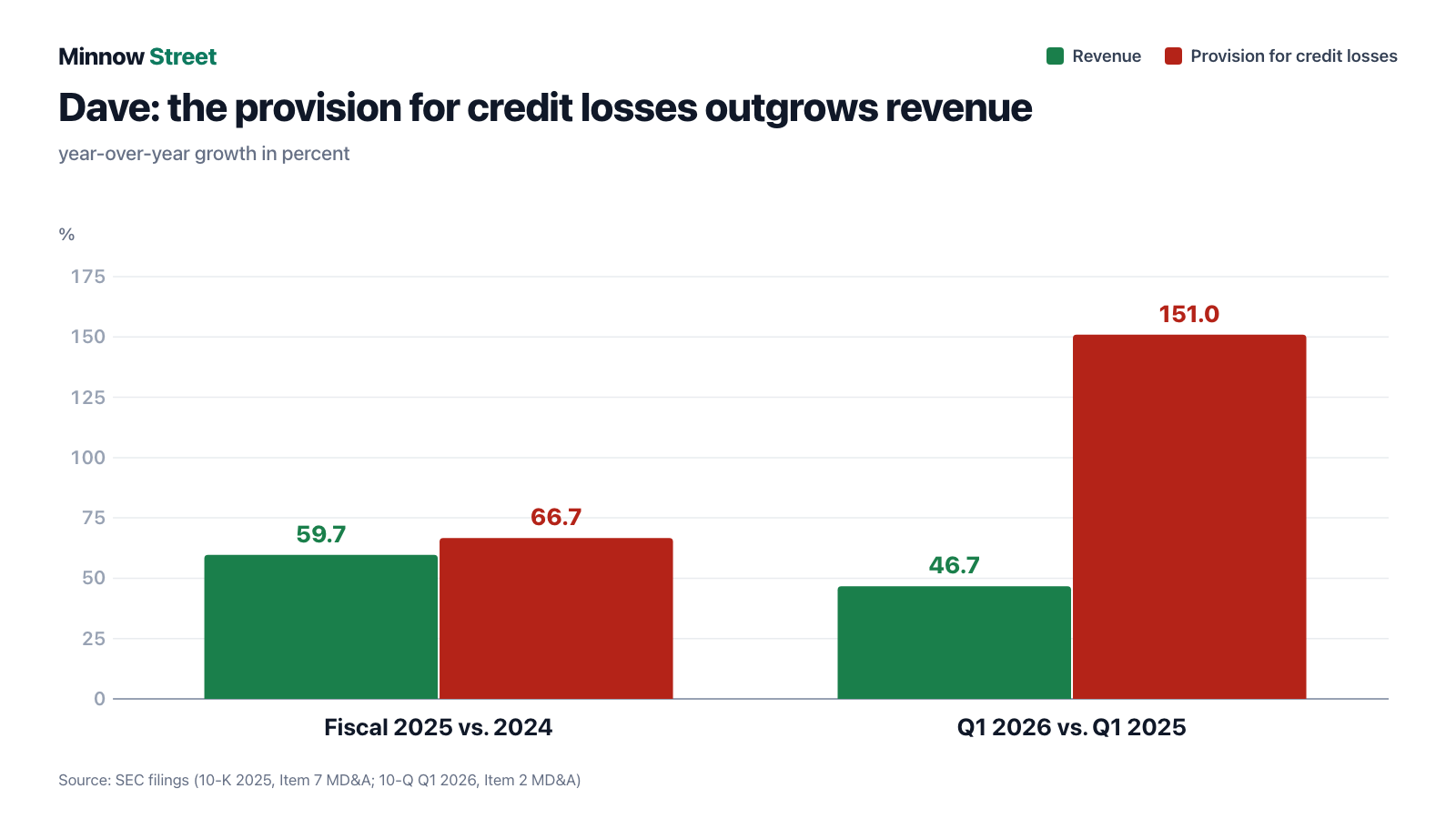
Management explains the increase with a larger ExtraCash book — origination volume rose from about $1.5 billion to about $2.1 billion in the quarter, an increase of roughly 40 percent, and the average advance climbed from $192 to $212 — plus portfolio maturation and a deliberate focus on unit-level profitability. CashAI, meanwhile, reports "lower delinquency rates". Both can be true. But the bare arithmetic stands: a loan book built on customers with tight cash is cyclical. The annual report says so itself: unemployment and consumer behaviour feed straight through to repayment. When the U.S. economy coughs, Dave's customers run a fever.
Where does that road end when the book is fully grown? Our analysis of World Acceptance shows the mature version of the same lending model: an average annual percentage rate of 51.4 percent across the loan book — and a net charge-off ratio of 18.5 percent in fiscal 2026. A subprime book has a natural loss rate. The open question at Dave is simply where its own settles.
Uncomfortable truth no. 3: no banking network of its own — and that is deliberate
Dave holds no banking licence. Accounts, cards and the ExtraCash mechanics run through the partner banks Evolve Bank & Trust and Coastal Community Bank; on top of that, a single payment processor — Galileo — handles all card transactions. The annual report puts that on the record as a risk factor of its own, with startling frankness:
"We rely on two bank partners, but intend to eventually rely on one bank partner. If our present or any future key banking relationships are terminated and we are not able to secure or successfully migrate client portfolios to a new bank partner or partners, […] our business would be adversely affected."
— Dave Inc., SEC annual report 10-K 2025, Item 1 "Business" / Item 1A "Risk Factors"
Two banks, deliberately heading for one, a single processor — that is efficient as long as everything runs. The company expects the migration of existing members to Coastal to be substantially finished by the end of 2026. The industry watched in 2024, when the banking-services provider Synapse collapsed and dragged Evolve into the mess, how quickly such chains can snap. Dave was not directly affected, but the architectural question remains.
It helps to look at the same trade from the other side. Pathward Financial is the kind of counterparty Dave rents: a chartered U.S. bank that lends its licence to fintechs and card programs. Its net interest margin reached 7.34 percent in fiscal 2025 — a multiple of an ordinary bank — because roughly $5.9 billion of its deposits are non-interest-bearing balances from partner card programs at a deposit cost of 0.09 percent. And Pathward's own annual report warns that if a major customer or card program were to leave, deposit outflows "could be more significant" than with an ordinary customer. That is the same dependency, written from the bank's chair: profitable for both sides, and fragile in the same place.
One more look at the capital side, because it rounds out the picture. Dilution has stopped: in the first quarter of 2026 alone Dave repurchased 912,622 of its own shares for $188.4 million, funded by a $200 million non-interest-bearing convertible note due 2031, with capped calls bought for $17.4 million to blunt later dilution. At the same time insiders sold 18 times and bought not once in the last reporting period. The company buys, the insiders sell — you are entitled to know both.
Valuation: almost reasonable for this growth — with an asterisk
As of July 27, 2026 the market put $4.1 billion on Dave. Measured against the 2025 net result of $195.9 million that is a trailing price-earnings ratio of roughly 21; on the analysts' estimates for the current year our screener shows 23.6. Note the direction of that pair, because it is the opposite of the usual: the forward multiple sits above the trailing one. The reason is the tax benefit of 2025 — the profit that flatters the trailing figure will not repeat in the same form. Price-to-sales stands at 6.7, price to free cash flow at 12.5, enterprise value to EBITDA at 23.0 (all data as of July 27, 2026).
For a company growing revenue near 60 percent with a return on equity above 100 percent, that is moderate by sector standards — the lawsuit and the subprime credit risk are visibly priced in. The professionals are unanimously optimistic: eight analysts cover the stock and the average recommendation sits at 1.0 on a scale from 1 (buy) to 5 (sell) — not a single "hold" among them, although with a circle that small, unanimity is not the same thing as a broad consensus. Short interest, by contrast, stands at 21.7 percent, and the beta of 3.83 tells you the ride is nearly four times as violent as the market's.
Opportunities and risks at a glance
What speaks for Dave
- A documented turnaround: revenue from $153.0 million to $554.2 million (2021 to 2025), the net result from minus $128.9 million to plus $195.9 million; the deficit accumulated since inception fully wiped out in 2025.
- Extreme capital efficiency: about 280 full-time employees, roughly $2 million of revenue per head, $289.7 million of free cash flow on almost no capital expenditure, return on equity of 111.6 percent.
- Real, measurable use of AI (CashAI, more than 180 million past advances as training data, an eleven-day feedback loop) instead of a buzzword.
- The fee redesign was forced and mastered: tips abolished, revenue up 46.7 percent all the same.
- Dilution stopped, buybacks running; a moderate valuation for close to 60 percent growth (forward price-earnings ratio 23.6, data as of July 27, 2026).
What speaks against it
- The DOJ action against the company and the chief executive personally is running in the main proceedings; the outcome is not quantified, and only $7.8 million is accrued. Alongside it sit the class action with its payday-loan allegation and the Baltimore complaint.
- The provision for credit losses grows far faster than revenue (plus 151 percent in the first quarter of 2026) — a loan book built on customers with tight cash is cyclical.
- Dependence on two partner banks (with the stated intention of ending up with one) and on a single payment processor.
- A Piotroski score of only 6 out of 9; a short profit history (black ink only since 2024); the trailing profit flattered by a $33.6 million tax benefit in the third quarter of 2025.
- Insiders: zero purchases against 18 sales in the last reporting period; short interest at 21.7 percent (data as of July 27, 2026).
A human conclusion
The drawer labelled "SPAC junk" was the right address for this stock in 2022 — and that is exactly why so few people look inside today. What lies in there now is a different company: small, highly profitable, technically impressive, with an engine that actually works instead of merely appearing in a prospectus. But in the same compartment sits an envelope from the Department of Justice addressed to the founder personally, and a red curve called the provision for credit losses that rises faster than anything else in the report.
If you only see the old drawer, you miss one of the strongest turnarounds in the U.S. fintech sector. If you only see the phoenix, you underestimate that courts do not care about growth rates. You now know both sides. What you make of it is your decision. And that is exactly as it should be.
Sources
Every original document used in this analysis — for you to read yourself:
- SEC annual report (10-K), fiscal year 2025: dave-20251231.htm (sec.gov)
- SEC annual report (10-K), fiscal year 2024: dave-20241231.htm (sec.gov)
- SEC quarterly report (10-Q), Q1 2026 (to March 31, 2026): dave-20260331.htm (sec.gov)
- SEC quarterly report (10-Q), Q3 2025 (to September 30, 2025): dave-20250930.htm (sec.gov)
- SEC quarterly report (10-Q), Q2 2025 (to June 30, 2025): dave-20250630.htm (sec.gov)
- SEC quarterly report (10-Q), Q1 2025 (to March 31, 2025): dave-20250331.htm (sec.gov)
- Annual and quarterly series re-verified against the SEC XBRL company facts: companyfacts CIK 0001841408 (sec.gov)
- Dave's complete SEC filing history: EDGAR overview (sec.gov)
- Fundamental data (revenue, earnings, balance-sheet and cash-flow series, analyst consensus): from our financial data, reconciled with the SEC filings.
- Screener and rating data: in-house stock scanner (data as of July 27, 2026).
Data basis: Dave annual reports (SEC form 10-K) for fiscal years 2024 and 2025 and quarterly reports (10-Q) through March 31, 2026; supplementary fundamental data from our financial data; screener data from our in-house stock scanner (data as of July 27, 2026). This article is a journalistic, fact-based analysis and expressly not investment advice and not a solicitation to buy or sell securities. Investing in shares carries the risk of losses up to a total loss. All information without guarantee.
Our Bottom Line at a Glance
- Growth positive
- Revenue up 59.7 percent in 2025 and 46.7 percent in the first quarter of 2026; ExtraCash origination volume up roughly 40 percent to about $2.1 billion in the quarter.
- Profitability positive
- Net income of $195.9 million (2025), return on equity of 111.6 percent, $289.7 million of free cash flow on almost no capital expenditure.
- Legal risk negative
- The DOJ action against the company and the chief executive personally is running in the main proceedings (motion to dismiss denied); a class action and the Baltimore case sit alongside it — outcome not quantified, only $7.8 million accrued.
- Credit risk negative
- The provision for credit losses rose 151 percent in the first quarter of 2026 against 46.7 percent revenue growth; a subprime customer base is cyclical.
- Valuation positive
- A trailing price-earnings ratio of about 21 and a forward multiple of 23.6 for close to 60 percent growth (data as of July 27, 2026) — lawsuit and credit risk are visibly priced in.
- Dependencies negative
- No banking licence of its own: two partner banks (with the stated aim of one) and a single payment processor — an efficient but thin chain.
Dave is a documented, highly profitable turnaround with a genuine AI core — and a court case whose outcome nobody knows. The moderate valuation is paying for exactly that uncertainty. If at all, then as a speculative position, in the knowledge that a ruling can rewrite the story at any time. Not investment advice.
What Our Rating Means
Open questions
The business works in principle, but one material question is open. As long as it stays open, our findings do not carry a quality verdict.
A documented, highly profitable turnaround with a genuine AI core at a moderate valuation — but only as a speculative position, because the live court case can rewrite the story at any time.
A journalistic assessment by our editorial team at the time of the deep dive, based on public sources — not investment advice and not a solicitation to buy or sell. Your personal circumstances (investment goals, risk capacity, taxes) cannot be taken into account. What our levels mean, how verdicts are formed, and what conflicts of interest exist →
Worth Noting
- The trailing profit contains a $33.6 million tax benefit from the third quarter of 2025 — the forward multiple is the more conservative yardstick.
- Insiders sold 18 times and bought not once in the last reporting period.
Frequently Asked Questions
Dave is a U.S. banking app whose flagship product is ExtraCash: short-term advances of up to $500 with no interest and no conventional credit check, decided in real time by the in-house engine CashAI on the basis of the member's account activity. Around it sit a fee-free checking account and a debit card — settled through partner banks, because Dave holds no banking licence of its own.
Very bad. After the market debut in early 2022 the stock lost roughly 97 percent from its peak and the company had to consolidate the shares 1 for 32. Since then it has multiplied — the average annual move over three years works out at plus 2,117 percent, and as of July 27, 2026 the stock traded only 5.8 percent below its 52-week high.
Yes, since fiscal year 2024. In 2025 Dave earned $195.9 million net on revenue of $554.2 million and generated $289.7 million of free cash flow. The deficit accumulated since inception was wiped out in 2025 and turned into $43.4 million of retained earnings. One caveat: the 2025 figure includes a tax benefit of $33.6 million booked in the third quarter.
The U.S. Department of Justice alleges misleading practices in the former fee structure (among them the "tips" and express fees) and names chief executive Jason Wilk personally as a defendant alongside the company. The court denied the motion to dismiss on September 12, 2025; the proceedings are running and the possible penalty is not quantified. The criticised fee model itself was replaced in February 2025 by a transparent mandatory fee of 5 percent with a $5 minimum. As of December 31, 2025 Dave had accrued $7.8 million for legal contingencies it considers probable and reasonably estimable.
The credit risk of its own customers. The provision for credit losses rose 151 percent in the first quarter of 2026 — around three times as fast as revenue, which grew 46.7 percent. On top of that come the dependence on two partner banks (Evolve and Coastal, with the stated intention of ending up with only one) and on a single payment processor.
We give no investment advice. Our systematic view shows a highly profitable turnaround in Weinstein stage 2 — fourth of 38 hits in our Fundamental Rank scanner, data as of July 27, 2026 — at a moderate valuation (forward price-earnings ratio 23.6). Against that stand the live DOJ action, a fast-growing credit provision, short interest of 21.7 percent and 18 insider sales against zero purchases. Both sides belong in your weighing; the decision is yours.
Found an error?
Did you spot a factual error, an outdated number, or a typo in this deep dive? Let us know briefly — your report goes straight to the editorial team.