Offerpad Stock: A Home Buyer Priced at 0.05 Times Sales — and Why That Is No Bargain
Offerpad buys your house by the click, repairs it and hopes for the margin in between. On paper the stock looks dirt cheap: the market value equals barely five percent of one year of revenue. But at this "iBuyer" the revenue is almost everything and the profit is nothing — the gross margin is a little over seven percent, revenue halved within a year, and the handsome cash flow our filters pick up comes from selling off the company's own stock of homes. We read five SEC filings and did the arithmetic on what sits behind the mini valuation. No advice on what you should do - just an honest stocktake of a business model that is expensive precisely because it looks cheap.
 Thomas Mücke
Founder & Publisher
Thomas Mücke
Founder & Publisher
Chart
Interactive price chart (TradingView).
Note: pure fact-based analysis, not investment advice and not a solicitation to buy or sell. All figures without guarantee.
There is a reflex so seductive that it has shaped an entire investment style: we see a low ratio and think "cheap". A stock whose market value equals only a fraction of one year of revenue simply has to be a bargain — otherwise it would not be available this inexpensively. Let us call that reflex the optically-cheap trap. The treacherous part: sometimes a stock is not cheap but cheap for good reason. The market pays little because there is barely any profit behind the big revenue number — and in the bad case none at all. At Offerpad Solutions (NYSE: OPAD) the valuation looks almost absurdly low at first glance: the price-to-sales ratio sits at roughly 0.05. So let us make a deal: before you reach for it because "it can't stay this cheap", we open the filings together and look at why the market pays so little here. A report to the U.S. securities regulator, the SEC, is honest under penalty of law. At the end you decide for yourself.
What Offerpad actually does — buying houses by the click
Offerpad is what the industry calls an iBuyer ("instant buyer"). The principle is disarmingly simple: you want to sell your house, you type the address into Offerpad's website, and within a short time the company makes you a binding cash offer — no broker, no viewings, no months of waiting. Say yes and Offerpad buys the house from you, fixes it up, and resells it at what it hopes is a small markup. Picture a used-car dealer — only for homes: buy, refurbish, resell, earn the spread.
For that offer to appear within seconds, there is a pricing model behind the click. Offerpad's in-house valuation engine, called "Offercomp", uses machine learning and artificial intelligence and, by the company's own account, values more than 100,000 properties a year automatically; image recognition even estimates renovation costs. That is the attractive side of the story — technology that makes a slow, expensive process convenient. But the catch sits in the economics behind it, and you have to understand it to place the stock: every house Offerpad buys becomes inventory on its own balance sheet. The company therefore ties up real money in real property — largely financed on credit. And when the home goes back out at its full sale price, Offerpad books that entire amount as revenue. Remember this tension, it runs through everything that follows: the revenue is gigantic because it contains the full house prices — the profit is tiny because almost nothing is left between purchase and sale.
After the interest-rate and housing shock of 2022 this model became a problem for the whole industry: anyone holding houses on credit while prices stall and financing gets more expensive is quickly sitting on goods worth less than expected. The bigger rival Opendoor went the same way, several sizes larger: its revenue fell from $6,946 million (2023) to $4,371 million (2025), and in the first quarter of 2026 it sold 1,921 homes instead of 2,946 while revenue dropped 38 percent to $720 million. Offerpad took the identical road, one size down.
Where the stock shows up in our scanner
Every day we run thousands of stocks through our in-house stock scanner. At Offerpad what is telling is how few filters fire and which ones (data as of July 9, 2026): not a single growth, quality or momentum filter, but exclusively three pure valuation and cash-flow rankings — the price-to-sales ranking, the price-to-cash-flow ranking and the price-to-free-cash-flow ranking. Here is how to find the stock yourself: on minnowstreet.com, open the "Scanner" menu, pick one of the three filters and look for the OPAD row.
And here is the honest reading that no ratio screener hands you by itself: at a loss-making iBuyer a low price-to-sales ratio is not a quality signal. It is in the nature of the business. Because Offerpad books the full house prices as revenue, the revenue is structurally enormous — a price-to-sales ratio of 0.05 therefore says almost nothing about "cheap", only that a lot of revenue passes through at a very thin margin. The same goes for the cash flow: that Offerpad appears in the cash-flow ranking sounds like strength — but it is, as we will see in a moment, the sound of a company selling down its stock of homes. Three low ratios and not a single quality filter: that is not a shopping list, it is a warning to look closer.
The numbers over the years: plenty of revenue, almost never a profit
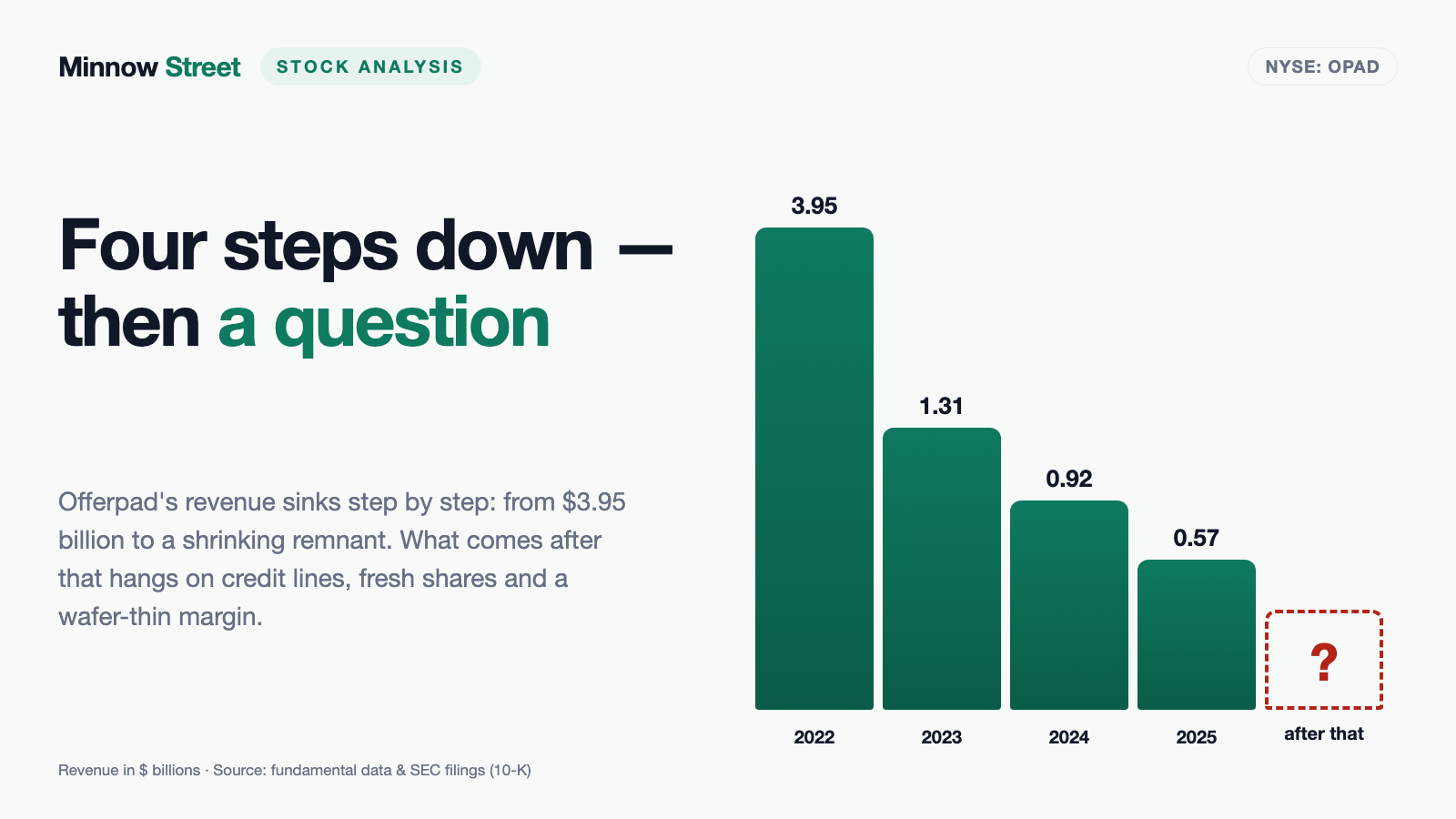
Let us start with what genuinely impresses — the sheer size. At the peak of the housing boom in 2022 Offerpad turned over $3,952.3 million, close to four billion dollars. That is a lot of timber for a company this size. Only: that enormous revenue never turned into a reliable profit. Across the whole run from 2020 to 2025 there was exactly one profitable year — 2021, in the middle of the boom, with a wafer-thin plus of $6.5 million. After that it went downhill and into the red.
The full series, from the annual reports: revenue of $2,070.4 million (2021), $3,952.3 million (2022), $1,314.4 million (2023), $918.8 million (2024) and $567.8 million (2025). Against it the bottom line: a profit of $6.5 million in 2021, then losses of $148.6 million (2022), $117.2 million (2023), $62.2 million (2024) and $46.4 million (2025). Note the pattern — the losses do get smaller, but so does the company.
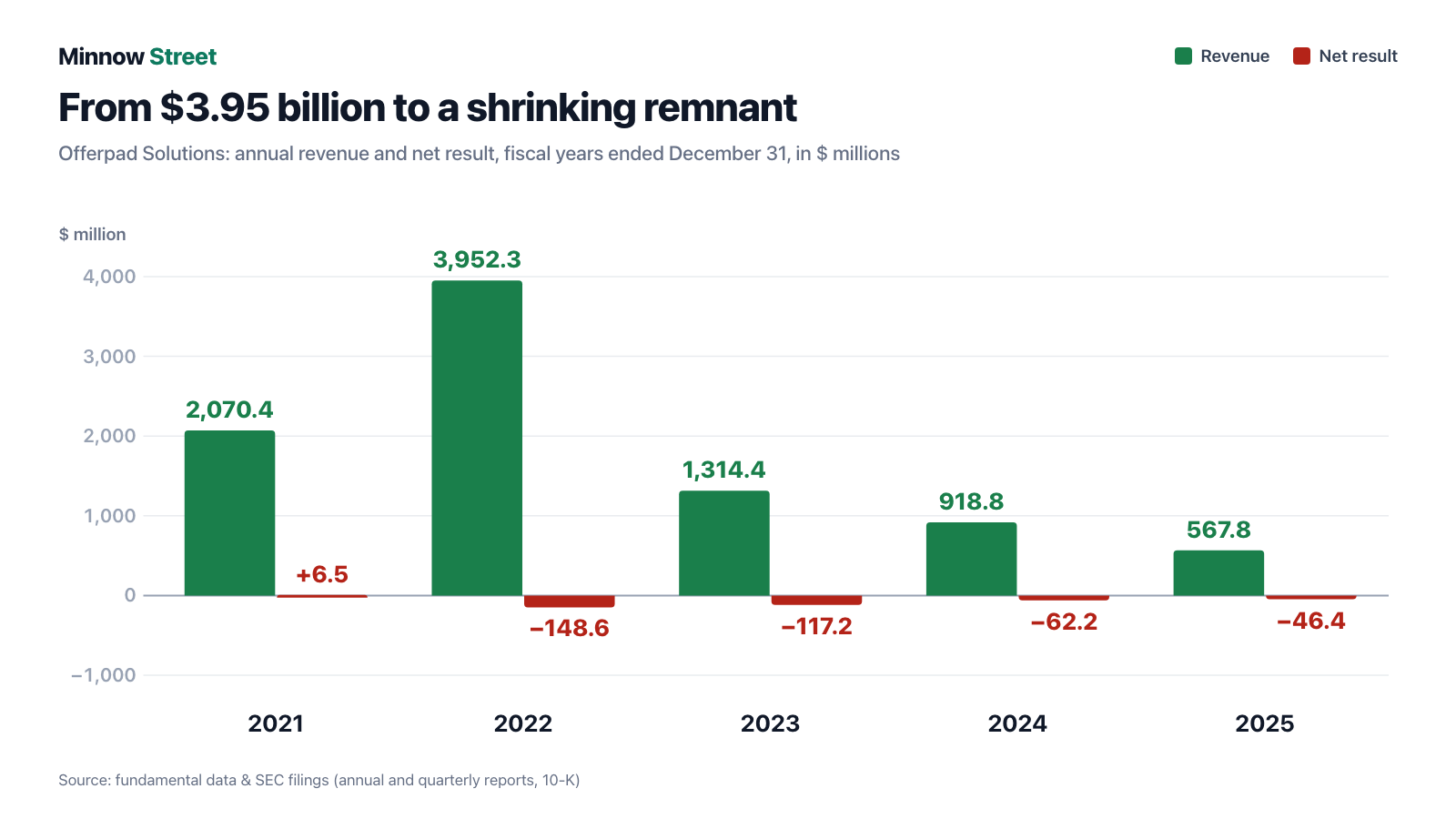
The slide since 2022 is not a slip but a deliberate shrinking cure: after the rate shock Offerpad throttled its buying to limit losses. In 2025 revenue fell 38.2 percent to $567.8 million, and the number of homes sold dropped from 2,707 to 1,591 (down 41 percent). The first quarter of 2026 shows that the descent is not over: only $80.1 million of revenue (down 50.2 percent against the prior-year quarter) and a mere 211 homes sold (down 54.1 percent). On revenue of $567.8 million against cost of revenue of $525.8 million, 2025 left a gross profit of roughly $42.0 million — a gross margin of about 7.4 percent, or roughly $26,000 per home sold, before a single dollar of interest, salary or marketing is deducted. After that comes the net loss of $46.4 million. The lesson: when only seven cents of every revenue dollar survive the round trip between purchase and sale, every storm in the housing market is dangerous.
The uncomfortable truths
Uncomfortable truth no. 1: the cash flow the filters praise comes from a clearance sale
Here we solve the riddle of the optically-cheap trap. Why does a permanently loss-making company show up in the cash-flow rankings of all places? Because in 2025 Offerpad really did report a positive operating cash inflow of $66.8 million. That sounds healthy. It is not — and the annual report itself says where the money came from:
“During the year ended December 31, 2025, net cash provided by operating activities primarily resulted from a $109.4 million decrease in real estate inventory due to our continued focus on selling through our aged real estate inventory and our ongoing intentional reduction in home acquisition pace.”
— Offerpad Solutions Inc., SEC annual report 10-K for fiscal year 2025, MD&A — Liquidity and Capital Resources
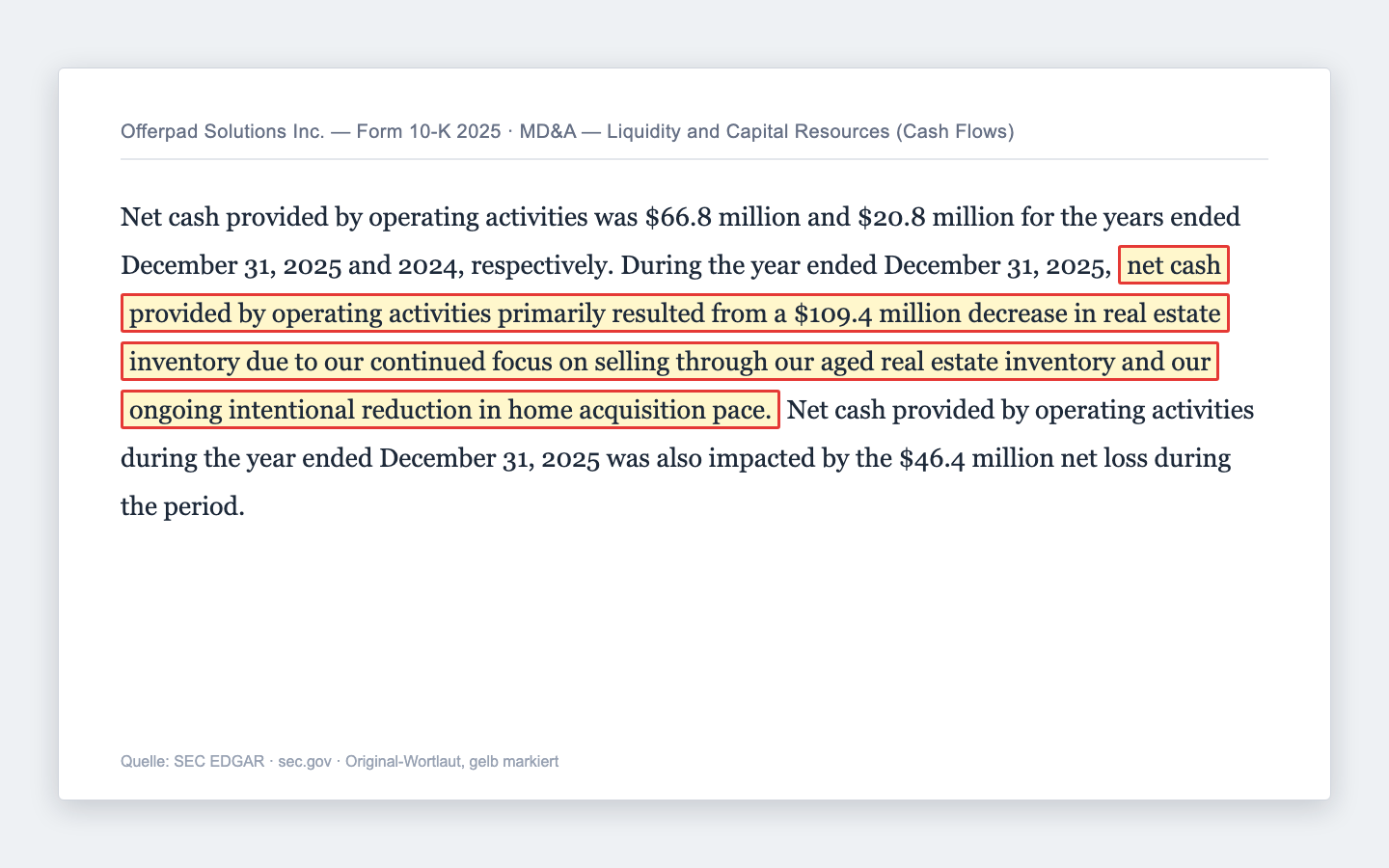
This is the decisive point. When a dealer empties the warehouse and does not refill it, a lot of money flows in for a while — but not because business is booming, rather because it is getting smaller. That is cash flow out of substance, not out of earnings. It stops at the exact moment the stock of homes has been sold. A price-to-cash-flow ratio that takes this one-off effect at face value measures the company by an event that cannot be repeated. Which is why the "cheapness" in the cash-flow ranking is deceptive: it describes a contraction, not a strength.
Uncomfortable truth no. 2: a wafer-thin margin — and the homes carry the price risk
A business with a gross margin of a little over seven percent has no buffer for error. If the housing market falls while Offerpad is sitting on inventory, that narrow spread can turn into a minus — because the properties sit on the balance sheet at cost and have to be written down when their value drops. The annual report names precisely this risk as one of the company's central dependencies:
“Our business is dependent upon our ability to accurately value and manage real estate inventory and an ineffective pricing or portfolio management strategy, or other changes to our underwriting process, may have an adverse effect on our business, sales and results of operations.”
— Offerpad Solutions Inc., SEC annual report 10-K for fiscal year 2025, Item 1A Risk Factors
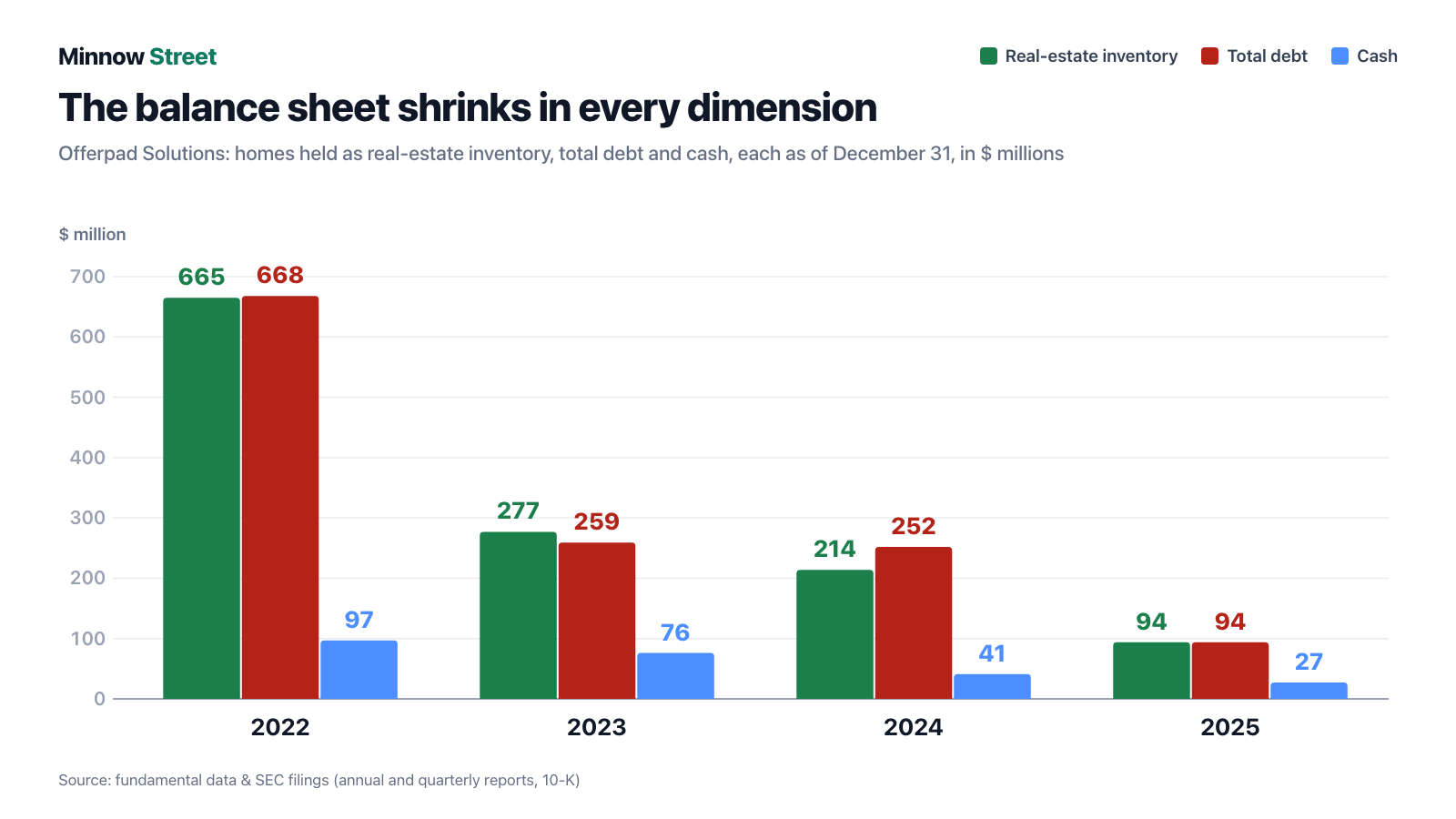
To put the order of magnitude in place: as of December 31, 2025, homes worth $93.8 million sat on the balance sheet as inventory — more than twice the book equity of roughly $38 million. At the 2022 peak it was $664.7 million. Every percentage point those homes lose against their purchase price eats directly into the thin equity. The good news: because Offerpad has cut the stock so hard, this risk is smaller today than in 2022. The bad news: it is the core of the model and can never be switched off entirely — anyone trading houses is always also betting on their price.
Uncomfortable truth no. 3: the debt exceeds the cash — and the credit lines already needed waivers
An iBuyer lives off its credit lines. Offerpad finances the homes through secured senior and subordinated mezzanine credit facilities (the mezzanine lines rank second on the collateral and are therefore riskier) plus a revolving credit facility — in the jargon: the homes serve as collateral, and the size of the borrowings follows a "borrowing base", the lendable value of the stock of homes. Those lines are the lifeline: without them Offerpad cannot buy houses. And exactly here stands a figure you have to hold next to the cash position:
“As of December 31, 2025, we had $93.3 million of total debt outstanding under our secured credit facilities, other debt and revolving credit facility. Our leverage has meaningful consequences for us, including increasing our vulnerability to economic downturns, limiting our ability to withstand competitive pressures, or reducing our flexibility to respond to changing business and economic conditions.”
— Offerpad Solutions Inc., SEC annual report 10-K for fiscal year 2025, Item 1A Risk Factors
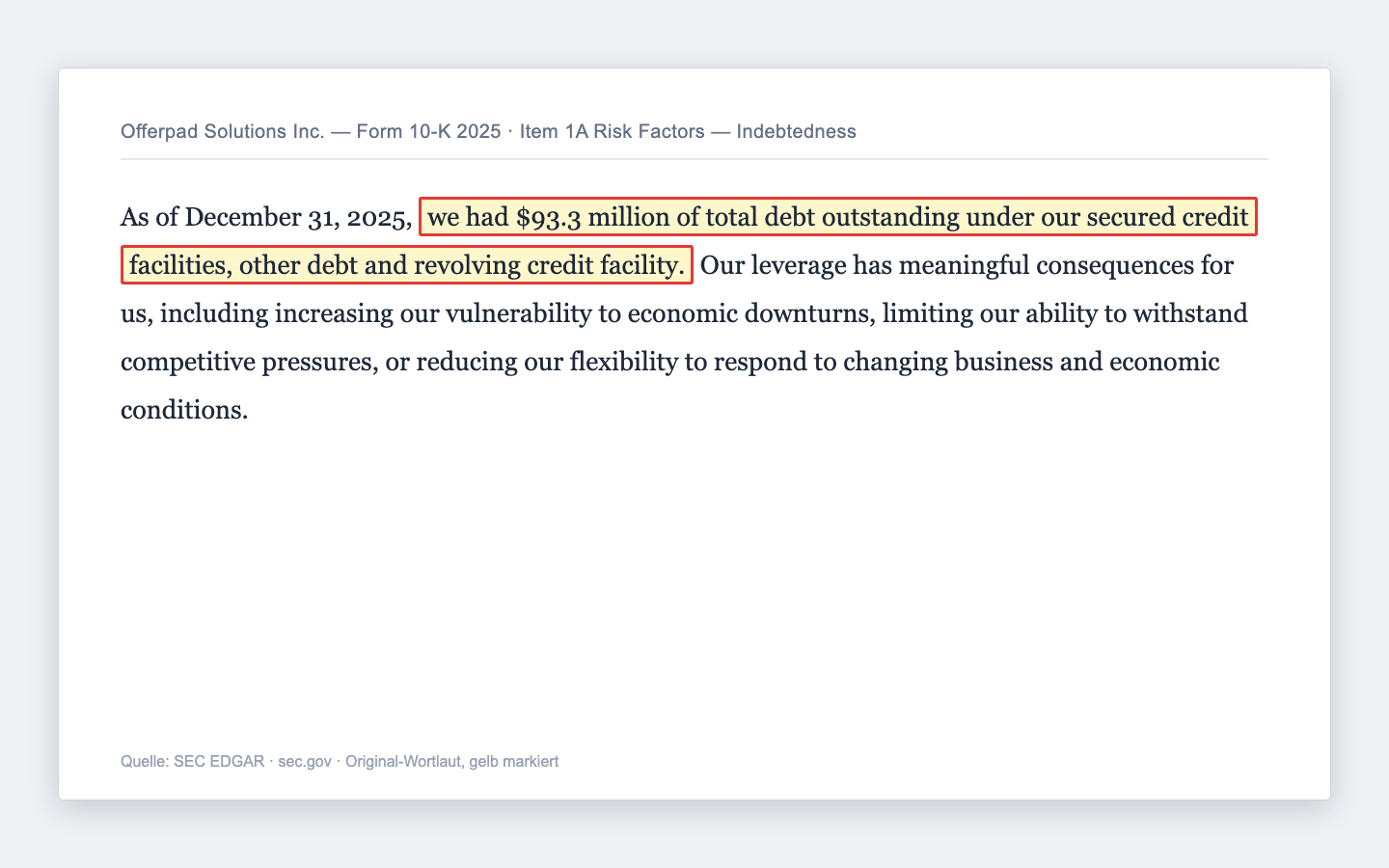
$93.3 million of debt stands against $26.5 million of cash (December 31, 2025). To be fair: Offerpad has cut its leverage drastically since the boom — in 2022 it was $668.3 million. And the company was in compliance with all covenants at the balance sheet date. But the report contains a sentence that makes you sit up: “At various points during 2025, we obtained temporary waivers for certain of these covenants” — at several points during 2025 Offerpad had to have individual credit covenants temporarily waived; the associated draw windows expired afterwards. Those covenants cover, among other things, a minimum tangible net worth and leverage ceilings. Waivers of this kind are not a default — but they are a clear sign that the credit lines are under tension in a shrinking business. And unlike some crisis cases there is no formal doubt about the company's ability to continue: the 10-K states no going-concern warning. So the balance sheet holds — but it hangs on credit lines whose covenants have already had to be stretched once.
How brittle the balance between cash inflow, debt and value can become is something we took apart at the hotel REIT Ashford Hospitality Trust: there a quarterly operating inflow of $29.5 million consisted largely of bills not yet paid — $20.4 million of it advisory fees owed to its own external manager — while $2.4 billion of debt stood against stockholders' equity of minus $695.2 million and an audit opinion carrying a going-concern paragraph. Offerpad is nowhere near that point. But the question is the same one: where does the money come from, and what stands behind it?
Valuation — and why cheap does not mean inexpensive here
By the middle of 2026 Offerpad puts roughly $24 million on the stock market scales against a most recent annual revenue of $567.8 million — hence the price-to-sales ratio of about 0.05. Add the net debt and the enterprise value comes to roughly $65 million; measured against revenue that is still only about 0.13. On paper this is spectacularly low. Only: at a business that structurally loses money and whose revenue contains the full house prices, the revenue multiple is no measure of "cheap". You can barely value Offerpad on revenue at all — and a profit you could pin a price-to-earnings ratio to simply does not exist. Closer to the actual substance is the price-to-book ratio of roughly 0.5 (a market value of $24 million against equity of roughly $38 million). That, too, sounds like a cushion — but it is a cushion that thins out as house prices fall and losses keep running.
The professionals' view is correspondingly cautious and split: the average analyst price target sits above the most recently traded level, yet the revenue estimates keep drifting down and no sustainable profit is in sight on the horizon. On top of that comes the dilution, which distorts the picture.
Two events have to be known to read the mini valuation correctly, and both turn on the same date. First the dilution (your slice of the pie gets smaller when new slices are constantly cut): in January 2026 Offerpad issued 10 million new shares in a direct placement for $18 million — a pre-split share count, since that happened five months before the consolidation — and an at-the-market share sales program is running alongside. Second the reverse split: because the price fell below the minimum-price requirement of the New York Stock Exchange, on June 9, 2026 Offerpad combined ten old shares into one new one (1-for-10). Since then the quoted price looks ten times higher without anything changing in the value of the company — a cosmetic measure to avoid a delisting. That is also why the market value of roughly $24 million by the middle of 2026 refers to only about 4.7 million shares outstanding after the split, and not to the roughly 47 million before it. Growth paid for with fresh shares is never entirely free; a price hoisted above the minimum threshold only by consolidation, even less so.
Opportunities and risks at a glance
What speaks for Offerpad:
- Deleveraging: total debt has fallen from $668.3 million (2022) to $93.3 million (2025); the company was in compliance with all credit covenants at year-end and has no formal going-concern problem.
- A positive operating cash flow ($66.8 million in 2025) and real, quickly realizable current assets — houses can be sold, unlike an empty biotech pipeline.
- An established, technology-supported model (the "Offercomp" AI valuation) with a growing share of higher-margin services; should the U.S. housing market pick up and buying accelerate again, there is operating leverage to the upside.
- A price-to-book ratio of roughly 0.5: the market value sits below book equity — at stable house prices, a certain cushion of substance.
What speaks against it:
- A structurally thin margin: a gross margin of roughly 7.4 percent, and below it red ink throughout (a net loss of $46.4 million in 2025); since 2020 there has been exactly one profitable year (2021).
- Collapsing revenue: down 38.2 percent in 2025 to $567.8 million, down 50.2 percent in the first quarter of 2026; homes sold fell to 1,591 in 2025 and to 211 in the first quarter of 2026.
- The positive cash flow comes from running down the stock of homes (inventory down $109.4 million), not from profit — it ends when the clearance sale ends.
- Credit dependence: $93.3 million of debt against $26.5 million of cash; "temporary waivers" of individual credit covenants had to be obtained during 2025.
- Dilution and cosmetics: an $18 million capital increase (January 2026), a running at-the-market share sales program and a 1-for-10 reverse split (June 2026) to avoid a delisting.
- The low revenue multiple (price-to-sales around 0.05) is a consequence of the business model, not a sign of undervaluation.
A human conclusion
Do you remember the optically-cheap trap from the opening — the reflex that mistakes a low ratio for a bargain? After the trip through the filings you now know why the market credits Offerpad with so little. The price-to-sales ratio of 0.05 is not a gift but a mirror of the model: a business that pushes enormous house prices through its books and keeps only a wafer-thin remainder — and lately not even that, but losses. The handsome cash flow is the sound of a warehouse being cleared; the handsome book value hangs on houses whose price nobody guarantees; and above the cash position sits debt whose covenants have already had to be stretched.
The other side deserves fairness: this is not fraud and not an accounting scandal. Offerpad discloses everything cleanly, has cut its debt radically and reports — unlike some crisis cases — no doubt about its own continuation. Should the housing market turn and the company start buying in meaningful volume again, the shrunken remainder could become a business once more. But that is a bet on a market cycle and on a margin that has hardly ever existed — not a safe value investment lying around cheap by accident.
What you make of it is your decision. And that is exactly as it should be. From where we sit, the numbers deliver no discernible margin of safety: an optically cheap price does not offset a thin margin, collapsing revenue and dependence on credit lines. We see no demonstrable reason to read the low valuation as a favorable entry — and what matters, in our view, is less the price-to-sales ratio than three other things: whether homes sold and revenue turn back up, whether the gross margin makes progress, and how the credit covenants and the dilution develop.
Sources
- Offerpad Solutions Inc. — SEC annual report 10-K, fiscal year 2025 (as of 31.12.2025, filed 24.02.2026)
- Offerpad Solutions Inc. — SEC quarterly report 10-Q (as of 31.03.2026, filed 30.04.2026)
- Offerpad Solutions Inc. — SEC annual report 10-K, fiscal year 2024 (comparison basis)
- Offerpad Solutions Inc. — proxy statement DEF 14A of 22.04.2026 (beneficial ownership)
- Offerpad Solutions Inc. — SEC filing 8-K of 09.06.2026 (1-for-10 reverse stock split, NYSE minimum price); plus the Schedule 13G filings (special-situation screening).
- Fundamental data (metrics, valuation, annual and quarterly series); in-house stock scanner, data as of July 9, 2026.
Disclaimer: This article is a journalistic analysis and not investment advice. It is not a solicitation to buy or sell securities and cannot take your personal circumstances into account. Share prices fluctuate; a total loss is possible. Make your investment decisions on your own responsibility and seek independent advice when in doubt.
Our Bottom Line at a Glance
- Business model & margin negative
- iBuying is a capital-hungry, thin-margin model: Offerpad books the full house prices as revenue but keeps a gross margin of only around 7.4 percent (2025) — and a loss at the bottom. Since 2020 there has been exactly one profitable year (2021). Every bout of weakness in the housing market hits that narrow spread directly.
- Revenue & unit sales negative
- Revenue collapsed from $3,952.3 million (2022) to $567.8 million (2025, down 38.2 percent) and to $80.1 million in the first quarter of 2026 (down 50.2 percent); homes sold fell to 1,591 in 2025 and to 211 in the first quarter of 2026 (down 54 percent). The company is shrinking faster than it is healing.
- Cash flow & balance sheet neutral
- A positive operating cash flow ($66.8 million in 2025) and no going-concern statement — but the inflow comes from running down the stock of homes (inventory down $109.4 million), not from profit. Debt of $93.3 million exceeds the cash position ($26.5 million); the deleveraging from $668 million to $93 million is real, yet the cash has shrunk as well.
- Leverage & credit covenants negative
- The homes are financed through secured senior and mezzanine credit facilities (borrowing base); those lines are the lifeline of the model. During 2025 "temporary waivers" of individual covenants (among them a minimum tangible net worth and leverage ceilings) had to be obtained — a sign of tension, even if not a default.
- Valuation, dilution & governance neutral
- A price-to-sales ratio of roughly 0.05 and a price-to-book ratio of roughly 0.5 look cheap, but they are a consequence of the model and a thin cushion of substance respectively. An $18 million capital increase (January 2026), a running at-the-market share sales program and a 1-for-10 reverse split (June 2026) against a delisting dilute and paper over. Ownership is broadly spread (LL Capital 12.1 percent, First American 10.8 percent and at the same time a service provider, insiders 16.7 percent); no activist, no takeover.
Offerpad is an iBuyer in the same thin-margin, capital-hungry model as Opendoor: the full house prices run through the books as revenue, what sticks is a gross margin of roughly 7.4 percent — and a loss at the bottom ($46.4 million in 2025). Revenue collapsed from $3,952.3 million (2022) to $567.8 million (2025) and further to $80.1 million in the first quarter of 2026 (down 50.2 percent). The optically spectacular valuation (price-to-sales around 0.05) is no bargain but a mirror of the model: the positive cash flow comes from selling off the stock of homes, the debt ($93.3 million) exceeds the cash ($26.5 million), waivers of credit covenants had to be obtained in 2025, and a capital increase plus a 1-for-10 reverse split (June 2026) dilute and paper over. There is no formal going-concern statement. We see no discernible margin of safety. Not investment advice.
What Our Rating Means
Open questions
The business works in principle, but one material question is open. As long as it stays open, our findings do not carry a quality verdict.
Our findings give no reason to read the low valuation as a favorable entry: a structurally loss-making business with a gross margin of around 7.4 percent, revenue down by more than 50 percent, a positive cash flow that comes only from selling off the stock of homes, and credit lines whose covenants had to be stretched in 2025 — that is a value trap, not substance. We see no margin of safety. Three things are worth following: whether revenue and homes sold turn back up, whether the gross margin improves, and how the credit covenants and the dilution develop. The decision is yours.
A journalistic assessment by our editorial team at the time of the deep dive, based on public sources — not investment advice and not a solicitation to buy or sell. Your personal circumstances (investment goals, risk capacity, taxes) cannot be taken into account. What our levels mean, how verdicts are formed, and what conflicts of interest exist →
Worth Noting
- Materiality gate: (1) A thin margin plus inventory price risk — a gross margin of around 7.4 percent, $93.8 million of homes (more than 2x equity) on the balance sheet = a structural finding. (2) A revenue collapse of 50.2 percent in the first quarter of 2026 and roughly 86 percent against 2022, a business surviving by shrinking = a structural finding with existential proximity. (3) Debt of $93.3 million against $26.5 million of cash, warehouse and mezzanine lines with temporary covenant waivers in 2025 = a structural/existential finding (the credit lines are the lifeline, and the covenants have already been stretched). (4) Dilution (an $18 million capital increase in January 2026, an at-the-market program) plus a 1-for-10 reverse split against an NYSE delisting = a price finding. No formal existential finding: NO going-concern or substantial-doubt statement in the 10-K, a positive operating cash flow, deleveraging from $668 million to $93 million. The cluster of a structural finding plus near-existential credit dependence plus a revenue collapse carries the "open questions" rating — for "substance risk" the documented finding is missing, and for "quality demonstrated" the open points weigh too heavily. The low valuation does not determine the color: the rating says nothing about the entry price — that is what the ratio scanners are for.
- Price and valuation figures are dated to mid-2026; analyses are evergreen, daily prices are not a buy argument. The market value of roughly $24 million refers to the roughly 4.7 million shares outstanding after the 1-for-10 reverse split (June 9, 2026); the 10 million new shares of the January 2026 direct placement are a pre-split count and correspond to roughly 1 million shares afterwards. The price-to-sales ratio of around 0.05 refers to the 2025 annual revenue ($567.8 million); on the declining current revenue (roughly $487 million on a trailing twelve-month view) it is slightly higher.
- Special-situation screening (documented): no activist, no takeover, no rights plan or poison pill, no formal strategic-review press release, no reverse merger. The only "special case" is the delisting avoidance via the reverse split (NYSE minimum price, effective June 9, 2026). The Schedule 13G filings concern passive holders; the cluster of Form 4 filings in June 2026 is split-related. First American Financial Corporation (10.8 percent, the second-largest holder after LL Capital at 12.1 percent) is at the same time a related party (title and settlement services); Offerpad director Kenneth DeGiorgio was chief executive and a board member of First American until April 2025.
- AI rating: uses. Offerpad applies machine learning and AI operationally in its "Offercomp" valuation engine (valuing more than 100,000 properties a year automatically, with computer-vision-supported renovation estimates) but generates no AI revenue — AI is a tool for pricing, not a revenue source. Supporting quotes are held in the company-specific AI file.
- Side finding: the Wall Street price target (post-split) sits above the most recently traded level, yet revenue estimates keep drifting down and EPS estimates stay negative for the coming years. Short interest stands at roughly 12.6 percent of the free float — part of the market is betting on further price falls.
Frequently Asked Questions
An iBuyer ("instant buyer") buys residential homes directly from the seller through an algorithmic instant offer, repairs them and resells them. Offerpad Solutions (NYSE: OPAD, headquartered in Tempe, Arizona) does exactly that: its in-house AI valuation engine "Offercomp" generates the purchase offers, the homes go onto its own balance sheet, get fixed up and are sold on. The money is earned on the spread between purchase and sale — which in 2025 averaged a gross margin of only around 7.4 percent.
Because Offerpad books the full sale prices of the homes as revenue, the revenue is structurally enormous ($567.8 million in 2025) relative to the small market value (around $24 million by the middle of 2026) — hence a price-to-sales ratio of roughly 0.05. That is not a sign of undervaluation but a quirk of the business model: a lot of revenue, barely any margin, a loss at the bottom. A company like this can hardly be valued on revenue at all.
No — the SEC filings we evaluated (the 10-K for 2025 and the 10-Q for the first quarter of 2026) contain no reference to "substantial doubt about the ability to continue as a going concern". In 2025 Offerpad even reported a positive operating cash flow and has cut its debt sharply. That said, the cash flow came from selling down the stock of homes, the debt ($93.3 million) exceeds the cash position ($26.5 million), and temporary waivers of individual credit covenants had to be obtained during 2025.
From selling off its own stock of homes. According to the annual report (10-K), the 2025 operating cash inflow of $66.8 million resulted primarily from a $109.4 million decrease in real estate inventory — Offerpad sold through aged homes while simultaneously throttling purchases. That is cash flow out of a shrinking balance sheet, not out of profit; it ends once the inventory has been sold.
Because the share price fell below the minimum-price requirement of the New York Stock Exchange and a delisting loomed. On June 9, 2026 Offerpad therefore combined ten old shares into one new one (a 1-for-10 reverse split). Since then the quoted price looks higher without anything having changed in the value of the company. Before that, in January 2026, the company had already issued 10 million new shares — a pre-split count — for $18 million, so existing shareholders were diluted.
Only optically. The low valuation ratios (price-to-sales around 0.05, price-to-book around 0.5) reflect a structurally loss-making business with a thin margin, collapsing revenue and credit dependence — not an overlooked undervaluation. From where we sit, the numbers deliver no discernible margin of safety. Buying in would be a bet that the U.S. housing market turns and the company starts buying profitably again — not a safe value investment.
Offerpad uses AI operationally but does not sell it. According to the 10-K the company applies machine learning and AI in its "Offercomp" valuation engine, which values more than 100,000 properties a year automatically; image recognition estimates renovation costs. AI is therefore a tool for pricing and efficiency, not a revenue source of its own — Offerpad earns its money with houses and real estate services, not with AI products.
Found an error?
Did you spot a factual error, an outdated number, or a typo in this deep dive? Let us know briefly — your report goes straight to the editorial team.