Credo Stock: The Cable AI Hangs On — and the Three Customers Credo Hangs On
Revenue tripled in a single year, a 35 percent net margin, eight record quarters in a row — Credo Technology supplies the connectivity for AI data centers and the prettiest growth numbers in our scanner. We read the SEC filings and show you the other side too: three customers, one contract manufacturer, and a price that assumes perfection. Not investment advice — just both sides of a gleaming balance sheet.
 Thomas Mücke
Founder & Publisher
Thomas Mücke
Founder & Publisher
Chart
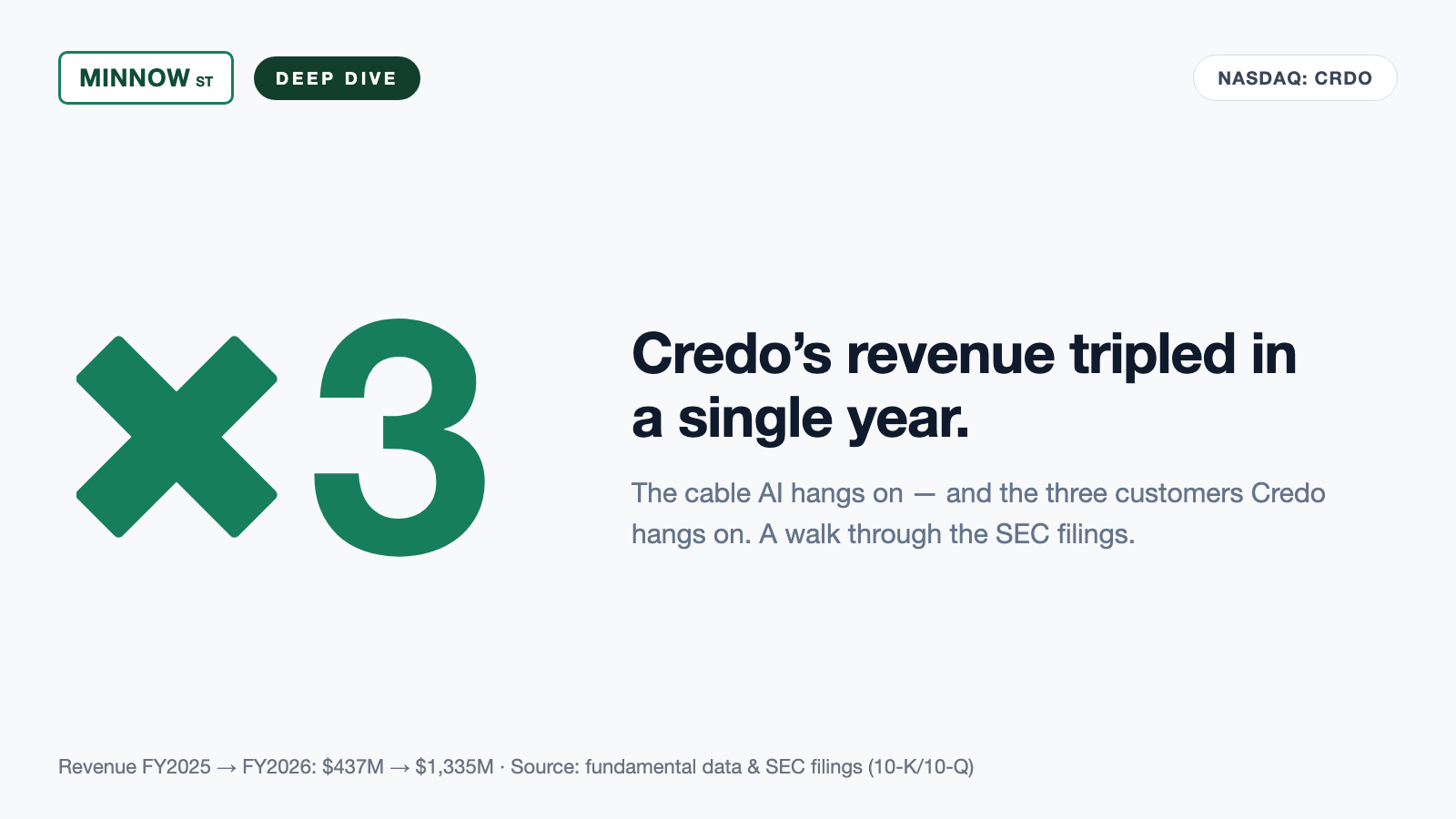
Interactive price chart (TradingView).
Note: pure fact-based analysis, not investment advice and not a solicitation to buy or sell. All figures without guarantee.
Take a ruler, lay it against a rising revenue curve and extend the line by three years — and voilà, your dream return. That little move may be the most expensive habit we investors have; let's call it the ruler mistake. Hardly any stock invites it right now as seductively as Credo Technology (Nasdaq: CRDO): revenue tripled in a single year, eight record quarters in a row, up 2,011 percent in four years. The ruler is already trembling with anticipation in your hand. So let's make a deal: we put it down for a moment and look together into the original filings with the U.S. securities regulator, the SEC — the freshly filed annual report (10-K) for fiscal year 2026 and four quarterly reports (10-Q). That is where it says what carries the curve. And what can tear it.
What Credo actually does
Credo builds the connectivity for data centers — above all so-called Active Electrical Cables (AEC). Picture an AI data center as a giant brain: the graphics processors are the nerve cells, but without nerve fibers there is no thinking. Credo's cables are exactly those nerve fibers — copper cables with built-in signal-processor chips that carry data reliably from server to server at up to 1.6 terabits per second. Add optical signal chips, so-called retimers, and licenses for the underlying SerDes chip technology. The company was founded by semiconductor veterans; the legal domicile sits in the Cayman Islands, the operating headquarters in San Jose, California; 807 employees, 616 of them engineers.
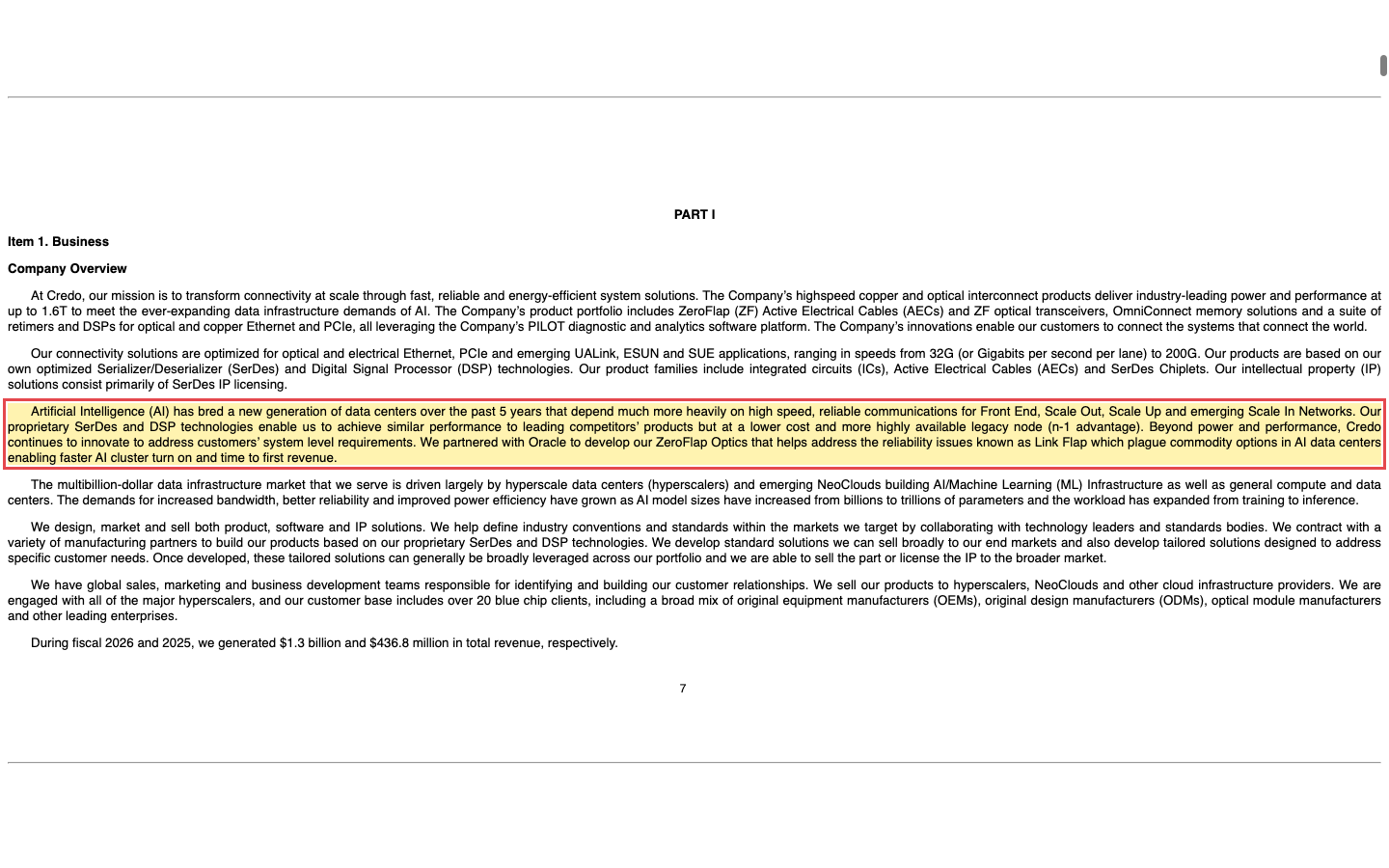
The tailwind is the same one currently driving half the tech world: the annual report says verbatim that AI has bred a new generation of data centers that depends far more heavily on fast, reliable communications. How the same boom looks from a completely different angle is something we dissected at Vicor — there the AI data centers get their power delivered, here they get their cabling.
Where the stock shows up in our scanner
In our in-house stock scanner (3,211 stocks, 72 scanners), Credo is what you would call a model student — rank 2 of 3,211 in the fundamental rating (A +75), right behind Reddit (data as of June 25, 2026). Here is how you get there yourself: open the scanner menu on Minnow Street → choose "Fundamental Rank (A / A+)" → second row. Unlike Reddit above it, Credo shows a green "Stage 2" — the trend is running.
Credo shows up in 16 of 72 scanners — across all categories, which is rare:
- Trend: Stan Weinstein: Stage 2, stage-2 leader, 21-EMA trend, above the 50- and 200-day averages — the uptrend is intact, the trend template satisfied, the power trend active.
- Momentum: CANSLIM Type RS, RS leader (≥ 90) — a relative strength rating of 96 means: stronger than 96 percent of all stocks.
- Growth and quality: quality growth, triple-digit revenue growth, EPS & revenue power, Ben Bennett: Focus List, institutional accumulation, fundamental rank and "Best of All".
Translated: trend and numbers line up here. The Piotroski score of 7 of 9 — a nine-point test of balance-sheet health — signals solid, though not perfect, book quality. One warning already sits right in the scanner: the average daily range (ADR) is 10.9 percent — this stock moves as much on an ordinary Tuesday as others do in a month. Whoever gets in needs a calm stomach.
The numbers over the years — the steepest curve in our universe

Fiscal year 2026 (ended May 2, 2026) was the breakthrough: $1,335 million in revenue, up 205.7 percent. The annual report quantifies the source precisely:
"The sales increase was primarily driven by the ramp-up of our AEC solutions at our hyperscale data center customers during fiscal 2026 which contributed over 99% of the increase in revenue."
— Credo Technology, SEC annual report 10-K FY2026, Item 7 MD&A
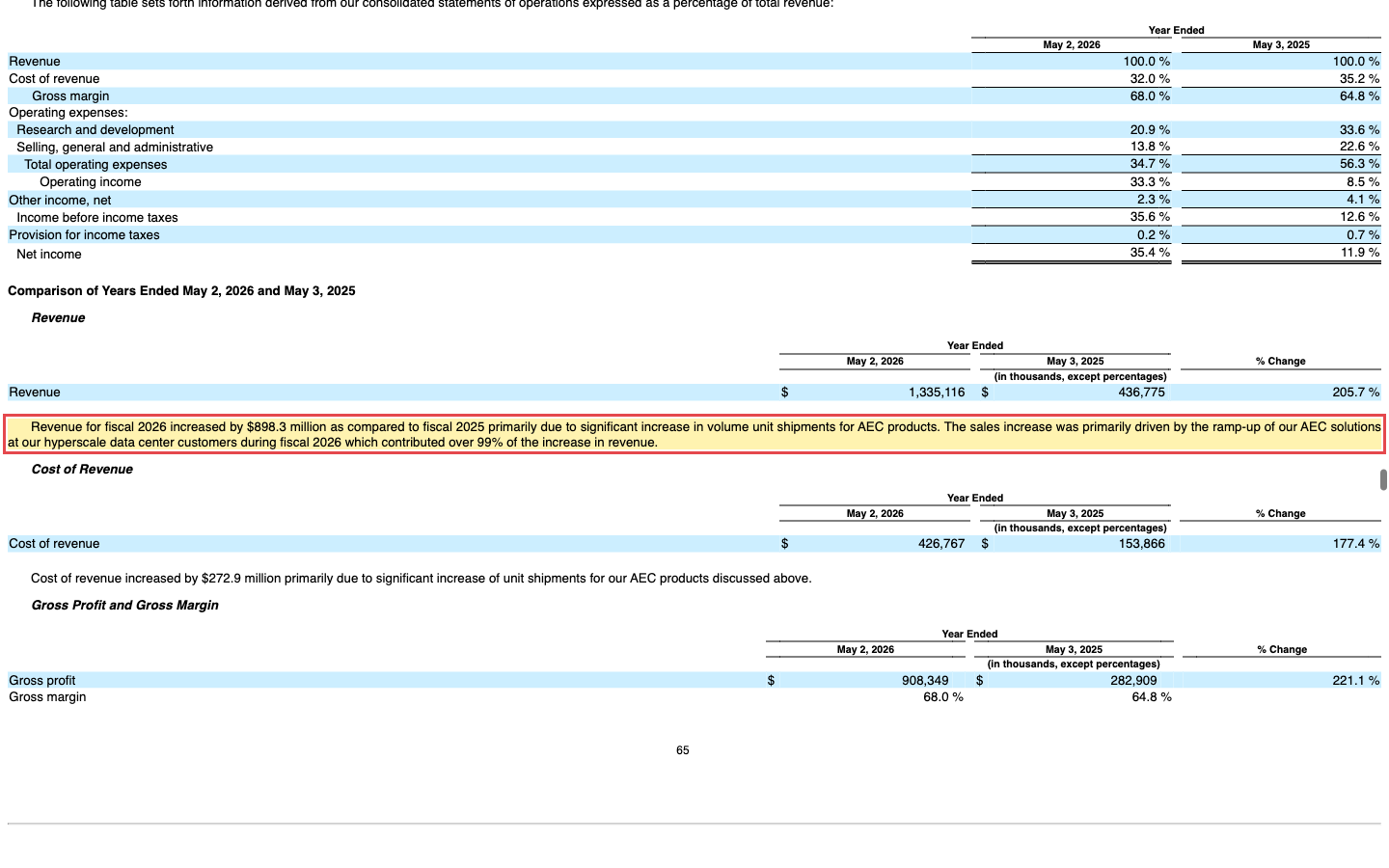
And Credo is not just getting bigger, it is getting better: a gross margin of 68 percent (after 64.8), net income of $472 million — a net margin of 35.4 percent. The balance sheet: $1.44 billion in cash and investments, essentially no debt. And the quarterly series shows this was no one-off jump:

What the filings say — three uncomfortable truths
A filing with the U.S. securities regulator, the SEC, is honest under penalty of law. And Credo's filings are refreshingly blunt — if you know where to look.
Uncomfortable truth no. 1: three whales carry 84 percent of revenue
If your baker sold 90 percent of his rolls to ten customers — and 84 percent to just three — then the question "What if one stays away?" belongs in every purchase decision. Exactly these numbers sit in the annual report:
"We currently rely and expect to continue to rely on a limited number of customers for a significant part of our revenue. In fiscal 2026, sales to our top 10 customers accounted for approximately 90% of our total revenue. Furthermore, we had two customers that accounted for 10% or more of our total fiscal 2026."
— Credo Technology, SEC annual report 10-K FY2026, Item 1 "Business — Our Customers"
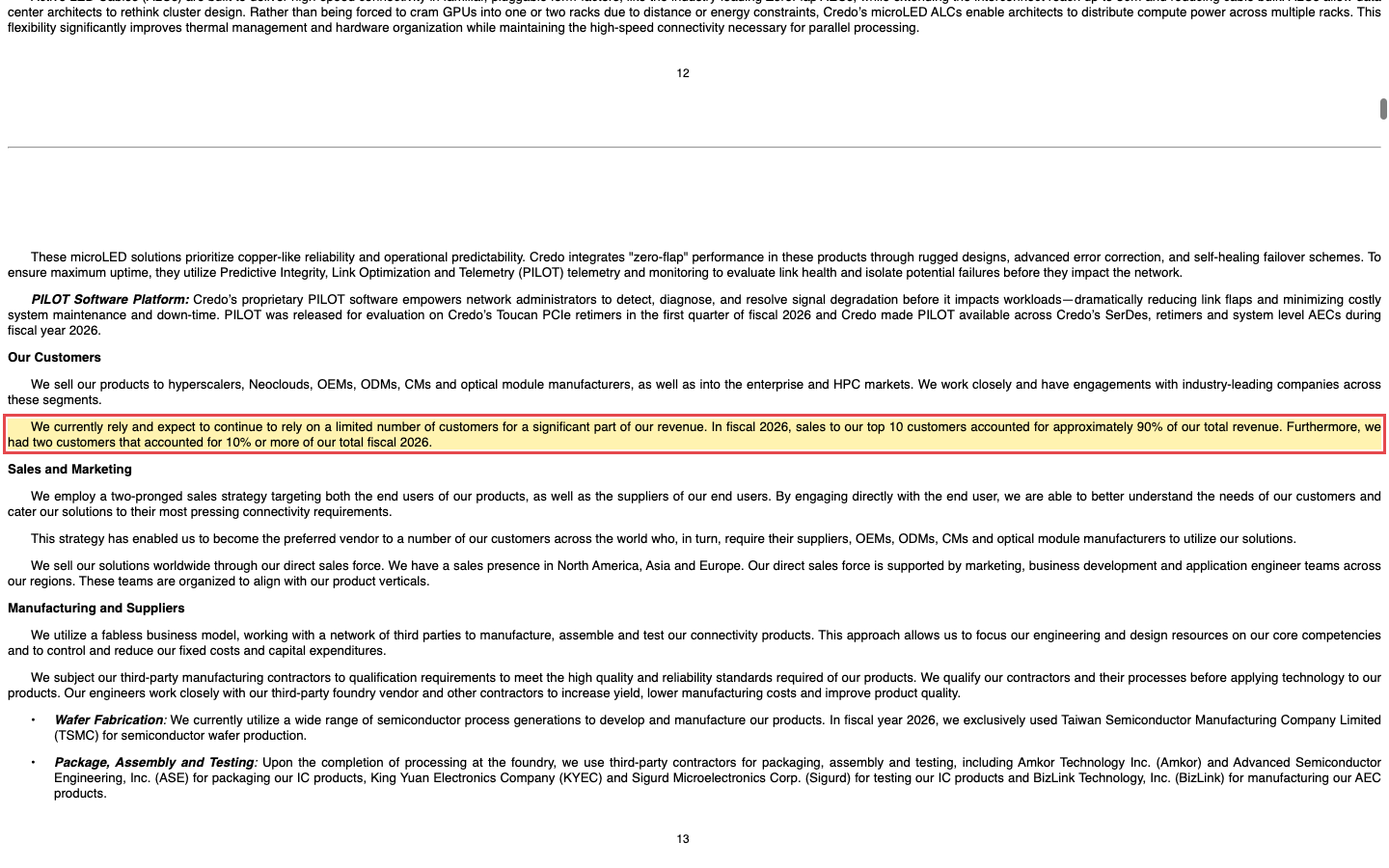
The detail tables in the report make it even more tangible: the three largest end customers stood for 33 + 32 + 19 = 84 percent of fiscal 2026 revenue. The year before, as much as 67 percent hung on a single contracting party. So the cluster has grown broader — from one whale to three — but it is and remains a cluster. The report itself recalls how quickly that can tip: in early 2023 the then-largest customer cut its demand forecasts, and fiscal year 2024 grew by only 4.8 percent. In this industry, that is not a "maybe" — it has already happened.
Uncomfortable truth no. 2: the profit era is younger than the price suggests
"Prior to fiscal 2025, we had a history of net losses. While we generated net income of $472.3 million and $52.2 million in fiscal 2026 and fiscal 2025, respectively, we incurred net losses of $28.4 million in fiscal 2024 […]"
— Credo Technology, SEC annual report 10-K FY2026, Item 1A "Risk Factors"
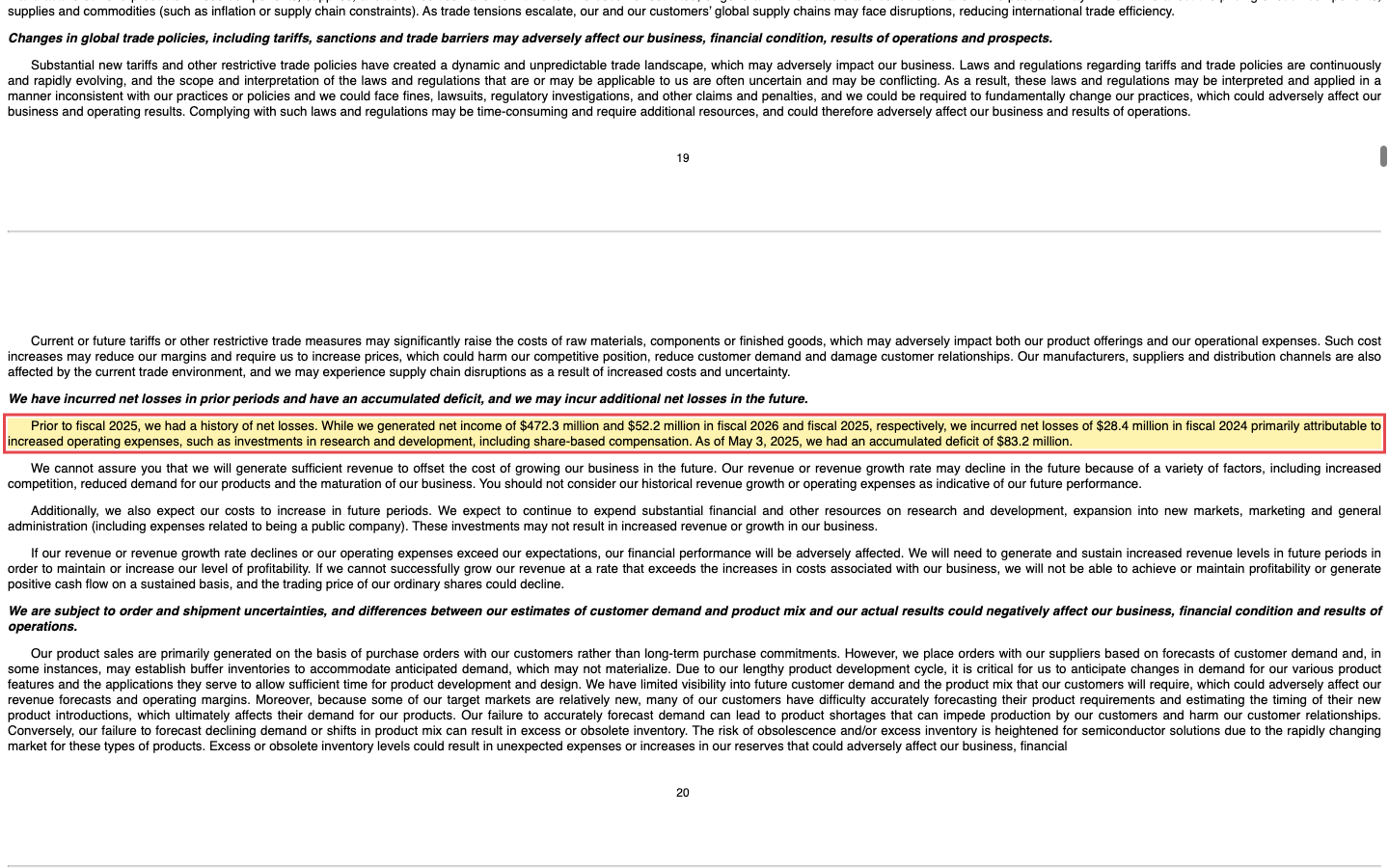
That does not diminish the achievement — but it is a reminder that this company has been proving for only two years that it can make money durably. And the wealth gets shared before it reaches you: stock-based compensation ran to $182.6 million in fiscal 2026 — more than a third of net income — and the share count has grown by roughly a third since 2021:

A look at the behavior of those who know the company best fits the picture: our data feed shows zero insider purchases and 20 insider sales for the most recent reporting period — and a check of the insider filings (Form 4) through July 16, 2026 shows the pattern intact: more sales, still not a single purchase. Insiders sell for many reasons — but they buy for only one.
Uncomfortable truth no. 3: a lot of chain for one cable
Credo designs its chips itself but has everything manufactured — and in concentrated fashion: per the annual report, the semiconductor wafers come exclusively from TSMC, assembly and test run "primarily in Asia", and the AEC cables are built by BizLink. Engineering teams sit in mainland China, Hong Kong and Taiwan, among other places, and the report lists U.S. restrictions on China investments as a risk factor of its own. The legal domicile in the Cayman Islands does not make the construction any simpler. None of this is unusual for the industry — but it means: between Credo's order book and Credo's revenue lie a foundry, a contract manufacturer, several straits, and world politics.
And the engine of it all — the AI investment wave — is cyclical, as the report itself records: "Our business depends on continued capital expenditures by data center service providers and is subject to the cyclicality of such expenditures." As long as hyperscalers invest record sums, things run. When they pause for breath, Credo's revenue breathes with them. How hard the semiconductor investment cycle can swing is a story the equipment makers tell best — see our Lam Research analysis.
Valuation: dream numbers at a dream price
Now to the bill. At mid-2026 Credo weighed in at roughly $49 billion of market value — about 104 times trailing annual earnings, 36 times revenue, and a good 100 times operating income before depreciation. On the analyst estimates for the new fiscal year, the earnings multiple shrinks to around 46 — provided the estimates hold. For scale: even many large AI beneficiaries cost considerably less relative to revenue. A price like this is no longer a valuation but a promise — the promise that the curve keeps running for years the way it ran in 2026.
The professionals are on board anyway: 13 analysts, 12 of them with a buy rating, an average price target around $270. But remember: those same estimates assume that three whales keep ordering with record appetite. The ruler mistake is no beginner's trap here — it is built into the price target.
Opportunities and risks at a glance
What speaks for Credo
- Revenue tripled in a single year ($1,335 million, up 205.7 percent), documented and real — no story growth.
- Highly profitable: a 68 percent gross margin, a 35.4 percent net margin, $1.44 billion in liquidity, practically debt-free.
- Structural tailwind: AI data centers need exactly Credo's connectivity; U.S. revenue in Q3 FY2026 jumped to 35 times its prior-year level.
- Trend and quality align: stage 2, an RS rating of 96, a Piotroski score of 7 of 9, 16 of 72 scanners, rank 2 in the fundamental rating.
- Serial beater: seven consecutive quarters above the earnings estimates.
What speaks against it
- An extreme customer cluster: top 10 ≈ 90 percent, three end customers = 84 percent of revenue — a single order stop nearly wiped out all growth once before, in 2023.
- A valuation without a safety net: a trailing P/E around 104, a price-to-sales ratio around 36 — years of perfection are priced in.
- Supply-chain concentration (wafers exclusively from TSMC, manufacturing in Asia) plus China/Taiwan geopolitics as documented risk factors.
- Dilution: 33 percent more shares since 2021; stock-based compensation of $182.6 million eats more than a third of the profit; zero insider purchases against 20 sales.
- Very high volatility (an average daily range of 10.9 percent) and dependence on the AI investment cycle.
A human conclusion
Credo may be the cleanest growth story our scanner currently knows: a real product in the right place at the right time, with numbers you have to read twice. But that is exactly why the ruler belongs in the drawer. Whoever buys today is not paying for fiscal year 2026 — that is long since in the price. They are paying for fiscal years 2027, 2028 and 2029, delivered by three major customers, manufactured by a single foundry, in the middle of the moodiest investment cycle in tech history.
Maybe the math works out — the tailwind is real, and companies with a 68 percent gross margin and net cash have long lungs. But a tripled revenue curve does not extend by ruler; it extends by order intake. You now know both sides — the steep curve and the three whales carrying it. What you make of it is your decision. And that is exactly as it should be.
Sources
All original documents used in this analysis — for reading yourself:
- SEC annual report (10-K), fiscal year 2026 (as of May 2, 2026): crdo-20260502.htm (sec.gov)
- SEC annual report (10-K), fiscal year 2025 (as of May 3, 2025): crdo-20250503.htm (sec.gov)
- SEC quarterly report (10-Q), Q3 FY2026 (January 31, 2026): crdo-20260131.htm (sec.gov)
- SEC quarterly report (10-Q), Q2 FY2026 (November 1, 2025): crdo-20251101.htm (sec.gov)
- SEC quarterly report (10-Q), Q1 FY2026 (August 2, 2025): crdo-20250802.htm (sec.gov)
- SEC quarterly report (10-Q), Q3 FY2025 (February 1, 2025): crdo-20250201.htm (sec.gov)
- Complete SEC filing history of Credo: EDGAR overview (sec.gov)
- Fundamental data (revenue, income, balance-sheet and cash-flow series, analyst consensus), cross-checked against the SEC filings.
- Screener and rating data: in-house stock scanner (Russell 3000 universe, data as of June 25, 2026).
Data basis: Credo annual reports (SEC Form 10-K) for fiscal years 2025 and 2026 and quarterly reports (10-Q) through January 31, 2026; supplementary fundamental data from our financial data; screener data from our in-house stock scanner (data as of June 25, 2026). This analysis is a journalistic contextualization of publicly available information and is expressly not investment advice, not a financial analysis in the regulatory sense, and not a solicitation to buy or sell securities. Stock investments carry substantial risks up to total loss. All information without guarantee.
Our Bottom Line at a Glance
- Growth positive
- Revenue tripled in fiscal year 2026 (up 205.7 percent to $1.34 billion); eight record quarters in a row.
- Profitability positive
- A 35.4 percent net margin and a 68 percent gross margin — but the profit era is only two years old.
- Balance sheet positive
- $1.44 billion in cash and investments, practically debt-free, a Piotroski score of 7 of 9.
- Customer cluster negative
- Top 10 customers ≈ 90 percent, three end customers = 84 percent of revenue; in 2023 a single customer nearly stopped growth once before.
- Valuation negative
- A trailing P/E around 104, a price-to-sales ratio around 36 — years of perfection are priced in; zero insider purchases against 20 sales.
- Momentum positive
- Stage 2, an RS rating of 96, trend template and power trend active, 16 of 72 scanners — trend and numbers point in the same direction.
Credo is the cleanest growth story in our scanner — a real product, a real boom, real profits — at a price that allows not a single misstep, carried by three major customers and one foundry. If at all, then as a deliberately risky growth position with a clear exit plan, not as a quiet core holding. Not investment advice.
What Our Rating Means
- If you don't own the stock
- Our findings don't argue against an entry — the weighing is yours.
- If you hold it in your portfolio
- Our findings offer no reason to sell.
A journalistic assessment by our editorial team at the time of the deep dive, based on public sources — not investment advice and not a solicitation to buy or sell. Your personal circumstances (investment goals, risk capacity, taxes) cannot be taken into account. What our categories mean, how verdicts are formed, and what conflicts of interest exist →
Worth Noting
- An average daily range of 10.9 percent — budget for extreme volatility.
- The fiscal year ends in early May: fiscal year 2026 is already closed and audited.
- EDGAR check as of July 18, 2026: no new annual, quarterly or current reports since July 9, 2026 — only routine insider filings (Forms 4/144, all sales).
Frequently Asked Questions
Credo develops connectivity for data centers: active copper cables (AEC) with built-in signal processors, optical signal chips, retimers, and SerDes chip licenses for data rates of up to 1.6 terabits per second. Its main buyers are hyperscale operators of AI data centers; Credo owns no factories, and the wafers come exclusively from TSMC.
Exceptionally fast: in fiscal year 2026 (ended May 2, 2026), revenue rose 205.7 percent to $1,335 million — per the SEC annual report, more than 99 percent of the increase came from AEC cables for hyperscalers. It was the eighth record quarter in a row, and earnings estimates were beaten in seven consecutive quarters.
Yes, but only recently. Prior to fiscal year 2025, Credo reported losses throughout, per its own annual report. In fiscal year 2026, net income reached $472.3 million (a 35.4 percent net margin) on a 68 percent gross margin, with $1.44 billion in cash and investments.
Customer concentration: the ten largest customers account for roughly 90 percent of revenue, the three largest end customers for 84 percent. Add the exclusive wafer manufacturing at TSMC, the dependence on the cyclical AI investment boom, and a valuation around 104 times earnings that forgives hardly any disappointment.
At mid-2026 the stock cost about 104 times trailing earnings and 36 times revenue. Multiples like that price in several more years of hypergrowth. Also striking: zero insider purchases against 20 insider sales, and roughly a third more shares outstanding than in 2021.
We do not give investment advice. Our systematic view shows a rare double hit of an intact uptrend (stage 2, RS 96) and top fundamentals (rank 2 of 3,211) — but also a price that assumes perfection and an extreme customer cluster. Both belong in your weighing; the decision is yours.
Found an error?
Did you spot a factual error, an outdated number, or a typo in this deep dive? Let us know briefly — your report goes straight to the editorial team.