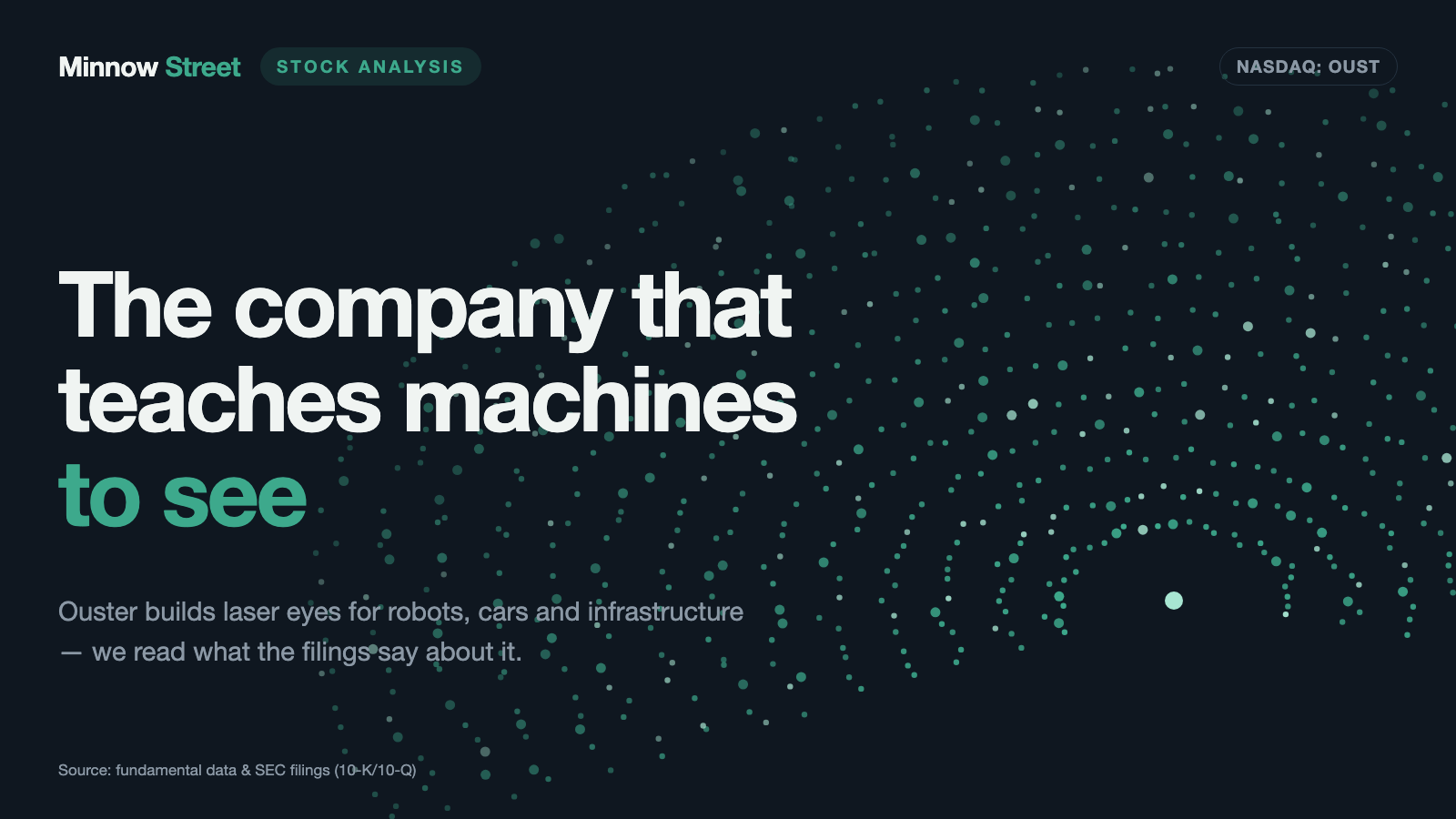
Ouster Stock: Lidar Growth, a Physical-AI Story and the Fine Print
The lidar specialist Ouster has more than quadrupled its revenue in three years and now tells a Physical-AI story. We read the last two annual reports, four quarterly reports and our own screener row, and we say plainly what carries and what wobbles. Not investment advice, just the fine print behind the fireworks.
 Thomas Mücke
Founder & Publisher
Thomas Mücke
Founder & Publisher
Chart
Interactive price chart (TradingView).
Note: pure fact-based analysis, not investment advice and not a solicitation to buy or sell. All figures without guarantee.
Be honest with yourself: you have seen a stock that tripled in three months, and a small devil on your shoulder whispered "you should have been in that one." The devil has a name — FOMO, the fear of missing out — and he is a miserable investment adviser. He buys highs and sells in panic. So before we talk about the lidar specialist Ouster, Inc. (Nasdaq: OUST), let's make a deal: we look at the real numbers together, soberly and completely, and you make your decision with open eyes instead of a racing pulse. For that I read the last two annual reports, the last four quarterly reports and our own screener row. Here we go.
What Ouster actually does
Ouster builds digital lidar — sensors that measure their surroundings in three dimensions with laser pulses. Think of them as eyes for machines: for robots, autonomous vehicles, warehouses, factories and "smart" infrastructure such as traffic monitoring. Four markets, one component. The company sits at 350 Treat Avenue in San Francisco, went public in 2020 and employed 320 people full time at the end of 2025 — 204 in the United States and 116 internationally.
New, and this is the core of the current stock-market story, is that Ouster now frames its entire business under the label "Physical AI": artificial intelligence that does not live in a chat window but acts in the physical world. Sounds like marketing? Part of it is. But there is a real strategic bet behind it, and we will come back to it with the original filing in hand.
Where the stock shows up in our scanner
Every day we run thousands of U.S. and German stocks through our screeners. Ouster is no obscure tip from the back row there, but it is no flawless model student either. This is what its row looks like in our in-house stock screener:
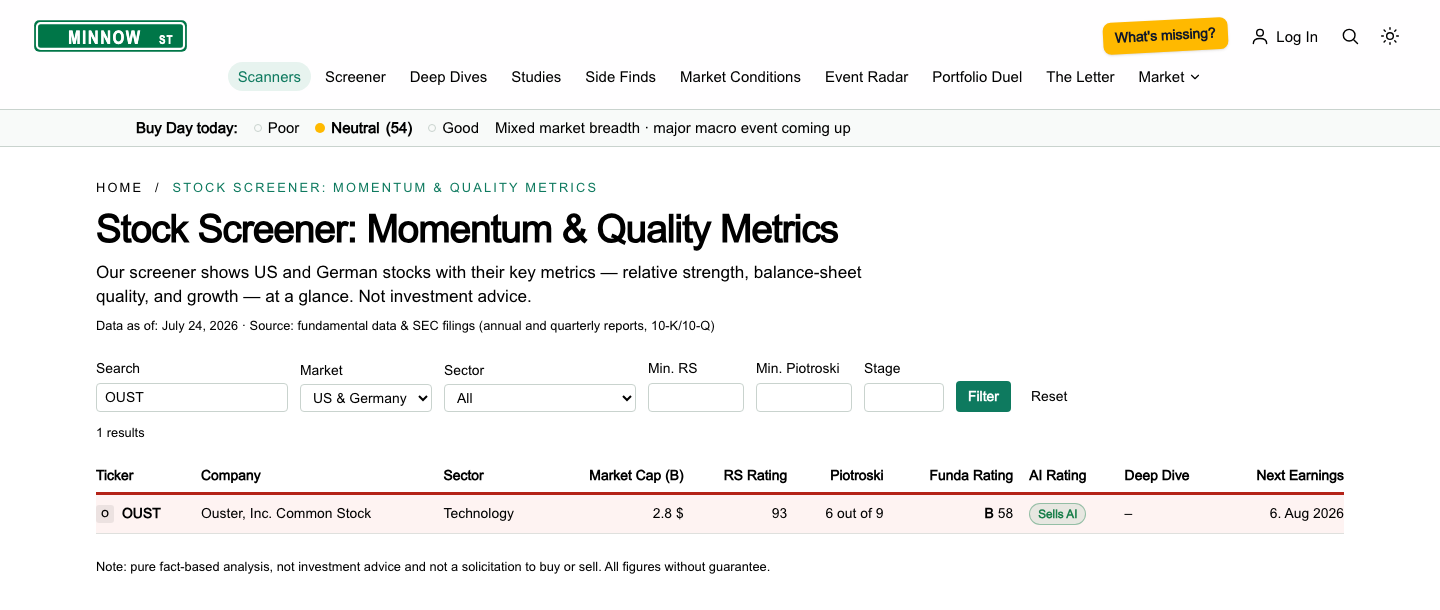
Translated into plain language, that row says:
- Stage 2 — in Stan Weinstein's language, the advancing phase in which a stock breaks out of its base. Momentum investors love it; latecomers pay the bill when the phase turns.
- An RS rating of 93 — relative strength on a scale of 1 to 99. Ouster has outrun 93 percent of all stocks. Over three months the price rose 206.2 percent, year to date 108.7 percent (data as of July 24, 2026). That is the pretty side.
- A Piotroski score of 6 out of 9 — and this is where it gets uncomfortable. The Piotroski F-score is a nine-point check of balance-sheet quality (profitability, leverage, efficiency). Six out of nine is okay, not good. A thoroughly healthy, profitable company sits at 8 or 9. This number is the honest dampener on the pretty price story.
Ouster shows up not in one scanner, but in many
A single hit can be luck. It gets meaningful when a stock appears in several independent scanners at the same time. In our system Ouster currently matches 21 of our scanner strategies (data as of July 24, 2026) — and the split tells you what kind of stock this is:
- Thirteen momentum and trend scanners — among them "Stan Weinstein: Stage 2", "Stage 2 Leader", "CANSLIM Type RS", "Oliver Kell: Doublers", "RS Leader (≥90)", "Character Change" and "Above the 50- & 200-SMA".
- Five growth scanners — "Ben Bennett: Focus List", "High Revenue Growth", "Matt Caruso: Sales Leader", "Patrick Walker: 40, 40 Screen" and "Ted Zhang: Super Stock Universe".
- Three quality and balance-sheet scanners — "Institutional Accumulation", "U/D Accumulation" and "Mike Webster: Recession Proof".
A broadly supported momentum picture, then. You just have to keep in mind that almost all of these scanners measure price strength, not balance-sheet quality — thirteen of the twenty-one are pure trend filters.
Remember this tension — strong momentum, middling quality. It runs through the whole analysis. And it cuts both ways: the machines Ouster wants to give eyes to are themselves stock-market stories, and our scanner reads them very differently. The sidewalk delivery robots of Serve Robotics sit in exactly one growth filter with us and at the same time in eight weakness filters — a Weinstein stage 4 downtrend, a relative-strength rating of 6 out of 99, below both the 50-day and the 200-day line, and 2.2 percent above the 52-week low (data as of July 8, 2026). Same Physical-AI promise, opposite scanner verdict. The filter row is not a seal of approval; it is a measurement.
The numbers over the years — the growth is real
Let's start with what genuinely impresses. Ouster is not just growing, it is getting more efficient while it grows. Here are the annual figures from the annual reports:
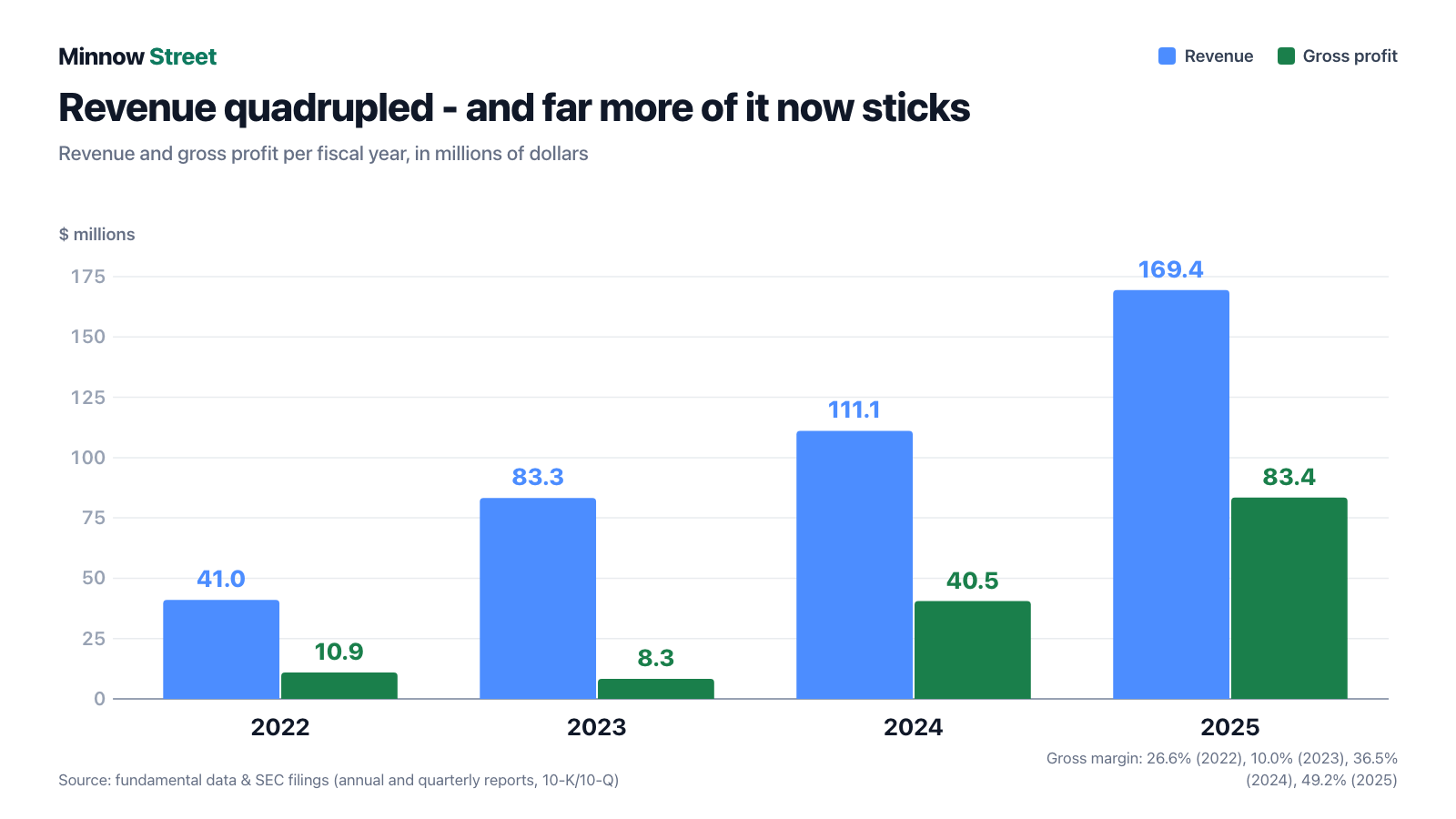
Read that chart from left to right and you are looking at a small recovery story. Revenue more than quadrupled in three years, from $41.0 million (2022) via $83.3 million and $111.1 million to $169.4 million (2025). Gross profit went from $10.9 million (2022) through a low of $8.3 million (2023, the year of the write-downs after the Velodyne merger) and $40.5 million (2024) to $83.4 million (2025). In margin terms: 26.6 percent in 2022, a meagre 10.0 percent in 2023, then 36.5 percent and finally 49.2 percent in 2025. Translated: of every hundred dollars of revenue, roughly forty-nine now remain before all the other costs. The product business carries itself at its core.
And the bottom line? The loss shrank from a catastrophic $374.1 million (2023) via $97.0 million (2024) to $60.4 million (2025). In the fourth quarter of 2025 Ouster even posted a small net profit of about $4 million for the first time — psychologically an important moment, even though the first quarter of 2026 was red again at minus $17.5 million. One quarter does not make a summer.
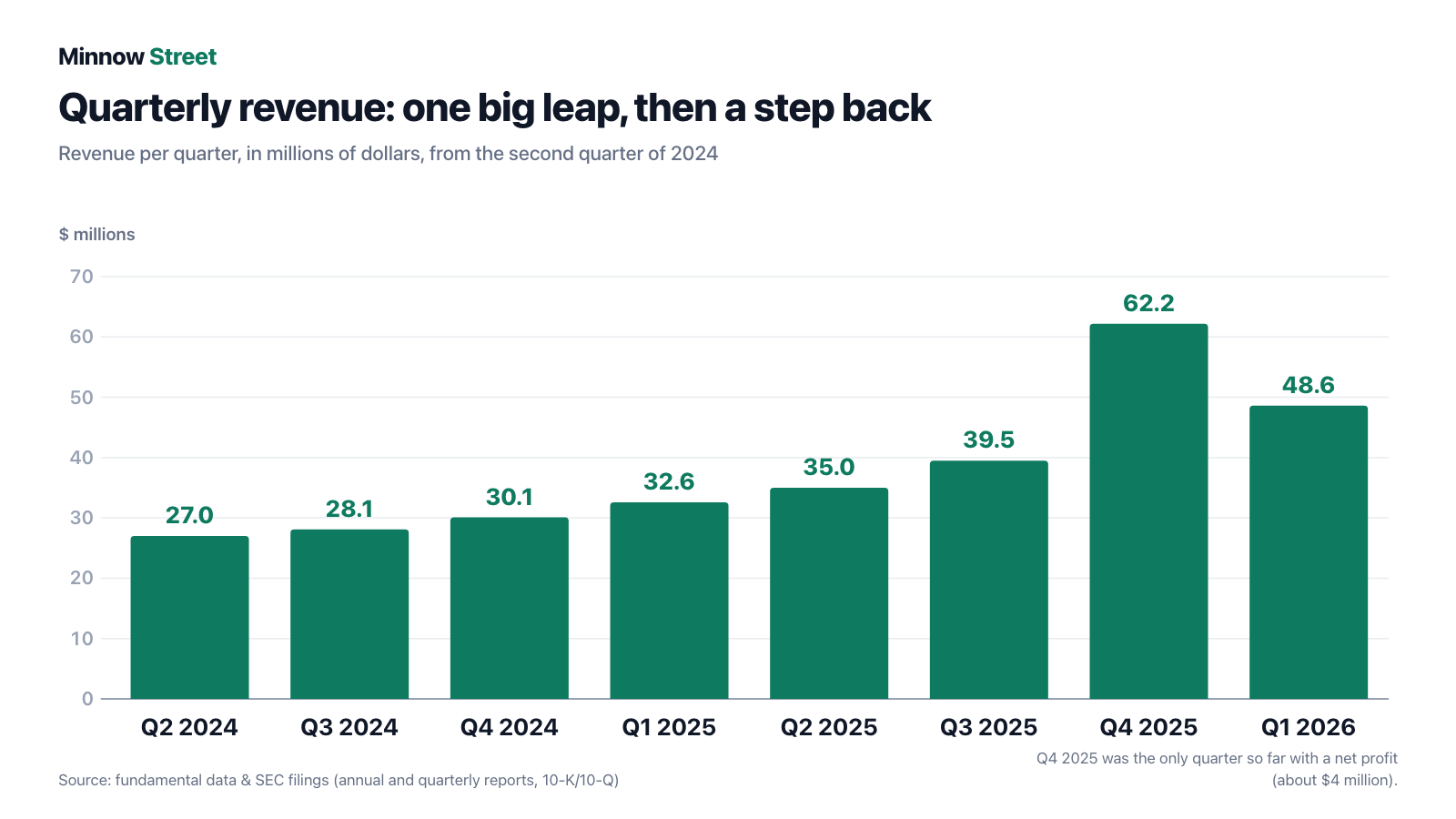
The balance sheet also holds up. At the end of the first quarter of 2026 Ouster sat on $173.1 million in cash and short-term investments — $78.7 million of cash plus $94.4 million of short-term investments — and is practically debt-free, with an equity ratio of 72.2 percent (data as of July 24, 2026). That buys the company room to breathe. But — and this "but" matters — growth costs cash: operating cash flow was minus $40.0 million in 2025, capital expenditure another $24.9 million, which puts free cash flow at roughly minus $64.9 million. The cushion is there, but it is melting.
What the filings say — a rebrand, a takeover and three weak spots
This is where it gets interesting, because here the marketing brochure parts company with the mandatory document. An annual report filed with the U.S. securities regulator, the SEC, is honest under penalty of law — it also contains what no press release emphasizes. I have picked out and marked the decisive passages for you.
The AI story: "Physical AI"
Ouster presents itself as an AI company in the very first sentence of its current annual report — a clear strategic pivot. This is exactly how it reads in the annual report (10-K) for 2025:
“Ouster, Inc. is a leader in sensing and perception for Physical Artificial Intelligence (Physical AI). Ouster enables machines to “Sense, Think, Act, and Learn” and independently execute tasks without human intervention.”
— Ouster, Inc., SEC annual report 10-K for fiscal year 2025, Item 1 “Business — Overview”
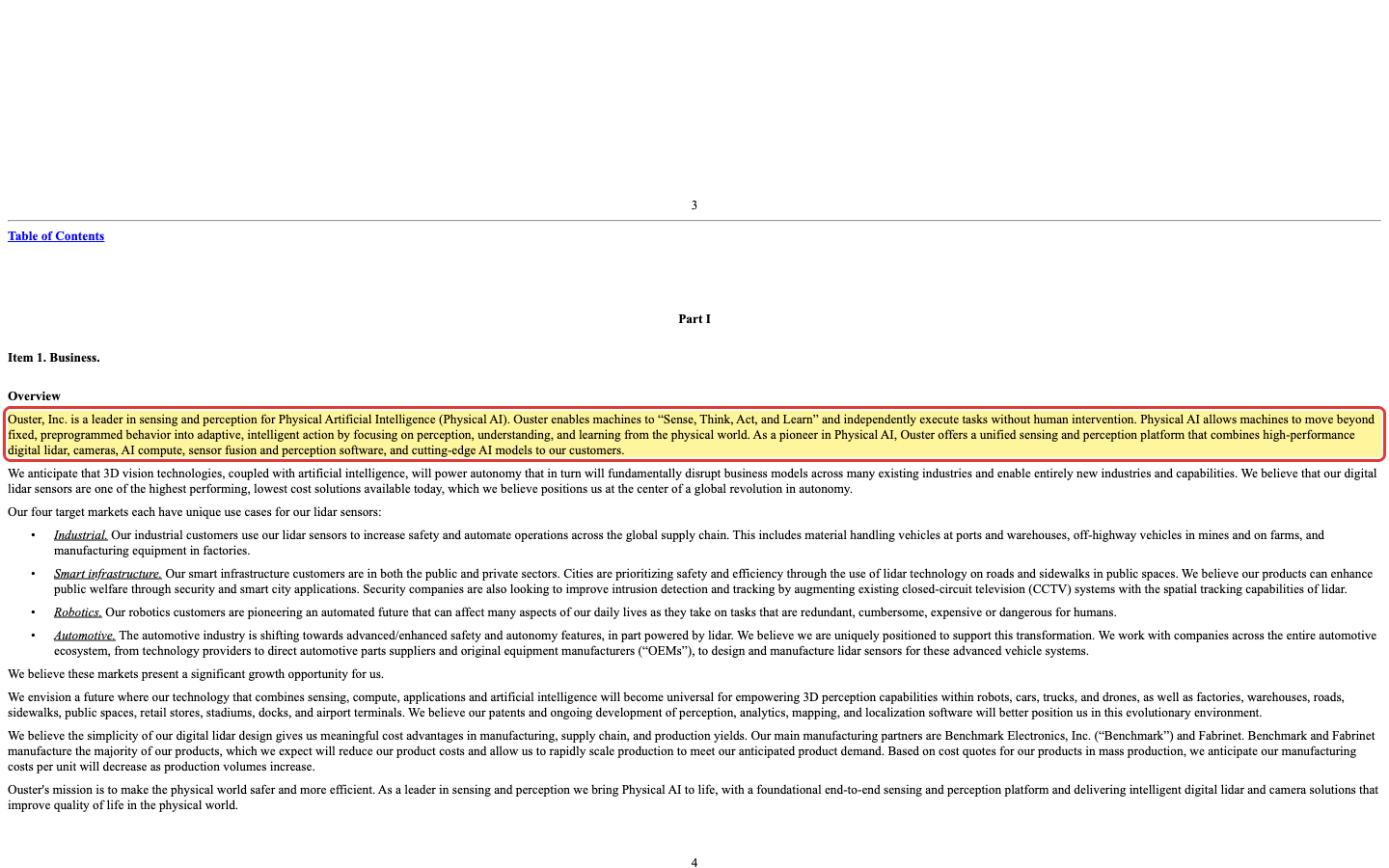
For context: in the annual report for 2024 the term "Physical AI" did not appear a single time. So this is fresh paint — a deliberate re-telling of the company's own business. Whether it turns into revenue is something the company still has to prove.
The takeover that puts money behind the story: Stereolabs
Unlike pure marketing, Ouster has put money on this bet. In February 2026 it acquired the French camera and vision-processing specialist Stereolabs. That combines lidar, cameras, AI compute and perception software into one platform — the sensor maker wants to become a supplier of complete sensor fusion. The quarterly report documents the deal:
“On the Closing Date, the Company acquired 100% of the outstanding share capital of Stereolabs, a privately-held developer, manufacturer and seller of vision systems headquartered in France.”
— Ouster, Inc., SEC quarterly report 10-Q as of March 31, 2026, Note 3 “Business Combination and Related Transactions”
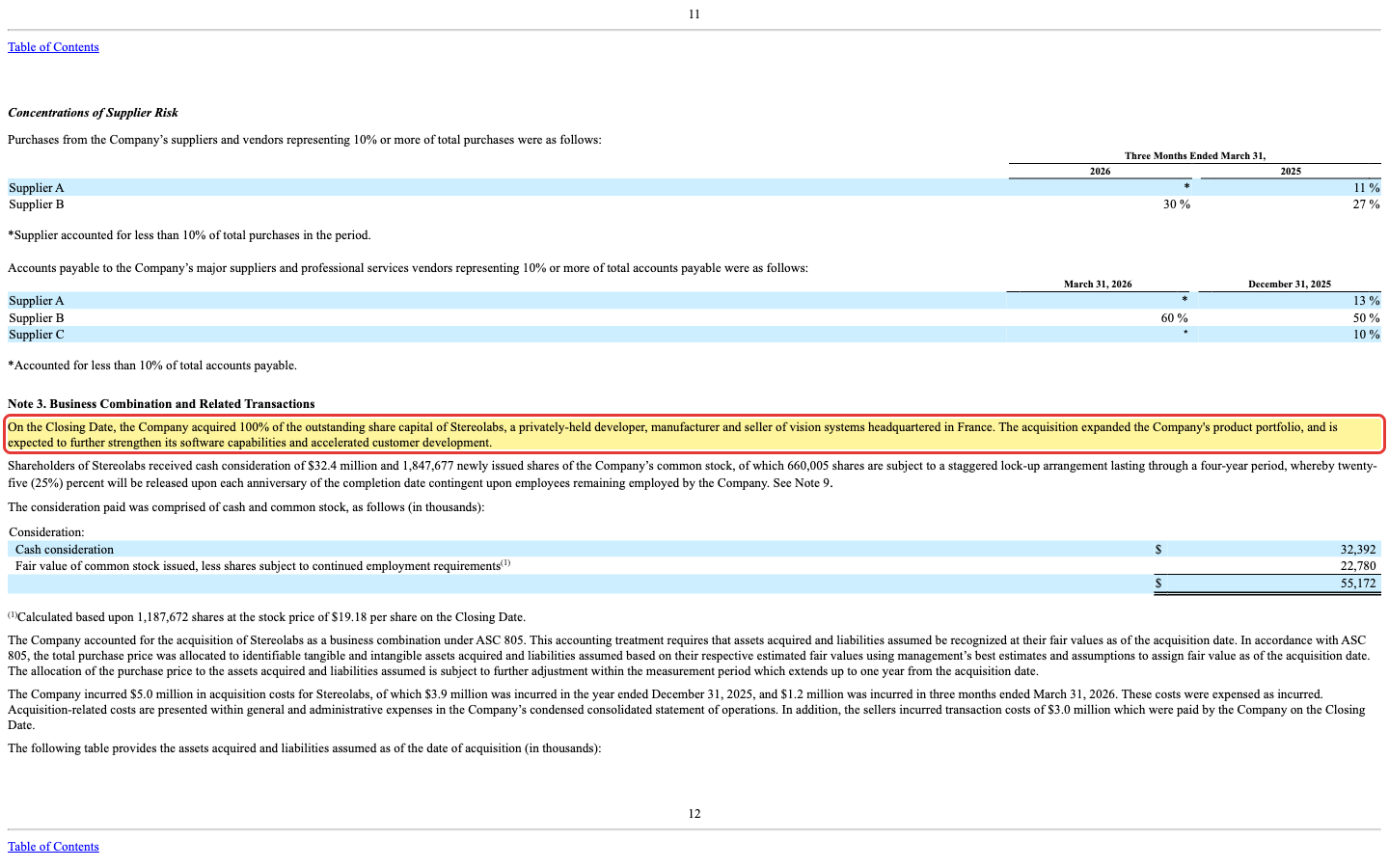
Note the second half of that price tag: part of the purchase was paid in freshly printed shares. Keep it in mind — it comes back in uncomfortable truth no. 3.
Uncomfortable truth no. 1: nothing but losses since inception
For all the growth cheer — this company has never made money over a full year. The annual report says so with complete clarity, including an accumulated deficit of nearly one billion dollars:
“We have experienced net losses in each year since our inception. In the years ended December 31, 2025 and 2024, we incurred net losses of $60.4 million and $97.0 million, respectively. […] As of December 31, 2025, we had an accumulated deficit of $973.4 million.”
— Ouster, Inc., SEC annual report 10-K for fiscal year 2025, Item 1A “Risk Factors”
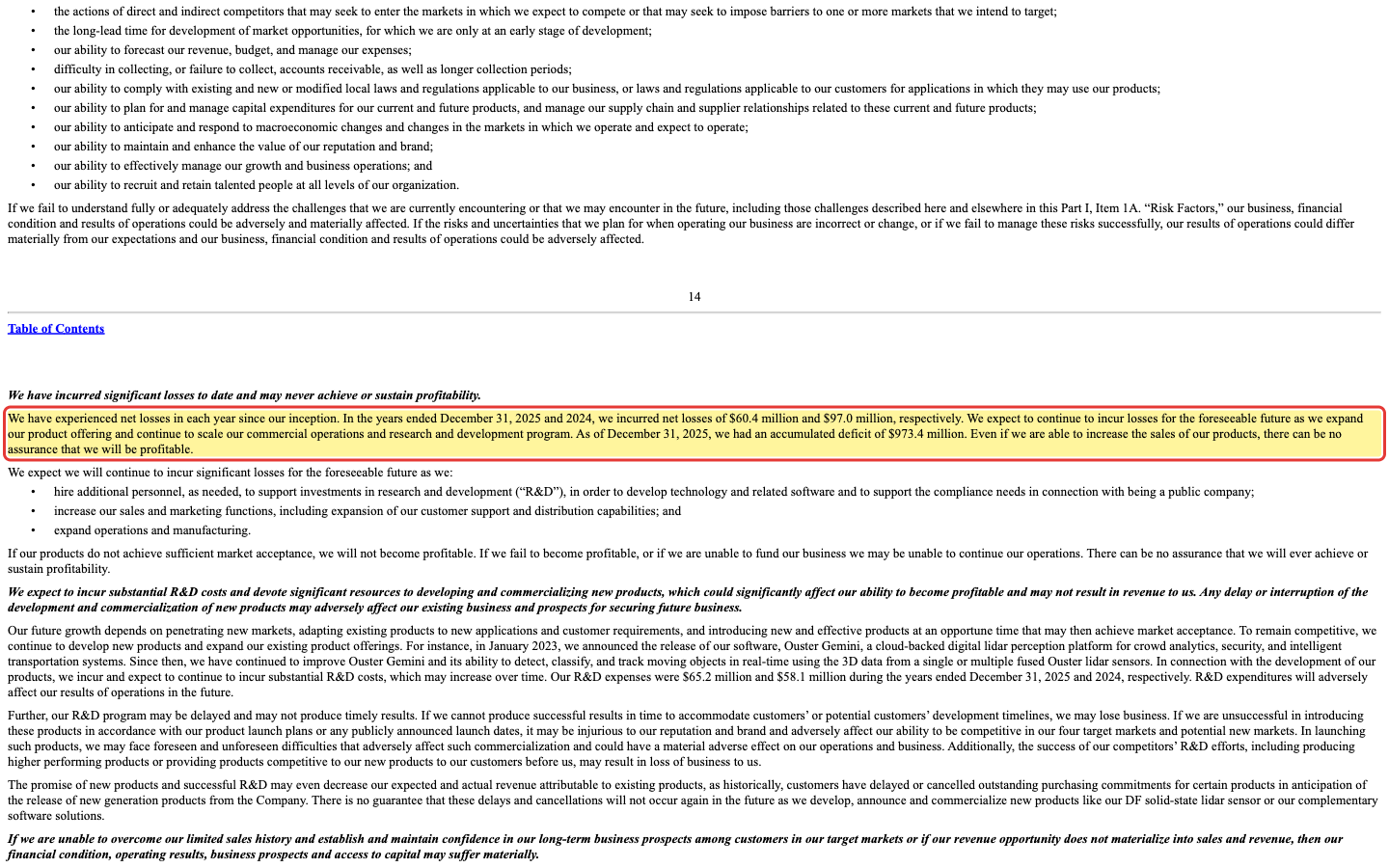
Management writes itself that it expects further losses and negative cash flow "for the foreseeable future". To be fair: unlike many former listed shells, there is no doubt about the company's ability to continue as a going concern — the report states that liquidity is sufficient for at least twelve months. So the company is not in distress. But it depends on growth to turn those losses around one day.
Uncomfortable truth no. 2: one customer, many eggs in one basket
If your neighbor told you his small business was going great, and you then learned that a single customer supplies a fifth of his revenue, would you swallow for a second? That is exactly the situation in the annual report: in 2025 one single customer ("Customer E") accounted for 21 percent of total revenue, up from 12 percent the year before, with a second customer ("Customer A") at 11 percent. If the big one walks away, it tears a hole.
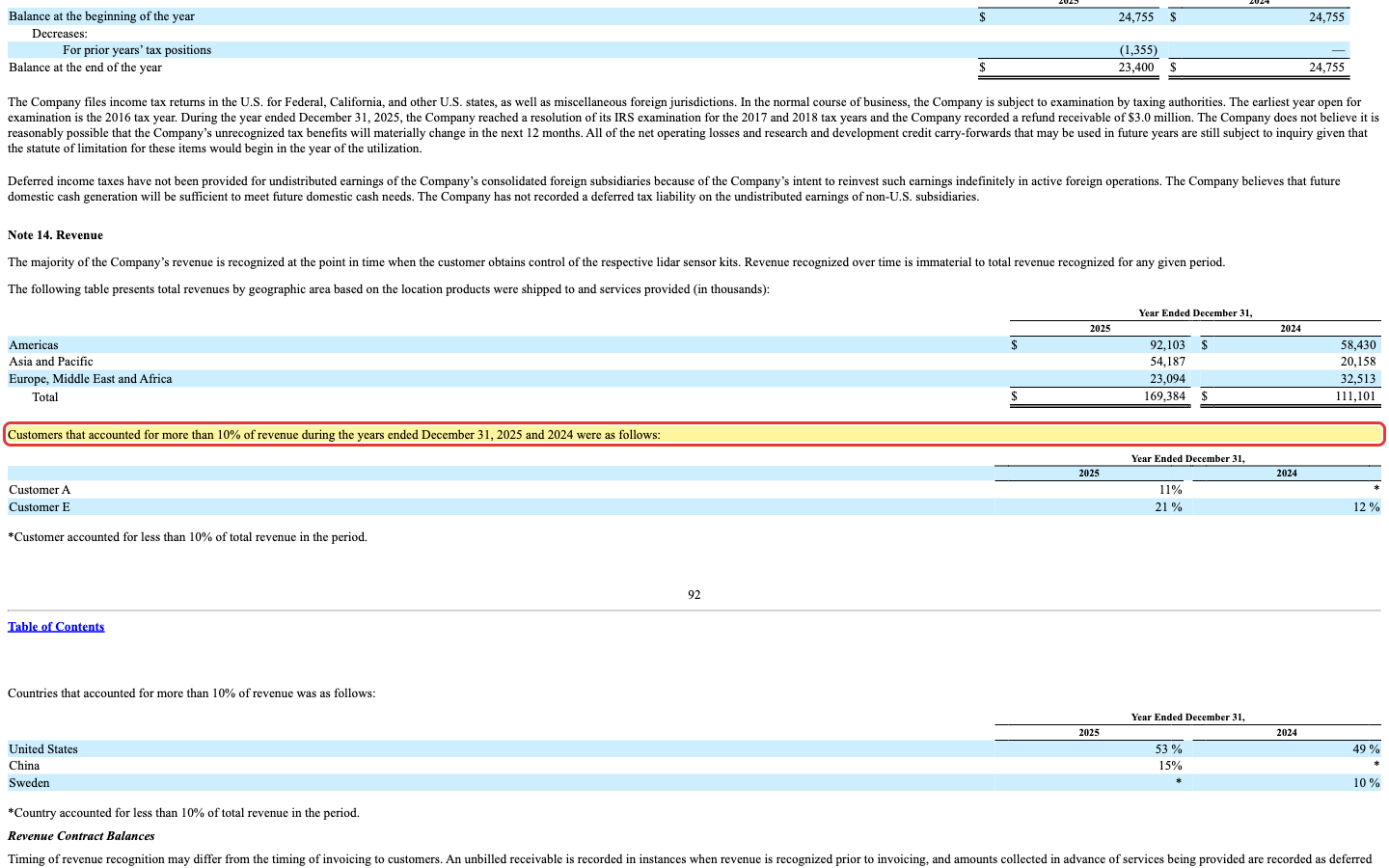
There is a dependency on the supply side too. The bulk of the sensors is built by contract manufacturers — the report names Benchmark Electronics and Fabrinet, both of which manufacture in Thailand — and the annual report lists that reliance on a few suppliers explicitly as a risk. Add the roughly 15 percent of revenue that hangs on China, and in an era of tariffs and trade conflict that is not a footnote you can wave away.
Uncomfortable truth no. 3: the dilution
This weakness is the most insidious one, because it is invisible on a price chart. Ouster finances its growth partly by issuing new shares — among other things through an "at-the-market" program, and partly to pay for the Stereolabs deal. The result: the weighted average share count rose from 17.8 million (2022) to 61.8 million (first quarter of 2026), roughly three and a half times as many.
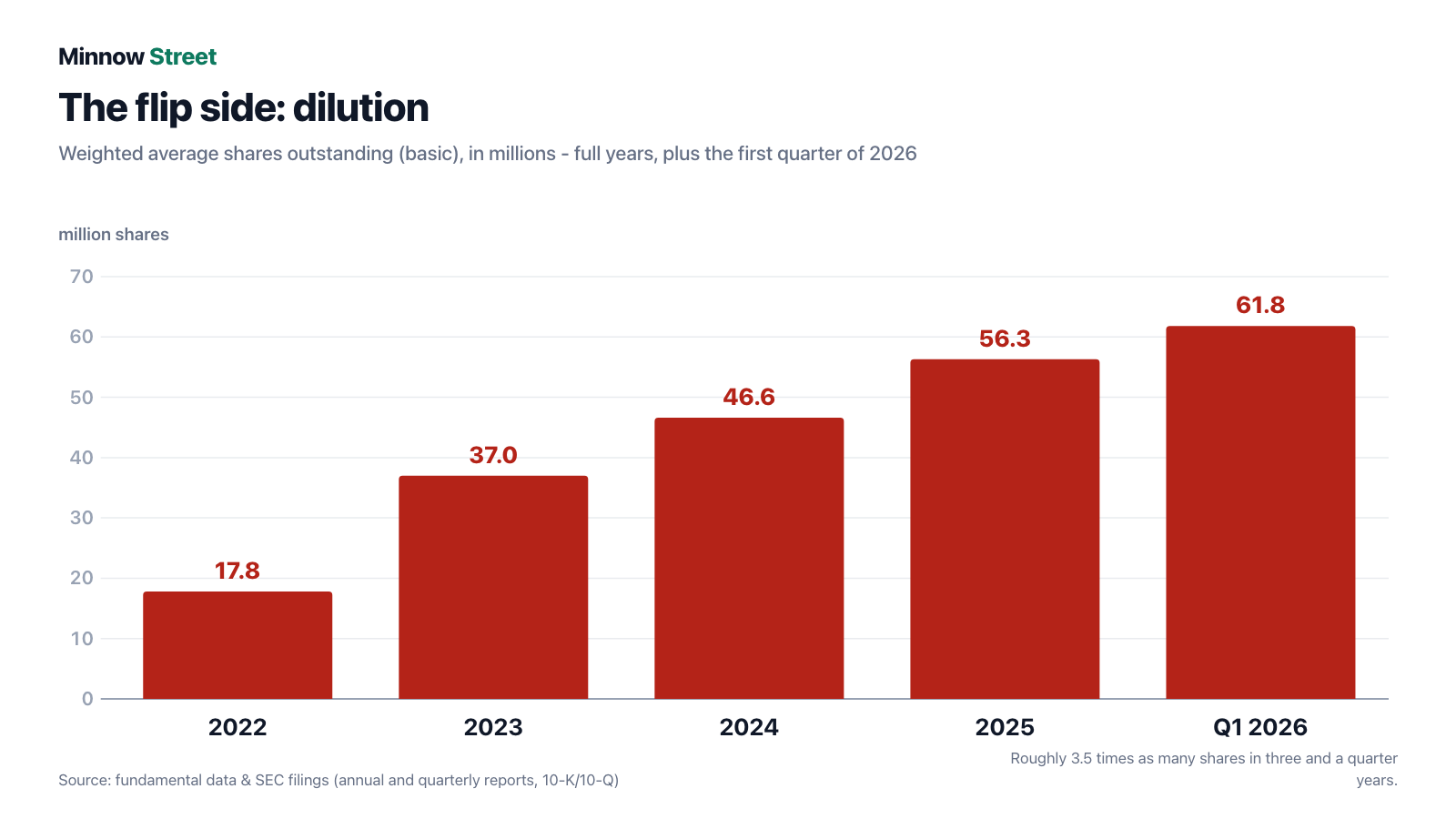
Remember the mechanism: even if the value of the company grows, your slice of the cake gets smaller when new slices keep being cut. Growth paid for with fresh shares is never entirely free. The company's own filings show it plainly — the loss per share improved from minus $0.42 in the first quarter of 2025 to minus $0.28 in the first quarter of 2026, but part of that improvement is simply spread across more shoulders.
Valuation: expensive, and the market knows it
Because Ouster posts losses, there is no meaningful price-to-earnings ratio — you fall back on the price-to-sales ratio. As of July 24, 2026, the company was worth about $2.8 billion on the market, which puts the price-to-sales ratio at 15.2 times the revenue of the past twelve months, or roughly 17 times full-year 2025 revenue. Multiples of that size already price in many years of vigorous growth. For comparison: even fast-growing, profitable software companies are rarely valued that highly. And high multiples are especially sensitive to interest rates — when rates rise, growth valuations of exactly this kind come under pressure first.
What do the professionals expect? Analysts see revenue growing another 34.4 percent over the next twelve months (data as of July 24, 2026). Strong — but noticeably less than the 52.5 percent Ouster delivered in 2025. In other words, even the optimists assume the pace comes down, while the valuation still assumes it holds.
One more number belongs in the picture, because it describes the ride rather than the destination: Ouster's beta is 3.2. That means the stock has historically moved roughly three times as violently as the overall market — in both directions. Even after the run, it sat 18.8 percent below its 52-week high on July 24, 2026. Whoever buys here is not buying a savings account.
Opportunities and risks at a glance
What speaks for Ouster
- Impressive, documented revenue growth ($41.0 million to $169.4 million in three years) with a sharply rising gross margin (10.0 percent in 2023 to 49.2 percent in 2025).
- Clearly shrinking losses ($374.1 million in 2023 to $60.4 million in 2025) and a first profitable quarter (the fourth quarter of 2025).
- A solid balance sheet: $173.1 million of cash and short-term investments as of March 31, 2026, practically debt-free, an equity ratio of 72.2 percent, and no doubt about the company's ability to continue as a going concern.
- A clear Physical-AI strategy backed by a real acquisition (Stereolabs) in a structurally growing market.
What speaks against it
- Never profitable over a full year; an accumulated deficit of $973.4 million and free cash flow still negative at minus $64.9 million (2025).
- Heavy dilution — roughly three and a half times as many shares in three years.
- Customer concentration (one customer accounted for 21 percent of 2025 revenue) plus dependence on a handful of contract manufacturers and on the China business (15 percent of revenue).
- A demanding valuation (a price-to-sales ratio of 15.2) with a beta of 3.2 — little margin of safety, high sensitivity to swings.
- Only middling balance-sheet quality (a Piotroski score of 6 out of 9).
A human conclusion
Ouster is neither a castle in the air nor a safe haven — it is exactly what the chart and the filings tell you together: a company with real, verifiable growth and a credible AI story that comes at a high price and with honest design flaws. Anyone who invests here is betting that the revenue growth eventually turns into durable profits, and that dilution does not eat that progress along the way.
And the little FOMO devil from the opening? He has seen the past 206 percent. Smart investing, though, always begins with the question about the next few years, not the last few months. You now know both sides — the pretty one and the uncomfortable one. What you make of that is your decision. And that is exactly as it should be.
Sources
All original documents used in this analysis — for you to read yourself:
- SEC annual report (10-K), fiscal year 2025: oust-20251231.htm (sec.gov)
- SEC annual report (10-K), fiscal year 2024: oust-20241231.htm (sec.gov)
- SEC quarterly report (10-Q), first quarter of 2026 (as of March 31, 2026): oust-20260331.htm (sec.gov)
- SEC quarterly report (10-Q), third quarter of 2025 (as of September 30, 2025): oust-20250930.htm (sec.gov)
- SEC quarterly report (10-Q), second quarter of 2025 (as of June 30, 2025): oust-20250630.htm (sec.gov)
- SEC quarterly report (10-Q), first quarter of 2025 (as of March 31, 2025): oust-20250331.htm (sec.gov)
- Ouster's complete SEC filing history: EDGAR overview (sec.gov)
- Fundamental data (revenue, earnings, balance-sheet and cash-flow series): from our own financial data, reconciled with the SEC filings.
- Screener and rating data: our in-house stock scanner, data as of July 24, 2026.
Data basis: Ouster annual reports (SEC form 10-K) for fiscal years 2024 and 2025 and quarterly reports (10-Q) for the quarters through March 31, 2026; supplementary fundamental data from our own financial data; screener data from our in-house stock scanner (data as of July 24, 2026). This article is a journalistic, fact-based analysis and is expressly not investment advice and not a solicitation to buy or sell securities. Investments in stocks carry the risk of loss up to a total loss. All figures without guarantee.
Our Bottom Line at a Glance
- Growth positive
- Revenue more than quadrupled in three years ($41.0 million to $169.4 million); the gross margin rose from 10.0 percent (2023) to 49.2 percent (2025).
- Profitability negative
- Not a single profitable fiscal year since inception; an accumulated deficit of $973.4 million and free cash flow still negative at minus $64.9 million (2025).
- Balance sheet positive
- $173.1 million of cash and short-term investments as of March 31, 2026 and practically debt-free — but the cushion melts with every loss-making quarter.
- Dilution negative
- The weighted average share count rose from 17.8 million (2022) to 61.8 million (first quarter of 2026) — growth paid for with fresh shares is never free.
- Valuation negative
- A price-to-sales ratio of 15.2 and a beta of 3.2 (data as of July 24, 2026): the multiple prices in years of growth, and the ride is three times as violent as the market.
- Momentum neutral
- 21 matching scanner strategies and an RS rating of 93 — strong, but thirteen of those hits measure price strength, not quality (Piotroski 6 out of 9).
Ouster is a speculative growth bet: real, documented revenue growth and a Physical-AI story backed by the Stereolabs acquisition — at a high price and with honest design flaws. If at all, then as a small admixture for risk-aware investors, not as a core holding. Not investment advice.
What Our Rating Means
Open questions
The business works in principle, but one material question is open. As long as it stays open, our findings do not carry a quality verdict.
Documented revenue growth and a Physical-AI story backed by the Stereolabs acquisition — but only as a small admixture for the risk-aware: the valuation is high, and ongoing share issuance keeps diluting existing holders.
A journalistic assessment by our editorial team at the time of the deep dive, based on public sources — not investment advice and not a solicitation to buy or sell. Your personal circumstances (investment goals, risk capacity, taxes) cannot be taken into account. What our levels mean, how verdicts are formed, and what conflicts of interest exist →
Worth Noting
- A single customer accounted for 21 percent of revenue in 2025 — a concentration risk.
- Ongoing capital increases keep diluting existing shareholders.
Frequently Asked Questions
Ouster develops and sells digital lidar — sensors that capture their surroundings in three dimensions using laser pulses. They are used in robotics, industry, automotive and smart infrastructure. Since the acquisition of Stereolabs in February 2026 the company has combined lidar, cameras and AI software and positions itself as a platform for "Physical AI" — artificial intelligence that acts in the physical world.
Not on an annual basis, not yet. Ouster has posted a loss in every fiscal year since inception: $60.4 million in 2025, after $97.0 million in 2024 and $374.1 million in 2023. So the loss is shrinking sharply, and the fourth quarter of 2025 brought a small net profit of about $4 million for the first time. The accumulated deficit, however, stood at $973.4 million at the end of 2025.
Fast and steadily. Annual revenue rose from $41.0 million (2022) via $83.3 million (2023) and $111.1 million (2024) to $169.4 million (2025) — more than a quadrupling in three years. At the same time the gross margin improved from a low of 10.0 percent (2023) to 49.2 percent (2025), so the product business increasingly carries itself at its core.
Three points stand out from the SEC filings. First, the continuing losses and the cash burn (free cash flow of minus $64.9 million in 2025). Second, heavy dilution — the weighted average share count rose from 17.8 million to 61.8 million within three years. Third, customer concentration: a single customer accounted for 21 percent of revenue in 2025. On top of that come dependencies on a handful of contract manufacturers in Thailand and on the China business (15 percent of revenue).
The valuation is demanding. With no earnings to speak of, the price-to-sales ratio serves as the yardstick, and on July 24, 2026 it stood at 15.2 times the revenue of the past twelve months, for a market value of $2.8 billion. That prices in many years of growth, while analysts expect revenue growth of 34.4 percent over the next twelve months — less than the 52.5 percent of 2025. Whether the stock is too expensive depends on whether Ouster holds its pace and makes the leap into durable profits.
As of July 24, 2026 the stock matched 21 of our scanner strategies: thirteen momentum and trend filters (among them "Stan Weinstein: Stage 2", "Oliver Kell: Doublers" and "RS Leader"), five growth filters and three quality and balance-sheet filters. The weighting matters: the large majority of those hits measure price strength, not balance-sheet quality — which sits at a middling Piotroski score of 6 out of 9.
Found an error?
Did you spot a factual error, an outdated number, or a typo in this deep dive? Let us know briefly — your report goes straight to the editorial team.