Prairie Operating Stock: A 40-Fold Jump in Output, Paid for With Debt and Fresh Shares
Prairie Operating pumps oil and gas in Colorado's DJ Basin and multiplied its output within a single year, through acquisitions, from 464 to 18,487 barrels a day — an impressive number. Only: that growth was paid for with a heavily drawn credit line, a $148 million preferred stock and fresh common shares. We read the annual and the quarterly report: what is left is roughly $484 million of net debt, a net loss of $60.9 million and a share price our scanner carries with six downtrend filters. Growth you buy on credit is simply not the same thing as value created — and the market is doing that arithmetic right now.
 Thomas Mücke
Founder & Publisher
Thomas Mücke
Founder & Publisher
Chart
Interactive price chart (TradingView).
Note: pure fact-based analysis, not investment advice and not a solicitation to buy or sell. All figures without guarantee.
There is a reflex that catches us investors out at fast-growing companies in particular, and it is as old as the stock market itself: we confuse size with value. A number like "output up forty-fold in a single year" or "revenue plus 2,900 percent" sets something off in us — call it the growth rush. Surely that has to be a rocket. The error of thinking behind it: we look at the speed and forget to ask what it was paid for with. A neighbor who parks a bigger car outside every year looks successful — until you learn that each of them was bought on credit and the installments are eating him alive. Prairie Operating (Nasdaq: PROP) is exactly that kind of story. So let's make a deal: before you let the spectacular growth figures dazzle you, we read together what the filings to the U.S. securities regulator, the SEC, actually say. An annual report is honest under penalty of law. What you make of it at the end is your decision.
So that you know the tension everything turns on right away: Prairie produces real oil and gas, the output is genuine and growing, the reserves in the ground are valued at more than a billion dollars. This is not a castle in the air. The question is a different one — whether growth that was paid for with a heavily drawn credit line, a $148 million preferred stock and fresh common shares ultimately creates anything for you as a shareholder, or merely shifts it. Remember this sentence: growth you buy on credit is not the same thing as value created. And the share price, to say it up front, passed its verdict long ago.
What Prairie Operating actually does
Prairie is an oil and gas producer — in the jargon an "E&P" company (short for exploration and production, meaning finding it and pumping it). Picture a farmer, except that what lies under his field is not wheat but oil and gas. Prairie leases drilling rights on acreage in the DJ Basin (short for the Denver-Julesburg Basin) in Weld County, Colorado — one of the established oil regions of the United States — drills holes in the ground, brings up crude oil, natural gas and so-called natural gas liquids (NGLs, the liquid components that come with the gas) and sells them. Roughly half of it is oil, and the oil earns by far the most money: in 2025, $204 of $242 million in revenue came from crude.
The business model has a quirk you have to understand: an oil field is a melting ice cube. Every well delivers a lot at the start and then less year after year — the specialists call it the decline rate. An E&P that does not want to shrink therefore has to keep adding new wells or buy more producing acreage. And here Prairie chose the fast route: buy instead of drill. Almost the entire jump in output from 464 to 18,487 barrels a day comes from takeovers, not from its own drilling. That is one half of the story. The other half is the bill for it, and we will look at that closely in a moment.
One more piece of the company's past belongs here, because it explains a chart that looks strange at first glance. Until May 2023 the company was not an oil producer at all: it was called "Creek Road Miners, Inc." and mined bitcoin. Only the reverse merger with Prairie Operating LLC, completed in May 2023, turned it into the DJ Basin producer we are looking at today. So if you compare today's price with old all-time highs, you are comparing two different companies with each other — a change of name and structure, not an operating argument for buying.
Where the stock shows up in our scanner
Every day we run thousands of stocks through our in-house stock scanner. At Prairie what is most revealing is which filters fire (data as of July 10, 2026). There are nine hits, and they fall into two groups. The first — and this is the important one — is six weakness and downtrend filters: "stage 4 (downtrend)", "Stan Weinstein: stage 4" and "stage 4B", "relative-strength weakness (≤10)", "weakness cluster" and "below the 50- and 200-day moving average". Translated, that means: the price sits below its long-term averages, close to its low, and its relative strength against the market is poor. This matters, because these filters are the opposite of a buy signal — they describe a falling knife, not a base being built. The growth rush from the opening likes to whisper that a fallen stock like this "has to turn at some point". The scanner says soberly: the market is selling, and it is selling with conviction.
The second group is three cheapness rankings — the price-to-sales ranking, the price-to-cash-flow ranking and the price-to-free-cash-flow ranking. They show that measured against revenue and cash flow the stock looks dirt cheap (price-to-sales around 0.25). And exactly that combination is the real tension here: optically cheap and at the same time technically on the floor — the classic picture of a possible value trap, in which "cheap" can also mean "cheap for good reason". Here is how to get there yourself: on minnowstreet.com, open the "Scanner" menu, pick one of the filters and look for the PROP row. Whether cheap ever turns back into valuable, however, is decided not by the chart but by the balance sheet and the oil price. So let's look at the numbers.
The numbers over the years
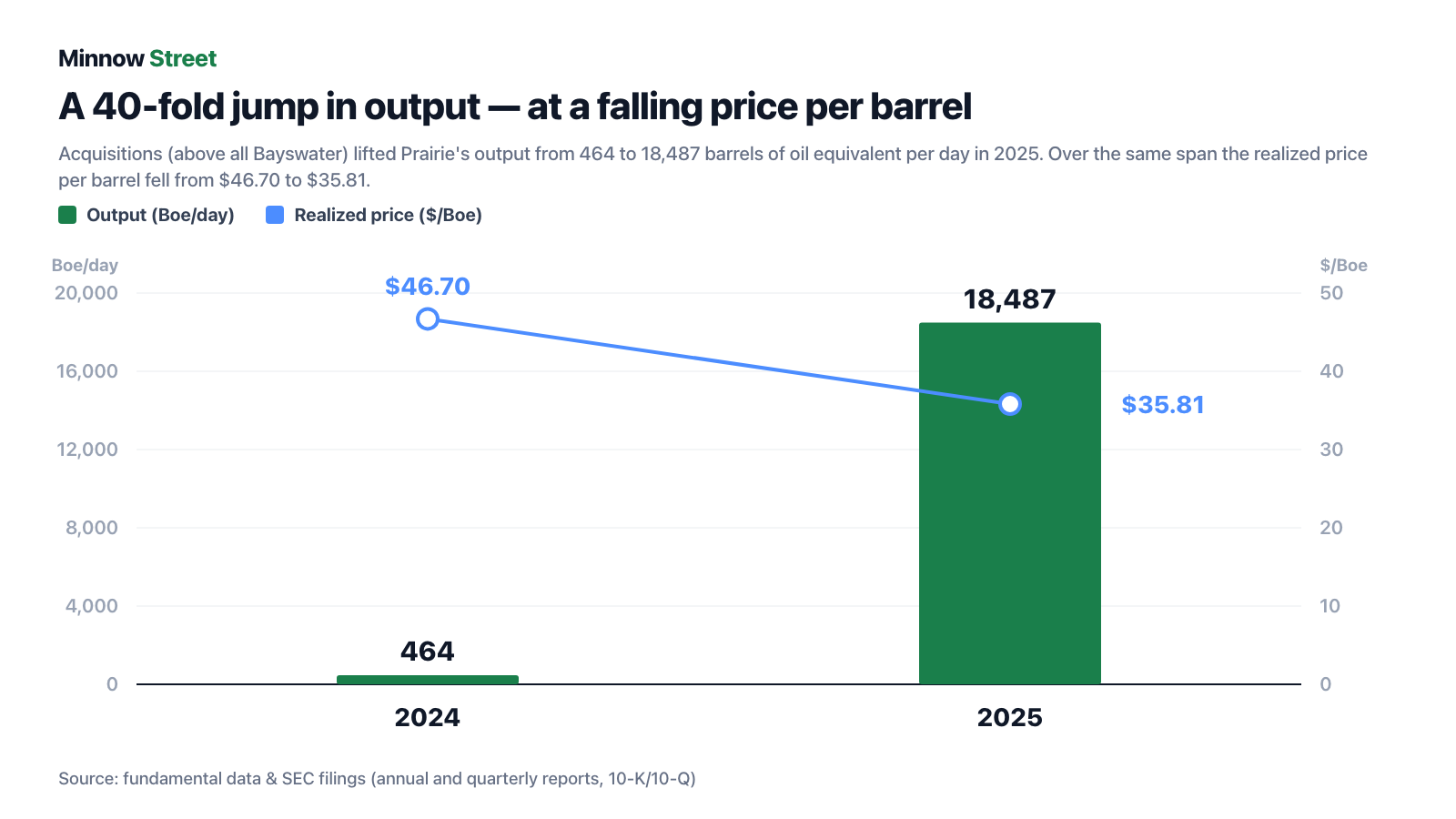
Let's start with what genuinely impresses — the jump in output. After only 464 barrels of oil equivalent per day in 2024, Prairie produced an average of 18,487 barrels a day in 2025, 6.75 million barrels over the full year. That is a forty-fold increase, and it is real: the oil flows, revenue climbed from $7.9 million to $241.6 million, and the first quarter of 2026 added another $83.4 million. But look at the blue line in the chart — the realized price per barrel. Over the same span it fell from $46.70 to $35.81. More volume, a weaker price: that is the nature of the commodity business, in which no producer sets its own selling price.
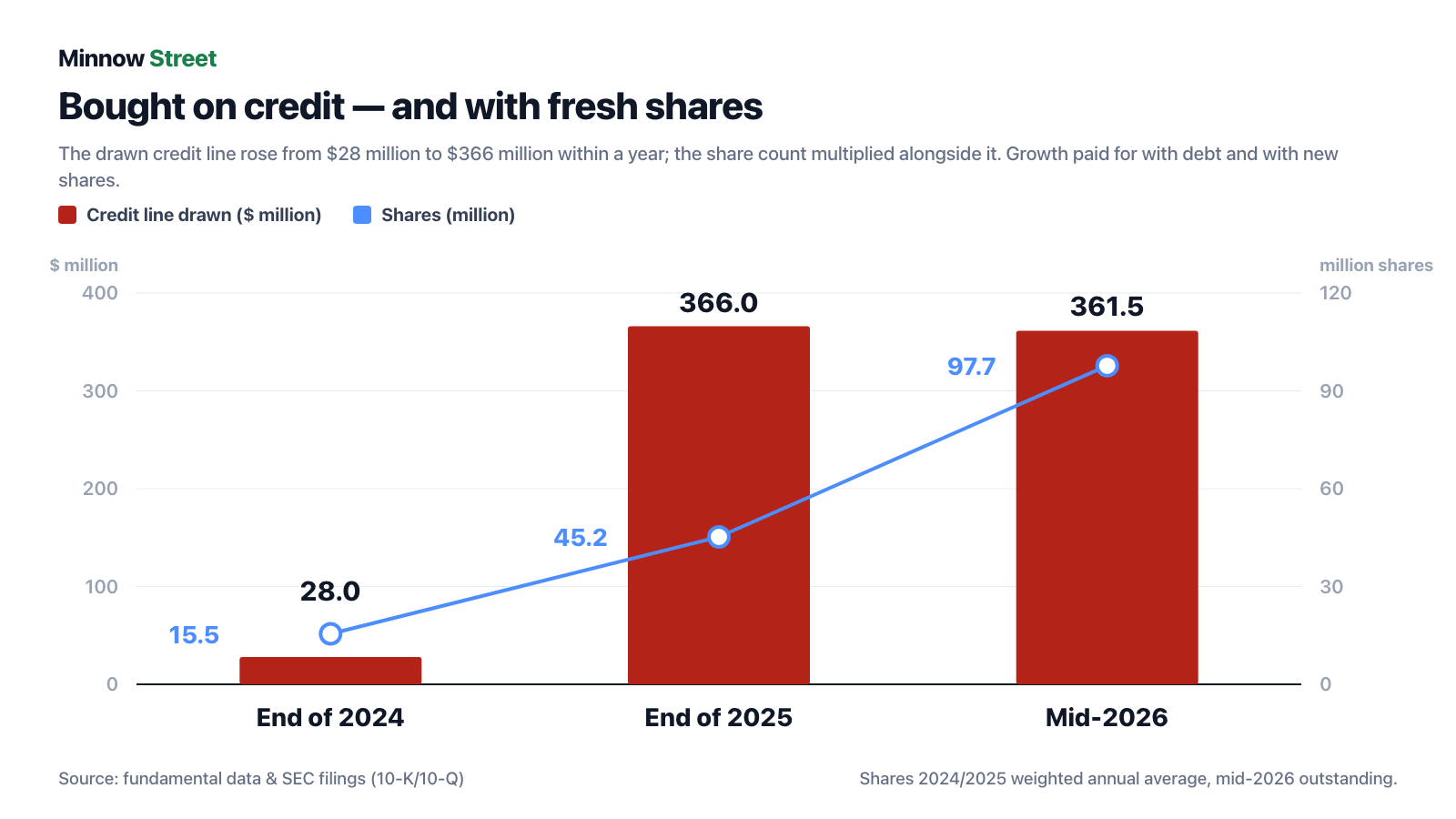
And now the flip side, the one that tends to get lost in the cheering about growth numbers — the bill. The jump in output was not paid for out of the running business but out of debt and fresh shares. The drawn credit line rose from $28.0 million (end of 2024) to $366.0 million (end of 2025), and in parallel the share count multiplied. The next chart puts the two side by side.
The result of that arithmetic is unambiguous: despite output rising forty-fold, the bottom line for 2025 was a net loss of $60.9 million (2024: a loss of $40.9 million). So Prairie produces a great deal — and is not yet earning money for its shareholders. Which is exactly why the three uncomfortable truths come next.
The uncomfortable truths
At a debt-financed growth stock the uncomfortable truths are not a footnote — they are the core of the valuation. Three things are worth having read before you treat that low revenue multiple as a bargain.
Uncomfortable truth no. 1: the growth sits in the books as debt
Here the growth rush from the opening comes back as hard evidence. The biggest acquisition, the Bayswater deal of March 2025, cost $602.8 million — a multiple of what Prairie is worth on the stock market. It was financed through a reserve-based credit facility with Citibank (in the jargon an "RBL", whose limit is set by the value of the oil reserves). How full that facility is drawn, the report states in black and white:
“As of December 31, 2025 and 2024, we had $366.0 million and $28.0 million, respectively, of revolving borrowings and no letters of credit outstanding under the Credit Facility, resulting in $109.0 million and $7.2 million, respectively, of availability for future borrowings and letters of credit.”
— Prairie Operating Co., SEC annual report 10-K for fiscal year 2025, MD&A / notes (debt)
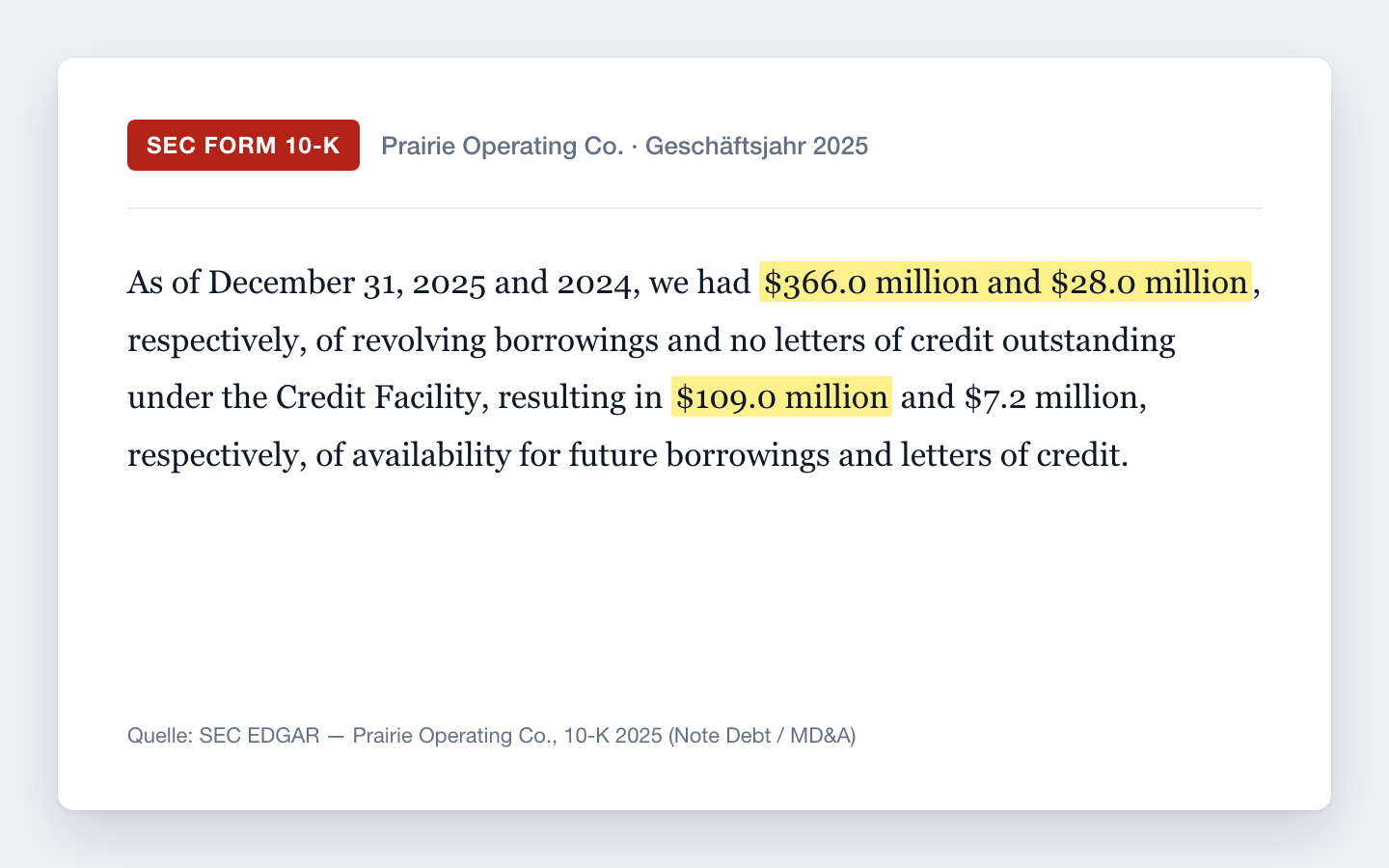
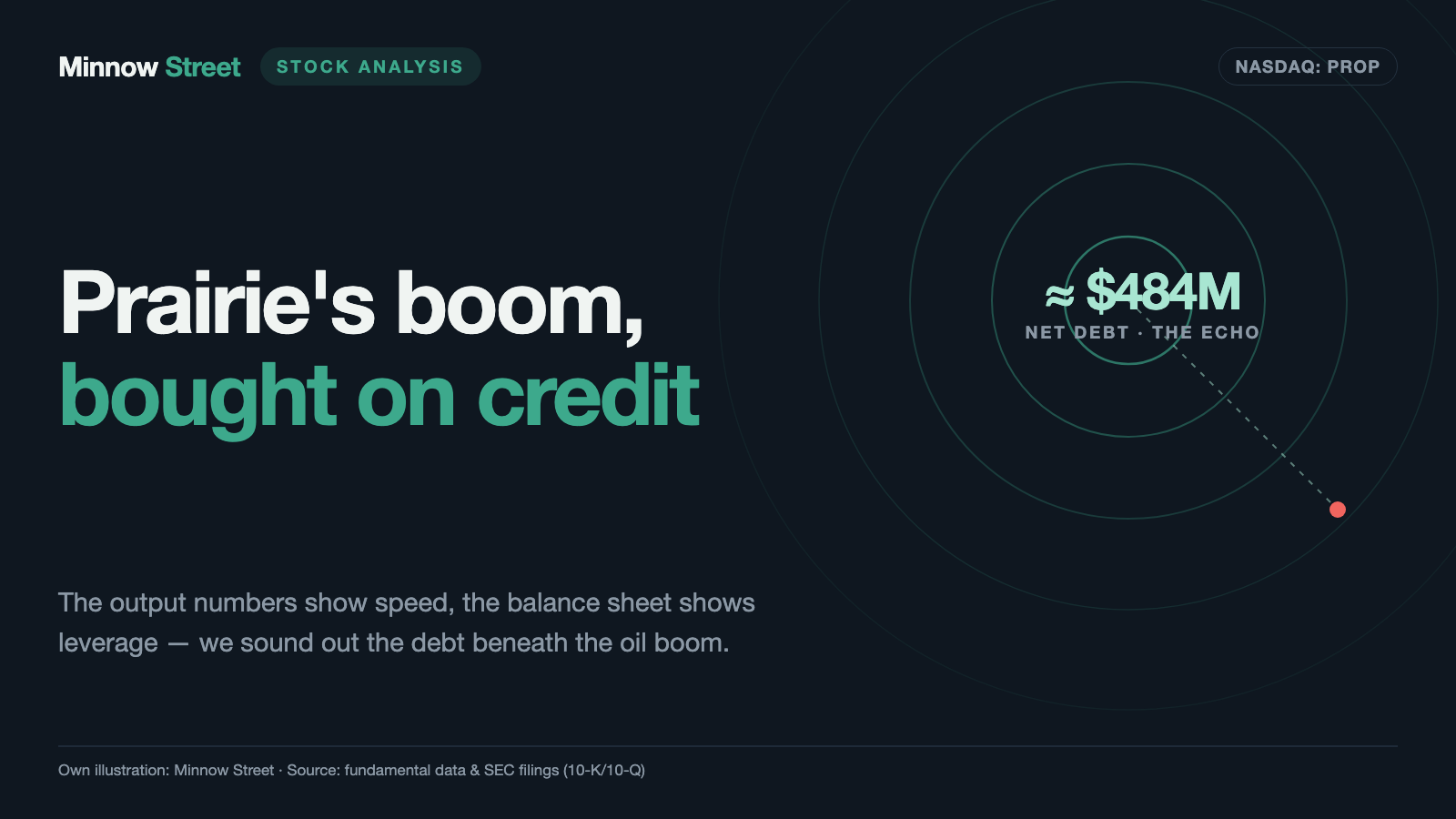
An honest reading has two sides. One: by the first quarter of 2026 the limit — the "borrowing base" — stood at $475 million, of which $361.5 million was drawn, leaving $113.5 million free; and Prairie expressly denies any doubt about its ability to continue as a going concern. So nothing is on fire right now. The other, more uncomfortable side: the banks reset that limit twice a year — depending on the value of the oil reserves, which depends on the oil price. If the oil price falls, the limit can be cut at precisely the moment Prairie would need it most. Net the whole debt against the cash and roughly $484 million of net debt remains — about 3.1 times operating profit (EBITDA). For a producer at the low end of the price cycle that is serious leverage, not a comfortable cushion. The same caution applies to any leveraged commodity producer whose substance sits behind other people's claims — we took that apart in detail at the Delaware Basin producer Battalion Oil, where $162.5 million of debt and $221.2 million of preferred capital compounding at 16.0 percent a year rank ahead of the common shareholders.
Uncomfortable truth no. 2: your slice of the pie gets smaller
Debt is only one half of the bill. The other half you pay as a shareholder, with your stake. Dilution means: your slice of the pie gets smaller when new slices are constantly being cut and handed out. Prairie cut a lot of new slices for its acquisitions — for Bayswater alone a preferred stock worth $148.3 million that can turn into millions of common shares:
“In March 2025, we issued 148,250 shares of Series F Convertible Preferred Stock … for aggregate consideration of approximately $148.3 million, which is convertible into shares of Common Stock. … [the shares of Series F Preferred Stock] were convertible into an aggregate of 21,468,687 shares of our Common Stock.”
— Prairie Operating Co., SEC annual report 10-K for fiscal year 2025 (notes, Series F preferred stock)
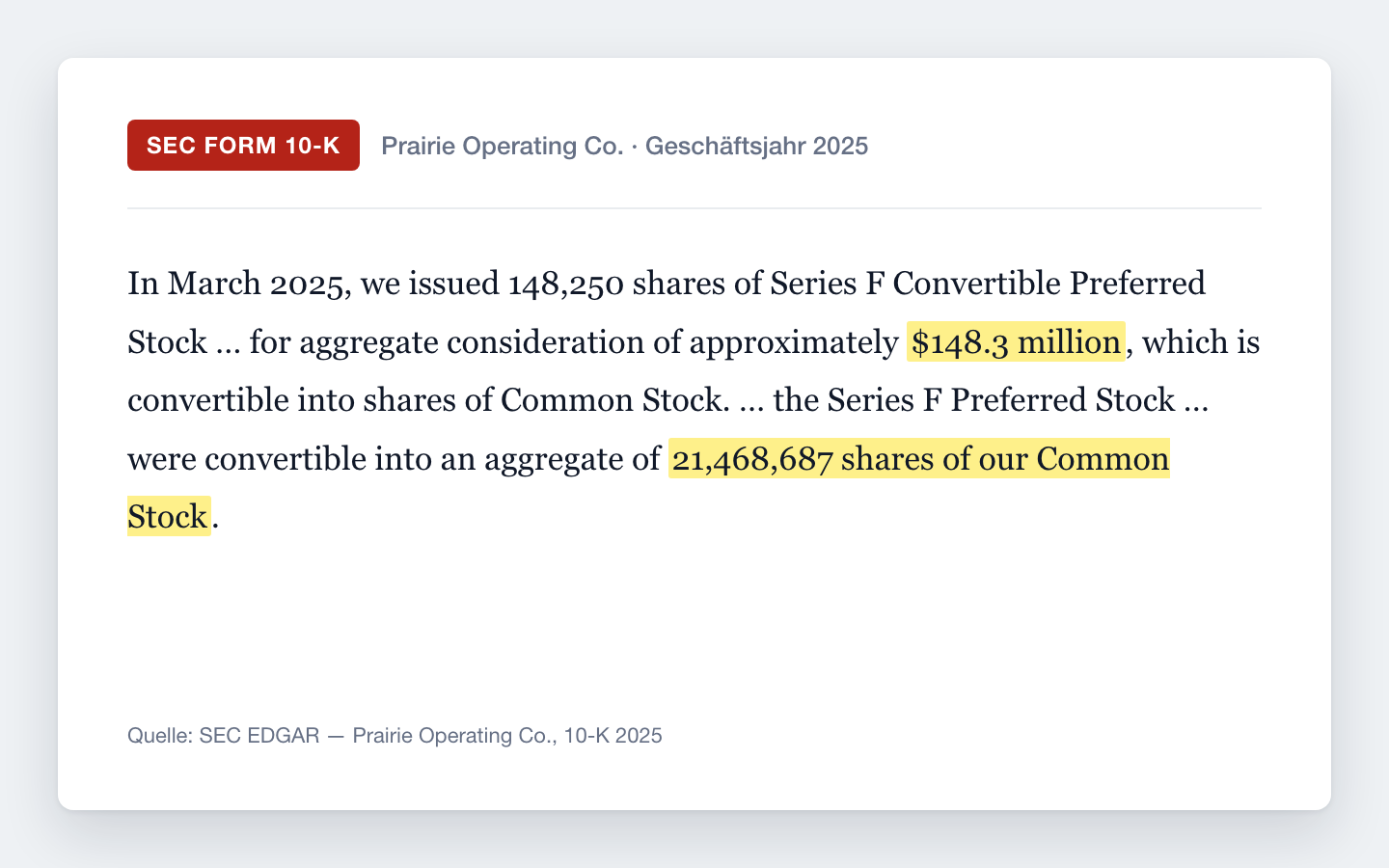
On top of that came 3.66 million new common shares handed straight to the seller, Bayswater, plus further issuance. You can see the effect in the share count: the weighted annual average rose from 15.5 million (2024) to 45.2 million shares (2025), with roughly 97.7 million outstanding by mid-2026. When the number of owner slices multiplies in a short time, the value of the company has to grow at the same pace just for your single slice to stay worth as much. Remember: growth paid for with fresh shares is never quite free — the price simply does not appear on the invoice, it appears in your shrinking stake. A dividend that might ease the pain, incidentally, Prairie does not pay.
Uncomfortable truth no. 3: everything hangs on a price Prairie does not set
The third truth is the most fundamental. A producer sells an interchangeable good at a price set by the world market, not by the company. That is the ground the first two truths stand on: debt and dilution are bearable only as long as the oil price plays along. Prairie writes it into its risk factors:
“Our revenues, profitability, and cash flows will depend upon the prices for oil, natural gas, and NGLs. The prices we may receive for oil, natural gas, and NGLs production are volatile and a decrease in prices can materially and adversely affect our financial results and impede our growth, including our ability to maintain or increase our borrowing capacity.”
— Prairie Operating Co., SEC annual report 10-K for fiscal year 2025, Item 1A "Risk Factors"
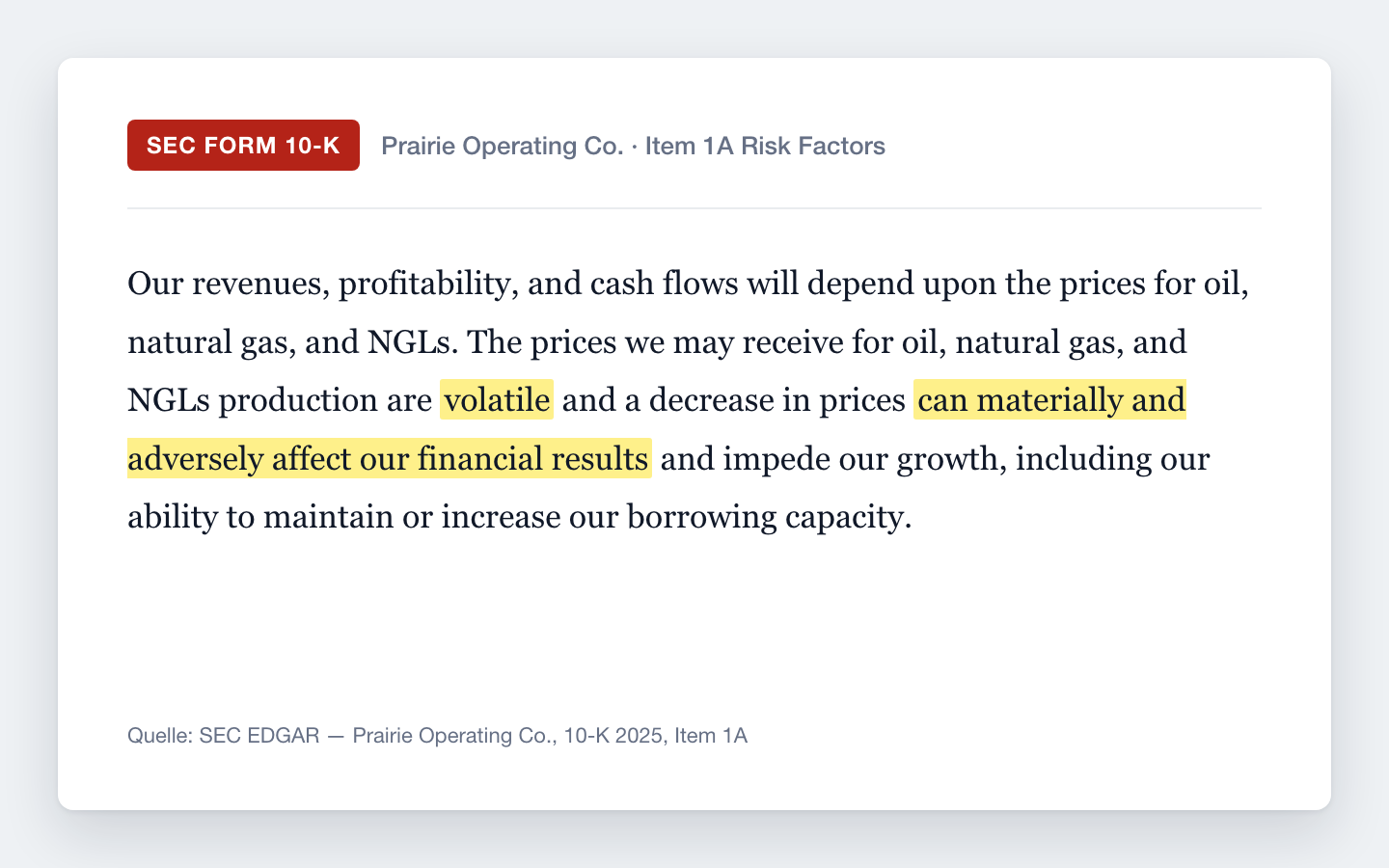
Prairie does something about it, and that deserves fair acknowledgment: part of future output is price-protected through forward contracts (hedges) — roughly 4.2 million barrels of oil for 2026 at around $62. That is a safety net, but a time-limited one: it covers the next one to two years, not the time after that, and at today's prices it is not a gold mine but an emergency blanket. The hedging is also required by the lender — a sign of how tightly debt and price are tied together here. The sore point remains: at Prairie a volatile price, high leverage and a large share count all meet in one place. If the price falls, it presses three times at once — on revenue, on the credit limit and on the value per (by now numerous) share.
Valuation — what is cheap here and what is not
Now to the core question: is the stock cheap enough to carry the leverage and the dilution? As of mid-2026 Prairie puts only about $79 million on the stock market scales — tiny. But at a company this indebted, the market value is the wrong lens. Add the debt and the enterprise value comes to roughly $563 million. Measured against that, Prairie is not dirt cheap but normally valued: the enterprise value equals about 3.6 times operating profit (EV/EBITDA) and roughly $30,400 per barrel of daily production — solid mid-field numbers for a DJ Basin producer, not a fire sale.
The optimists' strongest argument sits in the reserves: Prairie reports 121 million barrels of proved reserves whose discounted value (the so-called PV-10, the present value of future net revenues before tax) is put at $1.22 billion — clearly above the enterprise value. On that measure there is substance in the stock. But be careful with that number: the PV-10 is calculated at a fixed cut-off price (here around $65 per barrel of oil) and before deducting debt. It is a snapshot in good weather, not a guaranteed check. If the oil price falls, the PV-10 falls with it — and the debt stays standing at full size. So the low revenue multiple (price-to-sales around 0.25) that trips our cheapness scanner should be read with care: it is cheap because the market distrusts the debt-financed model in a soft price environment — not because the market overlooked it.
Opportunities and risks at a glance
What speaks for Prairie Operating:
- A real, strongly grown production business: 18,487 barrels a day (2025), roughly half of it oil, in the established DJ Basin; proved reserves of 121 million barrels with a PV-10 of $1.22 billion.
- An optically low valuation: a market value of only around $79 million, price-to-sales around 0.25; three cheapness ranking filters of the scanner fire.
- No acute doubt about survival: the company expressly denies a going-concern issue, still had $113.5 million of the credit facility available as of March 31, 2026, and hedges part of its output through forward contracts.
- Low production costs per barrel (lease operating expenses of around $6.14 per Boe, 2024: $7.44) — operationally, Prairie pumps cheaply.
What speaks against it:
- Growth on credit: the acquisition roll-up (Bayswater alone $602.8 million) drove the drawn credit line to $366.0 million; net debt stands at roughly $484 million — about 3.1 times operating profit. The credit limit is reset twice a year and depends on the oil price.
- Heavy dilution: Series F preferred stock worth $148.3 million (convertible into 21.5 million shares) plus new common shares; the share count multiplied, and there is no dividend.
- Red ink despite growth: a net loss of $60.9 million (2025), a net margin of roughly minus 38 percent; the company produces a lot but (so far) earns nothing for its shareholders.
- Price dependence and downtrend: the realized price fell to $35.81 per barrel; technically, six weakness and downtrend filters carry the stock close to its low — the market confirms the skepticism.
A human conclusion
Do you remember the growth rush from the opening — the reflex that confuses size with value? After the trip through the filings you know why it is especially treacherous at Prairie. The growth number is real, the oil flows, the reserves in the ground exist. But every additional barrel was paid for with debt and with fresh shares — and both now stand in the books as a bill, while the bottom line stays a loss. The neighbor with the ever-bigger car looks successful. Only a look at the financing shows who is really building wealth and who is just buying speed on credit.
And yet it would be unfair to end the story there. Unlike a pure castle in the air, there is substance in the ground here: a billion-dollar PV-10, low production costs, part of the output hedged, no acute doubt about survival. For anyone who believes the oil price will hold or rise and that Prairie will integrate the acquisitions cleanly, the stock is a leveraged bet on a firm oil price — with a correspondingly long drop in both directions. Only, a leveraged bet is not a bargain, however cheap the revenue multiple looks.
What you make of it is your decision. And that is exactly as it should be. But if we weigh our findings soberly, we see no margin of safety and no reason to buy the downtrend against the company's own balance sheet: high, price-dependent debt, heavy dilution, red ink and a chart that confirms all of it. Our findings therefore argue for caution — not as doomsday, but as the sober observation that growth on credit only creates value once the arithmetic works out. Whether and when it does hangs on a price that neither Prairie nor we control. Keep an eye on the oil price, the credit limit and the share count — not on the growth number alone.
Sources
- Prairie Operating Co. — SEC annual report 10-K, fiscal year 2025 (as of 31.12.2025, filed 31.03.2026)
- Prairie Operating Co. — SEC quarterly report 10-Q (as of 31.03.2026, filed 14.05.2026)
- Prairie Operating Co. — SEC annual report 10-K, fiscal year 2024 (loss history, NRO acquisition)
- Prairie Operating Co. — SEC filing 8-K of 24./26.03.2025 (closing of the Bayswater acquisition)
- Fundamental data (metrics, valuation, annual and quarterly series); in-house stock scanner, data as of July 10, 2026.
Disclaimer: This article is a journalistic analysis and not investment advice. It is not a solicitation to buy or sell securities. Share prices fluctuate; a total loss is possible. Make your investment decisions on your own responsibility and seek independent advice when in doubt.
Our Bottom Line at a Glance
- Business model & reserves neutral
- Prairie produces real oil and gas in the established DJ Basin (18,487 Boe/day in 2025, roughly half of it oil) and reports 121 million barrels of proved reserves with a PV-10 of $1.22 billion — substance in the ground. Production costs per barrel are low. But the growth comes from acquisitions, not from its own drilling, and the PV-10 holds only at a fixed cut-off price.
- Growth & earnings negative
- The jump in output is real, yet it does not carry itself: despite output rising forty-fold, 2025 ended with a net loss of $60.9 million (net margin roughly minus 38 percent), while the realized price per barrel fell from $46.70 to $35.81. Plenty of volume, a weak price, red ink — Prairie produces a great deal and so far earns nothing for its shareholders.
- Debt & credit limit negative
- The acquisition roll-up (Bayswater alone $602.8 million) drove the drawn credit line to $366.0 million; net debt stands at roughly $484 million — about 3.1 times operating profit. The credit limit (borrowing base $475 million) is redetermined twice a year and depends on the oil price. No acute going-concern issue, but serious, price-dependent leverage.
- Dilution & capital discipline negative
- Next to the debt, shareholders paid with their stake: $148.3 million of Series F preferred stock (convertible into 21.5 million shares) plus 3.66 million new common shares to Bayswater. The weighted share count rose from 15.5 million to 45.2 million, with roughly 97.7 million outstanding (mid-2026). There is no dividend. Growth on credit and with fresh shares at the same time.
- Valuation & chart picture negative
- Optically cheap (price-to-sales around 0.25), but normally valued on an enterprise-value basis (EV/EBITDA about 3.6, roughly $30,400 per Boe/day). Technically, six weakness and downtrend filters carry the stock close to its low — the market confirms the skepticism toward the debt-financed model. Cheap here can also mean cheap for good reason.
Prairie Operating is a debt-financed oil and gas producer in the DJ Basin that multiplied its output within a single year, through acquisitions, from 464 to 18,487 barrels a day. The oil really flows, and the reserves (PV-10 $1.22 billion) are substance. But the growth was paid for with a heavily drawn credit line ($366.0 million drawn, net debt roughly $484 million, about 3.1 times EBITDA), a preferred stock worth $148.3 million and fresh common shares — alongside a net loss of $60.9 million and a realized price that fell to $35.81 per barrel. No acute doubt about survival, but high, price-dependent leverage, heavy dilution and a share price in a confirmed downtrend. A leveraged bet on a firm oil price, not a bargain. Not investment advice.
What Our Rating Means
Open questions
The business works in principle, but one material question is open. As long as it stays open, our findings do not carry a quality verdict.
After the materiality gate several serious structural and price findings remain standing, and they coincide: high, price-dependent debt (net debt about 3.1 times operating profit, a credit limit redetermined every six months), a debt-financed roll-up that is still writing red ink (a net loss of $60.9 million), heavy dilution (the share count multiplied) and weak realized prices — confirmed by six weakness and downtrend filters in the scanner. Against that stands documented substance (PV-10 $1.22 billion, no acute going-concern issue, partial hedging), which makes a total failure unlikely for now but delivers no margin of safety. Our findings see no basis for buying the downtrend against the company's own balance sheet; they argue for caution. The decision is yours. Not investment advice.
A journalistic assessment by our editorial team at the time of the deep dive, based on public sources — not investment advice and not a solicitation to buy or sell. Your personal circumstances (investment goals, risk capacity, taxes) cannot be taken into account. What our levels mean, how verdicts are formed, and what conflicts of interest exist →
Worth Noting
- Materiality gate (finding typology): debt — net debt of roughly $484 million, about 3.1 times EBITDA ($158 million); credit facility $366.0 million drawn against a borrowing base of $475 million (only $113.5 million free as of 31.03.2026), redetermined every six months against the oil price. A serious structural finding with existential proximity under stress (a borrowing-base cut), but NOT an existential finding in the narrow sense, since the company expressly denies a going-concern doubt and the PV-10 ($1.22 billion) covers the debt. Outspending/capital discipline — Bayswater $602.8 million debt-financed, a net loss of $60.9 million, a margin of minus 38 percent = a structural/price finding. Dilution — shares from 15.5 million to 45.2 million (weighted) and roughly 97.7 million outstanding, Series F convertible into 21.5 million shares = a price finding. Commodity price — realized $35.81 per Boe (down from $46.70), gas $0.88 per Mcf, partly hedged (around $62 for oil in 2026) = a price/cyclicality finding. Downtrend — six weakness and downtrend filters, close to the 52-week low = market confirmation. Overall picture: no single existential finding, but the cluster of serious structural and price findings at debt-financed growth with a confirmed downtrend justifies caution on the evidence rather than the reflexive "watch" — there is no margin of safety at all.
- Identity/history: Prairie Operating Co. (CIK 1162896, Commission File 001-41895, Delaware, ISIN US7396501097). Until May 2023 the company was named "Creek Road Miners, Inc." (a bitcoin miner); the reverse merger with Prairie LLC (completed in May 2023) turned it into the oil and gas producer. That explains the extreme price history against old all-time highs (a change of name and structure), which is not an operating argument for buying.
- Price and valuation figures are dated to mid-2026; analyses are evergreen, daily prices are not a buy argument. The market value of roughly $79 million refers to roughly 97.7 million shares outstanding; the enterprise value of roughly $563 million follows from market value plus net debt.
- Special-situation screening (EDGAR full index, CIK 1162896): the SC 13D filings date from 2023 (the reverse-merger/founding and insider environment, amendments through 08/2024); the DEF 14A 2026 is an ordinary annual meeting. No live hostile activist campaign, no announced strategic review, no poison pill (rights plan) and no takeover offer in the most recent mandatory filings. Insiders hold roughly 29 percent. A subordinated note ($5.0 million) is held by entities of director Jonathan H. Gray (a related party, with a 2.0x minimum return).
- AI rating: neutral (a documented negative finding). The filings evaluated (10-K 2025/2024, 10-Q Q1 2026) contain no material AI angle: no AI revenue source, no documented operational use of AI, no AI business risk to the company's own model. The only hits are boilerplate in the cybersecurity risk section (deepfakes, AI-assisted attacks) — not grounds for a rating.
Frequently Asked Questions
Prairie Operating Co. (Nasdaq: PROP) is an independent oil and gas producer (E&P) headquartered in Houston, Texas. The company leases drilling rights in the DJ Basin (Denver-Julesburg Basin) in Weld County, Colorado, where it produces crude oil, natural gas and natural gas liquids (NGLs) and sells them. In 2025 Prairie produced an average of 18,487 barrels of oil equivalent per day, a good half of it oil. A curiosity: until May 2023 the company was called "Creek Road Miners" and mined bitcoin.
Almost exclusively through acquisitions, not through its own drilling. The biggest step was the Bayswater acquisition of March 2025 for $602.8 million, followed by the NRO, Edge and Summit/Crown deals. Daily output jumped from 464 barrels (2024) to 18,487 (2025) and revenue from $7.9 million to $241.6 million. That growth was paid for with a credit facility, a preferred stock and fresh common shares.
At the end of 2025, $366.0 million of the reserve-based credit facility with Citi was drawn (end of 2024: $28.0 million). The limit — the borrowing base — stood at $475 million in early 2026, of which $361.5 million was drawn most recently. Net debt is roughly $484 million, about 3.1 times operating profit (EBITDA). Important: the banks reset that limit twice a year, depending on the value of the oil reserves — if the oil price falls, the limit can shrink.
Not acutely: in the 2025 annual report the company expressly denies any doubt about its ability to continue as a going concern, and as of March 31, 2026 it still had $113.5 million of the credit facility available. But the debt is high and price-dependent, and Prairie posted a net loss of $60.9 million in 2025. The biggest risk is a sustained fall in the oil price, which would hit revenue, the credit limit and the share value all at once.
Yes, considerably. For the acquisitions Prairie issued $148.3 million of Series F convertible preferred stock in March 2025, convertible into 21,468,687 common shares, plus 3.66 million new common shares handed straight to the seller, Bayswater. The weighted share count rose from 15.5 million (2024) to 45.2 million (2025), with roughly 97.7 million outstanding by mid-2026. Prairie pays no dividend.
Only at first glance. A price-to-sales ratio of around 0.25 looks dirt cheap — but the market value of roughly $79 million leaves the debt out. Add it back and the enterprise value comes to roughly $563 million (EV/EBITDA about 3.6), a normal figure for a DJ Basin producer. The proved reserves carry a PV-10 of $1.22 billion, but calculated at a fixed cut-off price and before deducting debt. The low multiple reflects the market's distrust of the debt-financed model, not an oversight.
No. The SEC filings we evaluated contain no material AI angle: no AI products, no documented operational use of AI and no AI as a concrete business risk. The only mentions are boilerplate in the cybersecurity risk section (deepfakes, for instance). In our AI rating Prairie is therefore classified as "neutral" — a documented negative finding, exactly what you would expect at a classic oil and gas producer.
Found an error?
Did you spot a factual error, an outdated number, or a typo in this deep dive? Let us know briefly — your report goes straight to the editorial team.