Collective Mining stock: 184,000 Meters of Core and Not One Ounce of Resource
Collective Mining has been drilling in Colombia since 2021, reports spectacular grades and carries a market value of roughly a billion dollars. Its own annual report to the U.S. securities regulator answers with one very dry sentence: the company holds neither mineral resources nor mineral reserves. There has been no revenue since inception, the net loss widened to $49.9 million in 2025, and the share count grew 51 percent in two years. Since May 2026 a C$500 million shelf prospectus has been sitting ready. A London fund still holds the stock as the fourth-largest position in its portfolio and has added for four quarters straight. Not investment advice — just the question of what you actually own while the treasure exists only as a drill hole.
 Thomas Mücke
Founder & Publisher
Thomas Mücke
Founder & Publisher
Chart
Interactive price chart (TradingView).
Note: pure fact-based analysis, not investment advice and not a solicitation to buy or sell. All figures without guarantee.
There is an investor trap far older than the stock market — call it the treasure-map trap. On a treasure map the treasure is already drawn in. That is the whole trick: the map feels like ownership. Between the cross on the paper and a coin in your hand sit a ship, a crew, a shovel and the awkward possibility that the spot holds nothing but sand. At Collective Mining Ltd. (NYSE American and TSX: CNL) that trap is the entire story — and it is the reason Collective Mining stock is so hard to price. The company has been drilling in Colombia since 2021, has pulled roughly 184,000 meters of core by July 2026, reports grades that make commodity investors hold their breath — and carries a market value of about a billion dollars. So let us make a deal: before you take one of those releases for treasure, we read together what Collective Mining itself reported to the U.S. securities regulator, the SEC — the annual report on Form 40-F for 2025 filed March 31, 2026 with all three exhibits, the interim report as of March 31, 2026, and half a dozen news releases through July 22, 2026. A filing to the SEC is honest under penalty of law. And this one contains a sentence that appears in no headline. In the end you decide.
What Collective Mining actually does — two names on the map, not one gram of metal sold
Collective Mining is a pure exploration company. It mines nothing, sells nothing and earns nothing. It searches. The interim statements as of March 31, 2026 put it in a sentence worth reading twice:
"To date, the Company has not generated any revenue from mining or other operations as it is considered to be in the exploration stage."
— Collective Mining Ltd., unaudited interim condensed consolidated financial statements as of March 31, 2026 (6-K exhibit 99.1), Note 1 "Nature of Operations"
The search happens in two places, both in the department of Caldas in western Colombia, inside an established mining camp with ten fully permitted and operating mines:
- Guayabales — the flagship, anchored by the Apollo system, a combination of porphyry, breccia and vein-hosted gold, silver, copper and tungsten mineralization. The discovery hole was announced on June 22, 2022; through September 2025 the company had drilled 196 holes over 84,648.9 meters from 33 pads at Apollo, and by July 2026 about 120,000 meters at that system alone.
- San Antonio — the second project, where the company announced a porphyry and vein system discovery in 2025 and a silver-dominant vein system from surface in 2026.
The business model is easy to describe and hard to value: you pay for rigs, geologists, laboratories and landowners, and hope that a deposit emerges which is either built or sold to a large producer. This team has done exactly that once before. The July 22, 2026 release says so bluntly: "Founded by the team that developed and sold Continental Gold Inc. to Zijin Mining for approximately $2 billion in enterprise value." The predecessor was sold to a Chinese group for roughly $2 billion of enterprise value. That history is the stock's strongest selling point — and it is real.
Which names the central tension of this analysis, and it runs through every chapter: Collective Mining has made one of the most striking exploration discoveries of recent years and, in the language of the securities regulator, has exactly nothing to show for it. The gap between those two sentences is what you are buying.
Drill intercept, resource, reserve — three words that decide everything
Before the numbers, a piece of translation work, because no exploration stock makes sense without it. Picture an enormous raisin cake.
- A drill intercept is a thin needle you push into the cake. The core you pull out is a few centimeters across and several hundred meters long. It tells you precisely what sits along that one line — and nothing at all about what lies beside it. When Collective reports on June 29, 2026 that it hit 27.35 meters at 37.55 grams of gold equivalent per tonne (including 1.68 percent tungsten trioxide, 11.62 grams of gold, 54 grams of silver and 0.43 percent copper), that is a very good needle. Nothing more.
- A resource is the geological extrapolation: how many raisins are in the whole cake? That takes many needles on a grid, a geological model and an independent expert. Resources come in three confidence levels — inferred (an educated guess), indicated and measured. Even a measured resource says nothing about whether baking is worth it.
- A reserve is the portion of a resource that an economic study has shown can be mined at a profit at today's costs, prices and permits. Only here does geology become a business.
Remember the sequence: needle, extrapolation, proof. Press releases cover needles, because needles look spectacular. The value of a mining company is created in the other two stages. And that is exactly where Collective Mining stands — for now — at zero.
How Collective Mining stock landed on our desk
This analysis does not begin with a hit in our in-house stock scanner but with a form. On May 8, 2026, Helikon Investments Ltd of London filed its Form 13F-HR with the SEC for the quarter ended March 31, 2026 (accession 0001839497-26-000002). A 13F is the mandatory quarterly disclosure for large U.S. asset managers: anyone managing more than $100 million in U.S.-listed equities must report what they hold. Helikon's table lists 17 positions worth $2,648,555,113 in total — and among them 10,979,312 Collective Mining shares worth $193,345,684. That is the fourth-largest position in the portfolio and roughly 11.9 percent of every share the company has issued.
The movement is calmer than in most other names in that portfolio. Reported across four dates: 9,916,894 shares (June 30, 2025), 10,455,037 (September 30, 2025), 10,650,248 (December 31, 2025) and 10,979,312 (March 31, 2026) — four consecutive quarters of modest additions, most recently up 3.1 percent. And Helikon shows up here beyond the 13F: the fund has also filed direct ownership statements on Collective Mining, most recently on October 28, 2025 covering 10,455,037 shares, or 12.32 percent. What stands out is less the size than the pattern: a fund holding $2.6 billion across just 17 names puts hundreds of millions into companies with not one dollar of revenue — besides Collective Mining also Skeena, Solaris Resources, New Pacific Metals and Highlander Silver.
Now the limit that belongs with every 13F, so that a mandatory filing does not become a legend: a 13F shows only U.S.-listed long positions, reported with a 35- to 45-day delay, without short sales, without derivatives and without anything listed outside the United States. It is a rear-view mirror, not a road map.
A word about the scanner, because honesty requires it: Collective Mining stock is not a name our filters push to the front — and it cannot be. The data series covers eight quarters (second quarter of 2024 through first quarter of 2026), and revenue is zero in all eight. That knocks out every metric with revenue or earnings in the denominator: no price/earnings ratio, no price/sales ratio. The Piotroski F-Score stands at 3 of 9 — a nine-point test of the health of the books on which a genuinely sound company scores 8 or 9. But several of those nine points require profits and operating cash inflow that simply cannot exist here. The 3 is therefore a statement about the business type, not about quality.
Then there is the Altman Z-Score of 55.91. Altman’s distress test — we carry the book-value variant Z″ — sounds an alarm below 1.1 and treats 2.6 and above as safe — so 55.91 looks like a knighthood. It is not. The number comes almost entirely from the fact that the company had barely any liabilities at the end of 2025: the formula weighs market value against debt, and when the denominator is tiny the result explodes. A test built for companies with revenue and borrowings measures nothing at all in an explorer that has neither. Remember this: a metric that is only large because its denominator is missing is not proof of solvency. How fast that flips is uncomfortable truth no. 3.
Why there is no quarterly report from Collective Mining
A point many investors miss: there is no 10-K and no 10-Q from Collective Mining. The company is an Ontario corporation and reports to the SEC through the multi-jurisdictional disclosure system: it files under Canadian rules and submits the same package to the SEC as Form 40-F — for 2025 on March 31, 2026, with three exhibits: the Annual Information Form, the IFRS financial statements audited by BDO Canada LLP, and the MD&A. Quarterly figures arrive as an unaudited exhibit to a Form 6-K.
There is a second point the 40-F names itself: Collective Mining qualifies as an "emerging growth company" and is therefore exempt from the auditor attestation on internal control:
"This Annual Report does not include an attestation report of the Company's registered public accounting firm due to a transition period established by rules of the SEC for newly public companies. … The Company qualifies as an 'emerging growth company' and therefore has not included in, or incorporated by reference into, this Annual Report such an attestation report."
— Collective Mining Ltd., SEC annual report on Form 40-F for 2025, section "Disclosure Controls and Procedures and Internal Control over Financial Reporting"
That is entirely legal and normal for young listed companies — but it is a thinner control environment than you would get from an established U.S. peer. And the listing history really is young: the stock started on the TSX Venture Exchange on May 20, 2021, moved to the Toronto Stock Exchange on September 6, 2023 and has traded on NYSE American only since July 2024. Remember: a short listing history is not a weakness of the business, but it is a weakness in your data.
The numbers over the years — a company that only spends
First what genuinely impresses, because there is plenty. The drilling effort is exceptional: 62,500 meters were drilled in 2025, the largest campaign in company history at that point; up to 100,000 meters are planned for 2026, and in July 2026 13 rigs were turning at once. The results are not a footnote: on a grams × meters basis, hole APC104-D5 is the strongest intercept at Apollo at 1,499 grams of gold equivalent, and the company has drilled 18 intercepts above 1,000 grams × meters there. Permitting is improving too: after public hearings in Marmato (February 17, 2026) and Supía (May 21, 2026), Colombia's national mining agency ANM granted further mining titles on April 10 and July 10, 2026.
Now the other side. For an explorer there is no revenue curve — there is a cash curve and a burn curve:
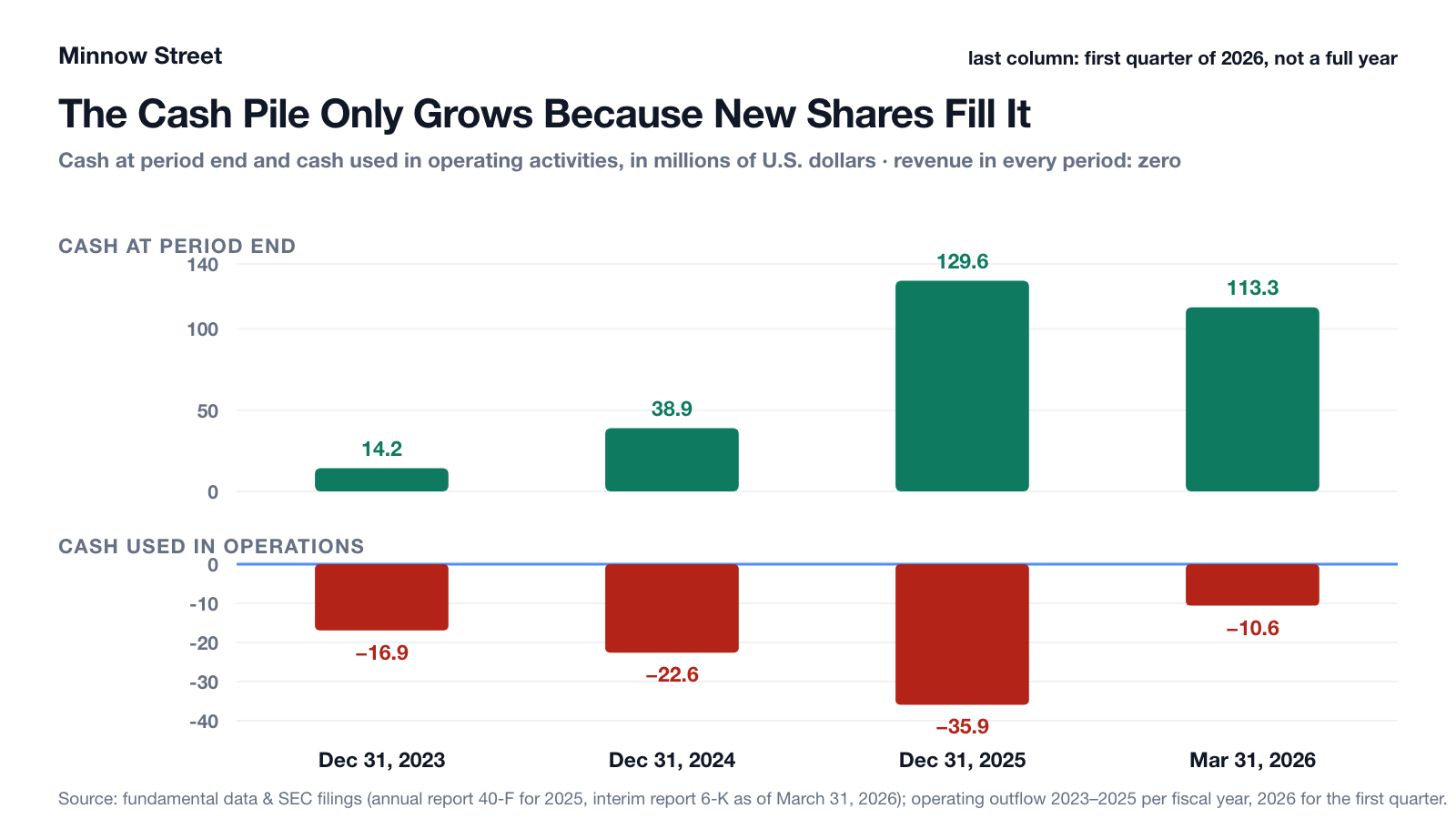
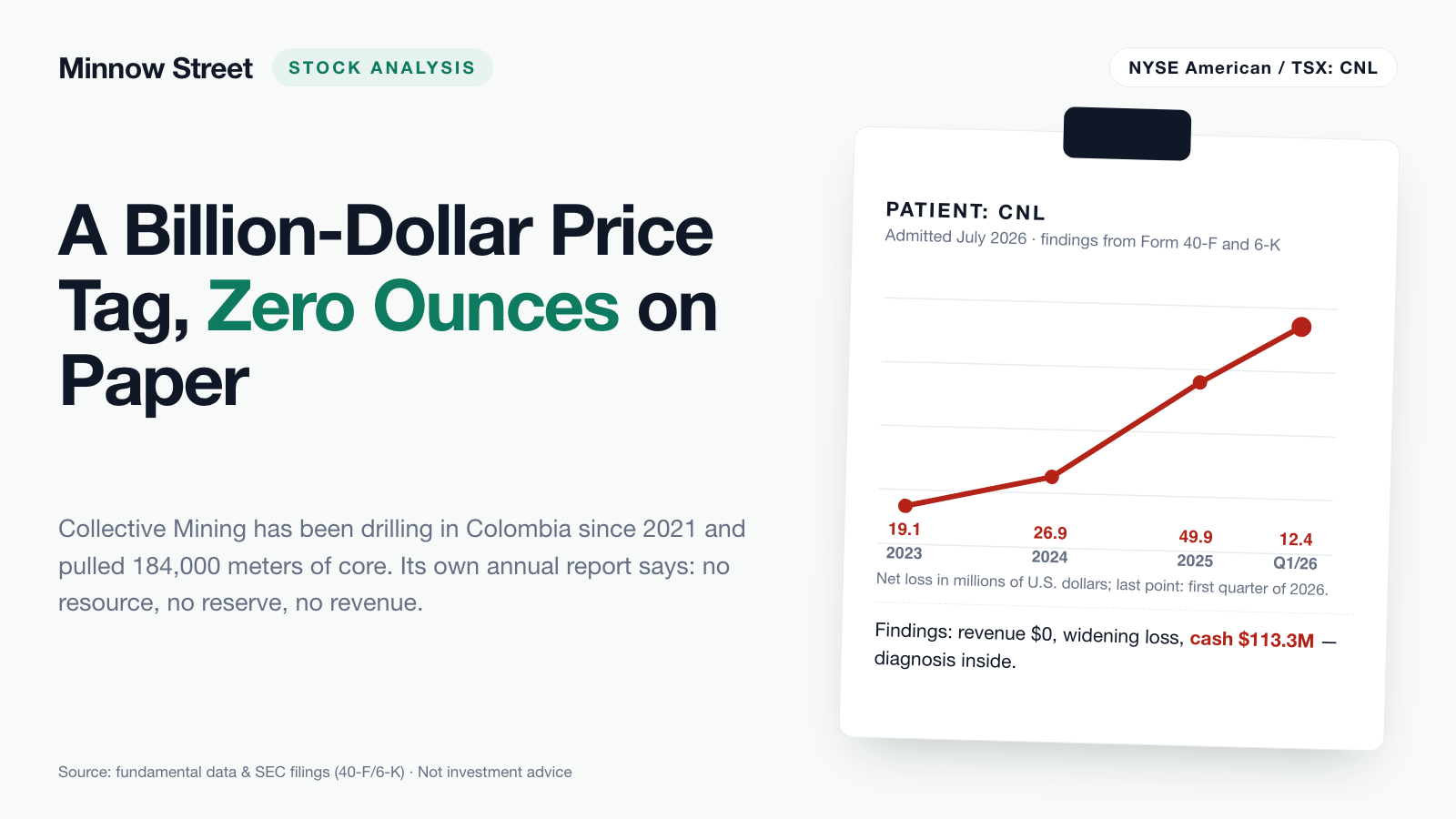
The net loss rose from $19.1 million (2023) to $26.9 million (2024) and $49.9 million (2025); per share that was $0.33, $0.33 and $0.58. The first quarter of 2026 added another $12.4 million ($0.13 per share). The biggest line item is exploration itself: $14.1 million, $18.1 million and $32.5 million across the three years, plus $9.1 million in the first quarter of 2026 (of which $8.1 million at Guayabales and $1.0 million at San Antonio). General and administrative expense grew alongside, from $5.3 million to $5.8 million and $9.5 million, reaching $4.0 million in the first quarter of 2026. One special item explains part of the 2025 jump: revaluing subscription warrants cost $10.6 million — a pure accounting loss, triggered of all things by the company's own rising share price.
The accumulated deficit since inception stood at $144.6 million as of March 31, 2026, against $243.8 million of share capital raised. Put differently: roughly a third of every dollar ever raised has already gone into the ground, quite literally.
What the filings say — the uncomfortable truths
Uncomfortable truth no. 1: there is no resource and no reserve — in writing
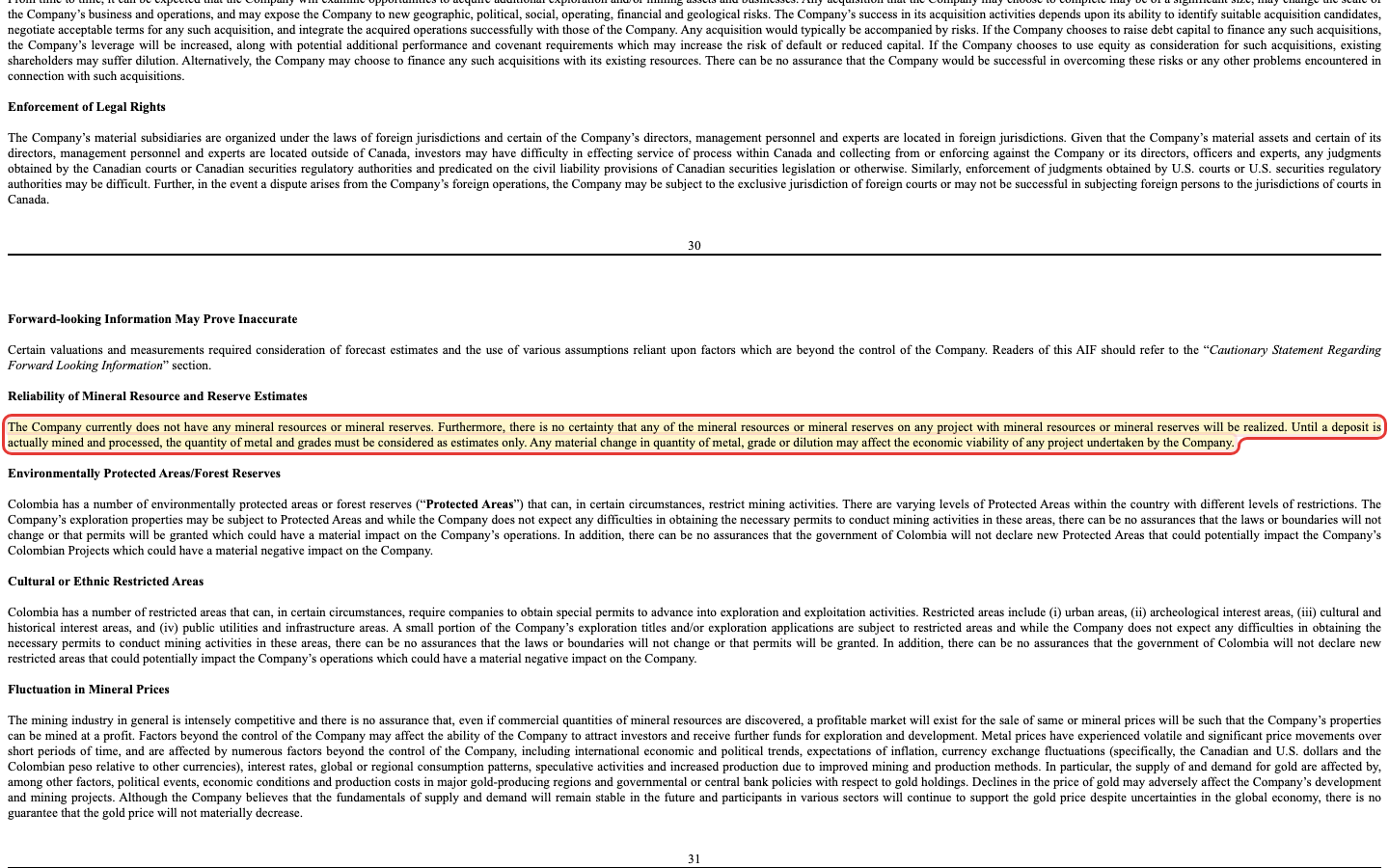
This is the sentence the whole analysis turns on. It sits in the Annual Information Form, the largest exhibit to the annual report, under the heading "Reliability of Mineral Resource and Reserve Estimates":
"The Company currently does not have any mineral resources or mineral reserves. Furthermore, there is no certainty that any of the mineral resources or mineral reserves on any project with mineral resources or mineral reserves will be realized."
— Collective Mining Ltd., Annual Information Form 2025 (40-F exhibit 99.1), "Risk Factors — Reliability of Mineral Resource and Reserve Estimates"
Anyone hoping that applies only to the side projects will find the same statement in the technical report on the flagship — this time entirely specific:
"There are no mineral resource estimates for the Guayabales Project that were prepared in accordance with the current CIM standards and definitions required by the NI 43-101. Mineral resources that are not mineral reserves do not have demonstrated economic viability."
— Collective Mining Ltd., Annual Information Form 2025 (40-F exhibit 99.1), "Guayabales Project — Mineral Resource and Mineral Reserve Estimates"
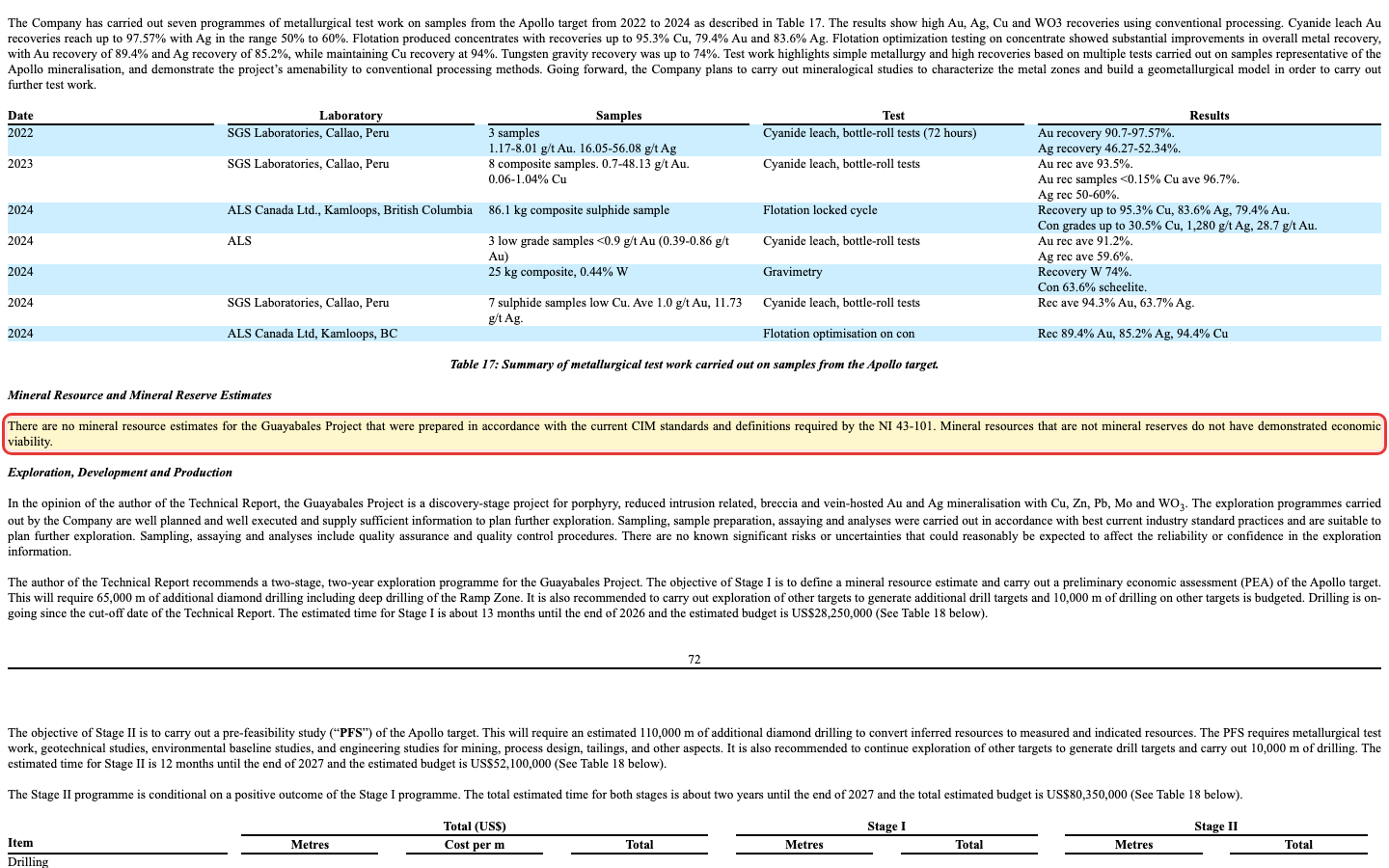
The author calls Guayabales a "discovery-stage project" and lays out a road map that shows the size of the work still outstanding. Stage I: 65,000 meters of additional drilling, about 13 months through the end of 2026, budget $28,250,000 — the stated objective is "to define a mineral resource estimate and carry out a preliminary economic assessment (PEA) of the Apollo target," in other words to produce a resource estimate in the first place. Stage II: another 110,000 meters, twelve months through the end of 2027, budget $52,100,000, to convert inferred resources into indicated and measured ones and deliver a pre-feasibility study. Together roughly $80.4 million and two years — and Stage II is explicitly conditional on a positive outcome of Stage I.
To be fair: none of this is an accusation, it is a description of where the company stands. Every mine on earth went through this phase, and a company without a resource can still hold a magnificent discovery. But it changes what you buy. You are not buying inventory; you are buying the probability that needles turn into an extrapolation.
Uncomfortable truth no. 2: every drilling season is paid for with new shares
A company without revenue has exactly two sources of money: the cash box and new shares. The MD&A says so itself:
"The Company has no operating cash flow from a producing mine and therefore must utilize its current cash reserves and funds obtained from equity financing transactions to fund its operating and exploration activities, including payments subject to exploration option agreements."
— Collective Mining Ltd., Management's Discussion and Analysis for 2025 (40-F exhibit 99.3), "Liquidity and Management of Capital Resources"
What that looks like is written in the share count:
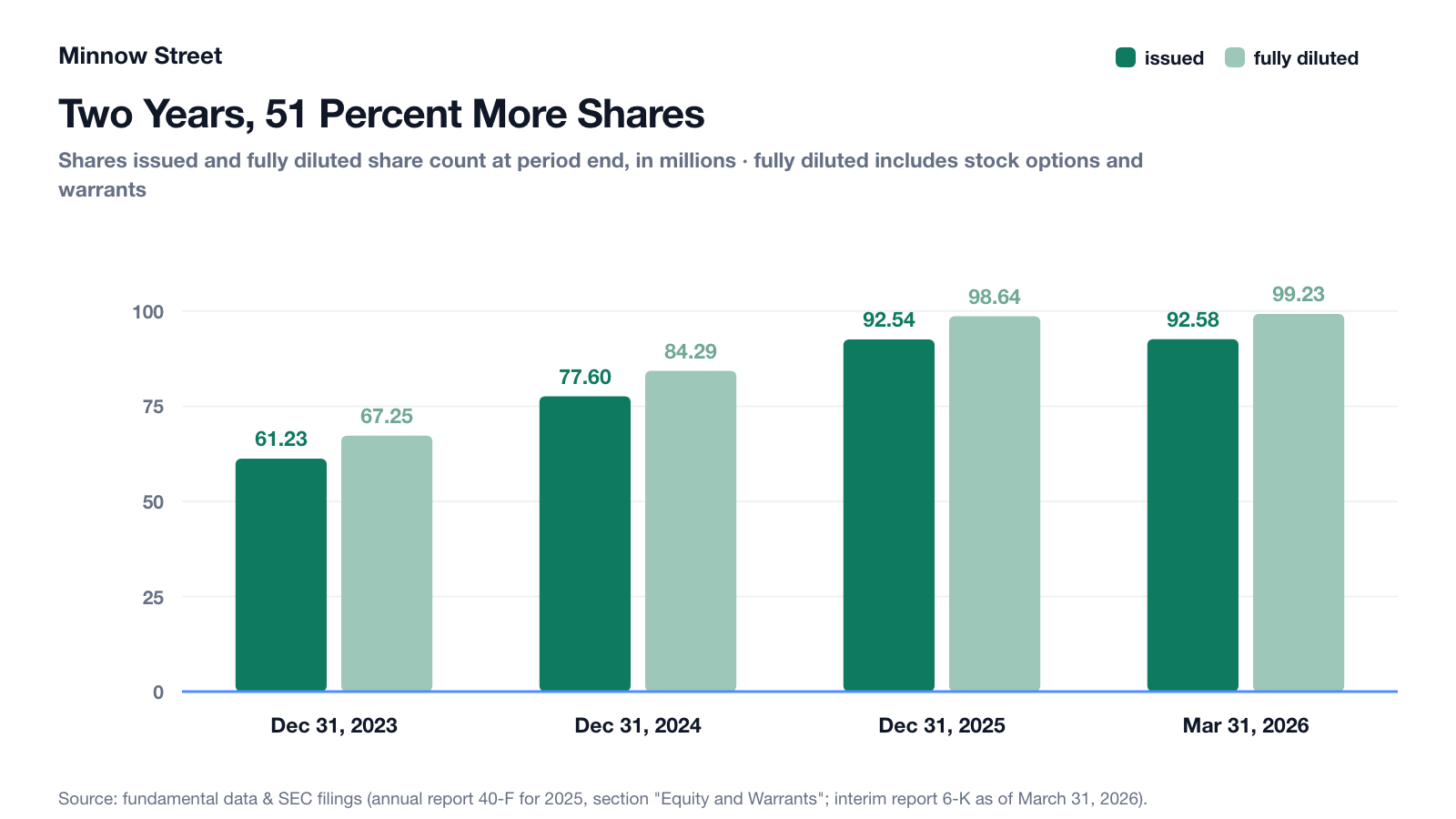
Here is the everyday image for dilution: your slice of the cake gets smaller when new slices are cut all the time — even if the cake itself is growing. The numbers: 61,234,906 shares at December 31, 2023, 77,602,208 a year later, 92,537,998 at the end of 2025 and 92,575,498 as of March 31, 2026 — up 51 percent in two years. Fully diluted, including 6,656,300 outstanding stock options, the count is 99,231,798. In 2025 alone $146.1 million came in: $36.4 million from a March private placement at C$11.00 per share, $89.9 million from an October bought deal at C$19.00, $10.8 million from a concurrent private placement and $9.2 million from option and warrant exercises.
And the company says outright that this will continue:
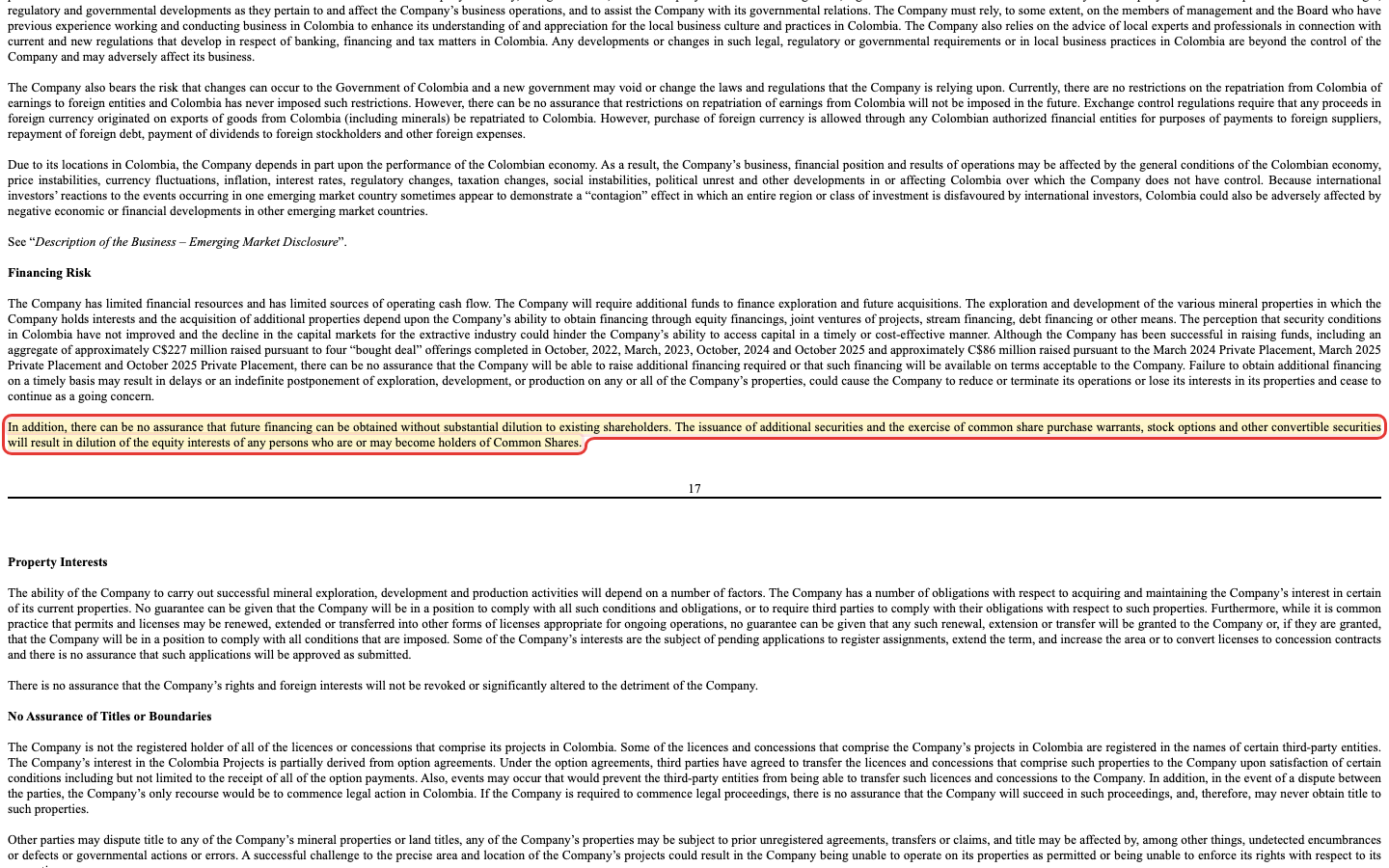
"In addition, there can be no assurance that future financing can be obtained without substantial dilution to existing shareholders. The issuance of additional securities and the exercise of common share purchase warrants, stock options and other convertible securities will result in dilution of the equity interests of any persons who are or may become holders of Common Shares."
— Collective Mining Ltd., Annual Information Form 2025 (40-F exhibit 99.1), "Risk Factors — Financing Risk"
The tool is already in place: on May 13, 2026 Collective Mining furnished a new base shelf prospectus permitting up to C$500 million of issuance within 25 months — roughly three times everything raised in 2025, and against the market value about a third of the company. Remember the line: growth paid for with fresh shares is never entirely free. How thoroughly a capital structure can overshadow an otherwise decent commodity project also shows in our analysis of TRX Gold.
Uncomfortable truth no. 3: in one quarter, $4.7 million of liabilities became $41.8 million
Remember the Altman Z-Score of 55.91, which was only large because the company had almost no liabilities? That premise is gone. At December 31, 2025 the balance sheet showed $12.9 million of total liabilities; as of March 31, 2026 it showed $52.6 million — four times as much in three months. Over the same period the equity ratio fell from 0.918 to roughly 0.72.
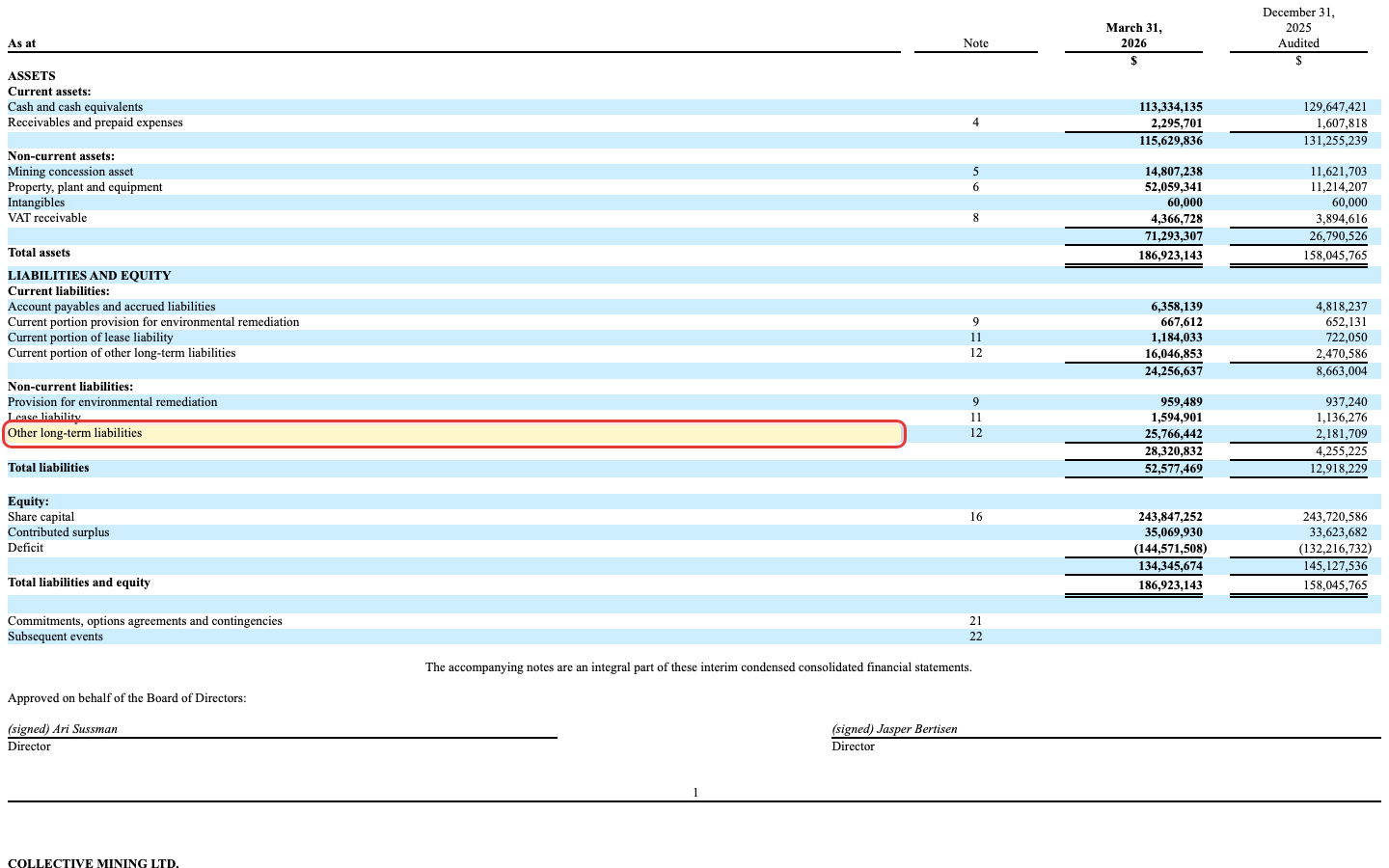
The cause is in Note 12: in February and March 2026 the company bought land and mineral rights on instalment plans. The line "Other long-term liabilities" rose from $4,652,294 to $41,813,295, of which $16,046,853 is due within one year. The single largest contract, dated March 10, 2026, covers $33,581,007 for ground at Guayabales, payable through 2030 and discounted at 9.50 percent. Add $10.57 million for land at San Antonio (February 25, 2026), $2.05 million (March 20, 2026) and $3.48 million for rights under a concession application (March 27, 2026). Property, plant and equipment jumped accordingly from $11.2 million to $52.1 million.
On the merits this is understandable: whoever wants to build a mine needs the ground above it, and paying in instalments preserves cash. For you as an investor it changes two things. First, a fixed payment schedule is now running regardless of whether the next drilling season finds anything. Second, the buffer is shrinking: net current assets after all liabilities fell from $118.1 million to $63.3 million (as of March 31, 2026). And third — the lesson for every screener user — that pretty 0.918 equity ratio was already out of date by the time it appeared in the filters.
Uncomfortable truth no. 4: the cash lasts — as long as nothing intervenes
As of March 31, 2026 the company held $113.3 million in cash, down from $129.6 million at the end of 2025. In the first quarter of 2026, $10.6 million went out through operations and $5.4 million through investing, while financing contributed nothing on balance — a decline of $16.3 million in three months. At that pace the cash lasts roughly seven quarters, or into late 2027.
The company frames it positively, and in the July 22, 2026 release word for word: "With US$113.3 million in cash (as of March 31, 2026), the Company is fully funded for its planned 2026 program, which envisions up to 100,000 meters of drilling." Both statements can be true — you just have to read the premise with them. In the first quarter of 2026 the company drilled 12,226 meters. To reach up to 100,000 meters in the year, the pace has to rise sharply, and the burn with it. On top of that come the $16.0 million of instalments due within twelve months, and the author's road map of $28.25 million for Stage I and $52.1 million for Stage II. Remember: "fully funded" is always a statement about a program, never about a company.
Uncomfortable truth no. 5: Colombia is not a side issue
Both projects sit in Colombia, and the Annual Information Form devotes several pages of risk language to the country — openly and without varnish. It names guerrilla groups, drug cartels, kidnapping and extortion; the company records that the Colombian government suspended talks with a guerrilla group in 2025 because of unrest in certain regions. Add protected areas and culturally or ethnically restricted zones where mining is limited or requires special permits, plus the possibility that new protected areas are declared.
Informal mining is especially concrete: the report states that artisanal mining takes place in four areas of the Guayabales project. The company stresses that it respects those miners' rights — but carries the risk that accidents in informal mining are attributed to it. Nor is title fully in its own hands: some licences and concessions are registered to third parties and held through option agreements, with transfer depending on the mining agency ANM. The spring 2026 releases show how visible that is: only after public hearings in Marmato and Supía were further titles granted in April and July 2026. That is a success on one hand — and on the other a reminder that every expansion here has to pass through a political process.
Uncomfortable truth no. 6: who actually calls the shots
An exploration company without revenue lives off its financiers — and at Collective Mining they are unusually prominent and unusually closely tied in. The largest is Agnico Eagle Mines, one of the world's biggest gold producers. It came in during March 2024 and reported 12,718,219 shares, or 14.99 percent, as of March 14, 2025. There is also an investor rights agreement: Agnico may participate in every financing and top its stake back up to 14.99 percent, and while it stays above 10 percent it may nominate one director. That explains the curious "top-up placements" of October 2024 and October 2025, in which Agnico subscribed for extra shares purely to hold its percentage.
Alongside sit Executive Chairman Ari Sussman with 10,786,934 shares, or 11.6 percent (ownership filing of March 18, 2026), London-based Helikon Investments with 10,979,312 shares as of March 31, 2026 (about 11.9 percent), and since June 2026 the equally London-based Jupiter Asset Management, which last reported 9,250,000 shares, or 9.97 percent. The company itself writes in its July 22, 2026 release: "Management, insiders, a strategic investor and close family and friends own 45.2% of the outstanding shares of the Company and as a result, are fully aligned with shareholders."
Both things are true and both count. A large stake held by management and a strategic producer is a strong signal — nobody puts 14.99 percent into a project they consider worthless. At the same time it means the free float is thin. In a thin market, modest buy and sell orders move the price more, and any new placement from the C$500 million shelf has to land in exactly that market.
Valuation: what roughly a billion dollars actually buys here
For an evergreen framing we need dated anchors rather than daily prices — and the first one comes from the form we started with. $193,345,684 for 10,979,312 shares implies a price of about $17.61 per share as of March 31, 2026; applied to 92,575,498 shares that is a market value of roughly $1.63 billion. As of this analysis (data as of July 24, 2026) the market value stood at about $1.2 billion — the difference is the second-quarter decline, which we deliberately do not plot day by day.
Classic multiples for Collective Mining stock do not exist: no price/earnings ratio (no earnings), no price/sales ratio (no sales). What remains are three comparisons against documented figures:
- Against the balance sheet: equity was $134.3 million as of March 31, 2026. Roughly $1.2 billion of market value is therefore about nine times book — for a company whose balance sheet consists essentially of cash, land and concession rights.
- Against the money raised: since inception Collective Mining has raised $243.8 million of share capital and spent $144.6 million of it. The market values the result at roughly five times the capital collected.
- Against the cash: $113.3 million sits in the bank. That means about nine tenths of the market value rests on something no balance sheet carries — the expectation that drill holes turn into a deposit.
An analyst consensus in the usual sense does not help here either: there is no earnings series for an estimate to attach to. The handful of houses covering the name are valuing a drilling program, not an income statement. All valuation figures carry a data cut-off of July 24, 2026; analyses are evergreen, daily prices are not a buy argument. How differently the market prices commodity names depending on whether metal is actually sold shows in the contrast with our analysis of Allied Gold from the same portfolio — there, a producer with $1.3 billion of annual revenue is up for sale at a comparable price tag.
Opportunities and risks at a glance
What speaks for Collective Mining stock:
- Exceptional drilling success: 184,000 meters of core through July 2026, 120,000 of them at Apollo; 18 intercepts above 1,000 grams × meters of gold equivalent, the strongest at 1,499; and in June 2026 a new tungsten-rich zone with 27.35 meters at 37.55 grams of gold equivalent per tonne from 300 meters depth.
- A team with a track record: the same group developed and sold Continental Gold to Zijin Mining for roughly $2 billion of enterprise value.
- A strategic anchor: Agnico Eagle holds 14.99 percent (as of March 14, 2025), may participate in every financing and nominate a director; management, insiders, the strategic investor and close relations together hold 45.2 percent (company statement, July 22, 2026).
- Enough money for the current season: $113.3 million of cash as of March 31, 2026, essentially no bank debt, a drilling program with 13 rigs and the company's own statement that 2026 is fully funded.
- Permitting is visibly improving: after public hearings in Marmato and Supía the mining agency ANM granted additional titles in April and July 2026, opening new drill-ready targets.
What speaks against it:
- No resource, no reserve, no revenue — all three straight from the company's own filings. There is no NI 43-101 estimate for Guayabales; the technical report author budgets roughly $80.4 million and two years across two stages simply to deliver a resource estimate and a pre-feasibility study.
- The losses are widening: $19.1 million (2023), $26.9 million (2024), $49.9 million (2025) and another $12.4 million in the first quarter of 2026; accumulated deficit $144.6 million as of March 31, 2026.
- Dilution as a permanent condition: 51 percent more shares in two years, $146.1 million of equity raises in 2025 alone — and since May 13, 2026 a shelf prospectus for up to C$500 million with a 25-month term.
- The debt-free balance sheet is history: total liabilities went from $12.9 million to $52.6 million in one quarter, instalment obligations from land purchases reached $41.8 million (of which $16.0 million current), and the equity ratio fell from 0.918 to about 0.72.
- Country risk the company describes itself: guerrilla groups and suspended peace talks, artisanal mining in four areas of the Guayabales project, protected and restricted zones, concessions partly held only through option agreements — and, as a young listed company, neither an audited quarterly report nor an auditor attestation on internal control.
A human conclusion
Back to the treasure-map trap from the opening. Its core is not that the map is forged — quite the opposite. What Collective Mining has pulled out of the ground in Caldas over four years is impressive, and the people who pulled it have already taken this exact road all the way to a sale once before. The core of the trap is that the map answers a question you never asked. It tells you that a lot of metal sits in the rock at certain points. It does not tell you how much in total — that would be the resource, and it does not exist. And it certainly does not tell you whether mining it pays — that would be the reserve, which exists even less. In between lie, by the company's own plan, roughly $80 million, two years, 175,000 further meters of drilling, a Colombian permitting process and the likelihood that part of it gets paid for with shares that do not exist yet. The London fund that has added to this position for four straight quarters knows all of that — its form simply does not say why it keeps doing it. So the honest question for you is not "is the discovery good?" — much argues that it is. It is: are you buying a probability that already costs a billion dollars, when the number everything is measured against will only appear on paper one to two years from now? If you answer yes and can carry the timeline and the dilution, you have a thesis for Collective Mining stock. If not, you had an interesting afternoon with rock samples. What you make of it is your decision. And that is exactly as it should be.
Sources
Every original document used in this analysis — for your own reading:
- Collective Mining Ltd. — SEC annual report on Form 40-F for 2025 (filed March 31, 2026)
- Collective Mining Ltd. — Annual Information Form for 2025, with risk factors and the technical report on the Guayabales project (40-F exhibit 99.1)
- Collective Mining Ltd. — Audited IFRS financial statements 2025 (40-F exhibit 99.2, auditor BDO Canada LLP)
- Collective Mining Ltd. — Management's Discussion and Analysis for fiscal year 2025 (40-F exhibit 99.3)
- Collective Mining Ltd. — Unaudited interim financial statements as of March 31, 2026 (6-K exhibit 99.1 of May 14, 2026)
- Collective Mining Ltd. — Interim Management's Discussion and Analysis for the first quarter of 2026 (6-K exhibit 99.2 of May 14, 2026)
- Collective Mining Ltd. — Final short form base shelf prospectus for C$500 million dated May 12, 2026 (6-K exhibit 99.1 of May 13, 2026)
- Collective Mining Ltd. — News release on the new tungsten-rich subzone at Apollo (6-K exhibit 99.1 of June 29, 2026)
- Collective Mining Ltd. — News release on newly granted mining titles following public hearings (6-K exhibit 99.1 of July 13, 2026)
- Collective Mining Ltd. — News release on the 2025 sustainability report, with drill meters, cash and ownership disclosure (6-K exhibit 99.1 of July 22, 2026)
- Agnico Eagle Mines Limited — Schedule 13G/A on Collective Mining, filed March 20, 2025 (14.99 percent)
- Helikon Investments Limited — Schedule 13G/A on Collective Mining, filed October 28, 2025 (12.32 percent)
- Ari Sussman — Schedule 13G/A on Collective Mining, filed March 18, 2026 (11.6 percent)
- Jupiter Asset Management Ltd — Schedule 13G on Collective Mining, filed July 16, 2026 (9.97 percent)
- Complete SEC filing history of Collective Mining: EDGAR overview (sec.gov)
- Helikon Investments Ltd — Form 13F-HR as of March 31, 2026 (filed May 8, 2026, accession 0001839497-26-000002)
- Fundamental data (metrics; data as of July 24, 2026), reconciled with the SEC filings (40-F/6-K, CIK 1953575).
Transparency & disclaimer: This analysis is a journalistic contextualization of publicly available information. It is not investment advice, not a regulated financial analysis and not a solicitation to buy or sell securities. Equity investments carry substantial risk up to and including total loss; in exploration companies with no revenue, no resource estimate and a continuing need for capital, that risk is particularly pronounced. All information without warranty; the data cut-off is stated in the text. The author holds no position in Collective Mining shares at the time of publication.
Our Bottom Line at a Glance
- Exploration success positive
- The drill results are exceptional. About 184,000 meters of core had been pulled by July 2026, 120,000 of them at the Apollo system; 18 intercepts exceed 1,000 grams × meters of gold equivalent, the strongest reaching 1,499. On June 29, 2026 the company reported a new tungsten-rich zone with 27.35 meters at 37.55 grams of gold equivalent per tonne from 300 meters below surface. In 2025 it drilled 62,500 meters; up to 100,000 meters are planned for 2026 with 13 rigs.
- Substance in the books negative
- The Form 40-F for 2025 states: "The Company currently does not have any mineral resources or mineral reserves." There is no NI 43-101 resource estimate for Guayabales; the technical report author classifies it as a discovery-stage project and budgets two program stages totalling about $80.4 million and two years through the end of 2027 — the first of them merely to deliver a resource estimate and a preliminary economic assessment. There has been no revenue since inception.
- Dilution negative
- Shares issued rose from 61,234,906 (12.31.2023) to 92,575,498 (03.31.2026), up 51 percent in two years; fully diluted the count is 99,231,798. In 2025 alone $146.1 million came in from equity financings. On May 13, 2026 the company filed a base shelf prospectus for up to C$500 million with a 25-month term — roughly three times the 2025 raises and about a third of the market value. The company explicitly does not rule out substantial dilution.
- Financial position neutral
- Cash stood at $113.3 million on March 31, 2026 with essentially no bank debt, and the company calls its 2026 program fully funded. At the same time the balance fell by $16.3 million in the first quarter of 2026, and the February and March 2026 land purchases pushed instalment obligations from $4.7 million to $41.8 million, of which $16.0 million falls due within a year. The equity ratio dropped from 0.918 to about 0.72 and net current assets from $118.1 million to $63.3 million.
- Ownership & governance neutral
- Agnico Eagle Mines reported 14.99 percent as of March 14, 2025 and holds contractual rights to participate in every financing and nominate a director; management, insiders, the strategic investor and close relations reach 45.2 percent by the company's own account. Add Helikon at about 11.9 percent and Jupiter Asset Management at 9.97 percent — the latter filed three overdue threshold statements on a single day, June 15, 2026. Strong anchors, but a thin free float.
- Country risk & reporting quality negative
- The Annual Information Form names guerrilla groups and drug cartels, the Colombian government's suspension of peace talks in 2025, protected and restricted areas, and artisanal mining in four areas of the Guayabales project; part of the concessions is held only through option agreements and must be transferred by the mining agency ANM. As a Canadian MJDS filer and a young listed company, Collective Mining also publishes no audited quarterly reports and no auditor attestation on internal control.
Collective Mining is the treasure-map trap in its purest form: the Apollo discovery is real, the drill results are exceptional, and the team has already delivered one sale at roughly $2 billion of enterprise value with Continental Gold. None of it appears in the books: no revenue since inception, a $49.9 million net loss in 2025, a $144.6 million accumulated deficit — and, per the company's own annual report, neither mineral resources nor mineral reserves. Reaching that point takes, in the technical report author's estimate, roughly $80.4 million and two years. It is paid for with shares: 51 percent more of them in two years, plus a C$500 million shelf prospectus. Not investment advice.
What Our Rating Means
Open questions
The business works in principle, but one material question is open. As long as it stays open, our findings do not carry a quality verdict.
Whoever buys here is not buying a deposit but a probability — and already paying about a billion dollars for it. The number everything would be measured against does not yet exist: on the technical report author's road map, a resource estimate for Guayabales only arrives after 65,000 further meters of drilling and $28.25 million, with the pre-feasibility study a year later. Until then the burn continues ($16.3 million in the first quarter of 2026 alone), $16.0 million of land instalments come due, and every extension of the drilling season has to be financed with new shares — the frame for that has stood ready since May 2026 at C$500 million. Against that sit a strategic anchor at 14.99 percent, a proven team and drill results few other explorers can match. Anyone waiting watches exactly three things: does the first resource estimate for Apollo arrive? When and at what price is the C$500 million shelf used? And how do cash and instalment obligations develop in the next interim report? The decision is yours.
A journalistic assessment by our editorial team at the time of the deep dive, based on public sources — not investment advice and not a solicitation to buy or sell. Your personal circumstances (investment goals, risk capacity, taxes) cannot be taken into account. What our levels mean, how verdicts are formed, and what conflicts of interest exist →
Worth Noting
- Collective Mining reached our research list not through a scanner hit but through the Form 13F-HR of Helikon Investments Ltd (London) as of March 31, 2026: 10,979,312 shares worth $193,345,684, the fourth-largest of 17 positions and about 11.9 percent of all shares outstanding. The fund has added for four consecutive quarters (9,916,894 → 10,455,037 → 10,650,248 → 10,979,312) and also reported its stake directly on Schedule 13G/A. A 13F shows only U.S.-listed long positions with a 35- to 45-day delay, without short sales or derivatives — a rear-view mirror, not a road map.
- Collective Mining is a Canadian MJDS filer with the SEC: there is no 10-K and no 10-Q. Audited figures appear once a year on Form 40-F (for 2025 filed March 31, 2026, auditor BDO Canada LLP); interim figures are furnished only as an unaudited exhibit to a Form 6-K. Accounting is under IFRS in U.S. dollars. As an "emerging growth company" the issuer is also exempt from the auditor attestation on internal control over financial reporting.
- On the metrics from the data series: the Altman Z-Score of 55.91 is arithmetically correct but substantively worthless — it arises almost entirely from the fact that the company had barely any liabilities at the end of 2025, so it essentially measures market value against debt and nothing else. Three months later liabilities had quadrupled. The Piotroski F-Score of 3 of 9 is likewise no quality statement: several of the nine tests require profits and operating cash inflow that an explorer without revenue cannot produce. Valuation figures are dated and evergreen: the implied price of about $17.61 per share comes from the 13F filing as of March 31, 2026 and serves as an order of magnitude, not a daily price.
Frequently Asked Questions
Collective Mining Ltd. (NYSE American and TSX: CNL) is a pure exploration company registered in Toronto with its head office in Miami. It searches for gold, silver, copper and tungsten in the Colombian department of Caldas — at the Guayabales project, anchored by the Apollo system, and at the San Antonio project. Nothing is mined or sold: the interim report states that the company has generated no revenue to date.
No. The Form 40-F for 2025 says verbatim: "The Company currently does not have any mineral resources or mineral reserves." There is also no resource estimate for the flagship Guayabales project under the Canadian NI 43-101 standard. The technical report author recommends a first program stage of 65,000 meters of drilling and $28.25 million through the end of 2026 simply to define a resource estimate and a preliminary economic assessment.
A drill intercept measures only what sits along the line of a single hole — it says nothing about the ground beside it. A resource is the geological extrapolation for the whole rock body, graded by confidence into inferred, indicated and measured. A reserve is the part of that for which a study has demonstrated profitable mining. Collective Mining has many intercepts, but neither a resource nor a reserve.
Cash stood at $113.3 million on March 31, 2026, down from $129.6 million at the end of 2025. In the first quarter of 2026 the balance fell by $16.3 million: $10.6 million of operating outflow and $5.4 million of investing. At that pace the cash lasts roughly seven quarters. The company itself calls its 2026 program, envisioning up to 100,000 meters of drilling, fully funded.
Substantially. Shares issued rose from 61,234,906 on December 31, 2023 to 92,575,498 on March 31, 2026 — up 51 percent in two years. In 2025 alone $146.1 million came in from equity financings. On May 13, 2026 the company filed a base shelf prospectus permitting up to C$500 million of issuance within 25 months.
Because Collective Mining is a Canadian issuer reporting to the SEC under the multi-jurisdictional disclosure system. For these companies there is no 10-K and no 10-Q: the audited annual report appears on Form 40-F (for 2025 filed March 31, 2026, auditor BDO Canada LLP), and interim figures are furnished only as an unaudited exhibit to a Form 6-K. Accounting is under IFRS in U.S. dollars.
Gold producer Agnico Eagle Mines reported 12,718,219 shares, or 14.99 percent, as of March 14, 2025 and holds contractual rights to participate in financings and nominate a director. Executive Chairman Ari Sussman reported 11.6 percent in March 2026, Helikon Investments held about 11.9 percent as of March 31, 2026, and Jupiter Asset Management reported 9.97 percent in July 2026. The company puts management, insiders, the strategic investor and close relations at 45.2 percent combined.
Not from us: this analysis is journalism, not investment advice, and we publish no price targets. There is no basis for a classic estimate either — revenue is zero in all eight quarters of the data series, so there is no P/E and no P/S ratio. What can be dated: the market value stood at about $1.2 billion (data as of July 24, 2026) against $134.3 million of equity as of March 31, 2026, roughly nine times book. The figure everything would ultimately be measured against — a first mineral resource estimate for Apollo — only arrives after another 65,000 meters of drilling and $28.25 million, on the technical report author's own road map.
Found an error?
Did you spot a factual error, an outdated number, or a typo in this deep dive? Let us know briefly — your report goes straight to the editorial team.