Cheesecake Factory Stock: Record Revenue, Falling Profit — and Growth That No Longer Comes From the Namesake
The Cheesecake Factory rang up more revenue than ever in fiscal year 2025 — $3.75 billion, up 4.7 percent — and still earned less than the year before ($148.4 million in net income, down from $156.8 million). We read the annual reports (10-K) for fiscal years 2024 and 2025 and the quarterly report (10-Q) as of March 31, 2026: the namesake brand now grows only through menu price (core comparable sales up 0.1 percent while 1.9 percent fewer guests walked in), the real pace comes from the small sister brands North Italia and Flower Child, and refinancing a convertible note cost $15.9 million on the bottom line. Not investment advice — just the question of what a familiar sign is worth when the building behind it is under renovation.
 Thomas Mücke
Founder & Publisher
Thomas Mücke
Founder & Publisher
Chart
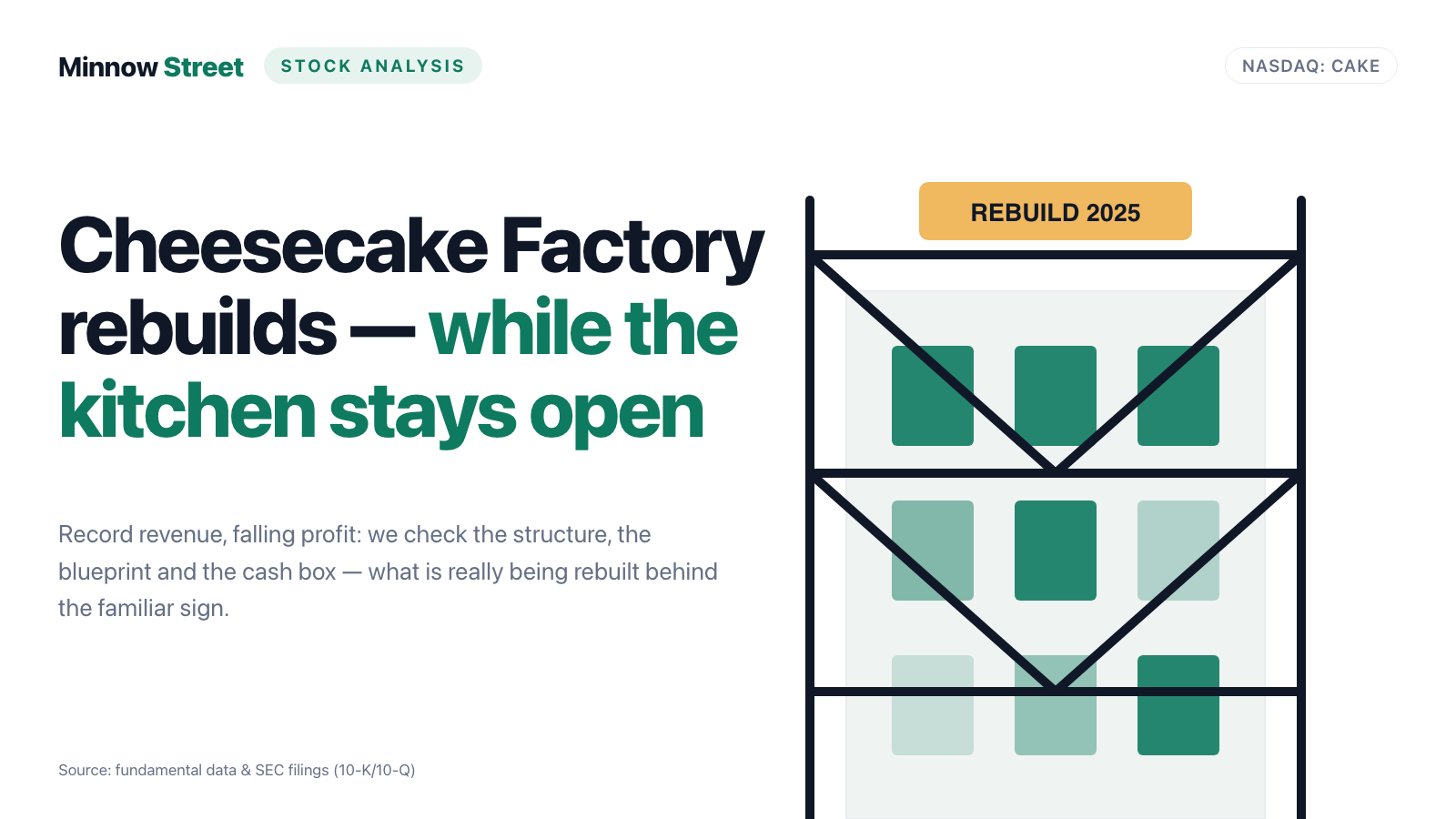
Interactive price chart (TradingView).
Note: pure fact-based analysis, not investment advice and not a solicitation to buy or sell. All figures without guarantee.
There is an investor trap that catches you precisely on the pleasant things: the familiarity trap. It works like this: what we know well and like, we automatically judge to be safe. The enormous menu, the generous portions, the cheesecake case by the door — The Cheesecake Factory is a slice of everyday life for millions of Americans, and the mind loves to translate that warm feeling into "solid stock." The Cheesecake Factory Incorporated (Nasdaq: CAKE) of Calabasas Hills, California, does deliver good news in fiscal year 2025: the highest revenue in company history, $3.75 billion. But beside it stands a second number that sounds less familiar: profit fell. So let’s make a deal: before you trust the brand on familiarity alone, we read together what the company itself reported, under penalty of law, to the U.S. securities regulator, the SEC — the annual reports (10-K) for fiscal years 2024 and 2025 and the quarterly report (10-Q) as of March 31, 2026. And these filings describe a company being renovated while it stays open for business — with a new growth engine and a freshly rebuilt balance sheet. In the end, you decide for yourself.
What Cheesecake Factory actually does — and for whom
The Cheesecake Factory runs no fast-food counters but full-service restaurants: you sit down, you are waited on, you order from a menu of more than 200 dishes, and you rarely leave without a slice of cheesecake. As of December 30, 2025, the company operates 368 company-owned restaurants across the U.S. and Canada under several brands: 216 under the name The Cheesecake Factory, plus the modern Italian brand North Italia (48 locations), the health-minded fast-casual concept Flower Child (43), and a bundle of additional brands from the acquisition of Fox Restaurant Concepts (55 locations, "Other FRC" in the filing). Another 35 The Cheesecake Factory restaurants are run by international partners under license. Then there is an often-overlooked second pillar: an in-house bakery operation that produces the cheesecakes for the company’s own restaurants, its licensees and other customers. The whole thing grew out of exactly that bakery: Evelyn Overton baked the cakes; her son David Overton opened the first restaurant in Beverly Hills in 1978 — and remains Chairman and CEO to this day. Roughly 48,400 people work for the company, about 47,000 of them in the restaurants.
One calendar quirk belongs at the start because it trips up every reader of the numbers: Cheesecake Factory uses a 52/53-week fiscal year that ends on the Tuesday closest to December 31. "Fiscal year 2025" ended December 30, 2025, and comprised 52 weeks; the "first quarter of fiscal year 2026" is the 13 weeks through March 31, 2026. Every few years a 53rd week slips in and inflates annual revenue optically — fiscal year 2025 was not one of them. Which brings us to the central tension of this analysis, and it runs through every chapter: revenue is at a record, yet profit fell — and the growth no longer comes from the namesake but from the small sister brands. How quickly a familiar crowd-pleaser becomes a construction site is rarely as visible as it is here — and that attention alone is no business model is something we dissected at Reddit favorite AMC Entertainment, while how a business gets rebuilt in a tough market is a theme we traced at Rackspace.
Where the stock shows up in our scanner
Every day we run about 3,500 stocks through our scanners. Cheesecake Factory reached the research list through our growth scanner "Joshua" — the stock ranked 17th of 75 hits on July 17, 2026. "Joshua" filters for companies with visible growth momentum in revenue and earnings; that a restaurant operator more than 30 years old lands in a growth scanner is the first small surprise. The reason lies in the latest quarter: plus 5.6 percent revenue and about plus 50 percent net income in the first quarter of fiscal year 2026 (more on that below) are enough to surface in a momentum-driven growth filter. But be careful — a scanner reports movement, not quality. Remember this fingerprint: a growth hit tells you something has accelerated; it does not tell you whether the acceleration comes from the engine or from the downhill slope. That is exactly what we now separate. For context: the same scanner is far cooler on classic value metrics — a price-to-book ratio around 8.7 and a trailing price-to-earnings ratio around 23–24 (data as of July 17, 2026) are no bargain signal.
The numbers over the years — honestly appraised
First, what genuinely impresses. Cheesecake Factory is no boom-bust bet but a remarkably steady revenue machine: $3,439.5 million in fiscal year 2023, $3,581.7 million in fiscal year 2024, $3,751.8 million in fiscal year 2025 — three straight years higher, most recently up 4.7 percent. Profitability recovered strongly too: net income climbed from $101.4 million (fiscal year 2023) to $156.8 million (fiscal year 2024), and diluted earnings per share from $2.07 to $3.20. And the company earns real money: income from operations reached $187.3 million in fiscal year 2025, more than half again the 2023 level. Read only this curve and you see a success story on track.
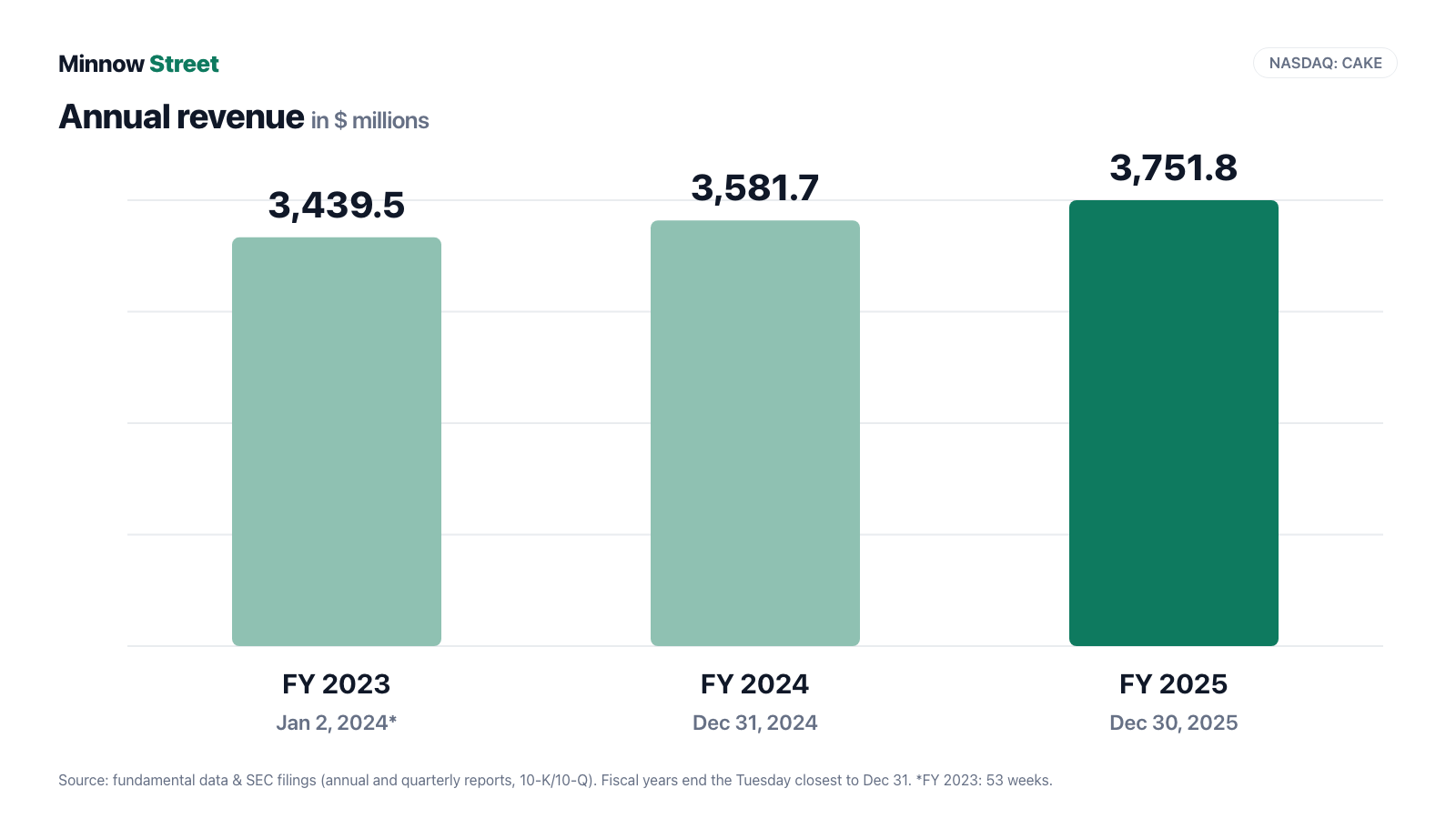
But now the second number, and it is the connecting thread: in fiscal year 2025 net income fell — from $156.8 million to $148.4 million, diluted earnings per share from $3.20 to $3.06. That is unusual: revenue rose, operating income rose, and yet less remained at the bottom. The reason sits further down in the income statement — and leads us straight to the uncomfortable truths.
What the filings say — the uncomfortable truths
Uncomfortable truth no. 1: Record revenue, but profit fell — a debt refinancing ate the gain
Why does a company earn less even though it sells more and earns more operationally? Because between "income from operations" and "net income" sits a special item that was absent in 2024:
"Income from operations 187,285 … Loss on extinguishment of debt (15,891) … Net income $ 148,427" (prior year: "Net income $ 156,783"). Figures in thousands of dollars.
— The Cheesecake Factory Incorporated, SEC annual report 10-K for fiscal year 2025, consolidated statement of operations
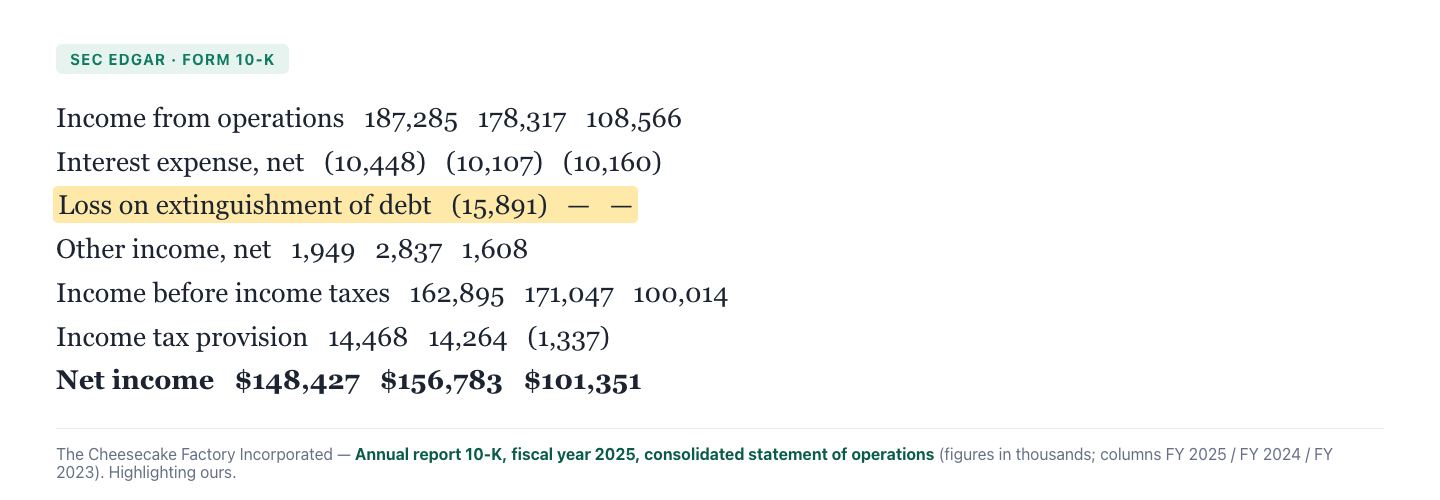
What happened? In February 2025, Cheesecake Factory issued new convertible senior notes of $575.0 million maturing in 2030 and used them to retire the old notes that had come due in 2026 early. A convertible note is a loan that can turn into shares under certain conditions — a comparatively low-interest financing for the company, but one you may end up paying for with fresh shares. The early retirement is commercially sensible (the maturity moves from 2026 to 2030, buying four years of calm), but it costs once: the book loss of $15.9 million plus higher impairments on individual sites ($23.0 million versus $13.6 million) pushed the net margin from 4.4 to 4.0 percent. In fairness: this is a one-time effect, not a hole in the day-to-day business — in the first quarter of fiscal year 2026 the company promptly earned much more again. But the lesson stands: "record revenue" and "record profit" are two different sentences, and the familiarity trap loves to read only the first.
Uncomfortable truth no. 2: The namesake now grows only on price, not on guests
The single most important metric for a restaurant chain is comparable sales — the sales of restaurants open at least a full year. They show whether the core business grows under its own power or only because new locations are added. For The Cheesecake Factory brand, that number reads like this in fiscal year 2025:
"The Cheesecake Factory comparable sales increased by 0.1%, or $2.2 million, from fiscal 2024. The increase from fiscal 2024 was primarily driven by an increase in average check of 2.4% (based on an increase of 4.3% in menu pricing, partially offset by a 1.9% [decline in customer traffic])."
— The Cheesecake Factory Incorporated, SEC annual report 10-K for fiscal year 2025, Item 7 "Management’s Discussion and Analysis"
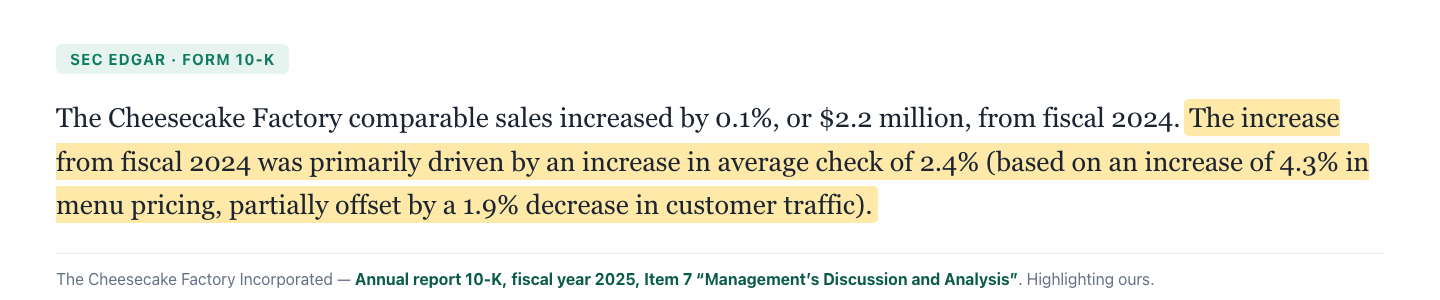
Picture a restaurateur who says at year-end, "Held revenue flat!" — and admits under questioning that he managed it only by raising prices 4.3 percent and losing 1.9 percent of his guests in the process. That is exactly what this says, only for a billion-dollar brand. For the restaurant industry it is the most uncomfortable combination, because both levers age against each other: price increases have a ceiling (eventually the guest goes elsewhere), traffic erosion rarely has a visible floor. In fairness: 4.3 percent of pricing is below the food inflation of the prior years, so Cheesecake Factory did not overreach — and a mature core concept that keeps its pricing power is worth more than one that loses it. But "comparable sales up 0.1 percent" means, in plain terms: the flagship barely grows under its own power anymore. Which raises the question of where the growth does come from.
Uncomfortable truth no. 3: The real growth comes from the small brands — but that too has a flip side
The answer is in the same filings: not the namesake but the small sister brands drive the growth. Flower Child, the health-minded concept, grew sharply:
"Flower Child sales increased 27.8% to $185.3 million for fiscal 2025 compared to $145.0 million for fiscal 2024."
— The Cheesecake Factory Incorporated, SEC annual report 10-K for fiscal year 2025, Item 7 "Management’s Discussion and Analysis"

The modern Italian brand North Italia also grew, by 16.5 percent. That is the good news — and the real reason for the growth hit in the scanner. But you have to look closely at how that growth is created. At North Italia it came almost entirely through new locations: the number of restaurant operating weeks rose, but comparable sales fell about 2 percent. In fiscal year 2025 the company opened 25 new restaurants in total (four Cheesecake Factory, six North Italia, nine other FRC locations, six Flower Child). New restaurants are expensive before they make money — the filing books this as "preopening costs," which rose to $33.1 million in fiscal year 2025. Translated: the new growth engine is running, but it is fed with capital, not (yet) with rising sales per existing location. Remember the distinction: growth through new sites is an investment decision with a payback period; growth through comparable sales is gifted margin. Cheesecake Factory currently has a lot of the first and little of the second.
Uncomfortable truth no. 4: A thin equity layer over a mountain of leases and convertible notes
A restaurant company is a real-estate and labor business dressed as dining. You see it in the balance sheet as of December 30, 2025: against $215.7 million of cash (up from $84.2 million the year before — the new note filled the account) stand $561.3 million of long-term debt (essentially the $575.0 million of 2030 convertible notes) and $1.33 billion of lease liabilities for the rented restaurant space. Reported equity through all this is just $436.4 million — on total assets of $3.26 billion. That sounds thin, but part of the reason is harmless: over the years the company has bought back nearly two billion dollars of its own shares, and that treasury stock reduces book equity. Still: the convertible note is not free financing. If it one day converts into shares, your slice of the pie gets smaller — the classic dilution where new slices keep getting cut. And the lease obligations are fixed costs that come due on time even when a few guests fewer show up — see truth no. 2. In fairness: operating cash flow covers all this comfortably, the net interest burden ($10.4 million in fiscal year 2025) is manageable, and the 2030 maturity buys room. But whoever buys CAKE buys a capital-intensive chain with a thin equity layer — no balance-sheet bulwark.
Valuation: $4.1 billion in market value — near the high
In mid-July 2026 the market value of Cheesecake Factory stood at roughly $4.1 billion, the stock near its 52-week high (data as of July 17, 2026). Measured against earnings, that is neither cheap nor expensive but average: the trailing price-to-earnings ratio sits around 23–24 (on trailing-twelve-month earnings per share of about $3.54, which already includes the strong start to 2026), the price-to-sales ratio around 1.1, the dividend yield around 1.4 percent. The price-to-book ratio of about 8.7 looks sporty at first glance but is — as noted above — mostly an artifact of years of buybacks that bought the book value away; for a restaurant-heavy business, price-to-book carries little meaning anyway. The "professionals’ view" therefore reads soberly: the market prices Cheesecake Factory as what it is — a solid, steadily growing, well-run chain whose growth is just now swapping engines and whose earnings quality took a one-time dent in fiscal year 2025. The strongest anchor for optimists is the latest quarter:
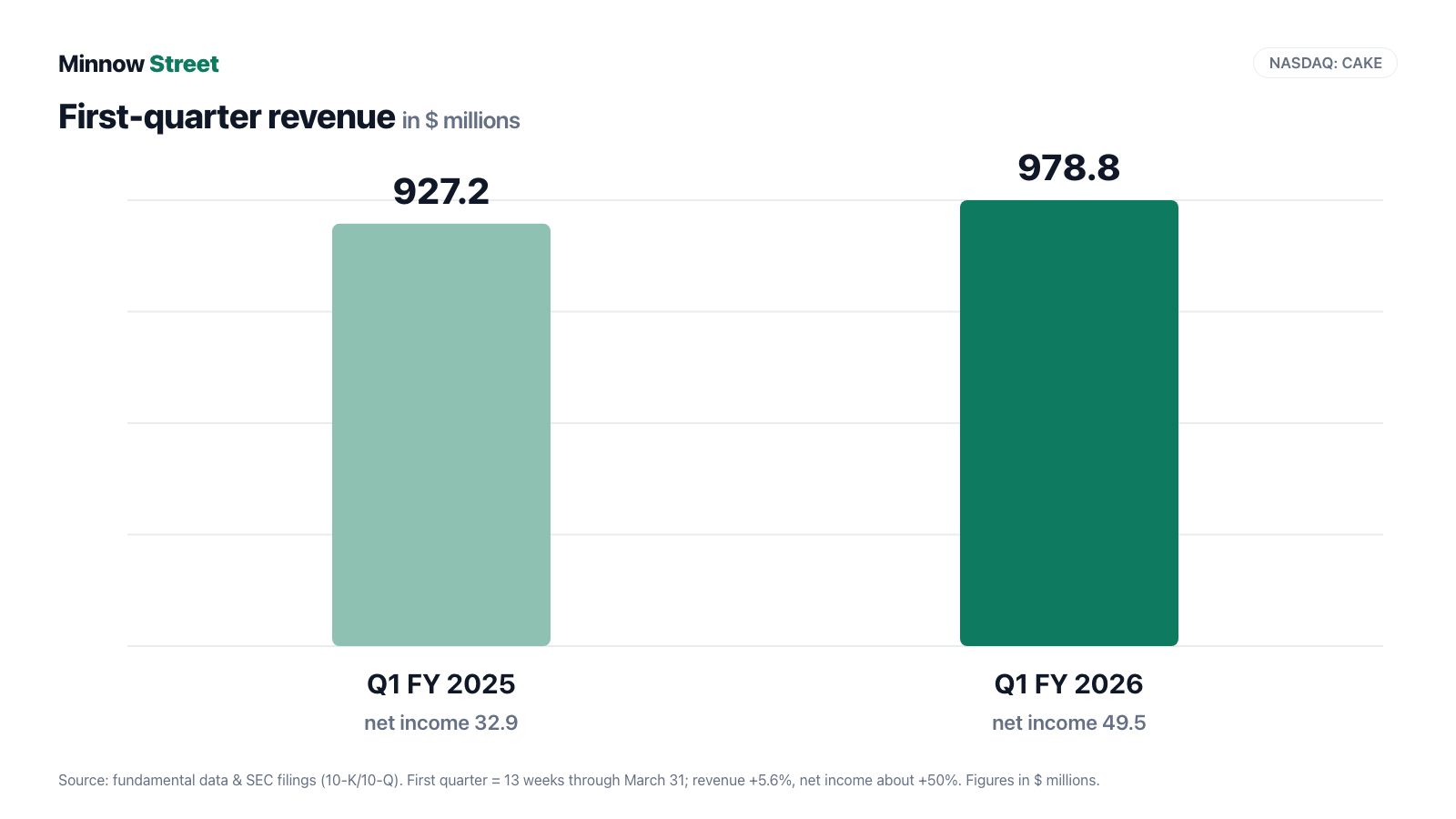
In the first quarter of fiscal year 2026, revenue rose 5.6 percent to $978.8 million, and net income jumped from $32.9 million to $49.5 million — without the prior year’s note-related special item. One quarter makes no summer, but it shows that earning power without a one-time charge is again markedly higher. Roughly 7.5 percent of the shares are held by insiders, the large majority by institutional investors (data as of July 17, 2026).
Opportunities and risks at a glance
What speaks for Cheesecake Factory:
- Steadiness and scale: three years of rising revenue to a record $3,751.8 million (fiscal year 2025, +4.7 percent), 368 company-owned restaurants plus 35 international licensed locations, real earning power (income from operations $187.3 million).
- A new growth engine exists and is running: Flower Child up 27.8 percent to $185.3 million, North Italia up 16.5 percent; 25 openings in fiscal year 2025 — the company is not dependent on the one mature brand.
- A strong start to 2026: plus 5.6 percent revenue and about plus 50 percent net income in the first quarter of fiscal year 2026 (13 weeks through March 31, 2026), without the note-related special item.
- Shareholder-friendly: $153.9 million of buybacks and $55.2 million ($1.08 per share) of dividends in fiscal year 2025; the 2026 notes were extended to 2030 — four years of financing calm.
- Founder-led and experienced: David Overton, who opened the first restaurant in 1978, is still Chairman and CEO — a rare continuity at the top.
What speaks against it:
- The namesake grows only on price: core brand comparable sales up 0.1 percent in fiscal year 2025 — carried by 4.3 percent menu pricing against 1.9 percent fewer guests. Pricing power has a ceiling.
- Earnings quality with a dent: record revenue, but net income fell from $156.8 million to $148.4 million (diluted EPS $3.06 versus $3.20), weighed by a $15.9 million note-extinguishment loss and higher impairments; net margin only 4.0 percent.
- Growth on the company’s own dime: North Italia grew through new locations while comparable sales there fell about 2 percent; preopening costs rose to $33.1 million — the new engine costs first, before it carries.
- A thin equity layer: $436.4 million of equity against $575.0 million of convertible notes and $1.33 billion of lease liabilities (December 30, 2025); the convertible note can dilute later.
- Thin margins, high fixed costs: in full-service dining, labor ($1.31 billion in fiscal year 2025) and rent squeeze the margin; any traffic erosion hits a business with roughly a 4 percent net margin immediately.
A human conclusion
Back to the familiarity trap from the opening. Its core is not that familiar brands are bad investments — often they are good ones. Its core is that familiarity substitutes for checking: we know the cheesecake, so we wave the stock through. Read the filings instead and you find no catastrophe, but no self-driving miracle either — a company under renovation while it stays open. The mature namesake holds its revenue only on price, the new growth engine (North Italia, Flower Child, the FRC brands) is running but still fed from the company’s own till, and the record revenue of fiscal year 2025 met a profit that a debt refinancing dragged down. The good news is in the latest quarter: without the special item, earning power springs back, and a founder-led management that buys back its shares and extends its maturities to 2030 knows what it is doing. So the honest question for you is not "Does the cheesecake taste good?" (it does), but: do you want a solid, moderately fast-growing chain at an average price — with a flagship that grows only on price and a new engine that still has to prove itself? Cheesecake Factory is no house of cards and no rocket. It is a well-run restaurant empire reinventing itself while the dining room stays open. What you make of it is your decision. And that is exactly as it should be.
Sources
All original documents used in this analysis — to read for yourself:
- The Cheesecake Factory Incorporated — SEC annual report 10-K for fiscal year 2025 (ended December 30, 2025; filed February 23, 2026)
- The Cheesecake Factory Incorporated — SEC annual report 10-K for fiscal year 2024 (ended December 31, 2024; filed February 24, 2025)
- The Cheesecake Factory Incorporated — SEC quarterly report 10-Q as of March 31, 2026 (filed May 4, 2026)
- The Cheesecake Factory Incorporated — SEC quarterly report 10-Q as of September 30, 2025 (filed November 3, 2025)
- The Cheesecake Factory Incorporated — SEC quarterly report 10-Q as of July 1, 2025 (filed August 4, 2025)
- The Cheesecake Factory Incorporated — SEC quarterly report 10-Q as of April 1, 2025 (filed May 5, 2025)
- Complete SEC filing history: EDGAR overview (sec.gov)
- Fundamental data (valuation, metrics, ownership; data as of July 17, 2026), reconciled with the SEC filings.
- Screener data: in-house growth scanner "Joshua" (as of July 17, 2026).
Transparency & disclaimer: This analysis is a journalistic contextualization of publicly available information and is not investment advice, not a financial analysis in the regulatory sense, and not a solicitation to buy or sell securities. Stock investments carry substantial risks up to total loss. All information without guarantee; the data cut-off is noted in the text in each case. The author holds no position in Cheesecake Factory stock at the time of publication.
Our Bottom Line at a Glance
- Revenue steadiness & scale positive
- Three years of rising revenue to a record $3,751.8 million (fiscal year 2025, +4.7 percent), 368 company-owned restaurants plus 35 international licensed locations, income from operations $187.3 million — a steady, profitable chain without boom-bust cyclicality (10-K fiscal year 2025).
- Earnings quality negative
- Record revenue, but net income fell from $156.8 million to $148.4 million (diluted EPS $3.06 versus $3.20) — weighed by a $15.9 million loss on a note extinguishment and higher impairments ($23.0 million versus $13.6 million); net margin only 4.0 percent (10-K fiscal year 2025, statement of operations).
- Growth engine & core brand neutral
- The namesake grows only on price (comparable sales +0.1 percent, menu price +4.3 percent against 1.9 percent fewer guests), while the real pace comes from Flower Child (+27.8 percent) and North Italia (+16.5 percent) — the latter through new locations, where comps fell about 2 percent (10-K fiscal year 2025, MD&A).
- Balance sheet & capital structure neutral
- $215.7 million of cash against $575.0 million of convertible notes (due 2030) and $1.33 billion of lease liabilities on just $436.4 million of equity (December 30, 2025); the thin layer is partly a result of buybacks, the convertible can dilute later, the 2030 maturity buys calm (10-K fiscal year 2025, balance sheet).
- Capital return & latest quarter positive
- $153.9 million of buybacks and $55.2 million of dividends ($1.08 per share) in fiscal year 2025; the first quarter of fiscal year 2026 (13 weeks through March 31, 2026) grew revenue 5.6 percent and net income about 50 percent — without the note-related special item (10-Q as of 03/31/2026).
The Cheesecake Factory is a company under renovation while it stays open: $3.75 billion of record revenue in fiscal year 2025, but a fallen net income that a debt refinancing dragged down. The mature namesake holds its revenue only on menu price, the growth comes from the small brands North Italia and Flower Child — partly through expensive openings. Balance sheet and valuation are unremarkably average, and the latest quarter was the strongest in a while. Whoever buys here buys a solid, founder-led chain with middling growth at an average price. Not investment advice.
What Our Rating Means
- If you don't own the stock
- As long as the question raised in the bottom line stays open, we see no basis for an entry.
- If you hold it in your portfolio
- Our findings offer no acute reason to sell — the checkpoints named remain decisive.
A journalistic assessment by our editorial team at the time of the deep dive, based on public sources — not investment advice and not a solicitation to buy or sell. Your personal circumstances (investment goals, risk capacity, taxes) cannot be taken into account. What our categories mean, how verdicts are formed, and what conflicts of interest exist →
Worth Noting
- CAKE reached our research list via the in-house growth scanner "Joshua" (rank 17 of 75, as of July 17, 2026); the hit traces to the strong first quarter of fiscal year 2026 — a growth hit signals acceleration, not a quality verdict.
- Cheesecake Factory uses a 52/53-week fiscal year (ending the Tuesday closest to December 31); fiscal year 2025 ended December 30, 2025, and comprised 52 weeks. All quarterly references carry that calendar offset.
- Price and valuation figures are dated to July 17, 2026 (market value roughly $4.1 billion, near the 52-week high); analyses are evergreen, daily prices are not a buy argument. Trailing earnings per share (about $3.54) already include the strong first quarter of fiscal year 2026.
Frequently Asked Questions
The Cheesecake Factory Incorporated (Nasdaq: CAKE) of Calabasas Hills, California, operates full-service restaurants with a menu of more than 200 dishes. As of December 30, 2025, the company runs 368 company-owned locations in the U.S. and Canada — 216 under The Cheesecake Factory brand, plus North Italia (48), Flower Child (43) and other Fox Restaurant Concepts brands (55); another 35 The Cheesecake Factory restaurants run internationally under license. It also has an in-house bakery operation. Revenue in fiscal year 2025: $3,751.8 million.
Cheesecake Factory uses a 52/53-week fiscal year that ends on the Tuesday closest to December 31. "Fiscal year 2025" ended December 30, 2025, and comprised 52 weeks; the "first quarter of fiscal year 2026" is the 13 weeks through March 31, 2026. Every few years a 53rd week slips in and inflates annual revenue optically — fiscal year 2025 was not one of them.
Revenue rose 4.7 percent to $3,751.8 million in fiscal year 2025 and operating income to $187.3 million — but net income fell from $156.8 million to $148.4 million. The reason is a special item: in February 2025 the company retired its 2026 convertible notes and issued new ones maturing in 2030; the book loss on that early extinguishment was $15.9 million. Higher impairments ($23.0 million versus $13.6 million) added to it. Net margin slipped from 4.4 to 4.0 percent.
No longer from the namesake: comparable sales at The Cheesecake Factory brand rose only 0.1 percent in fiscal year 2025, entirely on 4.3 percent higher menu prices against 1.9 percent fewer guests. The pace comes from the small sister brands: Flower Child up 27.8 percent to $185.3 million and North Italia up 16.5 percent — the latter through new locations, where comparable sales fell about 2 percent. The company opened 25 new restaurants in fiscal year 2025.
Capital-intensive and leased: as of December 30, 2025, $215.7 million of cash, $561.3 million of long-term debt (essentially $575.0 million of convertible notes due 2030) and $1.33 billion of lease liabilities sat against just $436.4 million of equity on $3.26 billion of total assets. The thin equity is partly explained by years of buybacks (roughly $2 billion cumulatively), which reduce book value.
Rather average: in mid-July 2026 the market value stood at roughly $4.1 billion, the stock near its 52-week high. The trailing price-to-earnings ratio sits around 23–24, price-to-sales around 1.1 and the dividend yield around 1.4 percent (data as of July 17, 2026). The high price-to-book ratio of about 8.7 is mostly an artifact of the buybacks and carries little meaning for a restaurant chain.
Found an error?
Did you spot a factual error, an outdated number, or a typo in this deep dive? Let us know briefly — your report goes straight to the editorial team.