Garrett Motion Stock: A Rally to the Brink of All-Time Highs — While Its Own Annual Report Has the Turbo Market Shrinking From 2026
Garrett Motion builds turbochargers for more than 60 automakers — and lights up 24 filters in our in-house stock scanner at once, almost all of them trend and momentum (data as of July 10, 2026). We read the annual reports (10-K) for 2024 and 2025 and the quarterly report (10-Q) as of March 31, 2026: a record quarter with $985 million in revenue, $310 million of annual profit, a dividend and buybacks — but also a stockholders' deficit of $802 million, $1.4 billion of gross debt, and a market outlook in the company's own filing that sees global turbocharger production falling from 2026 onward. Not investment advice — just a look through the windshield while the rearview mirror gleams.
 Thomas Mücke
Founder & Publisher
Thomas Mücke
Founder & Publisher
Chart
Interactive price chart (TradingView).
Note: pure fact-based analysis, not investment advice and not a solicitation to buy or sell. All figures without guarantee.
There is an investor trap that catches the diligent ones in particular: the rearview-mirror trap. It works like this: you look at the chart — up 98 percent in three months, up 103 percent in six, just a few percent below the all-time high (data as of July 10, 2026) — and your mind turns it into a forecast: whatever has risen this beautifully will surely keep rising. The rearview mirror is spotless, so the road ahead must be clear. Hardly any mid cap feeds that trap in the summer of 2026 as thoroughly as Garrett Motion Inc. (Nasdaq: GTX): the world's leading turbocharger maker from Lake Geneva, showing up in our in-house stock scanner with 24 hits — almost all of them trend and momentum filters. So let's make a deal: before you trust the rearview mirror, we read together what the company itself reported, under penalty of law, to the U.S. securities regulator, the SEC — the annual reports (10-K) for 2024 and 2025 and the quarterly report (10-Q) as of March 31, 2026. And this filing contains one sentence about the company's own industry that hardly any momentum buyer seems to have read. In the end, you decide for yourself.
What Garrett Motion actually does — and for whom
A turbocharger is, if you will, the lung of the combustion engine: it uses the exhaust stream to drive a turbine that forces extra air into the cylinders — so a smaller engine delivers the power of a big one while burning less fuel and emitting less. That inconspicuous part is Garrett's world: in its annual report (10-K) for 2025 the company describes itself as the global leader in the roughly $10 billion OEM turbocharger industry, supplies more than 60 automakers, and runs an aftermarket business through a network of roughly 370 distributors in 165 countries. About 86 percent of revenue comes from the original-equipment business and 14 percent from aftermarket and other products; by product line, gasoline turbos contributed 45 percent in 2025, diesel 23, commercial vehicles 18 and the parts business 12 percent. The most important market is Europe at 49 percent of revenue, followed by Asia at 29 and the United States at 19 percent. Roughly 6,700 employees, about 1,330 engineers, roughly 1,350 patents — all of it run from Rolle, Switzerland, with the stock listed on Nasdaq. One chapter of company history shapes the balance sheet to this day: Garrett came public in 2018 as a spin-off of the conglomerate Honeywell (the SEC lists "Garrett Transportation Systems Inc." as a former name), slid into Chapter 11 — the U.S. court process for restructuring over-indebted companies — in 2020, and emerged on April 30, 2021. The rescue financing came from the investment firms Centerbridge and Oaktree, which received preferred stock in return; in 2023, Garrett repurchased part of those shares for $570 million and converted the rest into common stock. Which brings us to the central tension of this analysis, and it runs through every chapter: a highly profitable global market leader near its all-time high — whose own annual report sees the core market shrinking from 2026 onward, and whose balance sheet carries negative equity. What it feels like when a stock price runs ahead of its substance is something we dissected at Rackspace (price up sevenfold, creditors selling) — and what it means when a market giant's end market structurally shrinks, at the glass-packaging group O-I Glass.
Where the stock shows up in our scanner
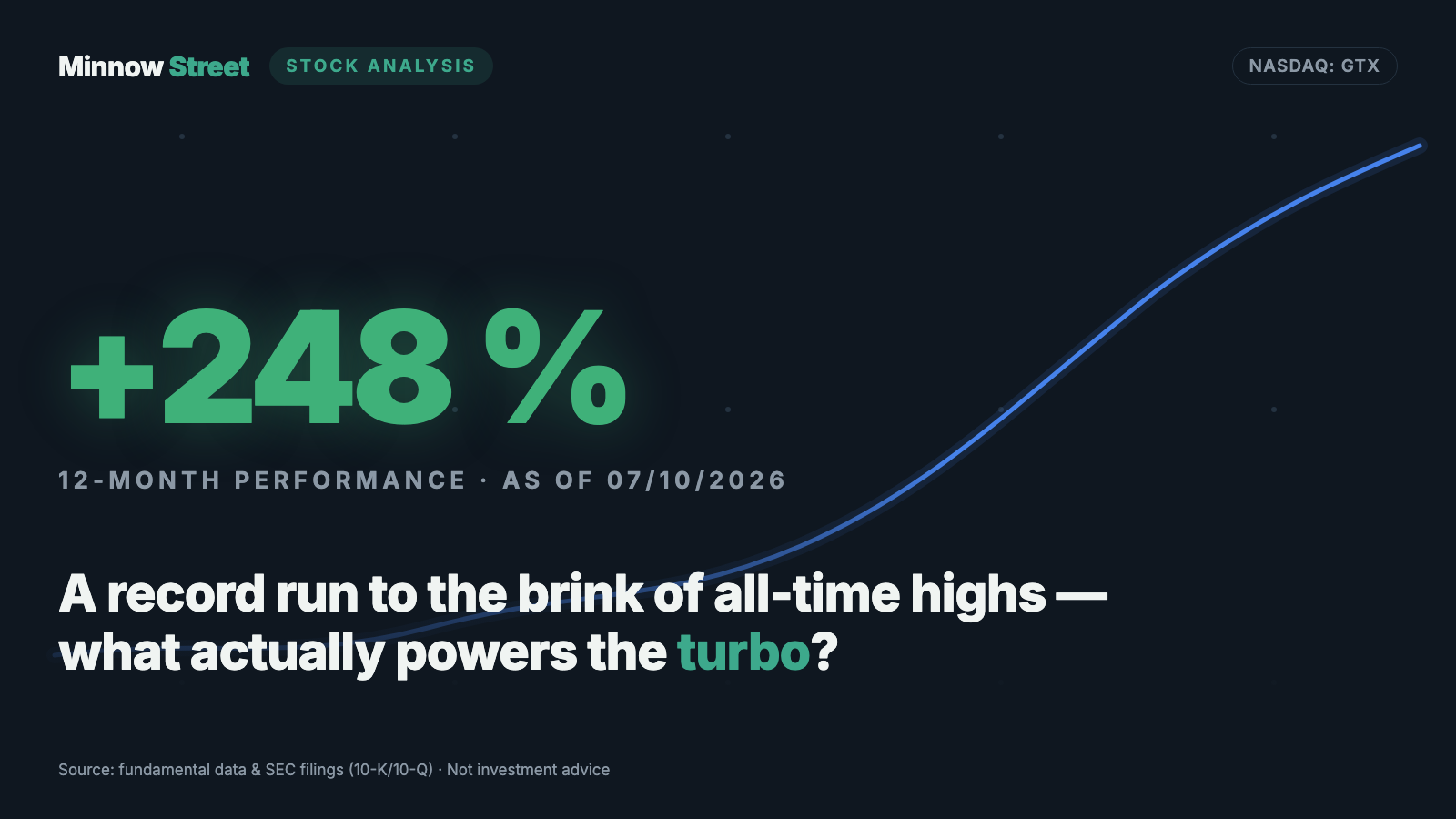
Every day we run about 3,500 stocks through our scanners. Garrett reached the research list through one of the broadest trend confluences of recent months: 24 hits as of the July 10, 2026 data cut-off — among them the Stan Weinstein stage-2 uptrend (price above a rising 200-day average), RS leader ≥90 (the stock is beating 90 percent of the market), near 52-week high, CANSLIM type RS, the Mark Minervini trend criteria and EPS acceleration (earnings per share growing faster quarter after quarter). To replicate it yourself: open the Garrett stock page or browse the stage-2 scanner. Behind it stand plus 98 percent in three months, plus 103 percent in six, and roughly plus 248 percent over twelve months (data as of July 10, 2026). What the fundamental lens of the very same scanner shows is remarkable — a split picture: the Piotroski F-score, a nine-point test of the direction of the books, stands at a top-tier 8 of 9 (quarter ended March 31, 2026), the trailing price-to-earnings ratio sits mid-field around 20.5 — but the Altman Z-score, an early-warning gauge of insolvency risk built from several balance-sheet ratios, reads 1.5 and thus formally inside the historical danger zone (it starts below 1.8). How a company that operates this healthily can trip an insolvency alarm at the same time is resolved further down: the Altman Z punishes balance sheets without equity — and that is exactly what Garrett has. Remember the pattern: when trend filters cheer and balance-sheet filters twitch, read the filing before your finger lands on "buy."
The numbers over the years — honestly appraised
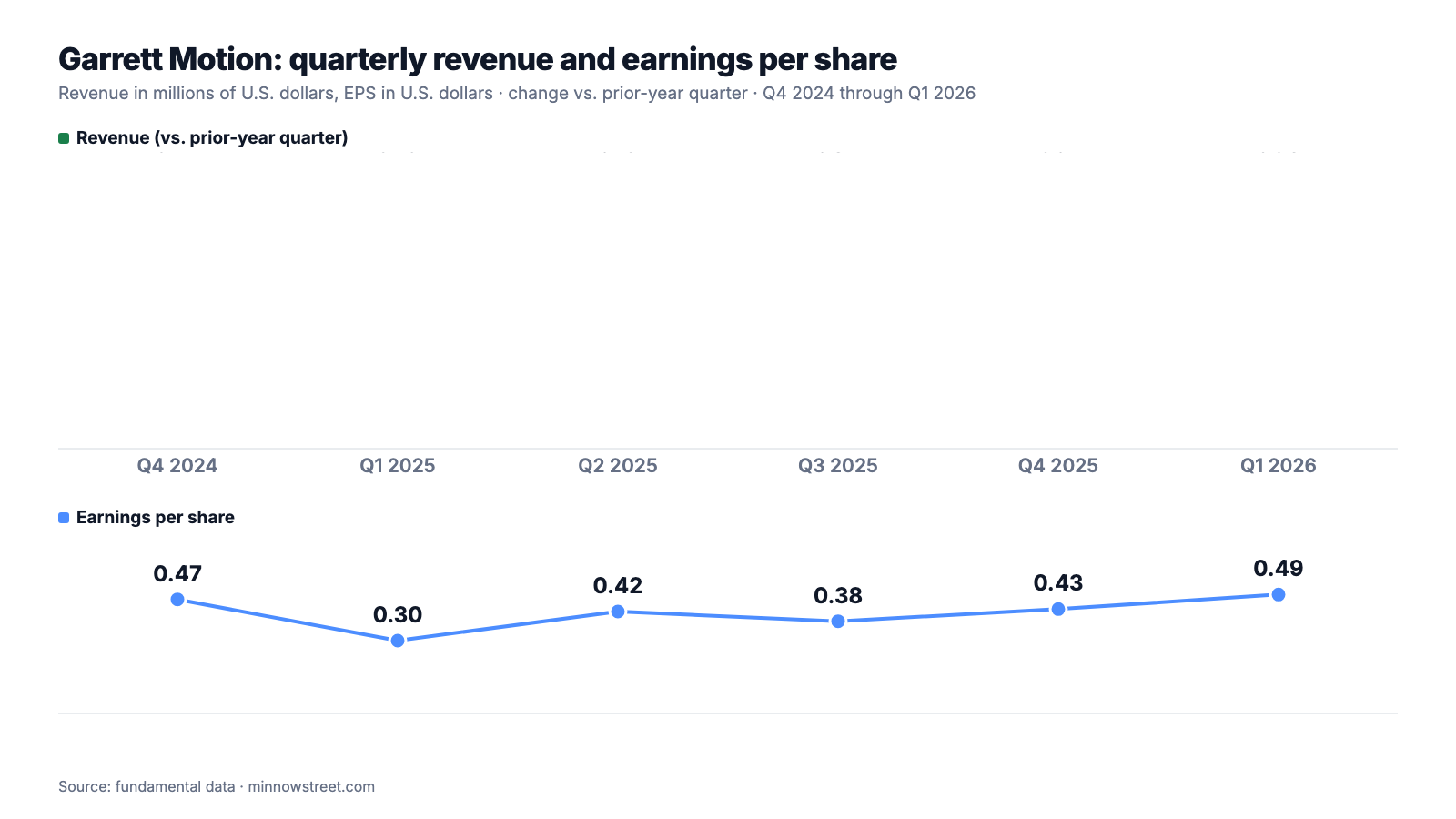
First, what genuinely impresses — and that is a lot. Garrett makes money, reliably and in every market environment of recent years: $390 million of net income in 2022, $261 million in 2023, $282 million in 2024, $310 million in 2025 — on revenue between $3.48 and $3.89 billion. Adjusted EBIT (operating profit before interest and taxes, adjusted for one-offs) reached $510 million in 2025 after $485 million the year before, a margin of a good 14 percent of revenue. Operating cash flow came to $413 million. And the latest quarter was the strongest in a long time: in the first quarter of 2026, revenue grew 12 percent to $985 million (though 6 percentage points of that were tailwind from the weak dollar), net income jumped from $62 million to $95 million, and Adjusted EBIT rose to $151 million. On top sits a capital-return policy straight out of the textbook: since January 2025 Garrett pays a quarterly dividend (started at $0.06, now $0.08 per share), 2025 saw $52 million of dividends plus $208 million of share buybacks, and for 2026 the board has authorized a new $250 million repurchase program. The share count fell from 206.4 million to 187.7 million within five quarters — a good 9 percent fewer pieces for the profit to spread across. That is why earnings per share grew 21 percent in 2025 (from $1.26 to $1.52 diluted) while net income rose "only" 10 percent. Remember the lever: at Garrett, two engines work on earnings per share — the business, and the shredder for its own stock.
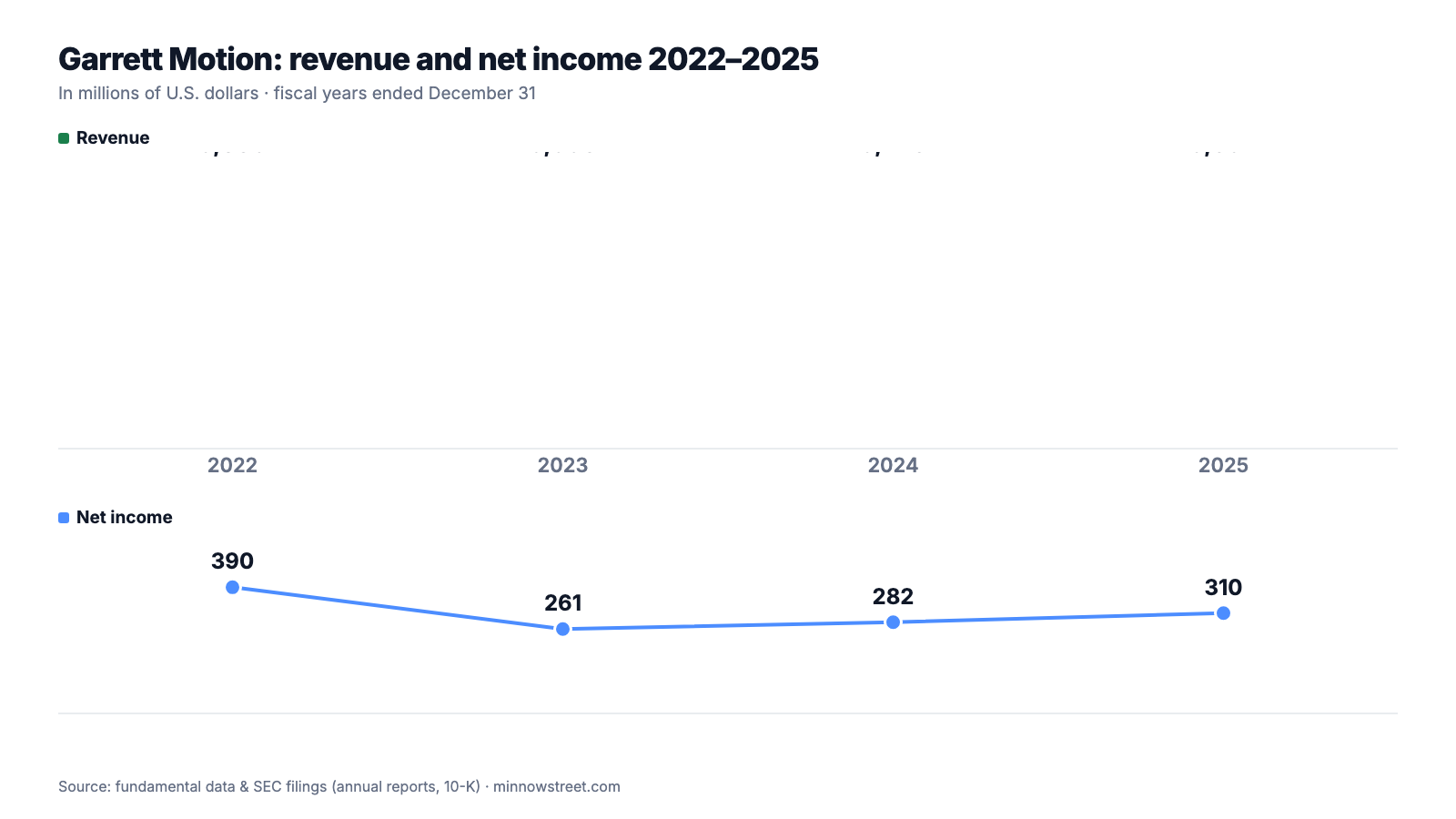
Now the honest reading of the same picture: revenue in 2025 ($3.58 billion) sits below the 2023 level ($3.89 billion) — on an annual view, Garrett is not a growth company but an extremely well-run sideways business in a mature market. The 3 percent revenue increase in 2025 also consisted of roughly two-thirds currency tailwind ($62 of $109 million), plus $40 million of recovered import tariffs. And the strong first quarter of 2026 carried the same stamp: $58 of the $107 million revenue increase came from the euro exchange rate. Still, the quarterly series shows a genuine revival — since the second quarter of 2025, revenue has been growing on its own again, and profitability is following:
What the filings say — the uncomfortable truths
Uncomfortable truth no. 1: The company's own annual report forecasts its core market to shrink
The most important passage of the entire annual report is not in the risk section but in the middle of the industry description — and it is about the water level of the pond in which Garrett is the biggest fish:
"Total turbocharger production increased globally from approximately 49 million units in 2024 to close to nearly 50 million units in 2025, increasing by more than half a million units year-over-year, and is expected to decrease in 2026 and onward (based on current expectations for BEV penetration), gradually declining to 2022 volume levels by 2030."
— Garrett Motion Inc., SEC annual report 10-K for 2025, Item 1 "Business" (Turbocharger penetration)

That is no short-seller pamphlet and no critic's thesis — it is the company's own planning basis, built on forecasts by the industry service S&P. Fairness requires the counter-arithmetic that sits in the same filing: the decline is slow (back to 2022 means a melt, not a crash), hybrids count as allies — per the report, S&P expects global production of hybrid vehicles (including range-extended EVs, which carry a small combustion engine as a generator) to grow from about 16 million in 2025 to 26 million in 2029, and many of them carry turbos. The product mix is also shifting toward Garrett's premium variable-geometry technology, and roughly 50 percent of R&D spending ($151 million net in 2025) already flows into zero-emission technologies: fuel-cell compressors, electric powertrain and cooling compressors — in early 2025, Garrett won its first series application there. But as of today these new fields are an investment, not a revenue pillar; the filing itself warns that many of these technologies are "in the pre-development stage" and that their commercialization is not assured. Translated into investor language: whoever buys the stock buys an excellent operator of a market whose water level, per the company's own report, falls from 2026 — plus a bet that the new business grows up in time.
Uncomfortable truth no. 2: A $802 million stockholders' deficit — the balance sheet of a company buying itself
Whoever looks for the "equity" line in Garrett's balance sheet as of December 31, 2025, finds a minus instead: total deficit, $802 million — liabilities ($3,169 million) exceed assets ($2,367 million). The retained deficit stands at $1,384 million, and the risk section supplies the sentence to go with it:
"We have substantial consolidated indebtedness. As of December 31, 2025, we had gross outstanding debt of $1,439 million."
— Garrett Motion Inc., SEC annual report 10-K for 2025, Item 1A "Risk Factors" (Risks Related to Our Capital Structure)

Now the context, because negative equity here is not what it looks like at first glance — money burned through years of losses. Garrett has been profitable for years. The hole in the balance sheet is the sum of three deliberate chapters: first, the Chapter 11 legacy including the preferred-stock structure; second, the $570 million repurchase of that preferred stock from Centerbridge and Oaktree in 2023 (booked, in effect, as a special dividend directly against the retained deficit); third, the ongoing share buybacks — by now $520 million of the company's own stock sits in the vault (52.0 million shares as of December 31, 2025). The company is buying itself piece by piece — and books every purchase against equity. There is still substance behind it: interest expense fell by $48 million to $108 million in 2025 thanks to refinancing, operating profit covers the interest bill roughly five times over, the credit facilities are committed until 2030, and against the $1,439 million debt pile stand $413 million of annual operating cash flow — net debt comes to about 2.5 times Adjusted EBIT. That is manageable as long as the business runs. But it explains the Altman Z of 1.5 from the scanner chapter: this balance sheet has no cushion for a genuinely bad year — it is built for throughput, not for reserves. A recession in Europe (49 percent of revenue) or a price war among automakers would hit a balance sheet without an airbag.
Uncomfortable truth no. 3: Three customers, a third of revenue — and contracts without purchase obligations
Sorting Garrett's revenue by customer reveals a remarkable concentration at the top:
"Our largest customer is Stellantis N.V. (“Stellantis”). In 2025, 2024 and 2023, our sales to Stellantis accounted for 12%, 9% and 9%, respectively, of our total sales. In 2025, 2024 and 2023, our sales to Bayerische Motoren Werke AG (“BMW”), our second largest customer, were 11%, 12%, and 12%, respectively, of our total sales. In 2025, 2024 and 2023, our sales to Ford Motor Company (“Ford”), our third largest customer, were 11%, 10%, and 9%, respectively, of our total sales."
— Garrett Motion Inc., SEC annual report 10-K for 2025, Item 1 "Business" (Our Customers)

Three customers — Stellantis, BMW, Ford — accounted for roughly 34 percent of revenue in 2025, the top ten for 62 percent. Picture a bakery that delivers every third roll to three big buyers — and now read what the filing says about the supply relationships: the framework agreements do not oblige customers to buy minimum quantities ("our customers are not required to purchase a minimum amount of product from us"), and the risk section adds that supply agreements with automakers "typically require step-downs in component pricing over the period of production" (10-K for 2025, Item 1A). That is industry standard in automotive supply, not a Garrett anomaly — but it means prices for the same part fall on schedule year after year, and Garrett has to re-earn its margin through cost cuts again and again. That the largest customer is Stellantis — a group that went through its own severe sales and restructuring phase in 2025 — does not make the math more comfortable. The fair counterpoint: the customer base is broad at more than 60 automakers, the big three span three continents, and turbochargers are safety-relevant components engineered deep into the engine design — switching suppliers mid-platform is rare. But every new engine generation is awarded fresh, and a lost flagship program would show up in the numbers only years later — but then clearly.
Valuation: $6.5 billion of market value for the best player in a finite game
In early July 2026 the Garrett stock cost about $35, putting the market value at roughly $6.5 billion (data as of July 10, 2026). The trailing price-to-earnings ratio thus stands around 20.5, price-to-sales around 1.8, price to free cash flow around 17. On estimated earnings for the current year (about $1.99 per share), the price-to-earnings ratio comes to about 17.5 (data as of July 10, 2026). For perspective: through much of 2024 and 2025 the very same stock traded at six to eight times earnings — the market has not discovered Garrett, it has repriced it: from "dying combustion-engine supplier" to "quality machine with capital returns." The 248 percent price gain over twelve months (data as of July 10, 2026) owes the smaller part to higher earnings and the larger part to that repricing. A detail from the annual report fits this picture and is worth knowing: of the $208 million of buybacks in 2025, $103 million went to funds of the investment firm Oaktree — 7.5 million shares bought from a related party, as the filing itself discloses ("During 2025, we also repurchased from Oaktree a total of 7,500,000 shares of Common Stock for $103 million under our share repurchase program"; 10-K for 2025, Related Party Transactions). The Chapter 11 rescuers of 2021 are handing their stakes back, step by step — to the company itself. The latest insider filings show movement on the sell side too: as of July 10, 2026, our dataset counts twenty insider sales and not a single insider purchase over the preceding months. Insider selling near an all-time high proves nothing by itself — people buy houses, pay taxes, diversify. But nobody bought, either. The dividend yield stands at roughly 0.9 percent, and the new $250 million buyback program equals almost 4 percent of the market value (data as of July 10, 2026).
Opportunities and risks at a glance
What speaks for Garrett Motion:
- A global market leader with pricing power in its niche: leading the roughly $10 billion OEM turbo market, more than 60 OEM customers, premium variable-geometry technology with a growing share — per the annual report (10-K for 2025), from 21 percent of gasoline turbo production in 2025 to an expected 29 percent in 2030.
- Reliable earnings power: $310 million of net income in 2025 (8.6 percent margin), $510 million of Adjusted EBIT, $413 million of operating cash flow; in the first quarter of 2026, revenue up 12 percent to $985 million and net income up 53 percent to $95 million.
- Aggressive capital returns: $208 million of buybacks plus $52 million of dividends in 2025, a new $250 million program for 2026, share count down a good 9 percent in five quarters — earnings per share grow faster than earnings.
- The hybrid buffer: per the filing, S&P expects hybrid production (including range-extended EVs) to grow from 16 million vehicles in 2025 to 26 million in 2029 — many with turbos; plus a first series award in the e-powertrain business and roughly 50 percent of R&D spending in zero-emission technologies.
- The technicals confirm the run: 24 scanner hits, a stage-2 trend, RS leader ≥90, a Piotroski F-score of 8 of 9, accelerating earnings per share (data as of July 10, 2026).
What speaks against it:
- The core market shrinks by the company's own forecast: global turbocharger production is expected, per the annual report (10-K for 2025), to decrease from 2026 onward and decline to 2022 volume levels by 2030 — while the new businesses (e-powertrain, fuel-cell compressors) are largely in pre-development, with commercialization, per the filing, not assured.
- A balance sheet without an airbag: a stockholders' deficit of $802 million, $1,439 million of gross debt against $177 million of cash (December 31, 2025), an Altman Z-score around 1.5 — formally the danger zone; the buybacks deepen the balance-sheet minus further.
- Concentration risk and structural price pressure: Stellantis, BMW and Ford account for roughly 34 percent of revenue, the top ten for 62 percent — with no minimum purchase obligations and with contractually falling piece prices over program lifetimes.
- The 2025 growth was largely borrowed: $62 of the $109 million revenue increase came from exchange rates and $40 million from tariff recoveries; revenue remains below its 2023 level, and Europe (49 percent of revenue) stays cyclical.
- After a 248 percent price gain in twelve months, the margin of safety is spent: the price-to-earnings ratio has expanded from 6–8 to a good 20 (data as of July 10, 2026), insiders sold twenty times and bought zero times recently, and the Chapter 11 investors are handing their stakes back to the company.
A human conclusion
Back to the rearview-mirror trap from the opening. Its core is not that the rearview mirror lies — Garrett's numbers are real, the record quarter is real, the dividend arrives. Its core is that the rearview mirror is fundamentally the wrong window for a buying decision: what you pay for is always the road ahead. And about that road, Garrett's own annual report says two things at once — that this company masters its craft like few others, and that the market in which it practices that craft is likely to get smaller year after year from 2026. In between sits the actual bet you take with this stock: that the hybrid wave cushions the combustion decline long enough for fuel-cell and e-powertrain compressors to become real revenue pillars — and that a balance sheet with a $802 million deficit never hits a truly bad year along the way. At six times earnings, that was a bet with a built-in safety net. At a good twenty times, a few percent below the all-time high, the net has been taken down — now the future has to deliver, not just the present. Whether that is worth an entry to you, whether you wait for a pullback, or whether you prefer to admire the best player of a finite game from the stands: what you make of it is your decision. And that is exactly as it should be.
Sources
All original documents used in this analysis — to read for yourself:
- Garrett Motion Inc. — SEC annual report 10-K for 2025 (filed February 19, 2026)
- Garrett Motion Inc. — SEC annual report 10-K for 2024 (filed February 20, 2025)
- Garrett Motion Inc. — SEC quarterly report 10-Q as of March 31, 2026 (filed April 30, 2026)
- Garrett Motion Inc. — SEC quarterly report 10-Q as of September 30, 2025 (filed October 23, 2025)
- Garrett Motion Inc. — SEC quarterly report 10-Q as of June 30, 2025 (filed July 24, 2025)
- Garrett Motion Inc. — SEC quarterly report 10-Q as of March 31, 2025 (filed May 1, 2025)
- Garrett Motion Inc.'s complete SEC filing history: EDGAR overview (sec.gov)
- Fundamental data (metrics, quarterly series, valuation; data as of July 10, 2026), reconciled with the SEC filings.
- Screener and rating data: in-house stock scanner (data as of July 10, 2026).
Transparency & disclaimer: This analysis is a journalistic contextualization of publicly available information and is not investment advice, not a financial analysis in the regulatory sense, and not a solicitation to buy or sell securities. Stock investments carry substantial risks up to total loss. All information without guarantee; the data cut-off is noted in the text in each case. The author holds no position in Garrett Motion stock at the time of publication.
Our Bottom Line at a Glance
- Earnings power & cash flow positive
- Four profitable years in a row ($310 million of net income in 2025), $510 million of Adjusted EBIT, $413 million of operating cash flow, interest expense cut by $48 million to $108 million in 2025; in the first quarter of 2026, revenue up 12 percent and net income up 53 percent (annual report 10-K for 2025, quarterly report 10-Q as of 03/31/2026).
- Capital returns & share count positive
- A dividend since January 2025 (now $0.08 per quarter), $208 million of buybacks in 2025, a new $250 million program for 2026; the share count fell a good 9 percent in five quarters to 187.7 million — which is why earnings per share grew faster than earnings (+21 versus +10 percent in 2025).
- End market & structural risk negative
- The company's own annual report expects global turbocharger production to decrease from 2026 onward and fall back to 2022 volume levels by 2030; the new businesses (e-powertrain and fuel-cell compressors) are, per the filing, largely in pre-development — the hybrid wave (16 to 26 million vehicles by 2029, per S&P) is the buffer, not the solution (10-K for 2025, Item 1).
- Balance sheet & concentration negative
- A stockholders' deficit of $802 million against $1,439 million of gross debt and $177 million of cash (December 31, 2025), an Altman Z around 1.5; on top, Stellantis, BMW and Ford at a combined roughly 34 percent of revenue — with no minimum purchase obligations and contractually falling piece prices (10-K for 2025, Items 1 and 1A).
- Valuation & momentum neutral
- 24 trend hits in the scanner, plus 248 percent in twelve months, a few percent below the all-time high — while the price-to-earnings ratio expanded from 6–8 to about 20.5 (data as of July 10, 2026); insiders sold twenty times and bought zero times recently, and Oaktree handed 7.5 million shares back to the company for $103 million.
Garrett Motion is the rare case of a Chapter 11 returnee that gets almost everything right operationally: reliable profits, strong cash flow, a dividend, aggressive buybacks, a record quarter. But after a 248 percent price gain in twelve months, the stock has largely priced that quality in, while two structural burdens remain: a core market its own annual report sees shrinking from 2026, and a balance sheet with a $802 million stockholders' deficit that forgives no bad year. Whoever invests here buys the best player in a finite game — at the price of a growth stock. Not investment advice.
What Our Rating Means
- If you don't own the stock
- As long as the question raised in the bottom line stays open, we see no basis for an entry.
- If you hold it in your portfolio
- Our findings offer no acute reason to sell — the checkpoints named remain decisive.
A journalistic assessment by our editorial team at the time of the deep dive, based on public sources — not investment advice and not a solicitation to buy or sell. Your personal circumstances (investment goals, risk capacity, taxes) cannot be taken into account. What our categories mean, how verdicts are formed, and what conflicts of interest exist →
Worth Noting
- GTX reached our research list via the confluence of 24 trend hits in our in-house stock scanner (data as of July 10, 2026) — one of the broadest momentum signatures of recent months.
- Scanner metrics (P/E, P/S, Piotroski, Altman Z) are computed from trailing twelve-month figures; the Altman Z of 1.5 mainly reflects the negative equity from the Chapter 11 legacy and the buybacks, not acute payment problems — interest coverage and cash flow are solid.
- Price and valuation figures are dated to July 10, 2026 (about $35, market value roughly $6.5 billion); analyses are evergreen, daily prices are not a buy argument.
Frequently Asked Questions
Garrett Motion Inc. (Nasdaq: GTX), headquartered in Rolle, Switzerland, is the global leader in the roughly $10 billion OEM turbocharger industry — components that make combustion engines more efficient and more powerful. The company supplies more than 60 automakers and runs an aftermarket business through roughly 370 distributors in 165 countries. Revenue 2025: $3.58 billion, net income $310 million.
As of December 31, 2025, Garrett reported a stockholders' deficit of $802 million — not because of losses (the company is profitable), but because of the Chapter 11 legacy, the $570 million repurchase of preferred stock from Centerbridge and Oaktree in 2023, and ongoing share buybacks ($520 million of treasury stock). The flip side: hardly any balance-sheet cushion for bad years, against $1,439 million of gross debt.
Garrett came public in 2018 as a Honeywell spin-off, slid into Chapter 11 (the U.S. restructuring process for over-indebted companies) in 2020, and, per the annual report, emerged on April 30, 2021. The investment firms Centerbridge and Oaktree provided capital in exchange for preferred stock; in 2023, part of it was repurchased for $570 million and the rest converted into common stock. In 2025, Garrett bought back another 7.5 million shares from Oaktree for $103 million.
Very: turbochargers for gasoline, diesel and commercial-vehicle engines plus the related parts business made up essentially all of 2025 revenue. The company's own annual report (10-K) expects global turbocharger production to decrease from 2026 onward and decline to 2022 volume levels by 2030. As counterweights, the filing points to growing hybrid volumes (many with turbos) and new products such as fuel-cell and e-powertrain compressors, most of which are still in pre-development.
Yes, since January 2025: initially $0.06 per share per quarter, raised to $0.08 with the December 2025 payment. In full-year 2025, Garrett paid $52 million in dividends and repurchased $208 million of its own stock; for 2026, a new $250 million buyback program has been authorized (annual report 10-K for 2025).
Per the annual report (10-K) for 2025: Stellantis at 12 percent, BMW at 11 percent and Ford at 11 percent of total sales — together roughly a third. The ten largest customers account for 62 percent. The framework agreements contain no minimum purchase obligations and typically require step-downs in component pricing over the production period.
Far less cheap than it used to be: after a roughly 248 percent price gain in twelve months, the trailing price-to-earnings ratio stands around 20.5 and price-to-sales around 1.8 (data as of July 10, 2026) — through much of 2024 and 2025 the stock traded at six to eight times earnings. The market now pays for the quality of the operator, no longer for the discount on the shrinking core market.
Found an error?
Did you spot a factual error, an outdated number, or a typo in this deep dive? Let us know briefly — your report goes straight to the editorial team.