BayFirst Financial: The Cheapest Free Cash Flow on the List Comes From Winding Down the Business
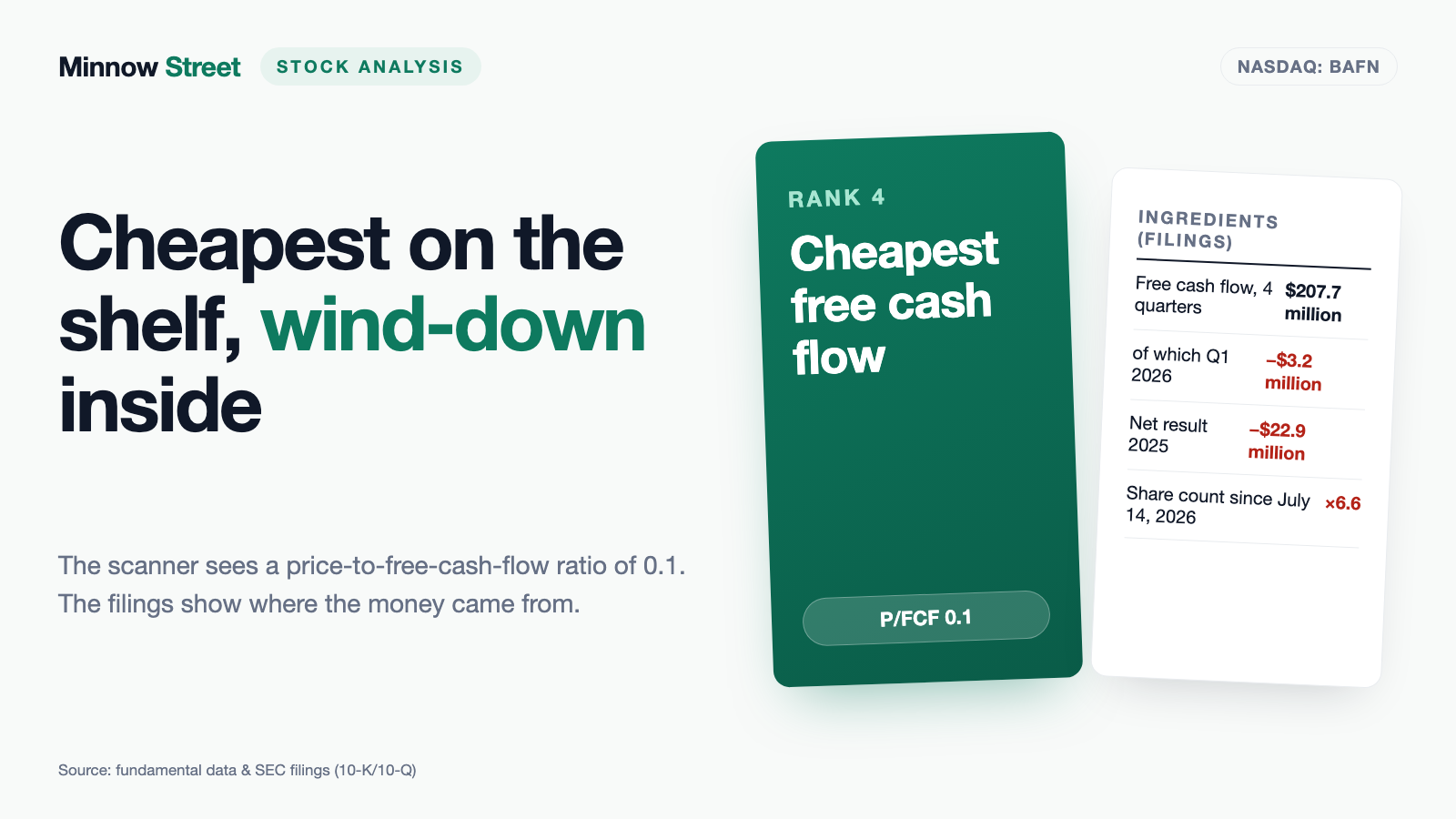
On July 26, 2026, our in-house stock scanner put BayFirst Financial 4th in the price-to-free-cash-flow ranking of the U.S. selection, at a ratio of 0.1. That looks like the bargain of the year. The filings with the U.S. securities regulator, the SEC, tell a different story. The $207.7 million of free cash flow over the trailing four quarters is almost entirely proceeds from selling the bank's own loan book, which it has been unwinding since the fourth quarter of 2025; in the first quarter of 2026, $3.2 million flowed out. Add a change of control on July 14, 2026, a share count that has multiplied more than sixfold, and financial statements for 2024, 2025 and the first quarter of 2026 the bank itself says can no longer be relied on. What counts in the end is not how cheap a ratio looks, but where its numbers came from.
 Thomas Mücke
Founder & Publisher
Thomas Mücke
Founder & Publisher
Chart
Interactive price chart (TradingView).
Note: pure fact-based analysis, not investment advice and not a solicitation to buy or sell. All figures without guarantee.
There is an investor trap that catches the diligent ones — because it feels like the reward for doing the work: the bargain trap. It goes like this. You sort a list by a ratio you care about, and at the very top sits a name almost nobody knows. The number beside it is so extreme it feels indecent. And your brain fills in the rest: "the market missed this one." That is exactly how BayFirst Financial Corp. (NASDAQ: BAFN) landed on our desk — with a price-to-free-cash-flow ratio of 0.1. So let us make a deal: before we celebrate the number, we read where it came from. The source is what BayFirst files with the U.S. securities regulator, the SEC — the annual report (10-K) for 2025, the quarterly report (10-Q) for the period ended March 31, 2026, and a run of current reports (Form 8-K) from the spring and summer of 2026. Those documents are honest under penalty of law. And they describe a small Florida bank that has wound down its most important business, whose control changed hands in July 2026, whose share count multiplied more than sixfold in a single step — and whose own financial statements for 2024, 2025 and the first quarter of 2026 may no longer be used as of July 15, 2026. What you do with that is up to you.
Contents
- What BayFirst Financial actually does
- Where the stock came to our desk — and what a 0.1 P/FCF means at a bank
- The numbers over the years — given their due
- What the filings say — the uncomfortable truths
- Valuation: why we do not use a market capitalization here
- Opportunities and risks at a glance
- A human conclusion
- Sources
What BayFirst Financial actually does
BayFirst Financial Corp. is a bank holding company — a parent that owns essentially one thing: BayFirst National Bank. The holding company began operations on September 1, 2000; the bank itself has been trading since February 12, 1999, and converted its charter to a national banking association in 2022. Its offices sit at 700 Central Avenue in St. Petersburg, Florida. The business is ordinary in the best sense: twelve banking centers across the Tampa Bay/Sarasota region — five in Pinellas County, two in Hillsborough, four in Sarasota, one in Manatee. Checking accounts, savings accounts, certificates of deposit, home mortgages, commercial loans, lines of credit for contractors and medical practices. As of December 31, 2025, the bank reported total assets of $1.30 billion, loans held for investment of $963.9 million, deposits of $1.18 billion and shareholders\' equity of $87.6 million (Form 10-K for 2025).
The second leg of the business is where it gets interesting — the one that no longer exists. For years BayFirst ran a nationwide business in government guaranteed small business loans, known as SBA 7(a) loans. The model deserves an explanation, because without it the rest of this analysis makes no sense. The Small Business Administration (SBA) is a federal agency that guarantees part of such loans — typically 75 to 85 percent. A bank originates the loan, then splits it: the guaranteed portion can be sold to investors at a premium, because the government stands behind it, while the unguaranteed remainder stays on the bank\'s own books. The gain lands immediately and visibly at the sale. The risk stays behind, invisible and later. For a bank the size of BayFirst this was the profit engine: in 2024 the company earned $28.3 million from selling government guaranteed loans — nearly half of its total noninterest income of $60.5 million.
In 2025 the bank pulled the plug. The annual report puts it plainly, with no embellishment:

What remained: a regional bank with twelve branches, plus SBA 504 and USDA loans offered through those branches. And that names the central tension of this analysis, which runs through every chapter that follows: the exit from the SBA business released an enormous stream of cash — and it is precisely that stream that makes the stock look dirt cheap on one ratio, when in truth it marks the end of an income source.
Where the stock came to our desk — and what a 0.1 P/FCF means at a bank
We came across BayFirst in our in-house stock scanner, specifically in the price-to-free-cash-flow ranking. That ranking sorts the entire stock universe by price to free cash flow, ascending — cheapest first. On July 26, 2026, the list showed 544 hits in total, of which the 25 strongest are displayed; within the U.S. selection, BayFirst Financial sat at rank 4 with a ratio of 0.1. To reproduce it: open the stocks section, choose the scanner list, select the price-to-free-cash-flow ranking, then set the market filter to the United States. The lists are recomputed every day — so the placement is a snapshot dated July 26, 2026, not a permanent state.
Now the ratio itself, in plain language. Free cash flow is the money left after all running costs and investments — what a company could use to pay down debt, pay dividends or buy back stock. Price to free cash flow divides market value by that amount. A ratio of 20 means you pay twenty times one year of free cash, a 5 percent yield. A ratio of 0.1 would mean the company generates ten times its own market value in free cash within a single year. At an industrial company that would be a sensation.
At a bank it is not. This is the most important sentence in the analysis. At a machinery maker, operating cash flow comes from machines sold; it is a picture of earnings power. At a bank, the same line also carries movements in the loan book. Loans a bank originates in order to resell them are treated like inventory: funding them is an operating outflow, selling them an operating inflow. So a lender that stops writing new loans and sells the existing stock produces an enormous operating inflow — precisely at the moment it shuts the business down. Picture a furniture dealer clearing the warehouse, selling every sofa and ordering none: in the month of the clearance sale there is more cash in the till than ever before. That is not purchasing power. That is inventory.
All of it can be checked in the filings. The cash flow statement in the 2025 annual report shows operating cash flow of $285.3 million against purchases of premises and equipment of just $0.3 million — free cash flow of $285.0 million. In the same statement sits the line that explains everything: "Proceeds from sales of government guaranteed loans held for sale: 298,162" thousand dollars. Proceeds from selling loans exceed the entire operating cash flow. In the first quarter of 2026, with the business wound down, the same line read $665 thousand — against $76.6 million in the year-ago quarter. Operating cash flow turned to minus $3.2 million. The chart shows the break:
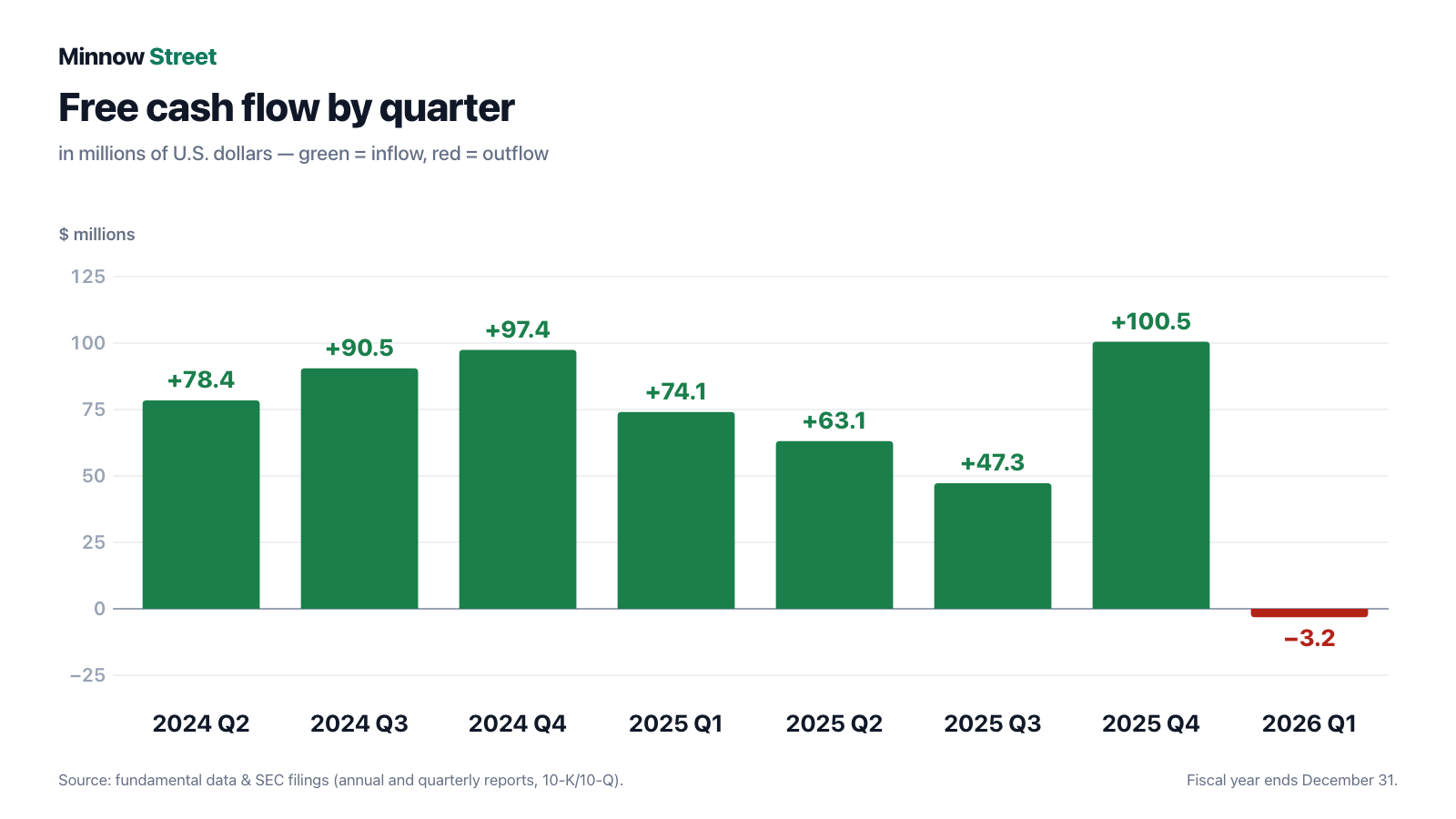
The scanner uses the four quarters through March 31, 2026: 63.1 plus 47.3 plus 100.5 minus 3.2 equals $207.7 million. Three of those four quarters belong to the wind-down. The one quarter that shows the state afterwards is negative. The value the scanner uses is arithmetically correct and still fails to describe the situation. It measures how fast a bank cleared its loan book — not what it earns. Remember the rule: an extremely low price-to-free-cash-flow ratio at a bank is a question first, never an answer.
A second finding from the same data set completes the picture. On July 26, 2026, BayFirst Financial simultaneously appeared in seven weakness lists of our in-house scanner: near 52-week low, relative strength weakness (10 or below), weakness cluster, Stage 4 downtrend, Stan Weinstein: Stage 4, Stan Weinstein: Stage 4B- and below the 50- and 200-day moving averages. The "cheapest free cash flow" and the full breadth of weakness in one name: that is not a contradiction but the same fact from two angles. These lists, too, are recomputed daily.
The numbers over the years — given their due
First what genuinely impresses, and it is more than the headline suggests. The core bank works. Net interest income — at a bank the central earnings figure, the difference between what it collects on loans and pays on deposits — rose to $45.8 million in 2025 from $38.0 million in 2024. The net interest margin, that same spread measured against interest-earning assets, improved from 3.45 to 3.75 percent. For a regional bank of this size that is a good number; many peers sit between 3.0 and 3.5 percent. The reason is solid craft: interest expense fell by $4.8 million in 2025 while loan interest income including fees rose by $2.4 million.
The funding side holds up too: $1.18 billion in deposits as of December 31, 2025, up $40.7 million over the year. And the bank acted rather than hoped — it shut the loss-making business, absorbed $7.3 million of restructuring charges and raised fresh capital in the spring of 2026. That is more decisiveness than many small institutions show in comparable spots. Readers who want to see what a regional bank looks like when its income statement carries no such break will find the counterexample in our analysis of Banner Corporation; and for how tightly government guaranteed lending can be woven into a bank\'s results, see our analysis of Pathward Financial.
Now the other side. The $12.6 million of net income in 2024 turned into a net loss of $22.9 million in 2025 — from $2.68 to minus $5.93 per share. The annual report breaks the swing into its own building blocks, and they form a remarkably clear bridge:
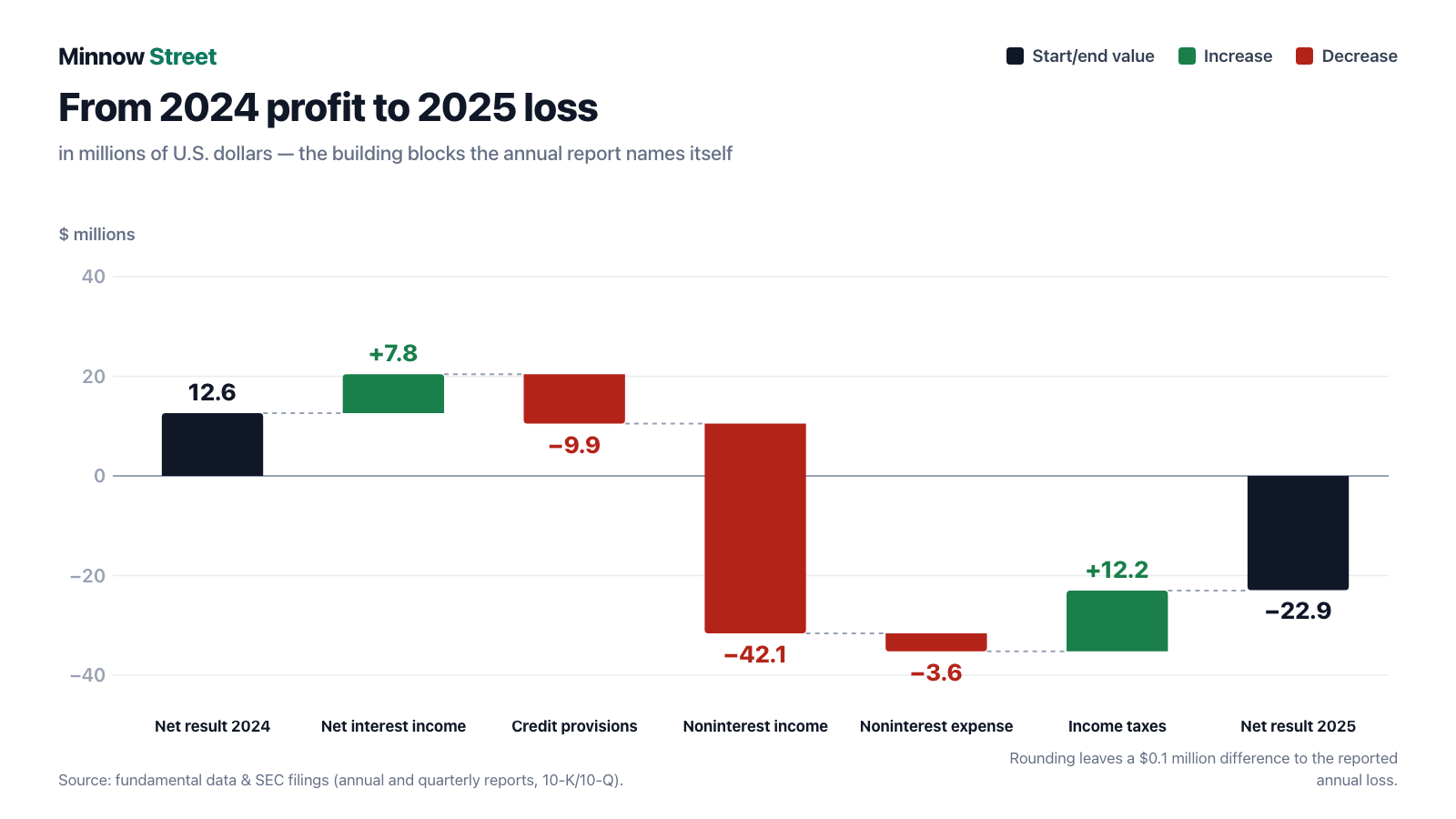
The largest bar is the decisive one. Noninterest income — fees, commissions and, above all, loan sale gains — fell from $60.5 million to $18.4 million. In 2024 that line had contributed more to results than the entire lending spread. That was the dependency BayFirst has now removed — at the price of an income statement that shrank by half overnight. The workforce tells the same story in one number: 305 full-time equivalents on March 31, 2025; 143 on March 31, 2026. More than half the bank was the SBA business.
What the filings say — the uncomfortable truths
Uncomfortable truth no. 1: the statements the bank itself withdrew
On July 15, 2026, BayFirst filed a report under Item 4.02. That heading has a very narrow meaning in U.S. reporting: "Non-Reliance on Previously Issued Financial Statements." In plain words: do not rely on what we told you before. The cause: during a review, management found $2.8 million of deferred origination costs and $2.1 million of accrued interest sitting as of March 31, 2026 on loans that had long since defaulted or been placed on non-accrual. The consequence: too little provision expense, too much net interest income, across the quarters of 2024, 2025 and the first quarter of 2026.
"…the Company\'s consolidated financial statements as of and for the years ended December 31, 2024, and December 31, 2025, and the quarter ended March 31, 2026, should be restated, and the previously issued consolidated financial statements, and the related audit reports from its independent registered public accounting firm for such periods, should no longer be relied on."
— BayFirst Financial Corp., Form 8-K filed July 15, 2026, Item 4.02
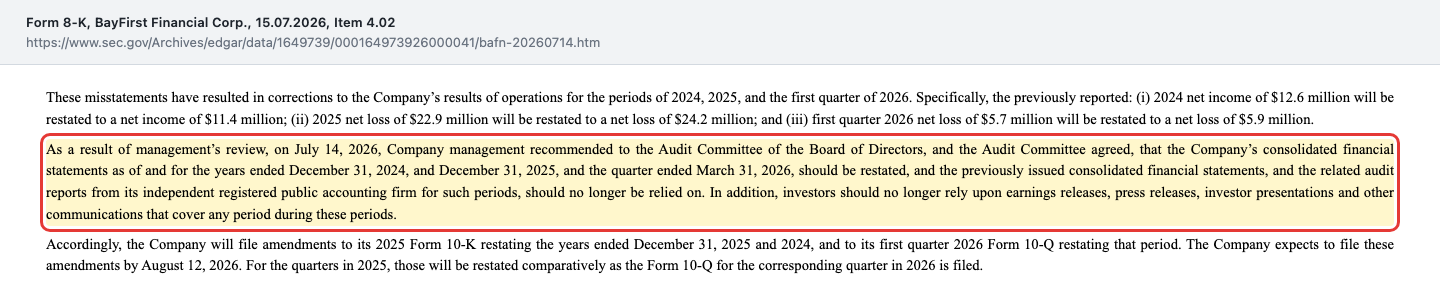
Three things stand out. First, the company says it expects to file the amendments by August 12, 2026. Second, it is running a recovery analysis under the U.S. clawback rule (17 CFR 240.10D-1(b)) to determine whether incentive-based compensation must be recovered from executive officers. Third — and this is the sentence to remember — the company is still evaluating whether the matter produces material weaknesses in internal control over financial reporting. In the annual report filed on March 27, 2026, the chief executive and chief financial officer had expressly described disclosure controls as effective as of December 31, 2025. Barely four months later, the same statements are unusable. In practical terms for you as a reader: every figure from 2024, 2025 and the first quarter of 2026 in this analysis is an interim number until the amended filings appear. We still quote them — they are the official record — and we flag the restated amounts wherever the company has already published them.
Uncomfortable truth no. 2: the bank was no longer "well capitalized"
U.S. bank supervision works with five capital categories, from "well capitalized" through "adequately capitalized" down to "critically undercapitalized." The top rung is not a beauty prize; it is an operating licence for certain activities. As of March 31, 2026, BayFirst National Bank\'s total capital ratio stood at 9.84 percent — the threshold for "well capitalized" is 10.00 percent. The other three ratios were met (tier 1 risk-based 8.58 percent against 8.00, common equity tier 1 8.58 against 6.50, leverage 6.54 against 5.00). The quarterly report itself states: "At March 31, 2026, the Bank did not meet all of its regulatory capital requirements to be well-capitalized but the consummation of the capital raise is expected to meet these capital requirements going forward."
Why this is more than a decimal place: the status governs brokered deposits — funds gathered through intermediaries. An institution that is merely "adequately capitalized" needs a waiver from the deposit insurer, the FDIC, to accept or renew them. As of March 31, 2026, BayFirst held $183.9 million of such deposits, roughly 15 percent of total assets. A related figure from the same report: total deposits fell by $98.1 million in the first quarter of 2026, and cash dropped from $207.0 million to $134.5 million. Remember the image: at a bank, capital is not a ratio, it is the licence to keep going.
Uncomfortable truth no. 3: $80 million of fresh capital — and 4.1 million shares become roughly 27 million
On April 28, 2026, BayFirst placed $80 million of preferred stock with an investor group around Kenneth R. Lehman: 4,000 Series D shares and 4,000 Series E shares at $10,000 each. The point sits in the conversion terms: each preferred share converts into 2,857 common shares, an effective conversion price of $3.50 per common share. For comparison, the rights offering prospectus records the closing price on April 29, 2026 at $8.00. The new capital therefore came in at less than half the then-current market price.

Dilution takes one sentence to explain: your slice of the pie gets smaller because the pie is cut into more pieces. Here the effect is extraordinary. At the special meeting on July 14, 2026, 4,106,905 common shares were entitled to vote. Shareholders approved the issuance of the underlying shares (2,401,615 for, 12,391 withheld, 910,047 abstentions and broker non-votes) and raised authorized common stock from 15 million to 100 million shares (3,239,088 for, 17,548 withheld). Convert both series — 8,000 preferred shares times 2,857 — and 22,856,000 new common shares appear. Just over four million becomes roughly 27 million. An investor who owned 1 percent of the bank before now owns about 0.15 percent.
Uncomfortable truth no. 4: since July 14, 2026 one investor owns more than four tenths of the bank
The conversion was also a change of control. On July 14, 2026, Kenneth R. Lehman exchanged his 4,000 Series E preferred shares for common stock — and the company reported the outcome under the heading reserved for it, Item 5.01, "Changes in Control of Registrant":
"…BayFirst Financial Corp. (the "Company") exchanged 4,000 shares of Mandatorily Convertible Cumulative Perpetual Preferred Stock, Series E owned by Kenneth R. Lehman for 11,428,000 shares of common stock. Such shares represent 42.38% of the outstanding common shares of the Company as of the date of hereof."
— BayFirst Financial Corp., Form 8-K filed July 16, 2026, Item 5.01

In the ownership report filed two days later (SCHEDULE 13D of July 16, 2026), Lehman reports 11,500,000 shares, or 42.4 percent, and states that he intends to join the boards of both the holding company and the bank. The purchase agreement also grants him gross-up rights: in future issuances he may buy enough to maintain his proportionate stake. One point matters for perspective, and we checked it deliberately: there is no takeover and no merger under way. The complete filing history contains no Form S-4, no DEFM14A and no Rule 425 communication. The change of control is the result of a capital raise, not the sale of the bank.
Uncomfortable truth no. 5: in December 2025 the holding company could not pay its interest in cash
This footnote is easy to miss, yet it says a great deal about the position before the capital raise. On December 29, 2025, BayFirst agreed with the holders of its $6.0 million subordinated notes (4.5 percent, due June 30, 2031) that instead of paying interest, the outstanding principal would be increased by the interest due — retroactively and through June 30, 2026. If the company does not pay everything by that date, the balance rises by a further 3 percent. A day later, First National Bankers Bank allowed the quarterly interest payment due December 10, 2025 on a $1.6 million term loan (6.75 percent) to be deferred until March 10, 2026.
The parent-only balance sheet explains why: as of December 31, 2025, the holding company held $769 thousand of cash on deposit with its own subsidiary, against $7.8 million of liabilities. Dividends on common and preferred stock had already been suspended by the board in July 2025. Deferring interest is not a default. But it is a very clear signal of how tight things were at the end of 2025.
Valuation: why we do not use a market capitalization here
Which brings us to a decision we have to disclose. Valuing a stock requires a market capitalization — share count times price. In price to free cash flow it is the numerator. The problem: the share count multiplied more than sixfold on July 14, 2026. The value the ranking uses corresponds arithmetically to just over four million shares — the count before the exchange. Measured at the documented $3.50 conversion price, roughly 27 million shares would be worth about $94 million; measured at the $8.00 closing price recorded in the prospectus for April 29, 2026, correspondingly more. The gap is wide enough that, under our own house rule, we use neither the market capitalization nor any ratio derived from it — no price-to-sales, no enterprise value, and no reliable price-to-free-cash-flow figure either. We cite the ranking position as a hook and a source, not as a valuation verdict.
What remains are anchors from the filings themselves. First, book value per share: $15.74 as of March 31, 2026, after $17.22 at December 31, 2025 and $22.77 at March 31, 2025 — down almost a third in a year, and that is before the second-quarter charges. Second, the price a professional investor actually paid: $3.50 per share for $80 million of new capital, together with a board seat, gross-up rights and a jointly developed resolution plan for problem assets. That is not a price target, but it is the one hard, documented price in this story. Third, the bill still outstanding: $37.0 million of adjustments to the loan portfolio, $1.5 million of impairment on an equity investment and $1.6 million of write-downs on USDA premiums — $40.1 million in total, to be booked in the second quarter of 2026 and visible only with the numbers due on July 30, 2026.
A note for anyone used to screening companies with standard metrics: at banks most of them do not work. The Altman Z-score, otherwise a rough distress indicator, carries no meaning at a lender — it was built for industrial firms and relies on working capital and leverage, quantities that mean something entirely different on a bank balance sheet. The same applies to enterprise value, because deposits are not financial debt in the usual sense. The measures that matter at a bank are the ones we have used: net interest income, net interest margin, provisions for credit losses, nonperforming loans and regulatory capital ratios.
Opportunities and risks at a glance
Opportunities
- The core business is healthy. Net interest income rose to $45.8 million in 2025, the margin improved from 3.45 to 3.75 percent, and deposits stood at $1.18 billion as of December 31, 2025 — twelve branches in a growing part of Florida.
- The ballast is gone. The loss-making SBA 7(a) business has been discontinued since the fourth quarter of 2025, $7.3 million of restructuring charges are booked, and headcount has been cut from 305 to 143 full-time equivalents.
- Fresh capital has arrived. $80 million from the April 28, 2026 private placement, explicitly to strengthen capital ratios and fund incremental credit loss allowance — plus an anchor investor with a long-term interest and a board seat.
- The legacy issues are named, not hidden. The resolution plan was quantified in advance, the accounting error self-reported, and a new bank chief executive appointed on April 28, 2026. Federal net operating loss carryforwards of $11.1 million and state carryforwards of $10.6 million stand against future profits.
Risks
- The data basis is officially unreliable. Since July 15, 2026, the statements and audit reports for 2024, 2025 and the first quarter of 2026 may no longer be relied on; amended filings are expected by August 12, 2026, and possible material weaknesses are still being evaluated.
- Capital status. As of March 31, 2026, the bank\'s 9.84 percent total capital ratio fell short of the 10.00 percent threshold for "well capitalized" — the condition for holding $183.9 million of brokered deposits without a waiver.
- Credit quality. Nonperforming loans of $21.5 million as of March 31, 2026 (2.44 percent of loans held for investment), net charge-offs of $4.4 million in the quarter, plus the announced $40.1 million of charges for the second quarter of 2026.
- Dilution, and it is not finished. Just over four million shares became roughly 27 million; authorized common stock now stands at 100 million shares; a rights offering for up to 4,108,072 further shares at $3.50 had been filed but was not yet effective as of July 26, 2026.
- The income gap. Noninterest income fell from $60.5 million in 2024 to $18.4 million in 2025, and to $0.9 million in the first quarter of 2026. Whether the lending spread alone supports a bank with this cost base is the open operating question — in the first quarter of 2026 net interest income fell to $9.4 million and the margin to 3.42 percent.
- No liquid market. The annual report itself warns that the Nasdaq listing "has not yet resulted in a substantially liquid market" for the common stock and that investors should consider the potentially illiquid, long-term nature of the investment.
A human conclusion
Back to the bargain trap. It works so well because it requires no error in reasoning, only a shortcut: look at one number and stop asking. At BayFirst Financial the shortcut leads especially far astray, because the number is true. There really was $207.7 million of free cash flow across four quarters. It just happens to be the proceeds of a clearance sale of a business that no longer exists — and the quarter that followed was negative.
What remains is an honest small bank in Florida that made a painful decision: to get out rather than muddle on. Twelve branches, a decent lending spread, a deposit base that grew. Against that stand financial statements the bank itself withdrew, a capital ratio that recently sat below the supervisory threshold, a share count that multiplied more than sixfold, and $40.1 million of charges yet to appear in a report. This is not a collapse, but it is not a bargain either. It is a bank in the middle of its rebuild, whose books are being rewritten right now — and whose next chapter opens on July 30, 2026.
We are not telling you whether to buy. We are telling you what the filings say, and what to measure the next chapter against: the capital ratio after the raise, book value per share after the charges, and the lending margin without the old loan sale business. What you make of that is your decision. And that is exactly as it should be.
Sources
- BayFirst Financial Corp., Form 10-K for 2025 (filed March 27, 2026, CIK 0001649739)
- Form 10-Q for the quarter ended March 31, 2026 (filed May 12, 2026)
- Form 8-K filed July 16, 2026 — Items 5.01 (change of control), 5.03 (charter amendment), 5.07 (shareholder votes)
- Form 8-K filed July 15, 2026 — Items 2.02 (quantified charges) and 4.02 (non-reliance on previously issued financial statements)
- Form 8-K filed June 30, 2026 — second-quarter reporting date
- Form 8-K filed April 30, 2026 — Items 1.01/3.02 ($80 million private placement) and 5.02 (new bank chief executive)
- Form S-1 filed April 30, 2026 — rights offering of up to 4,108,072 shares at $3.50
- Form 8-K filed January 6, 2026 — Item 1.01, deferral of interest on subordinated notes and a bank term loan
- SCHEDULE 13D filed July 16, 2026 — beneficial ownership report, Kenneth R. Lehman
- Fundamental data (quarterly free cash flow series, as of July 26, 2026), reconciled against the cash flow statements in the filings
- Our in-house stock scanner, price-to-free-cash-flow ranking, U.S. selection, measured live on July 26, 2026
This analysis is journalistic commentary on publicly available documents. It is not investment advice and not a solicitation to buy or sell securities. Shares of individual small banks can move sharply; a total loss is possible. All figures come from the filings named above and carry their as-of dates; the statements for 2024, 2025 and the first quarter of 2026 are currently being restated. At the time of publication the author holds no position in BayFirst Financial Corp.
Our Bottom Line at a Glance
- Core business positive
- The regional bank itself works: net interest income rose to $45.8 million in 2025 (2024: $38.0 million), the net interest margin improved from 3.45 to 3.75 percent, and deposits reached $1.18 billion at December 31, 2025 after growing $40.7 million over the year. Twelve branches in a growing part of Florida, 143 full-time equivalents as of March 31, 2026.
- Source of income negative
- Noninterest income collapsed from $60.5 million in 2024 to $18.4 million in 2025 and to $0.9 million in the first quarter of 2026 — the consequence of exiting nationwide SBA 7(a) lending in the fourth quarter of 2025. More than half of the previous earnings base disappeared; in the first quarter of 2026 net interest income also fell to $9.4 million and the margin to 3.42 percent.
- Accounting quality and controls negative
- Since July 15, 2026, the financial statements for 2024, 2025 and the first quarter of 2026, together with the related audit reports, may no longer be relied on (Item 4.02); the cause was $2.8 million of deferred origination costs and $2.1 million of accrued interest on defaulted loans. Amended filings are expected by August 12, 2026, a clawback review of incentive compensation is under way and possible material weaknesses are still being evaluated — after the annual report of March 27, 2026 had described disclosure controls as effective.
- Capital position negative
- As of March 31, 2026, the bank's total capital ratio of 9.84 percent fell short of the 10.00 percent threshold for "well capitalized" status — the condition for $183.9 million of brokered deposits. The holding company held just $769 thousand of cash at December 31, 2025 and added the interest on its $6 million subordinated notes to principal instead of paying it. The $80 million placement of April 28, 2026 addresses this, but only the second-quarter 2026 report will show the result after the announced $40.1 million of charges.
- Ownership and dilution negative
- On July 14, 2026, 4,106,905 voting shares became roughly 27 million; a single investor has held 42.38 percent since then and is joining both boards. Authorized common stock rose from 15 million to 100 million shares, and a rights offering for up to 4,108,072 further shares at $3.50 had been filed but was not effective as of July 26, 2026. Book value per share: $15.74 at March 31, 2026, after $22.77 a year earlier.
- Hook and data quality neutral
- Rank 4 in our in-house price-to-free-cash-flow ranking of the U.S. selection at a ratio of 0.1 (as of July 26, 2026; 544 hits, 25 listed). The underlying $207.7 million of free cash flow over four quarters is arithmetically correct but comes from selling the bank's own loan book; in the first quarter of 2026 the figure was minus $3.2 million. The market capitalization in the data feed reflects the share count before July 14, 2026, so we do not use it here — nor any ratio derived from it.
BayFirst Financial is not a cheap bank; it is a bank in the middle of a rebuild whose ratio merely looks cheap. The $207.7 million of free cash flow over four quarters that lifts it to rank 4 in the price-to-free-cash-flow ranking is the proceeds of a clearance sale of its own SBA loan book — and the quarter that followed was negative. The core business, with twelve branches, $1.09 billion of deposits and a recent margin of 3.42 percent, is real. Alongside it sit financial statements the company withdrew on July 15, 2026, a capital ratio of 9.84 percent below the supervisory threshold, a change of control on July 14, 2026, and $40.1 million of charges that will only become visible with the numbers due July 30, 2026. Not investment advice.
What Our Rating Means
Substance risk
We found at least one documented issue that threatens the company itself — regardless of how the stock is currently valued.
The red rating here is not about the fallen share price but about documented findings in the substance of the business: as of March 31, 2026 the bank's 9.84 percent total capital ratio missed the supervisory threshold for "well capitalized" status, on which $183.9 million of brokered deposits depend; in December 2025 the holding company could not service the interest on its subordinated notes in cash; and since July 15, 2026 the financial statements for 2024, 2025 and the first quarter of 2026, together with their audit reports, may no longer be relied on, while possible material weaknesses are still being evaluated. That is an accounting and controls finding, not a price judgment. The $80 million of fresh capital raised on April 28, 2026 is the right answer to it — whether it is enough will be shown by the second-quarter numbers on July 30, 2026 and the amended filings due by August 12, 2026. Until then the company stands without a reliable set of numbers. The decision is yours.
A journalistic assessment by our editorial team at the time of the deep dive, based on public sources — not investment advice and not a solicitation to buy or sell. Your personal circumstances (investment goals, risk capacity, taxes) cannot be taken into account. What our levels mean, how verdicts are formed, and what conflicts of interest exist →
Worth Noting
- Hook and source: rank 4 in our in-house price-to-free-cash-flow ranking of the U.S. selection, measured live on July 26, 2026 (544 hits in total, 25 listed). The scanner lists are recomputed daily, so the placement is a snapshot.
- Why free cash flow reads differently at a bank: originating and selling loans held for sale runs through the operating line of the cash flow statement. A lender that stops originating and sells the existing stock produces its largest inflow precisely when it shuts the business down. 2025: $298.2 million of sale proceeds against $285.3 million of operating cash flow; first quarter of 2026: $0.7 million of proceeds and minus $3.2 million of operating cash flow.
- Data status and caveat: all figures for 2024, 2025 and the first quarter of 2026 are the official record as of July 26, 2026 but are currently being restated (Form 8-K of July 15, 2026, Item 4.02). Where the restated amount has already been published, it is named.
- Banks use their own metrics. The Altman Z-score reported in our overviews for industrial companies carries no meaning at lenders, and neither does enterprise value or price-to-sales. What counts is net interest income, net interest margin, provisions for credit losses, nonperforming loans and regulatory capital ratios.
- Risk of confusion: BayFirst Financial Corp. (BAFN, St. Petersburg, Florida) is not the same as similarly named regional banks in other states. The SEC registrant name remains "BayFirst Financial Corp."; no former names are recorded in the EDGAR history.
Frequently Asked Questions
BayFirst Financial Corp. is the holding company of BayFirst National Bank, a regional lender with twelve branches across the Tampa Bay/Sarasota region of Florida. As of December 31, 2025, it reported total assets of $1.30 billion and deposits of $1.18 billion. Its former second business — nationwide lending in government guaranteed SBA 7(a) loans — was discontinued in the fourth quarter of 2025.
Because free cash flow across the four quarters through March 31, 2026 came to $207.7 million — almost entirely from selling government guaranteed loans as the business was wound down. At banks, loan sales run through the operating line of the cash flow statement. The ratio therefore measures the clearing of the loan book, not earnings power. In the first quarter of 2026 operating cash flow was negative at minus $3.2 million.
No. The company's SEC filing history contains no Form S-4, no DEFM14A and no Rule 425 communication. The change of control reported on July 16, 2026 came out of a capital raise: investor Kenneth R. Lehman exchanged preferred stock for 11,428,000 common shares and now holds 42.38 percent. The bank remains listed on Nasdaq.
Item 4.02 is the heading "Non-Reliance on Previously Issued Financial Statements": a company states that earlier statements may no longer be used. Here it covers 2024, 2025 and the first quarter of 2026, together with the related audit reports. Net income for 2024 falls from $12.6 million to $11.4 million and the 2025 net loss rises from $22.9 million to $24.2 million. Amended filings are expected by August 12, 2026.
As of March 31, 2026, the bank's total capital ratio stood at 9.84 percent, below the 10.00 percent threshold for "well capitalized" status; the other three ratios were met. The quarterly report notes that the completed $80 million capital raise is expected to satisfy the requirements going forward. That status governs $183.9 million of brokered deposits.
Severely. At the special meeting on July 14, 2026, 4,106,905 common shares were entitled to vote. Converting the preferred stock placed in April 2026 creates 22,856,000 new shares, leaving roughly 27 million outstanding. Authorized common stock was raised from 15 million to 100 million shares. A rights offering for up to 4,108,072 further shares at $3.50 was not yet effective as of July 26, 2026.
Net interest income, net interest margin, provisions for credit losses, nonperforming loans and regulatory capital ratios. For BayFirst in 2025 those were: net interest income of $45.8 million, a margin of 3.75 percent and provisions of $24.6 million. The Altman Z-score is meaningless at banks because it was designed for industrial companies, and enterprise value and price-to-sales mislead at lenders as well.
Second-quarter 2026 results were scheduled for release after the U.S. market close on July 30, 2026, with a conference call on July 31, 2026. That quarter carries the pre-announced charges of $40.1 million. The amended versions of the 2025 annual report and of the quarterly report for the period ended March 31, 2026 are expected by August 12, 2026.
Found an error?
Did you spot a factual error, an outdated number, or a typo in this deep dive? Let us know briefly — your report goes straight to the editorial team.