Atlanticus Stock: +404 Percent Revenue Growth — a Data Artifact
The scanner reports triple-digit revenue growth, but at Atlanticus that is a measurement error: the data series mixes net and gross revenue. Computed cleanly, total revenue rose 96.9 percent in the first quarter of 2026 — and two-thirds of that came from an acquisition. Behind it sits a lender to weak credit that has been profitable for six straight years: over 20 percent return on equity, but $406 million of charge-offs in a single quarter and a regulatory risk that strikes at the heart of the business model. Not investment advice — just the second look these numbers demand.
 Thomas Mücke
Founder & Publisher
Thomas Mücke
Founder & Publisher
Chart
Interactive price chart (TradingView).
Note: pure fact-based analysis, not investment advice and not a solicitation to buy or sell. All figures without guarantee.
There is a combination that makes many investors go weak: highly profitable and triple-digit growth in a single row. When a company has been earning money for years, throws off more than 20 percent return on equity — and the screener reports "+404 percent revenue" on top, the same voice pipes up in your head immediately: this is the fintech rocket you must not miss this time. That voice has a name — FOMO, the fear of missing out. And it is expensive, because it skips one simple question: is the number even right? So let's make a deal. Before you touch a single share of Atlanticus Holdings (NASDAQ: ATLC), we look together at what sits behind the 404 percent — using the filings with the U.S. securities regulator, the SEC. An SEC filing is honest under penalty of law. And at Atlanticus it tells a two-part story: a genuine, high-earning business — and a growth number that simply is not true. In the end, you decide.
What Atlanticus actually does
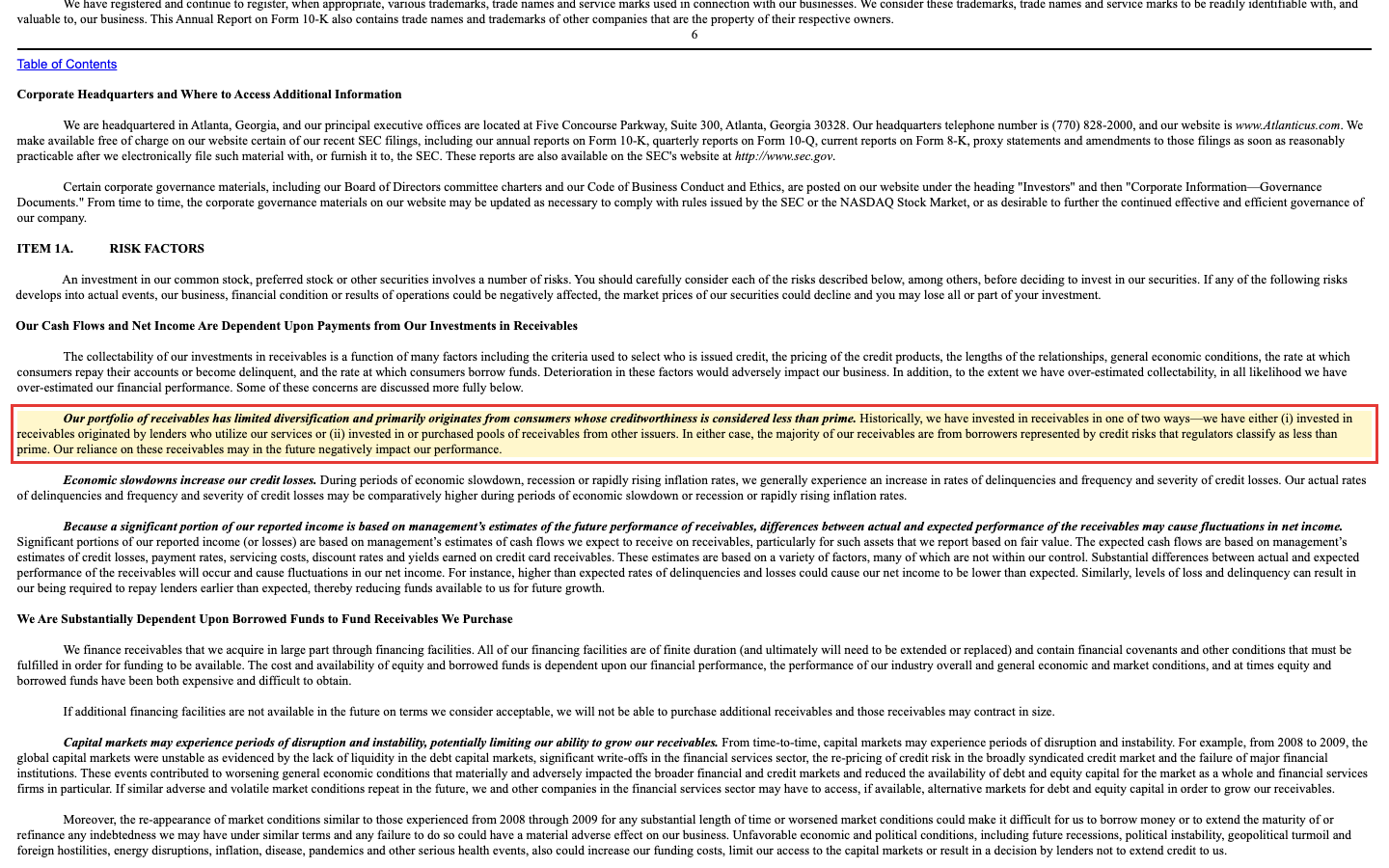
Atlanticus is the lender for people who get turned away at the regular bank. Through partner banks, the company issues credit cards and installment financing to U.S. consumers with weak credit — "less than prime" in the trade jargon, subprime in everyday speech. Picture it as a bouncer with a price list: whoever does not get past the big banks still gets credit here — but at a price that bakes in the high risk of default. The annual report itself says whom the business is aimed at:
"Our portfolio of receivables has limited diversification and primarily originates from consumers whose creditworthiness is considered less than prime. […] In either case, the majority of our receivables are from borrowers represented by credit risks that regulators classify as less than prime."
— Atlanticus Holdings Corporation, SEC annual report 10-K for fiscal year 2025, Item 1A "Risk Factors"
The price for that risk is written in black and white: annual percentage rates of 19.99 to 36 percent, annual fees up to $175, monthly fees up to $15, on credit lines of $350 to $5,500. Add financing right at the store counter (furniture, electronics, dental care — through the Curae brand), where merchants pay a fee of up to 65 percent of the purchase price so that even 0-percent promotions remain profitable for Atlanticus. Formally, Atlanticus does not act as a bank itself: it buys the receivables that partner banks originate through its technology platform — a construct that is legally attackable, as we will see shortly. Important for everything that follows: on September 11, 2025, Atlanticus acquired Mercury Financial, a large credit card program for somewhat better credit profiles ("near-prime") with roughly $3.08 billion of receivables. That more than doubled the managed portfolio in one stroke — and this very acquisition is the key to the growth number.
Where the stock shows up in our scanner
Every day we run about 3,500 stocks through our scanners. Atlanticus fires in 23 of them at once — most are momentum filters, because the stock is a genuine price leader (relative-strength rank 90, a new multi-year high, up roughly 106 percent over twelve months). For this analysis, though, a different one matters: the "Triple-Digit Revenue Growth" filter (data as of July 8, 2026). It looks for companies whose quarterly revenue has at least doubled versus roughly a year and a half earlier, climbing quarter after quarter along the way. On the data series available to the scanner, both conditions are formally met: reported revenue jumps from $133 million to $680 million, every step rising, the latest quarter standing at +404.6 percent year over year.
And here we have to be honest: this number does not survive a check against the original figures. On a clean, consistent data basis, the scanner's condition would not be met at all — the filter should never have fired here. Why, the look into the original numbers shows. Here is how to get there yourself: on minnowstreet.com, open "Scanner" in the menu, open the "Triple-Digit Revenue Growth" filter and look for the ATLC row. Remember this tension — the company earns real money, but the growth number is a measurement error. It is the connecting thread for everything that comes now.
The look into the real numbers — gross instead of mixed
The reason for the 404 percent is unspectacular and decisive at the same time: the series available to the scanner mixes two different revenue bases. The latest value ($679.6 million) corresponds exactly to the gross total revenue from the quarterly report — the earlier quarterly values ($133 to $248 million) correspond instead to a net measure, that is, revenue after certain deductions. Compare one gross value against a row of net values and you get a jump that never actually happened. Compute all quarters consistently on a gross basis instead (from the SEC's raw XBRL data), and the series looks completely different:
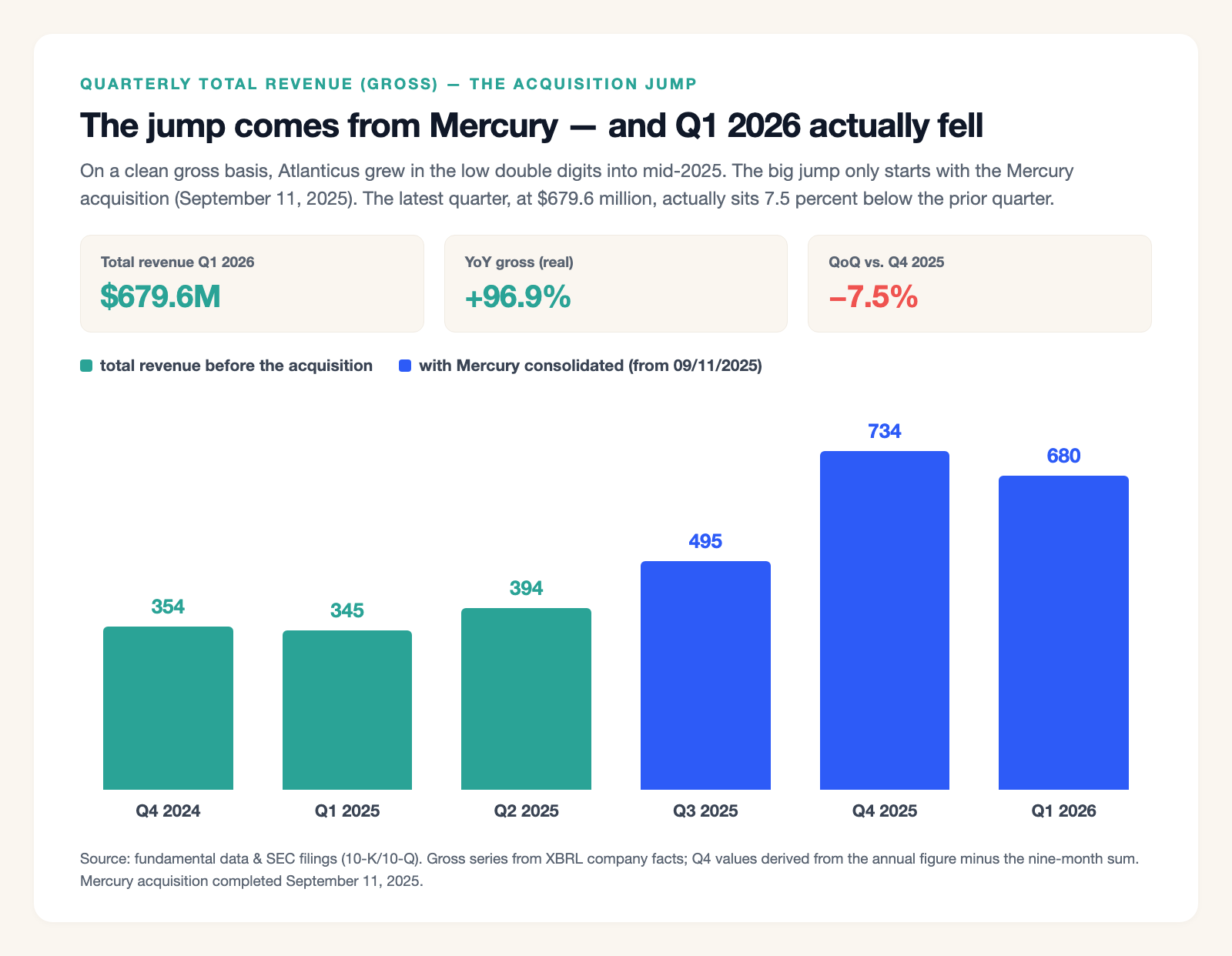
In numbers: gross total revenue rose from $345.2 million (first quarter of 2025) to $679.6 million (first quarter of 2026) — a real gain of 96.9 percent, not 404. And versus the prior quarter ($734.3 million) it actually fell 7.5 percent, among other things because many customers pay down their card balances with their tax refunds in spring. The scanner's 2x condition? On a gross basis, the latest quarter reaches only 1.9 times the comparison quarter — narrowly missed. That is still a strong business. But it is not triple-digit growth, and certainly not a rocket.
The uncomfortable truths
Uncomfortable truth no. 1: Two-thirds of the growth was bought
Even the real 96.9 percent has to be split — because the larger part was not grown but purchased. Of the roughly $334.7 million by which total revenue rose in the first quarter of 2026 versus the prior year, $224.4 million — two-thirds — came from the Mercury acquisition. Only the rest grew organically out of the existing business:
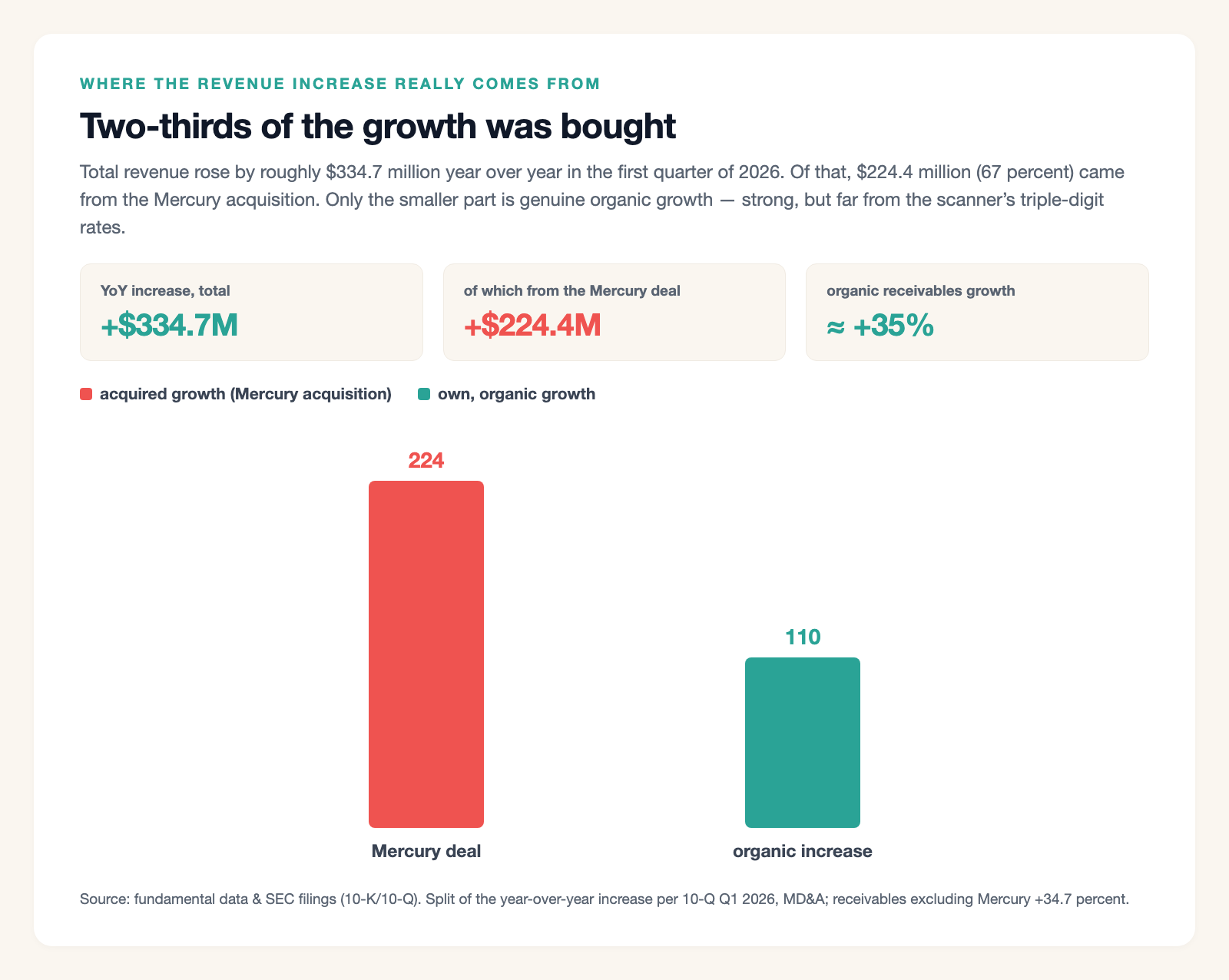
To be fair: the organic growth underneath is still remarkable. Receivables excluding Mercury rose roughly 35 percent, and the number of active accounts grew by more than 900,000. That is healthy, genuine growth — just a fraction of what the scanner promises. How deceptive a triple-digit scanner hit can be for an entirely different reason is something we dissected at Friedman Industries: there, the "doubling" measured a cyclical rebound from a loss-making quarter, not structural growth.
Uncomfortable truth no. 2: Every dollar grows — and the charge-offs grow with it
A subprime loan book earns a lot because it risks a lot. And the risk is no theory: in the first quarter of 2026, Atlanticus wrote off $406 million of gross charge-offs on its card book — in a single quarter, nearly double the prior-year figure. The annualized net charge-off rate in the managed portfolio climbed to 17.1 percent (from 15.6 percent in the prior quarter), and 7.0 percent of the portfolio was more than 90 days past due — trending upward (5.7 percent in September 2025). Most unpleasant is the margin compression: the net interest margin — what remains of the interest earned after funding costs — fell from 12.1 to 9.3 percent within a single quarter. When the book grows faster than its quality holds, defaults eat the return — and that is exactly the point people like to overlook in a "highly profitable rocket".
Uncomfortable truth no. 3: Levered 9.8 times and refinanced at a steep price
A lender is always a borrower too — it borrows money to lend it on at a higher rate. At Atlanticus, roughly $6.3 billion of financial debt stands against only $0.65 billion of equity — about 9.8 times. The report breaks down how that mountain is composed:
"As of December 31, 2025, we had $934.9 million of recourse indebtedness outstanding and $5,629.6 million of indebtedness outstanding under warehouse facilities and asset backed securities, all of which is non-recourse indebtedness."
— Atlanticus Holdings Corporation, SEC annual report 10-K for fiscal year 2025, Item 1A "Risk Factors"
"Non-recourse" sounds reassuring — the securitization creditors cannot go after the whole group, only after the respective loan packages. The catch is the flip side: if the loan book deteriorates, exactly these creditors keep the cash flows first, before anything reaches the parent. And fresh money has become expensive: the most recent senior notes cost 9.25 to 9.75 percent interest per year, and interest expense rose roughly 158 percent year over year in the first quarter of 2026 (from $47.5 to $122.8 million). The report itself announces further capital needs — the growth has to be continuously refinanced.
Uncomfortable truth no. 4: One stroke of a pen in Washington can strike the model at its core
The entire business lives on the 19.99 to 36 percent interest plus fees. That is precisely where the biggest external risk attacks — and the 10-K names it unusually concretely:
"For example, in February and March 2025, bipartisan legislation was introduced in both the United States Senate and House, respectively, seeking to amend the Truth in Lending Act (“TILA”) to cap credit card interest rates at 10% effective January 1, 2031. Thereafter, in January 2026, the current presidential administration proposed a 10% cap on credit card interest rates for one year. […] Any temporary or permanent implementation of a specific interest rate cap on consumer credit cards […] could have a material adverse effect on our business and operations."
— Atlanticus Holdings Corporation, SEC annual report 10-K for fiscal year 2025, Item 1A "Risk Factors"
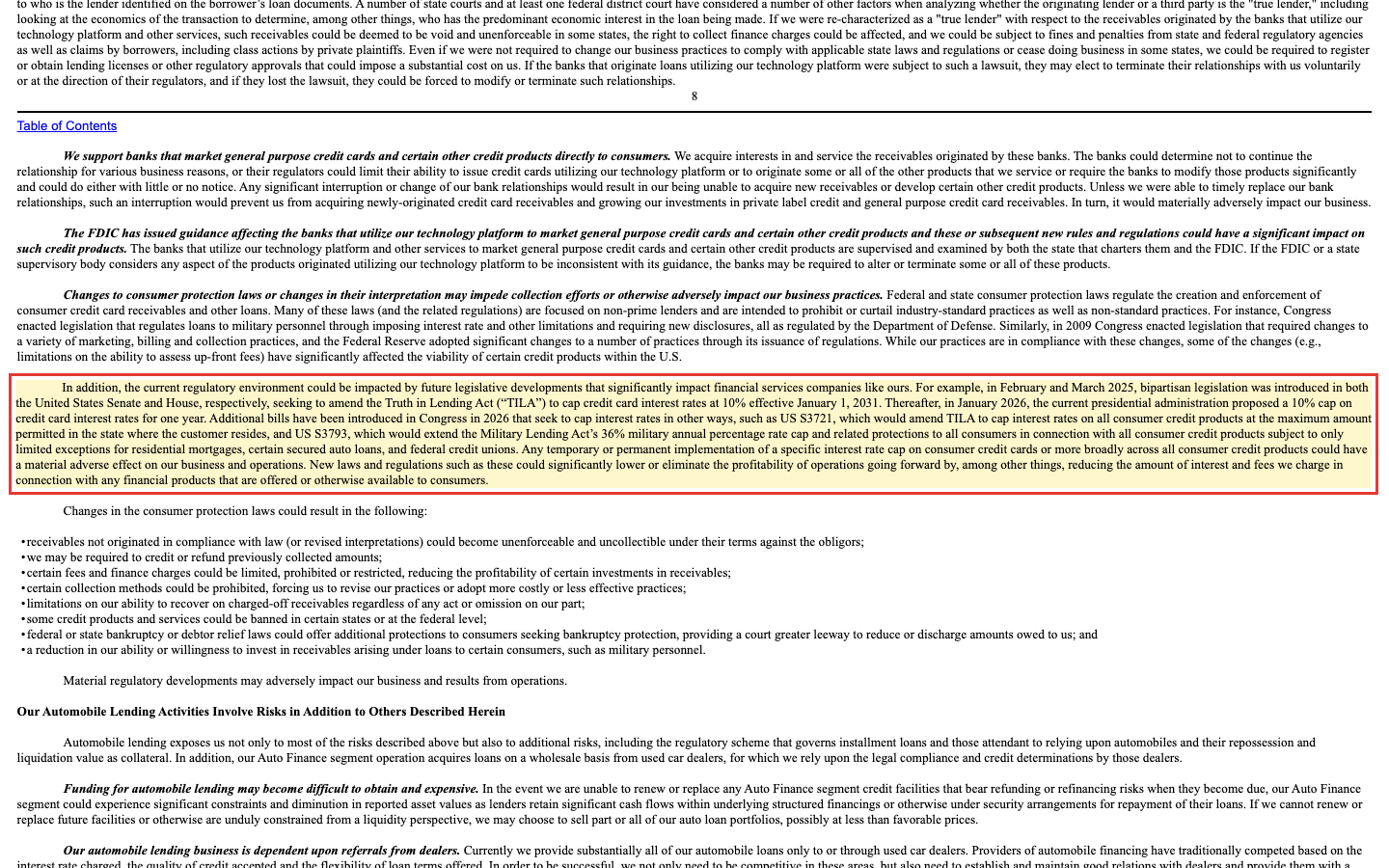
A cap at 10 percent would render a business model that charges 19.99 to 36 percent immediately unprofitable. Whether such a proposal ever becomes law is open — but the risk is real and named. Add the second, legal front: the "true lender" debate. Because formally the partner banks originate the loans and Atlanticus only buys them, plaintiffs regularly argue that Atlanticus is in truth the actual lender — with drastic consequences should a court agree:
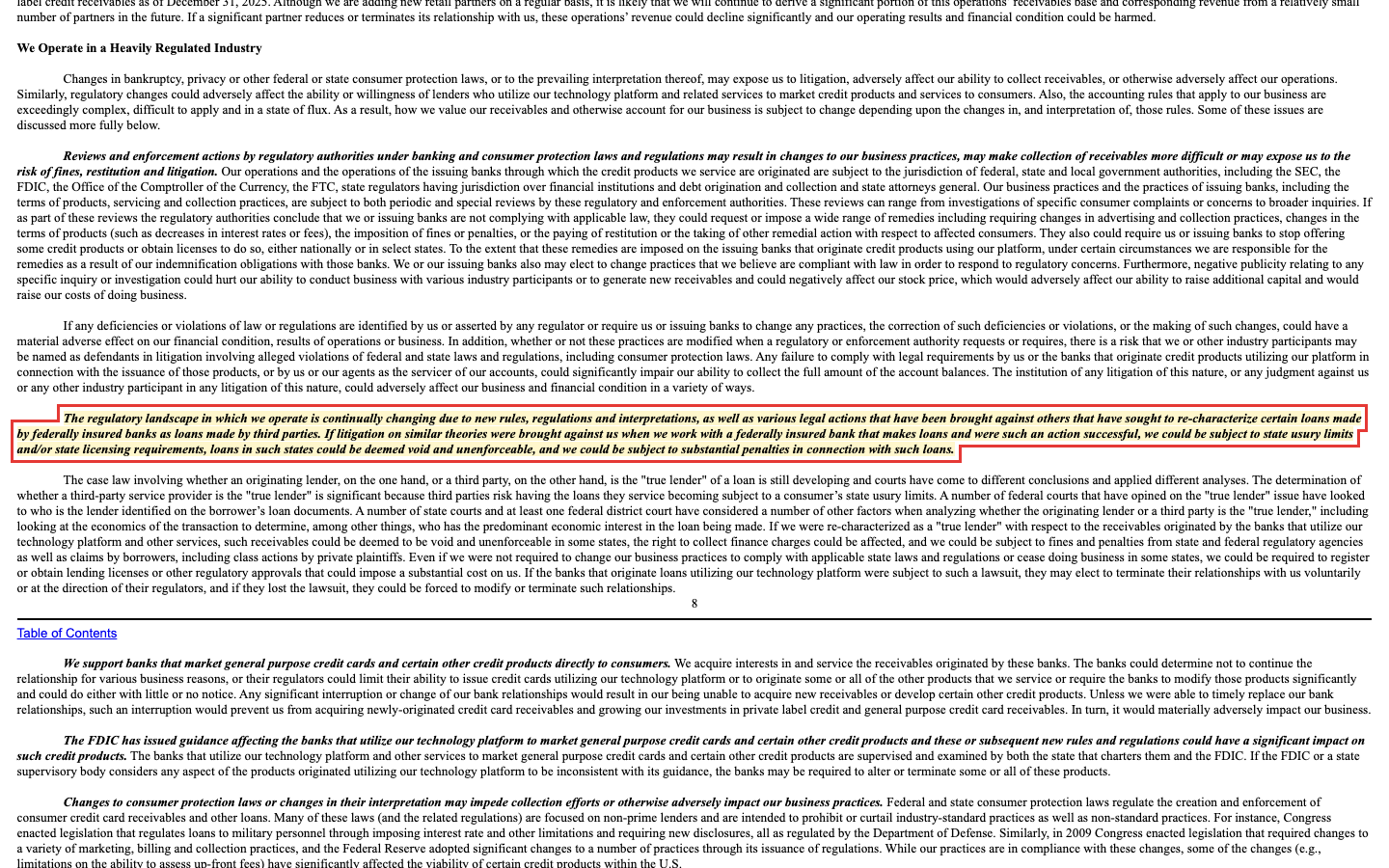
"If litigation on similar theories were brought against us when we work with a federally insured bank that makes loans and were such an action successful, we could be subject to state usury limits and/or state licensing requirements, loans in such states could be deemed void and unenforceable, and we could be subject to substantial penalties in connection with such loans."
— Atlanticus Holdings Corporation, SEC annual report 10-K for fiscal year 2025, Item 1A "Risk Factors"
Uncomfortable truth no. 5: Tiny float, big insiders, built-in dilution
The stock is technically easy to move — in both directions. Insiders hold 65.5 percent of the shares, the freely tradable float comprises only roughly 5.4 million shares, and 22.9 percent of that is sold short (data as of July 6–8, 2026). A float that small with a short interest that high means: even moderate waves of buying or selling can swing the price hard. Add built-in dilution: Series A preferred stock worth $40 million is convertible at $10 per share — with the stock far above that, a substantial arithmetic lever. It already shows in the income statement today: diluted earnings per share sit roughly 20 percent below the undiluted figure. And part of the reported pre-tax profit in the first quarter of 2026 comes from soft, assumption-driven bookings — adjustments to fair-value assumptions and the write-down of a purchase-price obligation from the Mercury acquisition. That is not earned money in the same sense as collected interest.
Valuation — earned, but not a gift
Unlike at some other scanner "rockets", a real profit stands behind this one, so a valuation actually makes sense. On the diluted trailing-twelve-month earnings of roughly $6.70 per share, the price-to-earnings ratio comes to about 14 — not expensive for a company earning more than 20 percent on equity. Book value per share sits at roughly $37 to $43, so the price-to-book ratio is about 2.2. For a profitable lender that is neither a bargain nor a bubble multiple. Caution is due with the strikingly low ratios some data vendors show: a price-to-cash-flow ratio of about 2 sounds dirt cheap, but for a loan-book business it is misleading, because operating cash flow does not cleanly separate the lending itself — as a buy argument this number is useless. It is the same trap we dissected at Consumer Portfolio Services, where the scanner saw more free cash flow than market cap while the bank account held $6.9 million. The decisive question is not the price but the durability: can a 21 percent return on equity hold at nearly ten times leverage and rising charge-offs? Analysts on average credit the stock with a price target roughly 24 percent above the level of early July 2026 — confidence that already prices in a good deal of things going right.
Opportunities and risks at a glance
What speaks for Atlanticus:
- Consistently profitable: six profitable years in a row ($94 to $178 million per year since 2020), return on equity of roughly 21 percent — no red ink even through the rate shock of 2022 to 2024.
- A scale jump with a safety net: Mercury brings a large credit card program with lower charge-off rates than the existing book; the seller shares part of the credit risk through an earn-out, and a repricing of the Mercury book is expected to lift revenue from 2026 on.
- Genuine organic growth underneath: roughly 35 percent more receivables excluding Mercury, over 900,000 new active accounts, a 30-year history with roughly $52 billion of loans serviced.
- Pricing power in the niche: merchant fees up to 65 percent and "limited loss" agreements shift risk onto retail partners; available liquidity stands at roughly $651 million.
What speaks against it:
- The growth number is a measurement error: really +96.9 percent gross instead of +404.6 percent, two-thirds of it acquired, and versus the prior quarter actually minus 7.5 percent.
- Charge-offs are rising: $406 million of gross charge-offs in one quarter, a 17.1 percent charge-off rate, and a net interest margin down from 12.1 to 9.3 percent within a single quarter.
- Roughly $6.3 billion of debt on $0.65 billion of equity (about 9.8 times), new notes at 9.25 to 9.75 percent; the growth must be continuously and expensively refinanced.
- Regulatory and litigation risk at the core of the model (10 percent interest-rate cap, "true lender"); a tiny float of 5.4 million shares with 22.9 percent short interest makes the price very volatile.
A human conclusion
Remember the FOMO from the opening — the reflex to grab immediately at "highly profitable plus 404 percent"? After the look into the filings you now know: the 404 percent does not exist. It is a measurement error, born of comparing gross against net figures; in reality revenue grew 97 percent, and two-thirds of that was purchased. That is one half of the truth — the half that disenchants the hype.
The other half is just as real: underneath the false number sits a company that has earned money for six straight years, throws off more than 20 percent return on equity, bought a better loan book with Mercury, and still grows 35 percent organically. Unlike many scanner hits, there really is a business here that carries. The price for it is written in the charge-offs: $406 million per quarter, a rising default rate, nearly tenfold leverage — and a stroke of a pen in Washington that could strike the model at its core. Similarly two-sided, in the very same corner of the market, is the story at World Acceptance: a cash machine charging 51 percent interest — with one sentence in the 10-K that could end it all.
Atlanticus is thus no rocket, but a bet that a highly profitable, high-risk loan book survives the next wave of defaults and the next regulatory push. What you make of it is your decision — and that is exactly as it should be. What matters is only that you know what you are betting on: a genuine subprime business with real risks, not the 404 percent from the scanner.
Sources
- Atlanticus Holdings Corporation — SEC annual report 10-K, fiscal year 2025 (filed March 12, 2026)
- Atlanticus Holdings Corporation — SEC quarterly report 10-Q, Q1 2026 (as of March 31, 2026, filed May 7, 2026)
- Atlanticus Holdings Corporation — SEC quarterly report 10-Q, Q3 2025 (as of September 30, 2025, filed November 10, 2025)
- Fundamental data (metrics, valuation, analyst consensus, quarterly series); in-house stock scanner, data as of July 8, 2026.
Transparency & disclaimer: This analysis is a journalistic contextualization of publicly available information and is not investment advice, not a financial analysis in the regulatory sense, and not a solicitation to buy or sell securities. Stock investments carry substantial risks up to total loss. All information without guarantee; the data cut-off is noted in the text in each case. Make your investment decisions on your own responsibility and seek independent advice when in doubt.
Our Bottom Line at a Glance
- Profitability positive
- Six profitable years in a row ($94 to $178 million per year since 2020), return on equity of roughly 21 percent — no red ink even through the rate shock of 2022 to 2024. Unlike many scanner hits, a genuine, carrying business stands behind this one.
- Revenue "growth" negative
- The +404.6 percent in the scanner is a data artifact: the series mixes gross and net revenue. Really, total revenue grew 96.9 percent gross, two-thirds of it from the Mercury acquisition; versus the prior quarter it fell 7.5 percent. On clean data, the scanner's 2x condition would not be met.
- Credit quality negative
- $406 million of gross charge-offs in a single quarter, the annualized charge-off rate up to 17.1 percent, 7.0 percent of the portfolio more than 90 days past due. The net interest margin fell from 12.1 to 9.3 percent within one quarter — the defaults grow along with the book.
- Leverage negative
- Roughly $6.3 billion of financial debt on only $0.65 billion of equity (about 9.8 times); new senior notes cost 9.25 to 9.75 percent, and interest expense rose roughly 158 percent in the first quarter of 2026. The growth must be continuously and expensively refinanced.
- Regulation & share structure negative
- A 10 percent interest-rate cap (bills pending in Congress) and the "true lender" litigation risk could strike the model at its core; loans in individual states could become "void and unenforceable". Insiders hold 65.5 percent, the float comprises only 5.4 million shares with 22.9 percent short interest — very volatile.
Atlanticus is no 404-percent rocket but a subprime lender profitable for six straight years with a return on equity of roughly 21 percent — wrapped in a growth number that is a pure measurement error (gross mixed against net; really +96.9 percent, two-thirds of it acquired). Against the genuine earnings stand rising charge-offs (17.1 percent), nearly tenfold leverage and a regulatory risk that could strike the pricing model at its core. Not investment advice.
What Our Rating Means
- If you don't own the stock
- As long as the question raised in the bottom line stays open, we see no basis for an entry.
- If you hold it in your portfolio
- Our findings offer no acute reason to sell — the checkpoints named remain decisive.
A journalistic assessment by our editorial team at the time of the deep dive, based on public sources — not investment advice and not a solicitation to buy or sell. Your personal circumstances (investment goals, risk capacity, taxes) cannot be taken into account. What our categories mean, how verdicts are formed, and what conflicts of interest exist →
Worth Noting
- The scanner metric "+404.6 percent revenue growth" rests on a data series mixing gross and net revenue; on a consistent gross basis it would be +96.9 percent (YoY) and −7.5 percent (versus the prior quarter). Computed cleanly, the filter's 2x condition would not be met.
- Mercury Financial was acquired on September 11, 2025 (roughly $3.08 billion of receivables). Credit-quality ratios have been period-wise distorted since, because the Mercury book is included — the company points this out itself.
- Q4 quarterly values for 2024 and 2025 are derived from the annual figure minus the nine-month sum. All credit-quality percentages are the company's non-GAAP metrics based on "managed receivables".
Frequently Asked Questions
Atlanticus is a lender to U.S. consumers with weak credit ("less than prime", colloquially subprime). Through partner banks, the company issues credit cards and installment financing at annual percentage rates of 19.99 to 36 percent and buys the receivables. Its brands include Fortiva, Aspire and Curae; since September 2025 the Mercury credit card program is part of the group as well. The business has been consistently profitable for six years.
Because the underlying data series mixes two different revenue bases: the latest value is a gross total-revenue figure, while the prior quarters correspond to a net measure. Compare gross against net and you get a jump that never actually happened. On a consistent gross basis, total revenue grew 96.9 percent year over year in the first quarter of 2026 — and even fell 7.5 percent versus the prior quarter. The +404.6 percent is a data artifact.
Both. Of the revenue increase in the first quarter of 2026 (roughly $334.7 million), two-thirds ($224.4 million) came from the Mercury acquisition of September 11, 2025. The organic remainder is still strong, with roughly 35 percent receivables growth and over 900,000 new active accounts — just not triple-digit growth.
Very. In the first quarter of 2026, Atlanticus wrote off $406 million in charge-offs; the annualized charge-off rate rose to 17.1 percent, 7.0 percent of the portfolio was more than 90 days past due, and the net interest margin fell from 12.1 to 9.3 percent within one quarter. Add a debt load of roughly 9.8 times equity, refinanced at 9.25 to 9.75 percent.
The business lives on 19.99 to 36 percent interest. Congress has bipartisan proposals to cap credit card interest rates at 10 percent (from 2031), and in early 2026 the administration proposed a one-year 10 percent cap. Add the "true lender" litigation risk: because the partner banks formally originate the loans, courts could classify Atlanticus as the actual lender — loans in individual states could become "void and unenforceable".
Measured on diluted trailing-twelve-month earnings, the price-to-earnings ratio sits around 14 and the price-to-book ratio around 2.2 — for a lender earning more than 20 percent on equity, neither cheap nor overpriced. The strikingly low cash-flow multiples some data vendors show are misleading for a loan-book business and are useless as a buy argument. What matters is whether the high return holds at nearly tenfold leverage and rising charge-offs.
Found an error?
Did you spot a factual error, an outdated number, or a typo in this deep dive? Let us know briefly — your report goes straight to the editorial team.