Astrana Stock: Four Times the Revenue, a Third of the Profit — and a Price Hugging Its 52-Week High
Astrana Health coordinates care for roughly 1.55 million patients in America on fixed per-member fees — and lights up 25 filters in our in-house stock scanner at once, from the Stan Weinstein stage-2 trend to the revenue growth screen (data as of July 17, 2026). We read the annual report (10-K) for 2025 and the quarterly report (10-Q) as of March 31, 2026: revenue that has quadrupled since 2021, profit that melted to $22.5 million along the way, a $674.9 million acquisition whose sellers filed for bankruptcy six days after closing — and four health plans that account for 60 percent of revenue. Not investment advice — just both ends of the same ledger: $3.2 billion at the top, $22.5 million at the bottom.
 Thomas Mücke
Founder & Publisher
Thomas Mücke
Founder & Publisher
Chart
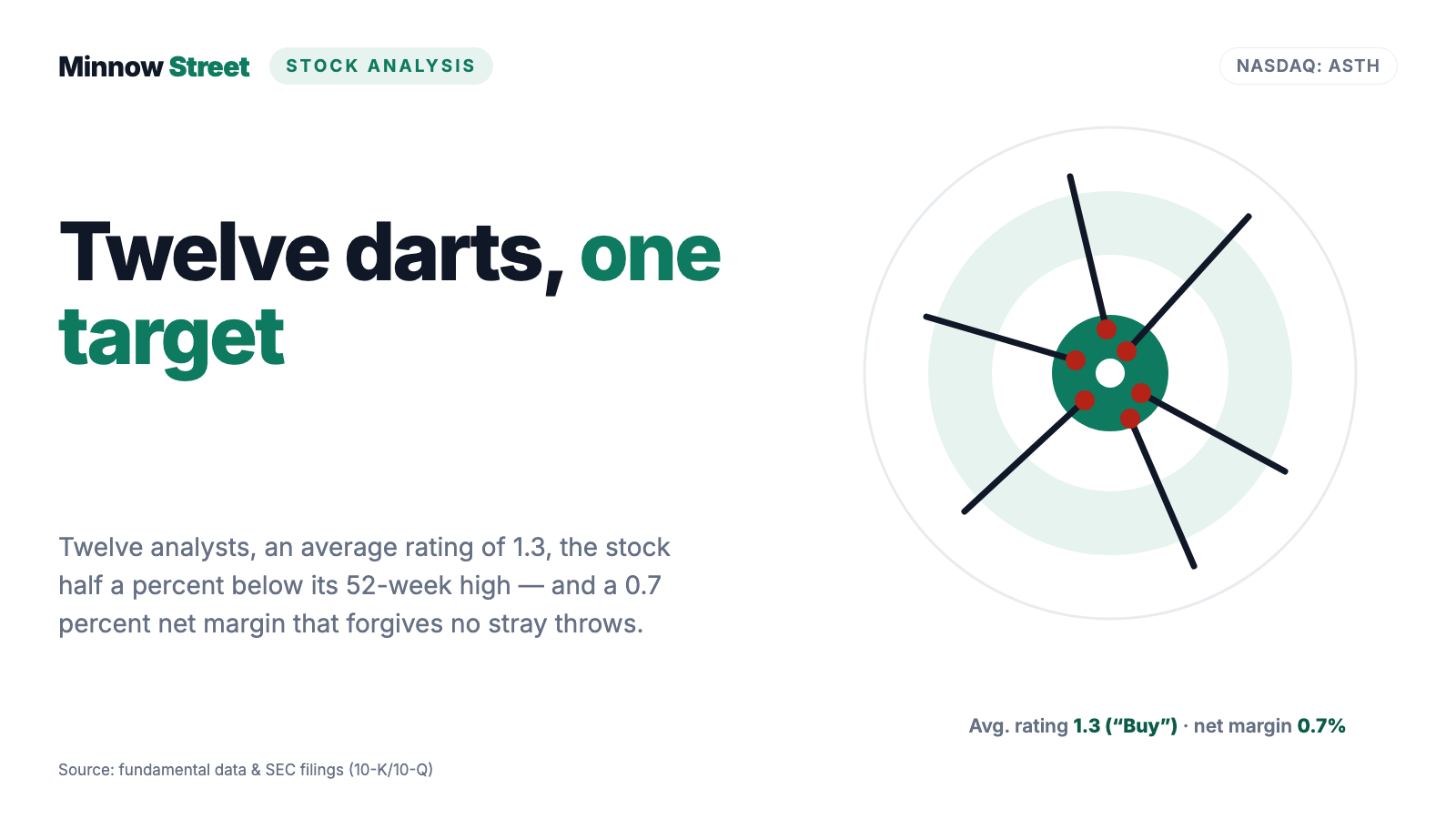
Interactive price chart (TradingView).
Note: pure fact-based analysis, not investment advice and not a solicitation to buy or sell. All figures without guarantee.
There is an optical illusion that works more reliably on the stock market than any chart pattern: the top-line illusion. It goes like this: you see a company growing revenue 56 percent, and your brain instantly translates — "they are conquering their market." Size feels like strength. That an entire engine room sits between revenue and profit is something the mind blanks out in the first moment. Hardly any stock tests this illusion in the summer of 2026 as cleanly as Astrana Health, Inc. (Nasdaq: ASTH) from Alhambra, just outside Los Angeles: a healthcare network that quadrupled its revenue in four years, whose share price sits about half a percent below its 52-week high (data as of July 17, 2026) — and whose $3.2 billion of annual revenue left $22.5 million on the bottom line. Less than a cent per dollar. So let's make a deal: before the 56 finishes its victory lap in your head, we read together what the company itself reported, under penalty of law, to the U.S. securities regulator, the SEC — the annual report (10-K) for 2025 and the quarterly report (10-Q) as of March 31, 2026. And these filings tell both halves: a genuine growth story, and its price tag. In the end, you decide for yourself.
What Astrana actually does — and for whom
Astrana runs what America calls value-based care. Translated into an everyday image: a fixed-price menu instead of à la carte. In classic U.S. healthcare, every doctor earns per procedure — more tests, more revenue. At Astrana it works the other way around: health plans pay the network a fixed per-member-per-month fee ("capitation"), and Astrana has to organize and pay for the member's entire care out of that budget. Whatever is left over is profit; if treatment costs more than the fee, Astrana eats the difference. The company — it traded as Apollo Medical Holdings until February 2024 — coordinates care for roughly 1.55 million patients (March 31, 2026, up from roughly 1.0 million a year earlier) through more than 20,000 contracted physicians, overwhelmingly in California. Three segments interlock: Care Partners (the risk-bearing networks that collect the capitation fees), Care Delivery (its own clinics and medical groups) and Care Enablement (the administration and technology platform, managing 28 physician groups at the end of 2025). The big gulp came on July 1, 2025: for $674.9 million, Astrana acquired the Prospect businesses — a network of more than 11,000 providers plus a health plan license, a pharmacy, and even a hospital in Tustin. Which brings us to the central tension of this analysis, and it runs through every chapter: the momentum and the growth are real — but the growth is mostly purchased, financed with debt, and almost none of it trickles through to profit. How harshly the economics of physician-group medicine can treat shareholders is something we dissected at Pediatrix Medical Group — and what an acquisition-built healthcare balance sheet looks like under a debt load, at Fortrea.
Where the stock shows up in our scanner
Every day we run about 3,500 stocks through our scanners, and as of the July 17, 2026 data cut-off, Astrana delivered one of the broadest hit lists of the current momentum run: 25 filters fired. The most striking ones tell a single story. The stock sits in a Stan Weinstein stage-2 uptrend (price above a rising 200-day average — the only phase in which Weinstein would buy at all), shows up in the near 52-week high filter at just 0.5 percent below its yearly high, and simultaneously in the Tight & Near High setup screen — it is consolidating tightly right under the high instead of swinging wildly. Then come the growth screens: high revenue growth (plus 55.6 percent in the latest quarter) and EPS & revenue power, because the revenue jump came with an earnings-per-share gain of about 110 percent. Even the strict CAN SLIM screen after William O'Neil and the analyst filter pros 80% (12 professionals, average rating 1.3 — "buy") nod along. Behind it all: up 86 percent in three months, up 66 percent year to date, a relative strength of 89, and institutional accumulation — 11 funds added while 5 trimmed (data as of July 17, 2026). So much for the trend lens — and here, for once, it is almost flawless. The fundamental lens of the very same scanner half-agrees: grade B, an Altman Z-score around 5 (an early-warning gauge of insolvency risk — above 3 counts as safe ground), a Piotroski F-score of 5 of 9 (a nine-point test of the books: 5 is midfield, not a medal). But two numbers fall out of the choir: interest coverage of 1.85 — operating income does not even cover twice the interest bill — and a price-to-sales ratio of 0.6 that only looks cheap until you know the margin. Remember this sentence: a low price-to-sales ratio is not proof of a bargain — it is a question, namely how much of that revenue could ever stick.
The numbers over the years — honestly appraised
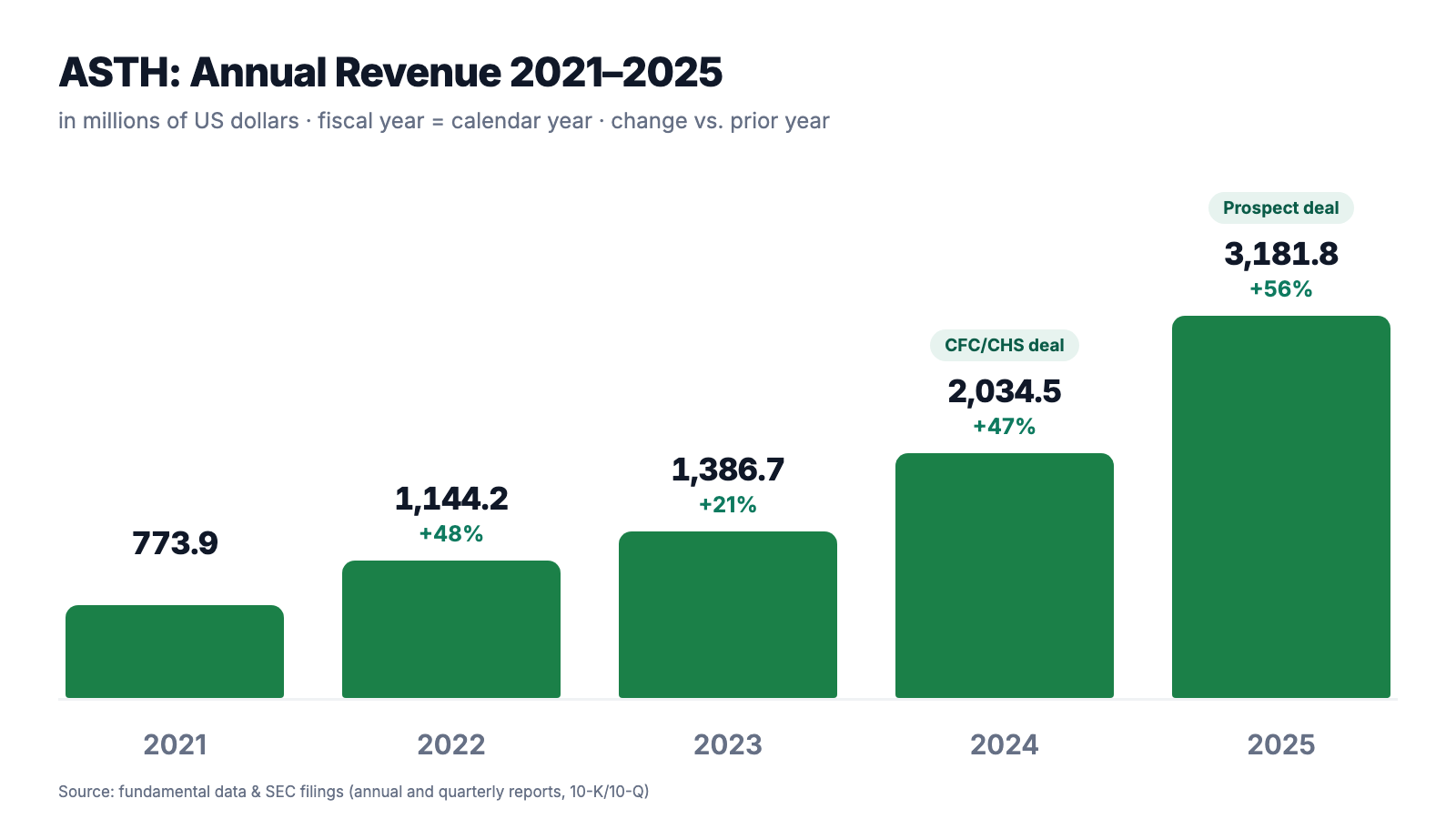
First, what genuinely impresses — and it is quite a lot. Astrana grew revenue from $773.9 million (2021) to $1,144.2 million (2022), $1,386.7 million (2023), $2,034.5 million (2024) and finally $3,181.8 million (2025) — a quadrupling in four years, with growth rates of 47 and 56 percent in the last two. The first quarter of 2026 continued seamlessly at $965.1 million (+56 percent). The bottom line showed a pulse too: quarterly earnings per share jumped from $0.14 to $0.29 (diluted), more than a double, and the operating cash flow is real — $114.6 million in 2025 (2024: $52.2 million) plus $68.1 million in the first quarter of 2026 alone. The patient count grew from 1.0 to 1.55 million within twelve months. If you read only this paragraph, you see a value-based-care consolidator in the fast lane. Now look at the whole curve:
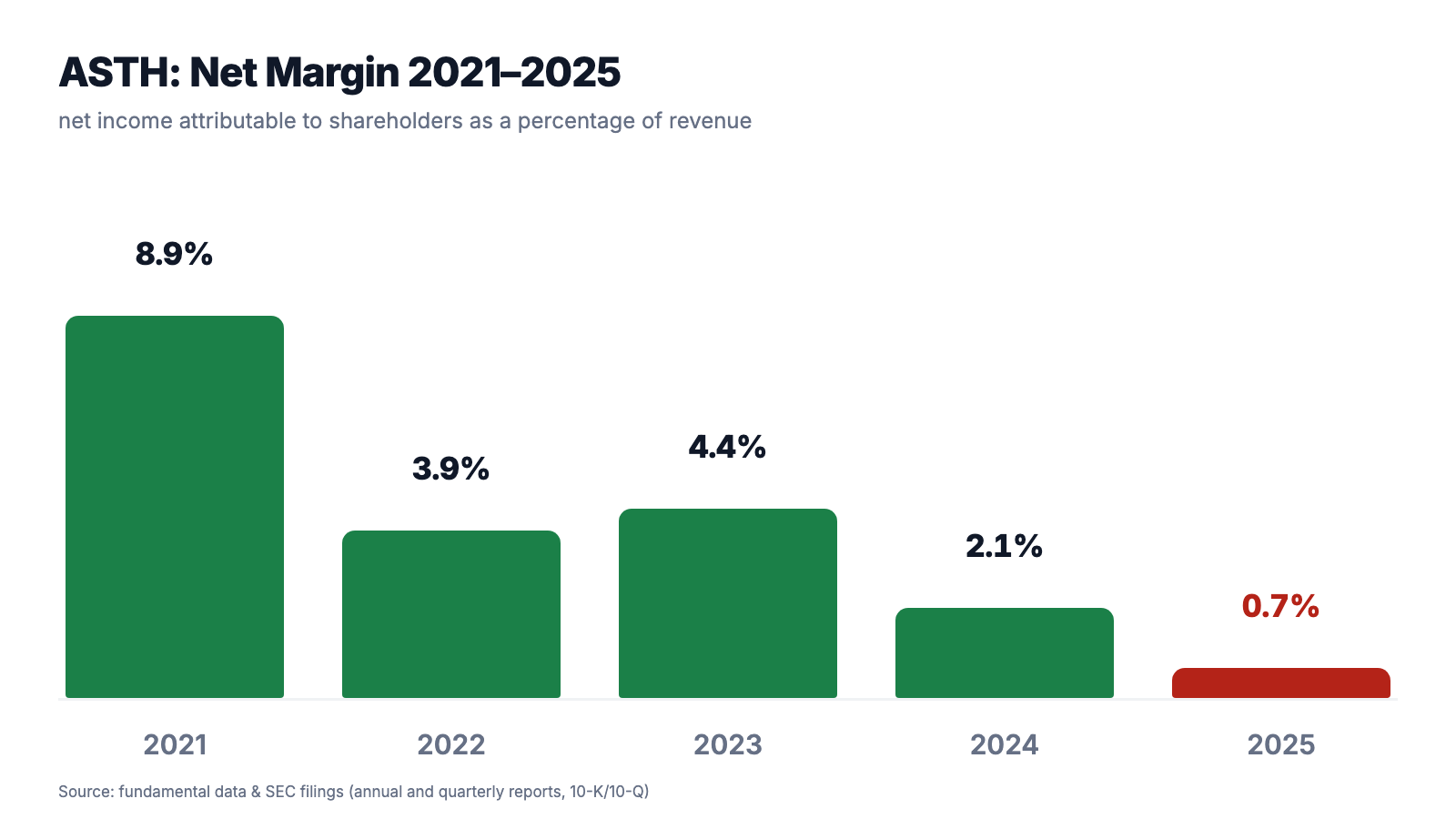
Because the same five years can be told the other way around: net income attributable to shareholders was $68.9 million in 2021 (after a later restatement of the books) — on a quarter of today's revenue. In 2023 it was $60.7 million, in 2024 $43.1 million, in 2025 just $22.5 million. Net margin thus fell from roughly 8.9 percent (2021) to 0.7 percent (2025). Of every dollar flowing through Astrana's books, not even a cent sticks for the owners — the rest goes to physicians, hospitals and drugs (cost of services alone rose 61 percent to $2,840.2 million in 2025), to administration, and increasingly to the bank. That is not an anomaly; it is the mechanics of the model: whoever collects capitation and buys care moves enormous sums at a wafer-thin markup. And the latest growth spurt was, on top of that, largely bought, not earned — the quarterly report makes it measurable:

"The increase in revenue was partially attributable to the Prospect acquisition, which contributed $300.2 million of revenue from the acquisition date."
— Astrana Health, Inc., SEC quarterly report 10-Q as of March 31, 2026, Item 2 "Management's Discussion and Analysis — Revenue"
Strip Prospect out, and the legacy business grew by about $44 million in the first quarter of 2026 — roughly 7 percent. Decent, but not the 56 the scanner is celebrating. The pro forma table in the same filing is even more honest: had Prospect belonged to the company in the prior-year quarter already, revenue back then would have been $929.3 million — making the move to $965.1 million a gain of barely 4 percent. Remember the mechanism: purchased growth runs through the comparison numbers for exactly four quarters — from July 1, 2026, Astrana's growth rate has to stand without the Prospect effect.
What the filings say — the uncomfortable truths
Uncomfortable truth no. 1: Four health plans account for 60 percent of revenue — and 87 percent hangs on the government
Who actually pays the $3.2 billion? The annual report answers in its key-payers chapter with an openness worth crediting:
"A limited number of payers represent a significant portion of our net revenue. For the years ended December 31, 2025, 2024, and 2023, four payers accounted for an aggregate of 59.8%, 66.2%, and 61.7% of our total net revenue, respectively."
— Astrana Health, Inc., SEC annual report 10-K for 2025, Item 1 "Business — Our Key Payers"

The single largest payer alone accounted for 26.0 percent of 2025 revenue. And the payer-type table in the notes exposes the second layer: of the $3,181.8 million of revenue, $1,906.2 million came from Medicare and $861.5 million from Medicaid — together roughly 87 percent from government-funded programs whose rates are set in Washington and Sacramento. Picture a caterer doing nearly all of his business with four large canteens whose budgets are re-voted by legislators every year: he can cook brilliantly and still have a brutal year if one canteen changes its terms. In fairness: this concentration is structural in California's managed-care world — the big HMO plans are simply few — and long-standing contracts with them are also Astrana's moat. But the report explicitly warns elsewhere about cuts to federal Medicaid funding ("Medicaid provider tax reform") and about shifts in payer mix. Whoever holds this stock holds a slice of U.S. budget politics in the portfolio.
Uncomfortable truth no. 2: The sellers of the $675 million acquisition went bankrupt six days after closing
The Prospect acquisition powers the current growth story — and it carries a footnote of a kind you rarely read. Six days after the deal closed, the seller entities filed for creditor protection:
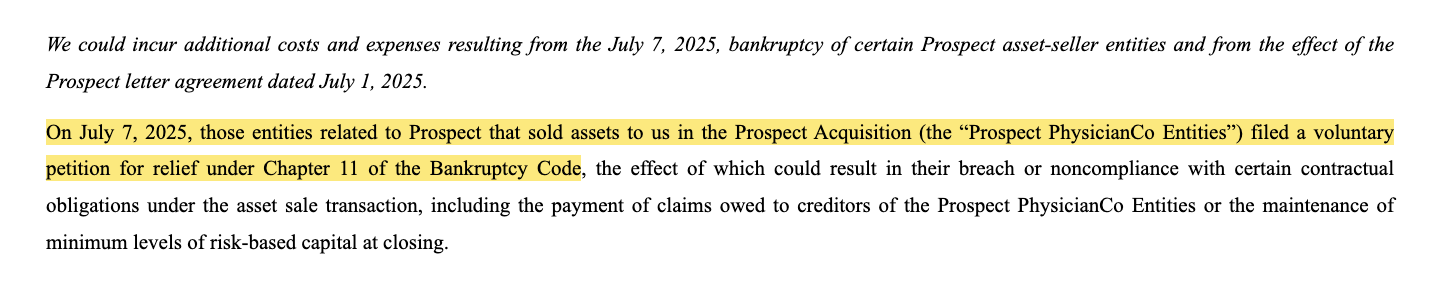
"On July 7, 2025, those entities related to Prospect that sold assets to us in the Prospect Acquisition (the “Prospect PhysicianCo Entities”) filed a voluntary petition for relief under Chapter 11 of the Bankruptcy Code, the effect of which could result in their breach or noncompliance with certain contractual obligations under the asset sale transaction, including the payment of claims owed to creditors of the Prospect PhysicianCo Entities or the maintenance of minimum levels of risk-based capital at closing."
— Astrana Health, Inc., SEC annual report 10-K for 2025, Item 1A "Risk Factors"
On its own, that would be the seller's bad luck. It becomes spicy through the second half of the same risk factor: under a letter agreement dated July 1, 2025 — closing day — the escrow account for non-assumed liabilities and the recourse against the sellers (with limited exceptions) were eliminated; in a worst case, Astrana writes, it would have "limited to no recourse." Translated: if problems spill over from the sellers' bankruptcy estate into the business Astrana bought — unpaid vendors, creditor claims, missing risk-based capital — Astrana may have to fix them out of its own pocket to protect its physicians and payer relationships. For perspective: Astrana bought the assets, not the insolvent shells, and the deal delivered operating networks with $300 million of quarterly revenue. But whoever buys from a seller on the brink of bankruptcy and waives protections along the way buys faster — and carries more. The $19.6 million of transaction costs the report discloses are only the start of the integration bill; a $13.0 million loss contingency followed in the third quarter of 2025.
Uncomfortable truth no. 3: When care costs more than the fee, there is no cap
The capitation model is Astrana's strength — and its structural risk. The annual report states it without a soft filter:
"If our affiliated IPAs can manage care-related expenses within the capitated levels, we realize operating profits from capitation contracts. However, if care-related expenses exceed projected levels, our affiliated IPAs may incur substantial operating deficits that are not capped and could result in substantial losses."
— Astrana Health, Inc., SEC annual report 10-K for 2025, Item 1A "Risk Factors"

That is the business model in two sentences: Astrana is not a service provider writing invoices — economically, it is an insurer in a doctor's coat. And the company is deliberately raising that stake right now: through its California health plan licenses (regulator jargon: "Restricted Knox-Keene"), it increasingly takes on full risk — hospital costs on top of physician costs. That is exactly where part of the latest growth came from ($46.4 million of additional capitation in the first quarter of 2026 from enrollees transitioning to full risk, per the quarterly report), and exactly where the 61 percent jump in care costs in 2025 came from. More risk means: more revenue immediately, more margin maybe later — if cost management works. The industry learned painfully in 2024 and 2025 how quickly rising medical costs in Medicare programs can eat entire annual profits. One quarter of $0.29 in earnings per share does not make a summer.
Uncomfortable truth no. 4: The billion on the other side of the balance sheet
None of this was paid out of petty cash. For Prospect, Astrana drew $707.3 million from a purpose-built credit facility; as of March 31, 2026, roughly $1.03 billion of bank debt sat on the balance sheet against $478.4 million of cash. The annual report names the consequence itself:
"In addition, the amount of cash required to pay interest on our increased indebtedness, and thus the demands on our cash resources, materially increased as a result of the indebtedness to finance the Prospect Acquisition."
— Astrana Health, Inc., SEC annual report 10-K for 2025, Item 1A "Risk Factors"
In numbers: interest expense rose to $49.9 million in 2025 (2024: $33.1 million), and the first quarter of 2026 already carried $16.1 million — annualized, still climbing. Against that stood $78.5 million of operating income in 2025: right now, the bank earns almost as much from Astrana's growth as the shareholders do — hence the thin interest coverage of 1.85 in the scanner. Add the substance check: after the acquisitions, $874.8 million of goodwill and $251.2 million of intangibles sit on the balance sheet (March 31, 2026) — together more than the entire equity of $800.3 million. Translated: the book equity consists entirely of paid-for acquisition hopes; if one of them disappoints, textbook impairments loom. The fair counterweight: an Altman Z-score around 5 signals no distress, operating cash flow covers the interest several times over, and management structured the loan over five years. But the days when Astrana looked like a debt-free, asset-light administrator ended on July 1, 2025. Growth bought with borrowed money is never entirely free.
Valuation: $2.2 billion of market value for $30 million of trailing profit — or for $3.2 billion of revenue?
In mid-July 2026 the Astrana share cost about $43.50, for a market value of roughly $2.15 billion (data as of July 17, 2026). Depending on which lens you pick up, that is dirt cheap or ambitious. The revenue lens: a price-to-sales ratio of roughly 0.6 — for a growth stock that sounds like a clearance sale, but at a 0.7 percent net margin it is simply the going rate for pass-through revenue. The earnings lens: over the last four quarters, profit attributable to shareholders adds up to a good $30 million — a trailing price-to-earnings ratio around 70. The future lens: the twelve analysts covering the stock rate it 1.3 on average ("buy") and project around $2.90 of adjusted earnings per share for 2026 (data as of July 17, 2026) — which would be a good 15 times. Between 70 and 15 lies not a rounding error but a worldview: the adjusted number excludes, among other things, the amortization of acquired customer relationships and the one-off costs of the deals — precisely the items with which this growth was paid for. Both numbers are true; what matters is which one you consider the company's permanent condition. For what it is worth: insiders hold about 22.9 percent of the shares, institutions 61.5 percent, and the company repurchased $25.6 million of its own stock in 2025 (data as of July 17, 2026). The next quarterly report — announced for August 6, 2026 — is also the first in which the Prospect comparison effect starts to expire.
Opportunities and risks at a glance
What speaks for Astrana:
- Structural tailwind: value-based care is the declared direction of the U.S. system; with more than 20,000 contracted physicians, 1.55 million patients (March 31, 2026) and its own health plan license, Astrana brings one of California's largest platforms to the scale.
- The growth is real and broadly documented: revenue from $773.9 million (2021) to $3,181.8 million (2025), plus 56 percent in the first quarter of 2026, patient count up 55 percent within twelve months.
- The cash flow carries: $114.6 million of operating cash flow in 2025 (more than doubled), $68.1 million in the first quarter of 2026 alone — the model generates real money, not just journal entries.
- The latest quarter showed margin direction: earnings per share more than doubled from $0.14 to $0.29 (diluted); the Prospect integration offers synergy headroom.
- The technicals are textbook: Stan Weinstein stage-2 trend, about 0.5 percent below the 52-week high in a tight consolidation, relative strength 89, up 86 percent in three months, 11 funds adding versus 5 trimming, 25 scanner hits (data as of July 17, 2026).
What speaks against it:
- The margin is wafer-thin: $22.5 million of profit attributable to shareholders on $3,181.8 million of revenue (0.7 percent, 2025) — the third profit decline in a row despite a revenue quadrupling; trailing price-to-earnings ratio around 70 (data as of July 17, 2026).
- Payer and politics concentration: four health plans = 59.8 percent of revenue, roughly 87 percent of revenue from Medicare/Medicaid — rate-setting and reform risk included (10-K 2025, Item 1 and 1A).
- Capitation losses are "not capped" — and Astrana is deliberately raising the stake via full-risk contracts of its Knox-Keene plans (10-K 2025, Item 1A).
- A debt tower after Prospect: roughly $1.03 billion of bank debt, interest expense of $49.9 million (2025), interest coverage 1.85; goodwill plus intangibles exceed equity (March 31, 2026).
- An acquisition with an aftertaste: the sellers filed for Chapter 11 six days after closing, with escrow and recourse contractually eliminated beforehand; from July 2026 the Prospect base effect also drops out of the growth rates.
A human conclusion
Back to the top-line illusion from the opening. It does not lie — it just leaves out half the picture. Astrana's $3.2 billion of revenue is real, the network is real, the cash flow is real, and the price strength has solid reasons: a company building scale in a structurally growing market belongs on momentum lists. But when your head automatically reads "+56 percent" as "winner," hold three numbers against it: a 0.7 percent margin. Sixty percent of revenue from four payers. A billion dollars of debt. Astrana moves other people's money — premium dollars from the government and health plans — at a wafer-thin markup, and just financed its biggest acquisition ever with debt, from sellers who were bankrupt six days later. This can end well: if the Prospect integration delivers, the full-risk contracts are managed cleanly, and the adjusted $2.90 per share eventually arrives unadjusted too, today's valuation will look moderate in hindsight. It can also go the other way — one bad cost year in the capitation books, one Medicaid reform, one disappointed goodwill package — and a 0.7 percent margin absorbs no shocks. So the honest question for you is not "Is Astrana growing?" (it is), but: are you paying for the size — or for what trickles through it? What you make of it is your decision. And that is exactly as it should be.
Sources
All original documents used in this analysis — for your own reading:
- Astrana Health, Inc. — SEC annual report 10-K for 2025 (filed March 12, 2026)
- Astrana Health, Inc. — SEC annual report 10-K for 2024 (filed March 14, 2025)
- Astrana Health, Inc. — SEC quarterly report 10-Q as of March 31, 2026 (filed May 8, 2026)
- Astrana Health, Inc. — SEC quarterly report 10-Q as of September 30, 2025 (filed November 10, 2025)
- Astrana Health, Inc. — SEC quarterly report 10-Q as of June 30, 2025 (filed August 7, 2025)
- Complete SEC filing history of Astrana Health, Inc. (including the former name Apollo Medical Holdings): EDGAR overview (sec.gov)
- Fundamental data (metrics, quarterly series, valuation; data as of July 17, 2026), reconciled against the SEC filings.
- Screener and rating data: in-house stock scanner (data as of July 17, 2026).
Transparency & disclaimer: This analysis is a journalistic contextualization of publicly available information and is not investment advice, not a financial analysis in the regulatory sense, and not a solicitation to buy or sell securities. Stock investments carry substantial risks up to and including total loss. All information without guarantee; the data cut-off is noted in the text. The author holds no position in Astrana shares at the time of publication.
Our Bottom Line at a Glance
- Momentum & technicals positive
- Stan Weinstein stage-2 uptrend, about 0.5 percent below the 52-week high in a tight consolidation (Tight & Near High), relative strength 89, up 86 percent in three months, 25 scanner hits and institutional accumulation (11 funds adding versus 5 trimming) — technically one of the cleanest pictures of the momentum run (data as of July 17, 2026).
- Growth & cash flow positive
- Revenue from $773.9 million (2021) to $3,181.8 million (2025), Q1 2026 up 56 percent, patient count from 1.0 to 1.55 million within twelve months; operating cash flow doubled to $114.6 million in 2025 and reached $68.1 million in the first quarter of 2026 — the growth generates real money (10-K 2025, 10-Q as of 03/31/2026).
- Earnings quality & margin negative
- Profit attributable to shareholders fell three years in a row — $60.7 million (2023), $43.1 million (2024), $22.5 million (2025) — while revenue quadrupled; net margin roughly 0.7 percent. Of the Q1 2026 growth, $300.2 of $344.7 million came from the Prospect acquisition; pro forma the gain was barely 4 percent, and the base effect expires from July 2026.
- Balance sheet & debt negative
- Roughly $1.03 billion of bank debt after the $707.3 million draw for Prospect, interest expense of $49.9 million (2025) against $78.5 million of operating income (coverage 1.85); goodwill plus intangibles ($1,126.0 million) exceed equity ($800.3 million, 03/31/2026). Counterweights: $478.4 million of cash and an Altman Z around 5.
- Payer concentration & politics negative
- Four health plans = 59.8 percent of 2025 revenue (largest payer 26.0 percent), roughly 87 percent of revenue from Medicare/Medicaid; capitation deficits are, per the annual report, "not capped," and the company is moving deeper into full risk through its Knox-Keene plans (10-K 2025, Item 1/1A).
- Valuation neutral
- A P/S around 0.6 meets a 0.7 percent margin; trailing P/E around 70, on adjusted analyst estimates (~$2.90 per share for 2026) a good 15 times — the gap between those two numbers is the actual bet; 12 analysts, average rating 1.3 (data as of July 17, 2026).
Astrana is the acid test of the top-line illusion: a genuine, cash-generative growth platform for value-based care with textbook technicals — and at the same time a company where less than a cent of every revenue dollar reaches shareholders, where four health plans provide 60 percent of revenue, whose latest growth spurt was bought for $674.9 million on credit, and whose sellers were bankrupt six days after closing. Whether 0.7 percent of margin becomes more again will be decided by cost management in the full-risk contracts and by the Prospect integration — not by the scanner. Not investment advice.
What Our Rating Means
- If you don't own the stock
- As long as the question raised in the bottom line stays open, we see no basis for an entry.
- If you hold it in your portfolio
- Our findings offer no acute reason to sell — the checkpoints named remain decisive.
A journalistic assessment by our editorial team at the time of the deep dive, based on public sources — not investment advice and not a solicitation to buy or sell. Your personal circumstances (investment goals, risk capacity, taxes) cannot be taken into account. What our categories mean, how verdicts are formed, and what conflicts of interest exist →
Worth Noting
- ASTH reached the research list through the momentum/stage-2 run of our in-house stock scanner on July 17, 2026, with 25 hits — including Stan Weinstein stage 2, near 52-week high, Tight & Near High, high revenue growth, EPS & revenue power, William O'Neil (CAN SLIM) and pros 80%.
- Scanner metrics (P/S, Piotroski, Altman Z, interest coverage, fundamental grade) are computed on trailing twelve-month figures; the Prospect acquisition has only been part of them since July 1, 2025 — growth rates and margins of the coming quarters are therefore only comparable pro forma.
- Price and valuation figures dated July 17, 2026 (about $43.50, roughly $2.15 billion market value); analyses are evergreen, daily prices are not a buy argument. Next quarterly report per current data: August 6, 2026.
Frequently Asked Questions
Astrana Health, Inc. (Nasdaq: ASTH) of Alhambra, California, organizes value-based care: health plans pay fixed per-member-per-month fees ("capitation"), and Astrana coordinates care for roughly 1.55 million patients (March 31, 2026) through more than 20,000 contracted physicians — mostly in California. Revenue in 2025: $3,181.8 million; the three segments are Care Partners, Care Delivery and Care Enablement.
Mainly through acquisitions: on July 1, 2025, Astrana acquired Prospect for $674.9 million. Of the $344.7 million revenue increase in the first quarter of 2026 (+56 percent), $300.2 million came from Prospect; on a pro forma basis — as if Prospect had already belonged to the company a year earlier — growth was barely 4 percent. From the third quarter of 2026, this base effect drops out of the comparison numbers.
Nothing hidden: Astrana Health is the same company. Per the SEC register, it traded as Apollo Medical Holdings, Inc. until February 13, 2024, then renamed itself Astrana Health; the ticker changed to ASTH. The SEC filing history continues under the same CIK number 1083446.
The annual report (10-K) for 2025 says it itself: if care costs exceed the fixed fees, the company faces "substantial operating deficits that are not capped." Astrana is deliberately raising the stake by moving enrollees to full risk (including hospital costs) through its own California health plan licenses — which added $46.4 million of capitation revenue in the first quarter of 2026, but also explains the 61 percent jump in care costs in 2025.
Heavily: four payers accounted for 59.8 percent of 2025 revenue, the largest alone for 26.0 percent. By program, $1,906.2 million of the $3,181.8 million of revenue came from Medicare and $861.5 million from Medicaid — together roughly 87 percent from government-funded programs whose rates are set politically (annual report 10-K for 2025).
As of March 31, 2026, roughly $1.03 billion of bank debt sat on the balance sheet (including the $707.3 million term loan draw for the Prospect acquisition), against $478.4 million of cash. Interest expense rose to $49.9 million in 2025 against $78.5 million of operating income — interest coverage of roughly 1.9. Goodwill and intangibles (together $1,126.0 million) exceed the $800.3 million of equity.
Depends on the lens: the price-to-sales ratio is about 0.6 — but on a net margin of just 0.7 percent. The trailing price-to-earnings ratio is around 70 (roughly $30 million of profit over the last four quarters against a $2.15 billion market value, data as of July 17, 2026). On the analysts' adjusted estimates of about $2.90 per share for 2026 it would be a good 15 times — the difference is mostly acquisition amortization and one-off deal costs.
Found an error?
Did you spot a factual error, an outdated number, or a typo in this deep dive? Let us know briefly — your report goes straight to the editorial team.