Pediatrix Stock: An 81 Percent Comeback for the Former Mednax — and More Than Half the Bills Go to the Government
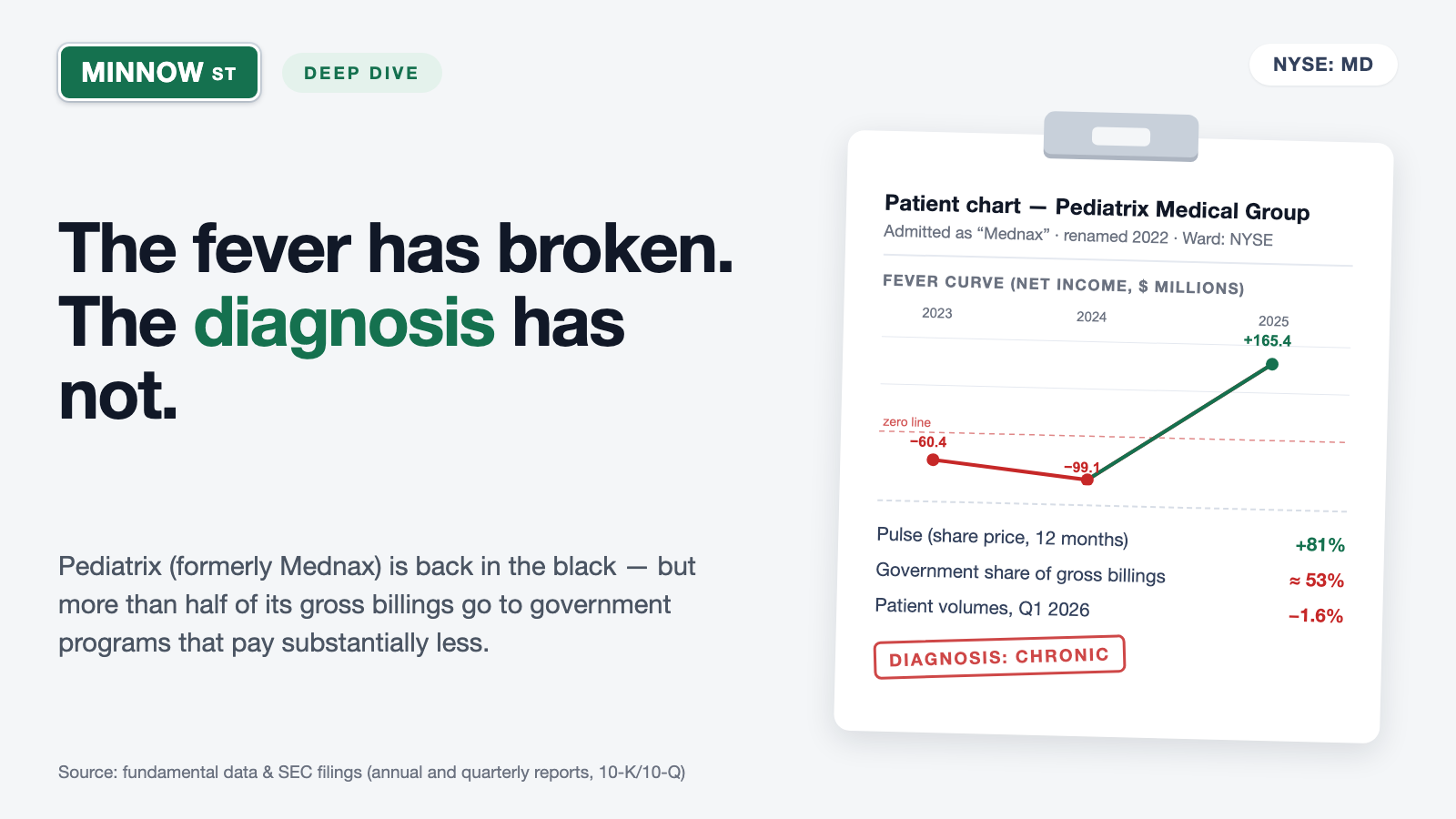
Pediatrix Medical Group surfaced in our Reddit hype scanner — under the name "Mednax", which has not existed since 2022 (2 mentions in 24 hours, as of July 15, 2026). We nailed down the identity in the SEC register and read the annual reports (10-K) for 2024 and 2025 plus the quarterly report (10-Q) as of March 31, 2026: a genuine profit turnaround to $165.4 million and a share price up about 81 percent in twelve months — but 53 percent of gross billings go to government programs that pay "substantially less", a law signed on July 4, 2025 cuts Medicaid, and patient volumes just shrank. Not investment advice — just the second opinion before the ward round.
 Thomas Mücke
Founder & Publisher
Thomas Mücke
Founder & Publisher
Chart
Interactive price chart (TradingView).
Note: pure fact-based analysis, not investment advice and not a solicitation to buy or sell. All figures without guarantee.
There is one glance that costs investors more money than any fee: the one into the rearview mirror. Psychologists call it the recency effect — whatever happened last feels like the normal state of the world, and a stock that has risen for twelve months feels like a stock that rises. Up about 81 percent in twelve months (data as of July 10, 2026) — that is the rearview mirror in which Pediatrix Medical Group (NYSE: MD) is currently gliding past the shop window. What caught our eye was a curiosity: our Reddit hype scanner logged 2 mentions in 24 hours (ApeWisdom, as of July 15, 2026) — under the name "Mednax". A company of that name has not existed since June 2022; the SEC register carries "MEDNAX, INC." only as a retired former name. So let's make a deal: before the rearview mirror decides, we first establish whom you would actually be buying — and then read together what this company reported, under penalty of law, to the U.S. securities regulator, the SEC: the annual reports (10-K) for 2024 and 2025 and the quarterly report (10-Q) as of March 31, 2026. In the end, you decide for yourself.
What Pediatrix actually does — and why the stock used to be called Mednax
Pediatrix is not a hospital chain and owns no clinics — it is a physician network: roughly 2,295 affiliated physicians provide newborn, maternal-fetal and pediatric subspecialty care across 37 states. The heart of it are 1,350 neonatologists — specialists for babies born prematurely or with complications — who staff and manage more than 360 neonatal intensive care units (NICUs) in 32 states around the clock; hospitals outsource the operation of these highly specialized wards to Pediatrix entirely. Add more than 475 maternal-fetal specialists for complicated pregnancies plus pediatric intensive care, hospital pediatrics and pediatric surgery teams. In many states the physicians are formally organized in separate "affiliated professional contractors" that Pediatrix steers through management contracts — a construction U.S. law ("corporate practice of medicine") requires. Translated: Pediatrix is the staffing department, billing office and operating company of American neonatal medicine. Of the roughly 3.6 million U.S. births a year, the company estimates 14 to 15 percent require NICU admission — and there are only about 7,200 board-certified neonatologists in the entire country. That is a narrow market with high barriers, and Pediatrix has been its largest player since 1979.
Which leaves the old name. From 2008 to 2022 the company traded as Mednax and had acquired its way into anesthesiology, radiology and telemedicine. That conglomerate was unwound — the anesthesiology and radiology groups were sold in 2020, in 2022 the company returned to its founding name Pediatrix, and 2024 brought the final cut: the exit from almost all office-based practices (except maternal-fetal medicine) and from the young primary and urgent care line was, per the annual report, completed by year-end 2024. What you would buy today is not the company in the rearview mirror but a smaller, focused core. Which brings us to the central tension of this analysis, and it runs through every chapter: the operating comeback is real — but it is a comeback of billing, not of patients. Volumes are falling, the birth rate is stagnating, and more than half of the bills go to a payer that pays substantially less and has just picked up the red pencil.
Where the stock shows up in our scanner
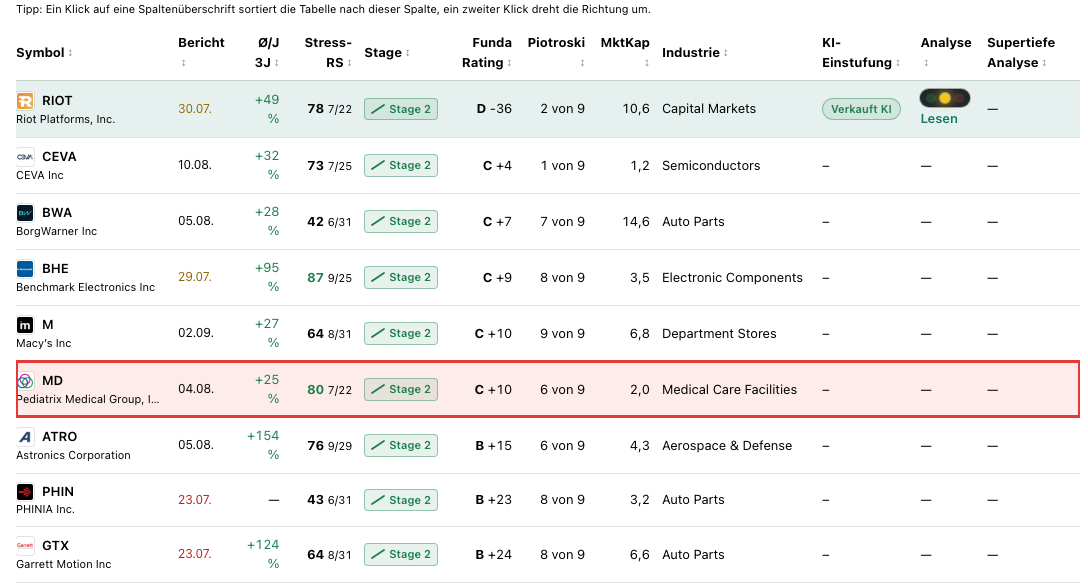
Every day we run about 3,500 stocks through our scanners. Pediatrix lights up in 15 filters as of the July 10, 2026 data cut-off — and the list reads like a single expert opinion titled "comeback in progress": a stage-2 uptrend in the Weinstein framework, price above the 50- and 200-day moving averages, near the 52-week high (only about 3.5 percent below it), "power trend", Antonacci-style "dual momentum", plus EPS acceleration and membership in the growth filter "Patrick Walker: 30% EPS growth" — earnings growth in the latest quarter ran at about 50 percent. The price: up 11.5 percent year to date, up 13.4 percent over six months, up 81 percent over twelve months (all data as of July 10, 2026). Whoever sees only this list buys. But the same scanner delivers the counter-opinions in the same breath: the fundamental grade is a C — average, not a quality stock —, the Piotroski F-Score (a nine-point test of balance-sheet quality) a decent but unspectacular 6 of 9. And among insiders, three sales stood against not a single purchase — one of the sellers being the chief executive (data as of July 10, 2026). Remember the fingerprint: momentum is buying a turnaround here that the company's own insiders are cashing in. We saw the same pattern from the other side at Sweetgreen, where momentum bought a turnaround that had not yet arrived in the numbers at all — Pediatrix at least delivers numbers; the question is what they are made of.
Two more readings belong on the table because they make the picture more honest. First: the Altman Z-score, a classic insolvency early-warning built from several balance-sheet ratios, sits around 5.2 — far outside the danger zone that historically begins below 1.8. Pediatrix is no shaky candidate; quite the opposite. Second: roughly all of the free float sits with institutional investors, led by BlackRock (16.5 percent) and Vanguard (13.1 percent; data as of July 10, 2026) — no Reddit crowd is betting here, this is index and quant money. The 2 Reddit mentions under the retired name are not a hype signal, just the reason we looked closer. The real question is the one the scanner itself poses: what is a momentum comeback worth if the fundamental grade stays a C?
The numbers over the years — honestly appraised
First, what genuinely impresses. Operationally, management has delivered, measurably: adjusted EBITDA — operating profit before depreciation, adjusted for one-offs — rose from $200.4 million (2023) via $224.0 million (2024) to $275.6 million (2025), two consecutive annual increases totaling 38 percent. Reported net income 2025: $165.4 million, or $1.94 per diluted share — after losses in both prior years. Operating cash flow from continuing operations climbed to $274.7 million, and because a physician network needs no factories, only $18.5 million of capital expenditures stood against it — leaving roughly $256 million of free cash flow. The balance sheet behind it: $499.7 million in cash and short-term investments against $596.9 million of debt ($400 million of it a 5.375 percent bond due 2030) — on a net basis the company is nearly debt-free. The money is flowing back to shareholders: in August 2025 the board authorized a new $250 million repurchase program, of which $83.8 million was already executed by year-end. Whoever reads only these paragraphs understands the 81 percent immediately. Now turn the patient chart over:
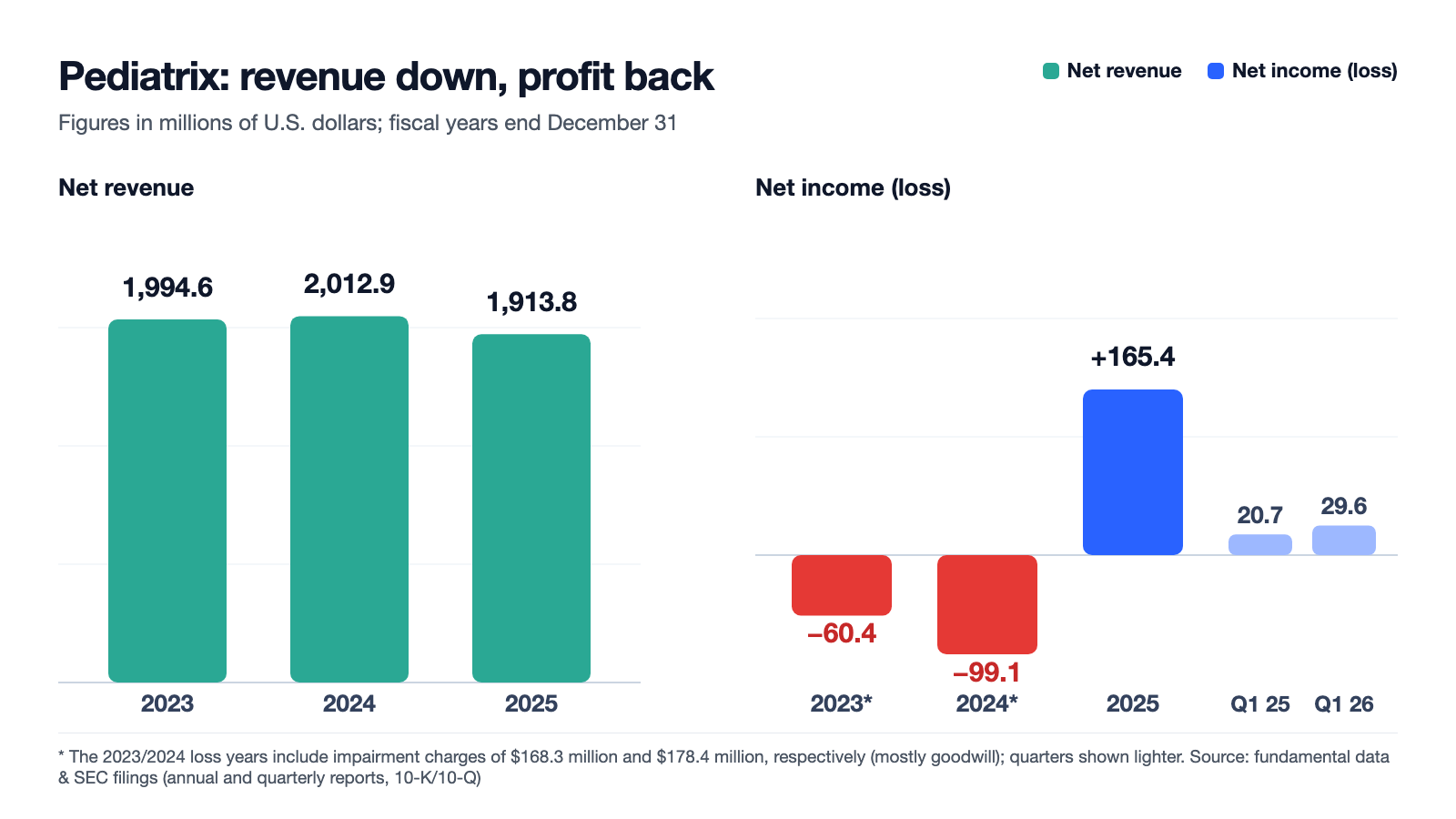
Because the same math has a second line: net revenue fell 4.9 percent to $1,913.8 million in 2025 — mainly because the divested practices no longer contribute. And the loss years 2023/2024 were not operating catastrophes but book-value confessions: 2023 was weighed down by $168.3 million of impairments (of which $148.3 million on goodwill — the capitalized premium of earlier acquisitions), 2024 by $178.4 million plus $9.7 million of disposal losses. So the 2025 profit turnaround is half honest work — better collections, tighter costs — and half simply the end of the write-downs. This deliberate shrink-to-focus playbook has a familiar shape: we dissected the same "smaller but healthier" arithmetic at Groupon. Remember the sentence: whoever values a comeback must know how much of it is healing and how much is merely the end of the diagnoses. Which brings us to the uncomfortable truths.
What the filings say — the uncomfortable truths
Uncomfortable truth no. 1: the biggest recipient of the bills is the government — which pays less and is cutting
The payor-mix table in the annual report looks reassuring at first glance: 70 percent of net revenue comes from private managed-care insurers, only 24 percent from the government. But two sentences further sits the line that flips the ratio — measured by gross billings, the government is the biggest recipient:
"For example, the gross amount billed to patients covered under GHC Programs for the years ended December 31, 2025 and 2024 represented approximately 53% of our total gross patient service revenue."
— Pediatrix Medical Group, SEC annual report 10-K for 2025, Item 7 MD&A "Payor Mix"

Fifty-three percent of the bills, 24 percent of the revenue — the gap in between is the discount the government grants itself. The report says it without ceremony: "Payments received from GHC Programs are substantially less for equivalent services than payments received from commercial insurance payors." For a company whose patients are newborns, that is not an accident but a system condition: Medicaid covers a large share of U.S. births — in Pediatrix strongholds like Texas all the more. And exactly this payer has just picked up the red pencil:
"For example, on July 4, 2025, President Trump signed into law the One Big Beautiful Bill Act, which reforms the Medicaid program by eliminating certain financial incentives for states that have expanded their Medicaid programs under the ACA, imposing work requirements on certain adult beneficiaries, and requiring states to increase patient cost-sharing amounts for certain services. These reforms to the Medicaid program could have a material impact on our business."
— Pediatrix Medical Group, SEC annual report 10-K for 2025, Item 1A "Risk Factors"

To be fair: the payor mix stayed stable in 2025, and infants and pregnant women are not directly hit by the new work requirements — Pediatrix's core patients are not the first to lose coverage. But the mechanics work indirectly: less federal Medicaid money for the states means pressure on reimbursement rates, stricter eligibility checks and more uninsured patients — and a company that sends more than half of its bills to these programs then negotiates against empty state coffers. Add a second regulatory lid: since 2022 the No Surprises Act has banned billing patients beyond in-network cost sharing for emergency care — and for neonatology such balance billing is never permitted, consent or not. This company's pricing power ends where its politics begin. Remember the image: Pediatrix runs the most expensive ward in the hospital — but half the price list is written by the government.
Uncomfortable truth no. 2: the core business is running out of patients — the growth comes from billing
The Pediatrix business model has one raw material no management team in the world can will into existence: births. The annual report devotes a dedicated risk factor to it — and it reads more soberly than the price chart suggests:
"Despite the slight increase in the number of total births in 2024, the birth rate has generally declined and future declines in births are possible, particularly if there is an economic recession, and could have an adverse effect on our patient volumes, net revenue, results of operations, cash flows, financial condition and the trading price of our securities."
— Pediatrix Medical Group, SEC annual report 10-K for 2025, Item 1A "Risk Factors"

What that feels like in practice, the latest quarterly report shows. Same-unit growth — what the same wards and practices bill compared with a year earlier — came to plus 2.8 percent in the first quarter of 2026. Sounds healthy. But the decomposition shows what it is made of:
"The increase in same-unit net revenue was comprised of an increase of $19.1 million, or 4.4%, from net reimbursement-related factors partially offset by $7.0 million, or 1.6%, related to patient service volumes."
— Pediatrix Medical Group, SEC quarterly report 10-Q as of March 31, 2026, Item 2 MD&A

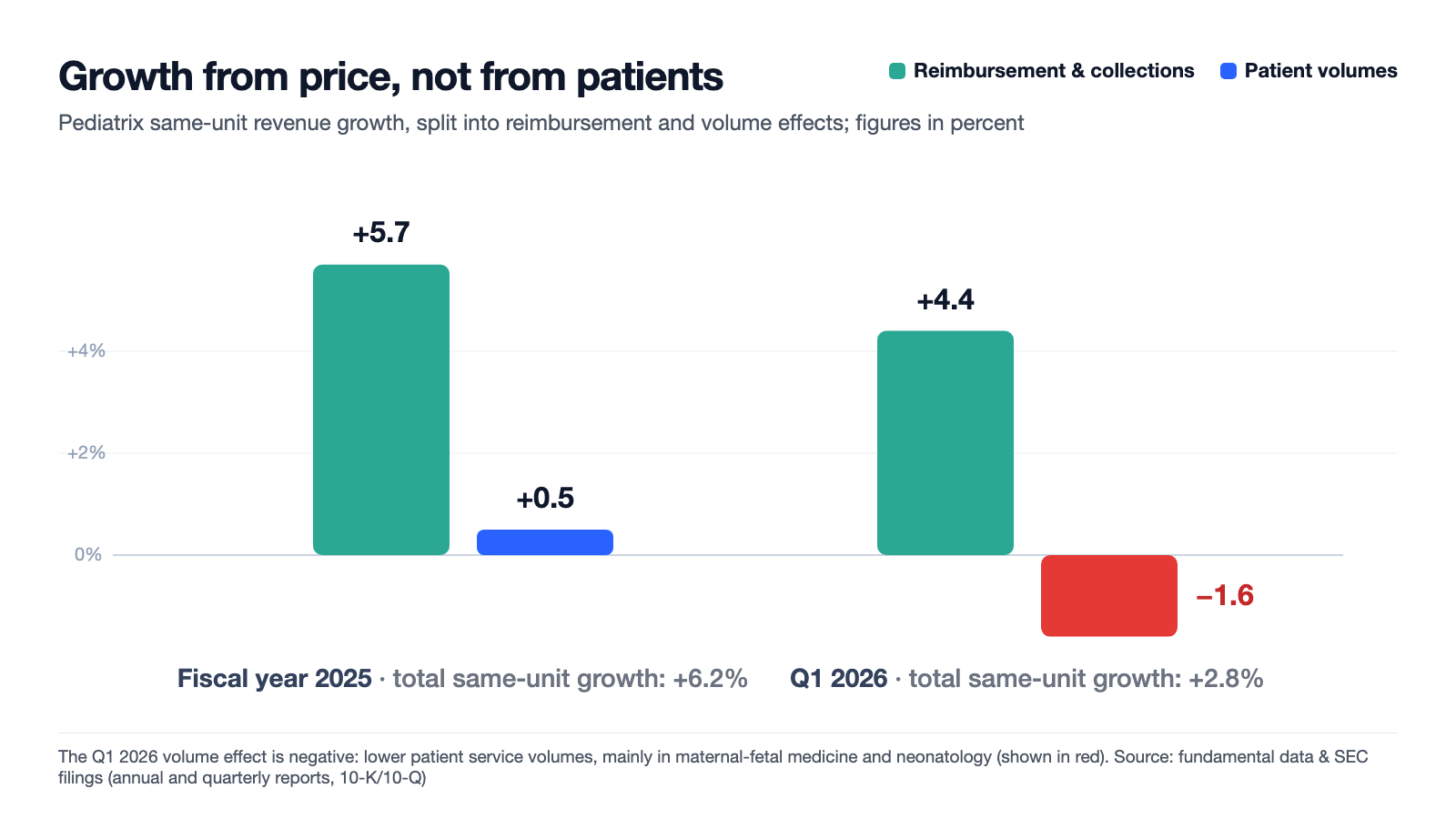
And per the report, the decline hit the crown jewels of all places: maternal-fetal medicine and neonatology. Already in full-year 2025, of 6.2 percent same-unit growth only 0.5 percentage points came from volume — the rest from better collections, higher patient acuity, hospital administrative fees and renegotiated contracts. None of that is improper; better billing is honest work. But it is finite: collection rates cannot be improved anew every year, contract rates cannot be renegotiated forever — at some point growth needs patients again. One quarter does not make a trend; that belongs to the truth. But the direction is uncomfortable: the machine runs better — the feedstock is thinning out.
Uncomfortable truth no. 3: 70 cents of every revenue dollar go to the physicians — and the market for them is tight
The cost side of a physician network is quickly told: practice salaries and benefits consumed about $1.34 billion in 2025 — 70.1 percent of revenue. In the first quarter of 2026 that ratio rose to 72.6 percent, because clinical compensation including performance bonuses increased. That is the flip side of a business model without factories: the working capital is people — highly specialized, scarce people. There are roughly 7,200 board-certified neonatologists in the entire United States; Pediatrix employs or contracts 1,350 of them and must defend them against hospitals, competing networks and plain attrition. The risk factors put it dryly: the company may not be able to recruit and retain qualified physicians, and compensation expense for existing clinicians may increase. For the valuation this means: of every additional reimbursement dollar that truths no. 1 and no. 2 laboriously bring in, the salary line structurally claims the largest part. The 10.9 percent operating margin (2025) is respectable for the industry — but it hangs on a labor market in which the seller sets the prices. Remember: at Pediatrix, the fixed assets go home to their families every evening — and can hand in their notice.
Uncomfortable truth no. 4: more than half the balance sheet is goodwill — and it has caught fire twice already
Which leaves the foundation. Total assets stood at about $2.25 billion at the end of 2025 — of which $1,260.7 million was goodwill, the capitalized premium of past acquisitions: 56 percent of the entire balance sheet. How real that position is, the years 2023 and 2024 have answered: $148.3 plus $150.6 million of goodwill impairments, plus $27.8 million on other long-lived assets and $20 million on a strategic investment — in two years, write-downs of roughly $347 million erased both annual results. That was the bill for the Mednax-era shopping spree. To be fair: the remaining goodwill sits on the profitable core business, the equity ratio is still around 39 percent ($865.9 million of equity), and net debt is minimal — this is no pledged-brand situation, but a solid balance sheet with one large soft position. Still, the cash flow statement contains a reminder worth keeping: the return to the acquisition playbook has begun — $23.2 million of acquisition payments in 2025, again for physician practices. It is the same growth recipe that piled up the goodwill mountain in the first place, just in smaller portions. Remember the tension in one number: every dollar of equity carries $1.46 of goodwill.
Valuation: $1.95 billion of market value — the comeback is half paid for
In early July 2026 the Pediatrix stock cost about $24, for a market value of roughly $1.95 billion (data as of July 10, 2026). Against the 2025 net income of $165.4 million that is a price-to-earnings ratio around 12; against roughly $256 million of free cash flow about 8 times — and because cash and debt nearly cancel out, enterprise value barely exceeds market value: about 7.5 times the $275.6 million of adjusted EBITDA. That is not comeback-euphoria pricing; healthy healthcare service companies often fetch 10 to 14 times. The analyst consensus — eight houses cover the stock — leans clearly toward buying, with expected earnings around $2.28 per share for the current year (data as of July 10, 2026), which pushes the forward P/E toward 10 to 11. Whoever instead consults the rearview mirror and takes the all-time high as a target should know: the roughly 72 percent distance to it dates from the Mednax era — when the company, anesthesiology and radiology included, had nearly twice the revenue. The anchor from back then values a company that no longer exists. Which leaves the sober question: is a P/E of 12 cheap for a business whose biggest bill recipient is cutting and whose volumes just shrank? Or fair for a nearly debt-free cash machine with a market position that cannot be copied? Both are defensible — which may be exactly why some insiders sold while the analysts see upside. You can find more metrics and ratings in the Pediatrix company profile of our scanner.
Opportunities and risks at a glance
What speaks for Pediatrix:
- Market leader in a market with high barriers: more than 360 staffed and managed NICUs in 32 states, 1,350 of the country's roughly 7,200 board-certified neonatologists, long-standing hospital contracts — and NICU services are typically covered as emergency services (annual report 10-K for 2025).
- The turnaround delivers measurably: adjusted EBITDA $200.4 → $224.0 → $275.6 million (2023–2025), net income $165.4 million in 2025, Q1 2026 up 43 percent to $29.6 million; operating cash flow of $274.7 million against only $18.5 million of capital expenditures.
- Solid balance sheet: $499.7 million in cash and short-term investments against $596.9 million of debt (bond not due until 2030), Altman Z around 5.2, equity ratio around 39 percent; a new $250 million buyback program since August 2025 ($83.8 million already executed; figures as of 12/31/2025).
- Moderate valuation despite the rally: P/E around 12, price-to-free-cash-flow around 8, enterprise value about 7.5 times adjusted EBITDA; analyst consensus (8 houses) clearly on the buy side (data as of July 10, 2026).
- Focusing completed: the office-based and primary/urgent care exits were, per the annual report, completed by the end of 2024 — management can concentrate on the profitable hospital network and small targeted acquisitions ($23.2 million in 2025).
What speaks against it:
- The government as the biggest bill recipient: 53 percent of gross billings go to government programs that pay "substantially less" (only 24 percent of net revenue); the One Big Beautiful Bill Act of July 4, 2025 cuts Medicaid — the report warns of a possible "material impact"; the No Surprises Act categorically bans balance billing in neonatology.
- Volumes and demographics: the U.S. birth rate is in structural decline per the risk factors; same-unit patient volumes fell 1.6 percent in Q1 2026 (in maternal-fetal medicine and neonatology of all places) — all growth came from reimbursement and collections.
- A cost structure without slack: 70.1 percent of revenue goes to practice salaries and benefits (Q1 2026: 72.6 percent), a tight specialist labor market, rising clinical compensation including bonuses.
- Concentration risks: Texas 32 percent of net revenue, five states 64 percent; goodwill of $1,260.7 million = 56 percent of total assets after $347 million of impairments already taken in 2023/2024.
- Mixed signals after the rally: three insider sales without a single purchase (including the chief executive), fundamental grade C, Piotroski 6 of 9 — the momentum (up 81 percent in twelve months) already prices in a lot of turnaround (data as of July 10, 2026).
A human conclusion
Back to the rearview mirror from the opening. It shows two things, and both are true: a stock that rose 81 percent in twelve months — and a company that delivered for it. The Pediatrix profit turnaround is not accounting cosmetics: adjusted operating profit has grown for two consecutive years, the cash nearly covers the debt, and the business — neonatal intensive care through the country's largest physician pool — has barriers no competitor can build overnight. But the rearview mirror does not show the road ahead. And on that road stand three signs, all taken from the company's own SEC filings: a main payer that pays substantially less for the same service and is being cut further by the law of July 4, 2025; patient volumes that just shrank while only the billing grew; and a salary line that claims 70 cents of every dollar. None of this is cause for panic — a P/E around 12 pays for no perfection, and an Altman Z of 5.2 says there is time enough. But it explains why insiders sold right now, while the scanner reports momentum fifteen times over. So check what exactly you are buying: the chart in the rearview mirror — or the company on the patient chart, whose fever has broken and whose diagnosis remains. What you make of it is your decision. And that is exactly as it should be.
Sources
All original documents used in this analysis — for your own reading:
- Pediatrix Medical Group — SEC annual report 10-K for 2025 (filed February 19, 2026)
- Pediatrix Medical Group — SEC annual report 10-K for 2024 (filed February 20, 2025)
- Pediatrix Medical Group — SEC quarterly report 10-Q as of 03/31/2026 (filed May 5, 2026)
- Pediatrix Medical Group — SEC quarterly report 10-Q as of 09/30/2025 (filed November 3, 2025)
- Pediatrix Medical Group — SEC quarterly report 10-Q as of 06/30/2025 (filed August 5, 2025)
- Pediatrix Medical Group — SEC quarterly report 10-Q as of 03/31/2025 (filed May 6, 2025)
- Identity and former names (MEDNAX, INC. 2008–2022): SEC EDGAR filing overview for CIK 0000893949 (sec.gov)
- Fundamental data (metrics, quarterly series, valuation; data as of July 10, 2026), cross-checked against the SEC filings.
- Screener and rating data: in-house stock scanner (data as of July 10, 2026); Reddit mentions: ApeWisdom (as of July 15, 2026).
Transparency & disclaimer: This analysis is a journalistic contextualization of publicly available information and is not investment advice, not a financial analysis in the regulatory sense, and not a solicitation to buy or sell securities. Stock investments carry substantial risks up to and including total loss. All information without guarantee; the data cut-off is noted in the text. The author holds no position in Pediatrix shares at the time of publication.
Our Bottom Line at a Glance
- Business model & market position positive
- The largest neonatology network in the U.S.: 1,350 of the country's roughly 7,200 board-certified neonatologists, more than 360 staffed and managed NICUs in 32 states, long-standing hospital contracts — an asset-light business with high barriers to entry (annual report 10-K for 2025).
- Turnaround & cash flow positive
- Adjusted EBITDA up two years in a row ($200.4 → $224.0 → $275.6 million, 2023–2025), net income of $165.4 million after two loss years, Q1 2026 up 43 percent; operating cash flow of $274.7 million against $18.5 million of capex, cash nearly covers the debt, a $250 million buyback program is running.
- Payor structure & politics negative
- About 53 percent of gross billings go to government programs that per the report pay "substantially less" (only 24 percent of net revenue); the One Big Beautiful Bill Act of July 4, 2025 cuts Medicaid with a possible "material impact" per the report; the No Surprises Act categorically bans balance billing in neonatology; Texas bundles 32 percent of revenue.
- Volumes & demographics negative
- The U.S. birth rate is in structural decline per the risk factors; same-unit patient volumes fell 1.6 percent in the first quarter of 2026 (maternal-fetal medicine and neonatology) — growth came entirely from reimbursement and collection factors (+4.4 percent) that cannot be repeated at will; 70.1 percent of revenue is tied up in practice salaries.
- Valuation & signals neutral
- P/E around 12, price-to-free-cash-flow around 8, EV/adjusted EBITDA around 7.5 — moderate for the quality, but after an 81 percent twelve-month rally no longer a crisis price; analyst consensus (8 houses) on the buy side against three insider sales without a single purchase, fundamental grade C and a Piotroski score of 6 of 9 (data as of July 10, 2026).
Pediatrix is a successful turnaround with a chronic underlying condition: adjusted operating profit has grown for two consecutive years, the balance sheet is nearly debt-free on a net basis, and the NICU network holds a market position that cannot be copied. But more than half the bills go to government programs that pay substantially less and are being cut by law since July 4, 2025, patient volumes just shrank, and 70 cents of every revenue dollar are tied up in physician pay. After an 81 percent rally, a good part of the recovery is already paid for — insiders sold while analysts recommend buying. Not investment advice.
What Our Rating Means
- If you don't own the stock
- As long as the question raised in the bottom line stays open, we see no basis for an entry.
- If you hold it in your portfolio
- Our findings offer no acute reason to sell — the checkpoints named remain decisive.
A journalistic assessment by our editorial team at the time of the deep dive, based on public sources — not investment advice and not a solicitation to buy or sell. Your personal circumstances (investment goals, risk capacity, taxes) cannot be taken into account. What our categories mean, how verdicts are formed, and what conflicts of interest exist →
Worth Noting
- MD reached our research list via the Reddit hype scanner (ApeWisdom, 2 mentions in 24 hours, as of July 15, 2026) — still listed there under the name "Mednax", retired in 2022; the identity was verified via the SEC register (CIK 0000893949, former names).
- The 15 hits in our in-house stock scanner carry the July 10, 2026 data cut-off and rotate daily; scanner metrics are computed from trailing twelve-month figures and reflect Q1 2026 effects only with a lag.
- Price and valuation figures are dated to July 10, 2026 (about $24, market value roughly $1.95 billion); analyses are evergreen, daily prices are not a buy argument.
Frequently Asked Questions
Pediatrix (NYSE: MD) runs a network of about 2,295 affiliated physicians in 37 states — above all 1,350 neonatologists who staff and manage more than 360 neonatal intensive care units (NICUs) for hospitals. It bills insurers and government programs per case and also collects hospital administrative fees. Revenue 2025: $1.91 billion, net income $165.4 million.
The company traded as Mednax from 2008 until June 2022, having acquired anesthesiology and radiology businesses. After selling those in 2020 it returned to its founding name Pediatrix Medical Group in 2022; the SEC register carries "MEDNAX, INC." only as a former name. Some data providers — including the Reddit tracker ApeWisdom — still listed the stock under the old name in July 2026.
More than the revenue mix suggests: government programs such as Medicaid delivered only 24 percent of 2025 net revenue but accounted for about 53 percent of gross billings — per the annual report (10-K) they pay "substantially less" than commercial insurers. On top, Texas alone bundles 32 percent of revenue, which ties the company to the Medicaid politics of individual states.
The law signed on July 4, 2025 cuts Medicaid: incentives for states with expanded Medicaid are eliminated, work requirements and higher patient cost-sharing arrive. Pediatrix warns in its 2025 annual report that the reforms "could have a material impact on our business." Newborns and pregnant women are not directly affected, but lower reimbursement rates and more uninsured patients threaten indirectly.
Because the turnaround is measurable: after losses in 2023 (−$60.4 million) and 2024 (−$99.1 million, both weighed down by impairments), Pediatrix earned $165.4 million in 2025; adjusted EBITDA rose for the second consecutive year to $275.6 million. The stock gained about 81 percent in twelve months (data as of July 10, 2026) — yet still sits about 72 percent below the all-time high of the Mednax era.
Nearly debt-free on a net basis: $499.7 million in cash and short-term investments stood against $596.9 million of debt at the end of 2025 (a $400 million bond at 5.375 percent due 2030); the Altman Z-score sits around 5.2. The soft spot: $1,260.7 million of goodwill makes up 56 percent of total assets — and about $299 million of it already had to be written off in 2023/2024.
Measured against 2025 earnings the stock costs a P/E around 12, about 8 times free cash flow and roughly 7.5 times adjusted EBITDA (market value $1.95 billion, data as of July 10, 2026) — moderate for a market leader, but no longer a bargain after an 81 percent rally. The analyst consensus (8 houses) leans to the buy side; three insider sales without a single purchase advise sobriety.
Found an error?
Did you spot a factual error, an outdated number, or a typo in this deep dive? Let us know briefly — your report goes straight to the editorial team.