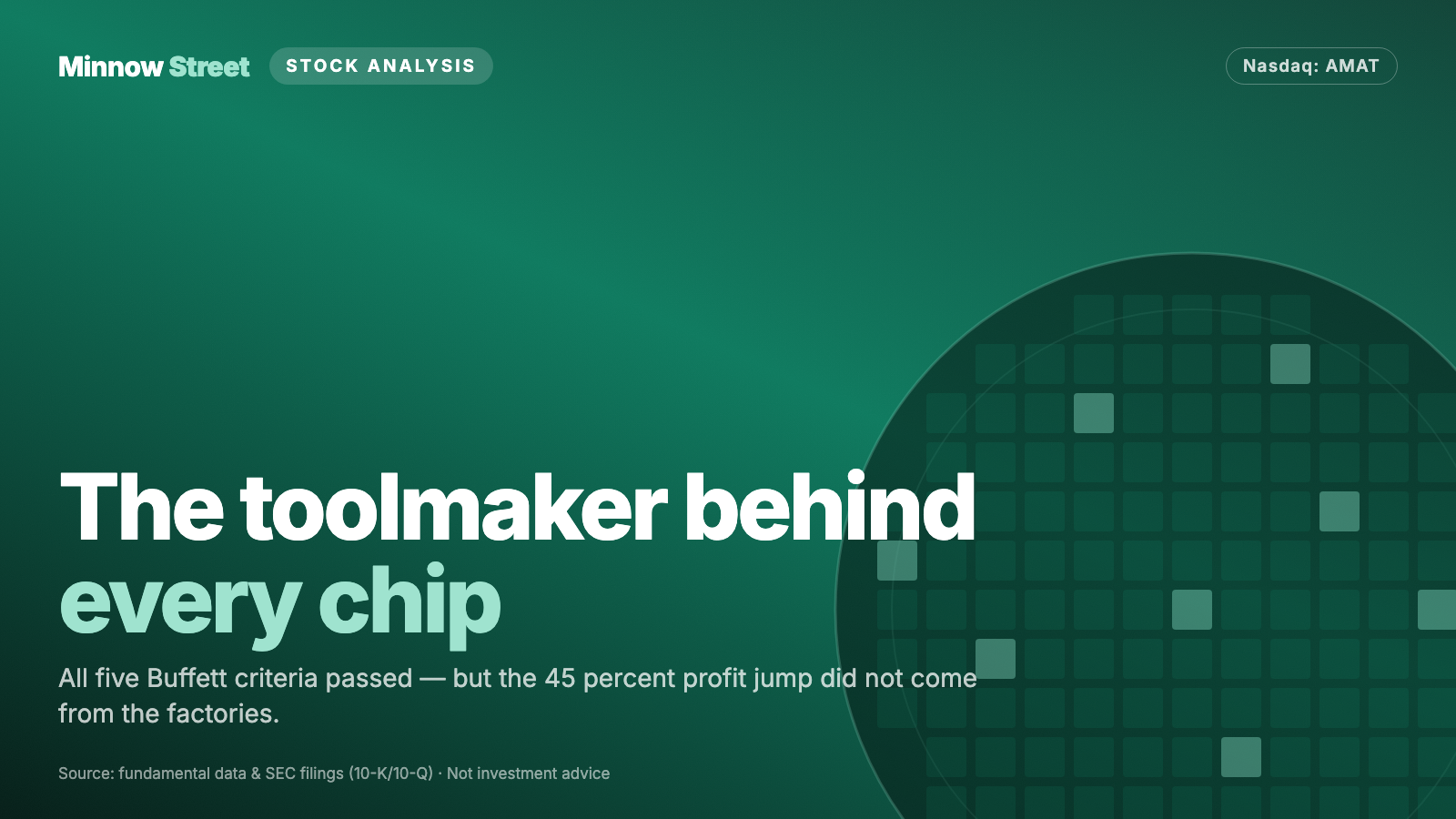
Applied Materials Stock: Straight A's on All Five Buffett Criteria — but the 45 Percent Profit Jump Didn't Come From the Factories
Applied Materials builds the machines without which no chip in the world gets made — and it passes all five tests in our in-house Buffett criteria scanner: rank 8 of the U.S. selection (as of July 18, 2026). We read the annual reports (10-K) and the quarterly reports (10-Q) through April 26, 2026: a world-class balance sheet with a 40 percent return on equity — but also a half-year profit that jumped 45 percent while operating income barely moved, a $253 million penalty for China shipments, and a valuation near 59 times earnings. Not investment advice — just a reminder that a screen is a sieve, not a blessing.
 Thomas Mücke
Founder & Publisher
Thomas Mücke
Founder & Publisher
Chart
Interactive price chart (TradingView).
Note: pure fact-based analysis, not investment advice and not a solicitation to buy or sell. All figures without guarantee.
There is an investor trap that is especially well camouflaged because it feels like diligence: the guarantor trap. It works like this: a great name appears to vouch for a stock — "passes the Buffett criteria," "Graham would have bought this," "a Munger kind of business" — and from that moment on, your brain stops examining the company and starts trusting the guarantor. The treacherous part: the guarantor has no idea. A checklist from a book is a sieve, not a blessing. Applied Materials, Inc. (Nasdaq: AMAT) is the perfect test case: in our in-house Buffett criteria scanner, the stock passes all five tests and ranks no. 8 of the U.S. selection (as of July 18, 2026). So let's make a deal: before you outsource your homework to the most famous name in stock market history, we read together what the company itself filed, under penalty of law, with the U.S. securities regulator, the SEC — the annual reports (10-K) for fiscal years 2025 and 2024 and the quarterly reports (10-Q) through April 26, 2026. Both things are in there: one of the best balance sheets we have ever covered in this series. And a 45 percent profit jump of which, on close inspection, only 0.2 percentage points came from the operating business. In the end, you decide whom to trust here.
What Applied Materials actually does — the toolmaker behind every chip
Applied Materials, founded in 1967 and headquartered in Santa Clara, California, is the world's largest maker of semiconductor manufacturing equipment, with about 36,500 employees (as of October 26, 2025). The company calls its field "materials engineering": machines that deposit, remove, dope and measure wafer-thin layers of material on silicon — the process steps from which a chip is made in the first place. Its own claim in the annual report is immodest and still fairly accurate: the leader in the solutions used to produce "virtually every semiconductor in the world." Important framing: Applied Materials sells neither chips nor artificial intelligence — it sells the factory equipment to those who build both: foundries, logic and memory chipmakers. In our company-by-company AI rating we accordingly file the company under "uses AI": its own filings describe AI as a demand driver and as a tool inside products and operations, not as a revenue source. Reporting comes in two segments plus a remainder: Semiconductor Systems (new equipment, $20.798 billion of fiscal 2025 revenue, 73 percent), Applied Global Services (service, spares and upgrades for the installed fleet, $6.385 billion, 23 percent) and "Corporate and Other" (mostly display equipment, $1.185 billion). One quirk that helps with reading the numbers: the fiscal year ends on the last Sunday in October — "fiscal 2025" ended on October 26, 2025, and the current "fiscal 2026" is already half over by mid-2026.
How tightly this toolmaker is wired into the AI build-out is something we have covered from two other angles in this series: at direct competitor Lam Research, which sits higher in the same scanner, and at memory maker Micron, which sits on the customer side of such machines. Which brings us to the central tension of this analysis, running through every chapter: The quality report card is real — margins, balance sheet and cash flow are world class. But the latest profit surge comes mostly from a stock portfolio and a tax effect, a third of revenue hangs on two customers, and the valuation has detached itself from the machinery business.
Where the stock shows up in our scanner
Every day we run roughly 3,500 stocks through our scanners. As of July 18, 2026, Applied Materials has two hits, and the first is the reason for this analysis: rank 8 in the Buffett criteria scanner (U.S. selection, 25 U.S. hits of 104 total). To replicate it yourself: open the scanner, set the country filter to "US" — Applied Materials sits in the top third of the list. The scanner tests the five screenable criteria from Mary Buffett's "Buffettology," and it is worth translating them one by one, because AMAT passes every single one with room to spare: a return on equity of about 40 percent (required: at least 15 — $100 of equity generates $40 of annual profit here), a debt-to-equity ratio of 0.32 (allowed: up to 0.5 — only 32 cents of financial debt per dollar of equity), an EBIT margin around 32 percent (required: 10 — of every revenue dollar, 32 cents remain as operating profit), positive earnings per share rising from the oldest to the newest of all six recorded quarters ($1.45 to $3.51), and clearly positive free cash flow. The second hit provides confluence: the Altman-Z balance fortress scanner, with a Z-score around 13.6 — a bankruptcy early-warning gauge whose danger zone starts below 1.8; 13.6 is about as far from that as an industrial company can get without net debt. Add a Piotroski F-Score of 7 of 9 (a nine-point test of the direction of the books — 7 is good; rock-solid starts at 8). But remember the principle, because it is the connecting thread of this piece: A criteria sieve tests the company of yesterday and today — not today's price, and not the source of tomorrow's profit. That is exactly why we now read the filings.
The numbers over the years — honestly appraised
First, what genuinely impresses — and there is a lot of it. Applied Materials does not grow spectacularly, but with a steadiness that has few equals in the cyclical semiconductor equipment industry: revenue of $26.517 billion (fiscal 2023), $27.176 billion (2024), $28.368 billion (2025, up 4 percent) — the third record in a row. Gross margin climbed from 46.7 to 47.5 to 48.7 percent along the way, and operating income reached $8.289 billion (29.2 percent margin). Operating cash flow in fiscal 2025 was $7.958 billion; after $2.3 billion of capital expenditures, roughly $5.7 billion of free cash flow remained. And the current fiscal year keeps delivering: in the second quarter (through April 26, 2026), revenue rose 11 percent to $7.910 billion, the core segment's gross margin hit 54.7 percent, and the order and service backlog already stood at $15.0 billion at the end of fiscal 2025. A second, often overlooked stabilizer: the services business, Applied Global Services — maintenance, spares and long-term contracts for the globally installed fleet — contributes almost half of that backlog and grew 17 percent in the second quarter; like an elevator company, Applied keeps earning on the service contract even when nobody is ordering new elevators. So much for the report card the Buffett scanner sees. Now for what it does not see:
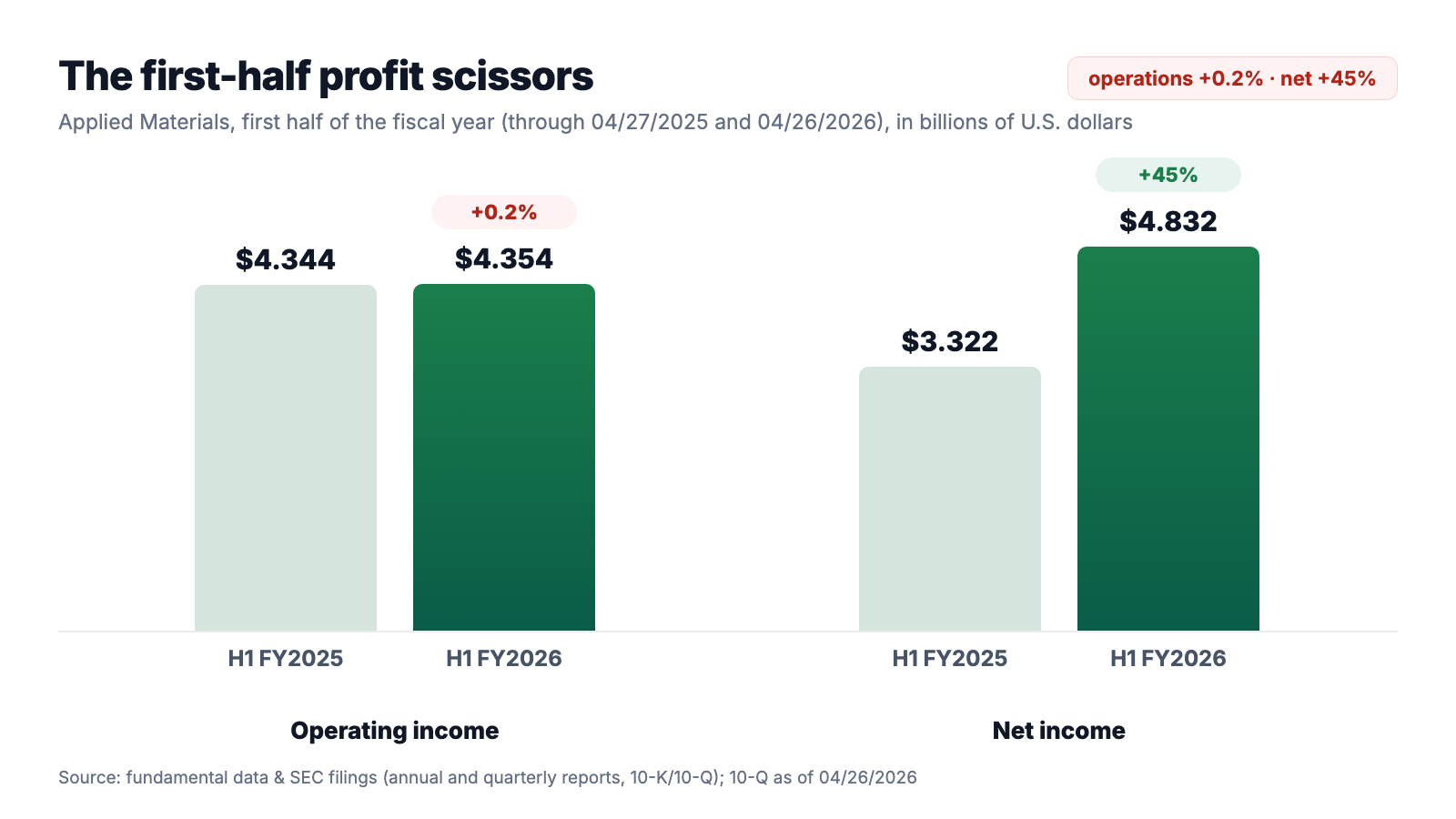
In the first half of fiscal 2026 (through April 26, 2026), Applied Materials reported $4.832 billion of net income — up 45 percent year over year. Operating income over the same period: $4.354 billion after $4.344 billion — up 0.2 percent. A scissors of 45 versus 0.2 does not open on the factory floor. Where it opens is the subject of the next chapter — and it is the most important finding of this analysis. Remember the image: The sieve measures that profit is rising. It does not ask what the profit is made of.
What the filings say — the uncomfortable truths
Uncomfortable truth no. 1: The profit jump comes from the portfolio and the tax line — not from operations
The quarterly report names the driver of the profit jump itself, in a single dry sentence:
"Interest and other income (expense), net in the three and six months ended April 26, 2026 increased compared to the same periods in the prior year, primarily driven by higher net unrealized gain on equity investments."
— Applied Materials, Inc., SEC quarterly report 10-Q as of April 26, 2026, Item 2 "Management's Discussion and Analysis"
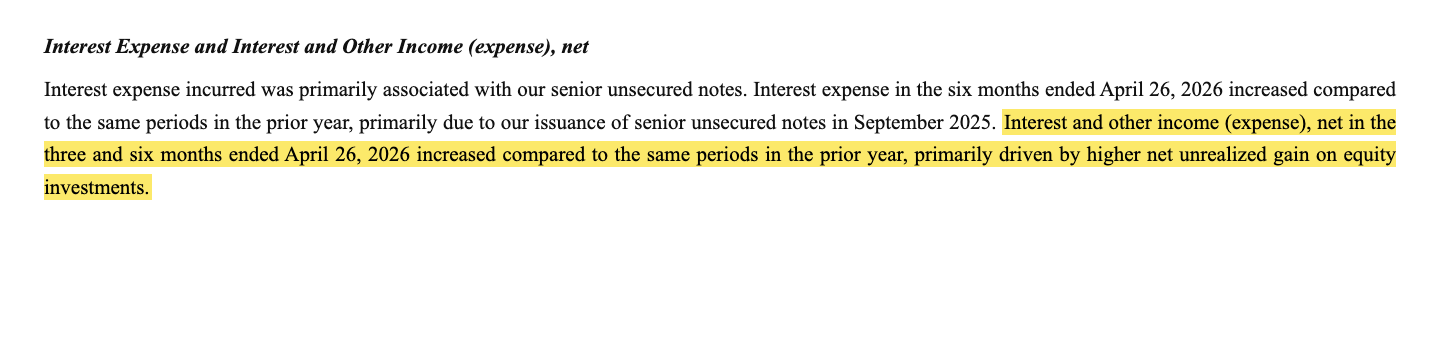
The numbers behind it: the line "interest and other income" exploded from $229 million to $1.337 billion in the half-year — including $1.157 billion of unrealized gains on publicly traded stocks the company holds in its portfolio (cost basis $965 million, market value $2.248 billion at the balance sheet date; which stocks they are, the report does not say). "Unrealized" means: nothing was sold, no cash came in — U.S. accounting rules require the price swings of such positions to run straight through the income statement. Then there is the second lever: the tax rate fell from 25.2 to 13.0 percent — the prior year was distorted by a one-off, as the first quarter of fiscal 2025 carried an extraordinary 44.1 percent rate from the remeasurement of deferred tax assets tied to new tax incentive agreements in Singapore. Strip both effects out, and almost nothing of the 45 percent jump remains: operations grew 0.2 percent — solid, but no breakout. None of this is illegal or hidden; it is all in the filing. But a stock portfolio works in both directions: the same accounting that just poured $1.2 billion into net income will pull it back out in the next correction. Growth the stock market lends you, the stock market can recall at any time.
Uncomfortable truth no. 2: A $253 million penalty for China shipments — and an export ban that is merely suspended
The second footnote no scanner in the world sees sits under "Legal Matters" in the quarterly report:
"As previously disclosed, on February 11, 2026, we entered into a settlement agreement with the U.S. Commerce Department Bureau of Industry and Security (BIS) to resolve its inquiry relating to certain China customer shipments and export controls compliance and agreed to pay BIS an amount of $253 million, which we paid in full during our second quarter of fiscal 2026."
— Applied Materials, Inc., SEC quarterly report 10-Q as of April 26, 2026, Note 13 "Guarantees, Commitments and Contingencies" (Legal Matters)
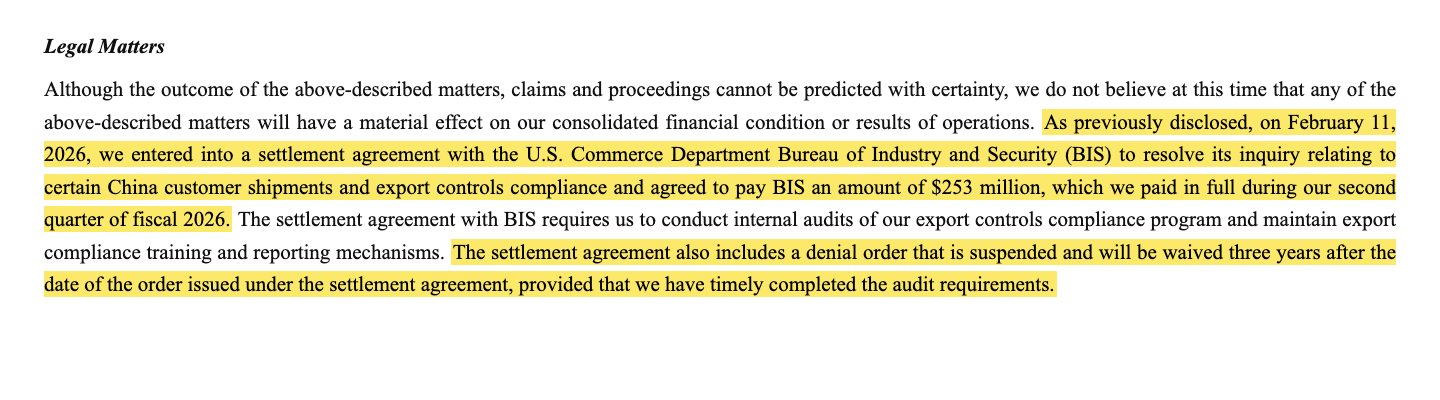
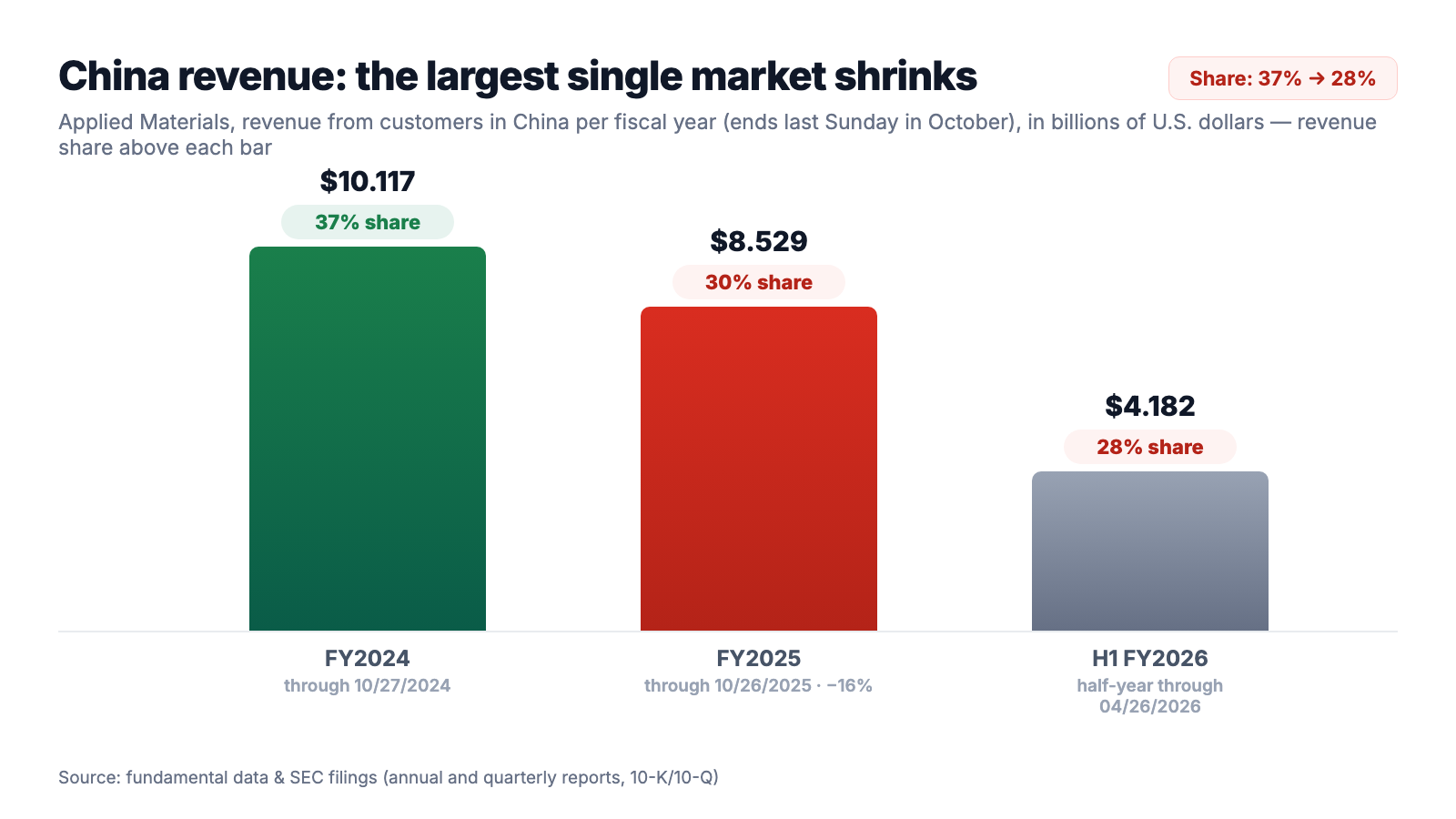
The $253 million is digestible — it equals a bit over one percent of annual revenue and shaved about two points off the core segment's half-year margin. The real risk is in the sentence that follows: the settlement includes a denial order that is merely suspended — it is only waived three years after issuance, and only if Applied Materials completes the agreed internal audits of its export controls program on schedule. A denial order is the sharpest instrument of U.S. export enforcement: an outright ban on exporting certain products. In everyday terms: the company did not just pay a fine — it is now driving with a probationary license for three years, where the next violation takes the license away. And the license here is the China business: $8.529 billion of revenue, 30 percent of the company in fiscal 2025 (prior year: $10.117 billion and 37 percent — the export controls are already biting).
Uncomfortable truth no. 3: Two customers pay a third of the bill — and the AI boom is, by the company's own filing, hard to forecast
Who buys these machines? The annual report names no names, but it does name a number that should make you pause:
"During fiscal 2025, two customers accounted for approximately 19% and 15%, respectively, of our net revenue."
— Applied Materials, Inc., SEC annual report 10-K for fiscal year 2025, Item 1 "Business" (Customers)
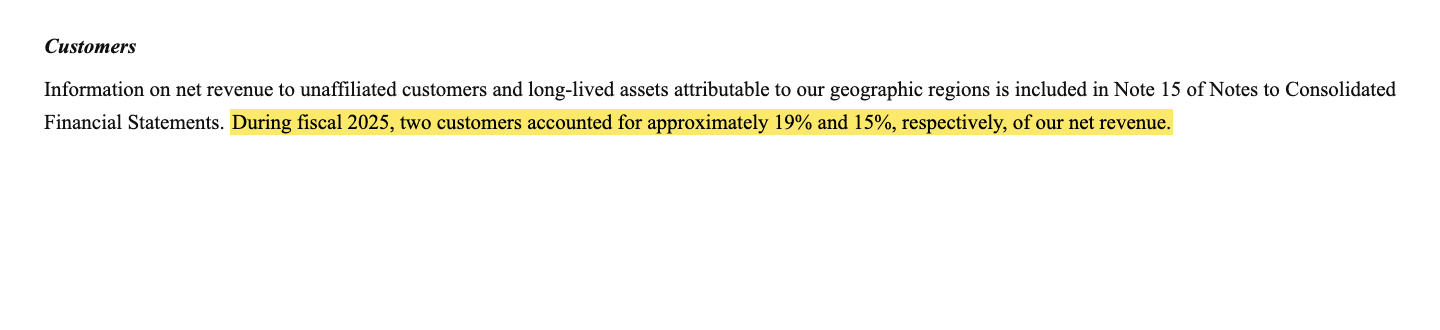
A combined 34 percent of revenue from two buyers — picture a baker who sells every third roll to just two wholesale customers: their construction plans decide his year. This is structural in the industry (only a handful of companies worldwide build multi-billion-dollar fabs), and you can guess the names behind it — the filing deliberately does not provide them. But the concentration has been rising: in fiscal 2024, the two largest customers stood at 12 and 11 percent. The same filing also tells you how dependable the AI demand driving those customers is — with a candor you have to credit the company for:
"Artificial intelligence (AI) and technologies related to AI are a significant demand driver for the industries we serve. AI is evolving rapidly and the expected timing and amount of investments related to AI can change significantly. As a result, it is difficult to accurately forecast demand for our products related to AI."
— Applied Materials, Inc., SEC annual report 10-K for fiscal year 2025, Item 1A "Risk Factors" (Business and Industry Risks)
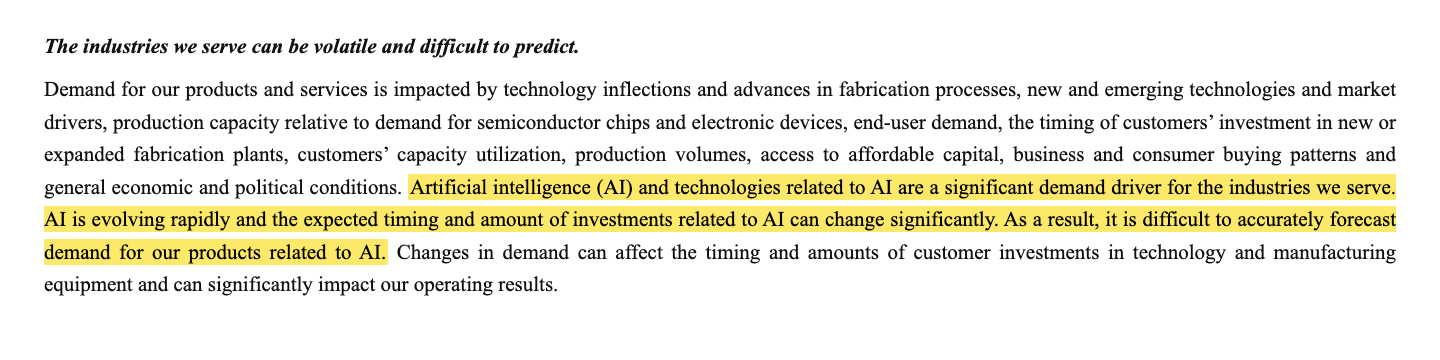
Hold these three facts next to each other: AI demand that is hard to forecast, two customers with 34 percent of revenue, and a China business of 30 percent under export supervision with probation conditions. Each of these dependencies is manageable on its own — together they explain why a company with this balance sheet quality remains a cyclical. For a reminder of what that cycle looks like from the inside, look one level deeper in the supply chain: in our Benchmark analysis, Applied Materials itself appears as the anchor customer on whom every seventh invoice of that contract manufacturer depends. Concentration runs through this industry like a watermark — at every level.
Valuation: What the market charges for the report card
Now for the price tag. In mid-July 2026 the Applied Materials share cost about $670, for a market value around $530 billion (all valuation figures: data as of July 18, 2026) — after a share-price gain of roughly 245 percent in twelve months. That works out to: a price-to-earnings ratio near 59 (on trailing twelve-month earnings), a price-to-sales ratio near 18, a price-to-book ratio near 22 and a price to free cash flow near 99. For context: for long stretches of the past decade, the equipment maker traded at 15 to 25 times earnings; the current multiple prices the machinery company like a software growth stock. And here it is worth watching what the company does with its own money: share repurchases were throttled to $737 million in the first half of fiscal 2026 (prior-year period: $2,999 million; just $400 million in the second quarter after $1,685 million) — against an open authorization of $13.2 billion. In fiscal 2025, at much lower prices, the same company bought back $4.9 billion. No official reason is given; as a quiet valuation verdict from management, it reads clearly enough. The dividend was raised 15 percent to $0.53 per quarter in March 2026 — about a 0.3 percent yield at the current price. The 39 analysts tracked by the data provider average a "buy" (consensus 1.2 on a scale where 1 means "strong buy") — the professionals' view is unanimously optimistic; for a stock that has just three-and-a-half-folded, unanimity is more choir than second opinion.
Opportunities and risks at a glance
What speaks for Applied Materials:
- Quality that passes all five Buffett criteria with room to spare: return on equity around 40 percent, debt-to-equity 0.32, EBIT margin around 32 percent, six quarters of rising earnings, positive free cash flow (data as of July 18, 2026) — plus an Altman-Z around 13.6 and a Piotroski score of 7 of 9.
- Three revenue records in a row ($26.5 → $27.2 → $28.4 billion, fiscal 2023–2025) with a rising gross margin (46.7 → 48.7 percent); Q2 of fiscal 2026 up 11 percent with a 54.7 percent segment gross margin.
- The service anchor: Applied Global Services ($6.4 billion of fiscal 2025 revenue, up 17 percent in the latest quarter) and a $15.0 billion backlog smooth the equipment cycle.
- The AI build-out as structural tailwind: no new fabs, no AI chips — and virtually no fab gets built without Applied Materials equipment; $3.570 billion of fiscal 2025 R&D spending defends that position.
- Capital discipline: essentially zero net financial debt ($12.9 billion of cash and investments as of October 26, 2025), a 15 percent dividend hike, and buybacks that were not forced at record prices.
What speaks against it:
- The earnings quality of the current year: of the 45 percent first-half jump, only 0.2 percentage points came from operations — the rest from $1.157 billion of unrealized portfolio gains and a tax rate that fell from 25.2 to 13.0 percent; both effects can reverse.
- Regulatory probation risk: a $253 million BIS settlement (February 2026) with a suspended denial order over three years — a direct lever on the top line with China at 30 percent of fiscal 2025 revenue.
- Customer concentration: two buyers at 19 and 15 percent of revenue (fiscal 2025; prior year: 12 and 11 percent) — the capex cycles of a few companies decide the year.
- A valuation without a safety net: P/E near 59, price-to-sales near 18, price to free cash flow near 99 after a 245 percent twelve-month run (data as of July 18, 2026) — historically the cyclical traded at 15 to 25 times earnings.
- AI demand is, per the company's own 10-K, "difficult to accurately forecast" — a capex pause by a few large customers would hit equipment revenue and the valuation at the same time.
A human conclusion
Back to the guarantor trap from the opening. Its core is not that the criteria lie — they do not: Applied Materials has one of the best balance sheets in this series, genuine pricing power and a services business that cushions the cycle. Its core is that a borrowed name lets you skip two examinations no sieve in the world performs: the price, and the quality of the earnings. Scanner rank 8 says "passed: returns, leverage, margin, earnings streak, cash flow." It does not say "a 45 percent profit jump, 0.2 of it from the factories." It also does not say "59 times earnings for a company on probation with the export regulator." Both are in the same documents — just in the footnotes, not the headline. The honest math looks like this: you get the indispensable toolmaker of the chip industry, with world-class metrics and a structural AI tailwind — at a growth-stock price, with an income statement currently being inflated by the stock market itself, and a third of the business in the hands of two customers and one regulator. Whether operating growth catches up with the valuation before the portfolio or the cycle catches up with it — that is the bet, and no checklist takes it off your hands. Instead of the label, read the next quarterly reports (10-Q): the "interest and other income" line (how much of the profit is paper?), the China share, and the progress of the BIS audits. What you make of it is your decision. And that is exactly as it should be.
Sources
All original documents used in this analysis — for your own reading:
- Applied Materials, Inc. — SEC annual report 10-K for fiscal year 2025 (ended October 26, 2025; filed December 12, 2025)
- Applied Materials, Inc. — SEC annual report 10-K for fiscal year 2024 (ended October 27, 2024; filed December 13, 2024)
- Applied Materials, Inc. — SEC quarterly report 10-Q as of April 26, 2026 (filed May 21, 2026)
- Applied Materials, Inc. — SEC quarterly report 10-Q as of January 25, 2026 (filed February 19, 2026)
- Applied Materials' complete SEC filing history: EDGAR overview (sec.gov)
- Fundamental data (metrics, quarterly series, valuation; data as of July 18, 2026), reconciled against the SEC filings.
- Screener and rating data: in-house stock scanner (data as of July 18, 2026), including the Buffett criteria scanner (U.S. selection, rank 8).
Transparency & disclaimer: This analysis is a journalistic contextualization of publicly available information and is not investment advice, not a financial analysis in the regulatory sense, and not a solicitation to buy or sell securities. Stock investments carry substantial risks up to and including total loss. All information without guarantee; the data cut-off is noted in the text. The author holds no position in Applied Materials shares at the time of publication.
Our Bottom Line at a Glance
- Market position & business model positive
- The world's largest maker of chip-manufacturing equipment, claiming a hand in "virtually every semiconductor in the world" (10-K FY 2025); three revenue records in a row ($26.5 → $28.4 billion, FY 2023–2025), a services business with $6.4 billion of revenue and nearly half of the $15 billion backlog as a cycle cushion.
- Buffett criteria & balance sheet quality positive
- All five screenable criteria passed with room to spare (data as of 07/18/2026): return on equity ~40%, debt-to-equity 0.32, EBIT margin ~32%, six quarters of rising earnings, positive FCF — plus an Altman-Z of ~13.6, Piotroski 7/9 and $12.9 billion of cash and investments (10/26/2025).
- Earnings quality FY 2026 negative
- The 45 percent jump in half-year net income to $4.832 billion feeds primarily on $1.157 billion of unrealized portfolio gains and a tax rate that fell from 25.2 to 13.0 percent; operating income rose just 0.2 percent (10-Q as of 04/26/2026). Both effects are reversible.
- China & regulation negative
- A $253 million BIS settlement (02/11/2026) over China shipments with a suspended denial order and three years of probation conditions — with China at 30 percent of revenue (FY 2025; FY 2024: 37 percent), a direct regulatory lever on the top line.
- Customer concentration neutral
- Two customers accounted for 19 and 15 percent of FY 2025 revenue (FY 2024: 12 and 11 percent) — typical for an industry with a handful of fab builders worldwide, but the AI demand behind it is, per the company's own 10-K, "difficult to accurately forecast."
- Valuation negative
- P/E near 59, price-to-sales near 18, price to free cash flow near 99 after a roughly 245 percent twelve-month run (data as of 07/18/2026) — historically the cyclical traded at 15 to 25 times earnings; the company itself cut buybacks by about three quarters in H1 FY 2026.
Applied Materials is the textbook case that a quality sieve and a buy signal are two different things: the company passes all five Buffett criteria with room to spare, earns world-class margins on the chip industry's indispensable toolbox, and carries essentially no net debt. At the same time, the latest profit jump comes almost entirely from unrealized portfolio gains and a tax effect, the China business (30 percent of revenue) sits under a three-year probation regime after the $253 million settlement, and a valuation near 59 times earnings prices the machinery maker like a software company. Whoever invests here is not buying the sieve result but the continuation of the AI capex boom at full price. Not investment advice.
What Our Rating Means
- If you don't own the stock
- As long as the question raised in the bottom line stays open, we see no basis for an entry.
- If you hold it in your portfolio
- Our findings offer no acute reason to sell — the checkpoints named remain decisive.
A journalistic assessment by our editorial team at the time of the deep dive, based on public sources — not investment advice and not a solicitation to buy or sell. Your personal circumstances (investment goals, risk capacity, taxes) cannot be taken into account. What our categories mean, how verdicts are formed, and what conflicts of interest exist →
Worth Noting
- AMAT made the research list as rank 8 of our in-house Buffett criteria scanner (U.S. selection, 25 U.S. hits of 104 total, as of July 18, 2026) — part of our series on the top 20 of that selection.
- Scanner metrics (ROE, debt-to-equity, EBIT margin, P/E, P/S, Piotroski, Altman-Z) use trailing twelve-month figures as of July 18, 2026; the Buffett criteria test quality and earnings direction, not the purchase price.
- Price and market value figures (~$670, ~$530 billion) from the July 18, 2026 feed, sanity-checked against 794 million shares outstanding per the quarterly report 10-Q as of April 26, 2026; analyses are evergreen, daily prices are not a buy argument.
Frequently Asked Questions
Applied Materials, Inc. (Nasdaq: AMAT, Santa Clara, California, about 36,500 employees as of October 26, 2025) is the world's largest maker of chip-manufacturing equipment. In fiscal year 2025 (ended October 26, 2025) it generated $28.368 billion in revenue: $20.798 billion from new equipment (Semiconductor Systems), $6.385 billion from service and spares (Applied Global Services), and the rest mostly from display equipment. Customers are foundries and logic and memory chipmakers.
As of July 18, 2026, it passes all five screenable criteria from "Buffettology": return on equity around 40 percent (required: at least 15), debt-to-equity of 0.32 (maximum 0.5), an EBIT margin around 32 percent (minimum 10), positive and rising earnings per share across all six recorded quarters, and positive free cash flow — rank 8 of the U.S. selection in our Buffett criteria scanner. What no scanner checks: the purchase price (P/E near 59) and the source of the latest profit jump.
Mostly outside the factories: in the first half of fiscal 2026 (through April 26, 2026), net income jumped 45 percent to $4.832 billion while operating income rose just 0.2 percent to $4.354 billion. Per the quarterly report (10-Q), the gap comes primarily from $1.157 billion of unrealized gains on publicly traded equity investments and a 13.0 percent tax rate versus 25.2 percent in the prior-year period.
On February 11, 2026, Applied Materials settled with the U.S. Commerce Department's Bureau of Industry and Security (BIS) and paid $253 million to resolve an inquiry into certain China customer shipments and export controls compliance. The settlement includes a suspended "denial order": if the company violates the conditions within three years (including internal audits of its export controls program), it faces an export ban on certain products.
Substantially, but decreasingly: in fiscal 2025, $8.529 billion or 30 percent of revenue came from China (fiscal 2024: $10.117 billion or 37 percent; first half of fiscal 2026: 28 percent). U.S. export controls restrict which technologies may be shipped there — and since February 2026, following the BIS settlement, the company additionally operates under a three-year probation regime.
No — it is historically expensive: as of July 18, 2026, at about $670 the stock traded near 59 times trailing earnings, 18 times revenue and 99 times free cash flow — after a roughly 245 percent share-price gain in twelve months. For long stretches of the past decade the equipment maker traded at 15 to 25 times earnings. Notably, the company itself cut its share buybacks by about three quarters in the first half of fiscal 2026.
Yes. In March 2026 the board raised the quarterly dividend 15 percent from $0.46 to $0.53 per share. In fiscal 2025 the company paid $1.384 billion in dividends — comfortably covered by roughly $5.7 billion of free cash flow. At the July 18, 2026 price (about $670), the $2.12 annual rate works out to only about a 0.3 percent yield.
Found an error?
Did you spot a factual error, an outdated number, or a typo in this deep dive? Let us know briefly — your report goes straight to the editorial team.