Benchmark Electronics Stock: The Price Doubled, Profit Halved — and Revenue Has Gone Nowhere in Three Years
Benchmark Electronics builds electronics for other companies — from chip-making equipment modules to medical devices — and lights up 24 trend filters in our in-house stock scanner, about 2 percent below its all-time high (data as of July 17, 2026). We read the annual reports (10-K) for 2023 through 2025 and the quarterly report (10-Q) as of March 31, 2026: revenue below its 2023 level, a 59.6 percent tax rate that cut 2025 profit by more than half, one customer paying 14 percent of the bills — and the company buying back its own shares at an average of $38.22 while the market now pays nearly two and a half times as much. Not investment advice — we simply hold the price tag up against the balance sheet.
 Thomas Mücke
Founder & Publisher
Thomas Mücke
Founder & Publisher
Chart
Interactive price chart (TradingView).
Note: pure fact-based analysis, not investment advice and not a solicitation to buy or sell. All figures without guarantee.
There is an investor trap that works entirely without greed: the price-as-proof trap. It goes like this: a stock rises, and with every percent the question "why, exactly?" gets a little quieter — because the price itself starts to feel like the answer. Somebody must know something we don't; this many buyers can't be wrong. Few stocks feed that trap as reliably in the summer of 2026 as Benchmark Electronics, Inc. (NYSE: BHE), the electronics contract manufacturer from Tempe, Arizona: up 148 percent in twelve months, about 2 percent below its all-time high, 24 hits in our in-house stock scanner (data as of July 17, 2026). So let's make a deal: before you accept the price as proof, we read together what the company itself reported, under penalty of law, to the U.S. securities regulator, the SEC — the annual reports (10-K, the audited yearly filings) for 2023 through 2025 and the quarterly report (10-Q) as of March 31, 2026. And those filings tell a remarkably different story than the chart: of revenue that has gone nowhere for three years, of a 2025 profit that mostly went to tax authorities — and of a company that recently bought its own stock for less than half of today's price. The decision, at the end, is yours.
What Benchmark actually does — the workbench behind the logos
Benchmark belongs to that class of companies whose products you have probably held in your hands without ever reading their name. It is an EMS provider ("electronics manufacturing services"): it designs, builds and tests electronics on behalf of others — printed circuit board assemblies, subsystems, complete systems including precision machining. Translated: Benchmark is the workbench behind the logos. The finished device carries the customer's name; it was built in one of Benchmark's plants in the United States, Mexico, Asia or Europe — roughly 11,840 employees in eight countries, in business since 1979. Per the annual report (10-K) for 2025, the customers sit in five sectors, and the mix is the company's real character: semiconductor capital equipment ("Semi-Cap," 28 percent of revenue — Benchmark builds modules and assemblies for the machines that make chips), industrial (22 percent), aerospace & defense (19 percent), medical (18 percent) and advanced computing & communications (13 percent — high-performance computing and networking gear). The business model has one built-in property you need to know before judging any Benchmark number: contract manufacturers buy components, add value for a fee, and pass them on — of every $100 in 2025 revenue, just $10.20 remained as gross profit and not even a full dollar as net income. How merciless that game is one floor up, in distribution, is something we just dissected at IT distributor TD Synnex — Benchmark plays the same game one level down, in the factory. And that names the central tension of this analysis, which runs through every chapter: the price has nearly doubled — but the business behind it is not growing, and its margins are structurally razor-thin.
Where the stock shows up in our scanner
Every day we run roughly 3,500 stocks through our scanners. Benchmark landed on the research list through the momentum run of July 17, 2026 — with 24 hits, almost all of them from the trend department. The five most striking: the stock sits in a Stan Weinstein stage-2 uptrend (price above a rising 200-day average — the phase of a price cycle in which trend followers get involved at all), belongs with a relative strength rating of 94 to the RS leaders above 90 (it beat 94 percent of all stocks over the past twelve months), meets the Minervini trend criteria, trades about 2 percent below its all-time high and shows EPS acceleration — earnings per share recently grew faster than in the preceding quarters. Behind that: up 72 percent in three months, 114 in six and 148 in twelve (data as of July 17, 2026). So much for the trend lens. The fundamental lens of the same scanner is as split as it gets: on one side a Piotroski F-score of 8 of 9 (a nine-point test of the direction of the books — 8 means nearly everything is improving) and an Altman Z-score around 8 (an early-warning gauge for insolvency risk; the danger zone historically begins below 1.8 — Benchmark is miles away). On the other side a fundamental grade of C, revenue that barely grew over twelve months, and a trailing price-to-earnings ratio around 98. And the metric that helps fuel the run — earnings growth of plus 261 percent in the latest quarter — deserves an asterisk we will get to shortly. To replicate it yourself: open the Benchmark stock page or browse the stage-2 scanner. Remember this for everything that follows: a price is an opinion — a balance sheet is an invoice. Let's do the math.
The numbers over the years — honestly appraised
First, what genuinely impresses. Benchmark is no shaky startup but a veteran that has been profitable for decades: even in the transition year 2025 the company made money, generated $124.0 million in operating cash flow and cut its interest expense for the second year running ($20.2 million after $26.9 million and $31.9 million). The balance sheet as of March 31, 2026: $324.9 million in cash against $147.2 million of borrowings — a net cushion of roughly $178 million, plus an untouched $550 million revolving credit facility through 2030. The company pays a quarterly dividend of $0.17 per share ($24.4 million in 2025) and buys back stock. And the first quarter of 2026 delivered exactly the turnaround optics momentum scanners feed on: revenue up 7 percent to $677.3 million, net income of $13.0 million after $3.6 million in the prior-year quarter — plus 257 percent. The growth drivers per the quarterly report: medical up 24 percent and advanced computing & communications up 41 percent, both explicitly "primarily due to new program wins" — in this industry, that means newly won volume-production contracts. If you read only this paragraph, you understand the chart. Now zoom out one notch:
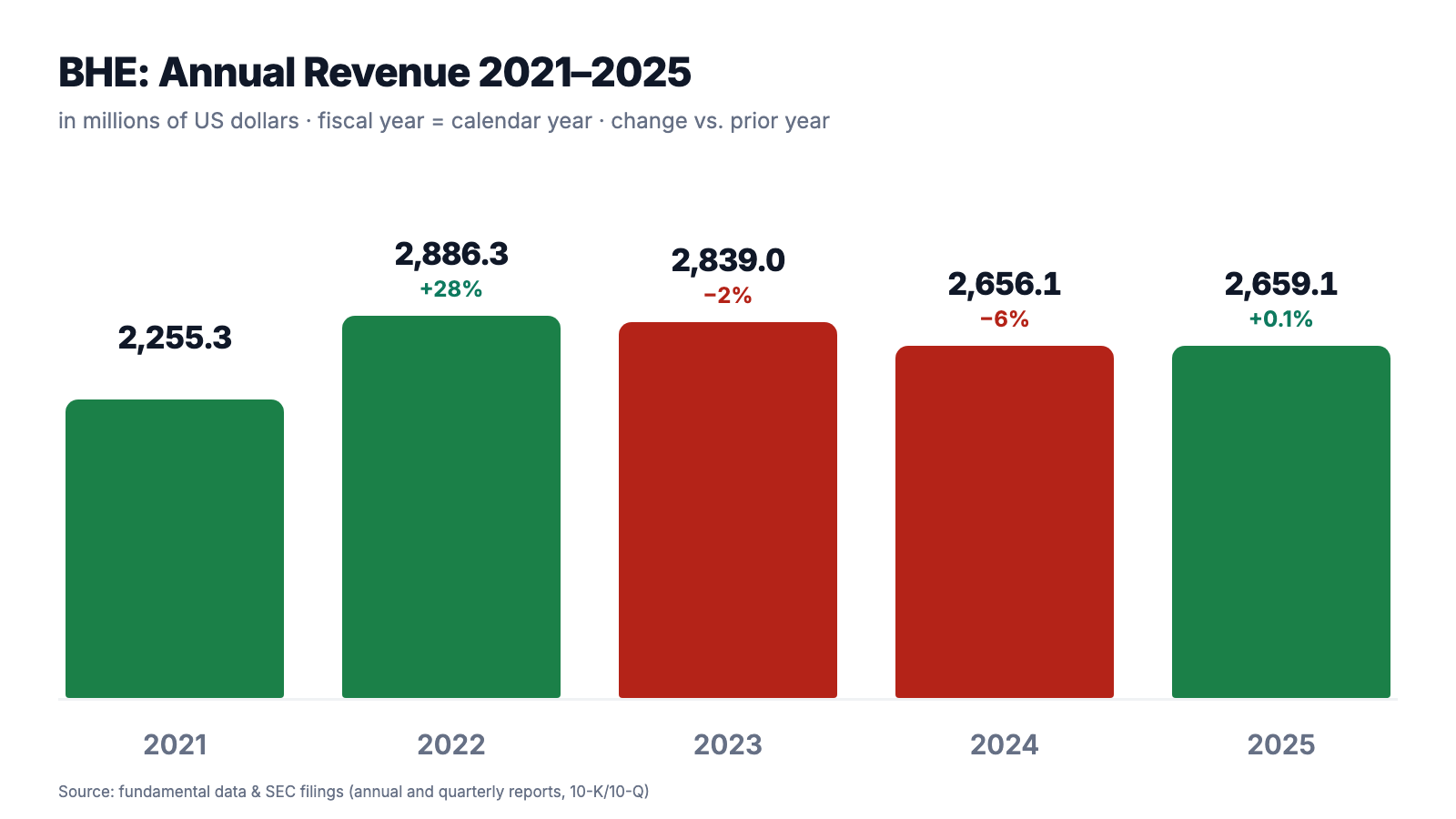
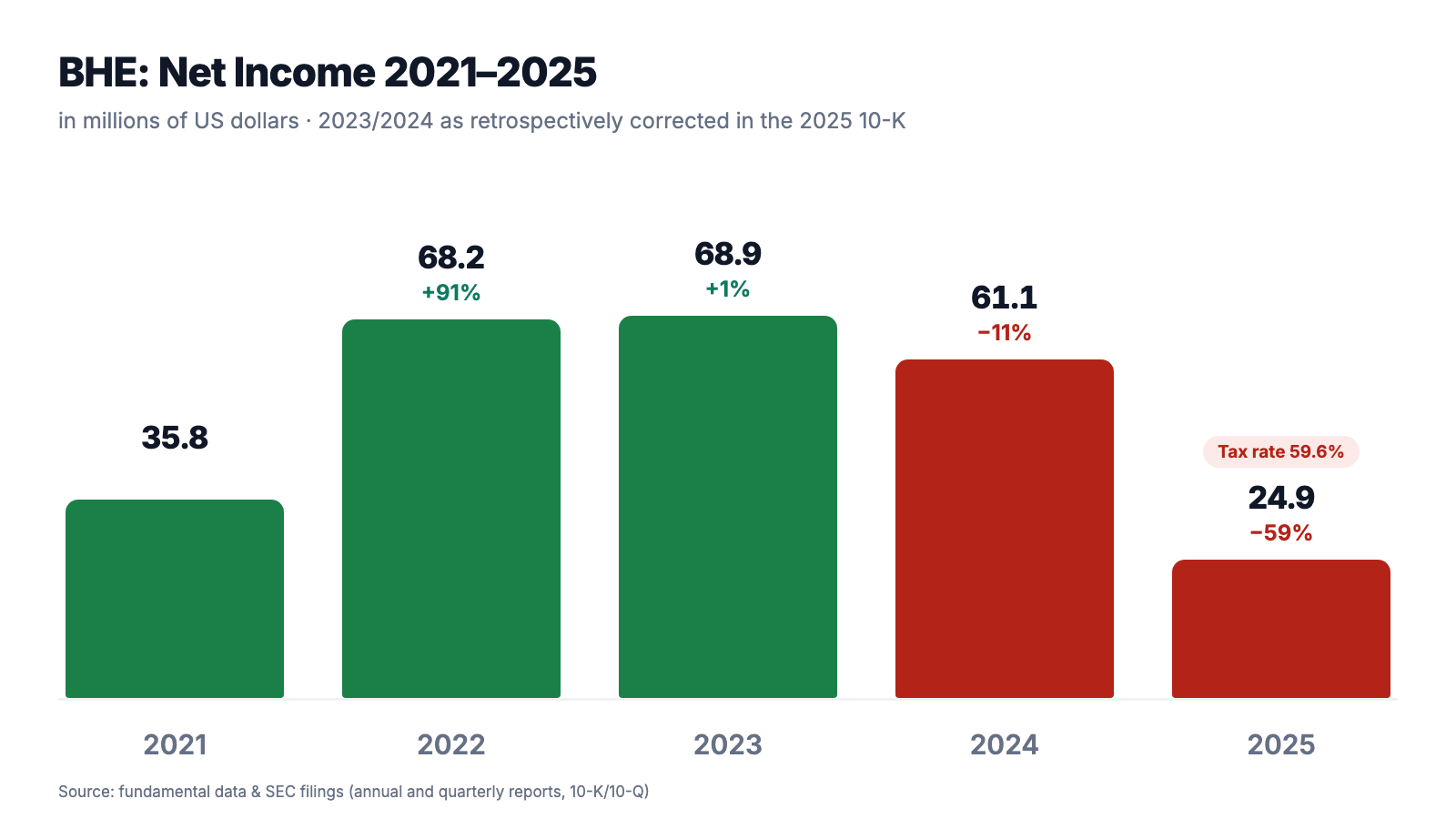
The revenue mountain tells a different story than the price: $2,886.3 million in 2022, $2,659.1 million in 2025 — with two down years and one year of standstill in between. The profit series is even less comfortable: $68.9 million (2023, as retrospectively corrected), $61.1 million (2024), $24.9 million (2025) — a 59 percent drop in the very year the price began to double. Earnings per share went from $1.92 to $1.66 to $0.68. Why that was not an operational collapse but a fireworks display of one-off items is what the uncomfortable truths below untangle — but hold the two pictures side by side for a moment: a price that nearly doubles above a profit that more than halves. That scissors motion is precisely what produces a trailing price-to-earnings ratio of 98.
What the filings say — the uncomfortable truths
Uncomfortable truth no. 1: The growth the price is celebrating is not in the books
The annual report for 2025 opens its management discussion with a sentence of disarming sobriety:
"Sales for 2025 and 2024 were both $2.7 billion. […] Revenue was flat year-over-year primarily due to increases in A&D, Medical, and Semi-Cap, which were offset by a decrease in AC&C sales."
— Benchmark Electronics, Inc., SEC annual report 10-K for 2025, Item 7 "Management's Discussion and Analysis," 2025 Overview
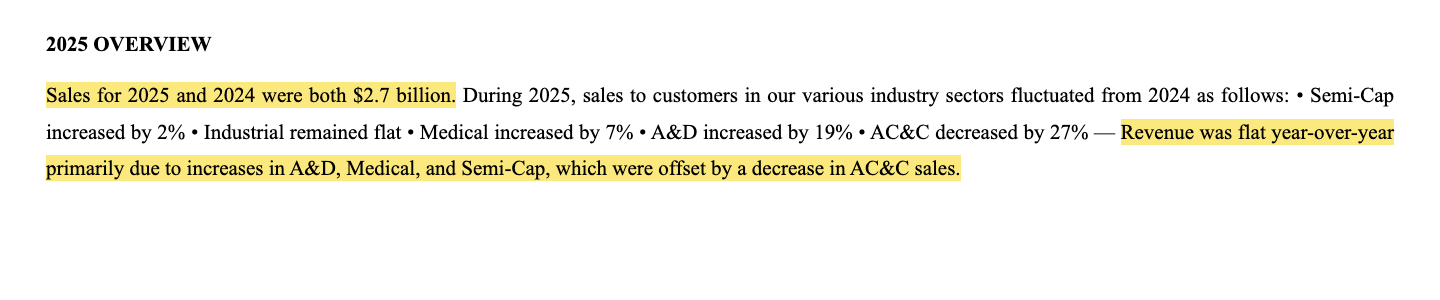
Underneath sits not uniform stagnation but a sector carousel: aerospace & defense grew 19 percent in 2025 to $514.4 million, medical 7 percent, semiconductor capital equipment 2 percent to $741.2 million — while advanced computing & communications collapsed by 27 percent. The very segment whose comeback (+41 percent in the first quarter of 2026) now carries the growth story erased the entire company's growth the year before. That is the nature of this business: programs arrive, run out, get re-awarded — the contract manufacturer rides its customers' investment cycles, in both directions. And one more asterisk belongs on the scanner metric "earnings up 261 percent": the prior-year quarter it is measured against was depressed by an $11.0 million indirect tax settlement (more on that in a moment) — part of the spectacular growth is simply the return from an artificially low starting point. Base effect, not boom. One aside: in Benchmark's own annual report, "artificial intelligence" appears exactly three times — as a competition, process and data-privacy topic. As a revenue source: not once. What the other end of the computing boom looks like, where AI genuinely is the business, we dissected in our Nvidia analysis.
Uncomfortable truth no. 2: In 2025 Benchmark earned $61.5 million before taxes — and handed $36.7 million to tax authorities
The real profit killer of 2025 was not on the factory floor but in the tax return:
"Income tax expense in 2025 was $36.7 million representing an effective tax rate of 59.6% compared with $22.8 million of income tax expense in 2024 representing an effective tax rate of 27.1%. The increase in the effective tax rate in 2025 is primarily due to the $10.4 million in discrete tax expense recorded in the second quarter for the foreign withholding taxes on repatriated distributions and recognition of deferred tax liabilities on China unremitted earnings […]"
— Benchmark Electronics, Inc., SEC annual report 10-K for 2025, Item 7 "Income Tax Expense"
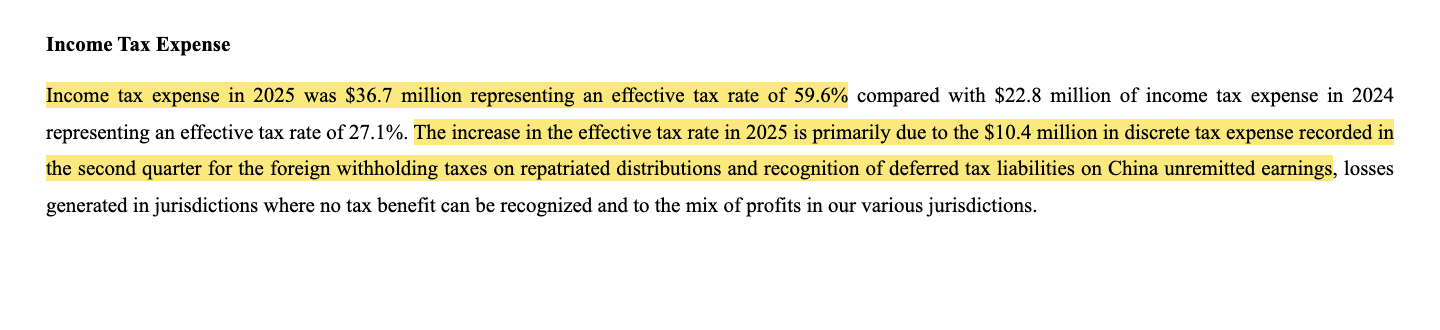
Why does a company from Arizona pay withholding taxes to get at its own money? Because its profit is made elsewhere: 64 percent of sales come from international operations, and of the $322.4 million in cash at the end of 2025, $288.9 million sat outside the United States — nearly 90 percent. The tax footnote lays the core bare: the U.S. business lost $57.6 million before taxes in 2025 (after minus $32.9 million in 2024); the money is earned in Asia and Europe. Whoever moves cash across the border — say, for dividends and buybacks — pays a toll. On top came two further one-offs in 2025 under "restructuring charges and other costs" ($29.5 million in total after $6.3 million the year before): an $11.1 million impairment on an underperforming Americas plant and $11.0 million to settle an indirect tax assessment, also in the Americas. The fair counterpoint: these genuinely are special items, not permanent conditions — in the first quarter of 2026 the effective tax rate was back at 29.3 percent, and profit promptly snapped back. But the episode reveals this company's anatomy: a business with a 0.9 percent net margin has no crumple zone — every special item hits earnings at full force. The next struggling plant or the next tax audit follows the same mechanics.
Uncomfortable truth no. 3: A single customer pays 14 percent of the bills — and the top ten pay half
In its customer chapter, the annual report records a concentration that fits the price story like a glove:
"Sales to our ten largest customers represented 51%, 50% and 52% of our total sales in 2025, 2024 and 2023, respectively. Sales to our largest customer, Applied Materials, Inc. and subsidiaries, represented 14% of our total sales in both 2025 and 2024 and 12% of our total sales in 2023."
— Benchmark Electronics, Inc., SEC annual report 10-K for 2025, Item 1 "Business" (Customers)

Picture a workshop whose biggest client pays every seventh invoice — and whose ten most important clients pay every second one. Applied Materials is the world's largest maker of chip-fabrication equipment; Benchmark builds assemblies and systems for it. That is first of all a knighthood: contracts like these don't go to shaky vendors, and the report fairly adds that the relationship has grown for years. But it hard-wires Benchmark's biggest sector (Semi-Cap, 28 percent of revenue, $741.2 million) straight into the most notorious capital-spending cycle in the world economy: semiconductor equipment. When chipmakers postpone their fab build-outs, Benchmark feels it at full force — and in the first quarter of 2026, Semi-Cap was already shrinking again slightly (minus 2 percent, "timing of customer demand"). The risk factors add that no customer is obligated to place future orders. Remember the image: whoever supplies the shovel sellers depends on the same gold rush — just one arm's length farther from the mine.
Valuation: a $3.5 billion market value on $25 million of profit — and a management that bought at $38
As of the July 17, 2026 data cut-off, the Benchmark share cost about $97, for a market value of roughly $3.5 billion. Measured against 2025 earnings ($24.9 million) that is a price-to-earnings ratio around 98 — a statement, for a contract manufacturer with a 10.2 percent gross margin. The milder math: normalize the tax rate and take the analyst estimate for the current year (about $2.75 per share per the fundamental data), and you get a P/E around 35 — still roughly double what the market has long granted Benchmark's larger competitor Jabil, and a price-to-sales ratio around 1.3 has to be justified by a business that has not added a single dollar of growth since 2022. The quiet punchline sits in the annual report itself:
"During 2025, the Company repurchased 0.7 million shares for an aggregate of $26.8 million, at an average price of $38.22 per share. As of December 31, 2025, the Company had $122.7 million remaining under share its repurchase authorization."
— Benchmark Electronics, Inc., SEC annual report 10-K for 2025, Item 7 "Liquidity and Capital Resources"

So in 2025 the company found its own stock worth buying at an average of $38.22 — and the market now pays nearly two and a half times that for a business that has barely changed operationally. A few observations from the fundamental data fit the picture (all as of July 17, 2026): insiders logged twelve sales and not a single purchase recently; among funds, accumulators (8) and reducers (10) roughly balance out — broad institutional accumulation looks different; and only three analysts cover the stock (average rating 1.3, i.e. "buy"). Thin coverage plus a sudden surge of attention is a double-edged sword: it lets prices run fast — in both directions. The dividend yield has shriveled to about 0.7 percent after the run. And above all this hangs a detail that nearly drowned in the price cheer: since March 31, 2026, a new CEO, David Moezidis, runs the company — the man who must deliver the priced-in expectations did not preside over the run that created them (more in the 8-K filings listed in the sources).
Opportunities and risks at a glance
What speaks for Benchmark:
- A rock-solid foundation: $324.9 million in cash against $147.2 million of borrowings (March 31, 2026), an untouched $550 million credit facility through 2030, a Piotroski F-score of 8 of 9, an Altman Z-score around 8, a $0.17 quarterly dividend plus ongoing buybacks (data as of July 17, 2026).
- The turnaround is measurable: revenue up 7 percent in the first quarter of 2026, medical up 24 and advanced computing up 41 percent on newly won programs (10-Q as of 03/31/2026); the tax rate back at 29.3 percent, net income of $13.0 million after $3.6 million.
- Diversification across five sectors with tailwinds on several fronts: aerospace & defense grew 19 percent in 2025, and with plants in the U.S., Mexico, Asia and Europe, Benchmark can serve customers regionalizing their supply chains.
- The semiconductor anchor: Applied Materials, a customer relationship grown over years, ties Benchmark to the structurally growing chip-equipment industry — a built-in turbo in an upcycle.
- Strong technicals: Weinstein stage-2 uptrend, relative strength 94, Minervini criteria met, about 2 percent below the all-time high — 24 scanner hits (data as of July 17, 2026).
What speaks against it:
- The story is far ahead of the business: the price is up 148 percent in twelve months while revenue sits below its 2023 level ($2,659.1 million after $2,839.0 million) and "grew" 0.1 percent in 2025.
- Razor-thin margins with no crumple zone: a 10.2 percent gross margin and a 0.9 percent net margin in 2025 — the year's one-offs (59.6 percent tax rate, an $11.1 million plant impairment, an $11.0 million tax settlement) halved profit in one stroke.
- Concentration risk: Applied Materials at 14 percent and the top ten customers at 51 percent of sales — with no purchase obligations; the largest sector, Semi-Cap (28 percent), rides the volatile chip-equipment cycle and was already shrinking again slightly in the first quarter of 2026.
- Valuation after the run: a trailing P/E around 98 (around 35 on the 2026 estimate), price-to-sales around 1.3 — while the company itself bought back at an average of $38.22 in 2025; insiders sold twelve times and bought never (data as of July 17, 2026).
- Handover risks: a new CEO since March 31, 2026, a CTO departure in January 2026, plus quietly corrected tax-calculation errors of earlier years (Note 1 of the 2025 10-K) — the very tax line that cost the 2025 profit had been error-prone before.
A human conclusion
Back to the price-as-proof trap from the opening. Its trick is that it reverses the burden of proof: it is no longer the story that has to justify itself, but your skepticism — after all, "the market is obviously right." The filings shift the burden back. Benchmark is a decent, fundamentally sound company: net cash instead of debt, profitable for decades, spread across five industries, with genuine new programs in medical devices and high-performance computing. Nothing about this company is rotten. But between "solid company" and "deserves a doubled price" lies an invoice, and so far it only balances with a lot of future in it: revenue below 2023, a net margin under one percent, the latest quarter's spectacular earnings growth largely a recovery from self-inflicted one-offs — and the company itself recently judged its share fairly priced at $38.22. Whoever buys today at around $97 (data as of July 17, 2026) is not betting on the Benchmark in the books, but on a Benchmark that has yet to come into being: one with durably growing revenue, a normalized tax rate and a chip-equipment cycle that stays friendly. It can happen — the new programs are real, and the new CEO knows this business from its toughest competitor. But for now it exists only in the price, not in the ledger. What you make of it is your decision. And that is exactly as it should be.
Sources
All original documents used in this analysis — for your own reading:
- Benchmark Electronics, Inc. — SEC annual report 10-K for 2025 (filed February 24, 2026)
- Benchmark Electronics, Inc. — SEC quarterly report 10-Q as of 03/31/2026 (filed April 30, 2026)
- Benchmark Electronics, Inc. — SEC annual report 10-K for 2024 (filed February 24, 2025; amended by a 10-K/A on February 27, 2025)
- Benchmark Electronics, Inc. — SEC annual report 10-K for 2023 (filed February 27, 2024; annual figures for 2021/2022)
- Benchmark Electronics, Inc. — Form 8-K dated September 2, 2025 (CEO succession: Benck → Moezidis)
- Benchmark Electronics, Inc. — Form 8-K dated October 7, 2025 (board appointment of Dr. Michael Slessor)
- Benchmark Electronics, Inc. — Form 8-K dated December 29, 2025 (CTO retirement of Jan Janick)
- Benchmark Electronics, Inc. — Form 8-K dated February 19, 2026 (employment agreement of the new CEO)
- Complete SEC filing history of Benchmark Electronics, Inc.: EDGAR overview (sec.gov)
- Fundamental data (metrics, quarterly series, valuation; data as of July 17, 2026), reconciled against the SEC filings.
- Screener and rating data: in-house stock scanner (momentum run, data as of July 17, 2026).
Transparency & disclaimer: This analysis is a journalistic contextualization of publicly available information and is not investment advice, not a financial analysis in the regulatory sense and not a solicitation to buy or sell securities. Stock investments carry substantial risks up to and including total loss. All information without guarantee; the data cut-off is noted in the text. The author holds no position in Benchmark shares at the time of publication.
Our Bottom Line at a Glance
- Balance sheet & substance positive
- $324.9 million in cash against $147.2 million of borrowings (March 31, 2026), an untouched $550 million credit facility through 2030, a Piotroski F-score of 8 of 9, an Altman Z-score around 8, a quarterly dividend plus buybacks — Benchmark is fundamentally soundly financed (10-K 2025, 10-Q as of 03/31/2026; scanner data as of July 17, 2026).
- Technicals & momentum positive
- Weinstein stage-2 uptrend, relative strength rating of 94, Minervini criteria met, about 2 percent below the all-time high, 24 scanner hits, up 148 percent in twelve months (data as of July 17, 2026) — the trend picture is as strong as for few stocks in the momentum run.
- Growth & story coverage negative
- 2025 revenue: $2,659.1 million — up 0.1 percent on the prior year and below the 2023 level ($2,839.0 million); the 7 percent quarterly growth and the +257 percent profit jump in the first quarter of 2026 stand on a comparison base depressed by one-offs (10-K 2025, 10-Q as of 03/31/2026).
- Margins & earnings quality negative
- A 10.2 percent gross margin and a 0.9 percent net margin in 2025: a 59.6 percent tax rate, an $11.1 million plant impairment and an $11.0 million tax settlement halved profit — a business without a crumple zone where every special item hits at full force; plus quietly corrected tax-calculation errors of earlier years (Note 1 of the 2025 10-K).
- Customers & cyclicality negative
- Applied Materials accounts for 14 percent and the top ten customers for 51 percent of sales — with no purchase obligations; the largest sector, Semi-Cap (28 percent), rides the semiconductor equipment cycle and was already shrinking again slightly in the first quarter of 2026 (10-K 2025, Item 1; 10-Q as of 03/31/2026).
- Valuation & signals neutral
- A P/E around 98 trailing resp. around 35 on the 2026 estimate, price-to-sales around 1.3 — while the company itself bought back at an average of $38.22 in 2025; insiders: twelve sales, no purchase; funds: 8 accumulators against 10 reducers; only three analysts cover the stock (data as of July 17, 2026). Normalized earnings can grow into this valuation — but they have to first.
Benchmark Electronics is a fundamentally solid, net-cash company with genuine new programs in medical devices and high-performance computing — and a stock whose price has nearly doubled while revenue sits below its 2023 level and the 2025 net margin stayed under one percent. The 2025 profit collapse was one-off driven (a 59.6 percent tax rate), the 2026 recovery is real but base-effect amplified. At 98 times trailing earnings, the market is paying for a Benchmark that operationally has yet to come into being. Not investment advice.
What Our Rating Means
- If you don't own the stock
- As long as the question raised in the bottom line stays open, we see no basis for an entry.
- If you hold it in your portfolio
- Our findings offer no acute reason to sell — the checkpoints named remain decisive.
A journalistic assessment by our editorial team at the time of the deep dive, based on public sources — not investment advice and not a solicitation to buy or sell. Your personal circumstances (investment goals, risk capacity, taxes) cannot be taken into account. What our categories mean, how verdicts are formed, and what conflicts of interest exist →
Worth Noting
- BHE landed on the research list through the momentum/stage-2 run of July 17, 2026 (24 hits in our in-house stock scanner, incl. Stan Weinstein stage 2, RS leader ≥90, Minervini trend criteria, pros 80%).
- Scanner metrics (P/E, P/S, Piotroski, Altman-Z, fundamental grade, earnings growth) use trailing twelve-month figures; the 2025 one-offs are baked in — the reported quarterly earnings growth of plus 261 percent is correspondingly base-effect amplified.
- Price and valuation figures dated July 17, 2026 (about $97, roughly $3.5 billion market value); analyses are evergreen, daily prices are not a buy argument.
Frequently Asked Questions
Benchmark Electronics, Inc. (NYSE: BHE) of Tempe, Arizona, is an electronics contract manufacturer (EMS): it designs, builds and tests electronics on behalf of other companies — from assemblies for chip-fabrication equipment to medical devices and high-performance computing systems. Its 2025 revenue of $2,659.1 million split across semiconductor capital equipment (28 percent), industrial (22), aerospace & defense (19), medical (18) and advanced computing & communications (13).
Chiefly because of one-off items: per the annual report (10-K), the effective tax rate jumped to 59.6 percent — including $10.4 million of withholding taxes on repatriated foreign profits and deferred taxes on China earnings. Added to that were an $11.1 million impairment on an Americas plant and an $11.0 million indirect tax settlement. Net income fell from $61.1 million to $24.9 million (minus 59 percent) even though revenue was stable.
Noticeably: Applied Materials, the world's largest maker of chip-fabrication equipment, accounted for 14 percent of Benchmark's sales in both 2025 and 2024 per the 10-K; the ten largest customers together accounted for 51 percent. There are no purchase obligations. The semiconductor capital equipment sector as a whole contributed $741.2 million, or 28 percent of 2025 revenue.
In the first quarter of 2026, revenue grew 7 percent to $677.3 million. Per the quarterly report (10-Q), the gains came from medical (+24 percent to $128.5 million) and advanced computing & communications (+41 percent to $105.1 million), each "primarily due to new program wins" — newly won production programs. Semiconductor capital equipment, industrial and aerospace & defense each shrank slightly.
After a run of plus 148 percent in twelve months (data as of July 17, 2026), the stock costs about 98 times its 2025 earnings and roughly 35 times the analyst estimate for the current year — at a price-to-sales ratio around 1.3 and with revenue below its 2023 level. For comparison: the company itself bought back its own shares in 2025 at an average of $38.22 — less than half the July 2026 price.
Yes. Benchmark pays a quarterly dividend of $0.17 per share (most recently declared June 8, 2026, payable July 10, 2026); in 2025 a total of $24.4 million went to shareholders. After the price run-up that works out to only about 0.7 percent in dividend yield (data as of July 17, 2026). Buybacks continue with $122.7 million remaining under the authorization (December 31, 2025).
Effective March 31, 2026, CEO Jeffrey Benck handed over to David Moezidis, previously 25 years at EMS competitor Flex (Form 8-K dated September 2, 2025). Chief technology officer Jan Janick retired in January 2026, and in October 2025 FormFactor CEO Michael Slessor joined the board. The expectations the price run has baked in must now be delivered by a largely new leadership team.
Found an error?
Did you spot a factual error, an outdated number, or a typo in this deep dive? Let us know briefly — your report goes straight to the editorial team.