Applied Digital Stock: Revenue Doubles, $6 Billion of Bonds Build the AI Factory — and Everything Hangs on Three Customers
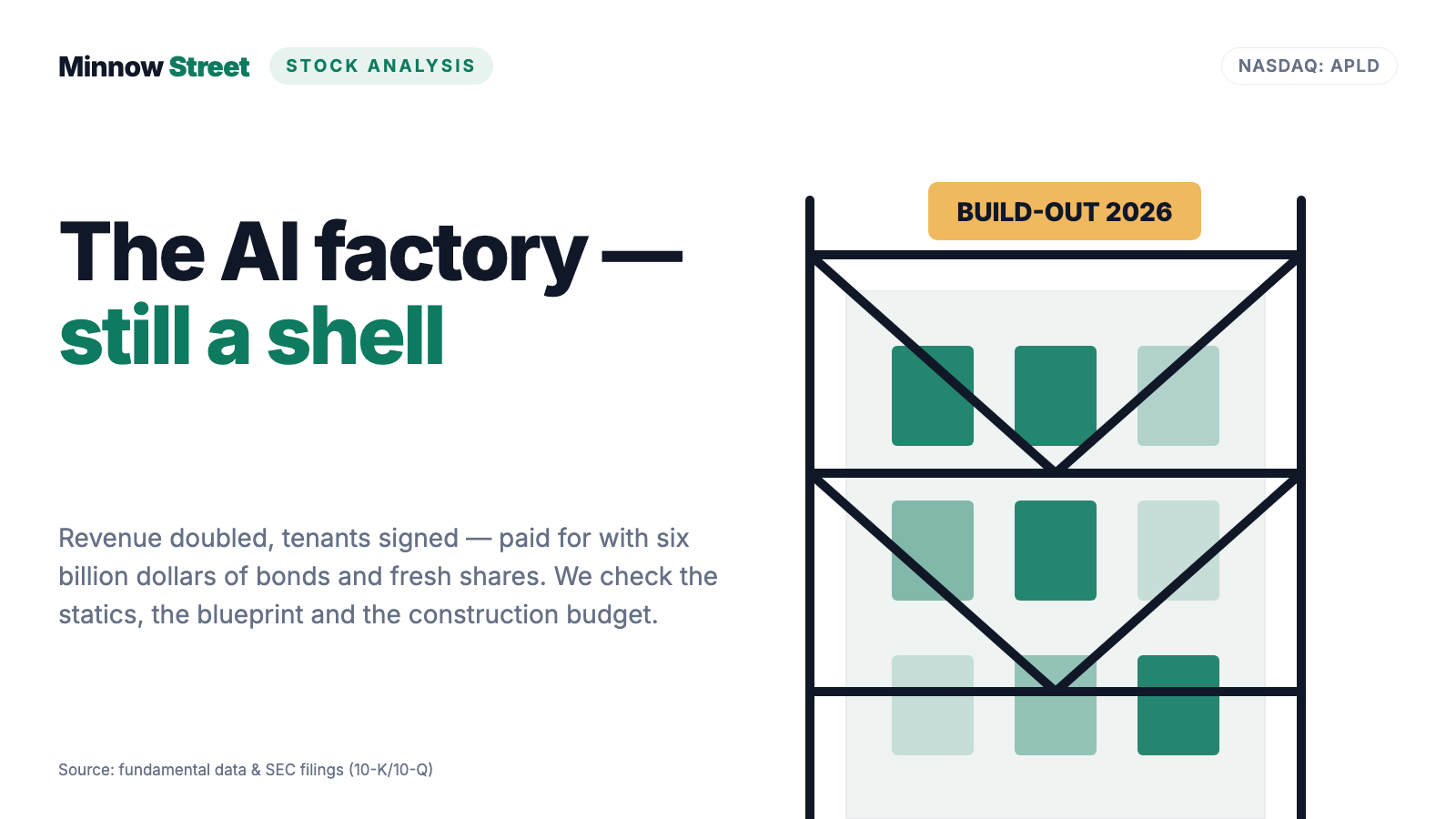
Applied Digital builds "AI factories" in North Dakota: data centers leased to AI cloud provider CoreWeave and to a hyperscaler for up to 15 years. Revenue has doubled year over year, and the stock ranks no. 4 in the U.S. selection of our in-house Big Earnings Surprise scanner (as of July 18, 2026). We read the quarterly reports (10-Q), the annual report (10-K) and the deal filings: the celebrated earnings surprise is an adjusted figure — under GAAP, $100.9 million of loss fell to common stockholders in the very same quarter. Three customers generate 100 percent of revenue, $6.09 billion of notes have been sold since November 2025, and the share count grew 27 percent in nine months. Not investment advice — just the question of which profit actually did the surprising here.
 Thomas Mücke
Founder & Publisher
Thomas Mücke
Founder & Publisher
Chart
Interactive price chart (TradingView).
Note: pure fact-based analysis, not investment advice and not a solicitation to buy or sell. All figures without guarantee.
There is a reflex that stock market professionals feed on purpose: the surprise reflex. It works like this: a company "beats expectations," the headline reports an earnings surprise in the triple digits, and your brain translates: things are going better than anyone thought — get in before everyone notices. What the reflex never asks: which profit did the surprising — and in what currency is it measured? Applied Digital Corporation (Nasdaq: APLD) is currently the perfect training piece for that question: the stock ranks no. 4 in the U.S. selection of our in-house Big Earnings Surprise scanner (as of July 18, 2026), its latest quarterly print landing about 143 percent above the analyst consensus per our scanner data. So let's make a deal: before the reflex takes over your portfolio, we read together what the company itself filed, under penalty of law, with the U.S. securities regulator, the SEC — the quarterly reports (10-Q), the annual report (10-K; the fiscal year here ends May 31) and the deal filings (8-K). Both things are in there: revenue that has doubled year over year, backed by leases running for decades. And a quarter in which, under GAAP, $100.9 million of loss fell to common stockholders — while the "surprise" was an adjusted number. In the end, you decide what actually surprises you here.
What Applied Digital actually does — and why it is pouring billions into concrete right now
Applied Digital, headquartered in Dallas, Texas, with about 205 full-time employees (as of May 31, 2025), describes itself in its quarterly report as a designer, developer and operator of high-performance data centers for artificial intelligence, networking and blockchain workloads. Translated: the company builds the halls, cooling and power hookups in which other people's AI chips do the computing — it is the landlord of the AI era, not its chipmaker. The business has three parts. First, crypto hosting: data centers for Bitcoin miners run at full capacity in Jamestown (106 megawatts) and Ellendale (180 megawatts, both North Dakota) — the legacy business from the days when the company was still called Applied Blockchain. Second, HPC leasing, the new centerpiece marketed as "Polaris Forge — AI Factory": at the Polaris Forge 1 campus in Ellendale, the first 100-megawatt data center went live in October 2025, two more at 150 megawatts each are under construction, and a fourth (150 megawatts, "ELN-04") has been fully funded since June 2026 — the tenant for all 550 megawatts is AI cloud provider CoreWeave. On top of that come the Polaris Forge 2 campus near Harwood (200 megawatts, leased for roughly 15 years to an unnamed "U.S. based investment grade hyperscaler") and the new builds Delta Forge 1 (300 megawatts, ground broken January 2026, lease signed April 2026) and Delta Forge 2 (lease signed June 2026) in the southern U.S. Third, until May 2026 there was a cloud unit renting out GPU computing power for AI — on May 5, 2026, it was contributed into the Nasdaq shell of exoskeleton maker Ekso Bionics and now operates as ChronoScale; before that, Applied Digital had to take a $59.7 million write-down on the unit.
Honesty also requires the backstory: the stock market shell holding all of this was named, in sequence since 2001, Reel Staff (temp staffing), Flight Safety Technologies, Applied Science Products, Applied Blockchain — and only since February 2023 Applied Digital. Today's business is real, made of steel and concrete; but the same shell has already worn two market fashions before AI. Which brings us to the central tension of this analysis, running through every chapter: the factories, the tenants and the growth are real — but the profit that triggers the scanner is an adjusted figure, the revenue hangs on three customers, and the build-out is paid for by a financing machine that continuously produces new debt and new shares.
Where the stock shows up in our scanner
Every day we run roughly 3,500 stocks through our scanners. As of July 18, 2026, Applied Digital is a conspicuous regular: rank 4 in the Big Earnings Surprise scanner (U.S. selection) — it sorts by the deviation of the most recently reported profit from the analyst consensus, +142.9 percent for Applied Digital, +85.8 percent on a full-year view. To replicate it yourself: open the scanner, set the country filter to "US" — the list shows the biggest surprises in scanner order, with Applied Digital in the top group. Around 20 further hits come almost entirely from the momentum family: stage-2 uptrend, relative-strength leaders, power trend, institutional accumulation. The fundamental lens of those same scanners tells a second story: a Piotroski F-Score of 5 out of 9 (a nine-point health test for the books — 5 is midfield, rock-solid starts at 8), a negative return on equity around −6 percent, a trailing operating margin around −20 percent, and a price-to-earnings ratio that cannot be computed because there are no earnings. Also notable: our scanner data shows 18 insider sales against zero purchases (as of July 18, 2026). Remember the principle: a surprise scanner measures the deviation from an expectation — not the quality of whatever did the surprising. Which is exactly why we now read the filings.
The numbers over the years — honestly appraised
First, what genuinely impresses — and there is plenty. Revenue from continuing operations grew from $55.4 million (fiscal year 2023) to $136.6 million (2024) and $144.2 million (2025, each ended May 31; excluding the cloud unit then reported as discontinued). Then the AI leasing business ignited: in the quarter ended February 28, 2026, revenue jumped 139 percent to $126.6 million, and over nine months 99 percent to $352.6 million (comparison base: $177.5 million; all figures after the cloud unit was folded back into continuing operations). The driver is the HPC business, which barely existed a year earlier: $71.0 million of quarterly revenue and $17.6 million of segment profit, alongside crypto hosting with a steady $37.5 million of revenue and $13.9 million of segment profit. Adjusted EBITDA reached $44.1 million — 41 percent of adjusted revenue. And the leases behind it run for decades, not quarters.
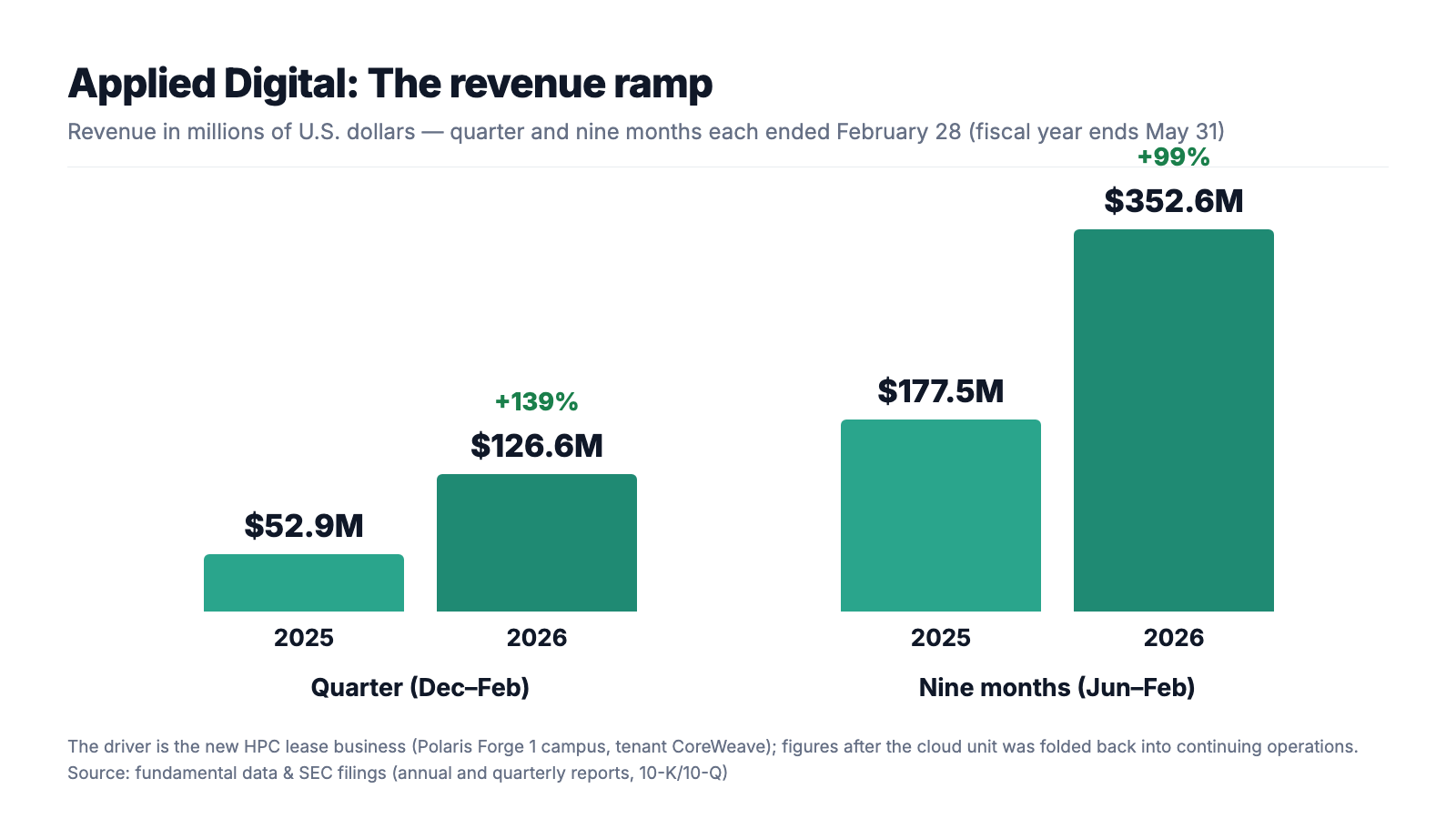
Now for the cross-check the surprise reflex skips. A third of nine-month revenue — $118.2 million of $352.6 million — was tenant fit-out: Applied Digital builds out the halls on the customer's behalf and passes through costs of roughly $112.5 million almost one for one; that is razor-thin-margin revenue that optically inflates the growth rate. Base rent, the actual recurring business, came to $55.7 million over nine months. And despite doubled revenue, the bottom line showed a nine-month net loss of $101.9 million ($138.5 million attributable to common stockholders, or −$0.51 per share). In parallel, total assets more than tripled within nine months, from $1.87 billion to $6.25 billion. Remember the image: this is not a profitable company growing — this is a factory being erected whose rent is supposed to pay the bill later.
What the filings say — the uncomfortable truths
Uncomfortable truth no. 1: Three customers account for 100 percent of revenue
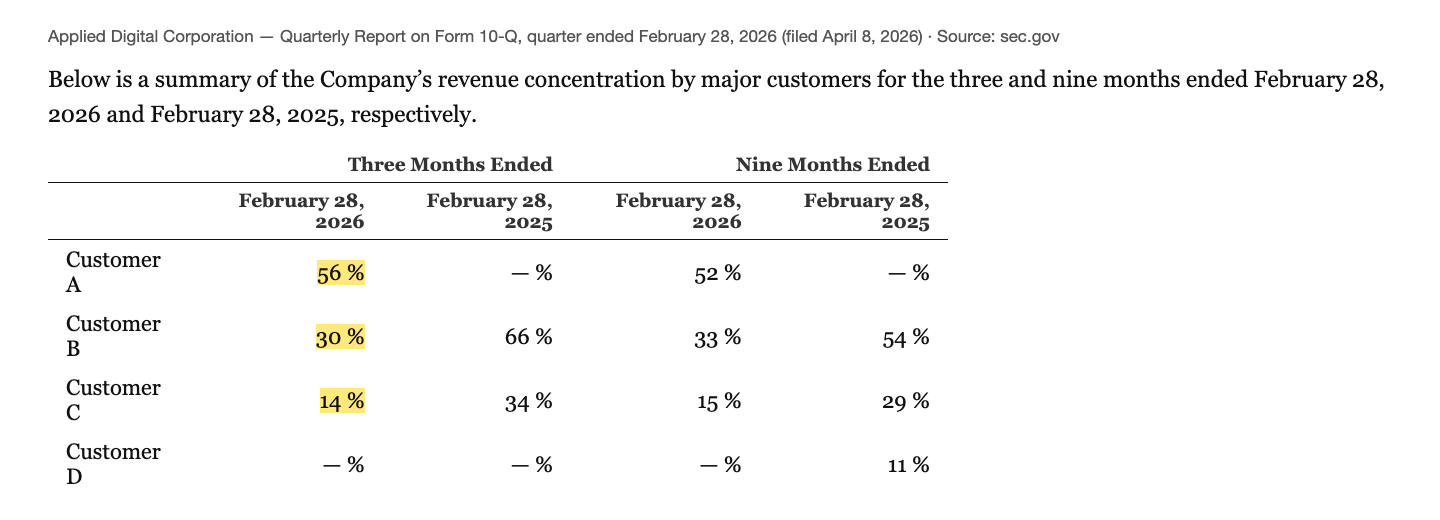
Customer concentration sounds abstract, so picture this: a landlord with three tenants — one moves out, and a third of the building goes dark. At Applied Digital it is exactly that, with no other tenants: the concentration table in the quarterly report shows, for the quarter ended February 28, 2026, Customer A at 56 percent, Customer B at 30 percent and Customer C at 14 percent — together 100 percent of revenue. The mapping is arithmetically unambiguous: 56 percent corresponds to the HPC lease business, whose tenant at Polaris Forge 1 is CoreWeave; 30 percent to crypto hosting; 14 percent to the cloud unit, about which the report itself states:
"As of February 28, 2026, this business segment had one customer and generated 14% of total revenue for the fiscal quarter ended February 28, 2026."
— Applied Digital Corporation, SEC quarterly report 10-Q as of February 28, 2026, Item 2 "Management's Discussion and Analysis" (Cloud Services Business)
How much hangs on a single anchor tenant, the report discloses as well: on March 30, 2026, CoreWeave transferred the leases for parts of the campus to a special-purpose vehicle ("CoreWeave SPV") — Applied Digital received an "Unconditional Springing Guaranty," a parent guarantee that only kicks in once things go wrong, plus a $50 million letter of credit. That structure is industry practice, but it moves the tenancy one step further away from CoreWeave's own balance sheet. How capital-hungry and credit-financed the end customer of the AI bet is, we dissected from the other side in our Nvidia analysis — Applied Digital's largest tenant, CoreWeave, is one of the central nodes of that web. Remember the image: when your entire building is rented to three parties, any single termination is not a dent — it is a landslide.
Uncomfortable truth no. 2: The earnings surprise is an adjusted figure — under GAAP it was the next big loss
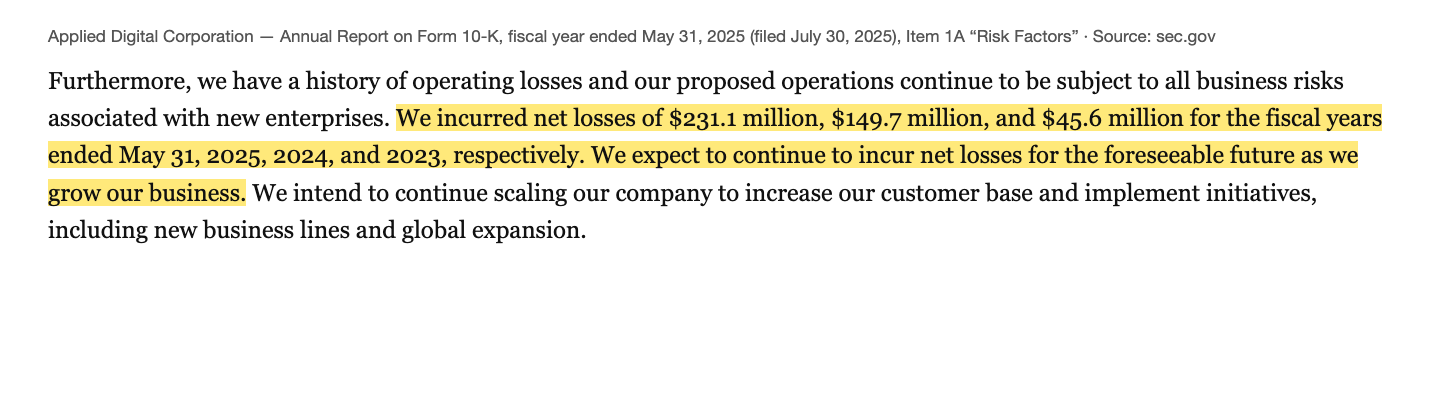
Now to the core of the scanner hit. For the quarter ended February 28, 2026, Applied Digital reported adjusted net income of +$33.2 million, or +$0.09 per diluted share — far above expectations, hence the +142.9 percent earnings surprise in our scanner data. Under U.S. accounting rules (GAAP), the same quarter looked like this: a net loss of $70.6 million; after the report's income attribution, $100.9 million of loss, or −$0.36 per share, fell to common stockholders — more than the consolidated net loss, because the calculation also deducts the amount attributed to the Macquarie preferred units ($28.7 million) and preferred dividends ($1.6 million). Between +$0.09 and −$0.36 sit mainly three items: the $59.7 million write-down on the cloud unit, $39.3 million of additional stock-based compensation (the item more than doubled in the quarter), and the claims of the preferred capital providers. That losses are no fluke here, the annual report says itself — in its risk factors:
"We incurred net losses of $231.1 million, $149.7 million, and $45.6 million for the fiscal years ended May 31, 2025, 2024, and 2023, respectively. We expect to continue to incur net losses for the foreseeable future as we grow our business."
— Applied Digital Corporation, SEC annual report 10-K for fiscal year 2025 (ended May 31, 2025), Item 1A "Risk Factors"
To be fair: adjusted figures here are not cosmetics for their own sake — in the middle of a mega build-out, one-off items genuinely distort the picture, and the $44.1 million of adjusted EBITDA shows the running operation makes money. But stock-based compensation is real for shareholders (it comes back as dilution — see truth no. 3), and so are the claims of the preferred capital providers. Remember the mechanism: an "earnings surprise" can come from a number that excludes precisely the costs that affect you as a shareholder the most.
Uncomfortable truth no. 3: The financing machine — six billion in bonds, a share conveyor belt, and partners with right of way
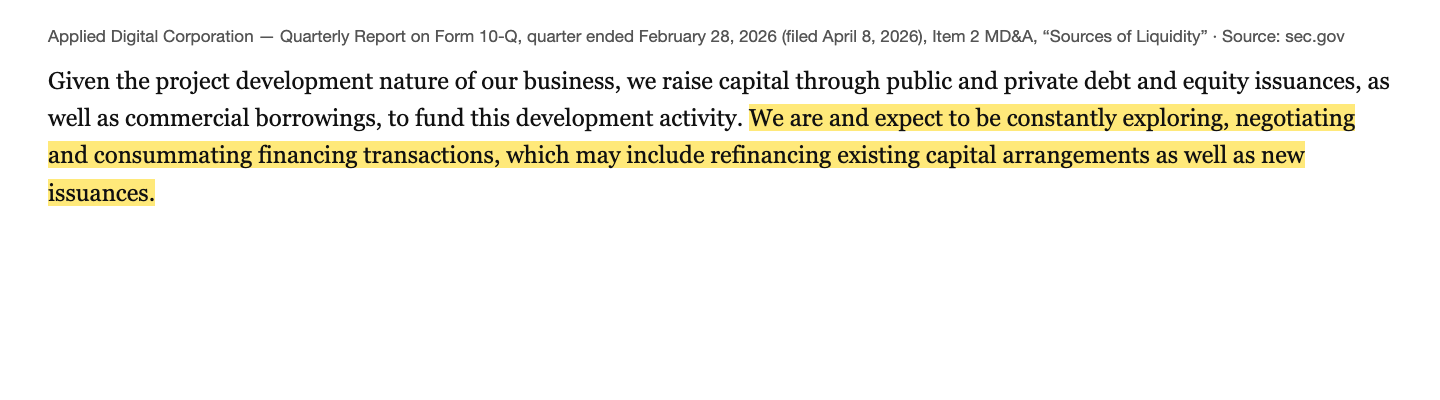
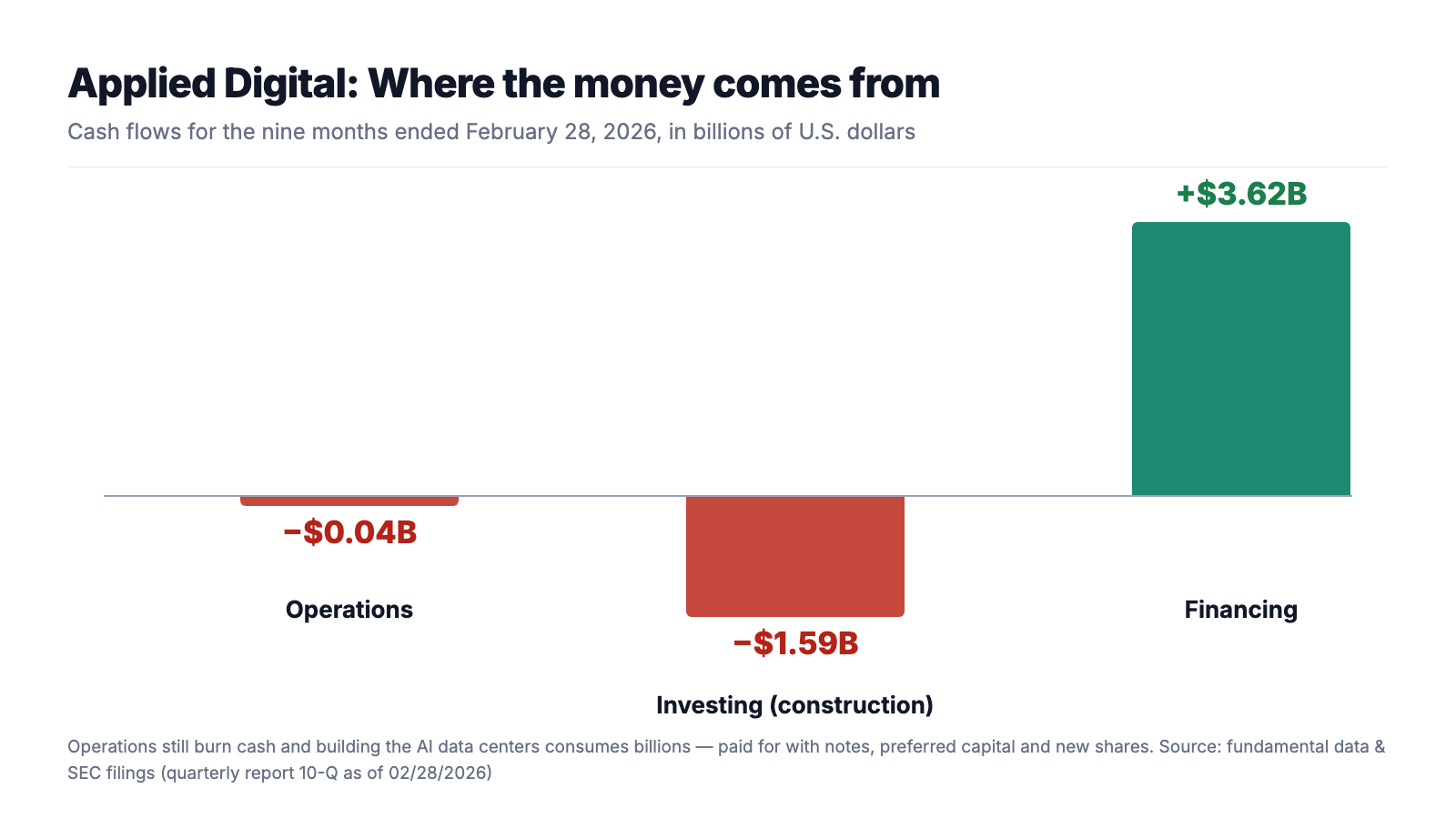
How do you pay for $1.59 billion of construction in nine months when operations burn $42.9 million of cash? The quarterly report answers with disarming candor:
"Given the project development nature of our business, we raise capital through public and private debt and equity issuances, as well as commercial borrowings, to fund this development activity. We are and expect to be constantly exploring, negotiating and consummating financing transactions, which may include refinancing existing capital arrangements as well as new issuances."
— Applied Digital Corporation, SEC quarterly report 10-Q as of February 28, 2026, Item 2 "Management's Discussion and Analysis" (Sources of Liquidity)
The machine's tally, as of July 2026: $2.35 billion of notes at 9.250% (November 2025, issued at 97 percent of par), $2.15 billion at 6.750% (March 2026) and $1.59 billion at 7.000% (June 2026) — $6.09 billion in total, issued by project subsidiaries. Add a revolver upsized to $430 million in June 2026, an 8 percent development credit line from Macquarie ($85 million drawn) — and the equity conveyor belt: through the Series G preferred stock, the company raised $740 million in nine months; 836,550 preferred shares were converted into 49.2 million new common shares. Plus $196.4 million from at-the-market stock sales. The result: shares outstanding rose from 224.9 million to 285.4 million (+27 percent) in nine months, stockholders have authorized 600 million shares, and the convertible notes can become another 46.1 million shares. Dilution means: your slice of the cake gets smaller while the bakery gets bigger — whether your slice ends up weighing more depends on the price at which new cake is baked.
And the partners have right of way: Macquarie Asset Management has put $900 million of preferred capital into the HPC subsidiaries (up to $4.9 billion more is agreed) and receives, besides 10 percent of the equity, a preferred return — $28.7 million of the quarter's income attribution went to that position, and the report puts future preferred dividends at $482.7 million. At the company's edge, it gets personal: Applied Digital guarantees the obligations of Base Electron — a power producer in which, per the filing, "certain officers and directors of the Company acting in their individual capacities" hold stakes — for the construction of a 1.2-gigawatt gas power plant by Babcock & Wilcox; exiting the guarantee costs $50 million or $100 million depending on timing (details and source in the side finds to this analysis). How a machinery maker earns money on precisely this power demand of AI data centers is shown in our Caterpillar analysis — Applied Digital sits on the buying side of those turbines. Remember the sentence: a company that constantly needs fresh capital sells bonds in good times — and its shareholders in bad ones.
Valuation: What the market pays for the construction site
In mid-July 2026, Applied Digital's market value stood around $12 billion (all valuation figures: data as of July 18, 2026). Against that: roughly $320 to $355 million of trailing twelve-month revenue (depending on how the cloud unit is counted), negative consolidated earnings, a price-to-sales ratio around 34 and a price-to-book ratio around 7. A P/E ratio does not exist for lack of GAAP profit; the earnings estimates of the nine analysts our scanner tracks sit in loss territory for the current fiscal year and have recently been revised down — yet the analyst consensus stands at "buy." That is not a contradiction but the nature of the bet: what is being paid for is not today's revenue but the hope that 550 megawatts of CoreWeave contracts, 200 megawatts of hyperscaler rent and the Delta Forge campuses turn into a steady rental stream over 15 years that services $6.09 billion of notes and leaves something for shareholders. For comparison, look at Hut 8 — the same transformation from Bitcoin supplier to AI infrastructure provider is under way there, with the same promises and the same fault lines. One anchor made of steel: property and equipment of $3.0 billion and cash of $1.7 billion (February 28, 2026) together cover less than half the market value — the rest is priced-in future.
Opportunities and risks at a glance
What speaks for Applied Digital:
- Real, long-term demand: 550 MW leased to CoreWeave (Polaris Forge 1), 200 MW for roughly 15 years to a U.S. investment-grade hyperscaler (Polaris Forge 2), leases signed for Delta Forge 1 (April 2026) and Delta Forge 2 (June 2026) — leasing runs ahead of construction.
- The revenue jump is documented: +139 percent in the quarter ended February 28, 2026, +99 percent over nine months; the HPC segment swung from −$0.2 million to +$17.6 million of segment profit within a year, and adjusted EBITDA reached $44.1 million (41 percent of adjusted revenue).
- Financing is in place: $1.7 billion of cash (February 28, 2026), $6.09 billion of notes placed, Macquarie on board with a framework of up to $5.8 billion, a $430 million revolver — the capital market is currently tearing the paper out of the company's hands.
- Crypto hosting (106 + 180 MW, fully utilized) delivers plannable contribution: $37.5 million of revenue and $13.9 million of segment profit in the quarter.
What speaks against it:
- Extreme customer concentration: three customers = 100 percent of quarterly revenue (56/30/14); the largest tenant, CoreWeave, moved parts of its leases into a special-purpose vehicle in March 2026, backed by a springing guaranty and a $50 million letter of credit.
- The earnings surprise is non-GAAP: +$0.09 adjusted versus −$0.36 GAAP per share; $100.9 million of quarterly loss for common stockholders; the 10-K announces further net losses "for the foreseeable future."
- Dilution as a permanent condition: +27 percent more shares in nine months, the Series G conveyor, a 46.1-million-share convertible overhang, a CoreWeave warrant over 8.4 million shares, $39.3 million of additional stock-based compensation in a single quarter; 18 insider sales, zero purchases (scanner data, July 18, 2026).
- A heavy capital structure with rights of way: 9.250%/7.000%/6.750% coupons, scheduled debt service of $2.94 billion principal plus $1.10 billion interest (as of February 28, 2026, before the June notes), Macquarie's preferred return ($28.7 million in the quarter; $482.7 million of future preferred dividends) — common stockholders stand at the back of the line.
- Governance footnotes: a guarantee for the 1.2-gigawatt power plant of a company in which its own officers hold private stakes (exit: $50–100 million); a securities class action from 2023 remains unresolved; before AI, the stock market shell already wore the labels blockchain, flight safety and temp staffing.
- A valuation around 34 times trailing revenue with a negative operating margin — priced in is a years-long, error-free run of construction and leasing.
A human conclusion
Back to the surprise reflex from the opening. At Applied Digital, it is right — in a way: revenue has doubled, the factory halls are standing, the tenants have signed, and the adjusted figure came in far above what analysts expected. But the reflex answers the wrong question. The right one is not "by how much was the expectation beaten?" but "what exactly did the surprising here — and what does it cost?". The honest answer from the filings: what surprised was a non-GAAP measure, while $100.9 million of loss fell to shareholders in the same quarter. The growth is real, but a third of it is thin-margin tenant fit-out. The leases are real, but they hang on three customers, the largest of which has just moved its contracts into a special-purpose vehicle. And the future is paid for with $6.09 billion of notes, Macquarie preferred capital and a share conveyor belt that diluted your stake by 27 percent in nine months. You are not buying a profit here — you are buying a construction site with excellent anchor tenants and expensive bridge financing. Can it work out? Yes: if the buildings are finished on time, the tenants pay, and rental income replaces the interest burden, an infrastructure company is growing up here. What can go wrong is written in the same documents. In every new quarterly report (10-Q; the fiscal year ends May 31), read three lines: the customer concentration, the bridge from the adjusted to the GAAP number — and the share count. What you make of it is your decision. And that is exactly as it should be.
Sources
All original documents used in this analysis — for your own reading:
- Applied Digital Corporation — SEC quarterly report 10-Q as of February 28, 2026 (filed April 8, 2026)
- Applied Digital Corporation — SEC quarterly report 10-Q as of November 30, 2025 (filed January 8, 2026)
- Applied Digital Corporation — SEC quarterly report 10-Q as of August 31, 2025 (filed October 9, 2025)
- Applied Digital Corporation — SEC annual report 10-K for fiscal year 2025, ended May 31, 2025 (filed July 30, 2025)
- Applied Digital Corporation — SEC annual report 10-K for fiscal year 2024, ended May 31, 2024 (filed August 30, 2024)
- Applied Digital Corporation — SEC current report 8-K dated April 23, 2026 (Delta Forge 1 lease)
- Applied Digital Corporation — SEC current report 8-K dated May 5, 2026 (closing of the ChronoScale transaction with Ekso Bionics)
- Applied Digital Corporation — SEC current report 8-K dated June 9, 2026 (Delta Forge 2 lease)
- Applied Digital Corporation — SEC current report 8-K dated June 16, 2026 ($1.59 billion of 7.000% notes for ELN-04)
- Applied Digital Corporation — SEC current report 8-K dated June 26, 2026 (revolver upsized to $430 million)
- Complete SEC filing history of Applied Digital: EDGAR overview (sec.gov)
- Fundamental data (metrics, quarterly series, valuation; data as of July 18, 2026), reconciled against the SEC filings.
- Screener and rating data: in-house stock scanner (data as of July 18, 2026), including the Big Earnings Surprise scanner (U.S. selection, rank 4).
Transparency & disclaimer: This analysis is a journalistic contextualization of publicly available information and is not investment advice, not a financial analysis in the regulatory sense, and not a solicitation to buy or sell securities. Stock investments carry substantial risks up to and including total loss. All information without guarantee; the data cut-off is noted in the text. The author holds no position in Applied Digital shares at the time of publication.
Our Bottom Line at a Glance
- Growth & lease pipeline positive
- Revenue up 139 percent in the quarter ended February 28, 2026 ($126.6 million) and 99 percent over nine months ($352.6 million); 550 MW leased to CoreWeave, 200 MW for roughly 15 years to an investment-grade hyperscaler, leases signed for Delta Forge 1 and 2 (10-Q as of 02/28/2026; 8-K dated 04/23 and 06/09/2026).
- Access to capital positive
- Since November 2025, $6.09 billion of project notes have been placed (9.250/6.750/7.000 percent), plus $900 million of Macquarie preferred capital within a framework of up to $5.8 billion, a $430 million revolver and $1.7 billion of cash (02/28/2026) — the build-out is funded for the visible future.
- GAAP profitability negative
- The earnings surprise (+142.9 percent per our scanner) refers to the adjusted figure (+$0.09/share); under GAAP, $100.9 million of loss fell to common stockholders in the same quarter (−$0.36/share), and the 10-K 2025 announces further net losses "for the foreseeable future" — after $45.6/$149.7/$231.1 million in fiscal years 2023–2025.
- Customer concentration negative
- Three customers generated 100 percent of revenue in the quarter ended February 28, 2026, per the 10-Q (56/30/14); the largest tenant, CoreWeave, transferred parts of its leases to a special-purpose vehicle in March 2026, secured only by a springing guaranty and a $50 million letter of credit.
- Dilution & capital structure negative
- Share count up 27 percent in nine months (224.9 to 285.4 million), a Series G conveyor belt (49.2 million new shares), a 46.1-million-share convertible overhang, $39.3 million of additional stock-based compensation in one quarter; plus capital providers with right of way: Macquarie's preferred return ($28.7 million in the quarter, $482.7 million in the future) and $2.94 billion of principal plus $1.10 billion of interest in scheduled debt service (02/28/2026).
- Valuation negative
- Roughly $12 billion of market value (07/18/2026) for about $320 to $355 million of trailing revenue — a price-to-sales ratio around 34 with no GAAP profit; property and equipment ($3.0 billion) and cash ($1.7 billion) cover less than half the market value, the rest is priced-in construction and leasing future.
Applied Digital is the rare combination of genuine substance and maximum capital market dependence: the data centers are standing, CoreWeave and an investment-grade hyperscaler have signed long-term, revenue has doubled and adjusted EBITDA is positive. At the same time, the celebrated earnings surprise comes from a non-GAAP calculation while GAAP assigned $100.9 million of quarterly loss to shareholders; three customers carry 100 percent of revenue, the share count grew 27 percent in nine months, and $6.09 billion of notes plus Macquarie preferred capital stand ahead of common stockholders in the payout order. Whoever invests here buys a construction site with first-class anchor tenants — but pays for it like a finished building. Not investment advice.
What Our Rating Means
- If you don't own the stock
- In our view, the documented risks clearly outweigh — we see no basis for an entry.
- If you hold it in your portfolio
- In our view, the findings carry enough weight to warrant a critical look at your own position.
A journalistic assessment by our editorial team at the time of the deep dive, based on public sources — not investment advice and not a solicitation to buy or sell. Your personal circumstances (investment goals, risk capacity, taxes) cannot be taken into account. What our categories mean, how verdicts are formed, and what conflicts of interest exist →
Worth Noting
- APLD made the research list as rank 4 of our in-house Big Earnings Surprise scanner (U.S. selection, as of July 18, 2026) — part of our series on the top 20 of that selection.
- Scanner metrics (earnings surprise +142.9 percent, Piotroski 5/9, Altman-Z ~4.7, P/S ~34, 18 insider sales/0 purchases) use trailing twelve-month data as of July 18, 2026; the surprise refers to the adjusted non-GAAP earnings figure for the quarter ended February 28, 2026.
- Market value (~$12.0 billion) from the July 18, 2026 feed, sanity-checked against 285.4 million shares outstanding per the quarterly report 10-Q as of February 28, 2026; analyses are evergreen, daily prices are not a buy argument.
Frequently Asked Questions
Applied Digital (Nasdaq: APLD, Dallas, Texas) develops, builds and operates data centers and leases out their capacity: crypto mining hosting in Jamestown (106 MW) and Ellendale (180 MW, North Dakota) plus AI/HPC data centers ("Polaris Forge"), whose first 100 MW building has been leased to CoreWeave since October 2025. In the quarter ended February 28, 2026, $71.0 million of revenue came from HPC leasing, $37.5 million from crypto hosting and $18.1 million from the cloud unit divested in May 2026.
The scanner sorts by the deviation of the most recently reported profit from the analyst consensus — +142.9 percent for Applied Digital (rank 4 of the U.S. selection, as of July 18, 2026). The surprise refers to the adjusted non-GAAP figure of +$0.09 per share for the quarter ended February 28, 2026; under GAAP, $100.9 million of loss fell to common stockholders in the same quarter (−$0.36 per share).
Per the quarterly report (10-Q), three customers generated 100 percent of revenue in the quarter ended February 28, 2026: 56 percent arithmetically corresponds to the HPC lease business with CoreWeave at the Polaris Forge 1 campus, 30 percent to crypto hosting, and 14 percent to the cloud unit, which had exactly one customer. Signed leases add to that: 200 MW with a U.S. hyperscaler (roughly 15 years, Polaris Forge 2) plus leases for Delta Forge 1 (April 2026) and Delta Forge 2 (June 2026).
Under GAAP, no: net losses were $45.6 million (fiscal year 2023), $149.7 million (2024) and $231.1 million (2025, each ended May 31); the nine months through February 28, 2026 added $101.9 million, and the annual report expects further losses "for the foreseeable future." Adjusted, the picture is friendlier: +$33.2 million of net income and $44.1 million of adjusted EBITDA in the quarter ended February 28, 2026 — excluding stock-based compensation, one-off write-downs and the cloud unit.
Through a running combination of debt and equity: $2.35 billion of notes at 9.250% (November 2025), $2.15 billion at 6.750% (March 2026), $1.59 billion at 7.000% (June 2026), a $430 million revolver, $900 million of preferred capital from Macquarie (up to $4.9 billion more agreed), and stock issuance: $740 million via Series G preferred shares and $196.4 million via at-the-market sales. The share count rose 27 percent in nine months as a result.
CoreWeave is by far the largest tenant: 550 megawatts at the Polaris Forge 1 campus in Ellendale are leased to the AI cloud provider (100 MW live since October 2025, the rest under construction), and CoreWeave also received a warrant over 8.4 million Applied Digital shares, which it assigned to Jane Street. In March 2026, CoreWeave moved parts of the leases into a special-purpose vehicle — backed by a springing guaranty and a $50 million letter of credit.
Yes — and more than that: the SEC registration history (CIK 1144879) lists the names Reel Staff (from 2001, temp staffing), Flight Safety Technologies (from 2002), Applied Science Products (from 2011) and Applied Blockchain (from 2021); since February 2023 the company has been Applied Digital. The crypto hosting business in North Dakota dates from the blockchain phase and is still running — it delivered about 30 percent of revenue in the quarter ended February 28, 2026.
Found an error?
Did you spot a factual error, an outdated number, or a typo in this deep dive? Let us know briefly — your report goes straight to the editorial team.