Caterpillar Stock: 32 Straight Dividend Hikes, a $62.7 Billion Backlog — and a Yield Down to 0.6 Percent
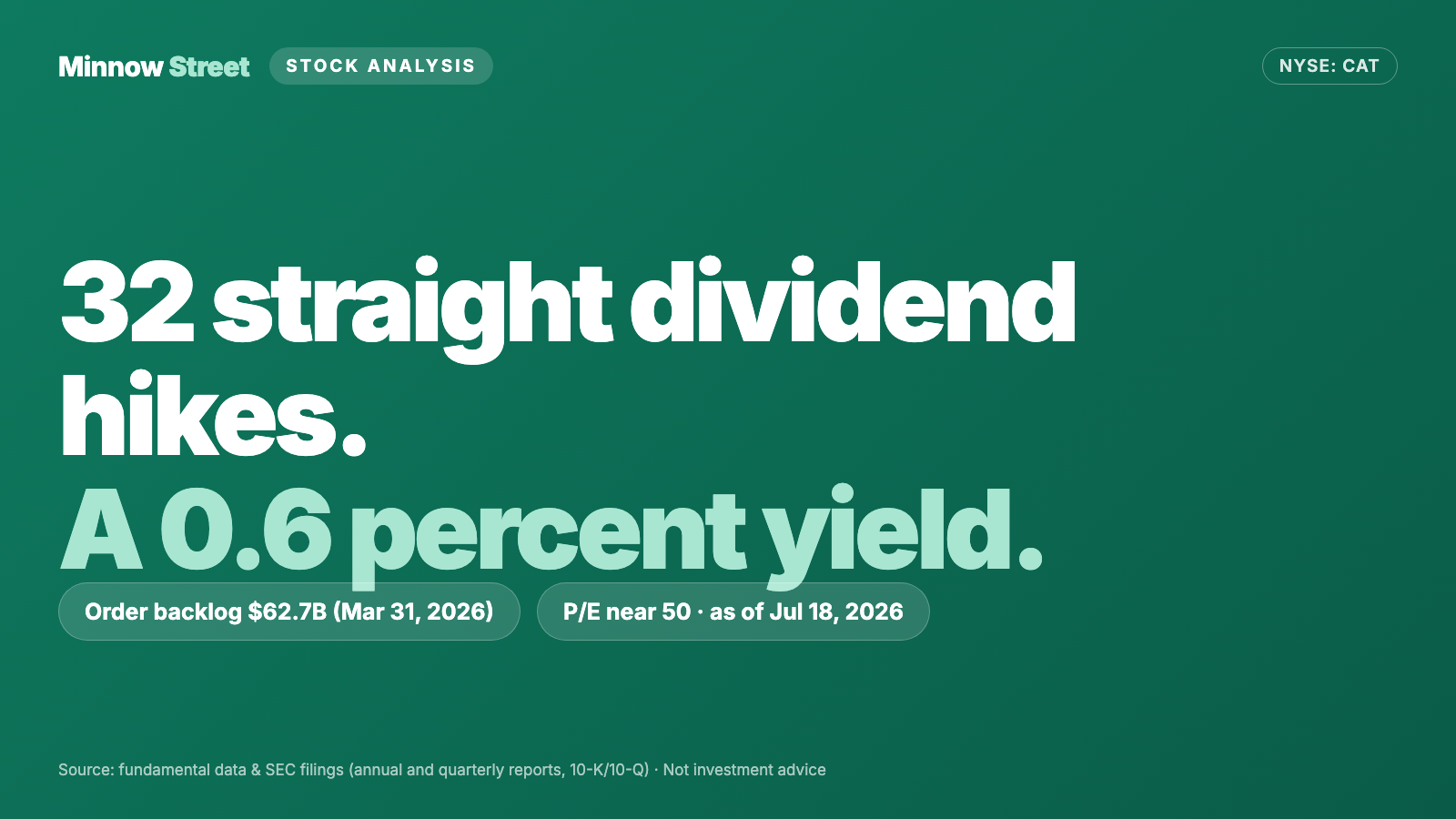
Caterpillar is the textbook Dividend Aristocrat: 32 consecutive years of higher annual dividends, a quarterly payout since 1933 — and rank 1 in the U.S. selection of our in-house Dividend Aristocrats scanner (as of July 18, 2026). We read the annual reports (10-K), the quarterly report (10-Q) as of March 31, 2026, and the June 2026 dividend announcement: an order backlog that more than doubled from $30.0 billion to $62.7 billion in 15 months because AI data centers need power — but also a profit that fell 15 percent in 2025, an expected $2.6 billion tariff bill for 2026, and a valuation that prices the machinery maker like a growth stock. Not investment advice — just a reminder that a royal title says nothing about the price of admission.
 Thomas Mücke
Founder & Publisher
Thomas Mücke
Founder & Publisher
Chart
Interactive price chart (TradingView).
Note: pure fact-based analysis, not investment advice and not a solicitation to buy or sell. All figures without guarantee.
There is an investor trap that catches the careful ones of all people: the label trap. It works like this: a word sounds like safety — "Dividend Aristocrat," "quality stock," "widows-and-orphans paper" — and from that moment on, your brain stops checking the company and starts trusting the label. Caterpillar Inc. (NYSE: CAT) wears the noblest label of them all: 32 consecutive years of higher annual dividends, a quarterly dividend since 1933, membership in the S&P 500 Dividend Aristocrats Index — and rank 1 in the U.S. selection of our in-house Dividend Aristocrats scanner (as of July 18, 2026). So let's make a deal: before you trust your portfolio to a royal title, we read together what the company itself filed, under penalty of law, with the U.S. securities regulator, the SEC — the annual report (10-K) for 2025, the quarterly report (10-Q) as of March 31, 2026, and the June 2026 dividend announcement. Both things are in there: an order backlog that more than doubled to $62.7 billion in 15 months. And a price tag that has turned the income stock of old into a share yielding about 0.6 percent. In the end, you decide what the label is worth to you.
What Caterpillar actually does — and why the bulldozer company is becoming a power plant builder
Caterpillar, founded in 1925 and headquartered in Irving, Texas, employs about 118,000 people (December 31, 2025) and is the world's largest maker of construction and mining equipment: the yellow excavators, wheel loaders, dozers and haul trucks, plus engines, turbines and locomotives. The company reports three industrial segments plus a finance arm: Construction Industries (construction machinery, $25.1 billion in 2025 segment sales), Resource Industries (mining, $12.5 billion) and Power & Energy (engines, turbines, power generation, $32.2 billion) — plus Cat Financial, the in-house captive lender. And here something has quietly shifted that many still miss: the biggest and most profitable piece of Caterpillar is no longer construction. The Power & Energy segment — until recently it was called "Energy & Transportation" — earned $6.4 billion in 2025 (up 12 percent), while construction fell to $4.7 billion (down 24 percent) and mining to $2.0 billion (down 22 percent).
The driver is spelled out in the annual report: data centers for cloud computing and generative artificial intelligence need electricity faster than grids can be built — so their operators order Caterpillar's large engines and turbines as power plants of their own ("prime power"). We looked at how capital-hungry that AI build-out is from the other side in our Nvidia analysis — Caterpillar is one of the companies earning from it without selling a single AI product. Which brings us to the central tension of this analysis, running through every chapter: the royal title and the order book have never been more real — but the market now prices the cyclical like a growth stock, while tariffs and price concessions eat at the profit line.
Where the stock shows up in our scanner
We run roughly 3,500 stocks through our scanners every day. As of July 18, 2026, Caterpillar has exactly one hit — but it comes with a fanfare: rank 1 in the U.S. selection of the Dividend Aristocrats scanner. To replicate it yourself: open the scanner, set the country filter to "US" — the list shows the aristocrats in scanner order, Caterpillar sits on top. The fundamental lens of the same scanner paints a split picture. On the quality side: a Piotroski F-Score of 8 out of 9 in the first quarter of 2026 (a nine-point health check of the books — 8 means almost everything is improving; robust territory starts at 8), an Altman Z-Score near 7 (an early-warning gauge for financial distress — the danger zone historically starts below 1.8, Caterpillar is miles away) and a return on equity around 51 percent, which is admittedly inflated by buybacks keeping the equity base small. On the price side: a price-to-earnings ratio near 50, a price-to-sales ratio near 7 and a price-to-book ratio near 25 (all as of July 18, 2026). Remember the principle: a scanner rank checks the dividend history — it does not check the price you pay for it today. Which is exactly why we now read the filings.
The numbers over the years — honestly appraised
First, what genuinely impresses. Caterpillar is a cyclical, but one with substance: revenue rose from $59.4 billion (2022) to $67.1 billion (2023), eased to $64.8 billion in 2024, and reached a new high of $67.6 billion in 2025 (up 4 percent). The industrial business (in company jargon "MP&E" — Machinery, Power & Energy) generated $9.5 billion of free cash flow in 2025, essentially level with the prior year ($9.4 billion); enterprise operating cash flow was $12.3 billion. And the first quarter of 2026 was an exclamation mark: revenue up 22 percent to $17.4 billion, profit per share up 30 percent to $5.47, operating margin at 17.7 percent. Honesty requires a footnote: part of the jump came from dealers restocking their inventories — the filing names dealer inventory changes and higher end-user sales as the main drivers. The most spectacular picture, though, is the order book:
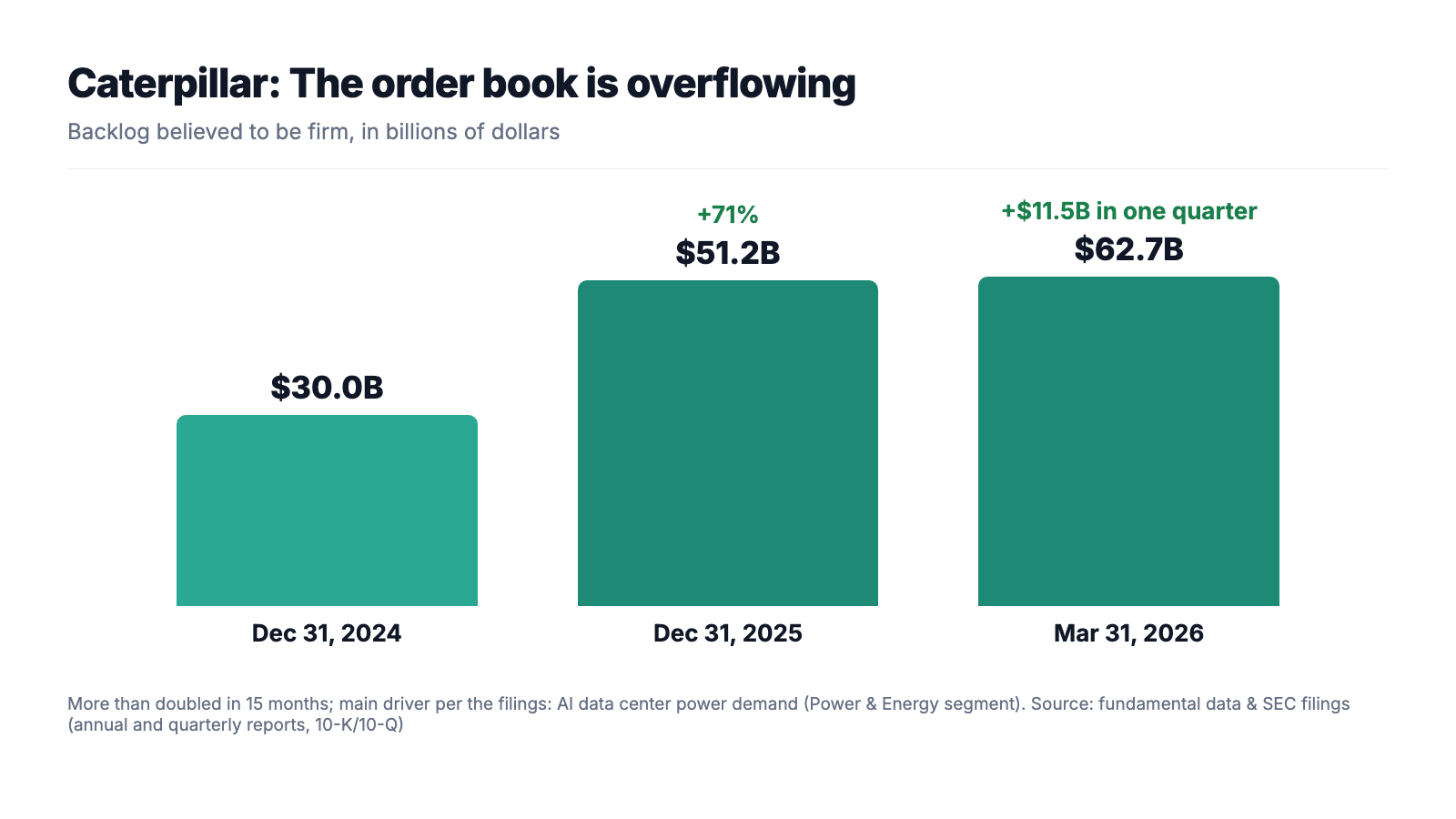
The backlog believed to be firm stood at $30.0 billion at year-end 2024, at $51.2 billion at year-end 2025 — and at $62.7 billion as of March 31, 2026, with $11.5 billion added in the first quarter alone. Doubling the order book within 15 months is extraordinary for a company this size; per the filings, the lion's share of the growth comes from Power & Energy. But pause before the number rush takes over: orders are not yet profit. What got lost on the way from order to margin is the subject of the next chapter — because 2025 was, on the bottom line, a weaker year: profit fell from $10.8 billion to $8.9 billion, from $22.05 to $18.81 per share. Remember the image: the order book filled faster than ever — and profit shrank anyway.
The dividend: a 32-year streak, no skipped quarter since 1933
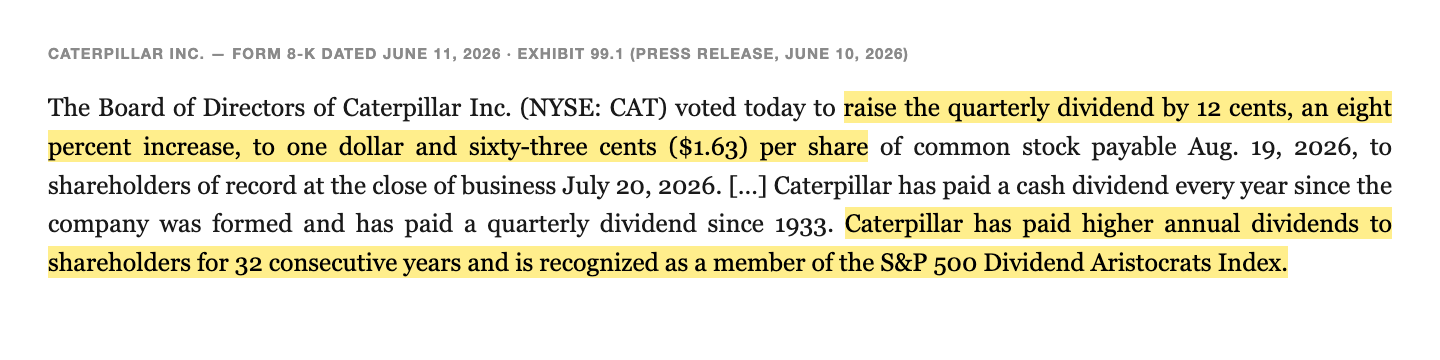
Now to the mandatory chapter of any Aristocrat analysis — the dividend history. At Caterpillar it is genuinely regal: on June 10, 2026, the board raised the quarterly dividend 8 percent to $1.63 per share (payable August 19, 2026). The press release, filed with the SEC as an exhibit to the 8-K, sums up the history in two sentences:
"Caterpillar has paid a cash dividend every year since the company was formed and has paid a quarterly dividend since 1933. Caterpillar has paid higher annual dividends to shareholders for 32 consecutive years and is recognized as a member of the S&P 500 Dividend Aristocrats Index."
— Caterpillar Inc., SEC current report 8-K dated June 11, 2026, Exhibit 99.1 (press release)
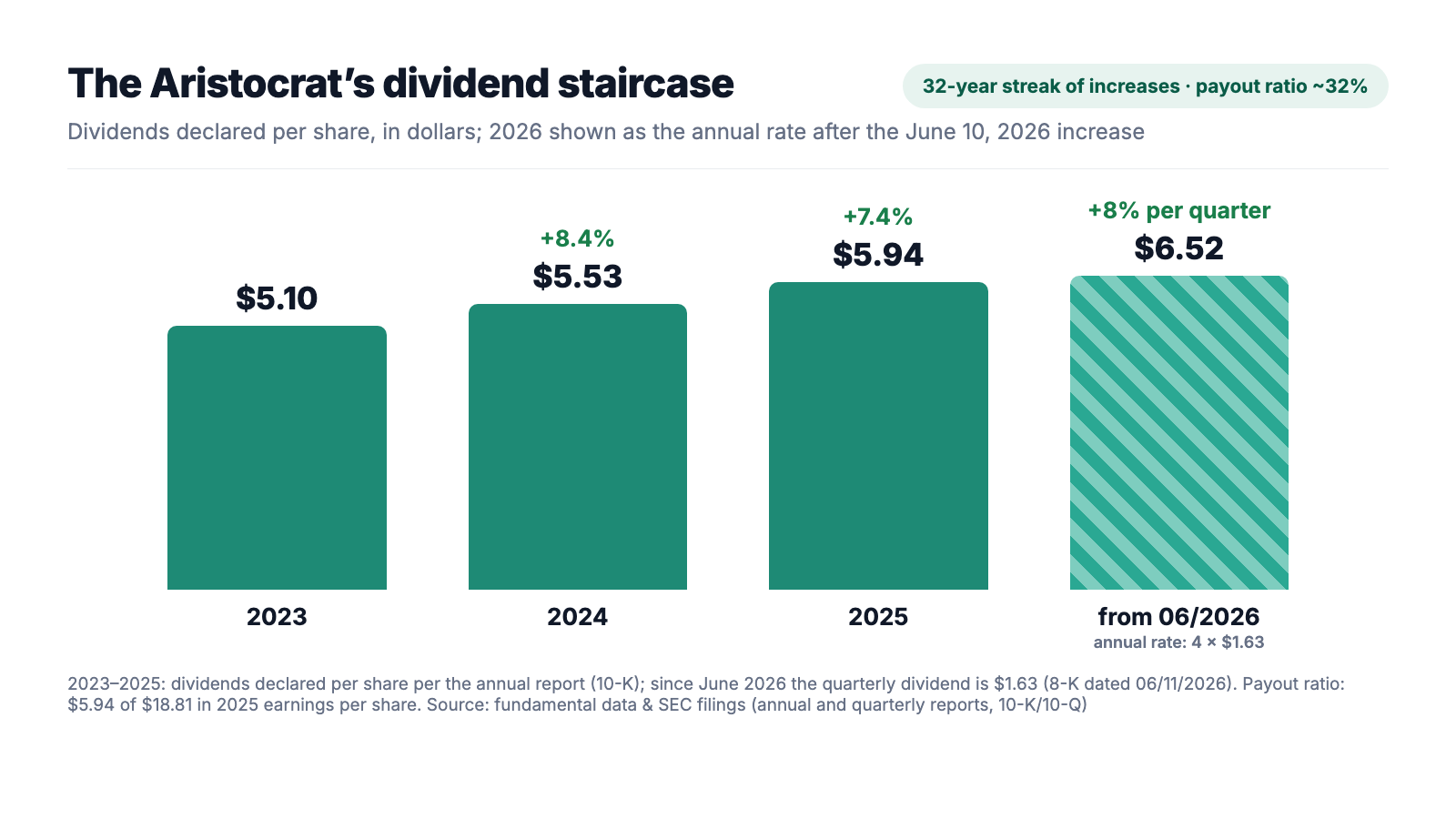
And the streak is not funded on credit: per share, Caterpillar declared $5.10 (2023), $5.53 (2024) and $5.94 (2025) — against $18.81 in 2025 earnings per share, a payout ratio of about 32 percent. Measured against the industrial business's free cash flow ($9.5 billion), the $2.7 billion of dividends paid in 2025 consumed just 29 percent. In everyday terms: of every dollar earned, 32 cents go to shareholders — leaving ample buffer even if profit were cut in half in a recession. Dividend safety is not the risk here. The risk sits on the price tag: at a share price around $1,050 (as of July 18, 2026), the new annual rate of $6.52 yields just about 0.6 percent. If you buy today for the dividend, you get an immaculate pedigree — and a starting yield below money-market level.
What the filings say — the uncomfortable truths
Uncomfortable truth no. 1: profit shrank 15 percent in 2025 — partly because Caterpillar had to cut prices
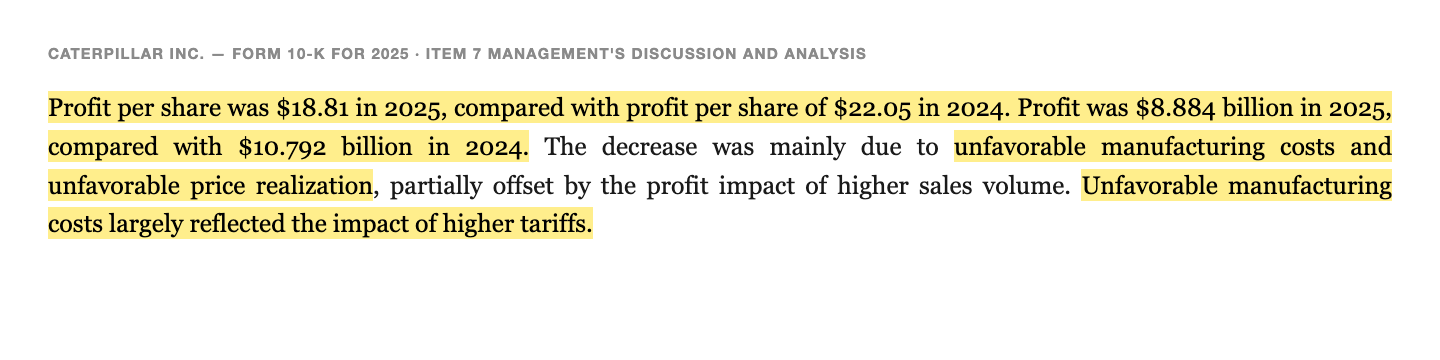
The record order book easily drowns out what happened on the bottom line in 2025. The annual report states it plainly:
"Profit per share was $18.81 in 2025, compared with profit per share of $22.05 in 2024. Profit was $8.884 billion in 2025, compared with $10.792 billion in 2024. The decrease was mainly due to unfavorable manufacturing costs and unfavorable price realization, partially offset by the profit impact of higher sales volume. Unfavorable manufacturing costs largely reflected the impact of higher tariffs."
— Caterpillar Inc., SEC annual report 10-K for 2025, Item 7 "Management's Discussion and Analysis"
"Unfavorable price realization" is the polite phrase for Caterpillar having to meet its customers halfway: it cost $817 million in 2025 — mostly in the construction business, where segment profit slumped 24 percent. The consolidated operating margin fell from 20.2 to 16.5 percent. In fairness: in the first quarter of 2026, price realization swung back positive (plus $426 million) and the margin stabilized at 17.7 percent. But remember the mechanism: an Aristocrat is not vaccinated against recessions of its own margin — 2025 proved it.
Uncomfortable truth no. 2: the 2026 tariff bill reads $2.6 billion — direction uncertain
We dissected what tariffs do to an industrial balance sheet most recently at forklift maker Hyster-Yale — at Caterpillar, the filing quotes figures of a different order. The outlook in the annual report (10-K) for 2025 is precise:
"Based on the incremental tariffs announced in 2025 and in place by January 29, 2026, we expect the impact from tariffs to be around $2.6 billion in 2026, which is $800 million higher than incurred in 2025. If we do not take the mitigating actions we plan to take in 2026, the impact from tariffs could be around 20 percent higher."
— Caterpillar Inc., SEC annual report 10-K for 2025, Item 7 "Management's Discussion and Analysis" (Trends and Economic Conditions)
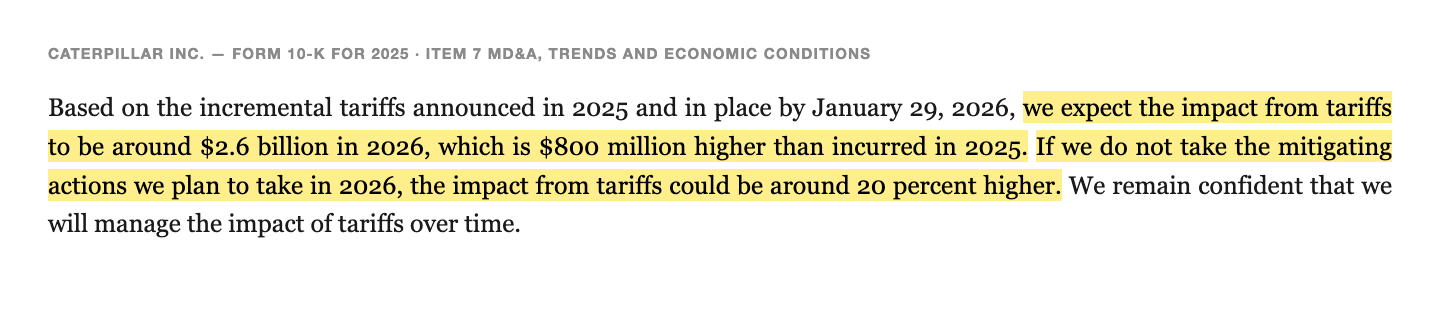
For scale: $2.6 billion equals almost a third of 2025 consolidated profit — and the phrase "could be around 20 percent higher" makes clear that even this figure depends on mitigating actions that have yet to bite. About half of the incremental burden lands, per the filing, on the already bruised construction segment; for the first quarter of 2026 alone, the company expected around $800 million of tariff impact. A margin that depends on trade policy is not a margin — it is a state of negotiations. We have used that sentence before in this series, and it fits again.
Uncomfortable truth no. 3: there is a bank inside the bulldozer — $41.6 billion of assets levered 8 to 1
Open the Caterpillar balance sheet and you find a second company next to the machinery maker: Cat Financial, the in-house captive lender that finances the yellow machines for dealers and customers. As of March 31, 2026, it accounted for roughly $41.6 billion of the $95.6 billion in total assets — and runs on bank-style leverage, as the quarterly report discloses:
"At March 31, 2026, Cat Financial's covenant interest coverage ratio was 1.53 to 1. This was above the 1.15 to 1 minimum ratio […] required by the Credit Facility. In addition, at March 31, 2026, Cat Financial's six-month covenant leverage ratio was 8.03 to 1. This was below the maximum ratio of debt to net worth of 10 to 1 […]"
— Caterpillar Inc., SEC quarterly report 10-Q as of March 31, 2026, Item 2 "Management's Discussion and Analysis" (Liquidity and Capital Resources)
In everyday terms: for every dollar of its own, Cat Financial has eight borrowed dollars at work, and interest income covers interest expense with a cushion of only about one and a half times. That is normal for a captive lender and comfortably inside the limits — but it also explains the consolidated debt-to-equity ratio around 3.4 (as of July 18, 2026) that you would never expect from a "machinery maker with net cash." In every credit crunch (2009, 2020), this part of the company becomes the stress point. The dividend held both times — but if you hold the stock as a rock, know that a bank is working underneath the rock.
Valuation: what the market charges for the royal title
Now to the price tag. In mid-July 2026 the stock cost about $1,050 and the market value stood near $500 billion (all valuation figures: data as of July 18, 2026). That works out to: a price-to-earnings ratio near 50 (on trailing twelve-month profit), a price-to-sales ratio near 7, a price-to-book ratio near 25 and price to operating cash flow near 40. For context: through most of past decades, Caterpillar traded at 10 to 20 times earnings — a P/E near 50 prices the cyclical like a growth stock and assumes the $62.7 billion order book converts into years of rising profits without tariffs, price pressure or a recession interfering. What the company itself is doing is remarkable: in the first quarter of 2026 it repurchased $5.0 billion of its own shares (almost as much as the $5.2 billion in all of 2025), at monthly average prices of $627 to $700 — halving its cash from $10.0 billion to $4.1 billion, with $9.9 billion of authorization still open afterwards. The share count fell from 471.0 to 460.6 million within a year. Buybacks at record prices are a booster while profits deliver — and an expensive misstep if the cycle turns. Either way, earnings per share get a tailwind that has nothing to do with the operating business.
Opportunities and risks at a glance
What speaks for Caterpillar:
- Dividend quality with few equals: a 32-year streak of increases, a quarterly dividend since 1933, a payout ratio of only about 32 percent of 2025 earnings — the June 2026 hike (8 percent to $1.63 per quarter) is comfortably funded from free cash flow.
- An order book as a visibility buffer: $62.7 billion of firm backlog (March 31, 2026) after $30.0 billion at year-end 2024 — carried by the structural power demand of AI data centers, which does not hinge on a single quarter.
- Power & Energy as the new profit center: $6.4 billion of segment profit in 2025 (up 12 percent) makes the company less dependent on the construction cycle; Q1 2026 delivered revenue up 22 percent and profit per share of $5.47 (up 30 percent).
- Balance sheet and cash flow substance: $9.5 billion of industrial free cash flow in 2025, a Piotroski F-Score of 8 out of 9, an Altman Z-Score near 7, and a stated mid-A rating priority.
What speaks against it:
- The valuation has already paid the Aristocrat premium: P/E near 50, price-to-book near 25, a dividend yield near 0.6 percent (as of July 18, 2026) — historically the cyclical traded at 10 to 20 times earnings.
- Tariffs as a standing burden: about $1.8 billion in 2025, an expected $2.6 billion in 2026 (up to 20 percent more without mitigating actions) — with roughly half hitting the already weak construction segment.
- 2025 proved the cyclicality: profit per share down 15 percent, operating margin down from 20.2 to 16.5 percent, price concessions of $817 million, construction and mining segment profits down 24 and 22 percent.
- Cat Financial: a $41.6 billion bank balance sheet levered 8 to 1 with 1.53 times interest coverage — the company's stress point in every credit crunch.
- Capital allocation in overdrive: $5.0 billion of buybacks in the first quarter of 2026 at prices of $627 to $700, cash cut in half — the higher the stock, the more aggressively the company buys.
A human conclusion
Back to the label trap from the opening. Its core is not that labels lie — the Caterpillar label is as honest as they come: the 32-year streak is stated verbatim in an SEC filing, the quarterly dividend has flowed since 1933, and the payout ratio leaves room for two recessions. Its core is that a label spares you a check it was never built to perform: the check of the price. Scanner rank 1 says "best dividend pedigree in the U.S. selection." It does not say "a 0.6 percent starting yield at a P/E near 50, for a company whose profit fell 15 percent in the last full year and whose tariff bill reads $2.6 billion." Both are in the same documents — just in different chapters. The honest ledger looks like this: you get a world market leader with the fullest order book in its history, a structural tailwind from the power hunger of the AI era, and a dividend as safe as they come — at the price of a growth stock, with a bank built in and trade policy as the residual risk. Whether the order book catches up with the valuation before the cycle catches up with both — that is the bet, and no filing will make it for you. Instead of the label, read the quarterly reports (10-Q): the firm backlog, actual tariff costs against the $2.6 billion forecast, and price realization. What you make of it is your decision. And that is exactly as it should be.
Sources
All original documents used in this analysis — for your own reading:
- Caterpillar Inc. — SEC annual report 10-K for 2025 (filed February 13, 2026)
- Caterpillar Inc. — SEC annual report 10-K for 2024 (filed February 14, 2025)
- Caterpillar Inc. — SEC quarterly report 10-Q as of March 31, 2026 (filed May 6, 2026)
- Caterpillar Inc. — SEC current report 8-K dated June 11, 2026, with Exhibit 99.1 (dividend increase to $1.63 per quarter)
- Caterpillar's complete SEC filing history: EDGAR overview (sec.gov)
- Fundamental data (metrics, quarterly series, valuation; data as of July 18, 2026), cross-checked against the SEC filings.
- Screener and rating data: in-house stock scanner (data as of July 18, 2026), including the Dividend Aristocrats scanner (U.S. selection, rank 1).
Transparency & disclaimer: This analysis is a journalistic contextualization of publicly available information and is not investment advice, not a financial analysis in the regulatory sense, and not a solicitation to buy or sell securities. Stock investments carry substantial risks up to and including total loss. All information without guarantee; the data cut-off is noted in the text. The author holds no position in Caterpillar shares at the time of publication.
Our Bottom Line at a Glance
- Dividend quality positive
- 32 consecutive years of higher annual dividends, a quarterly dividend since 1933, the June 10, 2026 increase of 8 percent to $1.63 per quarter — at a payout ratio of only about 32 percent of 2025 earnings and 29 percent of MP&E free cash flow (8-K dated 06/11/2026; 10-K 2025).
- Order book & AI power demand positive
- Firm backlog more than doubled from $30.0 billion (12/31/2024) via $51.2 billion (12/31/2025) to $62.7 billion (03/31/2026); the main driver per the 10-K is data center power demand for cloud and generative AI in the Power & Energy segment (2025 segment profit: $6.4 billion, up 12 percent).
- Profit trend & tariffs negative
- In 2025, profit per share fell from $22.05 to $18.81 (minus 15 percent) and the operating margin from 20.2 to 16.5 percent — on tariffs (~$1.8 billion) and price concessions ($817 million); for 2026 the company expects about $2.6 billion of tariff impact, up to 20 percent more without mitigating actions (10-K 2025). Q1 2026 swung back up with revenue up 22 percent and $5.47 per share.
- Valuation negative
- P/E near 50, price-to-sales near 7, price-to-book near 25, dividend yield near 0.6 percent (as of July 18, 2026) — the cyclical is priced like a growth stock; historically the P/E mostly sat at 10 to 20.
- Balance sheet & Cat Financial neutral
- The industrial business generated $9.5 billion of free cash flow (2025), Piotroski 8 of 9, Altman-Z near 7 and a stated mid-A rating goal — but captive lender Cat Financial carries $41.6 of the $95.6 billion in total assets at a covenant leverage of 8.03:1 and interest coverage of 1.53:1 (10-Q as of 03/31/2026).
- Capital allocation neutral
- Buybacks of $5.2 billion (2025) plus $5.0 billion in the first quarter of 2026 alone, at monthly average prices of $627 to $700, halved the cash pile to $4.1 billion; the share count fell a good 2 percent within a year — a booster per share, and an expensive entry price if the cycle turns.
Caterpillar is the rare case where the label is accurate and can still mislead: the 32-year dividend streak is SEC-documented, conservatively funded at a payout ratio around 32 percent, and complemented by a $62.7 billion order book filled by the power hunger of AI data centers. Against that stand a 15 percent profit decline in 2025, an expected $2.6 billion tariff bill for 2026, a built-in captive lender levered 8 to 1 — and a valuation near 50 times earnings at a 0.6 percent dividend yield. Whoever invests here is not buying the dividend but the continuation of the Power & Energy boom at full price. Not investment advice.
What Our Rating Means
- If you don't own the stock
- As long as the question raised in the bottom line stays open, we see no basis for an entry.
- If you hold it in your portfolio
- Our findings offer no acute reason to sell — the checkpoints named remain decisive.
A journalistic assessment by our editorial team at the time of the deep dive, based on public sources — not investment advice and not a solicitation to buy or sell. Your personal circumstances (investment goals, risk capacity, taxes) cannot be taken into account. What our categories mean, how verdicts are formed, and what conflicts of interest exist →
Worth Noting
- CAT made the research list as rank 1 of our in-house Dividend Aristocrats scanner (U.S. selection, as of July 18, 2026) — the opener of our series on the top 20 of that selection.
- Scanner metrics (P/E, P/S, P/B, Piotroski, Altman-Z, return on equity) use trailing twelve-month figures as of July 18, 2026; the high return on equity around 51 percent is partly a product of buybacks shrinking the equity base ($18.7 billion as of 03/31/2026).
- Price and market value figures (~$1,050, ~$500 billion) from the July 18, 2026 feed, sanity-checked against 460.6 million shares outstanding per the 10-Q as of March 31, 2026; analyses are evergreen, daily prices are not a buy argument.
Frequently Asked Questions
Caterpillar Inc. (NYSE: CAT, Irving, Texas, about 118,000 employees as of December 31, 2025) builds construction and mining equipment, engines and turbines. In 2025 the company generated $67.6 billion in revenue; its biggest and most profitable segment, for the first time by a clear margin, was Power & Energy (power generation, engines, turbines) with $6.4 billion of segment profit — ahead of Construction Industries ($4.7 billion) and Resource Industries ($2.0 billion). Cat Financial, the captive lender, comes on top.
Per the release filed with the SEC on June 10, 2026, Caterpillar has paid higher annual dividends for 32 consecutive years, is a member of the S&P 500 Dividend Aristocrats Index, has paid a quarterly dividend since 1933 and a cash dividend in every year since the company was formed. The latest increase: 8 percent to $1.63 per quarter, payable from August 19, 2026.
Very solid by the SEC-filed numbers: in 2025 Caterpillar declared $5.94 per share in dividends against $18.81 in earnings per share — a payout ratio of about 32 percent. The $2.7 billion actually paid equaled roughly 29 percent of the industrial business's free cash flow ($9.5 billion). Even a cyclical profit slump would leave a wide buffer before the dividend came under pressure.
Because the share price has risen faster than the dividend: at around $1,050 per share (as of July 18, 2026), the new annual rate of $6.52 yields only about 0.6 percent. The 32-year streak is intact — but a buyer today pays a price-to-earnings ratio near 50 for the history and receives a starting yield below money-market level.
Caterpillar does not sell AI — it sells AI's power supply: per the annual report (10-K) for 2025, the data center build-out for cloud computing and generative AI is driving demand for the Power & Energy segment's large engines and turbines — increasingly as permanent on-site generation ("prime power"). The firm order backlog rose from $30.0 billion (year-end 2024) to $62.7 billion (March 31, 2026).
Hard: about $1.8 billion of tariff costs were incurred in 2025; for 2026 the company expects about $2.6 billion per the annual report (10-K) — and roughly 20 percent more without the planned mitigating actions. About half hits the construction segment. Tariffs were the main reason profit per share fell from $22.05 to $18.81 in 2025 and the operating margin from 20.2 to 16.5 percent.
No — it is historically expensive: as of July 18, 2026, the stock traded at roughly 50 times trailing earnings, 7 times revenue and 25 times book value, with a dividend yield near 0.6 percent. Through most of its past, the cyclical traded at 10 to 20 times earnings. The market is paying up front for the record $62.7 billion order book.
Found an error?
Did you spot a factual error, an outdated number, or a typo in this deep dive? Let us know briefly — your report goes straight to the editorial team.