Hut 8 Stock: A $9.8 Billion Lease, 16,331 Bitcoin — and a Bottom Line Written by the Bitcoin Price
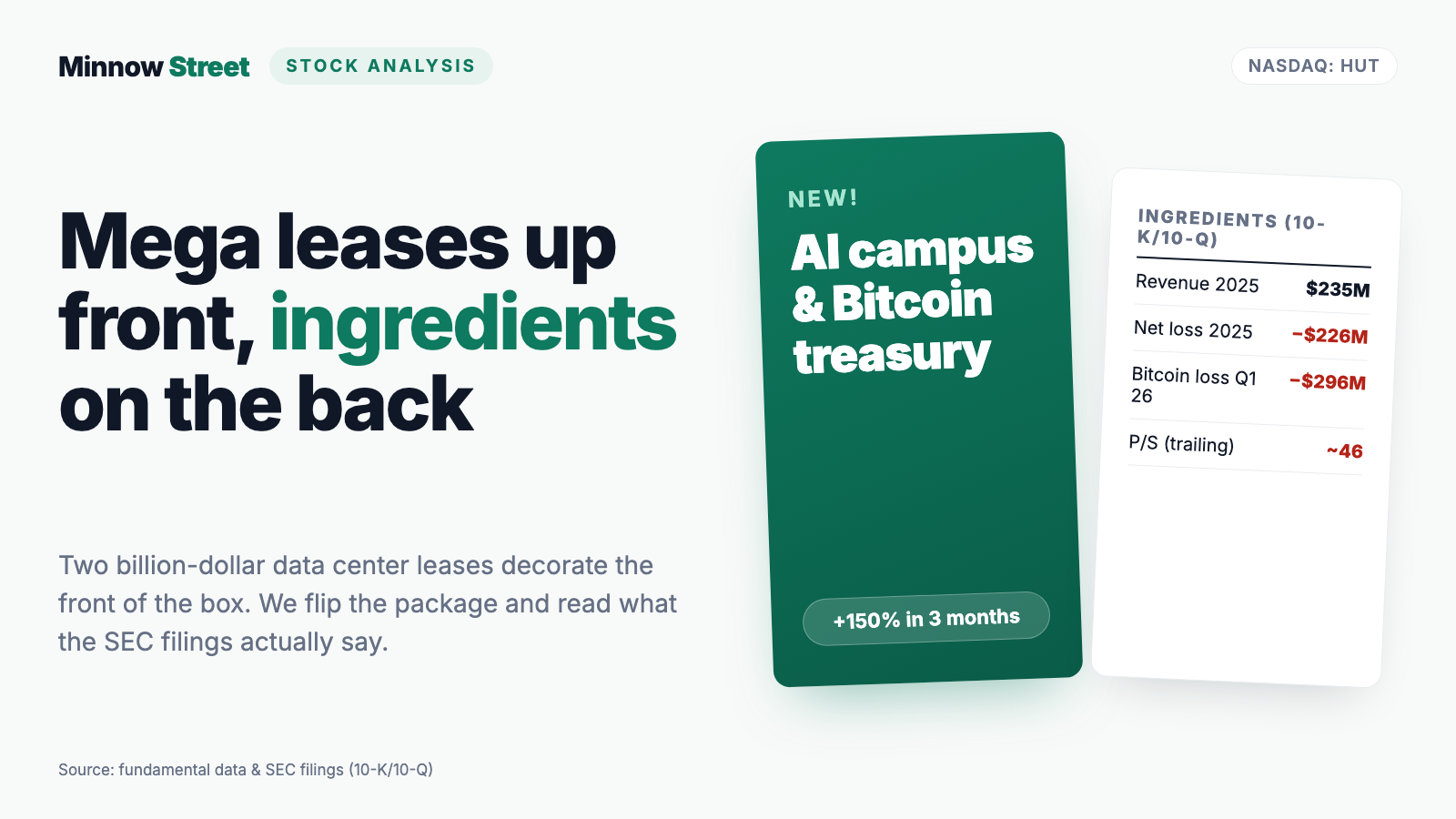
Hut 8 assembles power plants, data centers and Bitcoin mining into one energy platform — and lit up 17 hits in our momentum scanner run of July 17, 2026, after roughly 150 percent of share-price gains in three months. We read the annual reports (10-K) for 2024 and 2025 and the quarterly reports (10-Q) through March 31, 2026: a 15-year lease worth about $9.8 billion with an unnamed multi-trillion-dollar technology company, a Google backstop for the second campus, 16,331 Bitcoin on the balance sheet — and an income statement that swung from plus $332 million in 2024 to minus $226 million in 2025 because Bitcoin revaluation dominates it. Not investment advice — just a look at what remains once you twist the Bitcoin price out of the profit column.
 Thomas Mücke
Founder & Publisher
Thomas Mücke
Founder & Publisher
Chart
Interactive price chart (TradingView).
Note: pure fact-based analysis, not investment advice and not a solicitation to buy or sell. All figures without guarantee.
There is an investor trap enjoying a boom of its own in the summer of 2026: the label trap. It works like this: a company you had filed away for years under one label ("Bitcoin miner, cyclical, speculative") sticks a new one on the box ("AI data centers, leases with world-class tenants") — and from that moment your brain prices the label instead of the ledger. The stock rises, the new label looks validated by the rising stock, and at some point nobody checks what it says on the back of the package anymore. Hardly any stock feeds that trap as powerfully right now as Hut 8 Corp. (Nasdaq: HUT): roughly 150 percent of share-price gains in three months, a good 630 percent in twelve (data as of July 8, 2026), plus headlines about billion-dollar leases for the AI age. So let’s make a deal: before you buy the new label, we flip the box together and read what the company itself reported, under penalty of law, to the U.S. securities regulator, the SEC — the annual reports (10-K) for 2024 and 2025 and the quarterly reports (10-Q) through March 31, 2026. And these filings tell two stories at once: one about real, signed mega contracts — and one about an income statement currently written not by management, but by the Bitcoin price. In the end, you decide for yourself.
What Hut 8 actually does — and for whom
Hut 8 describes itself in the annual report as an "energy infrastructure platform" — translated: the company first secures power (plants, grid connections, sites with cheap energy), builds data centers on top, and then fills them with whatever compute business promises the best return — Bitcoin mining machines (so-called ASICs, specialized chips that can do nothing but mine Bitcoin) or AI servers. Accordingly, the group reports in three segments: Power, Digital Infrastructure and Compute, together 1,020 megawatts of energy capacity under management plus another 1,560 megawatts under construction and development (December 31, 2025). The Compute segment houses three brands: first, American Bitcoin — the Bitcoin mining and accumulation subsidiary, itself Nasdaq-listed since September 2025 (ticker ABTC) but consolidated by Hut 8; second, Hut 8 Canada with five data centers and more than 200 cloud customers; third, the AI cloud Highrise AI with 1,000 Nvidia H100 and 96 H200 graphics processors — compute capacity rented out to AI developers. Important for reading the history: Hut 8 Corp. is a young U.S. entity, incorporated in Delaware in January 2023 and created through the combination of Canadian miner Hut 8 Mining and U.S.-based US Bitcoin Corp (completed November 30, 2023) — earlier time series are only comparable to a limited degree, and 2023 was a stub period. How differently Bitcoin miners approach this pivot toward data centers is something we dissected at Riot Platforms and Bitdeer. Which brings us to the central tension of this analysis, and it runs through every chapter: the front of the box shows two mega leases with world-class credit quality starting in 2027 — the back shows an income statement that, for now, the Bitcoin price dictates.
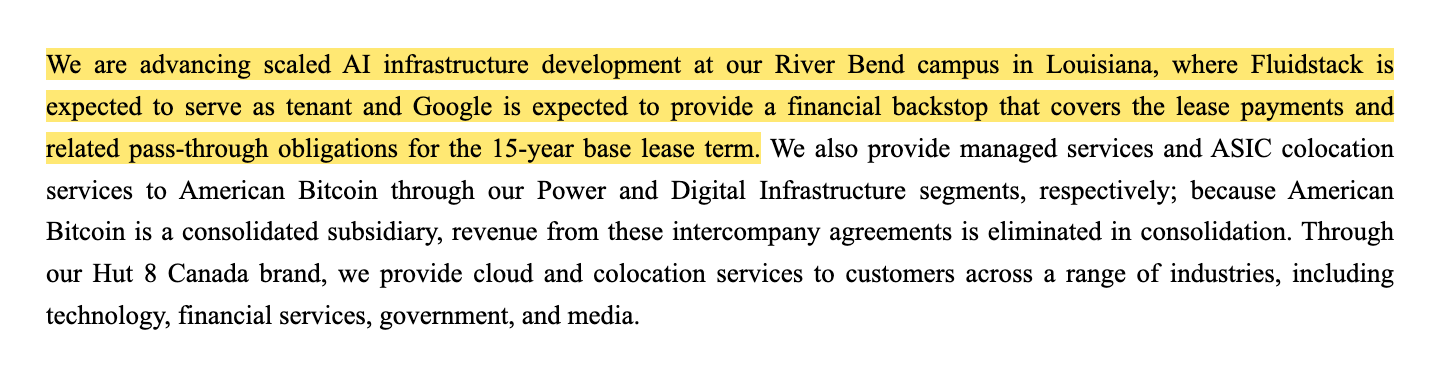
You need to see the two contracts, because they are the fuel of the fireworks. Contract number one, December 2025: for the River Bend campus in Louisiana (245 megawatts of IT load, 330 megawatts of utility capacity), a tenant signed a 15-year triple-net lease — "triple-net" means the tenant carries taxes, insurance and maintenance while the landlord collects base rent like a bond coupon. The annual report names names:
"We are advancing scaled AI infrastructure development at our River Bend campus in Louisiana, where Fluidstack is expected to serve as tenant and Google is expected to provide a financial backstop that covers the lease payments and related pass-through obligations for the 15-year base lease term."
— Hut 8 Corp., SEC annual report 10-K for 2025, Item 1 "Business" (Customers and Partners)
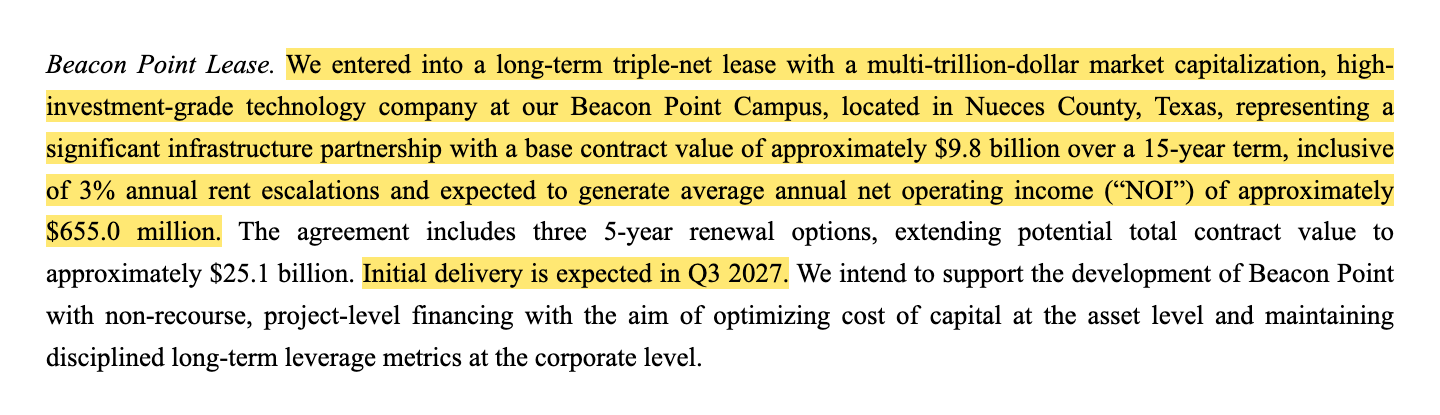
Contract number two, first quarter of 2026, is even bigger — and its partner has no name. At the Beacon Point campus in Texas (352 megawatts of IT load in the first phase, approvals for up to 1,000 megawatts), per the quarterly report a "multi-trillion-dollar market capitalization, high-investment-grade technology company" signed a triple-net lease with a base contract value of approximately $9.8 billion over 15 years, three 5-year renewal options included — roughly $25.1 billion if fully exercised. Expected net operating income: an average of about $655 million per year. Initial delivery: from the third quarter of 2027.
Fairness requires saying: this is not vaporware. The $3.25 billion River Bend financing is placed (more on that below), S&P and Fitch assigned it investment-grade ratings, and with its Vega site in Texas Hut 8 has proven it can bring large sites online fast: energized within a year of acquisition, at a development cost of roughly $455,000 per megawatt, today hosting 17,280 mining servers. But remember this for everything that follows: both mega leases deliver their first dollar of revenue in 2027 at the earliest — until then, today’s business earns the money. And today’s business is, for the most part, Bitcoin.
Where the stock shows up in our scanner
Every day we run about 3,500 stocks through our scanners. Hut 8 reached the research list through the momentum run of July 17, 2026 — with 17 hits, one of the broadest trend fingerprints in this series. The most striking ones: the stock sits in a Stan Weinstein stage-2 uptrend (price above a rising 200-day average — the phase of a price cycle in which trend followers even consider buying), belongs to the RS leaders above 90 with a relative strength of 98 (it beat 98 percent of all stocks over the trailing twelve months), shows up among the Oliver Kell doublers and the Qullamaggie top gainers, and passes the Minervini trend template. Behind that stand roughly plus 150 percent in three months, plus 124 in six and plus 631 in twelve; the stock trades only about 13 percent below its all-time high (data as of July 8, 2026). The professionals’ criterion is met too: institutions hold a good 80 percent of the shares. The fundamental lens of the very same scanner judges more coolly: a fundamental grade of C, a Piotroski F-score of 5 of 9 (a nine-point test of the direction of the books — 5 is mediocre), an Altman Z-score around 3.4 (an early-warning gauge of insolvency risk; the danger zone historically starts below 1.8 — no alarm here, but no fortress either) and a negative trailing price-to-earnings ratio, because the last four quarters combined produced red ink. One more number belongs in this chapter because it describes the risk profile: the stock’s average daily range sits around 9 percent — what reads as momentum on good days reads exactly the same on bad ones. To replicate it yourself: open the Hut 8 stock page or browse the stage-2 scanner. Remember: a scanner measures how a stock moves — not what it lives on. What Hut 8 lives on is in the filings.
The numbers over the years — honestly appraised
First, what genuinely impresses. Revenue is growing steeply: in 2025 it rose 45 percent to $235.1 million (after $162.4 million in 2024), and the quarterly series shows the curve accelerating through the year — from $21.8 million in the first quarter of 2025 to $83.5 million and $88.5 million in the following two quarters and $71.0 million in the first quarter of 2026, up 226 percent year over year. The driver is the Compute segment (2025: $202.3 million after $80.7 million), above all American Bitcoin’s mining after the Vega site ramped up. Operationally, the platform delivers evidence rather than promises: Vega was energized within a year, the mining fleet was upgraded to more efficient machines, and Bitcoin holdings grew from 10,171 (December 31, 2024) to 16,331 coins (March 31, 2026) — market value $1,114.2 million. Add the two leases from the previous chapter, which promise plannable rent from 2027, and a cash balance that rose to $160.0 million (March 31, 2026) after the notes placement and the sale of the four Canadian Ontario power plants (Far North, book gain $33.6 million). If you read only this paragraph, you see a growth company in top form. Now look at the rest of the ledger:
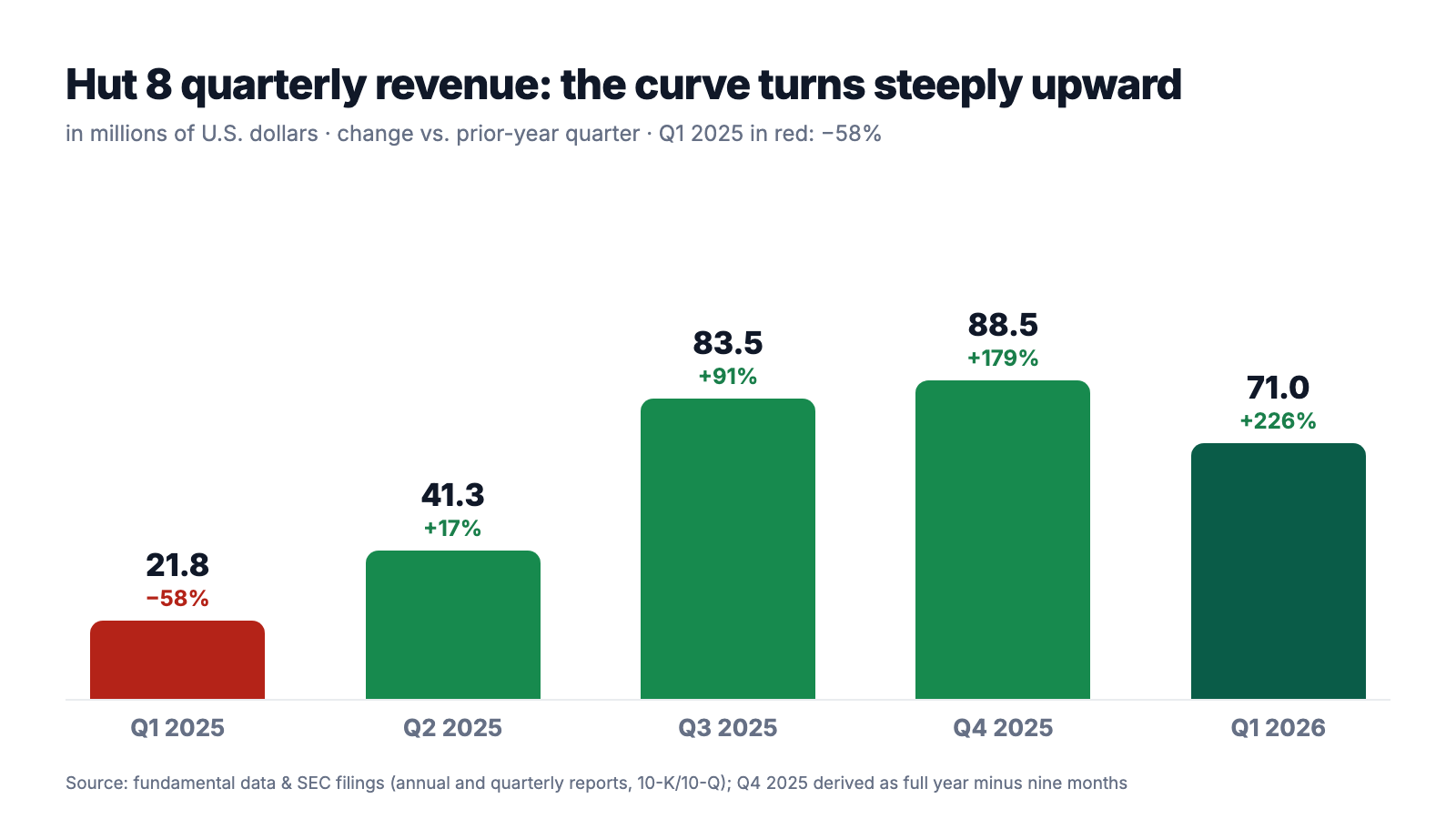
Because beneath the revenue lives a second truth: despite 45 percent growth, 2025 ended with a net loss of $226.1 million (attributable to Hut 8 shareholders), after a net profit of $331.9 million in 2024 — and the first quarter of 2026 promptly added another $219.8 million of losses. A business that keeps growing at the same pace but flips from fat profit to fat loss within twelve months? No operation explains that — a balance-sheet position does. Which brings us to the uncomfortable truths.
What the filings say — the uncomfortable truths
Uncomfortable truth no. 1: The Bitcoin price writes the income statement — in both directions
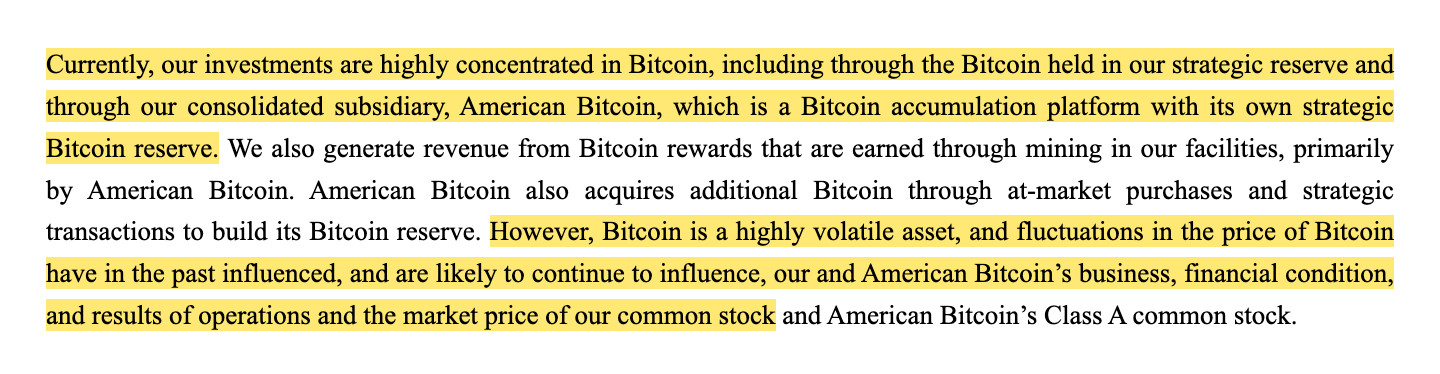
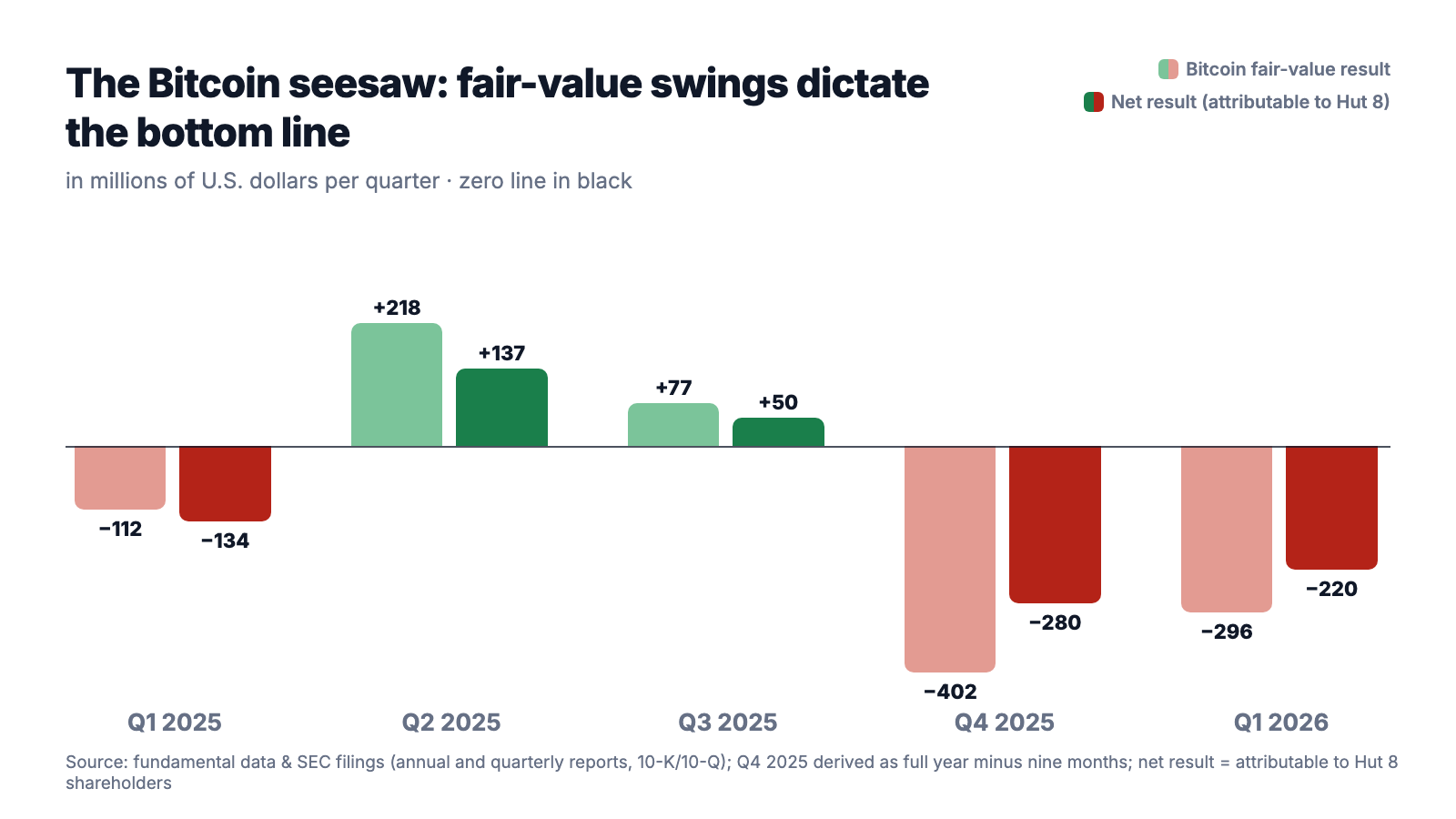
Hut 8 values its Bitcoin — as required since 2024 — at market ("fair value"): every price move of the 16,331 Bitcoin lands immediately and in full in the income statement, whether or not a single coin was sold. With holdings above one billion dollars, this line item is bigger than anything the operating business earns in a quarter. The annual report says it without hedging:
"Currently, our investments are highly concentrated in Bitcoin, including through the Bitcoin held in our strategic reserve and through our consolidated subsidiary, American Bitcoin, which is a Bitcoin accumulation platform with its own strategic Bitcoin reserve. […] However, Bitcoin is a highly volatile asset, and fluctuations in the price of Bitcoin have in the past influenced, and are likely to continue to influence, our and American Bitcoin's business, financial condition, and results of operations and the market price of our common stock and American Bitcoin's Class A common stock."
— Hut 8 Corp., SEC annual report 10-K for 2025, Item 1A "Risk Factors"
How hard this seesaw swings shows in the quarterly series: in the second quarter of 2025, Bitcoin revaluation delivered a gain of $217.6 million — net result: plus $137.3 million. In the fourth quarter of 2025 it swung to minus $401.9 million — net result: minus $279.7 million. In the first quarter of 2026, another $295.7 million of valuation losses, $219.8 million of net loss. Arithmetically, the carrying value per Bitcoin fell from roughly $93,000 (end of 2024) to roughly $68,000 (March 31, 2026). The record profit year 2024, with its $331.9 million of net income, was the same mechanism with the sign flipped: a valuation gain of $509.3 million. Remember the pattern: whoever reads Hut 8’s income statement reads the Bitcoin chart first — the operating business sits in the second row.
Uncomfortable truth no. 2: The growth engine is only half-owned — and when its shares were handed out, the company’s own chiefs sat on both sides of the table
The Compute revenue surge is real — but it originates almost entirely at American Bitcoin, and that subsidiary is a group within the group: its own Nasdaq listing, its own management, its own minority shareholders. As of December 31, 2025, third parties already held 39.93 percent; per American Bitcoin’s own annual report, Hut 8’s stake stood at roughly 55.3 percent on March 25, 2026 — trending lower over time, because the subsidiary also pays for Bitcoin purchases and expansion with its own shares. For you as a Hut 8 shareholder, that means: of the mining profit (and loss), only the pro-rata share is yours, and the 10-K names the gray zone in between with unusual candor: "Conflicts of interest may arise between us and minority shareholders or other stakeholders, and the resolution of such conflicts may not be favorable to us" (Item 1A "Risk Factors"). How concrete that can get is recorded in the same filing’s related-party footnote:
"[…] the boards of directors of each of the Company and American Bitcoin consented to the purchase of 23,199,205 shares of Class B common stock of American Bitcoin by a limited liability company (the 'LLC Purchaser') for a purchase price of $1.40 per share. Asher Genoot, Chief Executive Officer and director of the Company and Executive Chairman of American Bitcoin, and Michael Ho, Chief Strategy Officer and director of the Company and Chief Executive Officer and director of American Bitcoin, solely manage and control the LLC Purchaser […]"
— Hut 8 Corp., SEC annual report 10-K for 2025, related-party footnote (Investor Rights Agreement)
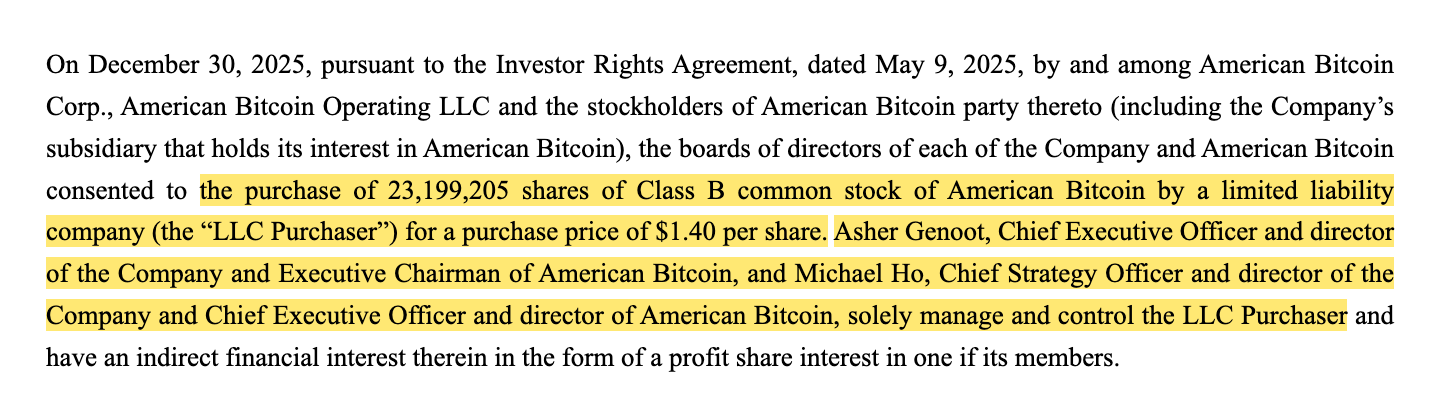
Without scandalizing: the transaction is disclosed, approved by both boards, and dual roles are not illegal in parent-subsidiary structures. But as an investor you should understand the architecture: the fastest-growing piece of the group is a separately listed entity with a shrinking Hut 8 stake, run by the very same people who run the parent — and who, when push comes to shove, must serve two shareholder groups at once. Picture a baker whose best-performing branch has its own till, its own co-owners and the same manager as the main shop: it can work out fine. But when things grind, your receipt is no longer the only one that counts.
Uncomfortable truth no. 3: The growth is borrowed — $3.25 billion of notes, ongoing share sales and a loan collateralized with Bitcoin
A platform that builds power plants and data centers burns money during construction — that is not an accusation, it is the physics of the business model. At Hut 8 it reads like this: operating cash flow was negative $139.2 million in 2025 (2024: negative $68.5 million), $754.2 million went into investing — including $405.1 million of Bitcoin purchases by the subsidiary — and the financing side closed the gap with $856.1 million. You should know the tools. First, the share-sale machine: through the ongoing ATM program ("at the market" — selling shares directly into the exchange), the share count rose from 99.5 to 110.1 million (+10.7 percent) in 2025, with another 2.1 million shares for $120.1 million added in the first quarter of 2026 alone — your slice of the cake keeps getting trimmed. Second, the big bond: in April 2026, project subsidiary Hut 8 DC LLC placed $3.25 billion of senior secured notes at 6.192 percent, due November 15, 2042 — "non-recourse," meaning no claim against the parent: if the project fails, the noteholders lose, not automatically Hut 8. That is cleverly structured and expensive at the same time: a good $200 million of interest per year that the River Bend tenant first has to earn. Third, the Bitcoin-collateralized loan: in May 2026, the group borrowed $200 million from FalconX against pledged Bitcoin — interest 7.0 percent, initial collateral ratio 143 percent, margin calls from 130 percent, forced liquidation from 105 percent. Translated: if the Bitcoin price falls hard, Hut 8 must post more Bitcoin or cash — the seesaw from truth no. 1 then hits not only the income statement but the liquidity line. The annual report frames it itself: "We may experience liquidity constraints and may need to raise additional capital" (10-K for 2025, Item 1A). The fair counterweight: $160.0 million of cash (March 31, 2026), $1.11 billion in Bitcoin and two investment-grade-rated project financings are not the picture of a strapped company — but they are the picture of one whose room for maneuver hangs on the same asset that writes its income statement.
Valuation: $13 billion of market value — you are paying for the rent of the day after tomorrow
In early July 2026 the Hut 8 share cost about $117.70, for a market value of roughly $13.0 billion (data as of July 8, 2026). Measured against the present, that is a statement: revenue over the trailing four quarters adds up to roughly $284 million — so the market pays about 46 times trailing revenue; price-to-book sits around 9.5, and a price-to-earnings ratio does not exist for lack of trailing profits. What the market is evidently pricing is the future from 2027/2028: Beacon Point with an expected average of roughly $655 million of net operating income per year, plus River Bend (pre-financed by the $3.25 billion notes, with Google’s backstop behind the tenant), plus 16,331 Bitcoin worth roughly $1.11 billion most recently, plus the majority in the separately listed American Bitcoin. Priced that way, the share becomes a bet on punctuality: both campuses must come online in 2027 on time and on budget, the unnamed multi-trillion-dollar tenant must remain a tenant, and Bitcoin must not sabotage the transition through the income statement and the loan covenants before then. Analysts are mostly upbeat — 15 firms cover the stock, and the consensus stands at "buy" (data as of July 8, 2026) — but honesty requires adding: for a stock that has more than sextupled in twelve months, consensus is part of the momentum, not proof of it. Roughly 9.3 percent of the shares sit with insiders; the most recent reported insider activity was five sales and no purchase (source: fundamental data, as of July 8, 2026).
Opportunities and risks at a glance
What speaks for Hut 8:
- Two signed mega leases with long maturities: Beacon Point (roughly $9.8 billion of base contract value over 15 years with a multi-trillion-dollar tech company, expected average annual net operating income of about $655 million, options up to roughly $25.1 billion) and River Bend (245 MW, Fluidstack as expected tenant with a Google backstop) — both triple-net structures with bond-like cash flow profiles (10-Q as of 03/31/2026, 10-K for 2025).
- Proven construction speed: the Vega site (205 MW) was energized within a year at roughly $455,000 per megawatt — in the race for AI capacity, execution speed is the hardest currency.
- Smart financing architecture: $3.25 billion of project notes without recourse to the parent (6.192 percent, due 2042, investment-grade ratings), plus $160.0 million of cash and $1.11 billion in Bitcoin (March 31, 2026).
- Steep, broad-based growth: revenue up 45 percent in 2025 and 226 percent in Q1 2026; 1,020 MW under management, 1,560 MW under construction and development; the AI cloud Highrise AI with a good 1,000 Nvidia GPUs as a third leg.
- Textbook momentum: 17 scanner hits in the run of July 17, 2026, relative strength of 98, stage-2 trend, a good 80 percent institutional ownership.
What speaks against it:
- The income statement hangs on the Bitcoin price: valuation swings from +$509.3 million (2024) through −$401.9 million (Q4 2025 alone) to −$295.7 million (Q1 2026) flip the group result faster than the operating business can grow.
- Losses and capital consumption today: a $226.1 million net loss (2025) plus $219.8 million (Q1 2026), operating cash flow of −$139.2 million in 2025; the gap is filled by share sales (share count +10.7 percent in twelve months, ATM still running) and debt.
- Group-within-the-group risk: mining sits inside the separately listed American Bitcoin (third-party stake of 39.93 percent as of 12/31/2025, Hut 8 stake roughly 55.3 percent per ABTC’s 10-K in March 2026), with documented conflict-of-interest warnings and an approved insider share purchase at $1.40 per share.
- Timing risk of the story: both mega leases deliver first rents in 2027 at the earliest (River Bend from Q2, Beacon Point from Q3 2027); the Beacon Point tenant is publicly nameless, and at River Bend both Fluidstack and Google appear in the filing explicitly in "expected" mode.
- A sporty valuation with leverage: roughly 46 times trailing revenue, price-to-book around 9.5, plus a Bitcoin-collateralized loan with forced liquidation from 105 percent coverage and roughly $200 million of note interest per year from 2026.
A human conclusion
Back to the label trap from the opening. Its core is not that new labels lie — sometimes they are true, and Hut 8 has delivered more than most transformation stories: two signed contracts, a placed multi-billion financing, a site that proves this company can build fast. Its core is that the new label does not replace the old one — it is pasted over it. Underneath the sticker "AI landlord with world-class tenants," until at least 2027 there works a group whose quarterly result is written by the Bitcoin price, whose best asset it now owns only a little more than half of, and whose growth is continuously paid for with new shares and debt. Both labels are true. So the honest question for you is not "Is the AI story real?" (it is, subjunctives included), but: which of the two labels is the price tag of 46 times revenue attached to — and which one do you get the next time Bitcoin turns in an ugly quarter? If Beacon Point and River Bend come online on schedule in 2027 and the rents flow, the stock gains a foundation that can negotiate with today’s price. Until then, every buyer buys both: the lease of the day after tomorrow and the Bitcoin seesaw of today. What you make of it is your decision. And that is exactly as it should be.
Sources
All original documents used in this analysis — for your own reading:
- Hut 8 Corp. — SEC annual report 10-K for 2025 (filed February 25, 2026)
- Hut 8 Corp. — SEC annual report 10-K for 2024 (filed March 3, 2025)
- Hut 8 Corp. — SEC quarterly report 10-Q as of 03/31/2026 (filed May 6, 2026; Beacon Point lease, $3.25 billion notes, FalconX loan)
- Hut 8 Corp. — SEC quarterly report 10-Q as of 09/30/2025 (filed November 4, 2025)
- Hut 8 Corp. — SEC quarterly report 10-Q as of 06/30/2025 (filed August 7, 2025)
- Hut 8 Corp. — SEC quarterly report 10-Q as of 03/31/2025 (filed May 8, 2025)
- American Bitcoin Corp. — SEC annual report 10-K for 2025 (filed March 27, 2026; Hut 8 stake of roughly 55.3% as of 03/25/2026)
- Complete SEC filing history of Hut 8 Corp.: EDGAR overview (sec.gov); American Bitcoin Corp. (ex Gryphon/Akerna/MTech): EDGAR overview CIK 1755953 (sec.gov)
- Fundamental data (metrics, quarterly series, valuation; data as of July 8, 2026), reconciled against the SEC filings — revenue and results series derived directly from the filings because of fair-value artifacts in the vendor data.
- Screener and rating data: in-house stock scanner (momentum run of July 17, 2026; price and valuation data as of July 8, 2026).
Transparency & disclaimer: This analysis is a journalistic contextualization of publicly available information and is not investment advice, not a financial analysis in the regulatory sense, and not a solicitation to buy or sell securities. Stock investments carry substantial risks up to and including total loss. All information without guarantee; the data cut-off is noted in the text for each figure. The author holds no position in Hut 8 shares at the time of publication.
Our Bottom Line at a Glance
- Mega leases & project pipeline positive
- Beacon Point (roughly $9.8 billion of base contract value over 15 years with a multi-trillion-dollar tech company, expected average annual net operating income of about $655 million) and River Bend (245 MW, Fluidstack/Google as expected partners, $3.25 billion financing placed) give the stock a contracted future foundation for the first time — deliveries from Q2/Q3 2027 (10-Q as of 03/31/2026, 10-K for 2025).
- Earnings quality & Bitcoin dependency negative
- Fair-value accounting for the 16,331 Bitcoin dictates the group result: +$331.9 million (2024), −$226.1 million (2025), −$219.8 million (Q1 2026), with valuation swings from +$509.3 to −$401.9 million per period — the 10-K explicitly names the Bitcoin concentration as a central risk (Item 1A).
- Governance & group structure negative
- Growth driver American Bitcoin is separately listed, and Hut 8's stake fell to roughly 55.3 percent (ABTC 10-K, 03/25/2026); the 10-K warns of conflicts of interest with minority shareholders and records a board-approved purchase of 23.2 million ABTC Class B shares at $1.40 by an LLC of the two group chiefs (related-party footnote).
- Financing & dilution neutral
- Cleverly structured project debt ($3.25 billion non-recourse, investment-grade ratings) meets negative operating cash flow (−$139.2 million in 2025), ongoing ATM dilution (share count +10.7 percent in 2025, another $120.1 million raised in Q1 2026) and a Bitcoin-collateralized loan with margin calls from 130 percent coverage (FalconX, May 2026).
- Valuation & technicals neutral
- 17 scanner hits, a relative strength of 98 and a stage-2 trend meet roughly 46 times trailing revenue, price-to-book around 9.5 and absent trailing profits (data as of July 8, 2026) — the market prices the rents from 2027, not the present; an average daily range around 9 percent makes the stock fast in both directions.
Hut 8 is that rare transformation story with signed receipts: two triple-net mega leases, a placed $3.25 billion project financing, and a site that proves the construction speed. But until the rents flow from 2027, the Bitcoin price writes the income statement (−$226.1 million in 2025 after +$331.9 million in 2024), the group's best asset is now only a little more than half-owned, and growth is continuously paid for with new shares and debt — at 46 times trailing revenue. Not investment advice.
What Our Rating Means
- If you don't own the stock
- As long as the question raised in the bottom line stays open, we see no basis for an entry.
- If you hold it in your portfolio
- Our findings offer no acute reason to sell — the checkpoints named remain decisive.
A journalistic assessment by our editorial team at the time of the deep dive, based on public sources — not investment advice and not a solicitation to buy or sell. Your personal circumstances (investment goals, risk capacity, taxes) cannot be taken into account. What our categories mean, how verdicts are formed, and what conflicts of interest exist →
Worth Noting
- HUT reached the research list through the momentum/stage-2 run of our in-house stock scanner on July 17, 2026 (17 hits, including Stan Weinstein stage 2, RS leader 90, Oliver Kell doublers, Qullamaggie top gainers 6M); price and valuation data carry the July 8, 2026 cut-off.
- The market-data vendor's quarterly series for HUT contains fair-value artifacts (including "negative revenue" for Q4 2025); the revenue and results series in this analysis are therefore derived directly from the SEC filings, with Q4 2025 as the difference between full-year and nine-month figures.
- Analyses are evergreen, daily prices are not a buy argument: price (~$117.70) and market value (~$13.0 billion) dated July 8, 2026; Bitcoin holdings and balance sheet as of 03/31/2026. Hut 8 Corp. has existed as a U.S. entity only since 2023 — longer time series are only comparable to a limited degree because of the business combination.
Frequently Asked Questions
Hut 8 Corp. (Nasdaq: HUT, headquartered in Miami) runs an energy and data center platform with three segments: Power (plants, power contracts), Digital Infrastructure (data centers, 1,020 MW under management as of December 31, 2025) and Compute. The latter houses the consolidated Bitcoin mining subsidiary American Bitcoin (Nasdaq: ABTC), the AI cloud Highrise AI (about 1,100 Nvidia GPUs) and cloud provider Hut 8 Canada. Revenue 2025: $235.1 million (+45 percent).
The momentum driver is a pair of mega leases: in December 2025, the River Bend campus (245 MW, Louisiana) was leased for 15 years — per the annual report with Fluidstack as the expected tenant and a financial backstop from Google — and in the first quarter of 2026 came Beacon Point (Texas) with an unnamed multi-trillion-dollar technology company: roughly $9.8 billion of base contract value over 15 years. The stock gained a good 630 percent in twelve months (data as of July 8, 2026).
Because the 16,331 Bitcoin (March 31, 2026) are carried at market value: every price move lands immediately in the income statement. In 2024, revaluation added $509.3 million (net income $331.9 million); in 2025 it subtracted $220.0 million (net loss $226.1 million), including $401.9 million in the fourth quarter of 2025 alone. The operating business is much smaller per quarter than this valuation line.
American Bitcoin (Nasdaq: ABTC) is Hut 8's Bitcoin mining and accumulation subsidiary and is fully consolidated. As of December 31, 2025, third parties held 39.93 percent; per ABTC's annual report, Hut 8's stake stood at roughly 55.3 percent of the shares plus a majority of voting power on March 25, 2026. Hut 8 additionally earns as the subsidiary's exclusive infrastructure and operating partner; those intercompany revenues are eliminated in consolidation.
Per the quarterly report (10-Q) as of March 31, 2026, Hut 8 signed a triple-net lease at its Beacon Point campus in Texas with an unnamed "multi-trillion-dollar market capitalization" technology company: a base contract value of roughly $9.8 billion over 15 years with 3 percent annual rent escalations, expected average annual net operating income of about $655 million, and three five-year renewal options extending the potential total to roughly $25.1 billion. Initial delivery: from the third quarter of 2027.
Through three channels: ongoing share sales (ATM program; share count up from 99.5 to 110.1 million in 2025, another $120.1 million of proceeds in the first quarter of 2026), project debt ($3.25 billion of Hut 8 DC LLC notes at 6.192 percent, due 2042, non-recourse to the parent) and loans against Bitcoin ($200 million from FalconX, 7.0 percent, margin calls from 130 percent collateral coverage). Operating cash flow in 2025 was negative at $139.2 million.
By classic yardsticks, no: a market value of roughly $13.0 billion stands against about 46 times trailing-four-quarter revenue (roughly $284 million), price-to-book sits around 9.5, and trailing profits are absent (data as of July 8, 2026). The market is paying for the expected rents from 2027 (Beacon Point: an average of roughly $655 million of net operating income per year), the Bitcoin holdings of $1.11 billion most recently, and the ABTC majority — the future, not the present.
Found an error?
Did you spot a factual error, an outdated number, or a typo in this deep dive? Let us know briefly — your report goes straight to the editorial team.