Amprius Stock: 450 Wh/kg Batteries, Triple-Digit Growth — and a Third of Revenue From a War
Amprius builds what may be the lightest battery in the drone world and is growing at a breathtaking pace: revenue went from $9.1 to $24.2 to $73.0 million in three years and rose another 153 percent in the first quarter of 2026 — our in-house scanner fires cleanly. But behind that stand a $44 million annual loss, 68 percent more shares, a buried factory of its own and a third of revenue hanging on shipments to Ukraine. We read the annual report (10-K) and the quarterly report (10-Q) — and untangle this bet for you. Not investment advice — just the fine print on the fuel tank before you chase the rocket.
 Thomas Mücke
Founder & Publisher
Thomas Mücke
Founder & Publisher
Chart
Interactive price chart (TradingView).
Note: pure fact-based analysis, not investment advice and not a solicitation to buy or sell. All figures without guarantee.
There is a bet many investors find hard to resist: the bet on the next rocket — ideally one that ignites two boom stories at once. Batteries of the future and defense, both in one stock. Revenue has multiplied eightfold in three years, the product flies in military drones, the Pentagon is putting money in — and the voice on your shoulder whispers: "If you are not in on this one, you will miss the stock everyone talks about in five years." Exactly this feeling — the fear of missing out, FOMO for short — is an expensive advisor, because it skips one uncomfortable question: what exactly are you paying for when you take this bet? So let's make a deal: before you touch a single share of Amprius Technologies (NYSE: AMPX), we read together what actually stands in the company's reports to the U.S. securities regulator, the SEC. An SEC filing is honest under penalty of law. And at Amprius it tells an honest double story — strong growth on one side, a few uncomfortable truths on the other. In the end, you decide for yourself.
What Amprius actually does
Amprius is a battery maker from Fremont, California with one special ingredient: the silicon anode. To understand why that is a big deal, a picture helps. A lithium-ion cell stores electricity by "parking" lithium atoms in the anode while charging. In ordinary batteries that anode is made of graphite — and there it takes six carbon atoms to hold on to a single lithium atom. Silicon is far greedier: a single silicon atom holds up to four lithium atoms. The same amount of energy therefore weighs considerably less. Amprius claims up to 450 watt-hours per kilogram for its volume product and more than 500 for a prototype — per the annual report, roughly double the energy density of conventional graphite cells.
Why that changes everything for drones: in a drone, the battery is often the heaviest component. Half the battery weight at the same energy means flying longer, carrying more payload, reaching farther — in military use, the difference between "comes back" and "never arrives." For that, drone and defense customers pay premium prices no car buyer would ever pay. Amprius sells two product lines: SiCore, the volume product (up to 450 Wh/kg, in series production), and SiMaxx, the high-performance variant with a pure silicon anode. Named customers include AALTO (an Airbus high-altitude platform), AeroVironment, BAE Systems, Teledyne FLIR and the U.S. Army. Sounds like a well-rounded growth story? It is — until you turn the page. The catch of the technology, by the way, sits in the silicon itself: it swells to three to four times its size while charging and crumbles over time. For a drone that needs a few hundred charge cycles, that is fine; for an electric car that has to last more than a thousand cycles, the annual report (10-K) itself concedes that cycle life, formats and costs still need to get better.
Where the stock shows up in our scanner
Every day we run about 3,500 stocks through our scanners. Amprius fires in the "Triple-Digit Revenue Growth" filter (data as of July 8, 2026) — the filter looks for companies whose latest quarterly revenue is at least double what it was roughly a year and a half earlier, and that climbed quarter after quarter along the way. Amprius satisfies both conditions, and cleanly: revenue rose for nine consecutive quarters, and the latest sits far above double the oldest.
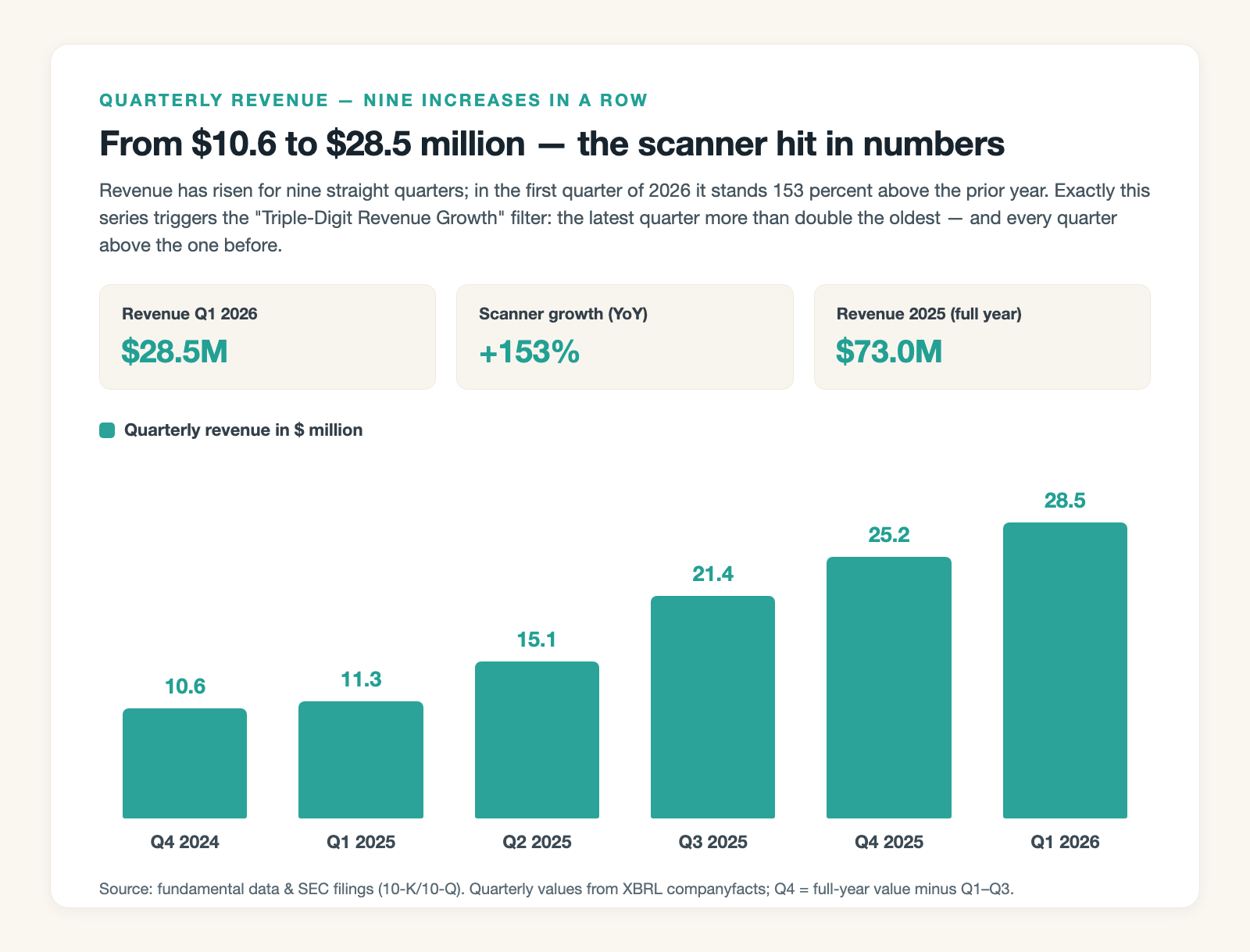
Unlike some other scanner hits, this growth is real and organic. It is not a merger artifact that tripled revenue overnight, and it is not a bookkeeping effect like the data-center revenue we dissected at Riot Platforms, where $32.2 of $33.2 million turned out to be a tenant's cost reimbursements. Amprius simply sells more batteries. Remember this tension — the growth is the beautiful part of the story, but it has a price the stock has not yet fully digested. It is the connecting thread for everything that follows. Here is how to get there yourself: on minnowstreet.com, open "Scanner" in the menu, open the "Triple-Digit Revenue Growth" filter and look for the AMPX row.
The numbers over the years — first, what impresses
Let's start with the strong part. Annual revenue rose from $9.1 million (2023) over $24.2 million (2024) to $73.0 million (2025) — most recently a gain of 202 percent. And in the first quarter of 2026, revenue of $28.5 million already ran 153 percent above the prior-year quarter. Even more important than sheer size is the direction of profitability: gross margin — what is left after pure production costs — was still deep red at minus 75.8 percent in 2024 (every battery sold cost more than it brought in). In 2025 it turned to plus 11.3 percent, and in the first quarter of 2026 it reached plus 20.1 percent for the first time. In parallel, the loss shrinks quarter by quarter. That is one half of the story, and it is good: here, a company is visibly scaling its way toward profitability. One quarter does not make a summer — but nine rising quarters and a flipping margin are a real trend.
What the filings say — the uncomfortable truths
Now let's turn the page. Literally.
Uncomfortable truth no. 1: the market pays years of flawless future in advance
As beautiful as the growth is — the company keeps losing money, and the stock is expensive. Amprius reported a net loss of $44.0 million for 2025 (2024: $44.7 million), and the sum of all losses since inception — the accumulated deficit — is quantified by the filing itself:
"Since our inception, we have incurred recurring losses and negative cash flows from operations. During the year ended December 31, 2025, we incurred a net loss of $44.0 million and at December 31, 2025, our accumulated deficit was $218.4 million."
— Amprius Technologies, Inc., SEC annual report 10-K for fiscal year 2025, Note 1 "Liquidity"
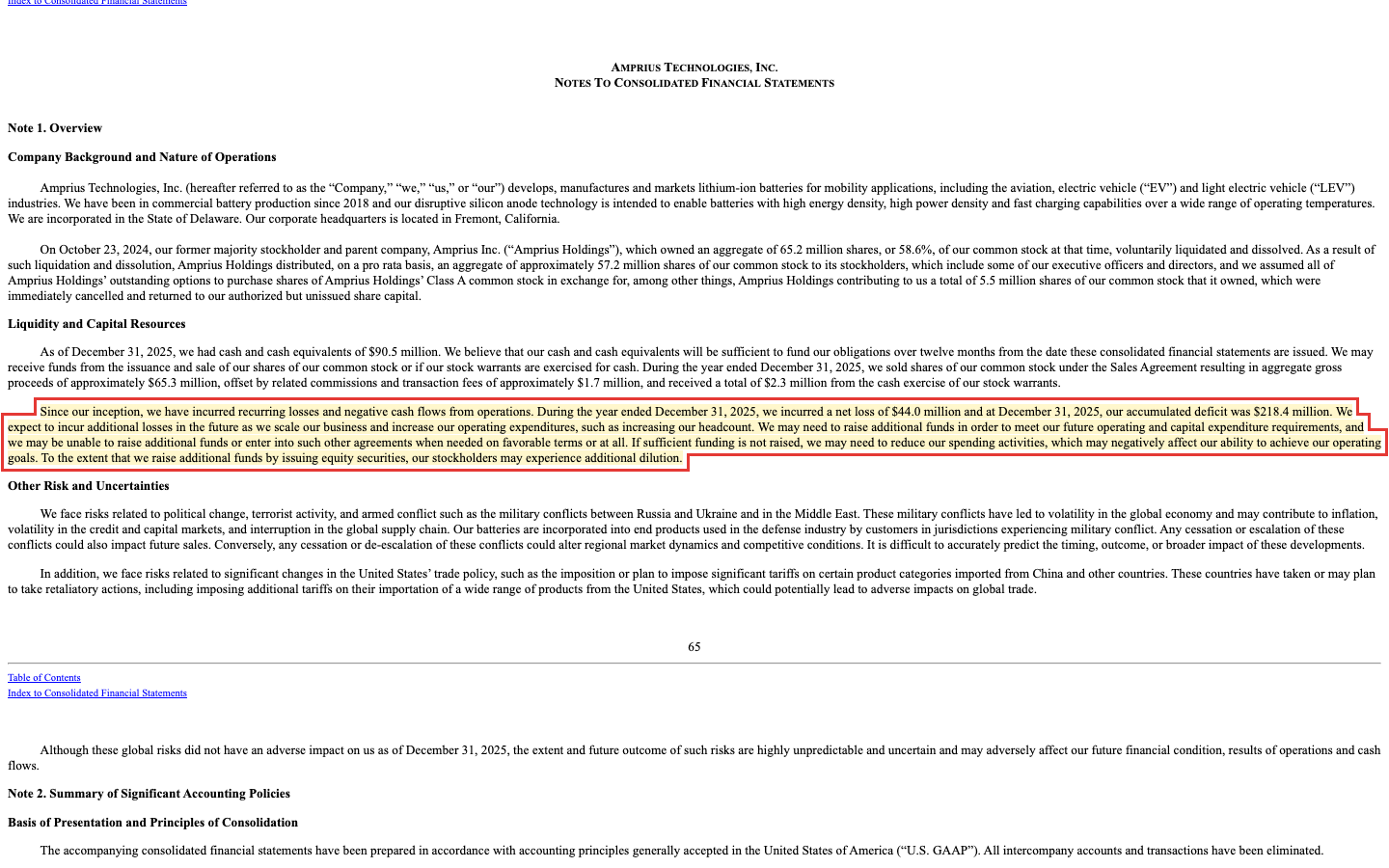
Through March 31, 2026, that deficit grew further, to $223.4 million. Against this picture stands the market value: roughly $1.8 billion on trailing-twelve-month revenue of about $90 million. That works out to a price-to-sales ratio around 20. For perspective: an established industrial company is often valued at one to three times its revenue. Even if Amprius tripled revenue once more and reached a mature hardware gross margin of 30 percent, roughly $80 million of gross profit would remain — meaning the market is already paying for many years of flawless hyper-scaling in advance. The growth is there; it is just generously priced in.
Uncomfortable truth no. 2: shareholders paid for the growth with 68 percent more shares
Where does the money come from that covers the losses? Not from the business — from you and the other shareholders. Amprius has practically no debt; for years it has financed itself by issuing new shares. The share count rose from 84.5 million (November 2022) to 141.6 million (May 2026) — a gain of about 68 percent:
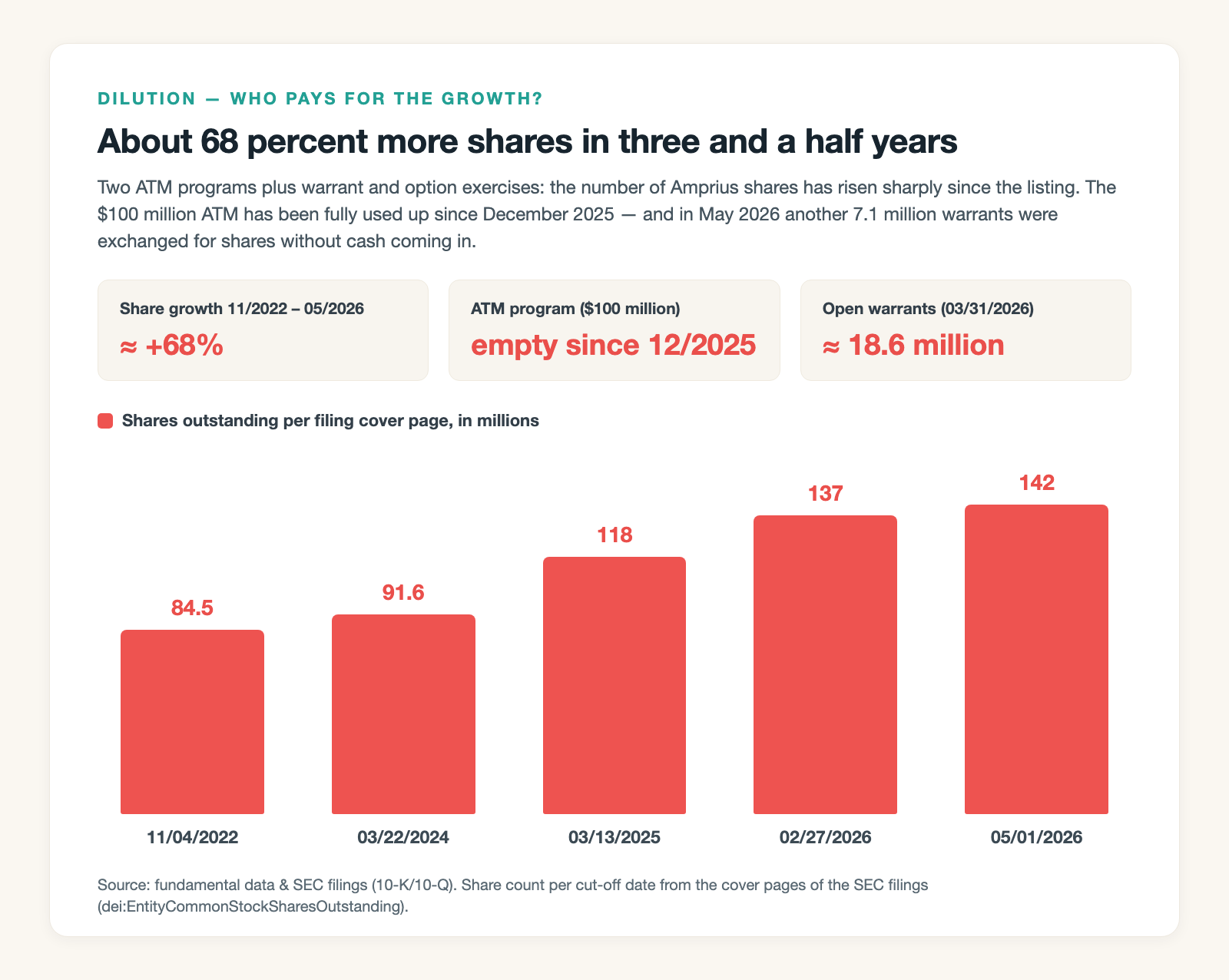
An "ATM" program (at-the-market) is the selling machine behind it: the company issues new shares directly into the market on a rolling basis and pockets the cash. For you as a shareholder, that means dilution — picture a pizza being cut into ever more slices: your slice gets smaller even though you sold nothing. The decisive detail sits in the MD&A section of the 10-K: the $100 million ATM is used up — "there is no remaining cash that we could potentially raise under the At Market Financing" (no headroom left as of December 31, 2025). The obvious cash register is therefore empty. And in May 2026, Amprius additionally exchanged 7.1 million warrants for shares without a single dollar of cash coming in — pure dilution. The filing itself notes dryly: "our stockholders may experience additional dilution." Remember: growth paid for with fresh shares is never entirely free.
Uncomfortable truth no. 3: the "battery factory" is at its core a purchasing department
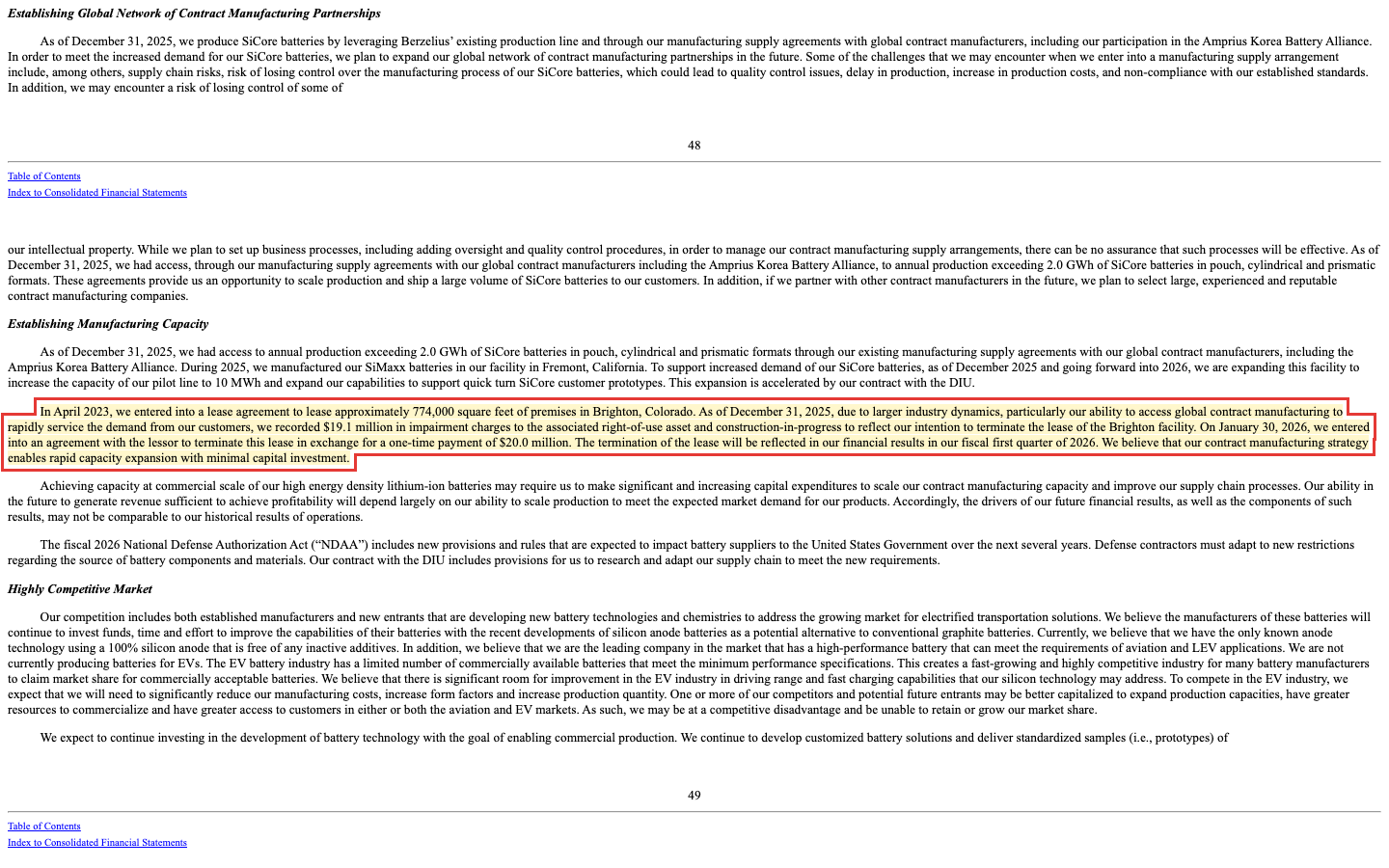
Many people picture a big factory of the company's own behind a U.S. battery maker. At Amprius, however, the volume product is largely made by others. The company's own gigafactory, planned for Brighton, Colorado (a lease covering about 774,000 square feet, signed in April 2023), was never built — and its ending cost money twice:
"As of December 31, 2025, due to larger industry dynamics, particularly our ability to access global contract manufacturing to rapidly service the demand from our customers, we recorded $19.1 million in impairment charges to the associated right-of-use asset and construction-in-progress to reflect our intention to terminate the lease of the Brighton facility. On January 30, 2026, we entered into an agreement with the lessor to terminate this lease in exchange for a one-time payment of $20.0 million."
— Amprius Technologies, Inc., SEC annual report 10-K for fiscal year 2025, Item 1 "Business"
Instead of building itself, Amprius buys SiCore from contract manufacturers in China and South Korea. At first glance that is clever — it saves billions in capital and lets capacity grow quickly. But it creates a dependency in a delicate spot: Amprius sources its critical anode material exclusively from the Chinese partner Berzelius, and the supply agreement has a remarkable catch — it contains no fixed commercial terms. "The Exclusive Supply Agreement does not include any commercial terms," the risk factors state verbatim; prices are renegotiated from order to order. A U.S. defense supplier whose core material comes exclusively from China — at prices that are not locked in, while new Chinese export controls on battery material are suspended only through at least November 2026. That may be the biggest open flank of this stock. To be fair: in January 2026, Nanotech Energy came aboard as a first U.S. manufacturing partner, at least beginning to address the "Made in USA" problem.
Uncomfortable truth no. 4: a third of the growth is war revenue
Where do the batteries end up? To a large extent, in a war. The quarterly report (10-Q) breaks down, for the first quarter of 2026, how much revenue went to customers in Ukraine:
"Revenue in the EMEA region, consisting of Europe, the Middle East and Africa, includes $10.0 million and $4.6 million related to shipments to customers based in Ukraine, for the three months ended March 31, 2026 and 2025, respectively."
— Amprius Technologies, Inc., SEC quarterly report 10-Q for Q1 2026, Note 2 "Segment and Geographic Data"
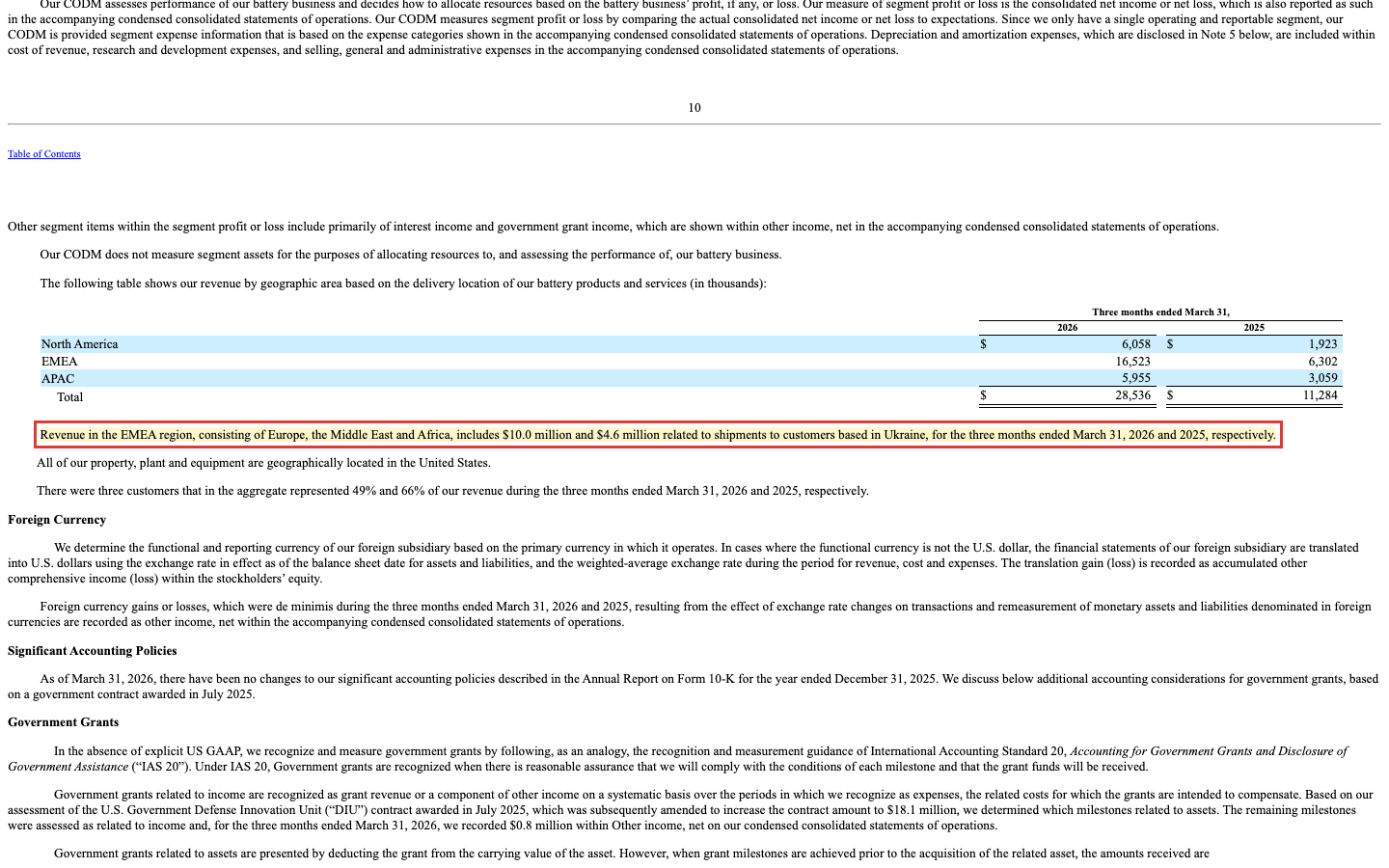
$10.0 of $28.5 million — about 35 percent of quarterly revenue thus hangs on an active war. The filing names the risk itself, openly: a ceasefire could dampen demand for combat-zone drones (it concedes at the same time that reconstruction and deterrence could also support demand). Add classic concentration: in 2025, a single customer accounted for $27.1 million, or 37 percent of annual revenue; as of March 31, 2026, two customers made up 64 percent of outstanding receivables. And the cash cushion is shrinking faster than the pure loss suggests: from $90.5 million (end of 2025) to $62.4 million (March 31, 2026), partly because the $20 million Colorado termination payment went out the door. A side note from the data: zero insider purchases against 20 insider sales, and the earnings estimate for the first quarter of 2026 was missed by a wide margin.
Valuation — what the market is actually paying for here
Let's sum up the valuation. At a market value around $1.8 billion and roughly $90 million of annualized revenue, the market pays about 20 times revenue — and thanks to the debt-free balance sheet with net cash, enterprise value to revenue looks barely cheaper. A classic price-to-earnings ratio does not exist for lack of earnings; analysts do not expect even a break-even until the fiscal year after next. Priced in, therefore, are: continued triple-digit growth, a defense-and-drone cycle that keeps turning, the margin leap from scaling, and the distant option of "someday, electric cars too." What does not look priced in are the flip sides: peace in Ukraine, a break in the China supply chain, or the next capital raise, which the empty ATM makes an obvious next step. The seven analysts rate the stock friendly on average (a price target noticeably above recently seen levels) — but they are few voices, and with a beta above 2 and daily swings around ten percent the stock is extremely volatile; it recently gave up about a third within a month. Run hot, in correction, richly valued.
Opportunities and risks at a glance
What speaks for Amprius:
- Real, accelerating growth: revenue $9.1 → $24.2 → $73.0 million (2023–2025), nine consecutive quarters of increases, up 153 percent year over year in the first quarter of 2026 — organic, no bookkeeping effect.
- Profitability is turning: gross margin from minus 75.8 percent (2024) to plus 20.1 percent (first quarter of 2026), the quarterly loss is shrinking, and analysts expect a first break-even in the fiscal year after next.
- Capacity without a multi-billion-dollar factory: access to more than 2 gigawatt-hours of annual production through contract manufacturers — asset-light; with Nanotech Energy, a first U.S. partner.
- Defense tailwind with a seal of approval: the Pentagon contract from the Defense Innovation Unit was increased to $18.1 million; customers include the U.S. Army, BAE Systems, AeroVironment and AALTO Airbus.
- A technology lead and a clean balance sheet: 450 Wh/kg in series production, more than 80 patents, practically no debt, $62.4 million in cash — dilution is the instrument here, not credit risk.
What speaks against it:
- A rich valuation on continuing losses: a price-to-sales ratio around 20, a $44.0 million annual loss, a $223.4 million accumulated deficit (03/31/2026).
- Ongoing dilution: 68 percent more shares since 2022, the $100 million ATM is empty, and in May 2026 another 7.1 million warrants were exchanged for shares without cash coming in — further warrants run until September 2027.
- A China cluster in the supply chain: SiCore is manufactured in China and South Korea, the anode material comes exclusively from Berzelius without fixed prices; new Chinese export controls are suspended only through at least November 2026.
- War and customer dependency: about 35 percent of Q1 2026 revenue went to Ukraine, one customer accounted for 37 percent of 2025 revenue; the stock is extremely volatile (beta above 2, short interest around 16 percent).
A human conclusion
Remember the FOMO from the opening — the fear of missing the next battery-and-defense rocket? After the look into the filings, it sounds quieter. Not because the story is bad — on the contrary: Amprius is genuinely growing, the margin is turning positive, the product leads technologically, and the Pentagon stands behind it. That is rare and impressive. But exactly this good part is already generously priced in, and next to it stand four uncomfortable truths that can send the rocket tumbling at any time: a loss that is still running; a share count that keeps rising; a supply chain that hangs on a Chinese partner; and a third of revenue that sticks to a war. FOMO sees only the rocket. The SEC filing also shows you the fine print on the fuel tank.
What you make of it is your decision. And that is exactly as it should be. If you buy Amprius, you are buying a bet on a company that is already showing it can scale — at a price that leaves little room for error, and with risks you should know. If you avoid it, you may pass on the next rocket. Both are legitimate. What matters is that you know what you are betting on — both halves of the story, not just the beautiful one. How a seductive story reads once you open the filings is something we have also dissected at the defense neighbor Castellum — near break-even, paid for with twice the shares — and at Virgin Galactic, where 675 customers are waiting for space while the annual report itself doubts the company's survival. Very different companies, the same core question: what exactly stands behind the beautiful number?
Sources
- Amprius Technologies, Inc. — SEC annual report 10-K for fiscal year 2025 (filed March 6, 2026)
- Amprius Technologies, Inc. — SEC quarterly report 10-Q for Q1 2026 (as of March 31, 2026, filed May 7, 2026)
- Fundamental data (metrics, valuation, analyst consensus, quarterly series); in-house stock scanner, data as of July 8, 2026.
Transparency & disclaimer: This analysis is a journalistic contextualization of publicly available information and is not investment advice, not a financial analysis in the regulatory sense, and not a solicitation to buy or sell securities. Stocks are subject to price swings; a total loss is possible. Make your investment decisions on your own responsibility and, when in doubt, seek independent advice.
Our Bottom Line at a Glance
- Revenue growth positive
- A real, organic product ramp: from $9.1 million (2023) over $24.2 million (2024) to $73.0 million (2025), nine consecutive quarters of increases, and the first quarter of 2026 up 153 percent year over year. No acquisition, no bookkeeping effect — the scanner hit is clean.
- Profitability & technology positive
- Gross margin turned from minus 75.8 percent (2024) to plus 20.1 percent (first quarter of 2026), and the quarterly loss is shrinking. Behind it stands a real technology lead: 450 Wh/kg in series production, more than 80 patents, asset-light via contract manufacturers, and a Pentagon contract (DIU) increased to $18.1 million.
- Valuation negative
- A market value around $1.8 billion against roughly $90 million of annualized revenue = a price-to-sales ratio around 20. The market is already paying for many years of flawless hyper-scaling in advance; the price leaves little room for disappointment, and with a beta above 2 the stock is extremely volatile.
- Balance sheet & dilution negative
- A $44.0 million annual loss and a $223.4 million accumulated deficit. Financing runs through new shares: up 68 percent since 2022, the $100 million ATM is empty, and in May 2026 another 7.1 million warrants were exchanged for shares without cash coming in. On the plus side: practically debt-free ($62.4 million in cash).
- Supply chain & customer risk negative
- The company's own Colorado factory was buried ($19.1 million in impairments, a $20 million termination payment); SiCore comes from China and South Korea, and the anode material exclusively from Berzelius without fixed prices. Add about 35 percent of Q1 2026 revenue from Ukraine and one customer with 37 percent of 2025 revenue.
Amprius is that rare growth story in which the growth is real: organic, accelerating, with a first positive gross margin and a technology lead in silicon-anode batteries for drones and the military. The catch lies not in the numbers but in the price and the fine print — a price-to-sales ratio around 20 on continuing losses, ongoing dilution, a Chinese supply chain and a third of revenue hanging on a war. Not investment advice.
What Our Rating Means
- If you don't own the stock
- As long as the question raised in the bottom line stays open, we see no basis for an entry.
- If you hold it in your portfolio
- Our findings offer no acute reason to sell — the checkpoints named remain decisive.
A journalistic assessment by our editorial team at the time of the deep dive, based on public sources — not investment advice and not a solicitation to buy or sell. Your personal circumstances (investment goals, risk capacity, taxes) cannot be taken into account. What our categories mean, how verdicts are formed, and what conflicts of interest exist →
Worth Noting
- The revenue is real and organic (no merger or bookkeeping effect), but a good third of Q1 2026 revenue ($10.0 of $28.5 million) comes from shipments to customers in Ukraine; a ceasefire could dampen demand for combat-zone drones.
- The volume product SiCore is entirely contract-manufactured (China/South Korea); the anode material comes exclusively from the Chinese partner Berzelius, whose supply agreement contains no fixed prices. Chinese export controls on battery material are suspended only through at least November 2026.
- Financing runs entirely through equity: zero insider purchases against 20 insider sales (data as of July 8, 2026), the $100 million ATM has been used up since December 2025, and roughly 18.6 million further warrants run until September 2027.
Frequently Asked Questions
Amprius (NYSE: AMPX) is a battery maker from Fremont, California that builds lithium-ion cells with a silicon anode instead of the usual graphite anode. As a result, the batteries store roughly twice the energy per unit of weight (up to 450 watt-hours per kilogram). Its main customers are manufacturers of drones, high-altitude platforms and military equipment — including the U.S. Army, BAE Systems, AeroVironment and AALTO Airbus.
Because revenue rose for nine consecutive quarters and the latest quarter sits more than double the oldest of the stored series. Annual revenue climbed from $9.1 million (2023) over $24.2 million (2024) to $73.0 million (2025); in the first quarter of 2026, at $28.5 million, it ran 153 percent above the prior year. Unlike some other hits, this growth is real and organic — no acquisition, no bookkeeping effect.
Not yet. 2025 brought a net loss of $44.0 million, and the accumulated deficit stood at $223.4 million as of March 31, 2026. The direction is the positive part: gross margin turned from minus 75.8 percent (2024) to plus 20.1 percent (first quarter of 2026), and the quarterly loss is shrinking. Analysts do not expect a break-even until the fiscal year after next.
Amprius covers its losses not from the business but by issuing new shares. Their number has risen about 68 percent since November 2022 (from 84.5 to 141.6 million). The $100 million at-the-market program has been fully used up since December 2025, and in May 2026 another 7.1 million warrants were exchanged for shares without cash coming in. Every new share shrinks the stake of existing shareholders.
In two places. First, the supply chain: the volume product SiCore is built by contract manufacturers in China and South Korea, and the anode material comes exclusively from the Chinese partner Berzelius — under a supply agreement that contains no fixed prices. Second, customer dependency: about 35 percent of Q1 2026 revenue went to customers in Ukraine, and a single customer accounted for 37 percent of 2025 revenue. Peace, or a break with China, could hit the growth hard.
Largely, no. The planned gigafactory in Brighton, Colorado was never built: in 2025 Amprius booked $19.1 million in impairment charges, and in January 2026 the lease was terminated in exchange for a one-time payment of $20.0 million. The volume product SiCore is bought from external contract manufacturers in China and South Korea; only a small pilot line in Fremont and, since January 2026, the U.S. partner Nanotech Energy produce domestically. That saves capital but creates dependencies.
Found an error?
Did you spot a factual error, an outdated number, or a typo in this deep dive? Let us know briefly — your report goes straight to the editorial team.