Castellum Stock: The Navy's Cyber Minnow Nears Break-Even — Paid For With Twice the Shares
On Reddit, the ticker CTM surfaces now and then — a defense contractor worth about $61 million, its stock trading for pocket change. We read what Castellum, Inc. itself reported to the U.S. securities regulator — in the annual report (10-K) for 2025 and the quarterly report (10-Q) through March 2026: a genuine revenue record of $52.9 million, a balance sheet nearly free of debt, a quarterly loss shrunk to $0.35 million — but also 73 percent of revenue from three customers, effectively a single payer called the U.S. government, and a share count that nearly doubled within two years. Not investment advice — just the per-share price tag and the share count, added up honestly.
 Thomas Mücke
Founder & Publisher
Thomas Mücke
Founder & Publisher
Chart
Interactive price chart (TradingView).
Note: pure fact-based analysis, not investment advice and not a solicitation to buy or sell. All figures without guarantee.
There is a mental shortcut so reliable that supermarkets sort entire shelves by it: the unit-price illusion. A stock at 65 cents feels cheaper than one at $650 — yet the per-share price says exactly nothing about what a company is worth; it only says into how many slices the cake has been cut. Few tickers feed that reflex in the summer of 2026 as well as Castellum, Inc. (NYSE American: CTM): a U.S. provider of cybersecurity and electronic warfare services with Navy contracts, a market value of about $61 million (as of July 15, 2026), and a share price in the pocket-change range. In our Reddit hype scanner, which counts every day which small U.S. tickers the forums are talking about, CTM surfaced on July 15, 2026 with 4 mentions within 24 hours (source: ApeWisdom) — not a storm, more of a knock. But it is exactly this kind of penny ticker with Pentagon shine where the second look pays, before the reflex buys. So let\'s make a deal: we leave the price tag aside and read together what Castellum itself reported to the U.S. securities regulator, the SEC — in the annual report (10-K) for 2025, filed on March 9, 2026, and the quarterly report (10-Q) as of March 31, 2026. A filing to the SEC is honest under penalty of law. And one thing up front, so no portfolio accident happens: Castellum, Inc. of Virginia has nothing to do with the Swedish real estate company Castellum AB — same name, entirely different company. In the end, you decide for yourself.
What Castellum actually does
Castellum is what you get when you buy several small Pentagon suppliers and bolt them together into one listed company: the firm delivers cybersecurity, electronic warfare, information operations and IT modernization to U.S. defense and federal agencies — services such as intelligence analysis, software engineering, program management and the modeling of complex weapon systems. Translated: Castellum builds no tanks and no off-the-shelf software products; it rents out highly specialized, security-cleared minds to the government — 244 employees as of December 31, 2025, 97 percent of them holding security clearances, 58 percent with STEM degrees. Those clearances are the true moat of this business: they take years to obtain, cost the government six-figure sums, and make the workforce hard to copy. Castellum grew by the modular principle of buy and build: seven acquisitions since 2019, among them Corvus Consulting (electronic warfare, November 2019), Specialty Systems (Navy software, August 2021), Lexington Solutions Group (national security, April 2022) and, most recently, Global Technology Management Resources, GTMR for short (March 2023). One subsidiary (MFSI) was sold again in September 2024, another (Merrison) was merged into Corvus in 2023. The rebuild is no sure thing, then — but the latest addition, GTMR, landed the biggest catch so far: a major contract, won in 2024, with the naval aviation procurement command NAVAIR.
Note, right here, the central tension of this analysis: The business really is turning — record revenue, a nearly debt-free balance sheet, the loss melting toward zero. But the road there was paid for with a share count that nearly doubled in two years, and the foundation stays narrow: three customers carry 73 percent of revenue, and practically everything comes from a single payer — the U.S. government. It runs through every chapter. How a low price can tell a longer story than the headline suggests is something we dissected at the bargain table of the streaming pioneer iQIYI — there it was the anchoring effect, here it is the unit-price illusion.
Where the ticker comes from — and why our fundamental scanner does not know it
Honesty first: CTM appears in none of our fundamental stock scanners. That is no verdict, it is systematics — our in-house stock scanner works through the Russell 3000 universe; Castellum, at about $61 million of market value (July 15, 2026), is a nano-cap — the smallest size class on the exchange, below the small caps — and falls through the grid. The ticker landed on our desk through our Reddit hype scanner, which evaluates daily which micro and small caps are suddenly the talk of the U.S. stock forums (data basis: ApeWisdom). On July 15, 2026 it counted 4 mentions within 24 hours for CTM — little noise, but the mix of a pocket-change price, Pentagon clientele and a defense boom is exactly the material from which forums knit "the next Palantir for 65 cents." What forum dynamics can do to a stock over time is something you can watch in our analysis of AMC Entertainment, the meme-stock veteran. For Castellum the setup means: no scanner metrics as guardrails, no Piotroski score from the database — only the original documents. All the more important to actually read them.
The numbers over the years — honestly appraised
First, what genuinely has substance. 2025 was the best year in the company\'s history: revenue rose 18.1 percent to $52.87 million — after three sideways years ($42.19 million in 2022, $45.24 million in 2023, $44.76 million in 2024). The driver is the contract awarded in March 2024 to the subsidiary GTMR: $103.3 million over five and a half years for "Special Missions" of the Naval Air Systems Command, program office PMA-290 — the Navy\'s maritime patrol aircraft. The contract ramped up through 2025 and keeps pulling: in the first quarter of 2026, revenue grew 23 percent to $14.29 million. At the same time, the loss machine nearly became self-sustaining: the net loss shrank from $17.80 million (2023, including a goodwill impairment of $6.92 million) via $9.98 million (2024) to $2.40 million in 2025 — and to $0.35 million in the first quarter of 2026, a loss per share that rounds to $0.00. The interest burden has practically vanished: no more bank debt, and the last related-party note ($0.4 million) was repaid in the first quarter of 2026; as of March 31, 2026, $15.77 million of cash stood against just $5.68 million of total liabilities. On top, the company reported a qualified opportunity pipeline of roughly $817 million as of December 31, 2025 — opportunities, not orders, but an order of magnitude. That is the bright side:
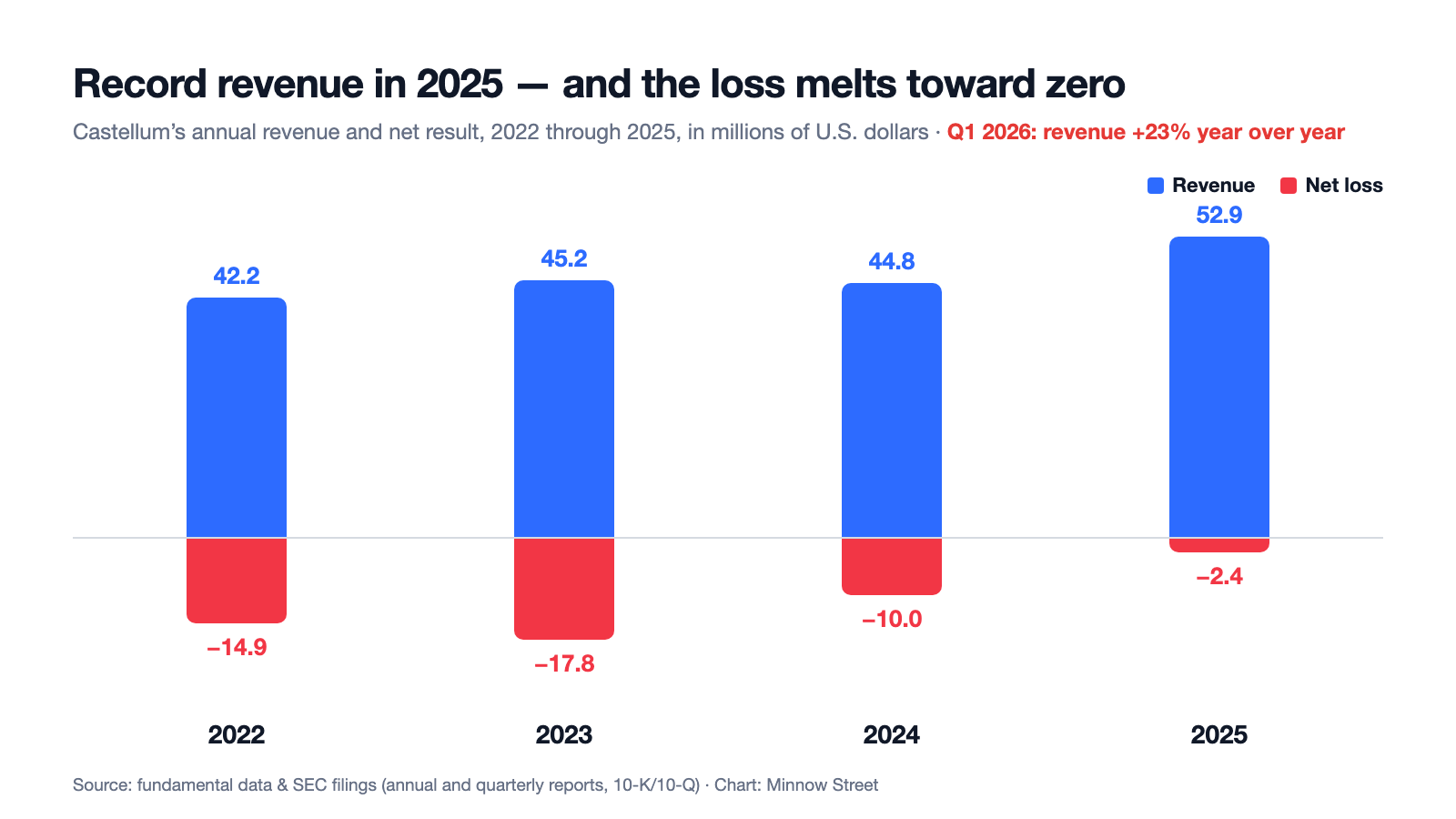
Honesty requires the dark side of the same arithmetic: Castellum has never been profitable — since the buy-and-build kit was started in 2019, every year has closed with a minus, accumulating to a deficit of $56.59 million (December 31, 2025). Operating cash flow was negative again in 2025 at minus $1.95 million (2024: plus $1.12 million; 2023: minus $2.26 million) — mostly because growing contracts first mean growing receivables; in the first quarter of 2026, operations generated cash again. And the growth has a price that does not appear in the income statement but in the share register. Remember this sentence: The per-share price tells you how small the slice is — not how big the cake. How many slices were added is in the filings.
What the filings say — the uncomfortable truths
Uncomfortable truth no. 1: there is effectively one payer — and it is in savings mode
Castellum\'s customer list is short, and the same address always sits at the top. The annual report says it without detours:
"We generate substantially all of our revenue from contracts with the U.S. federal, state, and local governments which are subject to a number of challenges and risks that may adversely impact our business, prospects, financial condition, and operating results."
— Castellum, Inc., SEC annual report 10-K for 2025, Item 1A "Risk Factors"
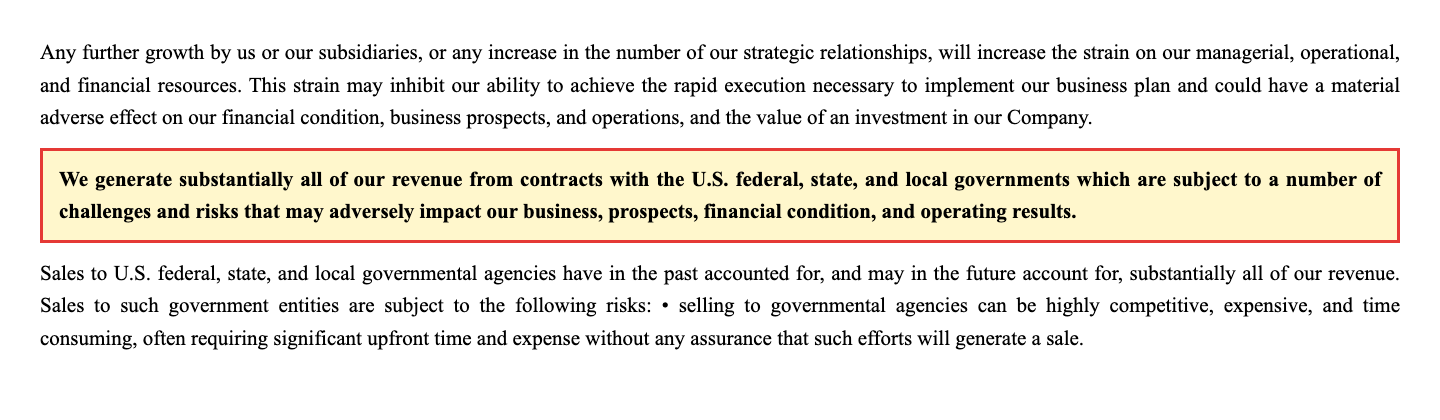
A single payer means: budget standoffs, stopgap funding ("continuing resolutions"), re-competes and shifting political priorities hit without a buffer. And since 2026 the quarterly report carries a name that personifies this risk — the U.S. government\'s cost-cutting organization that grew out of the Department of Government Efficiency:
"changes in political, economic, or regulatory conditions generally and in the markets in which we operate, and more specifically, the potential impact of the U.S. DOGE Service Temporary Organization on government spending and terminating contracts for convenience;"
— Castellum, Inc., SEC quarterly report 10-Q as of March 31, 2026, "Cautionary Note Regarding Forward-Looking Statements"
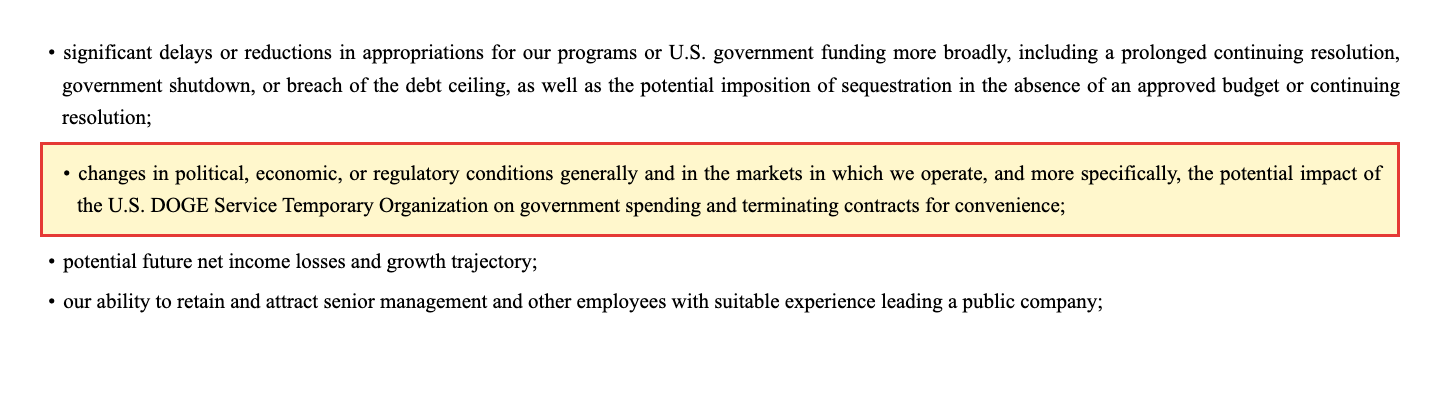
"Termination for convenience" is the government\'s right under U.S. procurement law to end a contract without the contractor having done anything wrong — like a tenant with a special right to cancel against whom you have no recourse. To be fair: defense counts as a comparatively protected budget in Washington, and Castellum\'s niche — cybersecurity and electronic warfare — sits high on the priority lists. But a vendor with a single payer never negotiates at eye level.
Uncomfortable truth no. 2: three customers, 73 percent — the lump inside the lump
Within the government business, revenue clusters once more — and increasingly so:
"For the years ended December 31, 2025, 2024, and 2023, the Company had three customers represent 73%, 47%, and 52% of revenue earned, respectively. Any customer that represents 10% or greater of total revenue represents a risk."
— Castellum, Inc., SEC annual report 10-K for 2025, Note 2 "Summary of Significant Accounting Policies — Accounts Receivable and Concentration of Credit Risk"
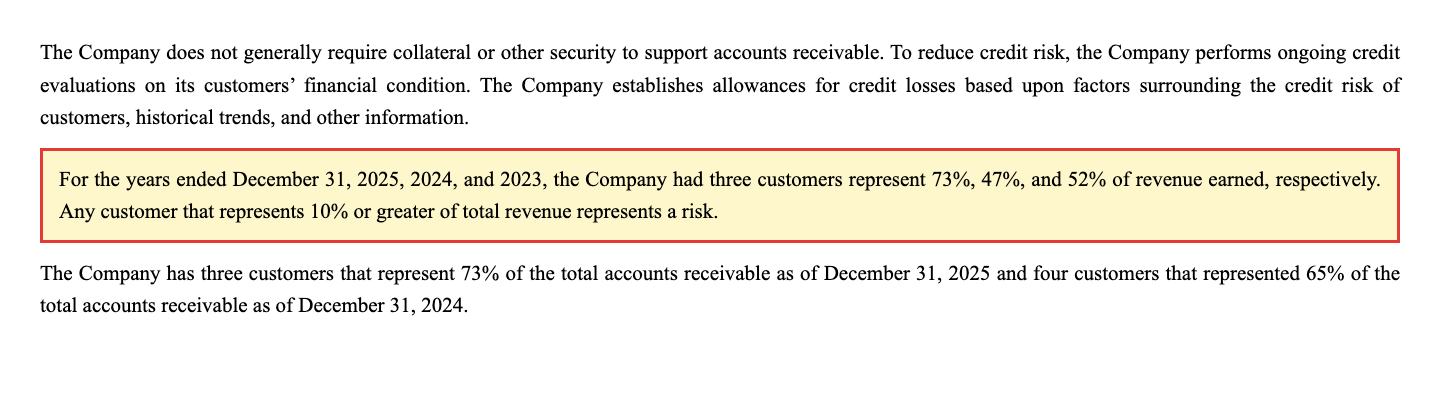
Customer concentration, translated: picture a bakery where three regulars buy almost three quarters of the rolls — and all three work in the same building. That is exactly what happened here, and the growth driver is also the concentration driver: the NAVAIR contract that lifted 2025 revenue by 18 percent pushed the three-customer share from 47 to 73 percent. The same three customers also account for 73 percent of all outstanding receivables (December 31, 2025). The report itself calls the 10-percent threshold a risk — here, each of the three averages about 24 percent, two and a half times that threshold. One re-compete, one bid protest by a competitor, or one DOGE termination on just one of these contracts, and the growth story turns around. That is the flip side of a kit built from small companies: every single contract is huge in proportion.
Uncomfortable truth no. 3: the share count nearly doubled — and the charter allows 3 billion shares
Now to the question of who paid for the rebuild. Answer: the existing shareholders, with their slice of the cake. The report itself warns that it can continue:
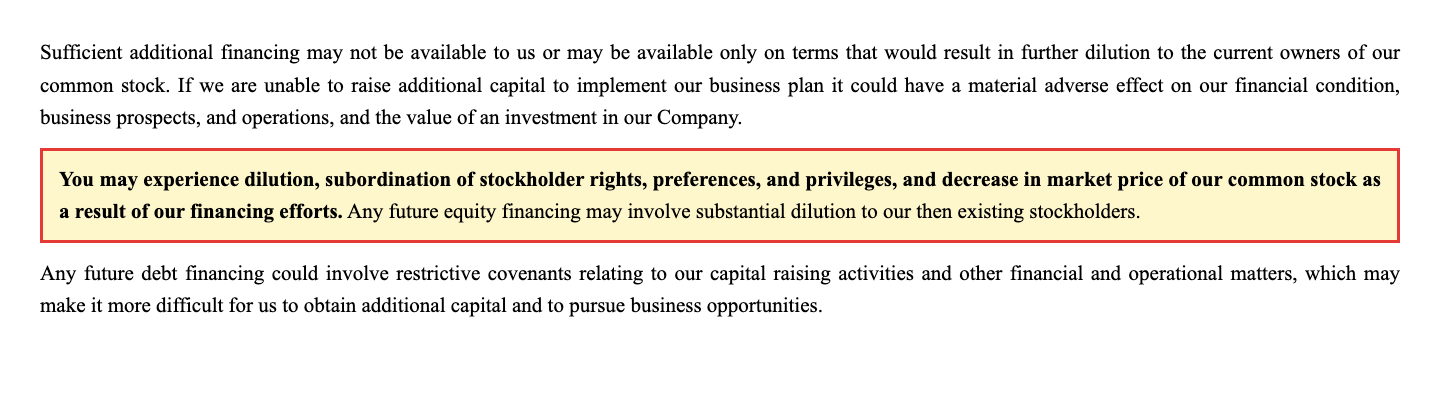
"You may experience dilution, subordination of stockholder rights, preferences, and privileges, and decrease in market price of our common stock as a result of our financing efforts. Any future equity financing may involve substantial dilution to our then existing stockholders."
— Castellum, Inc., SEC annual report 10-K for 2025, Item 1A "Risk Factors"
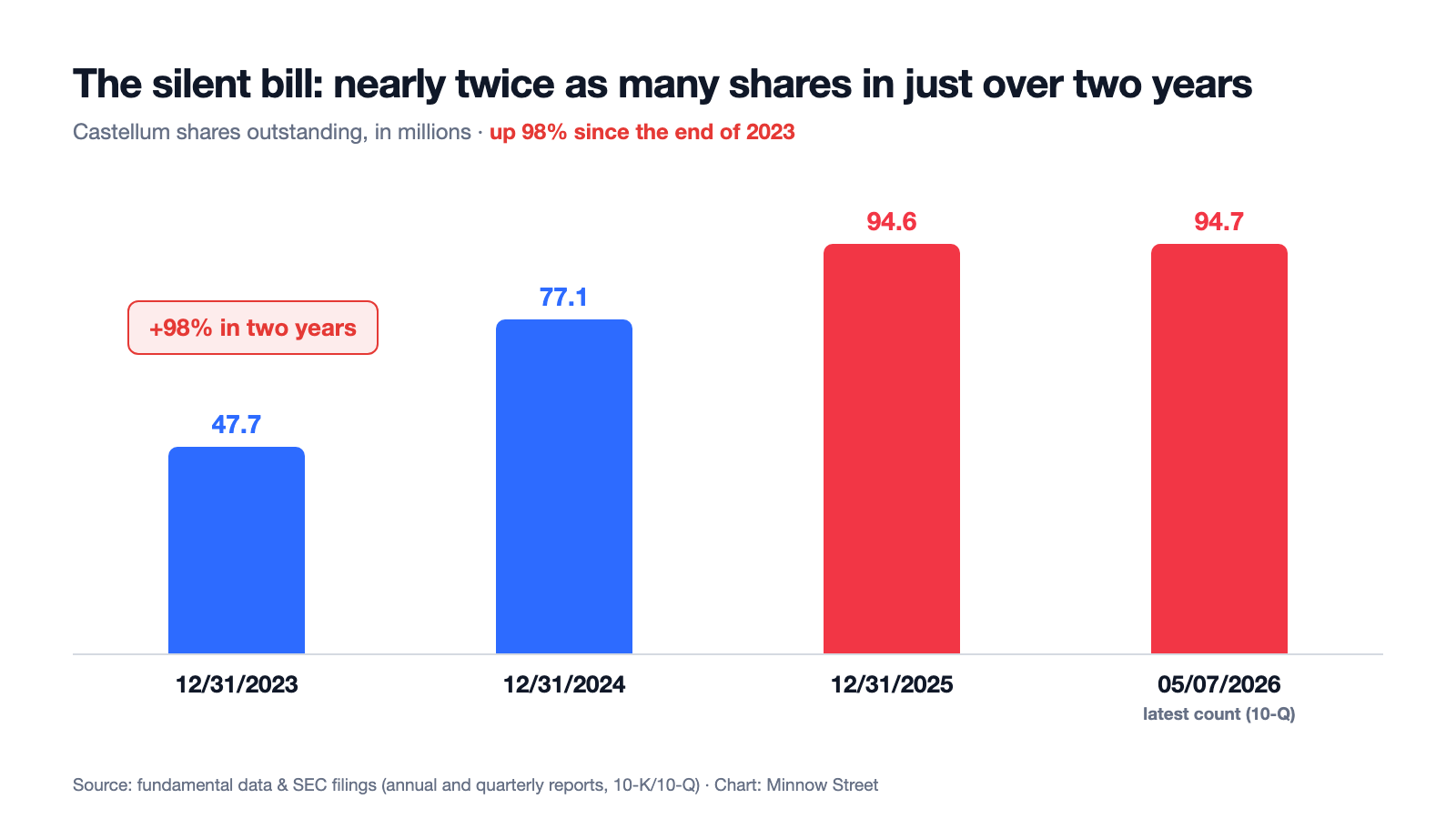
Dilution, translated: your slice of the cake gets smaller when new slices keep being cut. And many were cut: 47.7 million shares were outstanding on December 31, 2023, 77.1 million a year later, 94.6 million on December 31, 2025 — up 98 percent in two years. The routes: equity offerings in December 2024 (4.36 million shares at $0.85, gross proceeds of $3.7 million), March 2025 (gross $4.5 million) and June 2025 (gross $5.0 million), plus associated warrant exercises ($1.9 million and $4.48 million) — plus shares as acquisition currency and curiosities such as a warrant covering 1,080,717 shares at a total price of one dollar, fully exercised in 2025. The charter authorizes 3 billion shares — 31 times today\'s count held in reserve. None of this is fraud; it is all in the report. It is simply the financing model: a nano-cap without cheap credit lines pays for growth with fresh shares. You should just know the arithmetic: revenue rose 17 percent from 2023 to 2025 — per share, it fell. Remember: growth that is paid for with fresh shares is never entirely free.
Uncomfortable truth no. 4: $56.6 million of accumulated losses — Castellum has never been profitable
The fourth truth sits in the risk chapter, soberly quantified:
"We had an accumulated deficit of $56,588,218 as of December 31, 2025, and we expect to continue to generate a net loss in the year ending December 31, 2025."
— Castellum, Inc., SEC annual report 10-K for 2025, Item 1A "Risk Factors"
Yes, 2025 appears twice — the year in the expectation is a leftover text block from the prior-year report; what is clearly meant is the current year. The finding behind it is real all the same: an accumulated deficit is the loss account of a company\'s history, and Castellum\'s stands at $56.59 million — almost as much as the whole company costs on the exchange (about $61 million, July 15, 2026). Part of it is write-downs on companies bought too dearly (a $6.92 million goodwill impairment in 2023 alone) and non-cash items — but it remains the balance of six years of buy-and-build without a single profitable year. The countermove is real: minus $2.40 million in 2025, minus $0.35 million in the first quarter of 2026, practically no interest burden left. The trend points toward break-even. But a trend is a promise, not a bank statement — and one quarter does not make a summer.
Valuation: $61 million for $53 million of revenue — no bargain, no rip-off
Let\'s sum up the price question: about $61 million of market value (as of July 15, 2026) stands against $52.87 million of 2025 revenue — a price-to-sales ratio around 1.2. A price-to-earnings ratio does not exist for lack of earnings. Subtract the net cash ($15.77 million of cash against practically zero financial debt, March 31, 2026) and the market pays roughly $45 million for the operating business — about 0.9 times annual revenue. For scale: large listed U.S. government-services providers mostly trade between one and two times revenue — but with solid profits, dividends and billion-dollar contracts behind them. Castellum\'s discount to the profitability threshold is thus moderate; neither catastrophe nor fantasy is priced in. On the asset side: $35.75 million of stockholders\' equity (December 31, 2025), the $817 million pipeline, the NAVAIR contract running until about 2029, and the June 2026 wins — the joint venture\'s position on a $250 million multiple-award contract for Navy logistics IT (June 15, 2026) and a $4 million subcontract to modernize the Navy\'s ADMACS flight-deck management system (June 24, 2026). A multiple-award contract, mind you, is only the ticket into the stadium: it guarantees no revenue; it allows bidding on individual task orders. On the debit side: the lump from truths no. 1 and 2, the dilution mechanics from no. 3 — and the plain fact that a $61 million ticker with a pocket-change price makes double-digit percentage jumps in both directions on small news. What you buy here is a bet that break-even holds, that the three key contracts keep running, and that the next equity offering arrives later than the next contract win.
Opportunities and risks at a glance
What speaks for Castellum:
- A genuine growth spurt: 2025 revenue up 18.1 percent to a record $52.87 million, Q1 2026 up 23 percent to $14.29 million — carried by the $103.3 million NAVAIR PMA-290 contract (awarded March 2024, five-and-a-half-year term).
- The loss is melting: from $17.80 million (2023) via $9.98 million (2024) to $2.40 million (2025); just $0.35 million in the first quarter of 2026 — the interest burden has practically vanished after the debt repayments.
- A clean balance sheet: $15.77 million of cash against $5.68 million of total liabilities (March 31, 2026), no bank debt, $35.75 million of stockholders\' equity (December 31, 2025).
- A sought-after niche with a moat: cybersecurity and electronic warfare for the Pentagon; 97 percent of the 244 employees hold security clearances (December 31, 2025) — hard to copy and high on Washington\'s priority lists.
- A filled funnel: an opportunity pipeline of roughly $817 million (December 31, 2025), the joint venture\'s position on the $250 million Navy multiple-award contract (June 15, 2026), the $4 million ADMACS subcontract (June 24, 2026).
What speaks against it:
- Extreme customer concentration: three customers = 73 percent of revenue and 73 percent of receivables (2025); "substantially all" revenue from U.S. government entities — budget standoffs, re-competes and the DOGE office named in the quarterly report hit directly.
- A dilution machine: share count from 47.7 to 94.6 million in two years (up 98 percent), 3 billion shares authorized; the report itself warns of "substantial dilution" from future financings — revenue per share fell despite the record year.
- No profit history: no profitable year since 2019, an accumulated deficit of $56.59 million (December 31, 2025), operating cash flow negative again in 2025 at minus $1.95 million.
- Nano-cap risks: about $61 million of market value (July 15, 2026), a pocket-change share price, thin trading, wild swings; a buy-and-build kit with missteps on record (goodwill impairment of $6.92 million in 2023, MFSI sold in 2024, Merrison dissolved in 2023).
- Small among giants: Castellum competes for government contracts with providers that, per its own risk disclosure, have "substantially greater financial resources" — in re-competes, the minnow is more vulnerable than the whale.
A human conclusion
Back to the unit-price illusion from the beginning. Castellum\'s pocket-change price is not a discount sticker — it is a history book: it tells of $56.6 million in accumulated losses and of a cake cut into ever more slices, 94.7 million at last count. Whoever sees only the per-share price buys the illusion. Whoever reads the filings sees both: a company that in 2025 genuinely took the turn toward break-even — record revenue, a clean balance sheet, a filled order funnel, a niche in demand — and, at the same time, a foundation of three customers, one payer, and a charter with 3 billion shares in reserve. The 4 Reddit mentions of July 15, 2026 will spin this into the simpler story, either "forgotten Pentagon gem" or "worthless penny stock." Both are comfortable; both are wrong. The uncomfortable truth is a both-and with a calendar attached: does break-even hold through 2026? Do NAVAIR and the two other key contracts keep running? When does the next equity offering come — and at what price? Count in cakes, not in slices. What you make of it is your decision. And that is exactly as it should be.
Sources
All original documents used in this analysis — to read for yourself (Castellum, Inc., U.S. securities regulator SEC, CIK 0001877939):
- Castellum, Inc. — SEC annual report 10-K for 2025 (filed March 9, 2026)
- Castellum, Inc. — SEC annual report 10-K for 2024 (filed March 11, 2025)
- Castellum, Inc. — SEC quarterly report 10-Q as of March 31, 2026 (filed May 8, 2026)
- Castellum, Inc. — SEC current report 8-K of June 15, 2026: joint-venture position on a $250 million Navy multiple-award contract
- Castellum, Inc. — SEC current report 8-K of June 24, 2026: $4 million U.S. Navy ADMACS modernization subcontract
- Castellum, Inc. — SEC current report 8-K of July 2, 2026: extension of CEO Glen R. Ives\' employment agreement
- Castellum\'s complete SEC filing history: EDGAR overview (sec.gov)
- Reddit mentions: in-house Reddit hype scanner based on ApeWisdom data (4 mentions in 24 hours, as of July 15, 2026); market value about $61 million as of the same date.
- Fundamental data (metrics, valuation; data as of July 15, 2026), reconciled with the SEC filings.
Transparency & disclaimer: This analysis is a journalistic contextualization of publicly available information and is not investment advice, not a financial analysis in the regulatory sense, and not a solicitation to buy or sell securities. Stock investments — especially in nano-caps with pocket-change prices and thin trading volume — carry substantial risks up to total loss. All information without guarantee; the data cut-off is noted in the text in each case. The author holds no position in Castellum securities at the time of publication.
Our Bottom Line at a Glance
- Business model & moat neutral
- A sought-after niche — cybersecurity, electronic warfare and IT modernization for the Pentagon — with a genuine personnel moat: 97 percent of the 244 employees hold security clearances (December 31, 2025). But the kit of seven acquisitions since 2019 had missteps (a $6.92 million goodwill impairment in 2023, MFSI sold in 2024), and the company remains a minnow among whales.
- Trajectory of the numbers positive
- 2025 revenue up 18.1 percent to a record $52.87 million, Q1 2026 up 23 percent; the net loss shrank from $17.80 million (2023) to $2.40 million (2025) and $0.35 million in the first quarter of 2026 — the NAVAIR contract ($103.3 million, March 2024) carries, and the interest burden is repaid (annual and quarterly reports).
- Customer concentration & single-payer risk negative
- Three customers = 73 percent of revenue and 73 percent of receivables (2025; 2024: 47 percent), "substantially all" revenue from U.S. government entities; the quarterly report as of March 31, 2026 names the DOGE office and contract terminations for convenience as risks by name.
- Dilution & financing negative
- The share count nearly doubled from 47.7 to 94.6 million in two years (offerings 12/2024, 03/2025, 06/2025 plus warrants), with 3 billion shares authorized; the annual report itself warns of "substantial dilution" from future financings. Revenue per share fell despite the record year.
- Balance sheet & liquidity positive
- $15.77 million of cash against $5.68 million of total liabilities (March 31, 2026), no bank debt, the last related-party note repaid, $35.75 million of stockholders' equity (December 31, 2025) — unusually tidy for a nano-cap; bought, however, through the dilution.
- Valuation & nano-cap reality neutral
- A price-to-sales ratio around 1.2 (market value about $61 million, July 15, 2026), roughly 0.9 times revenue net of cash — neither a bargain nor a fantasy price. A pocket-change share price, thin trading and wild swings remain structural; the $817 million pipeline and the $250 million multiple-award contract (June 2026) are opportunities, not revenue.
Castellum is no empty penny ticker: record revenue in 2025, a quarterly loss melted down to $0.35 million, a balance sheet nearly free of debt, and a niche with priority in the defense budget. But the road there was paid for with a near-doubling of the share count, three customers carry 73 percent of revenue, the only payer is the U.S. government — and its cost-cutting office is named in the risk list. The pocket-change price is neither an argument nor a counterargument: it measures the slices, not the cake. Not investment advice.
What Our Rating Means
- If you don't own the stock
- As long as the question raised in the bottom line stays open, we see no basis for an entry.
- If you hold it in your portfolio
- Our findings offer no acute reason to sell — the checkpoints named remain decisive.
A journalistic assessment by our editorial team at the time of the deep dive, based on public sources — not investment advice and not a solicitation to buy or sell. Your personal circumstances (investment goals, risk capacity, taxes) cannot be taken into account. What our categories mean, how verdicts are formed, and what conflicts of interest exist →
Worth Noting
- CTM landed on the research list via our Reddit hype scanner (ApeWisdom data): 4 mentions in 24 hours, as of July 15, 2026. Forum mentions are sentiment signals, not quality signals. Our fundamental scanners (Russell 3000 universe) do not include the nano-cap by construction.
- Identity note: Castellum, Inc. (NYSE American: CTM, Vienna, Virginia, CIK 0001877939) is a U.S. defense services provider — not the Swedish real estate company Castellum AB (Stockholm exchange).
- The market value is dated July 15, 2026 (about $61 million); analyses are evergreen, daily prices are not a buy argument. The last share price cited in the annual report: $0.90 on March 6, 2026.
Frequently Asked Questions
Castellum, Inc. (NYSE American: CTM) of Vienna, Virginia delivers cybersecurity, electronic warfare, information operations and IT modernization to U.S. defense and federal agencies — mainly as a services firm with security-cleared specialists (97 percent of its 244 employees hold clearances, December 31, 2025). Revenue in 2025: $52.87 million, up 18.1 percent. Not to be confused with the Swedish real estate company Castellum AB.
Practically only the U.S. government: per the annual report (10-K) for 2025, "substantially all" revenue comes from contracts with U.S. federal, state and local agencies, above all the Navy and the Department of Defense. Three customers accounted for 73 percent of 2025 revenue (2024: 47 percent; 2023: 52 percent) — the biggest driver is the $103.3 million contract with the Naval Air Systems Command (PMA-290) from March 2024.
Never on an annual basis: every fiscal year since 2019 has ended in a net loss, accumulating to $56.59 million (December 31, 2025). But the trend is turning clearly: the loss shrank from $17.80 million (2023) via $9.98 million (2024) to $2.40 million (2025); in the first quarter of 2026 it was just $0.35 million on 23 percent revenue growth.
Because the cake is cut into very many slices: 94.7 million shares (May 7, 2026) against about $61 million of market value (July 15, 2026) arithmetically put the price in the pocket-change range. The share count rose from 47.7 million (end of 2023) to 94.6 million (end of 2025) through equity offerings, warrants and acquisition payments — up 98 percent in two years. The per-share price says nothing about the company's value, only about the number of slices.
Considerably: from the end of 2023 to the end of 2025, shares outstanding grew 98 percent to 94.6 million — through offerings in December 2024 (gross $3.7 million), March 2025 ($4.5 million) and June 2025 ($5.0 million), plus warrant exercises. 3 billion shares are authorized. The annual report for 2025 itself warns that future equity financings may involve "substantial dilution."
Surprisingly solid for a nano-cap: as of March 31, 2026, $15.77 million of cash stood against just $5.68 million of total liabilities; there is no bank debt left, and the last related-party note ($0.4 million) was repaid in the first quarter of 2026. Stockholders' equity was $35.75 million (December 31, 2025). The price for this was dilution: the cleanup was financed with fresh shares.
Two announcements within ten days: on June 15, 2026, a Castellum joint venture won a position on a $250 million U.S. Navy logistics IT multiple-award contract — an entry ticket to bid on individual task orders, not guaranteed revenue yet. On June 24, 2026, a $4 million subcontract followed to modernize the Navy's ADMACS flight-deck management system (SEC current reports, 8-K).
The risk is stated explicitly in the quarterly report (10-Q) as of March 31, 2026: Castellum names the potential impact of the U.S. DOGE Service Temporary Organization on government spending and on contract terminations for convenience as an uncertainty. Since substantially all revenue comes from U.S. government entities and three customers carry 73 percent (2025), the termination of one key contract would hit directly. Defense-related budgets, however, count as comparatively protected.
Found an error?
Did you spot a factual error, an outdated number, or a typo in this deep dive? Let us know briefly — your report goes straight to the editorial team.