Insolvency Radar: Ten Companies Running Out of Money — a Warning List, Not a Shopping List
Our Insolvency Radar calculates, for every stock, how many quarters the till will last at the current cash-burn rate. 151 stocks trip the alarm — we walk through the ten hits from the scanner page, from the biotech with two months of runway to the billion-dollar corporation. And we explain why a list of the worst balance sheets is more valuable to you as a reader than any list of winners. Not investment advice — a smoke detector.
 Thomas Mücke
Founder & Publisher
Thomas Mücke
Founder & Publisher
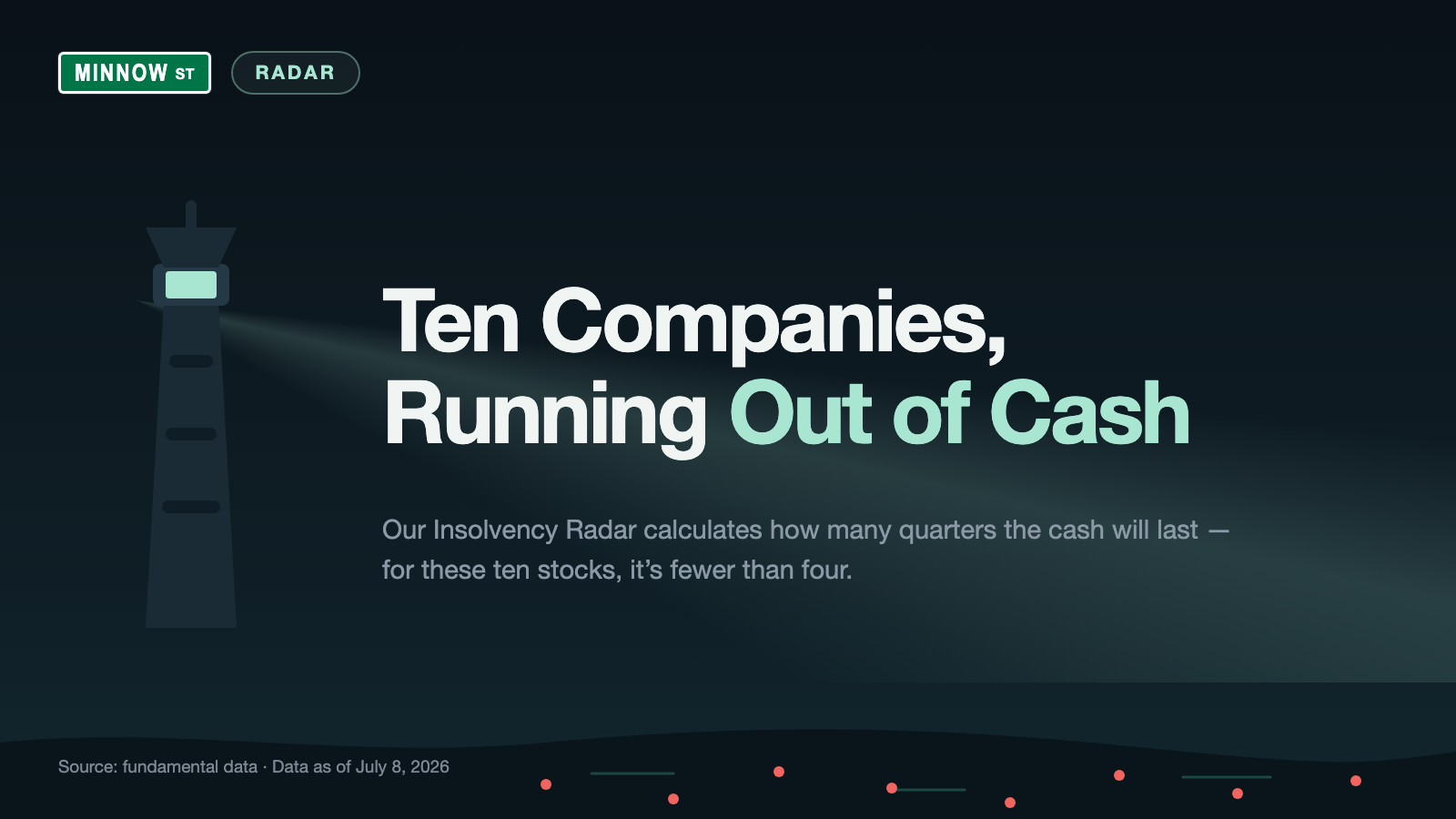
There is a reflex that destroys more money in the stock market than any crash: "It's already fallen this far — how much worse can it get?" A stock sits 80 or 90 percent below its high, the chart looks like a ski slope, and something inside you whispers: bargain. That reflex has a blind spot, and it shows up in no price app: the cash on hand. A stock can absolutely fall further still — namely whenever a company simply runs out of money and has to print new shares to survive. That is exactly what we built a tool for: the Insolvency Radar ("Cash Running Out"). In the run of July 8, 2026, it fired for 151 of roughly 3,500 stocks screened. Today we take a closer look at ten of them.
Why We Publish a List of the Worst Balance Sheets
Fair question: isn't it a little cynical to crown a "top 10" of companies running out of money — a list where a hit is "better" the worse the company looks? Our answer: a smoke detector that beeps is no compliment to the fire. It's the reason you get out in time. That's exactly how this scanner is meant — and the same list is useful to three very different kinds of readers:
- Do you already own one of these stocks? Then the finding is your early-warning system. Don't sell in a panic — but now go read specifically: how does the company plan to finance itself, and what would that mean for your shares?
- Are you hunting for bargains? Then this is your anti-shopping-list. Every one of these stocks looks "cheap" after a crash — the radar documents why the price has a reason.
- Do you trade actively and think about the short side? Then this is a watch list — nothing more. Why we deliberately give no short-selling recommendation is explained at the end of this article.
One sentence needs to stand over the whole list: a hit is a warning signal, not an insolvency verdict. Most of these companies will not go bankrupt — they will save themselves, typically with a capital raise. That saves the company. The rescue is paid for by existing shareholders, whose stake gets diluted. That's a loss too, just a quieter one than bankruptcy.
How the Insolvency Radar Does the Math
The methodology is deliberately simple enough to explain in three sentences. First: the operating business has to be burning cash — operating cash flow over the last four reported quarters is negative in sum. Second: cash plus short-term investments, at an unchanged burn rate, will last less than four quarters. Third: banks and financial-services firms are excluded (their cash flow swings for structural reasons), as are micro caps under $20 million in market value and obvious data outliers. Unlike score models such as the Altman-Z Distress Zone, the radar therefore calculates a concrete answer to how long the cash will actually last — a number anyone can understand.
The scanner page shows, of the 151 hits, the ten names with the highest relative strength — precisely the ones whose prices have run best lately and that therefore look least "like a crisis." For this article we sort the same ten companies differently, by the question that actually matters: how many quarters will the cash last? All figures: data as of July 8, 2026, each drawn from the most recent quarterly reports (spring 2026). Source: fundamental data.
The Ten Findings at a Glance
| Company (Ticker) | Industry | Cash | Cash Burn per Quarter | Runway | Market Value |
|---|---|---|---|---|---|
| Frequency Electronics (FEIM) | Communications technology | $0.1M | $0.2M | 0.4 quarters* | $0.6B |
| Outlook Therapeutics (OTLK) | Biotechnology | $7.7M | $11.8M | 0.7 quarters | $0.2B |
| Broadwind (BWEN) | Specialty manufacturing | $0.9M | $1.1M | 0.8 quarters | $0.1B |
| GCT Semiconductor (GCTS) | Semiconductors | $7.2M | $7.5M | 1.0 quarters | $0.2B |
| Silvaco (SVCO) | Chip design software | $10.9M | $11.0M | 1.0 quarters | $0.4B |
| P3 Health Partners (PIII) | Health care delivery | $25.5M | $21.3M | 1.2 quarters | $0.1B** |
| Quantum (QMCO) | Data storage | $15.6M | $9.5M | 1.7 quarters | $0.2B |
| SkyWater Technology (SKYT) | Semiconductor manufacturing | $22.2M | $13.1M | 1.7 quarters | $1.8B |
| Celcuity (CELC) | Biotechnology | $145.2M | $43.1M | 3.4 quarters | $4.8B |
| UroGen Pharma (URGN) | Biotechnology | $141.6M | $41.4M | 3.4 quarters | $1.7B |
Cash = cash and cash equivalents plus short-term investments per the most recent quarterly report; cash burn = average operating cash outflow per quarter (last four quarters); runway = cash divided by cash burn. *More on the special case FEIM shortly. **Our data source's figure ($2.1B) is a calculation artifact of the 1-for-50 reverse stock split — per the SEC cover page it's about $0.08 billion. Data as of July 8, 2026. Source: fundamental data.
We've published a dedicated deep-dive with SEC evidence for each of the ten companies — you'll find it linked at the end of each section.
The Ten Companies in Detail
Frequency Electronics (FEIM) — the special case that shows you how to read the radar
Of all things, the arithmetically most urgent case is the best lesson in reading the radar. Frequency Electronics builds precision timing and frequency technology for aerospace and defense — an established business, valued at just over $600 million on the market. And yes, the number is real: the balance sheet as of January 31, 2026 shows exactly $86,000 in cash, with no securities alongside it. And yet FEIM is the mildest case on the list: the outflow is tiny (under a million dollars for the entire year, mostly billing timing in the government business), current assets cover current liabilities 2.6 times over, there's no bank debt — but also no credit line as a safety net. Remember: the radar delivers questions to check, not verdicts. Anyone who reads only the runway number makes the same mistake as the bargain hunter who reads only the price crash.
Outlook Therapeutics (OTLK) — two months of runway, and the company says so itself
Outlook Therapeutics is developing an antibody for ophthalmology (ONS-5010/LYTENAVA) and faces the task of bringing it to market before the cash runs out: $7.7 million in cash against just under $12 million in cash burn per quarter — arithmetically about two months. This isn't a case where you'd have to rely on the scanner's interpretation; the company writes it itself in its most recent quarterly report — it speaks of "substantial doubt about the Company's ability to continue as a going concern":
"Management does not believe that the existing cash and cash equivalents as of March 31, 2026 are sufficient to fund the Company's operations through one year from the date of this Quarterly Report on Form 10-Q."
— Outlook Therapeutics, Inc., SEC quarterly report 10-Q as of March 31, 2026 (filed May 15, 2026)
The report also names the way out management is reviewing: additional financing. Translated for you as a reader: if the company survives, it will very likely be with fresh shares or convertible notes — and those spread the future upside across substantially more shares.
Broadwind (BWEN) — the manufacturer with $900,000 in the till
Broadwind spent decades manufacturing steel towers for wind turbines — past tense, because the SEC filings are currently documenting the overhaul: both tower plants are sold or up for sale, the wind business runs as a discontinued operation starting in the second quarter of 2026; what remains is components for energy and infrastructure projects. The cash finding stays serious regardless: $0.9 million in cash, just over $1 million in outflow per quarter — kept alive by a credit line whose covenants the bank has already had to loosen twice. → Read the full Broadwind analysis
GCT Semiconductor (GCTS) — chips without a fab, cash for one quarter
GCT designs communications semiconductors (4G/5G) without owning a fab. Fabless companies carry low fixed costs — but GCT is still burning about $7.5 million per quarter against $7.2 million in cash: runway of one quarter. At a market value of just over $200 million, access to the capital markets is the real survival question.
Silvaco (SVCO) — software margins don't protect against an empty till
Silvaco sells simulation and design software for chip development (TCAD/EDA) — on paper a dream business model. Even so, $10.9 million in cash stands against about $11 million in cash burn per quarter: runway of one quarter. The case is a reminder of a rule we already dissected in our FatPipe analysis: it isn't the margin that counts, it's what actually arrives as cash in the end.
P3 Health Partners (PIII) — a going-concern note and a rescue on borrowed money
P3 Health Partners organizes primary-care-centered coverage in the United States — a business with large revenue and thin margins. Important up front: the roughly $2.1 billion market value from our data source is a calculation artifact of the 1-for-50 reverse stock split from April 2025; per the SEC cover page only about 7.2 million shares exist, putting market value closer to about $75 million. That makes the situation more serious than the table suggests: the auditor has noted substantial doubt about the company's ability to continue as a going concern, cash covers only just over a quarter at the current outflow (just over $21 million per quarter) — and fresh money has come mostly as a loan from the controlling shareholder at 13.5 to 19.5 percent interest.
Quantum (QMCO) — the storage veteran under permanent stress
Quantum Corporation stores and manages video and bulk data — a company with a decades-long history and an equally long history of restructuring. Currently: $15.6 million in cash, about $9.5 million in outflow per quarter, runway under two quarters. Cases like this show that the radar isn't a snapshot of an accident, but often just the latest chapter of a long story. The newest chapter came after the balance-sheet date: in June 2026 Quantum retired its expensive loan and raised about $95 million net through a share placement — air purchased, dilution included.
SkyWater Technology (SKYT) — a contract manufacturer with a thin cushion
SkyWater runs semiconductor manufacturing in the United States — strategically in demand, capital-intensive like almost no other industry. $22.2 million in cash against just over $13 million in outflow per quarter yield 1.7 quarters of runway; it's kept alive by a $350 million credit line ($182 million drawn as of March 29, 2026). Two things soften the finding: the most recent quarter brought positive operating cash flow again — and over all of it sits a special situation, because SkyWater agreed to a takeover by IonQ in January 2026; the price has since traded mostly on the deal, not the balance sheet.
Celcuity (CELC) — when burning cash is part of the plan
Celcuity is a clinical biotech (targeted cancer therapies) with nearly $5 billion in market value — and burns just over $43 million per quarter, as planned, on trials. Here it matters what the radar doesn't say: at clinical biotechs, negative cash flow isn't an operating accident, it's a business-model phase — drugs cost hundreds of millions first and (maybe) earn billions later. The finding here doesn't mean "mismanagement," it means: this stock lives off the capital markets. $145 million in cash lasts just over three quarters; the next financing round is a question of when, not if. For an honest picture: alongside the cash, Celcuity holds another roughly $242 million in short-term investments — combined about $387 million, which pushes the real runway closer to nine quarters (the radar measures only the narrow cash position). The real test is binary either way: the FDA decision on the drug gedatolisib, set for July 17, 2026.
UroGen Pharma (URGN) — products on the market, cash still finite
UroGen develops and markets therapies for urinary-tract cancers — so not a pure hope-stock biotech, but a company with revenue. Even so: just over $41 million in outflow per quarter, $141.6 million in cash, runway of about 3.4 quarters. Marketing a drug costs money on sales before it pays for itself. For shareholders, the core question here is whether revenue is growing faster than the cash is shrinking.
What Becomes of Companies Like This — the Four Typical Ways Out
So the list doesn't sound more dramatic than it is: from "cash won't last four quarters" to bankruptcy is a long road, and most companies turn off it before the end. The four usual ways out, sorted by frequency:
- Capital raise: the company sells new shares (often at a discount) or convertible notes. The most common outcome — the company survives, your stake gets diluted. Repeated often enough, this produces the notorious downward spiral of a falling price and ever-larger share issuances.
- Loan or credit line: buys time but solves nothing — and interest raises future cash burn. Works only if an operating turnaround is in sight.
- Sale or partial sale: acquisition by a strategic buyer, sale of divisions or licenses. For shareholders, a rescue or a giveaway depending on the price.
- Bankruptcy (Chapter 11): the rarest but most final outcome — as a rule, existing shares head toward zero even if the company survives as a going business.
Which is why the most honest short summary for this list is: these aren't ten future bankruptcies — they're ten companies that, very likely, will need other people's money within the next few quarters. And other people's money always has a price, usually paid by whoever is already invested.
What About the Short Side?
Yes, professional short sellers use lists like this as a starting point. Even so, you won't find a short-selling recommendation here, and there are solid reasons for that: with a short sale, the maximum gain is capped (100 percent), while the theoretical downside is unlimited. Share borrowing costs ongoing fees — often in the double digits per year for small, heavily shorted names. And of all things, a thin cash cushion can send a price soaring: a surprise financing, a takeover rumor or a squeeze is all it takes. Reminder: the scanner page sorts hits by relative strength — the ten companies in this article are, therefore, precisely the ones whose prices have run strong lately. Betting against something like that requires risk management that goes well beyond one article. How quickly an apparently clear-cut warning-signal case can turn into a complicated tangle is shown by our Roadzen analysis — warning signals and a triple-digit price gain aren't mutually exclusive.
A Human Conclusion
Back to the reflex from the beginning — "it can't get much worse." Yes, it can: it can get to the point where the company survives and you still lose, because your shares got cut in half across two capital raises. That's exactly what this radar is meant to warn against. It turns the vague feeling "this stock is cheap" into a precise question: how long will the cash last — and who pays for the refill? If you hold one of these ten stocks, answer that question before the market answers it for you. If you want to buy one of them, answer it even more so. And if you want to short one: remember that between "looking bad" and "falling" there can sit a financing round, a squeeze, or a takeover offer. The radar is beeping. What you make of it is your decision. And that is exactly as it should be.
Sources
- In-house stock scanner: Insolvency Radar ("Cash Running Out") — run on July 8, 2026 (151 hits); methodology and the current list of hits on the scanner page
- Outlook Therapeutics, Inc. — SEC quarterly report 10-Q as of March 31, 2026 (filed May 15, 2026), "Liquidity and Capital Resources"/Going Concern section
- Fundamental data (cash, operating cash flow over the last four quarters, market values; data as of July 8, 2026); runway = cash ÷ average quarterly outflow, the identical formula the scanner uses
Transparency & disclaimer: This round-up is a journalistic contextualization of publicly available information and is not investment advice, not a financial analysis in the regulatory sense, and not a solicitation to buy, sell or short any securities. Metrics can be distorted by reporting dates and data-source definitions (see the Frequency Electronics case). Stock investments carry substantial risks up to total loss; short selling carries theoretically unlimited loss risk. All information without guarantee; data as of July 8, 2026. The author holds no position in the stocks named at the time of publication.
Frequently Asked Questions
A scanner that screens roughly 3,500 stocks (U.S. and Germany) every day: it fires when the operating business has burned cash over the last four quarters AND cash plus short-term investments, at an unchanged burn rate, will last less than four quarters. Banks, financial-services firms and micro caps under $20 million in market value are excluded.
No. A hit is a warning signal, not an insolvency verdict. The most common outcome is a capital raise that saves the company and dilutes existing shareholders; loans, partial sales or acquisitions are common too. Bankruptcy is the rarest outcome — but when it happens, existing shares typically head toward zero.
Because the radar measures cash flows, not size: clinical biotechs like Celcuity burn cash on trials as planned, before a drug ever earns anything — there the finding doesn't mean mismanagement, it means dependence on the capital markets. A high market value makes the next financing round easier, but not free for existing shareholders.
We advise against it, and we don't give short-selling recommendations: with a short sale the theoretical downside is unlimited, share borrowing costs ongoing fees, and a thin cash cushion can trigger sharp price gains through financings, takeovers or short squeezes. The ten stocks featured here even had unusually strong recent prices (high relative strength).
Answer three questions from the most recent quarterly report: how long does management itself say the cash will last (going-concern language)? What financing paths does the company name (capital raise, loan, sale)? And how much have shareholders already been diluted in recent years? This doesn't replace investment advice, but it makes the risk concrete.
The data cut-off is July 8, 2026 (scanner run at 11:10 a.m. German time); the cash and cash-flow figures come from the companies' most recent quarterly reports (spring 2026). The scanner page itself recalculates continuously — its current list of hits can therefore differ from this article's snapshot.
Found an error?
Did you spot a factual error, an outdated number, or a typo in this deep dive? Let us know briefly — your report goes straight to the editorial team.