Alnylam: Revenue Up 96 Percent — and a Royalty Staircase That Gets Steeper With Every Win
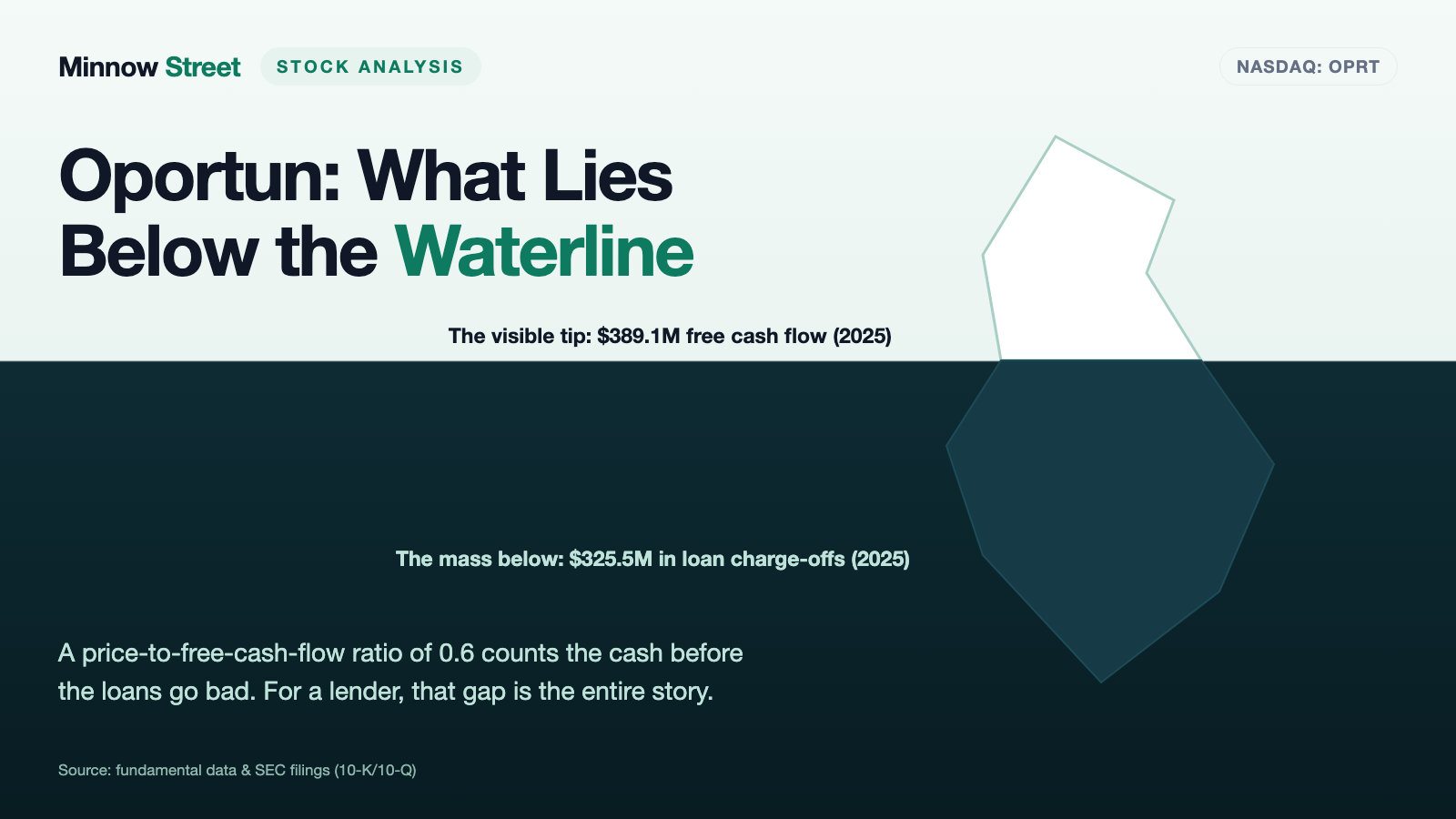
Alnylam booked the first profitable year in its history in 2025: $3,713.9 million in revenue, up 65.2 percent, and $313.7 million of net income. First-quarter 2026 revenue jumped another 96 percent to $1,167.2 million. Yet the stock sat 40.84 percent below its high as of July 24, 2026. The quarterly report filed April 30, 2026, explains why that is not necessarily a contradiction: the royalty owed to Sanofi climbs to 30 percent as AMVUTTRA grows, cost of goods sold rose from 15.0 to 20.0 percent of net product revenues, and the balance sheet carries $1,697.2 million of future income that has already been sold. We do the math on what actually stays in Cambridge.
 Thomas Mücke
Founder & Publisher
Thomas Mücke
Founder & Publisher
Chart
Interactive price chart (TradingView).
Note: pure fact-based analysis, not investment advice and not a solicitation to buy or sell. All figures without guarantee.
There is an investor trap that feels like diligence and is really just hypnosis: revenue trance. You read "up 96 percent," your brain quietly finishes the equation — twice the revenue, so eventually twice the profit — and from that moment on you only hear the parts that confirm it. At Alnylam Pharmaceuticals (NASDAQ: ALNY) the number is real: first-quarter 2026 revenue reached $1,167.2 million, against $594.2 million a year earlier. What it does not answer is the question that matters: how much of each new dollar actually stays in Cambridge? So let us make a deal. Before the growth number lulls us to sleep, we read what the company itself told the U.S. securities regulator, the SEC — the annual report (10-K) for 2025 filed February 12, 2026, and the quarterly report (10-Q) as of March 31, 2026, filed April 30, 2026. An SEC filing is honest under penalty of law. And this one describes a drug going vertical, a royalty staircase that gets steeper with every win, and $1,697.2 million of future income that has already been sold. What you make of it is your call.
What Alnylam actually does — the off switch inside the cell's copy shop
Alnylam builds medicines based on RNA interference, or RNAi. That sounds like a laboratory, but it translates into an everyday picture. Think of your cells as a copy shop: the blueprint for a protein sits in the genome, a messenger RNA carries a copy to the workbench, and the protein gets built there. Some of those proteins are harmful — they clump, settle in the heart and stiffen it. RNAi is an off switch right at the copier: a purpose-built molecule intercepts the messenger copy before it ever reaches the workbench. The protein is simply never made. The discovery won the 2006 Nobel Prize in Medicine; Alnylam was founded in 2002 to turn it into drugs — and it took roughly two decades and an accumulated deficit of $6,496.5 million as of March 31, 2026.
Today six approved medicines sit on the books, four of them sold by Alnylam itself: AMVUTTRA and ONPATTRO for ATTR amyloidosis, GIVLAARI for acute hepatic porphyria and OXLUMO for primary hyperoxaluria type 1. Two more run through partners: Leqvio (cholesterol) at Novartis and Qfitlia (hemophilia) at Sanofi, both of which pay royalties. As of December 31, 2025 the company employed roughly 2,500 people, about 1,945 of them in the United States; some 270 full-time positions were added during 2025.
The engine is a single product. In March 2025 the U.S. Food and Drug Administration also cleared AMVUTTRA for the cardiac form of the disease (ATTR-CM) — and demand has run hard ever since. In the first quarter of 2026 AMVUTTRA brought in $889.9 million against $310.0 million a year earlier, up 187 percent; in the U.S. alone it was $702.6 million, up 255 percent. That is 85.9 percent of all net product revenues for the quarter. Its older sibling ONPATTRO is losing patients in the process: down 59 percent to $20.5 million. That is not a failure but a plan — the successor is eating the predecessor.
Which names the central tension of this analysis, and it runs through every chapter: the business is growing faster than ever — and sharing more than ever. A large slice of the success was sold in advance, and the share paid out rises with the success itself. Hold on to that sentence; we are about to test it line by line.
How this stock landed on our desk
The prompt came from our in-house stock scanner, and specifically from the quality corner. As of July 26, 2026 Alnylam appears on the screen "Fundamental Rank (A / A+)" — a proprietary fundamental rating that ranks every stock against all others on earnings and revenue growth, earnings surprises, margins and margin expansion, balance sheet safety and return on equity. Only names rated 51 or higher (grade A or A+) are shown. Alnylam scores 54 — the lower edge of the distinction, not the top of it. On that day the scanner had 38 U.S. hits on this screen; the page displays the 25 highest ranked of them. These lists are recalculated daily — what held on July 26, 2026 can look different a week later.
In total the stock shows up on five screens that day: alongside Fundamental Rank there are Ben Bennett: Focus List, NASDAQ Growth Stars, Power Trend and Pros 80%. Two of those deserve context. Pros 80% is explicitly not a quality verdict — a high institutional ownership share is the norm rather than the exception among large U.S. names. And NASDAQ Growth Stars simply checks three boxes: membership in the NASDAQ-100, revenue growth above 20 percent, and an enterprise value below ten times revenue. Alnylam clears all three (revenue growth 65.2 percent, data as of July 24, 2026).
Now the other side of the same data row, and it is the reason we looked harder in the first place. The relative strength rating — which measures how the share price performed against every other stock — stands at 17 out of 100. Translation: 83 out of 100 stocks did better. The Stan Weinstein trend stage reads 4, meaning downtrend; the price sat 40.84 percent below its high and only 7.35 percent above its low of the past 52 weeks, and six-month performance is minus 26.6 percent (all values as of July 24, 2026). A company with top marks on the balance sheet and a share price in decline — that is exactly the setup where it pays to read the filings instead of the chart. How far quality and price action can diverge in biotech is something we also worked through in our analysis of Neurocrine Biosciences.
One more item that appears in the scanner only as a small number and finds its explanation in the filings: 20 insider sales and not a single insider purchase in the recorded filings (data as of July 24, 2026). That sounds more dramatic than it is. The 2025 annual report names the pre-announced trading plans outright — chief research and development officer Pushkal Garg may sell up to 25,418 shares between February 27 and November 1, 2026, and chief commercial officer Tolga Tanguler up to 25,782 shares between February 13 and November 15, 2026. Such plans are set months in advance precisely so nobody trades on inside knowledge. They say little about management conviction and a lot about tax planning.
The numbers over the years — given their due
First the part that genuinely impresses. In 2025 Alnylam pulled off what most biotech companies never manage: the jump from a permanent cash burn into profit. Revenue rose 65.2 percent in 2025 to $3,713.9 million (2024: $2,248.2 million; 2023: $1,828.3 million). The bottom line showed $313.7 million of net income, or $2.33 per diluted share — after losses of $278.2 million in 2024 and $440.2 million in 2023.
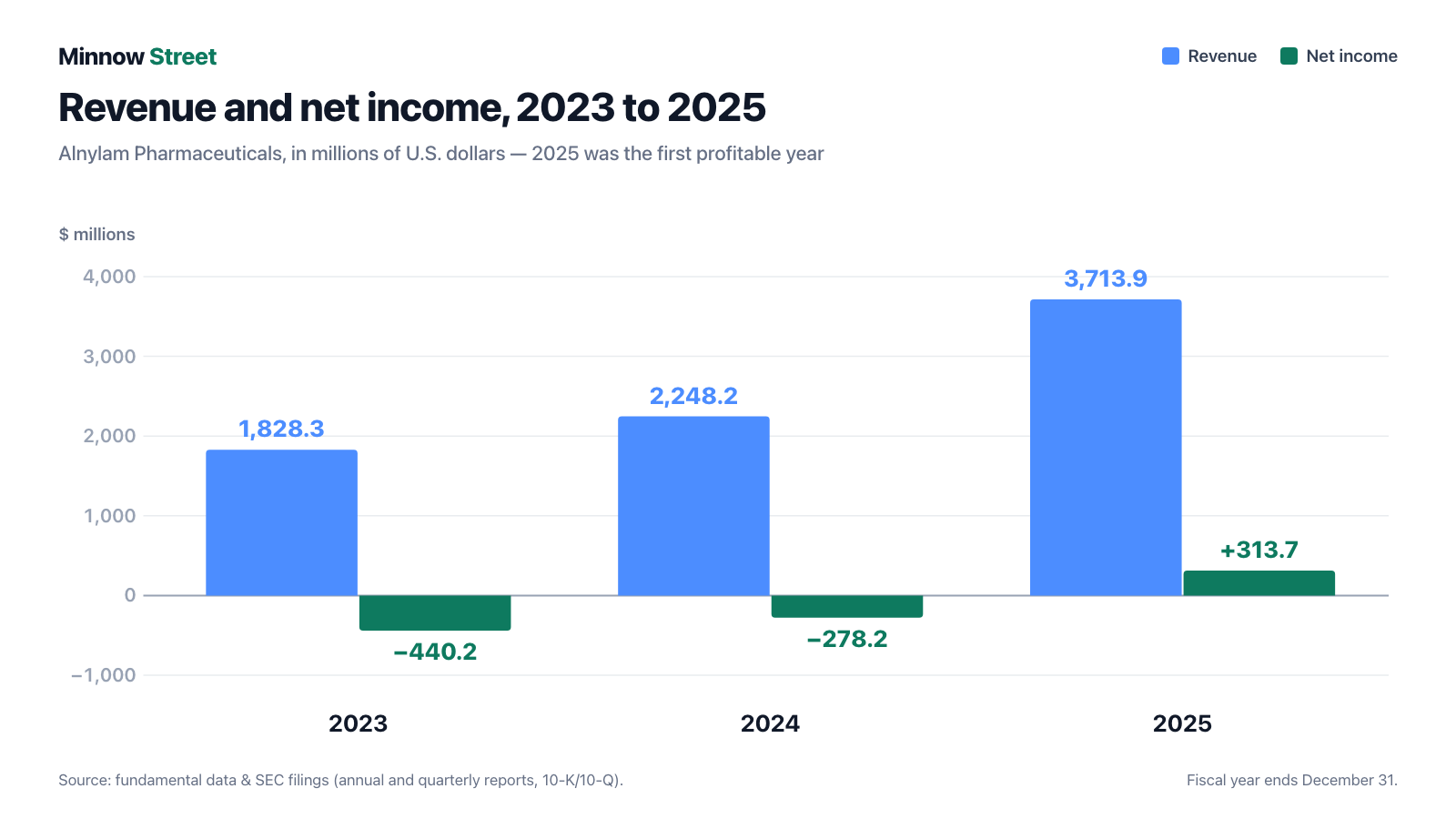
The first quarter of 2026 extends the trend and sharpens it: $1,167.2 million of revenue (up 96 percent), $206.0 million of net income after an $18.3 million loss a year earlier, and $1.51 of diluted earnings per share. Income from operations jumped from $18.1 million to $268.6 million. One quarter proves nothing on its own — but this one is not a fluke, it is the direct consequence of the March 2025 ATTR-CM approval.
The balance sheet has turned as well. At the end of 2023 stockholders' equity was negative (minus $220.6 million) — the company owed more than it owned. At the end of 2024 it was a thin $67.1 million, by the end of 2025 already $789.2 million, and as of March 31, 2026 the books show $1,075.4 million. Add $3,009.2 million of cash and short-term securities (March 31, 2026) and a fully undrawn $500.0 million revolving credit facility whose covenants were met at the same date. Operating cash flow — the money the running business actually deposits — was $524.1 million in 2025, against minus $8.3 million in 2024.
Note one figure for later that does not quite fit that picture: in the first quarter of 2026 the $206.0 million of net income was matched by only $70.5 million of operating cash flow. Not an alarm — receivables and accruals swing on a quarterly rhythm — but a good reason to read the next filing with that line in mind.
What the filings say — four uncomfortable truths
Uncomfortable truth No. 1: the royalty staircase rises with success
First things first: Alnylam does not own AMVUTTRA outright. The rights to the TTR products come from an agreement with Sanofi, and Sanofi is paid a royalty on sales — tiered by size. Up to $150.0 million of global annual net sales the rate is 15 percent, then 17.5 percent, 20 percent, 25 percent — and above $1.50 billion it is 30 percent. The quarterly report states it as plainly as such things ever get stated:
"Given the significant and growing contribution of AMVUTTRA to our total product revenues following regulatory approvals of AMVUTTRA for the treatment of ATTR-CM, our cost of goods sold, operating income and operating margin have been significantly impacted by the royalties we pay to Sanofi on global sales of AMVUTTRA, and we expect this will continue in future years."
— Alnylam Pharmaceuticals, Inc., SEC quarterly report 10-Q as of March 31, 2026, Management's Discussion and Analysis

What that means in practice sits a line below in the same filing: cost of goods sold rose from 15.0 percent of net product revenues in the first quarter of 2025 to 20.0 percent in the first quarter of 2026. The company names the higher blended royalty rate on AMVUTTRA as the reason and expects a further increase for full-year 2026. Translated into an everyday picture: it is a restaurant whose landlord takes a cut of revenue — and the fuller the place gets, the bigger the cut. Anyone converting AMVUTTRA growth one-for-one into profit growth is doing the wrong math.
And now the fair counterweight, because it sits in the same paragraph: no royalties are owed on nucresiran, the successor molecule aimed at the same disease. Alnylam writes that it has the potential to significantly improve gross margins and operating income margin. That is the real bet behind this stock: can Alnylam replace its own bestseller in time with a product nobody else earns a cut of? Nucresiran is in clinical development — as of the cut-off date of this analysis it is not approved.
Uncomfortable truth No. 2: one billion in, $1.49 billion owed
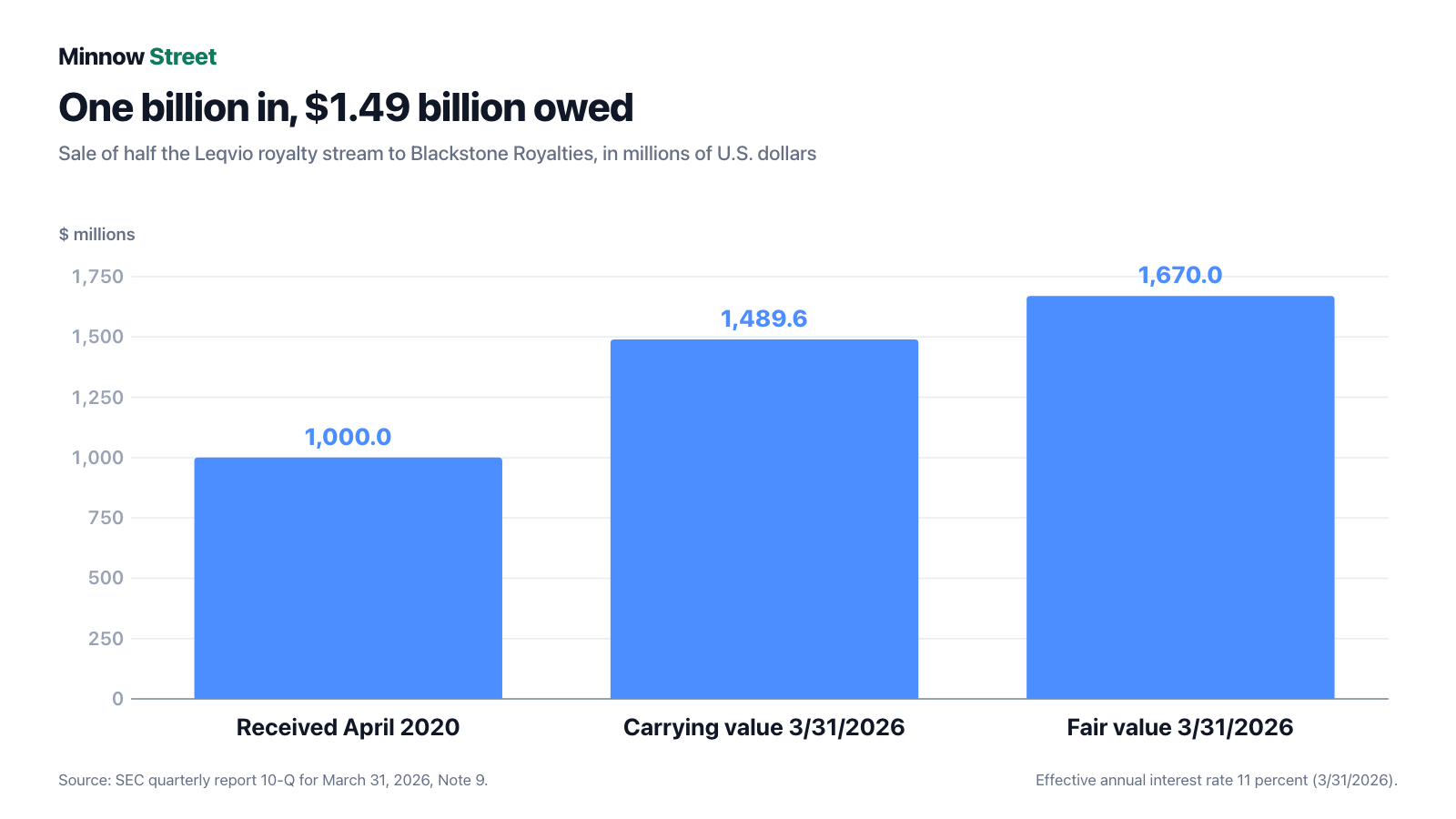
In April 2020 Alnylam needed money and sold something it did not yet have: future royalties. Blackstone Royalties paid $1.00 billion and received half of all royalties on the cholesterol drug Leqvio plus 75 percent of the related commercial milestone payments. Because Alnylam retains continuing involvement and an obligation to repay, the money does not appear as income but as debt — and that debt accrues interest.
The result after six years is remarkable. As of March 31, 2026 the liability is carried at $1,489.6 million — $489.6 million more than ever came in, and that is after payments. In the first quarter of 2026 alone it grew again: $40.5 million of interest expense against $30.1 million of payments, a net increase of $10.4 million. The notes carry it at a fair value of $1.67 billion.
On top of that sits a deadline few investors have on their radar. It appears verbatim in the notes:
"If Blackstone Royalties does not receive payments in respect to the Royalty Interest by December 31, 2029, equaling at least $1.00 billion, Blackstone Royalties will receive the Royalty Interest at 55% beginning on January 1, 2030."
— Alnylam Pharmaceuticals, Inc., SEC quarterly report 10-Q as of March 31, 2026, Note 9

For scale: Alnylam's total royalty revenue was $174.0 million in 2025 and $49.0 million in the first quarter of 2026. Management's discussion attributes it mainly to global Leqvio sales by Novartis — and half of that stream goes to Blackstone before anything stays. The deadline is not a catastrophe, but it is a date on the calendar at which one metric can permanently deteriorate.
Uncomfortable truth No. 3: a 49 percent effective interest rate, disclosed in the notes
There is a second Blackstone agreement, and it is more expensive still. In August 2020 Blackstone Life Sciences committed up to $150.0 million to co-fund two clinical programs: vutrisiran (the active ingredient in AMVUTTRA) and zilebesiran (hypertension). By March 31, 2026, $70.0 million had gone into the pivotal HELIOS-B trial and $38.0 million into zilebesiran. The consideration is steep: $175.0 million, triggered by the ATTR-CM approval in March 2025 and payable in eight equal quarterly installments over two years, plus a 1 percent royalty on all vutrisiran net sales for a ten-year term. For zilebesiran, $84.5 million in 16 quarterly installments and a further $243.0 million upon approval come on top.
What that means as an interest rate is something the company calculates itself — and it is the line worth reading twice:
"As of March 31, 2026, our estimate of total interest expense resulted in an effective annual interest rate of 49% related to vutrisiran and 32% related to zilebesiran."
— Alnylam Pharmaceuticals, Inc., SEC quarterly report 10-Q as of March 31, 2026, Note 9

A word on fairness: 49 percent is not usury in the ordinary sense. Blackstone carried the full risk in 2020 that the trial would fail and nothing would come back — in that case the money was simply gone. The high rate is the price of capital no bank would have supplied. Still, the point stands: part of today's success was already sold in 2020, and sold cheaply.
The gap between carrying amount and fair value is just as telling. The vutrisiran liability is carried at $187.9 million as of March 31, 2026 — the notes put its fair value at $558.1 million. For zilebesiran it is $19.6 million against $118.3 million. Together with the Leqvio position that makes $1,697.2 million of carrying value against roughly $2,346 million of fair value. The roughly $649 million difference is not hidden debt in any legal sense — it is the price of AMVUTTRA's success having made the other side's claim more valuable.
And one more number that ties these chapters together: of $69.3 million of interest expense in the first quarter of 2026, $66.2 million was non-cash — pure accretion on those liabilities, with no money leaving the building. For full-year 2025 it was $238.4 million of $252.6 million. Anyone reading the reported profit should know: this interest depresses earnings but costs no cash for now — it arrives later as payment.
Uncomfortable truth No. 4: one distributor, 45 percent
The 2025 annual report names, in an unassuming table, the customers accounting for at least 10 percent of gross revenues. It is one line: "Distributor A" — 45 percent. A year earlier it was 29 percent; in 2023, 28 percent. And the same name appears a second time: as of December 31, 2025 it accounted for 45 percent of gross accounts receivable, up from 16 percent a year earlier.

The everyday picture: if a neighbor told you his business was booming, but nearly half his revenue and nearly half his open invoices hung on one buyer — would you swallow for a second? In fairness: U.S. distribution of specialty prescription drugs typically runs through a handful of large wholesalers; that is industry structure, not carelessness. But it remains a concentration that has almost doubled from 28 to 45 percent in two years.
A second concentration sits one level up: AMVUTTRA alone accounts for 85.9 percent of net product revenues in the first quarter of 2026. And the competition there is not theoretical. The annual report names it: VYNDAQEL/VYNDAMAX from Pfizer and ATTRUBY from BridgeBio are both approved for the same cardiac indication, both taken as a pill, and both carry lower U.S. list prices than the injected AMVUTTRA. More candidates sit in Phase 3, including WAINUA from AstraZeneca and Ionis and a gene-editing approach from Intellia and Regeneron. How fast a single drug can carry an entire balance sheet — and how hard the fall is when it goes away — is laid out in our analysis of Biogen.
Valuation — expensive, though less so than last autumn
The headline first: even after the decline, Alnylam is not a cheap stock. On fundamental data as of July 24, 2026, the price-to-earnings ratio is around 73 and the price-to-sales ratio around 9. The forward view eases the picture considerably: on expected earnings for the next twelve months it is around 34. That is the difference between a company that is expensive and a company growing out of its valuation — provided the expectation holds.
One metric deserves caution. The return on equity of roughly 90 percent looks spectacular but is largely an artifact of arithmetic. It measures profit against an equity base that only turned positive in 2024 and stood at $1,075.4 million as of March 31, 2026 — against total assets of $5,129.5 million. That puts the equity ratio at 21.0 percent. A high return on a thin base is not the same thing as a high return on a thick cushion.
Because daily prices have no place in an analysis, here are three dated price anchors from primary documents that let you judge the order of magnitude yourself. First: on June 1, 2026, director David E. I. Pyott sold 3,830 shares under a plan adopted in November 2025 at weighted-average prices between $297.71 and $302.65 (insider filing Form 4). Second: when pricing its zero-coupon 2028 convertible notes, Alnylam cited a volume-weighted average price of $478.63 on September 9, 2025. Third, and most revealing: the older 2027 notes become convertible when the share price trades above 130 percent of the $286.20 conversion price on enough days — that is roughly $372. That condition was met in the fourth quarter of 2025; in the first quarter of 2026 it was not. The filing records it plainly: the notes were not convertible in the second quarter of 2026. The decline is therefore not merely a screener figure but a matter of public record.
And what do the professionals think? As of July 24, 2026, 30 analysts carried the stock at an average buy rating with a mean target price of $434.72 — roughly 48 percent above the price level at the time. Such targets are opinions, not measurements, and they get moved down as readily as up; earnings estimates for the current year were trimmed slightly in the four weeks before the cut-off date. Remember: the value of an analyst estimate lies in its reasoning, not its height.
Opportunities and risks at a glance
What speaks for Alnylam:
- The jump into profitability is done. $313.7 million of net income in 2025 and $206.0 million in the first quarter of 2026 alone — after two loss-making years.
- AMVUTTRA is growing at full force: $889.9 million of quarterly revenue, up 187 percent, and up 255 percent in the U.S. — driven by genuine patient demand in the cardiac indication, not by price increases.
- The balance sheet carries it: $3,009.2 million of liquid assets as of March 31, 2026, an undrawn $500.0 million revolving facility, all financial covenants met, and $524.1 million of operating cash flow in 2025.
- Nucresiran is the answer to the royalty staircase: per the quarterly report, no royalties are owed on the successor molecule. If the switch works, the largest margin brake disappears.
- A broad pipeline funded by others: Roche paid $310.0 million upfront for zilebesiran, $65.0 million in April 2024 and $300.0 million in September 2025, and carries 60 percent of development costs; up to $2.15 billion of further payments are contracted.
What speaks against it:
- The royalty staircase rises with success: up to 30 percent to Sanofi above $1.50 billion of annual net sales. Cost of goods sold already climbed from 15.0 to 20.0 percent of net product revenues, with a further rise announced for 2026.
- $1,697.2 million of sold-forward future on the balance sheet (March 31, 2026), more than the $1,075.4 million of equity — plus $1,009.4 million of convertible notes. The equity ratio is 21.0 percent.
- One product carries nearly everything: 85.9 percent of first-quarter 2026 net product revenues come from AMVUTTRA — against two approved pill competitors with lower U.S. list prices.
- One distributor accounts for 45 percent of gross revenues and 45 percent of gross receivables (December 31, 2025), up from 28 percent and considerably less respectively in 2023.
- The valuation leaves little room: a price-to-earnings ratio around 73 and price-to-sales around 9 (data as of July 24, 2026) — with a relative strength rating of 17 and a price 40.84 percent below its high.
A human conclusion
Remember the revenue trance from the opening? "Up 96 percent" — and the brain quietly finishes the sum. After reading the filings the math looks different, and that does not make it worse, it makes it more honest. Alnylam achieved something rare in biotech: turning twenty years of research into a medicine that helps people and earns money. The $6,496.5 million accumulated deficit is the receipt for that road — and the fact that it is now shrinking rather than growing is the real news of 2025.
At the same time, the company paid for that road with pieces of its own future. Sanofi holds a royalty staircase that steepens with success. Blackstone put a billion on the balance sheet in 2020 and took half the Leqvio royalties in return — today $1,489.6 million sits there as debt, and it is still growing. None of that is a scandal; it is the price a company pays when it needs capital before it has profits. But it explains why a 96 percent revenue jump does not arrive at the bottom line as 96 percent.
So the tension stands exactly where we set it at the start: the business is growing faster than ever — and sharing more than ever. Whether that was a good trade or a bad one will not be settled on the revenue line, but by three questions: how quickly does the gross margin recover once nucresiran arrives? How tight does the Leqvio threshold get by December 31, 2029? And does operating cash flow return to the level of reported profit? All three numbers appear in every future filing — you can read them yourself. What you make of that is your decision. And that is exactly as it should be.
Sources
- SEC quarterly report (10-Q) as of March 31, 2026, Alnylam Pharmaceuticals, Inc., filed April 30, 2026 (CIK 0001178670)
- SEC annual report (10-K) for fiscal year 2025, filed February 12, 2026
- SEC current report (8-K) dated April 30, 2026 — first-quarter 2026 results
- SEC current report (8-K) dated May 27, 2026 — annual meeting of May 20, 2026 (133,427,910 shares outstanding as of the March 25, 2026 record date), ratification of PricewaterhouseCoopers as auditor and expansion of the board to eleven members
- Insider filing (Form 4) dated June 3, 2026 — sales by David E. I. Pyott on June 1, 2026
- SEC EDGAR filing index, CIK 0001178670
- Fundamental data (metrics, valuation, analyst consensus, scanner figures), data as of July 24, 2026; scanner membership as of July 26, 2026
This analysis is journalistic commentary on publicly available corporate filings and is not investment advice. It is neither an offer nor a solicitation to buy or sell securities. Stocks can lose substantial value; a total loss is possible. All figures come from the primary sources named above and carry the as-of date stated with them; metrics drawn from fundamental data can change daily. The author holds no position in Alnylam Pharmaceuticals at the time of publication.
Our Bottom Line at a Glance
- Business and growth positive
- Revenue rose 65.2 percent in 2025 to $3,713.9 million and another 96 percent in the first quarter of 2026 to $1,167.2 million. The driver is the March 2025 approval of AMVUTTRA for the cardiac form of ATTR amyloidosis: $889.9 million of quarterly revenue, up 187 percent, and up 255 percent in the U.S. That is genuine patient demand rather than pricing — the quarterly report explicitly cites the higher number of patients treated.
- Quality of earnings neutral
- 2025 produced the first profit: $313.7 million after losses of $278.2 million in 2024 and $440.2 million in 2023; the first quarter of 2026 added $206.0 million. Operating cash flow of $524.1 million exceeded net income in 2025 but fell well short of it in the first quarter of 2026, at $70.5 million. On top of that, $66.2 million of the quarter's $69.3 million of interest expense is non-cash accretion — the profit is real, but its cash conversion swings.
- Margin structure and dependence on Sanofi negative
- The royalty owed to Sanofi steps up to 30 percent of global annual AMVUTTRA net sales above $1.50 billion. Cost of goods sold accordingly climbed from 15.0 percent of net product revenues in Q1 2025 to 20.0 percent in Q1 2026, with the company announcing a further rise for 2026. Growth here makes itself more expensive — until the royalty-free successor molecule nucresiran is approved.
- Balance sheet and sold-forward future negative
- As of March 31, 2026 the balance sheet carries $1,697.2 million of liabilities from sold royalties and development funding — more than the $1,075.4 million of equity (ratio 21.0 percent). The billion received from Blackstone Royalties in 2020 has grown to $1,489.6 million and added a further $10.4 million in the first quarter of 2026 alone. The effective annual interest rate on the development funding is 49 percent for vutrisiran and 32 percent for zilebesiran.
- Concentration risk negative
- AMVUTTRA accounts for 85.9 percent of first-quarter 2026 net product revenues, and a single distributor for 45 percent of gross revenues and 45 percent of gross receivables (December 31, 2025, up from 28 percent and 16 percent respectively). The annual report names two approved competitors for the same indication that are taken as pills and carry lower U.S. list prices than the injected AMVUTTRA.
- Financial strength and headroom positive
- As of March 31, 2026 the company held $3,009.2 million in cash and short-term securities, its $500.0 million revolving facility was undrawn and all financial covenants were met. The convertible notes carry coupons of 0.00 and 1.00 percent; the more expensive 1.00 percent tranche was largely repurchased during 2025. Roche funds 60 percent of zilebesiran development costs and had paid $675.0 million in upfront and milestone payments through September 2025.
In 2025 Alnylam cleared the hurdle most biotech companies never do: a first profit, $3,713.9 million of revenue (up 65.2 percent), $524.1 million of operating cash flow, and another 96 percent of revenue growth in the first quarter of 2026. The price of all that is in the filings too: a royalty staircase to Sanofi reaching 30 percent, $1,697.2 million of sold-forward future on the balance sheet, one product at 85.9 percent of net product revenues, and one distributor at 45 percent. Investing here is a bet that the royalty-free successor molecule nucresiran arrives in time to win the margin back. Not investment advice.
What Our Rating Means
Open questions
The business works in principle, but one material question is open. As long as it stays open, our findings do not carry a quality verdict.
The business model clearly works: six approved medicines, $3,713.9 million of revenue in 2025, a first profit, $3,009.2 million of liquidity as of March 31, 2026, an undrawn credit facility and covenants comfortably met. What keeps us from green is an unanswered operational question: earnings power rests on a single product that triggers a higher royalty rate to Sanofi with every increment — cost of goods sold has already risen from 15.0 to 20.0 percent of net product revenues, and further increases are announced. Add $1,697.2 million of future income sold in advance against $1,075.4 million of equity, and one buyer accounting for 45 percent of revenues. This is not a solvency issue — cash, interest coverage and covenants argue clearly against that — but it is more than a formality. Hence yellow: proven strength, unproven durability of the margin. The decision is yours.
A journalistic assessment by our editorial team at the time of the deep dive, based on public sources — not investment advice and not a solicitation to buy or sell. Your personal circumstances (investment goals, risk capacity, taxes) cannot be taken into account. What our levels mean, how verdicts are formed, and what conflicts of interest exist →
Worth Noting
- Alnylam reached our research list through the quality screen "Fundamental Rank (A / A+)" of our in-house stock scanner (fundamental rating 54 out of a maximum 100, inclusion from 51; 38 U.S. hits, as of July 26, 2026). On the same day the stock also appeared on the screens "Ben Bennett: Focus List", "NASDAQ Growth Stars", "Power Trend" and "Pros 80%". These lists are recalculated daily.
- Cut-off dates: annual figures from the 10-K for 2025 (filed February 12, 2026), quarterly figures from the 10-Q as of March 31, 2026 (filed April 30, 2026). Every filing after that date was reviewed: current reports 8-K dated April 30 and May 27, 2026, insider filings on Form 4 through June 3, 2026, and Schedule 13G/A ownership filings through May 14, 2026. Metrics and market picture carry a data date of July 24, 2026.
- Valuation figures are dated and evergreen: the price anchors come from primary documents — insider sales at weighted-average prices between $297.71 and $302.65 on June 1, 2026 (Form 4) and the volume-weighted average price of $478.63 on September 9, 2025 cited in the convertible note offering. The market capitalization drawn from fundamental data (roughly $38.9 billion, as of July 24, 2026) was cross-checked against 133,444,000 shares times $297.71; the deviation is roughly 2 percent.
Frequently Asked Questions
Alnylam develops medicines based on RNA interference (RNAi): a purpose-built molecule intercepts the messenger copy of a blueprint before the cell can build a harmful protein from it. Six medicines are approved, four of which the company sells itself — AMVUTTRA, ONPATTRO, GIVLAARI and OXLUMO. It is headquartered in Cambridge, Massachusetts, and employed roughly 2,500 people as of December 31, 2025.
Yes, since 2025. Fiscal 2025 delivered $313.7 million of net income on $3,713.9 million of revenue — after losses of $278.2 million in 2024 and $440.2 million in 2023. The first quarter of 2026 added $206.0 million of net income on $1,167.2 million of revenue. The accumulated deficit from two decades of research still stood at $6,496.5 million as of March 31, 2026.
Because Alnylam owes Sanofi tiered royalties on AMVUTTRA: 15 percent on the first $150.0 million of global annual net sales, then 17.5, 20 and 25 percent — and 30 percent above $1.50 billion. Cost of goods sold as a share of net product revenues therefore rose from 15.0 percent in the first quarter of 2025 to 20.0 percent in the first quarter of 2026. The company expects a further increase during 2026.
Alnylam monetized future income in advance. Blackstone paid $1.00 billion in 2020 for half the Leqvio royalty stream and separately co-funded clinical trials. Because a repayment obligation exists, both are accounted for as debt: $1,697.2 million as of March 31, 2026, of which $1,489.6 million relates to the Leqvio interest. Almost all of the associated interest expense is non-cash accretion.
We do not explain price action — we show what is measurable. As of July 24, 2026 the stock traded 40.84 percent below its 52-week high with a relative strength rating of 17 out of 100. Documented pressures from the filings include the rising royalty rate, dependence on a single product and two approved pill competitors with lower U.S. list prices. Valuation remains high, with a price-to-earnings ratio around 73.
Heavily, and increasingly so. The 2025 annual report discloses that a single distributor ("Distributor A") accounted for 45 percent of gross revenues, up from 29 percent in 2024 and 28 percent in 2023. As of December 31, 2025 the same buyer also represented 45 percent of gross accounts receivable, up from 16 percent a year earlier. U.S. specialty distribution runs through few wholesalers, but the concentration remains.
Nucresiran is Alnylam's successor molecule for the same disease AMVUTTRA treats, and it is in clinical development. The decisive point for investors: per the quarterly report as of March 31, 2026, no royalties are owed on nucresiran. If it is approved and patients switch, the largest margin brake would disappear — the company itself speaks of a significant improvement in gross and operating income margin.
As of March 31, 2026, $3,009.2 million of cash and securities stood against total assets of $5,129.5 million and stockholders' equity of $1,075.4 million — an equity ratio of 21.0 percent. Add $1,009.4 million of convertible notes (0.00 percent due 2028, 1.00 percent due 2027) and an undrawn $500.0 million revolving credit facility whose financial covenants were met at the reporting date.
Found an error?
Did you spot a factual error, an outdated number, or a typo in this deep dive? Let us know briefly — your report goes straight to the editorial team.