Neurocrine: 87.9 Percent of Revenue From One Molecule — and $2.9 Billion Spent to Change That
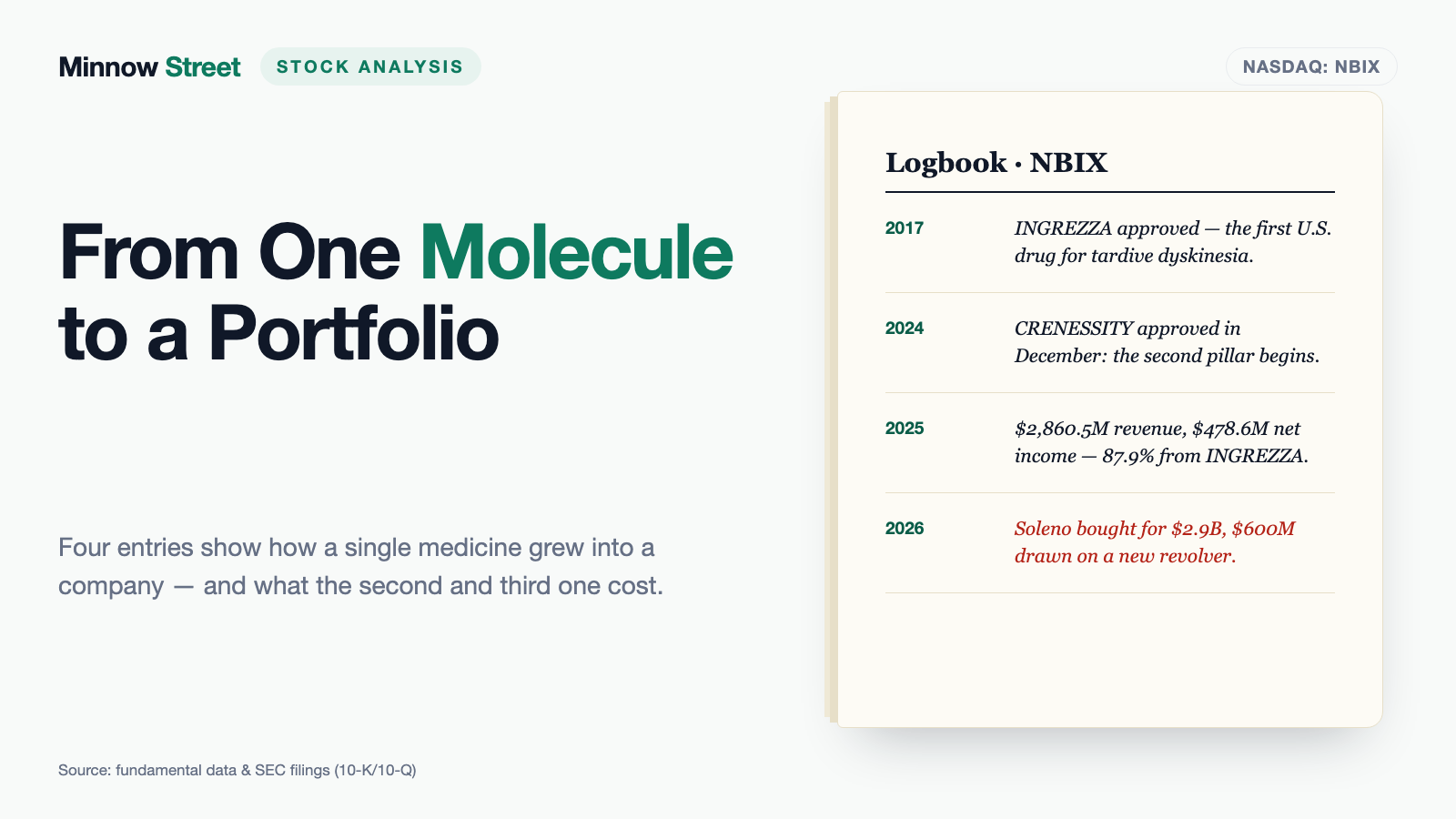
Neurocrine Biosciences makes real money: $2,860.5 million in revenue and $478.6 million in net income in 2025, followed by a first quarter of 2026 with $814.5 million in revenue. Almost all of it came from a single active ingredient — INGREZZA accounted for 87.9 percent of 2025 revenues. So in May 2026 the company spent practically its entire war chest: roughly $2.9 billion for Soleno Therapeutics, plus a first-ever $600.0 million draw on a secured credit facility backed by a pledge of substantially all of its assets. Not investment advice — just the question of what an insurance policy against your own dependence is allowed to cost.
 Thomas Mücke
Founder & Publisher
Thomas Mücke
Founder & Publisher
Chart
Interactive price chart (TradingView).
Note: pure fact-based analysis, not investment advice and not a solicitation to buy or sell. All figures without guarantee.
There is a mental trap that hits successful companies especially hard, and it has a friendly name: the straight-line habit. You see a row of numbers pointing upward for years — revenue, profit, margin — and your brain does what brains do best: it extends the line. Five years, ten years, nice and straight. At Neurocrine Biosciences, Inc. (Nasdaq: NBIX) that line looks genuinely good: $1,887.1 million of revenue in 2023, $2,355.3 million in 2024, $2,860.5 million in 2025 — and net income that nearly doubled over the same stretch, from $249.7 million to $478.6 million. The trouble is that in the pharmaceutical business every straight line has a built-in ending, and that ending is printed as a date in the annual report. So let us make a deal: before you extend the line, we read together what the company itself told the U.S. securities regulator, the SEC — the annual report (10-K) for 2025 filed February 11, 2026, the quarterly report (10-Q) as of March 31, 2026, filed May 5, 2026, and above all the current report (8-K) of May 18, 2026, in which the company explains what it spent its entire cash pile on. An SEC filing is honest under penalty of law. And this one describes a very profitable business that knows exactly how exposed it is.
What Neurocrine Actually Does — Three Medicines for Very Small Groups
Neurocrine is not a conglomerate shipping cough syrup to supermarkets. The company, based in San Diego, develops and sells medicines for conditions that are rare but severe, and for which there was often nothing at all or only makeshift treatment. The business model fits in one sentence: few patients, a high price per patient, and an in-house sales force that calls on the small number of physicians who treat them. As of December 31, 2025, roughly 2,000 full-time employees worked there, up from about 200 in 2017. The commercial field organization alone counts about 600 professionals, according to the 2025 annual report.
Three approved medicines are on the shelf:
- INGREZZA (valbenazine), approved in the U.S. since May 2017 — the first medicine for tardive dyskinesia. Behind that term sits a bitter side effect: people who take certain psychiatric drugs for years develop involuntary movements of the face, tongue, hands or trunk that do not go away. Neurocrine estimates that roughly 800,000 people in the U.S. are affected. Since August 2023 INGREZZA has also been approved for chorea associated with Huntington’s disease; of the roughly 40,000 Americans with the disease, about 90 percent develop that movement disorder.
- CRENESSITY (crinecerfont), approved since December 2024, for classic congenital adrenal hyperplasia. In this inherited disorder the adrenal gland cannot produce a vital hormone; until now patients had to take high doses of steroids for life, with all the consequences. CRENESSITY works at a different point in the chain and is intended to reduce the steroid dose. At least 20,000 people in the U.S. are affected.
- VYKAT XR (diazoxide choline), approved by the U.S. Food and Drug Administration on March 26, 2025, and part of the group since May 18, 2026 — for hyperphagia in Prader-Willi syndrome. Hyperphagia means a sensation of hunger that never stops and can become life-threatening. About 10,000 people in the U.S. live with the syndrome.
The pattern is no coincidence: all three are the first of their kind for their indication. That is a powerful selling point — and at the same time the reason for the central tension of this analysis, which runs through every chapter: Neurocrine earns a great deal of money, but almost all of it from a single molecule. The company knows this — and in May 2026 spent practically its entire cash position to change it. How expensive such an insurance policy may be is the real question about this stock.
How the Stock Landed on Our Desk
The prompt came from our in-house stock scanner. NBIX sits in the U.S. selection of the Fundamental Rank (A / A+) screen — a ranking that sorts companies by the substance of their numbers rather than by price action (as of July 26, 2026; 38 U.S. names met the criteria, the page shows the 25 highest-ranked, and the list is recalculated daily). To repeat it yourself: go to Stocks → Scanner, open the "Fundamental Rank (A / A+)" screen and filter for the U.S. market.
The confluence is what makes it interesting. On the same date NBIX appeared on 18 scanner screens in total — quality filters such as Buffett criteria, Quality stocks and Martin Zweig: growth with sanity, but also pure trend screens such as Stan Weinstein: Stage 2 and Above the 50- and 200-day averages. Quality and price behavior point the same way. That, too, applies to that date only; the screens are recomputed daily.
So you can place the underlying metrics, here are the important ones translated and judged (fundamental data as of July 24, 2026):
- Piotroski F-Score of 6 out of 9. This scale runs nine yes/no questions on balance sheet health. Six is decent but not outstanding — a genuinely healthy company scores 8 or 9.
- Altman Z-Score of 9.44. An early-warning measure for payment difficulties; anything above 3 counts as safe. A reading of 9.44 is the balance sheet of a company with no financial debt — measured as of March 31, 2026, that is, before the big acquisition. Remember that caveat; it returns shortly.
- Fundamental rating of 58 out of 100. Solidly mid-pack. The company earns well, but the metrics are not top-tier across the board.
- Earnings growth rating of 98 out of 100. Nearly the maximum — earnings per share have risen very quickly of late. That is exactly what feeds the straight-line habit.
- Beneish M-Score of −2.575. A statistical flag for earnings manipulation; anything below −1.78 is considered unremarkable. So there is no suspicion here.
A word of framing: the scanner says the numbers are sound. It does not say how long they will stay sound. That is what the next chapters are about. How stubbornly a single molecule can carry an entire company — and what happens as a patent date approaches — is something we took apart in our analysis of Exelixis.
The Numbers Over the Years — Given Their Due
First the part that genuinely impresses, and there is plenty of it. Total revenues rose 21.4 percent in 2025 to $2,860.5 million — after $2,355.3 million in 2024 and $1,887.1 million in 2023. That is more than half again as much revenue in two years. Net income climbed over the same period from $249.7 million through $341.3 million to $478.6 million, and diluted earnings per share from $2.47 through $3.29 to $4.67. Cash from operations — the money the running business actually deposits — rose from $389.9 million in 2023 through $595.4 million in 2024 to $782.7 million in 2025.
The first quarter of 2026 continued the run, and forcefully: $814.5 million of revenue against $572.6 million in the prior-year quarter, up 42.2 percent. Net income jumped from $7.9 million to $197.9 million. Honesty requires one note here: those $197.9 million include two one-off items absent from the prior-year quarter — a $28.6 million book gain on the January 21, 2026, sale of the British subsidiary Neurocrine Group Limited for $63.2 million in cash, and a $25.3 million mark-to-market gain on equity investments, against a $30.6 million loss on the same line a year earlier. Strip both out and the jump is still large — just not quite as large as the headline suggests.
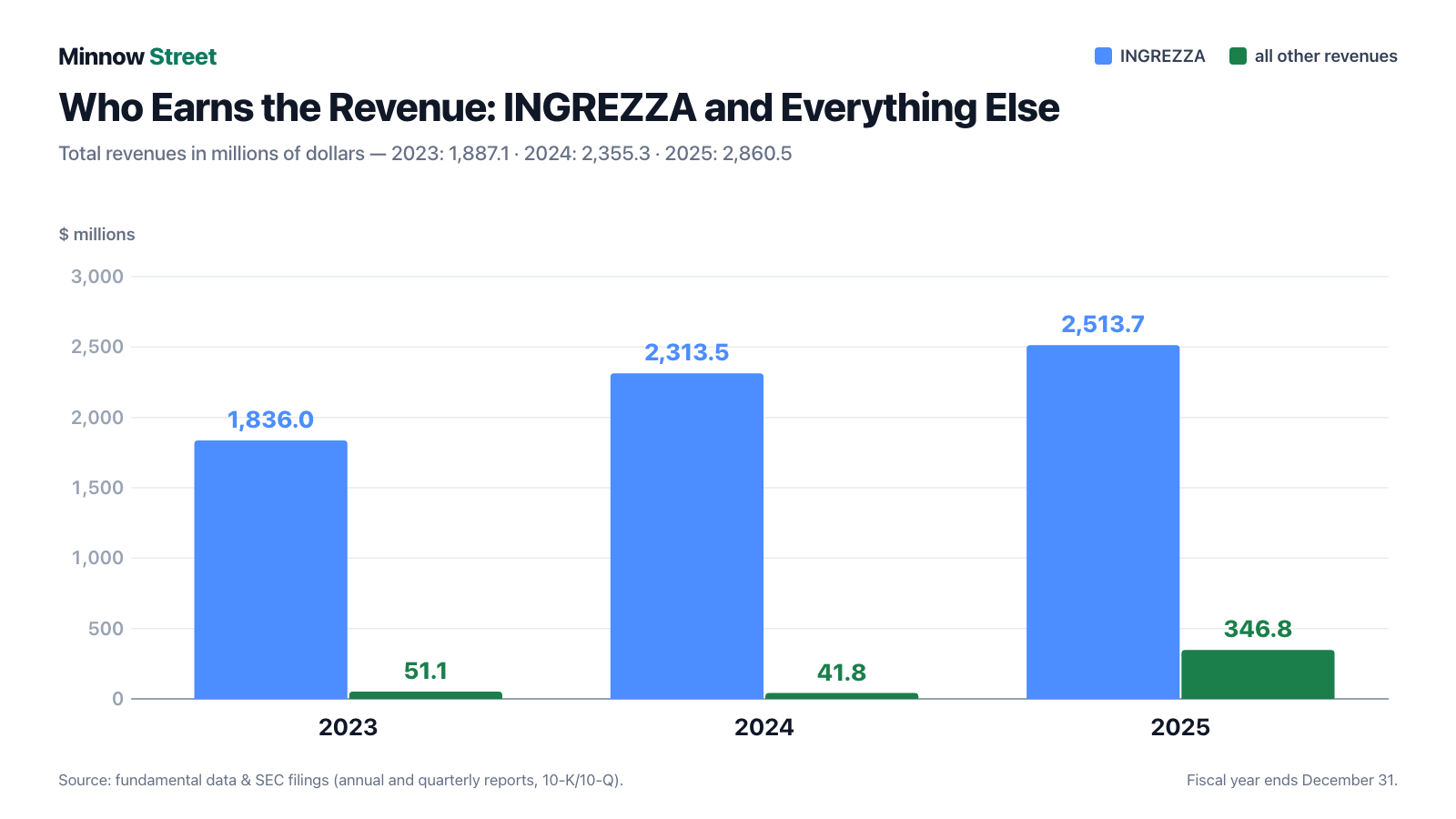
The green bar is the real message of that chart. Everything other than INGREZZA came to $51.1 million in 2023 and just $41.8 million in 2024 — a rounding item at a company with more than two billion dollars of revenue. In 2025 the total jumped to $346.8 million, because CRENESSITY was sold for a full year for the first time after its December 2024 approval.
How the money is earned matters too. Gross margin ran at roughly 64 percent and operating margin at just under 23 percent (data as of July 24, 2026) — and that while Neurocrine spent $1,015.7 million on research and development in 2025, up 38.9 percent from 2024. A company that puts more than a third of its revenue into the future and still books $478.6 million of profit is doing something right. Add $1,156.2 million for selling, general and administrative expense — a very large apparatus for a business that only needs to reach a few thousand prescribing physicians. It is the price of INGREZZA holding its share for eight years.
And as of March 31, 2026, the balance sheet was enviably clean: $4,906.2 million of total assets, of which $3,407.4 million was equity — an equity ratio of roughly 69 percent. Interest-bearing financial debt: none. What shows up in the metrics as a debt-to-equity ratio of 0.12 is essentially $406.2 million of long-term lease obligations for offices and laboratories. Hold that picture — the next chapter rebuilds it.
What the Filings Say — The Uncomfortable Truths
Uncomfortable Truth No. 1: 87.9 Percent Hangs on a Single Active Ingredient
INGREZZA delivered $2,513.7 million of the $2,860.5 million in total 2025 revenues. That is 87.9 percent. A year earlier it was 98.2 percent; two years earlier 97.3 percent. In the first quarter of 2026 the share fell further, to 80.7 percent ($656.9 million of $814.5 million) — because CRENESSITY grew from $14.5 million to $153.3 million.
So the direction is right. So is the order of magnitude: four out of every five dollars earned still hang on valbenazine. Put plainly: this is a family business whose best customer accounts for four-fifths of sales — except that here the customer is not a person but a molecule with an expiration date. Neurocrine puts it in the fine print itself:
“Net product sales of INGREZZA were $2.51 billion for 2025, $2.31 billion for 2024, and $1.84 billion for 2023 and accounted for a significant portion of our total net product sales during each of these years.”
— Neurocrine Biosciences, Inc., SEC annual report 10-K for 2025, revenue recognition note
Anyone who wants to know how it feels when a once-untouchable flagship product passes its peak will find the full story in our analysis of Biogen.
Uncomfortable Truth No. 2: Two Clocks Are Running, and the Faster One Is Not a Patent Clock
Ask ten investors when generics arrive for INGREZZA and nine will give the same answer: 2038. That date really is in the annual report — and it is still only half the story.
“INGREZZA, our highly selective VMAT2 inhibitor approved in the U.S. for the treatment of TD and of chorea associated with Huntington’s disease, is covered by 22 issued, FDA Orange Book-listed U.S. patents which are set to expire between 2027 and 2040. Patent term extension corresponding to regulatory approval delay of 552 days has been received for U.S. Patent No. 8,039,627, which now expires in 2031 and covers valbenazine, the active pharmaceutical ingredient contained in INGREZZA. In 2023, we entered into settlement agreements resolving all patent litigation brought by us against the companies that filed ANDAs seeking approval to market generic versions of INGREZZA, and all cases have been dismissed. Pursuant to the terms of the respective settlement agreements, such companies have the right to sell generic versions of INGREZZA in the U.S. beginning March 1, 2038, or earlier under certain circumstances.”
— Neurocrine Biosciences, Inc., SEC annual report 10-K for 2025, patents and proprietary rights

Three things matter here. First, 2038 is not a statute but a contract, signed in 2023 with the companies that had filed generic applications at the time. Second, the sentence ends with "or earlier under certain circumstances," and the filing does not say which circumstances those are. Third, the 2023 settlement covers only those applicants. In March 2025, Zydus filed a new abbreviated application for a generic version of INGREZZA SPRINKLE, asserting that certain patents are invalid or not infringed. Neurocrine sued in the U.S. District Court for the District of Delaware in April 2025; the case is pending.
The second clock has nothing to do with patents — and runs much faster.
“While the Medicare drug negotiation program targets high-expenditure drugs/biologics that have been on the market for several years without generic or biosimilar competition, we were notified in January 2025 that INGREZZA qualifies for the small biotech exception, which provides an exemption from selection for price negotiation until 2027 (for initial price applicability year 2029, pursuant to which negotiated pricing would go into effect, if selected).”
— Neurocrine Biosciences, Inc., SEC annual report 10-K for 2025, coverage and reimbursement
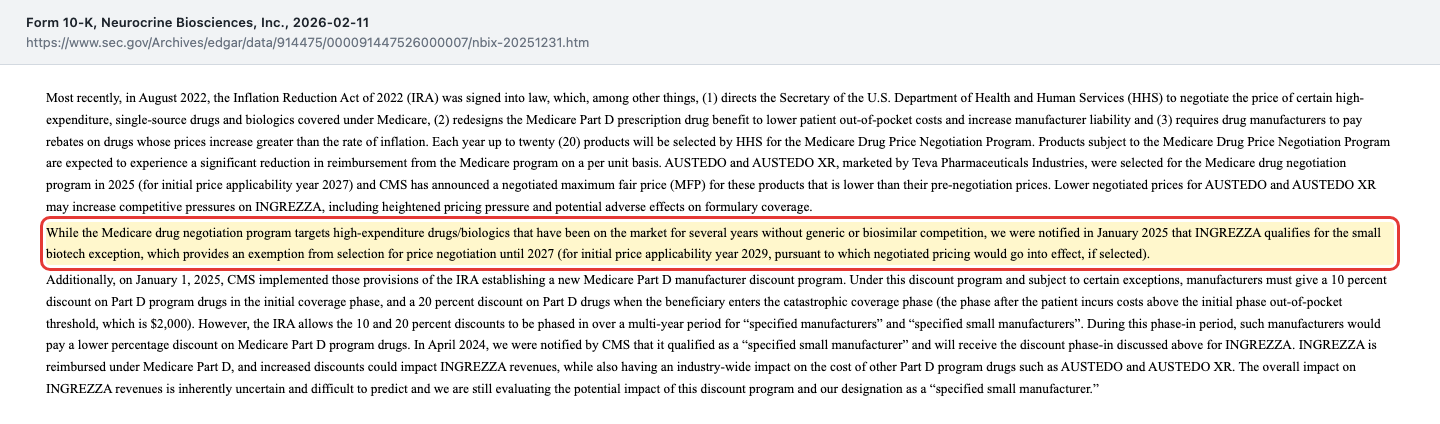
In plain language: since 2022 Medicare has been allowed to negotiate the prices of especially expensive medicines directly. Smaller biotech companies are exempt for a while — INGREZZA until 2027. What can follow is visible at the direct competitor: AUSTEDO and AUSTEDO XR from Teva were selected in 2025 (initial price applicability year 2027), and the agency has already announced a maximum fair price below the previous one. Neurocrine writes itself that lower competitor prices can raise the pressure on INGREZZA, both on price and on formulary coverage. For earnings modeling that means the relevant year is not 2038 but 2027.
Uncomfortable Truth No. 3: The War Chest Is Spent — and the Assets Are Pledged
Here the tidy balance sheet from the previous chapter gets rebuilt, and it takes only a few weeks. On April 5, 2026, Neurocrine agreed to acquire Soleno Therapeutics, Inc.; on April 20 the all-cash tender offer at $53.00 per share began; on May 15 it expired. Holders tendered 46,356,114 shares, roughly 88.9 percent — enough. On May 18, 2026, the acquisition closed. What Neurocrine gets: VYKAT XR, the first and so far only approved medicine for hyperphagia in Prader-Willi syndrome. What it costs is in the same filing:
“The aggregate cash paid by the Company and Purchaser in the Offer and the Merger was approximately $2.9 billion, plus related fees and expenses, which was funded by the Company from its available cash on hand.”
— Neurocrine Biosciences, Inc., SEC current report 8-K dated May 18, 2026, Item 2.01
Set that against the last documented cash position. As of March 31, 2026, Neurocrine held $2,647.2 million of cash, cash equivalents and marketable securities (December 31, 2025: $2,543.4 million). The purchase price was higher. So on May 14, 2026, the company signed a credit agreement with JPMorgan Chase for a $1.0 billion secured revolving credit facility with a five-year term — and drew $600.0 million on it the same day.
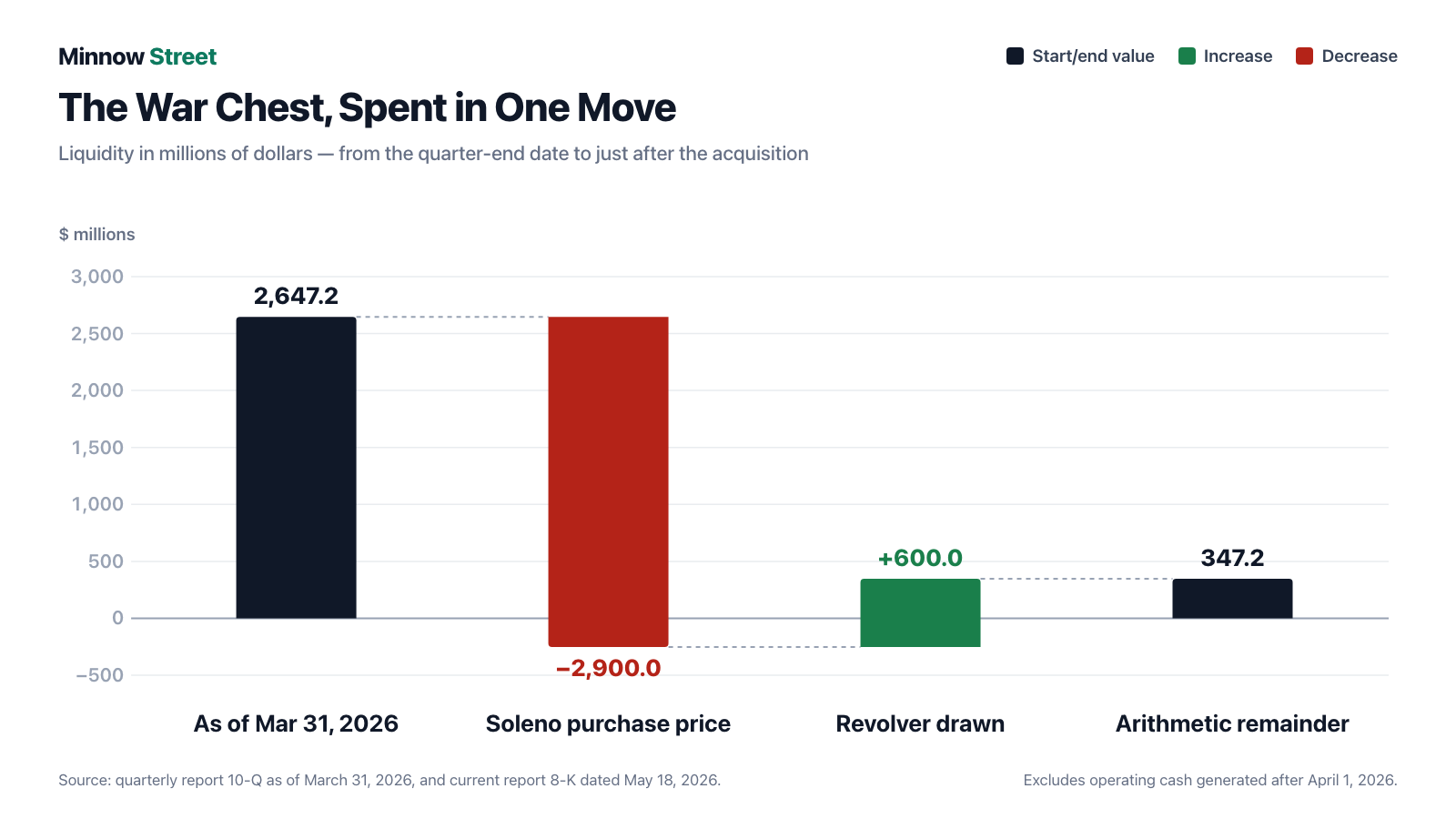
A caveat on that math: it is an interim figure, not a balance sheet number. Neurocrine took in $145.8 million from operations in the first quarter of 2026 alone; the business keeps running and refills the account week by week. How much was actually in the till on June 30, 2026, the next quarterly report will show. The point is not the remainder but the movement: a company that spent nine years piling up cash spent it in a single month.
And the truly notable sentence sits in the fine print of the credit agreement:
“On the Closing Date, the Company entered into a pledge and security agreement, pursuant to which the Company granted to the Agent, for the benefit of the lenders under the Credit Agreement, a security interest in substantially all of its assets, subject to customary exceptions and exclusions.”
— Neurocrine Biosciences, Inc., SEC current report 8-K dated May 18, 2026, Item 2.03
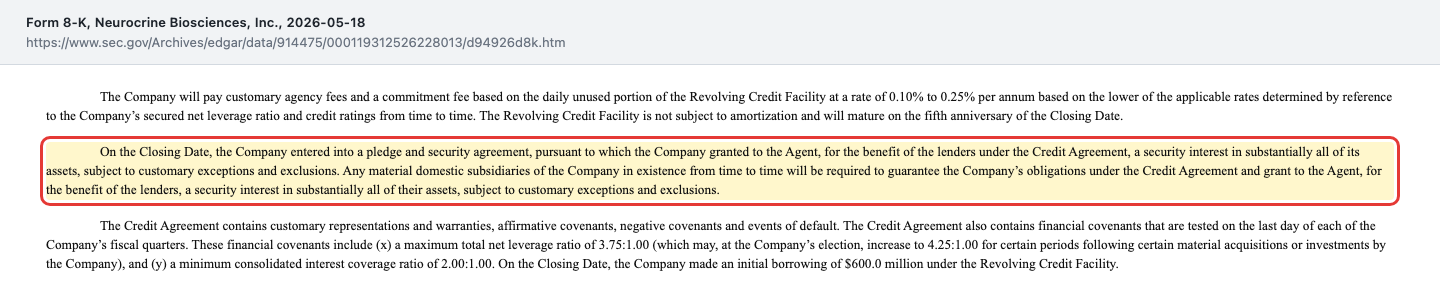
Put in everyday terms: until May 2026 the family owned the house free and clear. Since then there is a lien on it — not because the money was missing, but because the bank wanted it that way. The rate is floating (Term SOFR plus 1.125 to 1.75 percentage points), the facility runs five years, and Neurocrine pays a commitment fee of 0.10 to 0.25 percent on the undrawn portion. This is not distress — but it is a different state than it was in March. And it means that from now on there are ratios that must be met, not merely hoped for.
Uncomfortable Truth No. 4: Three Doors Deliver 87 Percent of Sales
If your neighbor told you business was booming but three customers accounted for 87 percent of revenue, you would swallow hard. That is exactly what the quarterly report as of March 31, 2026, discloses. Three individual customers accounted for 36, 27 and 24 percent of total gross product sales in the first quarter of 2026; in the prior-year quarter the figures were 41, 30 and 14 percent. Receivables look similar: 40, 30, 18 and 10 percent across four customers as of March 31, 2026.
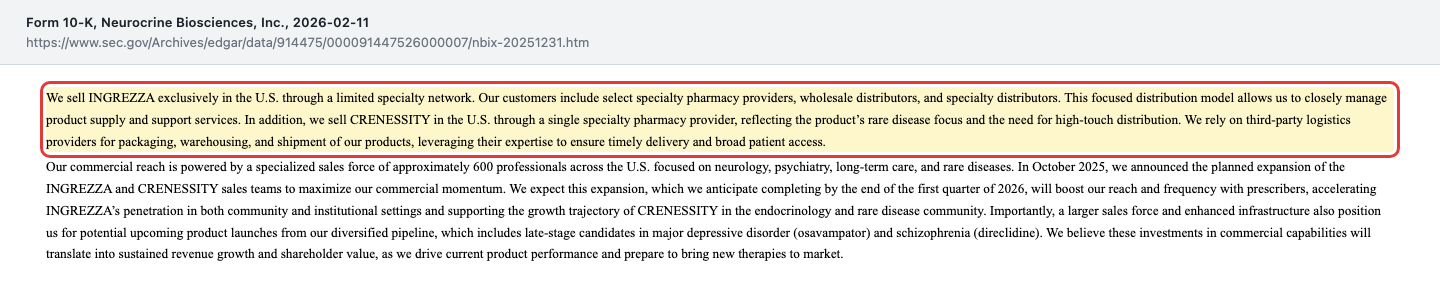
“We sell INGREZZA exclusively in the U.S. through a limited specialty network. Our customers include select specialty pharmacy providers, wholesale distributors, and specialty distributors. This focused distribution model allows us to closely manage product supply and support services. In addition, we sell CRENESSITY in the U.S. through a single specialty pharmacy provider, reflecting the product’s rare disease focus and the need for high-touch distribution.”
— Neurocrine Biosciences, Inc., SEC annual report 10-K for 2025, commercial reach and distribution
To be fair: concentration like this is normal in the U.S. pharmaceutical trade, where a handful of large intermediaries share the market, and a specialty network makes sense for expensive niche medicines. The risk view still stands: if one of these partners drops out or changes terms, it runs straight through the entire revenue line.
One more item belongs in this chapter even though it cannot be quantified. In August 2025 Neurocrine received a civil investigative demand from the U.S. Department of Justice concerning the sales and marketing of INGREZZA. The company is cooperating; nothing can be said about timing or outcome. That is neither an accusation nor a verdict — but it is an open proceeding around precisely the product that carries four-fifths of revenue.
Valuation — What the Market Pays for the Second Clock
Market capitalization stood at roughly $17.7 billion on July 24, 2026 — that is the Nasdaq closing price of $175.77 times 100,549,983 shares (as of April 28, 2026, per the quarterly report cover page). That works out to a price-to-earnings ratio of about 27, measured against diluted trailing-twelve-month earnings of $6.50 per share ($4.67 for 2025, less $0.08 from the first quarter of 2025, plus $1.91 from the first quarter of 2026), and a price-to-sales ratio of roughly 5.7, measured against trailing-twelve-month revenue of $3,102.4 million. For a profitable drugmaker growing at a double-digit rate, that is neither cheap nor expensive — it is the valuation of a company credited with further growth but no miracles.
Because daily prices say nothing about what a company is worth, here are three dated anchors, all documented in mandatory filings. First: Neurocrine itself repurchased 77,120 of its own shares at an average of $129.66 in February 2026 and another 353,414 shares at an average of $130.06 in March 2026 — 430,534 shares in total for $56.0 million. Second: on July 9, 2026, the chief legal officer sold 10,000 shares at $179.6014, and on July 10, 2026, the chief regulatory officer sold 4,367 shares at $181.02 — both under pre-arranged trading plans, which defuses the usual suspicion. Third: $276.3 million of the $500.0 million 2025 repurchase authorization was still open as of March 31, 2026. Between the price the company paid in the spring and the price at which executives sold in the summer lies roughly 40 percent. That is not a signal, but it is a sober reminder of how quickly expectations for this stock shifted during 2026.
The professional view is friendly: 25 analysts covered the stock with a consensus of 1.12 on a scale where 1 is the strongest buy signal, at a mean price target of $195.99 (data as of July 24, 2026). Against that stands a short interest of 7.4 percent of the float — there are investors betting on falling prices. Both figures are snapshots that change daily; neither replaces your own judgment.
One methodological note matters more here than usual: the standard metrics do not yet reflect the acquisition. The debt-to-equity ratio of 0.12, the Altman Z-Score of 9.44 and the equity ratio of 69 percent all come from the balance sheet as of March 31, 2026 — that is, from before May 18. Only the quarterly report as of June 30, 2026, will show what the balance sheet looks like after purchase accounting, goodwill and the drawn revolver. Anyone valuing this stock today on balance sheet metrics is valuing a company that no longer exists in that form.
Opportunities and Risks at a Glance
What speaks for Neurocrine:
- The business genuinely earns money: $2,860.5 million of revenue and $478.6 million of net income in 2025, plus $782.7 million of operating cash flow — and a first quarter of 2026 with $814.5 million of revenue (up 42.2 percent) and $197.9 million of net income.
- The dependence is measurably shrinking: INGREZZA fell from 98.2 percent of total revenues in 2024 to 87.9 percent in 2025 and 80.7 percent in the first quarter of 2026, because CRENESSITY grew from $1.7 million to $301.2 million and then to $153.3 million in a single quarter.
- VYKAT XR adds a third approved medicine as of May 18, 2026 — the first and only treatment for hyperphagia in Prader-Willi syndrome, which affects about 10,000 people in the U.S.
- All three products are first-in-class in their indication, and all three run through the same field organization of roughly 600 professionals reaching the same physicians.
- Research is funded seriously: $1,015.7 million in 2025, up 38.9 percent, with late-stage candidates in major depressive disorder (osavampator) and schizophrenia (direclidine).
- The balance sheet carried no financial debt before the acquisition, and even with $600.0 million drawn there was $3,407.4 million of equity as of March 31, 2026.
What speaks against it:
- Four out of five dollars still hang on one ingredient: $656.9 million of $814.5 million in the first quarter of 2026 came from INGREZZA.
- Price protection against Medicare negotiation is granted only until 2027 (initial price applicability year 2029) — competitor AUSTEDO was already selected in 2025 and received a lower maximum fair price.
- Patent protection starts eroding in 2027 (22 patents expiring 2027 through 2040); the agreed generic start of March 1, 2038, applies "or earlier under certain circumstances," and the Zydus dispute over INGREZZA SPRINKLE has been pending since April 2025.
- The liquidity is gone: $2,647.2 million as of March 31, 2026, against a purchase price of roughly $2,900 million in May; for the first time there is a secured facility with a pledge over substantially all assets and covenants (total net leverage no higher than 3.75x, interest coverage no lower than 2.00x).
- Three customers accounted for 36, 27 and 24 percent of gross product sales in the first quarter of 2026; CRENESSITY runs through a single specialty pharmacy provider.
- A civil investigative demand from the U.S. Department of Justice regarding INGREZZA sales and marketing has been open since August 2025, with no visible end.
- Collaboration and license agreements could trigger milestone payments of up to $15.39 billion (as of March 31, 2026) — almost as much as the entire company is worth on the market (roughly $17.7 billion on July 24, 2026).
A Human Conclusion
Back to the straight-line habit from the opening. Its problem is not that it leads you to bad companies — Neurocrine is a good company. It turned one molecule into a billion-dollar business, earns comfortably, funds research seriously and kept its balance sheet clean for years. The problem with the habit is that it blanks out the time axis. A revenue line pointing upward says nothing about how long it will keep doing so. At a drugmaker, the answer is not in the chart but in two paragraphs of the annual report: one on patents, one on reimbursement prices.
And here is the remarkable part: management appears to read those paragraphs the same way. Anyone who spends their entire cash position in May 2026, borrows $600 million and pledges the company assets to do it does not regard their own dependence as a theoretical risk. You can find that reassuring — they are acting instead of waiting. You can also find it unsettling — they are acting because waiting did not look good enough. Both readings are legitimate, and both follow from the same documents.
So the honest question is not "is a price-to-earnings ratio of 27 too much?" but: do you believe CRENESSITY and VYKAT XR together grow large enough before INGREZZA prices get negotiated and the first patents fall? If yes, you have a thesis — and the filings give you clear measurement points: INGREZZA’s share of total revenues, the revenue curve for CRENESSITY and VYKAT XR, and whether and when INGREZZA appears on a negotiation list. If no, what you had was a pretty straight line. What you make of that is your decision. And that is exactly as it should be.
Sources
Every original document used in this analysis — for you to read yourself:
- Neurocrine Biosciences, Inc. — SEC quarterly report 10-Q as of March 31, 2026 (filed May 5, 2026)
- Neurocrine Biosciences, Inc. — SEC annual report 10-K for 2025 (filed February 11, 2026)
- Neurocrine Biosciences, Inc. — SEC current report 8-K dated May 18, 2026 (completion of the Soleno Therapeutics acquisition, $1.0 billion credit agreement, initial borrowing of $600.0 million)
- Neurocrine Biosciences, Inc. — SEC current report 8-K dated April 6, 2026 (merger agreement with Soleno Therapeutics dated April 5, 2026, at $53.00 per share)
- Neurocrine Biosciences, Inc. — SEC current report 8-K dated May 28, 2026 (annual meeting of May 27, 2026: election of Class III directors, ratification of Ernst & Young LLP as auditor)
- Tender offer statement SC TO-T filed April 20, 2026, and its amendments, plus insider filings (Form 4) dated July 9 and July 13, 2026, all available through the EDGAR filing index for CIK 0000914475 (sec.gov)
- Fundamental data (metrics, valuation; data as of July 24, 2026), reconciled with the SEC filings.
- Scanner screens: our in-house stock scanner, as of July 26, 2026; the screens are recalculated daily.
Transparency & disclaimer: this analysis is journalistic commentary on publicly available information. It is not investment advice, not a regulated financial analysis and not a solicitation to buy or sell securities. Equity investments carry substantial risk up to and including total loss. All information is provided without warranty; the as-of date for each figure is noted in the text. The author holds no position in Neurocrine shares at the time of publication.
Our Bottom Line at a Glance
- Earnings power positive
- Neurocrine earns real money: $478.6 million of net income in 2025 on $2,860.5 million of revenue (2024: $341.3 million on $2,355.3 million), plus $782.7 million of operating cash flow. The first quarter of 2026 brought $814.5 million of revenue and $197.9 million of net income, against $572.6 million and $7.9 million a year earlier. Even after $1,015.7 million of research spending, 2025 operating income came to $619.1 million.
- Product dependence negative
- INGREZZA delivered $2,513.7 million in 2025, roughly 87.9 percent of total revenues, and still 80.7 percent in the first quarter of 2026 ($656.9 million of $814.5 million). The ratio is falling because CRENESSITY grew from $1.7 million in 2024 to $301.2 million in 2025 — but it remains the central weak point of the business model.
- Exclusivity and price regulation negative
- The 2025 annual report lists 22 Orange Book patents expiring between 2027 and 2040 and an agreed generic start of March 1, 2038 — "or earlier under certain circumstances." The second deadline matters more: the exemption from Medicare price negotiation runs only until 2027 (initial price applicability year 2029). Competitor AUSTEDO was selected in 2025 and received a lower maximum fair price. On top of that, the Zydus dispute over INGREZZA SPRINKLE has been running since April 2025.
- Balance sheet and financing neutral
- As of March 31, 2026, the balance sheet showed $3,407.4 million of equity and $2,647.2 million of liquidity with no financial debt whatsoever. On May 18, 2026, the company paid roughly $2.9 billion in cash for Soleno Therapeutics and on May 14 drew a first $600.0 million on a $1.0 billion secured facility backed by a pledge of substantially all its assets. The covenants (total net leverage no higher than 3.75x, interest coverage no lower than 2.00x) sit far away for a company with this earnings power — but they exist now.
- Diversification positive
- One product has become three: CRENESSITY already reached $153.3 million in the first quarter of 2026, up from $14.5 million a year earlier, and VYKAT XR joined on May 18, 2026, as the first and only approved medicine for hyperphagia in Prader-Willi syndrome. All three run through the same field organization of roughly 600 professionals (as of December 31, 2025), with late-stage candidates in major depressive disorder and schizophrenia behind them.
- Valuation neutral
- At a market capitalization of roughly $17.7 billion (Nasdaq closing price of $175.77 on July 24, 2026, times 100,549,983 shares), the stock trades at about 27 times earnings and 5.7 times sales. For a growing, profitable drugmaker that is unremarkable. The caveat matters: debt-to-equity, the Altman Z-Score and the equity ratio all come from the balance sheet as of March 31, 2026, and do not yet reflect the acquisition.
Neurocrine is not a turnaround bet but a profitable specialist with a very concrete expiration date in the fine print. Revenue of $2,860.5 million and net income of $478.6 million in 2025, plus a strong first quarter of 2026 — but 87.9 percent of revenue from a single ingredient whose price protection is granted only until 2027. To address exactly that dependence, the company spent roughly $2.9 billion in May 2026, deployed its entire liquidity and drew on a secured credit facility for the first time. Whether that was early enough comes down to one number: the revenue of CRENESSITY and VYKAT XR over the coming quarters. Not investment advice.
What Our Rating Means
Open questions
The business works in principle, but one material question is open. As long as it stays open, our findings do not carry a quality verdict.
The quality of this company is well documented across most dimensions: the business is profitable, operating cash flow reached $782.7 million in 2025, the balance sheet carried no financial debt as of March 31, 2026, and the Altman Z-Score stood at 9.44. There is no sign of earnings management, no going-concern qualification and no governance breach. What remains open is the core operating question, and it carries weight: 87.9 percent of 2025 revenues came from a single active ingredient whose price protection, per the annual report, runs only to 2027 and whose patent shield begins eroding in 2027. Whether CRENESSITY and VYKAT XR close that gap in time is not settled today — it is an open bet, not a documented fact. Hence yellow: strong numbers, unresolved dependence. The decision is yours.
A journalistic assessment by our editorial team at the time of the deep dive, based on public sources — not investment advice and not a solicitation to buy or sell. Your personal circumstances (investment goals, risk capacity, taxes) cannot be taken into account. What our levels mean, how verdicts are formed, and what conflicts of interest exist →
Worth Noting
- Neurocrine reached our research list through our in-house stock scanner: the stock sits in the U.S. selection of the "Fundamental Rank (A / A+)" screen and, on the same date, appeared on 18 scanner screens in total — including quality filters such as "Buffett criteria" and "Quality stocks" as well as trend screens such as "Stan Weinstein: Stage 2" (as of July 26, 2026; 38 U.S. names met the Fundamental Rank criteria, and the page shows the 25 highest-ranked). These screens are recalculated daily.
- Possible confusion: "Neurocrine Group Limited" (formerly Diurnal Group plc), sold to Immedica Pharma AB in January 2026 for $63.2 million, was a former British subsidiary, not the listed Neurocrine Biosciences, Inc. The listed company has traded under the same name and the same SEC file number, CIK 0000914475, since its registration; there are no predecessor or successor entities.
- Data basis and cross-check: all balance sheet and earnings figures come from the annual report 10-K for 2025 and the quarterly report 10-Q as of March 31, 2026; all acquisition details come from the current reports 8-K dated April 6 and May 18, 2026. The market capitalization of roughly $17.7 billion is the Nasdaq closing price of July 24, 2026 ($175.77) times the 100,549,983 shares named in the quarterly report. Cross-check against the most recent price documented in a mandatory filing, $181.02 (Form 4 filed July 13, 2026, for the July 10, 2026, trade date): $18.2 billion, a deviation of roughly three percent. Analyses are evergreen; daily prices are not a reason to buy.
Frequently Asked Questions
Neurocrine Biosciences (Nasdaq: NBIX), based in San Diego, develops and sells medicines for rare but severe conditions. Three approved products are on the shelf: INGREZZA for tardive dyskinesia and Huntington-related chorea, CRENESSITY for classic congenital adrenal hyperplasia, and, since May 18, 2026, VYKAT XR for hyperphagia in Prader-Willi syndrome. The company generated $2,860.5 million of revenue in 2025.
Very dependent, though less so than before. INGREZZA delivered $2,513.7 million in 2025, or about 87.9 percent of total revenues of $2,860.5 million. In 2024 the share was 98.2 percent and in 2023 it was 97.3 percent. In the first quarter of 2026 it stood at 80.7 percent ($656.9 million of $814.5 million). The decline comes almost entirely from the growth of the second product, CRENESSITY.
The 2025 annual report lists 22 Orange Book-listed U.S. patents expiring between 2027 and 2040; the compound patent for valbenazine runs to 2031. What matters most is a 2023 settlement: the applicants at that time may sell generic versions from March 1, 2038 — per the filing, "or earlier under certain circumstances." A separate patent suit against Zydus over INGREZZA SPRINKLE has been pending since April 2025.
Since the Inflation Reduction Act of 2022, Medicare negotiates the prices of especially high-revenue medicines directly. Smaller biotech companies are temporarily exempt. Neurocrine was notified in January 2025 that INGREZZA qualifies for that exception — but only until 2027, for initial price applicability year 2029. After that the drug can be selected. Competitor AUSTEDO was already selected in 2025.
Neurocrine acquired Soleno Therapeutics through an all-cash tender offer at $53.00 per share; the deal closed on May 18, 2026. According to the 8-K filing, the aggregate cash paid was roughly $2.9 billion plus fees. In return the company gained VYKAT XR, the first and so far only approved medicine for hyperphagia in Prader-Willi syndrome, which affects about 10,000 people in the United States.
As of March 31, 2026, the company had no interest-bearing financial debt; reported liabilities consisted mainly of payables and $406.2 million of lease obligations. That changed on May 14, 2026: Neurocrine signed a $1.0 billion secured revolving credit facility with a five-year term and immediately drew $600.0 million on it. Substantially all of the company assets are pledged as collateral.
No. The company pays nothing out and has no dividend history. Cash returns to shareholders run exclusively through buybacks: an accelerated $300.0 million program in 2024 (2.3 million shares at an average of $131.83) and, since February 2025, a $500.0 million program of which $276.3 million was still available as of March 31, 2026.
CRENESSITY (crinecerfont) has been approved in the U.S. since December 2024 and is the first of its kind for classic congenital adrenal hyperplasia, which affects at least 20,000 Americans. Revenue rose from $1.7 million in 2024 to $301.2 million in 2025 and reached $153.3 million in the first quarter of 2026, against $14.5 million a year earlier. Sanofi is the licensor and receives royalties of 3.0 to 5.0 percent.
Found an error?
Did you spot a factual error, an outdated number, or a typo in this deep dive? Let us know briefly — your report goes straight to the editorial team.