Ziff Davis: The Profit That Is No Longer There
Ziff Davis owns CNET, PCMag, Mashable, IGN, Humble Bundle, BabyCenter and RetailMeNot — assembled through nearly 100 acquisitions since 2012. For 2025 the company reported revenue of $1,451.3 million and net income of $47.4 million. On June 17, 2026 it sold its smallest division to Accenture for $1.2 billion in cash. The pro forma statements it had to file with the U.S. securities regulator, the SEC, four days later show in black and white what remains without that division: a loss of $9.8 million. We read the 2025 annual report, the quarterly report for the period ended March 31, 2026 and the current reports covering the sale. There is no recommendation at the end, only a receipt you have to read yourself.
 Thomas Mücke
Founder & Publisher
Thomas Mücke
Founder & Publisher
Chart
Interactive price chart (TradingView).
Note: pure fact-based analysis, not investment advice and not a solicitation to buy or sell. All figures without guarantee.
The receipt trap
Picture a friend proudly showing you his annual statement. At the very bottom there is a number in black. He worked, it paid off, all good. What he does not mention: half of it came from a side job he quit last week.
The number is correct. It is audited, signed off, accurate. And it still describes a world that no longer exists.
That is exactly what happened at Ziff Davis — and it is provable, in a document the company itself had to file with the U.S. securities regulator, the SEC. Call it the receipt trap: we read the total at the bottom and forget to check which items are still on the menu.
The deal for this article: we retype the bill together. Line by line, using the original figures from the 2025 annual report (Form 10-K), the quarterly report for the period ended March 31, 2026 (Form 10-Q) and the current reports (Form 8-K) around the sale. By the end you will know what the continuing business actually earns — and how much cash Ziff Davis has in the bank.
What Ziff Davis actually does
Ziff Davis is not a publisher in the old sense. It is a bundle of internet brands under one roof. The group buys websites, apps and software services, plugs them into a shared advertising and subscription machine, and earns money three ways: from advertising and performance marketing, from subscriptions and licensing, and from a remainder made up of hardware, courses and game distribution.
Five segments are reported separately. Technology & Shopping holds CNET, PCMag, Mashable, Lifehacker, ZDNET and Spiceworks, plus the deal sites RetailMeNot, VoucherCodes and Offers.com. Gaming & Entertainment holds IGN, Eurogamer, Rock Paper Shotgun and the game store Humble Bundle. Health & Wellness gathers Everyday Health, MedPage Today, BabyCenter, What to Expect and the weight-loss app Lose It!. Cybersecurity & Martech runs VIPRE and Inspired eLearning. And then there was Connectivity — the Ookla brand behind Speedtest, which millions of people use to measure their internet speed.
That last one is no longer part of the group. It has been sold. More on that shortly.
A note on corporate history: until October 4, 2021 the company was called J2 Global, before that J2 Global Communications and originally JFAX.COM. Anyone looking for price history or older figures before 2021 will find them under those names. The company is incorporated in Delaware, the office is in New York, and roughly 3,900 people worked for the group as of December 31, 2025, 55 percent of them in the United States.
One sentence from the annual report describes the business model better than any analysis:
“The Company has made nearly 100 acquisitions between 2012 and 2025, including seven during 2025 (exclusive of any acquisitions that were part of businesses we have since divested).”
— Ziff Davis, Inc., Form 10-K for 2025, Item 1, Human Capital Resources

Nearly 100 acquisitions means almost everything you see inside this group was paid for once. That shapes every line of the balance sheet — and we get to the goodwill chapter below.
How the stock landed on our desk
The stock surfaced through our in-house stock scanner "Turnaround candidates". It tests four pillars to see whether a fallen stock is finding its feet: has the price really crashed, is survival secured, is the operating business turning, and is the market confirming it?
To repeat the search: go to Stocks → Scanner, open "Turnaround candidates" and pick "USA" as the market in the top right. The list is sorted by the turnaround check out of 8 possible points.
An honest caveat belongs right here. On July 27, 2026 the scanner counted 60 U.S. hits — identical on both of our brands. Ziff Davis scores 6 out of 8 on the turnaround check. The problem: 44 of those 60 names also score exactly 6. Together they occupy places 17 through 60, and inside that group no second criterion decides the order — only the arbitrary sequence of the database. On the same day ZD appeared in place 46 on one instance and place 45 on the other. Quoting an exact rank would be invented precision, so we do not.
More honestly still: the scanner page shows only the 25 strongest hits. Ziff Davis sits below that line and does not appear on the list at all. The stock passes the filter, but it is not a leader. Anyone looking for it will find it on the symbol page, not in the ranking. All lists are recomputed daily, so the figures in this section carry July 27, 2026 as their date and may look different tomorrow.
Two other rankings of ours listed ZD that same day: the KCF ranking and the K-FCF ranking. Both measure how much cash a company generates relative to its market value — and on that count Ziff Davis looks good. That is one half of the story.
The mandatory pillars of the turnaround filter, translated:
- Crash (mandatory): at least 50 percent below the all-time high. The highest closing price since the listing began is $132.98, set on November 9, 2021. On July 24, 2026 the stock closed at $51.60 — 61.2 percent below that. Comfortably met.
- Survival (mandatory): the Altman-Z score estimates bankruptcy risk from four balance sheet ratios; anything below 1.1 counts as the danger zone in our scanner. Our own calculation from the 2025 annual report gives 1.78 on the original formula and 3.02 on the variant normally used for non-manufacturers. Both clear the threshold. The equity ratio stood at 50.7 percent as of March 31, 2026 — a good half of every dollar of assets belongs to shareholders.
- Tradability: price above $3, daily dollar volume above $2 million. Both met.
A score of 6 out of 8 means six of the eight turnaround signals speak for the stock and two do not. That is respectable, but it is not an exclamation mark — one name on the same list scored 8 out of 8.
One metric in our own data set deserves a warning. The stored Altman-Z value is 6.89. We could not reproduce that number from the audited annual report, neither with the original formula nor with the service-company variant. Throughout this article we therefore use our own figures. For the scanner nothing changes, because 1.78 still clears the threshold. For you something does change: a pretty metric is no substitute for reading the balance sheet.
The numbers over the years — what genuinely impresses
Start with what is honestly good. Ziff Davis earns money — real, tangible money.
Net cash provided by operating activities rose from $320.0 million in 2023 to $390.3 million in 2024 and $407.1 million in 2025. After $119.2 million of purchases of property and equipment, free cash flow in 2025 came to roughly $287.9 million, following $283.7 million and $211.2 million in the two prior years. A company that generates more cash every year for three years running is not doing everything wrong.
The gross margin is impressive too: in 2025 revenue of $1,451.3 million carried only $206.6 million of direct costs. That is close to 86 percent gross margin — typical of a business where the expensive part is written once and then served millions of times.
Management is not spending that money aimlessly either; it buys back stock. On January 1, 2023 there were 47,269,446 shares outstanding. By May 4, 2026 there were 36,835,400. That is a decline of 22.1 percent in a little over three years. In plain terms: an investor who bought in 2023 and did nothing since owns a bigger slice of the same cake today.
The revenue series reads well too: $1,364.0 million in 2023, $1,401.7 million in 2024, $1,451.3 million in 2025. Three years, three increases.
That is one side of the sheet. Now we turn it over.
Uncomfortable truth No. 1: the profit came from the division that is gone
On March 2, 2026 Ziff Davis signed a purchase agreement with Accenture: the Connectivity division — the Ookla brand with Speedtest — would change hands for $1.2 billion in cash. The sale closed on June 17, 2026. After a purchase price adjustment and transaction costs, $1,194.4 million came in, of which $37.0 million sits in escrow for eighteen months.
Four days later Ziff Davis had to file what U.S. rules require after a sale of that size: a comparative statement showing what the past years would have looked like without the division. It sits in the Form 8-K/A of June 22, 2026, and it is the real charge in this analysis.
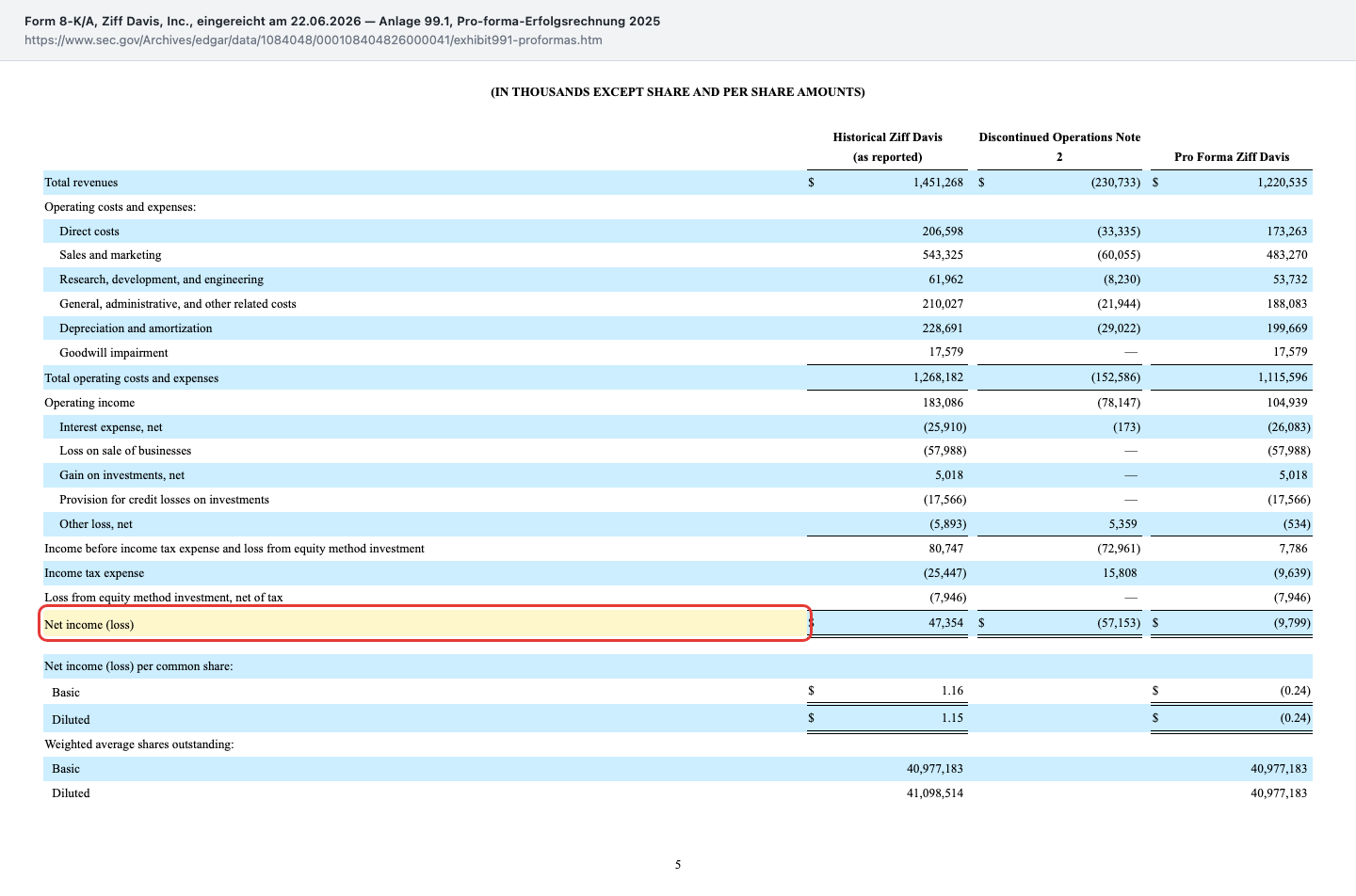
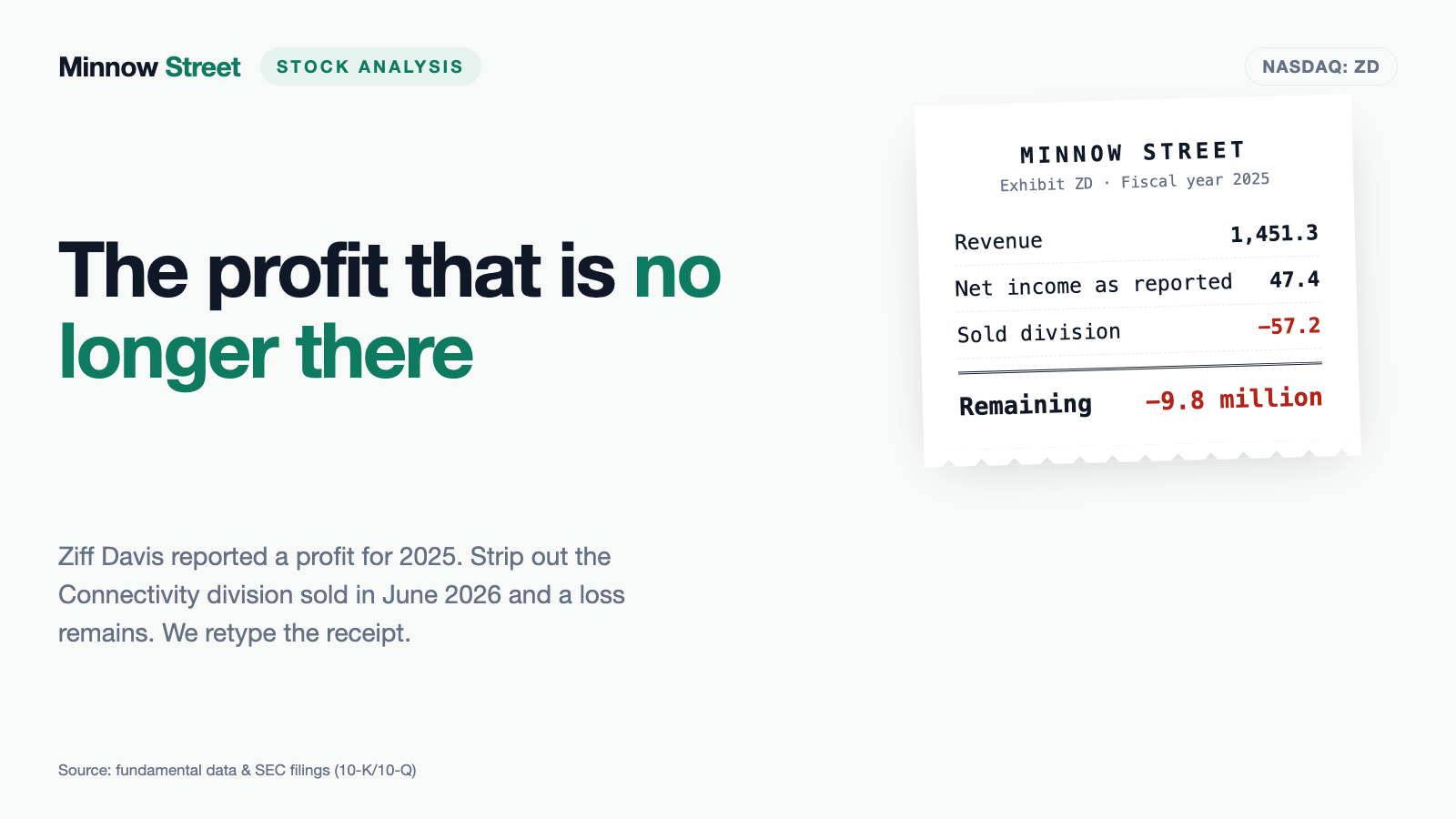
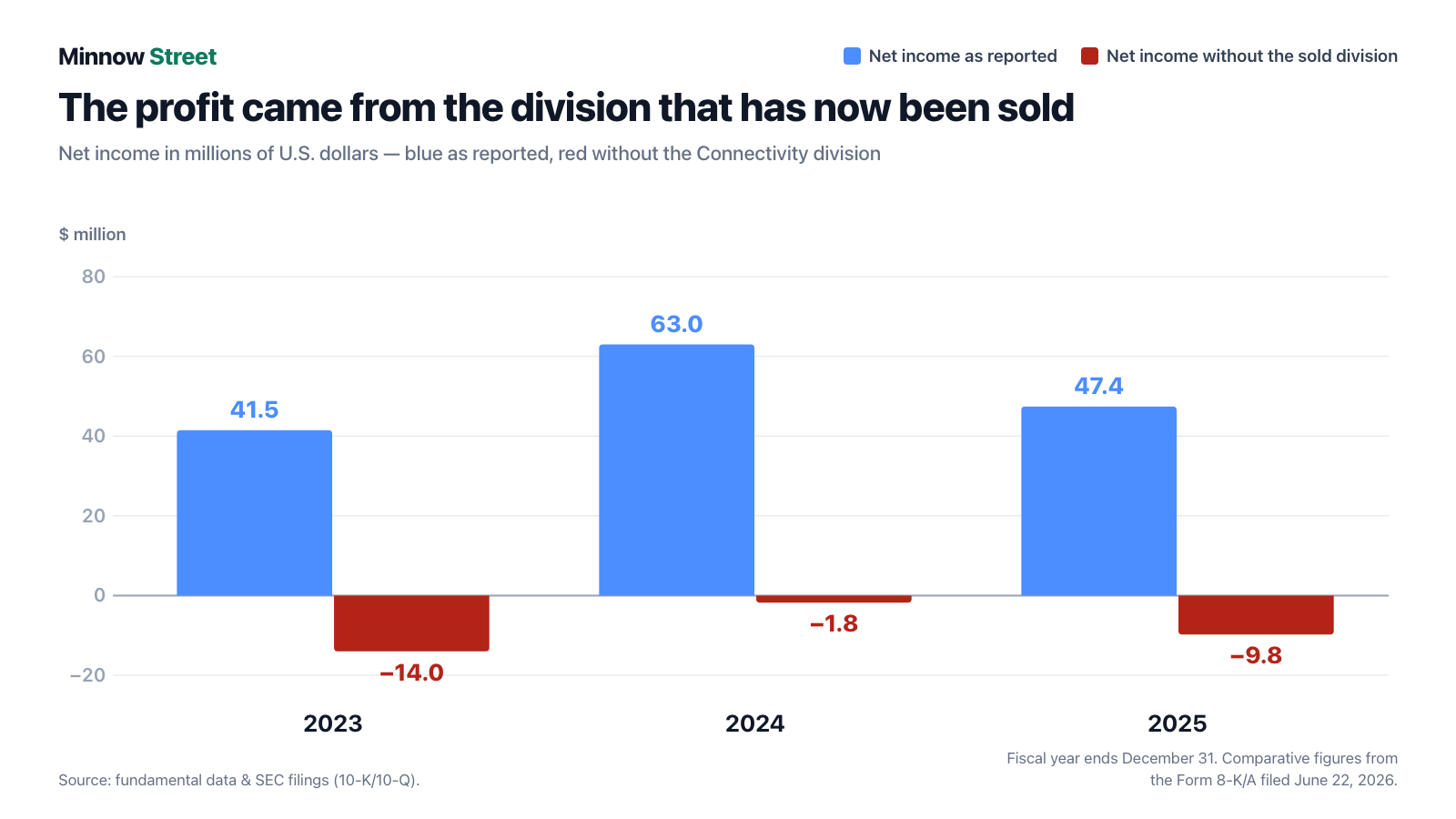
The arithmetic is simple: $47.4 million of reported net income for 2025, less the $57.2 million attributable to the division sold, leaves minus $9.8 million. Earnings per share of $1.15 become a loss of 24 cents.
And that was not a one-off. The same calculation shows a loss of $1.8 million for 2024, against a reported profit of $63.0 million, and a loss of $14.0 million for 2023, against a reported profit of $41.5 million. For three consecutive years the rest of the group earned nothing at the bottom line. That only became visible once the company sold the division.
The segment numbers explain why. In 2025 Connectivity was the smallest revenue contributor at $230.7 million, or 15.9 percent of the group. On operating income it accounted for $76.1 million of $256.4 million of total segment income — almost 30 percent. Its operating margin was 33.0 percent; the rest of the group ran at roughly 8.6 percent after the unallocated corporate overhead of $73.3 million.
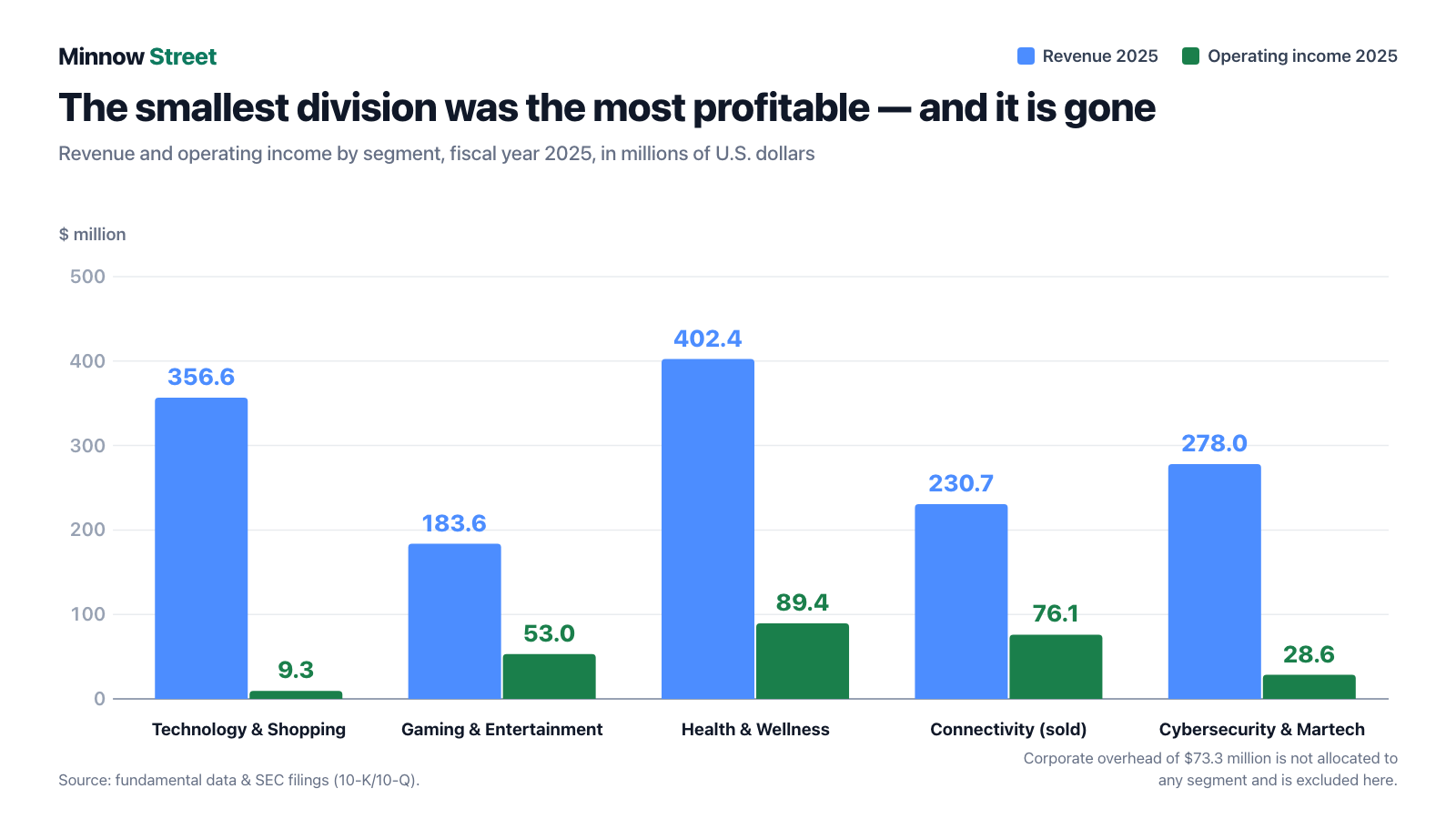
The look at the largest revenue segment is especially awkward. Technology & Shopping — CNET, PCMag, Mashable and RetailMeNot — brought in $356.6 million of revenue in 2025 but only $9.3 million of operating income. In the two years before it posted operating losses of $71.1 million (2024) and $50.5 million (2023). This is the segment with the most famous brand names. It is also the one where the least has stuck.
The most recent evidence sits in the quarterly report for the period ended March 31, 2026, the latest filing before we went to press: continuing operations generated $267.6 million of revenue (down from $272.8 million a year earlier), $2.9 million of operating income (down from $14.5 million) and a net loss of $0.8 million. Of the reported quarterly profit of $22.3 million, $23.0 million came from discontinued operations — that is, from the division the group no longer owns.
Uncomfortable truth No. 2: without acquisitions, revenue shrinks
Remember the friendly revenue series above? $1,364.0 million, $1,401.7 million, $1,451.3 million. Three years of growth. Now look at where it came from.
In 2024 Ziff Davis bought two larger businesses: the gift card and branded payments platform TDS Gift Cards in February 2024 and the technology publisher CNET in September 2024, together for $365.1 million. The annual report contains one sentence worth reading twice:
“For the year ended December 31, 2024, the Company recorded $83.2 million of incremental revenue from the businesses acquired during 2024.”
— Ziff Davis, Inc., Form 10-K for 2025, Note 4 — Acquisitions and Dispositions

Do the arithmetic. Revenue grew by $37.7 million in 2024. Acquisitions contributed $83.2 million. So the pre-existing business shrank by roughly $45.5 million in the same year — about 3.3 percent.
The annual report supplies the cross-check itself. Note 4 contains a comparative table in which TDS and CNET are treated as if they had belonged to the group from January 1, 2023. On that genuinely comparable basis, 2024 revenue was $1,470.2 million against $1,521.1 million in 2023. A decline of 3.3 percent — the same finding from a second direction.
That is the heart of the business model: Ziff Davis buys growth. Acquisitions consumed $9.5 million of cash in 2023, $217.6 million in 2024 and another $67.3 million in 2025 for seven companies. As long as the buying continues, the revenue line rises. When the buying stops, so does the growth.
And acquisitions do not always end well. On December 31, 2025 Ziff Davis sold its video game publishing business and booked a pre-tax loss of $58.0 million on the disposal. We have seen a similar pattern in our analysis of Teradata, where a solid legacy business also shrinks a little every year while the company hunts for its turnaround.
Uncomfortable truth No. 3: more goodwill than equity
When one company buys another and pays more than the acquired assets are worth, the difference lands on the balance sheet as goodwill. Think of it as the premium for a good reputation: you paid for it, you cannot touch it. Across nearly 100 acquisitions, that adds up.
As of December 31, 2025 the Ziff Davis balance sheet showed:
- $1,607.5 million of goodwill
- $344.2 million of intangible assets (trade names, customer relationships, purchased technology)
- $1,951.7 million combined
Against that stood equity of $1,753.6 million. In other words, the premium paid for acquisitions exceeded total equity by 11 percent. Subtract both and tangible book value comes to minus $198.1 million. On paper, shareholders owned less than nothing in hard assets at the end of 2025.
The intangibles are already largely written down: against historical cost of $1,606.5 million sits accumulated amortization of $1,262.3 million, or 78.6 percent. That explains the strikingly heavy depreciation and amortization charge of $228.7 million in 2025, equal to 15.8 percent of revenue. It suppresses reported profit without costing cash — which is why cash flow looks so much better than earnings.
Goodwill is tested regularly. The auditor, KPMG, explicitly flagged the valuation as a critical audit matter. The results of the last three years: an impairment charge of $56.9 million in 2023, $85.3 million in 2024 and $17.6 million in 2025, or $159.8 million combined. Accumulated impairment losses as of December 31, 2025 stood at $169.5 million in Technology & Shopping and $17.6 million in Cybersecurity & Martech.
That is where the next question waits. Cybersecurity & Martech carries $540.0 million of goodwill, the single largest block. At the same time its operating income fell from $55.0 million in 2024 to $28.6 million in 2025, and revenue slipped from $283.5 million to $278.0 million. A segment whose earnings halve while $540 million of purchase premium sits on the books is the natural candidate for the next write-down.
The good news: after the sale this looks far friendlier. The pro forma balance sheet as of March 31, 2026 shows equity of $2,404.3 million against $1,343.8 million of goodwill and $314.1 million of intangibles. Tangible book value swings to plus $746.4 million. The $1.2 billion check filled the hole.
Uncomfortable truth No. 4: AI is reading along
Ziff Davis lives on people reading its articles. Someone who wants to know which television is worth buying searches on Google, lands on PCMag or CNET and sees advertising there. That path is changing right now. When an AI answer engine delivers the information directly, nobody clicks through to the source.
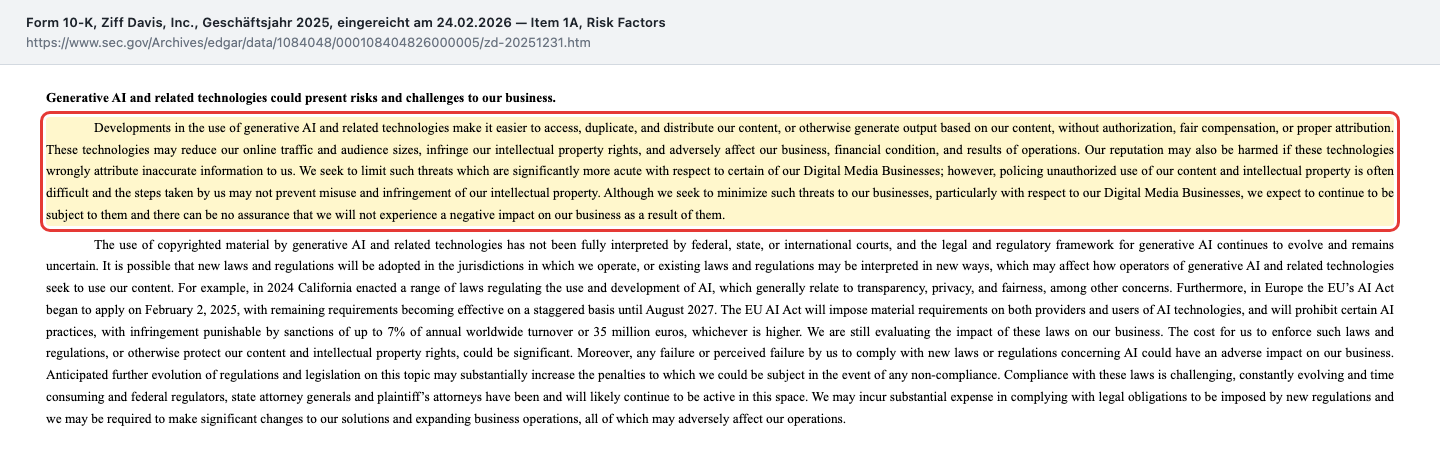
The company writes this down as a risk in its own annual report:
“Developments in the use of generative AI and related technologies make it easier to access, duplicate, and distribute our content, or otherwise generate output based on our content, without authorization, fair compensation, or proper attribution. These technologies may reduce our online traffic and audience sizes, infringe our intellectual property rights, and adversely affect our business, financial condition, and results of operations.”
— Ziff Davis, Inc., Form 10-K for 2025, Item 1A — Risk Factors
Ziff Davis is fighting back in court. On April 24, 2025 it sued OpenAI for copyright infringement; on May 14, 2025 the case was consolidated with other actions against OpenAI in the Southern District of New York. On February 6, 2026 a second suit followed against Google and Alphabet, alleging antitrust violations around publisher ad servers and ad exchanges. Both cases were still pending as of the quarterly report filed May 8, 2026. No outcome is foreseeable and no amount is stated anywhere.
A footnote with some irony: in July 2023 Ziff Davis bought a $25.0 million minority stake in the AI company OpenEvidence. On April 24, 2025 — the same day it filed suit against OpenAI — the group sold that stake for $29.7 million. The gain of roughly $4.7 million is less than a tenth of a single quarter's amortization charge.
What the stock costs — after the sale
This is where it gets interesting, because the sale has fundamentally shifted the valuation. All figures below use 36,835,400 shares outstanding as of May 4, 2026, taken from the cover page of the quarterly report, and a closing price of $51.60 on July 24, 2026. That gives a market value of roughly $1,900.7 million. We use that as a dated valuation anchor, not as a price forecast.
The cash. The pro forma balance sheet as of March 31, 2026 shows $1,676.7 million of cash. Against it sits $867.1 million of debt: $460.0 million of 4.625 percent senior notes due October 2030, $263.1 million of 3.625 percent convertible notes due March 2028 and $149.1 million of 1.75 percent convertible notes maturing on November 1, 2026. That leaves roughly $809.6 million of net cash — 42.6 percent of the entire market value sits in the bank.
The book value. Pro forma equity of $2,404.3 million equals $65.27 per share. At $51.60 you are paying 0.79 times book — the market values the group below what is arithmetically inside it.
The revenue. Subtract net cash from market value and enterprise value is roughly $1,091 million. Against pro forma 2025 revenue of $1,220.5 million that is 0.89 times sales. For a media business running close to 86 percent gross margin, that is not expensive.
The earnings. And here the pretty arithmetic stops. A price-to-earnings ratio on a continuing basis cannot be formed, because continuing operations showed a loss in all three pro forma years. Against pro forma 2025 operating income of $104.9 million, enterprise value is 10.4 times — solid, but measured against a result of which nothing remained after interest, taxes and amortization.
The professionals' view fits the picture: the average analyst price target in our data set as of July 24, 2026 stood at $49.40 — below the price at the time. The stock had already staged a strong recovery by then: from a 52-week low of $26.51 up to within 5.1 percent of the 52-week high of $54.38.
One more metric for balance sheet quality. The Piotroski score tests nine features of healthy balance sheet development. Our own recalculation of 2025 against 2024 gives 7 out of 9. Six out of nine would be okay but not good; seven is respectable. One of those points, however, is a pure accounting effect: it counts because long-term debt fell — in reality only the $149.1 million convertible note moved into current liabilities, while total debt was essentially unchanged at $866.5 million against $864.3 million. Counted honestly, it is 6 out of 9.
By the way: since August 2020 Ziff Davis has repurchased a cumulative 13,516,973 of its own shares for $755.3 million — an average of $55.88 per share, above the price on July 24, 2026. The 2025 vintage, at roughly $35.72 per share, was well timed by contrast. How a company handles buybacks often says more about management than any presentation, a point we covered in more detail in our analysis of Xerox.
Opportunities and risks at a glance
What speaks for Ziff Davis
- Cash in abundance. $1,676.7 million of cash against $867.1 million of debt in the pro forma balance sheet as of March 31, 2026. The $149.1 million convertible note maturing in November 2026 is a bookkeeping event, not a problem.
- The group generates real cash. $407.1 million of operating cash flow in 2025 and $287.9 million of free cash flow after capital expenditure — the third increase in a row.
- The valuation is sober. 0.79 times book and roughly 0.89 times sales on a pro forma basis, using the closing price of July 24, 2026.
- The share count falls reliably. From 47,269,446 on January 1, 2023 to 36,835,400 on May 4, 2026, down 22.1 percent. On February 22, 2026 the board added another ten million shares to the authorization.
- Health & Wellness is growing. Revenue of $402.4 million in 2025 after $362.4 million — up 11.0 percent, on operating income of $89.4 million.
What speaks against Ziff Davis
- Continuing operations were loss-making. Pro forma losses of $9.8 million in 2025, $1.8 million in 2024 and $14.0 million in 2023. In the first quarter of 2026, another $0.8 million.
- Growth only with a checkbook. $83.2 million of incremental revenue from 2024 acquisitions against $37.7 million of total growth; the comparative table in the annual report shows 2024 down 3.3 percent against 2023.
- Goodwill remains an open bill. $540.0 million sits in Cybersecurity & Martech, whose operating income halved to $28.6 million in 2025. That segment already absorbed a $17.6 million impairment in the same year.
- AI attacks the business model. The company's own risk report names falling online traffic explicitly. The suits against OpenAI and Google are open with no timetable.
- The best-known brands earn the least. Technology & Shopping, home to CNET, PCMag and Mashable, produced only $9.3 million of operating income on $356.6 million of revenue in 2025, after two loss-making years.
- The sale was not pure upside. The pro forma statements put $181.7 million of tax on the $874.2 million book gain.
A human conclusion
Back to the receipt from the opening. It is accurate — it simply describes a company that no longer exists in that form.
With this sale Ziff Davis did something many groups avoid: it handed over its most profitable building block and took cash instead. You can call that smart — the price was high, the money is real, the balance sheet is in excellent shape afterwards. You can call it dangerous — what remains are advertising portals in a market where AI answer engines are starting to take the click away from the human.
What you should not do is keep reading the old receipt. That $47.4 million of profit for 2025 belongs to a group that owned Ookla. Today's group has $1.68 billion in the bank, a book value above its share price — and three consecutive years in which the remaining business earned nothing at the bottom line.
The decisive question is not in any report yet; it is still coming. What does management do with $1.68 billion? Buy the next twenty websites? Buy back stock while it trades below book? Or let the money sit and lose value? The first solid answer arrives with the next quarterly report — the first in which continuing operations have to stand entirely on their own.
What you make of that is your decision. And that is exactly as it should be.
Sources
- Ziff Davis, Inc. — Annual report on Form 10-K for fiscal year 2025, filed February 24, 2026 (SEC EDGAR, CIK 0001084048)
- Ziff Davis, Inc. — Quarterly report on Form 10-Q for the period ended March 31, 2026, filed May 8, 2026
- Ziff Davis, Inc. — Form 8-K/A, Exhibit 99.1 (unaudited pro forma financial information after the sale), filed June 22, 2026
- Ziff Davis, Inc. — Form 8-K reporting completion of the sale of the Connectivity division, filed June 17, 2026
- Ziff Davis, Inc. — Form 8-K on the securities purchase agreement with Accenture, filed March 4, 2026
- Ziff Davis, Inc. — Form 8-K on first quarter results and the annual meeting, filed May 8, 2026
- Source: fundamental data & SEC filings (annual and quarterly reports, 10-K/10-Q); price, valuation and ratio data as of July 24, 2026
- In-house stock scanner "Turnaround candidates", "KCF ranking" and "K-FCF ranking", measured July 27, 2026 on both brands
Journalistic analysis, not investment advice. This article is not a solicitation to buy or sell securities and does not replace individual advice. Stocks can fluctuate substantially; a total loss of invested capital is possible. All figures come from the original documents linked above and carry the date stated with them. The author holds no position in Ziff Davis, Inc. at the time of publication.
Our Bottom Line at a Glance
- Earnings power of continuing operations negative
- The pro forma statements filed June 22, 2026 show a loss of $9.8 million for 2025 without the divested division, $1.8 million for 2024 and $14.0 million for 2023. In the first quarter of 2026 continuing operations posted a loss of $0.8 million on operating income of just $2.9 million, down from $14.5 million a year earlier.
- Growth without acquisitions negative
- The 2025 annual report puts incremental revenue from the businesses acquired in 2024 at $83.2 million against total growth of $37.7 million. The comparative table in Note 4 shows 2024 revenue of $1,470.2 million against $1,521.1 million in 2023 — down 3.3 percent on a like-for-like basis.
- Cash generation and gross margin positive
- Operating cash flow rose for the third consecutive year to $407.1 million in 2025; after $119.2 million of capital expenditure, $287.9 million of free cash flow remained. Gross profit was $1,244.7 million on revenue of $1,451.3 million, close to 86 percent.
- Balance sheet after the sale positive
- The pro forma balance sheet as of March 31, 2026 shows $1,676.7 million of cash against $867.1 million of debt and equity of $2,404.3 million. Tangible book value swings from minus $198.1 million on December 31, 2025 to plus $746.4 million. The $149.1 million convertible note maturing November 1, 2026 is comfortably covered.
- Goodwill and impairment risk neutral
- Of $1,607.5 million of goodwill as of December 31, 2025, $540.0 million sits in Cybersecurity & Martech, where operating income fell from $55.0 million to $28.6 million and $17.6 million was already written off in 2025. Accumulated impairment losses across the group total $187.1 million. Auditor KPMG lists the valuation as a critical audit matter.
- Structural market risk from AI negative
- The company's own risk report in the 2025 Form 10-K explicitly names falling online traffic and shrinking audiences caused by generative AI. Ziff Davis has been suing OpenAI since April 24, 2025 and Google and Alphabet since February 6, 2026; both cases were open as of May 8, 2026 and no amount is quantified anywhere.
After selling its Connectivity division for $1.2 billion, Ziff Davis is financially as solid as it has been in years: $1,676.7 million of cash against $867.1 million of debt, book equity above the market value, and $287.9 million of free cash flow in 2025. At the same time its own pro forma statements have revealed that the rest of the group earned nothing at the bottom line from 2023 through 2025 and shrank without acquisitions. Substance is plentiful; proof of earnings power is still missing. Not investment advice.
What Our Rating Means
Open questions
The business works in principle, but one material question is open. As long as it stays open, our findings do not carry a quality verdict.
The traffic light judges the company, not the share price. There is no documented substance problem: equity stood at $1,721.5 million on March 31, 2026 and rises to $2,404.3 million in the pro forma balance sheet after the sale, the equity ratio is 50.7 percent, cash exceeds debt by roughly $809.6 million, there is no indication of a going-concern issue, no listing risk, and KPMG issued an unqualified opinion on February 24, 2026. What is open is the core operating question: the company's own pro forma statements of June 22, 2026 show a loss in continuing operations in all three years from 2023 to 2025 (minus 14.0, minus 1.8 and minus 9.8 million), growth came from acquisitions according to the annual report ($83.2 million of incremental revenue in 2024 against $37.7 million of total growth), and $540.0 million of goodwill sits in a segment whose operating income halved to $28.6 million in 2025. On top of that comes the structural risk from generative AI named in the company's own risk report. Hence yellow: plenty of substance, unproven earnings power.
A journalistic assessment by our editorial team at the time of the deep dive, based on public sources — not investment advice and not a solicitation to buy or sell. Your personal circumstances (investment goals, risk capacity, taxes) cannot be taken into account. What our levels mean, how verdicts are formed, and what conflicts of interest exist →
Worth Noting
- Hook: in-house stock scanner "Turnaround candidates" (U.S. selection), measured July 27, 2026 on both brands — 60 hits, turnaround check 6 out of 8. 44 of the 60 names share that value and occupy places 17 through 60; the order inside that group is a pure database sort with no secondary criterion. Only the 25 strongest hits are listed, and Ziff Davis sits below that line. All lists are recomputed daily.
- Data as of: price, valuation and ratio data from July 24, 2026; balance sheet and income figures from the Form 10-K for 2025 (February 24, 2026), the Form 10-Q for March 31, 2026 (May 8, 2026) and the pro forma statements in the Form 8-K/A (June 22, 2026).
- The Altman-Z value of 6.89 stored in our data set could not be reproduced from the audited annual report. Own calculation: 1.78 on the original formula, 3.02 on the Z double-prime variant for non-manufacturers. Both clear the scanner threshold of 1.1.
- Risk of confusion: Ziff Davis was named J2 Global until October 2021, and price and earnings series before 2021 run under that name. The cloud fax business spun off in 2021 trades separately as Consensus; Ziff Davis has held no Consensus shares since 2024.
- Mandatory check as of July 27, 2026: no Form 25, no Form 15, no SC 14D9, no SC 13E3 and no DEFM14A in the SEC filing list. Ziff Davis is the seller of a division, not a takeover target.
Frequently Asked Questions
On June 17, 2026 Ziff Davis sold its Connectivity division — the Ookla brand with Speedtest — to Accenture for $1.2 billion in cash. After a purchase price adjustment of $16.1 million and transaction costs of $21.7 million, net cash proceeds were $1,194.4 million, of which $37.0 million sits in escrow. The estimated pre-tax gain on the sale is $874.2 million.
Connectivity generated only 15.9 percent of group revenue in 2025 but $76.1 million of the $256.4 million in total segment operating income. Its operating margin was 33.0 percent against roughly 8.6 percent for the rest of the group. In the pro forma statements filed June 22, 2026, what remains without it is a loss of $9.8 million for 2025, $1.8 million for 2024 and $14.0 million for 2023.
Not in the most recently reported years. The 2025 annual report puts incremental revenue from the businesses acquired in 2024 at $83.2 million, while total group revenue rose by only $37.7 million. The comparative table in Note 4, which runs both acquisitions from the start of 2023, shows 2024 revenue of $1,470.2 million against $1,521.1 million in 2023 — a decline of 3.3 percent.
As of December 31, 2025 goodwill of $1,607.5 million and intangibles of $344.2 million stood against equity of $1,753.6 million, leaving tangible book value at minus $198.1 million. After the sale it swings to plus $746.4 million in the pro forma balance sheet. What remains open is $540.0 million of goodwill in Cybersecurity & Martech, where operating income halved to $28.6 million in 2025.
The 2025 annual report names generative AI explicitly as a risk: the technologies may reduce online traffic and audience sizes and infringe intellectual property rights. Ziff Davis has sued OpenAI for copyright infringement since April 24, 2025 and Google and Alphabet since February 6, 2026 over antitrust violations in the advertising business. Both cases were open as of May 8, 2026.
As of December 31, 2025 fixed-rate debt stood at $866.5 million: $149.1 million of 1.75 percent convertible notes maturing on November 1, 2026, $263.1 million of 3.625 percent convertible notes due March 2028 and $460.0 million of 4.625 percent senior notes due October 2030. Against that the pro forma balance sheet as of March 31, 2026 shows $1,676.7 million of cash.
Because the list shows only the 25 strongest hits. On July 27, 2026 the scanner counted 60 U.S. hits; Ziff Davis reaches 6 out of 8 points on the turnaround check — exactly like 44 other names, which together occupy places 17 through 60. Inside that tie group no metric decides the order, only the sequence of the database. Ziff Davis therefore sits below the visible cutoff.
The company traded as JFAX.COM from 1999, as J2 Global Communications from December 2000 and as J2 Global from December 2011; it has only carried the name Ziff Davis since October 4, 2021. Price history runs continuously back to July 23, 1999. The highest closing price of $132.98 dates from November 9, 2021, shortly after the renaming.
Found an error?
Did you spot a factual error, an outdated number, or a typo in this deep dive? Let us know briefly — your report goes straight to the editorial team.