Xerox: The Cheap Cash Flow the Lease Book Is Paying For
In our in-house P/FCF ranking, Xerox sits at rank 30 of the U.S. selection — five rows below the visible window. A ratio of 1.67 looks like a bargain. The 2025 annual report shows where it comes from: of $224 million in operating cash flow, $489 million came from the run-off of the company's own lease receivables. Strip that out and the year ends in the red. We read along to see what the company pledged in the first quarter of 2026 — and who now holds the Xerox brand.
 Thomas Mücke
Founder & Publisher
Thomas Mücke
Founder & Publisher
Chart
Interactive price chart (TradingView).
Note: pure fact-based analysis, not investment advice and not a solicitation to buy or sell. All figures without guarantee.
The iceberg trap
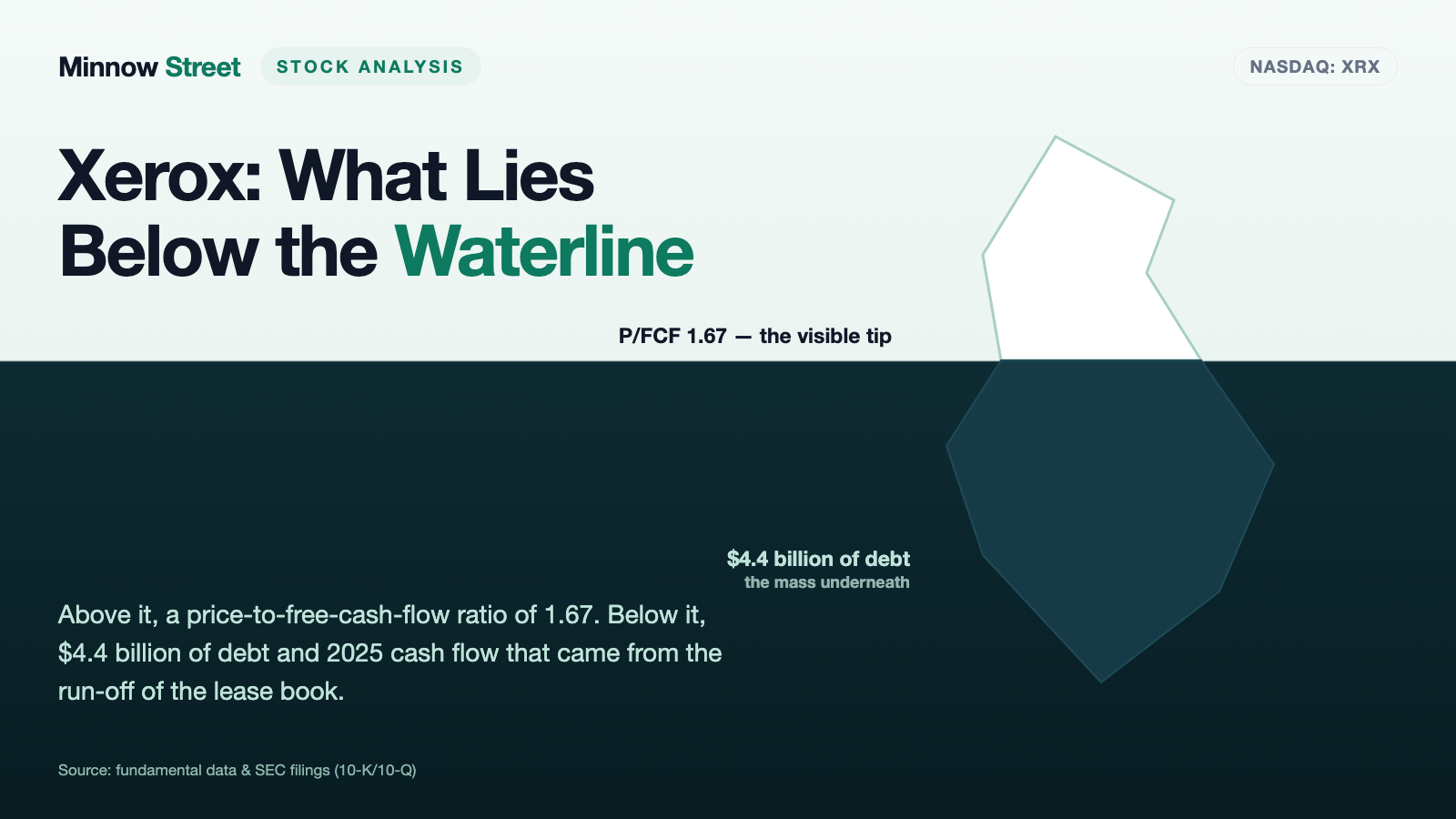
There is one human weakness that costs investors real money: we judge what we can see, not what is there. An iceberg is the most honest picture of it — seven eighths of its mass sits below the surface, and every observer still estimates its size from the tip.
With Xerox the tip is a very friendly number. In our own P/FCF ranking the company shows a price-to-free-cash-flow ratio of 1.67 (U.S. selection, measured on July 27, 2026). Translated: the whole company costs roughly what it generates in free cash over about twenty months. At a sound business that would be an exclamation mark.
Here is the deal for the next twenty minutes. We leave the tip standing and dive underneath it. We read the 2025 annual report and the quarterly report for March 31, 2026 line by line — above all the one line in the statement of cash flows that carries this entire ratio. By the end you will know what the 1.67 measures and what it does not. What you do with that is your business.
What Xerox actually does
Xerox is the company whose name became a verb for copying. Based in Norwalk, Connecticut, it builds and leases printers and multifunction devices, supplies toner and paper, services the machines and runs entire print fleets for large customers — managed print services, or in plain language: one corporation takes care of every printer in every office of another corporation.
A second leg has been added over recent years: IT services for mid-market customers, bought in through acquisitions such as ITsavvy. And a third, easy to overlook: Xerox finances its own machines. A customer who leases a device pays Xerox in installments, and the resulting claim sits on the balance sheet as a finance receivable. Remember that term. It is the key to this whole article.
Since July 1, 2025, Lexmark belongs to the group as well — a direct competitor in printing, acquired for $676 million net of cash. In the quarterly report for March 31, 2026, Xerox reports two segments: Print and Other with $1,692 million of quarterly revenue and IT Solutions with $156 million. Printing is therefore still 92 percent of the company.
The stock market story attached to it is called Reinvention — a multi-year transformation that, according to the annual report, delivered more than $500 million of cumulative run-rate gross cost savings through the end of 2025. The sober reading: the global market for office printing is shrinking as documents move to screens. A transformation cannot make that market grow. It can only fit the cost base to a smaller revenue base, and that is a race against the clock.
How the stock reached our desk
Xerox did not reach our list through a news story but through a sort. Our in-house stock scanner P/FCF ranking collects every stock with positive free cash flow and a price-to-free-cash-flow ratio of no more than 10 and sorts them in ascending order — the arithmetically cheapest first. The metric itself is a simple division: market capitalization divided by free cash flow over the past four quarters. A value of 10 means ten years of that cash flow equal today's price. A value below 2 means barely two years.
On July 27, 2026 we counted. The English edition of the list showed 544 hits; the German edition of the same screen counted 835 that day. Both had last been recomputed on July 26, 2026. With the market filter set to the United States, the page displays 25 rows.
And here is the honest part: Xerox is not among those 25 rows. The last visible row that day carries a value of 1.4. Xerox sits at 1.67, in rank 30 — five rows below the visible window. If you want to verify the placement yourself, use the screening list: open the stocks section, choose the screener, set the market to the United States and the P/FCF filter to "under 10", sort ascending by that column and look for the XRX row. These lists are recomputed daily, so rank 30 is a dated snapshot of July 27, 2026, not a permanent state.
That poses the decisive question rather than answering it: what exactly sits inside the free cash flow that produces this 1.67? At a shrinking hardware business with a large lease book there is an uncomfortable possibility — that no money is being earned at all and a receivables balance is simply being wound down. That is what we check next. We asked the same question of DXC Technology, which appears in the same list, and of Upland Software, which ranks even higher there.
The numbers over the years — fairly credited
Start with what genuinely impresses. Xerox still moves large sums. Revenue of $7,022 million in 2025 is a real number, and the company managed to raise revenue 12.9 percent against 2024. For a business whose demise has been forecast for two decades, that is remarkable.
The cost discipline in the first quarter of 2026 is remarkable too: segment profit rose from $22 million to $72 million, even though a shrinking core business sits behind it. Print and Other contributed $87 million, IT Solutions $6 million, corporate cost $21 million.
That is where the good news ends.
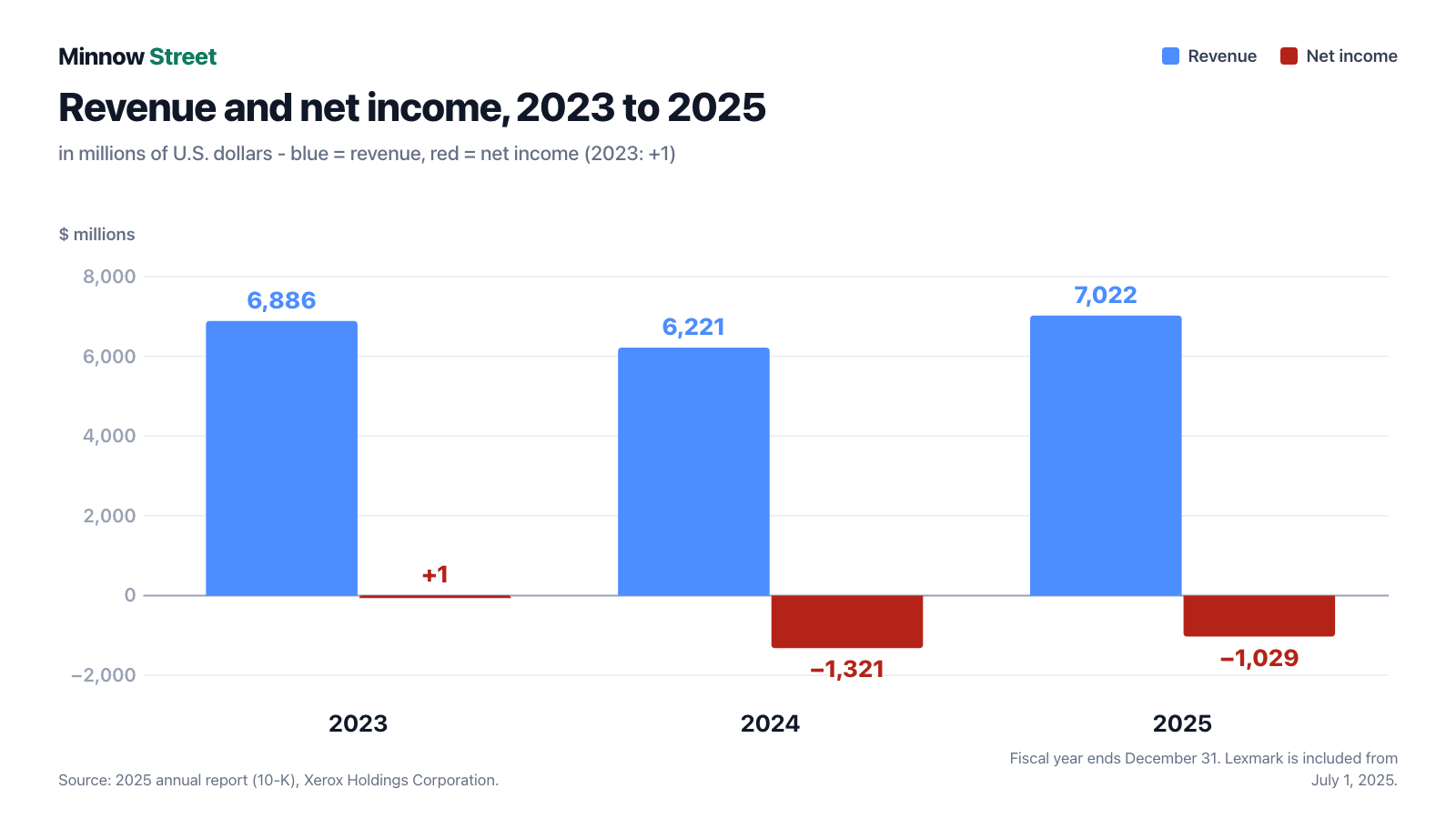
The 12.9 percent of revenue growth breaks down into 15.5 percentage points from Lexmark, 6.5 points from ITsavvy and 0.7 points from currency. Legacy Xerox revenue fell 9.1 percentage points in the same year. Counting Lexmark in both years, the group shrank 7.6 percent in 2025. An acquisition flipped the sign, not the business.
The bottom line for 2025 was a net loss of $1,029 million, after $1,321 million in 2024 and a wafer-thin profit of $1 million in 2023. The two loss years have different causes. In 2024 it was a goodwill impairment of $1,058 million pre-tax. In 2025 the loss before taxes was only $488 million — and then a tax charge of $541 million landed on top. More on that shortly.
What the filings say
Uncomfortable truth no. 1: the cash comes from winding down the lease book
This is the core of the analysis. Operating cash flow was $224 million in 2025, after $511 million in 2024 and $686 million in 2023. That two-thirds decline in two years is already a story. The real story sits one line above it in the statement of cash flows.

"Cash flow from operating activities was further impacted by a $174 million decrease related to finance receivables, primarily due to lower sales of finance receivables, partially offset by increased portfolio run-off as origination volumes declined."
— Xerox Holdings Corporation, Form 10-K for 2025, Cash Flow Analysis
Read the last clause again: increased portfolio run-off as origination volumes declined. The book runs off faster because less new business is coming in. That is not a source of earnings. That is the till filling up while the engine cuts out.
The statement of cash flows puts a number on it. The line "Decrease in finance receivables" reads $489 million in 2025, $663 million in 2024 and $614 million in 2023. Without that line, Xerox would have reported an operating cash outflow of $265 million in 2025.
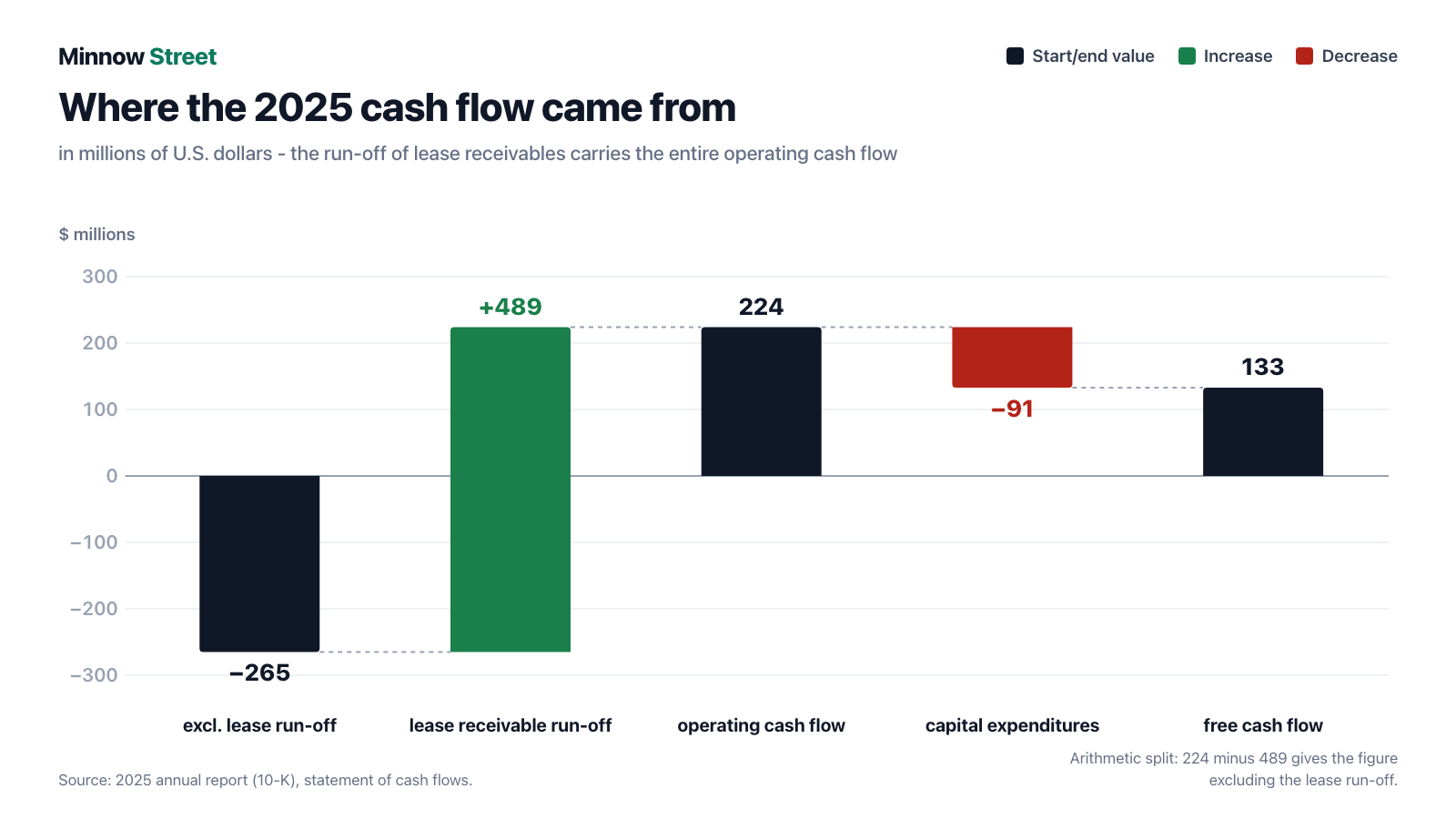
And the effect does not stop. In the first quarter of 2026 the lease book contributed a further $66 million — and $144 million still flowed out, after an $89 million outflow a year earlier. A balance turning into cash is finite. A business that earns money is not. Right now Xerox is living off the first.
Uncomfortable truth no. 2: the dividend was cut 90 percent in one year
Anyone holding Xerox as an income stock received two letters in 2025. In the first quarter of 2025 the company halved the annual dividend from $1.00 to $0.50 per share. In the second quarter of 2025 came the second cut, to $0.10.

In money: $146 million paid out in 2023, $128 million in 2024, $27 million in 2025. A dividend cut is rarely a whim of the board. It is almost always the most honest signal a company sends: the money is needed elsewhere.
Uncomfortable truth no. 3: Xerox pledged its own brand
Where exactly the money was needed is set out in a current report of February 17, 2026. Xerox formed a joint venture with funds managed by Angelo, Gordon & Co. The investors provided $405 million of secured term loans and bought units for $45 million. Together, $450 million of fresh cash.

The price comes in three parts. First the interest: SOFR plus 8.125 percentage points, a five-year term, amortizing at 4.50 percent a year. Second the royalty: the Xerox entities pay 2.0 percent of specified consolidated revenue to the joint venture for the use of their own name, quarterly, into a restricted reserve account. Third the covenant: an asset coverage ratio is tested at the end of each quarter, and a breach is an event of default.
A brand is not a raw material you can dig up again. At Xerox it is effectively the most valuable asset the company owns — and it is now collateral for a loan at a rate you normally see in restructuring cases.
Uncomfortable truth no. 4: the company no longer believes in its own future profits
Back to the 2025 loss. Before taxes it was $488 million. After taxes it was $1,029 million. The difference is a tax charge of $541 million — a charge, in a year the company lost money.
"Net (Loss) for 2025 includes the results of ITsavvy and the Lexmark Acquisition from July 1, 2025, and primarily reflects higher Income tax expense, as a result of the establishment of valuation allowances of $537 million against certain deferred tax assets to reflect their realizability."
— Xerox Holdings Corporation, Form 10-K for 2025, results discussion
A deferred tax asset is a credit with the tax authorities: a company that lost money in the past may offset those losses against future profits. The credit is only worth something if those future profits actually arrive. A valuation allowance against it means, in accounting language, that the company itself considers it more likely than not that the required profits will not materialize. That is $537 million of expected future, written off in one year.
Uncomfortable truth no. 5: $305 million of equity carries a $9.9 billion balance sheet
As of March 31, 2026, Xerox reported total assets of $9,902 million — and total equity of $305 million. At the end of 2025 it had still been $449 million. That is an equity ratio of 3.1 percent. For comparison: a soundly financed industrial company sits at 30 to 40 percent.
On the other side of the ledger stood $4,446 million of debt on the same date, up from $4,247 million at year-end. Of that, $1,407 million is financing debt backed by lease receivables. That leaves $3,039 million of core debt, against $2,759 million three months earlier. Non-financing interest expense rose to $84 million in the first quarter of 2026, from $33 million a year earlier — more than doubling within a year. The annual report says where that comes from:
"We have incurred a substantial amount of debt in connection with the financing of the Lexmark Acquisition."
— Xerox Holdings Corporation, Form 10-K for 2025, risk factors
For scale: $4,446 million of debt is about thirteen times the market capitalization of roughly $337 million. Anyone buying shares today is buying a very small residual on a very large pile of debt. Two ratios straight from the March 31, 2026 balance sheet make it tangible: debt is 14.6 times equity, and every dollar of assets is backed by three cents of equity. A soundly financed industrial company is below 1 on the first measure and at 30 to 40 cents on the second.
Uncomfortable truth no. 6: 77 million warrants are waiting for a rally
On February 12, 2026, Xerox gave its shareholders a present — and built itself a tool in the process.

77,271,234 warrants at an exercise price of $8.00, running to February 12, 2028, listed under the symbol XRXDW. Against 130,779,611 shares outstanding (as of April 30, 2026) that is potentially 59 percent more shares — your slice of the pie would shrink accordingly. But the exercise price of $8.00 sits far above the last price documented in an SEC filing, $2.78 (a purchase on July 10, 2026, recorded in the Schedule 13D/A of July 13, 2026). They will only be exercised if the share price roughly triples.
The real purpose hides in a subordinate clause of the warrant agreement: the warrants may also be exercised by tendering designated Xerox notes. For bondholders that is a way to swap debt for equity. For Xerox it is a deleveraging tool that costs no cash — only a share of what existing holders own.
Valuation — what $337 million really buys
Market capitalization stood at roughly $337 million (130,779,611 shares at a closing price of $2.58 on July 24, 2026). Cross-check against a price documented in an SEC filing: 130,779,611 shares at $2.78 (the purchase of July 10, 2026) gives $363 million — the same order of magnitude.
At first glance that is grotesquely cheap: 0.05 times annual revenue of $7,022 million. 1.1 times book equity of $305 million. And of course the 1.67 times free cash flow that produces rank 30 in the screen.
At second glance the picture changes in one place. A price-to-sales ratio is a valuation only if the revenue eventually turns into profit. A price-to-free-cash-flow ratio is a valuation only if the cash flow is repeatable. Both are open questions here: legacy revenue is falling 9.1 percentage points a year, and the 2025 cash flow came from a balance that is currently dissolving.
The more useful measure is enterprise value — market capitalization plus debt minus cash. At roughly $337 million of market capitalization, $4,446 million of debt and $585 million of cash (as of March 31, 2026), that lands at about $4.2 billion. On that basis Xerox trades at roughly six times trailing EBITDA of $372 million. That is no longer a bargain. It is a normally valued industrial business with a very unusual capital structure.
The professionals are split accordingly. Of five houses covering the stock, one rates it a strong buy, two a hold, one a sell and one a strong sell. The mean price target is $2.75 (as of July 27, 2026) — essentially at the last closing price. Translated: the analysts will not commit in either direction.
Opportunities and risks at a glance
What speaks for Xerox:
- The transformation is working on costs: more than $500 million of cumulative run-rate gross savings through the end of 2025, and segment profit rose from $22 million to $72 million in the first quarter of 2026.
- Lexmark brings scale in a shrinking print market — 22,900 employees instead of 16,800, access to its own manufacturing and a second distribution network.
- Liquidity has improved: $585 million of cash as of March 31, 2026 against $512 million at the end of 2025, supported by the $450 million from the joint venture.
- The brand still carries weight — enough, at least, that lenders accept it as collateral.
- An investor with strategic intent has arrived: 6.84 percent for $21.0 million, with an explicit wish to discuss strategy and capital allocation.
What speaks against Xerox:
- The $224 million of 2025 operating cash flow is entirely carried by $489 million from the run-off of lease receivables; without that line the year would show a $265 million outflow.
- In the first quarter of 2026, $144 million flowed out — despite a further $66 million from the lease book.
- Legacy Xerox revenue fell 9.1 percentage points in 2025; on a pro forma basis the group shrank 7.6 percent.
- $4,446 million of debt stands against $305 million of equity, and non-financing interest expense has more than doubled within a year, to $84 million per quarter.
- The company wrote down $537 million of deferred tax assets — an admission that it does not expect the future profits needed to use them.
- The brand secures a loan at SOFR plus 8.125 percentage points, tied to an asset coverage ratio tested every quarter.
- The 2025 annual report was late: on March 2, 2026, Xerox filed a notification of late filing (Form NT 10-K) because the purchase price allocation for Lexmark was still open. The report followed on March 17, 2026.
A human conclusion
Back to the iceberg. The tip is real: Xerox did report $224 million of operating cash flow in 2025, and the market capitalization really is small. The 1.67 is not invented, it is calculated — from two figures that both hold up.
It simply measures something other than what the first glance suggests. It does not measure how much money a business earns. It measures how much money arrived in the till last year. At Xerox that money came mainly from customers paying down old lease contracts while fewer new ones are signed. That is a process with a built-in end.
Add a balance sheet with almost no cushion left, a board that cut the dividend twice in two quarters, and a financing route that turned the company's own brand into loan collateral. None of this is a death sentence — Xerox has cash, has liquidity, has a transformation under way and a new chief executive since March 31, 2026. These are the signals of a company under pressure in several places at once.
Anyone investing here is not betting on a cheap company. They are betting that a shrinking core business, a freshly integrated acquisition and $4.4 billion of debt will together turn the corner before the lease book is used up. That can work out. It is simply a very different bet from the one a number like 1.67 appears to promise at first sight.
What you make of that is your decision. And that is exactly as it should be.
Sources
- Quarterly report on Form 10-Q for March 31, 2026, Xerox Holdings Corporation and Xerox Corporation, filed May 7, 2026 (most recent periodic report)
- Annual report on Form 10-K for fiscal year 2025, filed March 17, 2026
- Notification of late filing on Form NT 10-K, March 2, 2026 (Lexmark purchase price allocation still open)
- Current report on Form 8-K of February 17, 2026, Item 1.01 (joint venture over the trademarks)
- Current report on Form 8-K of April 2, 2026, Item 5.02 (change of chief executive effective March 31, 2026)
- Current report on Form 8-K of July 2, 2026, Item 5.02 (2026 to 2028 transformation retention award plan)
- Schedule 13D/A of July 13, 2026, STARTEEPO Invest and Frantisek Bostl
- Screening and valuation data: our in-house stock scanner and fundamental data (as of July 24 to 27, 2026), including the P/FCF ranking — measured on July 27, 2026: 544 hits in the English list, 25 rows displayed with the U.S. market filter, and Xerox is not among them; the screening list shows Xerox at rank 30 with a ratio of 1.67. The list had last been recomputed on July 26, 2026.
Disclaimer: This article is journalistic analysis and not investment advice. It is not an offer or a solicitation to buy or sell securities. Stocks can lose their entire value, and that applies with particular force to companies with high debt and thin equity. All figures come from the original documents linked above and carry the reporting dates stated there. The author holds no position in Xerox Holdings Corporation at the time of publication.
Our Bottom Line at a Glance
- Source of the cash flow negative
- The $224 million of 2025 operating cash flow is entirely carried by the run-off of lease receivables: the statement of cash flows shows $489 million for that line (2024: $663 million, 2023: $614 million). Without it, the year would have ended at minus $265 million. In the first quarter of 2026, $144 million flowed out even though the book contributed a further $66 million.
- Revenue trend negative
- The reported 12.9 percent revenue increase to $7,022 million in 2025 came entirely from acquisitions: 15.5 percentage points from Lexmark, 6.5 points from ITsavvy and 0.7 points from currency. Legacy Xerox shrank 9.1 percentage points in the same year; on a pro forma basis with Lexmark in both years the group shrank 7.6 percent.
- Balance sheet and leverage negative
- As of March 31, 2026, total assets of $9,902 million were supported by only $305 million of equity, down from $449 million on December 31, 2025 — a ratio of 3.1 percent. Debt stood at $4,446 million, roughly thirteen times the market capitalization. Non-financing interest expense rose to $84 million in the first quarter of 2026, from $33 million a year earlier.
- Financing routes negative
- On February 17, 2026, Xerox contributed its own trademarks to a joint venture and received $450 million — at SOFR plus 8.125 percentage points, tied to an asset coverage ratio tested each quarter and a royalty of 2.0 percent of specified consolidated revenue. On February 12, 2026, it also distributed 77,271,234 warrants at $8.00 that may be exercised by tendering Xerox notes.
- Cost transformation positive
- The transformation is working on the cost side: more than $500 million of cumulative run-rate gross savings through the end of 2025, and segment profit rose from $22 million to $72 million in the first quarter of 2026. Cash grew from $512 million to $585 million in the same quarter. For a business in a shrinking market, that is a serious achievement.
- Valuation neutral
- About $337 million of market capitalization (130,779,611 shares at $2.58 on July 24, 2026) equals 0.05 times annual revenue and 1.1 times book equity. Counting the debt, Xerox trades at an enterprise value of roughly $4.2 billion, or about six times trailing EBITDA — no longer a bargain. The mean analyst price target is $2.75.
Xerox sells printers, supplies and document services into a shrinking market and bought scale with Lexmark on July 1, 2025. The reported revenue jump of 12.9 percent to $7,022 million came entirely from those acquisitions; the legacy business fell 9.1 percentage points. The low valuation in the P/FCF screen has a single source: $489 million from the run-off of lease receivables, without which 2025 would show an outflow of $265 million. Against that stand $4,446 million of debt versus $305 million of equity, a dividend cut by 90 percent, $537 million of written-down deferred tax assets and a brand that has served as loan collateral since February 2026. Not investment advice.
What Our Rating Means
Substance risk
We found at least one documented issue that threatens the company itself — regardless of how the stock is currently valued.
The substance is used up, not merely stretched. As of March 31, 2026, $305 million of equity carried total assets of $9,902 million — a ratio of 3.1 percent, down from $449 million a quarter earlier. Against it stand $4,446 million of debt, roughly thirteen times the market capitalization, with non-financing interest expense more than doubling within a year to $84 million per quarter. The operating cash flow that produces the low valuation is not earning power: it came to $224 million in 2025, while $489 million alone came from the run-off of a lease book that is dissolving because new business is not replacing it — and in the first quarter of 2026, $144 million flowed out despite a further $66 million from that source. On top of that come three admissions by the company itself: a dividend cut of 90 percent within a year, a $537 million valuation allowance against deferred tax assets because the future profits needed to use them are no longer considered likely, and the pledge of its own trademarks for $450 million at SOFR plus 8.125 percentage points. That is red — not as a price forecast, but as a statement about how much the balance sheet can absorb. That the stock also looks cheap does not change the color: price is not a quality attribute.
A journalistic assessment by our editorial team at the time of the deep dive, based on public sources — not investment advice and not a solicitation to buy or sell. Your personal circumstances (investment goals, risk capacity, taxes) cannot be taken into account. What our levels mean, how verdicts are formed, and what conflicts of interest exist →
Worth Noting
- Xerox reached our research list through our in-house stock scanner, the P/FCF ranking. Measured on July 27, 2026: the English edition of the list counts 544 hits, while the German edition of the same screen counts 835; both had last been recomputed on July 26, 2026. With the market filter set to the United States the page displays 25 rows — and Xerox is not among them. The screening list places the stock at rank 30 with a ratio of 1.67; the last visible row of the scanner page carries a value of 1.4 that day. These lists are recomputed daily, so the placement is a dated snapshot.
- The scanner collects every stock with positive free cash flow and a price-to-free-cash-flow ratio of no more than 10 and sorts them in ascending order. That is a sort of the universe, not a quality verdict. The value of 1.67 rests on free cash flow over the past four quarters; that this cash flow came entirely from the run-off of lease receivables in 2025 ($489 million against $224 million of operating cash flow) is something the metric cannot see by construction.
- Takeover check: there is no tender offer, no take-private and no merger agreement on Xerox. Between the quarterly report of May 7, 2026 and the data cut-off of July 27, 2026, the SEC filings contain the annual meeting (8-K of May 27, 2026, Items 5.02 and 5.07), a retention award plan for executives (8-K of July 2, 2026, Item 5.02), insider filings (Form 4), sale notices (Form 144) and two amendments to a Schedule 13D (June 3 and July 13, 2026). No S-4, DEFM14A, SC 14D9 or SC TO-T has been filed.
- Holding structure: the ticker XRX belongs to Xerox Holdings Corporation (CIK 0001770450, Commission File 001-39013). The operating Xerox Corporation (CIK 0000108772, Commission File 001-04471) is a co-registrant of the same combined reports and has had no listed common stock since 2019. Both are incorporated under the law of the State of New York, with headquarters in Norwalk, Connecticut. A second Nasdaq security sits on the same cover page: XRXDW, the warrants of February 12, 2026.
- Prices are dated valuation anchors, not buy arguments: closing price $2.58 on July 24, 2026, 52-week high $6.55 (July 24, 2025), 52-week low $1.19 (April 13, 2026). Market capitalization cross-check: 130,779,611 shares (10-Q cover page, as of April 30, 2026) at $2.78 — the last price documented in an SEC filing, recorded in the Schedule 13D/A of July 13, 2026 for a purchase on July 10, 2026 — gives $363 million against $337 million from fundamental data. The deviation is below one fifth, so the figure is usable. The most recent periodic report is the quarterly report on Form 10-Q for March 31, 2026.
Frequently Asked Questions
Because the market capitalization of about $337 million is very small relative to the reported free cash flow. The scanner collects every stock with positive free cash flow and a ratio of no more than 10 and sorts them in ascending order. On July 27, 2026, that put Xerox at rank 30 of the U.S. selection with a value of 1.67. Only the top 25 rows are displayed, so Xerox was not visible there.
From the run-off of lease receivables. The statement of cash flows in the 2025 annual report shows $489 million under "Decrease in finance receivables" against total operating cash flow of $224 million. Without that line, 2025 would have ended with an outflow of $265 million. Xerox names the reason itself: the portfolio runs off faster because origination volumes have declined.
No. Between the quarterly report of May 7, 2026 and July 27, 2026, the SEC filings contain only the annual meeting, a retention plan for executives, insider and sale notices, and two amendments to a Schedule 13D. There is no tender offer and no merger agreement. The Schedule 13D is an activist position of 6.84 percent that explicitly announces conversations only.
Xerox Holdings Corporation, SEC identifier 0001770450. The operating Xerox Corporation, SEC identifier 0000108772, is a co-registrant of the same combined reports but has had no listed common stock since the 2019 holding reorganization. A second Nasdaq security appears on the same cover page: XRXDW, the warrants issued in February 2026 with an exercise price of $8.00.
Yes, but only a very small one. The annual dividend was halved from $1.00 to $0.50 per share in the first quarter of 2025 and cut again to $0.10 in the second quarter of 2025. In total, $27 million was declared in 2025, after $128 million in 2024 and $146 million in 2023. That is a cut of 90 percent within a single year.
On February 17, 2026, Xerox contributed its trademarks to a joint venture financed by funds managed by Angelo, Gordon & Co. with $405 million of loans and $45 million of units. Since then the Xerox entities pay 2.0 percent of specified consolidated revenue to that joint venture for the use of their own name, into a restricted reserve account that services interest and amortization.
As of March 31, 2026, total debt stood at $4,446 million, up from $4,247 million at the end of 2025. Of that, $1,407 million is financing debt backed by lease receivables and $3,039 million is core debt. Against it stood $305 million of equity on total assets of $9,902 million — an equity ratio of 3.1 percent.
Because Xerox wrote down $537 million of deferred tax assets. The pre-tax loss for 2025 was $488 million; a tax charge of $541 million produced a net loss of $1,029 million. Such a valuation allowance means the company itself no longer expects the future profits that would be needed to use those tax credits.
Found an error?
Did you spot a factual error, an outdated number, or a typo in this deep dive? Let us know briefly — your report goes straight to the editorial team.