Carter Bankshares: How a Bank Earned $100 Million Without Doing Any Banking
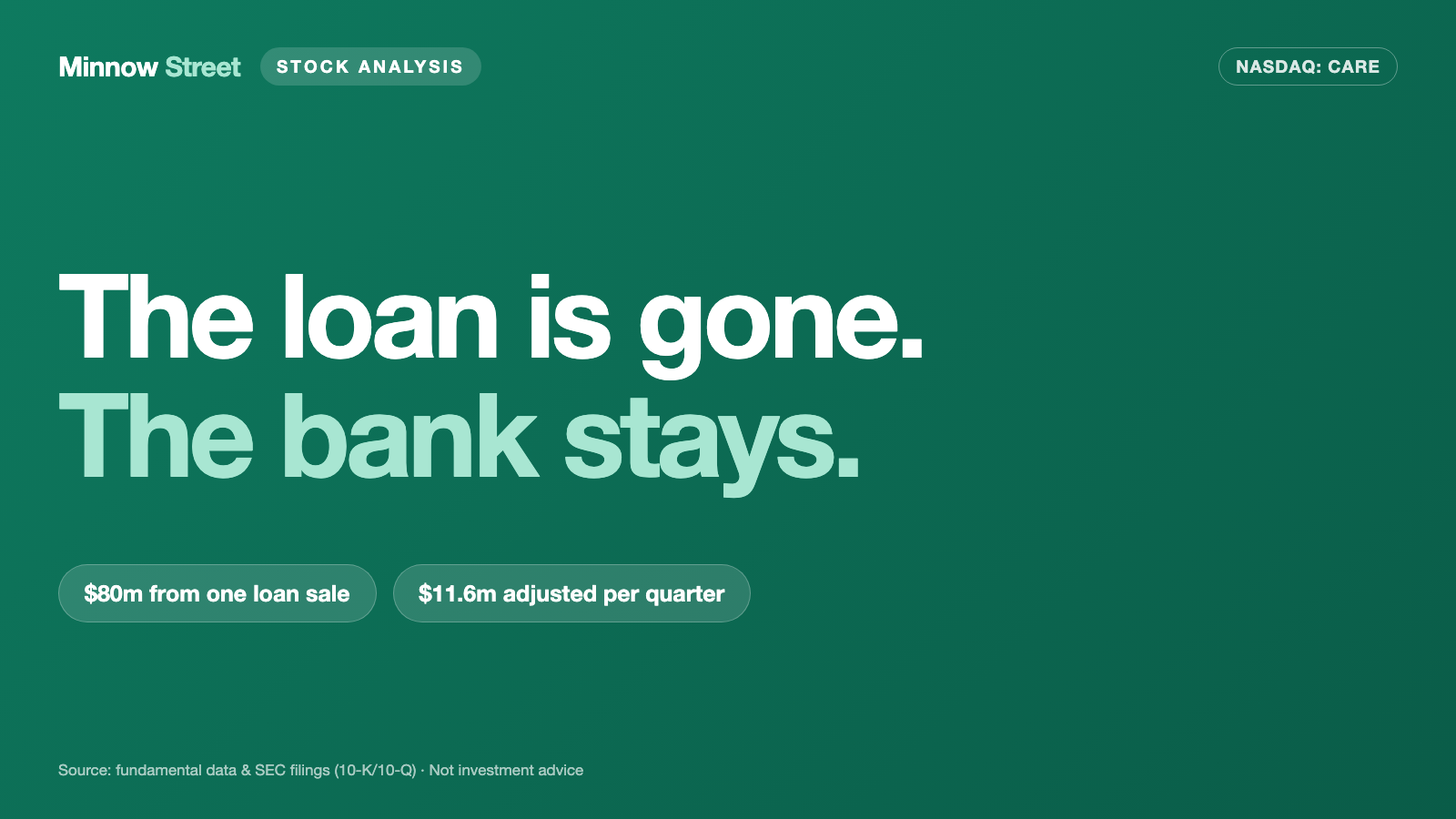
For three years this Virginia regional bank carried a credit relationship that ended at $214 million and paid no interest at all — $91.2 million of forgone interest income over three years. On March 26, 2026 Carter Bankshares sold the judgments for $289.5 million in cash and booked an $80 million gain. Six weeks later came the sale of its insurance subsidiary. The result: $114.7 million of first-half net income — and $20.2 million once the one-off items come out. We read the 2025 annual report, the March 31, 2026 quarterly report and the numbers released on July 23, 2026 to find out what is left of this bank when the one-offs run out. What you get at the end is not a verdict on the share price but an arithmetic you can carry forward yourself.
 Thomas Mücke
Founder & Publisher
Thomas Mücke
Founder & Publisher
Chart
Interactive price chart (TradingView).
Note: pure fact-based analysis, not investment advice and not a solicitation to buy or sell. All figures without guarantee.
There is a thinking trap that works especially well on banks, because the number looks so large and so unambiguous: the record-profit trap. A bank reports $85.8 million of net income for a quarter. A year earlier it was $8.5 million. Your head computes the tenfold jump and files it under "doing well". What it never asks is where the profit came from. At Carter Bankshares, Inc. (NASDAQ: CARE), the holding company of Carter Bank & Trust in Martinsville, Virginia, three quarters of it came from two asset sales — not from banking.
So let us make a deal. Before we talk about the stock, we read together what the bank itself filed with the U.S. securities regulator, the SEC: the annual report (10-K) for 2025 of March 5, 2026, the quarterly report (10-Q) for March 31, 2026 of May 7, 2026, and the current report (8-K) of July 23, 2026 carrying the second-quarter numbers. Those documents are honest under penalty of law. And they tell a story that took three years: about a single loan that held an entire bank back, and about what happens once it is finally gone.
What this analysis covers
- What Carter Bankshares actually does
- Where the stock landed on our desk — and why the ratio misleads here
- The numbers over the years — what genuinely impresses
- What the filings say — four uncomfortable truths
- Valuation — what the market pays for a $4.8 billion bank
- Opportunities and risks at a glance
- A human conclusion
- Sources
What Carter Bankshares actually does
Carter Bankshares is an ordinary regional bank — and that is meant as a compliment. Its subsidiary Carter Bank & Trust opened for business on December 29, 2006, created by the simultaneous merger of ten Virginia banks, from Blue Ridge Bank in Floyd to Shenandoah National Bank in Staunton. It takes deposits, makes loans and lives off the difference. As of June 30, 2026 that meant $4.8 billion of assets, $4.2 billion of deposits and 63 branches in Virginia and North Carolina. As of December 31, 2025, 687 people worked there.
A look at the loan book shows what this bank is really betting on. Of $3,728.5 million of loans at March 31, 2026, $2,127.9 million were commercial real estate, $513.6 million construction, $815.3 million residential mortgages and only $245.5 million commercial and industrial. Commercial real estate and construction together are roughly 71 percent of the book. The bank knows the concentration and caps it in its own credit policy: commercial real estate at no more than 300 percent of total risk-based capital, construction at no more than 100 percent.
On the other side of the balance sheet sits a pattern that is typical for regional banks and expensive: $1,846.4 million of deposits are certificates of deposit (June 30, 2026), the portion repriced at every turn in rates. As of December 31, 2025, 71.7 percent of those certificates matured within twelve months. That is both curse and blessing: it squeezed the margin at the peak in rates and is now working in the bank's favor as rates come down.
Since October 27, 2025 the holding has been a financial holding company, and since November 13, 2025 the bank has been a member of the Federal Reserve System — both readable as preparation for growth. That frames the central tension of this analysis: this bank has just reported the best half-year in its history, and almost none of it came from banking. The question is what is left when the one-off items run out.
Where the stock landed on our desk — and why the ratio misleads here
We run roughly 3,200 stocks through our scanners every day. CARE reached the research list through our in-house K/FCF ranking — a list that sorts strictly by market value divided by trailing four-quarter free cash flow, cheapest first. On July 27, 2026 the U.S. selection held 545 hits. CARE sat in place 49 with a K/FCF of 2.2 — identical on both brands.
The scanner page, however, shows only the 25 strongest hits. CARE is not on it. Anyone wanting to find the name themselves does not use the scanner but the screener, sets the P/FCF filter to its lowest band and sorts the result by that ratio. These lists are recomputed daily — the place and the value are a dated snapshot.
And now the important part, because this is where the real lesson of this analysis sits: a K/FCF of 2.2 does not mean this bank is dirt cheap. It means the ratio measures something different at a bank than at an industrial company — and that here it is additionally distorted by a one-off transaction.
First, the structure. At a bank, operating cash flow is not what is left after all investment. It includes released loan-loss provisions — money that never flowed, it is simply no longer needed as a buffer. And it excludes a bank's actual capital deployment: lending sits in investing activities. At Carter Bankshares that was $61.4 million net in the first quarter of 2026 and $255.3 million across 2025. Ignore those lines and you mistake net interest income before credit losses for free cash flow. We took the same mechanics apart earlier in this series at a consumer lender — see our analysis of OneMain Holdings.
Second, the one-off. At CARE a second and larger distortion is layered on top. The proceeds from selling the nonperforming claims — $289.5 million — run through the cash flow statement as their own line, "Proceeds From the Transaction", inside operating activities, because the loans were reclassified to held-for-sale before the sale. First-quarter 2026 operating cash flow is therefore $303.9 million, against $6.4 million a year earlier. Here is what that looks like from the inside:
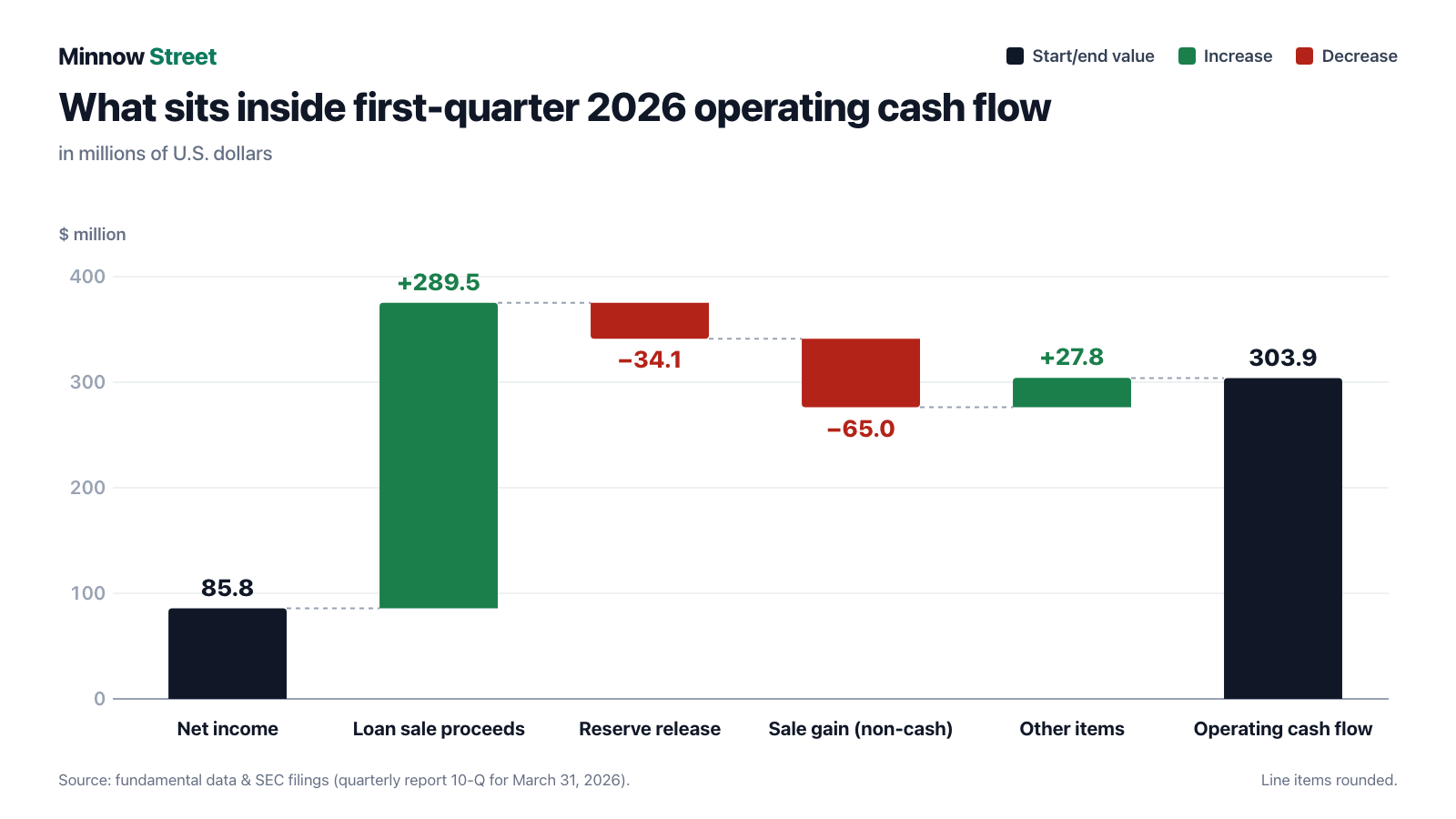
So let us recompute the ratio ourselves. Market value is roughly $753.5 million (22,162,213 shares at June 30, 2026 times the July 24, 2026 price of $34.00). Trailing four-quarter free cash flow is roughly $329 million — which produces the scanner value of about 2.3. Strip out the $289.5 million one-off and roughly $39.8 million remains, a K/FCF of about 19. Measured against completed fiscal 2025 ($39.9 million operating less $8.1 million of capital expenditure) it is about 24. Remember this: a ratio built for factories measures a bank's interest margin before credit losses — and after an asset sale it measures the sale itself.
The same applies to a second figure that sits in our data set and that we expressly do not use here: the Altman Z-score of -1.86. In the Z" variant we use, 1.1 marks the distress zone and 2.6 the safe zone, so a negative reading sounds like an alarm. It is simply meaningless: the formula measures things like working capital and revenue relative to total assets. At a deposit-funded bank, whose balance sheet is 87 percent customer deposits recorded as liabilities, those ratios carry no economic content. Two other banks have already been removed from a scanner in this series for exactly this reason. Anyone judging this bank's safety looks at bank metrics — and as of June 30, 2026 they read: Tier 1 capital ratio 14.26 percent, total risk-based capital 15.51 percent, leverage ratio 11.65 percent, equity to assets 11.23 percent, allowance for credit losses 1.48 percent of loans, nonperforming loans 1.01 percent, allowance coverage of nonperforming loans 146.88 percent. A year earlier the same figures were 10.87, 12.12, 9.46 and 8.48 percent, with coverage at 28.34 percent.
The numbers over the years — what genuinely impresses
Start with what honestly impresses: this bank made money for three straight years while dragging a boulder. Net income was $23.4 million (2023), $24.5 million (2024) and $31.4 million (2025) — earnings per share of $1.00, $1.06 and $1.38. And that was with a credit relationship of eventually $214 million paying not a single dollar of interest across the whole period.
Net interest income rose to $130.8 million in 2025 from $114.5 million, with the net interest margin improving from 2.57 to 2.82 percent. Most of that came from the funding side: the cost of interest-bearing deposits fell from 2.91 to 2.69 percent and the cost of all interest-bearing liabilities from 3.06 to 2.74 percent. In 2025 the bank also bought two North Carolina branches from First Reliance Bank, taking on $55.9 million of deposits — and no loans at all.
Then came 2026. The first half delivered $114.7 million of net income, $5.18 per diluted share. Before you extrapolate that, here are the same quarters next to the figure the company itself adjusts for one-off items:
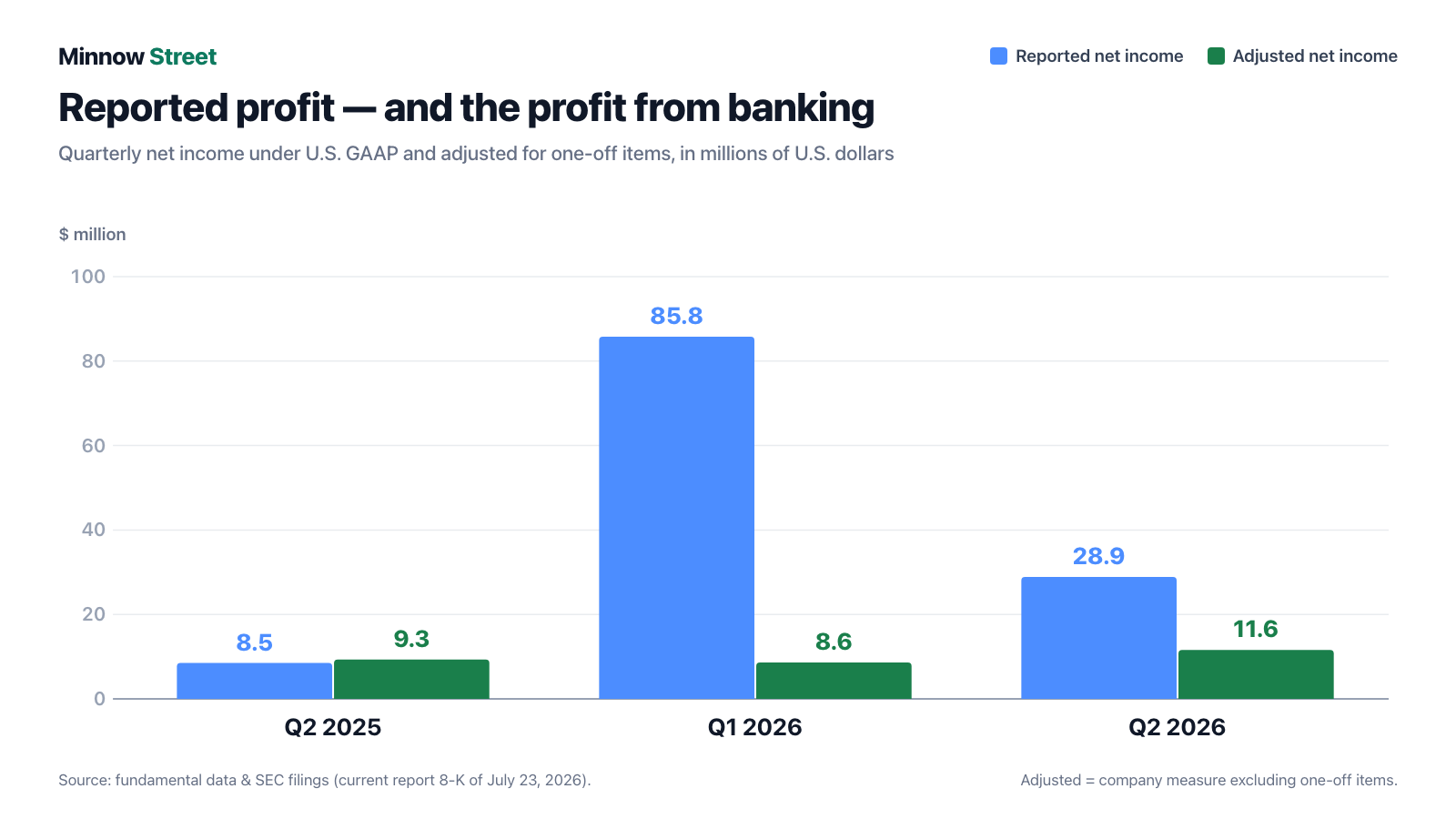
And that is where the genuinely good news hides: the adjusted figure is growing — from $9.3 million (second quarter of 2025) through $8.6 million to $11.6 million (second quarter of 2026), roughly a quarter more year over year. The interest margin is climbing sharply too: from 2.80 percent to 3.38 percent across four quarters, with quarterly net interest income up from $32.4 million to $40.0 million. The adjusted efficiency ratio improved from 75.55 to 62.66 percent.
What the filings say — four uncomfortable truths
No. 1: Three quarters of first-half profit came from two asset sales
The bank puts it plainly enough in its own release that it deserves quoting:
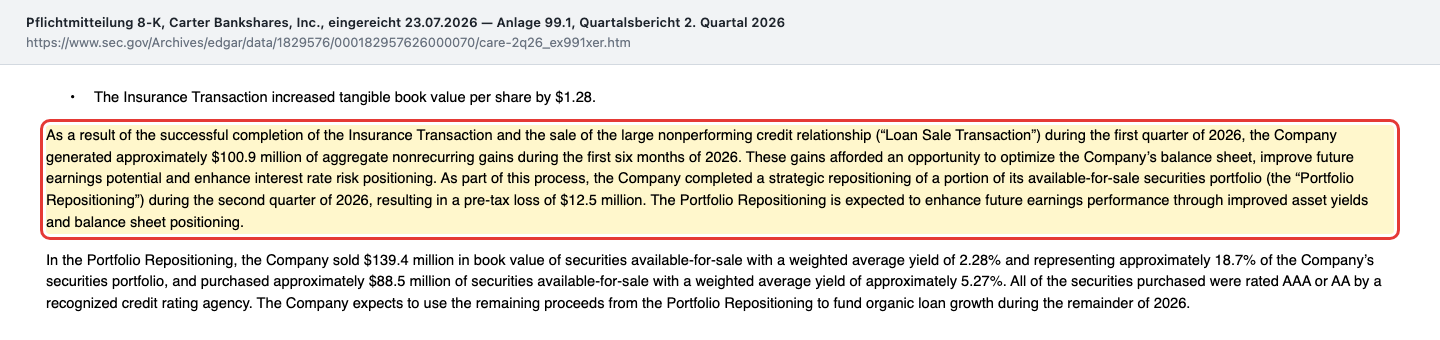
"As a result of the successful completion of the Insurance Transaction and the sale of the large nonperforming credit relationship (“Loan Sale Transaction”) during the first quarter of 2026, the Company generated approximately $100.9 million of aggregate nonrecurring gains during the first six months of 2026."
— Carter Bankshares, Inc., SEC current report 8-K of July 23, 2026, Exhibit 99.1
The two building blocks: $80.0 million of net gain from the first-quarter loan sale ($65.0 million gain on sale plus $15.0 million of recoveries on previously charged-off amounts) and $35.9 million of pre-tax gain from selling insurance subsidiary Bearing Insurance Group, LLC effective May 1, 2026. Against that: a $12.5 million pre-tax loss from repositioning the securities portfolio in the second quarter. Of the $114.7 million of first-half profit, $20.2 million remains on an adjusted basis.
In fairness: the repositioning was a deliberate decision with a defensible purpose. The bank sold securities with $139.4 million of book value yielding 2.28 percent — 18.7 percent of the portfolio — and bought roughly $88.5 million of new paper yielding roughly 5.27 percent, all of it rated AAA or AA. Realizing a book loss to more than double the running yield is the right move. It is simply being done with money that came from a one-off.
No. 2: The problem loan sold above par
March 26, 2026 is the date that reordered this stock. What exactly happened is in the quarterly report:

"The Company received consideration of $289.5 million in cash in the Transaction. Immediately prior to the Transaction, the Judgments had an outstanding aggregate principal amount of $209.5 million, all of the Judgments were nonperforming and on nonaccrual status, and the Company had recorded a specific reserve with respect to the Judgments of $18.0 million as of December 31, 2025."
— Carter Bankshares, Inc., SEC quarterly report 10-Q for March 31, 2026, Item 2
$289.5 million for $209.5 million of principal — roughly 138 percent. For nonperforming loans that is unusual; they normally change hands at a discount. The explanation sits in the word judgments: the bank had already reduced the loans to court-awarded claims, and interest and costs keep accruing on those after judgment. The report describes the sale as an "absolute, 'as-is, where-is' sale" to an unaffiliated third party — final, no recourse, no earn-out. For the bank that means the matter is closed in both directions.
The borrower is not an anonymous entity. These were companies in which James C. Justice II holds an interest, active in hospitality, agriculture and energy. The loans were placed on nonaccrual in the second quarter of 2023 at $301.9 million, because they matured and were not repaid in full. Litigation followed in both directions: a suit by the Justice family against the bank, dismissed with prejudice in the second quarter of 2024, and a note trustee's suit, voluntarily dismissed in the third quarter of 2024. By December 31, 2025 curtailment payments of $87.9 million had reduced the balance to $214.0 million.
No. 3: The loan cost $91.2 million of interest income over three years
The remarkable thing about this exposure is not the loss — in the end there was none. It is the price of waiting, and the bank quantifies it itself:

"Since placement of these loans, now reduced to judgments, on nonaccrual status during the second quarter of 2023, interest income has been negatively impacted by $26.1 million, $35.1 million and $30.0 million during the years ended December 31, 2025, 2024 and 2023, respectively, or by $91.2 million in the aggregate."
— Carter Bankshares, Inc., SEC annual report 10-K for 2025, Item 7
$91.2 million is nearly three times full-year 2025 net income. That sum never appeared as a loss in the income statement — it was simply absent. It is the reason the interest margin is jumping now without the bank doing anything new: capital that earned nothing for three years is working again. An everyday picture: imagine a landlord whose largest apartment was tied up for three years with a tenant who could not pay. The damage appears nowhere — it only becomes visible once the apartment produces rent again.
No. 4: One concentration is gone, concentration risk is not
How large this single exposure was shows up in one line of the annual report's risk factors:

That concentration is history. Nonperforming loans fell from $250.6 million (June 30, 2025) to $24.0 million (March 31, 2026), and their share of the loan book from 6.69 to 0.64 percent. Except that by June 30, 2026 they were back at $37.6 million, or 1.01 percent. The cause is a commercial relationship of three loans totaling $13.4 million that was downgraded during the quarter. Allowance coverage fell as a result from 219.03 to 146.88 percent.
And the more fundamental concentration remains regardless: $2,127.9 million of commercial real estate loans plus $513.6 million of construction lending are roughly 71 percent of the loan book (March 31, 2026). A regional bank built this way is tied to the property market of its two states, and selling one large loan does not change that. The bank's own risk factors name rising delinquency and foreclosure rates on commercial real estate, and the value of the underlying collateral, as risks.
Valuation — what the market pays for a $4.8 billion bank
Before the arithmetic: these are dated anchors, not buy arguments. Price $34.00 (as of July 24, 2026), 22,162,213 shares (balance sheet at June 30, 2026) — a market value of roughly $753.5 million.
For banks, book value comes first. Equity stood at $539.1 million on June 30, 2026, or $24.33 per share; deduct goodwill ($1.2 million) and the core deposit intangible ($0.8 million) and tangible book value is $24.24 per share. The share price therefore equals roughly 1.4 times book. A year earlier tangible book value was $17.79 — it has risen 36 percent in twelve months, $3.49 of that from the loan sale alone and $1.28 from the insurance sale.
On earnings you have to run two calculations side by side. Against reported first-half earnings of $5.18 per share the price-to-earnings ratio would be single digit — a worthless number, because three quarters of that profit came from asset sales. Annualizing the adjusted quarterly figure of $11.6 million (roughly $2.09 per share per year) gives a multiple of about 16. On completed fiscal 2025 at $1.38 per share it is about 25. For a regional bank that is the upper end — what is being paid for is the expectation that the 3.38 percent margin holds and improves.
Return on equity shows the same thing from another angle: 22.01 percent reported for the second quarter of 2026 (annualized), roughly 8.6 percent on the adjusted figure. The professional view is unusually sober: the average analyst price target in our data set is $28 — roughly 18 percent below the July 24, 2026 price. Targets often lag price moves; here the stock has gained roughly 93 percent in twelve months and sits at the highest level in company history.
Since April 2026 there is a dividend again: $0.10 per share per quarter, declared on April 22 and again on July 22, 2026. The company itself calls it "the first quarterly cash dividend in nearly 10 years". Annualized that is $0.40, a yield of 1.22 percent against the July 22, 2026 closing price of $32.92. For a look at how differently a lending business can be valued, see our earlier piece on a Puerto Rico bank in this series, the analysis of First BanCorp.
Opportunities and risks at a glance
What speaks for Carter Bankshares:
- The legacy exposure is definitively gone. Sold as an absolute, as-is, where-is sale with no recourse: $289.5 million in cash for $209.5 million of principal. Nonperforming loans fell from $250.6 million to $37.6 million within a year.
- The interest margin is climbing hard. From 2.80 percent (second quarter of 2025) to 3.38 percent (second quarter of 2026), with quarterly net interest income up from $32.4 million to $40.0 million — 23.5 percent more year over year.
- Capital is markedly thicker. Tier 1 capital ratio of 14.26 percent against 10.87 percent a year earlier, total risk-based capital 15.51 against 12.12 percent, equity to assets 11.23 against 8.48 percent (June 30, 2026).
- Funding is relaxed. No Federal Home Loan Bank borrowings at all as of June 30, 2026 (previously $178.5 million), an additional $879.5 million of capacity there, and $105.0 million of unsecured lines with four correspondent banks.
- Adjusted profit is growing. $11.6 million in the second quarter of 2026 against $9.3 million a year earlier, with the adjusted efficiency ratio improving from 75.55 to 62.66 percent.
What speaks against it:
- Three quarters of first-half profit is non-repeatable. $114.7 million reported against $20.2 million adjusted; roughly $100.9 million came from two asset sales.
- Concentration risk remains. $2,127.9 million of commercial real estate plus $513.6 million of construction lending are roughly 71 percent of the loan book (March 31, 2026), concentrated in two states.
- Nonperforming loans are already rising again. From $24.0 million to $37.6 million within one quarter, triggered by a $13.4 million relationship; allowance coverage fell from 219.03 to 146.88 percent.
- The share price has front-run the turn. Up roughly 93 percent in twelve months to the highest level in company history, while the average analyst price target sits at $28.
- Expensive funding on the books. $1,846.4 million of certificates of deposit (June 30, 2026); as of December 31, 2025, 71.7 percent of them matured within twelve months. If rates rise again, the tailwind of recent quarters reverses.
- Unrealized losses in the securities book. As of June 30, 2026, amortized cost of $682.3 million compared with fair value of $640.3 million — $42.0 million of unrealized loss, mirrored in a negative $32.9 million equity valuation reserve.
A human conclusion
Back to the record-profit trap. For a bank this size, $85.8 million in one quarter is an exceptional number, and it is real — the money moved, $289.5 million in cash. It simply does not describe a business model; it describes the end of a problem. Valuing the stock on that number means valuing a full stop.
The more interesting number sits underneath. Adjusted quarterly profit has risen from $9.3 million to $11.6 million, the interest margin from 2.80 to 3.38 percent, the Tier 1 ratio from 10.87 to 14.26 percent. That is not a sensation; it is what happens when a bank that dragged $214 million of dead capital for three years puts it back to work. And that is precisely the open question: how much of the new margin is the loan, how much is the rate market — and what is left when the wind turns?
The share price answered before the answer existed: roughly 93 percent up in twelve months, highest level in company history, 1.4 times book. Whether that is too much or too little will be settled by a single quarter without one-off items. That quarter arrives with the next report — and you now know three numbers to measure against: a net interest margin of 3.38 percent, adjusted profit of $11.6 million and nonperforming loans of $37.6 million.
What you make of that is your decision. And that is exactly as it should be.
Sources
- SEC annual report 10-K for 2025, Carter Bankshares, Inc., filed March 5, 2026 (CIK 0001829576)
- SEC quarterly report 10-Q for March 31, 2026, filed May 7, 2026
- SEC quarterly report 10-Q for September 30, 2025, filed November 3, 2025
- SEC annual report 10-K for 2024, filed March 7, 2025
- SEC current report 8-K of July 23, 2026, Exhibit 99.1 (Item 2.02: second-quarter 2026 results)
- SEC current report 8-K of July 23, 2026 (Item 8.01: dividend declared July 22, 2026)
- SEC current report 8-K of April 23, 2026 (Item 8.01: reinstatement of the dividend)
- Fundamental data (ratios, price, analyst and valuation data; as of July 27, 2026, last price July 24, 2026)
- Our in-house stock scanner "K/FCF ranking", U.S. selection, measured July 27, 2026 on both brands
This analysis is journalistic commentary and expressly not investment advice, not a recommendation to buy or sell, and not a solicitation to buy or sell securities. All figures come from the original sources listed above and carry the dates stated; numbers change with every new filing. Stocks can fluctuate substantially and a total loss of invested capital is possible. The author holds no position in the security discussed at the time of publication.
Our Bottom Line at a Glance
- Credit quality & legacy exposure positive
- The exposure that made up 87.7 percent of all nonperforming loans was sold on March 26, 2026, finally and without recourse: $289.5 million in cash for $209.5 million of principal. Nonperforming loans fell from $250.6 million (June 30, 2025) to $37.6 million (June 30, 2026), and their share of the loan book from 6.69 to 1.01 percent.
- Capital position positive
- As of June 30, 2026 the Tier 1 capital ratio stood at 14.26 percent, total risk-based capital at 15.51 percent, the leverage ratio at 11.65 percent and equity to assets at 11.23 percent — a year earlier those figures were 10.87, 12.12, 9.46 and 8.48 percent. Federal Home Loan Bank borrowings were repaid in full (December 31, 2025: $178.5 million).
- Earnings quality negative
- Of $114.7 million of first-half 2026 net income, $20.2 million remains on an adjusted basis. Roughly $100.9 million came from two one-off sales — the loan sale in the first quarter and the sale of the insurance subsidiary on May 1, 2026 — against a $12.5 million loss from repositioning the securities portfolio.
- Margin & operating turn positive
- The net interest margin rose from 2.80 percent (second quarter of 2025) through 3.07 to 3.38 percent (second quarter of 2026), with quarterly net interest income up from $32.4 million to $40.0 million. Adjusted quarterly profit grew from $9.3 million to $11.6 million and the adjusted efficiency ratio improved from 75.55 to 62.66 percent.
- Concentration risk negative
- As of March 31, 2026, of $3,728.5 million of loans, $2,127.9 million were commercial real estate and $513.6 million construction — roughly 71 percent, concentrated in Virginia and North Carolina. Nonperforming loans already rose again during the second quarter of 2026 from $24.0 million to $37.6 million, triggered by three loans of one relationship totaling $13.4 million.
- Funding neutral
- As of June 30, 2026, $1,846.4 million of deposits were certificates of deposit; as of December 31, 2025, 71.7 percent of them matured within twelve months. That helped as rates fell — the cost of interest-bearing liabilities dropped from 3.06 to 2.74 percent during 2025 — but works the other way if rates rise.
Carter Bankshares is a $4.8 billion regional bank in Virginia that spent three years blocked by a single problem loan: $214 million at the end, 87.7 percent of all nonperforming loans and $91.2 million of forgone interest income. On March 26, 2026 it was sold for $289.5 million in cash — more than the $209.5 million of principal. Together with the sale of the insurance subsidiary that produced roughly $100.9 million of one-off gains in the first half and reported net income of $114.7 million against $20.2 million adjusted. What remains operationally is still an improvement: net interest margin from 2.80 to 3.38 percent, adjusted quarterly profit from $9.3 million to $11.6 million, Tier 1 capital from 10.87 to 14.26 percent. The open question is how much of that was the loan and how much the rate market — and the share price has already answered, up roughly 93 percent in twelve months. Not investment advice.
What Our Rating Means
Open questions
The business works in principle, but one material question is open. As long as it stays open, our findings do not carry a quality verdict.
This light rates the company, not the share price. No documented substance finding is present: the Tier 1 capital ratio is 14.26 percent, total risk-based capital 15.51 percent, equity to assets 11.23 percent, the allowance covers nonperforming loans 146.88 percent, there are no Federal Home Loan Bank borrowings left, no going-concern doubt and no listing risk (all figures as of June 30, 2026). What is open is the decisive operating question, and it is open twice over. First, reported profit does not carry the business: of $114.7 million in the first half of 2026, $20.2 million remains adjusted, because roughly $100.9 million came from two sales that cannot be repeated. Second, it is unclear how durable the new 3.38 percent margin is: it draws on capital freed by the sold loan, on funding costs that fell 37 basis points, and on a securities repositioning that took a $12.5 million book loss to lift the yield on newly purchased paper from 2.28 to roughly 5.27 percent. Add a loan book that is roughly 71 percent commercial real estate and construction, and nonperforming loans that already climbed back from $24.0 million to $37.6 million. Expressly excluded from this color are price, valuation, float and volatility. Also excluded is the Altman-Z of -1.86 in our data: the formula is built for industrial and trading companies and carries no meaning at a deposit-funded bank. The decision is yours.
A journalistic assessment by our editorial team at the time of the deep dive, based on public sources — not investment advice and not a solicitation to buy or sell. Your personal circumstances (investment goals, risk capacity, taxes) cannot be taken into account. What our levels mean, how verdicts are formed, and what conflicts of interest exist →
Worth Noting
- Carter Bankshares reached the research list through our in-house stock scanner "K/FCF ranking" (U.S. selection), measured July 27, 2026 on both brands: 545 U.S. hits, CARE at a K/FCF of 2.2229 in place 49 — identical on boersenlotse.de and minnowstreet.com. The detail page shows only the 25 strongest hits, so CARE is not visible there; anyone wanting to find the name uses the screener and sets the P/FCF filter to its lowest band. These lists are recomputed daily.
- The ratio is distorted twice over for this name and is therefore recomputed in the piece. First, free cash flow at a bank measures the interest margin before credit losses: released loan-loss provisions sit in operating cash flow, while the actual capital deployment — lending — sits in investing ($255.3 million in 2025, $61.4 million in the first quarter of 2026 alone). Second, the $289.5 million of loan sale proceeds also runs through operating activities as its own line, "Proceeds From the Transaction", because the loans were reclassified to held-for-sale beforehand (supplementary disclosure in the quarterly report: $209,484 thousand). Own calculation: market value of roughly $753.5 million divided by roughly $329 million of trailing four-quarter free cash flow gives 2.3; excluding the one-off, roughly 19; measured on fiscal 2025, roughly 24.
- The Altman-Z of -1.86 in our data is expressly not used as a safety argument. In the Z" variant used here the thresholds are 1.1 (distress zone) and 2.6 (safe zone); the formula was, however, developed for industrial and trading companies and measures working capital, asset turnover and retained earnings against total assets — quantities that carry no economic meaning at a deposit-funded bank. Two other banks have already been removed from a scanner in this analysis series for the same reason. The assessment runs on bank metrics instead (as of 2026-06-30): Tier 1 capital ratio 14.26 percent, total risk-based capital 15.51 percent, leverage ratio 11.65 percent, equity to assets 11.23 percent, allowance for credit losses 1.48 percent of loans, nonperforming loans 1.01 percent, coverage 146.88 percent, net interest margin 3.38 percent.
- Identity checked strictly, because the CARE ticker is ambiguous: the SEC ticker registry maps CARE to CIK 0001829576, and the cover page of the quarterly report for March 31, 2026 reads "CARTER BANKSHARES, INC.", Virginia, Commission File Number 001-39731, trading symbol CARE on the Nasdaq Global Select Market. No former names are recorded in the SEC entity data. Not to be confused: some data sets list the name "Carter Bank and Trust" — that is the subsidiary bank, not the listed holding company.
- Price and valuation figures are dated anchors, not buy arguments: price $34.00 as of July 24, 2026, ratio data as of July 27, 2026. The market value of roughly $753.5 million is computed from 22,162,213 shares (balance sheet at June 30, 2026). After a roughly 93 percent gain over twelve months the stock sits at the highest level in company history, while the average analyst price target in the same data set is $28.
- The most recent periodic report is the quarterly report 10-Q for March 31, 2026 (filed May 7, 2026). Filed after that, through the data date of July 27, 2026: current reports 8-K of May 1, 2026 (Item 8.01, completion of the insurance sale), May 1, 2026 (Items 7.01 and 9.01), May 29, 2026 (Item 5.07, annual meeting results), May 29, 2026 (Item 7.01), June 24, 2026 (Item 5.02, employment and change-of-control agreements), July 23, 2026 (Item 2.02, second-quarter 2026 results) and July 23, 2026 (Item 8.01, dividend), plus ownership filings (Schedule 13G) and insider reports (Form 4). All June 30, 2026 figures in this analysis come from the July 23, 2026 release; the corresponding quarterly report 10-Q had not been filed as of the data date and will carry those figures in reviewed form for the first time.
Frequently Asked Questions
Carter Bankshares is the holding company of Carter Bank & Trust, a regional bank based in Martinsville, Virginia. It takes deposits and makes loans, mostly to commercial real estate borrowers and residential builders. As of June 30, 2026 it held $4.8 billion of assets, $4.2 billion of deposits and 63 branches in Virginia and North Carolina. The bank opened for business on December 29, 2006, created by the merger of ten banks.
Because the bank sold its large nonperforming credit relationship on March 26, 2026. Outstanding principal was $209.5 million and the cash consideration $289.5 million. That produced a $65.0 million gain on sale, $15.0 million of recoveries on previously charged-off amounts and the release of an $18.0 million specific reserve. Quarterly net income rose to $85.8 million as a result; adjusted for those items it was $8.6 million.
Companies in which James C. Justice II holds an interest, active in hospitality, agriculture and energy. The loans were placed on nonaccrual in the second quarter of 2023 at $301.9 million, because they matured and were not repaid in full. By December 31, 2025 curtailment payments of $87.9 million had reduced the balance to $214.0 million. Litigation in both directions ended during 2024.
Because the ratio is distorted twice over here. At a bank, operating cash flow includes released loan-loss provisions, while the actual capital deployment — lending — sits in investing activities ($255.3 million in 2025). On top of that, the $289.5 million of loan sale proceeds was also booked as an operating inflow. Without that one-off item the ratio would be roughly 19 rather than 2.2.
Nothing usable. The formula was developed for industrial and trading companies and measures things like working capital and revenue relative to total assets. At a deposit-funded bank, whose balance sheet consists mostly of customer deposits, those ratios are economically meaningless. The informative figures are bank metrics: Tier 1 capital ratio 14.26 percent, equity to assets 11.23 percent, allowance for credit losses 1.48 percent of loans (June 30, 2026).
Yes, again since April 2026. The board declared a quarterly dividend of $0.10 per share on April 22, 2026 and again on July 22, 2026. The company itself describes the reinstatement as the first quarterly cash dividend in nearly ten years. Annualized that is $0.40; against the July 22, 2026 closing price of $32.92 that is a yield of 1.22 percent.
As of March 31, 2026, of $3,728.5 million of loans, $2,127.9 million were commercial real estate and $513.6 million construction — roughly 71 percent together. The bank's own credit policy caps commercial real estate at 300 percent and construction at 100 percent of total risk-based capital. It names rising delinquency and foreclosure rates on commercial real estate as a risk in its own filings.
No. As of July 27, 2026 the entire filing history with the U.S. securities regulator contains no SC 14D9, no SC 13E3, no Form S-4, no Form 25 and no Form 15. The stock trades on the Nasdaq Global Select Market under the ticker CARE. One thing to note: some data sets still list the name "Carter Bank and Trust" — that is the subsidiary bank, not the listed holding company.
Found an error?
Did you spot a factual error, an outdated number, or a typo in this deep dive? Let us know briefly — your report goes straight to the editorial team.