AMC Global Media: When a Stock Looks Too Cheap, Read the Debt Line
Market capitalization equals 1.6 times free cash flow — one of the lowest readings our ranking finds anywhere in the United States. Add $1.2 billion of net debt and it becomes 6.0 times. Eighty-eight percent of the 2025 profit came from buying back the company's own bonds below par, and the cash flow comes from spending less on programming than it writes off. Above it all sits a family that controls 79 percent of the votes with 4 percent of the tradable shares. Not investment advice — just an attempt to finish reading a number.
 Thomas Mücke
Founder & Publisher
Thomas Mücke
Founder & Publisher
Chart
Interactive price chart (TradingView).
Note: pure fact-based analysis, not investment advice and not a solicitation to buy or sell. All figures without guarantee.
There is an investor trap that disguises itself as a reward for doing the math: the metric trap. It works like this. You find a number too good to be true — here, a company worth just 1.6 times its free cash flow on the stock market. For comparison, the broad U.S. market pays twenty to thirty times depending on the cycle. Your brain immediately fills in the rest: “this has to be a bargain.” And there you have a thesis without having read the balance sheet. AMC Global Media (NASDAQ: AMCX) is exactly that company. So let us make a deal: before you buy the number, we read together what the company itself filed with the U.S. securities regulator, the SEC — the annual report (10-K) for 2025, the quarterly report (10-Q) as of March 31, 2026, and the current report (8-K) of March 13, 2026. An SEC filing is honest under threat of prosecution. And this one describes $1.2 billion of net debt, a profit that came from repurchasing the company's own bonds, a content library that is shrinking — and a family that holds 79 percent of the votes with 4 percent of the tradable shares. In the end, the decision is yours.
What AMC Global Media actually does — and why the name is new
First the name plate, because two very different companies are easily confused here. AMC Global Media Inc. was called AMC Networks Inc. until April 3, 2026; the change took effect on April 8, 2026 with amended and restated articles of incorporation filed with the Nevada Secretary of State. It is a pure rename, not a restructuring: the SEC identifier (CIK 0001514991), the ticker AMCX and every time series run straight through. Not to be confused with AMC Entertainment — that is the cinema chain trading as AMC, a different company with a different story.
The business is television in transition. On one side sit the cable networks: AMC (home of “The Walking Dead” and “Mad Men”), BBC America, IFC, Sundance TV and WE tv. They earn money twice over — cable and satellite distributors pay a fee per household, and advertising is sold in between. On the other side sit the streaming services: AMC+, Acorn TV (British crime drama), Shudder (horror), Sundance Now, ALLBLK and HIDIVE (anime). Together they ended 2025 with roughly 10.4 million subscribers. Internally the company runs two segments: Domestic Operations and International.
Revenue in 2025 fell into three buckets: subscription of $1,453.2 million (down 1.3 percent), advertising of $580.8 million (down 14.2 percent) and content licensing and other of $277.8 million (up 1.9 percent). Together $2,311.8 million — after $2,421.3 million the year before and $2,711.9 million in 2023. In two years $400 million of revenue has disappeared, and almost all of the decline comes from advertising: fewer cable households mean fewer viewers, and fewer viewers mean lower advertising rates.
That frames the central tension of this analysis, and it runs through every chapter: the company throws off a lot of cash and is worth almost nothing on the stock market — but the cash comes from drawing down its own content library, the profit from repurchasing its own debt, and both sit next to net debt that exceeds market capitalization by two and a half times.
Where the stock landed on our desk
AMCX showed up in our price-to-free-cash-flow ranking — a list that sorts stocks by market capitalization divided by free cash flow, ascending. Free cash flow is the money left after all running costs and investment; a low ratio means you get a lot of recurring cash for a small purchase price. To repeat it yourself: open the scanner section, choose the price-to-free-cash-flow ranking and set the country filter to the United States. The lists are recomputed daily.
And now the honest part. The U.S. selection of that list had 545 hits on July 27, 2026; AMCX sits inside it with a reading of 1.74 at rank 32 (price data as of July 24, 2026). The page, however, displays only the 25 strongest hits — so AMCX cannot be seen there. To look the stock up in our data set, take the other route: open the stock screener, set the country to the United States, choose “under 10” in the P/FCF filter and type AMCX into the search box. That path works regardless of how the ranking sorts itself tomorrow. Remember it as a rule: a ranking page is an excerpt, not a directory.
The stock also appears on two other valuation lists, the price-to-sales ranking (0.18) and the price-to-cash-flow ranking. That is not a coincidence but the same finding from three angles: measured against the running business, this stock is extremely cheap. Whether it is therefore inexpensive is precisely the question of this analysis — and the difference between the two words fills the rest of the text.
For context, two metrics we checked against the audited accounts. The Altman Z-score of 7.13 (data as of July 24, 2026) is a bankruptcy early-warning figure; we use the Z-double-prime variant for non-manufacturers, where anything below 1.1 counts as distress and anything above 2.6 as the safe zone. At 7.13 the reading sits far above that — which is plausible, because the balance sheet as of March 31, 2026 shows $3,873.7 million of total assets, $988.2 million of equity and $552.1 million in cash; nothing is acutely at risk. The Piotroski F-score of 5 out of 9, by contrast, is middling at best: it scores nine yes-or-no questions on balance-sheet quality, and 5 simply means about half of them deteriorated. A genuinely healthy company scores 8 or 9.
The numbers over the years — given their due
First what genuinely impresses, and it is more than the share price suggests. This company makes money, in cash. In 2025 operations produced $305.7 million; after $33.3 million of capital expenditure, free cash flow of $272.4 million remained — the definition the company itself uses and reconciles in its filings. The year before it was $330.8 million, in 2023 $168.7 million. This is not accounting acrobatics: on the balance sheet, cash rose during the first quarter of 2026 from $502.4 million to $552.1 million.
The operating picture is not that of a turnaround case either. Adjusted operating income (the company calls it AOI and strips out depreciation, stock compensation, impairments and restructuring) came to $411.9 million in 2025 after $562.6 million the year before. Roughly 10.4 million subscribers pay for the streaming services, and licensing grew slightly in 2025. But now the question this analysis turns on: where does that money come from?
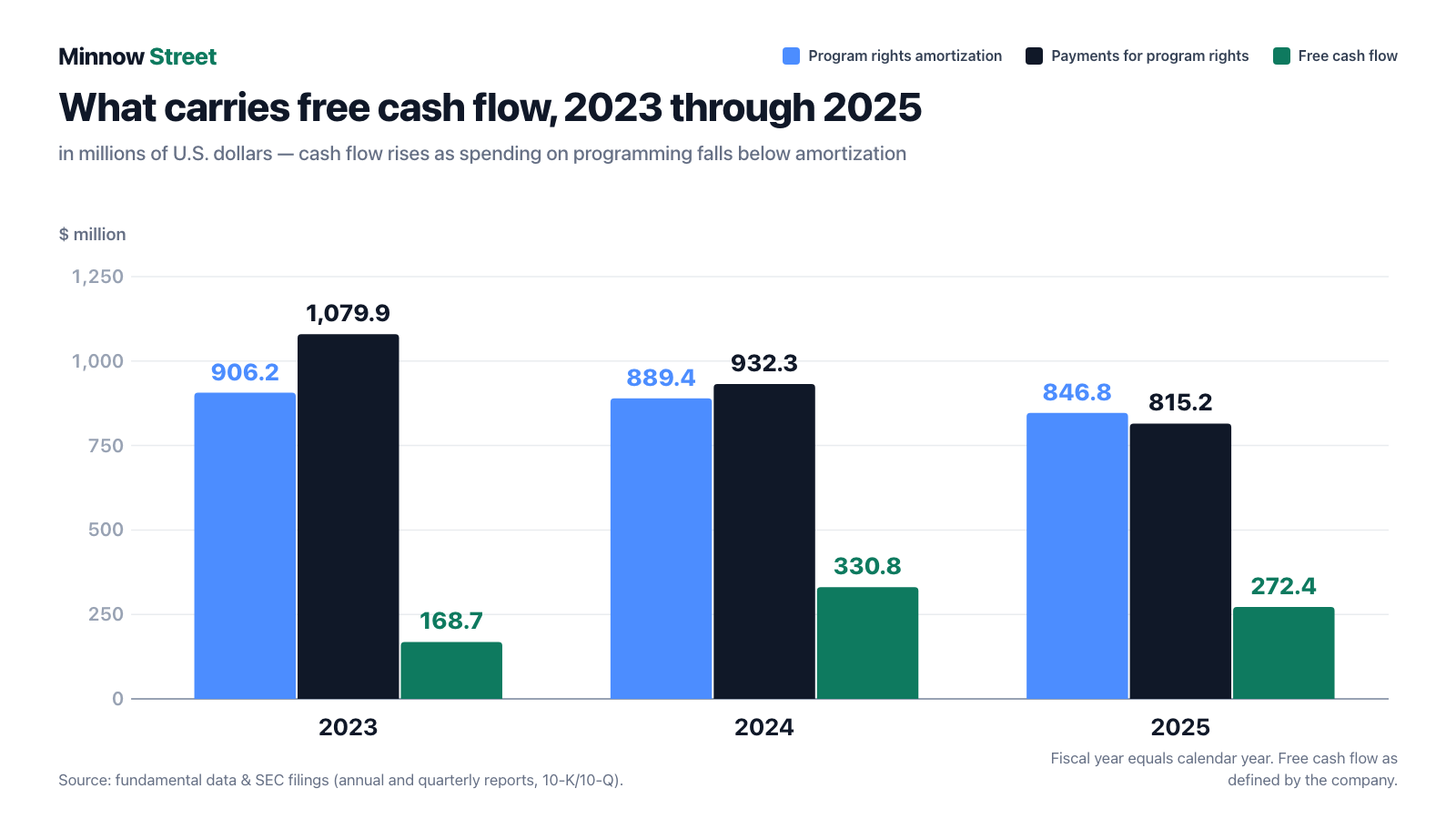
In plain terms, here is what happens. Program rights are the series and film library, capitalized like a machine: first you pay for the production or the license, then the value is written off over its useful life. As long as a company spends more on new programming than it amortizes, the library grows — and cash flow is low. Reverse that and cash flow rises, but the library shrinks. Remember the image: this is not an engine, it is a pantry. And that pantry is measurably emptying: program rights fell during the first quarter of 2026 alone from $1,766.6 million to $1,691.6 million, and the “in-production and in-development” line from $333.6 million to $307.1 million.
The year in between shows the arithmetic is not always that clean: in 2024, $889.4 million of amortization still faced $932.3 million of payments — the library was still growing — and yet free cash flow peaked at $330.8 million. The reason sits one line further down in the cash flow statement: the release of prepaid expenses and other assets brought in a one-time $215.0 million in 2024. That, too, is money that arrives only once.
The annual report puts it soberly:
“In 2025, net cash provided by operating activities primarily resulted from $1,030.2 million of net income before amortization of program rights, net gain on extinguishment of debt, impairment charges, depreciation and amortization, and other non-cash items, partially offset by payments for program rights of $815.2 million.”
— AMC Networks Inc. (today AMC Global Media Inc.), SEC annual report 10-K for 2025, Management's Discussion and Analysis

What the filings say — the uncomfortable truths
Uncomfortable truth No. 1: market capitalization is only a quarter of the purchase price
Here lies the real flaw in the opening number. A price-to-earnings or price-to-cash-flow ratio measures market capitalization — what the shareholders are collectively worth. Anyone actually buying the company would also have to assume its debt. Let us run that, using the full share count printed on the cover of the quarterly report: as of May 1, 2026 there were 32,443,304 Class A shares and 11,484,408 Class B shares outstanding, together 43,927,712. At $9.80 per share (data as of July 24, 2026) that is $430.5 million of market capitalization. Anyone counting only the Class A shares — the common mistake, because many data services carry only that class — arrives at $318.0 million and lands a quarter too low.
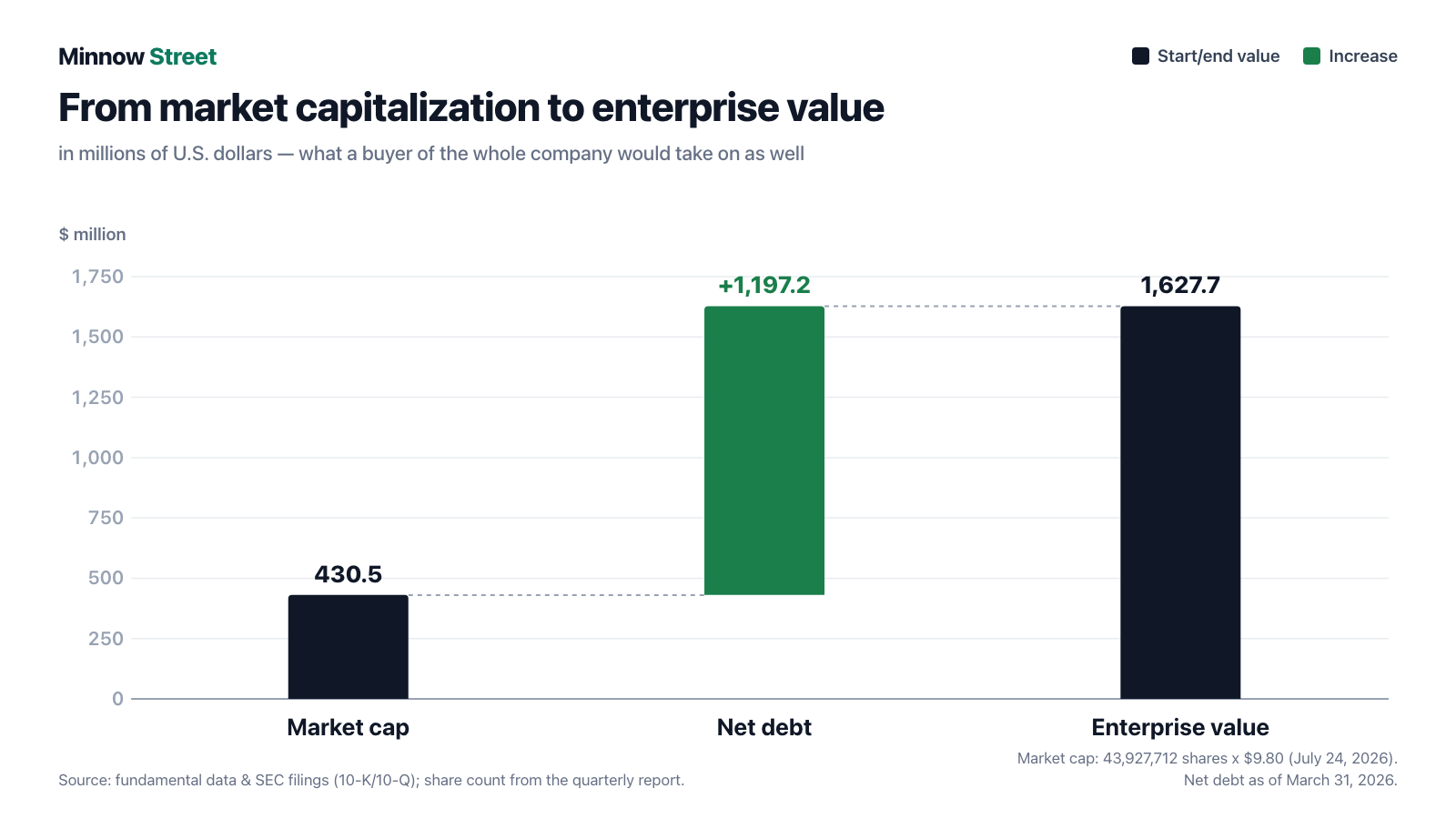
Net debt as of March 31, 2026: financial debt of $1,749.3 million as carried on the balance sheet (after discount and financing costs; principal is $1,829.3 million) less $552.1 million of cash gives $1,197.2 million. Enterprise value is therefore about $1,627.7 million. Now the same calculation as at the start, only honest: measured against free cash flow of $272.4 million, the company costs not 1.6 times but 6.0 times. That is still low — but it is an entirely different number. For every dollar of market capitalization there are $2.80 of net debt. Buying the stock means buying a thin slice of equity in a heavily indebted business; that is classic leverage, and it works in both directions.
Uncomfortable truth No. 2: the 2025 profit came from the finance department
In 2025 AMC Networks reported net income attributable to stockholders of $89.4 million after a $226.5 million loss the year before. A turnaround? Look at the income statement. Pre-tax income was $148.0 million. Inside it sits a line called gain on extinguishment of debt worth $129.8 million — 88 percent of pre-tax income. Without it, $18.2 million would remain.
“In July 2025, we completed a cash tender offer to repurchase $600.0 million of our Senior Notes at a discount of $111.0 million, and retired the tendered Senior Notes. … During 2025, we also repurchased $108.3 million principal amount of our outstanding Senior Notes through open market repurchases, at discounts totaling $28.2 million, and retired the repurchased Senior Notes.”
— AMC Networks Inc. (today AMC Global Media Inc.), SEC annual report 10-K for 2025, Management's Discussion and Analysis

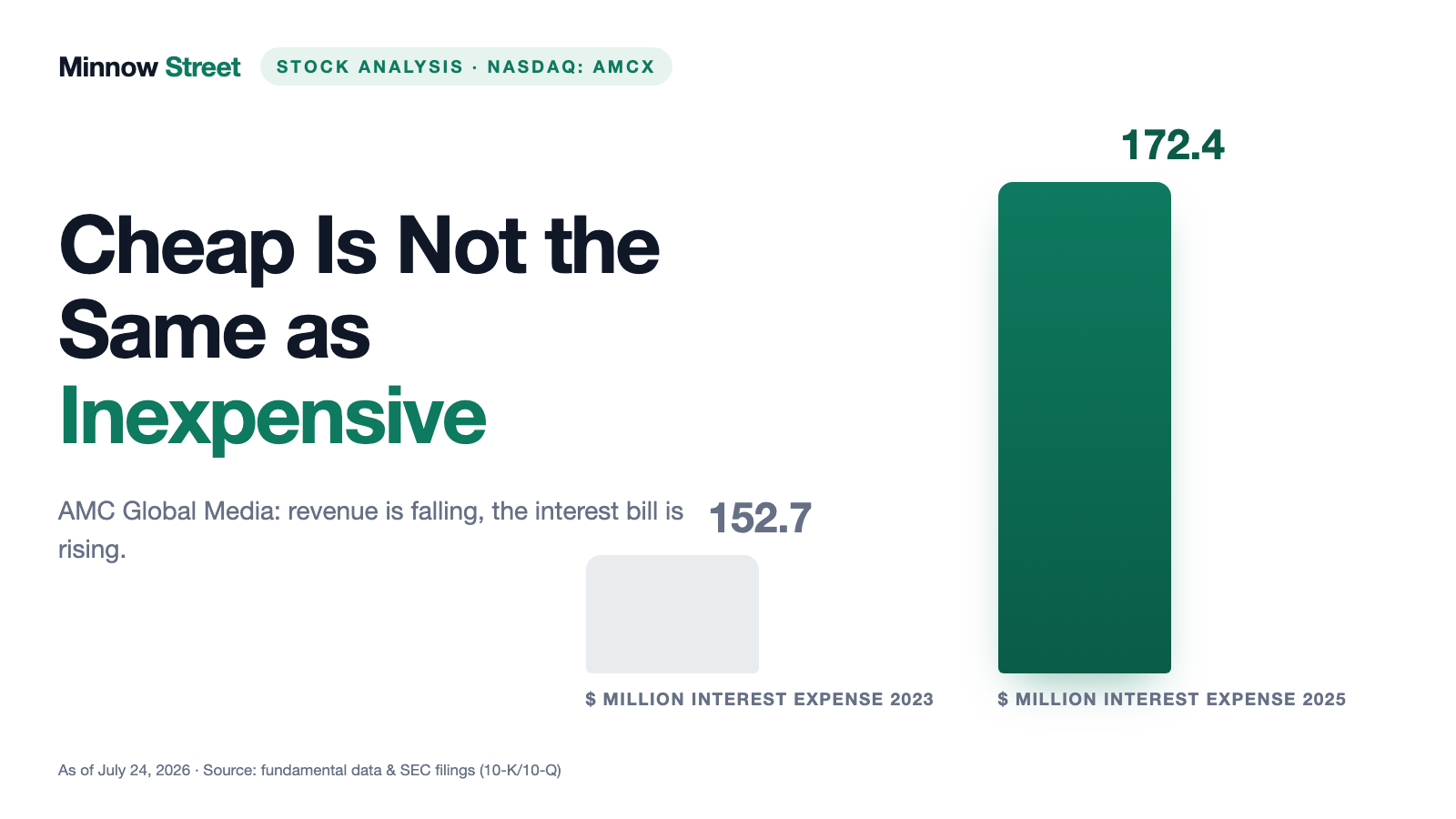
Economically this is a good transaction: buying back your own debt at 80 cents on the dollar destroys liabilities cheaply. But it is not an operating result and not repeatable — bonds collected cheaply once cannot be collected a second time. The first quarter of 2026 shows the company without that item: revenue of $542.1 million (down 2.4 percent), operating income of $31.3 million after $64.2 million a year earlier, interest expense of $41.3 million — and therefore a net loss of $18.9 million after a $18.0 million profit the year before. Adjusted operating income fell 34 percent to $69.0 million, free cash flow 31 percent to $64.8 million. Interest expense, incidentally, is the one line that reliably grows: $152.7 million (2023), $166.2 million (2024), $172.4 million (2025).
Uncomfortable truth No. 3: the swap made the debt bigger, dearer — and permitted buybacks
On March 13, 2026 the company completed the early settlement of an exchange offer. Roughly $830.6 million of principal of its 10.25 percent notes due 2029 — about 95 percent of the $875 million outstanding — was swapped for new 10.50 percent notes due 2032. Roughly $884 million of principal was issued in return. Compare that carefully: principal rose by about $53 million, the coupon by a quarter point, the maturity by three years. As of March 31, 2026, $1,315.1 million of the 10.50 percent notes due 2032 were outstanding against just $13.7 million of the old 2029s.
“… (ii) related consent solicitation (the ‘Consent Solicitation’) to amend the indenture governing the Old Notes (the ‘Old Notes Indenture’) to amend the covenant that limits restricted payments in order to permit buybacks, purchases, redemptions, retirements or other acquisitions of the Company’s equity interests in an aggregate amount not to exceed $50,000,000.”
— AMC Networks Inc., SEC current report 8-K of March 13, 2026, Item 1.01

Against a market capitalization of $430.5 million, $50 million is 11.6 percent — so the headroom purchased is substantial. For the matching consent from holders of the 2032 notes the company paid an additional $2.0 million fee in February 2026. One more move belongs in the picture: on May 12, 2026 it repaid the remaining $80.0 million of its term loan and terminated the undrawn $175.0 million revolving credit facility. That leaves the balance sheet free of bank debt — but it also removes the maintenance covenants attached to it (a maximum net leverage ratio of 5.50 and a minimum interest coverage ratio of 1.50). As of March 31, 2026 the company reported that it was in compliance with them.
Uncomfortable truth No. 4: four percent of the shares, seventy-nine percent of the votes
Anyone hoping at this valuation for a sale of the company or for an activist investor has to read one line in the annual report:
“As of December 31, 2025, certain members of the Dolan family, including certain trusts for the benefit of members of the Dolan family (collectively ‘the Dolan Family Group’), collectively owned all of our Class B Common Stock, approximately 4% of our outstanding Class A Common Stock and approximately 79% of the total voting power of all our outstanding common stock …”
— AMC Networks Inc. (today AMC Global Media Inc.), SEC annual report 10-K for 2025, Risk Factors

Translated: a Class B share carries ten votes, a Class A share one. Class A holders together elect at least 25 percent of the board — Class B decides the rest. Within the family, so-called Excluded Trusts hold 83 percent of the Class B shares and vote independently of the family committee. Without their consent there is no sale and no change of control. You know the same structure from our analyses of MSG Entertainment and Sphere Entertainment — both Dolan-controlled companies with two share classes.
For investors one technical detail matters even more than the percentage: Class B shares can be converted into Class A shares one for one at any time. The 11,484,408 Class B shares equal about 35 percent of the 32,443,304 Class A shares. A conversion would raise the tradable float accordingly — and with average daily volume just under half a million shares, that is no small matter.
Valuation — cheap is not the same as inexpensive
Let us pull the valuation side together, all with price data as of July 24, 2026 and balance-sheet figures as of March 31, 2026. Market capitalization is roughly $430.5 million, enterprise value $1,627.7 million. Against revenue that gives a price-to-sales ratio of 0.18 and an enterprise value of 0.70 times annual revenue. Against adjusted operating income of $411.9 million, enterprise value costs 4.0 times. The share price equals 0.45 times book value. These are, without any varnish, distressed-sale valuations.
The professional view is split and, on balance, negative: of eight analysts one recommends a strong buy, one a buy, two a hold, one a sell and three a strong sell; the average price target is $7.50 — below the $9.80 share price. The market is betting against the stock too: roughly 21 percent of the float was sold short. And the price sits roughly 89 percent below its all-time high.
So why is the stock this cheap? Because the market is pricing in three things, all of which sit in the filings. First, revenue is shrinking, and precisely where the margin was highest — 14.2 percent less advertising revenue in a single year. Second, the cash flow is borrowed from tomorrow, because it comes from drawing down the content library; produce less now and you have less to sell in two years. Third, the debt is the real security — $1,197.2 million of net debt against $430.5 million of market capitalization, with interest expense exceeding operating income in the first quarter of 2026. One more warning sits in the notes: in the annual impairment test the estimated fair value of the U.S. segment exceeded its carrying value by only 6 percent — for the international segment it did not suffice in 2025, and $93.4 million was written off.
The other side of the calculation is just as real: at an enterprise value of $1,627.7 million and free cash flow of $272.4 million, a buyer of the whole company would recover the purchase price in six years — provided the cash flow holds. That proviso is the wager.
Opportunities and risks at a glance
Opportunities
- Real, substantial cash flow: $272.4 million of free cash flow in 2025 (2024: $330.8 million; 2023: $168.7 million) against $430.5 million of market capitalization; cash rose to $552.1 million during the first quarter of 2026.
- Debt is being actively reduced: in 2025 bonds with $708.3 million of principal were repurchased below par and $282.8 million of the term loan was repaid; the rest of the loan followed on May 12, 2026.
- Very low valuation multiples: price-to-sales of 0.18, enterprise value at 0.70 times revenue and 4.0 times adjusted operating income, price-to-book of 0.45 (data as of July 24, 2026).
- No acute balance-sheet distress: an Altman Z-score of 7.13 in the Z-double-prime variant, whose safe zone starts at 2.6; $988.2 million of equity and $552.1 million of cash (March 31, 2026).
- Permitted buyback headroom: share repurchases of up to $50 million have been allowed since February 2026 — 11.6 percent of market capitalization.
Risks
- The cash flow comes out of the pantry: in 2025 the company amortized $846.8 million of program rights but spent only $815.2 million on them; program rights fell during the first quarter of 2026 from $1,766.6 million to $1,691.6 million.
- The 2025 profit is a one-off: $129.8 million of the $148.0 million pre-tax income came from repurchasing the company's own bonds; the first quarter of 2026 produced a $18.9 million net loss.
- Interest exceeds operating income: $41.3 million against $31.3 million in the first quarter of 2026; interest expense rose from $152.7 million (2023) to $172.4 million (2025), and the exchange lifted both coupon and principal further.
- Advertising revenue is collapsing: down 14.2 percent to $580.8 million in 2025; total revenue has fallen by $400 million since 2023 to $2,311.8 million.
- No takeover story against the family's will: roughly 79 percent of the votes sit with the Dolan Family Group, and 83 percent of the Class B shares sit in trusts that vote independently.
- Goodwill on the edge: the fair value of the U.S. segment exceeded its carrying value by only 6 percent in the 2025 test; the international segment already took a $93.4 million impairment.
- Heavy short interest: roughly 21 percent of the float; analyst consensus carries a $7.50 price target below the share price.
A human conclusion
Back to the metric trap. The 1.6 times free cash flow is not a wrong number — it is correctly calculated and still fails to describe what you are buying. As soon as $1.2 billion of net debt stands beside it, 1.6 becomes 6.0. And as soon as you ask where the cash flow comes from, there is no machine, only a pantry from which more has been leaving than entering for two years.
What remains is an honest conflict of interest you have to sit with. For the bondholders AMC Global Media is a good story: the company throws off cash, retires debt below par and has just bought itself three more years. For the shareholder the very same company is a thin residue behind a large pile of debt — with revenue shrinking every year, and no way to change any of it against the will of one family. Both readings sit in the same filings. They do not contradict each other; they simply concern different securities of the same company.
If you follow this one, there are three numbers to look for in the next quarterly report: how large is interest expense relative to operating income? How much program rights value is left on the balance sheet? And does the income statement again show a gain from debt repurchases — or does the business have to carry itself this time? What you make of that is your call. And that is exactly as it should be.
Sources
- SEC annual report 10-K, AMC Networks Inc. (today AMC Global Media Inc.), fiscal 2025, filed February 11, 2026
- SEC quarterly report 10-Q as of March 31, 2026, filed May 8, 2026 (most recent periodic report)
- SEC current report 8-K of March 13, 2026, Items 1.01 and 2.03 (note exchange, consent solicitation, terms of the new notes)
- SEC current report 8-K of June 17, 2026, Items 5.02 and 5.07 (appointment of Hozefa Lokhandwala as chief financial officer, annual meeting results)
- Fundamental data and metrics from our in-house data set (price, valuation, analyst consensus, short interest; data as of July 24, 2026)
- Our in-house price-to-free-cash-flow ranking (U.S. selection, 545 hits), measured July 27, 2026
This analysis is journalistic commentary and expressly not investment advice, not a buy or sell recommendation, and not a solicitation to buy or sell securities. Stocks can lose value substantially at any time; a total loss is possible, and at a company whose net debt is a multiple of its market capitalization, any deterioration in the business hits the share price disproportionately. All figures come from the primary sources named above and carry the reporting date stated there. The author holds no position in the security discussed at the time of publication.
Our Bottom Line at a Glance
- Cash flow and valuation positive
- Free cash flow was $272.4 million in 2025 (2024: $330.8 million) against a market capitalization of $430.5 million — 1.6 times. Cash rose to $552.1 million during the first quarter of 2026. Price-to-sales 0.18, price-to-book 0.45 (data as of July 24, 2026).
- Where the cash flow comes from negative
- From drawing down the content library: in 2025 the company amortized $846.8 million of program rights but spent only $815.2 million on them. In 2023 the ratio was the other way round ($906.2 million against $1,079.9 million). Program rights fell during the first quarter of 2026 from $1,766.6 million to $1,691.6 million, and the in-production and in-development line from $333.6 million to $307.1 million.
- Earnings quality negative
- Of $148.0 million in 2025 pre-tax income, $129.8 million came from repurchasing the company's own bonds below par — 88 percent. Without that one-off accounting gain, $18.2 million would have remained. In the first quarter of 2026 interest expense of $41.3 million exceeded operating income of $31.3 million and a net loss of $18.9 million remained.
- Leverage negative
- Net debt of $1,197.2 million stands against $430.5 million of market capitalization — $2.80 of debt per dollar of market capitalization. The March 13, 2026 exchange lifted principal from roughly $830.6 million to roughly $884 million, the coupon from 10.25 to 10.50 percent and the maturity from 2029 to 2032. The term loan was repaid on May 12, 2026 and the revolver terminated — which also removes the maintenance covenants attached to them.
- Business trend negative
- Revenue fell from $2,711.9 million (2023) through $2,421.3 million (2024) to $2,311.8 million (2025), advertising alone by 14.2 percent to $580.8 million in 2025. The first quarter of 2026 added another 2.4 percent decline. In the 2025 impairment test the fair value of the U.S. segment exceeded its carrying value by only 6 percent; the International segment took a $93.4 million write-off.
- Control and share structure negative
- As of December 31, 2025 the Dolan Family Group held all Class B shares with ten votes each, roughly 4 percent of the Class A shares and therefore roughly 79 percent of all votes; Class A holders elect only at least 25 percent of the board. The 11,484,408 Class B shares convert one-for-one into Class A at any time — about 35 percent of the Class A count.
AMC Global Media is the metric trap in its purest form: a market capitalization of $430.5 million equals 1.6 times free cash flow of $272.4 million — and as soon as net debt of $1,197.2 million stands beside it, that becomes 6.0 times. The cash flow itself comes from spending only $815.2 million on program rights in 2025 while amortizing $846.8 million; the reported profit came 88 percent from repurchasing the company's own bonds below par. The business underneath has shed $400 million of revenue since 2023, advertising alone fell 14.2 percent in 2025, and in the first quarter of 2026 interest expense exceeded operating income. Above it all, the Dolan family holds roughly 79 percent of the votes with about 4 percent of the Class A shares. Not investment advice.
What Our Rating Means
Substance risk
We found at least one documented issue that threatens the company itself — regardless of how the stock is currently valued.
The balance sheet holds up in the near term — $988.2 million of equity, $552.1 million in cash, an Altman Z of 7.13 in the Z-double-prime variant whose safe zone starts at 2.6 — and free cash flow of $272.4 million is real. The quality of the business underneath is not. First, direction: revenue fell from $2,711.9 million (2023) through $2,421.3 million (2024) to $2,311.8 million (2025), and another 2.4 percent in the first quarter of 2026; advertising alone dropped 14.2 percent in 2025. Second, earnings quality: $129.8 million of the $148.0 million of 2025 pre-tax income came from repurchasing the company's own bonds below par, and the cash flow from spending $815.2 million on program rights while amortizing $846.8 million — program rights fell in the first quarter of 2026 alone from $1,766.6 million to $1,691.6 million. Third, leverage: $1,197.2 million of net debt against $430.5 million of market capitalization, and in the first quarter of 2026 interest expense of $41.3 million exceeded operating income of $31.3 million. Add an impairment test in which the U.S. segment cleared its carrying value by only 6 percent while the International segment already took a $93.4 million write-off. A shrinking business, borrowed earning power, high leverage — that is red, not yellow.
A journalistic assessment by our editorial team at the time of the deep dive, based on public sources — not investment advice and not a solicitation to buy or sell. Your personal circumstances (investment goals, risk capacity, taxes) cannot be taken into account. What our levels mean, how verdicts are formed, and what conflicts of interest exist →
Worth Noting
- AMC Global Media reached our research list through our in-house price-to-free-cash-flow ranking (U.S. selection). Important for context: the list had 545 U.S. hits on July 27, 2026, and AMCX sat at rank 32 with a reading of 1.74 — outside the 25 displayed places. The stock can be looked up through the stock screener (country United States, P/FCF filter "under 10", search box AMCX). It also appears in the price-to-sales and price-to-cash-flow rankings. All lists are recomputed daily.
- The data basis is the annual report 10-K for 2025 (filed February 11, 2026), the quarterly report 10-Q as of March 31, 2026 (filed May 8, 2026, the most recent periodic report) and the 8-K filings of March 13, 2026 and June 17, 2026. Market data as of July 24, 2026. Market capitalization was calculated by us: 43,927,712 shares across both classes per the quarterly report cover page (as of May 1, 2026) times $9.80. Data services that carry only the 32,443,304 Class A shares arrive at $318.0 million and land roughly a quarter too low.
- Three risks of confusion: AMC Global Media (ticker AMCX) is not the cinema chain AMC Entertainment (ticker AMC). The name AMC Networks Inc. applies only through April 3, 2026, while the SEC identifier (CIK 0001514991) stays. And the Altman Z-score of 7.13 comes from the Z-double-prime variant for non-manufacturers, whose thresholds are 1.1 (distress) and 2.6 (safe zone) — not from the original formula with 1.8 and 3.0.
Frequently Asked Questions
AMC Global Media Inc. (NASDAQ: AMCX) of New York runs the cable networks AMC, BBC America, IFC, Sundance TV and WE tv along with the streaming services AMC+, Acorn TV, Shudder, Sundance Now, ALLBLK and HIDIVE, which ended 2025 with roughly 10.4 million subscribers. Revenue in 2025 was $2,311.8 million: $1,453.2 million from subscriptions, $580.8 million from advertising and $277.8 million from content licensing and other sources.
It is a pure name change. On April 8, 2026 AMC Networks Inc. filed amended and restated articles of incorporation with the Nevada Secretary of State to become AMC Global Media Inc.; in SEC records the change is dated April 3, 2026. The SEC identifier (CIK 0001514991), the ticker AMCX and all time series remain unchanged. Not to be confused with the cinema chain AMC Entertainment (ticker AMC).
Cheap it is; inexpensive is another question. At $9.80 per share (data as of July 24, 2026) and 43,927,712 shares across both classes, market capitalization is $430.5 million — 1.6 times the $272.4 million of free cash flow. Add net debt of $1,197.2 million and the same cash flow costs 6.0 times. For every dollar of market capitalization there are $2.80 of net debt.
Largely from spending less on programming than it writes off. In 2025 the company amortized $846.8 million of program rights and paid $815.2 million for them. In 2023 it was the reverse: $906.2 million of amortization against $1,079.9 million of payments, and free cash flow was only $168.7 million. Accordingly, program rights fell during the first quarter of 2026 from $1,766.6 million to $1,691.6 million.
Because the 2025 profit came from the finance department. Of $148.0 million in pre-tax income, $129.8 million came from repurchasing the company's own bonds below par — a one-off accounting gain. The first quarter of 2026 had no such item: with operating income of $31.3 million and interest expense of $41.3 million, the result was a net loss of $18.9 million, after an $18.0 million profit a year earlier.
The Dolan family. As of December 31, 2025 the Dolan Family Group owned all Class B shares carrying ten votes each plus roughly 4 percent of the Class A shares — together roughly 79 percent of all voting power. Class A holders elect only at least 25 percent of the board. Within the family, so-called Excluded Trusts hold 83 percent of the Class B shares and vote independently. A sale against the will of those trusts is effectively impossible.
As of March 31, 2026 the balance sheet showed financial debt of $1,749.3 million (principal $1,829.3 million) — essentially $1,315.1 million of 10.50 percent notes due 2032, $276.7 million of 4.25 percent notes due 2029, $143.8 million of convertible notes due 2029 and $13.7 million left of the 10.25 percent notes due 2029. Less $552.1 million of cash that leaves net debt of $1,197.2 million. The term loan was repaid on May 12, 2026.
Because the page shows only the 25 strongest hits. The U.S. selection of that list had 545 hits in total on July 27, 2026; AMCX sat at rank 32 with a reading of 1.74, outside the displayed places. You can look the stock up through the stock screener: set the country to the United States, choose “under 10” in the P/FCF filter and type AMCX into the search box.
Found an error?
Did you spot a factual error, an outdated number, or a typo in this deep dive? Let us know briefly — your report goes straight to the editorial team.