Zepp Health: Xiaomi Is Gone — and the Largest Item on the Balance Sheet Is a Chinese Stake That Cost $144.9 Million
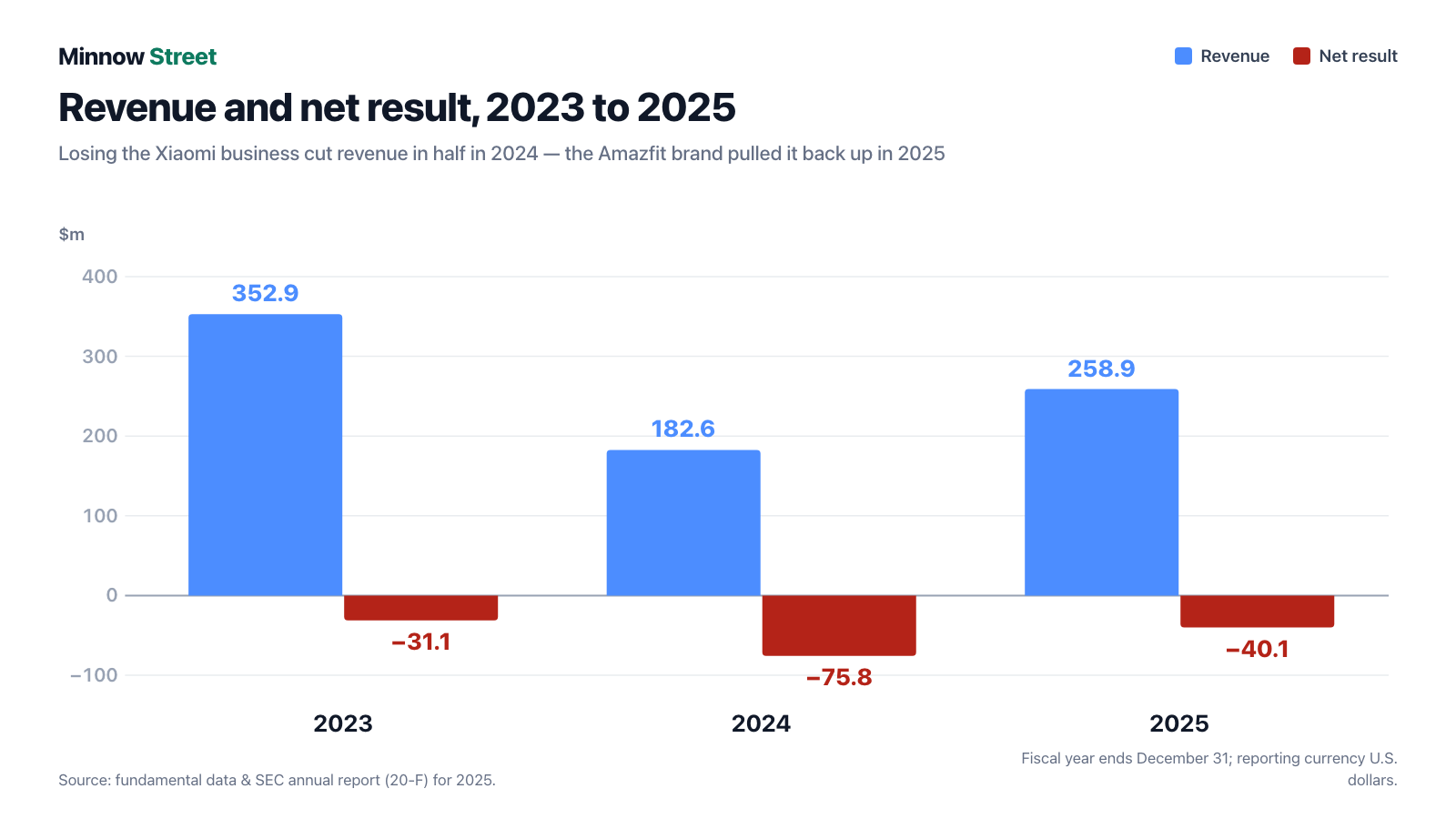
Zepp Health builds the Amazfit sports watches — and was called Huami until February 2021. Back then a good quarter of revenue came from contract manufacturing for Xiaomi. In 2025 not a single dollar did: revenue fell from $352.9 million to $182.6 million before recovering to $258.9 million, while gross margin climbed from 26.2 to 38.3 percent. Open the annual report, though, and something else appears: $220.0 million of investments, including $135.0 million in a Shenzhen-listed company whose board is chaired by Zepp's own chief executive. Not investment advice — but the watch on your wrist is only one third of the package here.
 Thomas Mücke
Founder & Publisher
Thomas Mücke
Founder & Publisher
Chart
Interactive price chart (TradingView).
Note: pure fact-based analysis, not investment advice and not a solicitation to buy or sell. All figures without guarantee.
There is an investor weakness with no elegant name, so let us call it the wrist test. We judge a company by the one part we can see, touch and check for ourselves — and quietly assume the rest is just as solid. At Zepp Health (NYSE: ZEPP) that one part sits literally on your wrist: the Amazfit sports watches. The company was named Huami Corporation until February 2021 and originally made its money assembling fitness bands for Xiaomi. It is worth roughly $68 million on the exchange while carrying $194.2 million of equity on its balance sheet and $103.2 million of cash — which sounds like a twenty-dollar bill for ten. So let us make a deal: before you let the watch on your wrist vouch for the whole company, we read together what Zepp itself reported to the U.S. securities regulator, the SEC — the annual report on Form 20-F for 2025 filed April 24, 2026, and the interim report on Form 6-K of June 9, 2026 carrying first-quarter 2026 results. An SEC filing is honest under penalty of law. And this one tells the story of a divorce that made the business healthier and half its former size — plus one balance-sheet item larger than the entire market value. What you do with it is your call.
What Zepp Health actually does — and why the company changed its name twice
Zepp Health sells sports watches, fitness bands, smart rings and accessories under the Amazfit brand. Around them sit an in-house watch operating system, Zepp OS, an AI chip called Huangshan, and two smaller health applications: Zepp Clarity (hearing aids) and Zepp Aura (soundscapes for sleep). By the company's own account in the interim report of June 9, 2026, it has shipped more than 200 million devices, served over 53 million users and sells in more than 150 countries and regions.
The corporate history explains almost everything that happens in the numbers. Founded in 2013 as Huami, the company began as a contract manufacturer for Xiaomi, building the fitness bands sold under the Chinese phone maker's brand. In everyday terms: it was the bakery that supplies rolls to the supermarket — high volume, someone else's name on the bag, thin margin. Its own Amazfit brand arrived in September 2015, the Zepp brand in August 2020, and in February 2021 the company renamed itself Zepp Health Corporation; the ticker changed from HMI to ZEPP. At the SEC the filer identifier is unchanged (CIK 0001720446), with "Huami Corp" recorded as a former name.
Legally, Zepp is a Cayman Islands holding company; its executive offices are now in Gorinchem in the Netherlands, while research and manufacturing sit largely in China, organized through variable interest entities — companies the group does not own but consolidates through contracts (Anhui Huami and Huami Beijing). As of December 31, 2025 they employed 763 people, 643 of them in mainland China, 55 in North America and 54 in Europe; 465 of the 763 work in research and development. One detail matters for anyone reading the filings: Zepp is a foreign private issuer. That means there is an annual report on Form 20-F and interim reports on Form 6-K — but no quarterly report on Form 10-Q of the kind U.S. domestic filers submit. Looking for a 10-Q here is looking for something that does not exist.
That frames the central tension of this analysis, and it runs through every chapter: Zepp has rebuilt itself from contract manufacturer into a branded business — higher margin, smaller scale. But only half the balance sheet belongs to that business; the other half is an investment portfolio in China.
How the stock reached our desk
Zepp Health is not a momentum find. It reached the desk through a ratio anomaly in the universe covered by our in-house stock scanner (data as of July 29, 2026): a company whose entire market value sits below half its book equity — and that still grew revenue 33.8 percent in its most recently reported quarter. That combination is rare enough to warrant a look. The key ratios, translated and judged:
- Price-to-book of roughly 0.35. For every dollar of book equity you pay 35 cents on the exchange. That is a genuine outlier — a consumer electronics maker would normally trade somewhere between 1 and 3 times book. Numbers like this do not appear by accident: either the market distrusts the book values or it expects the company to burn through them.
- Price-to-sales of roughly 0.25. The market value equals about one quarter's revenue. Also unusually low — but no proof of quality, only the price of the fact that no profit sits underneath that revenue.
- Equity ratio of 36.5 percent (March 31, 2026). Adequate, not comfortable. For a hardware maker carrying inventory risk, more would be pleasant.
- Exactly one analyst estimate in the data set as of July 29, 2026. Calling that a "consensus of the professionals" would be a lie — almost nobody follows this stock. With small caps that is both an opportunity and a risk: less efficiency, but also less of a corrective.
Before we calculate anything further, two data traps have to go — otherwise you are working with the wrong numbers. First, the share count. Many data sources show roughly 8.5 million shares for ZEPP. That is the 135,608,316 Class A shares divided by 16, because one American depositary share (ADS) — the certificate that makes a foreign share tradeable in New York — has represented 16 Class A ordinary shares since September 16, 2024. The problem: there are another 99,277,687 Class B ordinary shares. Together that is 234,886,003 ordinary shares, or roughly 14.68 million ADS equivalents. Forget the Class B and you understate both share count and market value by a good 42 percent. Second, the currency. Zepp historically reported in Renminbi and switched to U.S. dollars in the second quarter of 2024, applied retrospectively to every prior year shown. Balance sheet and listing are therefore in the same currency, and every figure in this analysis is in U.S. dollars.
The numbers over the years — given honest credit
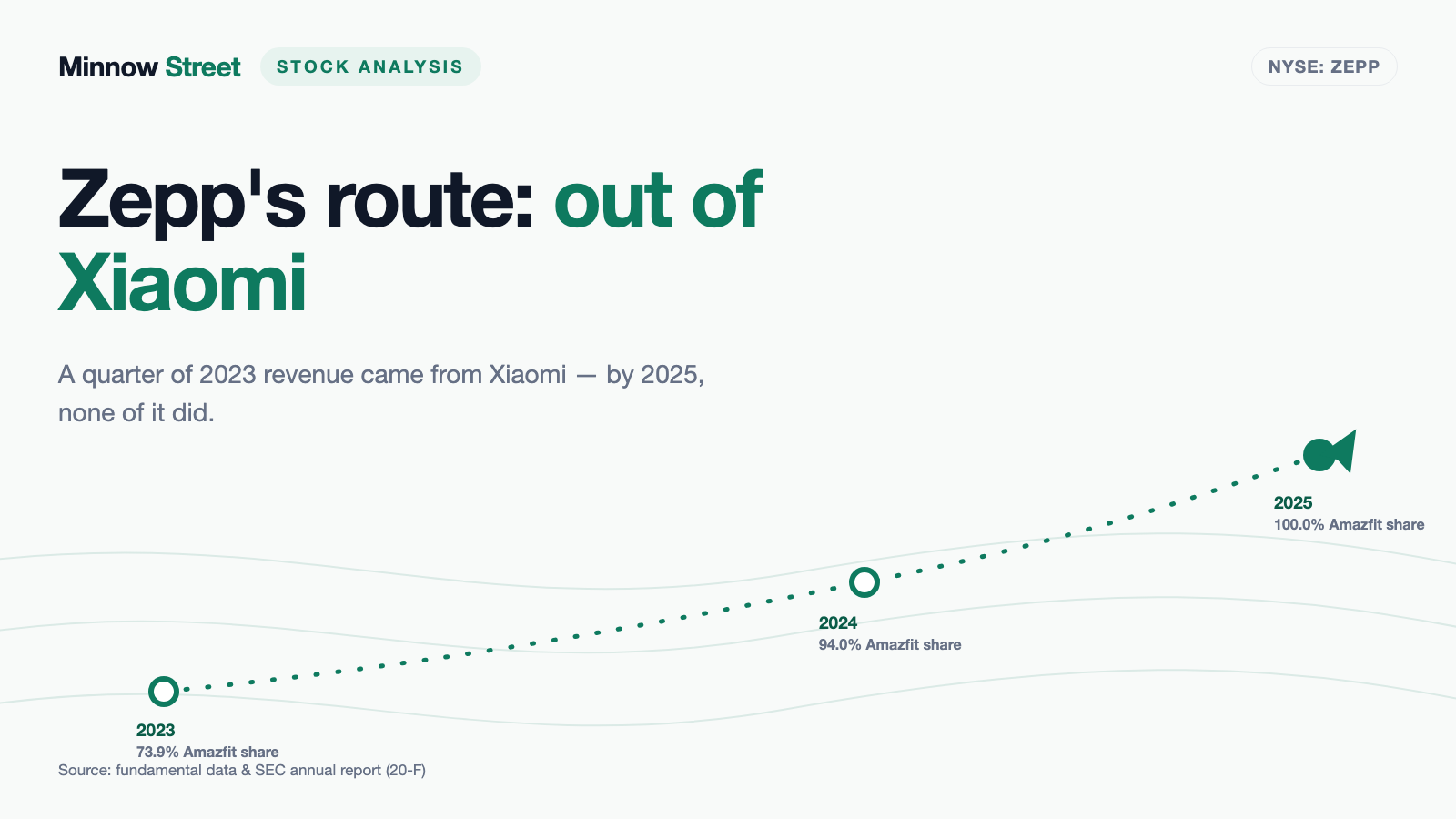
First the part that genuinely impresses. Zepp pulled off something many contract manufacturers do not survive: walking away from the big customer without going under. Revenue fell 48.3 percent in 2024 to $182.6 million — and rose 41.8 percent in 2025 to $258.9 million. More important than the level is the quality. Gross margin — the share of revenue left after production cost — climbed from 26.2 percent in 2023 to 38.5 percent in 2024 and 38.3 percent in 2025, reaching 40.4 percent in the fourth quarter of 2025. The supermarket bakery now has its own shop: fewer units, more margin per unit. One line in the annual report shows how complete the switch is: the Amazfit brand's share of revenue rose from 73.9 percent in 2023 through 94.0 percent in 2024 to 100.0 percent in 2025.
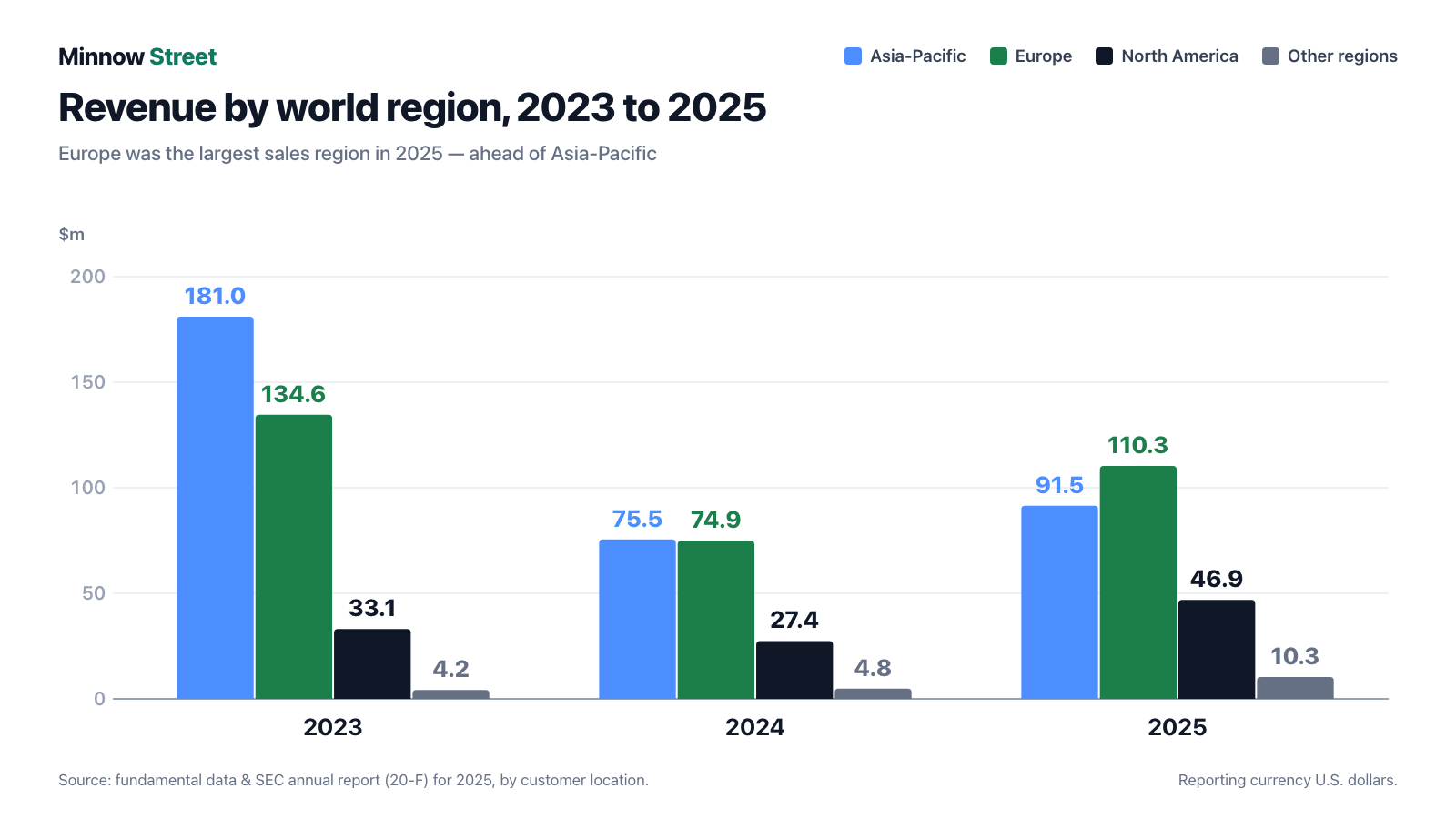
The map has flipped as well, and decisively. In 2023 Asia-Pacific was the largest sales region at $181.0 million, with Europe second at $134.6 million. In 2025 the order reversed: Europe $110.3 million, Asia-Pacific $91.5 million, North America $46.9 million (the United States accounting for $43.6 million) and other regions $10.3 million. A company with Chinese roots whose biggest market is now Europe — which also explains why the executive offices have moved to the Netherlands.
The most recent figures continue the trend. In the first quarter of 2026 revenue rose 33.8 percent to $51.5 million, gross margin came in at 37.7 percent (37.3 percent a year earlier) and gross profit at $19.4 million, up 35.3 percent. For the second quarter of 2026 management guides to $63.0 million to $68.0 million — 6 to 14 percent above the $59.4 million a year earlier. In April 2026 the partnership with the fitness racing series HYROX was extended into an exclusive global three-year agreement. Remember the finding: the operating business is running better than it has in years. Which brings us to the uncomfortable truths.
What the filings say — the uncomfortable truths
Uncomfortable truth No. 1: the revenue collapse was a divorce — and the marriage paid badly
Read "revenue down 48.3 percent" and you picture a dying business. The annual report says where the drop came from:
"Our revenues decreased by 48.3% from US$352.9 million for the year ended December 31, 2023 to US$182.6 million for the year ended December 31, 2024. The decrease in total revenues mainly resulted from an 88.0% decline in the sales of Xiaomi wearable products."
— Zepp Health Corporation, SEC annual report on Form 20-F for 2025, Item 5.A

The income statement puts a dollar figure on the divorce. Each revenue line carries a parenthetical showing the portion from related parties — essentially Xiaomi: $92.0 million (2023), $11.0 million (2024), zero (2025). And here is the number that turns the story around: the same line shows the related cost of revenues at $82.2 million (2023) and $9.4 million (2024). The Xiaomi business therefore carried a gross margin of roughly 10.7 percent in 2023 — a quarter of revenue, but only a tenth of gross profit. A customer whose departure lifts group margin from 26.2 to 38.5 percent was never a good customer. He was a big one.
Honesty requires the counterweight: Zepp also lost purchasing scale, and customer concentration has not vanished, only moved. As of December 31, 2025, 57.9 percent of receivables sat with five customers, 23.2 percent with a single one that had accounted for 0.1 percent a year earlier. One customer also delivered 10.2 percent of 2025 revenue. How quickly that becomes a problem was on display in our analysis of Verra Mobility, where a single client accounted for 14 percent of revenue and almost a third of profit. Remember this: shedding one large customer is not diversification — it is often just a new large customer.
Uncomfortable truth No. 2: the stock you buy is only half the company
Miss this one and it costs real money. The cover page of the annual report shows the full capital structure:
"As of December 31, 2025, there were (i) 135,608,316 Class A ordinary shares issued and outstanding, par value US$0.0001 per share […], and (ii) 99,277,687 Class B ordinary shares issued and outstanding, par value US$0.0001 per share."
— Zepp Health Corporation, SEC annual report on Form 20-F for 2025, cover page

The Class B shares are economically equivalent — they convert one-for-one into Class A at any time — but they carry ten votes instead of one. The report does the math: Class B represents 42.3 percent of the capital and 88.0 percent of the votes as of February 28, 2026. Founder and chief executive Wang Wayne Huang controls 87,858,307 shares through HHtech Holdings Limited: 37.4 percent of the capital and 72.7 percent of the votes. The second-largest holder is Xiaomi-affiliated People Better Limited with 15.3 percent of the capital — and Zepp director Alain Lam is also Xiaomi's chief financial officer, a conflict of interest the filing names itself. The divorce appears to have been amicable; the parties still share a roof.
Where does the unusual 1-for-16 ADS ratio come from? From a tight spot. On April 30, 2024 the NYSE notified the company that the average closing price of its ADSs had fallen below one dollar over 30 consecutive trading days, breaching the minimum price criterion. On September 16, 2024 Zepp changed the ratio from 1:4 to 1:16, which arithmetically quadruples the ADS price while changing nothing about the business. On October 2, 2024 the NYSE confirmed compliance had been regained. How wild the ride was afterward is in the filing itself: the 2025 ADS trading range ran from $2.17 to $61.27. In everyday terms, that is not a price chart; it is a roller coaster without a safety bar.
A third point belongs in this chapter because it concerns tomorrow's share count: as of February 28, 2026, 48,760,845 options and share awards on Class A shares were outstanding (13.9 million under the 2015 plan, 25.2 million under the 2018 plan, 9.6 million under the 2023 plan). That is a good fifth of the 234.9 million ordinary shares outstanding. Dilution, in everyday terms: your slice of the cake shrinks because new slices keep being cut — and here the knives are already positioned over a fifth of it.
Uncomfortable truth No. 3: the largest balance-sheet item is not a watch factory
Here is the part the wrist test never reaches. As of December 31, 2025, Zepp's balance sheet carried $220.0 million of long-term investments ($222.3 million at March 31, 2026). That is roughly 39 percent of total assets — and more than the entire $214.5 million of equity. By far the largest single position:
"In February 2021, the Group acquired 29.99% equity interest of Jiangsu Yitong, a company listed on the Shenzhen stock exchange, for a total cash consideration of US$144.89 million. The purpose of the investment is to expand the healthcare ecosystem in the domestic market."
— Zepp Health Corporation, SEC annual report on Form 20-F for 2025, note 8 "Long-term investments"

Run the numbers: in 2021 Zepp paid roughly twice what the entire company is worth on the exchange today for 30 percent of another firm. As of December 31, 2025 the stake is carried at $135.0 million under the equity method — proportional book equity, not market price. It contributed a $1.2 million loss in 2025 (2024: −$2.0 million; 2023: −$0.2 million). As a financial investment, something that has produced nothing for five years while tying up close to a quarter of the balance sheet is a block. And the note on bank borrowings adds a detail:
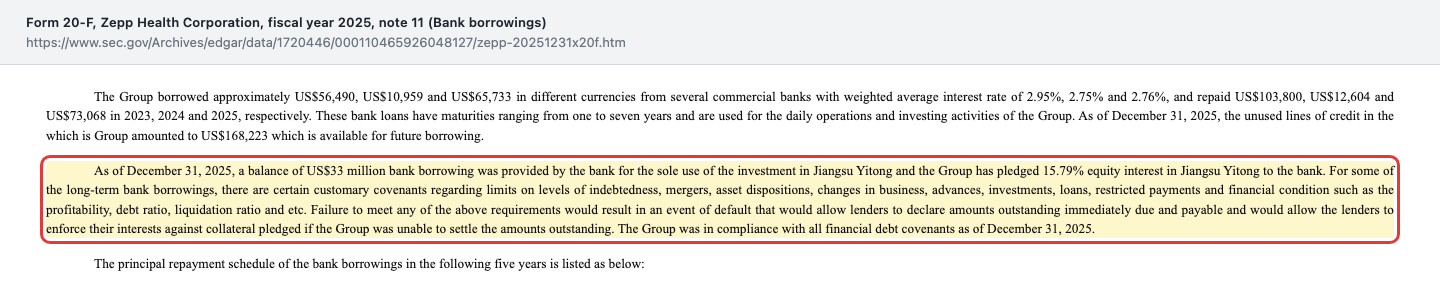
"As of December 31, 2025, a balance of US$33 million bank borrowing was provided by the bank for the sole use of the investment in Jiangsu Yitong and the Group has pledged 15.79% equity interest in Jiangsu Yitong to the bank."
— Zepp Health Corporation, SEC annual report on Form 20-F for 2025, note 11 "Bank borrowings"
Honesty requires the other half of the picture, and it is in the same filing: Jiangsu Yitong is not only an investment but a supplier. The annual report states that the main chips and heart-rate sensors in Amazfit watches are primarily supplied by that company. In 2023 Zepp sold the technology behind its Huangshan-2/2S chips to Yitong's subsidiary Whale Microelectronics for $3.0 million; since September 2024 every product line carries the Huangshan-3, developed by that sister company. Raw-material purchases from the same subsidiary ran to $12.3 million (2023), $3.3 million (2024) and $4.3 million (2025), and in 2025 Zepp billed it $2.1 million for research and development services in return. This is not purely a side show — it is a two-way dependency.
And the circle closes on the personnel side: chief executive Wang Wayne Huang also chairs the board of Jiangsu Yitong, which the annual report lists explicitly among potential conflicts of interest. Close to a quarter of the balance sheet and the chip supply therefore hang on a company whose board is chaired by Zepp's own boss. How badly an investment position can distort the picture of an operating business was also visible at Unusual Machines, where the first quarterly profit came not from the core business but from the company's own securities portfolio. The rest of Zepp's investment package is broadly spread and small: $13.9 million in chip designer SiFive, $25.2 million and $4.2 million in two Chinese technology funds, $8.8 million in Shenzhen Yunding, $7.3 million in medical device maker Promaxo and $3.6 million in AliveCor.
Uncomfortable truth No. 4: half the cash is not free
"$103.2 million of cash" sounds like plenty of room, and the company itself calls it "ample runway" in the interim report. The annual report explains why the figure is smaller than it looks:
"Restricted cash represents deposits made to the bank for bank acceptance notes (or notes payable) issued by the Group. When the Group issues the bank acceptance notes, the banks require the Group to make a deposit for 20% to 100% of the face value of the bank acceptance notes issued as collateral."
— Zepp Health Corporation, SEC annual report on Form 20-F for 2025, note 2 "Significant accounting policies"

The split at March 31, 2026: $52.4 million freely available, $50.8 million restricted. Against that stand $238.1 million of financial liabilities — $111.1 million of notes payable, $87.0 million of short-term and $40.0 million of long-term bank borrowings. Net, that is roughly $134.9 million of debt. Three counterpoints belong here, all from the same filing: the weighted average interest rate on bank borrowings was just 2.76 percent in 2025, $168.2 million of credit lines remain undrawn, and since the start of 2023 the company has retired a cumulative $46.4 million of debt. This is not an acute emergency. But $52.4 million of free cash against roughly $25 million of annual operating cash burn (−$25.7 million in 2025, −$24.4 million in 2024) does not last forever either.
Uncomfortable truth No. 5: revenue is growing, the loss is staying
This is the plainest and most important truth. In 2025 Zepp generated $99.2 million of gross profit — and spent $128.4 million on operating expenses: $53.8 million on sales and marketing, $45.3 million on research and development, $29.3 million on administration. That produced a $29.2 million operating loss and, after interest, investment write-downs and taxes, a $40.1 million net loss. In the first quarter of 2026 the operating loss was $17.7 million and the net loss $19.6 million — both slightly better than a year earlier, but still red.
The simple question: how much revenue does this company need for the math to work? At a 38 percent gross margin and a cost base of roughly $128 million, the answer is around $335 million of annual revenue — about 30 percent above 2025 and roughly the level of 2023, when the low-margin Xiaomi business was still in the mix. At the current growth rate that point is two to three years away, provided costs grow more slowly than revenue. That is the bet. And it is not far-fetched: operating expenses rose 9.3 percent in 2025 (from $117.5 million to $128.4 million) while revenue grew 41.8 percent. Remember the tension: the margin is right, the scale is not.
Valuation: cheap is not the same as a bargain
How expensive is Zepp? A price-to-earnings ratio cannot be formed without earnings. So we work with what is documented — and with a dated anchor from a mandatory filing: on June 26, 2026, chief financial officer Leon Cheng Deng sold 9,836 ADSs at a weighted average price of $4.61 (individual fills between $4.31 and $4.80) following the vesting of share awards, reported in the Form 4 insider filing of June 29, 2026. It was a sell-to-cover transaction for tax withholding, not an exit — but it still works as a price anchor. Applied to 14.68 million ADS equivalents, that puts the market value at roughly $68 million as of that date.
From there, the order of magnitude:
- Price-to-book of about 0.35 (equity of $194.2 million at March 31, 2026). The market pays a good third of book value.
- Price-to-sales of about 0.25 (trailing four-quarter revenue of $271.9 million).
- Enterprise value of about $203 million — market value plus $134.9 million of net financial debt. On that basis the company is valued at 0.75 times annual revenue, not 0.25 times. That is the difference between "free" and "cheap."
- Cash alone ($103.2 million) exceeds the market value — but half of it is pledged, and the debt is larger.
The professional view is barely available here: the data set holds exactly one analyst estimate as of July 29, 2026. For a company with a roughly $68 million market value, two share classes and a filing regime without quarterly reports, that is no surprise — but it means nobody is doing the work for you. The honest read: the discount to book value is real, and it is also explained. Close to a quarter of the balance sheet sits in an illiquid Chinese stake, half the cash is pledged, the business burns money, and 88 percent of the votes sit in a share class you cannot buy.
Opportunities and risks at a glance
What speaks for Zepp Health:
- The brand transition is working: 100 percent of 2025 revenue came from the in-house Amazfit brand, gross margin rose from 26.2 to 38.3 percent and reached 40.4 percent in the fourth quarter of 2025.
- Growth is back: revenue up 41.8 percent to $258.9 million in 2025, up 33.8 percent to $51.5 million in the first quarter of 2026, with guidance of $63.0 million to $68.0 million for the second quarter of 2026.
- Operating leverage: operating expenses grew 9.3 percent in 2025 (from $117.5 million to $128.4 million) while revenue grew 41.8 percent — the gap to break-even narrows with every step of revenue.
- Balance-sheet substance and cheap funding: $194.2 million of equity (March 31, 2026), a 2.76 percent weighted average interest rate on bank borrowings, $168.2 million of undrawn credit lines and $46.4 million of debt retired cumulatively since 2023.
- A buyback program is running: $17.0 million had been used for roughly 2.3 million ADSs through March 31, 2026, and the program extends into November 2026.
- Europe as the largest market ($110.3 million in 2025) and the exclusive global three-year partnership with fitness racing series HYROX since April 2026 give the brand a distribution channel well beyond China.
What speaks against it:
- Three consecutive loss years (−$31.1 million, −$75.8 million, −$40.1 million) and two years of negative operating cash flow (−$24.4 million and −$25.7 million); gross profit of $99.2 million does not cover operating expenses of $128.4 million.
- Almost 40 percent of the balance sheet sits in investments ($220.0 million at December 31, 2025), including $135.0 million in a single Chinese listed company whose board is chaired by Zepp's own chief executive, which also supplies the main chips, and 15.79 percent of which is pledged to a bank.
- Of $103.2 million of cash, only $52.4 million is free; against it stand $238.1 million of financial liabilities, $198.1 million of which is current.
- Voting concentration: 88.0 percent of the votes in the Class B shares, 72.7 percent with the founder; plus 48,760,845 outstanding options and share awards, a good fifth of the ordinary shares.
- Listing risk and volatility: a minimum-price breach in 2024, resolved by changing the ADS ratio from 1:4 to 1:16, and a 2025 ADS trading range between $2.17 and $61.27.
- China risks remain structural: variable interest entities instead of direct ownership of the operating units, capital controls on moving dividends out, and an audit firm based in a jurisdiction whose inspectability by the U.S. oversight board has been contested in the past.
- Customer concentration has not disappeared, only moved: 57.9 percent of receivables with five customers and 23.2 percent with a single one (December 31, 2025).
A human conclusion
Back to the wrist test. It is not a bad test — the watch on your wrist really is the most honest piece of this company, and the operating business is running better than it has in years. Its flaw lies elsewhere: it reasons from the part you can check to a whole you never checked. At Zepp you buy three very different things in one package. First, a real, growing watch brand with a 38 percent gross margin whose largest market is now Europe — and which spends roughly $25 million a year more than it takes in. Second, an investment portfolio in China whose largest holding has produced nothing for five years, is half pledged to a bank, supplies the main chips for those very watches, and is overseen by a board chaired by Zepp's own chief executive. And third, a share class without influence: 88 percent of the votes sit in stock that is not traded on the NYSE at all.
So the honest question is not "is the watch any good?" but rather: would you buy a company where the one third you believe in only comes bundled with two thirds you cannot steer? If yes, you have a thesis — and the checkpoint is the next annual report: is revenue still heading toward $335 million, and is the loss shrinking on the way? If no, what you had was a watch. What you do with that is your decision. And that is exactly as it should be.
Sources
Every primary document used in this analysis, for you to read yourself:
- Zepp Health Corporation — SEC annual report on Form 20-F for 2025 (filed April 24, 2026)
- Zepp Health Corporation — SEC interim report on Form 6-K of June 9, 2026, exhibit 99.1 (first-quarter 2026 results)
- Zepp Health Corporation — SEC insider filing on Form 4 of June 29, 2026 (sale of 9,836 ADSs at $4.61 on June 26, 2026)
- Zepp Health Corporation — SEC notice of proposed sale on Form 144, June 26, 2026
- Complete SEC filing history of Zepp Health Corporation (formerly Huami Corporation): EDGAR overview (sec.gov)
- Fundamental data (ratios, valuation, analyst coverage; as of July 29, 2026), reconciled with the SEC filings.
Transparency & disclaimer: This analysis is journalistic commentary on publicly available information. It is not investment advice, not a research report in any regulatory sense, and not a solicitation to buy or sell securities. Equity investments carry substantial risk up to and including total loss. All information is provided without warranty; the as-of date of each figure is noted in the text. The author holds no position in Zepp Health shares at the time of publication.
Our Bottom Line at a Glance
- Margin and brand build-out positive
- Leaving the contract business behind clearly improved the quality of revenue: gross margin rose from 26.2 percent (2023) through 38.5 percent (2024) to 38.3 percent (2025), reaching 40.4 percent in the fourth quarter of 2025. In 2025, 100 percent of revenue came from the in-house Amazfit brand, and first-quarter 2026 revenue grew 33.8 percent to $51.5 million.
- Profitability negative
- Better margins have not produced profit: operating loss of $29.2 million (2025), $47.3 million (2024) and $30.5 million (2023); net loss of $40.1 million, $75.8 million and $31.1 million. Operating cash flow was negative in 2024 (−$24.4 million) and 2025 (−$25.7 million), and the first quarter of 2026 brought another $19.6 million net loss. Operating expenses of $128.4 million (2025) clearly exceed gross profit of $99.2 million.
- Balance sheet and liquidity neutral
- Equity stood at $194.2 million as of March 31, 2026 (a 36.5 percent ratio) and cash at $103.2 million — but $50.8 million of that is restricted collateral for bank acceptance notes. Only $52.4 million was freely available against roughly $25 million of annual operating cash burn. Financial liabilities total $238.1 million, of which $198.1 million is current; borrowing costs are low at a 2.76 percent weighted average (2025), and $168.2 million of credit lines remain undrawn.
- Capital allocation and entanglement negative
- The biggest balance-sheet item is not an operating asset: $220.0 million of long-term investments at December 31, 2025, including $135.0 million in Shenzhen-listed Jiangsu Yitong High-Tech (purchase price $144.89 million in cash in February 2021, 2025 contribution −$1.2 million). A 15.79 percent equity interest is pledged against a $33 million loan. The same company also supplies the main chips and heart-rate sensors for Amazfit watches, and chief executive Wang Wayne Huang chairs its board — a conflict of interest the annual report names explicitly.
- Ownership and dilution negative
- Class B shares carry ten votes and account for 88.0 percent of the votes on 42.3 percent of the capital (February 28, 2026); founder Wang Wayne Huang controls 72.7 percent. Minority holders have no practical say. On top of that sit 48,760,845 outstanding options and share awards on Class A shares — a good fifth of the 234.9 million ordinary shares outstanding.
- Listing and data quality neutral
- After an NYSE minimum-price notice dated April 30, 2024, Zepp changed the ADS ratio from 1:4 to 1:16 on September 16, 2024 and regained compliance on October 2, 2024. The annual report puts the 2025 ADS trading range between $2.17 and $61.27. Many data sources count only the Class A shares — anyone doing so understates both share count and market value by a good 42 percent.
Zepp Health has completed a restructuring that many contract manufacturers do not survive: away from the Xiaomi business ($92.0 million of revenue in 2023, zero in 2025) and toward its own Amazfit brand. Gross margin rose from 26.2 to 38.3 percent, revenue recovered 41.8 percent to $258.9 million in 2025 and grew another 33.8 percent in the first quarter of 2026. Yet the company still earns nothing: a $40.1 million net loss in 2025 and $25.7 million of operating cash burn. And the largest item on the balance sheet is a Chinese listed stake that cost $144.9 million, whose board is chaired by Zepp's own chief executive and 15.79 percent of which is pledged to a bank. Not investment advice.
What Our Rating Means
Open questions
The business works in principle, but one material question is open. As long as it stays open, our findings do not carry a quality verdict.
The business model works again: the Amazfit brand is growing at a double-digit rate, margins are far better than in contract manufacturing, the company sits on $194.2 million of equity, and the stock trades below book value. What remains open is the one question that decides everything: when will revenue cover the cost base? At $258.9 million of revenue and $128.4 million of operating expenses, roughly a third more gross profit is needed to break even, and operating cash flow has been negative for two years. A red rating would need a substance finding, and there is none — no going-concern language, no broken covenant, cheap borrowing costs and $168.2 million of undrawn credit lines. A green rating would need proof that growth turns into profit. The decision is yours.
A journalistic assessment by our editorial team at the time of the deep dive, based on public sources — not investment advice and not a solicitation to buy or sell. Your personal circumstances (investment goals, risk capacity, taxes) cannot be taken into account. What our levels mean, how verdicts are formed, and what conflicts of interest exist →
Worth Noting
- Zepp Health came onto the desk through a ratio anomaly in the universe covered by our in-house stock scanner: a company whose entire market value (roughly $68 million, calculated as of June 26, 2026) is below half its book equity ($194.2 million at March 31, 2026), while first-quarter 2026 revenue grew 33.8 percent. Scanner result lists are recalculated daily.
- Share-count trap: many data sources show about 8.5 million shares for ZEPP — that is the 135,608,316 Class A shares divided by the ADS ratio of 16. The 99,277,687 Class B shares are missing from that figure. Every valuation number in this analysis uses 234,886,003 ordinary shares, or 14.68 million ADS equivalents (annual report cover page, as of December 31, 2025). The company itself uses a broader denominator for earnings per share: a weighted average of 254,431,492 shares in 2025 and 253,929,090 in the first quarter of 2026. The difference is the Class A shares held by the depositary bank, which the cover page explicitly excludes from shares outstanding; on that broader basis the market value would be roughly 8 percent higher.
- The reporting currency has been the U.S. dollar since the second quarter of 2024 (Renminbi before that, applied retrospectively), so balance sheet and listing currency match. As a foreign private issuer, Zepp files an annual report on Form 20-F and interim reports on Form 6-K — there is no Form 10-Q.
- Not to be confused: Zepp Health Corporation (NYSE: ZEPP) was named Huami Corporation until February 2021 and is filed with the SEC under the same identifier, CIK 0001720446. The Amazfit brand belongs to Zepp, not to Xiaomi.
Frequently Asked Questions
Zepp Health Corporation (NYSE: ZEPP) develops and sells sports watches, fitness bands and accessories under the Amazfit brand, along with its own watch operating system, Zepp OS. Two smaller health applications round out the portfolio: Zepp Clarity (hearing aids) and Zepp Aura (soundscapes for sleep). In 2025, Amazfit-branded products accounted for 100 percent of the $258.9 million in revenue. The company is incorporated in the Cayman Islands, its executive offices are in Gorinchem in the Netherlands, and research and manufacturing sit largely in China.
The company was founded in 2013 as Huami and started out as a contract manufacturer building fitness bands sold under the Xiaomi brand. Its own Amazfit brand followed in September 2015 and the Zepp brand in August 2020. In February 2021 the company renamed itself Zepp Health Corporation and the ticker changed from HMI to ZEPP. The U.S. securities regulator, the SEC, still lists "Huami Corp" as a former name under the same identifier, CIK 0001720446.
As of December 31, 2025 there were 135,608,316 Class A and 99,277,687 Class B ordinary shares outstanding, or 234,886,003 in total. One American depositary share traded on the NYSE has represented 16 Class A ordinary shares since September 16, 2024 — four before that. The company therefore equals roughly 14.68 million ADS equivalents. Databases that count only the Class A shares arrive at about 8.5 million ADS and leave out a good 42 percent of the capital.
U.S. dollars since the second quarter of 2024. Before that the company reported in Renminbi; the change was applied retrospectively to every prior year shown in the annual report. The parent company's functional currency is also the U.S. dollar. Balance sheet and listing therefore sit in the same currency, so ratios such as price-to-book or net debt can be calculated without a currency mismatch. Operating expenses, however, are still incurred mostly in Renminbi.
On April 30, 2024 Zepp received a letter from the New York Stock Exchange: the average closing price of its ADSs had fallen below one dollar over 30 consecutive trading days, breaching the minimum price criterion for continued listing. On September 16, 2024 the company changed the ratio from one ADS per four Class A shares to one ADS per 16 Class A shares, which arithmetically quadruples the ADS price. On October 2, 2024 the NYSE confirmed that the company had regained compliance.
In February 2021 Zepp acquired 29.99 percent of Jiangsu Yitong High-Tech Co., Ltd., a company listed on the Shenzhen stock exchange, for $144.89 million in cash; a further hundredth of a percent followed in 2022. The stake is accounted for under the equity method and was carried at $135.0 million as of December 31, 2025, contributing a loss of $1.2 million in that year. A 15.79 percent equity interest in Jiangsu Yitong is pledged against a $33 million bank loan.
The interim report puts the cash balance at $103.2 million as of March 31, 2026. Of that, $50.8 million is restricted: it is collateral banks require for issued bank acceptance notes, at between 20 and 100 percent of face value. That left $52.4 million freely available. Against it stand $238.1 million of financial liabilities: $111.1 million of notes payable, $87.0 million of short-term and $40.0 million of long-term bank borrowings.
Founder, chairman and chief executive Wang Wayne Huang holds 87,858,307 shares through HHtech Holdings Limited — 37.4 percent of the capital but 72.7 percent of the votes, because his Class B shares carry ten votes each. In total the Class B shares represent 42.3 percent of the capital and 88.0 percent of the votes (as of February 28, 2026). The second-largest holder is Xiaomi-affiliated People Better Limited with 15.3 percent of the capital, and Zepp director Alain Lam is also the chief financial officer of Xiaomi.
Found an error?
Did you spot a factual error, an outdated number, or a typo in this deep dive? Let us know briefly — your report goes straight to the editorial team.