Unusual Machines: The First Quarterly Profit Did Not Come From Drones — It Came From the Company’s Own Stock Portfolio
Unusual Machines builds motors, headsets and flight controllers for small drones in Orlando, Florida — exactly what Washington has been pushing to have made on American soil. Revenue nearly quadrupled in the first quarter of 2026 to $8.1 million, and for the first time the bottom line was black: $10.3 million. The quarterly report filed with the U.S. securities regulator, the SEC, shows where that money came from: $16.8 million in gains on the company’s own securities portfolio. The drone business itself lost $7.3 million over the same three months and burned $17.4 million in operating cash. Not investment advice — just the question of which register actually rang.
 Thomas Mücke
Founder & Publisher
Thomas Mücke
Founder & Publisher
Chart
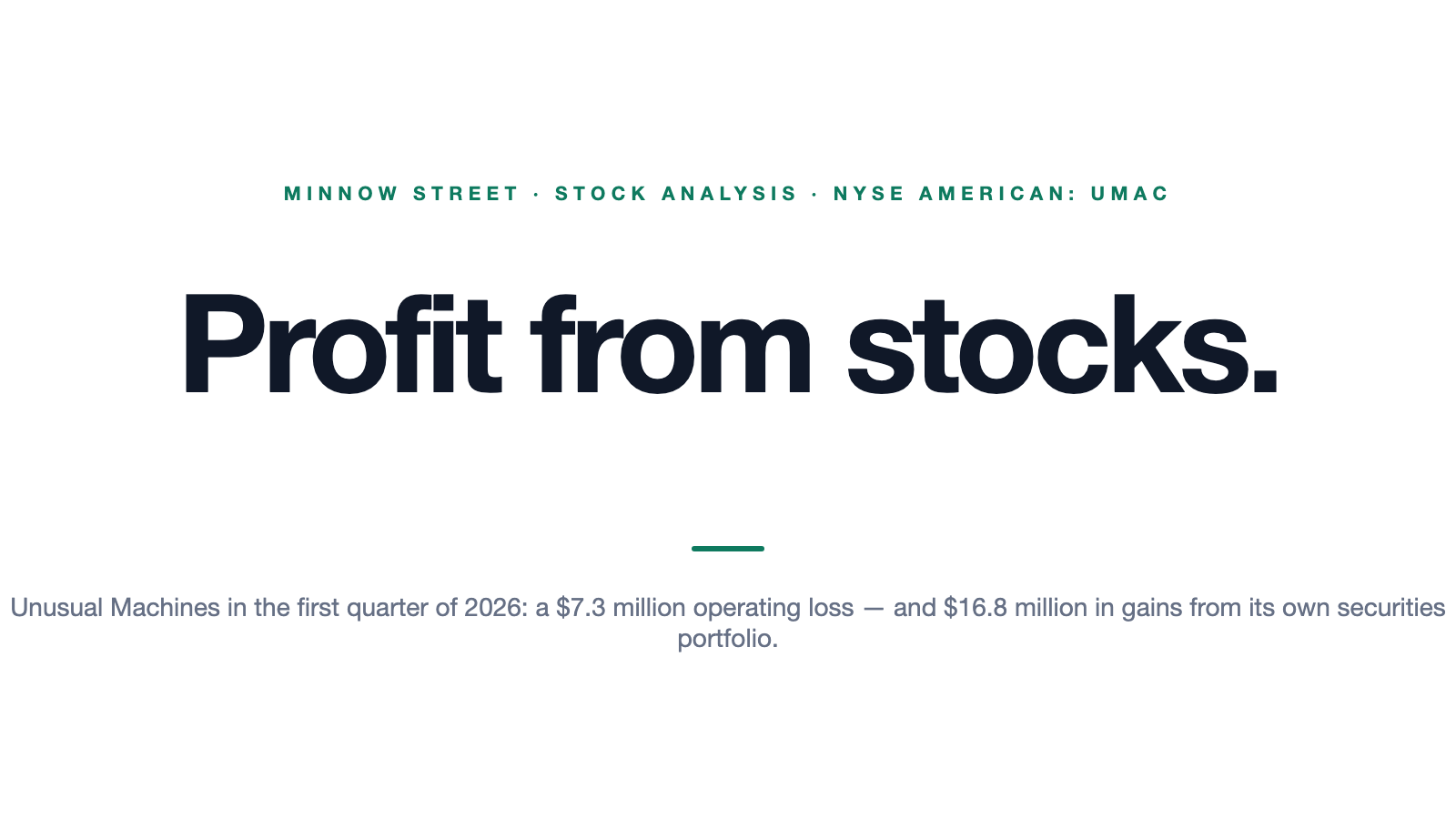
Interactive price chart (TradingView).
Note: pure fact-based analysis, not investment advice and not a solicitation to buy or sell. All figures without guarantee.
There is an investing trap that springs shut at the exact moment you finally read good news: the register trap. It works like this. You work your way down a column of numbers, understand about half of it, start to tire — and then, right at the bottom, a figure appears in black instead of red. Profit. At that instant the checking stops. Your brain has what it wanted: proof that the thing works. What it does not ask is the one question that matters: which register actually rang? Unusual Machines, Inc. (NYSE American: UMAC) of Orlando, Florida, is a perfect specimen. The company builds motors, video goggles and flight controllers for small drones — precisely the parts Washington would rather see made in America than in China. And in the first quarter of 2026 it posted a fat quarterly profit for the first time: $10.283 million. So let us make a deal: we leave the headline alone and read together only what the company itself reported, under penalty of law, to the U.S. securities regulator, the SEC — the annual report (10-K) for 2025, the quarterly report (10-Q) as of March 31, 2026, and the two most recent current reports (8-K) filed on June 25 and July 28, 2026. And what those filings say is this: the drone business lost $7.259 million that quarter. What you make of that is your decision.
What Unusual Machines actually does — the parts underneath the drone
Unusual Machines does not sell drones. It sells the parts other people build drones from. Specifically: electric motors (propellers do not turn themselves), FPV video goggles under the Fat Shark brand — FPV stands for first-person view, the live feed from the drone straight to the pilot’s eyes with as little lag as possible — plus flight controllers, cameras and accessories. There are two routes to market: the company’s own Rotor Riot storefront, which sells directly to hobbyist pilots, and a fast-growing supplier business to other companies that build drones. The second route is the interesting one — in fiscal 2025 enterprise customers became the primary revenue driver for the first time.
The target segment is what the industry calls Group 1 UAS: the small, light, cheap drones — the kind you can afford to lose. In defense use they fly real-time reconnaissance; in civilian use they map, film and race. The filing names T-Motor, Orqa, ModalAI and ARK Electronics among its competitors, and one long shadow over all of them: DJI of China, which industry researchers credit with a majority of global consumer and prosumer drone sales.
That is where the market story lives. Under the National Defense Authorization Act and the American Security Drone Act inside it, U.S. federal agencies may no longer procure or operate certain drones made in countries designated as national security threats. On December 23, 2025 the Federal Communications Commission went further: any drone system seeking authorization must source at least 65 percent of its components by value domestically, and the agency names motors and batteries explicitly. In December 2025 the Department of War announced a program called Drone Dominance: $1.0 billion for small drones over two years. Sounds like a perfect tailwind? It is one. And yet a tailwind is not an income statement. That sets the central tension of this analysis, and it runs through every chapter: the political expectation attached to this company is enormous, the operating substance standing against that expectation today is small, and the only profit the company has ever reported did not come from the business it is being bought for.
How this stock landed on our desk
Honesty first: Unusual Machines is not a hit from any of our stock scanners. We checked on July 28, 2026 — the stock appears in none of the lists our in-house stock scanner recalculates every day, neither the momentum lists nor the quality or valuation screens. That is not a technicality, it is already a finding. The usual filters look for companies with profits, returns on capital employed, or at least a stable revenue base. A company that has never delivered an operating profit since going public falls straight through that mesh — even when its share price has run.
What put it on the desk was our daily review of the U.S. stocks generating the most discussion in the large retail investing forums (as of July 28, 2026). Lists like that are not a quality judgment; they are a thermometer for attention. But they reliably point to the companies where narrative and numbers have drifted furthest apart. And because they have drifted unusually far apart here, the close reading is worth it. Keep one sentence in mind for everything that follows: a good story and a good business are two different things — they sometimes meet, but never automatically.
The numbers over the years — honestly appraised
Start with what genuinely impresses, because there is plenty of it. Revenue at Unusual Machines rose from $5.565 million in 2024 to $11.199 million in 2025 — a doubling. In the first quarter of 2026 it produced $8.096 million in three months alone, against $2.042 million in the year-ago quarter. That is a gain of 296 percent, and it is not an accounting artifact: business-to-business revenue jumped from $34,030 (first quarter of 2025) to $7.318 million (first quarter of 2026). Within a single year an online shop for drone hobbyists turned into a components supplier.
The quality of that revenue improved too. Gross margin — what is left of $100 in sales once materials and manufacturing are paid for — rose from 24.3 percent (first quarter of 2025) to 32.8 percent (first quarter of 2026). Of every $100 in revenue, close to $33 now remains before administration, sales and development are paid, rather than $24. For a company only just starting to manufacture in-house, that is a good sign — a production ramp usually squeezes margin rather than lifting it. Headcount is growing at the same pace: from 18 employees on March 31, 2025 to 80 at the end of 2025, and 141 full-time employees plus 3 full-time contractors as of March 6, 2026, spread across five sites in Orlando and one in Canberra, Australia.
And now the chart that tells the other half of the story:
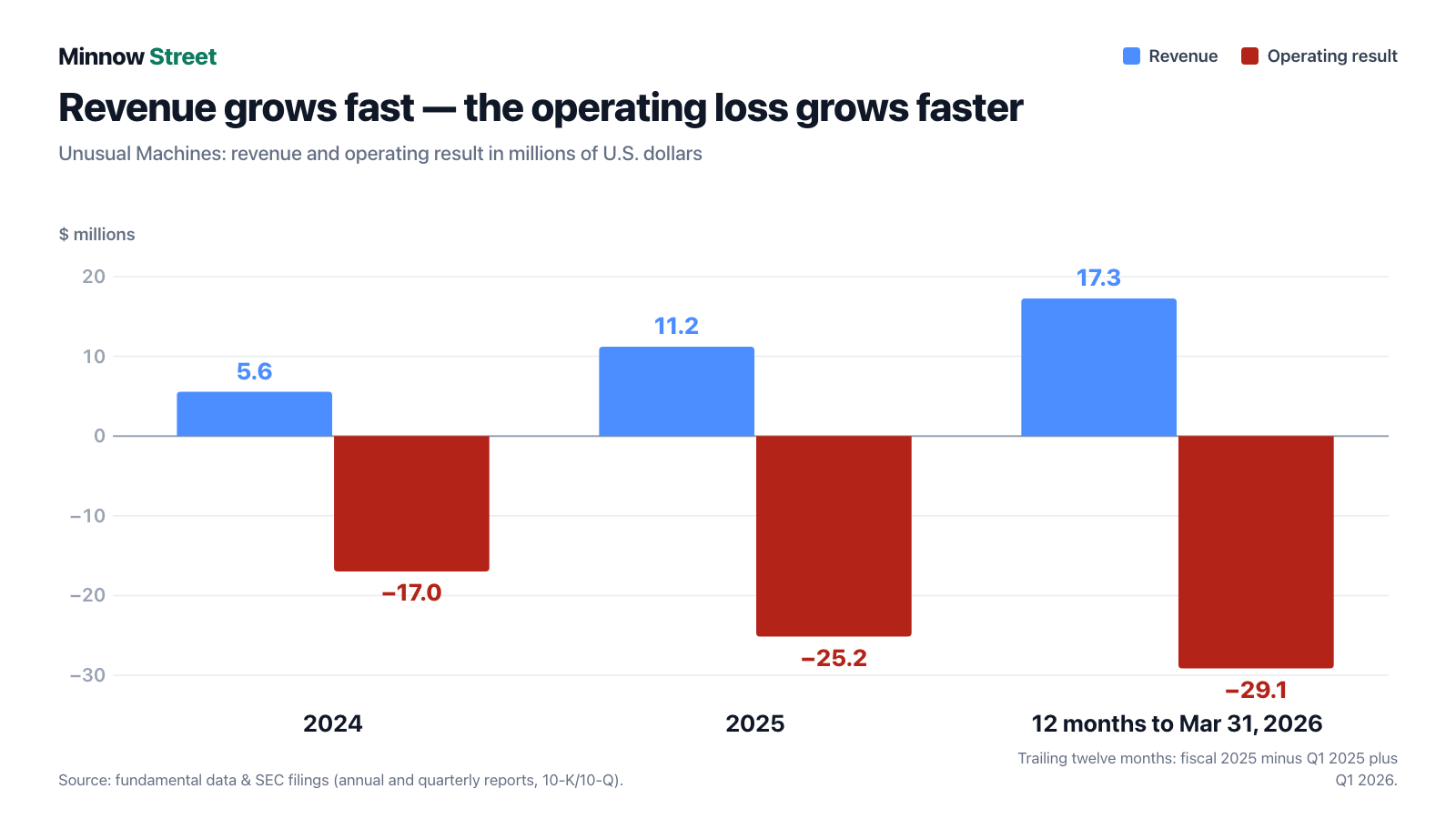
Revenue grows fast — the operating loss grows faster. In absolute terms: a $17.0 million operating loss in 2024, $25.2 million in 2025, $29.1 million over the twelve months to March 31, 2026. In relative terms the picture does improve — in 2024 every dollar of revenue cost roughly three dollars of loss, most recently only about $1.70 — but the distance to breakeven has widened in dollars, not narrowed. Remember the image: the company is running fast, but it is chasing a finish line that keeps moving.
What the filings say — the uncomfortable truths
Uncomfortable truth no. 1: the first profit in company history came out of the securities portfolio
This is where the register trap springs. In the first quarter of 2026 Unusual Machines reported net income of $10.283 million, or $0.22 per share. After eight quarters of red ink, that is the headline every shareholder had been waiting for. Except the profit did not come from selling drone motors. The quarterly report breaks it out line by line — and that breakdown is the heart of this analysis:
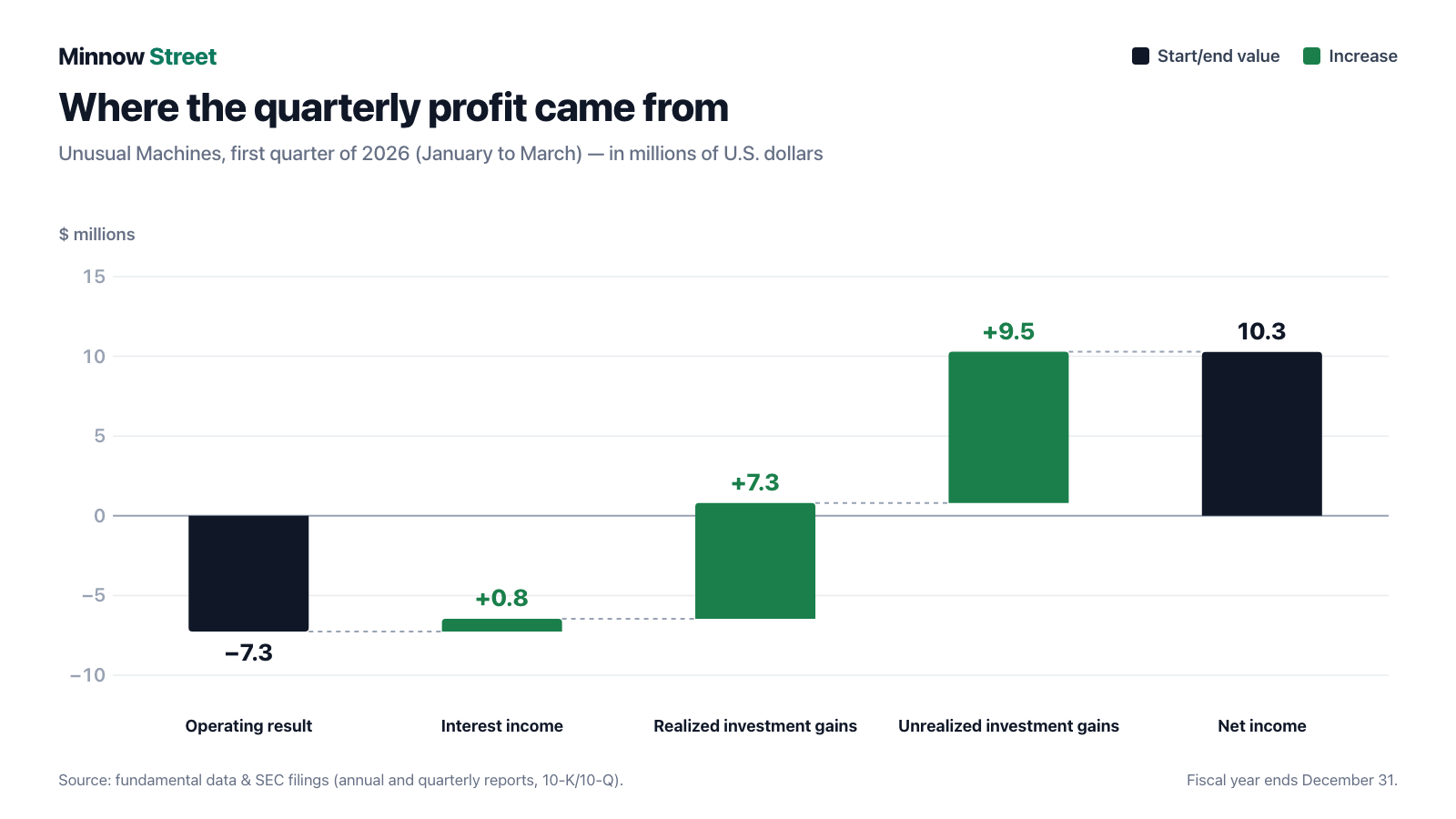
In words: the operating business lost $7.259 million. To that were added $0.792 million of interest income on the large cash pile, $7.265 million of realized and $9.492 million of unrealized gains on securities the company owns. Unrealized means not sold, merely marked higher — a paper gain that can evaporate again by the next quarterly release. Together that is $16.757 million of investment gains, more than twice the quarter’s revenue. The company described this mechanism itself in its 2025 annual report, about the only other profitable quarter in its history:
"Since inception, we have incurred net losses for each reported quarter other than the quarter ended September 30, 2025. In the quarter ended September 30, 2025, we incurred net income of $1,603,465, which was related to an unrealized gain in short-term investments rather than our core operations."
— Unusual Machines, Inc., SEC annual report 10-K for fiscal year 2025, Item 1A "Risk Factors"

The hardest cross-check is the cash flow statement, because cash does not have opinions: in the first quarter of 2026 the company used $17.413 million of cash in operating activities — against reported net income of $10.283 million. A company can earn on paper and lose at the till; here the gap between the two is $27.7 million wide. Remember the mechanism: a paper gain on securities is the market’s opinion about other companies. Operating cash burn is a fact about this one.
Uncomfortable truth no. 2: a drone supplier with an investment committee and a performance fee
If investment gains decide the bottom line, it is worth asking who picks the investments. The answer sits in the related-party note, and it is remarkable. Unusual Machines runs an investment committee made up of the chief executive and two independent directors. And that committee shares in the upside:
"On April 1, 2026, the Company paid $217,943 to its investment committee, which includes the CEO and two independent Directors of the Company. The payment is based on a 1% per committee member based on the realized gains during the previous quarter."
— Unusual Machines, Inc., SEC quarterly report 10-Q as of March 31, 2026, Note 11 "Related Party Transactions"

Picture it this way: your local baker opens a brokerage account next to the bakery and pays himself and two advisory board members 1 percent each of every trading gain he books. None of it is illegal, and all of it is disclosed. But it changes the incentives: a bonus on realized gains rewards selling at the right moment — not baking. The figures: $43,474 went to the committee on December 31, 2025, and $217,943 on April 1, 2026. The portfolio itself stood at $60.657 million on March 31, 2026 — $44.251 million in common stock, $3.221 million in pre-funded warrants, $0.685 million in non-public warrants and $12.500 million carried at cost in privately held companies. The company stresses that it holds less than 5 percent of each of those businesses. The annual report lists the holdings explicitly as part of the strategy: strategic investments in emerging leaders of the U.S. drone ecosystem, intended to deepen supplier and customer relationships. For a shareholder that means buying an industrial company and getting a small sector fund on top — one whose swings now drive the headline.
Uncomfortable truth no. 3: the growth is paid for in fresh shares — and the CEO gets five million of them
Now the bill every shareholder eventually pays: dilution. The image is simple — your slice of the cake shrinks when new slices keep being cut, even if the cake itself is growing. At Unusual Machines it happened quickly. On December 31, 2024 there were 15,122,018 shares; a year later 37,759,911; and as of May 13, 2026 there were 47,793,923. That is more than a tripling in roughly eighteen months. The largest single step: on March 19, 2026 the company placed 8,823,529 new shares at $17.00 for gross proceeds of $150.0 million; after $10.5 million in placement fees and $0.7 million in other expenses, $138.8 million remained. That money is precisely what sits on the balance sheet as cash today — and it generates the interest income that contributed $0.792 million to first-quarter earnings.
And it continues. On July 24, 2026 the compensation committee approved a package the company disclosed four days later:
"On July 24, 2026, the Compensation Committee (the “Committee”) of Unusual Machines, Inc. (the “Company”) approved a grant of warrants to purchase 5,000,000 shares of the Company’s common stock to Dr. Allan Evans, the Company’s Chief Executive Officer. In consideration for the warrant grant, Dr. Evans has agreed to waive all cash compensation from the Company following December 31, 2026. The warrant grant is subject to shareholder approval."
— Unusual Machines, Inc., SEC current report 8-K filed July 28, 2026, Item 5.02 (event July 24, 2026)

The terms are unusually ambitious, which is exactly what makes them worth reading. The warrants cost $25.00 per share and run to July 24, 2031. They vest in five tranches of 1,000,000 each, whenever the average closing price over any 20 consecutive trading days reaches $25, $40, $60, $80 and $100. On the same day three other executive officers received a combined 1,275,000 options at $19.36 (525,000 for the president, 375,000 each for the chief financial officer and the chief revenue officer), vesting in twelve quarterly installments over three years. Together that is 6,275,000 new instruments — 13.1 percent of today’s share count, approved in a single meeting.
Add up honestly what already hangs over the share count: 723,834 options as of March 31, 2026; another 190,000 granted in April 2026 at $12.34; the 6,275,000 from the July package; and 1,792,012 shares earmarked as consideration for an acquisition (more on that shortly). That comes to 8,980,846 instruments, or 18.8 percent of the 47,793,923 shares outstanding. On top sits capacity: the 2022 equity incentive plan was authorized for 8,983,338 instruments as of March 31, 2026, of which 3,654,703 were still available — and it carries an evergreen provision that tops the pool up by as much as 5 percent of shares outstanding every year through 2032. Authorized capital stands at 500,000,000 shares, so there is ample room. Remember: growth paid for in fresh shares is never quite free — the bill simply does not appear in the income statement, it appears in your slice.
Uncomfortable truth no. 4: few customers — and one of them sits at the table
A supplier is only as stable as its customer list. This one is short. The 2025 annual report states the numbers openly:

Customer A accounted for roughly 16.7 percent of 2025 revenue and Customer B for roughly 15.9 percent — close to a third between them. And Customer B held about 62.6 percent of all outstanding receivables at December 31, 2025; the filing adds that these were fully collected during 2026. Picture a neighbor telling you his business is booming, while two customers supply a third of his revenue and one of them owes him two-thirds of every unpaid invoice. You would swallow hard.
One level down it gets more interesting. In January 2026 a $2.1 million order arrived from Teal Drones, a subsidiary of Red Cat. The quarterly report explains the link itself: Red Cat is a related party because Jeff Thompson is the chief executive of Red Cat and also sits on the board of directors of Unusual Machines. In the first quarter of 2026 that produced roughly $0.7 million of revenue — 8.6 percent of the $8.096 million quarterly total — plus $0.4 million of related-party receivables outstanding at March 31, 2026. The closeness has a history: Fat Shark and Rotor Riot belonged to Red Cat until the February 2024 initial public offering, and everything is disclosed. Still, the principle holds: a customer whose chief executive sits on your own board is not evidence of market demand — it is evidence of a relationship. Anyone who wants to know how broad demand for these motors really is should look at revenue excluding related parties. For contrast, a listed drone company with a very different business model is worth a look: Ondas Holdings.
Uncomfortable truth no. 5: four construction sites at once
With $283.6 million in liquid assets you can start a great deal, and Unusual Machines is starting a great deal. In May 2026, according to the quarterly report, the company initiated purchase orders for roughly $75.0 million of materials and inventory — against $17.253 million of revenue over the twelve months to March 31, 2026, that is material worth more than four years of sales. On May 7, 2026 it signed a definitive agreement to acquire Upgrade Energy (DroneNX, LLC), a maker of battery and power systems for unmanned aircraft. The purchase price is put at roughly $52.0 million: 1,792,012 shares at $13.9508 (about $25.0 million), $1.0 million in cash at closing, and up to $26.0 million more in cash if $10.0 million of revenue from internally manufactured batteries is recognized within the first two years. And on June 25, 2026 the company disclosed a long-term lease for roughly 14,000 square feet of manufacturing and operational space in Orlando, explicitly to support its growing battery business.
The logic is sound: the FCC names motors and batteries as the components that matter under its 65 percent rule. Building both in the United States puts you exactly where regulation is pointing. But standing up motor, headset, camera and battery production simultaneously across what is now six sites is an extremely broad front for a company with 141 employees and $8.1 million of quarterly revenue. The filing says as much itself, naming "risks associated with our rapid expansion" and "inventory management and potential obsolescence" among its own risk factors. Opening four construction sites at once is bold when the money holds out. And the money does hold out: operating cash burn was most recently $17.4 million per quarter, which against $222.9 million of cash is arithmetically more than twelve quarters of runway. But buying time and buying success are two different things.
Valuation — what the market is actually paying for
Now the question it all comes down to: what does this company cost, measured against what it delivers? Because we do not use daily prices, we take an anchor that appears in a mandatory filing: on July 24, 2026 Unusual Machines granted executive options with an exercise price of $19.36 — the price the company itself applied that day. Multiplied by the 47,793,923 shares outstanding, that implies a market capitalization of roughly $925 million.
Against that stands $17.253 million of revenue over the twelve months to March 31, 2026. That is a price-to-sales ratio of roughly 54. For context: a solid, growing industrial business typically trades at one to three times annual revenue; even fast-growing software companies rarely exceed 15. A price-to-sales ratio of 54 does not say "this company is good." It says: the market is paying today for revenue that does not exist yet.
Two corrections are only fair, and both favor the company. First, the $925 million includes $283.6 million of cash and securities against essentially no debt — total liabilities are just $8.066 million. Strip the money out and the operating business costs roughly $642 million, or about 37 times trailing revenue. Second, growth is steep enough that trailing figures lag. Annualize the first quarter of 2026 — $8.096 million times four gives $32.4 million — and the multiple falls to roughly 29 on market capitalization and roughly 20 on the operating business. Still expensive, but a different order of magnitude. A price-to-earnings ratio cannot be formed meaningfully: the only earnings come from investment gains, not from the business.
The most tangible anchor is book value: $331.637 million of equity at March 31, 2026 equals $6.94 per share — of which roughly $5.93 per share is simply cash and securities. At $19.36 the market is paying 2.8 times book, and a good two-thirds of the price is expectation attached to a business that lost $7.3 million in the last reported quarter. Whether that expectation is warranted will be settled by the coming quarterly reports, not by this analysis.
Opportunities and risks at a glance
What speaks for Unusual Machines:
- Regulatory tailwind the company did not have to create: the American Security Drone Act, the FCC rule of December 23, 2025 (at least 65 percent domestic components by value, with motors and batteries named explicitly) and the Department of War’s Drone Dominance program ($1.0 billion over two years, announced in December 2025) push demand toward precisely where this company manufactures.
- The growth is documented, not asserted: revenue up 296 percent in the first quarter of 2026 against the year-ago quarter, business-to-business revenue from $34,030 to $7.318 million, gross margin improved from 24.3 percent to 32.8 percent.
- A balance sheet without fracture lines: $222.940 million of cash plus $60.657 million of securities against total liabilities of only $8.066 million; no bank debt, no bonds, no going-concern warning. At $17.413 million of quarterly operating cash burn, cash alone covers more than twelve quarters.
- Products on the Blue List: several U.S.-made products sit on the Department of War’s cleared list, which is what makes federal agency orders possible at all and works as a seal of approval with enterprise customers.
- The chief executive ties himself to the share price: by waiving all cash compensation after December 31, 2026 in exchange for warrants whose lowest tranche does not vest below $25.00, Allan Evans moves his entire pay into the future.
What speaks against it:
- The core business does not make money: a $7.259 million operating loss in the first quarter of 2026, $29.143 million over the twelve months to March 31, 2026 — and the only profit in company history came from investment gains, as the company itself states in its filing.
- Cash flow is sharply negative: $17.413 million of cash used in operating activities in the first quarter of 2026, against $1.194 million in the year-ago quarter.
- Dilution on a large scale: share count from 15,122,018 (December 31, 2024) to 47,793,923 (May 13, 2026), plus 8,980,846 further instruments already approved (18.8 percent) and an incentive plan that tops itself up annually through 2032.
- Concentration and proximity: two customers at 16.7 percent and 15.9 percent of 2025 revenue, one customer holding 62.6 percent of all receivables at year-end 2025, and a board member who is also the chief executive of a customer.
- The valuation leaves no room for error: roughly 54 times trailing revenue on market capitalization, roughly 37 times on the operating business — any disappointment in growth lands directly in the expectation.
- Four construction sites at once: motors, headsets, cameras and batteries all being built out across six sites, with $75.0 million of inventory orders against $17.253 million of trailing revenue — and the company itself names obsolescence risk in its filings.
A human conclusion
Remember the register trap from the opening? At Unusual Machines it takes a particularly elegant form. There, at the bottom of the first quarter of 2026, sits a profit of $10.283 million, and everything in you wants to stop reading right there. It feels like the proof you were waiting for: the company has found its stride, the tailwind is working, the bet is paying off. Except that register did not ring in the factory. It rang in the brokerage account. In the factory the number was a $7.259 million loss, and $17.413 million flowed out of the till.
That expressly does not mean anything here is crooked. Everything in this analysis was reported by the company itself — openly, verifiably, in a mandatory filing. And much of it is impressive: nearly quadrupling revenue in a year, growing headcount from 18 to more than 140 people and improving margin along the way is not the profile of a company doing everything wrong. The balance sheet is rock solid, there is no loan coming due and no auditor questioning the company’s ability to continue. This business has time — more time than almost any company of its size.
What it does not yet have is proof that drone motors can be sold at a profit. That proof will not arrive in a press release or a headline. It will arrive in one line of a quarterly report that almost nobody reads: loss from operations. If that line shrinks over the coming quarters while revenue keeps climbing, expectation will have turned into a business. If it does not shrink, the first-quarter 2026 profit was exactly what it was: a good day in the market, booked on the wrong line.
So the next time you see a black number at the bottom of a column, ask the one question that springs the register trap: which register rang? You have now run that check yourself, with the original documents on the table. What you make of it is your decision. And that is exactly as it should be.
Sources
- Unusual Machines, Inc. — SEC annual report 10-K for fiscal year 2025 (filed March 12, 2026)
- Unusual Machines, Inc. — SEC quarterly report 10-Q as of March 31, 2026 (filed May 14, 2026)
- Unusual Machines, Inc. — SEC current report 8-K, Item 5.02 (event July 24, 2026, filed July 28, 2026)
- Unusual Machines, Inc. — SEC current report 8-K, Items 1.01 and 7.01 (battery facility lease, filed June 25, 2026)
- SEC EDGAR — complete filing history, CIK 0001956955 (recency gate: all filings after the quarterly report reviewed, as of July 28, 2026)
- Source: fundamental data & SEC filings (annual and quarterly reports, 10-K/10-Q) — metrics and price series, data as of July 28, 2026
This analysis is a journalistic contextualization of publicly available information and is not investment advice. It is neither an offer nor a solicitation to buy or sell securities. Shares of small companies are volatile; a total loss of invested capital is possible. All figures are taken from the original sources named above and carry the as-of dates stated there. The author holds no position in Unusual Machines, Inc. at the time of publication.
Our Bottom Line at a Glance
- Growth & market position positive
- Revenue rose from $5.565 million (2024) through $11.199 million (2025) to $8.096 million in the first quarter of 2026 alone — up 296 percent on the year-ago quarter. Business-to-business revenue jumped from $34,030 to $7.318 million and gross margin from 24.3 percent to 32.8 percent. Regulation (the FCC rule of December 23, 2025 requiring at least 65 percent domestic components by value) and the Department of War’s $1.0 billion procurement program push demand into precisely this niche.
- Earnings quality negative
- The only meaningful profit in company history did not come from the business: the first quarter of 2026 showed a $7.259 million operating loss and +$10.283 million of net income — the difference being $16.757 million of gains on an owned securities portfolio plus $0.792 million of interest income. Operating cash burn in the same quarter was $17.413 million. The company describes this mechanism itself in its 2025 annual report.
- Balance sheet & funding positive
- As of March 31, 2026 the company held $222.940 million of cash and $60.657 million of securities against total liabilities of only $8.066 million; equity stands at $331.637 million, or $6.94 per share. There is no financial debt, no going-concern warning and no refinancing coming due. At $17.413 million of quarterly operating cash burn, cash alone covers more than twelve quarters.
- Dilution & compensation negative
- Share count rose from 15,122,018 (December 31, 2024) to 47,793,923 (May 13, 2026). On July 24, 2026 another 6,275,000 instruments were added — 5,000,000 warrants for the chief executive at $25.00 with price targets to $100.00, and 1,275,000 options at $19.36 for three other officers; together 13.1 percent of shares outstanding. In total 8,980,846 instruments, or 18.8 percent, are approved, and the incentive plan tops itself up by as much as 5 percent annually through 2032.
- Governance & dependencies negative
- An investment committee comprising the chief executive and two independent directors receives 1 percent per member of the prior quarter’s realized investment gains ($43,474 on December 31, 2025 and $217,943 on April 1, 2026) — a fund-style fee inside an industrial company. At the same time a board member is the chief executive of Red Cat, whose subsidiary Teal Drones placed a $2.1 million order in January 2026. In 2025 two customers accounted for 16.7 percent and 15.9 percent of revenue.
- Pace of expansion neutral
- Motors, headsets, cameras and batteries are being built out simultaneously: the Upgrade Energy acquisition at roughly $52.0 million (agreement dated May 7, 2026), a lease for roughly 14,000 square feet of battery space (June 25, 2026) and inventory orders of roughly $75.0 million in May 2026 — against $17.253 million of trailing twelve-month revenue. It is funded; it is not proven. The company names rapid-expansion and inventory-obsolescence risks itself.
Unusual Machines sits in exactly the right spot of an industry into which Washington is currently pushing both money and rules, and it is growing accordingly: revenue up 296 percent in the first quarter of 2026, gross margin improved from 24.3 percent to 32.8 percent, headcount at 141 against 18 a year earlier. The first reported quarterly profit in company history ($10.283 million), however, came entirely from the company’s own securities portfolio — the drone business lost $7.259 million over the same three months and burned $17.413 million of operating cash. The balance sheet, with $283.6 million of cash and securities against $8.066 million of liabilities, is unusually robust and buys the company years of time; it was paid for by tripling the share count since the end of 2024, with a further 18.8 percent of instruments already approved. Buying in here means buying a documented growth curve, a very strong cash position — and the open question of whether drone motors can ever be sold at a profit. Not investment advice.
What Our Rating Means
Open questions
The business works in principle, but one material question is open. As long as it stays open, our findings do not carry a quality verdict.
Substance is not the problem here: no financial debt, $283.6 million of cash and securities against $8.066 million of liabilities, no going-concern warning, and arithmetically more than twelve quarters of runway. What is open is the core operating question, and it carries weight: the drone business has never made money, the operating loss has widened in absolute terms (−$16.992 million in 2024, −$25.152 million in 2025, −$29.143 million over the twelve months to March 31, 2026), the only profit came from investment gains, and scaling four product lines at once — including inventory orders of roughly $75.0 million against $17.253 million of trailing revenue — remains unproven. Add concentration risk (two customers at 16.7 percent and 15.9 percent of 2025 revenue) and a compensation structure that contemplates a further 18.8 percent of instruments. Separately, and expressly not the basis of this rating: at roughly 54 times trailing revenue the stock is expensive — that is a price argument, not a quality argument, and whether it is worth paying is not what this rating decides. The decision is yours.
A journalistic assessment by our editorial team at the time of the deep dive, based on public sources — not investment advice and not a solicitation to buy or sell. Your personal circumstances (investment goals, risk capacity, taxes) cannot be taken into account. What our levels mean, how verdicts are formed, and what conflicts of interest exist →
Worth Noting
- Unusual Machines reached our research list through the daily review of the most-discussed U.S. stocks on Reddit (as of July 28, 2026), not through a hit from our in-house stock scanner — as of July 28, 2026 the stock appeared in none of our scanner lists. Those lists are recalculated every day.
- Recency gate: the most recent periodic report is the quarterly report 10-Q as of March 31, 2026 (filed May 14, 2026). Every document filed after it was reviewed; the ones that change the picture are the current report 8-K of June 25, 2026 (battery facility lease) and the 8-K of July 28, 2026 (compensation decision of July 24, 2026). The share count of 47,793,923 comes from the quarterly report cover page (as of May 13, 2026); no later document states a different figure.
- The valuation anchor is deliberately a filing value rather than a daily price: $19.36 is the exercise price of the executive options approved on July 24, 2026, documented in the 8-K filed July 28, 2026. Every valuation figure in this analysis refers to it.
- Not to be confused: Unusual Machines supplies components but does not build complete drones. Red Cat (ticker RCAT) is a separate listed company and owned Fat Shark and Rotor Riot until February 2024; today the two are linked by a shared board member and a supply relationship.
Frequently Asked Questions
Unusual Machines, Inc. (NYSE American: UMAC), based in Orlando, Florida, manufactures components for small drones: electric motors, Fat Shark FPV video goggles, flight controllers and accessories. It sells through its own Rotor Riot storefront to consumers and increasingly to U.S. drone manufacturers. As of March 6, 2026 the company had 141 full-time employees and 3 full-time contractors across five sites in Orlando and one in Canberra, Australia.
Not at the operating level. The first quarter of 2026 showed a $7.259 million operating loss, and the twelve months to March 31, 2026 showed $29.143 million. The reported net income of $10.283 million in that quarter came from $16.757 million of gains on the company’s own securities portfolio plus $0.792 million of interest income. Net cash used in operating activities over the same quarter was $17.413 million.
The 2025 annual report names strategic investments in emerging leaders of the U.S. drone ecosystem as an explicit part of the growth strategy. As of March 31, 2026 the portfolio stood at $60.657 million. An investment committee made up of the chief executive and two independent directors manages it and receives 1 percent per member of the prior quarter’s realized gains — most recently $217,943 on April 1, 2026.
Heavily. The share count rose from 15,122,018 on December 31, 2024 to 37,759,911 a year later and to 47,793,923 as of May 13, 2026. The largest single step was a placement of 8,823,529 shares at $17.00 in March 2026 with $138.8 million of net proceeds. A further 8,980,846 instruments, or 18.8 percent, are already approved, including 6,275,000 from the compensation package of July 24, 2026.
On July 24, 2026 the compensation committee granted CEO Allan Evans warrants on 5,000,000 shares at an exercise price of $25.00, expiring July 24, 2031, vesting in five tranches at price targets of $25, $40, $60, $80 and $100. In exchange, Evans waives all cash compensation after December 31, 2026. The package is subject to shareholder approval. Three other executive officers received 1,275,000 options at $19.36.
Using the $19.36 option exercise price documented in an SEC filing on July 24, 2026 and 47,793,923 shares, market capitalization works out to roughly $925 million. Against $17.253 million of revenue for the twelve months to March 31, 2026, that is roughly 54 times; stripping out the $283.6 million of cash and securities leaves roughly 37 times. Annualizing the first quarter of 2026 lowers those multiples to roughly 29 and 20.
A dual one. Fat Shark and Rotor Riot belonged to Red Cat until the initial public offering in February 2024. Today Jeff Thompson, chief executive of Red Cat, sits on the board of directors of Unusual Machines. In January 2026 Red Cat subsidiary Teal Drones placed a $2.1 million order, of which roughly $0.7 million was recognized as revenue in the first quarter of 2026 — 8.6 percent of quarterly revenue.
On current figures, a long time. As of March 31, 2026 the company held $222.940 million in cash and $60.657 million in securities against total liabilities of only $8.066 million. At $17.413 million of operating cash burn per quarter, cash alone covers more than twelve quarters arithmetically. The company itself states in the quarterly report that existing balances will fund its current operating plans for more than the next twelve months.
Found an error?
Did you spot a factual error, an outdated number, or a typo in this deep dive? Let us know briefly — your report goes straight to the editorial team.