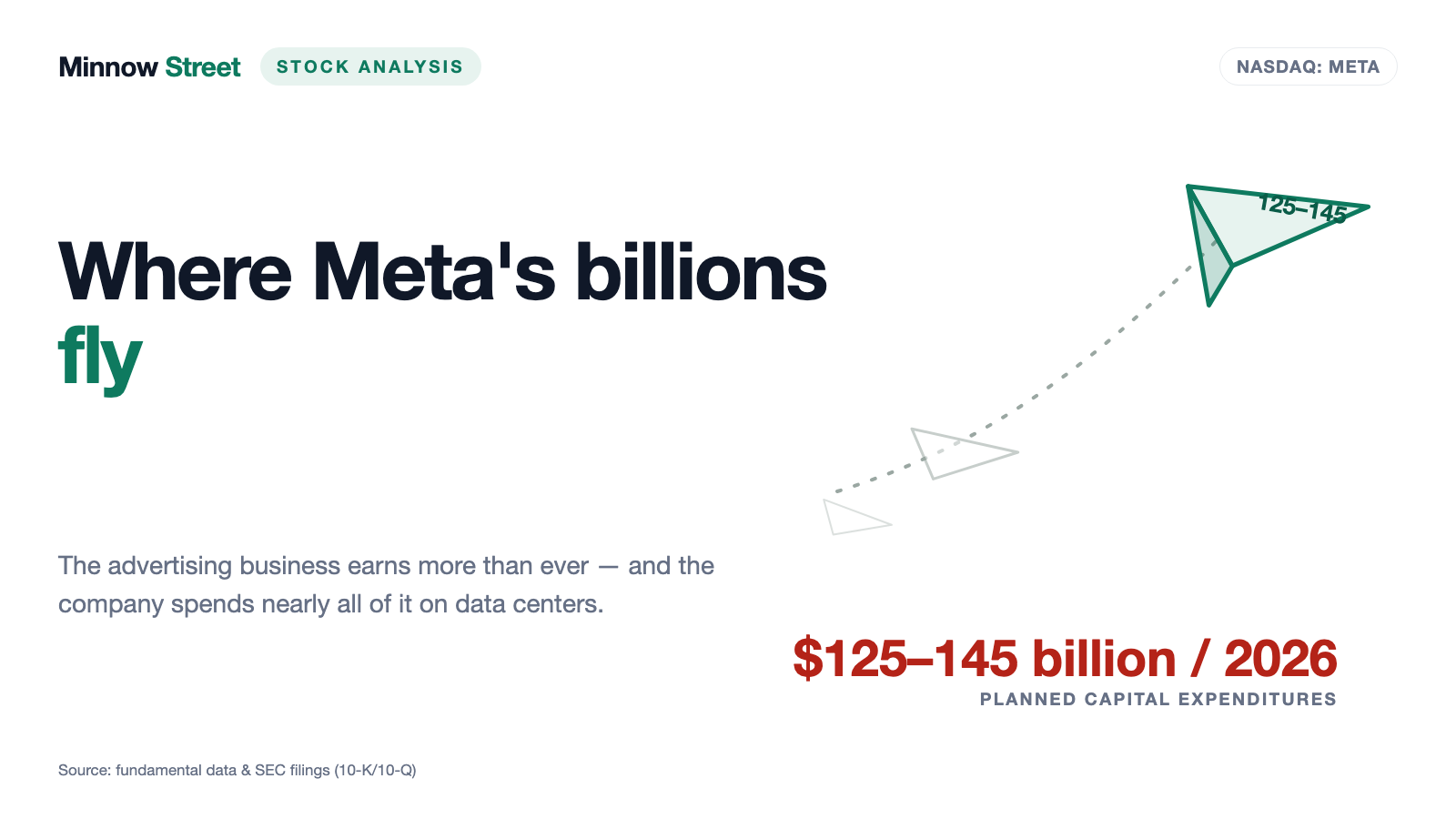
Verra Mobility: One Customer Brought 14 Percent of Revenue — and Almost a Third of Profit
On May 26, 2026, Avis Budget Group terminated its contract with Verra Mobility. Two months later the company announced agreement on the key terms of a new seven-year contract — and wrote in the same breath that those terms would be "materially less favorable." The numbers behind it are uncomfortable: the departing customer accounted for $135 million to $145 million of annualized revenue but $120 million to $125 million of annualized segment profit — roughly 29 to 30 percent of all segment profit in 2025. Add an interim chief executive since May 31, 2026, two more large customers whose contracts come up for renewal within 18 months, and $183.6 million of buybacks at about $22 a share shortly before the stock collapsed. Not investment advice — just the question of who draws the line under this story: the company or you.
 Thomas Mücke
Founder & Publisher
Thomas Mücke
Founder & Publisher
Chart
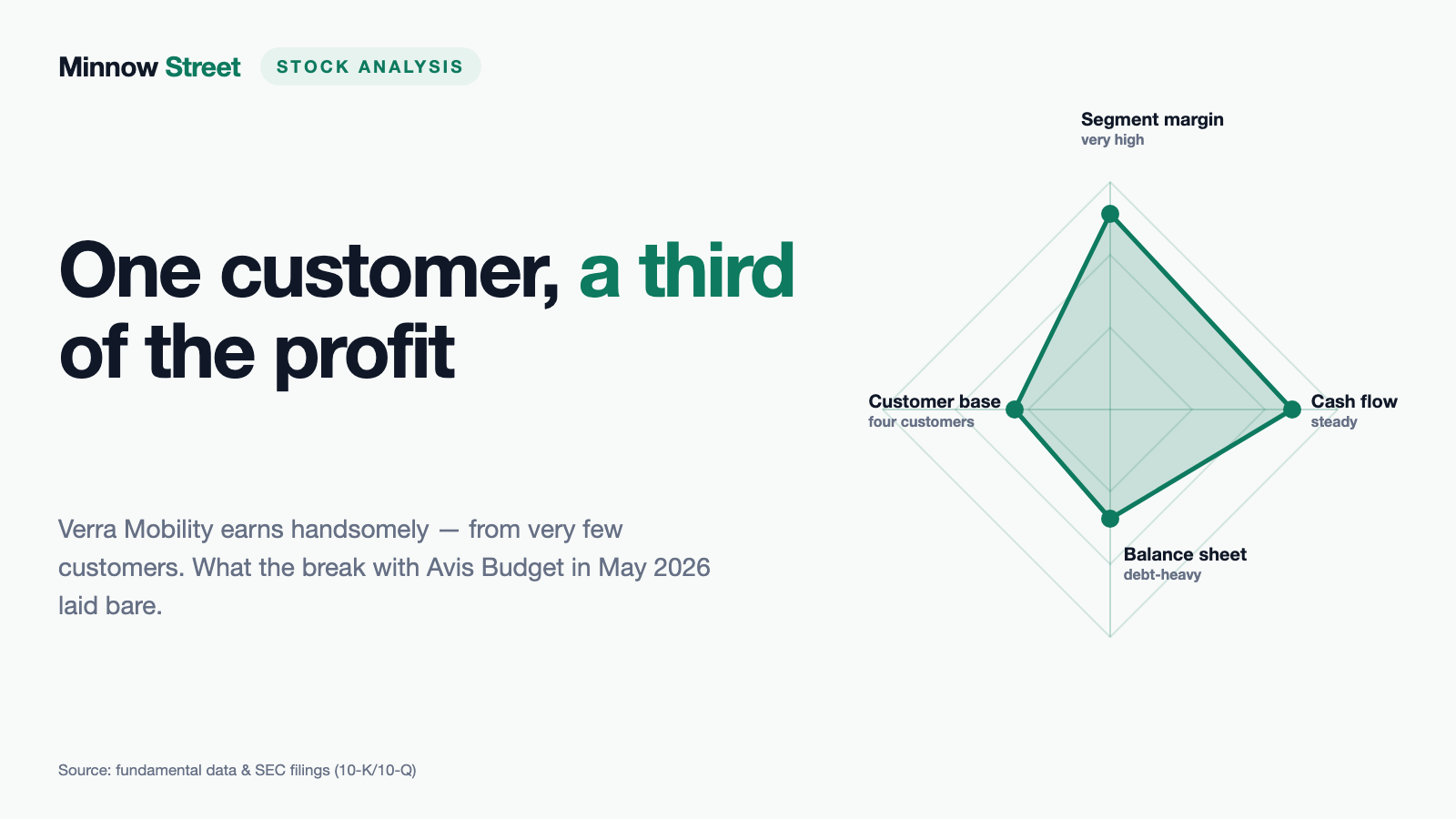
Interactive price chart (TradingView).
Note: pure fact-based analysis, not investment advice and not a solicitation to buy or sell. All figures without guarantee.
There is a mental trap that catches us whenever a bad headline finally gets an answer — call it the closing-line trap. It works like this. First a piece of news tears open a question that really hurts. The question stays open for weeks, the share price falls, and your mind holds its breath. Then a second piece of news arrives that sounds like a resolution — and your mind gratefully grabs it and draws a line underneath. Verra Mobility (NASDAQ: VRRM), the Mesa, Arizona company that processes tolls, camera citations and parking fees, has just staged that two-act play. On May 26, 2026 it disclosed that Avis Budget Group had terminated its contract. On July 28, 2026 it announced that it had reached agreement with Avis Budget on the key commercial terms of a new seven-year contract. That sounds like a closing line. It is not one — in the very same release the company writes that the new terms are expected to be "materially less favorable" and that the remaining operational terms are still being negotiated. So let us make a deal. Before you draw the line, we will read together what Verra Mobility itself has told the U.S. securities regulator, the SEC — the annual report on Form 10-K for 2025, the quarterly report on Form 10-Q for the period ended March 31, 2026, and the current reports on Form 8-K from the past few weeks. An SEC filing is honest under threat of penalty. In the end, you decide.
What Verra Mobility actually does — the company that pays your bill for you
Verra Mobility earns its money in a place that is almost invisible in daily life: the paperwork of driving. Picture yourself renting a car in Florida and crossing a toll bridge with no booth. Somebody has to pay that toll, match it to the right vehicle, bill you correctly later, and make sure the rental company does not drown in an avalanche of individual claims. That is the business. The group runs it in three divisions:
- Commercial Services — toll and violations management plus vehicle title and registration services for rental car companies, direct commercial fleets and fleet management companies. The 2025 annual report explicitly names the three largest U.S. rental car groups as long-standing partners: Avis Budget Group, Enterprise Mobility and The Hertz Corporation. Toll management accounted for roughly 39 percent of 2025 revenue.
- Government Solutions — speed, red-light, school-bus and bus-lane camera programs for cities, counties and school districts in the United States, Canada and Australia, including citation mailing and collections. That service accounted for roughly 42 percent of 2025 revenue; camera hardware sales added another five percent or so.
- Parking Solutions — software and hardware for parking management at universities, hospitals and municipalities.
The scale of the operation: by its own account, Verra Mobility supports more than 7.6 million vehicles globally and works with more than 300 communities; in 2025 it processed over 350 million toll transactions and more than 5.6 million violations for fleet customers (press release of July 28, 2026). As of December 31, 2025 the company employed 1,901 people, 1,888 of them full time.
One word about the company's origin, because it explains the balance sheet: Verra Mobility did not go public in the classic way but through a SPAC merger. Until October 3, 2018 the listed shell was called "Gores Holdings II, Inc." — a blank-check vehicle that raises money and then buys a business. Two items on the balance sheet still date from that history: a large goodwill balance and a tax receivable agreement under which $43.7 million is still payable to a legacy investor (as of March 31, 2026).
That frames the central tension of this analysis, and it runs through every chapter: Verra Mobility has an extraordinarily profitable business — but it hangs on a handful of signatures. Four customers recently produced roughly half of revenue, and the most profitable of those signatures has just been withdrawn. How much money hides in the side businesses around the automobile is something our Copart analysis shows as well — there it is the salvage of wrecked cars, here it is the processing of their bills.
How the stock landed on our desk
This time it was not a scanner. Verra Mobility appeared in none of our scanner lists on July 29, 2026 — neither a momentum nor a quality filter (those lists are recomputed daily, so tomorrow may look different). The stock reached us through our event radar, which pulls mandatory filings from the U.S. securities regulator, the SEC. On July 29, 2026 Verra Mobility filed a Form 8-K under Item 7.01 — the section companies use to publish price-relevant information voluntarily. The occasion was the agreement with Avis Budget.
Anyone taking such a filing seriously reads it not on its own but alongside the filing it answers. That is exactly what we do here: first the numbers of the preceding years, then the two disclosures of May and July 2026 side by side. Keep one principle in mind from the outset: a good headline only becomes news once you know which question it answers — and which one it does not.
The numbers over the years — honestly credited
Start with what genuinely impresses, because there is plenty of it. Verra Mobility is not a loss-making business selling a story. Revenue grew three years running, the cash kept coming every single year — and in 2025 profit jumped sharply after a one-off write-down had pushed it down in 2024.
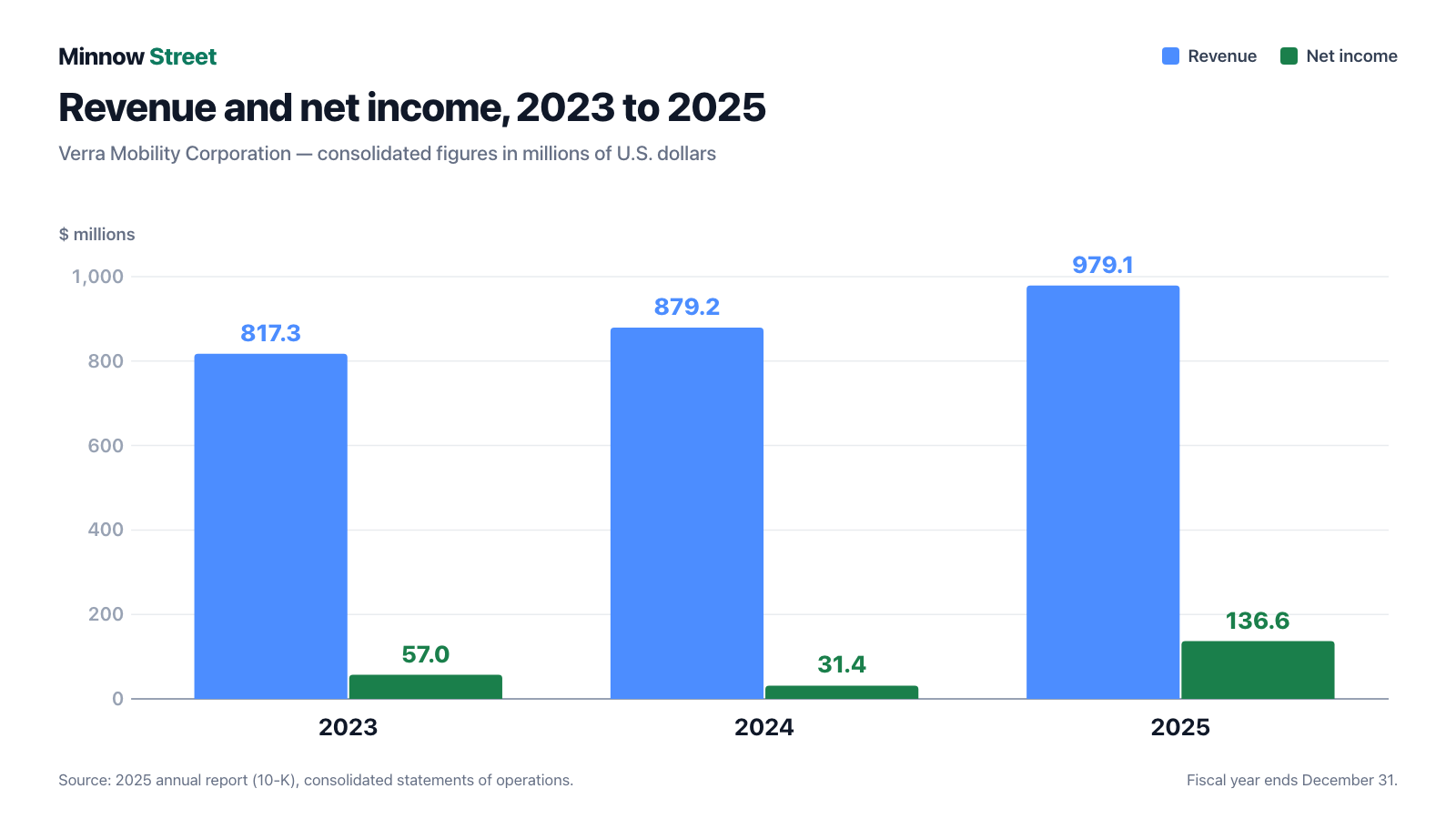
The hard figures: $979.1 million of revenue and $136.6 million of net income in fiscal 2025 (2024: $879.2 million and $31.4 million; 2023: $817.3 million and $57.0 million). Cash provided by operating activities — the money the business actually delivers — came to $255.8 million in 2025 after $223.6 million the year before. Income from operations of $238.4 million covered interest expense of $64.6 million about 3.7 times over. The first quarter of 2026 was quietly solid too: $223.6 million of revenue (year-ago quarter: $223.3 million) and $26.7 million of net income (versus $32.3 million).
Now it gets interesting, because revenue and profit are distributed very unevenly across the three divisions:
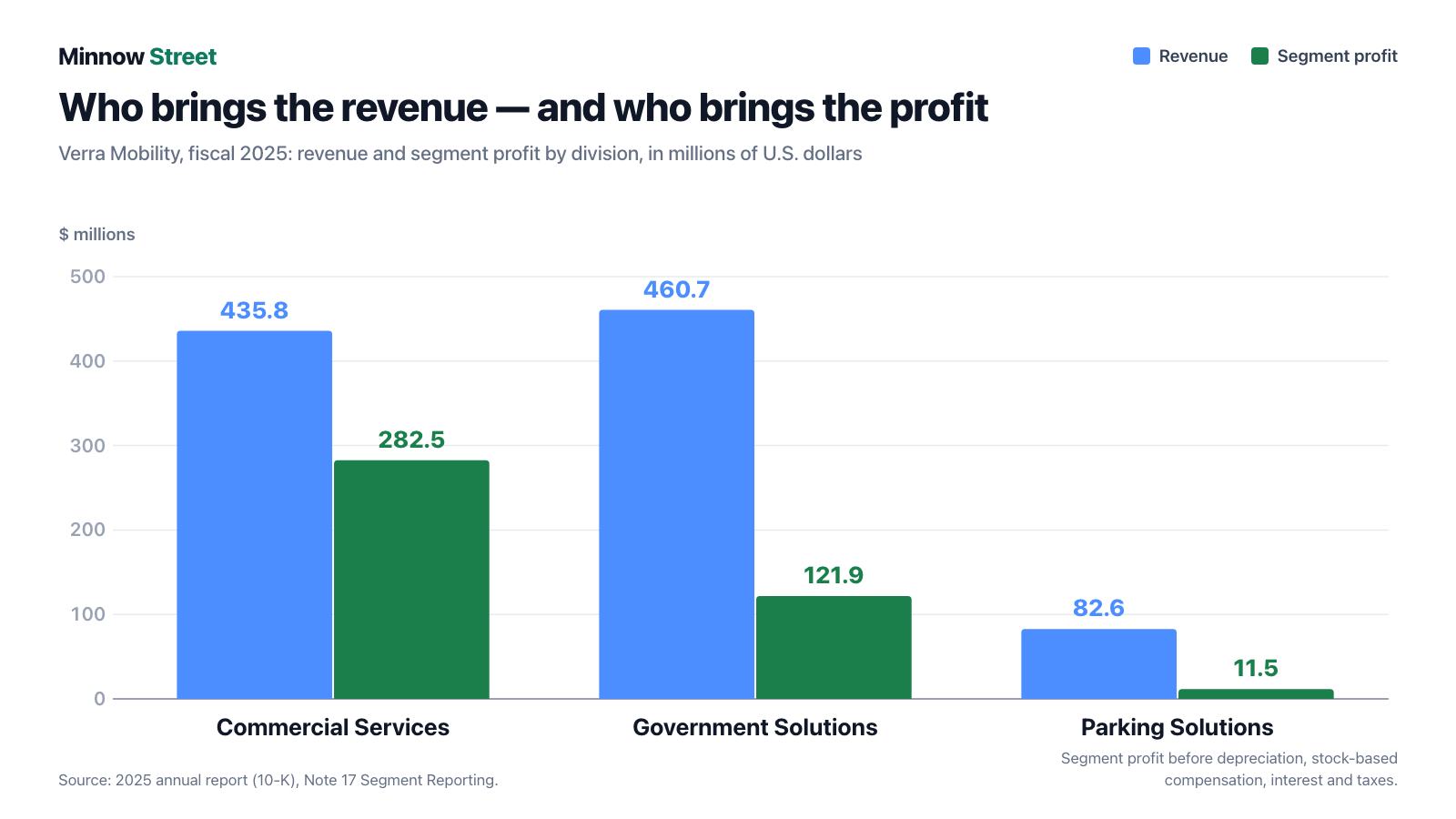
Convert that into percentages and the picture sharpens: Commercial Services contributed roughly 45 percent of revenue in 2025 but around 68 percent of total segment profit of $415.9 million. The segment margin was 64.8 percent — of every dollar taken in, almost 65 cents survived before depreciation, interest and taxes. Government Solutions managed 26.5 percent, Parking Solutions 13.9 percent. Remember that ratio, because it is the key to the whole case: at Verra Mobility, not every revenue dollar is worth the same. Dollars from the rental car business are roughly two and a half times as profitable as dollars from the camera business.
And because that is so, everything turns on the question of who supplies those especially valuable dollars.
What the filings say — the uncomfortable truths
Uncomfortable truth no. 1: four customers bring roughly half of revenue
Customer concentration is one of those phrases that sit in the risk section of an annual report and get skimmed. Translated into everyday terms, it is very concrete: if your neighbor tells you his business is thriving but four customers bring in half the revenue — would you swallow for a second? That is exactly the situation at Verra Mobility, and the quarterly report for the period ended March 31, 2026 spells it out.
"We also experience customer concentration in our Commercial Services segment. Three of our Commercial Services customers collectively accounted for 35.2% and 37.9% of our total revenues for the quarters ended March 31, 2026 and 2025, respectively. … We are currently operating under a short-term contract extension and are engaged in contract negotiations with one of our significant Commercial Services customers which represented over 10% of our total revenue for the three months ended March 31, 2026 and the year ended December 31, 2025."
— Verra Mobility Corporation, Form 10-Q for the quarter ended March 31, 2026, Item 1A Risk Factors

On top of that comes a fourth large customer from the other division: the New York City Department of Transportation (NYCDOT) accounted for 15.2 percent of consolidated revenue in the first quarter of 2026 (fiscal 2025: 17.9 percent). Added together, the three Commercial Services customers and NYCDOT make up roughly 50 percent of quarterly revenue. NYCDOT also dominates the balance sheet: 23.9 percent of all receivables as of March 31, 2026 related to that single customer, plus roughly $20.2 million of unbilled revenue. The New York contract was renewed effective January 1, 2026, runs for five years — and, according to the annual report, carries terms that are "materially different" from the prior one, including service credits and liquidated damages for poor performance.
Uncomfortable truth no. 2: the customer who left was by far the most profitable
On May 26, 2026, Verra Mobility disclosed what the risk factor had been about. The Form 8-K names the parties:
"On May 26, 2026, the Company announced that it received a termination notice from Avis Budget regarding Avis Budget's contract with the Company. Avis Budget is one of the Company's significant Commercial Services customers and represented over 10% of the Company's total revenue for the three months ended March 31, 2026 and year ended December 31, 2025."
— Verra Mobility Corporation, Form 8-K of May 26, 2026, Item 8.01

Losing ten percent of revenue hurts, but it sounds manageable. The number that matters sits in the press release attached to the same filing — and it is of a different order:
"The Company currently expects the termination to reduce Commercial Services' 2026 annualized revenue by approximately $135 million to $145 million and 2026 annualized segment profit by approximately $120 million to $125 million, before taking into account expected cost reduction initiatives."
— Verra Mobility Corporation, press release of May 26, 2026, Exhibit 99.1 to the Form 8-K

Read those two numbers side by side once more: $135 million to $145 million of revenue — and $120 million to $125 million of segment profit. For every revenue dollar lost, roughly 86 to 89 cents go missing from profit. That is not ordinary customer business, that is nearly pure margin. Measured against 2025 revenue of $979.1 million, the revenue loss equals roughly 14 percent; measured against total segment profit of $415.9 million, the profit loss equals roughly 29 to 30 percent — almost a third. A customer worth one seventh of revenue therefore carried nearly a third of the earnings.
Fairness requires one caveat: the company names three Commercial Services customers each above ten percent of revenue in its concentration note (13.3, 11.9 and 10.0 percent in the first quarter of 2026) but does not attach names to the letters. That the disclosed magnitude of roughly 14 percent matches the largest of those three is arithmetic, not confirmation by the company.
Verra Mobility drew the consequence immediately: guidance for 2026 was cut the same day to $985 million to $995 million of revenue, $380 million to $385 million of adjusted EBITDA (earnings before interest, taxes, depreciation and amortization), adjusted earnings per share of $1.19 to $1.25, and free cash flow of $140 million to $150 million. Because the termination only takes effect in September 2026, that guidance still contains most of the Avis business. The full annual impact lands in 2027.
Uncomfortable truth no. 3: the July 28 relief is not a signature
Now to the disclosure that invites the closing line. On July 28, 2026, Verra Mobility announced an agreement with Avis Budget. The headline of the press release reads, verbatim, "Verra Mobility Reaches Framework Agreement with Avis Budget Group" — a framework, not a contract. What was agreed and what was not sits in the first paragraph:
"… today announced that it has reached an agreement with Avis Budget Group ("ABG") on the key commercial terms of a new seven-year tolling and violations services contract and are working collaboratively to finalize the remaining operational terms and conditions. This redefined commercial relationship will give ABG the option to selectively perform certain activities internally. While Verra Mobility is not disclosing the commercial terms, from a financial perspective, the terms of the new agreement are expected to be materially less favorable to the Company when compared to the prior agreement it had with ABG."
— Verra Mobility Corporation, press release of July 28, 2026, Exhibit 99.1 to the Form 8-K of July 29, 2026

Three things sit in that paragraph that should not be skimmed. First: what is agreed are the key commercial terms; the operational terms are still being negotiated. An agreement on key terms is legally a different animal from a signed contract — and unlike the May termination, which the company reported under Item 8.01 as "Other Events," the agreement was disclosed under Item 7.01, Regulation FD Disclosure: information that expressly is not deemed "filed" with the SEC. Second: Avis Budget gains the right to perform certain activities internally, which reduces the volume that reaches Verra Mobility at all. Third, and this is the real number without a number: the terms are materially less favorable. How much of the $120 million to $125 million of segment profit comes back, nobody says.
Translated into everyday terms: your biggest client fires you, and two months later tells you that you may keep working — at a price he will not yet name but that is explicitly worse, and part of the work he will now do himself. That is unquestionably better than nothing. It is simply not a closing line; it is the opening of a new calculation.
Uncomfortable truth no. 4: the leadership team is being rebuilt
A good two months lie between the two Avis disclosures, and in them Verra Mobility filed five further current reports that describe a company in motion. On June 1, 2026 it disclosed that David Roberts had ceased to serve as president and chief executive officer effective May 31, 2026; the separation was a termination "without cause," with the corresponding severance entitlements. Roberts also resigned from the board effective May 30, 2026 — eleven days after shareholders had re-elected him at the annual meeting of May 19, 2026 with 136,040,667 votes for a term running to 2029; the board shrank from seven directors to six. The board appointed Jonathan Keyser, 44, until then chief transformation officer and chief legal officer since December 2022, as interim president and chief executive officer, with a base salary of $650,000 and a target bonus of 100 percent (Form 8-K of June 1, 2026). In the press release of July 28, 2026 he already appears as "president and chief executive officer" without the qualifier "interim" — the company has not disclosed a permanent appointment.
There is more. On June 5, 2026 the board formed a Transformation Committee to review cost structure, capital allocation and the "portfolio composition of business units" — the last of those being the polite way of saying that selling a division is on the table. On June 9, 2026 it was determined that Jonathan Baldwin, head of the Government Solutions segment, would depart on July 9, 2026. And on June 13 and 16, 2026 the compensation committee granted the new chief customer officer, Stacey Moser, restricted stock unit awards worth $375,000 and $125,000 plus cash retention awards of the same size. The far larger retention packages, though, sit in the June 1 filing: on top of his salary, Keyser received a one-time restricted stock unit award with a grant date value of $2.25 million and a cash retention award of $3.3 million; chief financial officer Craig Conti was granted, back on May 29, 2026 — three days before the leadership change was made public — a restricted stock unit award worth $1.75 million and likewise $3.3 million of cash retention, plus a base salary increase to $550,000 and a target bonus of 100 percent. Retention packages get written when a company fears people will leave.
The change at the top had an epilogue outside the current reports as well. On June 11 and again on June 26, 2026, David Roberts filed two Form 144 notices — the advance notice of a proposed sale. Together they covered 1,008,472 shares with an aggregate market value stated in the notices of roughly $4.47 million, or a little over four dollars a share. For comparison: the company itself had paid an average of about $22.27 for the same stock a few months earlier. A Form 144 only announces a sale; no Form 4 confirming execution had been filed as of July 29, 2026.
None of this is a scandal — it is the normal response of a board to a heavy setback. But it does mean this: the new Avis contract is being negotiated by a leadership team that is itself being reassembled.
Uncomfortable truth no. 5: the balance sheet carries more debt and goodwill than equity
As of March 31, 2026 the balance sheet showed $1,055.6 million of debt — the carrying amount after original issue discounts and deferred financing costs. Behind it sit a secured term loan of $685.4 million (last rate 5.7 percent, maturing October 15, 2032), unsecured notes of $350.0 million (5.50 percent, maturing April 15, 2029) and $26.0 million drawn on a $150 million revolving facility with a further $78.3 million available. Against that stood $46.9 million of cash and equity of $272.0 million. All debt covenants were met at the reporting date, and the maturities are comfortably distant — that is the good news.
The less good news: the same balance sheet carries $741.2 million of goodwill, the premium Verra Mobility paid above net asset value in past acquisitions. Of that, $424.4 million sits in the Commercial Services segment — more than the group's entire equity. For 2025 the company considered a purely qualitative assessment sufficient in its annual impairment test. That such a balance can shrink quickly is something the group has demonstrated itself: in 2024 it wrote off $97.1 million in the Parking Solutions segment, pushing net income down to $31.4 million. Another write-down would not cost a dollar of cash — but it would turn the profit line.
And one more capital movement belongs in this chapter, because it shows how unexpected the break was for the company itself. In the fourth quarter of 2025 Verra Mobility repurchased its own shares for $133.4 million (6,028,853 shares at roughly $22.13 apiece); in the first quarter of 2026 it spent another $50.2 million (2,215,800 shares at roughly $22.66). Together that is $183.6 million for 8.24 million shares at an average of about $22.27 — barely three months before the termination arrived. As of March 31, 2026, $66.3 million of the authorization remained. Buybacks are shareholder-friendly in principle; they are also the most honest bet a management team can place on its own future — and this bet went badly.
Valuation: cheap on a basis that no longer exists
As of July 28, 2026 the stock traded at $4.18; with 151,906,653 shares outstanding (as of May 1, 2026, per the cover page of the quarterly report), that produces a market value of roughly $0.64 billion. Measured against the trailing twelve months, the resulting metrics light up any screener: a price-to-earnings ratio of about 5, a price-to-sales ratio of about 0.65, and an enterprise value (market value plus net debt) of roughly $1.69 billion, about 4.5 times trailing twelve-month earnings before interest, taxes, depreciation and amortization (EBITDA) — not to be confused with the "adjusted EBITDA" the company reports itself.
This is exactly where a second look pays, because every one of those metrics has a numerator drawn from the past. Trailing profit still contains the full Avis business. Use instead what the company itself projects for 2026 — adjusted earnings per share of $1.19 to $1.25 — and the ratio drops to roughly 3.4, which also sounds cheap. Except that guidance too contains Avis through September. The most honest approach is therefore a rough calculation with the full loss applied: subtract the $120 million to $125 million of segment profit the company attributes to Avis from the adjusted EBITDA range of $380 million to $385 million and you land around $260 million — against the $1,017 million of net debt the company itself reports for March 31, 2026, that would be about four times leverage instead of the 2.5 it states for the same date. That calculation stays an approximation: segment profit and adjusted EBITDA are not the same measure, and cost cuts as well as whatever flows back from the new contract would soften the picture — both are unknown today.
The professional view points the same way and further: seven analysts covered the stock as of July 28, 2026 with an average target price of $9.86, a good deal more than double the share price, and their ratings skew clearly positive. Targets like these are often adjusted with a lag after heavy news — they are a sentiment reading, not evidence. On the other side of the trade, roughly 8.6 percent of the free float was sold short (as of July 28, 2026): a noticeable slice of the market is betting on further declines. As a second dated anchor, keep in mind the $22.27 the company itself paid on average for its own shares between October 2025 and March 2026. Remember the principle: a low price-to-earnings ratio is only as reliable as the earnings in the denominator — and here those earnings are being renegotiated. How quickly a valuation can turn when technology and traffic policy reshape a business model is something our Gorilla Technology analysis shows as well — that one deals with AI-driven video analytics in public space, the very neighborhood in which Verra Mobility's camera business operates.
Opportunities and risks at a glance
What speaks for Verra Mobility:
- A real, highly profitable business: $979.1 million of revenue and $136.6 million of net income in 2025, plus $255.8 million of cash from operations — income from operations covered interest expense about 3.7 times over.
- The Commercial Services segment margin was 64.8 percent in 2025; a business with margins like that is hard to replace, and Verra Mobility is deeply embedded through relationships with more than 50 U.S. tolling authorities.
- A second leg with long contract terms: Government Solutions produced $460.7 million of revenue in 2025; the new five-year contract with the New York City Department of Transportation has run since January 1, 2026, and camera contracts typically run three to five years with renewal options.
- The balance sheet buys time: the secured term loan runs to October 2032, the notes to April 2029, all covenants were met as of March 31, 2026, and $78.3 million of the revolving facility remained available.
- The customer is not gone entirely: the July 28, 2026 agreement contemplates a new seven-year contract — and the board has visibly responded with a transformation committee, a cost program and a new customer organization.
What speaks against it:
- Extreme customer concentration: three Commercial Services customers plus the New York City Department of Transportation brought roughly half of consolidated revenue in the first quarter of 2026; the contracts of the two remaining large customers come up for renewal discussions within 18 months, per the quarterly report.
- The profit loss is disproportionate: $135 million to $145 million of revenue costs $120 million to $125 million of segment profit — roughly 29 to 30 percent of all segment profit in 2025. The full annual impact lands only in 2027.
- The July 28, 2026 agreement covers only commercial key terms, not operational conditions; it gives Avis Budget the option to insource part of the work and is expressly "materially less favorable" — the amount of profit returning is unknown.
- Leadership rebuilt mid-crisis: chief executive change effective May 31, 2026 (filled on an interim basis), departure of the Government Solutions head on July 9, 2026, board reduced from seven directors to six, retention awards for executives.
- Balance sheet structure: $1,055.6 million of debt against $272.0 million of equity, plus $424.4 million of goodwill in the affected segment alone — after a $97.1 million write-down in the Parking Solutions segment in 2024, a further impairment cannot be ruled out.
- The second leg has a lump too: as of March 31, 2026 the New York City Department of Transportation accounted for 23.9 percent of all receivables plus roughly $20.2 million of unbilled revenue — and the new contract carries service credits and liquidated damages.
A human conclusion
Back to the closing-line trap. Its appeal is that it feels like diligence: you read the bad news, you read the good news, therefore you are informed and may now stop thinking. Verra Mobility shows why that is not enough. The bad news in May was quantified: $135 million to $145 million of revenue, $120 million to $125 million of segment profit, almost a third of earnings. The good news in July is not quantified — it says only that the relationship continues, and expressly that it continues on worse terms. Between those two disclosures sits the one number that matters, and to this day it has not been published.
What remains is an honestly good business in an honestly difficult position. The company earns money, has until 2029 and 2032 before debt comes due, and occupies a niche nobody walks into casually. At the same time it depends on very few signatures, two more of which will be renegotiated over the next year and a half, and the goodwill of the affected segment exceeds the entire equity base. Whoever buys today is not buying a price-to-earnings ratio of 5 but a bet on how much of the $120 million to $125 million comes back — and on whether the other two stay. So the honest question is not "is the stock cheap?" but: would you hand your money to a company whose most important number for the next three years sits in a contract nobody has signed? If yes, you have a thesis. If no, you had a reflex. The closing line is a line you draw yourself — the company has not drawn it. What you make of that is your decision. And that is exactly as it should be.
Sources
Every original document used in this analysis — for you to read yourself:
- Verra Mobility Corporation — Form 10-Q for the quarter ended March 31, 2026 (filed May 6, 2026)
- Verra Mobility Corporation — Form 10-K for fiscal 2025 (filed February 24, 2026)
- Verra Mobility Corporation — Form 8-K of May 6, 2026 (first quarter results, Item 2.02) and the accompanying earnings release (Exhibit 99.1, net debt and net leverage as of March 31, 2026)
- Verra Mobility Corporation — Form 8-K of May 26, 2026 (Avis Budget termination, Items 7.01/8.01) and the accompanying press release (Exhibit 99.1, revised 2026 guidance)
- Verra Mobility Corporation — Form 8-K of July 29, 2026 (agreement with Avis Budget, Item 7.01) and the accompanying press release (Exhibit 99.1)
- Verra Mobility Corporation — Form 8-K of June 1, 2026 (change at the top of the company, Item 5.02)
- Verra Mobility Corporation — Form 8-K of June 8, 2026 (formation of the Transformation Committee, Item 8.01)
- Verra Mobility Corporation — Form 8-K of June 15, 2026 (departure of the Government Solutions head, Item 5.02) and Form 8-K of June 17, 2026 (chief customer officer compensation, Item 5.02)
- Verra Mobility Corporation — Form 8-K of May 20, 2026 (results of the annual meeting held May 19, 2026, Item 5.07) and the amendment on Form 8-K/A of July 23, 2026 (Item 5.07)
- David M. Roberts — SEC notices of proposed share sales (Form 144) dated June 11, 2026 (500,000 shares) and June 26, 2026 (508,472 shares)
- Complete SEC filing history of Verra Mobility Corporation (CIK 0001682745): EDGAR overview (sec.gov)
- Fundamental data (metrics, valuation, analyst estimates; as of July 28, 2026), reconciled with the SEC filings.
Transparency & disclaimer: This analysis is journalistic commentary on publicly available information. It is not investment advice, not a regulated financial analysis and not a solicitation to buy or sell securities. Equity investments carry substantial risk up to and including total loss. All information without warranty; the data cut-off is stated in the text. The author holds no position in Verra Mobility shares at the time of publication.
Our Bottom Line at a Glance
- Earnings power of the core business positive
- The Commercial Services segment turned $435.8 million of 2025 revenue into $282.5 million of segment profit — a 64.8 percent margin and roughly 68 percent of total segment profit of $415.9 million. Group-wide, 2025 delivered $979.1 million of revenue, $136.6 million of net income and $255.8 million of operating cash flow.
- Customer concentration negative
- Three Commercial Services customers (13.3 / 11.9 / 10.0 percent) plus the New York City Department of Transportation (15.2 percent) brought roughly half of consolidated revenue in the first quarter of 2026. Per the quarterly report filed May 6, 2026, the contracts of the two remaining large Commercial Services customers come up for renewal discussions within 18 months.
- Avis Budget break and renegotiation negative
- The May 26, 2026 termination costs, by the company's own figures, $135 million to $145 million of annualized revenue and $120 million to $125 million of annualized segment profit — roughly 29 to 30 percent of 2025 segment profit. The July 28, 2026 agreement covers only the commercial key terms of a seven-year contract, leaves Avis Budget the option to insource selectively and is expressly "materially less favorable."
- Balance sheet and goodwill neutral
- As of March 31, 2026, $1,055.6 million of debt stood against $272.0 million of equity; maturities fall in 2029 and 2032, all covenants were met, and 2025 income from operations covered interest expense about 3.7 times over. The risk sits in $741.2 million of goodwill, of which $424.4 million is in the affected segment — in 2024 the company already wrote off $97.1 million in Parking Solutions.
- Leadership and capital allocation negative
- Chief executive change effective May 31, 2026 (filled on an interim basis), departure of the Government Solutions head on July 9, 2026, board reduced from seven directors to six, retention awards for executives. Beforehand the company had repurchased $183.6 million of its own shares between October 2025 and March 2026 at an average of roughly $22.27 — barely three months before the termination. In June 2026 the departed chief executive filed two Form 144 notices for proposed sales of 1,008,472 shares in total, with a stated market value of roughly $4.47 million; no Form 4 confirming execution had been filed as of July 29, 2026.
Verra Mobility earns its money from the paperwork of driving, and it does so with unusual profitability: $979.1 million of revenue, $136.6 million of net income and $255.8 million of operating cash flow in 2025, plus a 64.8 percent segment margin in the rental car business. That is also where the weakness lies: four customers recently brought roughly half of revenue, and the most profitable of them terminated on May 26, 2026 — it accounted for $135 million to $145 million of revenue but $120 million to $125 million of segment profit. The July 28, 2026 agreement keeps the relationship alive, but it is only an understanding on key terms and expressly on materially worse conditions. Whoever buys here is not buying a multiple but an open contract negotiation. Not investment advice.
What Our Rating Means
Open questions
The business works in principle, but one material question is open. As long as it stays open, our findings do not carry a quality verdict.
Yellow, because the company is substantively healthy while one material operating question stays open. On the side of substance: $255.8 million of operating cash flow in 2025, income from operations covering interest expense about 3.7 times over, maturities not until 2029 and 2032, covenants met, and positive equity of $272.0 million — none of that points to the kind of balance-sheet risk that would turn the light red. Against green: earnings for the coming years hang on individual signatures. The terminated customer carried roughly 29 to 30 percent of 2025 segment profit, its replacement contract so far exists only as an agreement on key terms at expressly worse conditions, and two further large customers worth 21.9 percent of quarterly revenue are up for renegotiation within 18 months. Add an interim chief executive and $424.4 million of goodwill in the affected segment, more than the entire equity base. The low share price argues neither way — it is a price, not a quality attribute. Green turns yellow the moment the decisive number of the coming years sits in a document still being negotiated. The decision is yours.
A journalistic assessment by our editorial team at the time of the deep dive, based on public sources — not investment advice and not a solicitation to buy or sell. Your personal circumstances (investment goals, risk capacity, taxes) cannot be taken into account. What our levels mean, how verdicts are formed, and what conflicts of interest exist →
Worth Noting
- Verra Mobility reached our research list through the event radar, which pulls mandatory filings from the U.S. securities regulator, the SEC — specifically the Form 8-K under Item 7.01 filed on July 29, 2026 (event of July 28, 2026) announcing the agreement with Avis Budget. It was not a hit from any of our momentum or quality filters; those scanner lists are recomputed daily.
- Important context for the valuation metrics: the price-to-earnings and price-to-sales ratios (about 5 and about 0.65 as of July 28, 2026) rest on the trailing twelve months and therefore still contain the full Avis business. The revised 2026 guidance likewise contains Avis through September 2026 — the full annual impact of the termination only lands in 2027.
- Verra Mobility identifies the three large Commercial Services customers in its concentration note only as "Customer A, B and C" and attaches no names. That the magnitude of the Avis termination ($135 million to $145 million against $979.1 million of 2025 consolidated revenue, roughly 14 percent) matches the largest of those three is arithmetic by this analysis, not confirmation by the company.
Frequently Asked Questions
Verra Mobility Corporation (NASDAQ: VRRM), based in Mesa, Arizona, processes the paperwork of driving. The Commercial Services segment handles tolls, traffic violations and vehicle title and registration for rental car and fleet customers; Government Solutions operates speed, red-light, school-bus and bus-lane camera programs for municipalities; Parking Solutions sells parking management software. Fiscal 2025 revenue was $979.1 million with net income of $136.6 million.
Because the profit loss far exceeds the revenue loss. Verra Mobility puts the impact at $135 million to $145 million of annualized revenue but $120 million to $125 million of annualized segment profit. Measured against 2025 revenue of $979.1 million that is roughly 14 percent of revenue — but measured against total segment profit of $415.9 million it is roughly 29 to 30 percent of earnings. The full annual impact only lands in 2027 because the termination takes effect in September 2026.
Only partly. The filing describes agreement on the "key commercial terms" of a new seven-year contract; the remaining operational terms are still being negotiated, so no signed contract exists. Avis Budget also receives the option to perform certain activities internally, and Verra Mobility states explicitly that the new terms are expected to be "materially less favorable" from a financial perspective than the prior agreement.
Heavily. Per the quarterly report for the period ended March 31, 2026, three Commercial Services customers at 13.3, 11.9 and 10.0 percent together accounted for 35.2 percent of consolidated revenue, plus 15.2 percent from the New York City Department of Transportation. Four customers therefore brought roughly half of revenue. The same report states that the contracts of the two remaining large Commercial Services customers come up for renewal discussions within 18 months.
Not through a classic initial public offering but through a SPAC merger. The listed shell was called "Gores Holdings II, Inc." until October 3, 2018 and acquired the operating business in 2018. Two items on the balance sheet date from that history: the large goodwill balance ($741.2 million as of March 31, 2026) and a tax receivable agreement under which $43.7 million is still payable to a legacy investor.
As of March 31, 2026, $1,055.6 million of debt stood against $272.0 million of equity and $46.9 million of cash. Maturities are distant: unsecured notes of $350.0 million run to April 2029 and a secured term loan of $685.4 million to October 2032. All debt covenants were met at the reporting date. The balance sheet also carries $741.2 million of goodwill, of which $424.4 million sits in the Commercial Services segment.
Because the multiples rest on past figures. As of July 28, 2026, at a price of $4.18, the price-to-earnings ratio was roughly 5 and the price-to-sales ratio roughly 0.65 — but the earnings in the denominator still contain the full Avis business. If the $120 million to $125 million of segment profit disappears, leverage rises arithmetically from the 2.5 times the company reports for March 31, 2026 to roughly four times adjusted earnings before interest, taxes, depreciation and amortization.
A great deal. Chief executive David Roberts left effective May 31, 2026, terminated "without cause," and resigned from the board, which shrank from seven directors to six. Chief legal officer Jonathan Keyser took over on an interim basis. On June 5, 2026 the board formed a Transformation Committee, on July 9, 2026 the head of the Government Solutions segment departed, and retention awards were granted to the new chief customer officer.
Found an error?
Did you spot a factual error, an outdated number, or a typo in this deep dive? Let us know briefly — your report goes straight to the editorial team.