Biglari Holdings: The Businesses Earn Money Every Year — the Loss Comes From a Fund That Owns the Company's Own Stock
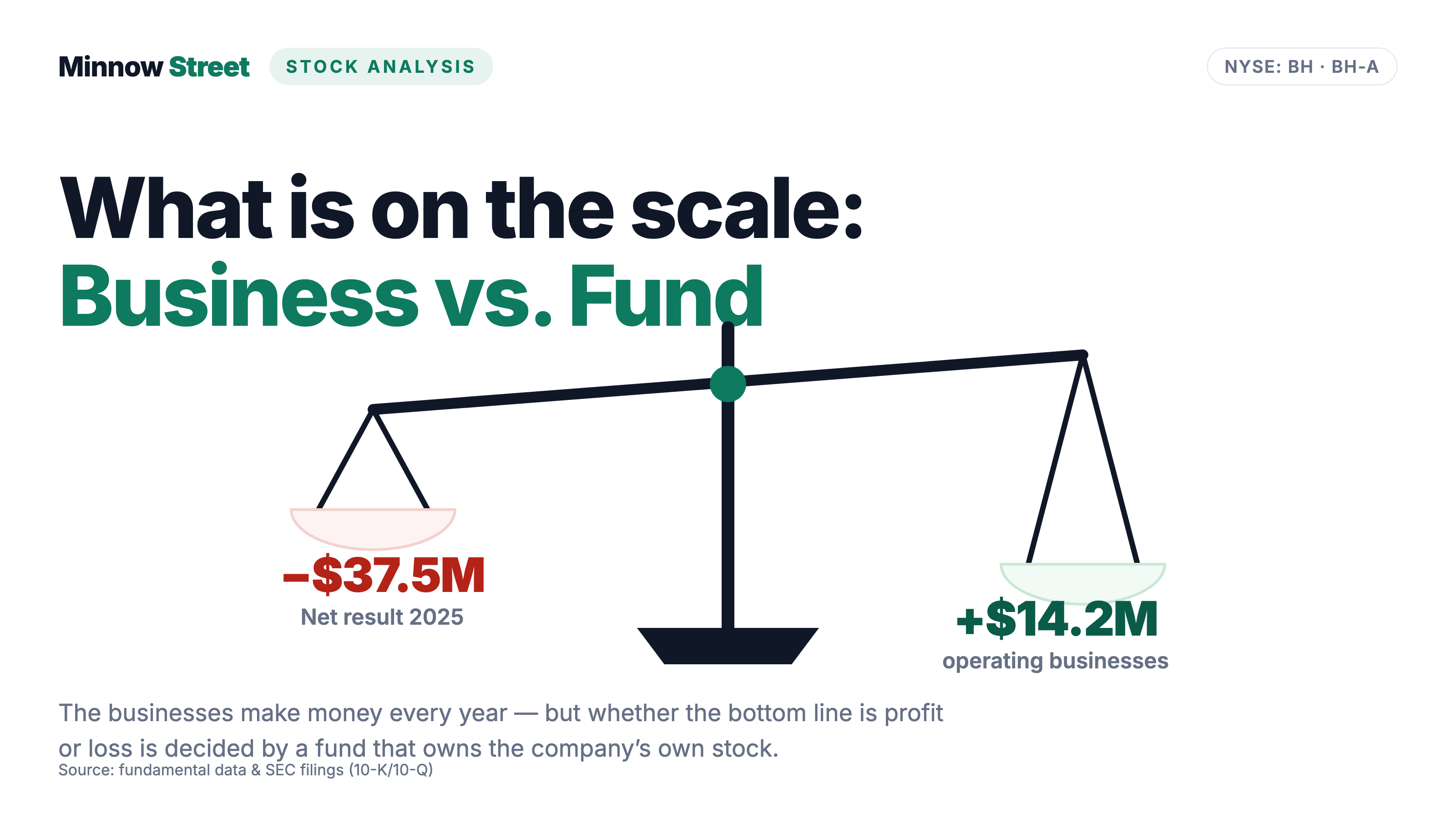
Biglari Holdings looks like a miniature Berkshire: restaurants, insurance, oil, an owner-operator who allocates capital centrally. But the mandatory filings to the U.S. securities regulator, the SEC, tell a different story. The operating businesses — Steak 'n Shake, First Guard, Southern Oil, Maxim — contributed $14.2 million to earnings in 2025; the bottom line was still a $37.5 million loss, because the in-house investment partnerships (Lion Fund) lost $52.0 million. Those funds hold the company's own stock, carried as treasury even though it is legally outstanding — and Chairman Sardar Biglari controls roughly 73.1 percent of the vote while owning 0.1 share directly. On Reddit the stock shows up with 6 mentions in 24 hours (ApeWisdom, as of July 23, 2026). Not investment advice — just a sober look at who owns the company, who makes the loss, and who sits at the register.
 Thomas Mücke
Founder & Publisher
Thomas Mücke
Founder & Publisher
Chart
Interactive price chart (TradingView).
Note: pure fact-based analysis, not investment advice and not a solicitation to buy or sell. All figures without guarantee.
There is an investor trap that catches the well-read especially, because it looks like a reward for paying attention: the doppelgänger trap. It works like this: you see a company copying a famous template — here a holding company with insurance float, an owner-operator who allocates capital centrally and writes long letters to shareholders. Your mind fills in the rest: "this is a young Berkshire Hathaway." And just like that you have an investment thesis without having read the balance sheet. Biglari Holdings (NYSE: BH and BH-A) out of San Antonio is exactly that company: restaurants, insurers, oil units, a chief named Sardar Biglari who has run everything single-handedly since 2008 — and who even named the holding company after himself, the way Warren Buffett shaped a textile mill into "Berkshire Hathaway." On Reddit the stock is no storm, more of a whisper: 6 mentions in 24 hours (ApeWisdom, as of July 23, 2026). So let's make a deal: before you buy the label "next Buffett," we read together only what the company itself reported, under penalty of law, to the U.S. securities regulator, the SEC — the annual report (10-K) for 2025, the quarterly report (10-Q) as of March 31, 2026, and the proxy statement for the 2026 annual meeting. A filing to the SEC is honest under penalty of law. And this one describes operating businesses that make money every year, a net loss that appears anyway, funds that hold the company's own stock — and a chairman who owns 73 percent of the vote while holding almost no shares directly. In the end, the decision is yours.
What Biglari Holdings actually is — a general store with a fund in the basement
Biglari Holdings is a holding company — in everyday terms, a parent that makes nothing itself but owns other companies and collects their profits, the way a landlord owns several shops. Under the roof sit five very different businesses. First, restaurants: the burger chain Steak 'n Shake (as of December 31, 2025: 131 company-operated restaurants, 179 "franchise partner" units, and 94 traditional franchise locations) and the steakhouse brand Western Sizzlin — 435 locations combined. Second, insurers: First Guard (commercial trucking insurance sold by phone and online), Southern Pioneer (property and casualty), and the reinsurer Biglari Reinsurance. Third, oil and gas: Southern Oil of Madisonville, Louisiana, and Abraxas Petroleum of San Antonio. Fourth, brand licensing: the men's magazine Maxim, whose business is essentially licensing. And fifth, in the basement of the house, the real engine: the investment partnerships Lion Fund L.P. and Lion Fund II L.P. — private investment funds with a fair value of $772.6 million as of December 31, 2025, plus $69.0 million of marketable securities held outside the funds. The 10-K is blunt about who runs it: "All major investment and capital allocation decisions are made for the Company and its subsidiaries by Mr. Biglari." One person decides. That names the central tension of this analysis, and it runs through every chapter: the operating businesses reliably make money — but whether the company reports a profit or a loss at year-end is decided by a fund that largely holds the company's own stock and is controlled by exactly one man.
Where the stock shows up — and why it is not a typical scanner pick
Biglari Holdings did not land on our research list through one of our momentum or value scanners, but through the Reddit hype scanner: 6 mentions in 24 hours (ApeWisdom, as of July 23, 2026). That is, honestly, atypical — and exactly why it is interesting. Biglari is not a feverish growth story but a special situation: a dual-listed holding company with two share classes (Class A with one vote, Class B with one-fifth of the economic interest and one ten-thousandth of the vote), extremely thin trading volume, and a capital structure you only understand once you have read the notes. Classic metrics mislead here: a price-to-earnings ratio cannot be formed for lack of earnings, a price-to-sales ratio ignores the investment side, and the reported loss suggests an operating decline that does not exist. Remember the finding right at the start: with Biglari you don't measure with the price thermometer, you measure with a magnifying glass on the notes. So let's take the magnifier.
The numbers over the years — honestly appraised
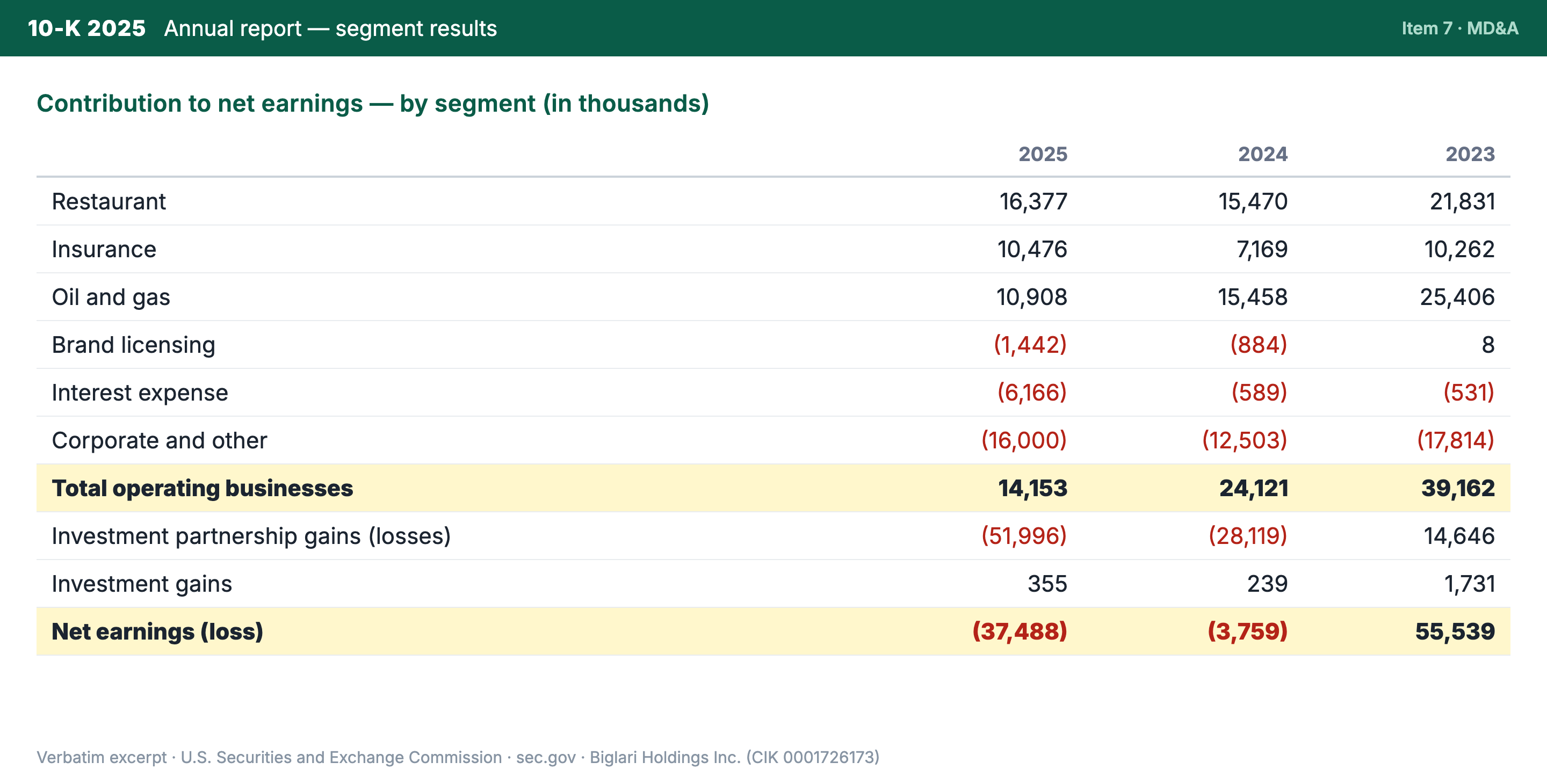
First, what genuinely speaks for Biglari — and that is more than the red bottom line suggests. The operating businesses deliver. In 2025 they contributed a combined $14.2 million to net earnings ($24.1 million in 2024, $39.2 million in 2023). Operating revenue in 2025 was $395.3 million, up 9.2 percent from the prior year ($362.1 million). By segment: restaurants contributed $16.4 million, the insurers $10.5 million (with a healthy underwriting book), oil and gas $10.9 million; against that stand brand licensing at −$1.4 million, interest expense at −$6.2 million, and corporate overhead at −$16.0 million. The balance sheet is tidy: $1,025.4 million in total assets, $268.8 million in cash (after just $30.7 million a year earlier), $523.4 million in equity. Now the curve that explains everything — net earnings over seven years:
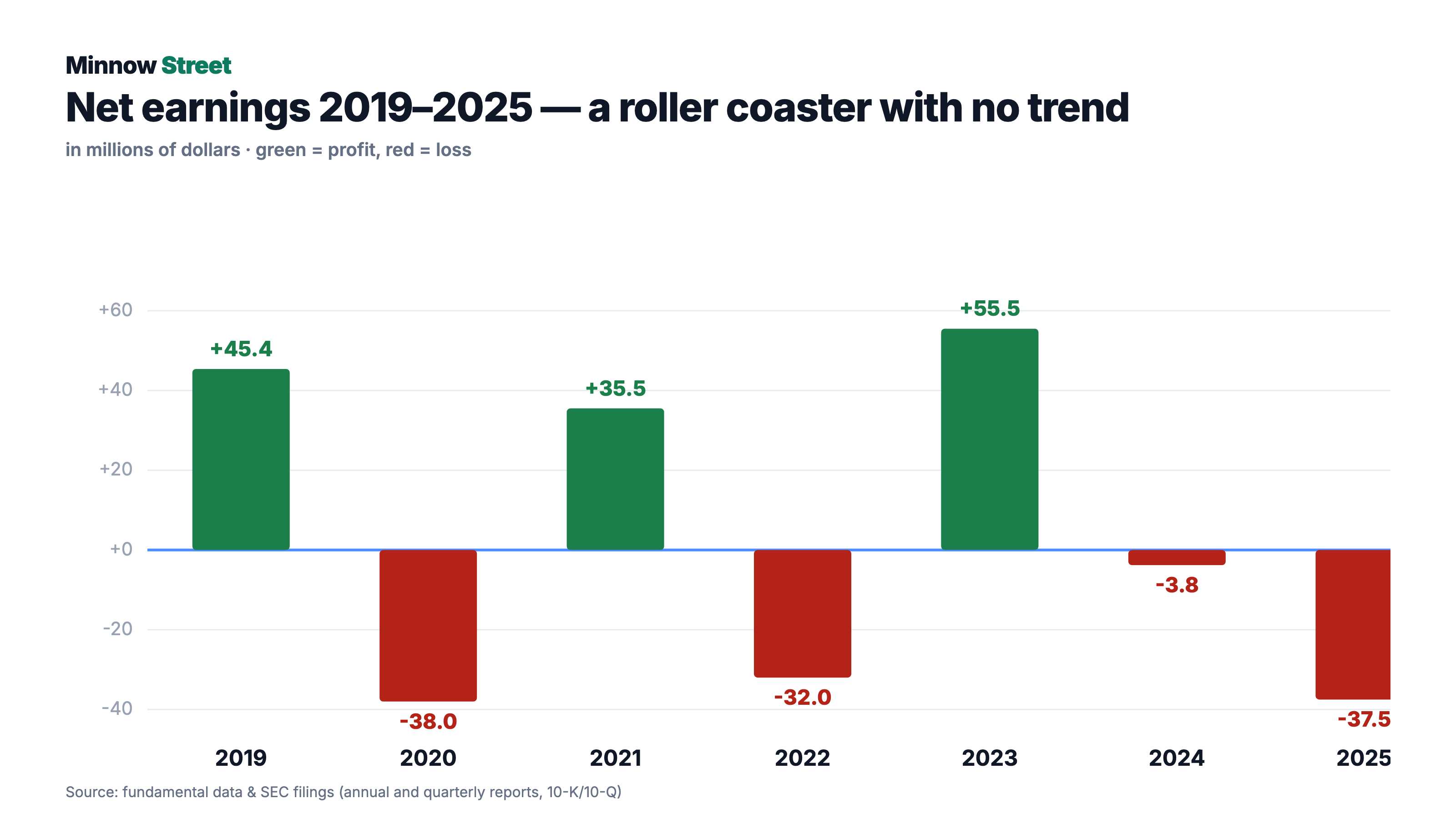
This curve has no trend — and that is the real message. Why net earnings swing so hard while the operating businesses quietly make their money is shown by the second chart: it splits the result into its two halves — the contribution of the operating businesses and the contribution of the investment partnerships.
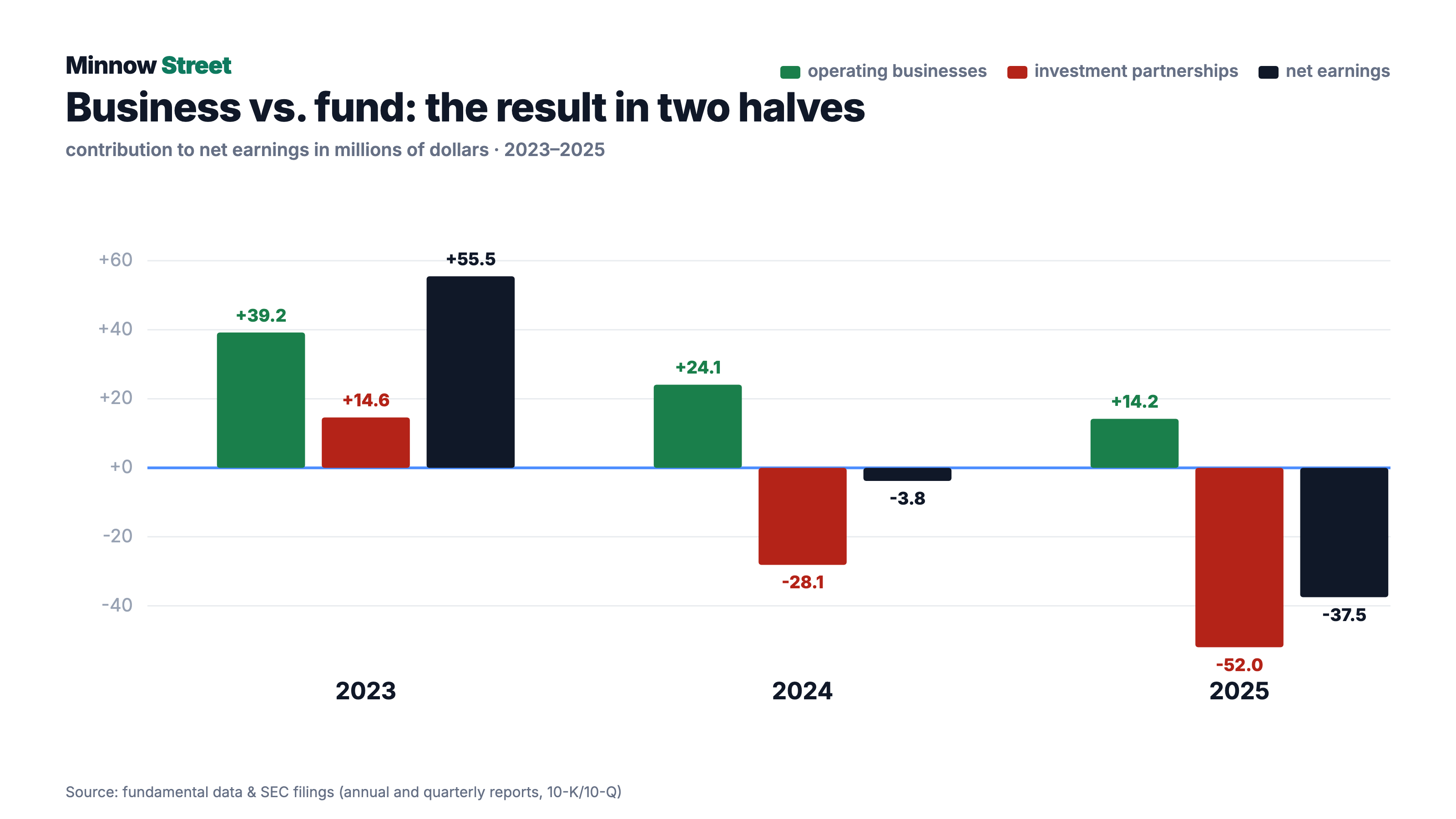
The annual report announces this roller coaster plainly:
"These gains and losses have caused and will continue to cause significant volatility in our periodic earnings."
— Biglari Holdings Inc., SEC annual report 10-K for 2025, Note 3 "Investment Partnerships"
One detail both softens and sharpens the curve: equity — the book value of the company — has not grown but shrunk over the years, from $616.3 million at the end of 2019 to $523.4 million at the end of 2025. A "compounder" whose book value falls over six years does not automatically earn the label. Remember the image: the businesses work, but shareholders' capital is smaller than it was in 2019, not larger. Which brings us to the uncomfortable truths.
What the filings say — the uncomfortable truths
Uncomfortable truth no. 1: the loss is not an operating loss — it is the price swing of a portfolio
Read "$37.5 million net loss" and you picture a business in trouble. The truth is in the segment table above: the operating businesses earned a combined $14.2 million in 2025 — the loss appeared one line lower, in the investment partnerships, which cost $52.0 million. These are not real cash outflows from the business but the valuation swings of a stock portfolio: when the positions in the Lion Fund rise, the bottom line shines (as in 2023: +$14.6 million from the funds, net earnings +$55.5 million); when they fall, the whole company turns red, even though the restaurants keep selling burgers and the insurers keep collecting premiums. In everyday terms: picture a master craftsman who runs a busy shop — but whose annual accounts depend on how his private stock portfolio happens to stand. In good market years he looks rich, in bad ones poor; neither has anything to do with the quality of his craft. That is the first lesson at Biglari: net income here measures the market, not the business. And in the first quarter of 2026 it went the same way — net −$14.5 million, of which −$13.5 million came from the funds.
Uncomfortable truth no. 2: more than half the shares sit in a fund that holds the company's own stock
Now comes the part you have to read twice because it sounds too strange to be true. The investment partnerships into which Biglari Holdings has put its capital buy, among other things, the shares of Biglari Holdings itself. The annual report describes it this way:
"The investment partnerships hold the Company's common stock as investments. The Company's pro-rata share of its common stock held by the investment partnerships is recorded as treasury stock even though these shares are legally outstanding."
— Biglari Holdings Inc., SEC annual report 10-K for 2025, Item 7 MD&A / Note 3
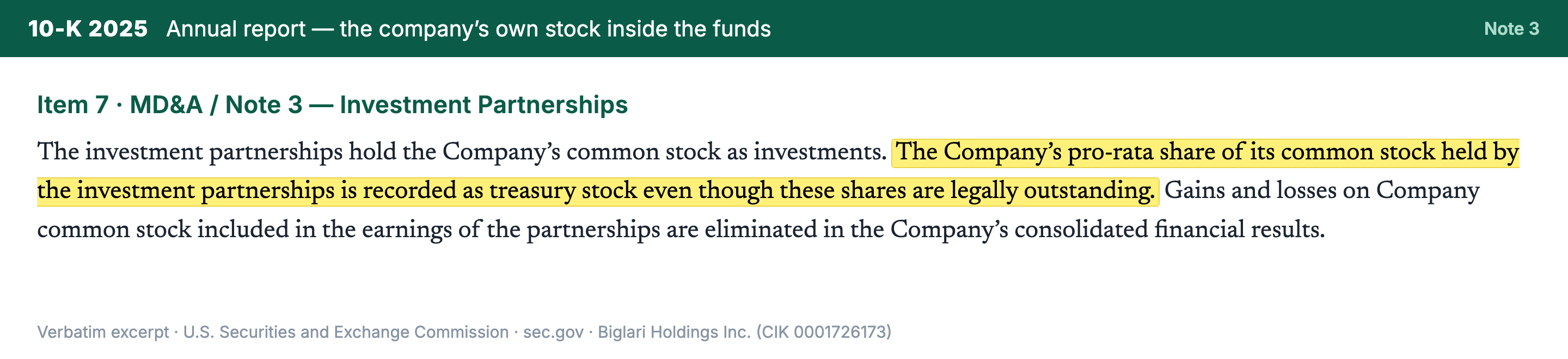
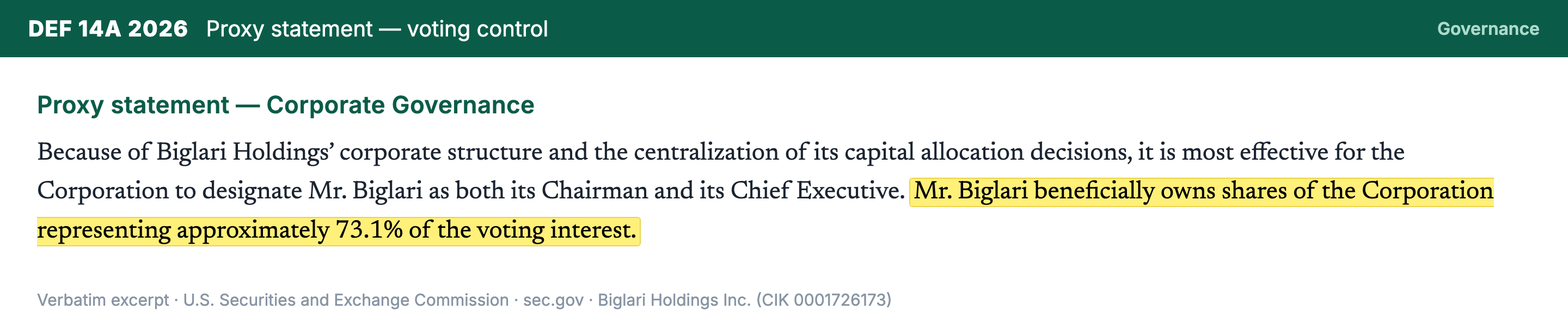
What that means in practice shows up in the share count. Legally outstanding are 206,864 Class A and 2,068,640 Class B shares — on a Class A basis (Class B counts as one-fifth) that is 620,592 Class A-equivalent shares. But for the earnings-per-share math in the quarterly report only about 260,000 Class A-equivalent shares remain, because the share held inside the fund is stripped out. Put differently: more than half of the company's economic shares sit in the funds — bought with money the company itself put into those funds. And it is clear who votes those shares. The proxy statement for the 2026 annual meeting names the figure:
"Mr. Biglari beneficially owns shares of the Corporation representing approximately 73.1% of the voting interest."
— Biglari Holdings Inc., SEC proxy statement DEF 14A 2026
In everyday terms: picture a club in which one member holds 73 of 100 votes — but those votes are locked in a portfolio bought with the club's own treasury. The board effectively cannot be voted out. For you as a minority shareholder that means: you co-own good businesses, but you have no say in anything — and you are aboard the boat of a captain no crew can remove. None of this is illegal, and it is fully disclosed. But it is the opposite of the shareholder democracy the Berkshire narrative romanticizes.
Uncomfortable truth no. 3: two times 25 percent — the pay that cuts both ways
Whoever holds 73 percent of the vote also sets his own pay. And at Biglari it has two layers, both at 25 percent. First, as general partner of the funds, Biglari Capital earns a performance fee:
"As the general partner of the investment partnerships, Biglari Capital will earn an incentive reallocation fee, on December 31 of each year, for the Company's investments equal to 25% of the net profits above a hurdle rate of 6% over the previous high-water mark."
— Biglari Holdings Inc., SEC annual report 10-K for 2025, Note 3 "Investment Partnerships"
Second, the "Incentive Agreement" pays Sardar Biglari personally a premium on the growth of the operating businesses:
"In order for Mr. Biglari to receive any incentive, our operating businesses must achieve an annual increase in shareholders' equity in excess of 6% (the "hurdle rate") above the previous highest level (the "high-water mark"). Mr. Biglari will receive 25% of any incremental book value created above the high-water mark plus the hurdle rate."
— Biglari Holdings Inc., SEC annual report 10-K for 2025, note "Incentive Agreement"
To be fair: both arrangements carry a hurdle (6 percent) and a high-water mark — the chief earns only after clawing back prior losses. In 2024 an incentive of $455 thousand accrued, in 2025 none because of the loss, and there was no incentive reallocation from the funds in 2023 through 2025. That is stricter than at many funds. But the core mechanic remains: one man controls the capital, decides how it is invested, and collects 25 percent of the upside on two levels — while the price swings of that same capital turn the whole company red on the downside, minority shareholder included. Remember the pattern: the upside is shared, the downside you carry.
Uncomfortable truth no. 4: the company sells new shares — while its own fund buys shares back
There is a capital movement at Biglari that looks paradoxical at first glance. On one side, the company placed fresh capital through an ongoing share offering:
"Through February 24, 2026, the Company sold 4,312 shares of Class A Common Stock for $9,080 and 14,500 shares of Class B Common Stock for $5,993. We intend to use the net proceeds from these offerings to support our business and investment activities and build a stronger capital position at the holding company for the acquisition of businesses …"
— Biglari Holdings Inc., SEC annual report 10-K for 2025, Item 5 (amounts in thousands)
That placement is, incidentally, a clean dated valuation anchor: the company sold its own new shares in early 2026 for about $2,106 per Class A share and about $413 per Class B share — right around the book value of a little over $2,000 per Class A-equivalent share (look-through). On the other side, in the same period, the in-house Lion Fund bought shares in the open market:
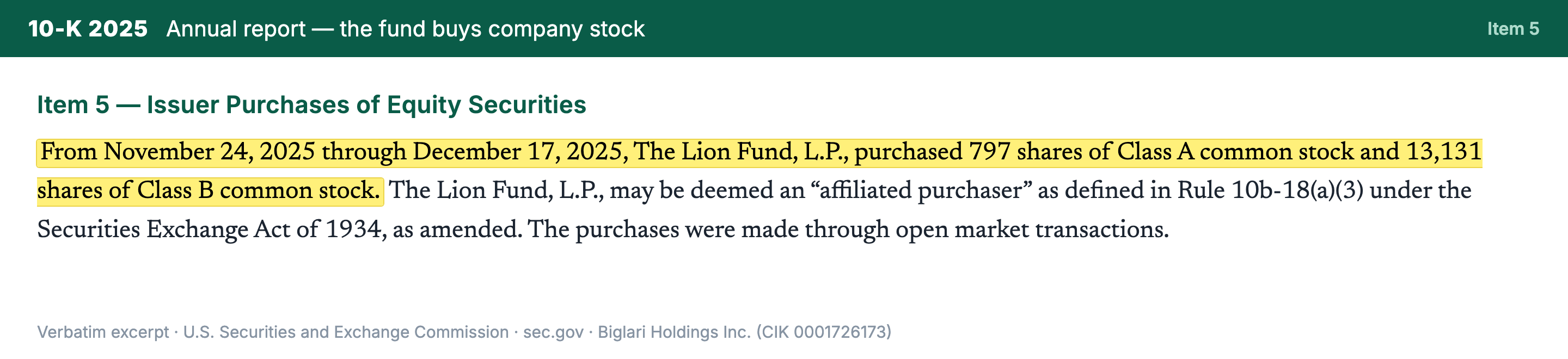
"From November 24, 2025 through December 17, 2025, The Lion Fund, L.P., purchased 797 shares of Class A common stock and 13,131 shares of Class B common stock. The Lion Fund, L.P., may be deemed an "affiliated purchaser" as defined in Rule 10b-18(a)(3) under the Securities Exchange Act of 1934, as amended."
— Biglari Holdings Inc., SEC annual report 10-K for 2025, Item 5 "Issuer Purchases of Equity Securities"
You don't have to dramatize this — the amounts are small relative to the company's size, and both are disclosed and legal. But the direction is notable: at the corporate level fresh shareholder money flows in, at the fund level money flows back into the same circle of shares. What matters for judgment is less the individual transaction than the principle: capital moves in a circle, and the circle is steered by one person. Anyone investing here should understand that "capital allocation" at Biglari also means the company collects its own stock through the funds — cementing the chairman's control.
Valuation: close to book value — but which book value counts?
How expensive is Biglari? Unlike a growth stock, there is no meaningful earnings multiple here — the result was negative in 2024 and 2025. The most honest yardstick is book value. Equity stood at $523.4 million at the end of 2025. Spread over the roughly 260,000 Class A-equivalent shares (look-through), that is a little over $2,000 per share — and it is precisely in that range that the company placed its own new shares in early 2026 (about $2,106 per Class A). So the stock trades roughly at its look-through book value — no inflated growth price, but also no bargain with a margin of safety, as the value narrative implies. Two things further cloud the picture: first, book value is itself a moving target, because a large part of the assets sits in the Lion Fund, whose fair value swings with the market ($772.6 million as of December 31, 2025). Second, the stock is extremely thin — with such low volume, even a small order can move the price. How quickly a structure like this gets repriced when sentiment turns, we have seen with other owner-run special situations: fair value here depends less on a single metric than on whether you trust the captain for the years ahead.
Opportunities and risks at a glance
What speaks for Biglari Holdings:
- Real, profitable operating businesses: restaurants (+$16.4 million contribution in 2025), insurers (+$10.5 million, with float) and oil and gas (+$10.9 million) make money every year; operating revenue rose 9.2 percent to $395.3 million in 2025.
- Tidy balance sheet with plenty of liquidity: $268.8 million in cash (after $30.7 million), $1,025.4 million in total assets — room for acquisitions, which the report explicitly names as the purpose of the share offering.
- Valuation near look-through book value (about $2,000 per Class A-equivalent share) rather than a growth premium; the company's own share placement in early 2026 provides a concrete, dated valuation anchor.
- Pay with a hurdle and a high-water mark: the chief earns only after 6 percent growth and after recovering prior losses — stricter than at many funds.
- Alignment in principle: through the funds, Sardar Biglari carries the largest stake in the same boat; a falling share price hits him hardest.
What speaks against it:
- The result is unpredictable: net earnings from 2019 to 2025 ranged between +$55.5 and −$38.0 million, driven by the funds, not the business (investment partnerships in 2025: −$52.0 million); an investment is therefore also a bet on Sardar Biglari's stock picking.
- Extreme concentration of control: roughly 73.1 percent of the vote in one person who holds 0.1 Class A share directly — minority shareholders effectively have no say, the chairman is practically irremovable.
- Circular own-stock ownership: more than half the economic shares sit in the in-house funds and are carried as treasury even though legally outstanding — bought with company capital, which cements the chairman's control.
- Double 25 percent pay (fund reallocation plus Incentive Agreement) and equity that has fallen since 2019 ($616.3 → $523.4 million) — the "compounder" has not grown book value per shareholder lately.
- A thin stock with two classes and minimal volume; classic metrics (P/E, P/S) mislead, and the oil-and-gas segment increasingly leans on disposal gains rather than production.
A human conclusion
Back to the doppelgänger trap from the start. Its core is not that the template is bad — Biglari Holdings does own good, profitable businesses, a clean balance sheet, and a chief who can clearly allocate capital shrewdly. Its core is that the resemblance to a famous template spares you the scrutiny an investment thesis demands. Whoever buys "young Berkshire" is really buying three very concrete things: a bundle of solid businesses whose combined contribution in 2025 was just $14 million; a swinging stock portfolio whose gains are shared 25 percent and whose losses turn the whole company red; and the permanent rule of a single man no annual meeting will ever outvote. That can be perfectly fine for you — if you trust that man for the next ten or twenty years and can live with the roller coaster. So the honest question for you is not "Is this a second Berkshire?" but: Would you hand your money to a captain you can never remove — one who takes 25 percent in success but drags your portfolio down in failure? If yes, you have a thesis. If no, you had a label. What you make of it is your decision. And that is exactly as it should be.
Sources
All original documents used in this analysis — to read for yourself:
- Biglari Holdings Inc. — SEC annual report 10-K for 2025 (filed March 2, 2026)
- Biglari Holdings Inc. — SEC annual report 10-K for 2024 (filed March 3, 2025)
- Biglari Holdings Inc. — SEC quarterly report 10-Q as of March 31, 2026 (filed May 8, 2026)
- Biglari Holdings Inc. — SEC proxy statement DEF 14A for the 2026 annual meeting (filed March 11, 2026)
- Full SEC filing history of Biglari Holdings Inc.: EDGAR overview (sec.gov)
- Fundamental data (metrics, segment contributions, valuation; data as of July 23, 2026), reconciled with the SEC filings and the SEC XBRL financial series.
- Reddit mentions: ApeWisdom (as of July 23, 2026); surfaced via our in-house Reddit hype scanner.
Transparency & disclaimer: This analysis is a journalistic contextualization of publicly available information and is not investment advice, not a financial analysis in the regulatory sense, and not a solicitation to buy or sell securities. Stock investments carry substantial risks up to total loss. All information without warranty; the data cut-off is noted in the text. The author holds no position in Biglari Holdings shares at the time of publication.
Our Bottom Line at a Glance
- Operating substance positive
- The operating businesses are profitable — every year: in 2025 restaurants (+$16.4 million), insurers (+$10.5 million, with float) and oil and gas (+$10.9 million) contributed a combined $14.2 million to earnings (2024: $24.1 million, 2023: $39.2 million), and operating revenue rose 9.2 percent to $395.3 million. A diversified, real business under the holding roof.
- Earnings quality & volatility negative
- Net income is a roller coaster (between +$55.5 and −$38.0 million from 2019 to 2025), driven by the investment partnerships, not the business: in 2025 the funds cost $52.0 million and turned an operating gain into a $37.5 million net loss. Whoever invests is also betting on Sardar Biglari's stock picking.
- Governance & control negative
- Roughly 73.1 percent of the vote sits with one person who owns 0.1 Class A share directly (proxy 2026); more than half of the economic shares sit in the in-house funds and are carried as treasury even though legally outstanding. Minority shareholders effectively have no say, and the chairman is practically irremovable.
- Compensation structure negative
- Two 25 percent layers (fund incentive reallocation plus the Incentive Agreement on operating book-value growth), each over a 6 percent hurdle and high-water mark. Strictly designed, but the upside is shared while the price losses of the same capital fall fully on the minority shareholder.
- Balance sheet & valuation neutral
- A solid balance sheet with $268.8 million in cash (from $30.7 million) and $1,025.4 million in total assets; the stock trades roughly at its look-through book value (~$2,000 per Class A-equivalent, anchor price of the company's own early-2026 placement ~$2,106). But equity has fallen since 2019 ($616.3 → $523.4 million), and the stock is thin.
Biglari Holdings is the doppelgänger trap in pure form: from the outside a miniature Berkshire with restaurants, insurance float and an owner-operator capital allocator — but in the notes a structure in which profitable businesses each year (2025: +$14.2 million) are overlaid by the valuation swings of the in-house funds (2025: −$52.0 million, net loss $37.5 million). Those funds hold the company's own stock, through which Sardar Biglari controls roughly 73.1 percent of the vote with 0.1 share held directly and collects 25 percent of the upside on two levels. Whoever invests buys good businesses at book value — and a captain no annual meeting will ever remove. Not investment advice.
What Our Rating Means
Open questions
The business works in principle, but one material question is open. As long as it stays open, our findings do not carry a quality verdict.
Whoever buys today is betting less on Steak 'n Shake or First Guard than on one person: that Sardar Biglari will, over the coming years, create more value with the capital — business and funds alike — than his double 25 percent pay and the equity that has fallen since 2019 suggest, and that you can live with roughly 73 percent of the vote in one hand and a net result that hangs on the market, not the grill. Whoever waits checks in every report: is book value per (look-through) share growing again? How do the operating segment contributions develop without the funds? And does the Lion Fund swing back into the black? The governance structure is the dominant risk and the reason for caution. The decision is yours.
A journalistic assessment by our editorial team at the time of the deep dive, based on public sources — not investment advice and not a solicitation to buy or sell. Your personal circumstances (investment goals, risk capacity, taxes) cannot be taken into account. What our levels mean, how verdicts are formed, and what conflicts of interest exist →
Worth Noting
- Biglari Holdings landed on the research list via the Reddit hype scanner (6 mentions in 24 hours, ApeWisdom, as of July 23, 2026). The stock is not a typical momentum or value scanner hit but an owner-run special situation with two share classes and very thin trading volume — classic metrics (P/E, P/S) mislead here.
- Net income is dominated by the investment partnerships (Lion Fund), whose fair value ($772.6 million as of December 31, 2025) swings with the market; the company itself warns of "significant volatility in our periodic earnings." The operating segment contributions show the actual business one level below.
- Valuation figures are dated and evergreen: book value per Class A-equivalent share about $2,000, anchor price of the company's own early-2026 share placement about $2,106 (Class A) and $413 (Class B); analyses are evergreen, daily prices are not a buy argument. Not to be confused: the two classes BH (Class B) and BH-A (Class A) are economically linked 1:5.
Frequently Asked Questions
Biglari Holdings Inc. (NYSE: BH and BH-A) of San Antonio, Texas, is a holding company. It owns the restaurant chains Steak 'n Shake and Western Sizzlin (435 locations combined), the insurers First Guard, Southern Pioneer and Biglari Reinsurance, the oil-and-gas units Southern Oil and Abraxas Petroleum, and the Maxim licensing brand. On top sit the investment partnerships Lion Fund L.P. and Lion Fund II L.P. (fair value $772.6 million as of December 31, 2025). All major capital decisions are made by Chairman and CEO Sardar Biglari.
Because the reported loss does not come from operations but from the investment partnerships. The operating businesses contributed a combined $14.2 million to earnings in 2025 ($24.1 million in 2024, $39.2 million in 2023). The investment partnerships (Lion Fund), by contrast, lost about $52.0 million in 2025 and about $28.1 million in 2024 — turning into a net loss of $37.5 million (2025) and $3.8 million (2024). In 2023 the same funds added $14.6 million and lifted net earnings to $55.5 million.
Chairman and CEO Sardar Biglari controls roughly 73.1 percent of the voting interest per the 2026 proxy statement — mainly through the investment partnerships Lion Fund and the Biglari Capital entity he runs, which hold Class A shares of the corporation. Directly he owns only 0.1 Class A share. The funds hold the company's own stock, carried as treasury stock even though it is legally outstanding. Minority shareholders therefore effectively have no say.
Lion Fund L.P. and Lion Fund II L.P. are private investment partnerships into which Biglari Holdings has invested its capital; the general partner is Biglari Capital, run by Sardar Biglari. Their fair value was about $772.6 million as of December 31, 2025. The funds hold, among other things, the own shares of Biglari Holdings. Their valuation swings drive the company's net result: the annual report warns that they "have caused and will continue to cause significant volatility in our periodic earnings."
On two levels, both at 25 percent. As general partner of the funds, Biglari Capital earns an incentive reallocation of 25 percent of fund profits above a 6 percent hurdle over the previous high-water mark. Separately, the "Incentive Agreement" pays Sardar Biglari 25 percent of the operating businesses' book-value growth above the same 6 percent hurdle. That came to $455 thousand in 2024 and nothing in 2025 because of the loss; there was no fund incentive reallocation from 2023 through 2025.
A price-to-earnings ratio cannot be meaningfully formed for lack of earnings. On a book-value basis the stock trades roughly at its look-through book value: equity stood at $523.4 million at the end of 2025, and spread over about 260,000 Class A-equivalent shares that is a little over $2,000 per share — right around where the company sold its own new Class A shares in early 2026 (about $2,106). That is not a bargain with a margin of safety, especially since equity has fallen since 2019 ($616.3 million).
Biglari Holdings has two NYSE-listed classes: Class A (symbol BH-A) with one vote per share and Class B (symbol BH) with one-fifth of the economic interest and one ten-thousandth of the vote of a Class A share. Legally outstanding are 206,864 Class A and 2,068,640 Class B shares. Because a large part of these sit in the in-house funds and are carried as treasury, the quarterly report computes earnings per share on only about 260,000 Class A-equivalent shares.
Found an error?
Did you spot a factual error, an outdated number, or a typo in this deep dive? Let us know briefly — your report goes straight to the editorial team.