Zebra Technologies: The Turnaround Is Real — the Credit Line Paid for It
Every beep at a checkout counter and in every parcel hub may come from Zebra. After the 2023 collapse the business is growing again: $5,396 million of revenue in fiscal 2025, up 14.3 percent in the first quarter of 2026. Profit is not keeping up — $419 million after $528 million the year before. We read the annual report and the quarterly report filed on May 12, 2026, and find three distributors delivering 59 percent of revenue, goodwill larger than equity, and $2,004 million of debt maturing in 2027. A beep means captured — it does not mean paid.
 Thomas Mücke
Founder & Publisher
Thomas Mücke
Founder & Publisher
Chart
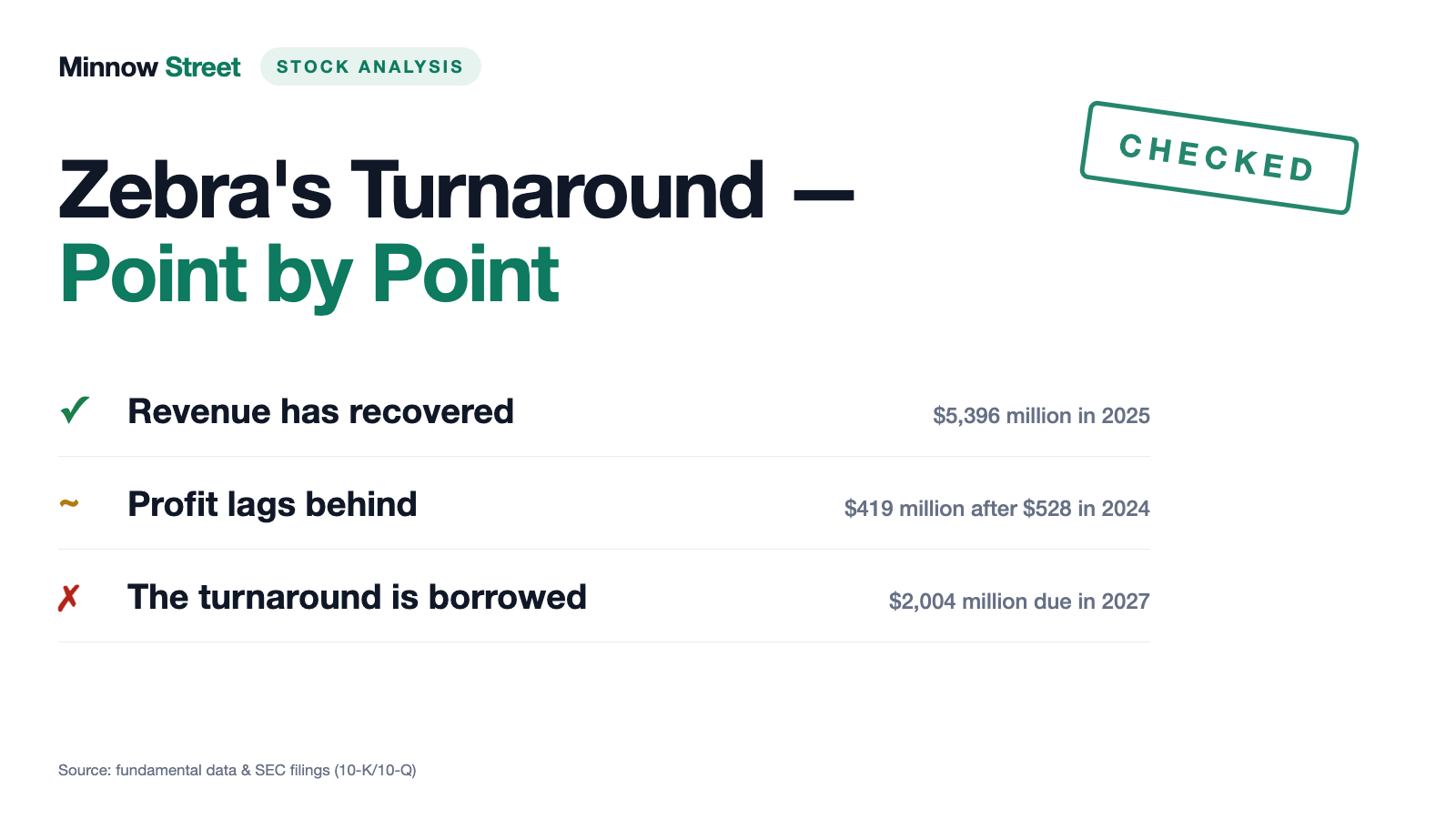
Interactive price chart (TradingView).
Note: pure fact-based analysis, not investment advice and not a solicitation to buy or sell. All figures without guarantee.
The Beep Reflex: Why We Confuse “Captured” With “Done”
The checkout counter beeps. The parcel hub beeps. The hospital wristband beeps. And every single time the same thing happens in your head: a tone, a checkmark, move on. Captured equals done.
We run the same reflex on numbers. Revenue up? Beep. Scanner hit? Beep. Turnaround achieved? Beep. The tone replaces the checking, which is convenient, because checking is work.
The company in question builds those beeps. Zebra Technologies makes the scanners, handheld computers and printers with which retail, logistics and manufacturing capture their world. And it landed on our desk through a list that does nothing but scan. So we make the deal we always make: we read the original filings, we do the arithmetic, and we look at what sits behind the tone — including when the answer is uncomfortable.
What This Analysis Covers
- What Zebra sells — and to whom
- How the stock landed on our desk
- The numbers over the years
- Uncomfortable truth no. 1: three distributors deliver 59 percent
- Uncomfortable truth no. 2: profit is not keeping pace with revenue
- Uncomfortable truth no. 3: the turnaround was bought — and goodwill exceeds equity
- Uncomfortable truth no. 4: $2,004 million comes due in 2027 — and the buyback runs anyway
- The lottery ticket in a footnote: $75 million of tariffs
- What the stock costs
- Opportunities and risks at a glance
- A human bottom line
- Sources
What Zebra Sells — and to Whom
Zebra Technologies sits in Lincolnshire, Illinois, and operates in a market with an unwieldy name: automatic identification and data capture, AIDC in the filings. In plain language, that is everything that gives an object an identity and makes that identity readable.
Concretely: barcode scanners, mobile handheld computers for warehouse and store staff, label and card printers, RFID technology (radio tags you do not have to hold up to a lens one by one), machine vision for factories, and the software that turns all that data into managed workflows. Customers span retail and e-commerce, manufacturing, transportation and logistics, healthcare, hospitality and the public sector.
As of December 31, 2025 the company employed approximately 10,700 people across 129 facilities. Selling happens overwhelmingly not direct, but through a network of more than 10,000 channel partners in 179 countries. Hold on to that fact — it returns later, and not pleasantly.
Since 2025 Zebra reports in two segments: Connected Frontline (mobile computers, printers, scanners for people at the front line) and Asset Visibility and Automation (data capture, RFID, machine vision, automation). In the first quarter of 2026 the first delivered $825 million and the second $670 million. Important for anyone comparing older figures: the segments were previously called AIT and EVM and were cut differently — segment time series spanning 2025 are not comparable.
A detail for filing enthusiasts: the entity behind SEC identifier 0000877212 was registered as “Zebra Technologies Corp/DE” until May 2009. The name change was cosmetic; the business stayed the same.
How the Stock Landed on Our Desk
We run roughly 3,500 stocks through our scanners every day. Zebra came in through the Turnaround Candidates list: rank 29 of 60 U.S. hits, turnaround check 6 of 8, measured on July 26, 2026. To reproduce it: open the scanner, set the country filter to “US”, and sort by the “turnaround check” column. These lists are recomputed daily — rank and score are a dated snapshot, not a permanent state.
The list has two mandatory pillars. Miss either one and you are out, no matter how good everything else looks:
- Pillar 1 — the crash: the stock must trade at least 50 percent below its all-time high. Without a real crash there is no turnaround; otherwise the list simply catches ordinary growth stocks.
- Pillar 2 — survival: the Altman Z score must be at least 1.1. That score condenses several balance sheet ratios into a single number estimating how far a company sits from insolvency. Below 1.1 it counts as distressed. On top of that: no more than one balance sheet warning flag, and positive equity.
Pillar 2 Zebra clears easily: the Altman Z stood at 6.69 on July 26, 2026 and the equity ratio at 41.6 percent. No sign of distress.
Pillar 1 we recomputed against the price history, because roughly 60 names in this data set carry an all-time high slipped by a factor of 1,000. For Zebra the number holds: the highest close on record was $614.55 on December 10, 2021, and the close on July 24, 2026 was $259.92. That is minus 57.7 percent — the crash is real, not an artifact.
That also lets us name the level at which this hit disappears: at roughly $307.28 — exactly half the all-time high — Zebra breaks pillar 1 and drops off the list. From the July 24, 2026 close, that is a little more than 18 percent of upside. Anyone relying on this placement is relying on a state with an expiry date. How fast such a hook can turn, we disclosed in our Moody’s analysis: there the same data set carried an all-time high the price history does not confirm.
Only once both pillars stand does the counting begin. The turnaround check awards eight points: four from the quarterly numbers (revenue direction, net margin, operating cash flow, balance sheet healing) and four from market behavior (price above the 50-day line, three-month relative strength beating twelve-month, insider buying, fund accumulation). A name is listed once it reaches at least six.
Zebra sits at 6 of 8 — the minimum, with no buffer whatsoever. Two of the eight points hang directly on the price. The 50-day line stood at about $251 on July 26, 2026, just below the market price. Slip beneath it and a point falls away, the check drops to 5 of 8, and the name is gone at the next recomputation.
What does this mean for you? A scanner computes; it does not judge. The list is the start of research and never its result. What we find in the filings decides the analysis — not the rank on a list.
The Numbers Over the Years
Start with what genuinely impresses: this company survived a brutal collapse without losing control.
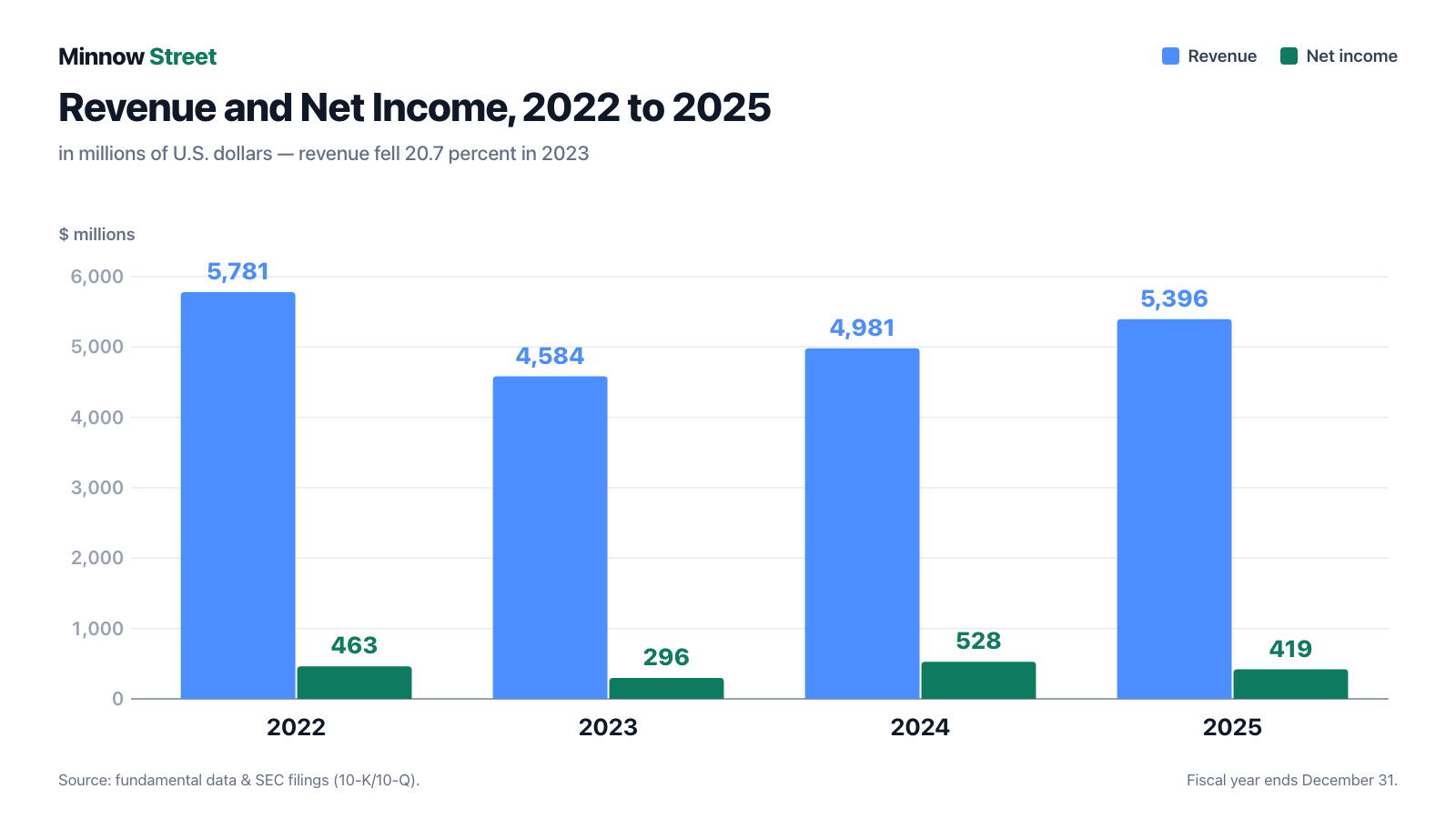
In 2022 Zebra booked $5,781 million of revenue. Then came 2023 — and revenue fell to $4,584 million, down 20.7 percent. The reason was not that the world stopped needing scanners. Resellers and their customers had built up full warehouses during the supply chain years and were now emptying them instead of ordering. Operating cash flow, normally the most reliable line in this house, turned negative in 2023: $4 million of outflow for the entire year.
Since then it has climbed back: $4,981 million in 2024, $5,396 million in 2025. The first quarter of 2026 rose 14.3 percent to $1,495 million, and it did so double digits in all four regions: North America $728 million (up 13.9 percent), Europe/Middle East/Africa $507 million (up 13.2), Asia-Pacific $167 million (up 21.9), Latin America $93 million (up 10.7).
Profitability per unit sold is solid too. Gross margin ran at 48.1 percent in 2025, after 48.4 percent in 2024 and 46.3 percent in the crisis year 2023. Of every dollar taken in, roughly 48 cents remain before sales, research and administration are paid.
Operating cash flow was $917 million in 2025, after $1,013 million in 2024. Less $86 million of capital expenditures, about $831 million was left free — considerably more than the reported profit of $419 million. That is a good sign: earnings are backed by cash, not by entries.
Rule of thumb: a one-fifth revenue collapse pushes many companies to the edge. Zebra rode it out with a positive gross margin and without issuing equity. That belongs on the credit side before we discuss the rest.
And now the part that appears in no brochure.
Uncomfortable Truth No. 1: Three Distributors Deliver 59 Percent
Zebra sells almost everything through resellers. That much is in the annual report — and what else is in there is the actual news:
“We have three customers, who are distributors of the Company’s offerings, that individually accounted for more than 10% of our Net sales during the past three years.”
— Zebra Technologies Corporation, annual report on Form 10-K for 2025, Item 1 “Customers”, filed with the U.S. securities regulator, the SEC

That table is blunter than the sentence. Revenue shares of the three large customers:
- Customer A: 29 percent (2025) — after 21 percent (2024) and 18 percent (2023)
- Customer B: 15 percent — after 19 and 14 percent
- Customer C: 15 percent — after 14 and 12 percent
Together that is 59 percent of $5,396 million, or roughly $3.18 billion of revenue running through three contracts. And the largest has expanded its share by eleven percentage points in two years.
The distinction between customer risk and channel risk matters. These three are not end users of Zebra devices — they are resellers who buy and pass on. That softens the credit risk and sharpens the cycle: resellers order in waves. When they fill warehouses, Zebra revenue looks better than end demand; when they empty them, it looks worse. Exactly that was on display in 2023 — revenue down 20.7 percent, without the world scanning proportionally fewer parcels.
What does this mean for you? Buying Zebra means buying a business whose quarterly numbers depend to a significant degree on the ordering behavior of three addresses. The concentration table appears once a year, in the annual report. The next reliable figure therefore arrives with the report for 2026.
Uncomfortable Truth No. 2: Profit Is Not Keeping Pace With Revenue
Now the arithmetic the beep reflex skips. Revenue rose 8.3 percent in 2025. And profit?
- Operating income: from $742 million to $700 million — down 5.7 percent
- Net income: from $528 million to $419 million — down 20.6 percent
- Diluted earnings per share: from $10.18 to $8.18
More revenue, less profit. The reason sits in the expense line: operating expenses rose from $1,671 million to $1,893 million, or from 33.5 percent to 35.1 percent of revenue. Inside that are higher employee costs, the expenses of the acquired businesses, $76 million of restructuring, $24 million of acquisition and integration costs, and $45 million of impairments on goodwill, intangibles and other assets. On top came a jump in share-based compensation: $163 million after $89 million a year earlier.
Gross margin gave way too, from 48.4 percent to 48.1 percent. The company names the reason itself — and supplies the all-clear in the same breath:
“As we exited 2025, the unfavorable impacts of existing import tariffs have been fully mitigated.”
— Zebra Technologies Corporation, Form 10-K for 2025, management’s discussion and analysis
The first quarterly report of 2026 supports that: gross margin recovered to 49.6 percent from 49.3 percent in the prior-year quarter. Even so, net income of $135 million came in just below the $136 million of a year earlier — on $187 million more revenue. That diluted earnings per share still rose from $2.62 to $2.72 is not the business at work but the buyback: the same profit divided among fewer shares.
What does this mean for you? The turnaround is a revenue turnaround. Whether it becomes an earnings turnaround is the open question of this analysis — and it will be written in black and white in every coming quarterly report.
Uncomfortable Truth No. 3: The Turnaround Was Bought — and Goodwill Exceeds Equity
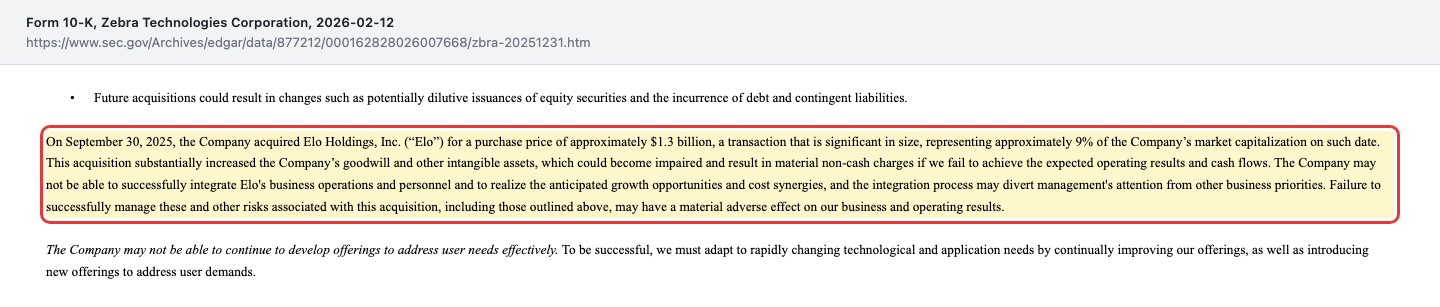
Part of the growth did not grow; it was acquired. On September 30, 2025 Zebra acquired Elo Holdings for $1,303 million in cash, and on February 28, 2025 the machine vision specialist Photoneo for $62 million. The 2025 cash flow statement shows $1,365 million in total.
How large that step was, the company writes into its own risk factors:
“On September 30, 2025, the Company acquired Elo Holdings, Inc. (“Elo”) for a purchase price of approximately $1.3 billion, a transaction that is significant in size, representing approximately 9% of the Company’s market capitalization on such date. This acquisition substantially increased the Company’s goodwill and other intangible assets, which could become impaired and result in material non-cash charges if we fail to achieve the expected operating results and cash flows.”
— Zebra Technologies Corporation, Form 10-K for 2025, risk factors
The price shows up on the balance sheet. Two dates side by side — September 27, 2025, three days before the acquisition closed, and April 4, 2026:
- Cash: from $1,053 million to $114 million
- Goodwill: from $3,931 million to $4,709 million
- Debt: from $2,173 million to $2,660 million
- Equity: from $3,747 million to $3,470 million
Goodwill, in plain language, is the premium a buyer paid above the measurable value of what it bought. It stays on the balance sheet as long as the acquired business meets expectations — and gets written down once it does not.
Do the math: $4,709 million of goodwill plus $765 million of other intangibles equals $5,474 million. Against that stands equity of $3,470 million. Strip out the intangibles and tangible equity is negative by roughly $2 billion. That 2025 already carried $45 million of impairments shows this is not a theoretical risk.
Honesty demands the other side too: this is not a solvency risk. The equity ratio is 41.6 percent, the Altman Z is 6.69, all debt covenants were met as of April 4, 2026, and the company earns money. But the cushion against a second 2023 is markedly thinner than before the acquisition.
Uncomfortable Truth No. 4: $2,004 Million Comes Due in 2027 — and the Buyback Runs Anyway
The maturity table in the quarterly report as of April 4, 2026 is lopsided enough to make you look twice.
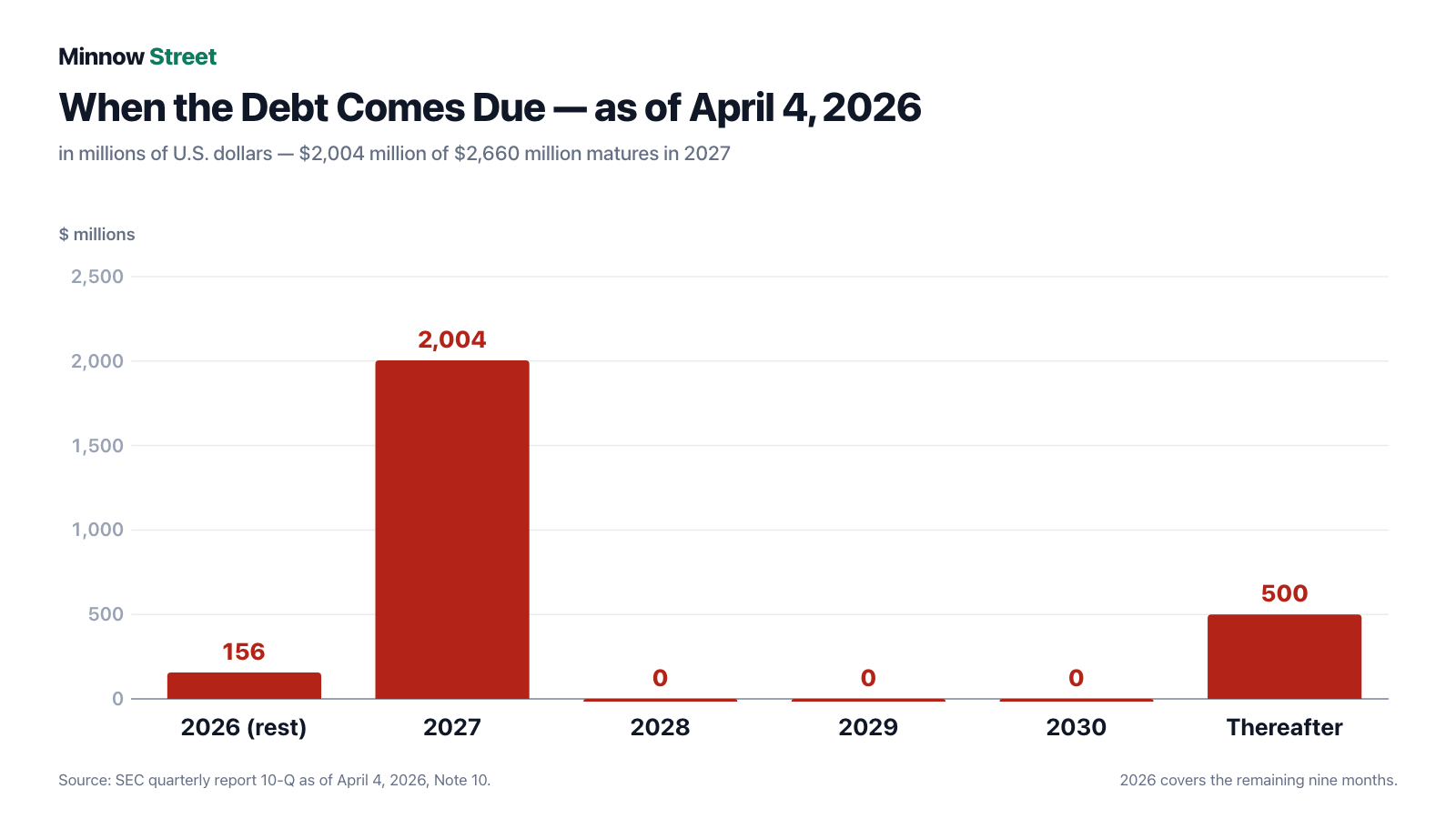
The $2,660 million of debt breaks down into a term loan of $1,553 million, senior notes of $500 million, a drawn revolver of $430 million and receivables financing of $177 million. The term loan matures on May 25, 2027 and carried a floating rate of 5.02 percent at the balance sheet date. The notes carry a 6.5 percent fixed coupon running to June 1, 2032 — they are the only item in the “thereafter” column.
A maturity wall is not a drama in itself. Large companies refinance such loans routinely, and Zebra has capital market access. But it is a bill with a fixed due date, and nobody knows today what 2027 terms will look like.
In the same quarter that published this table, Zebra repurchased $300 million of its own stock: 1,294,028 shares at an average of $231.83. Through May 12, 2026 another $200 million followed. Where the money came from, the report says itself:
“In the first quarter of 2026, we increased our borrowings under the Revolving Credit and Receivables Financing Facilities to help fund share repurchases.”
— Zebra Technologies Corporation, quarterly report on Form 10-Q as of April 4, 2026, management’s discussion and analysis

In numbers: the revolver went from $275 million to $430 million and the receivables facility from $161 million to $177 million. Operating cash flow for the quarter was $176 million — less than the $300 million that went into buybacks. The board authorized an additional $1 billion on February 4, 2026; $959 million remained available as of April 4, 2026.
What does this mean for you? Buybacks are not wrong as such — they lift earnings per share, and that is exactly what happened in the first quarter of 2026. But funding them with debt while $2 billion has to be refinanced in a little over a year is a decision about priorities. It can change at any time. Anyone modeling the buyback is modeling an intention, not an obligation. How quickly an intention can turn into a debt-reduction program is on display in our Carnival analysis.
The Lottery Ticket in a Footnote: $75 Million of Tariffs
Zebra manufactures a substantial share of its devices in Asia and imports them into the United States. The company spells out the risk in its annual report:
“The Company currently imports a significant percentage of our offerings into the U.S., and international trade disputes and increased tariffs between the U.S. and other countries in which the Company does business, including China, could negatively impact the Company’s financial performance.”
— Zebra Technologies Corporation, Form 10-K for 2025, risk factors
Then came a ruling. On February 20, 2026 the U.S. Supreme Court held that the emergency statute known as IEEPA does not authorize the executive branch to impose tariffs. The import tariffs enacted on that basis in 2025 fall away; the matter was remanded to the Court of International Trade and to Customs and Border Protection, including the administration of potential refunds.
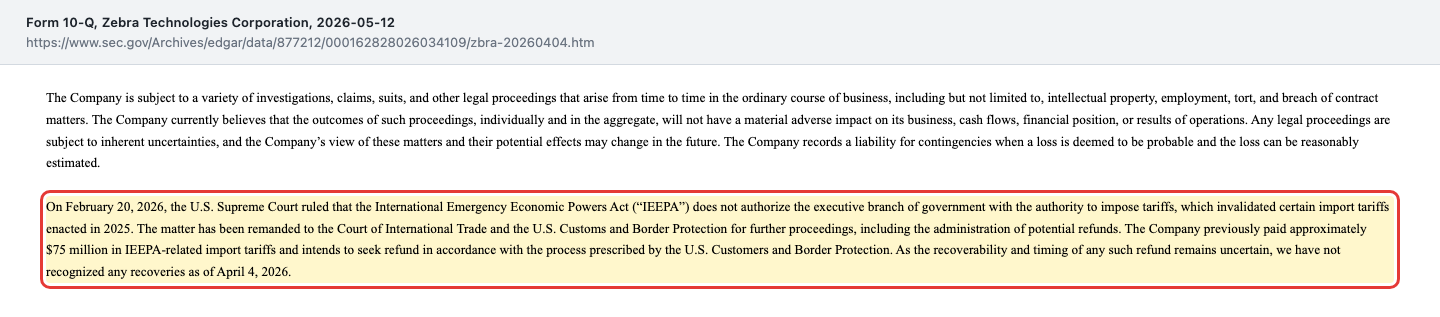
Zebra states it paid approximately $75 million of those tariffs and intends to seek refunds through the customs process. Because the recoverability and timing remain uncertain, not a single dollar is booked as of April 4, 2026.
For scale: $75 million equals roughly 18 percent of the entire net income of fiscal 2025. If the money arrives, it is a one-time item in no analyst model. If it does not, reported earnings are unchanged. A lottery ticket, then — but one actually held in hand.
What the Stock Costs
As of July 26, 2026, with 47,633,392 shares outstanding and a closing price of $259.92 on July 24, 2026, Zebra carries a market value of about $12.4 billion.
In orders of magnitude:
- Price to earnings about 32, measured against reported diluted earnings of $8.18 per share for 2025
- Price to sales about 2.3, measured against 2025 revenue
- Price to book about 3.6 — though book value consists largely of goodwill and says little
- Enterprise value about $14.9 billion (market value plus $2,660 million of debt less $114 million of cash)
A word of caution: many summaries show a far lower forward price-to-earnings ratio of roughly 14 for Zebra. That figure rests on adjusted earnings estimates that exclude items such as acquisition costs, restructuring and share-based compensation. It is not comparable with the $8.18 of reported earnings. We mention it so you know where the number comes from — and we do not use it as a valuation anchor.
The professional view: 19 analyst estimates produce an average price target of roughly $333 — nine strong buy ratings, two buy, eight hold, no sell (data as of July 26, 2026). A consensus is not a forecast but a mood reading. Mostly it says the street believes the turnaround.
Opportunities and Risks at a Glance
Opportunities
- Leadership in a niche with high switching costs: more than 10,000 channel partners in 179 countries and a large installed base that pulls services, supplies and software behind it.
- Broad-based recovery: all four regions grew double digits in the first quarter of 2026, Asia-Pacific fastest at 21.9 percent.
- Recurring revenue: $264 million from services and software in the first quarter of 2026, plus $1.15 billion of remaining performance obligations from multi-year contracts.
- Tariff relief: the burdening import tariffs were fully mitigated by the end of 2025 per the company, and $75 million is additionally recoverable.
- Solid earnings base: $917 million of operating cash flow in 2025, gross margin of 48.1 percent, Altman Z of 6.69.
Risks
- Channel risk: three distributors accounting for 59 percent of revenue combined, the largest alone at 29 percent after 18 percent two years earlier.
- Cycle: 2023 showed that an inventory drawdown at those resellers can cost a fifth of revenue — operating cash flow turned negative that year.
- Maturity wall: $2,004 million of $2,660 million in debt matures in 2027, the term loan on May 25, 2027; no refinancing has been announced as of July 26, 2026.
- Balance sheet structure: $5,474 million of goodwill and intangibles against $3,470 million of equity, with $45 million of impairments already taken in 2025.
- Earnings gap: profit is not tracking revenue — net income down 20.6 percent in 2025 on revenue up 8.3 percent.
- Trade policy: a substantial share of manufacturing sits in Asia; new tariffs or export restrictions hit the business directly.
A Human Bottom Line
Back to the beep. It says: captured. It does not say paid, delivered, earned. Between the tone and the money lies a whole chain of steps nobody hears.
With Zebra it is the same. The tone says: the turnaround is here. And that is even true — revenue is back at $5,396 million, the first quarter of 2026 grew 14.3 percent across every region, operating cash flow exceeds reported profit, and the balance sheet is not in danger.
What the tone does not say: that this turnaround was to a good degree bought, for $1,365 million. That cash melted from $1,053 million to $114 million in the process. That three resellers deliver 59 percent of revenue and the largest keeps getting larger. That profit fell despite more revenue. And that in a little over a year $2 billion has to be refinanced while stock is being repurchased on credit.
None of that is a doomsday scenario. It is the list of things worth knowing before you set the checkmark. A turnaround is only finished once it funds itself — and this one does not fund itself yet.
What you make of that is your decision. And that is exactly as it should be.
Sources
- Annual report on Form 10-K for 2025, Zebra Technologies Corporation, filed February 12, 2026 (CIK 0000877212)
- Annual report on Form 10-K for 2024, filed February 13, 2025 — supplies the comparative figures for 2022
- Quarterly report on Form 10-Q as of April 4, 2026, filed May 12, 2026
- Quarterly report on Form 10-Q as of September 27, 2025, filed October 28, 2025
- Quarterly report on Form 10-Q as of June 28, 2025, filed August 5, 2025
- Quarterly report on Form 10-Q as of March 29, 2025, filed April 29, 2025
- Current report on Form 8-K of May 19, 2026 — annual meeting and 2026 incentive plan
- Screening and metric data: our in-house stock scanner (data as of July 24 to 26, 2026), including the Turnaround Candidates scanner (U.S. selection, rank 29 of 60, turnaround check 6 of 8, measured July 26, 2026) — these lists are recomputed daily
- Metrics, price history and analyst estimates: fundamental data, as of July 24 to 26, 2026
Journalistic assessment, not investment advice and not a solicitation to buy or sell securities. Stocks can move sharply; total loss is possible. All figures come from the original documents linked above and carry their own as-of dates. The author holds no position in Zebra Technologies at the time of publication.
Our Bottom Line at a Glance
- Business model and market position positive
- Zebra is one of the two pacesetters in automatic data capture worldwide, and the business carries real switching resistance: more than 10,000 channel partners in 179 countries, an installed base that pulls services, supplies and software behind it, and $264 million of services and software revenue in the first quarter of 2026 alone. Gross margin ran at 48.1 percent in fiscal 2025.
- Turnaround in the numbers positive
- After the 2023 collapse (revenue $4,584 million, down 20.7 percent, with $4 million of operating cash outflow) the business is running again: $4,981 million in 2024, $5,396 million in 2025, up 14.3 percent to $1,495 million in the first quarter of 2026. All four regions grew double digits, Asia-Pacific fastest at 21.9 percent. The $917 million of operating cash flow in 2025 is real money.
- Profit per revenue dollar negative
- More revenue, less profit: revenue grew 8.3 percent in 2025, but operating income fell from $742 million to $700 million and net income from $528 million to $419 million. Operating expenses climbed from 33.5 percent to 35.1 percent of revenue. In the first quarter of 2026 net income of $135 million still trailed the $136 million of the prior-year quarter — on $187 million more revenue.
- Customer concentration negative
- Three distributors accounted for 29, 15 and 15 percent of fiscal 2025 revenue — 59 percent combined, or roughly $3.18 billion. The largest was still at 18 percent in 2023. Resellers order in waves: in 2023 that cost a fifth of revenue without end demand moving anywhere near as far.
- Balance sheet after the acquisitions neutral
- As of April 4, 2026 the balance sheet carries $4,709 million of goodwill and $765 million of other intangibles against $3,470 million of equity — on a tangible basis equity is negative. Cash fell from $1,053 million (September 27, 2025) to $114 million. This is not a solvency risk: Altman Z 6.69, equity ratio 41.6 percent, all debt covenants met. But the cushion for a second 2023 is thinner.
- The 2027 maturity wall negative
- Of $2,660 million in debt, $2,004 million matures in 2027, with the term loan due May 25, 2027 at a floating 5.02 percent. At the same time $500 million went into buybacks, funded per the quarterly report by increased borrowings under the credit facilities. No refinancing has been announced as of July 26, 2026.
Zebra Technologies has put the 2023 collapse behind it: $5,396 million of revenue in fiscal 2025, up 14.3 percent in the first quarter of 2026, $917 million of operating cash flow, a 48.1 percent gross margin. The turnaround in the numbers is real. It was paid for with $1,365 million of acquisitions, a cash pile shrunk from $1,053 million to $114 million and buybacks funded on the credit line — while $2,004 million of $2,660 million in debt matures in 2027 and three distributors deliver 59 percent of revenue. Profit is not keeping pace with revenue: $419 million after $528 million. Buying here means buying a strong market position and an open bill for 2027. Not investment advice.
What Our Rating Means
Open questions
The business works in principle, but one material question is open. As long as it stays open, our findings do not carry a quality verdict.
The business holds up: Zebra leads a niche with high switching costs, gross margin runs at 48.1 percent, the $917 million of operating cash flow in fiscal 2025 comfortably exceeds reported profit, the equity ratio is 41.6 percent and the Altman Z is 6.69. No sign of a solvency problem. What is open is an operating question, and it is weighty enough for yellow: earnings are not tracking revenue — revenue rose 8.3 percent in 2025 while net income fell 20.6 percent — while goodwill from acquisitions now exceeds total equity and $2,004 million of debt awaits refinancing in 2027. Whether the acquisitions lift profit or only revenue will be settled in the next few quarters. The decision is yours.
A journalistic assessment by our editorial team at the time of the deep dive, based on public sources — not investment advice and not a solicitation to buy or sell. Your personal circumstances (investment goals, risk capacity, taxes) cannot be taken into account. What our levels mean, how verdicts are formed, and what conflicts of interest exist →
Worth Noting
- Hook: our in-house stock scanner “Turnaround Candidates”, rank 29 of 60 U.S. hits, turnaround check 6 of 8, measured live on July 26, 2026. These lists are recomputed daily; rank and score are a dated snapshot, not a permanent state.
- Cross-check on the mandatory pillar “at least 50 percent below the all-time high”: the price history confirms it. Highest closing price $614.55 on December 10, 2021 against $259.92 on July 24, 2026 — minus 57.7 percent. Above roughly $307.28 (up 18.2 percent) Zebra drops out of this list.
- Data basis: annual report 10-K for 2025 filed February 12, 2026; annual report 10-K for 2024 filed February 13, 2025 (supplies 2022); quarterly report 10-Q as of April 4, 2026 filed May 12, 2026; quarterly reports as of September 27, 2025, June 28, 2025 and March 29, 2025; current reports 8-K of May 12 and May 19, 2026; metrics and price history July 24 to 26, 2026.
- Mind the segment change: Zebra recut its reporting segments in 2025 — “Connected Frontline” and “Asset Visibility and Automation” instead of the former AIT and EVM segments. Segment time series before 2025 are therefore not comparable.
- The traffic light in this analysis judges the company, not the entry point. A scanner rank is an invitation to research, not a buy signal.
Frequently Asked Questions
Zebra builds the devices that capture goods and processes: barcode scanners, mobile handheld computers for warehouses and stores, label and card printers, RFID technology, machine vision for factories, and the software that ties it together. Customers include retail, logistics, manufacturing, healthcare and the public sector. In fiscal 2025 that generated $5,396 million of revenue.
Because two mandatory conditions are met. First, the crash: the stock closed at its all-time high of $614.55 on December 10, 2021 and at $259.92 on July 24, 2026 — about 57.7 percent lower. Second, survival: the Altman Z bankruptcy warning score stood at 6.69 on July 26, 2026, with the danger zone starting below 1.1. Only then does the eight-point turnaround check apply, where Zebra scores 6.
Because costs rose faster. Revenue grew 8.3 percent to $5,396 million in 2025, but operating expenses grew 13.3 percent to $1,893 million — integration costs from the acquisitions, $76 million of restructuring, $45 million of impairments and sharply higher share-based compensation ($163 million after $89 million). Net income landed at $419 million instead of $528 million.
Very. The 2025 annual report names three distributors each above 10 percent of revenue: 29, 15 and 15 percent, or 59 percent combined. The largest was still at 18 percent in 2023. These are resellers rather than end users — their inventory behavior amplifies both upswings and downswings, as 2023 showed.
Zebra manufactures a large share of its devices in Asia and imports them into the United States. The import tariffs imposed in 2025 pushed gross margin from 48.4 percent to 48.1 percent. On February 20, 2026 the Supreme Court held the tariffs based on the IEEPA emergency statute unauthorized. Zebra had paid roughly $75 million and intends to seek refunds; nothing is booked as of April 4, 2026.
As of April 4, 2026 the balance sheet carried $2,660 million of debt: a $1,553 million term loan, $500 million of senior notes, $430 million drawn on the revolver and $177 million of receivables financing. Of that, $2,004 million matures in 2027, with the term loan due May 25, 2027. The notes carry a 6.5 percent fixed coupon and run to June 1, 2032.
AI sits inside the product. The 2025 annual report describes Zebra using artificial intelligence to automate task generation within complex workflows, to give frontline workers knowledge and product companions, and to deliver conversational interfaces. The same report mentions reinvestment into the company's AI product portfolio. That is why we classify Zebra as a company that sells AI.
No. Zebra paid no dividend in fiscal years 2020 through 2025. Capital return runs entirely through buybacks: $587 million in fiscal 2025, $300 million in the first quarter of 2026 and another $200 million through May 12, 2026. The board authorized an additional $1 billion on February 4, 2026.
Found an error?
Did you spot a factual error, an outdated number, or a typo in this deep dive? Let us know briefly — your report goes straight to the editorial team.