TTEC Holdings: The Call Center Giant Selling the Technology That Shrinks Its Own Business
On July 26, 2026, our in-house stock scanner put TTEC Holdings 17th in the price-to-free-cash-flow ranking of the U.S. selection at a ratio of 0.96, displayed as 1.0. That reads like a company that pays for itself in a single year. The filings with the U.S. securities regulator, the SEC, explain why it does not: cash flow has not grown, market value has shrunk to roughly $102 million — against $889.0 million drawn under the credit facility and $101.8 million of shareholders' equity. And the annual report for 2025 adds a sentence that was not there a year earlier: the artificial intelligence TTEC sells to its clients can reduce demand for TTEC's own work. When a ratio falls, always ask which of the two numbers moved.
 Thomas Mücke
Founder & Publisher
Thomas Mücke
Founder & Publisher
Chart
Interactive price chart (TradingView).
Note: pure fact-based analysis, not investment advice and not a solicitation to buy or sell. All figures without guarantee.
There is a trap that catches the diligent investor precisely because it feels like a reward for doing the math — call it the numerator trap. Every valuation ratio is a fraction: price on top, a company number underneath. When the fraction shrinks, the brain files it under "cheaper." What it does not ask is which of the two numbers actually moved. A fraction gets smaller in two ways: the business gets stronger, or the price falls. The result looks identical. That is exactly how TTEC Holdings, Inc. (NASDAQ: TTEC) landed on our desk, at a price-to-free-cash-flow ratio of 0.96. So let us make a deal: before we celebrate the number, we check which half of the fraction changed. The source is what TTEC files with the U.S. securities regulator, the SEC — the annual report (Form 10-K) for 2025, the quarterly report (Form 10-Q) for the quarter ended March 31, 2026, and a series of current reports (Form 8-K). Those documents are honest under penalty of law. And they describe a company that employs 51,000 people, has run other brands\' customer service since 1982, absorbed two large goodwill impairments since 2024 — and now sells its clients exactly the technology that its own risk factors describe as a threat to its own business. What you do with that is up to you.
Contents
- What TTEC Holdings actually does
- Where the stock came across our desk — and what a 0.96 ratio really says
- The numbers over the years — given their due
- What the filings say — the uncomfortable truths
- Valuation: what $102 million buys and what $900 million means
- Opportunities and risks at a glance
- A human conclusion
- Sources
What TTEC Holdings actually does
When you call your mobile carrier, message your insurer\'s chat window or query an order, the person on the other end often does not work for the brand whose logo sits in the background. They work for an outsourcing provider. TTEC is one of the largest of them. Founded in 1982 and listed on Nasdaq since 1996, the company was called TeleTech Holdings until November 20, 2017 — anyone finding old price history under that name is looking at the same company. Headquarters moved from Colorado to Austin, Texas effective January 1, 2025; since May 22, 2026 the legal domicile is Texas rather than Delaware, a pure conversion with no effect on the business, employees, contracts or share count (Form 8-K of May 27, 2026).
The company reports in two segments, and the difference between them is the key to everything that follows.
TTEC Engage is the large, labor-intensive one: customer care, tech support, sales and retention, fraud mitigation and back-office work, delivered by people at screens around the world. In 2025 Engage produced $1,667.7 million of revenue and $60.7 million of income from operations, a 3.6 percent margin. TTEC Digital is the small, technical one: software engineers, data scientists and consultants who deploy and run contact center platforms from Amazon Web Services, Cisco, Genesys, Google and Microsoft. Digital produced $469.2 million of revenue in 2025.
For scale: as of December 31, 2025 TTEC had roughly 51,000 employees — about 48,500 serving Engage clients and only 1,500 serving Digital clients. The workforce sits 48 percent in Asia, 33 percent in North America (32 percent in the United States), 9 percent in Central and South America and 10 percent in Europe, the Middle East and Africa; about half work remotely. Together they served more than 720 clients, and roughly 750 as of March 31, 2026.
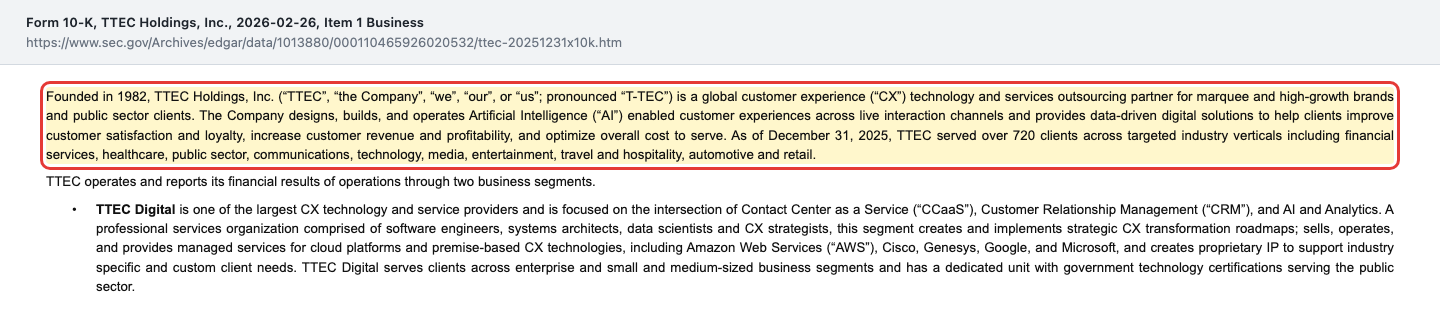
That establishes the central tension of this analysis, which runs through every chapter below: TTEC sells artificial intelligence to companies that use it to automate human customer conversations — and earns most of its money conducting exactly those conversations with humans. Both statements sit in the same annual report, and both are true.
Where the stock came across our desk — and what a 0.96 ratio really says
TTEC surfaced in our in-house stock scanner, specifically in the price-to-free-cash-flow ranking. That screen takes every stock with positive free cash flow and a price-to-free-cash-flow ratio of no more than 10 and sorts them ascending — cheapest first. On July 26, 2026 the list held 544 hits, of which the 25 strongest are displayed. In the U.S. selection, TTEC Holdings sat at rank 17 at a ratio of 0.96, shown in the table as 1.0. To reproduce it: open the Stocks section, choose Scanner, pick the price-to-free-cash-flow ranking and set the market filter to the United States. The lists are recalculated daily — the placement is a snapshot from July 26, 2026, not a permanent state.
Now the ratio in plain language. Free cash flow is the money left after all operating costs, after interest, taxes and investment in buildings and equipment — the money a company could use to repay debt, pay dividends or buy back shares. The price-to-free-cash-flow ratio divides market value by that amount. A ratio of 20 means you pay twenty years of freely available cash. A ratio near 1 means the entire market value equals roughly a single year of it. At a healthy company that would be extraordinary.
Except this fraction did not shrink from below. It shrank from above. Let us do the arithmetic with numbers from the filings. Free cash flow over the four quarters through March 31, 2026 totals $87.8 million ($85.5 million in the second quarter of 2025, minus $9.6 million in the third, minus $9.2 million in the fourth, plus $21.0 million in the first quarter of 2026). Market value: 48,658,381 shares outstanding as of May 1, 2026 per the cover page of the quarterly report, at the $2.10 price captured by our scanner on July 26, 2026, gives roughly $102 million. Both routes — the scanner\'s and our own — land at about one.
And now the sentence that matters. A company is not only its shares. As of March 31, 2026 the balance sheet showed $889.0 million drawn under the credit facility and $88.7 million of cash. Enterprise value — market value plus debt minus cash — comes to roughly $900 million. The market value is barely a tenth of that. Remember the picture: a share is the residual left after the lenders. When that residual gets thin, every ratio with price in the numerator looks dirt cheap — not because the company got cheaper, but because you are only buying a tenth of it.
The same data set from July 26, 2026 shows the market agrees. The stock sits in stage 4 of the Stan Weinstein trend classification — a downtrend — with a fundamental rating of D at minus 47, a Piotroski score of 4 out of 9 (6 out of 9 is acceptable, a genuinely healthy company scores 8 or 9), and a price 62.7 percent below its high. The "cheapest free cash flow" and the full spread of weakness in one name is not a contradiction — it is the same fact seen from two angles. We have taken this kind of ratio apart in the same list once before, in our analysis of BayFirst Financial, where the apparently cheapest cash flow came from selling off the business that generated it.
The numbers over the years — given their due
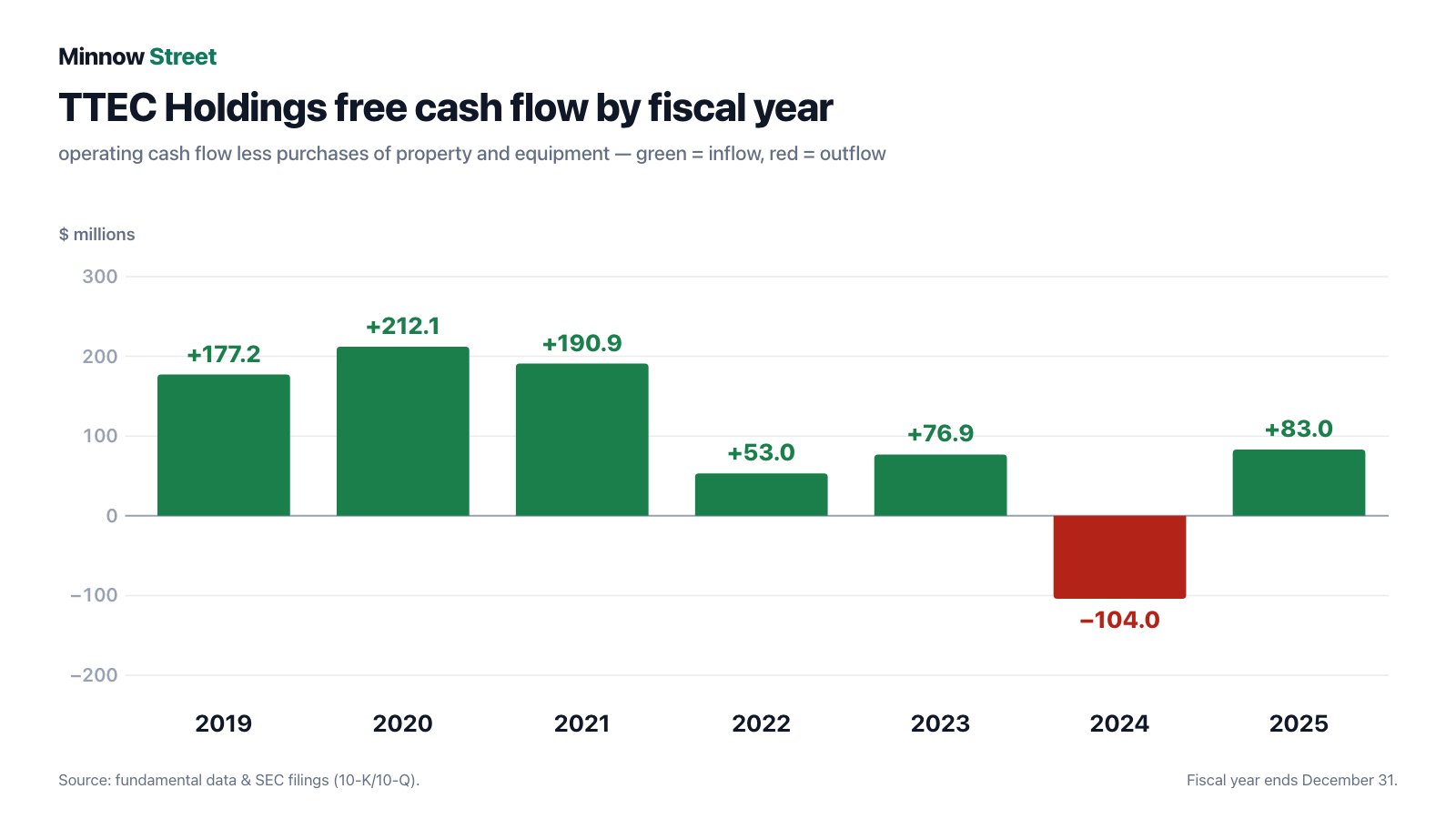
First the part that genuinely impresses, and it is more than the headline suggests. TTEC has reliably produced cash for years. Revenue rose from $1,643.7 million in 2019 to a peak of $2,462.8 million in 2023. Free cash flow was $177.2 million in 2019, $212.1 million in 2020 and $190.9 million in 2021. This is not a startup with hopes on a slide; it is a business that has generated cash for decades — and the core still works: 2025 brought $83.0 million of free cash flow, with another $21.1 million in the first quarter of 2026 against $16.2 million a year earlier.
Operationally, something also turned in 2025 that should not be talked down. The large Engage segment came back from a $197.2 million operating loss in 2024 to $60.7 million of income from operations, a 3.6 percent margin. Revenue retention in Engage — the share of the prior year\'s revenue that returned — rose from 82 percent to 95 percent. The client relationships are old: the ties to the five largest clients run between 6 and 26 years. And the auditors at PricewaterhouseCoopers issued an unqualified opinion on the 2025 statements and expressly judged internal control over financial reporting effective as of December 31, 2025. There is no accounting scandal here.
Now the other side, in a single sequence of numbers. Net income attributable to TTEC shareholders went from $140.97 million in 2021 to $8.4 million in 2023, a loss of $321.0 million in 2024 and a loss of $192.5 million in 2025. The cause is two goodwill impairments. Goodwill arises when a company pays more for an acquisition than the sum of its parts is worth — the premium paid for expectation. When the expectation shrinks, the premium must be written off. In the second quarter of 2024 that hit TTEC Engage for $233.5 million ($196.0 million of goodwill plus $37.5 million of tax effects); in the fourth quarter of 2025 it hit TTEC Digital for $205.4 million ($193.0 million plus $12.4 million). Together, $438.9 million in seven quarters. Both are non-cash — no money left the building. But equity vanished, and that is the number that gives this analysis its weight.
What the filings say — the uncomfortable truths
Uncomfortable truth no. 1: the technology TTEC sells now sits in its own risk factors
Every U.S. annual report has a section called Item 1A Risk Factors, where a company must write down what could hurt its business. Compare two consecutive years and you see what has shifted inside management\'s heads. In the 2024 annual report, filed February 27, 2025, artificial intelligence appeared in the risks only as a liability issue: using AI in our offerings could create liability and reputational harm. In the annual report for 2025, filed February 26, 2026, there is a new risk factor that did not exist a year earlier:
"Our clients are increasingly deploying AI-powered tools and solutions to automate, replace, or materially supplement some of the services that we have historically provided. This trend may accelerate as AI technologies continue to advance in capability, reliability, and cost-effectiveness."
— TTEC Holdings, Inc., Form 10-K for 2025, Item 1A Risk Factors

The framing matters, because it cuts both ways. TTEC is not simply a victim of AI; it is also a vendor. The Digital segment is explicitly focused on the intersection of contact center software, customer relationship management and "AI and Analytics," and Engage lists "AI Operations," including data annotation and labeling, as its own service line — the work of feeding AI models with labeled data. Both statements sit verbatim in the same document filed February 26, 2026: AI as a service sold and AI as a demand risk. The threat therefore sits alongside the revenue, not against it. The honest question is not "AI yes or no" but this: is AI revenue growing faster than human-hour revenue is shrinking? The answer from the first quarter of 2026 is cautious: group revenue fell to $496.2 million from $534.2 million a year earlier, down 7.1 percent. For a look at how another company in the same customer-contact world handles the same shift, see our analysis of Twilio.
Uncomfortable truth no. 2: equity has shrunk to a sixth in 27 months — and tangible equity is deeply negative
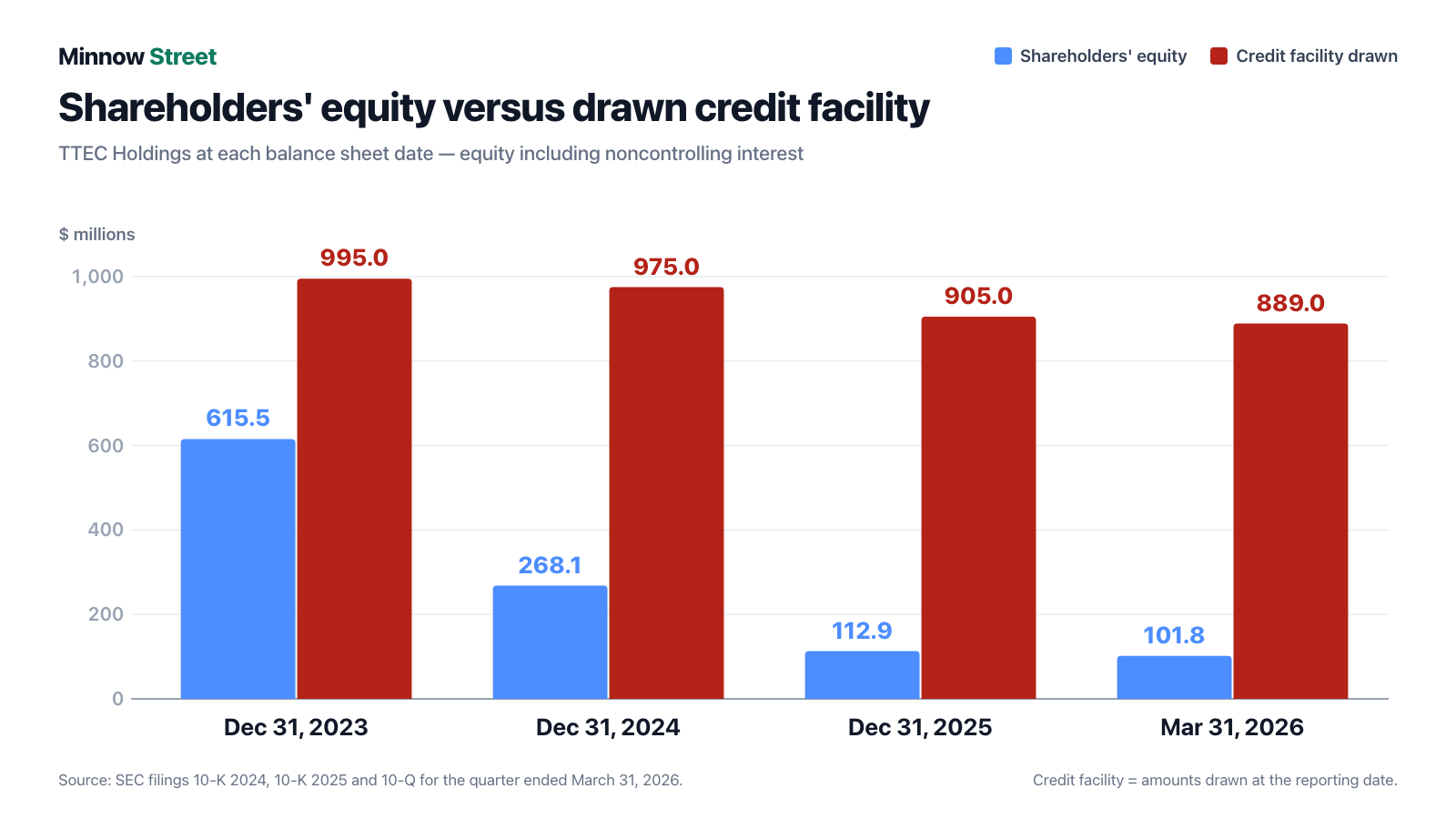
Equity is what belongs to the owners once all debts are paid. At TTEC it stood at $615.5 million on December 31, 2023 (including minority interests), $268.1 million a year later, $112.9 million at the end of 2025 and $101.8 million on March 31, 2026. Of that, $18.2 million belongs to the minority partners in the Percepta joint venture, leaving $83.5 million attributable to TTEC shareholders. That is an equity ratio of 7.2 percent of $1,412.6 million in total assets.
Now look beneath the surface, and it gets less comfortable. Among the assets sit $368.2 million of goodwill and a further $125.7 million of other intangibles — $493.9 million you cannot touch, cannot sell and, in a pinch, cannot turn into cash. Subtract them from equity attributable to TTEC shareholders and you are left with tangible equity of minus $410.3 million as of March 31, 2026. In plain terms: counted only on what is tangible, the company already belongs to its lenders. That is not a rule violation and not an auditor\'s warning — it is common at companies built through debt-funded acquisitions. But it means every further write-down eats directly into the thin remainder. The $368.2 million of goodwill still on the books is more than four times the equity attributable to shareholders.
Uncomfortable truth no. 3: the debt gets more expensive on October 1, 2026 — contractually, not speculatively
On November 5, 2025, TTEC amended its credit agreement for the tenth time. The terms of that amendment are the most important numbers in this entire analysis, because they are dates, not forecasts. Maturity was extended to November 23, 2027. The commitment fell from $1.2 billion to $1.05 billion, with a further $25 million step-down each on April 1 and July 1, 2026. Drawn as of March 31, 2026: $889.0 million. And then come the two sentences that matter:
"SOFR loans bear interest at a rate equal to the applicable spread adjusted SOFR plus applicable credit margin of 3.0% through September 30, 2026, increasing to spread adjusted SOFR plus 6.0% thereafter. … A one-time extension fee of 1.5% of the aggregate revolving credit commitment is payable if the Credit Facility is still in effect on October 1, 2026."
— TTEC Holdings, Inc., Form 10-K for 2025, Liquidity and Capital Resources

Translate that into money. Three additional percentage points on $889.0 million is roughly $27 million of extra interest a year — close to a third of the $83.0 million of free cash flow generated in 2025. The 1.5 percent extension fee on a commitment of roughly $1.0 billion works out to about $15 million, or roughly 15 percent of the entire market value, payable on a single day. Both go away only if TTEC refinances or repays the facility first; the company says in its annual report that it has engaged a financial advisor to evaluate alternatives, with no assurance of an outcome.
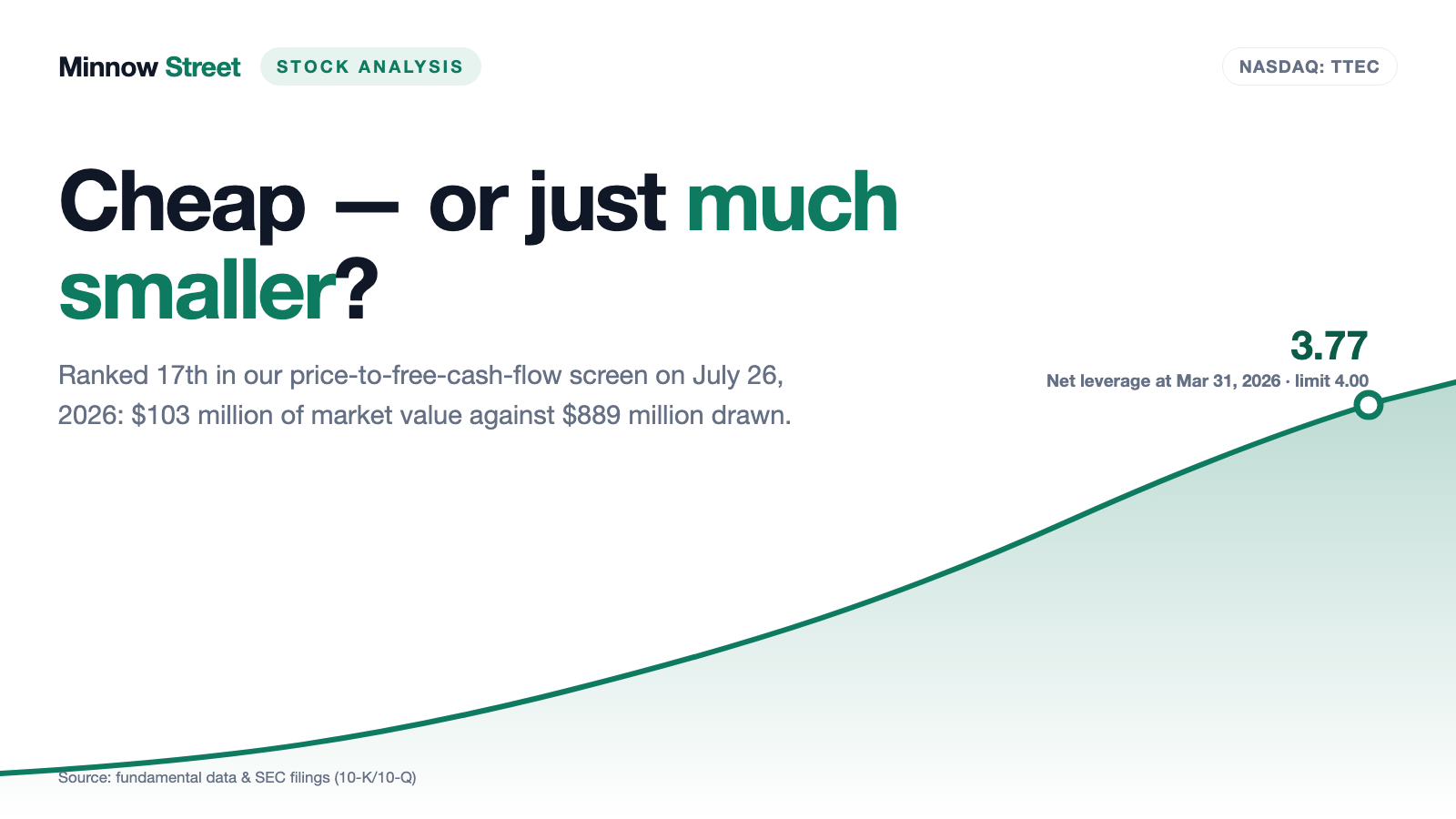
Then there is the covenant side. The credit agreement caps the net leverage ratio — broadly, net debt against an earnings measure defined in the contract — at 4.00 today, stepping down to 3.00 by the third quarter of 2027. TTEC stood at 3.58 on December 31, 2025 and 3.77 on March 31, 2026. Remaining availability under the covenant calculation shrank over the same period from roughly $95 million to roughly $50 million. All covenants were met as of March 31, 2026, and the company states it has sufficient resources for the next twelve months. But the gap to the ceiling is narrowing, not widening. A second data point of the same kind: 2025 income from operations of $96.1 million covered interest expense of $71.7 million 1.3 times — the covenant uses its own contractual earnings measure and requires at least 2.5 times, so the two figures are not directly comparable. The direction they point in is the same.
Uncomfortable truth no. 4: the man who knows the company best wanted to buy it — and then did not
On September 27, 2024, Kenneth D. Tuchman — founder, chairman, chief executive and holder of roughly 57 percent of the shares — put an unsolicited, non-binding proposal to the board: $6.85 per share in cash for every share he and his controlled affiliates did not already own. The board formed a special committee of independent directors with its own advisors. Tuchman tied his proposal to a condition that benefits minority holders: it would proceed only with the approval of a majority of the shares not owned by him.
Eleven months later it was over:
"…due to market conditions Mr. Tuchman has decided not to pursue his previously announced unsolicited, preliminary non-binding proposal of September 27, 2024 to acquire the outstanding shares of the Company that he and his controlled affiliates do not already own."
— TTEC Holdings, Inc., Form 8-K of August 1, 2025, Item 8.01

Checked explicitly, because the question always hangs over a controlled company: there is no live takeover and no merger. The entire filing history with the SEC contains no merger prospectus (Form S-4), no merger proxy (DEFM14A) and no Rule 425 communication; nor a Form 25 or Form 15, which would begin a delisting. The conversion from Delaware to Texas, approved by shareholders on May 21, 2026 by 31,934,654 votes to 5,328,454, has nothing to do with any of it: each share converted one-for-one into a share of the Texas corporation, and trading continues under the symbol TTEC on Nasdaq.
What remains is an observation you can read in both directions. Someone who owns 57 percent and has run the company since 1982 was willing to pay $6.85 a share — and later decided against buying when the price stood far lower. One reader sees a signal that even the best-informed buyer no longer considered the price justified. Another sees that financing such a step is simply hard to arrange against $889 million of existing debt. Both readings are legitimate; the filing says only that market conditions were the reason.
Uncomfortable truth no. 5: ten clients bring nearly half the revenue — and the contracts are expiring
In 2025 the five largest clients accounted for 30.6 percent of revenue and the ten largest for 46.8 percent; a single client represented more than 10 percent. That is not unusual for an outsourcing provider, but it has an edge: the contracts with the five largest clients expire between 2026 and 2029, and in the Engage business most contracts can be terminated for convenience by either side. The annual report names three causes for the 2025 revenue decline at Engage: a long-tenured client exiting an entire line of business supported by TTEC; conservative discretionary spending by large onshore enterprise clients; and delays in launching new and larger awarded contracts. The healthy 95 percent revenue retention in 2025 is a snapshot — a year earlier the figure was 82 percent.
Valuation: what $102 million buys and what $900 million means
No daily prices, only dated orders of magnitude. On 48,658,381 shares outstanding as of May 1, 2026 and the $2.10 price captured by our scanner on July 26, 2026, market value comes to roughly $102 million. Against revenue of $2,098.1 million over the trailing four quarters, that is a price-to-sales ratio of about 0.05 — five cents of market value for every dollar of revenue. Even for a thin-margin service business that is extraordinarily low.
Except that is only half the calculation. Enterprise value — what a buyer would have to put up for the whole thing, market value plus debt minus cash — sits at roughly $900 million. Measured that way, a dollar of revenue costs about 43 cents rather than five. That is no longer sensational; it is simply what a shrinking, indebted service provider costs. The entire gap between the two figures is the debt. That is exactly why a price-to-free-cash-flow ratio of 0.96 is an honest calculation with a misleading message: it correctly measures how little the equity slice costs, and says nothing about how large the debt slice is.
The professional view, as a snapshot from July 26, 2026: six analysts cover the stock, three with buy ratings and three at hold, with a mean price target of $4.00. Trailing earnings per share cannot be used sensibly because they are negative at minus $4.18; consensus expects $1.16 for the current year. The 52-week range ran from $1.91 to $5.28. That expectation carries a caveat: it assumes the tax line normalizes and that interest expense does not rise by the roughly $27 million a year the credit agreement provides for.
Opportunities and risks at a glance
What speaks for TTEC:
- The business produces cash. $83.0 million of free cash flow in 2025 and $21.1 million in the first quarter of 2026 against $16.2 million a year earlier — after interest and capital expenditure.
- The large segment has stabilized. TTEC Engage delivered $60.7 million of income from operations in 2025 after a $197.2 million loss in 2024; revenue retention rose from 82 to 95 percent.
- Client relationships are old and the audit is clean. Ties of 6 to 26 years with the five largest clients; an unqualified PricewaterhouseCoopers opinion and internal control judged effective as of December 31, 2025.
- The impairments were non-cash. The $438.9 million charged in 2024 and 2025 cost no money — and a large part of the goodwill that could still be written down is already gone.
- The owner is in the building. Roughly 57 percent sits with the founder and chief executive, which largely rules out short-term maneuvers at the expense of substance.
What speaks against it:
- The calendar works against the balance sheet. An extension fee of roughly $15 million falls due on October 1, 2026, and from that date the credit margin rises by three percentage points — roughly $27 million a year on $889.0 million drawn. The facility matures on November 23, 2027.
- Headroom is shrinking. Net leverage of 3.77 at March 31, 2026 against a 4.00 ceiling that steps down to 3.00 by the third quarter of 2027; remaining availability of roughly $50 million after $95 million a quarter earlier.
- Tangible equity is negative. Minus $410.3 million after deducting goodwill and intangibles as of March 31, 2026; reported equity attributable to TTEC shareholders is $83.5 million.
- Revenue is shrinking. From $2,462.8 million in 2023 to $2,136.9 million in 2025, and another 7.1 percent year over year in the first quarter of 2026.
- The company\'s own filing names AI as a demand risk. For the first time in the 2025 annual report — for a business that is roughly four-fifths labor-intensive customer care.
- The tax line eats the profit. $7.8 million of expense on $2.6 million of pre-tax income in the first quarter of 2026, a consequence of the $197.0 million valuation allowance against deferred tax assets as of December 31, 2025.
A human conclusion
We started with the numerator trap: a fraction shrinks and the brain reports "cheap," without asking which of the two numbers moved. At TTEC Holdings we now know. The roughly $88 million of free cash flow over four quarters is real and respectable; it has not grown, but it is there. What changed sits above it: market value has shrunk to roughly $102 million while $889 million of debt stayed put. A price-to-free-cash-flow ratio of 0.96 therefore does not say "this company is a bargain." It says "you are only buying a tenth of this company."
What happens next hangs on a question no valuation model answers: whether TTEC gets its credit facility replaced in time and on tolerable terms. If it does, here is a business with 51,000 people, old client relationships and positive cash flow valued at a fraction of its revenue. If it does not, the outcome will not be decided by shareholders. The calendar names the dates: October 1, 2026, when the fee and the margin step-up bite, and November 23, 2027, when the facility matures. Until then every figure in this analysis is an interim reading.
And then there is the man with 57 percent who offered $6.85 and changed his mind. You do not have to make his decision your own. But it belongs to the small set of signals where someone with complete information would have put up his own money — and then did not. What you do with that is your decision. And that is exactly as it should be.
Sources
- Form 10-K for 2025, TTEC Holdings, Inc., filed February 26, 2026 (CIK 0001013880)
- Form 10-K for 2024, filed February 27, 2025
- Form 10-Q for the quarter ended March 31, 2026, filed May 7, 2026
- Form 10-Q for the quarter ended September 30, 2025, filed November 6, 2025
- Form 10-Q for the quarter ended June 30, 2025, filed August 7, 2025
- Form 10-Q for the quarter ended March 31, 2025, filed May 8, 2025
- Form 8-K of September 30, 2024, Item 7.01 — the founder\'s buyout proposal at $6.85 per share
- Schedule 13D/A of September 30, 2024 — the wording of the proposal
- Form 8-K of August 1, 2025, Item 8.01 — withdrawal of the proposal
- Form 8-K of November 5, 2024, Items 1.01 and 8.01 — sale of the headquarters building, dividend suspension, move to Texas
- Form 8-K of May 27, 2026, Items 3.03/5.03/5.07/8.01 — annual meeting and conversion from Delaware to Texas
- Metrics and price data: fundamental data as of July 26, 2026; ranking position in the price-to-free-cash-flow screen measured live on July 26, 2026
Disclaimer: This article is journalistic analysis of publicly available company filings and is not investment advice. It contains no buy, hold or sell recommendation and is not a solicitation to buy or sell securities. Shares in highly indebted companies with declining revenue can move sharply; a total loss of invested capital is possible. The author holds no position in TTEC Holdings, Inc. at the time of publication and intends none, directly or through derivatives. All figures come from the primary sources named above and carry the as-of date stated there.
Our Bottom Line at a Glance
- Core business neutral
- The business carries itself but is shrinking. Revenue fell from $2,462.8 million in 2023 to $2,136.9 million in 2025 and another 7.1 percent to $496.2 million in the first quarter of 2026. The large Engage segment returned to $60.7 million of income from operations in 2025 (2024: a loss of $197.2 million) and revenue retention rose from 82 to 95 percent.
- Cash generation positive
- After interest, taxes and capital expenditure, $83.0 million was left in 2025 (2024: minus $104.0 million), with $21.1 million in the first quarter of 2026 against $16.2 million a year earlier. Over the four quarters through March 31, 2026 free cash flow totals $87.8 million — the basis of the screen placement and the most solid number in this analysis.
- Balance sheet and leverage negative
- Equity fell from $615.5 million on December 31, 2023 to $101.8 million on March 31, 2026, of which $83.5 million is attributable to TTEC shareholders; after deducting $493.9 million of intangibles, tangible equity is minus $410.3 million. Against that stand $889.0 million drawn on the credit facility. Net leverage rose from 3.58 to 3.77 against a 4.00 covenant ceiling that steps down to 3.00 by the third quarter of 2027, and remaining availability shrank from roughly $95 million to roughly $50 million.
- Financing calendar negative
- Contractual, not forecast: from October 1, 2026 the credit margin on SOFR loans rises from 3.0 to 6.0 percentage points — roughly $27 million of extra annual interest on $889.0 million drawn. If the facility is still in effect that day, a one-time extension fee of 1.5 percent of the commitment also falls due, about $15 million on roughly $1.0 billion. The facility matures on November 23, 2027; a financial advisor is evaluating refinancing alternatives with no assurance of an outcome (Form 10-K 2025).
- AI classification neutral
- TTEC sells artificial intelligence — TTEC Digital is focused on AI and analytics, and TTEC Engage lists "AI Operations," including data annotation, as its own service line. The same 2025 annual report also carries, for the first time, a risk factor absent from the 2024 edition: rapid adoption of AI by clients could reduce demand for TTEC's services. Both statements come from the same document filed February 26, 2026.
- Ownership and control neutral
- Founder and chief executive Kenneth D. Tuchman holds roughly 57 percent of the shares (Form 10-K 2025). He withdrew his September 27, 2024 buyout proposal at $6.85 per share on August 1, 2025, citing market conditions; no transaction is under way (no Form S-4, no DEFM14A, no Rule 425 communication). The conversion from Delaware to Texas effective May 22, 2026 changed neither capital nor control.
TTEC Holdings is not a cheap stock; it is a small stock in a large, indebted company. The price-to-free-cash-flow ratio of 0.96 that lifted it to rank 17 of our screen on July 26, 2026 is arithmetically correct: roughly $102 million of market value against $87.8 million of free cash flow over four quarters. But it measures only the equity slice — enterprise value is about $900 million because $889.0 million is drawn on the credit facility. The operating business carries itself with 51,000 employees and long-standing client relationships, yet it has been shrinking since 2023. Two goodwill impairments totaling $438.9 million pushed equity down to $101.8 million and tangible equity to minus $410.3 million. Two dates decide the rest: October 1, 2026, with the margin step-up and extension fee, and November 23, 2027, when the facility matures. Not investment advice.
What Our Rating Means
Substance risk
We found at least one documented issue that threatens the company itself — regardless of how the stock is currently valued.
The red rating here is not about the fallen share price — price is not a quality attribute — but about documented balance sheet substance. Equity fell from $615.5 million to $101.8 million in 27 months and, after deducting $493.9 million of intangibles, is deeply negative at minus $410.3 million, against $889.0 million drawn on the credit facility. Income from operations in 2025 covered interest expense only 1.3 times, and from October 1, 2026 the credit margin rises contractually by three percentage points, worth roughly $27 million a year — more than the entire cushion between operating income and interest. Net leverage of 3.77 sits close to the 4.00 covenant ceiling that steps down to 3.00 by 2027, and drawing headroom shrank from $95 million to $50 million in a single quarter. All covenants were met as of March 31, 2026, there is no going-concern qualification and no qualified audit opinion — the color describes the substance, not an acute event. The decision is yours.
A journalistic assessment by our editorial team at the time of the deep dive, based on public sources — not investment advice and not a solicitation to buy or sell. Your personal circumstances (investment goals, risk capacity, taxes) cannot be taken into account. What our levels mean, how verdicts are formed, and what conflicts of interest exist →
Worth Noting
- Hook and reference: rank 17 in our in-house price-to-free-cash-flow ranking of the U.S. selection, measured live on July 26, 2026 (544 hits in total, the 25 strongest displayed). The stated ratio is 0.96, rounded to 1.0 in the table. The screens are recalculated daily; the placement is a snapshot.
- Why the low ratio does not come from earnings power: free cash flow over four quarters ($87.8 million) sits below the level of 2019 through 2021 ($177.2 / $212.1 / $190.9 million). What fell is the numerator: market value of roughly $102 million is barely a tenth of an enterprise value of about $900 million, because $889.0 million is drawn on the credit facility (March 31, 2026).
- Merger check: no transaction is under way. The founder's September 27, 2024 proposal at $6.85 per share was withdrawn on August 1, 2025; no Form S-4, no DEFM14A, no Rule 425 communication, no Form 25 and no Form 15 in the filing history.
- Possible confusion: TTEC Holdings, Inc. was named TeleTech Holdings, Inc. until November 20, 2017 — price history and older filings under the former name concern the same company (CIK 0001013880). The conversion from Delaware to Texas on May 22, 2026 changed neither the ticker, the share count nor the listing.
- As-of dates: fundamental data and screen values from July 26, 2026; all balance sheet and income figures come from the SEC filings named above with their respective reporting dates. The market value was cross-checked: 48,658,381 shares (10-Q cover page, May 1, 2026) times $2.10 gives $102.2 million against $103.2 million from fundamental data.
Frequently Asked Questions
TTEC Holdings runs customer service and customer experience operations for other companies' brands — phone, chat, tech support, sales, fraud mitigation and back-office work. As of December 31, 2025 roughly 51,000 people did that work worldwide, 48 percent of them in Asia. The company reports two segments: TTEC Engage ($1,667.7 million of revenue in 2025) and TTEC Digital ($469.2 million).
Because market value shrank, not because cash flow grew. The four quarters through March 31, 2026 produced $87.8 million of free cash flow against a market value of roughly $102 million on July 26, 2026. Enterprise value, however, is about $900 million because $889.0 million is drawn on the credit facility. You are buying a tenth of the company cheaply, not the whole of it.
No. Founder and chief executive Kenneth D. Tuchman, who holds roughly 57 percent, offered $6.85 per share for the remaining shares on September 27, 2024. On August 1, 2025 he said he would not pursue the proposal due to market conditions. The SEC filing history contains no merger prospectus (Form S-4), no merger proxy (DEFM14A) and no Rule 425 communication.
Both, and the 2025 annual report says so itself. TTEC sells AI: the Digital segment is focused on AI and analytics, and Engage lists "AI Operations," including data annotation, as its own service line. The same report also carries a risk factor absent in 2024: rapid client adoption of AI could reduce demand for TTEC's services. Group revenue fell 7.1 percent in the first quarter of 2026.
Two things at once. If the facility is still in effect that day, a one-time extension fee of 1.5 percent of the commitment falls due — roughly $15 million on a commitment of about $1.0 billion. And the credit margin on SOFR loans rises from 3.0 to 6.0 percentage points after September 30, 2026; on the $889.0 million drawn at March 31, 2026 that is roughly $27 million of extra interest a year.
Reported equity was $101.8 million as of March 31, 2026, of which $83.5 million is attributable to TTEC shareholders. That figure includes $368.2 million of goodwill and $125.7 million of other intangibles. Strip them out and tangible equity is minus $410.3 million. The equity ratio is 7.2 percent of $1,412.6 million in total assets.
Because of two goodwill impairments. The second quarter of 2024 hit the TTEC Engage segment for a total of $233.5 million; the fourth quarter of 2025 hit TTEC Digital for $205.4 million. Together, $438.9 million. Both charges were non-cash — no money left the business — but they cut equity from $615.5 million on December 31, 2023 to $101.8 million on March 31, 2026.
No. The board suspended the semi-annual cash dividend on November 4, 2024 in order to prioritize debt reduction; the last payment was made on April 30, 2024. Since the Tenth Amendment of November 5, 2025 the credit agreement further restricts distributions and share repurchases. The board says it will decide later whether and when to reinstate the dividend.
Found an error?
Did you spot a factual error, an outdated number, or a typo in this deep dive? Let us know briefly — your report goes straight to the editorial team.