Vroom After the Restart: The Odometer Reads Zero — the Car Is the Same
Vroom sits at rank 11 in our in-house K/FCF ranking for the U.S. selection (as of July 26, 2026) — a market value of roughly $37 million against $61.9 million of free cash flow for 2025. That reads like the bargain of the year. The annual report explains the number in a single sentence: since emerging from bankruptcy on January 14, 2025, purchased finance receivables are booked in investing rather than operating activities. The same $419.7 million, just one line lower. Let us read what the restart actually delivered — and what it merely re-sorted.
 Thomas Mücke
Founder & Publisher
Thomas Mücke
Founder & Publisher
Chart
Interactive price chart (TradingView).
Note: pure fact-based analysis, not investment advice and not a solicitation to buy or sell. All figures without guarantee.
There is an investor trap that springs precisely where everything looks spotless — call it the odometer trap. Every used-car buyer knows the principle: the vehicle gleams on the lot, the mileage is low, the service book is fresh. Only the odometer has been rolled back, and the car underneath has the same years behind it as before. That is exactly what happens to a balance sheet after a bankruptcy. Vroom, Inc. (NASDAQ: VRM) emerged from a prepackaged Chapter 11 case on January 14, 2025 and applied fresh start accounting under the U.S. standard ASC 852 on the same day — giving it a new zero point: new opening values, a new accumulated deficit, a new share count. The business underneath stayed the same. So let us make a deal: before you buy a strikingly cheap ratio, we read together what the company told the U.S. securities regulator, the SEC — the annual report (10-K) for 2025, the quarterly report (10-Q) for March 31, 2026, and everything filed after that. An SEC report is honest under penalty of law. And this one tells of a genuine restructuring success, of a cash flow that is largely an accounting line, and of an owner who is also the lender. What you make of it is up to you.
What Vroom is today — the name stayed, the business did not
Anyone who knows the name Vroom knows it as an online used-car retailer: pick a car on the web, have it delivered to your door, initial public offering in June 2020, large expectations. That business no longer exists. On January 22, 2024 the company announced its Value Maximization Plan — in plain terms, the ecommerce operation was discontinued and the dealership business wound down to preserve cash. Two businesses remained, and their connection to selling cars is now indirect at best.
First, UACC, the United Auto Credit Corporation. This is an indirect auto lender — in everyday terms: Vroom does not sell you the car, a dealership does; and when you sign the loan there, UACC buys that contract from the dealer at a discount and collects your payments from then on. The focus is the non-prime market: customers who would not qualify for financing at a conventional bank. That is a legitimate, old business — but it is also a business in which the default rate is not an exception, it is the priced-in rule. Second, CarStory, acquired in 2021, which sells AI-powered market analytics to dealers and auto finance companies. Small, but it is the second reportable segment.
That names the central tension of this analysis, and it runs through every chapter: the books received a new zero point on January 14, 2025 — the loan book, the customer quality and the cost base underneath did not. With every figure the question is the same: has it improved, or has it merely been counted differently?
Where the stock landed on our desk
On July 26, 2026, Vroom stood at rank 11 in our K/FCF ranking, filtered to the United States. What the list does is stated on the page itself: it takes every stock with positive free cash flow and a K/FCF of no more than 10 and sorts them ascending — cheapest first. In total 544 names met the criterion; the 25 strongest of each country selection are displayed. Vroom\'s value: 0.6. To reproduce it: open the scanner, set the market to "USA", the first column is already sorted by K/FCF. The lists are recalculated daily, so today\'s rank is a snapshot, not a permanent state.
K/FCF translates quickly: market value divided by free cash flow — the money left after running the business and after investing in property and equipment. A value of 0.6 literally says: the entire company costs less on the stock market than the free cash it produced in one year. At a healthy company that would be an exclamation mark. A value around 10 counts as normal, around 15 as expensive. 0.6 is no longer a ratio, it is an alarm.
So let us check the arithmetic. Market value: 5,207,627 shares (10-Q cover page, as of May 12, 2026) times the July 24, 2026 close of $7.09 gives roughly $36.9 million. Free cash flow: the statement of cash flows in the 10-K reports $69.1 million of operating inflow for the full year 2025; deducting $7.2 million for property and equipment leaves $61.9 million. 36.9 divided by 61.9 — those are the 0.6. So the number is correct. It simply is not correct in the sense in which it is read.
One honest footnote on classification: our stock pages distinguish between verified scanner hits and pure ratio rankings that sort the entire universe. The K/FCF ranking belongs to the second group. As verified hits, Vroom appeared on July 26, 2026 in three strategies: FCF/Market Cap (32 hits), Pros 80% (1,792 hits — stocks with more than 80 percent institutional and insider ownership) and U/D Accumulation (111 hits). The second of those will come back later, because behind the 94 percent of "professionals" here sits essentially one address.
The numbers over the years — what genuinely improved
First the part that genuinely impresses, and it is more than nothing. The debt cut worked: the notes maturing in 2026 have disappeared from the balance sheet entirely, and the holders received stock instead. Interest expense on corporate debt fell from $5.8 million in 2024 to $3.0 million in 2025. Total expenses were cut from $180.8 million to $119.2 million. And trade creditors did not have to bleed — the plan left them expressly unimpaired.
The bottom line deserves a careful look, because this is where the odometer shows its first quirk. The company itself reports a net loss of $53.1 million for 2025 after $165.1 million for 2024 — a genuine improvement of more than half. Those $53.1 million, however, cover the successor period from January 15 to December 31, 2025. Add the 14 days before that, in which the debt discharge was recorded as a $51.0 million reorganization gain, and calendar year 2025 arithmetically ends at a loss of only $8.0 million. Both figures are correct, and each says something different: one measures the ongoing business after the restart, the other includes a one-off accounting gain from the case itself. Below we always use the view a given sentence means — and we say which.
Operationally the machine is running too: across the full year 2025 Vroom earned $178.8 million of interest income and $126.1 million of net interest income. The loan book, at $804.6 million of fair value (March 31, 2026), is more than 20 times the market value. And in June 2026 a step that had been open for months finally landed: the largest warehouse facility, which loan buyers need to bridge-finance their purchases, was still limited to June 2026 at the turn of the year and was extended by only one month in May. On June 30, 2026, Amendment No. 29 extended the facility, with JPMorgan Chase as administrative agent, to June 2, 2027 — and loosened the financial covenants along the way: a higher maximum leverage ratio, a simplified and reduced minimum tangible net worth threshold, a higher maximum advance rate. That the banks extended is a real signal. That they had to lower the bar to do it is the other one.
Uncomfortable truth no. 1: the free cash flow is largely a reclassification
Now to the number that brought us here. In 2024 Vroom burned $97.0 million in operating activities (total company, full year). In 2025, $69.1 million flowed in there. A swing of $166 million in one year — at a company that is still posting losses. How? The company explains it itself, in a single sentence of the management discussion on operating activities:
"As a result of emerging from the Prepackaged Chapter 11 Case and applying fresh start accounting, our finance receivables are originated and accounted for as held for investment at fair value and are classified as investing activities prospectively."
— Vroom, Inc., SEC annual report 10-K for 2025, Item 7 (MD&A), "Operating Activities"

In everyday terms: a baker who buys flour books it as a running expense — his operating cash flow drops. If that same baker suddenly booked the flour as an "investment", his operating cash flow would look splendid, even though he spent exactly the same money on exactly the same flour. For a lender, purchased loan receivables are the flour. And that line moved. The counter-check sits one row further down in the same statement: $419.7 million flowed out for purchases of finance receivables in investing activities in 2025. What comes in at the top goes out below.
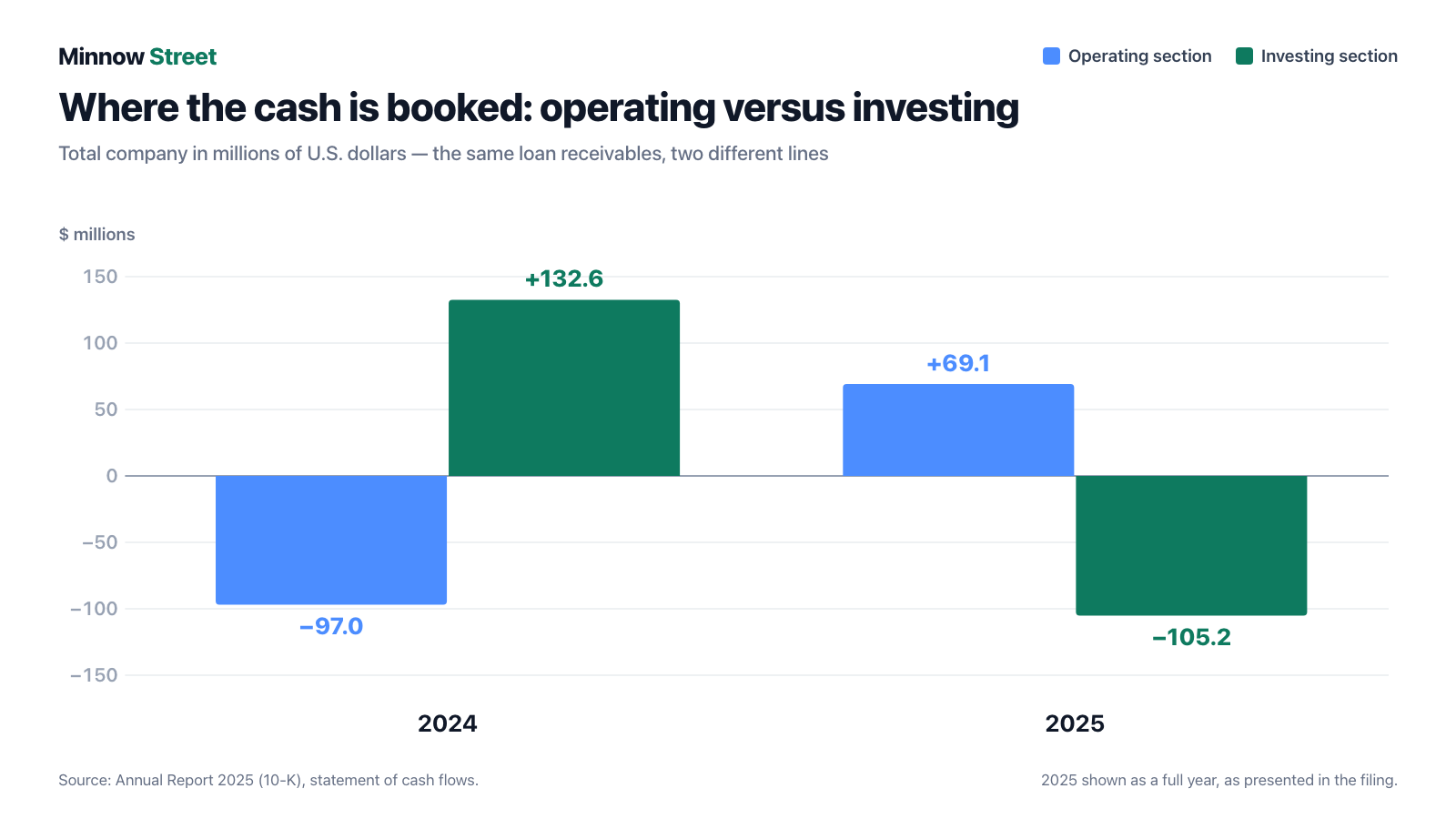
Across all three sections, Vroom still lost money in 2025: operating, investing and financing together produced a $12.1 million decrease in cash. Worth filing away: free cash flow that comes from a reclassification neither buys back stock nor repays debt.
Uncomfortable truth no. 2: the filing itself says where the money comes from
Credit where it is due: the company hides nothing. The liquidity section of the annual report contains the sentence everyone should read who mistakes the cash flow figure for earning power:
"We have historically had negative cash flows and generated losses from operations and our primary source of liquidity has been cash generated through financing activities."
— Vroom, Inc., SEC annual report 10-K for 2025, Item 7 (MD&A), "Liquidity and Capital Resources"

By March 31, 2026 the picture had barely changed: $14.5 million of unrestricted cash, $59.2 million restricted — mostly collateral inside the securitizations and warehouse facilities, money you cannot reach in daily operations. For comparison: the quarterly loss was $19.0 million. The filing contains no formal going-concern doubt; management expressly expects cash, credit facilities and securitizations to be sufficient for at least twelve months. But the order is worth noting: financing comes first, then the business.
Uncomfortable truth no. 3: the loan book is carried 11 percent below par — and losses eat the margin
A non-prime auto lender lives on a single calculation: interest minus funding cost minus defaults. That calculation does not work at Vroom right now, and it has not worked for two years. The quarterly report for March 31, 2026 shows it line by line.
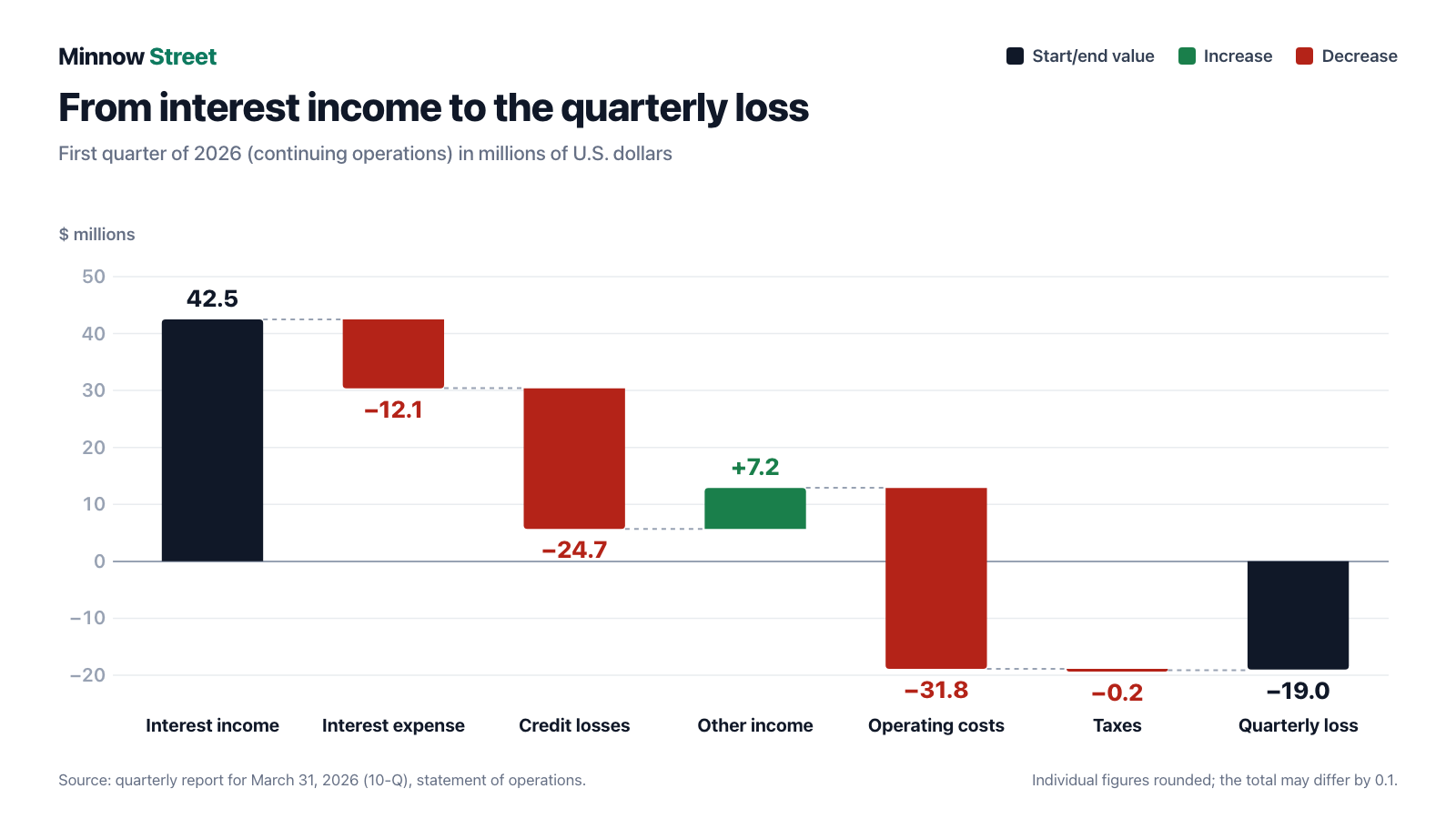
The decisive line is "realized and unrealized losses": $24.7 million in the first quarter of 2026, or 81 percent of the $30.4 million of net interest income. In the January 15 to March 31, 2025 comparison period it was $11.1 million against $26.0 million — only 43 percent. Honesty requires the context: the outlier is not the first quarter of 2026, it is that comparison period. On a full-year basis the ratio already stood at 84 percent in 2024 and 82 percent in 2025. That is the real finding — not a sudden collapse, but a loss rate that has been consuming more than 80 percent of net interest income for two years. Put differently: of every dollar of interest margin, less than 20 cents survives defaults to pay for the entire organization.
How Vroom assesses its own loan book is in the notes: the aggregate principal balance of finance receivables held for investment was $902.0 million as of March 31, 2026, against a carrying fair value of $804.6 million. That is a discount of $97.4 million, or 10.8 percent — and it is not a regulator\'s prudential reserve, it is the company\'s own valuation. For comparison: total equity is $98.4 million. The markdown on the loan book is almost exactly the size of the equity itself.
And that equity is shrinking measurably fast. As of December 31, 2025 it stood at $116.6 million, as of March 31, 2026 at $98.4 million — down 15.6 percent in a single quarter. The new accumulated deficit, which started at zero on January 14, 2025, already reached $72.7 million after barely fifteen months. The odometer is running again, and it is running fast.
Uncomfortable truth no. 4: $22.5 million of new money cost 37 percent of a subsidiary
On January 16, 2026, Vroom raised money — not as debt at the parent and not through a share issue, but by selling preferred units in a subsidiary. Vroom Automotive, LLC, which per the notes holds intellectual property licenses and other financial assets, issued 15,000 Series A and 7,500 Series B preferred units to the statutory trust SPE Holdings 2026-1. Gross proceeds were $22.5 million — more than half the current market value of the entire listed company.

The terms are in Note 13, and they are no bargain: a quarterly preferential distribution equal to the 90-day average of the U.S. benchmark rate SOFR plus 8.25 percent for Series A and 9.0 percent for Series B. In the first quarter of 2026 that cost $0.6 million, paid on April 16, 2026. Series B is convertible into common units of Vroom Automotive at any time; both series are redeemable at the holder\'s option — Series A first on March 16, 2027, Series B on January 16, 2031. And in a liquidation of the subsidiary, Series A is paid first, then Series B; whatever remains goes to the common units. In a shareholder\'s language: someone has stepped between you and part of the company\'s assets, and they get paid first. The technical term is structural subordination; the everyday image is a checkout line in which you have been moved to the back.
Uncomfortable truth no. 5: owner, lender and board chair are closely related here
Remember the scanner hit "Pros 80%", meaning more than 80 percent institutional and insider ownership? At Vroom it is 94 percent — and that is not a quality seal, it is a consequence of the plan of reorganization. The ownership table in the information statement of June 22, 2026 names one genuinely relevant holder as of April 16, 2026: Mudrick Capital Management, L.P. with 3,967,251 shares, or 76.10 percent. The second-largest holder is Silverback Asset Management with 8.16 percent. All officers and directors together hold 2.87 percent. The free float is correspondingly thin: roughly 750,000 shares, on average daily volume of about 29,000 shares (50-day average, as of July 24, 2026).

The same majority holder is also a lender. On March 8, 2025 Vroom agreed a drawable credit facility with Mudrick Capital Management, sized at $35.0 million since September 30, 2025, bearing interest at Term SOFR plus 850 basis points with the option to pay interest in additional debt rather than cash; it is collateralized by residual certificates in UACC securitization trusts and matures on December 31, 2026. Only $8.0 million had been drawn as of March 31, 2026. Then there is board chair Robert J. Mylod, Jr.: on November 25, 2025 he lent the company $10.5 million at Term SOFR plus 7.50 percent, secured by the company\'s assets and maturing on November 25, 2026 — fully drawn. And back on August 29, 2025, Vroom issued convertible notes due October 2030 to Annox Capital and the same Mr. Mylod, bearing 5.0 percent interest and initially convertible at roughly $35.00 per share — nearly five times the July 2026 price — while the agreement also permits conversion at the prevailing market price, capped at 20 percent of the capital absent further shareholder approval.
None of this is unlawful, or even unusual for a company fresh out of a restructuring. But it answers the question of who is actually at the wheel. For a small shareholder it means: you are along for the ride, someone else picks the route, and that someone is also your creditor. If you want to compare a lender\'s perspective at scale, our analysis of Rocket Companies shows the same credit cycle in a far larger balance sheet — and our analysis of BayFirst Financial covers another name from the same K/FCF ranking where the loan quality deserves a close look as well.
Valuation: what the stock costs — and what is inside
A price-earnings ratio cannot be formed because there are no earnings. That leaves two anchors. First, book value: $98.4 million of equity (March 31, 2026) against roughly $36.9 million of market value gives a price-to-book ratio of about 0.38 — the market pays a good third of what stands in the books. That is not an oversight, it is a statement: investors either consider the fair value of the loan book too optimistic or expect the running losses to keep eroding equity. At a quarterly decline of $18.2 million, that is not an unreasonable expectation.
Second, orders of magnitude: the entire market value equals about 4.6 percent of the $804.6 million loan book fair value, and roughly two quarterly losses. Put differently, the stock is an option on the equity, not a share in a running earnings stream. The professionals\' view helps little here: our data set holds a single analyst estimate for Vroom, and one voice does not make a consensus, so we do not treat it as one.
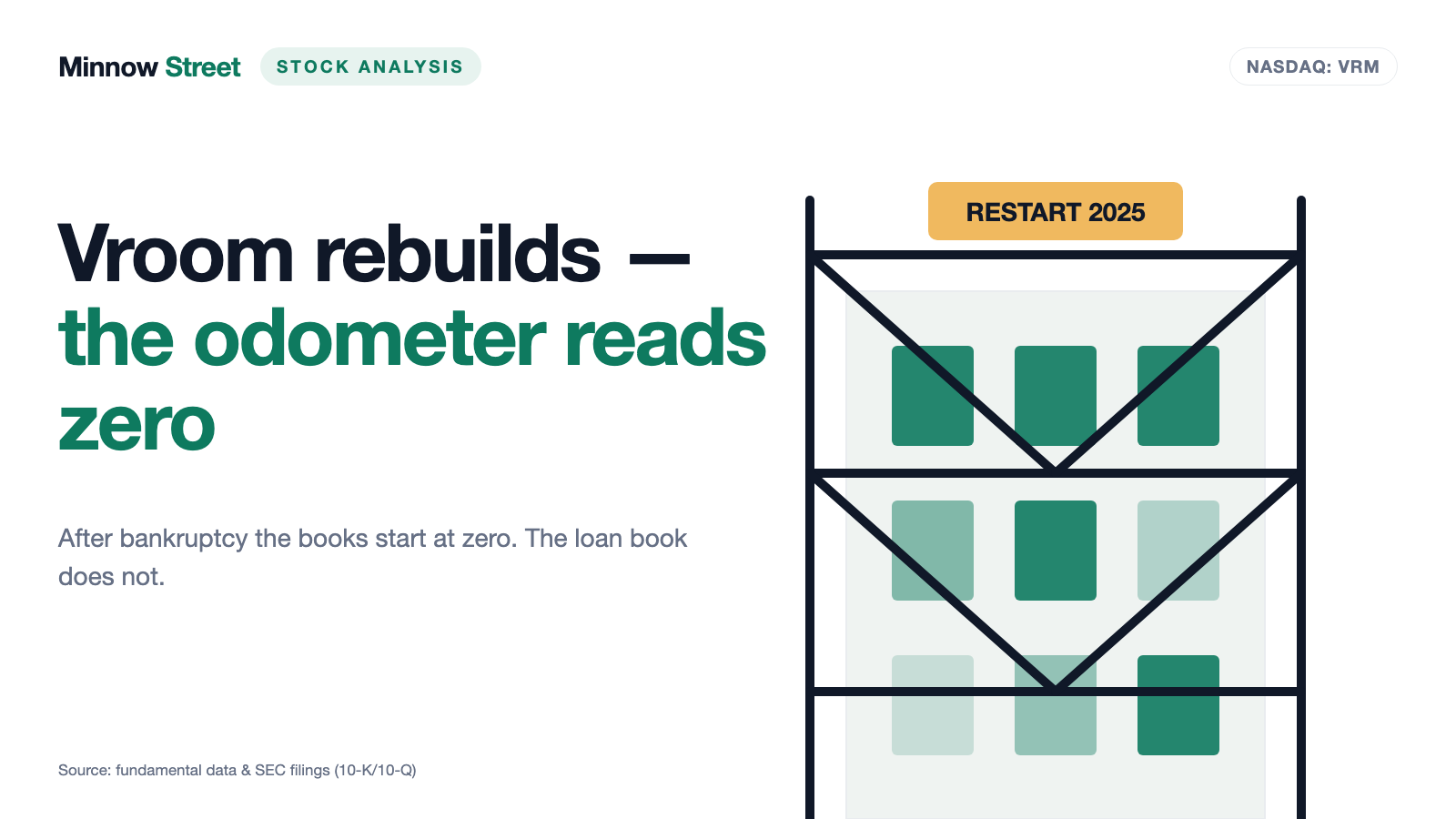
For price context, deliberately dated and without a forecast: the new stock started at a close of $31.00 on February 20, 2025, peaked at $39.98 on April 24, 2025, ended 2025 at $19.88 and stood at $7.09 on July 24, 2026. Important for any chart comparison: prices before February 20, 2025 belong to the old shares and are not directly comparable because of the 1-for-5 conversion.
Opportunities and risks at a glance
What speaks for Vroom:
- The debt cut worked: the notes maturing in 2026 are fully retired, interest expense on corporate debt fell from $5.8 million to $3.0 million, and the successor-period loss for 2025 was $53.1 million after $165.1 million for 2024.
- The cost base is markedly leaner: $119.2 million of expenses in 2025 after $180.8 million the year before, each on a full-year basis.
- Funding is in place: the largest warehouse facility runs to June 2, 2027 following the amendment of June 30, 2026; the banks extended rather than pulled out.
- Equity of $98.4 million stands well above the market value of roughly $36.9 million — if the fair value of the loan book holds, there is substance.
- The majority holder provides money itself (a $35.0 million line, only $8.0 million drawn) and therefore has a visible interest in survival.
What speaks against it:
- Credit losses consume the margin: $24.7 million in the first quarter of 2026 against $30.4 million of net interest income — 81 percent, after 84 percent in 2024 and 82 percent in 2025.
- Equity fell 15.6 percent in one quarter, from $116.6 million to $98.4 million; the new accumulated deficit reached $72.7 million after barely fifteen months.
- Unrestricted cash is thin: $14.5 million as of March 31, 2026 against a quarterly loss of $19.0 million.
- Dilution is built in: 1,630,880 shares are reserved under the employee plan — roughly 31.3 percent of today\'s capital — alongside 364,516 warrants and convertible notes.
- A free float of only about 750,000 shares on roughly 29,000 shares of daily turnover: anyone buying or selling moves the price themselves.
- The cheap K/FCF ratio rests on a reclassification and a small market value, not on running earning power.
A human conclusion
Back to the odometer. Vroom went through a bankruptcy that many companies do not survive, and came out with a clean opening balance sheet, without legacy notes and with a halved loss. That is no small thing, and reading only the label "former bankrupt" does not do it justice. But the new zero point is a zero point in the books, not in the business. The loan book, the customer quality, the default rate and the cost base all came along from before — and the number that washed this stock into our ranking does not measure earning power, it measures the after-effect of an accounting rule.
If you take one thing from this analysis, take this: whenever a ratio looks strikingly cheap, ask first which two numbers it is made of — and whether one of them comes from a one-off event. At Vroom it is made of a shrunken market value and a cash flow that moved one line. Both are true; neither is earnings. Whether the restructuring ultimately holds will be decided not by this ratio but by the loss rate in the loan book over the coming quarters. What you make of it is your decision. And that is exactly as it should be.
Sources
All original documents used in this analysis — to read for yourself:
- Vroom, Inc. — SEC annual report 10-K for 2025 (filed March 26, 2026)
- Vroom, Inc. — SEC quarterly report 10-Q for March 31, 2026 (filed May 15, 2026)
- Vroom, Inc. — Information statement DEF 14C (filed June 22, 2026)
- Vroom, Inc. — SEC current report 8-K on the warehouse facility extension (event June 30, 2026)
- Vroom, Inc. — SEC current report 8-K on the annual meeting results (June 11, 2026)
- Full SEC filing history of Vroom, Inc.: EDGAR overview (sec.gov)
- Fundamental data (ratios, cash flow series, ownership; data as of July 26, 2026), reconciled with the SEC filings.
- Ranking position and hit counts: our in-house stock scanner, K/FCF ranking, measured live on July 26, 2026.
Transparency & disclaimer: this analysis is journalistic commentary on publicly available information. It is not investment advice, not a regulated financial analysis and not a solicitation to buy or sell securities. Equity investments carry substantial risk up to total loss. All information without warranty; the as-of date of each figure is noted in the text. The author holds no position in Vroom shares at the time of publication.
Our Bottom Line at a Glance
- Restructuring success positive
- The prepackaged Chapter 11 case delivered what it was meant to: the notes maturing in 2026 are fully retired, interest expense on corporate debt fell from $5.8 million to $3.0 million, total expenses from $180.8 million to $119.2 million (full year 2024 versus 2025), and the successor-period loss for 2025 was $53.1 million after $165.1 million for 2024. Trade creditors were left unimpaired, and on June 30, 2026 the largest warehouse facility was extended to June 2, 2027.
- Earning power and credit quality negative
- The core calculation of an auto lender has not worked for two years: realized and unrealized credit losses consumed about 84 percent of net interest income in 2024 and about 82 percent in 2025; in the first quarter of 2026 it was $24.7 million of $30.4 million, or 81 percent. The loss from continuing operations rose from $6.5 million in the January 15 to March 31, 2025 period to $19.0 million in the first quarter of 2026.
- Balance sheet substance negative
- Equity fell from $116.6 million to $98.4 million within a single quarter, down 15.6 percent, and the accumulated deficit that started at zero on January 14, 2025 already stood at $72.7 million on March 31, 2026. Vroom carries its own loan book 10.8 percent below par ($902.0 million of principal against $804.6 million of fair value) — a markdown almost as large as the entire equity.
- Funding and dependence negative
- Unrestricted cash stood at only $14.5 million on March 31, 2026. New money has recently been expensive and has come from related parties: $22.5 million in January 2026 in exchange for 37 percent of the subsidiary Vroom Automotive at SOFR plus 8.25 and 9.0 percent, alongside a $35.0 million line from majority holder Mudrick (SOFR plus 8.50 percent, due December 31, 2026) and $10.5 million from the board chair (due November 25, 2026).
- Ownership and dilution negative
- Mudrick Capital Management holds 76.10 percent (as of April 16, 2026) and can act without a shareholder meeting — as it did on June 17, 2026 when the share plan reserve was lifted to 1,630,880 shares, roughly 31.3 percent of the capital. Add 364,516 warrants and convertible notes. The free float is about 750,000 shares.
- Valuation neutral
- Roughly $36.9 million of market value stands against $98.4 million of equity — a price-to-book ratio of about 0.38 and around 4.6 percent of the loan book fair value. The discount is substantial; whether it is too large depends entirely on whether the carrying fair value of the loan book holds. The eye-catching K/FCF of 0.6 is no evidence either way, because it stems from a reclassification.
Vroom is the odometer trap in its purest form: fresh start accounting on January 14, 2025 gave the books a new zero point, and one of the new numbers looks spectacular — $61.9 million of free cash flow against roughly $36.9 million of market value. The annual report explains where it comes from: since emergence, purchased finance receivables run through investing rather than operating activities, where $419.7 million went out in 2025. Beneath that number sits an unchanged auto lender whose credit losses consume 81 percent of net interest income (Q1 2026), whose equity fell 15.6 percent in one quarter, and which recently had to sell 37 percent of a subsidiary to raise $22.5 million. Not investment advice.
What Our Rating Means
Substance risk
We found at least one documented issue that threatens the company itself — regardless of how the stock is currently valued.
The red rating judges the company, not the share price, and it rests on three documented substance findings rather than on valuation: equity fell from $116.6 million to $98.4 million within one quarter; unrestricted cash stood at $14.5 million on March 31, 2026 against a quarterly loss of $19.0 million; and the near-term maturities depend on related parties ($10.5 million due November 25, 2026, the drawn majority-holder line due December 31, 2026, a $15.0 million redemption right first exercisable March 16, 2027). Add the company's own 10.8 percent markdown on the loan book, which nearly equals total equity. A yellow rating would be supported by the genuine restructuring success and the warehouse facility extended to June 2027; where the evidence sits between two levels, the more cautious one applies. There is expressly no formal going-concern doubt. The decision is yours.
A journalistic assessment by our editorial team at the time of the deep dive, based on public sources — not investment advice and not a solicitation to buy or sell. Your personal circumstances (investment goals, risk capacity, taxes) cannot be taken into account. What our levels mean, how verdicts are formed, and what conflicts of interest exist →
Worth Noting
- Vroom reached our research list at rank 11 in our in-house K/FCF ranking (U.S. selection, 544 hits in total, the 25 strongest displayed; measured live on July 26, 2026). The lists are recalculated daily, so the rank is a snapshot. As verified scanner hits on the same day, the stock appeared in FCF/Market Cap, Pros 80% and U/D Accumulation.
- Figures from 2025 are only partly comparable with earlier ones: because of the emergence on January 14, 2025 and fresh start accounting under ASC 852, the year splits into a predecessor and a successor period, and balance sheet values were remeasured at fair value on the emergence date. Where the text names a full year, both periods are combined, as the filing itself does.
- Price references relate exclusively to the new stock listed since February 20, 2025; older prices belong to the pre-conversion class and are not directly comparable after the 1-for-5 conversion. Not to be confused: the share VRM on the Nasdaq Global Market and the warrants VRMWW, which trade over the counter on OTCQX.
Frequently Asked Questions
No. On January 22, 2024 Vroom announced its Value Maximization Plan: the online retail business was discontinued and the dealership operation wound down. Two segments remained — United Auto Credit Corporation (UACC), which buys vehicle loans from third-party dealers, and CarStory, which sells AI-powered analytics to the automotive industry. The Vroom brand name survived; the business model behind it is a different one.
On November 12, 2024 Vroom signed a restructuring support agreement with the majority of its noteholders, and one day later filed a prepackaged Chapter 11 petition with the bankruptcy court for the Southern District of Texas. The plan became effective on January 14, 2025. Former noteholders received 92.94 percent of the new common stock, existing shareholders 7.06 percent plus warrants; trade creditors were left unimpaired.
Not in the narrow sense, but economically something similar. Under the amended certificate of incorporation effective January 14, 2025, the existing shares were automatically converted at a ratio of 1-for-5; together with the newly issued stock this produced roughly 5,163,109 shares. Prices before the relisting on February 20, 2025 are therefore not comparable with today's prices without conversion.
Under the U.S. standard ASC 852, Vroom had to remeasure all assets and liabilities at fair value as of January 14, 2025. The requirement was triggered because existing shareholders received less than 50 percent of the voting shares of the successor and the reorganization value fell below the liabilities. As a result, statements after January 14, 2025 are not directly comparable with earlier ones, and the accumulated deficit restarted at zero.
Because two numbers meet: a very small market value of roughly $36.9 million and reported free cash flow of $61.9 million for 2025. The latter, however, arose mainly from a reclassification — since emergence, purchased finance receivables run through investing rather than operating activities, where $419.7 million flowed out in 2025. The ratio measures no running earning power here.
In the first quarter of 2026 the loss from continuing operations was $19.0 million, after $6.5 million in the January 15 to March 31, 2025 comparison period. For the successor period of 2025 Vroom reports a $53.1 million loss, against $165.1 million for 2024. Equity fell from $116.6 million on December 31, 2025 to $98.4 million on March 31, 2026.
As of April 16, 2026, Mudrick Capital Management, L.P. held 3,967,251 shares, or 76.10 percent; the second-largest holder was Silverback Asset Management with 8.16 percent, and all officers and directors together held 2.87 percent. Mudrick is also a lender: a drawable facility of $35.0 million at Term SOFR plus 8.50 percent runs to December 31, 2026.
As of the most recent filings there was no notice of a listing rule deficiency; the stock has traded on the Nasdaq Global Market since February 20, 2025. The company does, however, list compliance with listing standards as a risk factor in its 10-K for 2025. Separately, the warrants have traded over the counter on the OTCQX Best Market under the symbol VRMWW since July 7, 2025.
Found an error?
Did you spot a factual error, an outdated number, or a typo in this deep dive? Let us know briefly — your report goes straight to the editorial team.