Moody's: The Company That Grades Debt — And Buys Away Its Own Equity
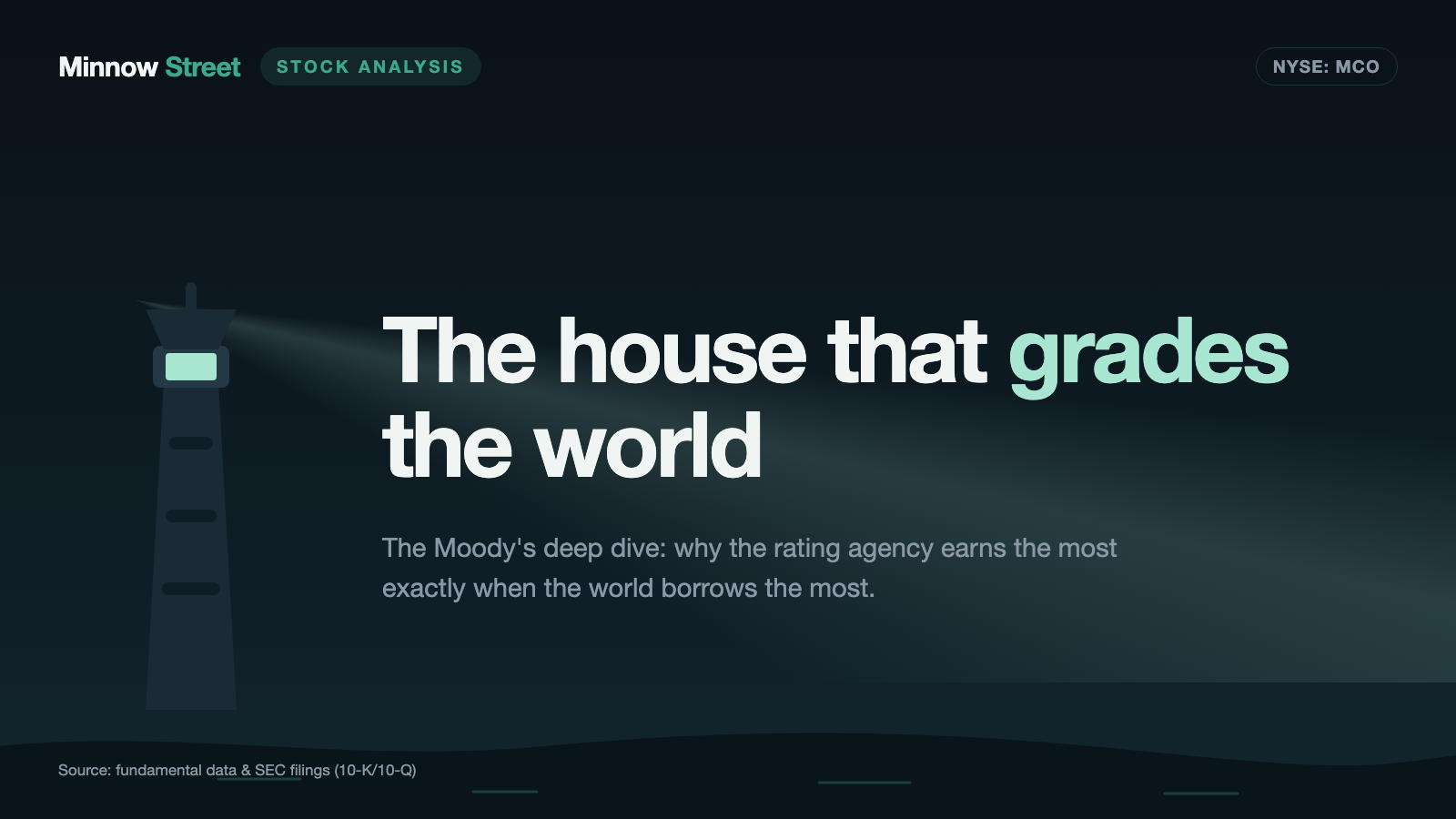
Moody's assigns the grades that half the bond market runs on. In fiscal 2025 that produced $7.718 billion in revenue and $2.459 billion in profit; in the second quarter of 2026 revenue climbed 15 percent, driven by bonds that finance data centers for artificial intelligence. At the same time shareholders' equity shrank by a quarter in six months, because $2.165 billion went into the company's own shares. We read the annual report and the quarterly report filed on July 23, 2026 — and found a company that writes its own dependence on issuance volume straight into its risk factors. No recommendation — just the question of what a grade is worth when the graded party pays for it.
 Thomas Mücke
Founder & Publisher
Thomas Mücke
Founder & Publisher
Chart
Interactive price chart (TradingView).
Note: pure fact-based analysis, not investment advice and not a solicitation to buy or sell. All figures without guarantee.
The authority trap: why we believe grades we have never checked
There is a convenience wired into all of us: when someone with authority hands out a grade, we stop checking. An "Aa2" on a bond feels like a stamp from a government office. We rarely know who assigned it, under which rules — and almost never who paid for it.
As a rule, the borrower paid for it. Anyone issuing a bond orders the rating along with it, because without a rating hardly anyone buys. That is no secret; it is written into every annual report of the company we are looking at here.
Moody's Corporation is one of the two big rating agencies in the world. It is also a stock that landed on our desk — through a screen for crashed shares, of all things. So we do what we always do: read the primary filings and run the numbers. Even when the answer is uncomfortable, and even when the list that delivered the stock turns out to need an explanation of its own.
What this analysis covers
- Two companies in one: grades and subscriptions
- How the stock reached our desk — and what is wrong with the list
- The numbers over the years
- Uncomfortable truth no. 1: the engine runs on issuance volume
- Uncomfortable truth no. 2: the equity is being bought away
- Uncomfortable truth no. 3: one fifth of the quarterly profit is borrowed
- Uncomfortable truth no. 4: Gen AI is product and attacker at once
- What the stock costs
- Opportunities and risks at a glance
- A human conclusion
- Sources
Two companies in one: grades and subscriptions
Moody's consists of two halves that could hardly be more different.
Moody's Investors Service — MIS in the filings — assigns the credit ratings. A company, a government or a securitization vehicle wants to raise money in the bond market and orders a rating for it. That is piecework: no bond, no fee. In fiscal 2025 this half produced $4.119 billion of external revenue. Its adjusted segment margin ran at 63.6 percent — of every ten dollars taken in, more than six were left.
Moody's Analytics — MA — sells what grows out of the ratings and the data around them: research, databases, risk models, software for banks and insurers, anti-money-laundering tools. That is subscription business, predictable and recurring. In fiscal 2025 it brought in $3.599 billion of external revenue, and annualized recurring revenue stood at $3.498 billion as of December 31, 2025, up 8 percent.
The idea behind the pairing is easy to grasp: ratings earn spectacularly but swing with the capital market. Subscriptions earn less spectacularly but do so every month. Together they are supposed to produce a business that catches the good years and survives the bad ones.
As of December 31, 2025 the group employed 16,076 people, including roughly 2,000 at majority-owned rating affiliates. Headquarters is 7 World Trade Center in New York. One detail for filing enthusiasts: the registrant behind SEC identification number 0001059556 was called "Dun & Bradstreet Corp" until February 2000. Today's Moody's Corporation is the renamed shell that remained when the data business was spun off in 2000.
How the stock reached our desk — and what is wrong with the list
The trigger was our in-house stock scanner. On July 25, 2026 Moody's sat at rank 22 of 62 U.S. hits in the list Turnaround-Kandidaten, with a turnaround check of 6 out of 8 points. The lists are recalculated daily; ranking and score are a snapshot, not a permanent state.
That list has two mandatory items, both of which must be met before anything is counted at all:
- Pillar 1 — the crash: the stock must trade at least 50 percent below its all-time high. No crash, no turnaround.
- Pillar 2 — survival: the Altman Z score must be at least 1.1. That score bundles five balance-sheet ratios into a single number and estimates how far a company is from insolvency — below 1.1 it counts as distressed. On top of that: no more than one balance-sheet warning flag, and positive equity.
Moody's clears pillar 2 by a wide margin: its Altman Z stood at 7.17 and interest coverage at 18.3 (data as of July 26, 2026). Nothing distressed about it.
Pillar 1 is the part that needs explaining, and we write it down rather than hide it. In our data set the distance to the all-time high for this stock reads minus 84.4 percent. The price history of the same stock says something else: the highest price ever traded was $546.88 on January 15, 2026 (closing at $539.61 that day), against a closing price of $471.50 on July 24, 2026. That is roughly 14 percent below, not 84.
What does that mean for you? Moody's is in this list because a metric claims a crash, not because the stock crashed. A scanner calculates; it does not judge. That is precisely why a list is where research starts and never where it ends. We take the hit as a reason to look at the company. What we find decides the analysis — not a rank on a list.
One more thing belongs to honesty here. A turnaround check of 6 out of 8 has no buffer, because 6 is the minimum score. Two of the eight points hang directly on the price — "trading above the 50-day line" and "three-month relative strength better than twelve-month". The 50-day line stood at roughly $463 on July 26, 2026. If the price slips below it, one point disappears, the check falls to 5 out of 8 — and the stock drops out of the list at the next recalculation. Anyone buying a stock because of a scanner rank is buying something that can dissolve overnight.
The numbers over the years
Start with what genuinely impresses. Moody's makes money at a level that would be unimaginable in most industries.
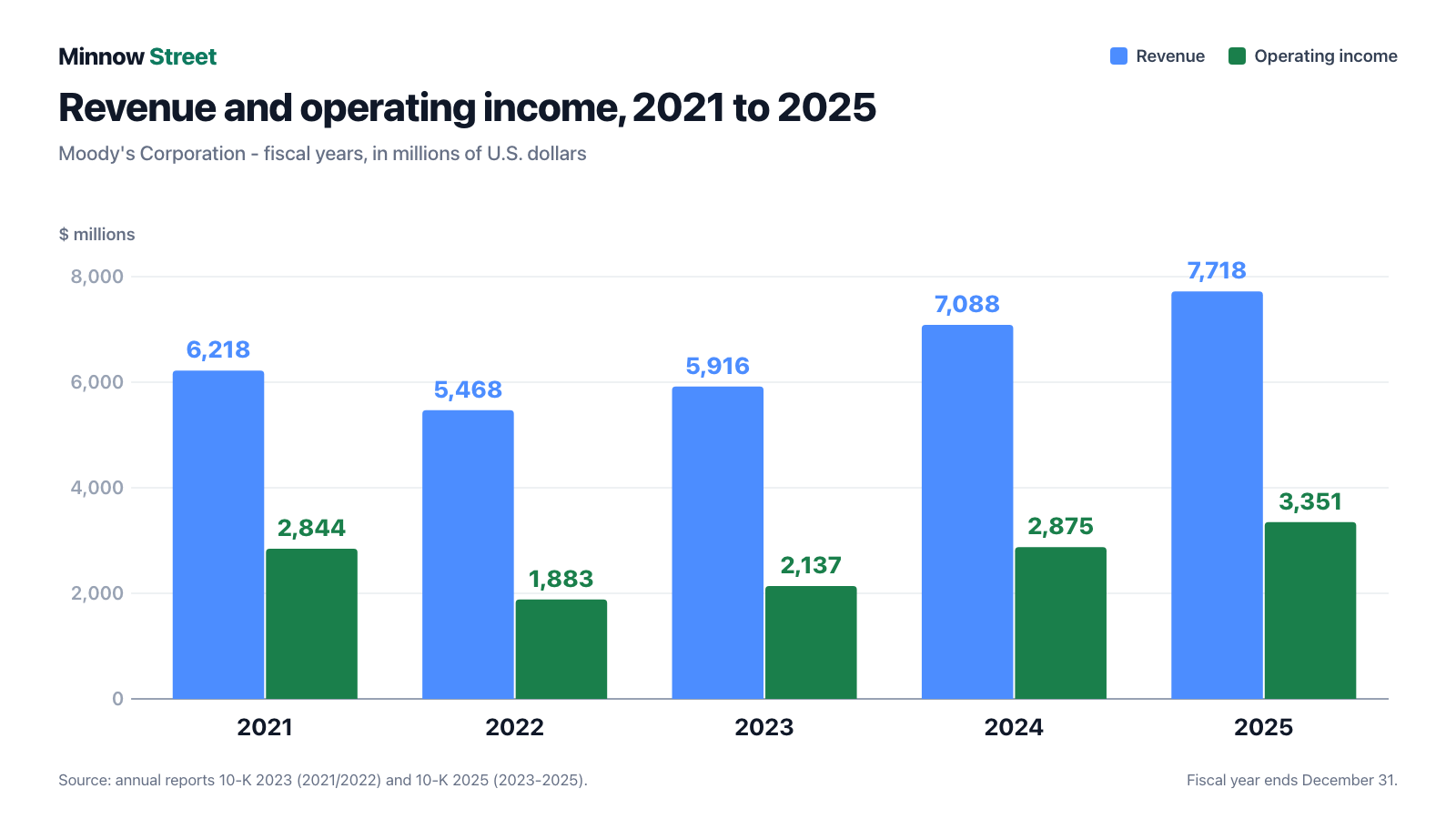
In fiscal 2025 the group booked $7.718 billion of revenue and turned it into $3.351 billion of operating income — a margin of 43.4 percent. After interest and taxes, $2.459 billion of net income was left, or $13.67 per diluted share. For comparison: 2024 delivered $7.088 billion of revenue, $2.875 billion of operating income and $2.058 billion of profit; 2023 delivered $5.916 billion of revenue, $2.137 billion of operating income and $1.607 billion of profit.
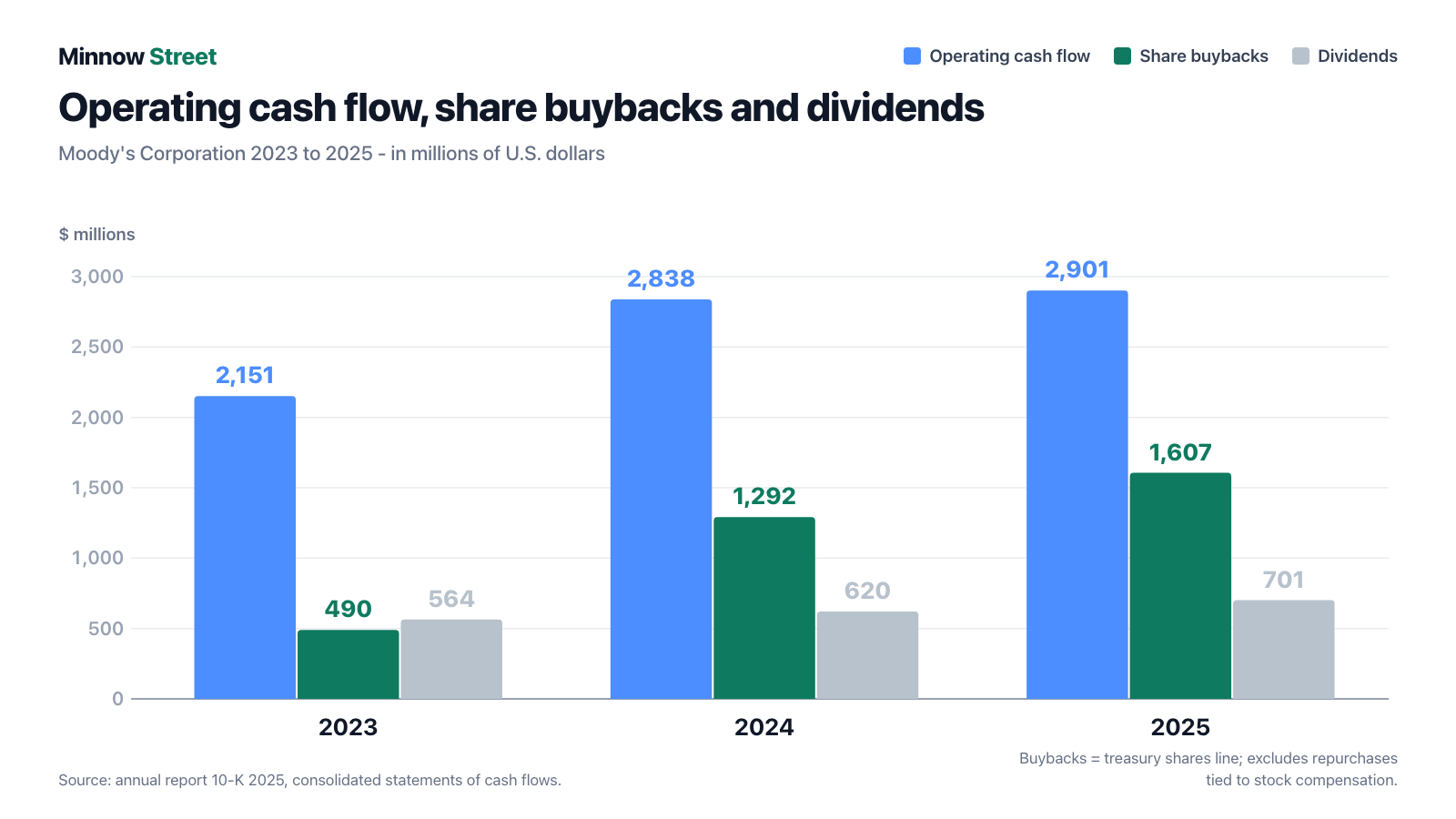
Operating cash flow — the money that actually arrives — came to $2.901 billion in 2025, after $2.838 billion in 2024 and $2.151 billion in 2023. After $326 million of capital additions in 2025, roughly $2.575 billion remained free. That is more than reported profit. A good sign: the earnings are backed by cash, not by entries.
The first half of 2026 continued the trend: $4.264 billion of revenue (after $3.822 billion), $1.539 billion of net income (after $1.203 billion), and $1.718 billion of operating cash flow (after $1.300 billion). In the second quarter alone, revenue rose 15 percent to $2.185 billion and the operating margin went from 43.1 to 47.9 percent.
Rule of thumb: a 43 percent margin means 43 cents of every dollar taken in survive to the operating line. A well-run industrial company keeps 10 to 15. This company has a moat you cannot argue away.
And now the part that appears in no brochure.
Uncomfortable truth no. 1: the engine runs on issuance volume
The most profitable half of this company earns per bond. No bond, no fee. Moody's writes that into its own risk factors:
"A majority of Moody’s credit-rating-based revenue is transaction-based, and therefore it is especially dependent on the number and dollar volume of debt securities issued in the capital markets."
— Moody's Corporation, SEC annual report on Form 10-K for 2025, Risk Factors

What that feels like was demonstrated in 2022. Central banks raised rates, companies postponed their bonds, and at Moody's what looks like a law of nature in good years simply broke:
- Revenue: from $6.218 billion to $5.468 billion — down 12.1 percent
- Operating income: from $2.844 billion to $1.883 billion — down 33.8 percent
- Net income: from $2.214 billion to $1.374 billion — down 37.9 percent
A 12 percent revenue decline cost a third of operating income. That is the price of high fixed costs: analysts, methodology and regulatory obligations keep running whether or not a bond arrives.
Now the current surge. In the second quarter of 2026 ratings revenue rose 25 percent to $1.260 billion. The quarterly report names the reasons: heavy corporate finance issuance, plenty of U.S. leveraged finance — and, verbatim, "investment-grade issuance related to continued AI-related financing by hyperscalers", meaning high-grade bonds with which the large cloud providers fund their AI spending. Add project and infrastructure finance around data centers.
What does that mean for you? A meaningful share of the current record growth hangs on an investment cycle that will end at some point. Nobody knows when. But buying this stock means buying the assumption that the world keeps borrowing at this pace. The year 2022 showed how fast that assumption collapses. If you want to see what a data business looks like without that lever, our FactSet analysis is the counter-example: a financial data house living almost entirely on subscriptions — with far calmer, but also far flatter, numbers.
Uncomfortable truth no. 2: the equity is being bought away
Anyone seeing Moody's balance sheet for the first time pauses. As of June 30, 2026 it shows:
- Total assets: $14.675 billion
- Equity attributable to Moody's shareholders: $3.025 billion — roughly 21 percent of assets
- Debt: $6.946 billion ($571 million current, $6.375 billion long-term)
- Goodwill from acquisitions: $6.318 billion, plus $1.749 billion of other intangibles
- Cash: $1.467 billion, down from $2.384 billion six months earlier
Goodwill alone is more than twice the entire equity base. Strip out goodwill and intangibles and there is no tangible equity left at all, only a negative number. At a company with thin earning power that would be an alarm. Here it is something else: the result of a deliberate decision.
This equity was not burned — it was repurchased. In the first half of 2026, $2.165 billion went into treasury shares. In the year-earlier period it was $657 million. That is a tripling of the pace. In parallel, $365 million of dividends were paid. Equity fell from $4.054 billion on December 31, 2025 to $3.025 billion on June 30, 2026 — a quarter gone in six months.
The trend has been building for years. The statement of cash flows shows buybacks (the treasury shares line) of $490 million in 2023, $1.292 billion in 2024 and $1.607 billion in 2025; dividends over the same period rose from $564 million through $620 million to $701 million. Operating cash flow grew from $2.151 billion to $2.901 billion across those three years — buybacks grew three times as fast.
The framework for it sits in the quarterly report, in a single sentence:
"On October 21, 2025, the Board approved $4.0 billion in share repurchase authority. At June 30, 2026, the Company had approximately $1.8 billion of remaining authority under this authorization."
— Moody's Corporation, SEC quarterly report on Form 10-Q as of June 30, 2026

On July 22, 2026 Moody's did not cut its full-year repurchase guidance but raised it — from roughly $2.5 billion to up to $3.0 billion.
The effect is measurable: the diluted share count in the second quarter of 2026 was 174.5 million, against 180.2 million a year earlier. Roughly 3.2 percent of all shares vanished within twelve months. Do nothing and you automatically own a larger slice of the same company. That is the point of the exercise.
What does that mean for you? Thin equity at a company with a 43 percent margin and 18 times interest coverage is not a solvency question. But it is not a cushion either. Should a year like 2022 arrive — with a third less operating income — there would be less room than before. And: repurchasing your own equity around $470 a share means betting shareholders' money that the stock is worth it. That bet is not free just because a company makes it instead of a person.
Uncomfortable truth no. 3: one fifth of the quarterly profit is borrowed
The headline for the second quarter of 2026 read: earnings per share up 57 percent. That is correct — and it tells only half the story.
Reported net income came to $878 million, against $578 million in the year-earlier quarter. Inside it sits an item with nothing to do with the operating business: a pre-tax gain of $179 million on the sale of the MA Regulatory Solutions business. Strip that out along with other one-off effects and adjusted diluted earnings per share rose 31 percent to $4.68 — rather than 57 percent to $5.03.
Thirty-one percent is still a very strong quarter. But the difference between 57 and 31 is exactly the kind of detail that sticks in your head if you only read the headline.
A second item never made a headline at all:
"As of June 30, 2026, the transaction agreement provides for up to $119 million of remaining contingent consideration, payable upon the achievement of certain post-closing conditions in the second half of 2026."
— Moody's Corporation, SEC quarterly report on Form 10-Q as of June 30, 2026, "Gain on business divestitures"

The sale is part of a larger rebuild. On December 19, 2024 an efficiency program began, and its scope was expanded in July 2026. It targets annualized savings of $300 million to $350 million, costs $285 million to $330 million pre-tax in one-off charges, and is expected to be substantially complete by the end of 2027. It covers headcount reductions, exits from leased office space, the retirement of legacy software — and, indeed, divestitures.
What does that mean for you? Rebuilds like this make figures hard to compare for a year or two. External revenue in the analytics segment grew only 4 percent in the second quarter of 2026 — but organic constant currency recurring revenue grew 9 percent. The difference is the divested units. Miss that distinction and you mistake a segment being tidied up for a segment going soft.
Uncomfortable truth no. 4: Gen AI is product and attacker at once
In the same annual report, generative artificial intelligence appears in two places — once as a growth promise, once as a threat.
As a promise it sounds like this: Moody's describes itself as an early adopter of generative and agentic AI, lists corresponding products in its growth strategy, and sees an advantage in its own curated data. That is plausible — a house that has collected credit data for decades holds something a language model cannot generate on its own.
As a threat it sounds like this:
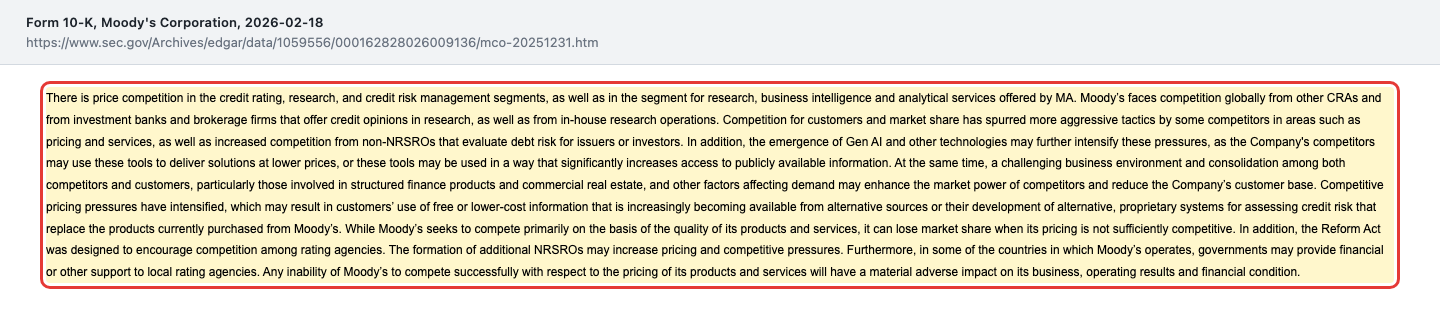
"In addition, the emergence of Gen AI and other technologies may further intensify these pressures, as the Company's competitors may use these tools to deliver solutions at lower prices, or these tools may be used in a way that significantly increases access to publicly available information."
— Moody's Corporation, SEC annual report on Form 10-K for 2025, competition risk factor
The sore point is not the ratings — those are regulated and hard to attack. Moody's Investors Service is registered as a nationally recognized statistical rating organization, an NRSRO, with the U.S. securities regulator, the SEC, and subject to its oversight; in the European Union it is supervised by ESMA, in the United Kingdom by the FCA. Anyone who wants to assign grades that count for regulatory purposes needs those registrations. It is a moat made of paper, and a very effective one.
The sore point is the analytics segment. Research, data preparation, models — these are products whose value rests on preparation being hard. If language models make preparation cheaper, the price you can charge for it falls.
There is a second layer that rarely gets mentioned: Moody's earns from AI without selling AI. The data centers the hyperscalers are building are financed in substantial part with bonds — and every one of those bonds needs a grade. The quarterly report names exactly that as a driver of ratings growth in the second quarter of 2026. What is a capital spending wave for the chip industry is an issuance wave for Moody's. For a look at how narrowly a data business can grow without that lever, our Q2 Holdings analysis describes the same customer base without the rating fees on top.
What the stock costs
No daily prices as an argument here — orders of magnitude with a date attached.
At roughly $81.7 billion of market capitalization (173.2 million shares as of June 30, 2026, closing price of $471.50 on July 24, 2026), the market pays:
- about 30 times trailing twelve-month earnings per share
- about 10 times revenue
- about 20 times EBITDA, measured on enterprise value
Against the company's own guidance of July 22, 2026 — adjusted diluted earnings per share of $16.50 to $17.00 for 2026 — that works out to roughly 28 times. No bargain, and rarely one. For a duopoly with a 43 percent margin it is not absurd either.
A book-value comparison misleads here. The nominal price-to-book ratio runs at about 27 — but only because equity has almost disappeared into buybacks. At Moody's this metric measures repurchase history, not substance.
The professional view: twenty-three analyst estimates average a target price of roughly $556, with 12 strong buy ratings, 4 buys, 7 holds and no sell (data as of July 26, 2026). Worth remembering: target prices are twelve-month estimates, not promises, and they follow the price more often than they lead it.
Opportunities and risks at a glance
Opportunities
- A duopoly with regulatory protection. Assigning ratings that count for regulatory purposes requires registrations with the SEC, ESMA and the FCA. New entrants do not appear overnight.
- Software-level margins. A 43.4 percent group operating margin and a 63.6 percent adjusted segment margin in ratings (fiscal 2025).
- The profit is cash. $2.901 billion of operating cash flow against $2.459 billion of reported net income in fiscal 2025 — roughly $2.575 billion free after capital additions.
- The share count is measurably shrinking. Diluted shares of 174.5 million in the second quarter of 2026, down from 180.2 million a year earlier — a 3.2 percent reduction.
- AI cuts both ways in its favor. Its own generative and agentic AI products on one side, rating fees on the bonds financing data centers on the other.
- An efficiency program with a number attached. Targeted annualized savings of $300 million to $350 million by the end of 2027.
Risks
- The issuance cycle. A majority of rating revenue is transaction-based — the annual report says so itself. In 2022 a 12.1 percent revenue decline cost a third of operating income.
- AI dependence inside the growth. The second-quarter 2026 surge comes in visible part from bonds financing data centers. When the investment cycle ends, that driver goes with it.
- Thin equity. $3.025 billion as of June 30, 2026 against $6.318 billion of goodwill and $6.946 billion of debt — deliberate, but without a cushion.
- Price. Roughly 30 times earnings leaves no room for disappointment.
- Pricing pressure from generative AI in the analytics business — named verbatim in the competition risk factor of the annual report.
- Regulation and liability. The 2025 annual report explicitly flags heightened regulatory attention to ratings in the fast-growing private credit market, plus new rules for ESG ratings in the European Union and the United Kingdom.
- One-off items in earnings. A $179 million divestiture gain in the second quarter of 2026 and up to $119 million of contingent consideration still outstanding make quarter-to-quarter comparisons harder.
A human conclusion
Back to the authority trap from the opening. We looked at Moody's because a list claimed a crash that does not exist. That was the first finding — and an uncomfortable one, because the list was ours. We write it down anyway, since a metric you follow blindly is exactly the kind of authority this article warns about.
What we found is not a restructuring case but the opposite: one of the most profitable business models on any exchange. A duopoly with a regulatory doorman, a 43 percent margin, profit that arrives as cash, and a management that hands that cash back to shareholders relentlessly.
And at the same time a company with three honest weak spots. It earns the most when the world borrows the most — and the world is currently borrowing to build data centers. It has largely repurchased its own book equity, which looks clever in good years and less clever in a year like 2022. And it writes into its own risk factors that the very technology it sells as a product could depress the price of its analytics.
None of that is a reason to run. All of it is a reason to take the price seriously. Roughly 30 times earnings is what certainty costs — and certainty is the most expensive thing on any exchange.
What you make of that is your decision. And that is exactly as it should be.
Sources
- Moody's Corporation, quarterly report on Form 10-Q as of June 30, 2026 (filed 2026-07-23) — income statement, balance sheet, cash flows, segment figures, repurchase authorization, Note 11 on divestitures, Note 9 on the efficiency program
- Moody's Corporation, annual report on Form 10-K for 2025 (filed 2026-02-18) — business model, segment revenue, headcount, regulation, risk factors
- Moody's Corporation, annual report on Form 10-K for 2023 (filed 2024-02-14) — comparative figures for fiscal 2021 and 2022
- Moody's Corporation, second-quarter 2026 earnings release (Form 8-K of 2026-07-22, Item 2.02) — key figures and full-year 2026 guidance
- SEC EDGAR — all filings for CIK 0001059556
- Fundamental data (metrics, price history, analyst estimates; data as of July 24 to 26, 2026)
- In-house stock scanner, list Turnaround-Kandidaten, as of July 25, 2026
This analysis is journalism and editorial context, not investment advice. It is neither an offer nor a solicitation to buy or sell securities. Stocks can lose substantial value at any time, up to and including the total loss of the capital invested. All figures come from the primary sources named above and carry the reporting dates stated there; they may have changed since. The author held no position in the stock discussed at the time of publication.
Our Bottom Line at a Glance
- Business model and earning power positive
- Two rating agencies share most of the global market, and Moody's is one of them. That shows up in numbers few industries ever see: a 43.4 percent operating margin in fiscal 2025 ($3.351 billion on $7.718 billion of revenue), and a 63.6 percent adjusted segment margin in ratings alone. In the second quarter of 2026 revenue rose 15 percent to $2.185 billion and the operating margin went from 43.1 to 47.9 percent.
- Dependence on issuance volume negative
- The 2025 annual report itself states that a majority of rating-based revenue is transaction-based. The year 2022 showed what that means: revenue fell from $6.218 billion to $5.468 billion (down 12.1 percent), operating income from $2.844 billion to $1.883 billion (down 33.8 percent) and net income from $2.214 billion to $1.374 billion. The current surge in the second quarter of 2026 comes in visible part from bonds financing AI data centers — demand nobody can guarantee for a decade.
- Balance sheet and capital returns neutral
- As of June 30, 2026, $3.025 billion of equity stands against $14.675 billion of total assets, $6.946 billion of debt and $6.318 billion of goodwill. That is policy, not accident: $2.165 billion went into treasury shares in six months, three times the year-earlier figure, and cash fell from $2.384 billion to $1.467 billion. Interest coverage of 18.3 and an Altman Z of 7.17 (data as of 2026-07-26) show this is not a solvency question — but the cushion for a bad year is thinner than it used to be.
- Quality of the quarterly result neutral
- Of the $878 million in net income for the second quarter of 2026, $179 million came from the sale of MA Regulatory Solutions. Reported diluted earnings per share rose 57 percent, the adjusted figure 31 percent — both are strong, but only the second one describes the operating business. Up to $119 million of contingent consideration from the same sale is still outstanding for the second half of 2026, per the quarterly report.
- Growth in the subscription segment neutral
- Moody's Analytics is meant to be the calm counterweight to the issuance cycle, but it grows more slowly than ratings: external revenue of $925 million in the second quarter of 2026 was up 4 percent, while ratings gained 25 percent. On an organic constant currency basis, recurring revenue grew 9 percent, and annualized recurring revenue stood at $3.498 billion as of December 31, 2025 (up 8 percent). The gap is explained by divested units — the segment is being reshaped right now.
- Valuation and market picture neutral
- Roughly $81.7 billion of market capitalization (173.2 million shares, closing price of $471.50 on July 24, 2026) equals about 30 times trailing earnings per share and about 10 times revenue — a price that assumes quality and forgives nothing. Twenty-three analyst estimates average a target price of roughly $556 (12 strong buy, 4 buy, 7 hold, no sell; data as of 2026-07-26). A book-value comparison does not help here: it would only measure how many shares have already been repurchased.
Moody's is an exceptionally profitable company in a market shared by two houses: $7.718 billion of revenue and a 43.4 percent operating margin in fiscal 2025, $2.901 billion of operating cash flow, and a 15 percent revenue gain in the second quarter of 2026. That very strength carries a price the ticker does not show: earnings hang on issuance volume — the annual report says so itself — the current surge comes in part from bonds financing AI data centers, and book equity shrank by a quarter in six months as $2.165 billion went into the company's own shares. Buying here means buying a very good business at a price that assumes a very good business. Not investment advice.
What Our Rating Means
Quality confirmed
Business model, numbers and balance sheet hold up to our review. Whether the current price supports an entry is a separate question — it hangs on the price, not on the company.
The quality of this company is documented: the business model has held for decades, the operating margin runs at 43.4 percent, profit is backed by cash ($2.901 billion of operating cash flow against $2.459 billion of reported net income in fiscal 2025), interest coverage stands at 18.3 and the Altman Z at 7.17. The thin book equity of $3.025 billion as of June 30, 2026 is the result of buybacks, not of losses — the balance sheet is lean by choice, not impaired. What remains open is a cycle question, not a substance question: ratings hang on issuance volume, and 2022 showed how fast that can turn. The stock is expensive on top of that — a price argument, which does not change the color of this light. The decision is yours.
A journalistic assessment by our editorial team at the time of the deep dive, based on public sources — not investment advice and not a solicitation to buy or sell. Your personal circumstances (investment goals, risk capacity, taxes) cannot be taken into account. What our levels mean, how verdicts are formed, and what conflicts of interest exist →
Worth Noting
- Hook: in-house stock scanner "Turnaround-Kandidaten", rank 22 of 62 U.S. hits, turnaround check 6 of 8, as of July 25, 2026. The lists are recalculated daily; ranking and score are a snapshot.
- Disclosed data finding: the mandatory pillar "at least 50 percent below the all-time high" carries a distance of 84.4 percent in our data set. The price history of the same stock shows a highest traded price of $546.88 on January 15, 2026 against $471.50 on July 24, 2026 — roughly 14 percent below. The entry in the list therefore rests on a value the price history does not confirm.
- Data as of: annual report 10-K for 2025 filed 2026-02-18, annual report 10-K for 2023 filed 2024-02-14 (supplies 2021 and 2022), quarterly report 10-Q as of 2026-06-30 filed 2026-07-23, Form 8-K of 2026-07-22; metrics and price history July 24 to 26, 2026.
- Possible confusion: the registrant behind CIK 0001059556 was named "Dun & Bradstreet Corp /DE/" until February 2000. Moody's Corporation is the renamed shell left after the data business was spun off; the former names still appear in SEC company records.
- Do not confuse: the credit ratings assigned by Moody's Investors Service are opinions about borrowers, not statements about Moody's stock. And the traffic light in this analysis judges the company, not the entry point.
Frequently Asked Questions
Moody's is two businesses. Moody's Investors Service assigns credit ratings to bonds, governments and companies — and as a rule the borrower who needs the rating pays for it. Moody's Analytics sells data, risk models and software on subscription. In fiscal 2025, $4.119 billion of revenue came from ratings and $3.599 billion from analytics.
Because a scanner calculates, it does not judge. The list requires two mandatory items: at least 50 percent below the all-time high, and survival secured (Altman Z of at least 1.1, positive equity). Moody's clears the second easily. The first rests on a distance value of 84.4 percent in our data set that the stock's own price history does not confirm. We say so in the article.
Issuance volume. The 2025 annual report states verbatim that a majority of credit-rating-based revenue is transaction-based and therefore especially dependent on the number and dollar volume of debt securities issued. How hard that bites showed in 2022: revenue down 12.1 percent and operating income down 33.8 percent versus 2021, as issuance stalled with rising rates.
Because it is being bought back on purpose. As of June 30, 2026 shareholders' equity of $3.025 billion stood against total assets of $14.675 billion — down from $4.054 billion six months earlier. In those six months $2.165 billion went into the company's own shares. Goodwill from acquisitions, at $6.318 billion, exceeds twice the equity base.
Partly. Revenue did rise 15 percent to $2.185 billion and the operating margin went from 43.1 to 47.9 percent. But of the $878 million in net income, $179 million came from the sale of the MA Regulatory Solutions business. Adjusted diluted earnings per share therefore rose only 31 percent, to $4.68, while the reported figure rose 57 percent, to $5.03.
In two ways. First, the company sells products built on generative and agentic AI and calls itself an early adopter in its 2025 annual report. Second, the ratings segment earns from data centers being financed with bonds: the quarterly report as of June 30, 2026 names AI-related financing by large cloud providers explicitly as a growth driver.
Regulation is the frame the business sits in. Moody's Investors Service is registered as an NRSRO with the U.S. securities regulator, the SEC, and subject to its oversight; in the European Union it is supervised by ESMA, in the United Kingdom by the FCA. The 2025 annual report also flags the EU regulation on ESG rating activities, applicable from July 2026, and the EU AI Act.
In fiscal 2025, $1.607 billion went into share buybacks and $701 million into dividends — $2.308 billion together, against $2.901 billion of operating cash flow. The first half of 2026 added $2.165 billion of buybacks and $365 million of dividends. Guidance issued on July 22, 2026 puts full-year repurchases at up to $3.0 billion.
Found an error?
Did you spot a factual error, an outdated number, or a typo in this deep dive? Let us know briefly — your report goes straight to the editorial team.