Carnival: Record Revenue, Lower Operating Income — and $18.5 Billion of New Ships
Carnival has cut $9.5 billion of debt since the peak, pays a dividend again and buys back its own shares. In the quarter ended May 31, 2026 revenue reached $6.66 billion — yet reported operating income fell from $934 million to $851 million. At the same time, commitments for new ships climbed from $11.9 billion to $18.5 billion in six months, and the fleet has been depreciated over 35 instead of 30 years since December 2025. We read the quarterly report, the annual report and the filing on the move to Bermuda. Not a recommendation — just the arithmetic behind the record headline.
 Thomas Mücke
Founder & Publisher
Thomas Mücke
Founder & Publisher
Chart
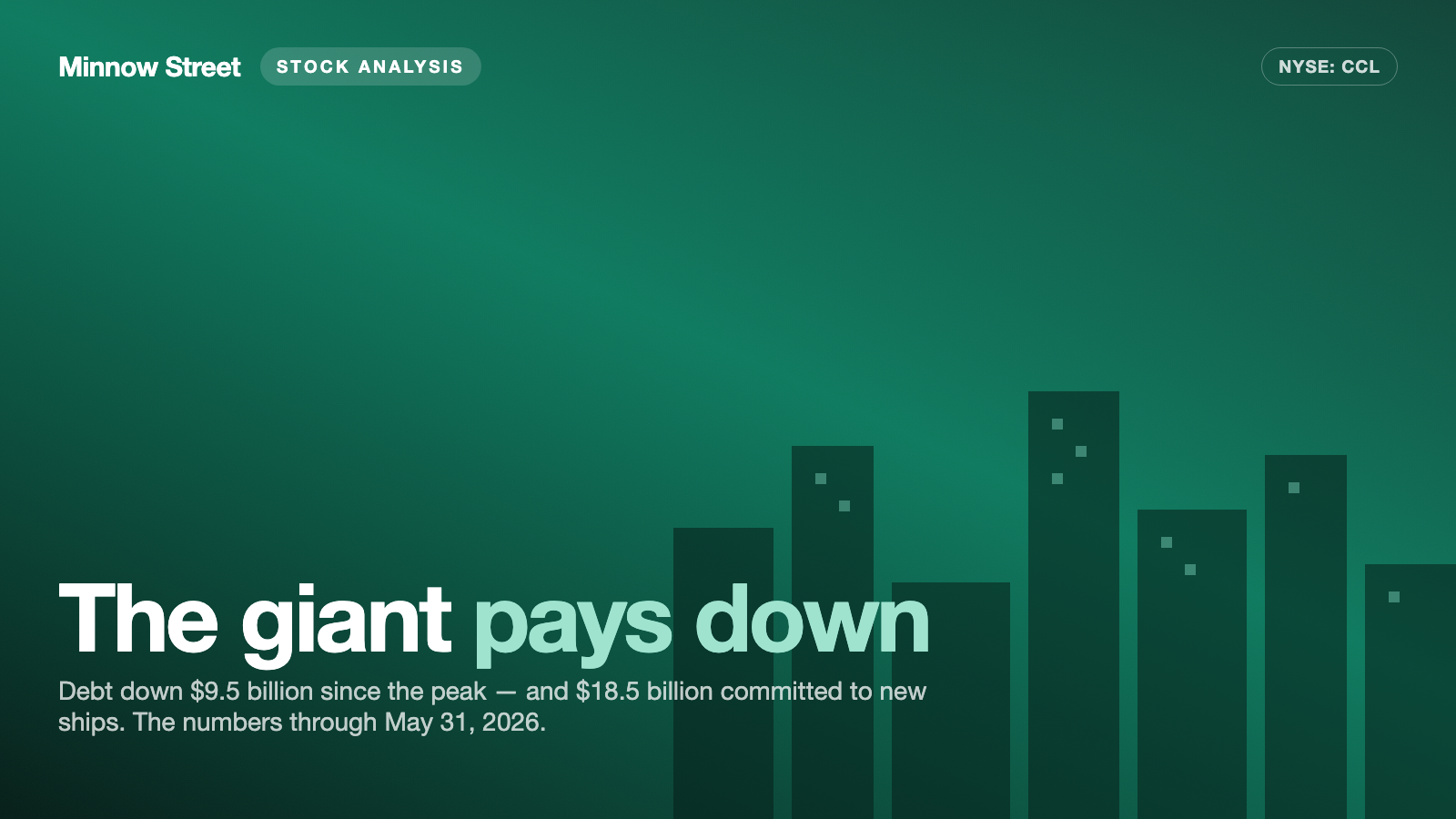
Interactive price chart (TradingView).
Note: pure fact-based analysis, not investment advice and not a solicitation to buy or sell. All figures without guarantee.
There is an investor trap that arrives dressed as good news: the headline trap. It works like this. A company reports a record, and your brain stops doing arithmetic — a record is a record, after all. On June 23, 2026 the headline above Carnival's earnings release read, word for word, "RECORD SECOND QUARTER REVENUES, NET YIELDS AND ADJUSTED NET INCOME". All of it is true. The same quarterly report also shows that reported operating income fell from $934 million to $851 million. Both at once. So let us make a deal: before we allow ourselves an opinion, we read together what Carnival Corporation Ltd. (NYSE: CCL) filed with the U.S. securities regulator, the SEC — the quarterly report (10-Q) for the quarter ended May 31, 2026, the annual report (10-K) for fiscal 2025 and the current report (8-K) dated May 7, 2026. An SEC filing is honest under penalty of law. And these tell of $9.5 billion of debt repaid, $18.5 billion of new ships committed, vessels that are supposed to last five years longer since December 2025 — and a company that moved its place of incorporation from Panama to Bermuda in May 2026 without anyone buying it.
What this analysis covers
- What Carnival actually does — and why guests pay in advance
- How the stock landed on our desk
- Bermuda, CUK and a DEFM14A — what really happened on May 7, 2026
- The numbers across the years — what genuinely impresses
- What the filings say — five uncomfortable truths
- Valuation — what the market pays for this comeback
- Opportunities and risks at a glance
- A human conclusion
- Sources
What Carnival actually does — and why guests pay in advance
Carnival runs hotels that float. Eight brands, each aimed at a different audience: Carnival Cruise Line for families and value seekers, AIDA Cruises for the German market, Costa Cruises for southern Europe, P&O Cruises for the United Kingdom, plus Princess Cruises, Holland America Line, Cunard and the luxury brand Seabourn. The Australian brand P&O Cruises (Australia) was sunset in 2025 and folded into Carnival Cruise Line.
The scale: as of December 31, 2025 the annual report puts passenger capacity at 272,460 berths against a global industry capacity of 764,310. That is roughly 36 percent of every cruise berth on the planet. More than 160,000 people from about 150 countries work for the company, and more than 13.5 million guests board its ships each year.
Two revenue streams, cleanly separated in the filings: the ticket (fiscal 2025: $17,419 million) and everything added on board — drinks, shore excursions, casino, internet, spa ($9,202 million). In the quarter ended May 31, 2026 the onboard side grew 7.4 percent, well ahead of the ticket at 4.1 percent. That matters, because onboard revenue carries a better margin: the guest is already there and the ship is sailing anyway.
The real business model, though, hides in the balance sheet. Guests book far ahead and pay a deposit — that money sits as a customer deposit on the liability side until the voyage happens. On May 31, 2026 it amounted to $9.0 billion (November 30, 2025: $7.2 billion), an all-time high. Carnival works with its customers' money before it delivers the service. The price of that model is a structural working capital deficit of $8.9 billion — current liabilities exceed current assets by that amount. For a travel operator this is normal; for a factory it would be an alarm bell. Remember: where customers prepay, a healthy balance sheet looks sick at first glance.
How the stock landed on our desk
We run roughly 3,500 stocks through our scanners every day. Carnival reached the research list through our in-house stock scanner "turnaround candidates": rank 24 of 62 US hits, turnaround check 6 of 8, as of July 25, 2026. To reproduce it: open the scanner, set the country filter to "US", sort by the turnaround check column. These lists are recalculated daily — the rank and the score are a dated snapshot, not a permanent state.
The scanner works in two stages. First, two mandatory pillars nobody can bypass:
- Pillar 1 — the crash: the stock must trade at least 50 percent below its all-time high. No real crash, no turnaround. Carnival's highest closing price is $71.94, set on January 29, 2018; on July 24, 2026 the stock closed at $26.33 — roughly 63 percent below. The pillar is comfortably met, but it has an edge: should the price rise above about $36, the gap narrows to less than 50 percent and Carnival drops off this list without anything changing in the business.
- Pillar 2 — survival: the Altman Z-score, a bankruptcy early-warning measure built from several balance sheet ratios, must be at least 1.1; below that the distress zone begins. Add no more than one balance sheet warning flag and positive equity. Carnival stands at 1.27 (data as of July 26, 2026). That is a pass — but with 0.17 points of headroom it is the thinnest margin we have seen in this series. For context: a genuinely healthy balance sheet reads above 3.
Only then does the turnaround check count: eight points, four from the quarterly figures (revenue direction, net margin, operating cash flow, balance sheet healing) and four from market behavior (price above the 50-day line, three-month relative strength ahead of twelve-month, net insider buying, institutional accumulation). The list displays anyone scoring at least 6 of 8 — and on July 25, 2026 Carnival scored exactly 6. That is the floor of the list, not its peak. Be honest with yourself: rank 24 of 62 with the minimum score is an invitation to research, not an exclamation mark.
If you like putting two leisure turnarounds side by side, our analysis of Vail Resorts shows the same scanner applied to a different business model — there the product is snow rather than sea miles, and the prepayments are called season passes.
Bermuda, CUK and a DEFM14A — what really happened on May 7, 2026
Anyone looking up Carnival today trips over three things that look like a takeover: a merger proxy (DEFM14A) dated February 27, 2026, a Form S-4 dated January 27, 2026, and a current report carrying the items "Completion of Acquisition or Disposition of Assets" and "Changes in Control of Registrant". It was still not a takeover. No buyer acquired Carnival.
What did happen is set out in the first paragraph of the May 7, 2026 filing:
"On May 7, 2026, Carnival Corporation and Carnival plc completed the unification of their dual listed company structure under a single company, Carnival Corporation Ltd., with Carnival plc as a UK subsidiary of Carnival Corporation Ltd. (the 'DLC Unification'). In addition, Carnival Corporation also migrated its jurisdiction of incorporation from the Republic of Panama to Bermuda and changed its name to 'Carnival Corporation Ltd.'"
— Carnival Corporation Ltd., SEC Form 8-K dated May 7, 2026, Introductory Note

In practice: holders of Carnival plc shares received one Carnival Corporation Ltd. share for each share held. The London listing was cancelled on May 7, 2026, and the American depositary shares trading under the symbol CUK were suspended from the New York Stock Exchange the same day and exchanged one for one into common shares. What remains is a single ticker: CCL. The quarterly report puts it plainly: there have been "no material changes to our business, including strategy, underlying assets and operations" following the transactions.
Three consequences matter for you as a reader. First, old CUK price series stop in May 2026 — that is not a delisting out of weakness. Second, Carnival Corporation's share count jumps optically in the filings because the former plc shares are now counted with it; economically they had long been part of the same group. Third, since May 7, 2026 the company is a Bermuda exempted company and shareholder rights follow the Bermuda Companies Act 1981. Headquarters remain in Miami.
The numbers across the years — what genuinely impresses
Let us start with what deserves real respect. In 2020 and 2021 Carnival came closer to the edge than most companies traded today. Ships stood still and revenue collapsed from $20,825 million (fiscal 2019) to $5,595 million (2020) and $1,908 million (2021) — a decline of more than 90 percent. Then it came back: $12,168 million (2022), $21,593 million (2023), $25,021 million (2024) and $26,622 million in fiscal 2025. The pre-crisis record has been beaten since fiscal 2023.
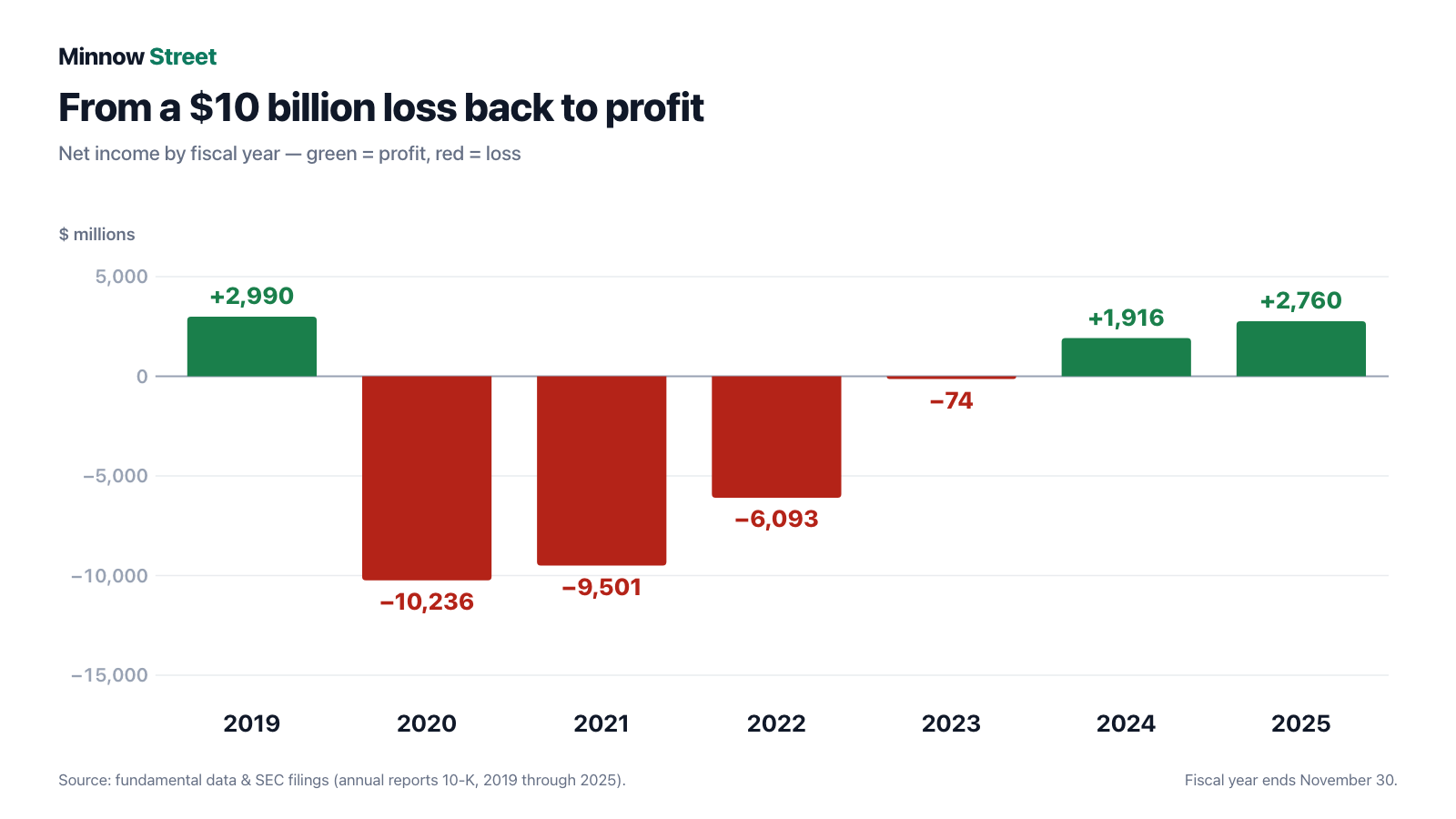
The earnings line reads even more starkly. Net income was $2,990 million in 2019, then fell to −$10,236 million (2020), −$9,501 million (2021) and −$6,093 million (2022), narrowed to −$74 million in 2023 and turned positive with $1,916 million in 2024 and $2,760 million in 2025.
Operating cash flow — the money the business actually throws off — rose from $4,281 million (2023) through $5,923 million (2024) to $6,218 million (2025). In the half year ended May 31, 2026 it reached $3,893 million after $3,317 million a year earlier. That is the basis for everything else, because this is what repays debt.
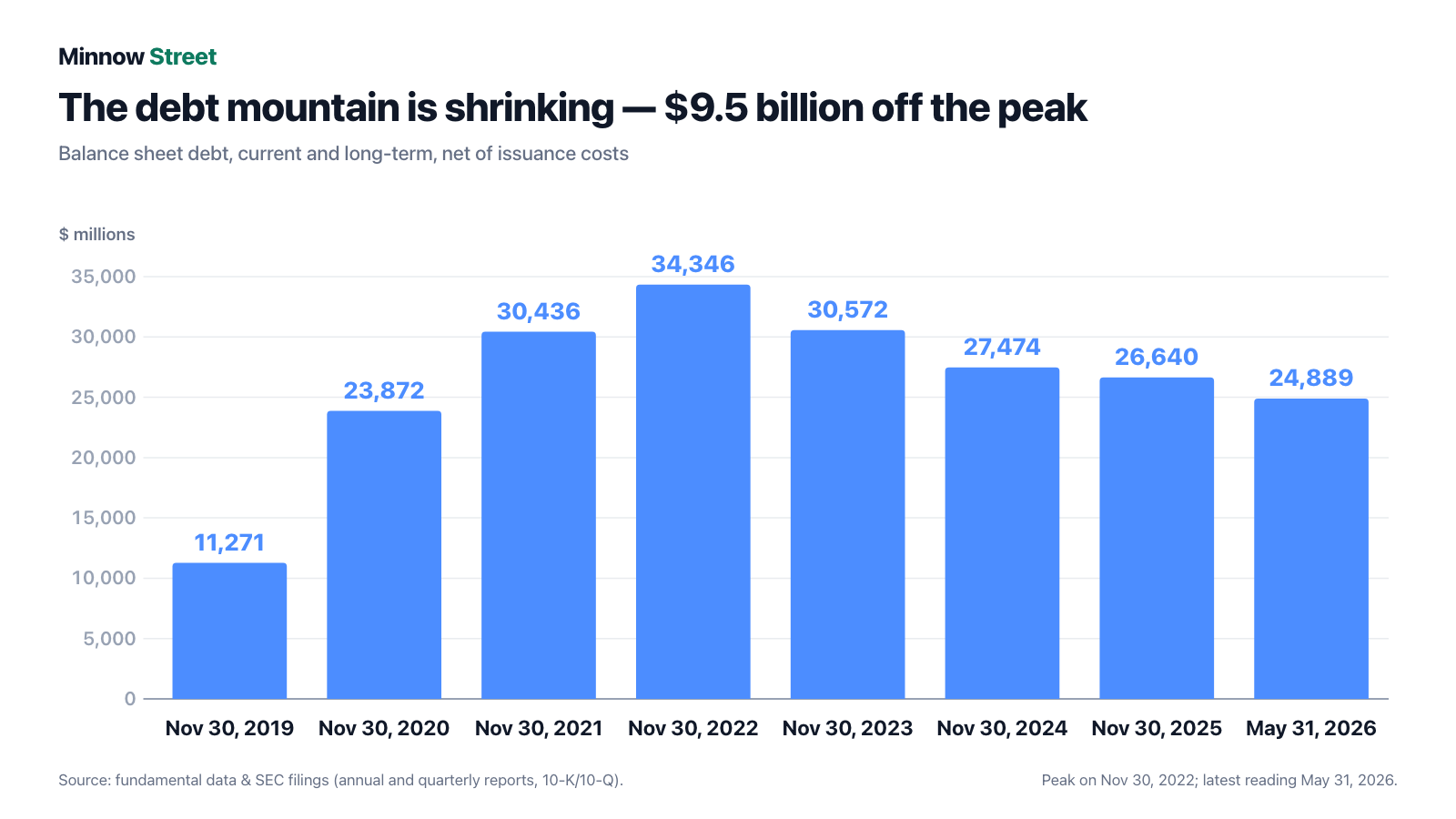
And repay it did. Balance sheet debt climbed from $11,271 million (November 30, 2019) through $23,872 million (November 30, 2020) and $30,436 million (November 30, 2021) to a peak of $34,346 million (November 30, 2022). Since then it has fallen: $30,572 million (November 30, 2023), $27,474 million (November 30, 2024), $26,640 million (November 30, 2025) and $24,889 million as of May 31, 2026.
The effect shows up in the interest line. Interest expense fell from $2,066 million (fiscal 2023) through $1,755 million (2024) to $1,349 million (2025) — and in the half year ended May 31, 2026 from $718 million to $577 million, down 20 percent. Every dollar of interest saved lands straight in profit. That is the engine behind the earnings turn: half-year operating income was essentially flat at $1,458 million against $1,477 million, yet net income still rose from $486 million to $795 million.
Demand adds to it, and it is genuinely strong. Occupancy in the quarter was 104 percent — readings above 100 mean that some cabins carried more than two guests. The company reports its twelfth consecutive quarter of record net yields and says it is 93 percent booked for the year. Since fiscal 2026 cash is flowing back to shareholders as well: $414 million of dividends and $381 million of share repurchases in the half year — both were zero in the prior-year period.
What the filings say — five uncomfortable truths
Uncomfortable truth no. 1: record revenue — and $83 million less operating income
In the quarter ended May 31, 2026 revenue rose by $335 million to $6,663 million (prior year $6,328 million). Cruise and tour operating expenses, however, rose by $339 million to $4,225 million, selling and administrative expense by $47 million to $863 million, and depreciation by $31 million to $723 million. The bottom line: $851 million of operating income after $934 million, down $83 million or 8.9 percent.
The quarterly report names the drivers itself. The two largest: $121 million of higher fuel prices and $103 million of gains from the sale of two ships that occurred a year earlier and did not repeat. The second item is a one-off — strip it out and operating income would have risen by roughly $20 million instead of falling by $83 million. Carnival's own segment measure, which excludes such items, shows $869 million of adjusted operating income after $835 million, up 4.1 percent. Both numbers are correct; only the first one sits in the statutory accounts and the second in the press release.
Fuel nevertheless remains the unsolved problem. The price per ton consumed rose from $614 to $793 (up 29 percent) and the fuel bill from $468 million to $595 million. The fleet does burn measurably less: consumption per thousand available lower berth days fell from 29.9 to 28.2 metric tons — worth $23 million. It was not enough. Company guidance for fiscal 2026 assumes $713 per ton and a fuel bill of $2.12 billion; a 10 percent move in the price shifts adjusted results for the remainder of the year by $102 million.
Uncomfortable truth no. 2: the ships have lasted five years longer since December 2025
Depreciation means a ship is paid for once but charged against profit over many years. The longer the assumed useful life, the smaller the annual charge — and the larger reported profit. Carnival turned exactly that dial:
"In December 2025, we completed such review considering the period over which we expect to operate our ships and our long-term plans. As a result, we extended our ships' depreciable lives to 35 years. … This revision did not have a material impact on our consolidated financial statements and has been applied prospectively beginning December 1, 2025."
— Carnival Corporation Ltd., SEC Form 10-Q for the quarter ended May 31, 2026, Note 1

The previous assumption was 30 years. At the same time, assumed residual values were cut — to 5 percent of original cost for LNG powered ships and salvage values under $25 million for all others. The company says the two changes offset each other. Whether they do cannot be checked from outside; the filing names no amount. What it does name is the order of magnitude elsewhere: the fiscal 2025 annual report calculates that one year less of useful life would have raised 2025 depreciation by roughly $52 million — and dropping residual values entirely by $265 million. Five extra years is therefore no footnote but a three-digit million figure that the residual value cut is meant to neutralize. In practice, depreciation in the half year ended May 31, 2026 rose from $1,346 million to $1,419 million, because the fleet is growing and currency moved in that direction. Remember: an assumption is not a number — but it sits inside every number below it.
Uncomfortable truth no. 3: while debt falls, ship commitments rise by $6.6 billion
The annual report as of November 30, 2025 puts commitments for new ships at $0.5 / $1.6 / $1.5 / $1.8 / $1.7 billion for fiscal 2026 through 2030 and $4.8 billion for everything after that — $11.9 billion in total. Six months later the filing reads:

The total therefore climbs from $11.9 billion to $18.5 billion — up $6.6 billion or 55 percent in half a year. The reason appears in the June 23, 2026 earnings release: Carnival ordered three LNG ships for Princess Cruises, with delivery in 2035, 2038 and 2039. For scale: $6.6 billion equals roughly 18 percent of the market capitalization of $36.06 billion (July 24, 2026) and about two and a half times fiscal 2025 net income.
None of this has to be bad — cruising is a capital business and new LNG ships burn less fuel. It is, however, the second half of the turnaround story, and record headlines rarely carry it: the company is repaying debt while simultaneously taking on new, very long-dated payment obligations. As of May 31, 2026 it had $10.8 billion of undrawn export credit facilities available for that purpose — but only for deliveries through 2033. The three Princess ships sit beyond that window.
Uncomfortable truth no. 4: 69.1 million new shares from a single convertible
Dilution means your slice of the pie gets smaller because new slices are issued. In December 2025 Carnival settled $1.1 billion principal amount of its 2027 convertible notes. The price: 69.1 million new shares plus a $500 million cash payment. Against the roughly 1,312 million shares outstanding net of treasury stock on November 30, 2025, that is 5.3 percent of additional stock.
Against it stands a $2.5 billion repurchase program announced in March 2026. In the quarter ended May 31, 2026 Carnival repurchased 15.1 million shares at an average of $25.85 — 3.4 million at $26.56 in April and 11.7 million at $25.65 in May. $2,110 million of the authorization remained at the reporting date. Retiring the 69.1 million convertible shares alone would take roughly $1.4 billion at the May price. That is achievable, but it is half the program — and that money then does not repay debt.
On the share count itself: the cover page of the quarterly report lists 1,369,649,119 shares as of June 19, 2026. The balance sheet as of May 31, 2026 shows 1,514 million shares issued less 142 million treasury shares, roughly 1,372 million. The optical jump versus earlier filings comes mostly from the unification with Carnival plc, not from a capital raise.
Uncomfortable truth no. 5: the climate bill doubles — and is only 70 percent live
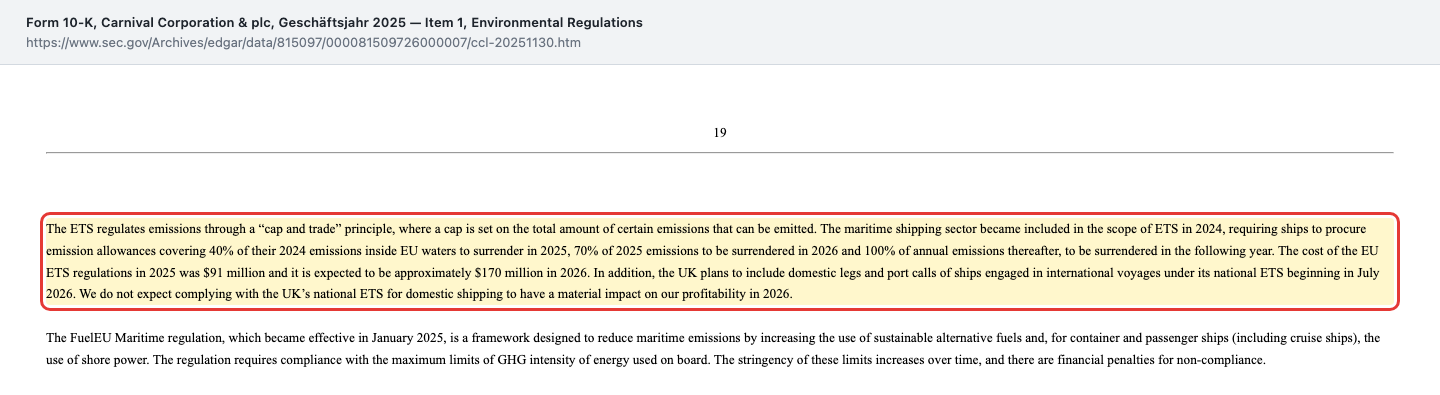
The European emissions trading system forces shipping companies to buy allowances for their emissions. The fiscal 2025 annual report gives both the numbers and the schedule in a single paragraph:
"The maritime shipping sector became included in the scope of ETS in 2024, requiring ships to procure emission allowances covering 40% of their 2024 emissions inside EU waters to surrender in 2025, 70% of 2025 emissions to be surrendered in 2026 and 100% of annual emissions thereafter, to be surrendered in the following year. The cost of the EU ETS regulations in 2025 was $91 million and it is expected to be approximately $170 million in 2026."
— Carnival Corporation & plc, SEC Form 10-K for fiscal 2025, Item 1, Environmental Regulations
The half-year cash flow statement through May 31, 2026 already shows the item in concrete terms: $57 million after $29 million in the prior-year period. For the Europe segment the filing additionally names $23 million of higher allowance costs in the half-year comparison. And the bill keeps growing: from emission year 2026 the coverage rises to 100 percent instead of 70 percent, and from July 2026 the United Kingdom adds its national scheme for domestic legs. $170 million equals roughly 32 percent of quarterly net income of $537 million.
Two further items belong here for completeness, even though Carnival classifies both as immaterial. First, on May 21, 2026 the U.S. Supreme Court vacated the appellate ruling that had favored Carnival in the Havana Docks case and remanded the matter; the original 2022 judgment was $110 million plus $4 million in fees and costs. Second, following a data security incident on April 14, 2026, six purported class actions were filed in April and consolidated in May 2026.
Valuation — what the market pays for this comeback
At the closing price of $26.33 on July 24, 2026 and 1,369,649,119 shares (cover page June 19, 2026), Carnival carries a market capitalization of roughly $36.1 billion. Add $25.6 billion of debt and subtract $2.2 billion of cash, and enterprise value lands near $59.4 billion. For a leveraged company that is the number that matters: buying the stock means buying a share of the debt pile too.
From that follow orders of magnitude, not decimal points:
- Price-to-earnings around 12 — both on trailing profit and on the company's own guidance of $2.22 of adjusted earnings per share for fiscal 2026.
- Price-to-sales around 1.4, measured against fiscal 2025 revenue of $26.6 billion.
- Enterprise value to adjusted EBITDA around 8.4, measured against company guidance of $7.11 billion for fiscal 2026. For a capital-heavy operator with this leverage that is neither cheap nor expensive — it is the price of "it works, but the balance sheet is not finished".
- Price-to-book around 2.8 on a return on equity of 26.7 percent (data as of July 26, 2026).
The professionals are considerably friendlier than we are: 28 analysts arrive at an average rating of 4.46 on a scale to 5, which sits in buy territory. Institutional investors hold roughly 65.9 percent of the shares. One anchor from the filing itself: in May 2026 the company repurchased its own stock at an average of $25.65 — Carnival considered that level attractive enough to spend cash that would otherwise have repaid debt.
Two metrics you cannot skip with this name: the equity ratio is 23.8 percent ($12,984 million of equity against $52,228 million of total assets as of May 31, 2026) and interest coverage is 3.32. The most restrictive credit agreement requires interest coverage of at least 3.0 — Carnival stated it was in compliance with all covenants at the reporting date, but the headroom is modest. If you want to see what heavy leverage does to a turnaround in a different business, our analysis of Sirius XM shows it.
Opportunities and risks at a glance
Opportunities
- Demand is documented, not asserted: 104 percent occupancy in the quarter, customer deposits at an all-time high of $9.0 billion, 93 percent of 2026 booked according to the company, and twelve consecutive quarters of record net yields.
- Every dollar repaid works twice: half-year interest expense fell $141 million to $577 million — with operating income essentially flat, net income still rose from $486 million to $795 million.
- Net debt to adjusted EBITDA stood at 3.1 times according to the company, more than half a point better than a year earlier; Moody's upgraded the credit rating.
- The company earns money on capital that costs nothing: $9.0 billion of customer deposits is interest-free prefunding.
- The fleet is getting more efficient: fuel consumption per thousand available lower berth days fell from 29.9 to 28.2 metric tons in the quarter.
Risks
- The debt pile is smaller but still large: $25.6 billion of debt, with $2.5 billion due through 2027 and $3.97 billion in 2028. The equity ratio stands at 23.8 percent.
- The Altman Z-score of 1.27 sits only 0.17 points above the distress zone — any balance sheet deterioration or revenue setback shows up here immediately.
- Fuel is the largest cost block outside the company's control: up 29 percent per ton in the quarter, with $102 million of earnings sensitivity per 10 percent price move for the remainder of fiscal 2026.
- $18.5 billion of new ship commitments tie up funds well into the 2030s; existing export credit facilities cover deliveries only through 2033.
- Regulation grows on a schedule: EU emissions trading from $91 million to about $170 million, coverage rising from 70 to 100 percent from 2026, plus the UK scheme from July 2026.
- Geopolitics hits the itinerary directly: the filing names higher crew travel costs and softer bookings for Mediterranean deployments because of the Middle East conflict.
- Open legal questions: the Havana Docks case was remanded by the Supreme Court on May 21, 2026 (original judgment $110 million plus $4 million in fees and costs), and six consolidated class actions follow the April 14, 2026 data security incident.
A human conclusion
Back to the headline trap. "Record revenue" and "operating income down" stood in the same company on the same day — and both were true. Read only the headline and you buy a story. Read the filing and you buy arithmetic: $335 million more revenue, $121 million more fuel cost, $103 million of missing ship-sale gains, and $83 million less operating income at the bottom — with a small gain once the one-off is stripped out.
What impresses us about Carnival is not the record. It is the distance travelled: from a $10.2 billion loss in fiscal 2020 to a $2.8 billion profit in 2025, from $34.3 billion of debt to $24.9 billion, from zero distributions to $414 million of dividends in a half year. That is honest work on a very heavy balance sheet.
What makes us uneasy is the simultaneity. The same company that is repaying debt has committed an additional $6.6 billion to new ships in six months, depreciates its ships five years longer, and carries a bankruptcy early-warning score of 1.27 — only 0.17 points above the zone where things get uncomfortable. And in the turnaround scanner that brought us here, Carnival scores 6 of 8, exactly the floor of the list.
We are not telling you whether to buy. We are telling you what to watch in the coming filings: the line with new ship commitments, the fuel price per ton, the remaining repurchase authorization, and North American occupancy, which slipped 1.1 percentage points in the quarter. What you make of it is your decision. And that is exactly how it should be.
Sources
- Form 10-Q for the quarter ended May 31, 2026 (filed June 26, 2026) — consolidated financial statements, Note 1 (unification, useful lives), Note 3 (debt, convertible notes, covenants), Note 4 (contingencies, ship commitments), Note 6 (segments), Note 7 (earnings per share), Item 2 (MD&A), Part II Item 2 (repurchases)
- Form 10-K for fiscal 2025 (filed January 27, 2026) — Item 1 (brands, fleet, environmental regulations), Item 7 (MD&A, depreciation sensitivity), consolidated financial statements and Note 7 (ship commitments)
- Form 10-Q for the quarter ended February 28, 2026 (filed March 27, 2026)
- Form 8-K dated May 7, 2026 — unification of the dual listed company structure, redomiciliation to Bermuda, discontinuation of the CUK secondary listing
- Form 8-K dated June 23, 2026 — earnings release with fiscal 2026 guidance, sensitivities and capital allocation
- Form 10-K for fiscal 2024 (filed January 27, 2025) — comparative figures
- Screener and market data: our in-house stock scanner (data as of July 24 to 26, 2026), including the turnaround candidates scanner (US selection, rank 24 of 62, turnaround check 6 of 8, as of July 25, 2026); metrics and price history from fundamental data
This analysis is journalistic commentary and expressly not investment advice, not a solicitation to buy or sell securities and not an individual recommendation. Stocks can lose substantial value; a total loss of the capital invested is possible. All figures come from the primary sources listed above and were verified on July 26, 2026; later developments are not reflected. The author holds no position in the stock discussed at the time of publication.
Our Bottom Line at a Glance
- Demand & business model positive
- Occupancy in the quarter ended May 31, 2026 was 104 percent, unchanged from the prior-year quarter, customer deposits reached an all-time high of $9.0 billion (November 30, 2025: $7.2 billion), and onboard revenue grew 7.4 percent against 4.1 percent for the ticket. The company reports its twelfth consecutive quarter of record net yields and says it is 93 percent booked for the year.
- Deleveraging & interest burden positive
- Debt fell from the peak of $34,346 million (November 30, 2022) to $24,889 million (May 31, 2026). Half-year interest expense dropped from $718 million to $577 million, down 20 percent. That is exactly where the earnings turn comes from: half-year operating income was essentially flat at $1,458 million against $1,477 million, yet net income rose from $486 million to $795 million.
- Operating margin negative
- In the quarter ended May 31, 2026 a $335 million revenue increase met a $339 million cost increase; reported operating income fell from $934 million to $851 million. Drivers named in the filing: $121 million of higher fuel prices ($793 versus $614 per ton) and $103 million of missing ship-sale gains. Excluding the one-off, operating income would have risen by roughly $20 million; on the company segment measure it rose $34 million to $869 million.
- Balance sheet substance neutral
- As of May 31, 2026, $12,984 million of equity stands against $52,228 million of total assets — a ratio of 23.8 percent with debt-to-equity of 2.18. Interest coverage is 3.32 against a covenant requirement of at least 3.0; all covenants were met at the reporting date. The Altman Z-score of 1.27 sits only 0.17 points above the distress threshold of 1.1 (data as of July 26, 2026).
- Capital program negative
- Commitments for new ships rose from $11.9 billion to $18.5 billion between November 30, 2025 and May 31, 2026, because three LNG ships for Princess Cruises with delivery in 2035, 2038 and 2039 were ordered. That is roughly 18 percent of market capitalization. Existing undrawn export credit facilities of $10.8 billion only cover deliveries through 2033. In parallel, the depreciable lives of ships were extended from 30 to 35 years effective December 1, 2025.
- Valuation & market view neutral
- About $36.1 billion of market capitalization (1,369,649,119 shares, closing price $26.33 on July 24, 2026) and an enterprise value near $59.4 billion equate roughly to twelve times earnings and 8.4 times the $7.11 billion of adjusted EBITDA guided for 2026. Twenty-eight analysts arrive at an average rating of 4.46 on a scale to 5. The company itself repurchased shares in May 2026 at an average of $25.65.
Carnival has the hardest part behind it: a $10.2 billion loss in fiscal 2020 became a $2.8 billion profit in 2025, $34.3 billion of debt became $24.9 billion, and zero distributions became $414 million of dividends in a half year. Demand is documented: 104 percent occupancy, $9.0 billion of customer deposits, 93 percent of the year booked. What stays uncomfortable is the simultaneity: in the quarter ended May 31, 2026 reported operating income fell from $934 million to $851 million despite record revenue, new ship commitments rose from $11.9 billion to $18.5 billion in six months, ships have been depreciated over 35 instead of 30 years since December 2025, and the Altman Z bankruptcy early-warning score of 1.27 sits only 0.17 points above the distress zone. Not investment advice.
What Our Rating Means
Open questions
The business works in principle, but one material question is open. As long as it stays open, our findings do not carry a quality verdict.
The business demonstrably works: 104 percent occupancy, customer deposits at an all-time high of $9.0 billion, $6.2 billion of operating cash flow in fiscal 2025 and record revenue. What remains open is one operating question and one balance sheet question, and both are real: in the quarter ended May 31, 2026 reported operating income fell $83 million despite revenue growth because fuel prices rose 29 percent — and the balance sheet still carries $24.9 billion of debt on a 23.8 percent equity ratio, with an Altman Z of 1.27 only 0.17 points above the distress zone. Red would require a substance finding, and there is none: interest coverage is 3.32, every covenant is met, liquidity stands at $6.7 billion, and the business generates billions of cash every half year. Green is out of reach while the balance sheet is unfinished — especially with $18.5 billion of ship commitments running alongside. The decision is yours.
A journalistic assessment by our editorial team at the time of the deep dive, based on public sources — not investment advice and not a solicitation to buy or sell. Your personal circumstances (investment goals, risk capacity, taxes) cannot be taken into account. What our levels mean, how verdicts are formed, and what conflicts of interest exist →
Worth Noting
- Carnival reached our research list through our in-house stock scanner "turnaround candidates": rank 24 of 62 US hits, turnaround check 6 of 8, as of July 25, 2026. These lists are recalculated daily — rank and score are a dated snapshot, not a permanent state. Six of eight is also the display floor of the list.
- The scanner's two mandatory pillars: at least 50 percent below the all-time high (Carnival: roughly 63 percent, measured from the highest closing price of $71.94 on January 29, 2018 against $26.33 on July 24, 2026) and an Altman Z-score of at least 1.1 (Carnival: 1.27). Should the price rise above about $36, pillar 1 breaks and the stock leaves the list without anything changing in the business.
- Not a takeover: the unification of the dual listed company structure on May 7, 2026 was an internal restructuring under a UK scheme of arrangement. Carnival plc became a subsidiary, the place of incorporation moved from Panama to Bermuda, and both the CUK secondary listing and the London listing ended. The DEFM14A dated February 27, 2026 belongs to that transaction, not to a sale of the company.
- The fiscal year ends November 30. The latest periodic report is the Form 10-Q for the quarter ended May 31, 2026 (filed June 26, 2026); no further filing existed as of July 26, 2026. Guidance figures come from the Form 8-K dated June 23, 2026 and are company statements, not our own estimates.
- Price references are dated valuation anchors, not buy arguments: closing price $26.33 on July 24, 2026, highest closing price $71.94 on January 29, 2018, 52-week high $33.99 on February 6, 2026. Cross-check on market capitalization: 1,369,649,119 shares × $26.33 gives $36.06 billion, matching the figure from fundamental data.
- Risk of confusion: Carnival Corporation Ltd. (CCL on the NYSE) is not the same as the British Carnival plc, which has been a subsidiary without its own listing since May 7, 2026. The CUK ticker has not existed since that date, and there is no longer a corresponding London listing.
Frequently Asked Questions
No. On May 7, 2026 the dual listed company structure was simply unified: Carnival plc became a UK subsidiary of Carnival Corporation Ltd. and the place of incorporation moved from Panama to Bermuda. The London listing and the New York secondary listing CUK ended, and holders received one new share for each share held. The stock still trades on the NYSE under CCL.
On November 30. Fiscal 2025 ran from December 1, 2024 to November 30, 2025, and the annual report was filed on January 27, 2026. The second quarter of fiscal 2026 ended on May 31, 2026. References to "2026" therefore mostly cover periods inside calendar 2026 that end on November 30, 2026.
In the quarter ended May 31, 2026 revenue rose by $335 million while cruise and tour operating expenses rose by $339 million. The largest drivers named in the filing: $121 million of higher fuel prices and $103 million of ship-sale gains that occurred a year earlier and did not repeat. Excluding that one-off, operating income would have risen by roughly $20 million.
As of May 31, 2026 the balance sheet shows $24,889 million of debt net of issuance costs, of which $1,471 million is current. The peak was $34,346 million on November 30, 2022. Against that stand $2.2 billion of cash and an undrawn $4.5 billion revolving facility, giving total liquidity of $6.7 billion.
The Altman Z-score is an early-warning measure for insolvency built from several balance sheet ratios. In our scanner the distress zone begins below 1.1. Carnival sits at 1.27 as of July 26, 2026 and therefore clears the mandatory pillar of the turnaround scanner — but with only 0.17 points of headroom. Genuinely healthy balance sheets read above 3.
Yes. In the quarter ended May 31, 2026 the company paid $0.15 per share, or $207 million; dividends for the half year totalled $414 million. In the prior-year period the payout was zero. A $2.5 billion share repurchase program has also been running since March 2026.
In the quarter ended May 31, 2026 a metric ton cost $793 versus $614 a year earlier, and the fuel bill rose from $468 million to $595 million. For fiscal 2026 Carnival guides to $713 per ton and $2.12 billion in total. A 10 percent move in the price shifts adjusted results for the remainder of the year by $102 million.
As of November 30, 2025 seven ships were under contract for delivery through 2033. During the quarter ended May 31, 2026 three LNG ships for Princess Cruises were added, with delivery in 2035, 2038 and 2039. Commitments for new ships rose as a result from $11.9 billion to $18.5 billion.
Found an error?
Did you spot a factual error, an outdated number, or a typo in this deep dive? Let us know briefly — your report goes straight to the editorial team.