Agora Stock: $366 Million in Cash, a $357 Million Market Cap — and a Profit That Lives on Interest
On Reddit, the ticker API is making the rounds, and the math sounds like a gift: Agora, the company behind the video and voice APIs inside many apps, holds more cash than the entire firm costs on the stock exchange — the business comes free, arithmetically. We read what Agora itself reported to the U.S. securities regulator — in the annual report for foreign private issuers (20-F) for 2025 and the interim reports (6-K) through June 2026: a genuine turnaround with six profitable quarters in a row, but also an operating loss that only interest income covers, a tax trap called PFIC, a Shanghai headquarters project the size of half the company's market value — and a founder holding 86.2 percent of the votes. Not investment advice — just the recount of whether the stock market ever really gives something away.
 Thomas Mücke
Founder & Publisher
Thomas Mücke
Founder & Publisher
Chart
Interactive price chart (TradingView).
Note: pure fact-based analysis, not investment advice and not a solicitation to buy or sell. All figures without guarantee.
No word switches off the price check in your head as reliably as "free." Behavioral economists call it the zero-price effect: the moment something looks free, we stop calculating — the question "what do I get?" crowds out the question "what do I risk?". The stock market has one setup that flips exactly this switch: a company whose cash is bigger than its entire market value. Agora (NASDAQ: API) is such a case in the summer of 2026: $366.1 million of liquidity stood on the books as of March 31, 2026, while the whole company cost about $357 million on the stock exchange (as of July 15, 2026). The operating business — video, voice and AI interfaces for thousands of apps — comes free, arithmetically. In our Reddit hype scanner, which counts every day which small U.S. tickers the forums are talking about, API surfaced on July 15, 2026 with 6 mentions within 24 hours (source: ApeWisdom) — quiet background hum, but exactly the raw material forums turn into "gifts." So here is our deal: before the zero-price effect decides for you, we read together what Agora itself reported to the U.S. securities regulator, the SEC — honest under penalty of law. And because Agora is registered as a foreign private issuer (the holding company sits in the Cayman Islands), the documents are not called 10-K and 10-Q but 20-F (the annual report for foreign private issuers, filed for 2025 on April 15, 2026) and 6-K (interim reports) — same penalty of law, different forms, looser rhythm: quarterly numbers arrive as unaudited attachments to a 6-K. In the end, you decide for yourself.
What Agora actually does
When you make a video call inside an app, watch a live stream or, lately, talk to an AI voice, the odds are high that nobody involved built that plumbing themselves. That is where Agora earns its money: the company sells APIs — ready-made programming interfaces that developers drop into their apps so that real-time video, audio, chat and live streaming simply work; think of them as power outlets from which apps draw video and voice connections without building their own power plant. That the stock ticker is literally API is not a coincidence but a mission statement. The traffic runs over Agora's own virtual network on top of the public internet (the "Software-Defined Real-Time Network"), built to keep latency below a second — during a customer's Super Bowl live shopping event, Agora says it streamed full HD video to nearly 600,000 peak concurrent viewers (6-K of March 3, 2026). Billing is usage-based: 10,000 free minutes per month draw developers in; after that, every minute costs money. Since March 2025 there is a new second leg: a conversational AI engine that lets developers build talking AI agents — for customer service, tutoring apps or talking toys; per the company, usage has more than doubled every quarter since launch, and since the first quarter of 2026 a no-code builder called "Agent Studio" sits on top.
Organizationally, this is a dual structure under one Cayman Islands holding company: the Agora brand (headquartered in Santa Clara, California) serves the United States and the world market and grew 16.1 percent to $74.9 million in 2025; the Shengwang brand (headquartered in Shanghai) serves the China market and shrank 3.5 percent to RMB 472.7 million ($66.2 million). Together: $141.1 million of 2025 revenue, up 5.9 percent — accelerating to plus 13.5 percent in the first quarter of 2026. Note, right here, the central tension of this analysis: The market throws in the business almost for the value of the cash — but the reported profit so far comes from interest on that very cash, the operating business still writes red ink, and 86.2 percent of the votes sit with the founder. It runs through every chapter. What a China ADR with the signs reversed looks like — a big business on a leaky balance sheet — is shown by our fresh analysis of iQIYI; Agora is its mirror image on almost every point.
Where the ticker comes from — and why our fundamental scanner does not know it
Honesty first: API appears in none of our fundamental stock scanners. That is no verdict, it is systematics — our in-house stock scanner works through the Russell 3000 universe, meaning U.S. companies; Agora is legally a Cayman Islands company whose depositary shares (ADSs, four Class A shares each) trade in New York, and so it falls through the grid. The ticker landed on our desk through our Reddit hype scanner, which evaluates daily which micro and small caps are the talk of the U.S. stock forums (data basis: ApeWisdom): 6 mentions within 24 hours on July 15, 2026 — little noise, much insinuation, mostly in the register of "more cash than market cap, what could go wrong?". What forum dynamics can do with stories like that is something we dissected in our analysis of AMC Entertainment, the meme-stock veteran — simple stories travel faster than footnotes. For Agora the setup means: no scanner metrics as guardrails, no Piotroski score from the database — only the original documents. All the more important to actually read them.
The numbers over the years — honestly appraised
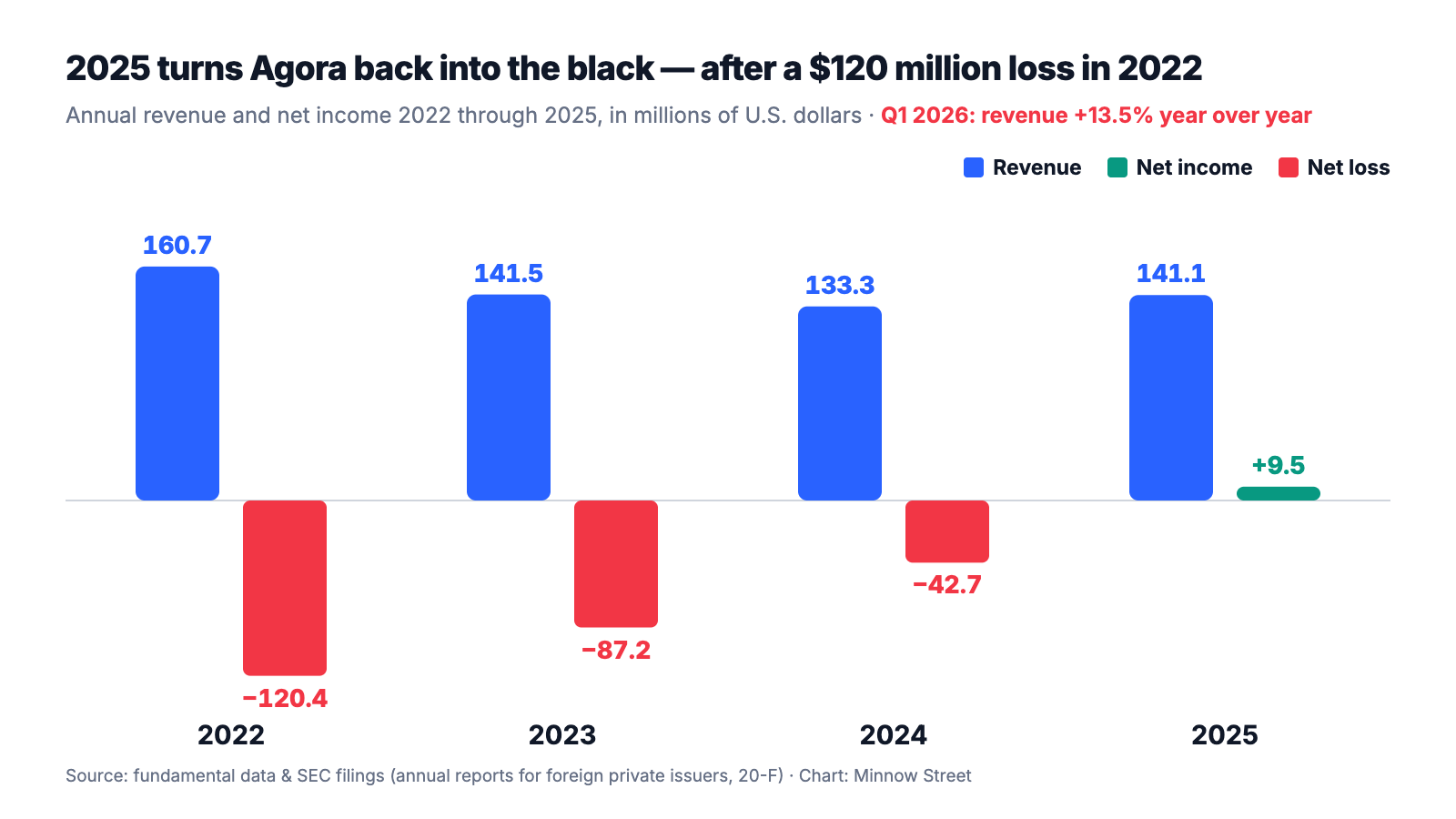
First, what genuinely has substance — and here that is more than a footnote. Agora is coming out of a deep valley: in 2022, $160.7 million of revenue came with a net loss of $120.4 million — the company burned through almost three quarters of a present-day market value in a single year. The crash had a very Chinese trigger: when Beijing switched off the K-12 online tutoring market by decree in 2021, Agora lost one of its biggest customer sectors; combined with the fading pandemic boom, revenue shrank two years in a row from 2021 to 2023. What followed was a textbook restructuring: headcount fell from 790 (end of 2023) to 543 employees (end of 2025), operating expenses dropped from $146.6 million (2023) to $104.5 million (2025), gross margin climbed to 66.4 percent. The result: 2025 was the first profitable year since 2018 — $9.5 million of net income —, operating cash flow swung to plus $27.2 million (after minus $14.1 million in 2024), and the first quarter of 2026 was the sixth profitable quarter in a row ($1.1 million net) with growth picking back up: revenue plus 13.5 percent, dollar-based net retention improved from 95 to 99 percent, and guidance for the second quarter of 2026 calls for $39.0 to $40.0 million (plus 13.7 to 16.6 percent). That is not a story; those are audited or officially reported numbers:
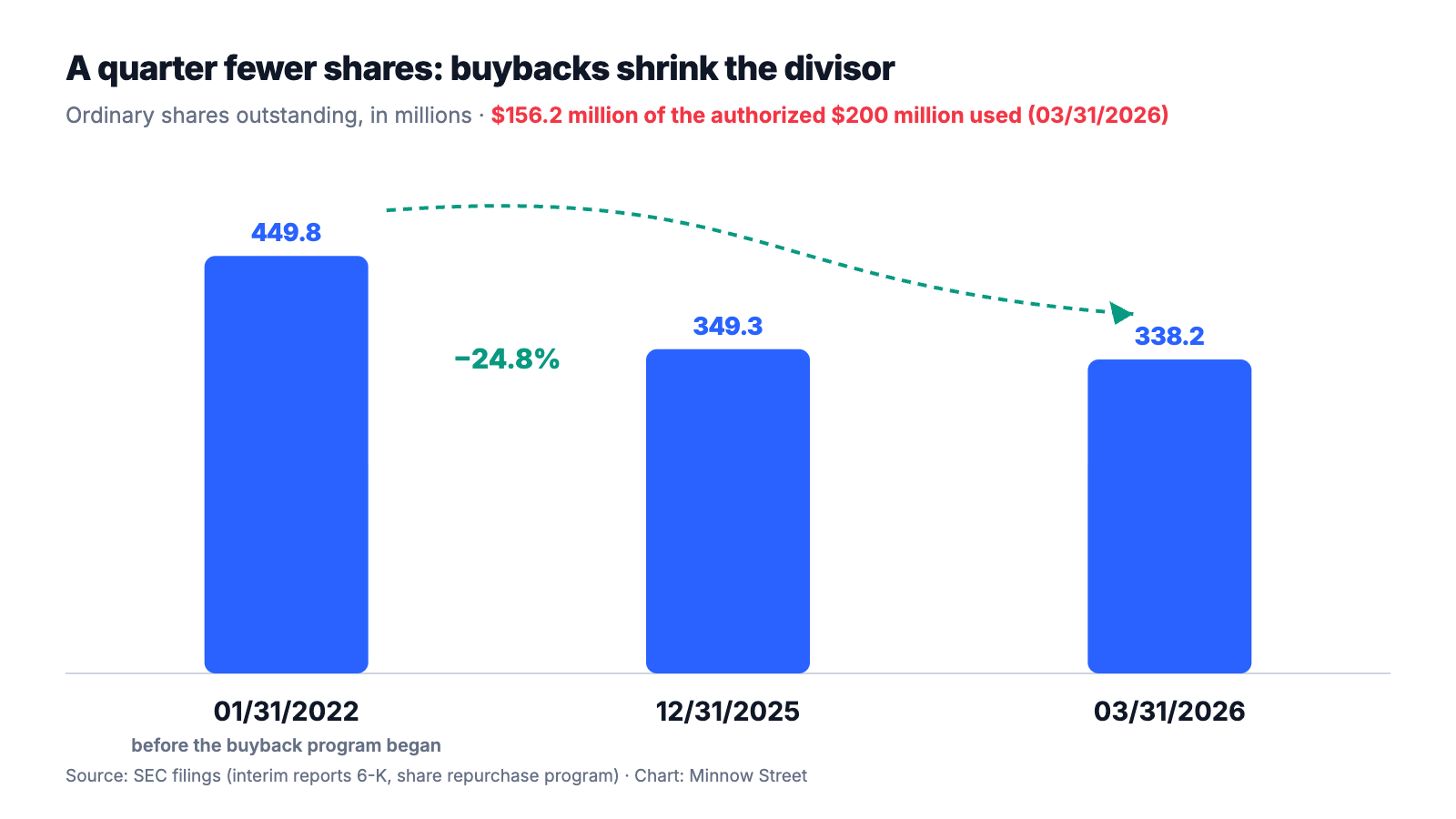
And one more thing separates Agora from the typical small cap after a crash: instead of diluting shareholders with ever more shares, the company has bought back $156.2 million of its own stock since February 2022 (as of March 31, 2026; up to $200 million is authorized, extended through the end of February 2027) — the share count fell from 449.8 million (January 31, 2022) to 338.2 million, a quarter fewer pieces for future profits to be divided by:
Still, remember this sentence: A big cash pile never answers the question of whether the business itself makes money — it only postpones it. The answer is in the filings.
What the filings say — the uncomfortable truths
Uncomfortable truth no. 1: the profit lives on interest — the operating business still writes red ink
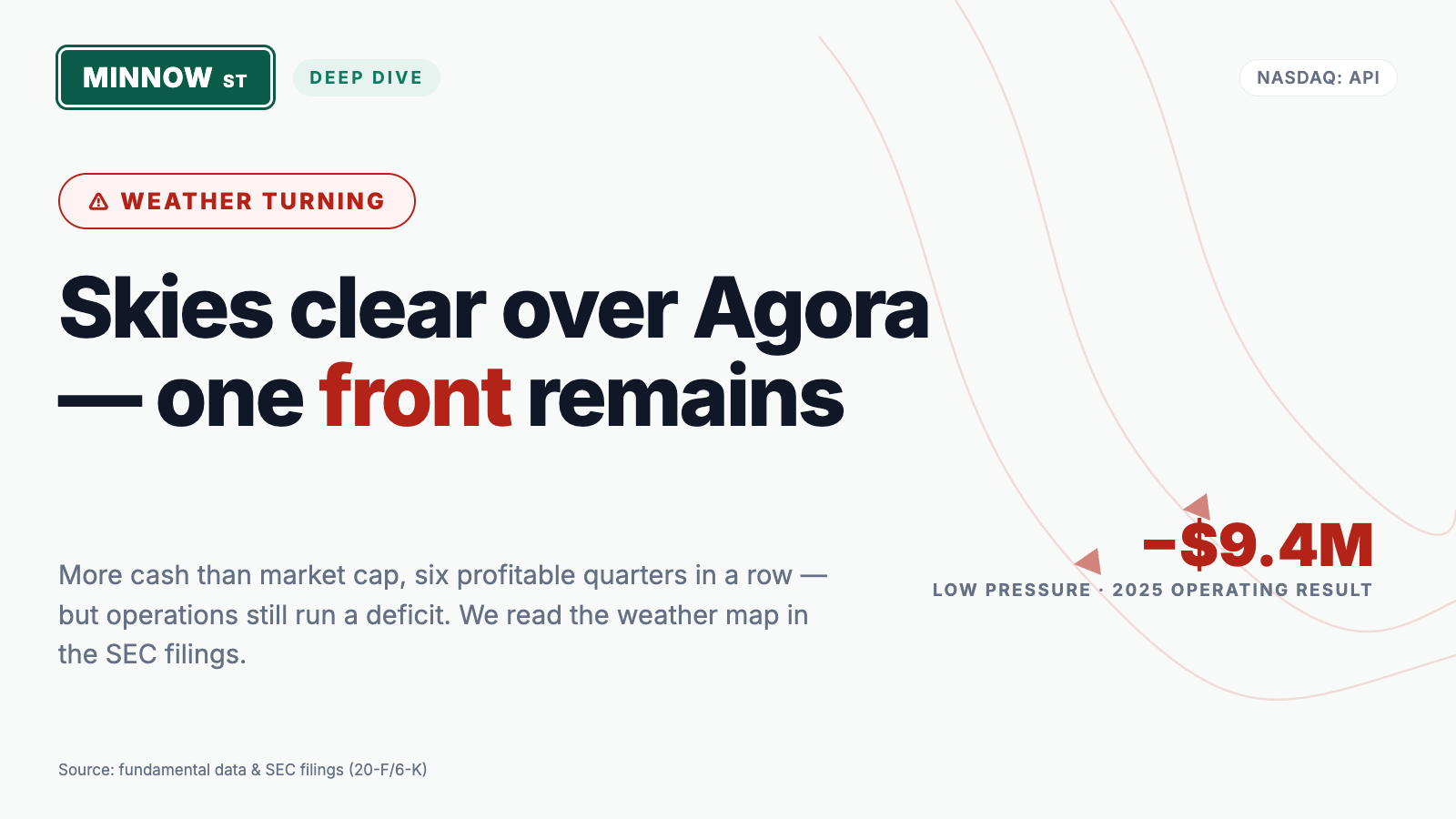
The headline "first profitable year since 2018" is true. It only becomes complete with the line above it: in 2025, operations lost $9.4 million — the $9.5 million of net income was carried by $15.1 million of interest income on the cash. The first quarter of 2026 shows the same pattern: a $1.6 million operating loss, $3.4 million of interest, $1.1 million of net income. The annual report itself lays out the backstory with remarkable candor:
"We recorded net losses from 2019 to 2023, and our revenue increased continuously from 2018 to 2021, followed by an overall decreasing trend from 2021 to 2023 [...] In 2023, 2024 and 2025, we recorded loss from operations of US$87.3 million, US$53.3 million and US$9.4 million, respectively [...] We will need to generate and sustain increased revenue levels and manage costs in future periods in order to remain profitable."
— Agora, Inc., SEC annual report 20-F for 2025, Item 3D "Risk Factors"
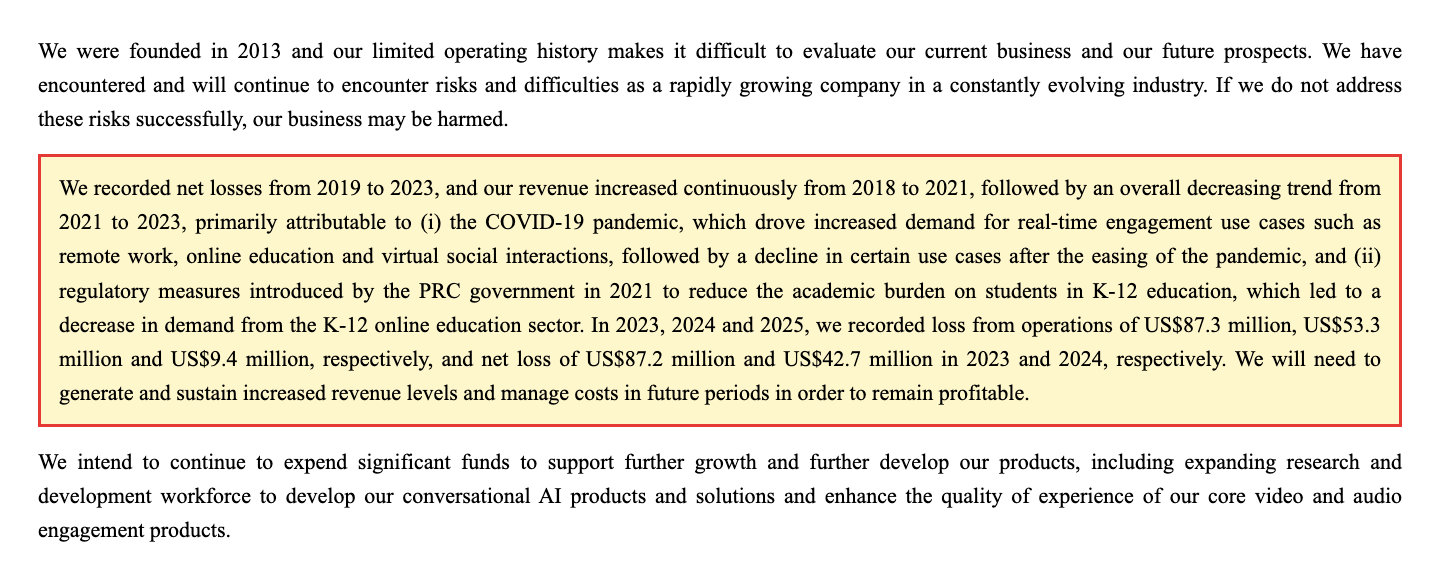
Translated into an everyday image: the shop on the ground floor still runs a small deficit — the black ink comes from the savings account in the basement. That is far better than 2022, when the shop itself lost $53 million a year, and the direction is right: the operating shortfall melted from $87.3 million (2023) via $53.3 million (2024) to $9.4 million (2025), and in the fourth quarter of 2025 operations missed break-even by just $1.0 million. But it also means: if interest rates fall or the cash shrinks — through buybacks and the headquarters build, see below —, the very income stream that currently carries the reported profit gets thinner. Interest income has already declined from $18.8 million (2023) via $16.9 million (2024) to $15.1 million (2025). On top of that, the new AI business is pressing on the margin for now: gross margin fell from 68.0 to 63.4 percent in the first quarter of 2026, per the 6-K partly because the conversational AI products remain "at a sub-scale stage."
Uncomfortable truth no. 2: Cayman shell, China oversight, delisting clause — the structure remains a stack of risks, even without a VIE
Whoever buys the Agora ADSs buys shares of a holding company in the Cayman Islands, under which two worlds hang: the international business (Agora, Santa Clara) and the China business (Shengwang, Shanghai) with 470 of the 543 employees. Until early 2025 this also included the most notorious construction in Chinese overseas listings: a VIE structure — license-holding companies the holding does not own but merely binds through contracts. Here comes the rare piece of good news: Agora terminated its last VIE arrangement in January 2025; the annual report states expressly that no VIE structure remains as of the report date. One link fewer in the chain. The remaining links, the report names itself:
"The PRC government has significant oversight and discretion over the conduct of our business in China and may intervene with or influence our operations in China as the government deems appropriate to further regulatory, political and societal goals."
— Agora, Inc., SEC annual report 20-F for 2025, Item 3D "Risk Factors — Risks Relating to Doing Business in China"
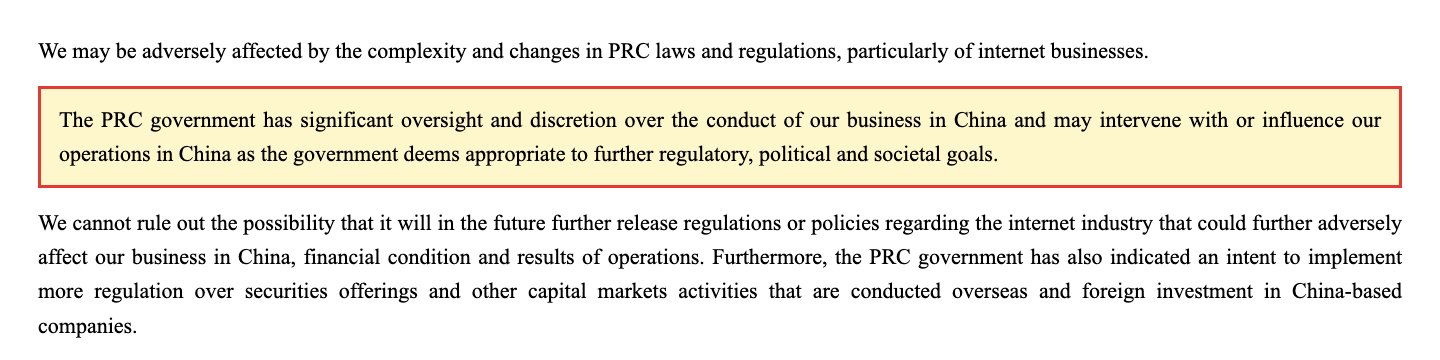
How real that right of intervention is, Agora has experienced on its own revenue line — the K-12 education decree of 2021 started the crash. Then there is the U.S. side of the pincer: under the Holding Foreign Companies Accountable Act (HFCAA), the ADSs face a U.S. trading ban if the American audit watchdog PCAOB cannot inspect the auditors for two consecutive years; Agora's auditor was covered by the PCAOB's 2021 determinations, and since the end of 2022 the PCAOB has had access to China inspections again — as long as that holds, as the report qualifies. And finally the cybersecurity flank: as an operator of network infrastructure in China, Shengwang sits under the data-security and review regimes of the CAC. None of this is Agora-specific failure — it is the price of the construction. Remember: even without a VIE, whoever buys the shell must trust both governments at once.
Uncomfortable truth no. 3: Agora believes it "likely" is a PFIC — precisely because of the beautiful cash pile
Now it gets footnote-deep — and expensive for one particular group of investors. The risk chapter contains this sentence:
"We believe we likely were a passive foreign investment company, or PFIC, for 2025, and there is a significant risk that we will be a PFIC for the current taxable year, and possibly future taxable years, in which case U.S. investors owning the ADSs or Class A ordinary shares will generally be subject to adverse U.S. federal income tax consequences."
— Agora, Inc., SEC annual report 20-F for 2025, Item 3D "Risk Factors"
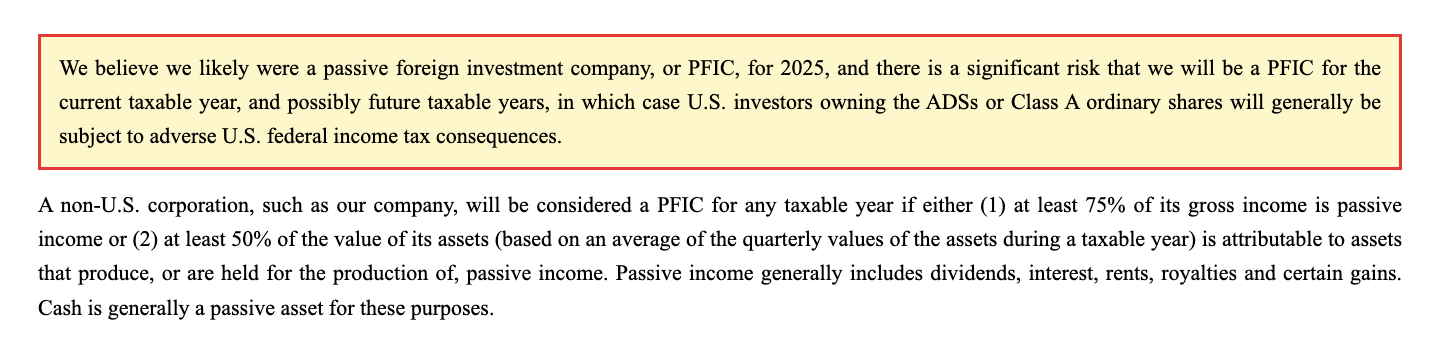
PFIC — passive foreign investment company — is a U.S. tax label: it hits foreign companies whose assets consist half or more of passively yielding positions. And cash counts as passive. The irony is hard to beat: the very money pile that makes the stock look like a gift has grown so large that it earned the company a tax warning label. In practice it means: U.S. investors can end up paying a punitive tax regime on gains instead of the friendlier capital gains rate, with interest charges and reporting duties on top. And it dampens demand from exactly the buyer group that would otherwise be most likely to close the valuation gap. A cash mountain towering over the business is not a seal of quality; it is a hint that the market gives the business itself little credit — and that the tax authority already half-classifies the company as a money vault.
Uncomfortable truth no. 4: 20 votes per founder share — 86.2 percent of the power on 27 percent of the capital
Which leaves the question of who owns all this — and who decides over the cash. The answer is quantified precisely in the annual report:
"As of March 31, 2026, our chief executive officer beneficially owned all of our issued Class B ordinary shares. These Class B ordinary shares constitute approximately 27.0% of our total outstanding share capital and 86.2% of the aggregate voting power of our total outstanding share capital, due to the disparate voting powers associated with our dual-class share structure."
— Agora, Inc., SEC annual report 20-F for 2025, Item 3D "Risk Factors"
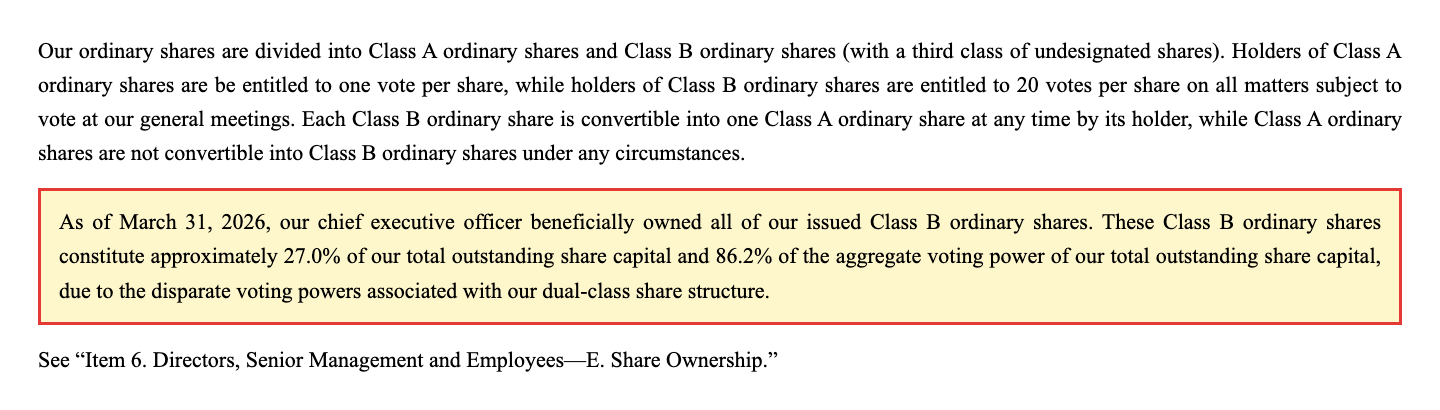
The lever is Class B shares carrying 20 votes apiece — twice what most dual-class tech companies grant —, and all of them sit with founder, chairman and CEO Tony Zhao. That makes Agora a "controlled company" under Nasdaq rules, allowed to exempt itself from governance standards that protect shareholders elsewhere; all other shareholders combined share 13.8 percent of the voting weight. Whether that worries you depends on how much you trust the man — and honesty cuts both ways here: Zhao delivered the restructuring, had the company buy back $156.2 million of stock instead of diluting, and on June 1, 2026 he announced he would put up to $20 million of his personal funds into Agora shares within twelve months (6-K of June 1, 2026) — insider buying instead of insider selling is the exception among small caps. Just do not confuse anything: you will never have a say here. Would you move into an apartment whose house rules one person can rewrite alone at any time — even if he has been a good landlord so far?
Valuation: the business comes almost for the value of the cash — why, exactly?
Let's recount the gift thesis. About $357 million of market value (July 15, 2026) stands against $366.1 million of liquidity (March 31, 2026) — cash, bank deposits and bank-issued financial products combined. Sizable financial debt exists in only one flavor: $80.4 million of long-term construction borrowings for the headquarters project (December 31, 2025). Even after that, the enterprise value of the operating business sits near zero; the price-to-sales ratio is about 2.5, and book value ($562.8 million of equity as of December 31, 2025) exceeds the market value. Before you shout "free," three notes from the filings. First: part of the cash is already spoken for — in Shanghai, Agora is building the future Shengwang headquarters; the land (42,000 square meters in the riverside Yangpu district) cost approximately RMB 2.5 billion per the annual report, and the balance sheet carries a $161.6 million land use right and $84.2 million of construction in progress, with completion estimated for 2026. A software vendor moonlighting as the developer of a real estate project this size is, at minimum, a question of style. Second: the cash is pleasingly international (only 10 percent with institutions in mainland China as of December 31, 2025; the rest in the United Kingdom, the United States, Hong Kong and Singapore) — but it currently yields the very interest that carries the profit; every dollar bought back and every dollar poured into concrete lowers future interest income. Third: the PFIC status makes the stock less attractive for U.S. taxpayers — a structural buyers' strike that can preserve discounts. What you really acquire, then, is not a gift but a bet: that the operating result breaks through zero before the interest source thins out — and that a sole ruler keeps steering the cash into buybacks rather than prestige concrete.
Opportunities and risks at a glance
What speaks for Agora:
- A documented turnaround: first profitable year since 2018 ($9.5 million net in 2025), six profitable quarters in a row through Q1 2026, operating cash flow of plus $27.2 million in 2025 (2024: minus $14.1 million), gross margin 66.4 percent (2025).
- Growth is picking back up: revenue plus 13.5 percent in Q1 2026 (after +5.9 percent in 2025), the Agora brand up 16.1 percent in 2025, dollar-based net retention 99 after 95 percent, Q2 2026 guidance of $39.0 to $40.0 million (+13.7 to +16.6 percent).
- A balance sheet as a buffer: $366.1 million of liquidity (March 31, 2026) against a market value of about $357 million (July 15, 2026), barely any financial debt beyond $80.4 million of construction borrowings; only 10 percent of deposits in mainland China (December 31, 2025).
- Capital discipline instead of dilution: share count down a quarter since early 2022 ($156.2 million of buybacks through March 31, 2026, program extended through February 2027); the founder announced personal purchases of up to $20 million on June 1, 2026.
- An AI option with a core of substance: the conversational AI engine launched in March 2025 with usage more than doubling every quarter per the company, the "Agent Studio" no-code builder since Q1 2026, the open-source TEN framework with more than 9,400 GitHub stars (December 31, 2025) — and the former VIE structure has been terminated since January 2025.
What speaks against it:
- Profit quality: operations lost $9.4 million in 2025 and $1.6 million in Q1 2026 — net income comes from interest ($15.1 million in 2025), which is already falling as cash and rates decline ($18.8 → $16.9 → $15.1 million, 2023–2025).
- Margin pressure from the new leg: gross margin down to 63.4 from 68.0 percent in Q1 2026 — conversational AI runs "at a sub-scale stage" per the 6-K, and bandwidth, server and AI costs are rising.
- The China pincer: sweeping oversight by Beijing over the Shengwang business (which is shrinking: revenue minus 3.5 percent in 2025, net retention 89 percent), the HFCAA delisting scenario, the CAC cybersecurity regime — the K-12 decree of 2021 demonstrated how fast a sector can vanish.
- The PFIC tax trap: Agora itself believes it "likely" was a passive foreign investment company for 2025 — adverse U.S. tax consequences dampen demand from the largest buyer group.
- Governance and capital allocation: 86.2 percent of the votes with a single man (20 votes per Class B share, "controlled company"), 13.8 percent of residual voting weight for everyone else — while cash flows into a headquarters project whose land alone cost about RMB 2.5 billion.
A human conclusion
Back to the zero-price effect from the beginning. It does not lie about the numbers — the cash is bigger than the market value; arithmetically, the business comes almost free. It lies about the word "free": the moment something looks free, we stop asking why nobody wants it. At Agora, the company's own filings deliver the answer along with the gift: an operating business that has not yet broken through zero and whose reported profit hangs on the interest drip of its own cash; a structure that stays wedged between Washington's delisting clause and Beijing's right of intervention, even though the VIE chapter closed in January 2025; a tax label that devalues the money pile for U.S. buyers; and a founder who decides alone, with 86.2 percent of the votes, whether the cash goes into buybacks, AI agents or Shanghai concrete. At the same time: restructuring delivered, growth turning, share count down a quarter, the insider buying — that is more substance than the 6 Reddit mentions of July 15, 2026 would suggest. Your task is the uncomfortable middle: neither shouting "free" nor "trap" — but recounting what the box costs once you subtract the money inside, and whether the rest is worth the three questions of trust to you. Check the footnotes before you accept the gift. What you make of it is your decision. And that is exactly as it should be.
Sources
All original documents used in this analysis — to read for yourself. Note: Agora is registered as a "foreign private issuer" and therefore files the annual report for foreign private issuers (20-F) and interim reports (6-K) instead of the U.S. forms 10-K/10-Q:
- Agora, Inc. — SEC annual report 20-F for 2025 (filed April 15, 2026)
- Agora, Inc. — SEC annual report 20-F for 2024 (filed April 15, 2025)
- Agora, Inc. — SEC interim report 6-K of March 3, 2026: fourth-quarter and fiscal-year 2025 results (Exhibit 99.1)
- Agora, Inc. — SEC interim report 6-K of May 28, 2026: first-quarter 2026 results (Exhibit 99.1)
- Agora, Inc. — SEC interim report 6-K of June 1, 2026: management share purchase plan (Exhibit 99.1)
- Agora's complete SEC filing history: EDGAR overview (sec.gov)
- Reddit mentions: in-house Reddit hype scanner based on ApeWisdom data (6 mentions in 24 hours, as of July 15, 2026); market value about $357 million as of the same date.
- Fundamental data (metrics, valuation; data as of July 15, 2026), reconciled with the SEC filings.
Transparency & disclaimer: This analysis is a journalistic contextualization of publicly available information and is not investment advice, not a financial analysis in the regulatory sense, and not a solicitation to buy or sell securities. Stock investments — especially in foreign depositary shares with China exposure — carry substantial risks up to total loss. All information without guarantee; the data cut-off is noted in the text in each case. RMB/USD conversions follow the period-end rates stated in the respective filings. The author holds no position in Agora securities at the time of publication.
Our Bottom Line at a Glance
- Business model & market position neutral
- A pioneer and, by its own account, leading provider of real-time engagement APIs with a genuine AI option (conversational AI engine since March 2025, Agent Studio since Q1 2026, TEN framework with 9,400+ GitHub stars) — but split in two: the Agora brand grows (+16.1 percent in 2025), the Shengwang brand in China shrinks (−3.5 percent, net retention 89 percent).
- Trajectory of the numbers positive
- Restructuring delivered: first profitable year since 2018 ($9.5 million net in 2025 after −$120.4 million in 2022), six profitable quarters in a row, operating cash flow +$27.2 million (2025), growth accelerating to +13.5 percent in Q1 2026, Q2 2026 guidance of +13.7 to +16.6 percent (annual and interim reports).
- Profit quality negative
- The net profit hangs on the interest drip: 2025 operating result −$9.4 million against $15.1 million of interest income, Q1 2026 operating −$1.6 million against $3.4 million of interest; the interest source is falling ($18.8 → $15.1 million, 2023–2025), and the AI products press on the gross margin (63.4 after 68.0 percent in Q1 2026).
- Cash & balance sheet positive
- Liquidity of $366.1 million (March 31, 2026) above the market value (~$357 million, July 15, 2026), equity of $562.8 million, barely any financial debt beyond $80.4 million of construction borrowings; only 10 percent of deposits in mainland China — but part of the cash is migrating into the Shanghai headquarters (land approx. RMB 2.5 billion).
- Structure & China risk negative
- A Cayman holding filing as a foreign private issuer (20-F/6-K), the Shengwang business under sweeping oversight by Beijing (quoted in the risk chapter), the HFCAA delisting scenario and a likely PFIC status for 2025 with adverse U.S. tax consequences. On the plus side: the former VIE structure was terminated in January 2025 — one link fewer in the chain.
- Ownership & governance neutral
- Founder Tony Zhao holds, via all Class B shares (20 votes each), 86.2 percent of the votes on 27.0 percent of the capital (March 31, 2026) — a "controlled company" with effectively zero say for outside holders. At the same time he acts shareholder-friendly: $156.2 million of buybacks, share count −25 percent, a personal purchase plan of up to $20 million (June 1, 2026).
Agora is no empty hype ticker: the restructuring is delivered, growth is picking back up, the cash exceeds the market value, and instead of dilution there are a quarter fewer shares. But the supposed gift has footnotes: the profit comes from interest on the cash, not from the business; the structure stays wedged between Beijing's oversight and Washington's delisting clause; the likely PFIC status scares off U.S. buyers; and everything is decided by a founder with 86.2 percent of the votes — most recently in favor of a headquarters project the size of half the market value. The stock looks cheap for good reasons; it is a gift only if the operating result breaks through zero before the interest source dries up. Not investment advice.
What Our Rating Means
- If you don't own the stock
- As long as the question raised in the bottom line stays open, we see no basis for an entry.
- If you hold it in your portfolio
- Our findings offer no acute reason to sell — the checkpoints named remain decisive.
A journalistic assessment by our editorial team at the time of the deep dive, based on public sources — not investment advice and not a solicitation to buy or sell. Your personal circumstances (investment goals, risk capacity, taxes) cannot be taken into account. What our categories mean, how verdicts are formed, and what conflicts of interest exist →
Worth Noting
- API landed on our research list through our Reddit hype scanner (ApeWisdom data): 6 mentions in 24 hours as of July 15, 2026. Forum mentions are sentiment signals, not quality signals. Our fundamental scanners (Russell 3000 universe) do not cover the Cayman-incorporated ADR by design.
- Agora is registered as a foreign private issuer and files Forms 20-F (annual report, filed for 2025 on April 15, 2026) and 6-K (interim reports) instead of 10-K/10-Q; quarterly figures are unaudited attachments to 6-K filings. The former VIE structure was terminated in January 2025.
- The market value figure is dated July 15, 2026 (about $357 million); analyses are evergreen, daily prices are not a buy argument. RMB amounts follow the period-end rates stated in the filings (12/31/2025: 6.9931 RMB per USD).
Frequently Asked Questions
Agora, Inc. (NASDAQ: API) sells developer APIs for real-time video, audio, chat and live streaming, plus — since March 2025 — a conversational AI engine for talking AI agents. Billing is usage-based, by the minute. The group runs as a dual structure: the Agora brand (Santa Clara) serves the world market, the Shengwang brand (Shanghai) serves China. Total 2025 revenue: $141.1 million, up 5.9 percent.
Because that is literally the product: APIs — application programming interfaces that developers embed in their apps to get real-time video, voice and AI speech features without building the infrastructure themselves. The Nasdaq ticker API, in place since the June 2020 IPO, doubles as the company's mission statement.
Half: legally, Agora, Inc. is a Cayman Islands holding company registered with the SEC as a foreign private issuer (Forms 20-F/6-K instead of 10-K/10-Q). Under it operate two divisions: Agora, headquartered in Santa Clara, for the world market, and Shengwang, headquartered in Shanghai, for China; 470 of the 543 employees sat in China at the end of 2025. The former VIE contract structure was terminated in January 2025.
Yes, with an asterisk: 2025 was the first profitable year since 2018 with $9.5 million of net income, and the first quarter of 2026 was the sixth profitable quarter in a row. Operations, however, still lost $9.4 million in 2025 and $1.6 million in Q1 2026 — the net profit is carried by interest income on the cash ($15.1 million in 2025).
As of the respective cut-off dates, yes: $366.1 million in cash, bank deposits and bank-issued financial products (March 31, 2026) stood against a market value of about $357 million (July 15, 2026); the only sizable financial debt was $80.4 million of construction borrowings for the Shanghai headquarters project. Only 10 percent of the deposits sat with institutions in mainland China at the end of 2025.
In its 20-F for 2025, Agora itself writes that it "likely" was a passive foreign investment company (PFIC) — a U.S. tax label for foreign companies whose assets yield mostly passive income; the large cash pile counts as a passive asset. U.S. investors then face adverse federal income tax consequences, with punitive rates and reporting duties. Investors outside the United States are not hit directly, but the label can dampen U.S. demand for the stock.
Founder, chairman and CEO Tony Zhao: he holds all Class B shares carrying 20 votes each — as of March 31, 2026 about 27.0 percent of the capital but 86.2 percent of the voting power. That makes Agora a "controlled company" under Nasdaq rules. On June 1, 2026, Zhao announced he would invest up to $20 million of his personal funds in Agora shares within twelve months.
At Agora, AI is the product, not just a tool: the conversational AI engine launched in March 2025 lets developers build talking AI agents (customer service, learning apps, talking toys); per the company, usage has more than doubled every quarter since. The first quarter of 2026 added the no-code builder "Agent Studio," and the open-source TEN framework counted more than 9,400 GitHub stars at the end of 2025. The flip side: the AI products still run at a sub-scale stage and press on the gross margin.
Found an error?
Did you spot a factual error, an outdated number, or a typo in this deep dive? Let us know briefly — your report goes straight to the editorial team.