Weibo Stock: A Record Profit the Business Did Not Earn — and a Dividend Cut by 26 Percent in the Same Year
Weibo looks like the cheapest thing on the Nasdaq: about 4.5 times 2025 earnings, half of book value, more cash than market value and a dividend yield near 8 percent (data as of July 15, 2026). We read the annual report (20-F) for 2025 and the interim report (6-K) of May 2026 line by line: reported profit rose 49 percent, but income from operations fell; the user base, the advertiser count and third-party ad money have all been shrinking for three years; and in its best reported year the board cut the payout per ADS from $0.82 to $0.61 while authorizing a $200 million buyback it had not touched. Not investment advice — just a careful look at what a receipt actually proves.
 Thomas Mücke
Founder & Publisher
Thomas Mücke
Founder & Publisher
Chart
Interactive price chart (TradingView).
Note: pure fact-based analysis, not investment advice and not a solicitation to buy or sell. All figures without guarantee.
A dividend feels like proof. The money lands in your account, dated and countable, and something in us files it as evidence that the business behind it is healthy — the way a receipt in your hand feels like proof that you own what is in the bag. Call it the receipt reflex: we treat a payment as a verdict on the payer. But a receipt only proves that money moved. It says nothing about where the money came from, whether more will follow, or what exactly you got in return. Hardly any stock puts that reflex to the test in the summer of 2026 like Weibo (Nasdaq: WB), China's great public square. Every number on the surface says bargain: roughly 4.5 times 2025 earnings, about half of book value, a dividend yield near 8 percent, and more cash on the balance sheet than the entire company is worth on the exchange (data as of July 15, 2026). Our Reddit hype scanner counted just 3 mentions in 24 hours (ApeWisdom, as of July 16, 2026) — this is not a forum story; it is a spreadsheet story. So let's make a deal: we set the screener aside and read what Weibo itself told the U.S. securities regulator, the SEC — honest under penalty of law. Because Weibo is registered as a foreign private issuer, its documents are not called 10-K and 10-Q but 20-F (the annual report for foreign private issuers, filed for 2025 on April 23, 2026) and 6-K (interim reports; the Q1 2026 numbers arrived on May 28, 2026). Same penalty of law, different forms, looser rhythm: quarterly figures come as voluntary attachments to a 6-K rather than as an audited mandatory report. At the end you decide what the receipt is worth.
What Weibo actually does — "China's Twitter" is close enough, and not quite right
Weibo is the place where public China talks in public. Anyone can post, anyone can follow anyone, and what trends on the "Weibo hot search" list is, for a few hours, what the country is arguing about — celebrity scandals, policy announcements, earthquakes, the price of pork. It is a microblogging platform with the reach of a broadcaster: 567 million monthly active users in December 2025 and 252 million average daily active users, meaning roughly 45 percent of the monthly crowd shows up on any given day. The comparison to Twitter/X is close enough for a first pass, but it misses the business: Weibo is less a messaging network than a media and celebrity marketing machine, built around key opinion leaders, brand campaigns and trending topics that companies pay to be part of. That is where the money is. Of US$1,757.2 million in total revenues in 2025, US$1,501.6 million — 85 percent — came from advertising and marketing; the remaining US$255.6 million came from value-added services, mostly memberships and game-related services. In an everyday image: Weibo is a stadium that fills itself for free every day and sells the billboards. And it does so at margins a Western media company would envy — income from operations of US$464.8 million on US$1,757.2 million of revenue in 2025 is a 26 percent operating margin: of every $100 of revenue, $26 remain as operating profit. This is not a broken company. Hold that thought, because here is the central tension of this analysis, and it runs through every chapter: Weibo is genuinely profitable and genuinely cheap — but nearly every number that makes it look cheap is either not produced by the business (the profit jump), not yet delivered (the buyback), quietly shrinking (the dividend, the users, the advertisers) — or not legally yours (the operating company itself). How a Chinese ADR can be dirt cheap for reasons that are entirely rational is something we worked through at iQIYI, the streaming pioneer with the same Cayman-and-contracts construction. Weibo is the healthier company by a wide margin. The construction is the same.
Where the ticker comes from — and why our fundamental scanner does not know it
Honesty first: WB appears in none of our fundamental stock scanners. That is not a verdict, it is systematics — our in-house stock scanner works through the Russell 3000 universe, meaning U.S. companies. Weibo is a Chinese company, incorporated in the Cayman Islands, whose depositary shares trade in New York, and so it falls straight through the grid. No Piotroski score from our database, no Altman Z, no scanner row to screenshot. The ticker reached our desk through a different tool: our Reddit hype scanner, which evaluates daily which small and mid caps the U.S. stock forums are suddenly talking about (data basis: ApeWisdom). On July 16, 2026 it counted 3 mentions within 24 hours — which is close to nothing, and that is precisely what made it interesting. A company with 567 million users, half a billion dollars of operating profit and an 8 percent dividend yield generates no conversation at all. For this analysis it means: no metric guardrails, no ratings to lean on — only the original documents. All the more reason to actually read them, which is what the rest of this piece does.
The numbers over the years — honestly appraised
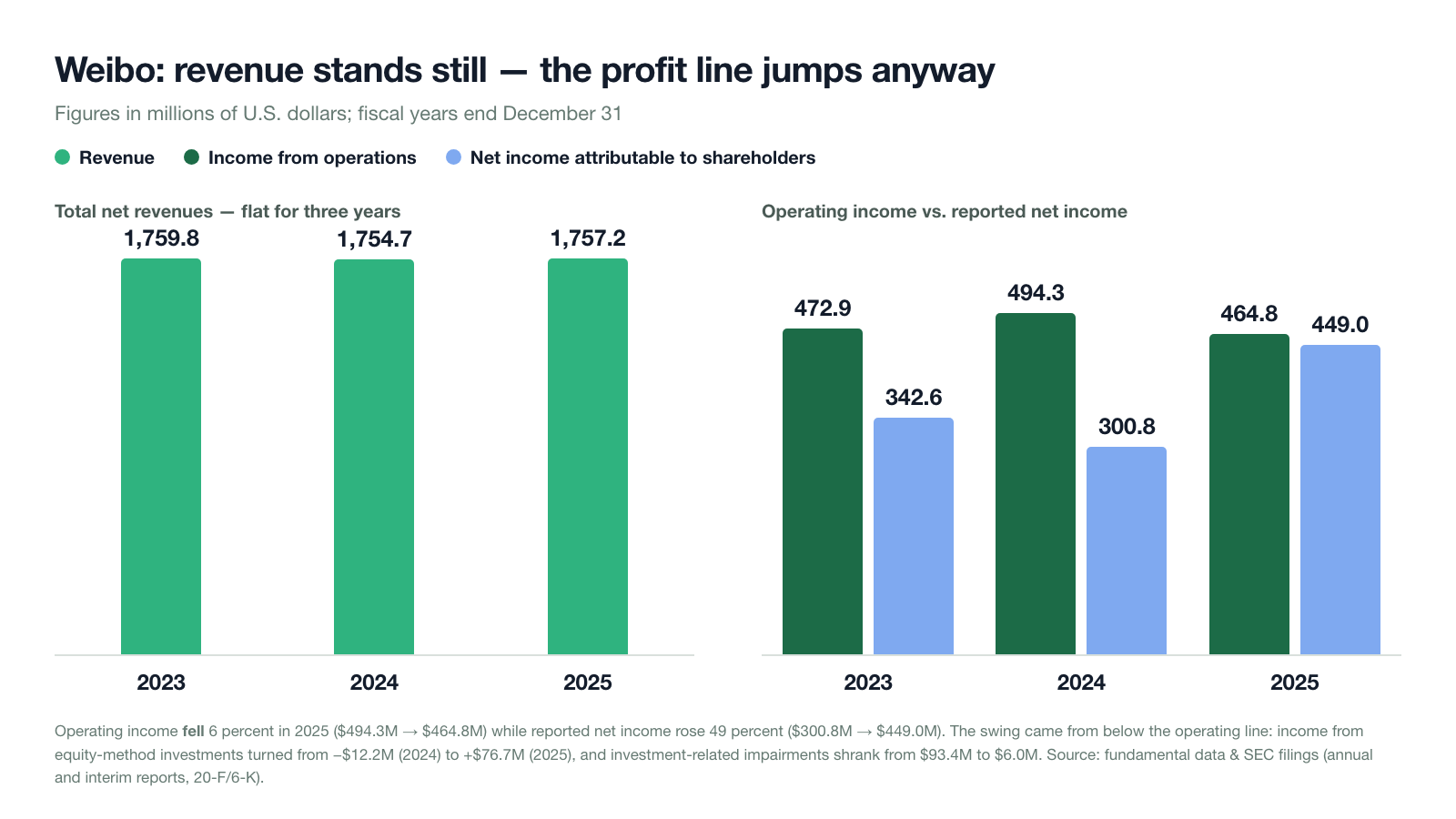
Start with what genuinely impresses, because it is real and it is unusual for a company this unloved. Weibo makes money — a lot of it, every year. Income from operations was US$472.9 million (2023), US$494.3 million (2024) and US$464.8 million (2025): three consecutive years around half a billion dollars, at operating margins between 26 and 28 percent. Operating cash flow in 2025 was US$519.5 million. Cash, cash equivalents and short-term investments stood at US$2,405.1 million on December 31, 2025 — against a market value of roughly US$1.88 billion (data as of July 15, 2026). Read that twice: the cash box alone is worth more than the whole company on the exchange. Book value attributable to Weibo's shareholders was US$3,920.7 million; the market pays less than half of it. Against that sit debts of about US$1.86 billion (unsecured senior notes US$745.6 million, convertible senior notes US$323.9 million, long-term loans US$794.0 million), so the net cash position is roughly US$540 million rather than US$2.4 billion — but it is a net cash position, in a company that earns. Now the part the headline number hides. Revenue has not moved in three years: US$1,759.8 million (2023), US$1,754.7 million (2024), US$1,757.2 million (2025) — a total change of minus 0.1 percent across three years, which is not stagnation so much as suspended animation. And yet reported net income attributable to shareholders jumped 49 percent, from US$300.8 million to US$449.0 million. A flat revenue line and a profit line that leaps by half: that combination is either brilliant cost control or something else. Turn the page.
What the filings say — the uncomfortable truths
Uncomfortable truth no. 1: you are not buying the company — you are buying contracts with it
Chinese law restricts or prohibits foreign ownership of internet content licenses. Weibo solves this, like most Chinese internet groups, through a construction called a VIE — variable interest entity: the license-holding companies belong to Chinese individuals, and the listed Cayman Islands holding company merely holds a bundle of private contracts with them — loan agreements, option agreements, powers of attorney, service agreements — that are supposed to route the profits and the control to New York. Translated: you are not buying the stadium, you are buying a stack of contracts with the person whose name is on the deed, who promises to hand over the billboard money. The annual report opens with the point rather than burying it:
"Weibo Corporation is not an operating company in China, but a Cayman Islands holding company with no equity ownership in the VIEs. […] Revenues contributed by the VIEs and their subsidiaries accounted for 87.0%, 86.2% and 85.9% of our total revenues for the years of 2023, 2024 and 2025, respectively."
— Weibo Corporation, SEC annual report 20-F for 2025, Item 3 "Key Information — Our Holding Company Structure and Contractual Arrangements with the VIEs"

The report is equally direct about who does hold the deed. The licenses sit in two companies, Weimeng and Weimeng Chuangke, and Weimeng belongs to "four PRC employees of us or SINA, namely, Yunli Liu, Wei Wang, Wei Zheng and Zenghui Cao", holding 29.70, 29.70, 19.80 and 19.80 percent, with a 1 percent third-party holder. The contracts binding them include spousal consent letters — because a divorce could otherwise put a license stake in play. Weibo's own filing grants that these arrangements "may not be as effective as direct ownership in providing us with control over the VIEs" and that they "have not been tested in court to date"; if Beijing were to strike the structure down, the company "could be subject to severe penalties or be forced to relinquish our interests in those operations". This has been the industry standard for two decades; Beijing has tolerated it throughout; nothing here is hidden. But tolerated is not guaranteed. A second imponderable rides alongside: under the Holding Foreign Companies Accountable Act (HFCAA), Chinese ADSs face a U.S. trading ban if the American audit watchdog PCAOB cannot inspect their auditors for two consecutive years. That danger receded when the PCAOB regained access to inspections in mainland China and Hong Kong at the end of 2022 — and Weibo has a second door in any case: it has been dual-listed in Hong Kong (HKEX: 9898) since 2021, so a New York delisting would not vaporize the shares the way it would for a New-York-only ADR. Remember the mechanism: whoever buys the shell trusts the chain — and the chain is only as strong as its most private link.
Uncomfortable truth no. 2: the record profit was not earned by the business
Here is the number that gets quoted: net income attributable to Weibo's shareholders rose from US$300.8 million (2024) to US$449.0 million (2025), up 49 percent, in a year when revenue moved by 0.1 percent. The annual report states both facts in the same breath:
"Our revenues in 2023, 2024 and 2025 were US$1,759.8 million, US$1,754.7 million and US$1,757.2 million, respectively. We had a net income attributable to Weibo's shareholders of US$342.6 million in 2023, US$300.8 million in 2024 and US$449.0 million in 2025."
— Weibo Corporation, SEC annual report 20-F for 2025, Item 5 "Operating and Financial Review and Prospects"

Now walk down the income statement, which is where the story actually lives. Income from operations fell: US$494.3 million (2024) to US$464.8 million (2025), minus 6 percent. So the operating business earned less in the record year. Everything that made the difference sits below the operating line, and it is investment accounting, not advertising: income from equity-method investments — Weibo's stakes in other companies — swung from minus US$12.2 million to plus US$76.7 million, a US$88.8 million turn; investment-related impairments collapsed from US$93.4 million (2024) to US$6.0 million (2025), another US$87.4 million of relief; and interest expense fell from US$105.4 million to US$82.4 million. Add those three and you have more than the entire profit increase. Put plainly: 2024 was depressed by a $93 million writedown on investments, and 2025 was flattered by a $77 million gain on investments — the advertising business did slightly worse in both. That is not a scandal and it is not hidden; the numbers sit in the report exactly where they belong. But it means the "49 percent profit growth" is a statement about Weibo's portfolio of minority stakes, not about the platform. And the mechanism cuts both ways, as the very next quarter showed: in the first quarter of 2026 (interim report 6-K of May 28, 2026), revenue rose 6 percent to US$421.3 million — but only 1 percent on a constant-currency basis, meaning the growth was mostly a weaker dollar — while net income attributable to shareholders collapsed 68 percent, from US$107.0 million to US$34.7 million. The cause was, once again, below the line: a US$35.0 million loss from fair-value changes on investments and US$22.1 million of equity pick-up losses. Non-GAAP net income, which strips those out, fell more modestly to US$91.9 million from US$119.5 million — but the non-GAAP operating margin still slipped from 33 to 28 percent. Remember the image: when the profit line swings by half while revenue does not move, you are watching the investment portfolio, not the business.
Uncomfortable truth no. 3: the base is shrinking under the flat revenue line — and Alibaba is filling the gap
A flat revenue line can mean a stable business. At Weibo it means two moving parts that happen to cancel out. Start with the people: monthly active users have fallen three years running, and the annual report says so without varnish:
"Our MAUs decreased slightly from 598 million in December 2023 to 590 million in December 2024, and 567 million in December 2025, as we have proactively adjusted our user strategy to focus on the acquisition and engagement of high quality users."
— Weibo Corporation, SEC annual report 20-F for 2025, Item 4 "Information on the Company — Business Overview"

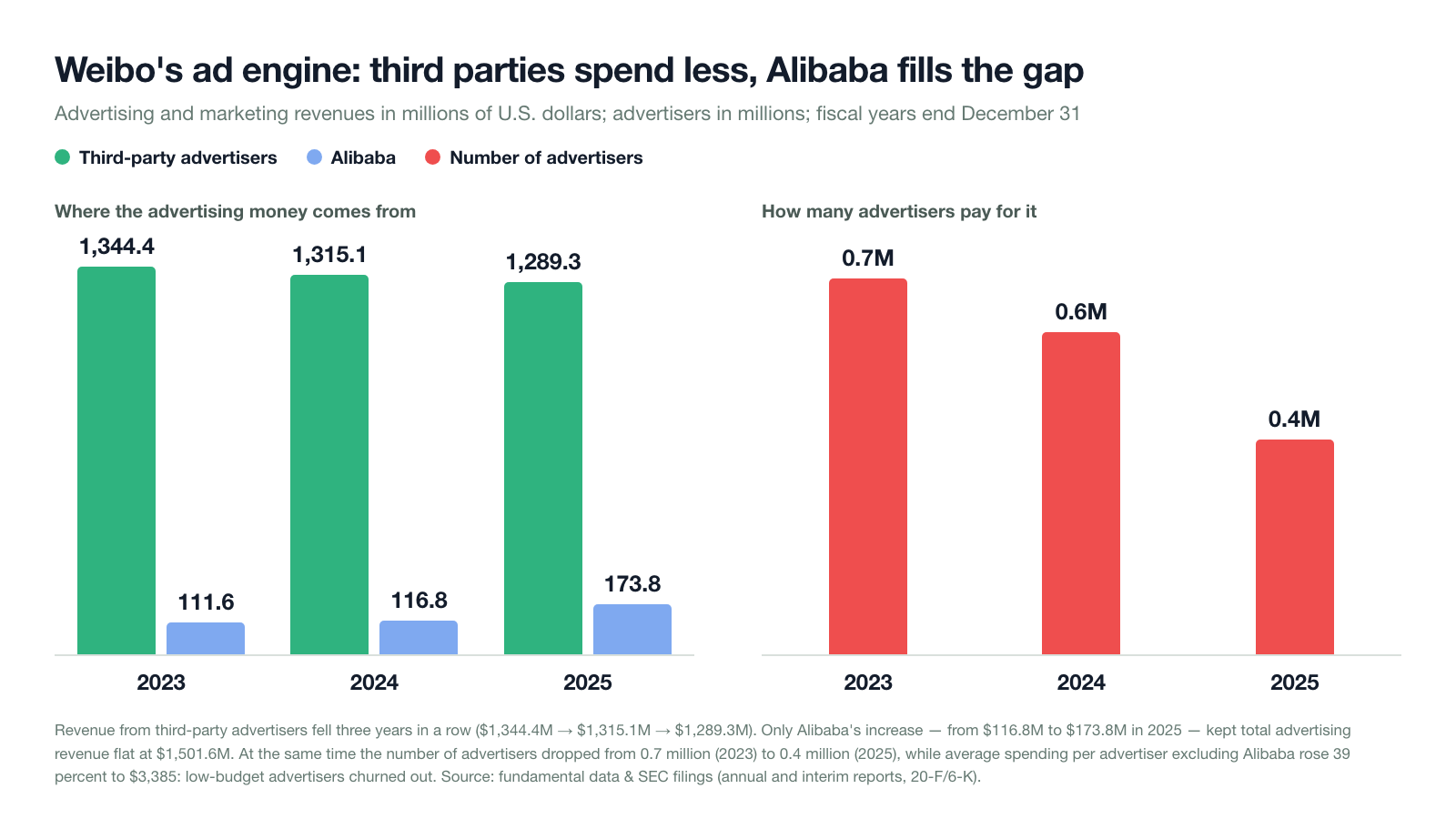
"Proactively adjusted our user strategy" is a defensible reading — a platform can shed low-value users on purpose — but it is worth noting what Weibo is up against, in its own words: it competes with "Weixin/WeChat", with "Douyin/TikTok, Kuaishou, Bilibili, Xiaohongshu (also known as RedNote)", and with the news apps of "Tencent and Bytedance". Those are the largest attention machines on earth, and they are not shedding users on purpose. By March 2026 the count was 562 million (interim report 6-K of May 28, 2026) — the drift continues. Now the advertisers, where the erosion is much starker than the revenue line admits: the number of advertisers fell from 0.7 million (2023) via 0.6 million (2024) to 0.4 million (2025) — a third of the customer base gone in a single year. Weibo explains it, again candidly, as churn at the bottom: the average spend per advertiser excluding Alibaba rose 39 percent to US$3,385 "primarily due to the churn of advertisers with relatively lower advertising budgets". Fine — but follow the money by counterparty and the picture sharpens into the real risk. Revenue from third-party advertisers declined every single year: US$1,344.4 million (2023), US$1,315.1 million (2024), US$1,289.3 million (2025). What kept total advertising revenue flat was one customer: Alibaba, whose spending rose from US$116.8 million to US$173.8 million in 2025 — an extra US$57.0 million that almost exactly offsets the third-party decline. Alibaba now accounts for about 12 percent of advertising revenue, and Weibo carried US$45.8 million of receivables from it at year-end. The report is refreshingly blunt about how reliable that pillar is:
"The advertising spending from Alibaba highly correlates to its own business operation, especially its marketing strategies, which fluctuates from time to time."
— Weibo Corporation, SEC annual report 20-F for 2025, Item 5A "Operating Results"
Picture a stadium whose billboards are emptying one by one — but a single large sponsor keeps buying more of them, so the revenue from billboards looks unchanged. That is not stability; that is concentration wearing stability's clothes. And it is a concentration that depends on the marketing budget of a company Weibo does not control, in a year of its own choosing. How the other side of this trade looks — a platform where advertising is diversified across millions of customers — is what makes the comparison with Alphabet instructive: the same business model, the opposite customer structure.
Uncomfortable truth no. 4: in the record year, the receipt got smaller — and the buyback never happened
Now back to the reflex we started with. Weibo pays a dividend, and it is a real one: US$200.1 million, US$199.4 million and US$200.6 million went to shareholders in 2023, 2024 and 2025 — roughly $200 million a year, paid in cash, three years running. That is the receipt, and it is genuine. But look at what the board decided in the record year:
"In March 2026, our board of directors approved an annual cash dividend for the year ended December 31, 2025 of US$0.61 per ordinary share, or US$0.61 per ADS […] For the years ended December 31, 2023, 2024 and 2025, dividends made to Weibo Corporation's shareholders were US$200.1 million, US$199.4 million and US$200.6 million, respectively."
— Weibo Corporation, SEC annual report 20-F for 2025, Item 8 "Financial Information — Dividend Policy"

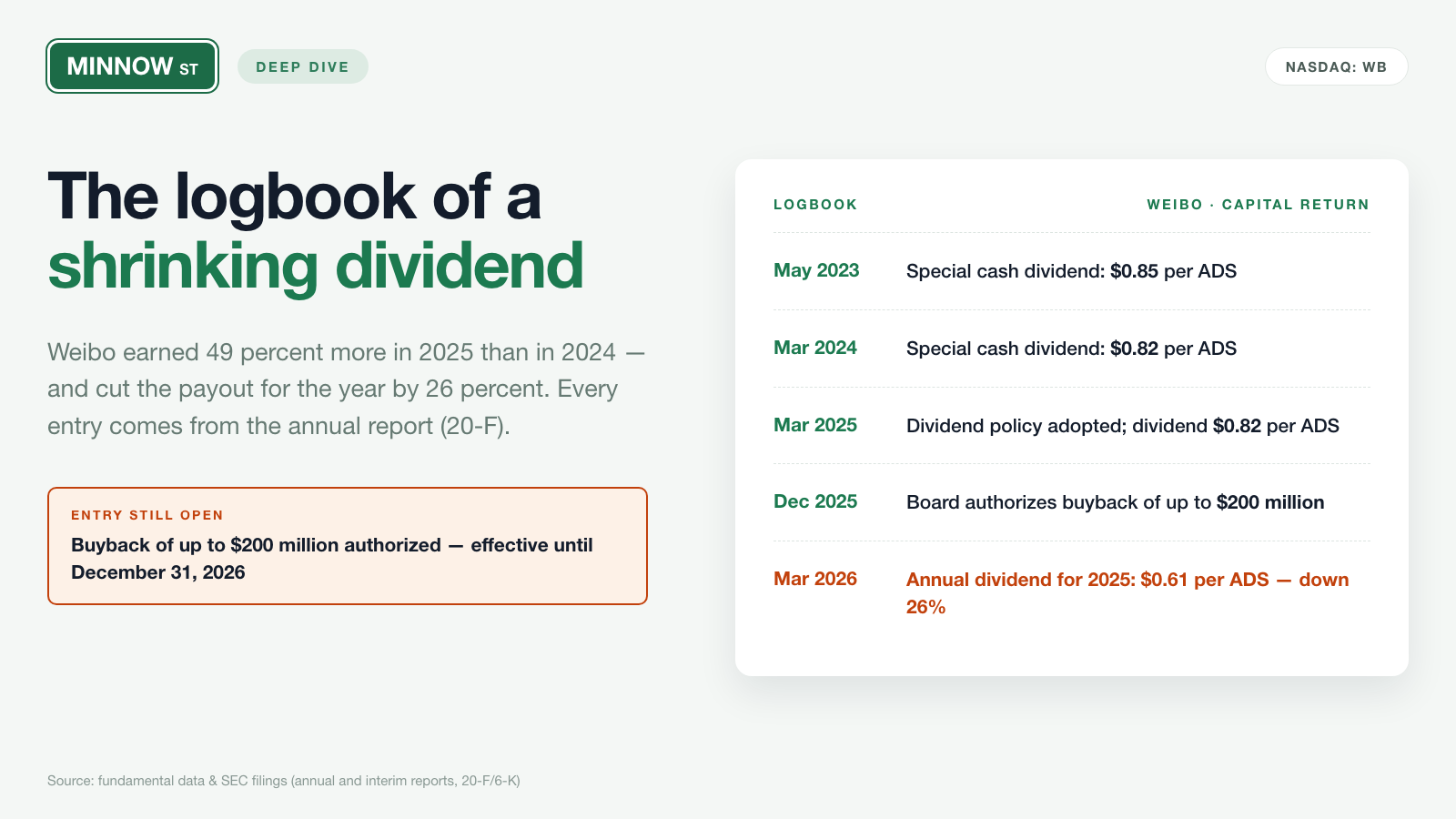
Line the payments up and the trend is unmistakable: a special dividend of US$0.85 per ADS in May 2023, US$0.82 in March 2024, US$0.82 in March 2025 under a newly adopted formal dividend policy — and then, in March 2026, for the year in which reported profit rose 49 percent, US$0.61. That is a 26 percent cut. In money: the dividend payable on the balance sheet as of March 31, 2026 was US$149.7 million — about US$50 million less than each of the three prior years. The payout ratio roughly halved, from about two thirds of net income to about a third. To be fair, there is a defensible reading, and Weibo offers it: in December 2025 the board authorized a share repurchase program of up to US$200 million, running until December 31, 2026. Buying back stock at half of book value is arithmetically a better use of a dollar than paying it out — so a shift from dividends to buybacks would be, in principle, good news, and would lift total intended capital return from about $200 million to as much as $350 million. Which brings us to Item 16E of the annual report, the item whose entire purpose is to disclose what the issuer actually purchased. It reads, in full and in eight words:
"We did not make any share repurchase in 2025."
— Weibo Corporation, SEC annual report 20-F for 2025, Item 16E "Purchases of Equity Securities by the Issuer and Affiliated Purchasers"
In fairness, the program was authorized in December, leaving barely three weeks of the year — nobody should expect much. But the interim report (6-K) for the first quarter of 2026, published on May 28, 2026, reports no repurchases either, and the annual report's own risk factors add the standard caution: "We cannot guarantee that any share repurchase program will be fully consummated." So as of the latest filed documents, the arithmetic is: the dividend is US$50 million smaller, and the buyback that was supposed to more than replace it has bought nothing. Remember the yardstick: an authorization is a press release; a repurchase is a receipt. Only one of them is money.
Valuation: about 4.5 times earnings — and the market still says no
In mid-July 2026 Weibo's ADS cost about US$7.74, giving the company a market value of roughly US$1.88 billion (all valuation figures: data as of July 15, 2026). The multiples are the reason anyone looks at this stock at all. On 2025 diluted earnings of US$1.70 per share, that is a price-to-earnings ratio of about 4.5; on trailing twelve-month earnings of about US$1.43 — lower, because the first quarter of 2026 collapsed — it is about 5.4. The price-to-sales ratio is about 1.1; the price-to-book ratio about 0.5 against shareholders' equity of US$3,920.7 million. Calculate like a buyer of the whole company — market value plus about US$1.86 billion of debt, minus US$2,405.1 million of cash and short-term investments — and the enterprise value lands near US$1.34 billion: about 0.76 times revenue, and less than three times 2025 operating income. On the declared dividend of US$0.61 the yield is roughly 7.9 percent. By any Western yardstick these are the numbers of a company the market expects to shrink or to be expropriated. The professionals' view is, unusually, not a chorus: of 21 analysts, 9 say strong buy, 10 say hold, 2 say sell, and the average target price sits around US$9.04 — roughly 17 percent above the mid-July price, which for a stock at 4.5 times earnings is a strikingly modest ambition. Read that consensus honestly: even the optimists are not underwriting a re-rating; they are pricing a discount that persists. And that is the correct way to hold all of this in your head. Weibo is not cheap because the market has overlooked it — it is cheap because the market is charging for four specific things: that you own contracts rather than the company; that the profit engine is a minority-stake portfolio rather than the platform; that users, advertisers and third-party money are all receding; and that the cash pile, though larger than the market value, sits in Chinese banks under a structure whose ability to move money to Cayman depends on rules Beijing can rewrite. Whether that discount is too large is a genuine question — a company earning half a billion dollars a year for a $1.88 billion price tag is not obviously mispriced in the wrong direction. But it is a discount with reasons, not an oversight.
Opportunities and risks at a glance
What speaks for Weibo:
- A genuinely profitable platform: income from operations of US$472.9 million (2023), US$494.3 million (2024) and US$464.8 million (2025) at operating margins of 26 to 28 percent, with US$519.5 million of operating cash flow in 2025 (annual report 20-F for 2025).
- A cash box larger than the company: US$2,405.1 million in cash and short-term investments as of December 31, 2025, against a market value of about US$1.88 billion; net cash of roughly US$540 million after about US$1.86 billion of debt; shareholders' equity of US$3,920.7 million versus a price-to-book ratio near 0.5 (data as of July 15, 2026).
- Real reach and a real moat of habit: 567 million monthly and 252 million daily active users in December 2025 — Weibo's trending-topics list remains the default public square for Chinese media, celebrity and brand marketing.
- Capital is being returned, and could be returned faster: about US$200 million of dividends paid in each of 2023, 2024 and 2025, a formal dividend policy adopted in March 2025, and a US$200 million buyback authorized in December 2025 that runs until December 31, 2026 — at half of book value, an unusually accretive use of cash if it is executed.
- The delisting nightmare is hedged: Weibo has been dual-listed in Hong Kong (HKEX: 9898) since 2021, so an HFCAA-driven exit from New York would not leave shareholders without a market; the PCAOB regained inspection access in mainland China and Hong Kong at the end of 2022.
What speaks against it:
- You do not own the operating business: the listed Cayman company holds "no equity ownership in the VIEs" that generated 85.9 percent of 2025 revenue; the licenses belong to four named private individuals; the contracts "have not been tested in court to date", and a PRC ruling against the structure could mean "severe penalties" or the loss of those interests.
- The record profit was not operational: income from operations fell 6 percent in 2025 while reported net income rose 49 percent — the gap came from equity-method investments (minus US$12.2 million to plus US$76.7 million) and vanished impairments (US$93.4 million to US$6.0 million). The reverse hit immediately: Q1 2026 net income fell 68 percent to US$34.7 million on a US$35.0 million investment fair-value loss (6-K of May 28, 2026).
- Every base metric is receding: MAUs from 598 million to 567 million (December 2023 to December 2025) and 562 million by March 2026; advertisers from 0.7 million to 0.4 million; third-party advertising revenue from US$1,344.4 million to US$1,289.3 million — with revenue growth of just 1 percent on a constant-currency basis in Q1 2026.
- Concentration where it matters most: only Alibaba's increase from US$116.8 million to US$173.8 million kept total advertising revenue flat, and Weibo itself notes that this spending "highly correlates to its own business operation […] which fluctuates from time to time" — while Weibo competes for attention with WeChat, Douyin, Kuaishou, Bilibili and Xiaohongshu.
- Capital return is shrinking and unproven: the dividend per ADS fell 26 percent from US$0.82 to US$0.61 in the record year (about US$149.7 million payable versus roughly US$200 million previously), and the US$200 million buyback authorized in December 2025 had not repurchased a single share as of the annual report ("We did not make any share repurchase in 2025") or the Q1 2026 interim report. Governance leaves little recourse: SINA holds 35.7 percent of the shares but 62.5 percent of the votes (March 31, 2026).
A human conclusion
Back to the receipt from the opening — because with this stock it turns out to be the whole method. Finding one: the receipt is real. Weibo earns about half a billion dollars a year in operating profit, at a 26 percent margin, and has paid roughly $200 million a year to its shareholders for three years. This is a real business with real cash — more of it, in fact, than the stock market says the whole company is worth. Anyone who dismisses Weibo as a value trap without opening the filings is skipping a genuinely profitable company. Finding two: the receipt does not say what you think it says. The 49 percent profit jump was written by the investment portfolio, not the platform — operating income fell that year — and the very next quarter the same mechanism ran in reverse and took 68 percent of the profit with it. Finding three: the receipt is getting smaller, and the promised bigger one has not been issued. In the best reported year in half a decade, the board cut the dividend per ADS by 26 percent and authorized a $200 million buyback that, per its own Item 16E, bought nothing. Finding four, and the one a U.S. reader should sit with longest: you never held a deed at all. What trades under the ticker WB is a share in a Cayman Islands holding company that owns no equity in the Chinese companies doing the work — those belong, on paper, to four employees whose spouses had to sign consent letters. So: is a company earning $465 million a year, sitting on $2.4 billion of cash, worth $1.88 billion? On arithmetic, that looks absurdly cheap. On the documents, the discount has four names, and each of them is written in Weibo's own words in its own annual report. Whoever buys here is not buying a mispricing that the market missed — they are taking the other side of four risks the market has priced deliberately, and betting that at 4.5 times earnings they are being paid enough to carry them. Whoever passes is not being timid; they are declining to accept contracts in place of ownership at any price. Both are defensible. What you make of it is your decision. And that is exactly as it should be.
Sources
All original documents used in this analysis — to read for yourself:
- Weibo Corporation — SEC annual report 20-F for 2025 (filed April 23, 2026)
- Weibo Corporation — SEC annual report 20-F for 2024 (filed April 15, 2025)
- Weibo Corporation — SEC interim report 6-K, Exhibit 99.1: first quarter 2026 unaudited financial results (filed May 28, 2026)
- Weibo Corporation's complete SEC filing history: EDGAR overview (sec.gov)
- Fundamental data (valuation, quote, analyst estimates; data as of July 15, 2026), reconciled with the SEC filings.
- Reddit mentions: ApeWisdom (3 mentions in 24 hours, as of July 16, 2026).
Transparency & disclaimer: This analysis is a journalistic contextualization of publicly available information and is not investment advice, not a financial analysis in the regulatory sense, and not a solicitation to buy or sell securities. Stock investments carry substantial risks up to total loss. All information without guarantee; the data cut-off is noted in the text in each case. The author holds no position in Weibo stock at the time of publication.
Our Bottom Line at a Glance
- Earnings power & balance sheet positive
- A genuinely profitable platform: income from operations of US$464.8 million in 2025 at a 26 percent margin, US$519.5 million of operating cash flow, US$2,405.1 million of cash and short-term investments against about US$1.86 billion of debt — a net cash position, and a cash box worth more than the entire US$1.88 billion market value (annual report 20-F for 2025; market data as of July 15, 2026).
- Corporate structure (VIE) negative
- ADS buyers acquire no equity in the operating business: the Cayman holding company has, in its own words, "no equity ownership in the VIEs" that produced 85.9 percent of 2025 revenue; the licenses belong to four named private individuals; the contracts "have not been tested in court to date", and a PRC ruling against the structure could bring "severe penalties" or loss of those interests (annual report 20-F for 2025, Item 3).
- Quality of earnings negative
- The 49 percent profit jump to US$449.0 million in 2025 came from below the operating line — equity-method investments swung from minus US$12.2 million to plus US$76.7 million and impairments fell from US$93.4 million to US$6.0 million — while income from operations fell 6 percent. The mechanism reversed at once: Q1 2026 net income minus 68 percent to US$34.7 million on a US$35.0 million investment fair-value loss (6-K of May 28, 2026).
- Growth & competitive position negative
- Revenue flat for three years (US$1,759.8m / US$1,754.7m / US$1,757.2m) and just +1 percent on a constant-currency basis in Q1 2026; MAUs down from 598 million to 567 million (12/2023 to 12/2025) and 562 million by March 2026; advertisers down from 0.7 million to 0.4 million; third-party ad revenue down three years running, with only Alibaba (US$116.8m → US$173.8m) keeping the total flat — against WeChat, Douyin, Kuaishou, Bilibili and Xiaohongshu.
- Capital return neutral
- Roughly US$200 million of dividends paid in each of 2023, 2024 and 2025 is real money, and a US$200 million buyback at half of book value would be accretive. But the dividend per ADS was cut 26 percent to US$0.61 in the record year (about US$149.7 million payable), and of the buyback authorized in December 2025 nothing had been executed: "We did not make any share repurchase in 2025" — nor per the Q1 2026 interim report.
- Valuation positive
- About 4.5 times 2025 diluted earnings (about 5.4 times trailing twelve-month earnings), roughly 0.5 times book value, about 1.1 times revenue and an enterprise value near US$1.34 billion — less than three times operating income — plus a dividend yield around 7.9 percent. Analysts are split rather than enthusiastic: 9 strong buy, 10 hold, 2 sell, average target about US$9.04 (data as of July 15, 2026).
Weibo is a genuinely profitable company at a distressed price: about US$465 million of operating income, US$2.4 billion of cash against a US$1.88 billion market value, roughly 4.5 times 2025 earnings and half of book value. But the discount has four documented reasons. ADS holders own contracts with a Cayman shell rather than equity in the operating business, which earns 85.9 percent of revenue. The record profit was written by the investment portfolio, not the platform — operating income fell, and Q1 2026 net income dropped 68 percent when the same mechanism reversed. Users, advertisers and third-party ad money are all receding, with only Alibaba filling the gap. And in the record year the board cut the dividend per ADS by 26 percent while its authorized US$200 million buyback repurchased nothing. Not investment advice.
What Our Rating Means
- If you don't own the stock
- As long as the question raised in the bottom line stays open, we see no basis for an entry.
- If you hold it in your portfolio
- Our findings offer no acute reason to sell — the checkpoints named remain decisive.
A journalistic assessment by our editorial team at the time of the deep dive, based on public sources — not investment advice and not a solicitation to buy or sell. Your personal circumstances (investment goals, risk capacity, taxes) cannot be taken into account. What our categories mean, how verdicts are formed, and what conflicts of interest exist →
Worth Noting
- WB reached our research list via the Reddit hype scanner (ApeWisdom, 3 mentions in 24 hours, as of July 16, 2026) — the striking part was the silence: a company with 567 million users and an 8 percent dividend yield generates no forum conversation at all.
- WB has no row in our fundamental in-house stock scanner: it works through the Russell 3000 (U.S. companies), and Weibo is a Chinese company with depositary shares in New York. There are therefore no scanner metrics (Piotroski, Altman Z) for this analysis — only the original SEC documents.
- Weibo is a foreign private issuer: its documents are the annual report 20-F and interim reports 6-K, not 10-K/10-Q. Quarterly figures come as voluntary attachments to a 6-K rather than as audited mandatory reports.
- Price and valuation figures are dated to July 15, 2026 (about US$7.74 per ADS, market value roughly US$1.88 billion); analyses are evergreen, daily prices are not a buy argument.
Frequently Asked Questions
Weibo (Nasdaq: WB) runs China's largest microblogging platform and sells advertising on the attention it collects. Of US$1,757.2 million in total revenues in 2025, US$1,501.6 million — about 85 percent — came from advertising and marketing services, and US$255.6 million from value-added services such as memberships and game-related services. Income from operations was US$464.8 million, a 26 percent operating margin.
Because the increase did not come from the business. Income from operations actually fell from US$494.3 million (2024) to US$464.8 million (2025). The jump in net income attributable to shareholders — from US$300.8 million to US$449.0 million — came from below the operating line: equity-method investments swung from minus US$12.2 million to plus US$76.7 million, and investment-related impairments fell from US$93.4 million to US$6.0 million (annual report 20-F for 2025).
Yes. In March 2026 the board approved an annual dividend of US$0.61 per ADS for fiscal 2025, after US$0.82 in March 2025 and March 2024 and a US$0.85 special dividend in May 2023 — a cut of about 26 percent, declared in the year reported profit rose 49 percent. Dividends actually paid were roughly US$200 million in each of 2023, 2024 and 2025; the amount payable as of March 31, 2026 was US$149.7 million.
Not as of the latest filed documents. The board authorized a repurchase program of up to US$200 million in December 2025, effective until December 31, 2026. Item 16E of the annual report 20-F for 2025 states: "We did not make any share repurchase in 2025." The interim report (6-K) for the first quarter of 2026, filed May 28, 2026, does not report any repurchases either.
You own a share in a Cayman Islands holding company, not in the Chinese operating business. Because PRC law restricts foreign ownership of internet licenses, Weibo controls its China business through contracts with variable interest entities (VIEs) it has, in the annual report's words, "no equity ownership" in. Those VIEs produced 85.9 percent of 2025 revenue; their shares belong to four private individuals who are employees of Weibo or of SINA.
Yes, slowly. Monthly active users fell from 598 million (December 2023) via 590 million to 567 million (December 2025), and stood at 562 million in March 2026; average daily active users went from 257 million to 252 million. Weibo describes this as a deliberate focus on "high quality users". It competes with WeChat, Douyin, Kuaishou, Bilibili and Xiaohongshu for the same attention.
More than the flat revenue line suggests. Revenue from third-party advertisers fell three years running (US$1,344.4 million to US$1,289.3 million from 2023 to 2025). Only Alibaba's increase — from US$116.8 million to US$173.8 million in 2025, about 12 percent of advertising revenue — kept the total flat. Weibo notes that this spending "highly correlates to its own business operation […] which fluctuates from time to time".
At about US$7.74 per ADS in mid-July 2026 the market value is roughly US$1.88 billion — about 4.5 times 2025 diluted earnings, about 0.5 times book value, and less than the US$2,405.1 million of cash and short-term investments on the balance sheet. The discount has reasons: the VIE structure, a profit driven by investment revaluations rather than the platform, shrinking users and advertisers, and a shrinking dividend (data as of July 15, 2026).
Found an error?
Did you spot a factual error, an outdated number, or a typo in this deep dive? Let us know briefly — your report goes straight to the editorial team.