ServiceNow Stock: Market Value Halved, Growth Unbroken — and a $7.8 Billion Bet on Borrowed Money
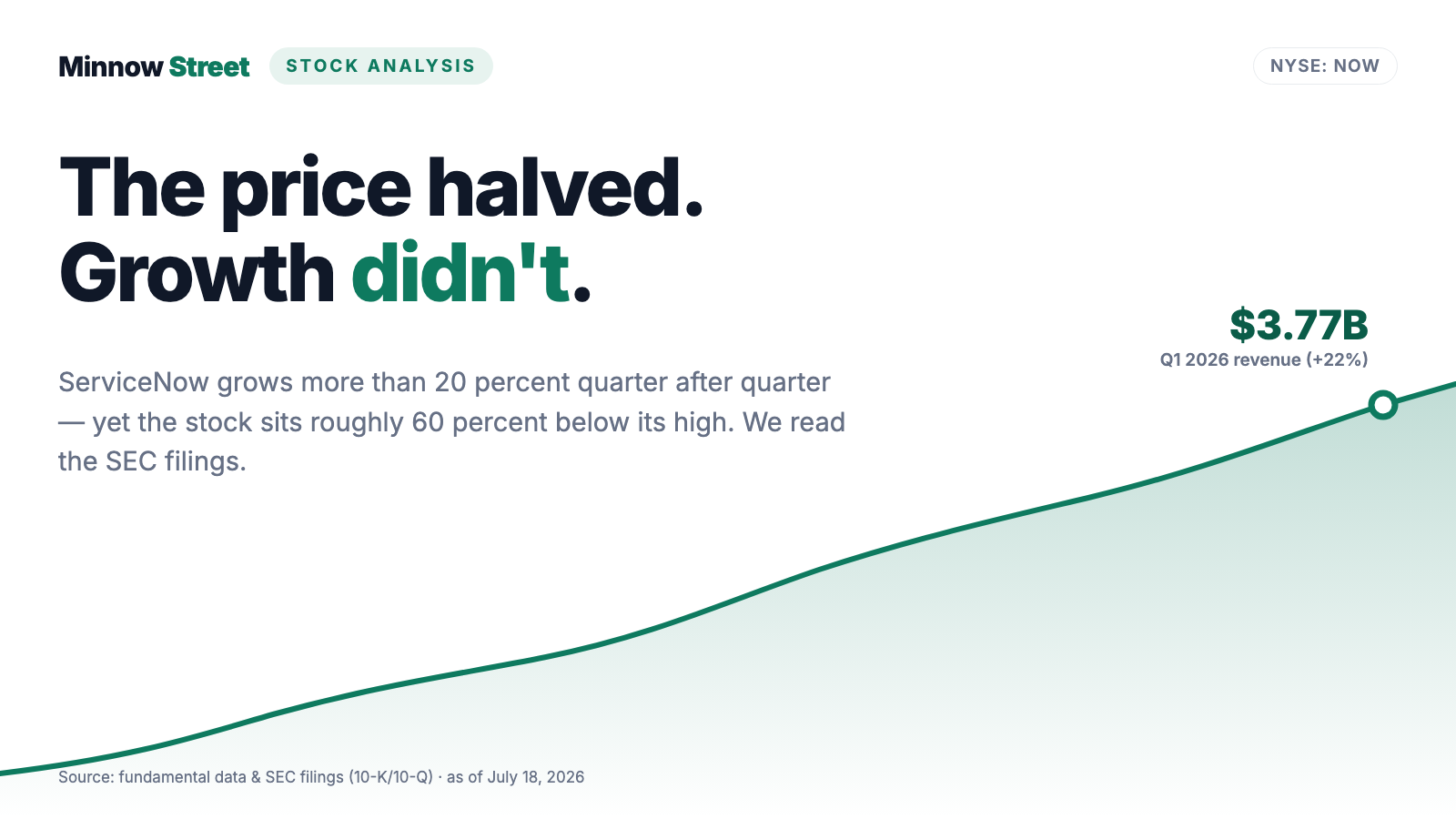
ServiceNow grows more than 20 percent quarter after quarter, renews 98 percent of its contracts and sits on $28.2 billion of contracted future revenue — yet its market value has more than halved since mid-2025, from $215 billion to about $89.5 billion, and our in-house turnaround scanner ranks the stock no. 2 in the U.S. selection (turnaround check 7 of 8, as of July 18, 2026). We read the annual reports (10-K) and the quarterly report (10-Q) as of March 31, 2026: earnings per share growing just 2 percent, stock-based compensation larger than all of operating income, a single partner supplying 12 percent of revenue — and a $7.8 billion acquisition funded partly with a $4.0 billion loan that comes due after six months. Not investment advice — just the question of whether a halved price is the same thing as a bargain.
 Thomas Mücke
Founder & Publisher
Thomas Mücke
Founder & Publisher
Chart
Interactive price chart (TradingView).
Note: pure fact-based analysis, not investment advice and not a solicitation to buy or sell. All figures without guarantee.
There is an investor trap that works better the bigger the crash: anchoring. Your brain stores the old all-time high like a manufacturer's suggested retail price — and everything below it automatically feels like a discount. "60 percent off the high? That has to be cheap." ServiceNow, Inc. (NYSE: NOW) is currently the perfect bait for that reflex: its market value has more than halved since mid-2025, from $215 billion to about $89.5 billion, while the business keeps growing as if nothing happened — and our in-house turnaround scanner ranks the stock no. 2 in the U.S. selection (turnaround check 7 of 8, as of July 18, 2026). So let's make a deal: before the anchor in your head makes the decision for you, we read together what the company itself filed, under penalty of law, with the U.S. securities regulator, the SEC — the annual reports (10-K) for 2025 and 2024 and the quarterly report (10-Q) as of March 31, 2026. Both things are in there: a subscription business that runs more reliably than most on the stock market. And three chapters of fine print that explain why the market turned its thumb down anyway. An old all-time high is not a price recommendation — it is just a backstory. What the halved price actually costs, we will calculate at the end.
What ServiceNow actually does — and why the AI question counts double here
ServiceNow, founded in 2004 and headquartered in Santa Clara, California, employs 29,187 people (December 31, 2025) and sells something gloriously unglamorous: the operating system for big organizations' busywork. When a laptop breaks at a large company, when a new hire needs system access, when a customer complaint wanders through three departments or the IT team works through a security vulnerability — at thousands of large customers, all of that runs on the ServiceNow platform. It is sold by subscription, typically over three years, paid in advance and practically non-cancellable during the term; 97 percent of revenue is subscription revenue. The business model is the opposite of a cyclical: it lives on renewal rates (98 percent — more on that in a moment) and on selling existing customers more modules year after year.
And AI? At ServiceNow it is both — sales pitch and attack surface. On the one hand, the company sells AI: the Now Assist product and its "AI agents" are paid add-on tiers across all product lines, including a consumption-based pricing component that kicks in when customers exceed their service credits — the annual report states the ambition to become "the defining AI enterprise software company of the 21st century." How capital-hungry the infrastructure behind this wave is, we covered from the supplier side in our Nvidia analysis. On the other hand, the same annual report contains the sentence every software investor currently fears:
"Cloud-based and AI native vendors may build more business applications or AI powered automation solutions that compete with our products and services."
— ServiceNow, Inc., SEC annual report 10-K for 2025, Item 1A "Risk Factors"
That is exactly the market's question hanging over this stock: if AI agents do the routine work, does anyone still need expensive workflow software with per-user licenses — or does ServiceNow become the toolbox those agents run on? Which brings us to the central tension of this analysis, running through every chapter: the subscription business grows like it always has — but the market suddenly prices in doubt, and management answers that doubt with speed: billion-dollar acquisitions, buybacks and loans.
Where the stock shows up in our scanner
Every day we run roughly 3,500 stocks through our scanners. As of July 18, 2026, ServiceNow has four hits, and the most important one is the reason for this analysis: rank 2 in the turnaround scanner (U.S. selection). To replicate it: open the scanner, set the country filter to "US" — the list sorts by the turnaround check, and ServiceNow sits right behind the leader with 7 of 8 points. The scanner works in two stages. First the mandatory part — the stock must trade at least 50 percent below its all-time high (ServiceNow: roughly 60 percent) and survival must be secured (Altman Z-score near 5, where the danger zone only begins below 1.1; equity ratio 48 percent). Then the checklist, eight points of operational turnaround and market confirmation: revenue stable (+22 percent in the latest quarter), net margin above its level three quarters ago, operating cash flow positive ($1.67 billion in Q1 2026), interest coverage improved, price back above the 50-day line, 3-month relative strength better than 12-month, institutional investors net buyers. The one missing point is an uncomfortable one: insiders are not buying. Over twelve months, 14 insider sales stood against 6 purchases — the people with the best view of the company are not reaching for the halved price so far. The fundamental lens fits that picture: a Piotroski F-score of 6 of 9 (a nine-point test of the direction of the books — 6 is okay, not good; rock-solid starts at 8). The other hits — Buffett criteria, owner earnings yield and fallen angels — tell the same story from three angles: a quality business after a crash. Remember the principle: a turnaround scanner finds candidates for a turn — whether the turn comes is written in no scanner, only in the filings. So that is what we read next.
The numbers over the years — honestly appraised
First, what genuinely impresses — and here that is a lot. Revenue climbed from $8.971 billion (2023) via $10.984 billion (2024) to $13.278 billion (2025, up 21 percent); the first quarter of 2026 added another 22 percent of growth to $3.770 billion. Customer retention is the real sensation of this business model:
"Our renewal rate was 98% for each of the years ended December 31, 2025, 2024 and 2023."
— ServiceNow, Inc., SEC annual report 10-K for 2025, Item 7 "Management's Discussion and Analysis"
Put into an everyday image: of 100 leases, 98 get renewed — year after year. The large accounts keep growing too: 603 customers paid more than $5 million in annual contract value at the end of 2025 (2024: 502; 2023: 420), and contracted, not-yet-recognized revenue (RPO) reached $28.2 billion (up 27 percent) — more than two full years of revenue already signed. Operating cash flow rose to $5.444 billion in 2025, leaving roughly $4.6 billion of free cash flow after investments. This is not a restructuring case, as the word "turnaround" suggests — it is a growth machine whose stock price crashed.
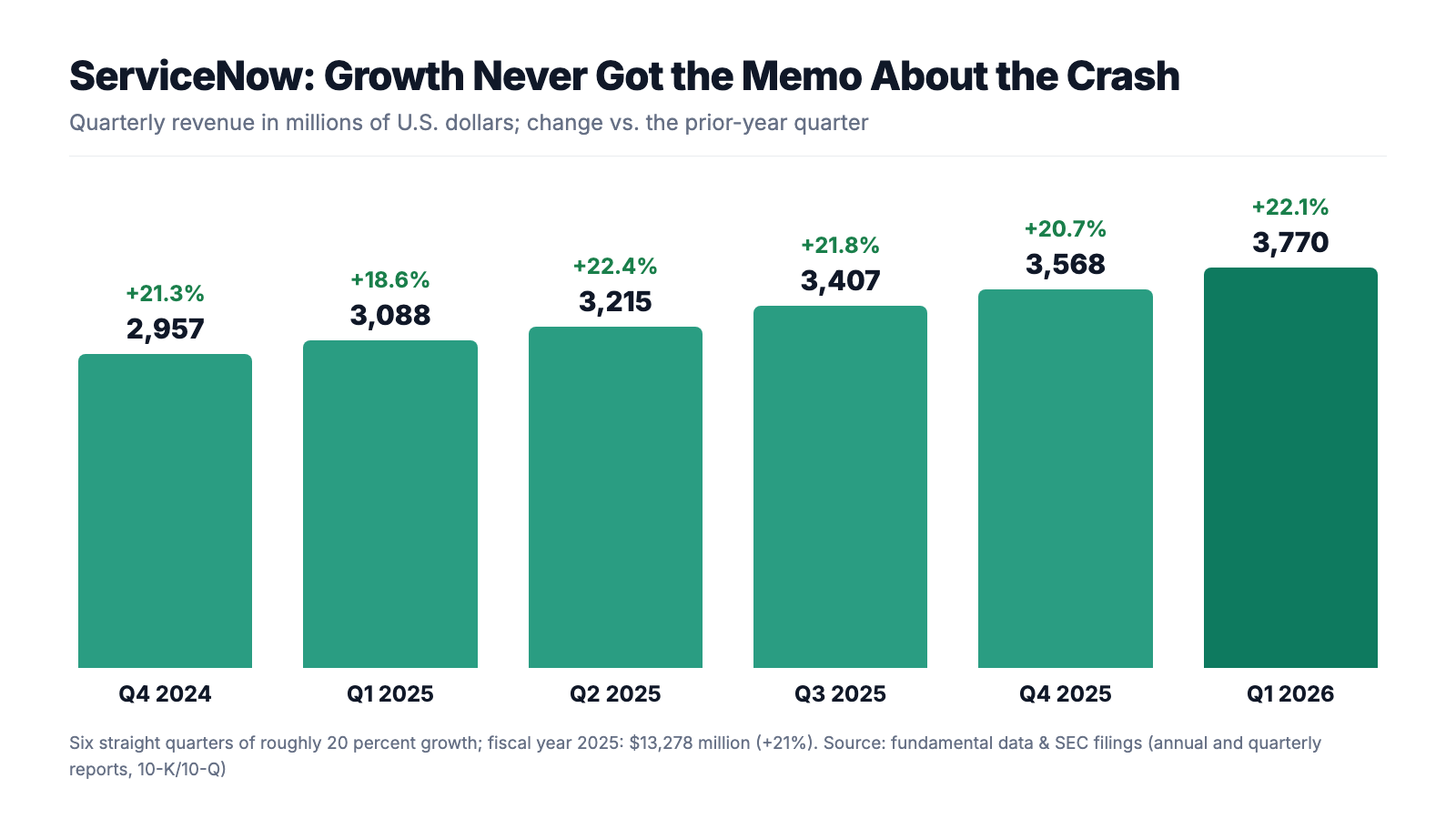
And now the other curve — the one that made the turnaround scanner fire in the first place. While revenue rose, the market value did this:
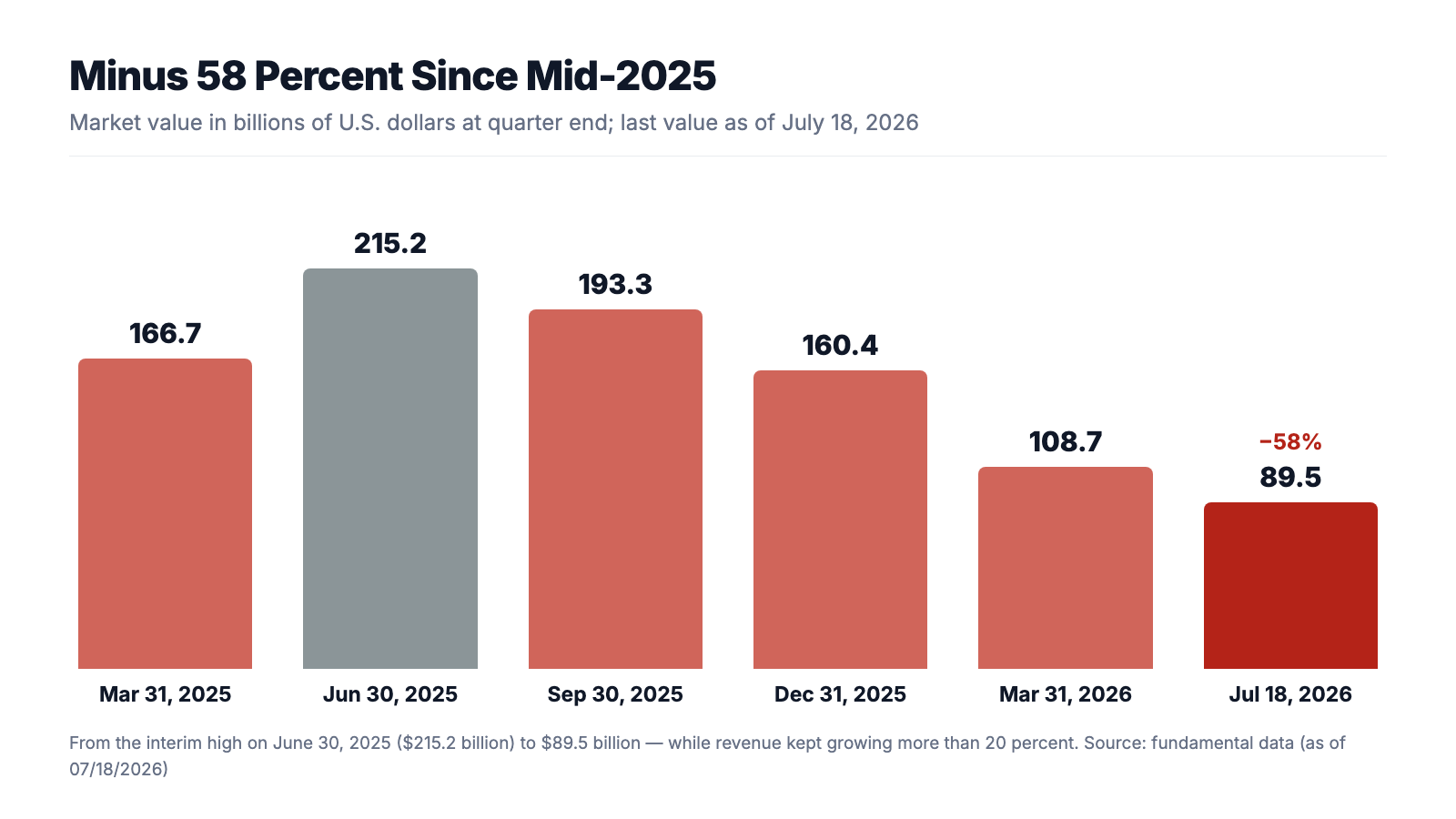
How do the two fit together? The answer sits in the profit line. In 2025, ServiceNow earned $1.748 billion in net income ($1.67 per diluted share) — comfortably above 2024's $1.425 billion, but barely above 2023's $1.731 billion, which, to be fair, included a one-time tax benefit of $723 million. And in the first quarter of 2026, almost nothing of the 22 percent revenue growth reached the bottom line: $469 million after $460 million — up 2 percent. The brakes: higher amortization from acquisitions ($258 million after $160 million), lower interest income ($88 million after $115 million, because the cash went into deals and buybacks) and a tax rate of 30 after 17 percent. The subscription gross margin gave way too: cost of subscription revenues jumped 46 percent — data centers and AI compute are expensive, and they get expensive faster than the AI add-on tiers bring in revenue. Remember the image: everything grows at the top, profit stalls at the bottom — and the stock price fell exactly into that gap.
What the filings say — the uncomfortable truths
Uncomfortable truth no. 1: Stock-based compensation exceeds operating income — while buybacks ran at $108 a share
ServiceNow reports operating income of $1.824 billion for 2025 (margin: 13.7 percent). The compensation employees receive in stock on top of their salaries sits one line deeper, in the notes — and it is larger:
"Total stock-based compensation expense for the years ended December 31, 2025, 2024 and 2023 was $1,955 million, $1,746 million and $1,604 million, respectively."
— ServiceNow, Inc., SEC annual report 10-K for 2025, Note 15 "Equity Awards"
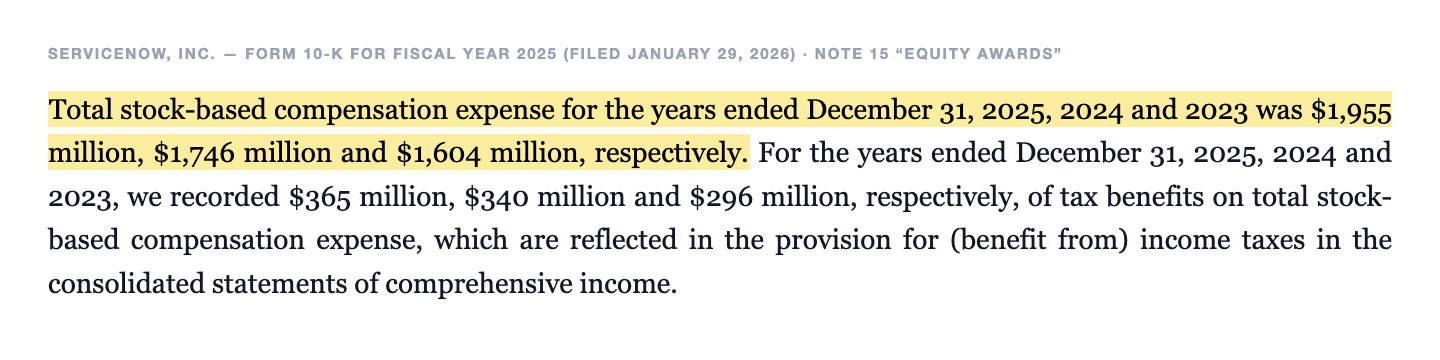
Put into an everyday image: of every dollar of operating profit the company earns by its own non-GAAP arithmetic ($4.149 billion), 47 cents go to the workforce as stock. Dilution means your slice of the cake shrinks when new slices keep getting cut. Against it, ServiceNow leans on buybacks — $1.8 billion in 2025, then $2.2 billion in the first quarter of 2026 alone, after the board authorized another $5.0 billion in January 2026. The timing deserves a second look:
"On January 30, 2026, we entered into an ASR agreement with a financial institution under which we purchased an aggregate of $2.0 billion of our common stock as part of the Share Repurchase Program. During the three months ended March 31, 2026, the Company completed the ASR transaction with 18.5 million shares of common stock repurchased at an average price of $107.97 per share."
— ServiceNow, Inc., SEC quarterly report 10-Q as of March 31, 2026, Note 13 "Stockholders' Equity"
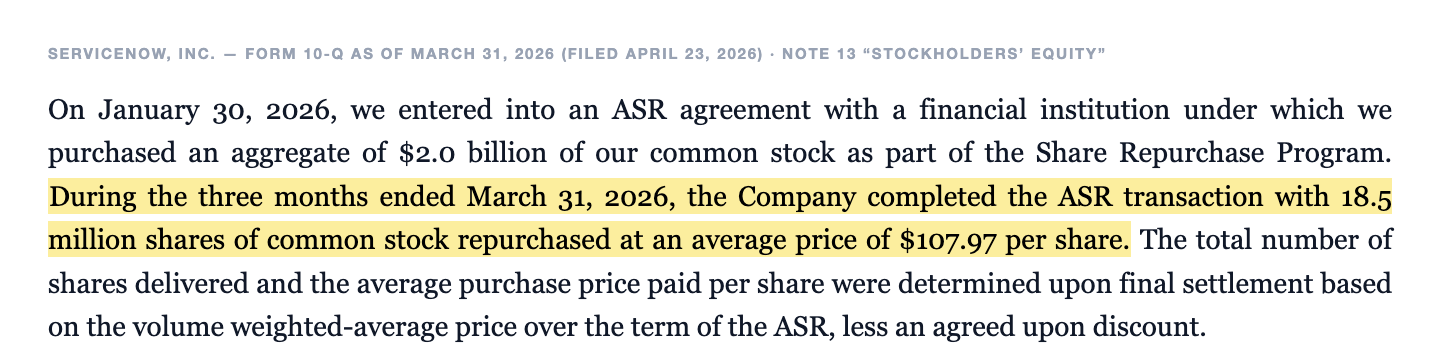
As of July 18, 2026, the stock trades near $89.50 — so the company bought back in spring at roughly 20 percent above today's price. And despite $2.2 billion of quarterly buybacks, the share count barely moved: 1,035 million weighted shares after 1,034 million a year earlier, because newly granted employee shares keep growing back. Remember the mechanism: buybacks that merely mop up the company's own stock compensation are not a gift to shareholders — they are an operating expense in different packaging.
Uncomfortable truth no. 2: One partner supplies 12 percent of revenue — and owes 19 percent of the receivables
Customer concentration sounds like a small-company problem. ServiceNow has more than 8,000 contracted customers — and still this line in the quarterly report:
"We had one customer, a U.S. federal channel partner and systems integrator, that represented 19% and 11% of our accounts receivable balance as of March 31, 2026 and December 31, 2025, respectively, and 12% of our total revenues for each of the three months ended March 31, 2026 and 2025."
— ServiceNow, Inc., SEC quarterly report 10-Q as of March 31, 2026, Note 2 "Concentration of Credit Risk and Significant Customers"
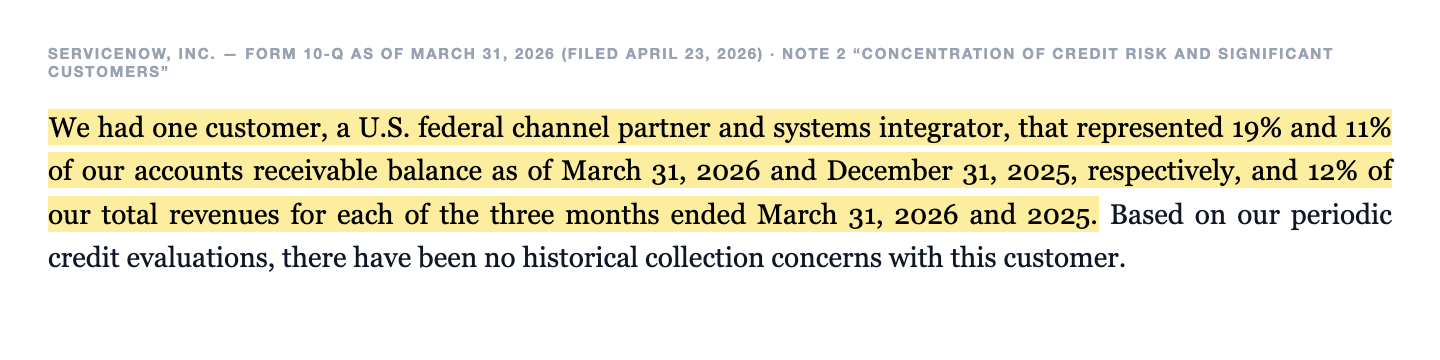
A "federal channel partner" is the reseller through which U.S. federal agencies buy their software — so behind the one customer stand many agencies. But the money flows through a single address, and the dependence is growing: in 2023, no customer crossed the 10 percent threshold; in 2024 and 2025 it was 11 percent of annual revenue each year, in the first quarter of 2026 it reached 12 percent — and almost a fifth of all outstanding receivables. Picture a baker whose best customer is a canteen that stands for an eighth of revenue and buys on account: as long as the canteen pays, all is well. But its budget is decided by a parliament, every year. Shutdowns, savings programs or a new procurement policy in Washington would not ruin ServiceNow — but they would hit the company's single most important revenue source, in a phase in which the market already doubts the growth story.
Uncomfortable truth no. 3: The $7.8 billion acquisition on borrowed money — in the middle of the crash
While the stock fell, management hit the accelerator: Moveworks (AI assistants for corporate employees, $2.4 billion, December 2025), Veza (AI identity security, $1.2 billion, March 2026), plus smaller deals such as Logik.io and data.world — and then, three weeks after quarter end, the largest deal in company history:
"On April 20, 2026, we acquired all outstanding shares of Armis, a cyber-exposure management and cyber-physical security solutions provider, for approximately $7.8 billion cash consideration."
— ServiceNow, Inc., SEC quarterly report 10-Q as of March 31, 2026, Note 19 "Subsequent Events"
$7.8 billion in cash — against liquidity of $7.9 billion (March 31, 2026, after $10.1 billion at the end of 2025). That only works with borrowed money, and the construction sits one footnote higher:
"On April 17, 2026, we entered into a credit agreement for a senior unsecured term loan (the “Term Loan”) of up to $4.0 billion and borrowed the full $4.0 billion under the Term Loan to fund a portion of the cash consideration for our acquisition of Armis Security Ltd. (“Armis”). The Term Loan matures on October 16, 2026, with an option to extend the maturity for an additional six months, subject to certain conditions."
— ServiceNow, Inc., SEC quarterly report 10-Q as of March 31, 2026, Note 19 "Subsequent Events"
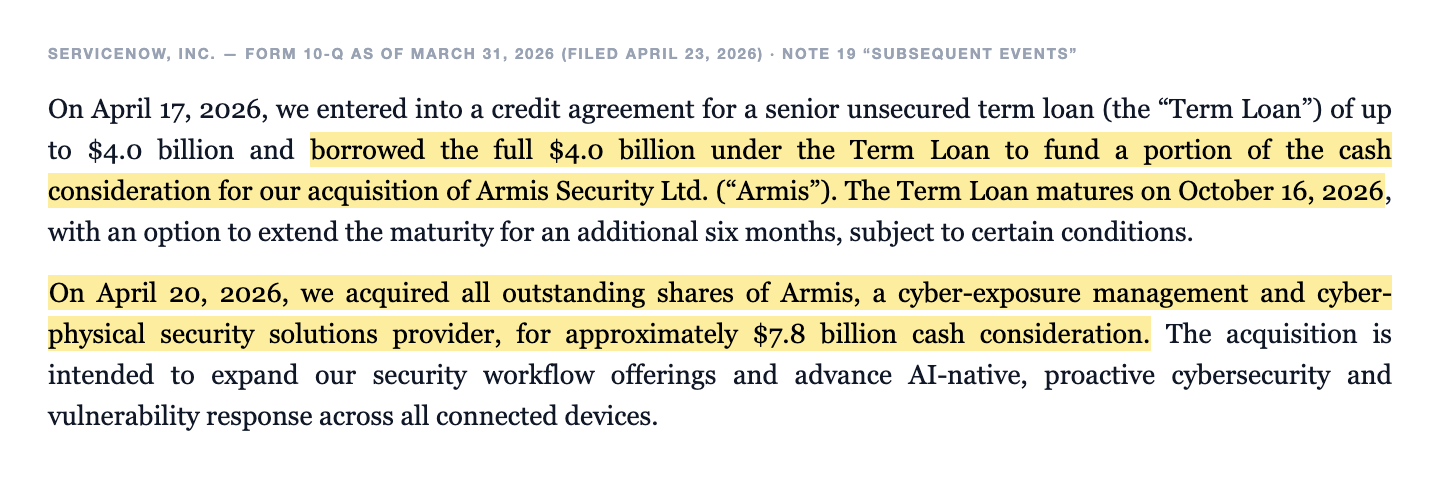
For context: cybersecurity fits strategically — security workflows are a ServiceNow strength, and how fiercely contested that market is, we covered in our Fortinet analysis. But the bill is sporty: roughly $11.4 billion of acquisitions in eleven months, a six-month $4 billion loan that must be refinanced before 2026 ends, plus a new $3 billion revolving credit facility — at a company that previously carried only a $1.5 billion bond due 2030. A management team that pulls out the biggest checkbook in company history in the middle of a crash either believes deeply in its own future — or is buying growth that is getting harder to produce organically. Probably both. For you as a reader it means: from now on, interest, integration costs and amortization from $11 billion of deals compete with a profit that is already stalling.
Valuation: what the halved price actually costs
Now to the price tag — and the anchoring question from the start. As of July 18, 2026, the stock cost about $89.50 and the market value stood near $89.5 billion. That works out to: a price-to-earnings ratio near 58 (on trailing twelve-month earnings), a price-to-sales ratio near 6.4, a price-to-book ratio near 8.7 and a price to free cash flow near 19. The anchor in your head says "60 percent below the high." The numbers say: even the halved price still pays 58 times reported earnings — because earnings never grew into the old price in the first place. In fairness: by the company's own non-GAAP arithmetic (excluding stock compensation and acquisition costs), ServiceNow earned $4.149 billion of operating profit in 2025 — on that basis, a bit over 20 times operating profit for 20 percent growth looks almost modest. This is exactly where you decide which stock you see: treat stock compensation as a real expense (we do), and you see a still-expensive stock with stalling profit. Ignore it, and you see a growth stock on clearance. The professionals' view, by the way, has barely moved: 47 analysts cover the stock, and the consensus still says "buy" despite the halving (data as of July 18, 2026) — after a crash of this size, that is either foresight or herd instinct, and from the outside the two have looked identical for long stretches of market history.
Opportunities and risks at a glance
What speaks for ServiceNow:
- A subscription business of rare quality: a 98 percent renewal rate three years running, 97 percent recurring revenue, $28.2 billion of contracted future revenue (up 27 percent, December 31, 2025).
- Growth without a break: revenue up 21 percent to $13.278 billion in 2025, up 22 percent in Q1 2026; 603 customers above $5 million in annual contract value (2023: 420).
- Solid substance: $5.444 billion of operating cash flow in 2025 (~$4.6 billion free), a 48 percent equity ratio, Altman Z near 5 — the turnaround scanner's mandatory "survival" pillar is not in question.
- AI as a product, not just a risk: Now Assist and AI agents are paid add-on tiers with a consumption-based pricing component; the acquisitions (Moveworks, Veza, Armis) expand the AI and security portfolio.
- The turnaround check delivers 7 of 8 points: revenue, margin direction, cash flow, interest coverage, the 50-day line, relative strength and institutional buying are already green (data as of July 18, 2026).
What speaks against it:
- Profit is stalling: Q1 2026 net income up 2 percent on 22 percent revenue growth; GAAP operating margin 13.7 percent (2025); subscription gross margin under pressure as AI compute drives costs faster than revenue (cost of subscription revenues up 46 percent in Q1 2026).
- Stock-based compensation of $1.955 billion (2025) exceeds operating income; buybacks ($2.2 billion in Q1 2026, ASR at an average $107.97) merely hold the share count roughly stable — and ran about 20 percent above the price level of July 18, 2026.
- A Washington concentration risk: a single U.S. federal channel partner at 12 percent of quarterly revenue and 19 percent of receivables (March 31, 2026).
- $11.4 billion of acquisitions in eleven months, including Armis ($7.8 billion) via a $4 billion term loan due October 16, 2026 — refinancing, integration and amortization weigh from here on.
- Insiders are net sellers (14 sales against 6 purchases in twelve months) — the one missing point in the turnaround check; and even the halved price still costs 58 times trailing GAAP earnings.
- The strategic AI question stays open: the company's own annual report names AI-native competitors and the uncertainty of new pricing models as risks to its own model.
A human conclusion
Back to the anchoring trap from the start. It whispers: "This stock was worth $215 billion once — $89.5 billion is a gift." But the anchor only knows the old price — not the new arithmetic. The new arithmetic goes like this: you get one of the best subscription businesses on the stock market — a 98 percent renewal rate, $28 billion contractually secured, 20-plus percent growth like clockwork — at a price that is still 58 times reported earnings. On top, you take over three open questions no scanner can answer: does AI eat the license model, or does ServiceNow successfully sell it on? Do $11 billion of debt-funded acquisitions become a stronger company or a series of write-downs? And why are insiders not buying, if it is supposedly so cheap? The turnaround scanner has done its job: the crash is real, survival is secured, seven of eight turn signals are on. The eighth signal — the confidence of the people who know the company from the inside — is still missing. You can wait for it and possibly pay a higher price for the confirmation; or you can buy the doubt and carry it yourself. For that, read three lines in every quarterly report (10-Q): subscription revenue and its growth rate, the "stock-based compensation" line against operating income — and the footnotes on the federal partner and the term loan refinancing. What you make of it is your decision. And that is exactly as it should be.
Sources
All original documents used in this analysis — for your own reading:
- ServiceNow, Inc. — SEC annual report 10-K for 2025 (filed January 29, 2026)
- ServiceNow, Inc. — SEC annual report 10-K for 2024 (filed January 30, 2025)
- ServiceNow, Inc. — SEC quarterly report 10-Q as of March 31, 2026 (filed April 23, 2026)
- Complete SEC filing history of ServiceNow: EDGAR overview (sec.gov)
- Fundamental data (metrics, quarterly series, valuation; data as of July 18, 2026), reconciled against the SEC filings.
- Screener and rating data: in-house stock scanner (data as of July 18, 2026), including the turnaround scanner (U.S. selection, rank 2, turnaround check 7 of 8).
Transparency & disclaimer: This analysis is a journalistic contextualization of publicly available information and is not investment advice, not a financial analysis in the regulatory sense and not a solicitation to buy or sell securities. Stock investments carry substantial risks up to and including total loss. All information without guarantee; the data cut-off is noted in the text. The author holds no position in ServiceNow shares at the time of publication.
Our Bottom Line at a Glance
- Business model & retention positive
- A subscription model with 97 percent recurring revenue, a 98 percent renewal rate three years running, RPO of $28.2 billion (up 27 percent as of 12/31/2025) and 603 customers above $5 million in annual contract value — the substance of one of the most stable software businesses on the market (10-K 2025).
- Growth positive
- Revenue up 21 percent to $13.278 billion in 2025, up 22 percent to $3.770 billion in Q1 2026 — with no visible break in the series; per the 10-K, the company expects subscription revenue to keep rising in absolute dollars in 2026.
- Earnings quality negative
- Q1 2026 net income up just 2 percent ($469 million) despite 22 percent revenue growth; stock-based compensation of $1.955 billion in 2025 above operating income of $1.824 billion; subscription gross margin under pressure from AI compute (cost of subscription revenues up 46 percent in Q1 2026).
- Capital allocation negative
- About $11.4 billion of acquisitions in eleven months, including Armis at $7.8 billion cash with a $4.0 billion term loan due 10/16/2026; ASR buybacks at an average $107.97 — roughly 20 percent above the price level of July 18, 2026 — while the share count barely falls (10-Q as of 03/31/2026).
- Concentration risk negative
- A single U.S. federal channel partner stood for 12 percent of total revenue in Q1 2026 and 19 percent of receivables (03/31/2026) — the company's most important single revenue source hangs on the U.S. federal budget (10-Q, Note 2).
- Turnaround signals neutral
- Turnaround check 7 of 8 (rank 2 of the U.S. selection, as of July 18, 2026): revenue, margin direction, cash flow, interest coverage, the 50-day line, relative strength and institutional buying are positive — but insiders sold on a net basis (14 sales, 6 purchases in twelve months), and a trailing P/E near 58 is no bargain price even after the halving.
ServiceNow is the unusual case of a turnaround candidate without an operating crisis: the subscription business grows more than 20 percent, renews 98 percent of its contracts and has $28.2 billion of revenue contractually secured — what crashed is the valuation alone, from $215 billion to about $89.5 billion of market value. Behind it stand real reasons: stalling GAAP earnings, stock compensation above operating income, a federal concentration risk and an $11 billion shopping spree that ends in a six-month loan. Whoever invests here buys a first-class business and carries, in exchange, the open AI question, the integration load and a P/E near 58 on reported earnings. Not investment advice.
What Our Rating Means
- If you don't own the stock
- As long as the question raised in the bottom line stays open, we see no basis for an entry.
- If you hold it in your portfolio
- Our findings offer no acute reason to sell — the checkpoints named remain decisive.
A journalistic assessment by our editorial team at the time of the deep dive, based on public sources — not investment advice and not a solicitation to buy or sell. Your personal circumstances (investment goals, risk capacity, taxes) cannot be taken into account. What our categories mean, how verdicts are formed, and what conflicts of interest exist →
Worth Noting
- NOW made the research list as rank 2 of our in-house turnaround scanner (U.S. selection, turnaround check 7 of 8, as of July 18, 2026) — part of our series on the top 20 of this selection.
- Scanner metrics (P/E, P/S, P/B, Piotroski, Altman Z, relative strength, insider/institutional data) use trailing twelve-month figures as of July 18, 2026.
- Price and market value figures (~$89.50, ~$89.5 billion) from the July 18, 2026 feed, sanity-checked against 1,035 million weighted shares per the quarterly report 10-Q as of March 31, 2026; analyses are evergreen, daily prices are not a buy argument.
Frequently Asked Questions
ServiceNow, Inc. (NYSE: NOW, Santa Clara, California, 29,187 employees as of December 31, 2025) sells cloud-based workflow software by subscription — a platform for IT service, HR, customer and security processes of large organizations, extended by the paid AI tiers Now Assist and AI agents. In 2025 the company generated $13.278 billion in revenue (up 21 percent), $12.883 billion of it — 97 percent — as subscription revenue; the typical contract runs three years.
The market value fell from $215.2 billion (June 30, 2025) to about $89.5 billion (as of July 18, 2026) even though revenue kept growing more than 20 percent. The core issue: profit did not keep up — in the first quarter of 2026, net income grew just 2 percent, weighed down by acquisition amortization, a higher tax rate and expensive AI compute — while the market additionally prices in the risk that AI-native competitors attack the license model of classic enterprise software.
Our in-house turnaround scanner first requires a real crash (at least 50 percent below the all-time high; ServiceNow: roughly 60 percent) with survival secured (Altman Z near 5), then checks eight turn signals. As of July 18, 2026, ServiceNow meets seven — revenue, margin direction, cash flow, interest coverage, the 50-day line, relative strength, institutional buying — putting it at rank 2 of the U.S. selection. Only one signal is missing: insiders did not buy (14 sales against 6 purchases in twelve months).
Yes. Per the annual report (10-K) for 2025, Now Assist is the platform's integrated AI offering, and customers can deploy thousands of out-of-the-box AI agents or build their own; certain AI and data solutions carry a consumption-based pricing component that applies when customers exceed their service credits. So AI is a revenue source at ServiceNow — while the same report names AI-native competitors as a risk to its own business.
Heavily: in 2025, stock-based compensation expense reached $1.955 billion — more than the entire operating income of $1.824 billion. Buybacks ($1.8 billion in 2025, $2.2 billion in the first quarter of 2026 alone, including 18.5 million shares at an average $107.97) merely hold the share count roughly stable instead of reducing it.
On April 20, 2026, ServiceNow acquired the cybersecurity provider Armis for approximately $7.8 billion in cash — the largest acquisition in company history, three weeks after a quarter that ended with $7.9 billion in liquidity. It was funded in part by a $4.0 billion term loan maturing October 16, 2026 (six-month extension option), accompanied by a new $3.0 billion revolving credit facility.
Not by reported earnings: as of July 18, 2026, the stock cost about 58 times trailing GAAP earnings, 6.4 times revenue and 19 times free cash flow. By the company's own non-GAAP arithmetic (excluding $1.955 billion of stock compensation), the valuation looks far more moderate — so the verdict hinges on whether you treat stock compensation as a real expense.
Found an error?
Did you spot a factual error, an outdated number, or a typo in this deep dive? Let us know briefly — your report goes straight to the editorial team.