Upland Software: A $12 Million Stub on Top of $234 Million of Debt
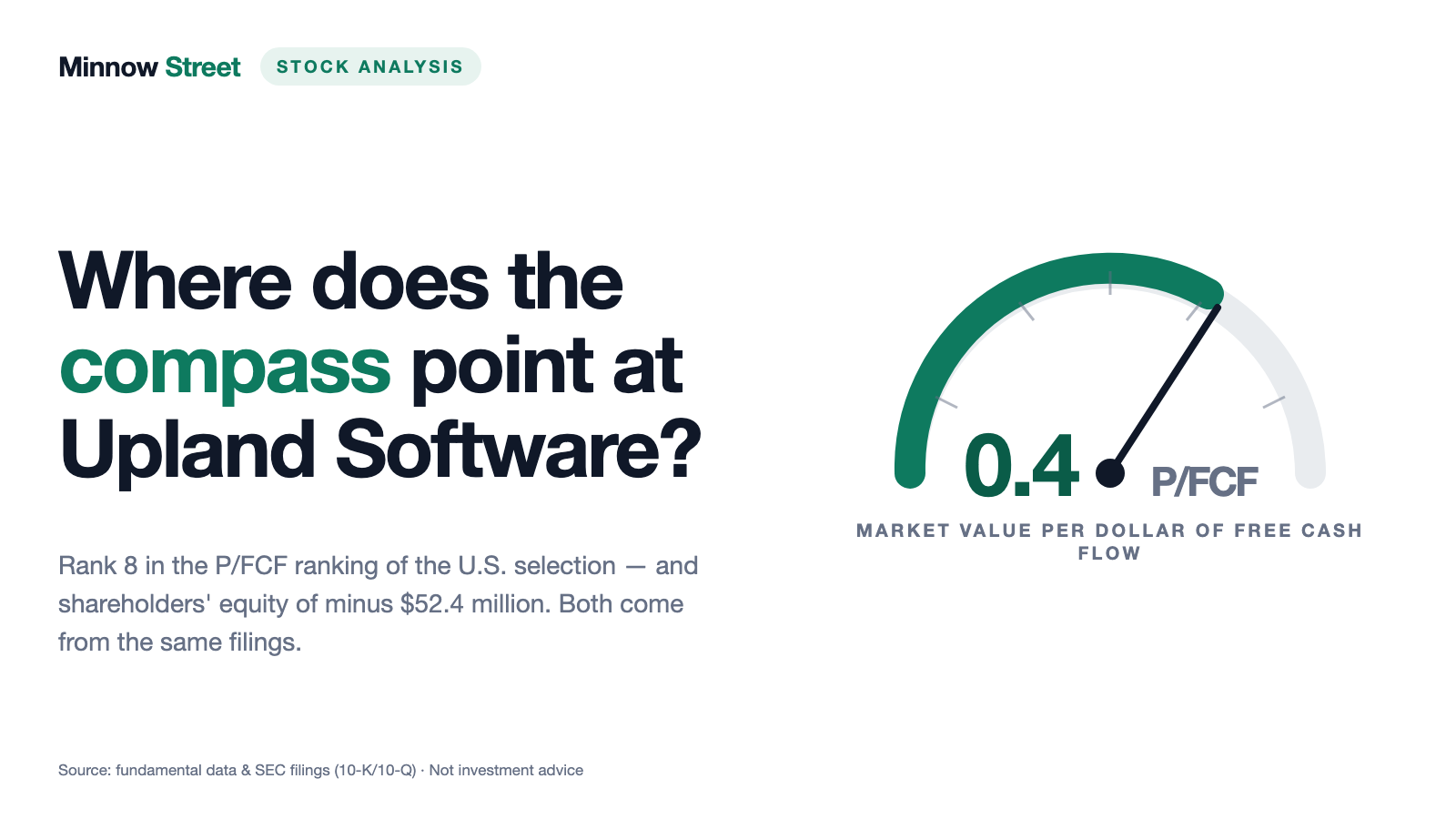
Our in-house stock scanner ranks Upland Software 8th in the U.S. selection of the P/FCF ranking: the market value equals 0.4 times free cash flow (as of July 26, 2026). The filings with the U.S. securities regulator, the SEC, explain why. The Austin-based software vendor did generate $24.4 million of free cash flow in 2025 — but it also carries $233.7 million of secured debt, $135.1 million of preferred stock and shareholders' equity of minus $52.4 million. Not investment advice — just the question of who actually owns that cash flow.
 Thomas Mücke
Founder & Publisher
Thomas Mücke
Founder & Publisher
Chart
Interactive price chart (TradingView).
Note: pure fact-based analysis, not investment advice and not a solicitation to buy or sell. All figures without guarantee.
There is a number that works on investors like a siren song: a ratio of market value to free cash flow below one. Translated, it claims that a company throws off as much cash in a single year as the whole equity costs on the exchange. At Upland Software, Inc. (Nasdaq Global Market: UPLD) that ratio sits at 0.4 (as of July 26, 2026). And this is exactly where the trap of this analysis lies: the denominator trap. We stare at the bottom of the fraction — the cash flow — and forget to ask why the top is so small. A tiny market value makes any ratio look spectacular. So let us make a deal: before you decide whether there is a bargain here, we read together what Upland itself filed with the U.S. securities regulator, the SEC — the annual report (10-K) for 2025 filed March 3, 2026, the quarterly report (10-Q) for the period ended March 31, 2026 filed May 1, 2026, and everything that followed. Those filings are truthful under penalty of law. And they describe a company that earns cash — just not for its common shareholders.
What Upland Software actually does — the shopping cart of enterprise software
Picture an insurer whose claims handlers answer a hundred questions a day: which clause applies here, which form belongs in which file, when was what last reviewed? The answers exist somewhere — in manuals, old emails, document archives. Upland sells the software that makes that knowledge findable and automates the paperwork around it. The 2025 annual report names two product families: knowledge management (AI-driven search, content recommendations, customer self-service, contact center operations) and content lifecycle and workflow automation (capture, storage, retrieval, compliance — including secure digital faxing, which heavily regulated U.S. industries genuinely still need). Customers pay by subscription.
The scale: more than 1,100 enterprise customers use at least one Upland product, and according to the annual report no single customer accounts for 10 percent or more of revenue. As of December 31, 2025 the company employed 760 people full time, mostly in the United States, Canada, India, the United Kingdom and Australia. Headquarters are in Austin, Texas; the company is incorporated in Delaware and carries SEC identifier CIK 0001505155.
The decisive part is not in the product catalog but in the corporate history. Upland is not an organically grown software group but a shopping cart: over more than a decade it bought small software houses and gathered them under one roof — paid for with debt and its own stock. What that produces shows up on the balance sheet: $258.3 million of goodwill and $55.4 million of intangible assets as of March 31, 2026, together 78 percent of total assets. Goodwill, in plain terms, is not an asset you can touch; it is the premium paid above the tangible value of the acquired businesses — a memorial to old purchase prices. We took apart how that item can flip in another acquisition-built software company: see the Digital Turbine analysis.
That names the central tension of this analysis, and it runs through every chapter: the business still throws off cash — but the common stock stands at the very back of the line, behind the lenders and behind a preferred shareholder.
Where the stock landed on our desk
Every day we run thousands of stocks through our in-house stock scanner. Upland Software sits at rank 8 of the U.S. selection in the P/FCF ranking (as of July 26, 2026). The list is quickly explained: it collects every stock with positive free cash flow and a price-to-free-cash-flow ratio of at most 10, sorted from lowest to highest. In total 544 stocks pass those criteria; the table shows the 25 strongest hits of the selected market. Upland appears with a reading of 0.4. To replicate it yourself: open the P/FCF ranking from the "Scanner" menu on minnowstreet.com, set the market filter to the United States and look for the UPLD row.
What does the metric measure? P/FCF is market value divided by one year of free cash flow — the money left after all running costs and after capital spending. A reading of 15 loosely means you pay fifteen annual portions. A reading of 0.4 means, arithmetically, that you pay less than half of one. But remember the principle that carries this analysis: an extremely low P/FCF is not a discovery, it is a question — namely why the market pays only forty cents for a dollar of annual cash flow. There are exactly two possible answers. Either the market is wrong. Or the cash flow does not belong to whoever buys the stock. Which one applies here is settled by the balance sheet, not by opinion.
The same scanner card shows more, and none of it fits the word "bargain" (all readings as of July 26, 2026). Our in-house fundamental rating stands at D (minus 11 out of 100). The Piotroski F-score, a nine-point test of the direction of the books, reads 6 of 9 — decent, not good; a genuinely healthy company sits at 8 or 9. The Altman Z-score, an early-warning gauge of insolvency risk built from several balance-sheet ratios, stands at minus 1.80; the danger zone already starts below 1.8. The stock is in Weinstein stage 4 (downtrend) with an RS rating of 2 out of 99 — weaker than 98 percent of all stocks. Translated: the scanner says cheap, bruised and balance sheet in the warning zone in the same breath. These lists are recalculated daily; the placement is a dated snapshot, not a permanent property.
The numbers over the years — honestly credited
Let us start with what genuinely impresses, because there is something here. Upland earns cash — every year. Operations brought in $49.9 million in 2023, $24.2 million in 2024 and $25.8 million in 2025. Because a software house barely needs to invest (property and equipment cost just $1.4 million in 2025), almost all of that survives as free cash flow: $48.7 million, $23.4 million and $24.4 million. The first quarter of 2026 added $5.6 million of operating cash flow and $5.5 million of free cash flow.
More impressive still is what the cost scissors achieved. Sales and marketing fell from $66.3 million (2024) to $44.1 million (2025), research and development from $47.4 million to $36.5 million, general and administrative from $49.5 million to $38.0 million — together a $44.5 million reduction in a single year. As a result, operating income turned positive in 2025 for the first time: $4.4 million, after minus $102.3 million (2024) and minus $163.9 million (2023). The first quarter of 2026 delivered plus $5.0 million against minus $1.1 million a year earlier. Gross margin in the first quarter of 2026 was 75.5 percent. That is the good news, and it is real.
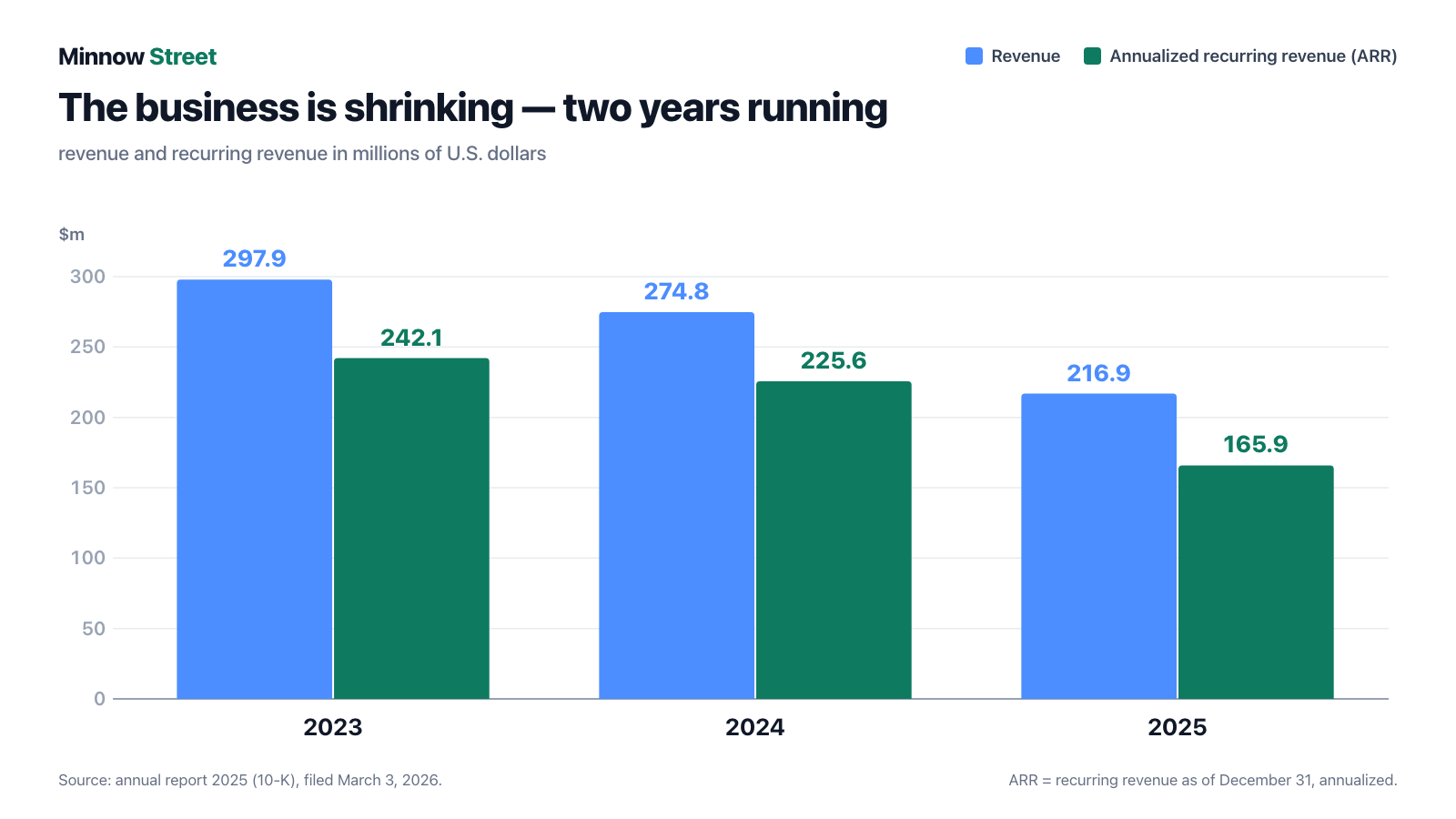
Now the other half. The business is shrinking for the third year. Revenue fell from $297.9 million (2023) through $274.8 million (2024) to $216.9 million (2025) — and in the first quarter of 2026 by another 23.5 percent to $48.7 million against $63.7 million a year earlier. The more important leading indicator is annualized recurring revenue (ARR in the filings), meaning subscription and support revenue as of December 31 multiplied by twelve. It fell from $242.1 million (2023) through $225.6 million (2024) to $165.9 million (2025) — down 26.5 percent in one year. If you want to know what the business will look like twelve months from now, watch that line, not revenue.
A word about net dollar retention, which the report puts at 96 percent for 2025 (2024: 96, 2023: 95 percent). The metric measures how much revenue a given year's existing customers still deliver the following year; 96 percent means a net loss of four percent. That sounds reassuring — but you have to read how it is calculated. The annual report excludes the Sunset Assets from the calculation (products and contracts Upland itself has designated for end of life) and also the businesses divested in 2025, in both comparison years. So the 96 percent applies to what remains — not to what was. The harder truth about the whole is in the ARR line: minus 26.5 percent.
What the filings say — the uncomfortable truths
Uncomfortable truth no. 1: equity has been consumed
As of March 31, 2026 total assets stood at $402.7 million. Against that stood $324.5 million of liabilities and, in a separate line between debt and equity, $130.6 million of preferred stock. What remains for common shareholders Upland itself reports as a stockholders' deficit — minus $52.4 million (December 31, 2025: minus $48.4 million). The accumulated deficit stands at $641.7 million.
For context, because a bare number helps nobody: as of December 31, 2022 equity still stood at plus $308.9 million. In a little over three years roughly $361 million has vanished — through losses, through goodwill write-downs and through share buybacks. The everyday image: the house is still standing, but on paper it belongs to the bank. That is precisely why the Altman Z-score reads minus 1.80.
Uncomfortable truth no. 2: a $135 million preferred stack ranks ahead of the common
In August 2022 Upland issued 115,000 shares of Series A preferred stock for $115.0 million. These are not ordinary equity: they carry a dividend of 4.5 percent per year that need not be paid in cash but instead compounds quarterly onto the redemption claim — and that rises to 7.0 percent on August 23, 2029. As of March 31, 2026 that had accumulated $20.1 million of dividends.
"In the event of any Liquidation, holders of the Series A Preferred Stock are entitled to receive an amount per share equal to the greater of (1) the Initial Liquidation Preference per share plus any accrued or declared but unpaid dividends on such shares (the "Liquidation Preference") or (2) the amount payable if the Series A Preferred Stock were converted into Common Stock. The Series A Preferred Stock will have distribution and liquidation rights senior to all other equity interests of the Company. As of March 31, 2026, the Liquidation Preference of the Series A Preferred Stock plus accrued and unpaid dividends was $135.1 million."
— Upland Software, Form 10-Q for the quarter ended March 31, 2026, Note 9 "Mezzanine Equity"

In theory the preferred can convert into common stock — at a conversion price of $17.50 per share. That figure predates the reverse split; after the 1-for-10 combination it corresponds to $175.00. The share price stood at $4.10 as of July 26, 2026. Remember: a conversion right demanding roughly forty-three times the market price is no longer a dilution risk — it is a bill that eventually has to be settled in cash. And it grows: about $1.5 million per quarter, faster from August 2029.
Uncomfortable truth no. 3: the interest rate has nearly doubled
On July 25, 2025 Upland signed a new credit agreement: a secured term loan of $240.0 million and a revolving facility of $30.0 million, both maturing July 25, 2031. The price is stated verbatim in the quarterly report.
"The Term Loan matures on July 25, 2031 and bears an interest rate of the secured overnight financing rate, which shall not be less than 1.5%, plus a margin of 6.0% per annum (with step downs and a potential step up at specified leverage levels). At March 31, 2026, the floating interest rate was 9.7%."
— Upland Software, Form 10-Q for the quarter ended March 31, 2026, Note 6 "Debt"

The report also gives average cash interest cost: 9.7 percent in the first quarter of 2026 against 5.9 percent in the first quarter of 2025. In money: Upland paid $5.8 million of interest in the first quarter of 2026 — against $5.5 million of free cash flow in the same quarter. Only part of the exposure is hedged: since September 30, 2025 an interest rate cap covers a 4.5 percent overnight rate on $120.0 million of the debt; as of December 31, 2025, $118.5 million was unhedged. The loan is secured by substantially all of the company's assets including intellectual property, and it carries a covenant: the consolidated secured leverage ratio must not exceed 6.0 to 1.0, tested quarterly. As of March 31, 2026 the company was in compliance with all covenants, according to the filing.
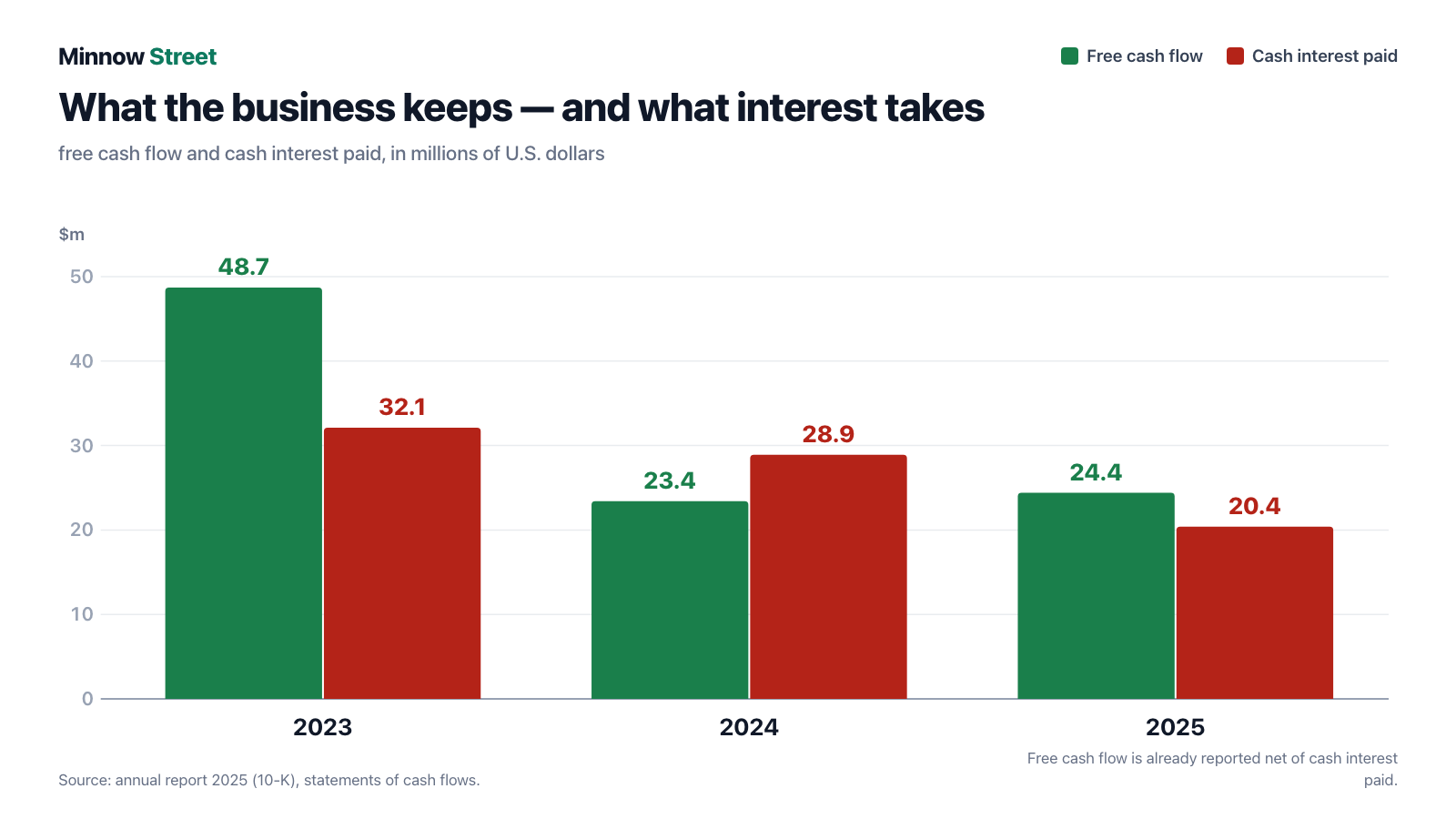
Cash interest paid has actually fallen over the years: $32.1 million (2023), $28.9 million (2024), $20.4 million (2025). That is not the reward for better terms but the result of repayment — in 2024 alone Upland repaid $188.4 million of debt, and $238.5 million was still outstanding at December 31, 2025. The interest rate moved the other way.
The decisive calculation runs as follows, and it is the core of this analysis. Under U.S. accounting rules, the $24.4 million of free cash flow reported for 2025 is already net of cash interest paid. Add it back and operations generated roughly $44.9 million before interest in 2025 — of which $20.4 million, or 45 percent, went straight to the lenders. In the first quarter of 2026 the figures were $11.3 million before interest and $5.8 million for the banks: 51 percent. The reason for the jump is not new borrowing but a new interest rate.
Uncomfortable truth no. 4: sold for $15.5 million, written down by $24.4 million
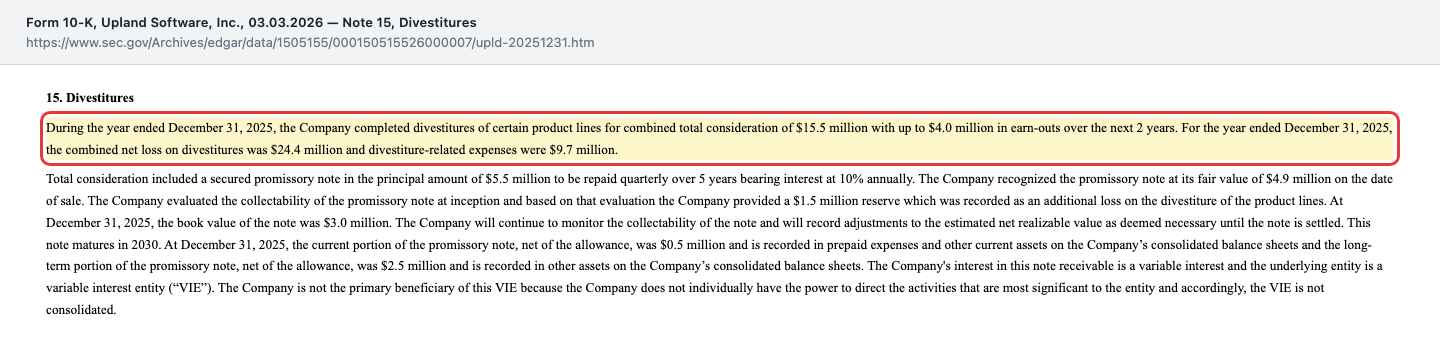
In 2025 Upland began emptying parts of the shopping cart again. What that achieved is in Note 15 of the annual report.
"During the year ended December 31, 2025, the Company completed divestitures of certain product lines for combined total consideration of $15.5 million with up to $4.0 million in earn-outs over the next 2 years. For the year ended December 31, 2025, the combined net loss on divestitures was $24.4 million and divestiture-related expenses were $9.7 million."
— Upland Software, Form 10-K for 2025, Note 15 "Divestitures"
Let us do the math: $15.5 million came in, while $24.4 million of losses and $9.7 million of expenses went through the income statement. In the process $8.6 million of goodwill and $31.9 million of intangible assets left the balance sheet. And part of the price is not money at all: a secured promissory note of $5.5 million, bearing 10 percent interest and maturing in 2030, was recognized at only $4.9 million on the date of sale and immediately reserved by $1.5 million, because Upland itself doubted collectability. As of December 31, 2025 it stood at $3.0 million in the books.
That is not an isolated case but the end of a chain. In 2023 Upland wrote down $128.8 million of goodwill and intangibles, in 2024 another $87.2 million, in 2025 a further $2.5 million. Roughly $218 million in three years — old purchase prices that turned out to be too high. As of December 31, 2025 Upland tested the remaining goodwill again, triggered by the decline in its share price, and concluded that no impairment existed because the estimated fair value of its one reporting unit exceeded the carrying value. A reminder: the market valued the common stock at roughly $12.0 million as of July 26, 2026. Goodwill alone sits at $258.3 million on the balance sheet.
Uncomfortable truth no. 5: the reverse split saved the deadline, not the business
On April 7, 2026 Upland received a letter from Nasdaq: the closing bid price had been below $1.00 for 30 consecutive business days, breaching the minimum bid price rule for continued listing. The cure period ran to October 5, 2026. The company's answer is in the 8-K of June 3, 2026.
"The Certificate of Amendment will become effective at 12:01 AM Eastern Time on June 17, 2026, prior to the opening of trading on The Nasdaq Global Market ("Nasdaq"). As a result of the Reverse Split, every 10 shares of common stock, par value $0.0001 per share (the "Common Stock"), issued and outstanding will be converted into one share of Common Stock."
— Upland Software, Form 8-K filed June 3, 2026, Item 5.03
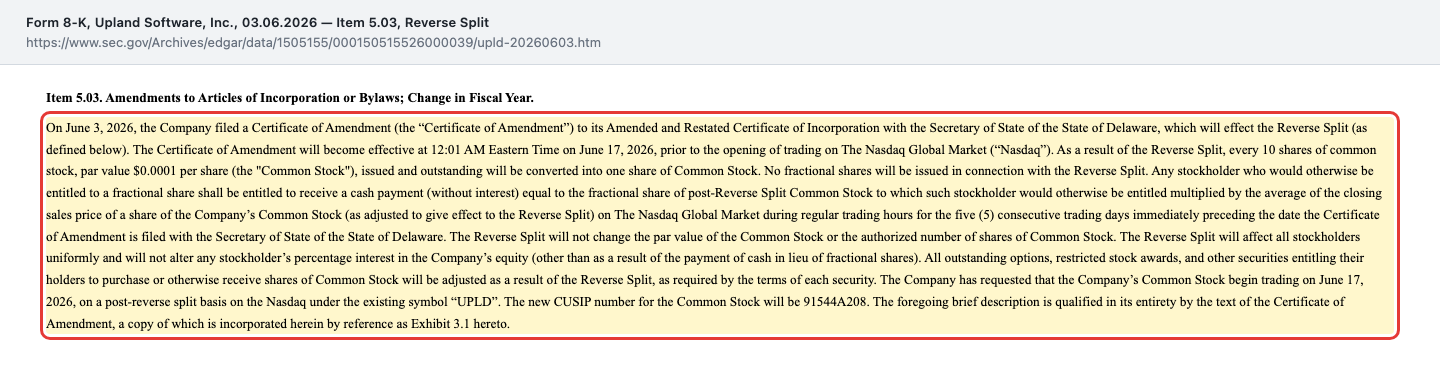
On July 2, 2026 the all-clear arrived: Nasdaq stated that the closing bid price had been at or above $1.00 for ten consecutive business days from June 17 through July 1, 2026, that compliance was regained and the matter closed. Read the dates again: the ten-day window began on exactly the day the split took effect. Remember: a reverse split multiplies the price and divides the share count — it changes nothing about the value of the business, and even less about the interest rate. It solved a real problem here, namely the looming delisting review. It did not win back a single subscription.
Uncomfortable truth no. 6: auditor and finance chief change in the same half-year
On March 9, 2026 the audit committee dismissed Ernst & Young and appointed KPMG for fiscal 2026. The 8-K explicitly records that the audit opinions for 2024 and 2025 were neither qualified nor modified and that there were no disagreements. On June 30, 2026 chief financial officer Michael D. Hill gave notice of his retirement effective July 27, 2026 — again, according to the filing, without any disagreement over the company's operations, policies or practices. On July 6, 2026 David Tamez was appointed interim chief financial officer, and on July 17, 2026 Jennifer Simon was named chief financial officer effective August 17, 2026. Within five months, then: a new auditor and three finance chiefs. Each filing on its own is unremarkable; read together they mean one thing above all — in the year of the turnaround, almost everyone responsible for the numbers is changing at once. For contrast, see what a software company looks like whose books are turning the other way in the Q2 Holdings analysis.
Valuation — what is actually on offer, and at what price
First the share count, because after a reverse split that is the most common source of error. The quarterly report states 29,363,201 shares of common stock outstanding as of April 29, 2026 — a figure from before the combination. After the 1-for-10 split that works out to 2,936,320 shares, and fundamental data reports exactly that number as of July 26, 2026. At a price of $4.10 that gives a market value of roughly $12.0 million. The cross-check holds: both routes lead to the same number.
And now the calculation that matters. Free cash flow over the last four reported quarters (second quarter of 2025 through first quarter of 2026) adds up to $22.1 million; in fiscal 2025 it was $24.4 million. That gives the common stock a P/FCF of between 0.5 (fiscal 2025) and 0.54 (trailing four quarters) — the scanner reports 0.4; the order of magnitude is identical, and the decimal depends on the chosen window and data cut-off.
But whoever buys a stock buys a business together with its debt. Measured by enterprise value — market value plus financial debt plus preferred stock minus cash — the picture looks like this: $12.0 million of market value plus $233.7 million of debt at face value plus $135.1 million of preferred minus $30.4 million of cash and restricted cash equals roughly $350 million. Fundamental data reports $343.2 million (as of July 26, 2026); the difference comes from whether debt is taken at face value or at carrying value net of discount. Either way: measured by enterprise value, Upland costs fifteen to sixteen times its free cash flow — and about 1.7 times annual revenue of $201.9 million (trailing twelve months, as of July 26, 2026).
That resolves the denominator trap. The equity stub costs half an annual portion. The business costs fifteen. The 0.4 reading is not a scanner error — it correctly describes a residual left over after the banks and the preferred. And because that residual is so small, every change in enterprise value acts on it like a lever: upward as well as downward.
The professionals' view is correspondingly thin. As of July 26, 2026 there were exactly three analyst ratings (one buy, two hold) with an average price target of $30.00. With three voices a "consensus" is more of an opinion than a consensus — the number belongs in the context, not in a buying decision. The free float comprised roughly 2.16 million shares; insiders held 28.0 percent and institutions 36.0 percent.
Opportunities and risks at a glance
Opportunities
- The business still throws off cash. $25.8 million of operating cash flow in 2025 and $5.6 million in the first quarter of 2026 — despite shrinking revenue.
- The cost base is dramatically smaller. Sales, research and administration together fell from $163.1 million (2024) to $118.6 million (2025); operating income turned positive in 2025 at $4.4 million.
- No customer concentration. More than 1,100 enterprise customers, none of them accounting for 10 percent or more of revenue.
- No near-term maturity. The term loan runs to July 25, 2031, the $30.0 million revolver was undrawn at March 31, 2026, and all covenants were met according to the filing.
- The Nasdaq matter is closed. Since July 2, 2026 the minimum bid price rule is satisfied again and the exchange considers the matter resolved.
- Leverage on the equity stub. At roughly $12.0 million of market value against $350 million of enterprise value, any durable improvement hits the stock disproportionately.
Risks
- Negative equity. Minus $52.4 million as of March 31, 2026, an accumulated deficit of $641.7 million and an Altman Z-score of minus 1.80 (as of July 26, 2026).
- Interest coverage below one. Over the trailing twelve months, operating income of roughly $10.5 million faced interest expense of roughly $17.8 million — operating income does not cover the interest.
- Revenue keeps shrinking. Minus 21.1 percent in 2025, minus 23.5 percent in the first quarter of 2026; recurring revenue fell 26.5 percent to $165.9 million.
- Floating rate with a gap. Only $120.0 million is covered by an interest rate cap at 4.5 percent; as of December 31, 2025, $118.5 million was unhedged.
- A 6.0 to 1.0 covenant. The consolidated secured leverage ratio is tested quarterly — a falling result pushes it up without a single dollar of new borrowing.
- 78 percent of the balance sheet is old purchase prices. $258.3 million of goodwill and $55.4 million of intangibles; $216.0 million of that was written off in 2023 and 2024 combined.
- The preferred keeps growing. $135.1 million as of March 31, 2026, roughly $1.5 million more per quarter, and 7.0 instead of 4.5 percent from August 23, 2029.
- A large reserve of authorized shares. The split cut shares outstanding to about 2.94 million but left authorized capital of 75.0 million shares untouched.
A human conclusion
Back to the denominator trap. It works so well because there is nothing wrong with the fraction. Upland really does earn money: $24.4 million of free cash flow in 2025, in a business that ties up almost no capital. And the stock really does cost next to nothing. The mistake is not in the number but in the silent assumption that this money belongs to whoever buys the stock. It does not. It belongs first to the lenders, who took roughly 45 percent of the pre-interest cash flow in 2025 and 51 percent in the first quarter of 2026. Then comes a preferred claim of $135.1 million that grows by a million and a half every quarter. And only at the very end comes the common stock.
This is not a verdict on the people in Austin. They cut $44.5 million out of the cost base, turned operating income positive after two brutal years and saved the listing. It is a verdict on the order of claims — and that order is written in the balance sheet, not in the press release. Whoever buys here is not buying a cheap software company. They are buying an option on a shrinking business at 9.7 percent interest turning the corner before the preferred and the 6.0 to 1.0 covenant get uncomfortable. Options like that can multiply. They can also expire.
So do not just check the denominator. Check who owns the numerator. What you make of that is your decision. And that is exactly how it should be.
Sources
- Form 10-Q for the quarter ended March 31, 2026 (filed May 1, 2026) — balance sheet, statements of operations and cash flows, Note 6 "Debt", Note 7 "Net Loss Per Share", Note 9 "Mezzanine Equity", Note 14 "Subsequent Events"
- Form 10-K for 2025 (filed March 3, 2026) — Item 1 "Business", risk factors, key metrics (ARR, net dollar retention, adjusted EBITDA), goodwill and amortization disclosures, Note 15 "Divestitures"
- Form 8-K filed June 3, 2026 — Item 5.03: 1-for-10 reverse split effective June 17, 2026
- Form 8-K filed April 10, 2026 — Item 3.01: Nasdaq minimum bid price deficiency notice, cure period to October 5, 2026
- Form 8-K filed July 8, 2026 — Item 8.01: Nasdaq confirms compliance with the minimum bid price rule
- Form 8-K filed March 13, 2026 — Item 4.01: change of independent registered public accounting firm from Ernst & Young to KPMG
- Form 8-K filed July 7, 2026 — Item 5.02: retirement of the chief financial officer, interim appointment
- Form 8-K filed July 21, 2026 — Item 5.02: appointment of the new chief financial officer effective August 17, 2026
- Screener and valuation data: in-house stock scanner and fundamental data (as of July 26, 2026), including the P/FCF ranking (U.S. selection, rank 8, ratio 0.4; 544 hits in total)
This analysis is journalistic commentary based on publicly available documents. It is not investment advice and not a solicitation to buy or sell securities. Share prices can move sharply; at a company with negative equity and heavy debt, a total loss is possible. Every figure carries the as-of date of its source. The author holds no position in Upland Software at the time of publication.
Our Bottom Line at a Glance
- Cash generation and cost discipline positive
- Despite three years of falling revenue the business throws off cash: $25.8 million of operating cash flow in 2025 and $24.4 million of free cash flow, plus $5.6 million and $5.5 million in the first quarter of 2026. Sales, research and administration were cut by $44.5 million combined in 2025, and operating income turned positive at $4.4 million (10-K 2025, 10-Q for Q1 2026).
- A shrinking business negative
- Revenue fell from $297.9 million (2023) through $274.8 million (2024) to $216.9 million (2025), and by another 23.5 percent to $48.7 million in the first quarter of 2026. Annualized recurring revenue dropped from $242.1 million to $165.9 million — down 26.5 percent in 2025 alone. The reported 96 percent net dollar retention excludes the sunsetting and divested businesses (10-K 2025).
- Balance sheet and capital structure negative
- As of March 31, 2026, equity of minus $52.4 million (December 31, 2022: plus $308.9 million) sits alongside $227.7 million of secured debt at carrying value and $130.6 million of preferred stock whose liquidation preference plus dividends is $135.1 million. Goodwill and intangibles make up 78 percent of total assets, and the Altman Z-score reads minus 1.80 (as of July 26, 2026).
- Interest burden negative
- The credit facility of July 25, 2025 cost 9.7 percent at March 31, 2026, up from 5.9 percent average cash interest a year earlier. In 2025, $20.4 million of the $44.9 million generated before interest went to the lenders (45 percent); in the first quarter of 2026 the share was already 51 percent. On a twelve-month view, operating income of about $10.5 million does not cover interest expense of about $17.8 million.
- Portfolio unwind neutral
- The unwinding of the acquisition portfolio is underway but expensive: product lines were sold for $15.5 million in 2025, producing a $24.4 million loss and $9.7 million of expenses; part of the price is a $5.5 million promissory note that was reserved by $1.5 million on day one. It relieves the cost side and shrinks the revenue base at the same time (10-K 2025, Note 15).
- Listing and personnel neutral
- The Nasdaq deficiency notice of April 7, 2026 has been resolved since July 2, 2026 — achieved through the 1-for-10 reverse split of June 17, 2026, whose ten-day window began on the day of the split. In parallel the auditor changed (March 9, 2026, Ernst & Young to KPMG) and the finance chief changed three times (retirement effective July 27, 2026, interim from July 6, 2026, successor from August 17, 2026) — in each case, according to the filings, without disagreement.
Upland Software is not a cheap software house but an equity stub sitting on a large pile of debt. The business works: $24.4 million of free cash flow in 2025, a first positive operating result and a cost base $44.5 million lighter. But revenue is shrinking for the third year ($216.9 million against $297.9 million in 2023), recurring revenue fell 26.5 percent in 2025, equity stands at minus $52.4 million, and ahead of the common sit $233.7 million of secured debt at 9.7 percent plus a $135.1 million preferred claim. The 0.4 reading therefore measures the residual, not the company: against enterprise value of about $350 million you pay fifteen times free cash flow. Not investment advice.
What Our Rating Means
Substance risk
We found at least one documented issue that threatens the company itself — regardless of how the stock is currently valued.
Red here stands for documented substance findings, not for a fallen share price. Three of them sit openly in the filings: negative equity of $52.4 million as of March 31, 2026, interest coverage below one (operating income of about $10.5 million against roughly $17.8 million of interest expense over twelve months) and an Altman Z-score of minus 1.80. On top of that comes a capital structure in which $233.7 million of secured debt and a $135.1 million preferred claim rank ahead of the common, while 78 percent of the balance sheet consists of goodwill from old acquisitions. The business itself is not worthless — it generates cash, serves more than 1,100 customers without concentration risk and faces no near-term maturity. But the substance question is documented, and in case of doubt the more cautious grade applies. The decision is yours.
A journalistic assessment by our editorial team at the time of the deep dive, based on public sources — not investment advice and not a solicitation to buy or sell. Your personal circumstances (investment goals, risk capacity, taxes) cannot be taken into account. What our levels mean, how verdicts are formed, and what conflicts of interest exist →
Worth Noting
- Upland Software reached our research list through the in-house stock scanner: rank 8 of the U.S. selection in the P/FCF ranking with a ratio of 0.4 (544 hits in total, with the 25 strongest shown per market selection; as of July 26, 2026). These lists are recalculated daily, so the placement is a dated snapshot.
- Mind the reverse split: on June 17, 2026 every ten shares became one. All share counts in the 2025 annual report and in the quarterly report for March 31, 2026 predate the split, while all price and market value figures postdate it. The preferred conversion price of $17.50 corresponds to $175.00 after the split.
- Valuation figures are dated and evergreen: the market value of roughly $12.0 million (as of July 26, 2026) was checked against the share count from the quarterly report (29,363,201 shares as of April 29, 2026, divided by ten) and the price of $4.10; both routes give the same number. Analyses are evergreen; daily prices are not a reason to buy.
Frequently Asked Questions
Upland sells enterprises subscription software for knowledge management and document lifecycles: AI-driven search, self-service portals, contact center tools, document capture, compliance workflows and secure digital faxing. More than 1,100 enterprise customers use at least one product, and no single customer accounts for 10 percent or more of revenue (2025 annual report).
Because the numerator is tiny, not because the denominator is large. Market value stood at roughly $12.0 million as of July 26, 2026, against $24.4 million of free cash flow in 2025. But $233.7 million of secured debt and $135.1 million of preferred stock rank ahead of the common. Measured against enterprise value of about $350 million, the multiple is fifteen to sixteen times.
Every ten shares became one, with fractional shares paid in cash. Ownership percentages are unchanged; the price is ten times higher arithmetically. The 29,363,201 shares outstanding on April 29, 2026 became 2,936,320. The split was the answer to the Nasdaq deficiency notice of April 7, 2026 over a closing bid price below $1.00.
Not according to the latest filings. On July 2, 2026 Nasdaq stated that the closing bid price had been at or above $1.00 for ten consecutive business days from June 17 through July 1, 2026, that compliance was regained and that the matter is closed. The original cure period ending October 5, 2026 is therefore moot.
As of March 31, 2026, total assets of $402.7 million faced $324.5 million of liabilities and $130.6 million of preferred stock — leaving minus $52.4 million for common shareholders. The causes are accumulated losses of $641.7 million, including $216.0 million of goodwill write-downs in 2023 and 2024, plus earlier share buybacks.
The secured term loan of $240.0 million signed in July 2025 bears the secured overnight financing rate (floor 1.5 percent) plus a margin of 6.0 percentage points. At March 31, 2026 that was 9.7 percent, up from 5.9 percent average cash interest cost a year earlier. Upland paid $5.8 million of interest in the first quarter of 2026.
It is 115,000 shares issued in August 2022 for $115.0 million. They carry a 4.5 percent annual dividend that compounds onto the redemption claim, rising to 7.0 percent on August 23, 2029. As of March 31, 2026 the liquidation preference plus accrued dividends stood at $135.1 million, ranking senior to all other equity interests.
For three reasons at once: divested product lines, legacy products the company itself designated for end of life (the "Sunset Assets" in its filings), and net dollar retention of 96 percent, meaning a four percent annual net loss within the remaining base. Annualized recurring revenue therefore fell from $242.1 million (2023) to $165.9 million (2025).
Found an error?
Did you spot a factual error, an outdated number, or a typo in this deep dive? Let us know briefly — your report goes straight to the editorial team.