W&T Offshore Stock: The Ticker Reads WTI Like the Oil Benchmark — and the Teardown Bill Outweighs the Whole Company
W&T Offshore shows up in our Reddit hype scanner — with just 2 mentions in 24 hours (as of July 15, 2026), and part of that noise may not even belong to the company: its ticker WTI is also the symbol of the West Texas Intermediate crude benchmark. We read the annual reports (10-K) for 2024 and 2025 and the quarterly report (10-Q) as of March 31, 2026: a 105 percent year-to-date rally and a stage-2 uptrend meet a $150.1 million annual loss, negative stockholders’ equity, $561.8 million of decommissioning obligations for aging platforms — and surety insurers demanding $254.7 million in collateral. Not investment advice — just a reminder that a ticker is not a commodity.
 Thomas Mücke
Founder & Publisher
Thomas Mücke
Founder & Publisher
Chart
Interactive price chart (TradingView).
Note: pure fact-based analysis, not investment advice and not a solicitation to buy or sell. All figures without guarantee.
There is a reflex in the investor brain that feels like a strategy: "Oil is getting scarce? Then I will just buy oil." And since you cannot exactly store a barrel in your basement, the hand reaches for the most familiar symbol the financial news has to offer: WTI. Psychologists call this proxy thinking — we do not buy the thing we want, we buy the thing that is named like the thing we want. That is exactly where this analysis begins: on the New York Stock Exchange, the ticker WTI does not belong to a crude oil grade but to W&T Offshore, Inc. — a producer of aging oil and gas fields in the Gulf of Mexico with a market value of roughly $0.5 billion (data as of July 8, 2026). Our Reddit hype scanner counted 2 mentions in 24 hours for this ticker (ApeWisdom, as of July 15, 2026) — and even with this mini echo it is unclear how much of it was meant for the company and how much for the oil benchmark that carries the same three letters. The company itself takes the mix-up to its logical extreme: in the glossary of its own annual report, it defines "WTI" as "West Texas Intermediate grade crude oil" — as the crude grade, not as itself. So let’s make a deal: before you buy a ticker because it sounds like a commodity, we read together what is actually on the books behind those three letters — in the annual report (10-K) for 2025, its predecessor and the quarterly report (10-Q) as of March 31, 2026, all filed with the U.S. securities regulator, the SEC. An SEC filing is honest under penalty of law. And this one packs a punch. In the end, you decide for yourself.
What W&T Offshore actually does — the antiques dealer among oil producers
W&T Offshore was founded in 1983 by Tracy W. Krohn, who is Chairman, CEO and President in one person to this day — and per fundamental data, a good third of the shares (roughly 37 percent, data as of July 8, 2026) sit with insiders, first and foremost the founder himself. The business model has been the same for four decades and is described plainly in the annual report: the company buys fields with existing production instead of exploring expensively for new ones — fields that have become too small or too old for the majors — and uses its own technical expertise to extract what is left. An antiques dealer among oil producers: he buys what others discard, polishes it up and lives off the remaining substance. As of December 31, 2025, W&T held working interests in 49 producing fields in federal and state waters off Louisiana, Texas, Mississippi and Alabama, across roughly 624,700 gross acres — from the shallow shelf to deepwater. A side note for the curious: the report consistently calls the basin the "Gulf of America" — the official U.S. designation for the Gulf of Mexico since 2025. The 2025 harvest: 12.4 million barrels of oil equivalent (33,978 barrels per day on average — "oil equivalent" converts natural gas into oil barrels, six thousand cubic feet of gas counting as one barrel), by now clearly more gas than oil: of the 121.0 million barrels of oil equivalent in proved reserves, 423.3 billion cubic feet are natural gas — about 58 percent. Revenues in 2025: $501.5 million. The latest purchase in the proven pattern: in January 2024, W&T acquired rights to fields on the central shelf for $77.3 million — out of the orbit of the bankrupt Cox group; with the bankruptcy trustee of Cox and Energy XXI, the company later struck further agreements to bring shut-in fields such as Main Pass 108 back online. Which brings us to the central tension of this analysis, and it runs through every chapter: whoever buys aging fields cheaply always buys two things — the remaining production and the obligation to tear everything down at the end. The market is currently celebrating the remaining production; the balance sheet carries the teardown bill. How quickly Reddit attention and substance can drift apart is something we dissected in this same series at AMC Entertainment; how a very different energy business earns its money, at Global Partners.
How tightly company and founder are interwoven is described by the annual report itself — as its own risk factor:
"Our CEO owns a significant portion of our common stock. Circumstances may arise in which he may have an interest in pursuing or preventing acquisitions, divestitures, hostile takeovers or other transactions, or conflicts of interest could arise in the future regarding, among other things, decisions related to our financing, capital expenditures and business plans, or the pursuit of certain business opportunities, including the payment of dividends or the issuance of additional equity or debt, that, in his judgment, could enhance his investment in us or in another company in which he invests."
— W&T Offshore, SEC annual report 10-K 2025, Item 1A "Risk Factors"

A fitting footnote, of the kind you rarely read: in 2023 the company bought its corporate jet for $19.1 million from an entity of its own CEO — including the assumption of a loan whose $8.0 million balloon payment comes due in September 2026. Approved by the audit committee, fully disclosed — and still a picture of how short the distance between the executive office and the corporate treasury is here.
Where the stock shows up in our scanner
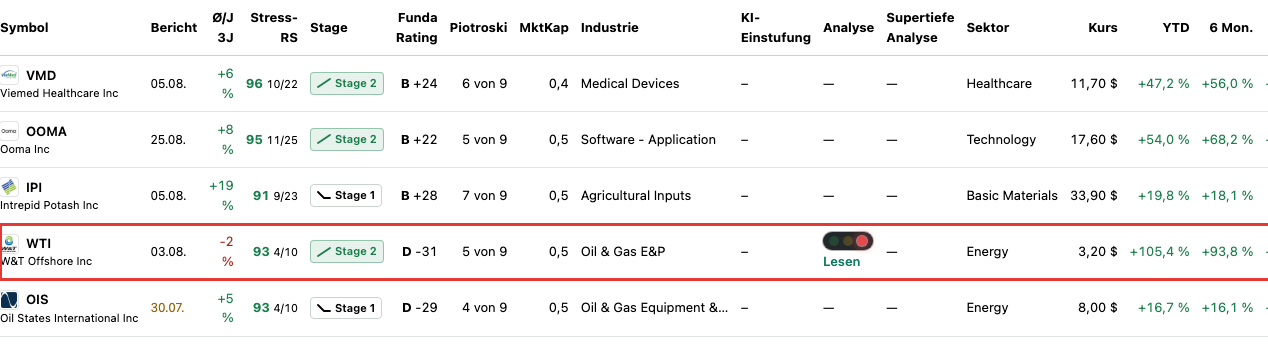
Every day we run about 3,500 stocks through our scanners. W&T Offshore (company profile) lights up in 8 filters as of the July 8, 2026 data cut-off — and the list reads like one long compliment to the share price: Stan Weinstein Stage 2 (the stock is in the advancing phase of the classic four-stage model), Power Trend, Richard Moglen’s Top Performers 3/6 months, institutional accumulation (most recently 9 funds added, 7 trimmed), the "pros over 80 percent" filter and — most remarkably — strength on stress days with a rating of 93 of 99: on 4 of the last 10 days on which both the broad market and its own sector closed down at least half a percent, this stock still finished green — only the strongest roughly 10 percent of the universe manage that, and institutional accumulation is often behind it. Add the P/CF ranking: the stock costs only 5.8 times operating cash flow. The price record: up 105 percent year to date, up 93 percent over six months — after minus 14 percent in the past month, with an average daily range around 6.4 percent (all data as of July 8, 2026). A momentum profile straight out of the textbook. Except: not a single one of these 8 hits is a quality filter. The fundamental side of the same database judges differently: an Altman Z-score around 0 — the classic insolvency early-warning system historically starts its danger zone below 1.8; readings near zero sit deep inside it —, a Piotroski F-Score of 5 of 9 (mediocre; rock-solid companies score 8 or 9), a fundamental grade of D, no P/E for lack of profit, and despite the double, the price still sits roughly 93 percent below its all-time high. Remember this fingerprint: when every trend light is green and every quality light is red, the market is trading a bet — not a company.
The numbers over the years — honestly appraised
First, what actually carries the rally — and it is more than hot air. The first quarter of 2026 was operationally the best in a long time: production rose 19 percent to 36,211 barrels of oil equivalent per day, revenues gained 15.5 percent to $150.0 million, and the net loss narrowed from $30.6 million to $22.5 million. The tailwind comes from natural gas: $5.41 per thousand cubic feet after $4.45 in the prior-year quarter — and W&T’s reserves are about 58 percent gas; already in 2025, the gas price ($3.90 after $2.65) had nearly offset the decline in oil prices. Add restored fields: West Delta 73, Mobile 916 and Main Pass 108 delivered again in 2025, and the Mobile Bay fields ran better after well stimulation work. Operating cash flow rose to $77.2 million in 2025 (from $59.5 million in 2024), in January 2025 the insurers wired another $58.5 million from a claims settlement for a Mobile Bay well lost in 2023, and cash stood at a solid $130.9 million as of March 31, 2026. The refinancing is done: in January 2025, a new $350 million note replaced the old paper, not due until 2029. Whoever reads only these paragraphs understands the doubling of the share price. Now turn the page:
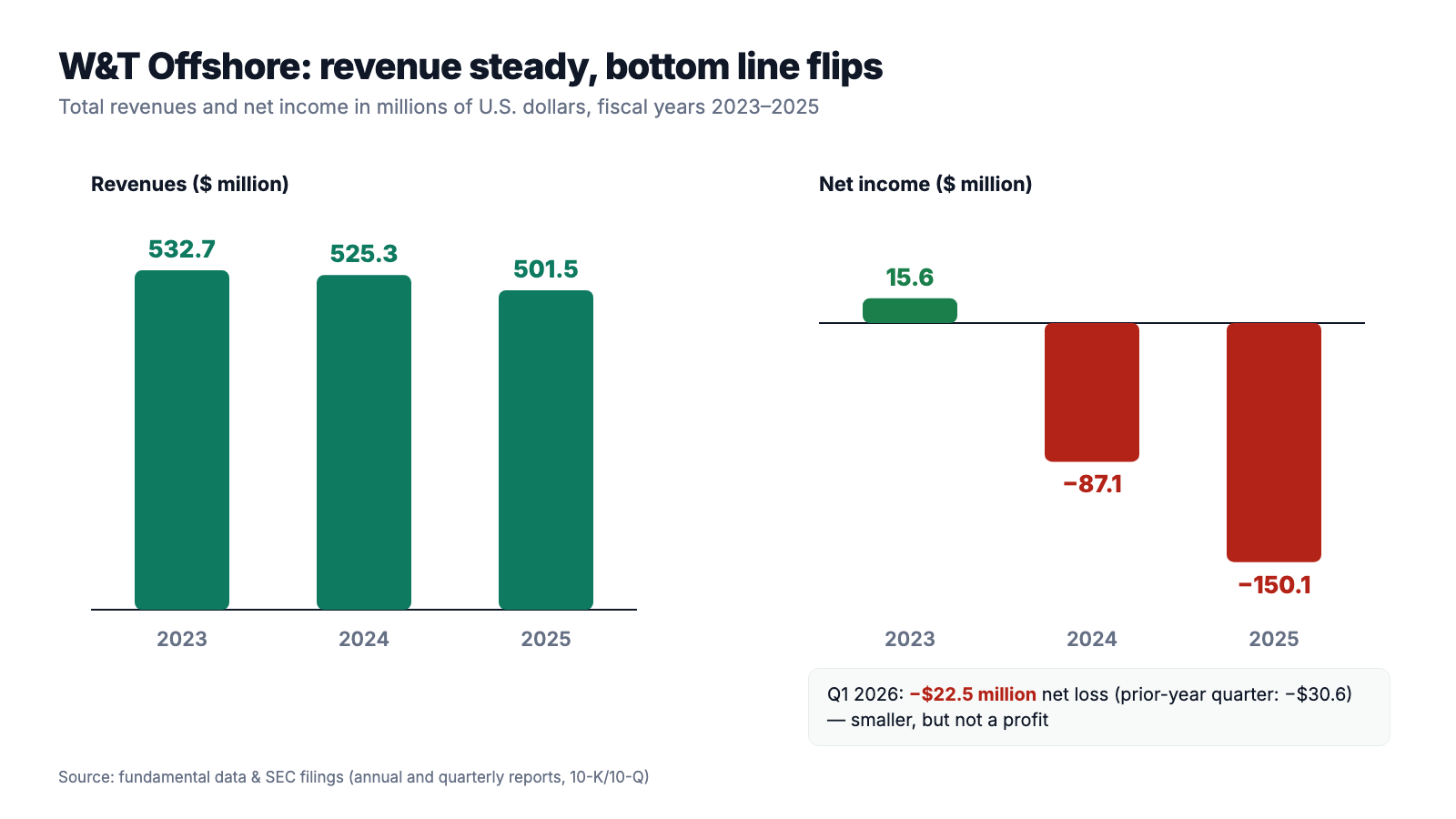
On an annual view, the same company shows a different face: revenues fell 4.5 percent to $501.5 million in 2025 (2023: $532.7 million), and the line at the bottom got worse for the third year in a row — plus $15.6 million (2023), minus $87.1 million (2024), minus $150.1 million (2025). The 2025 loss contains one-off effects — $15.0 million for retiring the old notes and $50.9 million of tax expense, mostly because the company wrote down nearly all of its deferred tax assets (a bookkeeping event, but one with a message: it means management does not consider near-term profits certain enough to offset them against old losses). And the balance sheet behind it: as of December 31, 2025, stockholders’ equity stood at minus $199.8 million, and at minus $221.8 million by March 31, 2026 — liabilities and obligations exceed the booked assets. One number makes the business model tangible: oil and gas properties with a remaining book value of $655 million carry $8.5 billion of accumulated depreciation, depletion and amortization (March 31, 2026) — this company has already consumed well over 90 percent of its substance. That is not an accusation; it is the antiques dealer’s business model. You just have to know what stands at the end of every produced-out field: the teardown bill. Which brings us to the uncomfortable truths.
What the filings say — the uncomfortable truths
Uncomfortable truth no. 1: the teardown bill — $561.8 million, more than the company is worth on the exchange
Whoever produces in the Gulf of Mexico may leave nothing standing at the end: every well must be plugged, every platform removed, the seabed restored. This obligation sits on the balance sheet as an "asset retirement obligation" (ARO) — in plain words: the provision for the teardown. The annual report describes it like this:
"We are required to record a liability for the present value of our ARO to plug and abandon inactive non-producing wells, to remove inactive or damaged platforms, and inactive or damaged facilities and equipment, collectively referred to as ‘idle iron,' and to restore the land or seabed at the end of oil and natural gas production operations."
— W&T Offshore, SEC annual report 10-K 2025, Item 1A "Risk Factors"
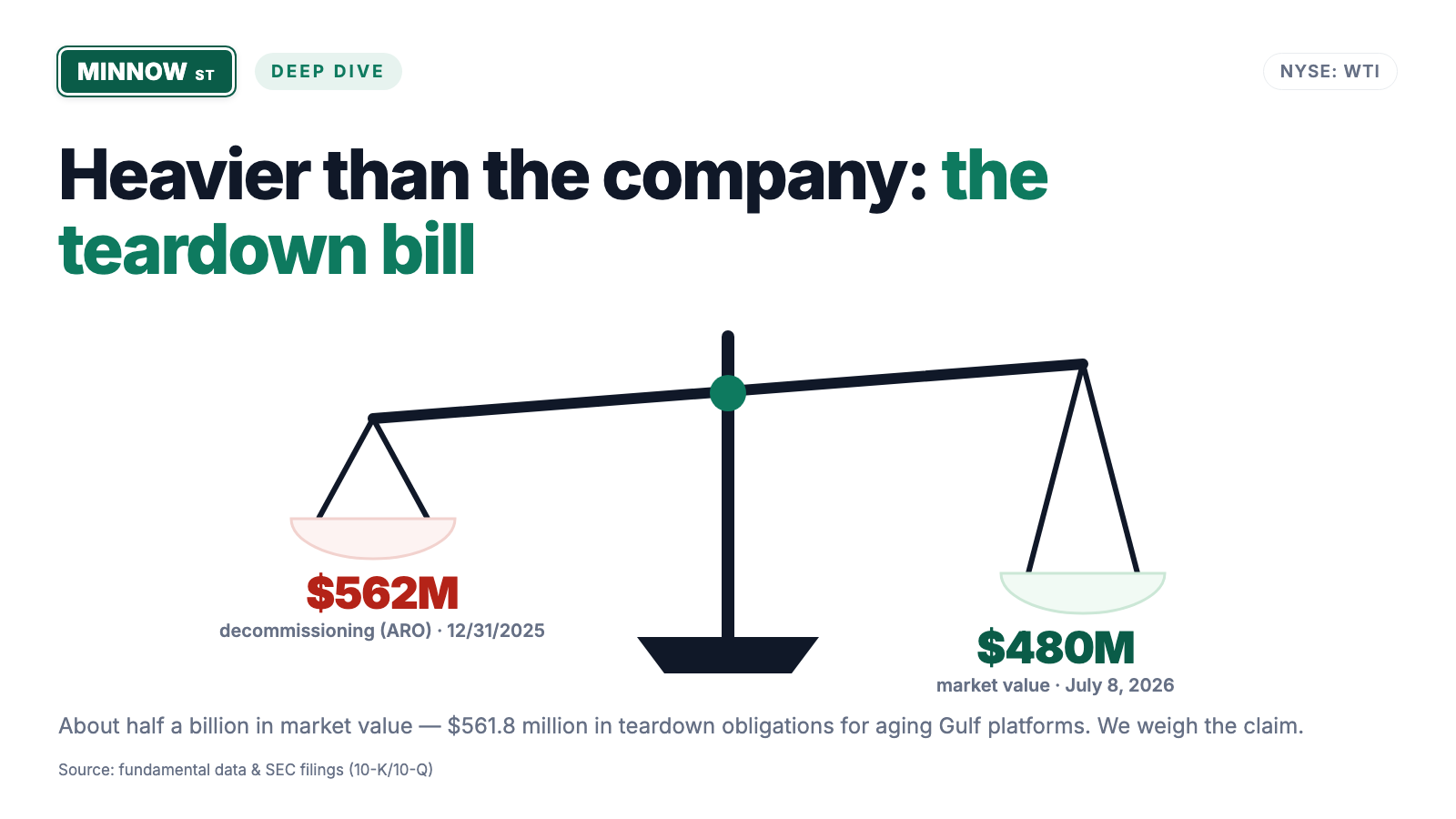
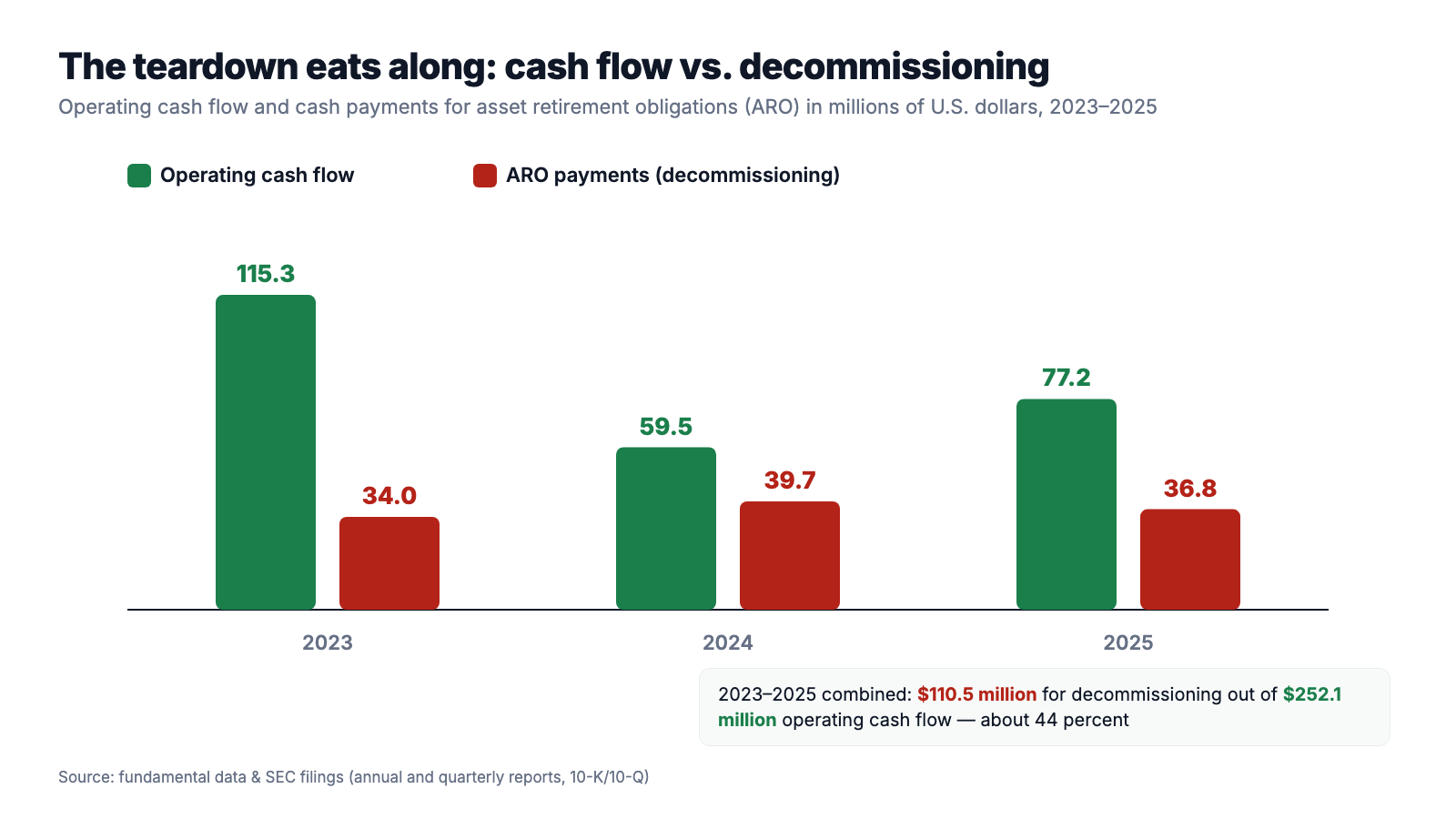
The sum of this obligation: $561.8 million as of December 31, 2025 ($26.1 million current, $535.7 million long-term) — more than the entire market value of roughly $0.5 billion (data as of July 8, 2026), and by March 31, 2026 it had grown further to $566.0 million. Translated into an everyday image: whoever buys an old house with a demolition order pays twice — once at the purchase, once for the wrecking ball. W&T has been buying old houses for decades. Important context: this is not a theoretical figure due in some distant future. The company works it off continuously — $36.8 million went into decommissioning work in 2025, $39.7 million in 2024, $34.0 million in 2023 — a combined $110.5 million within three years, roughly 44 percent of those years’ operating cash flow. And the estimate itself is soft: the report warns that unanticipated decommissioning costs could materially hurt the financial position, and the U.S. regulator BSEE has already sent W&T letters listing wells to be plugged as "idle iron" by set deadlines. The auditor, too, lists the ARO estimate as a critical audit matter — the part of the financial statements requiring the most judgment. Remember the sentence: for a buyer of old fields, the most important number is not what still comes out — it is what the teardown costs.
Uncomfortable truth no. 2: the sureties want collateral — $254.7 million, in the middle of the game
The decommissioning obligation has a second battleground, and it is a current one: toward U.S. regulators, W&T must post guarantees — so-called surety bonds from specialty insurers. In 2024, something happened that the company itself describes as a change of fronts: the sureties suddenly demanded cash collateral — although, per W&T, all premiums were paid and its financial condition had not materially changed. The annual report quantifies the front like this:
"The Sureties' aggregate collateral demands against us total approximately $183.7 million. In addition, Philadelphia Indemnity Insurance Company (‘PIIC') separately made a collateral demand of $71.0 million. No legal action has been filed by PIIC as of the date hereof. The total aggregate collateral demanded by the Sureties and PIIC is approximately $254.7 million (the ‘Demanded Collateral')."
— W&T Offshore, SEC annual report 10-K 2025, Item 1A "Risk Factors"

For scale: $254.7 million in cash collateral demanded from a company with $140.6 million of cash (December 31, 2025) — that is as if your landlord suddenly demanded eight times the security deposit in the middle of the lease. W&T fought back, and remarkably aggressively: the company went to court itself, had the cases consolidated and countered with a counterclaim under, among other statutes, the Sherman Antitrust Act — the heaviest artillery of U.S. competition law — alleging coordinated conduct among the sureties. There are first successes: in June 2025, W&T settled with two sureties (USSIC and PIIC, together $94 million of the demands); both withdrew their collateral demands and left premiums untouched until at least the end of 2026. Against the rest — Sompo ($55.0 million), Applied ($11.3 million) and U.S. Fire ($93.5 million) — the case continues. Why this front matters so much: not because W&T necessarily loses it. But because it shows how the professionals price the teardown bill from truth no. 1 — the very insurers who vouch for W&T’s demolition suddenly wanted to see cash. And the regulator relaxed the situation only partially: in April 2025 the Interior Department said it would not, for now, demand supplemental financial assurance in the Gulf — except for properties with no former owner left to share the liability. Precisely where the antiques dealer stands alone on the deed, the door stays open.
Uncomfortable truth no. 3: the reserves clock — a third of the inventory is gone within three years
A producer without its own exploration lives off buying more — and its most important clock is the life of its reserves. At W&T it ticks fast, and the annual report says so without hedging:
"Our independent petroleum consultant estimates that 34.0% of our total proved reserves as of December 31, 2025 will be depleted within three years."
— W&T Offshore, SEC annual report 10-K 2025, Item 1A "Risk Factors"

The numbers behind it: proved reserves fell from 127.0 to 121.0 million barrels of oil equivalent within one year, and the composition betrays the portfolio’s exhaustion — only 6.7 million barrels still count as "proved undeveloped" (2024: 21.7 million), meaning projects that could still be drilled; in 2025 the company dropped such locations because they became uneconomic at current prices or fell out of the SEC’s five-year rule. The estimated present value of all future net revenues from the reserves (the "standardized measure," an SEC standard calculation discounted at 10 percent) stood at $651.3 million at the end of 2025 — down from $740.1 million a year earlier. Translated: the pantry is emptying, and replenishment comes only for money — through acquisitions like the $77.3 million deal of January 2024 — or for drilling risk. Both cost exactly the liquidity that the teardown (truth no. 1) and the sureties (truth no. 2) are already pulling on. The clock does not run to zero by 2028 — 66 percent of the reserves last longer — but it explains why this company structurally must buy what others want to get rid of.
Uncomfortable truth no. 4: everything hangs on the same Gulf — hurricanes included
W&T produces 100 percent in the Gulf of Mexico. What that means is spelled out in the risk section at a level no investor can argue away — the weather:
"In the past, tropical storms and hurricanes in the Gulf of America have caused catastrophic losses and property damage. Similar events may cause damage or liability in excess of our coverage that might severely impact our financial position."
— W&T Offshore, SEC annual report 10-K 2025, Item 1A "Risk Factors"

That is not boilerplate; it is lived practice: in 2024, W&T booked its own hurricane expenses for repairs and evacuations after storms Francine, Helene and Rafael; every summer and fall, personnel evacuations and shut-in production are part of the calendar. The Gulf risk is compounded by a concentration problem in the portfolio: roughly 36 percent of production and 20 percent of revenue came from a single area in 2025 — the Mobile Bay fields off Alabama. Of all places, those facilities stood still at times in 2025 because of compressor and downstream plant problems; roughly 686,000 barrels of oil equivalent of production were deferred as a result. Read positively: the insurance works — for the Mobile Bay well lost in 2023, $58.5 million in claim proceeds arrived in January 2025. Read negatively: a company whose balance sheet has no cushion left (equity minus $199.8 million) produces in a basin where a single storm over the wrong spot can cost more than the policy covers. In the Gulf, one quarter of tailwind is quickly blown away.
Valuation: $0.5 billion in market value — and the true purchase price sits far above it
In early July 2026 the W&T Offshore stock cost about $3.20, for a market value of roughly $0.5 billion (data as of July 8, 2026). The scanner optics are friendly: a price-to-sales ratio around 0.9, 5.8 times operating cash flow, a good 10 times free cash flow. But calculate like a buyer of the whole company — and for a producer of aging fields that means: buying the debt and the teardown bill along with it. To the market value, add $358.8 million of debt (less $140.6 million of cash) and $561.8 million of decommissioning obligations that will come due as surely as the debt itself — only owed to the seabed instead of to a bank. Calculated that way, the economic purchase price sits at roughly $1.25 billion (all balance sheet figures: December 31, 2025) — no longer 5.8 times, but roughly 16 times the 2025 operating cash flow. Add the price of money: the $350 million note issued in January 2025 carries a coupon of 10.75 percent — $37.3 million of interest a year; that is how bondholders price this risk. The opposite position is honorable and belongs on the table: with 58 percent gas reserves, a rising gas price works like a lever directly on cash flow, and the first quarter of 2026 demonstrated it; cash of $130.9 million (March 31, 2026) is respectable; no major note matures before 2029; and a founder with a good third of the shares burns his own money alongside yours. Whoever buys this stock buys a leveraged warrant on the gas price with an expiry date called "reserve depletion" — the year-to-date double is the premium for the lever currently pointing the right way.
Opportunities and risks at a glance
What speaks for W&T Offshore:
- An operational comeback with numbers: first-quarter 2026 production up 19 percent to 36,211 barrels of oil equivalent per day, revenues up 15.5 percent to $150.0 million, net loss narrowed from $30.6 to $22.5 million (quarterly report 10-Q as of March 31, 2026).
- The gas lever: about 58 percent of reserves are natural gas; the realized gas price rose from $2.65 (2024) via $3.90 (2025) to $5.41 per thousand cubic feet (Q1 2026) — with largely fixed production costs, that feeds straight into cash flow.
- Liquidity and maturities in order: $130.9 million of cash (March 31, 2026), operating cash flow up to $77.2 million in 2025, $58.5 million of insurance proceeds collected; the $350 million note runs to 2029, the credit facility to July 2028.
- A proven acquisition model with the owner at the wheel: the same founder-CEO since 1983, roughly 37 percent insider ownership per fundamental data (as of July 8, 2026); the January 2024 purchase ($77.3 million) brought fields whose restart supported 2025 production.
- Partial relief on two fronts: settlements with two sureties (USSIC/PIIC) in June 2025 without posting collateral; since April 2025 the U.S. regulator has waived supplemental financial assurance for properties with predecessors still on the hook.
What speaks against it:
- The teardown bill exceeds the market value: $561.8 million of decommissioning obligations (December 31, 2025) against roughly $0.5 billion in market value (July 8, 2026); in real cash, $110.5 million flowed out for this from 2023 through 2025 — about 44 percent of those years’ operating cash flow.
- A balance sheet without a cushion: stockholders’ equity of minus $199.8 million (December 31, 2025; March 31, 2026: minus $221.8 million); net results worse for the third year in a row ($150.1 million loss in 2025); an Altman Z-score around 0 and a fundamental grade of D (data as of July 8, 2026); deferred tax assets nearly fully written down in 2025.
- The sureties dispute is unresolved: of $254.7 million in demanded cash collateral, roughly $160 million remains contested after the settlements (Sompo, Applied, U.S. Fire); losing would tie up nearly the entire cash balance — and, as the report itself warns, endanger the capital program and the ARO plan.
- A fast reserves clock: 34.0 percent of proved reserves depleted within three years, only 6.7 million barrels of undeveloped projects left — growth comes only via acquisitions or drilling risk, financed at 10.75 percent bond terms.
- Gulf concentration and weather: 100 percent of production in the Gulf of Mexico, 36 percent from a single area (Mobile Bay, 686,000 barrels of oil equivalent deferred in 2025 through technical outages); hurricane damage beyond insurance coverage remains the named catastrophe scenario.
A human conclusion
Back to proxy thinking from the opening. It has a true core: whoever wanted exposure to oil and above all natural gas in 2026 has been dead right with this ticker so far — up 105 percent year to date, carried by real barrels, a real gas price and genuinely restored fields. But check what exactly you are buying when you buy "WTI": not the crude grade from the news, but a company whose annual report lays three bills on the table that no oil price in the world pays. The teardown bill: $561.8 million of decommissioning obligations, more than the market value, worked off with roughly 44 percent of the past three years’ operating cash flow. The trust bill: surety insurers who suddenly wanted to see $254.7 million in cash — a dispute only half settled. And the time bill: a third of the reserves gone in three years, replenishment only for money or risk. None of this is a death sentence — the cash box is filled, the note runs to 2029, the gas lever is real, and since 1983 Tracy Krohn has steered this company through worse storms, with his own fortune on board. But this is an investment only for those who know they are not holding a commodity here, but a leveraged betting slip on the gas price and on decommissioning discipline — with negative equity as the margin of safety. The oil benchmark is called WTI. This stock merely shares the name. What you make of it is your decision. And that is exactly as it should be.
Sources
All original documents used in this analysis — to read for yourself:
- W&T Offshore, Inc. — SEC annual report 10-K for 2025 (filed March 16, 2026)
- W&T Offshore, Inc. — SEC annual report 10-K for 2024 (filed March 4, 2025)
- W&T Offshore, Inc. — SEC quarterly report 10-Q as of March 31, 2026 (filed May 7, 2026)
- W&T Offshore, Inc. — SEC quarterly report 10-Q as of September 30, 2025 (filed November 6, 2025)
- W&T Offshore, Inc. — SEC quarterly report 10-Q as of June 30, 2025 (filed August 5, 2025)
- W&T Offshore, Inc. — SEC quarterly report 10-Q as of March 31, 2025 (filed May 7, 2025)
- W&T Offshore’s complete SEC filing history: EDGAR overview (sec.gov)
- Fundamental data (metrics, quarterly series, valuation; data as of July 8, 2026), reconciled with the SEC filings.
- Screener and rating data: in-house stock scanner (data as of July 8, 2026); Reddit mentions: ApeWisdom (as of July 15, 2026).
Transparency & disclaimer: This analysis is a journalistic contextualization of publicly available information and is not investment advice, not a financial analysis in the regulatory sense, and not a solicitation to buy or sell securities. Stock investments carry substantial risks up to total loss. All information without guarantee; the data cut-off is noted in the text in each case. The author holds no position in W&T Offshore stock at the time of publication.
Our Bottom Line at a Glance
- Operating momentum & gas lever positive
- First-quarter 2026 production up 19 percent to 36,211 barrels of oil equivalent per day, revenues up 15.5 percent, the loss narrowed; about 58 percent of reserves are natural gas, whose realized price rose from $2.65 (2024) to $5.41 per thousand cubic feet (Q1 2026); cash of $130.9 million (March 31, 2026), notes not due until 2029 (quarterly report 10-Q as of March 31, 2026).
- Decommissioning obligations (ARO) negative
- $561.8 million of booked decommissioning obligations (December 31, 2025) exceed the market value of roughly $0.5 billion (July 8, 2026); from 2023 through 2025, $110.5 million in real cash went into decommissioning work — about 44 percent of operating cash flow; the auditor lists the ARO estimate as a critical audit matter, and the regulator BSEE is pressing for "idle iron" pluggings.
- Balance sheet & earnings quality negative
- Stockholders’ equity of minus $199.8 million (December 31, 2025; March 31, 2026: minus $221.8 million), net results worse for the third year running ($150.1 million loss in 2025), deferred tax assets nearly fully written down; an Altman Z-score around 0 and a fundamental grade of D (data as of July 8, 2026); the debt costs a 10.75 percent coupon.
- Sureties dispute & regulation neutral
- Of $254.7 million in demanded cash collateral, roughly $160 million remains contested after the June 2025 settlements with USSIC and PIIC; W&T counters with an antitrust counterclaim. Since April 2025 the U.S. regulator waives supplemental financial assurance — except for properties with no predecessor left on the hook, the core of the W&T model (annual report 10-K 2025).
- Reserves & ownership structure neutral
- Per the independent consultant, 34.0 percent of proved reserves will be depleted within three years, and only 6.7 million barrels of undeveloped projects remain — replenishment requires acquisitions or drilling risk. Against that stands a founder-CEO since 1983 with roughly 37 percent insider ownership (data as of July 8, 2026), whose interests the report simultaneously lists as its own risk factor.
W&T Offshore is a leveraged betting slip on the natural gas price: the operational comeback (Q1 2026: production up 19 percent, loss narrowed) and 58 percent gas reserves honestly explain the year-to-date doubling of the share price. But the balance sheet carries a teardown bill of $561.8 million — more than the company is worth on the exchange —, equity is depleted at minus $199.8 million, surety insurers still demand roughly $160 million in collateral, and a third of the reserves will be gone in three years. Whoever invests here holds no commodity, but a lever on the gas price and on decommissioning discipline. Not investment advice.
What Our Rating Means
- If you don't own the stock
- In our view, the documented risks clearly outweigh — we see no basis for an entry.
- If you hold it in your portfolio
- In our view, the findings carry enough weight to warrant a critical look at your own position.
A journalistic assessment by our editorial team at the time of the deep dive, based on public sources — not investment advice and not a solicitation to buy or sell. Your personal circumstances (investment goals, risk capacity, taxes) cannot be taken into account. What our categories mean, how verdicts are formed, and what conflicts of interest exist →
Worth Noting
- WTI reached our research list via the Reddit hype scanner (ApeWisdom, 2 mentions in 24 hours, as of July 15, 2026) — a mini echo that may additionally be noisy because the ticker is identical to the West Texas Intermediate crude benchmark. The 8 hits in our in-house stock scanner carry the July 8, 2026 data cut-off and rotate daily.
- Scanner metrics (P/S, P/CF, Altman Z, Piotroski, stress-day rating) are computed from trailing twelve-month figures; the improved first quarter of 2026 and the June 2025 sureties settlement show up in them only with a lag.
- Price and valuation figures are dated to July 8, 2026 (about $3.20, market value roughly $0.5 billion); analyses are evergreen, daily prices are not a buy argument.
Frequently Asked Questions
No. On the NYSE, WTI is the ticker of W&T Offshore, Inc., an oil and natural gas producer in the Gulf of Mexico — and at the same time the globally used symbol of the U.S. benchmark crude West Texas Intermediate. The glossary of the annual report 10-K for 2025 itself defines "WTI" as a crude oil grade. If you mean the stock, search for "W&T Offshore"; mention counts for the symbol WTI in forums and scanners may partly refer to the oil price.
W&T Offshore produces oil, natural gas and natural gas liquids from 49 fields in the Gulf of Mexico (December 31, 2025) — on the shallow shelf and in deepwater. The model since 1983: buy aging fields with existing production cheaply and lift the remaining substance, most recently for $77.3 million in January 2024. In 2025 the company produced 12.4 million barrels of oil equivalent (revenues: $501.5 million); about 58 percent of reserves are natural gas.
As of December 31, 2025, stockholders’ equity stood at minus $199.8 million (March 31, 2026: minus $221.8 million), because an accumulated deficit of $780.3 million exceeds the paid-in capital. 2025 added a net loss of $150.1 million — burdened by $15.0 million for retiring the old notes and $50.9 million of tax expense from writing down deferred tax assets. Liabilities and obligations thus exceed the booked assets.
ARO are the booked obligations to plug old wells, remove platforms and restore the seabed. At W&T Offshore they totaled $561.8 million on the balance sheet as of December 31, 2025 — more than the market value of roughly $0.5 billion (July 8, 2026). In real cash, $110.5 million went into decommissioning work from 2023 through 2025 combined — about 44 percent of those years’ operating cash flow.
Several insurers that backstop W&T’s decommissioning obligations via surety bonds began demanding cash collateral totaling roughly $254.7 million in 2024 — although, per the annual report, all premiums were paid. W&T sued and filed counterclaims, among them under the Sherman Antitrust Act. With USSIC and PIIC (together $94 million) it settled in June 2025 without posting collateral; the case against Sompo, Applied and U.S. Fire (roughly $160 million) continues.
A good third of the shares (roughly 37 percent, data as of July 8, 2026, source: fundamental data) sit with insiders — first and foremost founder Tracy W. Krohn, who has been Chairman, CEO and President in one person since 1983. The annual report lists the concentration of power as its own risk factor: the CEO’s interests may diverge from those of the other shareholders. About 47 percent of the shares sit with institutional investors.
Optically yes: a price-to-sales ratio around 0.9 and 5.8 times operating cash flow (data as of July 8, 2026). But once you add debt ($358.8 million), cash ($140.6 million) and the decommissioning obligations ($561.8 million; all figures December 31, 2025), the economic purchase price sits at roughly $1.25 billion — about 16 times the 2025 operating cash flow. On top, the debt costs a 10.75 percent coupon. What is cheap here is mainly the leverage, not the substance.
Found an error?
Did you spot a factual error, an outdated number, or a typo in this deep dive? Let us know briefly — your report goes straight to the editorial team.