Global Partners: 13 Distribution Hikes in a Row — and a Silent Partner Taking Almost Half of Every Increase
About 6.3 percent in distribution yield from gas stations and fuel terminals on the U.S. East Coast, the payout raised every single quarter for three years — on Reddit the ticker GLP is making the rounds again, and the yield goggles fog up. We read what Global Partners itself reported to the U.S. securities regulator, the SEC — in the annual report (10-K) for 2025 and the quarterly report (10-Q) for the first quarter of 2026: a rock-solid business on razor-thin margins, wrapped in a master limited partnership in which you have no vote, the general partner collects 48.67 percent of every cent above $0.6625 per quarter, and the IRS holds out its hand at every distribution. Not investment advice — just the itemized bill behind a tempting yield.
 Thomas Mücke
Founder & Publisher
Thomas Mücke
Founder & Publisher
Chart
Interactive price chart (TradingView).
Note: pure fact-based analysis, not investment advice and not a solicitation to buy or sell. All figures without guarantee.
There is a number that trips an old reflex in many investors: 6.3 percent. That is the distribution yield Global Partners LP (NYSE: GLP) works out to when you annualize the most recently declared quarterly distribution and hold it against the market value of about $1.64 billion (as of July 15, 2026). Psychologists know the reflex well: at "6.3 percent, raised every quarter for three years," the brain stops asking what is doing the distributing — the yield goggles blank out everything that is not a percent sign. It is exactly with these goggles that GLP is resurfacing in the U.S. stock forums: our Reddit hype scanner counted 6 mentions within 24 hours on July 15, 2026 (source: ApeWisdom) — no storm, more the quiet background hum out of which forums like to build "overlooked dividend gems." So let's make a deal: before you trust the yield, we read together what Global Partners itself reported to the U.S. securities regulator, the SEC — in the annual report (10-K) for 2025 and the quarterly report (10-Q) for the first quarter of 2026, honest under penalty of law. Because with GLP, the name itself announces that something is different here: LP stands for limited partnership — you are not buying a share of stock, you are buying a stake in a partnership. What that costs is in the fine print. In the end, you decide for yourself.
What Global Partners actually does
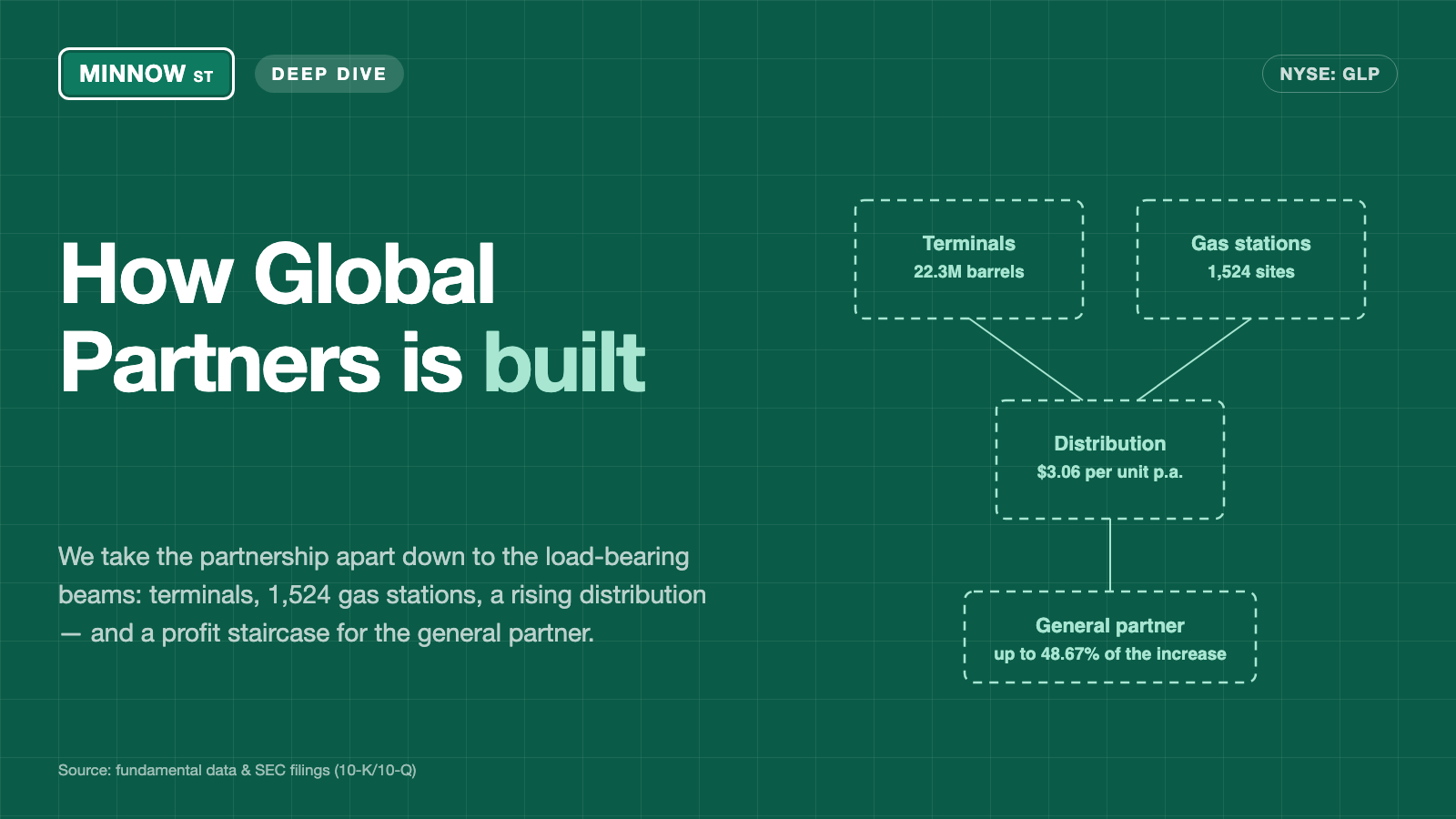
Global Partners is the backbone of fuel supply on the U.S. East Coast — the part you only notice when it is missing. The business rests on two beams. First, the terminals: a network of storage facilities for gasoline, diesel, heating oil and renewable fuels with about 22.3 million barrels of storage capacity, connected to rail, pipelines and ports, from Maine down the Atlantic seaboard to the U.S. Gulf Coast — at the end of 2023, 25 terminals from Motiva were added for $313.2 million. Second, the pumps: with 1,524 owned, leased or supplied gas stations — including 290 directly operated convenience stores — Global Partners is one of the largest independent gas station operators in the Northeast; another 67 sites in Texas run through a joint venture. All of it is organized in three segments: Wholesale (68 percent of 2025 revenue), GDSO — gasoline distribution and station operations, meaning the stations and their shops (26 percent) — and Commercial (direct business with companies and public agencies, 6 percent). About 4,700 employees, roughly 3,265 of them full-time, kept the operation running at the end of 2025.
The punchline sits in the margins: in 2025, Global Partners turned over $18.56 billion — nearly eight billion gallons of fuel — but earned only $98.0 million in net income on it. Of every $100 in revenue, just over 50 cents remain. That is not a flaw; it is the business model: in wholesale, about 5.5 cents of product margin stick per gallon on average, at the company's own pumps about 38 cents — plus coffee, lottery tickets and car washes in the shop. Which is how the station segment GDSO, with only a quarter of the revenue, delivers about 71 percent of the total product margin ($846.0 of $1,193.9 million in 2025). Note, right here, the central tension of this analysis: the business is rock solid, throws off real cash and has raised its distribution every quarter for three years — but the wrapper you buy it in is a master limited partnership with three built-in carrying costs: no ballot, a profit staircase for the general partner, and a tax backpack. It runs through every chapter. How tightly oil logistics and the business cycle are linked is something we dissected in our analysis of the barge operator Kirby — Global Partners is, in a sense, the onshore leg of the same supply chain.
Where the ticker comes from — and why our fundamental scanner does not know it
Honesty first: GLP appears in none of our fundamental stock scanners. That is no verdict, it is systematics — our in-house stock scanner works through the Russell 3000 universe of U.S. corporations, and Global Partners is not a corporation but a listed limited partnership; it falls through the grid. The ticker landed on our desk through a different tool: our Reddit hype scanner, which evaluates daily which small and mid caps the U.S. stock forums are talking about (data basis: ApeWisdom). On July 15, 2026 it counted 6 mentions within 24 hours for GLP — little noise, but typical of the kind of ticker passed around in dividend threads. What forum dynamics can do to a stock is something you can watch in our analysis of AMC Entertainment, the meme-stock veteran. For Global Partners, the setup means: no scanner metrics as guardrails — only the original documents. All the more important to actually read them.
The numbers over the years — honestly appraised
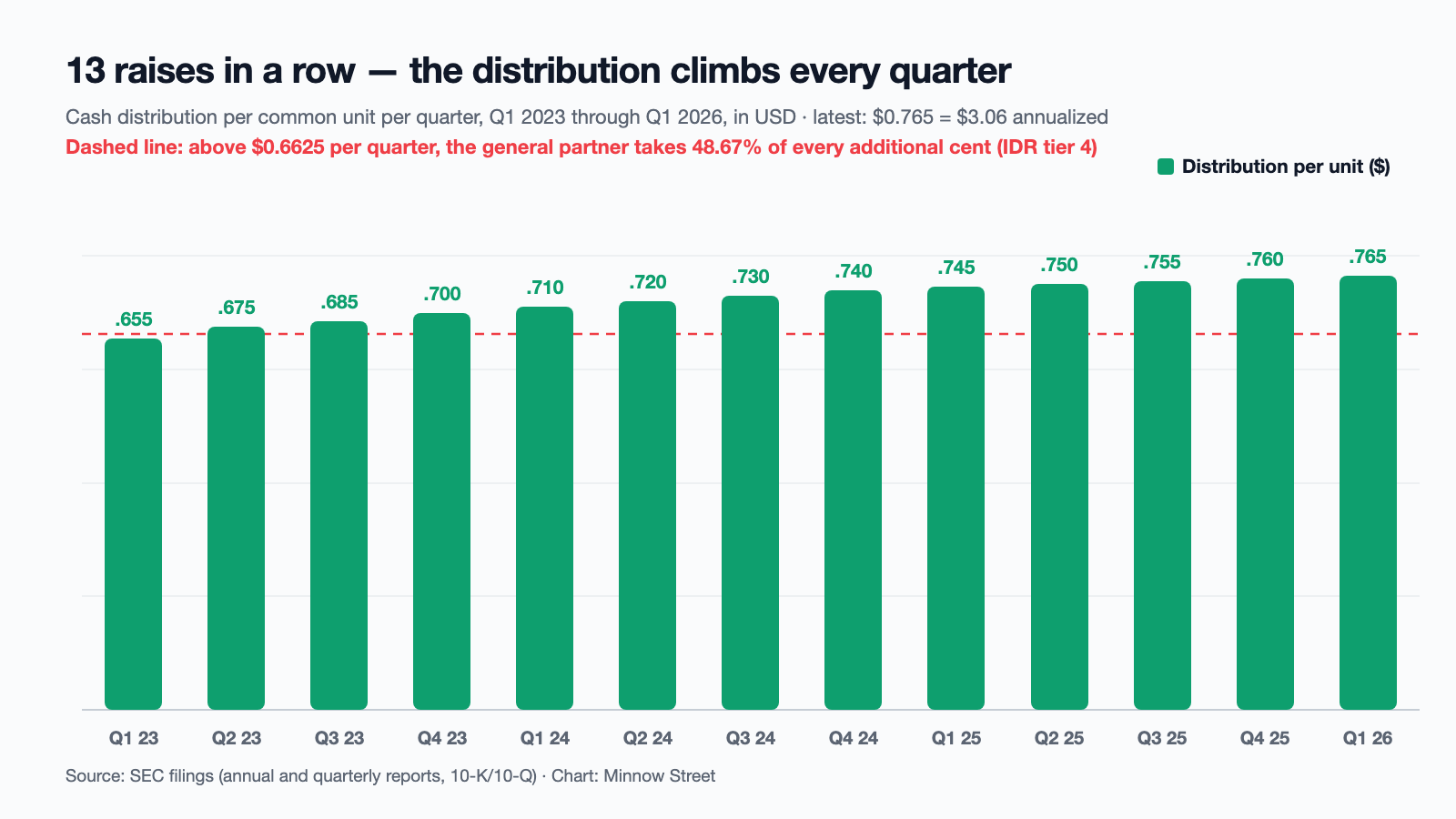
First, what genuinely has substance — and there is quite a bit of it here. Global Partners is growing: revenue climbed from $16.49 billion (2023) via $17.16 billion (2024) to $18.56 billion (2025, up 8 percent), driven by the expanded terminal business — wholesale volume jumped 28 percent to 5.88 billion gallons in 2025. Adjusted EBITDA came to $383.0 million in 2025 (2024: $389.1 million), and distributable cash flow — the MLP metric for what is left to distribute after interest and maintenance capital expenditures — to $189.1 million. Against that stood $119.9 million of distributions actually paid in 2025 (common units, general partner and IDRs combined): coverage of about 1.6 times — the cushion is real, not an accounting mirage. And the first quarter of 2026 was an exclamation mark: revenue up 16 percent to $5.32 billion, gross profit up 30 percent, net income of $70.1 million after $18.7 million in the prior-year quarter — a cold winter in heating oil country and strong wholesale margins helped mightily; the house, incidentally, treated itself to a slice of the party right away, more on that later. Above all, though, the partnership delivers what people buy MLPs for:
But an honest appraisal includes the second line of the income statement: net income has been falling since 2023 — from $152.5 million via $110.3 million to $98.0 million — even as revenue grew. The reasons are in the report: interest expense rose with the debt-financed terminal expansion from $85.6 million (2023) to $137.2 million (2025), and the operating costs of the larger network grew along. Distributable cash flow, too, came in below the prior year in 2025 ($189.1 million after $205.8 million). Remember this sentence: a yield is a fraction — the distribution sits on top, and underneath sits everything you buy along with it. The denominator is in the filings.
What the filings say — the uncomfortable truths
Uncomfortable truth no. 1: you are not buying a share of stock — and you elect nobody here
Global Partners is a master limited partnership (MLP): a partnership listed on a stock exchange under U.S. law. Instead of shares you buy common units — limited partner interests. The business is run not by a board elected by the owners but by the general partner, here Global GP LLC. Translated into an everyday image: you become a silent partner in a family business — you get your share of the profit, but the family picks the manager, not you. The annual report says it with disarming clarity:
"Unlike the holders of common stock in a corporation, unitholders have only limited voting rights on matters affecting our businesses and, therefore, limited ability to influence management's decisions regarding our businesses. Unitholders have no right to elect our general partner or its board of directors on an annual or other continuing basis. The board of directors of our general partner is chosen entirely by its members and not by the unitholders."
— Global Partners LP, SEC annual report 10-K for 2025, Item 1A "Risk Factors"

Who the family is stands in Item 13 of the same report: 95 percent of the general partner belongs to vehicles of CEO Eric Slifka and Thomas P. Jalkut; on top, the general partner and its affiliates hold 12.7 percent of the common units. To remove the general partner against its will would take 66 2/3 percent of all outstanding units — counting those of the general partner and its affiliates. And even control of the general partner itself may, per the report, be transferred to a third party without unitholder consent. The report lists as a risk in its own right that the general partner has "conflicts of interest and limited fiduciary duties, which could permit them to favor their own interests to the detriment of our unitholders." Remember: with an MLP you buy profit participation, not a say. Which raises the question of how the profit is actually divided.
Uncomfortable truth no. 2: the profit staircase — above 66.25 cents, the general partner takes almost half
For its work, the general partner receives no management fee. It receives something better: incentive distribution rights (IDRs) — a profit staircase anchored in the partnership agreement. The higher the quarterly distribution per unit climbs, the larger the general partner's share of every additional dollar:

The current distribution of $0.765 sits above the highest tier — every one of the 13 raises since 2023 has therefore happened on the step of the staircase where the general partner collects 48.67 percent of every additional cent. What that means in money, the report's distribution table shows: the quarterly incentive check grew from $1.6 million (for Q1 2023) to $4.6 million (for Q3 2025) — nearly a threefold increase, while the distribution per unit rose 15 percent. In the income statement, it adds up:
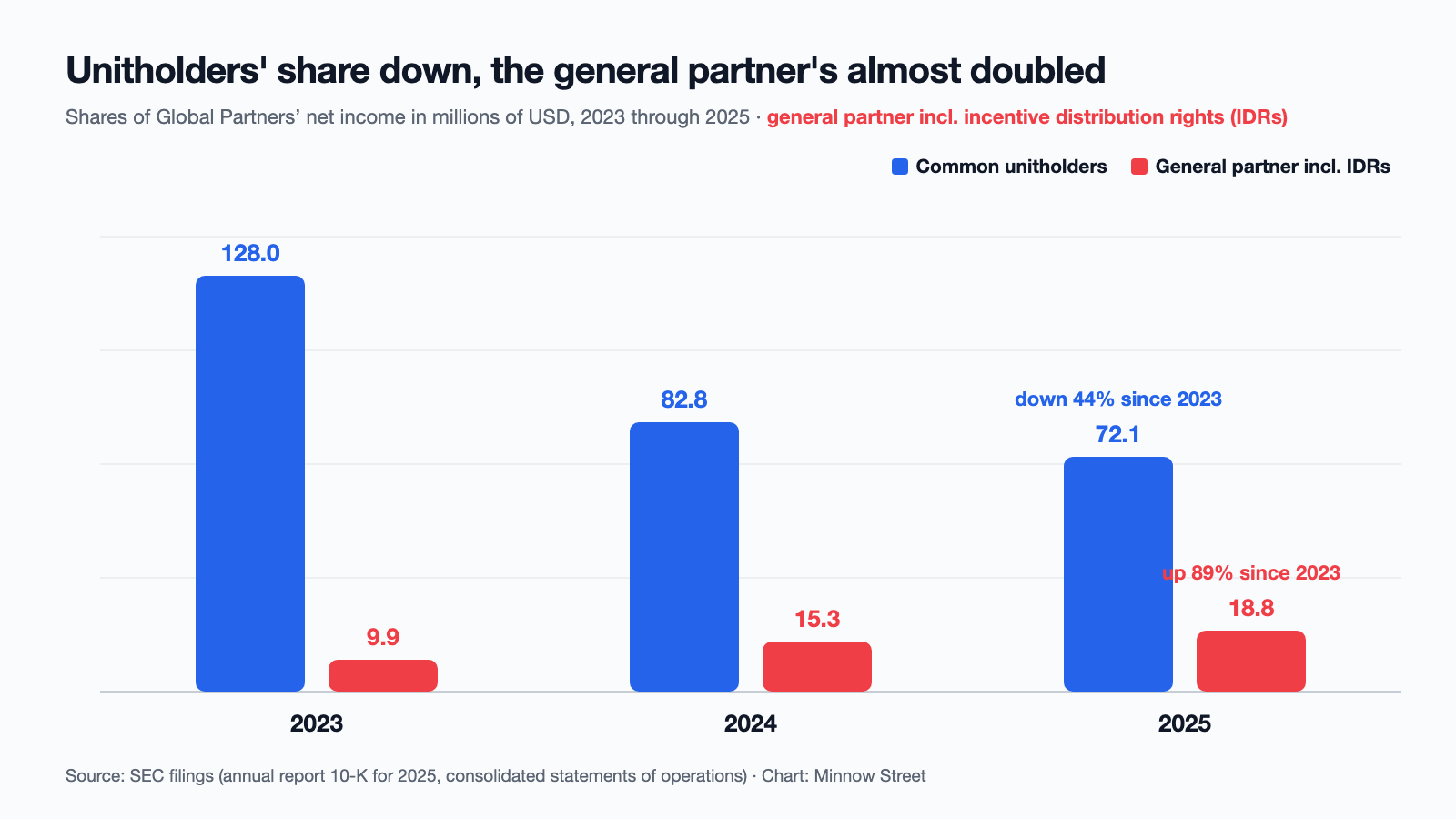
In 2025, $18.8 of $98.0 million in net income went to the general partner including IDRs — about 19 percent of the profit for a 0.67 percent capital stake. In 2023 it was still 6.5 percent. Fairness requires the context: the IDR ladder has been in the contract from the start, it rewards the general partner only when investors get more too, and many large U.S. MLPs used to have similar constructions — though quite a few have scrapped them in recent years, precisely because they drive up the cost of capital. For you as a buyer it means, plainly: of every future raise, only about half arrives with you. Today's 6.3 percent is real — but the elevator up carries two passengers.
Uncomfortable truth no. 3: the tax backpack — the IRS reads along, payout or not
The second peculiarity of the MLP wrapper is taxation. A partnership itself pays (almost) no income tax — the income is attributed directly to the owners, paid out or not. U.S. holders receive a Schedule K-1 tax form every year instead of a simple dividend statement, with their personal share of income, depreciation and interest — and the annual report states the consequence dryly:
"Our common unitholders are required to pay any U.S. federal income taxes and, in some cases, state and local income taxes on their share of our taxable income whether or not they receive cash distributions from us. Our common unitholders may not receive cash distributions from us equal to their share of our taxable income or even equal to the actual tax liability that results from that income."
— Global Partners LP, SEC annual report 10-K for 2025, Item 1A "Risk Factors — Tax Risks"
For investors outside the United States it gets one notch harder. MLP distributions count as income effectively connected with a U.S. trade or business and are taxed at the source; on top comes a 10 percent withholding tax that, strictly speaking, only hits the portion of a distribution exceeding cumulative net income — which Global Partners does not even bother to compute:
"As we do not compute our cumulative net income for such purposes due to the complexity of the calculation and lack of clarity in how it would apply to us, we intend to treat all of our distributions as being in excess of our cumulative net income for such purposes and subject to such 10% withholding tax. Accordingly, distributions to a non-U.S. unitholder will be subject to a combined withholding tax rate equal to the sum of the highest applicable effective tax rate and 10%."
— Global Partners LP, SEC annual report 10-K for 2025, Item 1A "Risk Factors — Tax Risks"

In plain terms: of the pretty 6.3 percent yield, a non-U.S. investor sees only a well-plucked remainder after U.S. withholding — how much of it can be recovered through refund procedures or the home tax return is a case for the tax adviser, not for the buy button. Add the fundamental risk the report itself names: should the partnership lose its tax status or should the law change, it would be taxed like a corporation — and its cash available for distribution "would be substantially reduced." A binding confirmation from the IRS, Global Partners says, has never been requested. Remember: with an MLP, the pre-tax yield and the after-tax yield are different currencies — and the exchange rate depends on your passport.
Uncomfortable truth no. 4: the distribution is an intention, not a promise — and one leg of the business is melting
Thirteen raises in a row feel like a guarantee. The report politely but unmistakably disagrees: "We may not have sufficient available cash each quarter to pay distributions on our preferred units and maintain distributions on our common units at current levels" (10-K for 2025). The distribution is a quarter-by-quarter decision of the general partner, boxed in by the credit agreement and the bond indentures. And the balance sheet counsels sobriety: $1.56 billion of debt stood against just $12.2 million of cash at the end of 2025 — an MLP distributes nearly everything and lives off its revolving credit line; the newest bond from January 2024 costs 8.25 percent in interest, the one from June 2025 still 7.125 percent. Interest expense has risen 60 percent since 2023, to $137.2 million. On top of that comes a structural headwind the report itself quantifies — the heating oil business, traditionally the winter leg in the Northeast:
"Increased conservation and technological advances have adversely affected the demand for home heating oil and residual oil. Consumption of residual oil has steadily declined over the last several decades. […] Other end users may elect to convert to natural gas, electric heat pumps or other alternative fuels."
— Global Partners LP, SEC annual report 10-K for 2025, Item 1A "Risk Factors"

The same holds, on a longer clock, for the main revenue carrier, gasoline: the report explicitly names more fuel-efficient and alternative drivetrains as a risk to volumes — even if U.S. policy since 2025 has been braking rather than accelerating the shift (the environmental regulator EPA withdrew the basis of federal vehicle emissions regulation in February 2026; litigation is likely). Global Partners leans against it by gearing terminals toward renewable fuels and by acquiring. But it has to be said plainly: the 6.3 percent yield is earned in a market whose two most important products — gasoline and heating oil — are structurally more likely to shrink than to grow.
Valuation: what does the yield really cost?
Let's sum up the price question. About $1.64 billion of market value (as of July 15, 2026) spreads across 34.0 million common units — arithmetically about $48 per unit. Measured against that: a distribution yield of about 6.3 percent ($3.06 annualized), a price-to-sales ratio around 0.09 — naturally tiny at $18.56 billion of revenue —, a price-to-earnings ratio around 23 on the common unitholders' 2025 income share ($2.13 per unit), and roughly nine times 2025 distributable cash flow. For an income vehicle, that is neither a bargain nor a moon price — the market is pricing pretty much exactly what the filings show: reliable distributions from a thin-margin, capital-intensive business, with the IDR ladder as a built-in brake on everything beyond. Whoever points at the strong first quarter of 2026 ($2.13 of income per unit in all of 2025, but $1.86 in Q1 2026 alone) should keep the seasonal logic in mind: Global Partners traditionally earns most in the winter half — one cold quarter does not make a new earnings level. On the asset side of the scale sit the 1.6-times distribution coverage out of distributable cash flow and a hard-asset foundation of terminals and 1,524 sites; on the liability side, $1.56 billion of debt at higher rates, the general partner's 19 percent profit share, and the tax haircuts that — depending on your residence — cost a sizable part of the yield. What you are buying is a solidly yielding stake in a family business — on the family's terms.
Opportunities and risks at a glance
What speaks for Global Partners:
- A real, hard-to-replace asset network: about 22.3 million barrels of terminal storage capacity from Maine to the Gulf Coast (including 25 terminals acquired from Motiva at the end of 2023) plus 1,524 gas stations/convenience stores — infrastructure that cannot be rebuilt on short notice (annual report 10-K for 2025).
- A reliable, growing distribution: 13 consecutive quarterly raises to $0.765 per unit (Q1 2026; $3.06 annualized), with 2025 distributions ($119.9 million) covered about 1.6 times by distributable cash flow ($189.1 million).
- A margin-rich station core: the GDSO segment delivers about 71 percent of product margin on 26 percent of revenue ($846.0 of $1,193.9 million in 2025) — shop business and fuel margins buffer oil price swings.
- A strong start to 2026: revenue up 16 percent to $5.32 billion, net income of $70.1 million after $18.7 million in the prior-year quarter — carried by winter demand and wholesale margins (quarterly report 10-Q for Q1 2026).
- A growing platform: revenue up from $16.49 billion (2023) to $18.56 billion (2025), wholesale volume up 28 percent in 2025 — the terminal acquisitions are paying into scale and market position.
What speaks against it:
- An MLP structure without a say: no right to elect the general partner or its board, removal only with 66 2/3 percent of all units (counting the general partner's); 95 percent of the general partner sits with Slifka/Jalkut family vehicles, and the report names "conflicts of interest and limited fiduciary duties" as a risk.
- The IDR ladder: above $0.6625 per quarter, the general partner receives 48.67 percent of every additional cent; its share of net income rose from 6.5 percent (2023) to about 19 percent (2025, $18.8 million), while the common unitholders' share fell 44 percent.
- The tax backpack: income is attributed even without a payout (Schedule K-1 logic); non-U.S. holders face withholding at the highest applicable rate plus a flat 10 percent on the entire distribution — Global Partners expressly treats every distribution as fully subject to withholding.
- Profit and interest trend: net income down from $152.5 million (2023) to $98.0 million (2025), interest expense up 60 percent to $137.2 million; $1.56 billion of debt stands against $12.2 million of cash (12/31/2025), and the newest bonds cost 7.125 to 8.25 percent.
- Structurally shrinking end markets: heating oil demand has been declining for decades per the report (heat pumps, natural gas), and more efficient or alternative drivetrains threaten gasoline volumes long term; the business remains weather- and season-dependent.
A human conclusion
Back to the yield goggles from the beginning. The 6.3 percent is no mirage — it is earned by real terminals and real pumps, covered out of cash flow, and it has been raised 13 quarters in a row. The goggles do not lie about the number. They lie about the field of view: they blank out that you are becoming a silent partner in a family business whose management you do not elect; that above 66.25 cents per quarter, almost half of every further raise goes to the general partner; and that between the gross yield and your account hangs a tax backpack that — depending on your passport — turns 6.3 percent into noticeably less. The 6 Reddit mentions of July 15, 2026 will make a simpler story out of all this: "6 percent, raised every quarter, what could go wrong?" Your task is the less comfortable one: take the goggles off and read the whole fraction — numerator and denominator. Whoever likes the business, accepts the family's rules and has sorted out their personal tax situation finds a solid distributor with a hard-asset foundation here. Whoever has only seen the percentage has not yet read the most important part. What you make of it is your decision. And that is exactly as it should be.
Sources
All original documents used in this analysis — to read for yourself:
- Global Partners LP — SEC annual report 10-K for 2025 (filed February 27, 2026)
- Global Partners LP — SEC annual report 10-K for 2024 (filed February 28, 2025)
- Global Partners LP — SEC quarterly report 10-Q for the first quarter of 2026 (filed May 8, 2026)
- Global Partners LP — SEC quarterly report 10-Q for the third quarter of 2025 (filed November 7, 2025)
- Global Partners' complete SEC filing history: EDGAR overview (sec.gov)
- Reddit mentions: in-house Reddit hype scanner based on ApeWisdom data (6 mentions in 24 hours, as of July 15, 2026); market value about $1.64 billion as of the same date.
- Fundamental data (metrics, valuation; data as of July 15, 2026), reconciled with the SEC filings.
Transparency & disclaimer: This analysis is a journalistic contextualization of publicly available information and is not investment advice, not a financial analysis in the regulatory sense, and not a solicitation to buy or sell securities. Investments in master limited partnerships carry substantial risks up to total loss and raise complex tax questions — especially for investors outside the United States — that only personal tax advice can settle. All information without guarantee; the data cut-off is noted in the text in each case. The author holds no position in Global Partners securities at the time of publication.
Our Bottom Line at a Glance
- Business model & market position positive
- A hard-to-replace asset network: about 22.3 million barrels of terminal capacity from Maine to the Gulf Coast plus 1,524 gas stations/convenience stores; the GDSO station segment delivers about 71 percent of product margin on 26 percent of revenue (annual report 10-K for 2025).
- Trajectory of the numbers neutral
- Revenue is growing ($16.49 billion to $18.56 billion, 2023–2025), but net income fell from $152.5 million to $98.0 million over the same span — mainly on an interest burden up 60 percent ($137.2 million in 2025). The first quarter of 2026 was exceptionally strong at $70.1 million of net income, but seasonally favored.
- Distribution & coverage positive
- 13 consecutive quarterly raises to $0.765 per unit (Q1 2026; $3.06 annualized, about a 6.3 percent yield on the July 15, 2026 market value); the distributions paid in 2025 ($119.9 million) were covered about 1.6 times by distributable cash flow. The report is equally clear: nothing is guaranteed.
- IDR structure (the cost of the wrapper) negative
- Above $0.6625 per quarter, the general partner receives 48.67 percent of every additional cent through incentive distribution rights; its share of net income rose from 6.5 percent (2023) to about 19 percent (2025, $18.8 million) — on a 0.67 percent capital stake. Of every future raise, only about half reaches the investors.
- Governance & say negative
- Unitholders elect neither the general partner nor its board; removal requires 66 2/3 percent of all units (counting the general partner's). 95 percent of the general partner sits with Slifka/Jalkut family vehicles; the report expressly names conflicts of interest and limited fiduciary duties as a risk (Item 1A, 10-K for 2025).
- Taxes for investors negative
- Partnership logic: income is attributed even without a payout (Schedule K-1 instead of a dividend statement); non-U.S. holders face withholding at the highest applicable rate plus a flat 10 percent on the entire distribution, per the report. The gross yield therefore overstates — depending on residence, substantially — what actually arrives.
Global Partners is the opposite of a story stock: terminals, gas stations, razor-thin margins on an enormous revenue base — and a distribution that rose 13 quarters in a row and was covered about 1.6 times by 2025 distributable cash flow. The price is the wrapper: a master limited partnership with no vote for the investors, an IDR ladder through which the general partner draws about 19 percent of net income on a 0.67 percent capital stake, a tax backpack that, per the report, burdens non-U.S. holders with the highest applicable rate plus 10 percent withholding on every distribution — and structurally shrinking end markets in heating oil and, long term, gasoline. The yield is real; so are its carrying costs. Not investment advice.
What Our Rating Means
- If you don't own the stock
- As long as the question raised in the bottom line stays open, we see no basis for an entry.
- If you hold it in your portfolio
- Our findings offer no acute reason to sell — the checkpoints named remain decisive.
A journalistic assessment by our editorial team at the time of the deep dive, based on public sources — not investment advice and not a solicitation to buy or sell. Your personal circumstances (investment goals, risk capacity, taxes) cannot be taken into account. What our categories mean, how verdicts are formed, and what conflicts of interest exist →
Worth Noting
- GLP landed on our research list through our Reddit hype scanner (ApeWisdom data): 6 mentions in 24 hours as of July 15, 2026. Forum mentions are sentiment signals, not quality signals. Our fundamental scanners (Russell 3000 universe of corporations) do not cover the limited partnership by design.
- Global Partners is a master limited partnership: common units, not shares; U.S. holders receive an annual Schedule K-1 tax form instead of a dividend statement, and non-U.S. holders face U.S. withholding on the entire distribution (details in the tax chapter). This analysis is no substitute for tax advice.
- The market value figure is dated July 15, 2026 (about $1.64 billion, arithmetically about $48 per unit); analyses are evergreen, daily prices are not a buy argument.
Frequently Asked Questions
Global Partners LP (NYSE: GLP) of Waltham near Boston stores, trades and sells fuels on the U.S. East Coast: terminals with about 22.3 million barrels of storage capacity from Maine to the Gulf Coast, wholesale of gasoline, diesel and heating oil, and 1,524 gas stations and convenience stores. Revenue in 2025: $18.56 billion (up 8 percent), net income $98.0 million.
A partnership listed on a stock exchange under U.S. law: investors buy common units (limited partner interests) instead of shares, and the business is run by a general partner whom the investors do not elect. The entity itself pays almost no income tax; the income is attributed directly to the owners for tax purposes — even when it is not paid out. U.S. holders receive an annual Schedule K-1 tax form instead of a dividend statement.
A profit staircase for the general partner anchored in the partnership agreement: the higher the quarterly distribution per unit, the larger its share of every additional dollar. At Global Partners, the general partner receives 48.67 percent of every cent above $0.6625 per quarter. Its share of net income rose that way from $9.9 million (2023) to $18.8 million (2025) — on a 0.67 percent capital stake.
For the first quarter of 2026, the general partner declared $0.765 per common unit (declared April 30, 2026, payable May 15, 2026) — $3.06 annualized and the 13th consecutive quarterly raise since Q1 2023 (then $0.655). Measured against the market value of July 15, 2026, that works out to a distribution yield of about 6.3 percent before taxes.
It is not guaranteed: the annual report warns expressly that available cash may not suffice in every quarter to maintain the current level. In 2025, however, distributable cash flow ($189.1 million) covered the distributions paid ($119.9 million) about 1.6 times. Weigh against that $1.56 billion of debt against just $12.2 million of cash (12/31/2025) and an interest burden up 60 percent since 2023.
Per the annual report, MLP distributions to non-U.S. holders are subject to U.S. withholding at the highest applicable tax rate plus a flat 10 percent — Global Partners expressly treats every distribution as fully subject to that withholding because it does not compute the relevant cumulative net income. Selling the units can also trigger U.S. tax. Before buying, check your broker's handling and your personal tax situation.
Control sits with the general partner, Global GP LLC, whose interests are 95 percent owned by vehicles of CEO Eric Slifka and Thomas P. Jalkut; the general partner and its affiliates also hold 12.7 percent of the common units (as of February 20, 2026). The remaining units sit with outside investors — who, however, cannot elect the general partner or its board.
Strongly: in the first quarter of 2026, revenue rose 16 percent to $5.32 billion and net income jumped from $18.7 million to $70.1 million — helped by a cold winter quarter in heating oil country and strong wholesale margins. For context: Global Partners seasonally earns most in the winter half, and full-year 2025 net income, at $98.0 million, sat below prior years (2023: $152.5 million).
Found an error?
Did you spot a factual error, an outdated number, or a typo in this deep dive? Let us know briefly — your report goes straight to the editorial team.