Wolverine World Wide: Earnings Per Share More Than Doubled — and the Old Tannery Still Sends a Bill
Merrell, Saucony, Sweaty Betty, Cat, Harley-Davidson: Wolverine World Wide sells footwear under eleven brands and more than doubled diluted earnings per share in 2025, from $0.55 to $1.14. Our brains love a curve like that — they read the direction and skip the altitude. The filings to the U.S. securities regulator, the SEC, deliver the second picture: the company is smaller than it was in 2023, one reporting segment accounts for 81.2 percent of quarterly revenue, equity turns into minus $220.2 million once the intangibles come out, the receivables program is drawn to 96.6 percent — and under the old plant in Rockford lies a cleanup bill that runs for up to 25 more years. Not investment advice — just the question of what survives a recovery once you turn it upside down.
 Thomas Mücke
Founder & Publisher
Thomas Mücke
Founder & Publisher
Chart
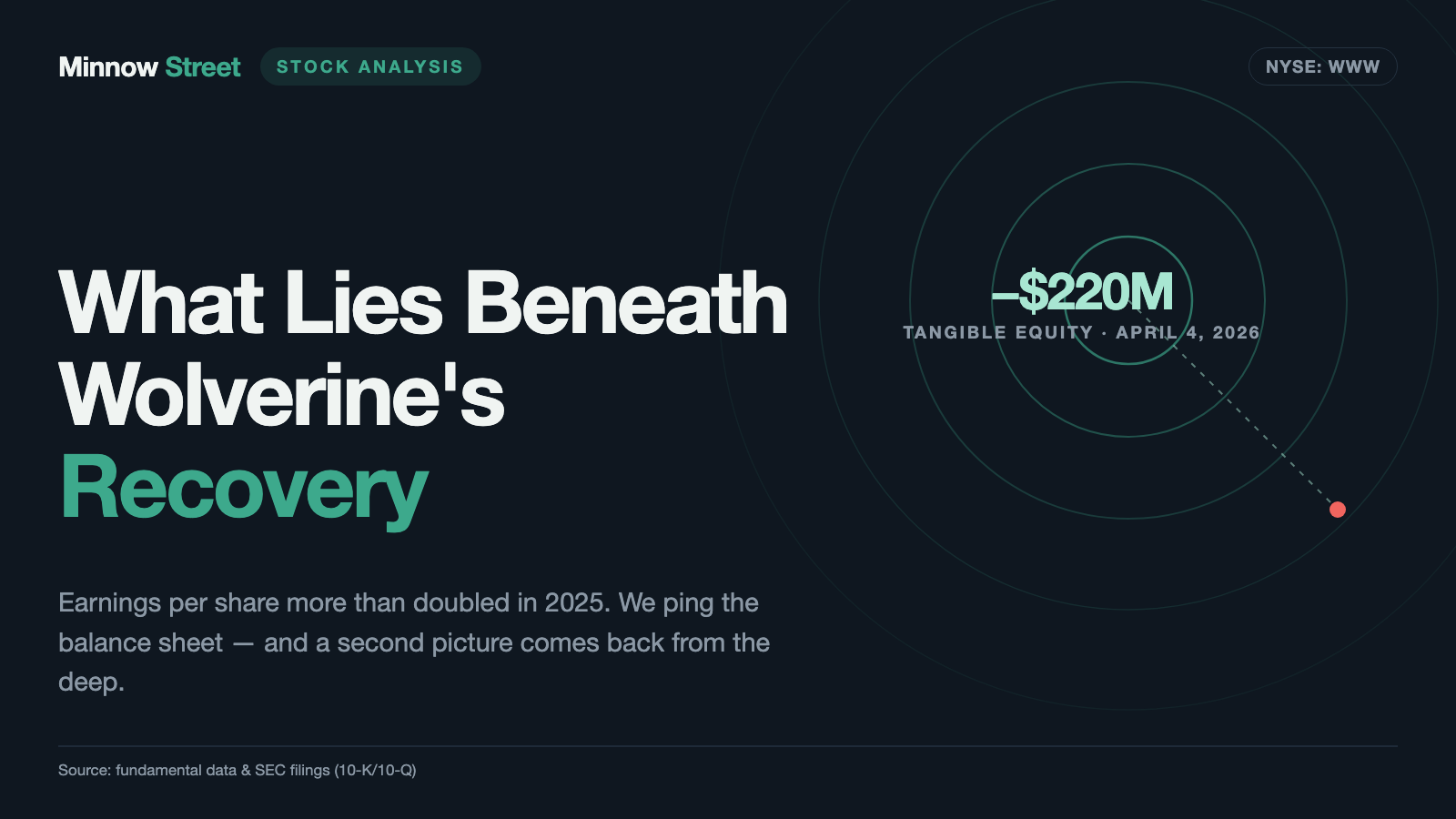
Interactive price chart (TradingView).
Note: pure fact-based analysis, not investment advice and not a solicitation to buy or sell. All figures without guarantee.
There is an investor trap that feels like an act of kindness: the comeback bonus. It kicks in whenever a fallen company returns. Your brain sees the direction — loss to profit, profit to double the profit — and hands the company a credit of trust it would never extend to a business that was always good. The direction is real, after all. But your brain is measuring the direction and forgetting the altitude: a company coming up from deep below doubles far more easily than one already standing high. At Wolverine World Wide (NYSE: WWW) the curve looks exactly like that: a loss of $0.49 per share in 2023, a profit of $0.55 in 2024, a profit of $1.14 in 2025. Which is why the stock keeps turning up in the Reddit mention lists again (ApeWisdom, as of July 28, 2026). So let us make a deal: before you believe the curve, we read together what the company itself reported to the U.S. securities regulator, the SEC — the annual report (10-K) for the fiscal year that ended January 3, 2026, and the quarterly report (10-Q) for the quarter ended April 4, 2026. A filing to the SEC is honest under penalty of law. And this one tells of two brands carrying almost everything, of equity that goes negative once the goodwill comes out, of an emergency exit in the financing that is nearly full — and of a tannery that has stood idle since 2009 and still costs money every quarter. In the end you decide for yourself.
What Wolverine World Wide actually does — a house full of brands
Wolverine World Wide is not a shoemaker in the literal sense. The company out of Rockford, Michigan, is a brand house: it designs footwear and apparel, has almost all of it produced by third-party contract manufacturers in the Asia-Pacific region, and sells it through wholesale, its own stores and licensees. Put in everyday terms: Wolverine owns the names on the shoe tongue, not the sewing machine behind it. The portfolio is sorted into two reportable segments. The Active Group covers Merrell (hiking), Saucony (running), Sweaty Betty (British activewear) and Chaco (outdoor sandals). The Work Group bundles Wolverine (work boots), Cat, Bates (uniform footwear), Harley-Davidson and HYTEST (safety footwear). On top of that sits an "Other" category with Hush Puppies and the licensed Stride Rite business. Products are sold in roughly 170 countries; as of April 4, 2026 the company operated 126 owned retail stores in the U.S., the United Kingdom, Ireland and Italy, plus 38 owned eCommerce sites. Headcount as of January 3, 2026 was roughly 3,050.
One detail you need before comparing any numbers: Wolverine does not run on a calendar fiscal year. The filing says so itself:
"The Company's fiscal year is the 52- or 53-week period that ends on the Saturday nearest to December 31. Fiscal year 2026 has 52 weeks and fiscal year 2025 had 53 weeks."
— Wolverine World Wide, Inc., SEC quarterly report 10-Q as of April 4, 2026, Note 1 "Basis of Presentation"
So fiscal 2025 ended on January 3, 2026 and was one week longer than fiscal 2024. An extra selling week in a year with $1,874 million of revenue is roughly 2 percent — worth keeping in mind when you compare years. And one more thing: about 52 percent of 2025 revenue came from outside the United States, against 49 percent the year before. That leaves Wolverine exposed to three weather systems at once — American consumer sentiment, the dollar, and import tariffs. If you want to see how strongly even a very large retailer hangs on that same consumer mood, our Target analysis shows it; for a pure consumer brand play, the Lovesac analysis is worth a look. With that, the central tension of this analysis is on the table, and it runs through every chapter: on top, the business is visibly recovering — underneath sit burdens that no quarterly figure dissolves.
How the stock landed on our desk
Wolverine World Wide reached our research list through the Reddit hype scan (ApeWisdom, as of July 28, 2026) — the daily read on which stocks investor forums are talking about unusually often. For a shoe company more than a century old that is unusual, and there are three understandable reasons for it, all visible in the fundamental data (data as of July 28, 2026). First, the stock fell hard and then came back: it trades roughly 41 percent below its 52-week high of $32.11 and roughly 44 percent above its 52-week low of $13.23. Curves like that attract turnaround hunters. Second, the stock is cheap measured against sales — the price-to-sales ratio is about 0.8 and the price-to-earnings ratio about 15. A price-to-sales ratio below 1 means, in everyday language: the market pays less for the whole company than it books in revenue in a single year. Third — and this is the real forum fuel — roughly 12.3 percent of the free float is sold short (about 6.0 million shares, an average 6.4 trading days to cover). Short sellers bet on falling prices; if the price rises they have to buy back and push it higher still. Reddit loves exactly that setup.
What the raw metrics say is surprisingly friendly. The Piotroski F-Score — a nine-point checklist for the health of the books — stands at 8 of 9. That is a good reading; a genuinely healthy company sits at 8 or 9, mediocre ones at 5 or 6. The Altman Z-double-prime score, an early warning indicator for payment trouble, comes in at 3.01 and therefore in the safe zone (our house thresholds are 1.1 and 2.6). Interest coverage — how many times operating profit earns the interest bill — is 4.6. The equity ratio, equity divided by total assets, is 26.4 percent ($433.0 million of $1,640.0 million as of April 4, 2026), trailing-twelve-month return on equity is 29.2 percent, and the 2025 operating margin was 8.0 percent ($150.2 million of $1,874.3 million). The professionals are friendly too: ten research houses rate the stock at an average 4.6 of 5 points (5 being the best mark), with a mean price target of $21.70 (data as of July 28, 2026). Remember this finding right at the start: on the metrics, Wolverine looks good. The rest of this analysis is about what the metrics do not show.
The numbers over the years — honestly appraised
First the part that genuinely impresses. Wolverine has pulled off a very respectable clean-up in two years. Gross margin — the share of revenue left after purchasing and production — rose from 39.0 percent (2023) to 44.3 percent (2024) to 47.3 percent (2025). That is more than eight percentage points in two years; in footwear that is a lot. Operating profit climbed 54.1 percent in 2025 to $150.2 million, and net earnings attributable to shareholders went from $45.2 million to $95.8 million. The interest bill fell from $42.7 million to $32.8 million, because average variable-rate debt balances were lower and their weighted average rate came down. And the company pays out: $33.3 million of dividends in 2025 ($0.10 per share per quarter) plus $14.5 million of share buybacks. Free cash flow — operating cash flow minus capital expenditure — came to roughly $125.5 million in 2025 ($140.0 million minus $14.5 million).
Now the chart that shows both things at once: the better margin and the smaller company.
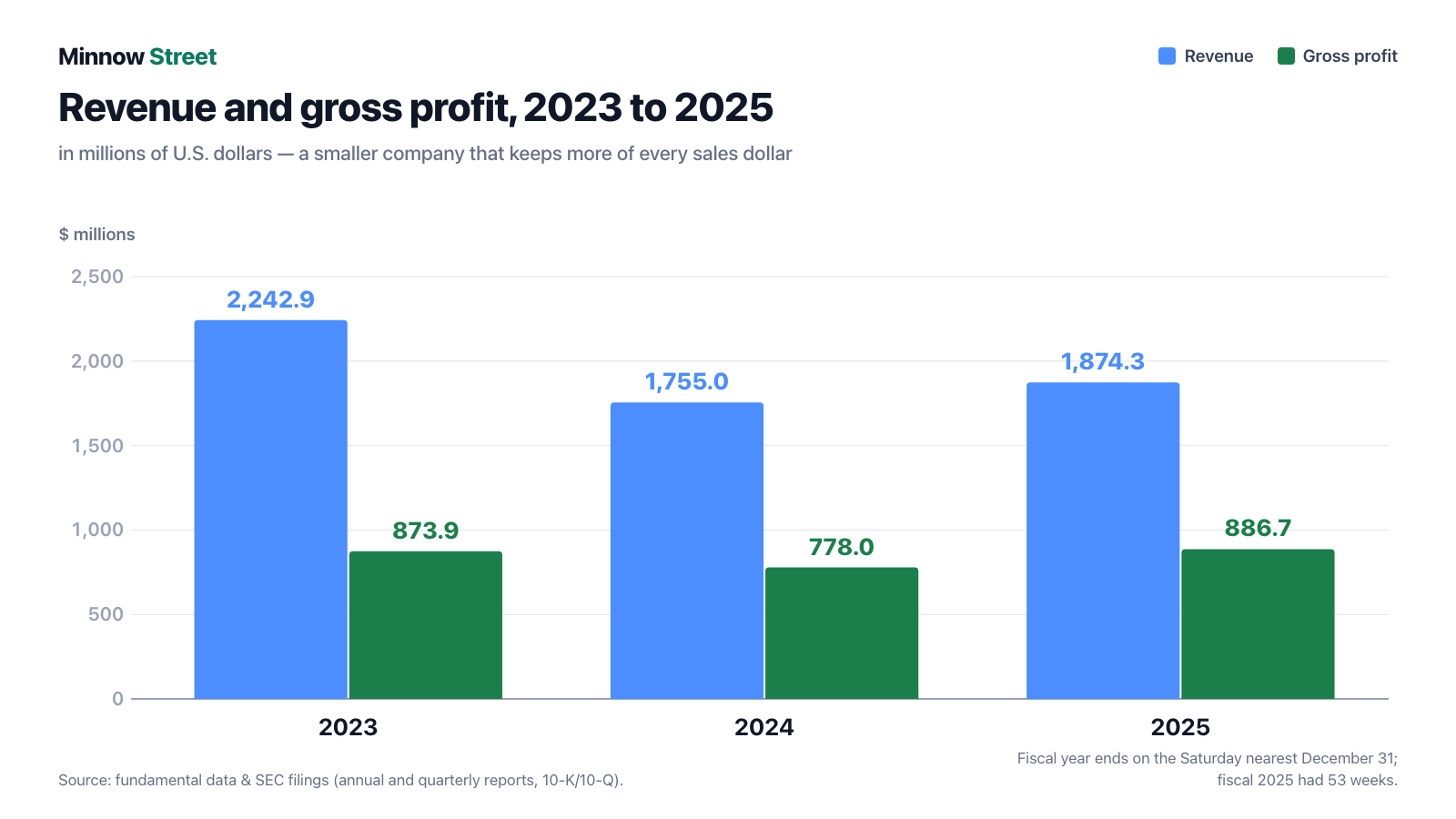
The current year started well too: in the first quarter of 2026 (quarter ended April 4, 2026) revenue rose 11.0 percent to $457.6 million, operating profit 61.4 percent to $33.9 million, and earnings per share from $0.15 to $0.24. Gross margin held steady at 47.6 percent — higher tariff costs were offset by price increases and a favorable mix shift toward more full-price sales. Two caveats belong in the same chapter, though. Of the $45.3 million of additional revenue, $15.4 million came from foreign exchange rates alone — that is the weaker dollar, not more shoes sold. And fiscal 2025, as quoted above, had one week more than fiscal 2024. There is growth, but it is a little smaller than the percentages suggest at first glance.
What the filings say — the uncomfortable truths
Uncomfortable truth no. 1: the company is smaller than in 2023 — and two brands carry almost everything
The pretty curve in earnings has an ugly twin in revenue. Wolverine booked $2,242.9 million of revenue in 2023 and $1,874.3 million in 2025 — a decline of 16.4 percent. The reason is not a demand collapse but a deliberate downsizing: Keds went to Designer Brands effective February 4, 2023, the Sperry business to Authentic Brands Group effective January 10, 2024, Hush Puppies in North America was handed to a licensee in 2023, and the Merrell and Saucony China joint ventures went to Xtep effective January 1, 2024 for $22.0 million. All of that was probably right commercially — it lifted the margin. But it also means the earnings jump was achieved on a smaller base, and part of the recovery is a sale of substance rather than growth.
What weighs more heavily is where the growth comes from. In 2025 the Active Group gained $161.7 million (up 13.0 percent), carried by Saucony (+$126.6 million) and Merrell (+$50.6 million). In the same year the Work Group lost $33.1 million (down 7.3 percent): Wolverine −$17.4 million, Cat −$5.2 million, HYTEST −$4.3 million, Harley-Davidson −$3.5 million, Bates −$2.7 million. The Other category shrank by another $9.3 million. That left the Active Group at 75.1 percent of group revenue in 2025 and at $253.2 million of $354.5 million in segment operating income — more than 71 percent. In the first quarter of 2026 the picture sharpened: $371.6 million of $457.6 million in revenue, or 81.2 percent, came from the Active Group; the Work Group added just $0.9 million of revenue and lost 8.5 percent of its operating income.
Translated into an everyday image: picture a fruit shop stocking eleven varieties. Two of them — apples and pears — bring in four of every five dollars, while the other nine move sideways at best. As long as apples and pears are in fashion, the shop looks brilliant. If tastes change, the variety does not help: it was never a hedge, only decoration. On paper Wolverine is an eleven-brand group; in practice it is a two-brand group. Running-shoe fashion is notoriously cyclical on top of that — Saucony has been through several highs and lows over the past twenty years.
Uncomfortable truth no. 2: nothing tangible is left of equity
Now to the balance sheet, and specifically to the line many readers skip. Equity attributable to Wolverine shareholders stood at $415.7 million as of April 4, 2026 (plus $17.3 million of noncontrolling interests). On the asset side stand $429.6 million of goodwill (the premium paid in old acquisitions), $178.1 million of indefinite-lived trade names and $28.2 million of other intangibles. Together $635.9 million — 38.8 percent of the $1,640.0 million balance sheet total. Subtract those intangible items from equity and what remains is tangible equity of minus $220.2 million.
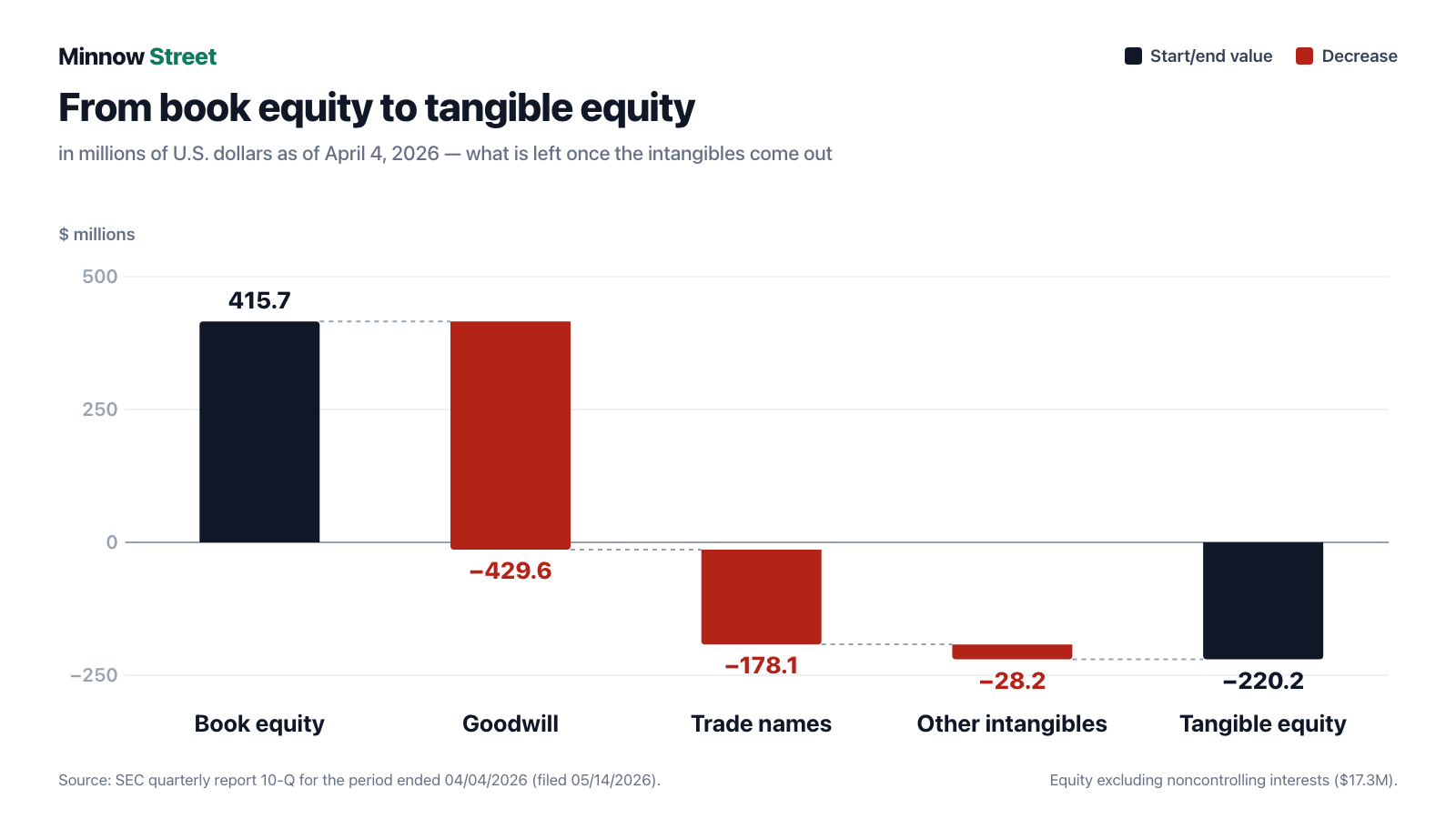
Before you panic: for brand companies this is not unusual and not an alarm signal in itself. A brand name is a value, even if you cannot touch it. The problem is a different one — that value is tested every year, and if it fails the test it disappears with a stroke of the pen. That is exactly where the sore spot sits, and the quarterly report names it:
"For the Sweaty Betty® reporting unit included in the fiscal year 2025 annual impairment test, the estimated fair value of the reporting unit exceeded the carrying value by 16%."
— Wolverine World Wide, Inc., SEC quarterly report 10-Q as of April 4, 2026, Note 4 "Goodwill and Indefinite-Lived Intangibles"
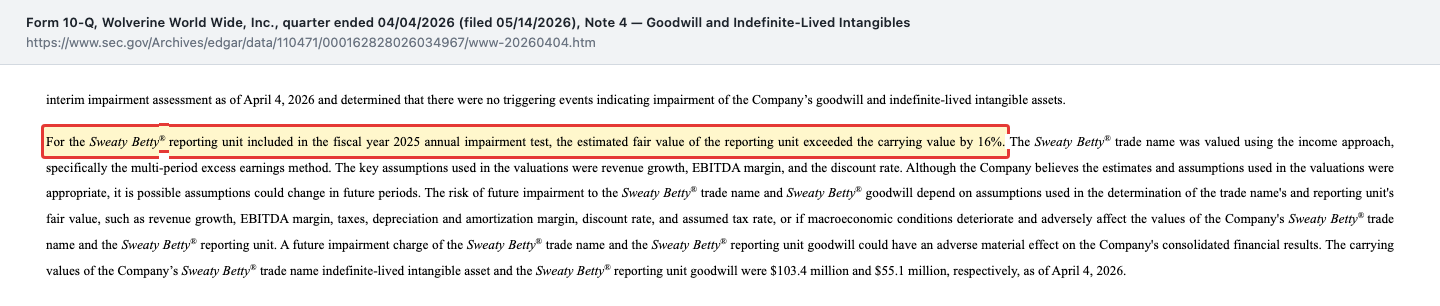
Sixteen percent of cushion is thin. For comparison: $48.4 million has already been written off on this unit, and Sweaty Betty revenue fell by another $6.1 million in 2025. The remaining carrying values of $158.5 million together equal 38.1 percent of equity attributable to Wolverine shareholders. The company itself writes that a future impairment could have an "adverse material effect" on consolidated results. Remember the sentence: goodwill is a claim about the future; the impairment test is the annual appointment at which that claim gets checked.
Uncomfortable truth no. 3: spring costs cash — and the emergency exit is nearly full
In the first quarter of 2026 Wolverine earned $22.4 million — and burned $83.2 million of cash doing it. That sounds contradictory but is seasonally normal: goods are bought ahead of the main season, suppliers get paid, receivables build up. The filing says itself that operating cash flow traditionally arrives in the second half of the year. In the prior-year quarter the outflow was almost identical at $83.8 million — so this is not a deterioration. Cash fell from $206.3 million (January 3, 2026) to $119.6 million, and the draw on the revolving facility rose from $75.0 million to $92.0 million.
It gets interesting one level down. Wolverine continuously sells its trade receivables to a bankruptcy-remote subsidiary of its own called Rockford ARS, which passes them on to outside purchasers. In everyday language: the company sells its customers' open invoices for cash immediately instead of waiting for payment — it receives less, but it has the money now. This is a perfectly legal and widespread technique. It only has two properties you need to know about: it makes operating cash flow look better, and it is capped.
"As of the fiscal quarters ended April 4, 2026 and March 29, 2025, the amount sold to the Purchasers under the RPA was $120.7 million and $102.6 million, respectively, which was derecognized from the consolidated condensed balance sheets."
— Wolverine World Wide, Inc., SEC quarterly report 10-Q as of April 4, 2026, Note 5 "Accounts Receivable"

The cap on this agreement is $125.0 million. As of April 4, 2026, $120.7 million was drawn — 96.6 percent. A year earlier it was 82.1 percent. So the emergency exit is nearly full. That is not an alarm: the agreement runs to September 25, 2028 after the extension of September 25, 2025, and the $600 million revolving facility still offered $492.9 million of headroom on April 4, 2026. But the quiet improvement to operating cash flow that this program delivers can no longer be materially increased. Anyone reading the cash flow series of the coming years should read this line alongside it.
Uncomfortable truth no. 4: under the old plant lies a bill running 25 years
Wolverine World Wide has a past that still costs the company money every quarter — and it begins with a success story. The filing tells it itself:
"Beginning in the late 1950s, the Company used 3M Company's Scotchgard™ in its processing of certain leathers at the Tannery."
— Wolverine World Wide, Inc., SEC quarterly report 10-Q as of April 4, 2026, Note 15 "Litigation and Contingencies"
The tannery in Rockford, Michigan, ran from the early 1900s until 2009. Leather processing byproducts were disposed of until about 1970 on a company-owned parcel on House Street and at other locations. Until 3M changed the formula in 2002, those byproducts may have contained PFOA and PFOS — two members of the PFAS family, the water- and stain-repellent chemicals that essentially do not break down in soil. In everyday terms: what made the shoe waterproof back then now sits in the groundwater. Michigan cut the permissible levels in 2020 to 8 and 16 parts per trillion respectively; before that the limit was 70 for both combined.
The action brought by the state environmental agency in 2018 became a court-approved consent decree in 2020: Wolverine pays to connect more than 1,000 properties to the municipal water system, capped at $69.5 million, plus water filters, resampling and ongoing remediation. The residents' class action was settled with prejudice in 2023. Two matters are still pending: a landfill owner's suit that has been refiled in Michigan state court, and a further suit filed on December 4, 2025 in which the owner of two landfills seeks recovery of PFAS response costs. As of April 4, 2026, $8.7 million was reserved for these matters. The remediation reserve itself stands at $25.5 million — and its maturity profile is remarkable:
"The reserve balance as of April 4, 2026 includes $11.1 million that is expected to be paid within the next twelve months and is recorded as a current obligation in other accrued liabilities, with the remaining $14.4 million expected to be paid over the course of up to 25 years, recorded in other liabilities."
— Wolverine World Wide, Inc., SEC quarterly report 10-Q as of April 4, 2026, Note 15, section "Environmental Liabilities"
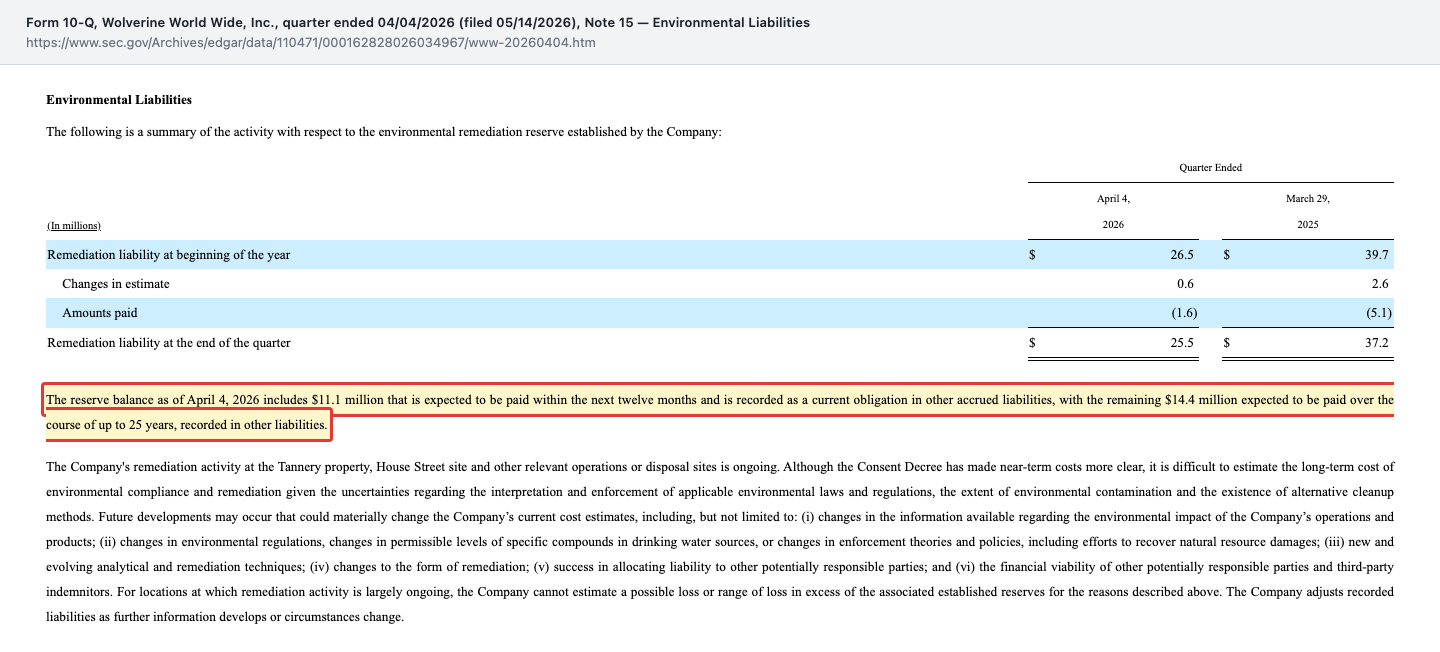
This deserves a sober framing. Measured against a company with $1.9 billion of revenue, $25.5 million is not an existential question, and the reserve has been shrinking for years: it stood at $57.9 million at the end of 2023, $39.7 million at the end of 2024 and $26.5 million at the end of 2025. In the first quarter of 2026, $0.6 million was added as a change in estimate and $1.6 million was paid out — which produced the $25.5 million as of April 4, 2026. But the company also writes that long-term costs are hard to estimate and that developments may occur which change the estimate materially — new limits, new methods, new plaintiffs. That is the difference between a quantified liability and an open bill: one sits on the balance sheet, the other keeps writing itself forward. Whoever buys Wolverine buys a tannery that has stood idle since 2009.
The $36 million question: a tariff credit that appears on no balance sheet line
And now the item that points the other way — the second half of being honest. On February 20, 2026 the U.S. Supreme Court ruled that the import tariffs imposed under the emergency statute IEEPA were unauthorized. Wolverine imports practically everything it sells, and had paid accordingly:
"The total amount of IEEPA tariffs paid by the Company as of the date of the ruling was approximately $36 million."
— Wolverine World Wide, Inc., SEC quarterly report 10-Q as of April 4, 2026, Item 2 "Known Trends Impacting Our Business"
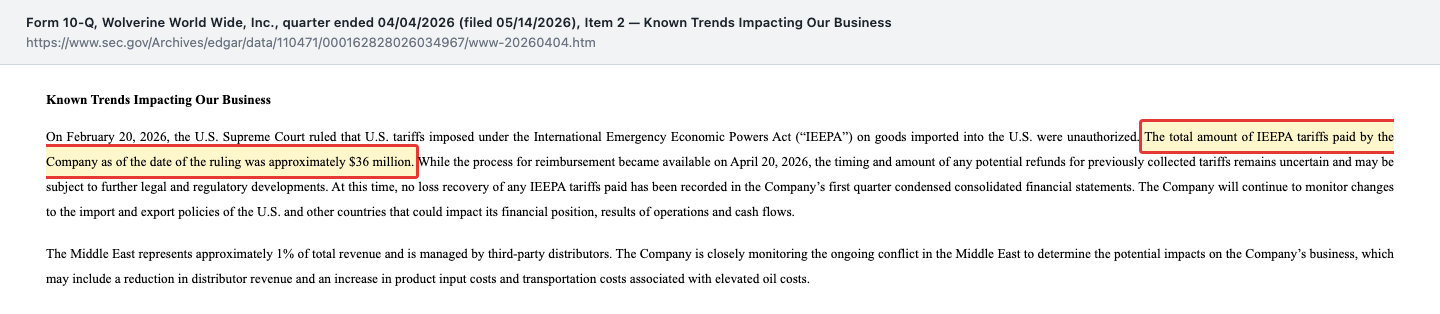
A reimbursement process has been open since April 20, 2026; the filing says the timing and amount of any refunds remain uncertain and may depend on further legal developments. Which is why the decisive sentence reads: none of it is booked in the quarterly report — "no loss recovery of any IEEPA tariffs paid has been recorded." For you as a reader that means the stock comes with an unbooked credit equal to roughly 38 percent of 2025 net earnings attributable to shareholders ($95.8 million). If it arrives, it will be a one-off item in some future quarter — not a better business, just a refund. If it does not arrive, nothing changes. Remember the pattern: an item carried at zero can only surprise to the upside — but that does not make it a value you are entitled to price in.
What the stock costs — valuation in orders of magnitude
Wolverine had 81,989,541 shares outstanding as of April 27, 2026 according to the cover page of the quarterly report. A dated price anchor from a mandatory filing: a director sold 25,000 shares on July 13, 2026 at a weighted average price of $18.14 (individual trades between $18.00 and $18.36; insider report Form 4, filed July 15, 2026); in May a comparable sale by another director came in at an average $15.88. Applying the July price to all shares gives a market value of roughly $1.49 billion; the fundamental data show roughly $1.56 billion as of July 28, 2026 — the same order of magnitude either way.
From that follow these orders of magnitude (data as of July 28, 2026). The price-to-sales ratio is about 0.8 (trailing four-quarter revenue: $1,919.6 million). The price-to-earnings ratio is about 15 (trailing four-quarter earnings per share: $1.25). Add net debt — $638.9 million of debt minus $119.6 million of cash, or $519.3 million — and you arrive at an enterprise value of roughly $2.1 billion, about 13 times trailing four-quarter operating profit ($163.1 million). The dividend yield, on the documented July price, is roughly 2.2 percent ($0.40 per share per year). That is the valuation of a solid but cyclical brand company — no bargain with a thick safety cushion, but no growth-fantasy multiple either.
One item is still missing from that arithmetic, and it comes from a mandatory filing that is easy to miss. On the same May 14, 2026 that brought the quarterly report, Wolverine also published an earnings release (SEC Form 8-K, Exhibit 99.1) — and it carries the company's own outlook for fiscal 2026. Management expects revenue of $1.960 billion to $1.985 billion (up 4.6 to 5.9 percent; up 4.5 to 5.8 percent in constant currency and excluding the prior year's 53rd week), a gross margin of roughly 46.4 percent, an operating margin of roughly 9.2 percent, an effective tax rate of roughly 18.0 percent, and diluted earnings per share of $1.39 to $1.54. Two things follow, and they point in different directions. First: on that forecast the price-to-earnings ratio is not 15 but roughly 12 to 14 — on a forward view the stock is cheaper than the trailing figure makes it look. Second: the gross margin whose rise from 39.0 to 47.3 percent carries this entire recovery is not supposed to keep climbing in 2026 on management's own plan — it is supposed to give back 90 basis points, to 46.4 percent. A forecast is not a fact — but it is the number the board has agreed to be measured by.
One point on capital allocation belongs here. The board approved a $150.0 million repurchase program on March 7, 2024, running three years. Through January 3, 2026 only $14.5 million had been used — $135.5 million remained open, roughly 9 percent of the market value. In the first quarter of 2026 the company repurchased no stock at all. That is notable: a management team that considered its own shares cheap would have an already-authorized instrument in hand. As for the professionals' view, ten research houses rate the stock at an average 4.6 of 5 points with a mean price target of $21.70 (data as of July 28, 2026). That is considerably friendlier than what this analysis found in the footnotes — both may stand side by side. Only the dispersion is missing: a consensus of ten houses says nothing about how confident those ten are.
Opportunities and risks at a glance
What speaks for Wolverine World Wide:
- The turnaround is documented, not asserted: gross margin from 39.0 percent (2023) to 47.3 percent (2025), operating profit up 54.1 percent to $150.2 million, diluted earnings per share from −$0.49 to $1.14. The first quarter of 2026 continued with revenue up 11.0 percent and earnings of $0.24 per share.
- Saucony and Merrell are genuinely running: together +$177.2 million of revenue in 2025 and +$45.2 million in the first quarter of 2026 — carried by real demand in the wholesale and international channels, not by price increases alone.
- The financing is orderly: $550 million of notes at a fixed 4.000 percent to August 2029, a $600 million revolving facility to September 2030 with $492.9 million of headroom (April 4, 2026), compliance with all covenants, interest coverage of 4.6.
- An unbooked credit: roughly $36 million of IEEPA tariffs with a reimbursement process open since April 20, 2026, sitting on no balance sheet line.
- Capital returns are possible: $0.40 per share of annual dividend plus $135.5 million of unused repurchase authorization (as of January 3, 2026).
What speaks against it:
- Two brands carry the company: the Active Group accounted for 75.1 percent of revenue in 2025 and 81.2 percent in the first quarter of 2026 — while the Work Group shrank by $33.1 million in 2025. Running-shoe fashion is cyclical.
- Tangible equity is negative: $415.7 million of book equity against $635.9 million of intangibles leaves minus $220.2 million (April 4, 2026) — and the Sweaty Betty unit had only 16 percent of headroom in the 2025 impairment test.
- The receivables program is nearly exhausted: $120.7 million of $125.0 million drawn (96.6 percent), which props up operating cash flow and can no longer be materially expanded.
- The PFAS legacy runs on: $25.5 million of remediation reserve with payments spread over up to 25 years, $8.7 million of litigation reserve, two pending matters, one of them only since December 4, 2025.
- Tariffs and exchange rates have a vote: practically all merchandise comes from the Asia-Pacific region, and $15.4 million of the $45.3 million revenue gain in the first quarter of 2026 came from currency effects alone.
A human conclusion
Back to the comeback bonus from the opening. Its core is not that recoveries are fake — Wolverine's is real, it stands in audited filings, and it lifted the margin by eight percentage points. Its core is that the pretty direction stops us from checking the altitude and opening the basement. Whoever buys Wolverine World Wide today buys three very concrete things: a company 16 percent smaller than in 2023 whose growth hangs on two brands; a balance sheet in which $220 million goes missing once goodwill comes out and in which $158 million of brand value hangs on a 16 percent cushion; and a tannery that has stood idle since 2009 and whose bill runs for up to 25 more years. Against that stand a genuinely working running-shoe business, orderly financing and an unbooked $36 million tariff credit. So the honest question to you is not "is the turnaround done?" but: are you paying for a recovery that is already in the numbers — or for the two brands that have to carry it from here? If you can answer the second question, you have a thesis. If only the first one convinced you, you had a curve. What you make of it is your decision. And that is exactly as it should be.
Sources
Every original document used in this analysis — for you to read yourself:
- Wolverine World Wide, Inc. — SEC quarterly report 10-Q for the quarter ended April 4, 2026 (filed May 14, 2026)
- Wolverine World Wide, Inc. — SEC annual report 10-K for fiscal year 2025, ended January 3, 2026 (filed February 27, 2026)
- Wolverine World Wide, Inc. — SEC annual report 10-K for fiscal year 2024, ended December 28, 2024 (filed February 20, 2025)
- Wolverine World Wide, Inc. — SEC earnings release for the first quarter of 2026, including the fiscal 2026 outlook (Form 8-K, Exhibit 99.1, filed May 14, 2026)
- Wolverine World Wide, Inc. — SEC insider report Form 4 of July 15, 2026 (sale of 25,000 shares at a weighted average $18.14 on July 13, 2026)
- Complete SEC filing history of Wolverine World Wide, Inc.: EDGAR overview (sec.gov)
- Fundamental data (valuation, metrics, analyst consensus, short interest; data as of July 28, 2026), reconciled with the SEC filings.
- Reddit mentions: ApeWisdom (as of July 28, 2026); accessed through our in-house stock scanner.
Transparency & disclaimer: This analysis is a journalistic contextualization of publicly available information. It is not investment advice, not a financial analysis in the regulatory sense, and not a solicitation to buy or sell securities. Equity investments carry substantial risk, up to and including total loss. All information is provided without warranty; the data cut-off is noted in the text in each case. The author holds no position in Wolverine World Wide stock at the time of publication.
Our Bottom Line at a Glance
- Earnings turnaround positive
- The turnaround is documented in audited filings: gross margin from 39.0 percent (2023) to 44.3 (2024) to 47.3 percent (2025), operating profit up 54.1 percent to $150.2 million in 2025, diluted earnings per share from −$0.49 to $1.14. The first quarter of 2026 continued the trend (revenue up 11.0 percent to $457.6 million, $0.24 instead of $0.15 per share).
- Brand concentration negative
- The company hangs on two brands: Saucony and Merrell together added $177.2 million of revenue in 2025 while the entire Work Group lost $33.1 million. The Active Group accounted for 75.1 percent of revenue and more than 71 percent of segment income in 2025, and for 81.2 percent of revenue in the first quarter of 2026. Running-shoe fashion is cyclical — the variety of the other nine brands barely cushions it.
- Balance sheet substance negative
- As of April 4, 2026, $415.7 million of equity attributable to Wolverine shareholders stands against $635.9 million of intangibles — minus $220.2 million on a tangible basis. The Sweaty Betty unit carries $158.5 million of book value (38.1 percent of equity) with only 16 percent of headroom in the 2025 impairment test; $48.4 million has already been written off there.
- Financing & liquidity neutral
- Orderly, but not generous: $550 million of notes at a fixed 4.000 percent to August 2029, a revolving facility to September 2030 with $492.9 million of headroom, compliance with all covenants, interest coverage of 4.6 and an Altman Z-double-prime of 3.01. Against that stand $519.3 million of net debt and a receivables program drawn to 96.6 percent ($120.7 million of $125.0 million) that props up operating cash flow (all figures April 4, 2026).
- Legacy & legal risk negative
- The tannery operated in Rockford through 2009 left a PFAS burden with a $25.5 million remediation reserve (of which $14.4 million runs over up to 25 years), an $8.7 million litigation reserve and a $69.5 million cap on the water connection settlement. Two matters remain pending, one of them only since December 4, 2025. The company itself writes that future developments could materially change the cost estimate.
- Valuation & capital allocation neutral
- Price-to-sales about 0.8, price-to-earnings about 15, enterprise value roughly 13 times trailing four-quarter operating profit (data as of July 28, 2026). The $0.40 annual dividend stands; but of the $150 million repurchase authorization of March 7, 2024 only $14.5 million had been used by January 3, 2026, and nothing at all was bought back in the first quarter of 2026.
Wolverine World Wide has a documented earnings turnaround behind it: gross margin rose from 39.0 to 47.3 percent in two years, diluted earnings per share from minus $0.49 to $1.14, and the first quarter of 2026 followed up with revenue growth of 11.0 percent. But that turn stands on a smaller company (revenue 16.4 percent below 2023) and on two brands: Saucony and Merrell carry the group while the Work Group shrinks. Underneath sit tangible equity of minus $220.2 million, a Sweaty Betty unit with only 16 percent of headroom in the impairment test, a receivables program drawn to 96.6 percent and a PFAS cleanup that runs for up to 25 more years. An unbooked tariff credit of roughly $36 million points the other way. Not investment advice.
What Our Rating Means
Open questions
The business works in principle, but one material question is open. As long as it stays open, our findings do not carry a quality verdict.
The business works and funds itself — $150.2 million of operating profit in 2025, interest coverage of 4.6, compliance with all covenants, $492.9 million of undrawn revolver and $119.6 million of cash as of April 4, 2026. Nothing supports red: no going-concern language, no negative book equity, no accounting or governance breach, no existential dependence on a single counterparty. But the open operating question is too large for green: the upswing hangs on Saucony and Merrell, whose Active Group delivered 81.2 percent of revenue in the first quarter of 2026 while the Work Group shrank by $33.1 million in 2025; on top of that sit $158.5 million of brand value with only 16 percent of headroom in the impairment test and a receivables program drawn to 96.6 percent. That is not a price argument but an open question about the business itself — hence yellow, the more cautious of the two grades. The decision is yours.
A journalistic assessment by our editorial team at the time of the deep dive, based on public sources — not investment advice and not a solicitation to buy or sell. Your personal circumstances (investment goals, risk capacity, taxes) cannot be taken into account. What our levels mean, how verdicts are formed, and what conflicts of interest exist →
Worth Noting
- Wolverine World Wide reached our research list through the Reddit hype scan (ApeWisdom, as of July 28, 2026). The forum attention is explained by the combination of a turnaround curve, a low price-to-sales ratio (about 0.8) and short interest of roughly 12.3 percent of the free float (data as of July 28, 2026). Scanner lists are recomputed daily.
- Currency status: the most recent mandatory filing is the quarterly report 10-Q as of April 4, 2026 (filed May 14, 2026); the first quarter earnings release (Form 8-K, Exhibit 99.1) appeared the same day and carries the company's fiscal 2026 outlook, which is worked into the valuation chapter. Only insider and ownership reports followed: two threshold notifications on May 15, 2026 (Callodine Capital Management with 5.96 percent and Wellington Management Group with 5.3 percent, each as of the March 31, 2026 event date), plus Form 144 and Form 4 filings in May and July 2026. No second quarter 2026 earnings report was available as of July 28, 2026.
- Basis of figures: the 2023 and 2024 annual figures are the retrospectively adjusted values shown in the 2025 annual report — in the third quarter of 2025 the company switched part of its domestic inventory from LIFO to FIFO costing and restated the prior years accordingly (2025: +$0.05 per share, 2024: −$0.03). When comparing 2024 with 2025, note also that 2025 contained a 53rd week. Valuation metrics carry a data cut-off of July 28, 2026; a dated price anchor from a mandatory filing is the insider sale at a weighted average $18.14 on July 13, 2026.
Frequently Asked Questions
Wolverine World Wide, Inc. (NYSE: WWW) runs two reportable segments. The Active Group comprises Merrell, Saucony, Sweaty Betty and Chaco. The Work Group comprises Wolverine, Cat, Bates, Harley-Davidson and HYTEST. An "Other" category holds Hush Puppies and the licensed Stride Rite business. Products are sold in roughly 170 countries; as of April 4, 2026 the company operated 126 owned retail stores and 38 owned eCommerce sites. Almost everything is made by contract manufacturers in the Asia-Pacific region.
Diluted earnings per share rose from minus $0.49 (2023) to $0.55 (2024) to $1.14 (2025). Operating profit gained 54.1 percent in 2025 to $150.2 million, and net earnings attributable to shareholders went from $45.2 million to $95.8 million. In the first quarter of 2026 (quarter ended April 4, 2026) revenue rose 11.0 percent to $457.6 million and earnings per share from $0.15 to $0.24. Revenue of $1,874.3 million (2025) still sits below the 2023 level of $2,242.9 million.
Because a large part of the balance sheet consists of intangibles. As of April 4, 2026, equity attributable to Wolverine shareholders of $415.7 million stood against $429.6 million of goodwill, $178.1 million of indefinite-lived trade names and $28.2 million of other intangibles. Subtract those and minus $220.2 million remains. For brand companies this is not unusual; the critical part is the annual impairment test, where the Sweaty Betty unit had only 16 percent of headroom in 2025.
Wolverine ran a tannery in Rockford, Michigan, from the early 1900s until 2009 and used 3M Scotchgard there from the late 1950s. Until the formula changed in 2002, the disposed byproducts may have contained PFOA and PFOS. A 2020 consent decree obliges the company, among other things, to connect more than 1,000 properties to the municipal water system, capped at $69.5 million. As of April 4, 2026 there was a $25.5 million remediation reserve — $14.4 million of it with payments over up to 25 years — plus an $8.7 million litigation reserve.
Like many U.S. retail and consumer companies, Wolverine counts in whole weeks rather than calendar months so that quarters compare cleanly. The fiscal year ends on the Saturday nearest to December 31. Fiscal 2025 therefore had 53 weeks and ended on January 3, 2026; fiscal 2026 has 52 weeks. When comparing years, the extra week is worth roughly 2 percent of revenue — worth keeping in mind when reading the growth rates.
On February 20, 2026 the U.S. Supreme Court ruled that import tariffs imposed under the IEEPA emergency statute were unauthorized. Wolverine had paid roughly $36 million of such tariffs up to that date. A reimbursement process has been open since April 20, 2026, and the filing says the timing and amount of any refunds remain uncertain. None of it is booked in the quarterly report as of April 4, 2026. The amount equals roughly 38 percent of 2025 net earnings attributable to shareholders.
In orders of magnitude (data as of July 28, 2026): at roughly $1.56 billion of market value the price-to-sales ratio is about 0.8 and the price-to-earnings ratio about 15. Add net debt of $519.3 million and you arrive at roughly 13 times trailing four-quarter operating profit. On the company's own fiscal 2026 outlook — diluted earnings per share of $1.39 to $1.54 per the earnings release of May 14, 2026 — the price-to-earnings ratio is roughly 12 to 14. Ten research houses rate the stock at an average 4.6 of 5 points with a mean price target of $21.70. That is the valuation of a solid, cyclical brand company — no bargain with a thick safety cushion.
Yes. The company has paid $0.10 per share per quarter for years, or $0.40 a year — unchanged across fiscal 2023, 2024 and 2025. That cost $33.3 million in total in 2025. Against the weighted average sale price of $18.14 documented in an insider report of July 15, 2026, that equals roughly a 2.2 percent dividend yield. On top of that, $135.5 million of the March 7, 2024 repurchase authorization was still open as of January 3, 2026.
Found an error?
Did you spot a factual error, an outdated number, or a typo in this deep dive? Let us know briefly — your report goes straight to the editorial team.