West Pharmaceutical Stock: 33 Straight Dividend Increases — and Still Only a 0.3 Percent Yield
West Pharmaceutical makes the rubber stoppers and seals without which hardly any injectable drug reaches the market — the weight-loss pens run on components from Exton, Pennsylvania, too. Our in-house stock scanner ranks the stock number 4 among dividend aristocrats (U.S. selection, as of July 18, 2026): the quarterly dividend has risen for 33 consecutive years. We read the annual reports (10-K), the quarterly report (10-Q) as of March 31, 2026, and the dividend announcements back to 2013: a payout ratio of just 13 percent, an unnamed customer worth 15.8 percent of revenue, key licenses expiring in 2027 — and a share price at 47 times earnings. Not investment advice — just the question of whether a noble title is an investment case.
 Thomas Mücke
Founder & Publisher
Thomas Mücke
Founder & Publisher
Chart
Interactive price chart (TradingView).
Note: pure fact-based analysis, not investment advice and not a solicitation to buy or sell. All figures without guarantee.
There is an investor trap that catches the careful ones of all people: the noble-title reflex. It works like this: a label sounds like safety — "dividend aristocrat," a quarter century of increases without a miss — and from that moment your brain stops checking the receipt and only checks the title. Anyone who pays that reliably for that long must be a pillow to sleep on. West Pharmaceutical Services (NYSE: WST) is the perfect test case in the summer of 2026: rank 4 in our in-house dividend-aristocrats scanner (U.S. selection, as of July 18, 2026), the quarterly dividend raised for 33 consecutive years — and at the same time a dividend yield of about 0.3 percent, a share price at 47 times earnings, and a business that leans ever harder on the weight-loss pen. So let\'s make a deal: before the noble-title reflex takes over, we read together what the company itself reported, under penalty of law, to the U.S. securities regulator, the SEC — the annual report (10-K) for 2025, the quarterly report (10-Q) as of March 31, 2026, and the dividend announcements all the way back to 2013. At the end, you decide for yourself whether this is a pillow — or a growth bet wearing a small crown.
What West Pharmaceutical actually does — the tollbooth of injectable medicine
West makes the most inconspicuous parts of the pharma world: rubber stoppers, seals and plungers made of specialty elastomers, plus needle-safety systems, prefilled-syringe components and wearable self-injection devices. Whenever a drug is injected rather than swallowed, it has to be sealed sterile, shipped and administered — and that is exactly where West earns its cut. The beauty of this business: it is a consumable. The stopper is discarded with the vial; the next batch needs new ones — a kind of tollbooth that collects on every fill-and-finish run, with a customer roster spanning biotech, generics and big pharma. On top sits a switching barrier that is easy to underestimate from the outside: once a component is part of a drug approval, no manufacturer swaps it lightly, because any change can mean new stability data and fresh rounds with the regulators.
The whole thing is organized in two segments: Proprietary Products (2025: $2,492.1 million in revenue, 81 percent of the company) sells West\'s own high-value components — brand names like Westar, NovaPure and FluroTec — plus analytical lab services; its gross margin ran around 40 percent in 2025. The smaller segment, Contract-Manufactured Products ($582.0 million, renamed "West Vantage" as of the first quarter of 2026), assembles complex devices for customers — injection pens, diagnostic components — solid work, but at a 16.5 percent gross margin a much thinner slice. About 10,800 people work for West, roughly 40-plus percent each in North America and Europe; 56.7 percent of revenue comes from outside the U.S. (all figures: annual report 10-K 2025). Headquarters sit in Exton, Pennsylvania — the address, "530 Herman O. West Drive," carries the founding family\'s name right on the street sign. Which brings us to the central tension of this analysis, and it runs through every chapter: the noble title is real and the business model is one of the best in our scanner — but the dividend is symbolism; what you actually pay for is the GLP-1 bet, and that bet hangs on one big customer and a license that expires in 2027.
Where the stock shows up in our scanner
We run roughly 3,500 stocks through our scanners every day. As of July 18, 2026, West is a multi-hit — 20 scanners flag it, and the mix is remarkable. The hook for this analysis: rank 4 in the dividend-aristocrats scanner (U.S. selection), which collects payers with decades-long raise streaks. Then comes quality in series: quality growth, the Buffett criteria (Buffettology) and the Altman-Z balance-sheet fortress — the Altman Z-score, an early-warning gauge for insolvency built from several balance-sheet ratios, stands near 12, as far above the danger zone (which historically begins below 1.8) as only debt-light companies get. The Piotroski F-score, a nine-point test of the direction of the books, reads 7 of 9 — good; rock-solid would be 8 or 9. The scanner\'s fundamental lens assigns a grade of B. And finally the momentum shelf: Stan Weinstein Stage 2, Power Trend, Minervini trend criteria — after a weak start to 2025 the stock is back in an intact uptrend (six-month performance around +24 percent, data as of July 18, 2026), yet still trades a good quarter below its pandemic-era all-time high. To replicate it yourself: open the West stock page and check the hits section. Remember the translation: the scanner says "quality, trend and a noble title" — what it does not say is the price. We settle that below.
The numbers over the years — honestly appraised
First, what genuinely impresses. West has the kind of financials for which "boring" is a compliment: in 2025, $3,074.1 million of revenue became $493.7 million of net income — a 16 percent net margin, earned with rubber stoppers, mind you. Operating cash flow rose to $754.8 million (2024: $653.4 million); after capital spending, roughly $470 million of free cash flow remained (fundamental data, 2025 quarterly series). At year-end, $791.3 million in cash sat on the books, the equity ratio runs around 73 percent, and net interest paid for all of 2025 came to — not a typo — $0.3 million. Add the dividend streak, which gets its own chapter in a moment, and buybacks that keep shrinking the share count. Read only these paragraphs and you understand why the Buffett and quality scanners fire. Now look at the whole curve:
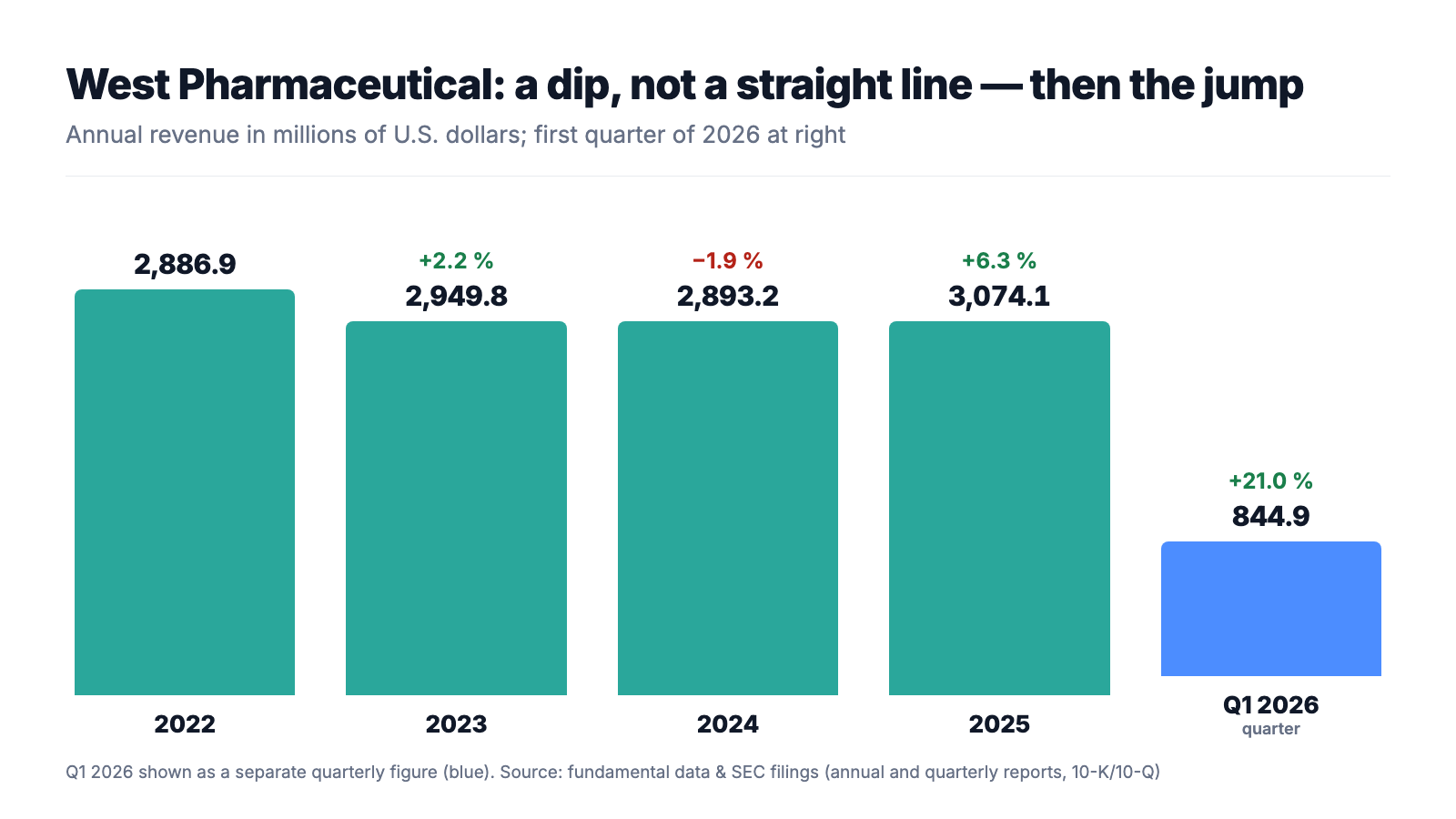
Because the curve also tells the other half of the story: West just came out of two hangover years. During the pandemic the company earned handsomely on vaccine components; afterwards its customers sat on full warehouses and ordered less — the 2024 annual report calls it, drily, "customer inventory management," and it hit precisely the high-margin, high-value products like FluroTec and Westar. The result: revenue fell 1.9 percent in 2024 to $2,893.2 million, and net income sagged from $593.4 million (2023) to $492.7 million (2024) — 2025, at $493.7 million, printed practically the same number, and diluted EPS of $6.79 remained clearly below the $7.88 of 2023. Gross margin took the same round trip: from 38.3 percent (2023) to 34.5 (2024), back to 35.9 percent (2025). Only the first quarter of 2026 delivered the real breakout: revenue up 21.0 percent to $844.9 million (up 15.3 percent at constant currency), diluted EPS up from $1.23 to $1.92, gross margin at 35.1 after 33.2 percent — carried by Westar, NovaPure, FluroTec and the self-injection platforms. Remember the pattern: even a tollbooth has traffic cycles — it does not lose customers, but it feels every warehouse clear-out. What it looks like when a pharma trend pushes traffic the other way is the GLP-1 story — and that one has a name that does not appear in the annual report. More on that shortly.
33 increases in a row — the dividend history, fully recomputed
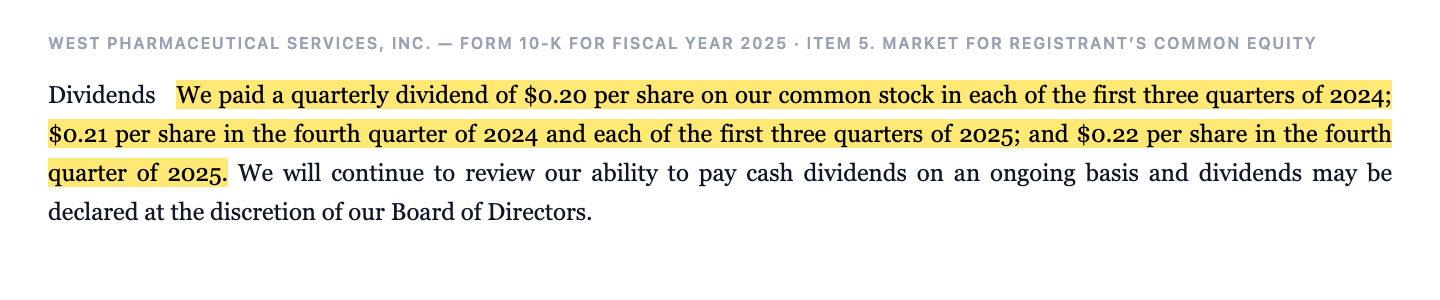
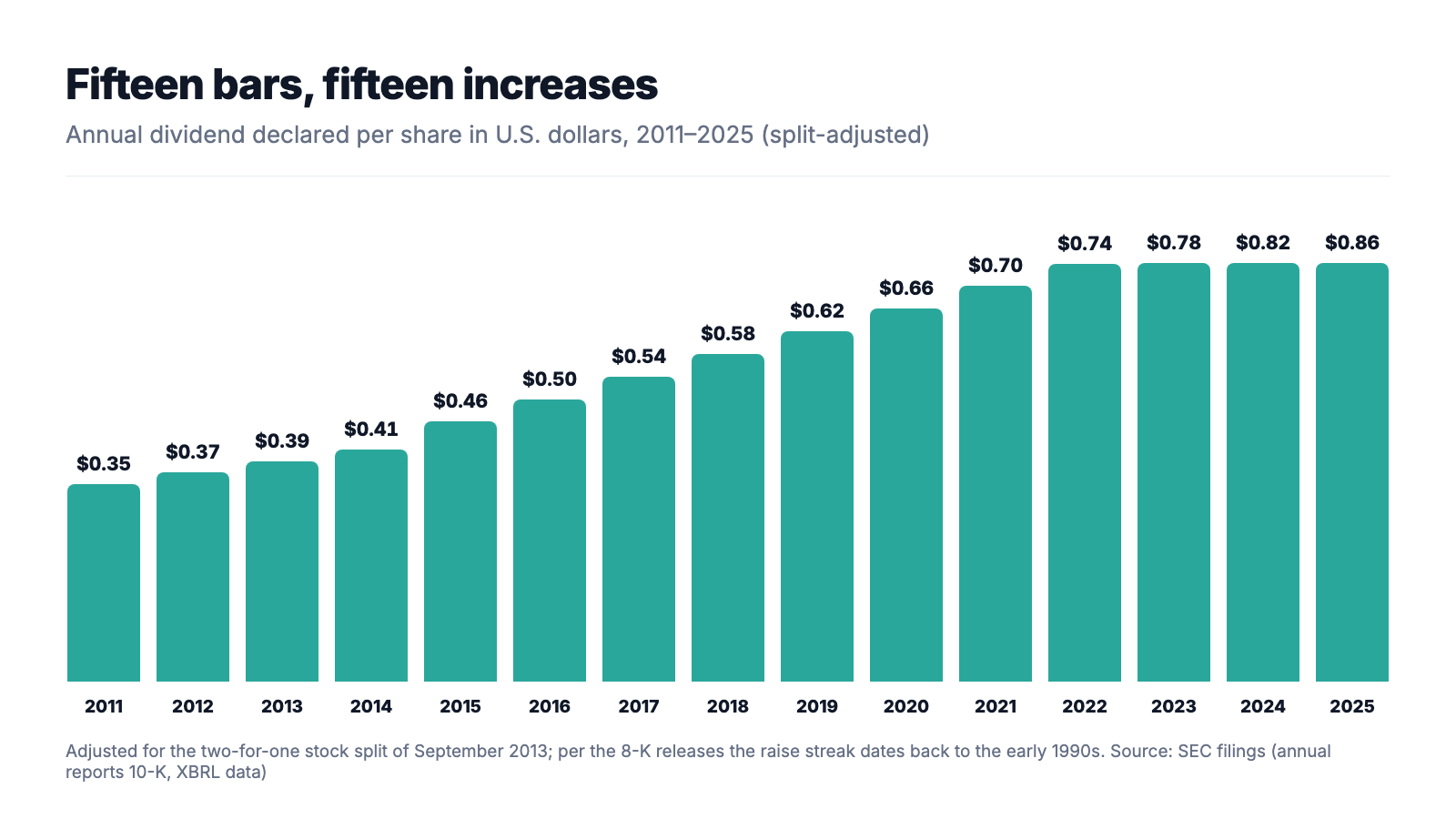
Now to the noble title itself — and it survives scrutiny emphatically. We traced the chain back through the SEC archives: in August 2013, West announced via press release (attached to an 8-K) the dividend increase "for the twenty-first consecutive year" — the same document, incidentally, announced a two-for-one stock split. In October 2020 the next release put on record: "This is the twenty-eighth consecutive annual increase in the Company\'s dividend." And from there the series disclosed in the annual reports carries on without a gap: $0.70 per share declared (2021), $0.74, $0.78, $0.82, finally $0.86 (2025) — making the raise of the quarterly dividend to $0.22 in the fourth quarter of 2025 the 33rd consecutive annual increase. The 2025 annual report documents the latest cadence:
"We paid a quarterly dividend of $0.20 per share on our common stock in each of the first three quarters of 2024; $0.21 per share in the fourth quarter of 2024 and each of the first three quarters of 2025; and $0.22 per share in the fourth quarter of 2025."
— West Pharmaceutical Services, SEC annual report 10-K 2025, Item 5 "Market for Registrant\'s Common Equity"
And now the number the noble-title reflex skips: all that splendor costs West almost nothing. In 2025 the company declared $61.9 million in dividends — against $493.7 million of net income, a payout ratio of roughly 13 percent. At the recent share price, the annual dividend (a $0.88 run rate) works out to a yield around 0.3 percent (data as of mid-July 2026). For comparison: over the same stretch West spent a multiple on share buybacks — $438.3 million (2023), $560.9 million (2024), $134.0 million (2025), and another $297.6 million in the first quarter of 2026 alone for 1,222,019 shares, an average of about $244 apiece; in February 2026 a fresh $1.0 billion program with no expiration date was added (quarterly report 10-Q as of March 31, 2026). Translated: at West, the dividend is the crest above the gate — the cash actually flows to shareholders through the buyback channel. The crest is as safe as a dividend gets: even a halving of profits would leave the payout ratio at a harmless 25 percent. But if you expect an income from an "aristocrat," you are standing in the wrong castle. And for completeness: West, too, writes the obligatory risk-section line that there is "no assurance … that we will pay or declare dividends in the future" — boilerplate, but a good reminder never to confuse a title with a guarantee.
What the filings say — the uncomfortable truths
Uncomfortable truth no. 1: one unnamed customer brings in 15.8 percent of revenue — and the share is climbing fast
A tollbooth with thousands of customers — that is how we described the business model above, and it is true. But the weights are shifting. The 2025 annual report gets specific:
"Our ten largest customers accounted for 47.6% of our consolidated net sales in 2025, and one of these customers individually accounted for more than 10% of consolidated net sales, at 15.8% or $485.9 million, contributing to net sales in both the Proprietary and Contract Manufacturing reporting segments."
— West Pharmaceutical Services, SEC annual report 10-K 2025, Item 1 "Business"
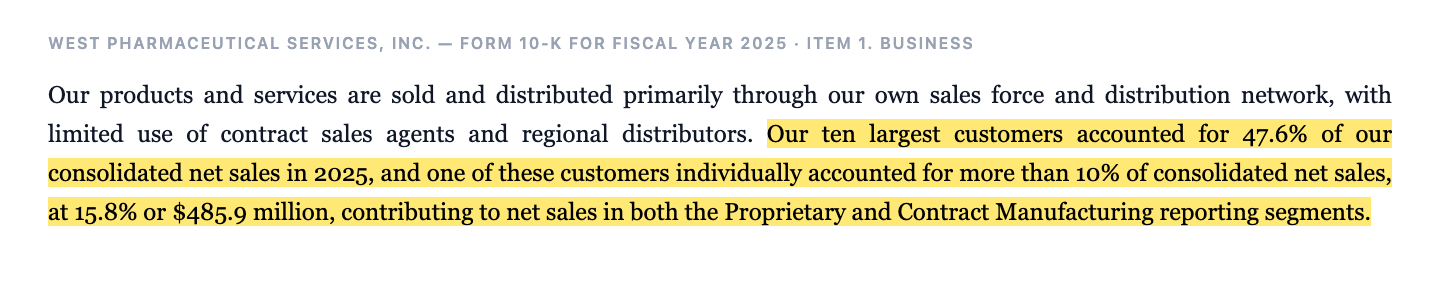
Put the years side by side and the footnote becomes a trend: in 2024 the same line item stood at 12.3 percent ($356.4 million), in 2025 at 15.8 percent — revenue with that one customer grew a good 36 percent while the company grew 6.3 percent. Customer concentration in an everyday image: if your market stall gets busier every morning, but every sixth dollar comes from a single regular, you are pleased — and you still check first thing each day whether he is still there. West does not say who the regular is. But per the management\'s discussion, contract-manufacturing growth came "primarily [from] … self-injection devices for obesity and diabetes." So the evidence strongly suggests that West\'s biggest growth driver and its biggest concentration risk are the same line item. In our Eli Lilly analysis we examined the other side of this boom — the drugmaker placing orders of exactly that size.
Uncomfortable truth no. 2: the business hangs on the needle — and pharma is working on the pill
West\'s toll is only collected when drugs are injected. That is precisely the vulnerability the risk section of the 2025 annual report names — including the word that currently dominates every pharma conference:
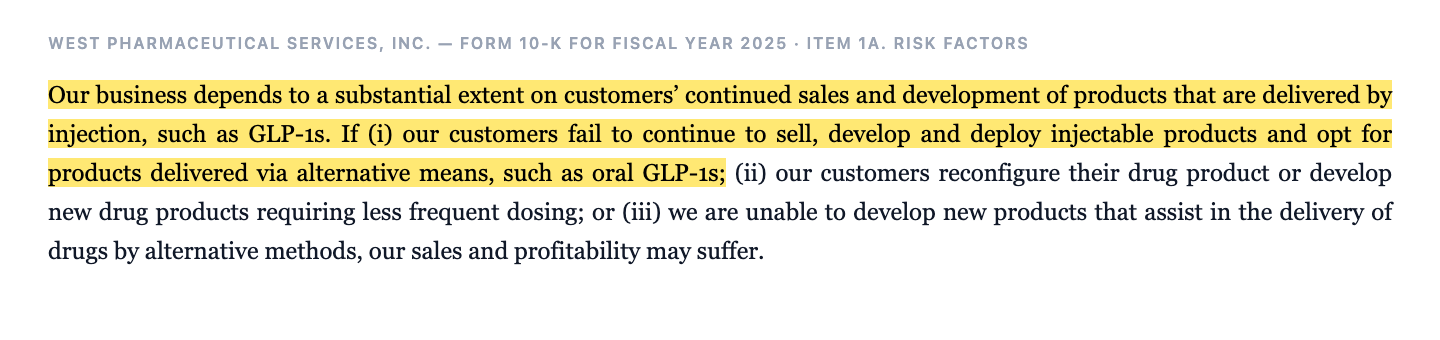
"Our business depends to a substantial extent on customers\' continued sales and development of products that are delivered by injection, such as GLP-1s. If (i) our customers fail to continue to sell, develop and deploy injectable products and opt for products delivered via alternative means, such as oral GLP-1s; (ii) our customers reconfigure their drug product or develop new drug products requiring less frequent dosing; or (iii) we are unable to develop new products that assist in the delivery of drugs by alternative methods, our sales and profitability may suffer."
— West Pharmaceutical Services, SEC annual report 10-K 2025, Item 1A "Risk Factors"
To be fair: in the short run the needle is West\'s friend — the first-quarter 2026 gains come exactly through this channel, and even a shift toward less frequent dosing or on-body systems can still pay West, as long as drugs are injected. Biologics, the core of West\'s high-value business, also cannot simply be pressed into pill form. But the logic of the risk stands: West earns on the delivery format, not on the molecule. Should the industry one day ship its GLP-1 blockbusters mostly in oral form, nobody would need West\'s stoppers for them — same drug, no toll. Anyone buying WST as a "safe GLP-1 shovel" should have read this footnote first.
Uncomfortable truth no. 3: the crown jewels are borrowed — Daikyo licenses expiring in 2027
FluroTec-coated stoppers and Crystal Zenith polymer containers are among the finest things West sells. Except: they were invented by long-time Japanese partner Daikyo Seiko, of which West owns 49 percent — and the usage rights carry a date:
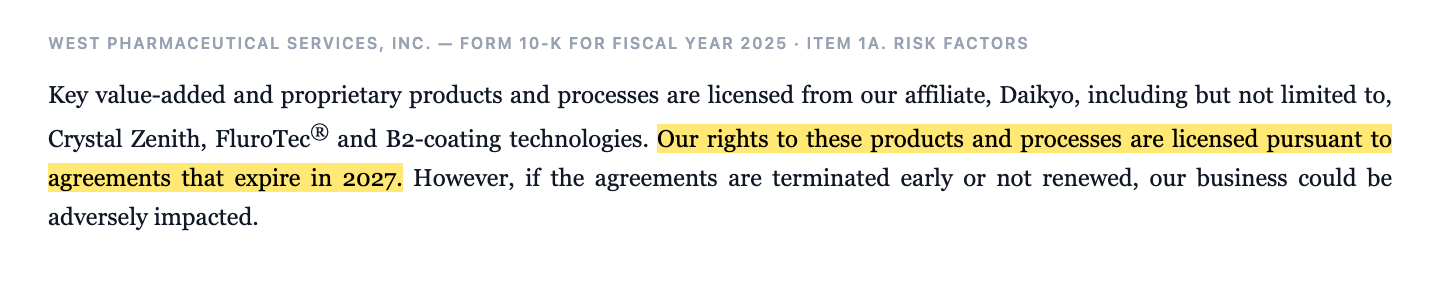
"Key value-added and proprietary products and processes are licensed from our affiliate, Daikyo, including but not limited to, Crystal Zenith, FluroTec® and B2-coating technologies. Our rights to these products and processes are licensed pursuant to agreements that expire in 2027. However, if the agreements are terminated early or not renewed, our business could be adversely impacted."
— West Pharmaceutical Services, SEC annual report 10-K 2025, Item 1A "Risk Factors"
A license, in an everyday image: West runs the best restaurant in town — but the secret recipe for the signature dishes belongs to the co-owner, and the lease on the recipe book ends in two years. Renewal is likely: the partnership goes back decades, West holds just under half of Daikyo, distributes its products in Western markets, and even hedges the stake with a $130 million cross-currency swap — a split would hurt both sides. But "likely" is a forecast, not a contract. The case belongs in the same category as the big customer: no acute alarm, but a quiet dependency the noble-title reflex never gets to see. How invisible suppliers become the chokepoint of entire industries is something we wrote up in our analysis of component maker CTS.
Valuation: what does nobility cost?
Now to the price tag — the real acid test of this analysis. As of mid-July 2026, West costs about $24 billion (sanity-checked against 72,021,491 shares outstanding per the annual report, as of January 29, 2026). That is roughly 47 times trailing earnings, 7.5 times revenue and a good 50 times free cash flow (fundamental data). Even granting the roughly $8.60 of 2026 earnings per share that analysts expect (feed as of mid-July 2026), you still pay about 40 times. For perspective: that is the multiple of a structural growth stock — while what West has actually delivered so far is one strong quarter after two hangover years in which profit ran a sixth below its 2023 level. The professionals\' view is friendly nonetheless: 13 analysts cover the stock and the consensus leans clearly toward buy (feed as of mid-July 2026) — though the same consensus also accompanied the stock through the hangover years. A second number from the annual report itself is worth noting: as of June 30, 2025, West put the market value of shares held by non-affiliates at about $15.7 billion — since then, the market has paid a premium of roughly 50 percent for the GLP-1 acceleration. Remember the principle: quality protects you from losses in the business — not from losses on your entry price.
Opportunities and risks at a glance
What speaks for West:
- Consumables with a regulatory moat: components are baked into customers\' drug approvals; every supplier switch costs time, data and regulator visits — West collects anew on every fill-and-finish run (annual report 10-K 2025).
- 33 consecutive dividend increases at only ~13 percent payout — the streak is as well covered as a dividend can be; plus buybacks ($1.43 billion from early 2023 through March 2026) and a fresh $1.0 billion program.
- Fortress balance sheet: $791.3 million in cash (12/31/2025), equity ratio around 73 percent, net interest paid in 2025: $0.3 million; Altman-Z near 12, Piotroski 7 of 9 (data as of 07/18/2026).
- GLP-1 tailwind: revenue up 21.0 percent and diluted EPS up 56 percent in the first quarter of 2026, driven by high-value components and self-injection systems for obesity and diabetes drugs (10-Q as of 03/31/2026).
- A structural shift toward biologics and self-injection, which tilts the product mix toward high-margin, high-value components (NovaPure, FluroTec, Westar).
What speaks against it:
- Customer concentration with momentum: one unnamed customer accounted for 15.8 percent of 2025 revenue ($485.9 million; 2024: 12.3 percent), the top ten for 47.6 percent (10-K 2025).
- Injection dependency: per the risk factors, the business depends "to a substantial extent" on injectable products such as GLP-1s; oral alternatives and less frequent dosing are named as concrete risks (10-K 2025, Item 1A).
- Daikyo licenses (FluroTec, B2, Crystal Zenith) expire in 2027 — renewal is likely, but part of the high-value story rests on borrowed technology (10-K 2025, Item 1A).
- Demanding valuation: about 47 times trailing earnings and 7.5 times revenue (data as of mid-July 2026) — after just one quarter of renewed growth since the slump.
- Inventory cyclicality: 2023/24 showed that customers run down stock after special booms (Covid) and West\'s profit then moves sideways for two years — net income in 2025 ($493.7 million) still sat below 2023 ($593.4 million).
A human conclusion
Back to the noble-title reflex from the opening. It is right about what it sees: the 33-year streak is real, SEC-documented back to 2013 and arithmetically gapless; the business model — a toll on every syringe in the world — is among the best our scanner knows; the balance sheet is a fortress. What the reflex does not see: the dividend that carries the title is, at a 0.3 percent yield, a crest, not an income. At 47 times earnings you are paying for something else — for the weight-loss pen to keep booming, for the one big customer to keep ordering, and for a license agreement to be renewed without drama before 2027. All of that may well work out; the odds are decent, and the next quarterly numbers arrive as soon as July 23, 2026, with fresh readings. But it is a growth bet wearing a small crown — not a pillow. What you make of it is your decision. And that is exactly as it should be.
Sources
- West Pharmaceutical Services — SEC annual report 10-K for 2025 (filed February 17, 2026)
- West Pharmaceutical Services — SEC annual report 10-K for 2024 (filed February 18, 2025)
- West Pharmaceutical Services — SEC quarterly report 10-Q as of March 31, 2026 (filed April 23, 2026)
- West Pharmaceutical Services — Press release on the 28th consecutive annual dividend increase (Exhibit 99.1 to the 8-K of October 28, 2020)
- West Pharmaceutical Services — Press release on the stock split and the 21st consecutive dividend increase (Exhibit 99.3 to the 8-K of August 1, 2013)
- West Pharmaceutical Services — Amendment No. 1 to the Global Master Supply Agreement with ExxonMobil (Exhibit 10.40 to the 8-K of November 30, 2023)
- Complete SEC filing history of West Pharmaceutical Services: EDGAR overview (sec.gov)
- Fundamental data (metrics, quarterly series, valuation; data as of July 18, 2026), reconciled against the SEC filings.
- Screener and rating data: in-house stock scanner (data as of July 18, 2026).
Transparency & disclaimer: This analysis is a journalistic contextualization of publicly available information and is not investment advice, not a financial analysis in the regulatory sense, and not a solicitation to buy or sell securities. Stock investments carry substantial risks up to and including total loss. All information without guarantee; the data cut-off is noted in the text for each figure. The author holds no position in West Pharmaceutical shares at the time of publication.
Our Bottom Line at a Glance
- Business model & market position positive
- Consumables with a regulatory moat: elastomer components are baked into customers' drug approvals, and every supplier switch costs data and regulator visits — a tollbooth of injectable medicine with $3,074.1 million in 2025 revenue and a 16 percent net margin (annual report 10-K 2025).
- Dividend history & safety positive
- 33 consecutive increases (SEC-documented chain: 21st increase 2013, 28th increase 2020, $0.22 per quarter since Q4 2025) at only about 13 percent payout — the streak is exceptionally well covered; the roughly 0.3 percent yield, however, makes the stock no income play (data as of mid-July 2026).
- Balance sheet & capital returns positive
- $791.3 million in cash (12/31/2025), equity ratio around 73 percent, net interest paid $0.3 million; buybacks of $1.43 billion since early 2023, a new $1.0 billion program since February 2026, Q1 2026 purchases at ~$244 per share (10-K 2025, 10-Q 03/31/2026).
- Growth & the GLP-1 cycle neutral
- A strong comeback in Q1 2026 (+21.0 percent revenue, diluted EPS $1.92 after $1.23), driven by high-value components and GLP-1 self-injection systems — but only one quarter after two hangover years: 2025 net income ($493.7 million) still sat below 2023 ($593.4 million), and customer inventory cycles left their mark in 2024.
- Concentration risks (big customer & Daikyo) negative
- The largest (unnamed) customer jumped from 12.3 to 15.8 percent of revenue within a year ($485.9 million), the top ten account for 47.6 percent; at the same time the Daikyo licenses for FluroTec, B2 and Crystal Zenith expire in 2027, and the risk factors name oral GLP-1s as a concrete threat to the injection business (10-K 2025).
- Valuation negative
- Roughly 47 times trailing earnings, 7.5 times revenue and a good 50 times free cash flow (data as of mid-July 2026) — the multiple of a structural growth stock, paid after a single quarter of renewed acceleration; the non-affiliate market value stood at $15.7 billion as recently as 06/30/2025 per the 10-K.
West Pharmaceutical is the rare case in which the noble title is accurate and can still mislead: 33 SEC-documented consecutive dividend increases, a fortress balance sheet and a tollbooth position in injectable medicine — but a yield around 0.3 percent, a share price at 47 times earnings, and a growth story that hangs on the weight-loss pen, one 15.8 percent customer and Daikyo licenses expiring in 2027. Whoever buys here is not buying a dividend stock but a richly priced quality-growth bet. Not investment advice.
What Our Rating Means
- If you don't own the stock
- As long as the question raised in the bottom line stays open, we see no basis for an entry.
- If you hold it in your portfolio
- Our findings offer no acute reason to sell — the checkpoints named remain decisive.
A journalistic assessment by our editorial team at the time of the deep dive, based on public sources — not investment advice and not a solicitation to buy or sell. Your personal circumstances (investment goals, risk capacity, taxes) cannot be taken into account. What our categories mean, how verdicts are formed, and what conflicts of interest exist →
Worth Noting
- WST entered the research list as rank 4 of the in-house dividend-aristocrats scanner (U.S. selection, as of July 18, 2026); 19 further scanners flagged it at the same time — from quality growth and the Buffett criteria to momentum signals (Stage 2, Power Trend).
- The 33-year streak is reconstructed from SEC sources: 8-K press releases of 08/01/2013 (21st increase) and 10/28/2020 (28th increase) plus the gaplessly rising, split-adjusted XBRL dividend series 2011–2025 ($0.35 → $0.86). Scanner metrics (P/E, P/S, Piotroski, Altman-Z) use trailing twelve-month figures.
- Market-value figure (~$24 billion) from the feed as of mid-July 2026, sanity-checked against 72,021,491 shares outstanding per the annual report 10-K 2025 (as of 01/29/2026); analyses are evergreen, daily prices are not a buy argument.
Frequently Asked Questions
West Pharmaceutical Services (NYSE: WST) of Exton, Pennsylvania, manufactures elastomer stoppers, seals, plungers and needle-safety systems for injectable drugs, and assembles complete self-injection devices under contract. In 2025 the company, with roughly 10,800 employees, generated $3,074.1 million in revenue; 81 percent came from the high-margin Proprietary Products components segment, the rest from contract manufacturing (renamed "West Vantage" in 2026).
For 33 years. The chain is documented in SEC filings: the press release attached to the 8-K of August 1, 2013, names the 21st consecutive annual increase, the release of October 28, 2020, the 28th — and the series disclosed in the annual reports rises without a gap ever since, through the raise to $0.22 per quarter in the fourth quarter of 2025, the 33rd consecutive increase. The annual dividend declared per share climbed from $0.35 (2011) to $0.86 (2025).
Arithmetically very safe, but small: in 2025 West declared $61.9 million in dividends — about 13 percent of the $493.7 million net income and likewise about 13 percent of free cash flow. Even a halving of profits would leave the payout ratio near 25 percent. The flip side: at the share-price level of mid-July 2026, the annual dividend (a $0.88 run rate) equals a yield of only about 0.3 percent — as an income source the stock barely registers.
West supplies elastomer components and assembles self-injection devices used with obesity and diabetes drugs (GLP-1). In the first quarter of 2026, company revenue grew 21.0 percent, with contract manufacturing driven per the quarterly report (10-Q) primarily by "self-injection devices for obesity and diabetes." The risk section states the flip side: the business depends "to a substantial extent" on injectable products — oral GLP-1 alternatives are a named risk.
Daikyo Seiko is West's Japanese partner, in which the company holds a 49 percent stake. Key technologies such as the FluroTec coating, the B2 coating and the Crystal Zenith polymer containers are licensed from Daikyo — per the 2025 annual report (10-K) under agreements that expire in 2027. Renewal is considered likely but is not guaranteed; without it, part of West's high-value lineup would rest on someone else's technology.
Yes, by classic yardsticks: as of mid-July 2026, at a market value of about $24 billion, the stock trades at roughly 47 times trailing earnings, 7.5 times revenue and a good 50 times free cash flow; on analysts' 2026 estimates, about 40 times. The market is paying for the GLP-1-driven comeback to continue — 2025 net income, at $493.7 million, was still below the 2023 level.
After the Covid boom, pharma customers ran down their inventories ("customer inventory management," per the 10-K for 2024) — hitting high-margin, high-value products like FluroTec and Westar hardest. Revenue fell 1.9 percent in 2024, gross margin dropped from 38.3 percent (2023) to 34.5 percent, and net income slid from $593.4 million to $492.7 million. In 2025 the business stabilized (+6.3 percent), and the first quarter of 2026 delivered the turn with +21.0 percent.
Found an error?
Did you spot a factual error, an outdated number, or a typo in this deep dive? Let us know briefly — your report goes straight to the editorial team.