CTS Stock: A Price at the All-Time High, Revenue Below 2022 — What Really Carries This 130-Year-Old Straight-A Stock
CTS Corporation builds sensors, connectivity components and actuators — and surfaced in our momentum run of July 17, 2026, with 12 scanner hits: stage-2 uptrend, a whisker below the all-time high, a Piotroski F-Score of 8 of 9 (metrics data as of July 10, 2026). We read the annual reports (10-K) for 2024 and 2025 and the quarterly report (10-Q) as of March 31, 2026: record earnings on revenue that still sits below 2022, a core market that has been shrinking for three years, a defense acquisition whose books needed fixing — and Superfund legacy sites in mediation with the EPA since October 2025. Not investment advice — just the question of what a report card is worth when the main subject is missing.
 Thomas Mücke
Founder & Publisher
Thomas Mücke
Founder & Publisher
Chart
Interactive price chart (TradingView).
Note: pure fact-based analysis, not investment advice and not a solicitation to buy or sell. All figures without guarantee.
There is an investor trap that catches the thorough ones in particular: the straight-A trap. It works like this: you run a stock through your checklist — uptrend? Check. Solid balance sheet? Check. Earnings growing? Check. And with every box ticked, your vigilance drops, until you stop asking what is not on the list. Exactly that kind of stock is what our in-house stock scanner washed up in its momentum run of July 17, 2026: CTS Corporation (NYSE: CTS) from Lisle, just outside Chicago — 12 hits, a stage-2 uptrend, a whisker below the all-time high, a Piotroski F-Score of 8 of 9, an equity ratio of 72 percent (metrics data as of July 10, 2026). A report card almost without blemish, issued to a company that has existed since 1896. So let\'s make a deal: before you count the checkmarks, we read together what the company itself reported, under penalty of law, to the U.S. securities regulator, the SEC — the annual reports (10-K) for 2024 and 2025 and the quarterly report (10-Q) as of March 31, 2026. That is where the tension running through this report card lives: the price is celebrating an all-time high and earnings a record — but revenue still sits below its 2022 level, because the straight-A student\'s biggest subject has been getting worse for three years. In the end, you decide for yourself.
What CTS actually does — and for whom
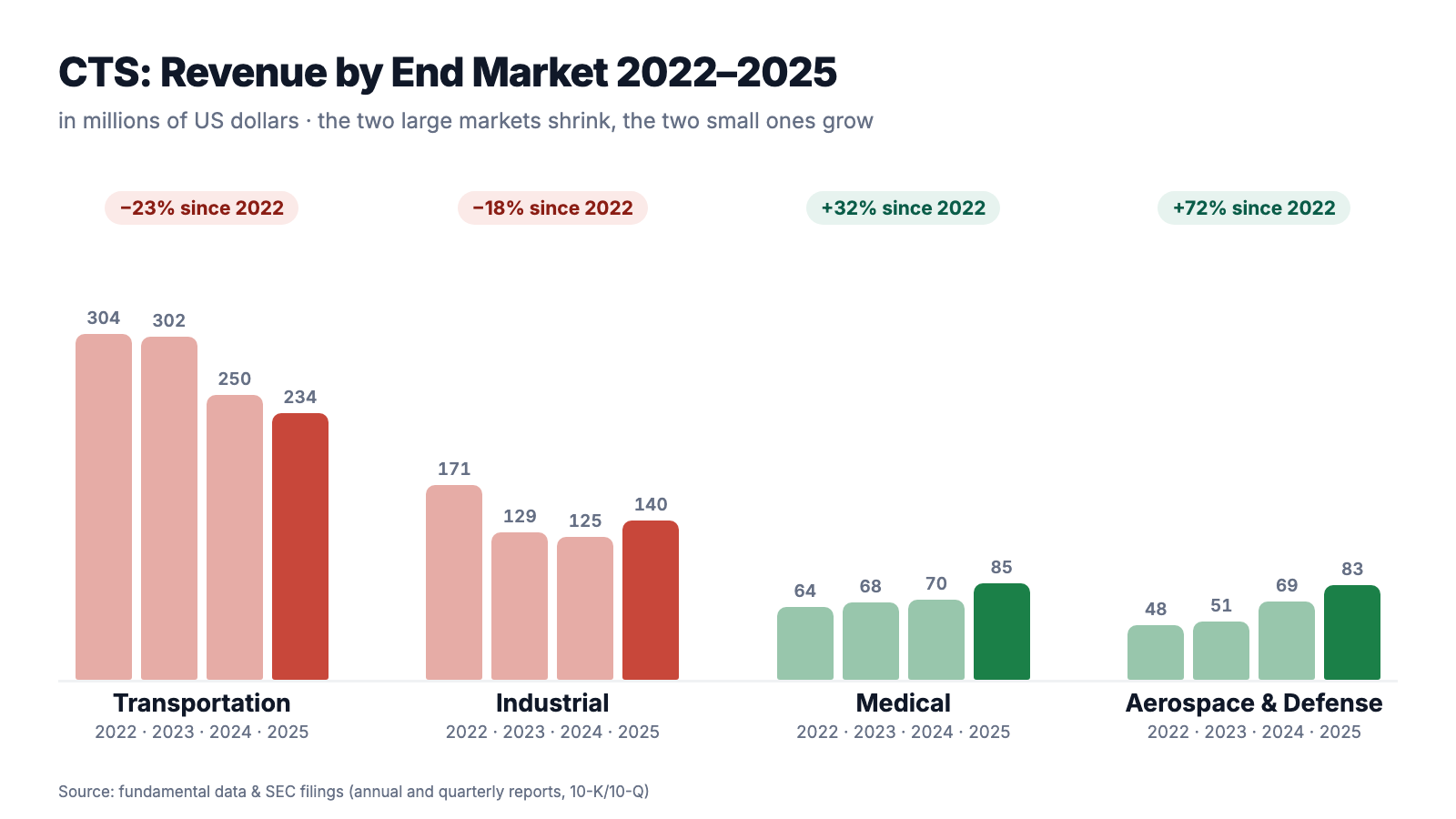
CTS builds what machines need in order to feel and move: sensors (the sense organs — they measure position, pressure, temperature or current), actuators (the muscles — they turn electrical signals into motion, from piezo microactuators to rotary actuators) and connectivity components (the nerve tracts — filters and components that carry signals cleanly from A to B). The company was founded in 1896 as a provider of telephone products and has been an Indiana corporation since 1929; today it employs 3,492 people (1,875 in North America, 1,099 in Asia, 518 in Europe; as of December 31, 2025). It sells into four end markets, and their ranking already tells half the story of this analysis: transportation (vehicle sensing and actuation — think accelerator-pedal modules and chassis sensors) still delivered 43 percent of 2025 revenue at $233.9 million, followed by industrial ($140.1 million), medical ($84.6 million, including ultrasound components) and aerospace & defense ($82.8 million — reinforced since July 2024 by acquired naval-sonar specialist SyQwest). The two largest single customers both sit in the shrinking transportation market: Toyota accounted for 11.2 percent of 2025 revenue, engine maker Cummins for 8.4 percent. What a components maker feels like when its end markets catch a cold is something we recently dissected at turbocharger world leader Garrett Motion — and how the market treats a chipmaker whose end markets wobble, at Lattice Semiconductor.
Where the stock shows up in our scanner
We run roughly 3,500 stocks through our scanners every day. CTS did not reach the research list through headlines — Reddit takes practically no interest in the name — but through a broad trend confluence in the run of July 17, 2026: 12 hits, including the stage-2 uptrend per Stan Weinstein (price above a rising 200-day moving average), ATH and near 52-week high (only about 2 percent below the all-time high), power-trend leader per Mike Webster, the trend criteria per Mark Minervini, the breakout signal per Pradeep Bonde — and, rarer in this company: the Altman-Z balance-sheet fortress and pros 80 percent (at least 80 percent of the shares sit with institutional investors). Behind it: up 35 percent in three months, 46 percent in six, and roughly 59 percent over twelve months (data as of July 10, 2026). To replicate it yourself: open the CTS stock page or browse the stage-2 scanner. What makes this case remarkable — unlike many momentum candidates — is that the fundamental lens nods along: a Piotroski F-Score of 8 of 9 (a nine-point test of the direction of the books; 8 means almost everything is improving), an Altman Z-Score around 11 (a bankruptcy early-warning gauge — the danger zone historically starts below 1.8, values above 10 are fortress territory), a fundamental grade of B, net debt near zero. The most expensive line on the report card is the price itself: a trailing price-to-earnings ratio around 28.5 (data as of July 10, 2026). Remember the sentence: a checklist tests what is on it — not what is missing. What is missing is in the filings.
The numbers over the years — honestly appraised
First, what genuinely impresses. CTS earned more in 2025 than ever before: $65.3 million in net earnings (+17.7 percent), $2.19 per diluted share after $1.81 in 2024. Gross margin climbed from 36.4 to 38.4 percent — and to 39.5 percent in the first quarter of 2026 — carried by efficiency programs and a better product mix. Operating cash flow reached $102.1 million, almost a fifth of revenue. And growth is visibly accelerating quarter by quarter: after a near-standstill in early 2025 (+0.1 percent), revenue most recently grew 10.9 percent to $139.2 million (Q1 2026) — the fifth consecutive quarter of rising growth rates, of which the weaker dollar contributed $2.9 million. Read only this paragraph, and the 12 scanner hits explain themselves.
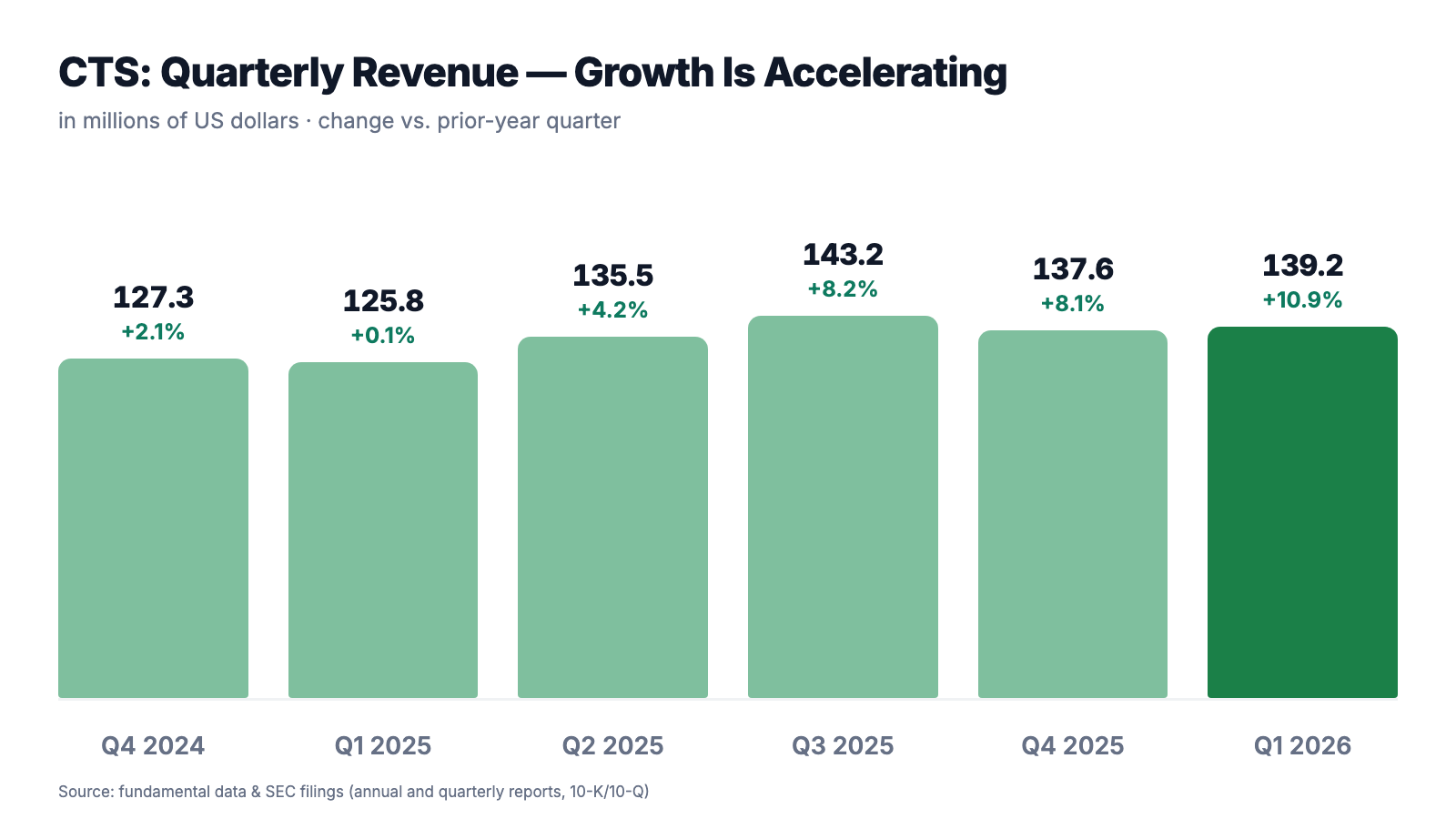
Now the full picture. In 2022, CTS booked $586.9 million in revenue. Then it went downhill for two years — $550.4 million (2023), $514.8 million (2024) — and the 2025 recovery to $541.3 million (+5.2 percent) has closed only part of the gap: the 2025 profit record was earned on roughly 8 percent less revenue than in 2022. Operationally that is an achievement (more margin from less business), but it explains why the all-time high in the stock is not an all-time high in the business. And it leads straight to the questions no checklist asks: where did the revenue decline come from — and where does the new growth actually come from? The answers are in the filings, and they are less comfortable than the report card looks.
What the filings say — the uncomfortable truths
Uncomfortable truth no. 1: the biggest subject has been getting worse for three years — and the filing says why
Transportation is CTS\'s largest end market at 43 percent of revenue — and it is shrinking for the third year in a row: from $303.7 million (2022) via $301.5 million (2023) and $250.4 million (2024) to $233.9 million (2025). The annual report names the reasons for the latest decline with unusual precision:
"Net sales to the transportation end market decreased $16,436 or 6.6%, primarily driven by lower volumes of our commercial vehicle related products and our customers' loss of market share in China."
— CTS Corporation, SEC annual report 10-K for 2025, Item 7 "Management's Discussion and Analysis"

The second half of that sentence deserves a moment: CTS is not losing here to a better sensor competitor — its own customers are losing to Chinese carmakers, and the supplier loses with them. Against this kind of decline, neither cost cutting nor product quality helps; it sits two steps away in the supply chain. In fairness: in the first quarter of 2026, transportation turned slightly positive again for the first time (+2.9 percent), and the company is deliberately diversifying away from this market — its share fell from 52 percent (2022) to 43 percent (2025). But a diversification that consists mostly of the largest segment shrinking is only half a success story. The other half — medical +20.9 percent, aerospace & defense +19.9 percent, industrial +11.7 percent in 2025 — is real and worth seeing:
Uncomfortable truth no. 2: a fifth of revenue hangs on two customers — with no firm purchase volumes
CTS\'s two largest customers sit, of all places, in the shrinking transportation market. The annual report names them — and in the same breath describes how loose the contractual tie is:
"We sell parts to these two transportation customers for certain vehicle platforms under purchase agreements that have program lifetime volume estimates and are subject to purchase orders issued from time to time."
— CTS Corporation, SEC annual report 10-K for 2025, Item 1 "Business," section "Major Customers"
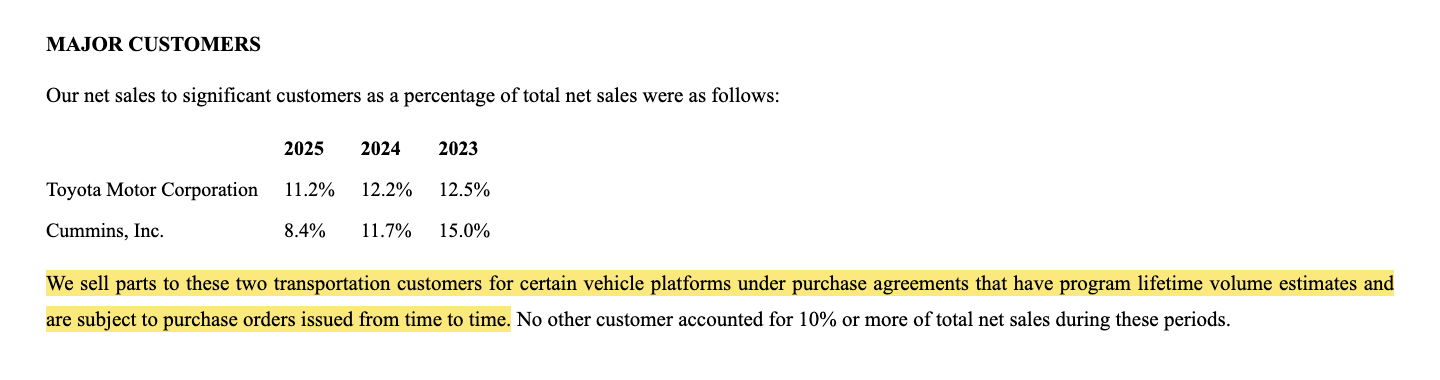
Toyota (11.2 percent) and Cummins (8.4 percent) together accounted for almost a fifth of 2025 revenue. "Volume estimates and purchase orders issued from time to time" translates to: when Cummins builds fewer engines, Cummins orders fewer sensors — immediately, and without breaching any contract. That is exactly what has already happened: Cummins\'s share of CTS revenue stood at 15.3 percent in 2022, 15.0 in 2023, 11.7 in 2024 and 8.4 percent in 2025. You can read that series as successful diversification — or as a time-lapse of what a customer ordering "from time to time" does to a revenue line. The truth sits in the middle: the report explicitly notes that no other customer exceeds 10 percent, and a fifth of revenue in two names is actually modest for an automotive supplier. But if you are buying the stock for its clean uptrend, you should know that the two most important order books sit in the end market that is currently shrinking.
Uncomfortable truth no. 3: the new growth is partly bought — and the acquisition came with calculation errors
Aerospace & defense is the company\'s showcase growth story: from $51.3 million (2023) to $82.8 million (2025). A sizable part of that stems from the acquisition of naval-sonar specialist SyQwest (July 2024, purchase price $128.0 million): per the annual report, the acquisition contributed $22.3 million of revenue in 2025. Strip that out, and CTS grew organically by roughly 3.4 instead of 5.2 percent in 2025. That is legitimate — acquisitions are a tool, not a flaw. What is more awkward is what the report documents under the heading "Immaterial Correction of Prior Period Errors":
"The errors related to the SyQwest acquisition were due to errors with the calculation of revenue and cost of goods sold both prior to and subsequent to the acquisition date of July 29, 2024."
— CTS Corporation, SEC annual report 10-K for 2025, Note 1 "Immaterial Correction of Prior Period Errors"
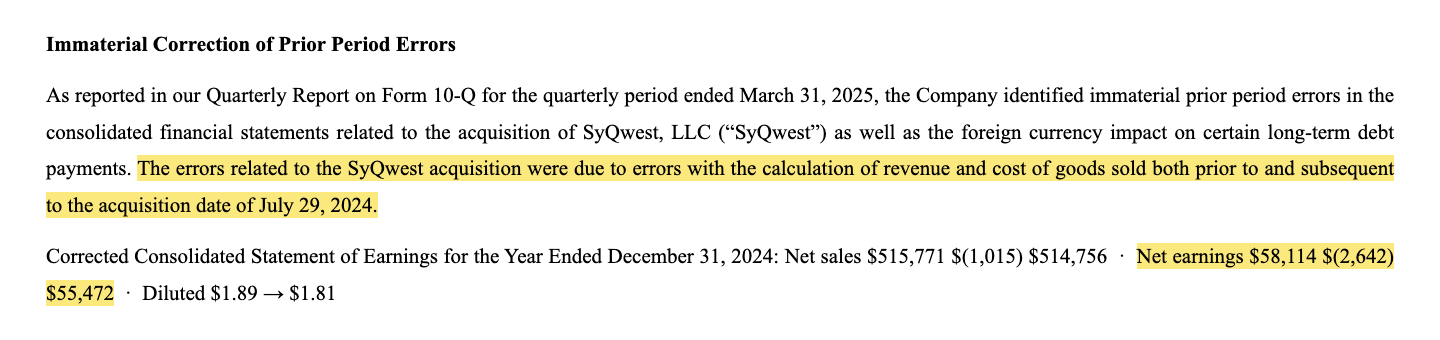
In plain language: the acquired company\'s books contained errors in quantities as basic as revenue and cost of goods sold — before the acquisition (that is, in the numbers on which the purchase price was negotiated) and after it (inside the consolidated statements). The correction changed the already audited year 2024 noticeably: net earnings from $58.1 million to $55.5 million (minus 4.5 percent), diluted earnings per share from $1.89 to $1.81. CTS classifies this as "immaterial" under SEC standards, and formally that is defensible. But for you as a reader of the report card it means two things. First, part of the defense growth story is built on bookkeeping that had to be repaired on arrival. Second, future quarters deserve a glance at whether the error source has truly run dry — in the fourth quarter of 2025, further "immaterial" follow-up corrections from the same origin were recorded. Remember the pattern: growth you buy comes with the seller\'s past attached.
Uncomfortable truth no. 4: the past still sends invoices — Superfund mediation since October 2025
Manufacture electrical components since 1896 and you carry not just tradition in the company crest but legacy contamination in the ground. Two former CTS sites — Asheville, North Carolina, and Mountain View, California — sit on the National Priorities List of the U.S. Superfund program, the country\'s roster of its most demanding cleanup cases. For Asheville, the U.S. Environmental Protection Agency (EPA) most recently sought $8.3 million in past response costs — an amount the Department of Justice adjusted down from the originally demanded $10.0 million; the current state reads like this in the annual report:
"On October 3, 2025, the Company presented a settlement offer as part of pre-litigation mediation and the mediation is ongoing. There can be no assurance that the matter will settle in mediation."
— CTS Corporation, SEC annual report 10-K for 2025, Note 11 "Commitments and Contingencies"
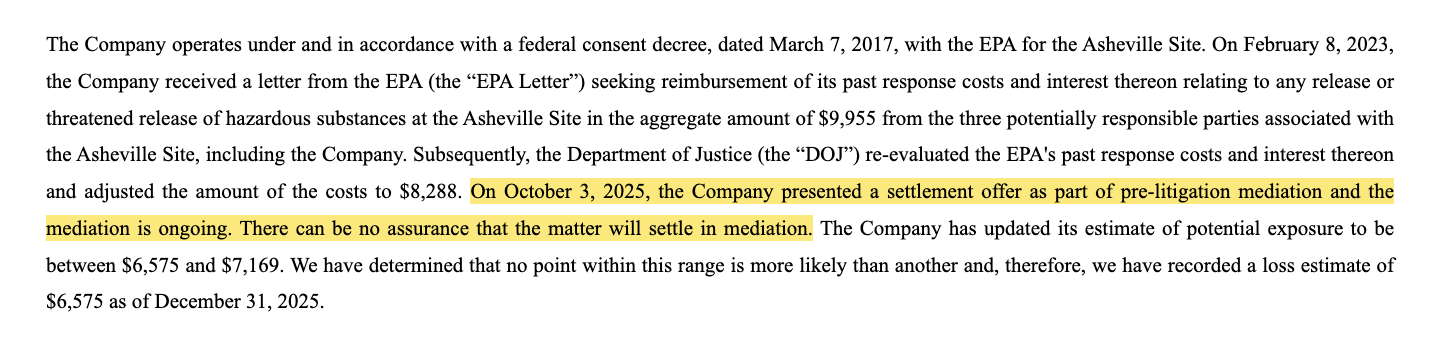
Accrued: $6.575 million (estimated range up to $7.169 million); a related one-time charge already weighed on 2025 administrative expenses. To keep perspective without alarmism: against $102 million of operating cash flow this is manageable, the amounts are quantified and on the balance sheet, and per the report the affected sites no longer generate any revenue. But the episode belongs in the picture of the straight-A student — it shows that beneath the freshly polished report card of a 130-year-old industrial company there are old files that keep costing money and lawyers. And it explains part of why administrative expenses grew faster than revenue in 2025 (+11.8 versus +5.2 percent).
Valuation: $1.9 billion of market value for the best earnings in company history
In early July 2026 the CTS share cost about $67, for a market value of roughly $1.9 billion (data as of July 10, 2026). That puts the trailing price-to-earnings ratio around 28.5, price-to-sales around 3.4, and price to free cash flow around 22. On the earnings estimates for 2026 (about $2.43 per share) the P/E comes to roughly 27.5, on the 2027 estimates (about $2.89) to roughly 23 (data as of July 10, 2026). Translated: the market is no longer paying for a turnaround here — it is paying for the acceleration to continue. For a company that most recently grew organically in the low-to-mid single digits, that is a sporty but not an absurd bill. How shareholders get paid is worth noting: the dividend has been symbolic for years at $0.16 per share annually (a yield around 0.2 percent); the real instrument is buybacks — $41.3 million (2023), $43.0 million (2024), $56.7 million (2025), plus a new $100 million program since November 2025. The balance sheet behind it holds a curiosity: CTS now keeps more of its own shares in the vault (29.0 million) than are outstanding (28.6 million; March 31, 2026). And one detail from the quarterly report is worth knowing: of $90.9 million in cash, $89.6 million sat outside the United States as of March 31, 2026 — in the same quarter, the company borrowed a net $5 million at home to fund buybacks and the dividend ("Cash and cash equivalents were $90,851 [...] of which $89,576 [...] were held outside the United States"; 10-Q as of March 31, 2026). That is no alarm signal — $62.5 million of debt against a $300 million credit facility remains modest — but it qualifies the image of the "full cash box": the money is there, just not where the buybacks happen. About 2 percent of the shares sit with insiders; the institutional ownership is high enough for our "pros 80 percent" filter (data as of July 10, 2026).
Opportunities and risks at a glance
What speaks for CTS:
- Record profitability with substance: 2025 net earnings of $65.3 million (+17.7 percent), gross margin up from 36.4 to 38.4 percent (Q1 2026: 39.5 percent), operating cash flow of $102.1 million — on an equity ratio around 72 percent and net debt near zero (10-K 2025, 10-Q as of March 31, 2026).
- Growth has accelerated for five straight quarters: from +0.1 percent (Q1 2025) to +10.9 percent (Q1 2026); the diversification markets grew double digits in 2025 (medical +20.9, aerospace & defense +19.9, industrial +11.7 percent).
- The pivot away from autos is deliberate: transportation\'s share cut from 52 percent (2022) to 43 percent (2025); SyQwest (naval sonar, $128 million) adds a second defense leg, and the defense cycle provides a tailwind.
- Shareholder-friendly capital allocation: $141 million of buybacks in three years, a new $100 million program (November 2025), a falling share count — every dollar of earnings spreads across fewer shares.
- The technicals confirm it: 12 scanner hits in the run of July 17, 2026 (including stage 2, ATH, power-trend leader, Minervini), a Piotroski F-Score of 8 of 9, an Altman Z around 11, up 59 percent over twelve months (metrics data as of July 10, 2026).
What speaks against it:
- The largest end market is shrinking structurally: transportation from $303.7 million (2022) to $233.9 million (2025), most recently on commercial-vehicle weakness and its own customers\' loss of market share in China — a problem two steps away in the supply chain that cannot be optimized away.
- Despite record earnings, revenue still sits roughly 8 percent below its 2022 level; organic growth in 2025 was only about 3.4 percent, and 2.3 percentage points of the 10.7 percent growth in Q1 2026 came from currency tailwinds.
- Concentration inside the shrinking segment: Toyota (11.2 percent) and Cummins (8.4 percent) account for almost a fifth of revenue — sold under agreements with "purchase orders issued from time to time"; Cummins\'s share has nearly halved since 2022.
- The SyQwest bookkeeping was faulty: correction of audited 2024 net earnings from $58.1 to $55.5 million (minus 4.5 percent), with the error source active before and after the acquisition date and follow-up corrections in the fourth quarter of 2025.
- A valuation with no margin for setbacks: roughly 28.5 times trailing earnings near the all-time high (data as of July 10, 2026) — plus Superfund legacy sites in ongoing EPA mediation ($6.6 million accrued) and 98 percent of the cash held abroad.
A human conclusion
Back to the straight-A trap from the opening. Its core is not that straight-A students cheat — CTS\'s report card is genuine: record earnings, rising margins, accelerating growth, a textbook balance sheet, and a management team that has spent decades quietly retiring shares instead of building empires. Its core is that the checkmarks distract you from the questions that are not on the list: Why does revenue still sit below 2022 after three years? What happens to the largest end market if China\'s carmakers keep taking share? How much of the new growth story comes from an acquisition whose books had to be repaired first? And what will the mediation over the Asheville factory past ultimately cost? None of these questions makes CTS a shaky candidate — they merely turn 28.5 times earnings into a price that leaves little room for wrong answers. If the diversification markets keep growing double digits and transportation stabilizes, the straight-A student can grow into this report card. If not, you will have bought a very good company at a very full price. What you make of it is your decision. And that is exactly as it should be.
Sources
All original documents used in this analysis — for your own reading:
- CTS Corporation — SEC annual report 10-K for 2025 (filed February 24, 2026)
- CTS Corporation — SEC annual report 10-K for 2024 (filed February 26, 2025)
- CTS Corporation — SEC quarterly report 10-Q as of 03/31/2026 (filed April 29, 2026)
- CTS Corporation — SEC quarterly report 10-Q as of 09/30/2025 (filed October 28, 2025)
- CTS Corporation — SEC quarterly report 10-Q as of 06/30/2025 (filed July 24, 2025)
- CTS Corporation — SEC quarterly report 10-Q as of 03/31/2025 (filed April 30, 2025)
- Complete SEC filing history of CTS Corporation: EDGAR overview (sec.gov)
- Fundamental data (metrics, quarterly series, valuation; data as of July 10, 2026), reconciled against the SEC filings.
- Screener and rating data: in-house stock scanner (momentum/stage-2 run of July 17, 2026; metrics data as of July 10, 2026).
Transparency & disclaimer: This analysis is a journalistic contextualization of publicly available information and is not investment advice, not a financial analysis in the regulatory sense, and not a solicitation to buy or sell securities. Stock investments carry substantial risks up to and including total loss. All information without guarantee; the data cut-off is noted in the text. The author holds no position in CTS shares at the time of publication.
Our Bottom Line at a Glance
- Profitability & balance sheet positive
- Record net earnings of $65.3 million in 2025 (+17.7 percent), gross margin up from 36.4 to 38.4 percent (Q1 2026: 39.5 percent), $102.1 million operating cash flow, an equity ratio around 72 percent, Altman Z around 11, Piotroski 8 of 9 — the scanner's quality checkmarks are backed by the SEC filings (10-K 2025, 10-Q as of March 31, 2026).
- Growth dynamics positive
- Five quarters of accelerating growth up to +10.9 percent (Q1 2026), diversification markets up double digits in 2025 (medical +20.9, aerospace & defense +19.9, industrial +11.7 percent) — though with 2.3 percentage points of currency tailwind in the latest quarter and roughly 3.4 percent organic growth for full-year 2025.
- Core market & customer concentration negative
- Transportation — 43 percent of revenue — is shrinking for the third year in a row ($303.7 to $233.9 million since 2022), per the 10-K on commercial-vehicle weakness and its own customers' loss of market share in China; Toyota and Cummins account for almost a fifth of revenue without firm purchase volumes, and Cummins's share has nearly halved since 2022.
- Acquisition & accounting neutral
- SyQwest ($128 million, July 2024) delivers the defense leg and $22.3 million of 2025 revenue — but the acquisition brought calculation errors in revenue and cost of goods sold, whose correction trimmed audited 2024 earnings by 4.5 percent; the error source still produced follow-up corrections in the fourth quarter of 2025 (10-K 2025, Note 1).
- Valuation & technicals neutral
- A stage-2 trend, 12 scanner hits and a price about 2 percent below the all-time high meet 28.5 times trailing earnings and 3.4 times revenue (data as of July 10, 2026) — what is being paid for is a continuation of the acceleration, while total revenue still sits roughly 8 percent below 2022; the Superfund mediation ($6.6 million accrued) and the almost entirely offshore cash are footnotes, not roadblocks.
CTS is a genuine straight-A student with one blind spot: record earnings, record margins, accelerating quarterly growth and a fortress balance sheet stand against a core market that has been shrinking for three years — and revenue that, despite everything, remains below its 2022 level. The new growth comes from medical and defense, partly bought and with bookkeeping that needed repair, while the market pays 28.5 times trailing earnings at the all-time high. Whoever invests here buys quality without a margin of safety. Not investment advice.
What Our Rating Means
- If you don't own the stock
- As long as the question raised in the bottom line stays open, we see no basis for an entry.
- If you hold it in your portfolio
- Our findings offer no acute reason to sell — the checkpoints named remain decisive.
A journalistic assessment by our editorial team at the time of the deep dive, based on public sources — not investment advice and not a solicitation to buy or sell. Your personal circumstances (investment goals, risk capacity, taxes) cannot be taken into account. What our categories mean, how verdicts are formed, and what conflicts of interest exist →
Worth Noting
- CTS reached the research list through the momentum/stage-2 scanner run of July 17, 2026 (12 hits in our in-house stock scanner) — not through Reddit or headlines; attention outside the trend filters is practically absent.
- Scanner metrics (P/E, P/S, Piotroski, Altman Z, fundamental grade) are computed on trailing twelve-month figures (data as of July 10, 2026); the SyQwest corrections to 2024 are baked in, a possible further defense-cycle push naturally is not.
- Price and valuation figures dated July 10, 2026 (about $67, roughly $1.9 billion market value); analyses are evergreen, daily prices are not a buy argument. CTS reports on a calendar-year basis (fiscal year ends December 31).
Frequently Asked Questions
CTS Corporation (NYSE: CTS) of Lisle, Illinois, manufactures sensors, connectivity components and actuators — accelerator-pedal modules, chassis sensors, ultrasound components for medical technology and sonar systems for naval applications. Its four end markets: transportation (43 percent of 2025 revenue), industrial, medical and aerospace & defense. Revenue 2025: $541.3 million, net earnings $65.3 million. The company was founded in 1896 as a provider of telephone products.
The market is paying for earnings quality, not revenue size: in 2025, CTS earned a record $65.3 million in net income on $541.3 million of revenue (about 8 percent less than in 2022), because gross margin rose to 38.4 percent. Quarterly growth has also accelerated for five straight quarters (most recently +10.9 percent in Q1 2026), and ongoing buybacks shrink the share count. The trailing P/E around 28.5 (data as of July 10, 2026) prices in a continuation of that trajectory.
Transportation revenue fell from $303.7 million (2022) to $233.9 million (2025). For the 6.6 percent decline in 2025, the annual report (10-K) names two reasons: lower volumes in commercial-vehicle products and its own customers' loss of market share in China — Western vehicle makers are losing ground there to Chinese manufacturers, and their U.S. supplier loses with them. In the first quarter of 2026 the segment turned slightly positive again at +2.9 percent.
SyQwest is a designer and manufacturer of sonar and acoustic sensing solutions for naval applications that CTS acquired in July 2024 for $128.0 million. The deal carries the defense growth story: it contributed $22.3 million of revenue in 2025 — without it, CTS would have grown organically by only about 3.4 instead of 5.2 percent. SyQwest's books, however, contained errors in the calculation of revenue and cost of goods sold, and the correction retroactively trimmed audited 2024 consolidated net earnings from $58.1 million to $55.5 million.
Toyota accounted for 11.2 percent and Cummins for 8.4 percent of CTS's 2025 revenue — together almost a fifth, sold under purchase agreements with volume estimates and purchase orders issued from time to time, without firm purchase volumes. Cummins shows the risk in time-lapse: the engine maker's share of CTS revenue fell from 15.3 percent (2022) to 8.4 percent (2025). No other customer exceeded 10 percent of revenue in 2025.
Two former CTS sites — Asheville, North Carolina, and Mountain View, California — are listed as Superfund cleanup cases on the U.S. EPA's National Priorities List. For Asheville, the EPA seeks about $8.3 million in past response costs; a pre-litigation mediation has been running since October 3, 2025, and CTS has accrued $6.575 million (range up to $7.169 million). The sites no longer generate any revenue but continue to cost money.
No — it is priced for perfection: roughly 28.5 times trailing earnings, 3.4 times revenue and 22 times free cash flow (data as of July 10, 2026), with the price about 2 percent below the all-time high. On the 2027 earnings estimates (about $2.89 per share) the P/E drops to about 23. Against that stand record margins, a Piotroski F-Score of 8 of 9 and a new $100 million buyback program — but little margin of safety for setbacks in the shrinking transportation market.
Found an error?
Did you spot a factual error, an outdated number, or a typo in this deep dive? Let us know briefly — your report goes straight to the editorial team.