Wendy’s Stock: The Cash Register Still Rings — but Guests Are Leaving, the Dividend Is Cut and the Brand Is Pledged
Wendy’s shows up in our Reddit hype scanner with 32 mentions in 24 hours (as of July 15, 2026) — down about 65 percent from its all-time high, the square-patty chain looks like a bargain with a 7 percent dividend yield. We read the annual reports (10-K) for 2024 and 2025 and the quarterly report (10-Q) as of March 29, 2026: U.S. same-restaurant sales down 7.8 percent in the first quarter of 2026, a dividend cut by 44 percent, a turnaround plan that closes roughly every 18th U.S. restaurant — and $2,760 million of securitized debt for which substantially everything that makes this company valuable is pledged. Not investment advice — just a look inside the kitchen before you order.
 Thomas Mücke
Founder & Publisher
Thomas Mücke
Founder & Publisher
Chart
Interactive price chart (TradingView).
Note: pure fact-based analysis, not investment advice and not a solicitation to buy or sell. All figures without guarantee.
There is a shortcut in the investor brain that feels like diligence: "I know this one. I have eaten there for years. I can judge it." Psychologists call it the familiarity effect — what we see often, we consider safe, and a stock whose product we have held in our hands feels more thoroughly vetted than any balance sheet. Hardly any ticker feeds that reflex in the summer of 2026 as reliably as The Wendy’s Company (Nasdaq: WEN): a brand every American knows, a share price about 65 percent below its all-time high, a dividend yield around 7 percent — and an appearance in our Reddit hype scanner with 32 mentions in 24 hours (as of July 15, 2026). On Reddit, the thesis sounds seductively simple: cult burger, half price, fat dividend. So let’s make a deal: before you order with the crowd, we take a look inside the kitchen together — the annual report (10-K) for 2025, its predecessor and the quarterly report (10-Q) as of March 29, 2026, all filed with the U.S. securities regulator, the SEC. An SEC filing is honest under penalty of law. And this one contains things that appear on no menu. In the end, you decide for yourself.
What Wendy’s actually does — and what the company really earns from
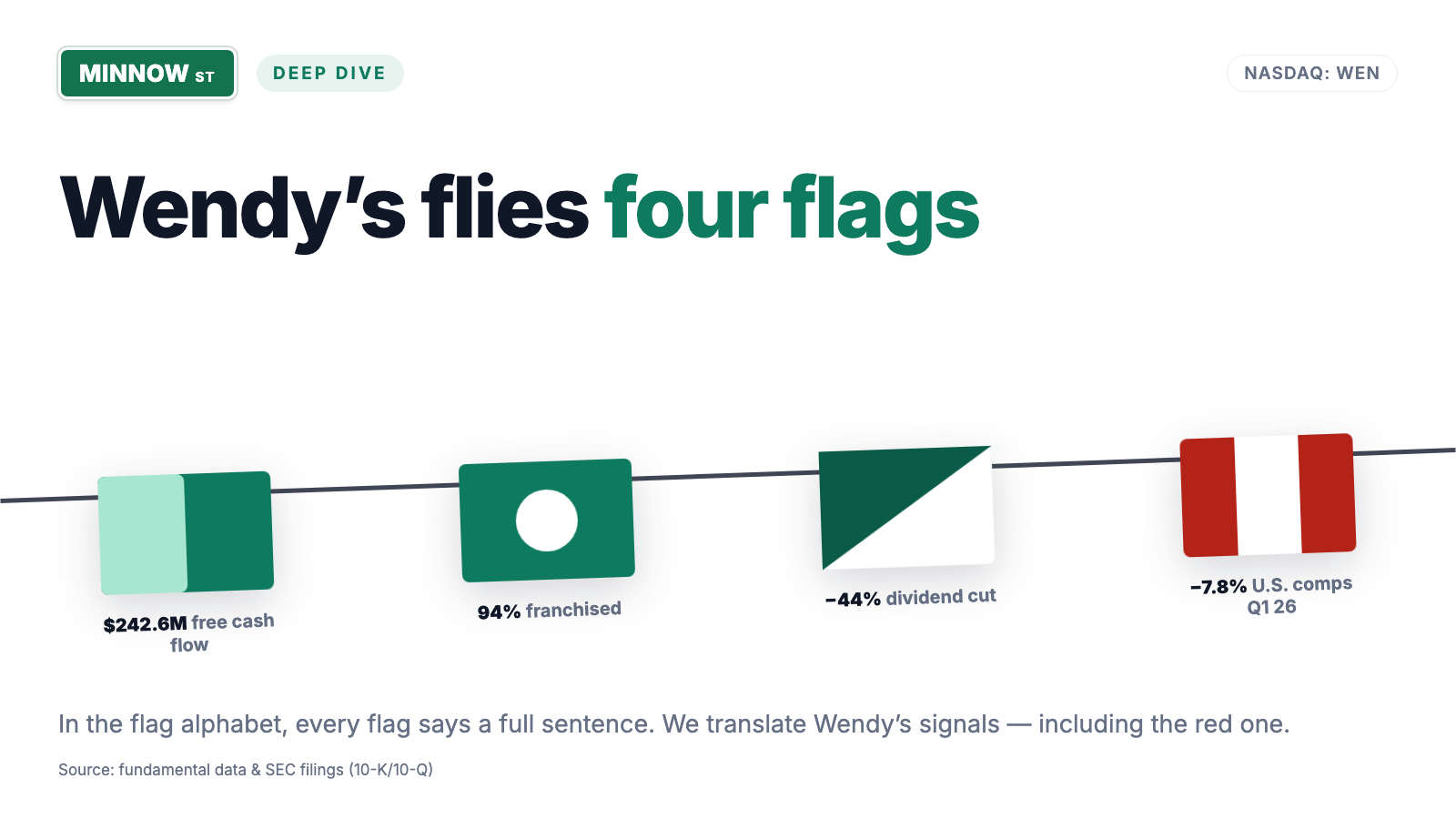
Wendy’s is, per its own annual report, the second-largest quick-service burger company in the U.S. by traffic and dollar share — and the third-largest globally. Founded in 1969 by Dave Thomas, it is famous for square fresh-beef patties and the Frosty. At the end of 2025 the system counted 7,397 restaurants — 5,969 in the U.S., 1,428 across 38 other countries and territories. But here comes the first translation the familiarity effect likes to skip: the listed company barely grills any burgers. About 94 percent of the restaurants belong to franchisees — 203 operator families and firms in the U.S. alone. The company itself runs only 434 restaurants of its own and otherwise earns like a licensing-and-landlord business: in 2025 it collected $504.5 million in royalties (as a rule 4 percent of restaurant sales), $98.2 million in franchise fees, $235.8 million in rental income — at many locations Wendy’s is its own franchisees’ landlord — and $422.1 million in advertising-fund contributions that flow, earmarked, back into marketing. Add $916.3 million of sales at company-operated restaurants and you get total revenues of $2.18 billion — while the cash registers of all Wendy’s restaurants worldwide rang up $13.96 billion (the "systemwide sales"). Remember the difference: the company is a toll booth on the burger highway. In good times that is a wonderful model — asset-light, high-margin, predictable. It has exactly one Achilles heel: the toll depends on the traffic. Which brings us to the central tension of this analysis, and it runs through every chapter: the licensing machine still delivers cash reliably — but the guests in the U.S. core business are getting fewer, and management’s answer consists of closures and a cut dividend. How quickly the market reprices familiar consumer brands when demand turns is something we just dissected at Deckers (UGG, Hoka).
Where the stock shows up in our scanner
Every day we run about 3,500 stocks through our scanners. Wendy’s reached our research list this time not through a warning or quality filter but through the Reddit hype scanner: 32 mentions in 24 hours (ApeWisdom, as of July 15, 2026) — for a burger classic with no earnings date on the calendar, that is a lot of tavern noise. In our metrics scanners the stock lights up in 8 filters as of the July 8, 2026 data cut-off, and the list reads like two expert opinions about two different companies. Opinion one, the value lens: the P/S ranking with a price-to-sales ratio of 0.63, the P/CF ranking at 4.3 times operating cash flow, the P/FCF ranking at about 6 times free cash flow — translated: for every dollar left over after all bills and investments, the market pays just six dollars; healthy consumer-franchise companies often fetch 15 to 20. Add net insider buying — most recently two insider purchases stood against not a single sale — and the "pros over 80 percent" filter: about 94 percent of the shares sit with institutional investors, led by Nelson Peltz’s Trian Fund Management with just under 16 percent. Opinion two, the trend lens, judges mercilessly: a relative-strength rating of 12 — the stock performed worse than 88 percent of all others —, a stage-4 downtrend, minus 22 percent year to date, minus 32 percent over twelve months. That "above the 50- and 200-day averages", "bullish reversal bar" and "power trend" fire at the same time only shows how forceful the latest bounce was: plus 12 percent in one month, plus 24 percent in two (all data as of July 8, 2026). Cheap, popular with insiders, technically damaged with a fresh recovery impulse — exactly this fingerprint appears when the market is arguing whether a stock is a bargain or a business model with a crack.
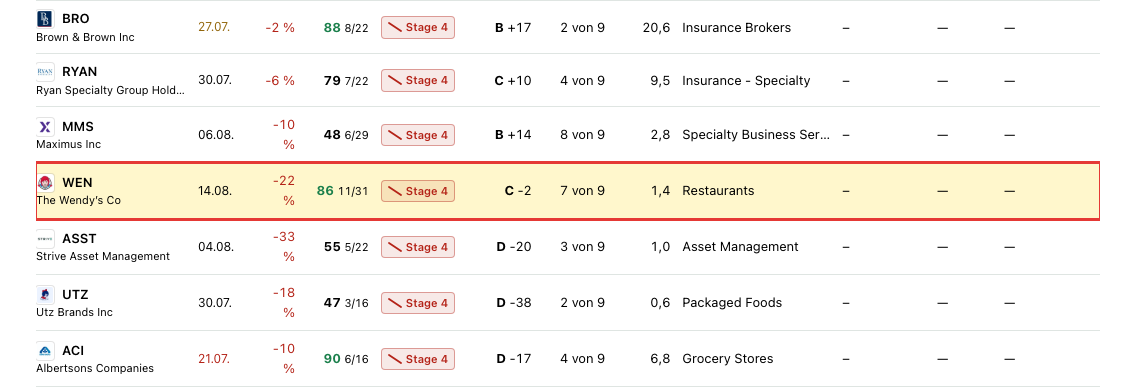
Two more scanner readings belong on the table because they make the picture more honest: the Piotroski F-Score, a nine-point test of balance-sheet quality, stands at a solid 7 of 9 — nothing is rotting here in the dark. And the Altman Z-score, a classic insolvency early-warning built from several balance-sheet ratios, sits around 4.4 — clearly outside the danger zone that historically begins below 1.8. Wendy’s is no bankruptcy candidate — nobody serious claims that. The question is a different one, and it is more uncomfortable: what is a toll booth worth when the traffic thins out year after year?
The numbers over the years — honestly appraised
First, what genuinely impresses — and it is more than the crashed price suggests. The franchise model does what it is supposed to do: of $2.18 billion in revenues, $343.5 million of operating profit and $165.1 million of net income remained in 2025 — a 7.6 percent net margin in a year in which the industry complained about thrifty consumers. Operating cash flow came to $344.5 million; after $101.9 million of capital expenditures, roughly $242.6 million of free cash flow was left — comfortably more than the reduced dividend ($129.6 million paid). The digital business is growing briskly: 20.8 percent of systemwide sales ran through the app and delivery platforms in 2025, up from 17.6 percent the year before. And the international business is genuinely growing: international systemwide sales rose 8.1 percent on a constant currency basis to $2.06 billion, same-restaurant sales there gained 1.3 percent, and the system opened 268 new restaurants worldwide in 2025 — a net plus of 157. Whoever reads only these paragraphs understands the Reddit thesis immediately. Now turn the menu over:
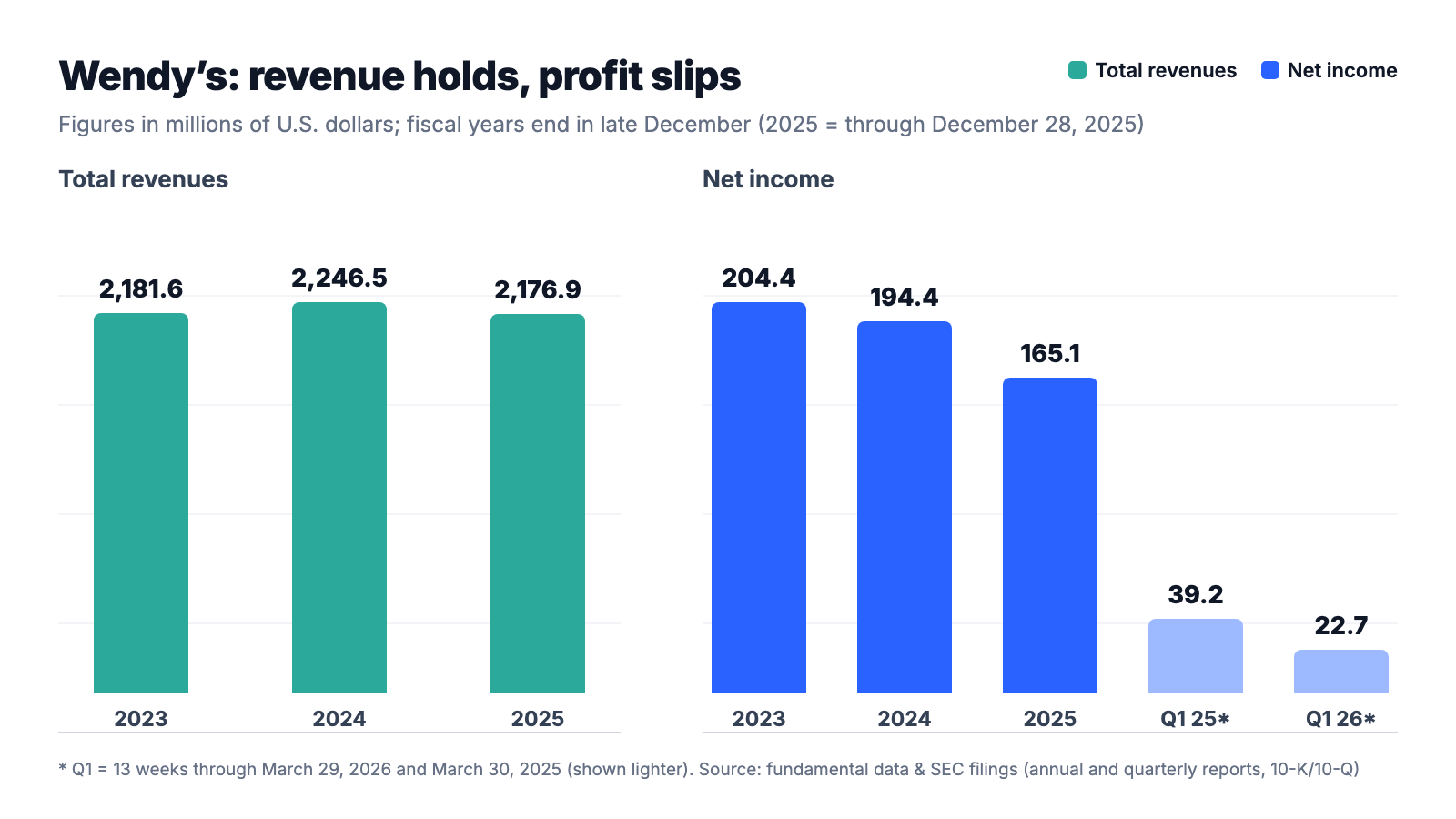
Total revenues fell 3.1 percent to $2,176.9 million in 2025, and net income declined for the third year in a row: $204.4 million (2023), $194.4 million (2024), $165.1 million (2025). Pre-tax income dropped 16.6 percent. The first quarter of 2026 accelerated the trend: $22.7 million of net income after $39.2 million in the prior-year quarter — minus 42 percent, even though revenue optically grew 3.3 percent (it grew mainly because Wendy’s bought 35 restaurants back from a franchisee in the summer of 2025 and now books their register sales itself). Systemwide sales — the most honest yardstick of a franchise system — shrank 3.5 percent on a constant currency basis to $13.96 billion in 2025, and 5.2 percent in the U.S. Remember the sentence: at a toll booth, the risk is not the toll price — it is the traffic. Which brings us to the uncomfortable truths.
What the filings say — the uncomfortable truths
Uncomfortable truth no. 1: the guests are leaving — and it is getting faster, not slower
The most important metric of any restaurant chain is same-restaurant sales: what do the same restaurants ring up compared with a year ago? At Wendy’s this curve has pointed down for two years, and lately the slope got steeper. In 2025, U.S. same-restaurant sales fell 5.6 percent (globally: minus 4.7 percent). Then came the first quarter of 2026:
"Global same-restaurant sales decreased 6.8%, U.S. same-restaurant sales decreased 7.8% and international same-restaurant sales decreased 0.4% compared with the first quarter of 2025"
— The Wendy’s Company, SEC quarterly report 10-Q as of March 29, 2026, Item 2 "Executive Overview"

The report also names the cause, and it is the most unpleasant one available: the declines came "primarily due to a decrease in traffic" — fewer guests, only partially offset by higher average checks. Higher checks on fewer visits translates to: the loyal customers pay more, the price-sensitive ones stop coming at all — for a fast-food brand whose reason for existing is the small budget, that is the wrong kind of pricing power. The consequences eat through the income statement: the company-operated restaurant margin fell from 13.6 percent (2025) to 10.8 percent in the first quarter of 2026 — minus 350 basis points within a year — and because every lost guest also carries a 4 percent royalty and advertising-fund contributions with them, falling traffic hits the company twice. For fairness: one quarter is not an obituary, and the entire U.S. fast-food industry battled thrifty consumers in 2025/26 — the same discretionary-dollar squeeze we traced at MSG Entertainment. But minus 7.8 percent is more than industry weather — it is the admission that Wendy’s is currently losing the price war for the scarce consumer dollar.
Uncomfortable truth no. 2: the turnaround plan means shrinking — roughly every 18th U.S. restaurant is set to close
Management’s answer carries a fresh name — "Project Fresh" — and four pillars: brand revitalization, operational excellence, system optimization and capital allocation. Behind the third pillar hides the hardest number of the annual report:
"For example, as part of the system optimization pillar, we are focused on reallocating resources to prioritize average unit volume growth in the United States and have announced that we expect to close certain underperforming restaurants in the United States. We currently expect incremental closures related to Project Fresh to total 5% to 6% of our total restaurants in the United States."
— The Wendy’s Company, SEC annual report 10-K 2025, Item 1A "Risk Factors"
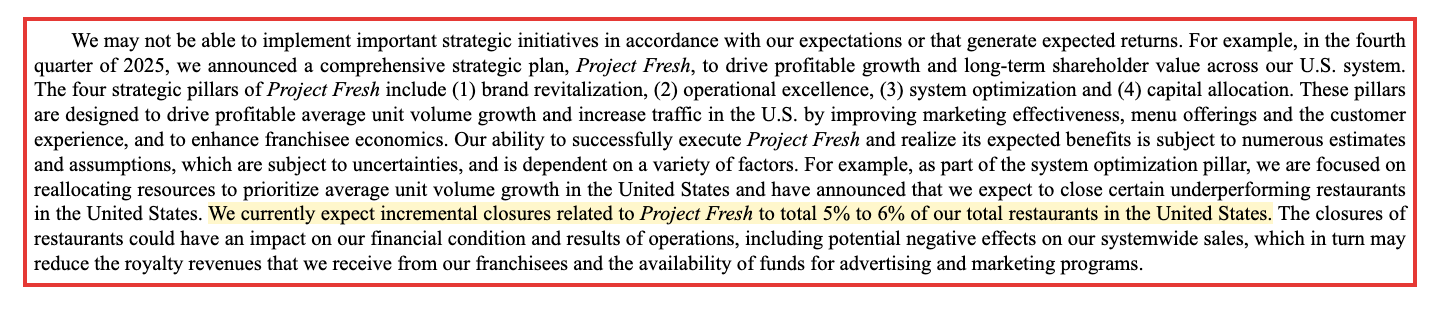
The pace is already visible: in the first quarter of 2026 alone, 196 restaurants closed, 184 of them U.S. franchise locations — the system count fell from 7,397 to 7,251. Honesty requires saying: targeted closures of weak locations are sound business — they lift the average volumes of the remaining restaurants, relieve struggling franchisees and are more honest than hold-the-line slogans. McDonald’s went through a similar exercise in the 2000s and came out stronger. But run the mechanics once: every closed restaurant takes its register sales with it — and with them the royalty, the advertising-fund contribution and often rent paid to the company. The annual report says so itself: the closures could have "potential negative effects on our systemwide sales, which in turn may reduce the royalty revenues that we receive from our franchisees." A system that simultaneously rings up less per restaurant and has fewer restaurants must first get out of reverse gear before the toll machine becomes a growth story again. Until then: Project Fresh is an admission, not a departure — the right therapy, but the diagnosis stays the same.
Uncomfortable truth no. 3: the dividend — from income-investor darling to a cut promise
For years Wendy’s was a favorite of income investors: a full dollar per share per year, paid quarterly, fed from the franchise cash flow. That chapter ended in the spring of 2025 — recorded soberly in the annual report:
"The Company paid quarterly cash dividends of $.25 per share of common stock during each of the first, second, third and fourth quarters of 2024 and the first quarter of 2025. The Company paid quarterly cash dividends of $.14 per share of common stock during each of the second, third and fourth quarters of 2025."
— The Wendy’s Company, SEC annual report 10-K 2025, Item 5 "Market for Common Stock"

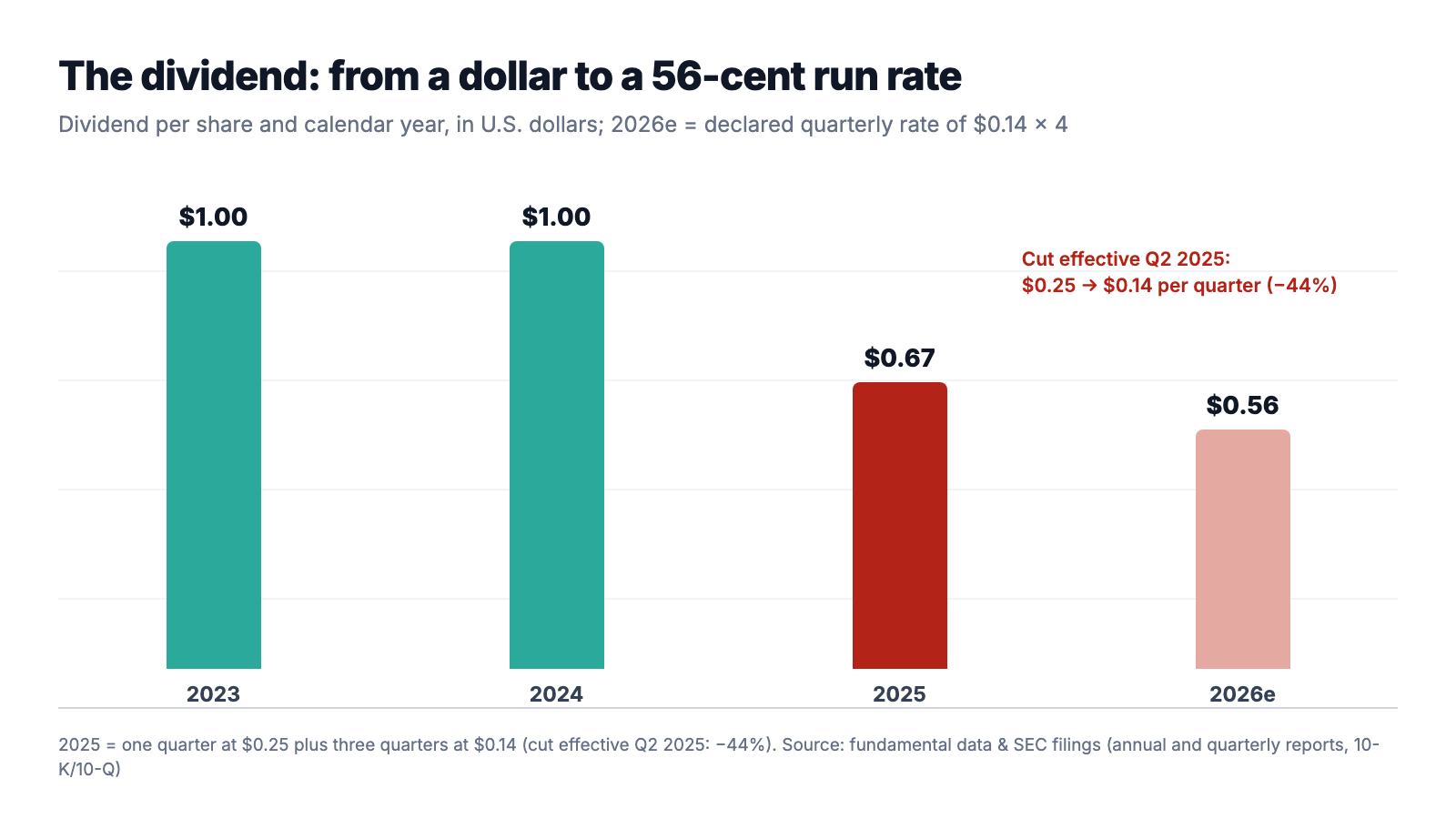
Why this is more than a footnote for the savings account: first, the signal — a franchise company with a 94 percent licensing share does not cut its dividend because of one bad summer, but because it has to re-sort its priorities. The freed-up money flows into Project Fresh, into technology and — remarkably — into share buybacks: Wendy’s paid $200 million for 14.4 million of its own shares in 2025, far more than the year before; of the $500 million buyback authorization, only $35.0 million remained at the end of March 2026. Second, the balance-sheet mechanics: because payouts and buybacks together far exceed net income, stockholders’ equity melted from $259.4 million to $117.4 million within a year — against a balance sheet of almost $5 billion, the cushion between assets and liabilities is nearly used up. And third, the yield trap for newcomers: the much-quoted "over 7 percent dividend yield" (a $0.56 annual rate on a price around $7.30, data as of July 8, 2026) is a product of the fallen price, not of rising payouts — and the 2025 cut has shown that this rate is not a law of nature. Remember: a dividend yield built by the share price is a promise at second hand.
Uncomfortable truth no. 4: $2,760 million of securitized debt — and the brand sits on the pledge shelf
That leaves the question of what foundation all this stands on. Since 2015, Wendy’s has financed itself through a so-called whole-business securitization: a bankruptcy-remote special-purpose entity (Wendy’s Funding, LLC) issues notes serviced from the system’s royalty and rental streams. As of December 28, 2025, $2,760 million stood on the books — against $117.4 million of equity and $300.8 million of cash. The risk section of the annual report describes the construction in one sentence you should read twice:
"The Company and certain of our subsidiaries are subject to various restrictions, and substantially all of the assets of certain subsidiaries are pledged as security, under the terms of a securitized financing facility."
— The Wendy’s Company, SEC annual report 10-K 2025, Item 1A "Risk Factors"

What exactly is pledged is quantified in the debt footnote: $1,162.0 million, and the largest single position is $962.7 million of intangible assets — at the core the franchise and brand rights, which is precisely what the company earns from. Securitizations of this kind are common in the franchise world (Domino’s and Dunkin’ finance themselves the same way) and cheap in calm times. But two developments deserve your attention. First, the price of money: in December 2025, Wendy’s retired an old note tranche — the new $450 million series costs 5.422 percent interest, the retired one cost 3.783 percent, and the still-outstanding 2021 tranches carry coupons of 2.370 and 2.775 percent. Every future refinancing happens at this higher rate level: $447 million comes due in 2028, roughly $890 million in 2029 — together almost half the debt pile within two years. Second, the coverage: the $126.5 million of interest expense was earned only 2.6 times over by operating results in 2025 (metric data as of July 8, 2026) — solid, but without the buffer a shrinking core business actually needs. The construction holds as long as the royalty stream flows. Except: that very stream hangs on the guests from truth no. 1 and the restaurants from truth no. 2. The toll is pledged — which makes the traffic matter all the more.
Valuation: a $1.4 billion market value — "cheap" is a matter of perspective here
In early July 2026 the Wendy’s stock cost about $7.30, for a market value of roughly $1.4 billion (data as of July 8, 2026) — against $165.1 million of 2025 net income that is a P/E around 8, a price-to-sales ratio of 0.63 and about 6 times free cash flow. Taken in isolation, that is the valuation of a restructuring case, not of a brand with $14 billion in systemwide sales. But calculate like a buyer of the whole company, not like a bargain hunter: add $2,760 million of debt to the market value, subtract $300 million of cash, and you get an enterprise value around $3.85 billion — roughly 16 times free cash flow. Suddenly Wendy’s is not dirt cheap anymore, but normally priced for a company whose profit is falling for the third year in a row. Exactly this arithmetic explains why the stock keeps falling despite its optical cheapness: minus 65 percent from the all-time high, minus 32 percent over twelve months, minus 22 percent year to date (all figures: data as of July 8, 2026). The opposite position is just as honorable: insiders bought recently, Trian sits firmly in the saddle with just under 16 percent, and if Project Fresh actually lifts U.S. sales per restaurant, you are paying 6 times a free cash flow that will then grow again. That is not an absurd bet. It is just not a safe one — and the 7 percent dividend yield does not pay you for taking it; it sweetens it.
Opportunities and risks at a glance
What speaks for Wendy’s:
- An asset-light franchise model with predictable streams: about 94 percent of 7,397 restaurants in franchisee hands, $504.5 million of royalties plus $235.8 million of rental income in 2025 — and $242.6 million of free cash flow that comfortably covers the reduced dividend ($129.6 million) (annual report 10-K for 2025).
- Growth where Wendy’s is small: international systemwide sales up 8.1 percent on a constant currency basis to $2.06 billion in 2025, same-restaurant sales there up 1.3 percent, 268 openings worldwide; the digital share rose from 17.6 to 20.8 percent of systemwide sales.
- Solid base readings despite the downtrend: a Piotroski F-Score of 7 of 9, an Altman Z-score around 4.4 — far from the danger zone; no maturity cliff before 2028 (data as of July 8, 2026).
- Owners who are stepping in: most recently two insider purchases against not a single sale, about 94 percent institutional ownership, Trian Fund Management (Nelson Peltz) as anchor shareholder with just under 16 percent (data as of July 8, 2026).
- An honest turnaround logic: Project Fresh deliberately closes weak locations to lift the average volumes of the remaining restaurants — the same approach that has worked at other restaurant systems; a valuation around 6 times free cash flow leaves room if the turnaround succeeds.
What speaks against it:
- The core is shrinking at an accelerating pace: U.S. same-restaurant sales minus 5.6 percent (2025) and minus 7.8 percent (Q1 2026), driven by falling traffic; the company-operated restaurant margin fell from 13.6 to 10.8 percent; net income down for the third year in a row ($204.4 million to $165.1 million), Q1 2026 minus 42 percent.
- The system is getting smaller: Project Fresh plans closures of 5 to 6 percent of U.S. restaurants; in the first quarter of 2026 alone, 196 locations closed — and every disappearing restaurant takes royalty, advertising and often rental income with it.
- Dividend trust damaged: a cut from $0.25 to $0.14 per quarter (minus 44 percent) starting in the second quarter of 2025; today’s yield around 7 percent is a product of the price decline, not of payout policy.
- A stretched balance sheet: $2,760 million of securitized debt against $117.4 million of equity; substantially all assets of certain subsidiaries pledged (a $1,162.0 million package, of which $962.7 million are brand and franchise rights); the late-2025 refinancing cost 5.422 instead of 3.783 percent, with about $1.34 billion due in 2028/2029 combined; interest coverage down to 2.6 (data as of July 8, 2026).
- Market technicals against entry reflexes: a relative-strength rating of 12, a stage-4 downtrend, minus 65 percent from the high — and a Reddit attention spike (32 mentions in 24 hours, July 15, 2026) is no substitute for a turnaround at the registers.
A human conclusion
Back to the familiarity effect from the opening. It has a true core that deserves acknowledgment: you really do know this product, the brand is real, the business model behind it — licenses, rents, advertising funds — is one of the most proven in stock market history, and even in a downturn it produces a free cash flow that growth companies dream of. But check what exactly is familiar to you: the burger — or the company? The company in the SEC filings has been losing guests for two years (lately faster), is closing roughly every 18th U.S. restaurant, has cut its dividend by 44 percent and has pledged its brand rights to a securitization structure whose next big maturities arrive in 2028 and 2029. None of this is a death sentence — a Piotroski score of 7, an Altman Z around 4.4, buying insiders and an anchor shareholder with a long breath argue against that, and Project Fresh is the kind of honest shrinking cure from which restaurant systems have emerged stronger before. But the order of events belongs on the table: only when U.S. same-restaurant sales grow again and the closure wave is worked through does 6 times free cash flow become a bargain — before that, it is the fair price for a business in reverse gear, sweetened by a dividend that has already been sacrificed to a turnaround once. The Frosty tastes the same as always. The stock is a different product. What you make of it is your decision. And that is exactly as it should be.
Sources
All original documents used in this analysis — to read for yourself:
- The Wendy’s Company — SEC annual report 10-K for 2025 (filed February 23, 2026)
- The Wendy’s Company — SEC annual report 10-K for 2024 (filed February 21, 2025)
- The Wendy’s Company — SEC quarterly report 10-Q as of March 29, 2026 (filed May 8, 2026)
- The Wendy’s Company — SEC quarterly report 10-Q as of September 28, 2025 (filed November 7, 2025)
- The Wendy’s Company — SEC quarterly report 10-Q as of June 29, 2025 (filed August 8, 2025)
- The Wendy’s Company — SEC quarterly report 10-Q as of March 30, 2025 (filed May 2, 2025)
- The Wendy’s Company’s complete SEC filing history: EDGAR overview (sec.gov)
- Fundamental data (metrics, quarterly series, valuation; data as of July 8, 2026), reconciled with the SEC filings.
- Screener and rating data: in-house stock scanner (data as of July 8, 2026); Reddit mentions: ApeWisdom (as of July 15, 2026).
Transparency & disclaimer: This analysis is a journalistic contextualization of publicly available information and is not investment advice, not a financial analysis in the regulatory sense, and not a solicitation to buy or sell securities. Stock investments carry substantial risks up to total loss. All information without guarantee; the data cut-off is noted in the text in each case. The author holds no position in Wendy’s stock at the time of publication.
Our Bottom Line at a Glance
- Business model & cash flow positive
- An asset-light franchise system (about 94 percent of 7,397 restaurants in franchisee hands) with predictable royalty, rental and advertising-fund streams: $344.5 million of operating and roughly $242.6 million of free cash flow in 2025 — the reduced dividend ($129.6 million) is comfortably covered (annual report 10-K for 2025).
- U.S. core business & demand negative
- U.S. same-restaurant sales minus 5.6 percent (2025) and minus 7.8 percent (Q1 2026), per the quarterly report primarily due to falling traffic; the company-operated restaurant margin fell from 13.6 to 10.8 percent, net income declined for the third year in a row, Q1 2026 minus 42 percent.
- Project Fresh & payout policy neutral
- The shrinking cure is sound business (closing 5 to 6 percent of U.S. restaurants, focus on average unit volumes), but it costs systemwide sales and thus royalties — and the 44 percent dividend cut starting in Q2 2025 has already broken the stock’s income promise once; in parallel, $200 million went into share buybacks (2025).
- Balance sheet & debt negative
- $2,760 million of securitized debt against $117.4 million of equity (December 28, 2025); substantially all assets of certain subsidiaries pledged, including $962.7 million of brand and franchise rights; the December 2025 refinancing cost 5.422 instead of 3.783 percent, with about $1.34 billion due in 2028/2029 combined; interest coverage 2.6 (data as of July 8, 2026).
- Valuation & ownership signals neutral
- A P/E around 8, P/FCF around 6 and a 7 percent dividend yield meet a relative-strength rating of 12, a stage-4 downtrend and minus 65 percent from the high; including debt, the company costs roughly 16 times free cash flow. Against that: two insider purchases without a sale, 94 percent institutional ownership, Trian as anchor with just under 16 percent (data as of July 8, 2026).
Wendy’s is no bankruptcy candidate but a working licensing machine with thinning traffic: free cash flow of roughly $242.6 million (2025) carries the dividend and the overhaul, and a Piotroski score of 7 plus an Altman Z around 4.4 signal substance. But the guests in the U.S. core business are disappearing faster (minus 7.8 percent same-restaurant in Q1 2026), Project Fresh closes roughly every 18th U.S. restaurant, the dividend was cut 44 percent, and behind everything stands a securitization to which substantially everything is pledged — including the brand. Optically cheap; including debt, fairly priced for a business in reverse gear. Not investment advice.
What Our Rating Means
- If you don't own the stock
- As long as the question raised in the bottom line stays open, we see no basis for an entry.
- If you hold it in your portfolio
- Our findings offer no acute reason to sell — the checkpoints named remain decisive.
A journalistic assessment by our editorial team at the time of the deep dive, based on public sources — not investment advice and not a solicitation to buy or sell. Your personal circumstances (investment goals, risk capacity, taxes) cannot be taken into account. What our categories mean, how verdicts are formed, and what conflicts of interest exist →
Worth Noting
- WEN reached our research list via the Reddit hype scanner (ApeWisdom, 32 mentions in 24 hours, as of July 15, 2026); attention waves of this kind are snapshots, not a quality verdict. The 8 hits in our in-house stock scanner carry the July 8, 2026 data cut-off and rotate daily.
- Scanner metrics (P/S, P/CF, P/FCF, interest coverage, Piotroski, Altman Z) are computed from trailing twelve-month figures; the dividend cut (Q2 2025) and the Q1 2026 closures show up in them only with a lag.
- Price and valuation figures are dated to July 8, 2026 (about $7.30, market value roughly $1.4 billion); analyses are evergreen, daily prices are not a buy argument.
Frequently Asked Questions
The Wendy’s Company (Nasdaq: WEN) operates only about 6 percent of its 7,397 restaurants itself; roughly 94 percent belong to franchisees. The company earns mainly royalties ($504.5 million in 2025), franchise fees ($98.2 million), rental income from franchisees ($235.8 million) and advertising-fund contributions. Total revenues in 2025 were $2.18 billion, while systemwide sales across all restaurants reached $13.96 billion.
The core is shrinking: U.S. same-restaurant sales fell 5.6 percent in 2025 and 7.8 percent in the first quarter of 2026 — per the quarterly report, primarily because of falling traffic. Net income declined for the third year in a row, the dividend was cut, and a turnaround plan calls for closing 5 to 6 percent of U.S. restaurants. As of July 8, 2026, the stock traded about 65 percent below its all-time high.
Yes. Starting in the second quarter of 2025, Wendy’s lowered the quarterly dividend from $0.25 to $0.14 per share — a 44 percent cut. In 2025 a total of $0.67 per share was paid ($129.6 million), after $1.00 in 2023 and 2024. At the unchanged rate, 2026 works out to $0.56 per share; free cash flow of $242.6 million (2025) covers that comfortably so far.
Project Fresh is the overhaul plan announced in 2025, built on four pillars: brand revitalization, operational excellence, system optimization and capital allocation. Its core is the closure of underperforming locations: per the annual report 10-K for 2025, an incremental 5 to 6 percent of all U.S. restaurants are expected to close — roughly 300 to 360 locations. In the first quarter of 2026 alone, 196 restaurants closed, taking the system count to 7,251.
As of December 28, 2025, $2,760 million of debt stood against just $117.4 million of stockholders’ equity. The financing runs through a whole-business securitization under which substantially all assets of certain subsidiaries are pledged — including $962.7 million of brand and franchise rights. $447 million comes due in 2028 and roughly $890 million in 2029; the December 2025 refinancing cost 5.422 percent interest.
About 94 percent of the shares sit with institutional investors (data as of July 8, 2026). The largest single holder is Nelson Peltz’s Trian Fund Management with just under 16 percent; per the annual report, the camp around Peltz, Peter May and Matthew Peltz controlled roughly 16 percent of the voting power (as of February 16, 2026) and may build up to 32.5 percent under a 2011 agreement. Wendy’s has been a company with a defining anchor investor since the 2008 Triarc takeover.
Optically yes: a P/E around 8, a price-to-sales ratio of 0.63, about 6 times free cash flow and a dividend yield around 7 percent (data as of July 8, 2026). But once you count the $2,760 million of debt, the enterprise value works out to roughly 16 times free cash flow — a normal valuation for a company whose profit is falling for the third year in a row. The stock only becomes cheap if the turnaround at the registers succeeds.
Found an error?
Did you spot a factual error, an outdated number, or a typo in this deep dive? Let us know briefly — your report goes straight to the editorial team.